



Abstract
Background
Although Namibia has made strides in improving the policy enabling environment, eradication of malnutrition is still elusive.
Objective
This review was aimed at determining the extent to which food and nutrition-related policies in Namibia address malnutrition.
Methods
This study used a qualitative approach by retrospectively analysing policy frameworks that address malnutrition in Namibia from 1991 to 2022. The analysis employed the policy triangle framework to elucidate the contextual factors, content, actors and process involved in the policy development. Moreover, a comparative analysis of Namibian policies and those of other southern African countries was undertaken.
Results
The review showed that there is a considerable degree of coherence in policy goals and strategies to address malnutrition despite parallel coordination structures. Policy process involved limited consultations with local communities which might have jeopardised the formulation of community problem-tailored interventions, ownership and participation in policy implementation. There is a strong political commitment to the eradication of malnutrition in Namibia. The Office of the Prime Minister played a leading role in policy development. Influential actors such as the UN agencies elevated the nutrition agenda. Further, the Namibian policy framework was generally similar to those of other southern African countries.
Conclusions
The review showed that Namibia has relevant and comprehensive policies to address malnutrition, however, contextual factors indicated high levels of malnutrition still exist in the communities. Further research is needed to understand the barriers and enablers to optimal nutrition for children under five years in Namibia.
Background
Globally, there has been an increased focus on nutrition policies and programs to alleviate the effects of malnutrition on the social and economic development of communities (Gillespie et al., 2013; Kennedy et al., 2016). In 2012, the World Health Assembly proclaimed the six Global Nutrition targets to be achieved by 2025, however, recent reports indicate that few countries are on course to achieve them (Development Initiatives, 2021). Furthermore, the sustainable development goals (SDGs) have re-focused countries on the need to invest resources in the fight against malnutrition and reports show that developing countries may not achieve set targets by 2030 (United Nations, 2019). Gillespie et al. (2013) noted that favourable food and nutrition policies and the political environment were key ingredients to the fight against malnutrition.
Governments have the responsibility to prioritise policies and programs and allocate significant resources to achieve nutrition security and provide health and nutrition services (Ecker and Nene, 2012). In Namibia, food and nutrition policy (FNP) development dates to the post-independence era. In the last three decades, Namibia has seen increasing political impetus in the development of food and nutrition-related policies. In 2011, Namibia joined the global scaling up nutrition (SUN) movement that has a focus on advocating for the complete eradication of malnutrition through re-invigorating political commitment, increased financing, accountability and strengthening coordination of nutrition policies and programs (Bach et al., 2020; Gillespie et al., 2013). As much as Namibia has made strides in improving the nutrition enabling environment, malnutrition still rages and is a strong negative force in socio-economic transformation (NPC, 2017).
There is limited research that has been conducted to understand the processes involved in nutrition policy development in Namibia and how such policies are interconnected to related policies to stimulate effective integration and synergism. Secondly, Namibia is a resident of southern Africa and is affected by geopolitical factors and the policy environment of neighbouring countries. It is therefore prudent to understand how the Namibian nutrition policy architecture compares with other countries in the sub-region. The identification of strength, gaps and best practices in the formulation of these policies have the potential of informing and guiding policymakers and managers on the correct course of action to strengthen the coordination, implementation and revision of these policies.
The Walt and Gilson (1994) policy triangle framework provides a robust approach to the study of policy development processes and enables the in-depth interrogation of policy triggers and enablers. The policy triangle framework entails an interwoven mechanism for identifying contextual factors, the actors, content and processes involved in policy development, implementation and evaluation. Kingdon (1984) noted that policy development is an uphill task triggered by critical contextual factor/s that open a window of opportunity exploited by key policy influencers to kick-start the process.
This review intended to determine the extent Namibia food and nutrition-related policies address malnutrition. This would provide an understanding of the degree of coherence, strength and gaps in the goals, strategies, coordination, implementation, monitoring and evaluation mechanisms of these policies. The study also makes a comparison of the Namibian National FNSP (2021) to those of three other Southern African countries (Zimbabwe, Malawi, and South Africa) in addressing malnutrition. This could guide policymakers in the development or revision of related policies in similar socio-economic settings.
Methods
Study design
This study used a qualitative case study approach by retrospectively analysing policies that address malnutrition and hunger in Namibia. The analysis employed the policy triangle framework described by Walt and Gilson, (1994) to understand the contextual factors, actors, content and process pertaining to policy development. Policies were purposefully selected based on their objectives in addressing malnutrition. Further, policy documents related to food and nutrition for South Africa, Malawi and Zimbabwe were purposefully selected to support the comparison of the Namibian policy framework with those in similar geographical setting.
Source of information
The search for all relevant policy documents related to food and nutrition in Namibia was conducted from portals of line ministries: Ministry of Health and Social Services (MoHSS), Ministry of Agriculture, Water and Forestry (MAWF), Office of the Prime Minister (OPM), Ministry of Education Arts and Culture (MoEAC) and UN agencies’ websites between August and September, 2022. Manual search within line ministries and organisations undertaking nutrition-related activities was undertaken in cases were they could not be located on portals, other searches for food and nutrition policies for South Africa, Malawi and Zimbabwe were conducted on the portals of relevant line government ministries (Ministry of Health, Ministry of Agriculture) in the respective countries.
Search strategy
The search strategy intended to identify published policies related to food and nutrition from portals of relevant ministries and websites of organisations engaged in nutrition-related activities. The search employed the following search terms: ‘nutrition policy and Zimbabwe’, ‘nutrition policy and Namibia’, ‘nutrition policy and South Africa’, and ‘nutrition policy and Zambia’, ‘agriculture policy and Namibia’, ‘health policy and Namibia’. Searches were limited to policies published from January 1991 to September 2022 but not by language. Policy documents published before 1991 and articles not related to FNP were excluded. Where hard copies of the policies were not available, reprints were requested from the line ministry responsible for the overall coordination of the policy.
Data extraction
The first step involved extracting data from the eligible policy documents on to a data extraction tool (Supplementary Appendix S1) based on the policy triangle framework (Figure 1) (Walt and Gilson, 1994). The following information was recorded: contextual factors, policy actors, policy process and policy content.
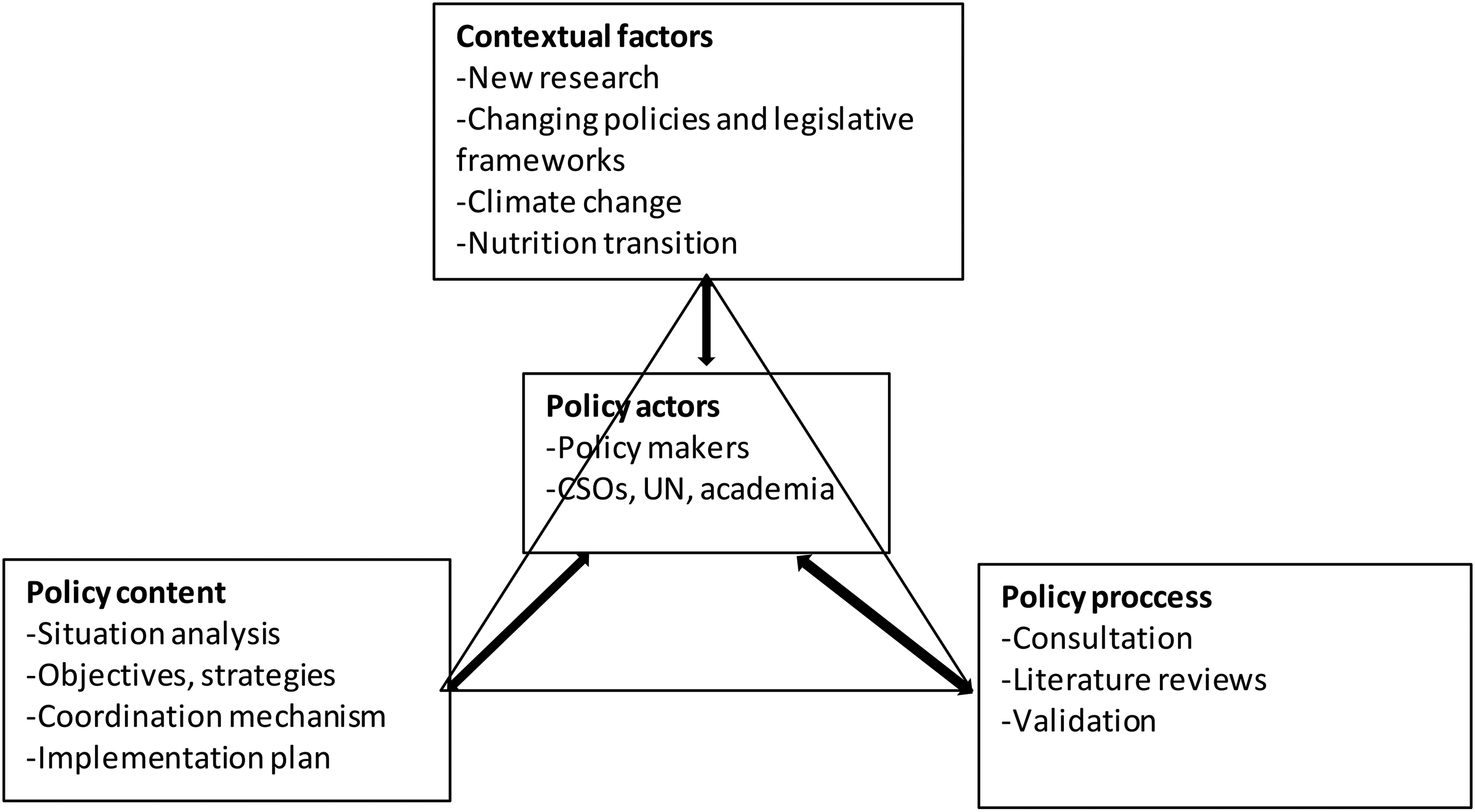
Policy triangle framework.
The second step involved undertaking a comparative analysis of Namibia food and nutrition policies and those of the three southern African Countries; Zimbabwe, Malawi and South Africa. A data extraction tool (Supplementary Appendix S2) was used and contained the following information: name of policy and country of origin, year of introduction/revised, approach, objectives, components, roles of actors, implementation plan and coordination, monitoring and evaluation plan.
Ethical considerations
The study obtained ethical clearance from the Research Ethics Committee at the Faculty of Health, Natural Resources and Applied Sciences of Namibia University of Science and Technology (FHAS: 08/2022) and approval to collect data was obtained from the Research Committee at the Ministry of Health and Social Services in Namibia (Ref: MGWW2022).
Findings
The study results are presented in three parts. The first section presents a review of the conception and evolution of food and nutrition-related policies in Namibia. The second section presents findings on contextual factors that influenced the development of policy, policy content that defined the situation including objectives and strategies to address food and nutrition security challenges, the actors involved and processes that were followed from conception, formulation, implementation and evaluation of the policy frameworks. The third section presents findings of the comparison of the Namibia FNP framework and that of three Southern African countries.
Conception and evolution of food and nutrition-related policies in Namibia
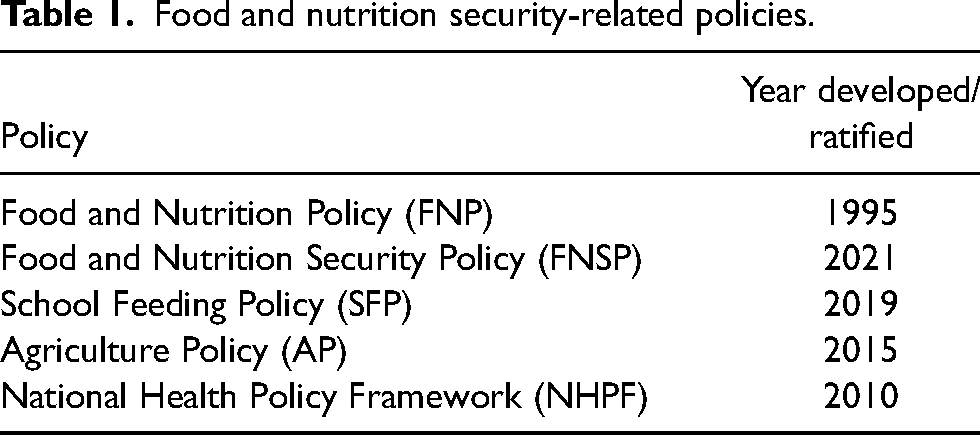
The review indicated that it was the UN Declaration on Nutrition of 1992 which the Government of Namibia (GRN) ratified the same year that triggered the development of food and nutrition-related policies in Namibia (FAO & WHO, 1992). This declaration mandated countries to develop people-centered, coherent and multi-sectoral policies to eradicate hunger and malnutrition. The 1995, FNP and Agriculture Policy (AP) were the first to be formulated and subsequently revised in 2021 and 2015, respectively (Republic of Namibia, 1995a, 1995b, 2015, 2021). Whereas Namibia has implemented the school feeding program since 1991, it was of recent (2019) that the SFP was developed (Republic of Namibia, 2019). Table 1 presents a summary of food and nutrition-related policies for Namibia.
Food and nutrition security-related policies.
Contextual factors, content, actors and processes involved in the policy formulation
Table 2 presents a summary of findings of contextual factors, content, actors and processes involved in the policy formulation.
Context, content, actors and process in the development of food and nutrition security-related policies in Namibia.
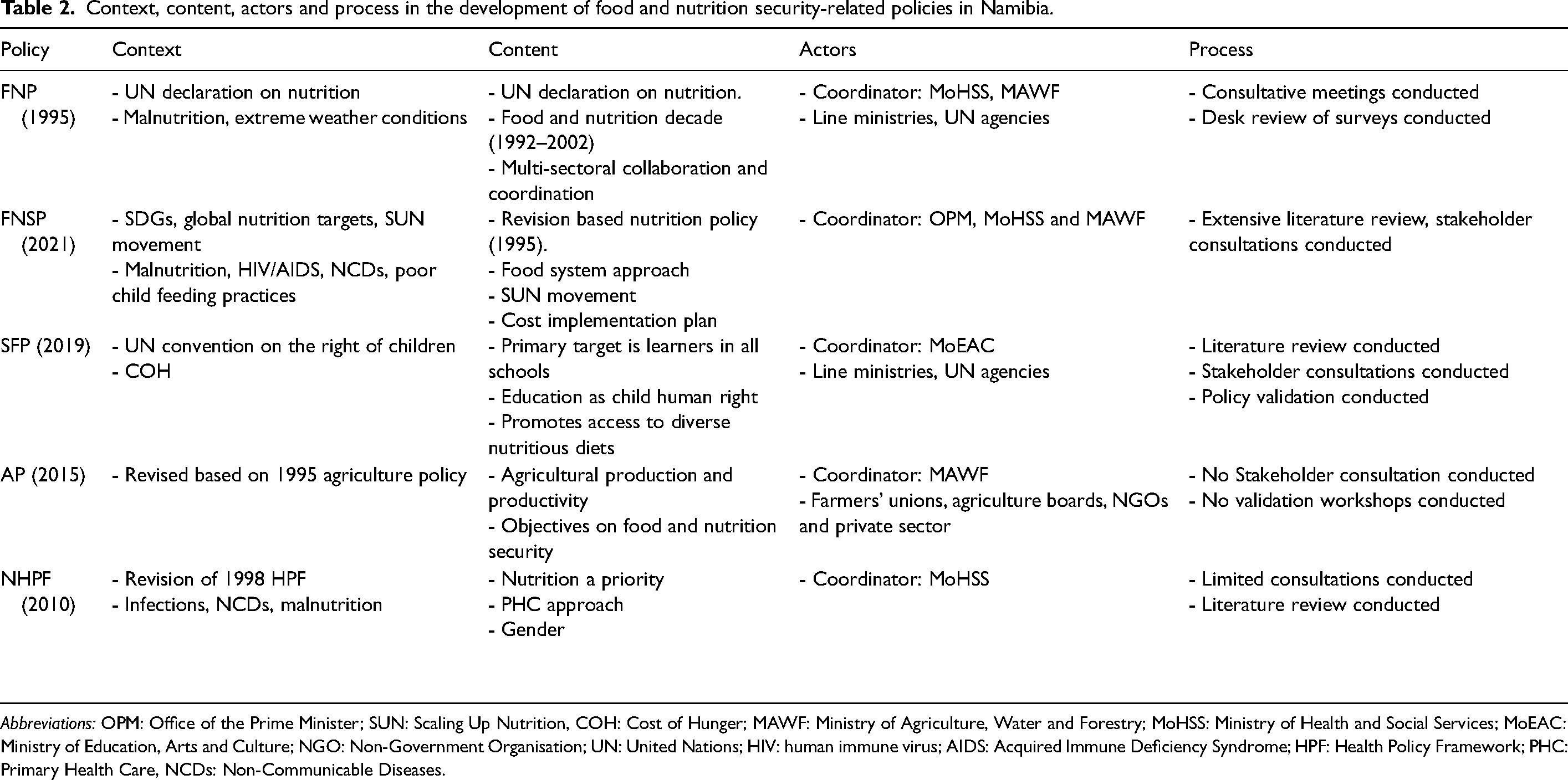
Abbreviations: OPM: Office of the Prime Minister; SUN: Scaling Up Nutrition, COH: Cost of Hunger; MAWF: Ministry of Agriculture, Water and Forestry; MoHSS: Ministry of Health and Social Services; MoEAC: Ministry of Education, Arts and Culture; NGO: Non-Government Organisation; UN: United Nations; HIV: human immune virus; AIDS: Acquired Immune Deficiency Syndrome; HPF: Health Policy Framework; PHC: Primary Health Care, NCDs: Non-Communicable Diseases.
Contextual factors
The review revealed that the development of food and nutrition-related policies in Namibia was influenced by the GRN's desire to improve the health and nutrition conditions of Namibians. The changing political context after independence in 1990, ushered the zeal for improved health conditions, healthier diets and household food security. Further, the global policy landscape necessitated Namibia to provide an enabling policy environment to stimulate health and nutrition reforms geared at reducing the prevalence of malnutrition and hunger.
The FNSP (2021) is aimed at improving access to adequate, affordable and safe food to Namibians and identifies inappropriate child feeding and care practices, poor hygiene and sanitation, HIV/AIDS, household food insecurity, extreme income disparities and poverty rates compounded by variabilities in climatic change as critical barriers to the eradication of malnutrition in Namibia. While the FNSP (2021) provides elaborate strategies and interventions to tackle the barriers, the key drivers underpinning some of these barriers such as inappropriate child feeding practices at household level are not well understood and thus, require in-depth investigation.
The AP (2015) targets to improve household food security through increased production and productivity. Whereas in FNSP (2021), policy objective 2 targets to increase food production and productivity, AP (2015) lack policy objectives on nutrition. The SFP (2019) aims to improve access to diverse and nutritious foods in schools to improve students’ academic performance and retention rates. The NHPF (2010) recognises the connectedness of nutrition and health and targets to combat both communicable and non-communicable diseases.
Content
The FNSP (2021), AP (2015) and SFP (2019) provide for the multi-sectoral and food systems approaches as mechanisms to deliver healthier, nutritious and diversified food to Namibians. The policies stipulate the need for intersectoral collaboration and coordination among actors to improve efficiency and quality of food and nutrition security services. The smallholder farmers, women and children are the primary target for the interventions in these policies. While NHPF uses the primary health care approach to enhance equity and equality of health services, it also recognises intersectoral collaborations as a pathway for improved service delivery.
Whereas the coordination and management of FNSP (2021) is undertaken by the Food and Nutrition Security Council (FNSC) and resides in the OPM, the coordination of the AP (2015), SFP (2019) and NHPF (2010) reside in the respective line ministries (MAWF, MoEAC and MoHSS). This fragmentation in policy governance, coordination and implementation causes duplication, omissions and failure to realise desired impact.
FNSP (2021) has an elaborate, costed implementation plan with clear activities linked to policy objectives, targets, indicators and expected outputs, the other policies (AP, SFP and NHPF) lacked implementation plans. Apart from the NHPF, none of the policies has a focus on addressing gender equity and equality.
Actors
Findings show various line ministries, civil society organisations (CSOs), private sector and UN agencies participated actively in the development of the policies. These actors provided technical and financial inputs during the policy formulation process. The OPM provided political leadership to mobilise and convene actors to develop the FNSP 2021. However, AP (2015), SFP (2019) and NHPF (2010) development was led by respective line ministries.
The review revealed high level political support to food and nutrition matters. The OPM under the leadership of the Right Honourable Prime Minister provides overall coordination and governance of the FNSP (2021). However, fragmentation in the coordination of AP (2015), SFP (2019) and NHPF (2010) presents a significant challenge to intersectoral collaboration, accountability and resource utilisation.
Processes
As mentioned, the formulation of the FNSP (2021) was coordinated by the OPM while AP (2015), SFP (2019) and NHPF (2010) were coordinated by respective line ministries (MAWF, MoEAC and MoHSS). Apart from SFP (2019), the rest were revision of the policies developed in the 1990s.
The formulation of the policies was the concerted effort of various actors both within and outside the government. While literature reviews and consultations were conducted to inform the formulation of the policies much of the consultations were done at national level. Limited community consultations were conducted to solicit perspectives/opinions/views of policy end users. Secondly, in the case of FNSP (2021), it relied mostly on old data (MoHSS, 2014).
Policy comparison with selected Southern African countries
Table 3 presents the findings of the comparison of the Namibia FNSP (2021) and that of the National Multi-Sectoral Nutrition Policy (NMNP) (Malawi), Food and Nutrition Security Policy (FNSP; South Africa) and Food and Nutrition Security Policy (Zimbabwe). The parameters considered during the comparison included; service delivery approach, objectives, standard policy components, roles of actors, implementation plan, coordination and governance structures.
Comparison of design, compositions, comprehensiveness and gaps in food and nutrition security policies.
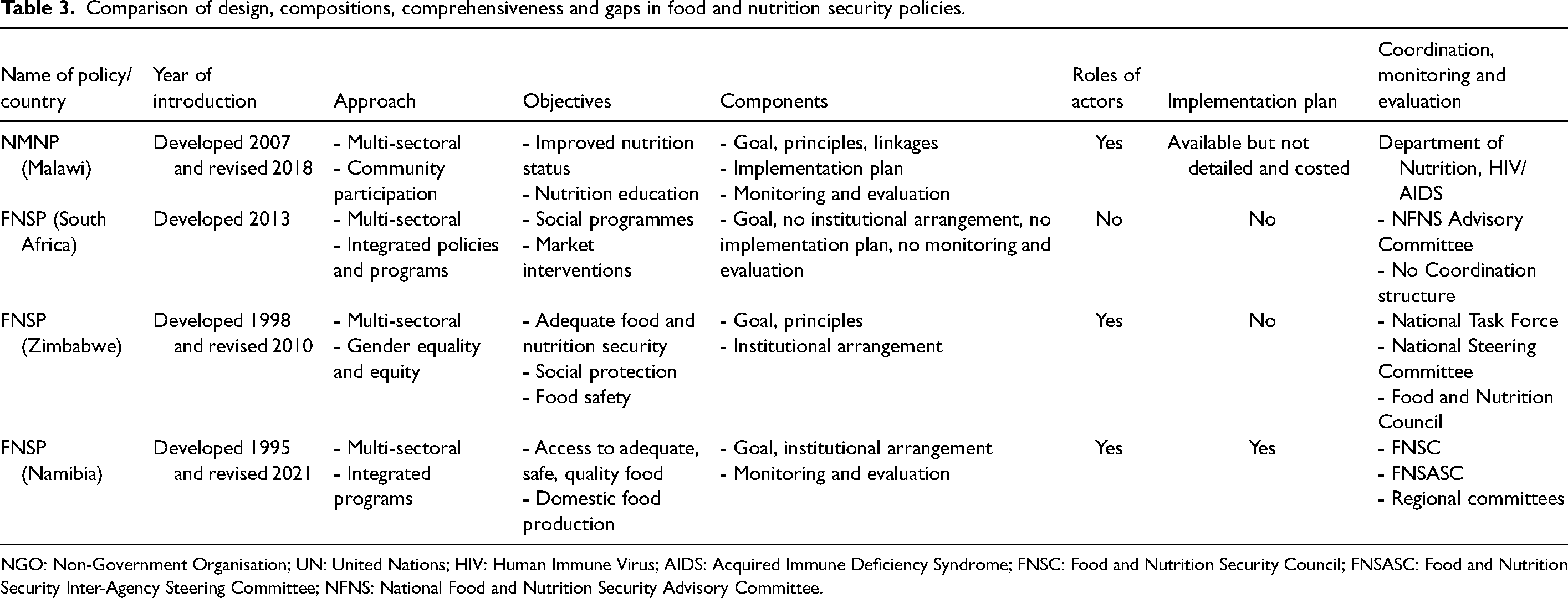
NGO: Non-Government Organisation; UN: United Nations; HIV: Human Immune Virus; AIDS: Acquired Immune Deficiency Syndrome; FNSC: Food and Nutrition Security Council; FNSASC: Food and Nutrition Security Inter-Agency Steering Committee; NFNS: National Food and Nutrition Security Advisory Committee.
The review showed that a part from the Namibian and Zimbabwean FNSPs that were first developed in the 1990s, the South African FNSP and Malawian NMNP, were developed in the 2000s. All the policies apart from the South African FNSP have ever been revised. Further, apart from the Malawian NMNP that is purely nutrition centered, the other three policies encompass food security objectives.
The implementation approach for all the policies is multi-sectoral and encourages intersectoral collaborations, interlinkages and partnerships as pathways to address malnutrition. The Malawian NMNP and Zimbabwean FNSP express the opinion that nutrition is a human right and emphasise gender equity and equality and community participation as a sustainable means to overcoming malnutrition and hunger at household level. The Namibian FNSP is not pronounced on gender equity and equality.
The Namibian FNSP aims to improve access to adequate, safe and quality food and prioritises undernourishment reduction and provision of enabling environment for coordination and implementation. The Zimbabwean FNSP targets increased access to adequate, diverse and nutritious foods that integrates nutrition-specific and nutrition sensitive interventions. The Malawian NMNP aims to improve nutrition status through implementation of majorly nutrition-specific interventions while the South African FNSP lacks explicit objectives on nutrition and embraced integrated approaches to address malnutrition.
Apart from the Namibian FNSP that contains a detailed and costed implementation plan with clear activities, targets, indicators, none of the other policies possessed this. The Malawian NMNP has an implementation plan but its shallow in scope.
Regarding governance and coordination structures, apart from the South African FNSP, the other policies have elaborate structures. The Namibian and Zimbabwean FNSPs governance and coordination matters are conducted within the highest political offices (OPM – Namibia and Office of the Vice President – Zimbabwe).
Discussion
From the review findings, it is evident that although eradication of malnutrition in Namibia and southern Africa is still elusive, relevant policies have been in existence since the 1990s. The development of these policies was triggered by the prevailing public health challenges, political context (Republic of Namibia, 1995b) and international nutrition policy landscape such as the 1992, UN Declaration on Nutrition (FAO & WHO, 1992). Although the burden of malnutrition in developing countries has been decreasing over the last three decades, the rate of decline is slow and new threats have emerged.
Historically, Namibia like other countries in Africa has suffered from persistent food insecurity, socio-economic deprivation and a high burden of infectious diseases. The advent of the millennium development goals (MDGs) and the subsequent sustainable development goals (SDGs) and evidence-based research on nutrition programming reignited the global focus on the eradication of malnutrition and the need to develop multi-sectoral policies and programs. However, in low and middle-income countries (LMICs), despite the presence of these policies, malnutrition is persistent (Black et al., 2008).
Earlier work on nutrition policy development in Africa showed that despite the local communities being policy end users, they are often neglected and never consulted adequately (Mwadime, 2011). This possesses challenges in policy ownership, participation and attainment of objectives. Lane and colleagues in their paper on strengthening health policy development in LMICs observed the need for comprehensive consultations especially with policy beneficiaries to understand the actual public health challenges and to foster ownership and increased participation in policy implementation (Lane et al., 2020). In line with that, this review revealed that consultations during policy development were majorly conducted with national-level actors and less with the policy end users. As much as regional tours were made during the consultation phase of the FNSP (2021), teams never reached the grassroots communities. This presented a likelihood of the failure to clearly understand the contextual factors contributing to specific nutrition problems in the community. As such the strategies proposed in the policies might be deficient in addressing the underlying causes of malnutrition. Evidence shows that drivers of malnutrition at household level are behavioural change-related thus unless these factors are well elucidated and rightful interventions undertaken, it is impossible to overcome malnutrition.
Policy development is a daunting task with non-linear processes, and actors that work towards a common goal of collecting ideas and formulating strategies to address a public health challenge (Lane et al., 2020). The review indicated that the development of policies in Namibia took not less than three years to complete. Various actors within and outside government advocated for, influenced and invested resources to develop the policies. In the case of FNSP (2021) the OPM, given its impartiality and strong convening powers, convoked line ministries and institutions to provide technical and financial support towards policy development. The OPM political leadership during the FNSP (2021) development evidenced the GRN's high-level commitment to addressing malnutrition. Gillespie et al. (2013) and Ecker and Nene (2012) reiterated the need for high-level commitment to place nutrition on the government agenda. Further, influential actors such as the UN agencies (UNICEF, WHO & FAO) and Namibia Alliance for Improved Nutrition (NAFIN) presented compelling evidence on the malnutrition plight in Namibia and the necessity to put in place policies to guide the implementation of programs (Republic of Namibia, 2021). The Global SUN movement, to which Namibia is a member since 2011, mandated countries to establish enabling environment for nutrition through the formulation of relevant policies, legislations, enhanced nutrition governance, financing and coordination to address malnutrition (Namibia SUN Multisectoral Platform, 2017). Furthermore, it is the requirement of the Global SUN movement for countries to provide annual progress reports and provide quarterly summaries on nutrition activities. This level of international attention, on the Namibian policy framework, placed the GRN in the limelight and compelled it to develop the FNSP (2021).
The Namibian policies related to nutrition and food security have an end goal of improving the socio-economic and health well-being of Namibians yet they are loosely interconnected at various facets of operationalisation. This parallel coordination structure breeds fragmentation, a recipe for duplication, omissions and resource wastage thus, impede the capabilities of various line ministries to contribute to national development goals. In LMICs that are chronically resource constrained synergism in policy and program approaches presents the best mechanisms for the attainment of the desired goals (Agyepong et al., 2021). Elsewhere, Naidoo (2013) noted that policy coordination among government institutions/sectors was a complex challenge, despite its being a pathway to positive policy outcomes.
Wan et al. (2013) and Lane et al. (2020) observed the need for policies to have well-defined targets, objectives, goals and indicators to improve accountability, resource mobilisation and utilisation. This supports policy management and facilitates the establishment of monitoring and evaluation frameworks necessary to track progress on implementation and evaluate the policy at the end of its lifetime (Aulo and Franscisco, 2013).
Implications for research
This review noted a gap in the way the policy strategies are translated into actionable interventions at household level. Studies have shown that intrinsic factors such as cultural beliefs and practices that define people's behaviours and norms can be barriers to the adoption of recommended nutrition practices (Akanda, 2020). There is limited qualitative research that has been conducted in Namibia to understand the degree of influence such socio-cultural practices have on maternal and child feeding and care practices. Research in this area will be helpful to refocus efforts and resources on addressing the actual but overlooked barrier to the eradication of malnutrition. Ambunda and De Klerk (2003) reported Namibia to be majorly patriarchal with critical decisions including food resources acquisition vested in men. A study by the Ministry of Health and Social Services (MoHSS, 2015), revealed that 40% of decisions on food purchases in households in Namibia were undertaken by men. Intra-household food distribution is skewed towards the male gender and in times of food crisis, men are served first and women and children eat the leftovers (Ambunda and De Klerk, 2003).
There were gaps in collecting perceptions/views/opinions of especially local communities during policy development. This presents challenges in the formulation of public health problem-tailored interventions, ownership and participation of communities in policy implementation. De Weger et al. (2018) observed that meaningful community engagement is achieved through processes that are adapted to ensure inclusiveness to people's views/ideas in a supportive environment. There is a need for research to elucidate the best approaches to increase community participation and engagement in policy development in Namibia. In Ghana, Dalaba et al. (2022) used a deliberative engagement tool [Choosing All Together (CHAT)] to engage and advance community participation in prioritising nutrition interventions and to understand reasons for intervention choices. As such local people were able to propose both nutrition-sensitive and nutrition-specific interventions that reflected the prevailing public health challenges in their communities. The CHAT tool provided an innovative approach that helped local people to understand the need to prioritise interventions amidst limited resources. In the United States of America, Banna and Bersamin (2018) emphasised the use of more than one community engagement strategy to design helpful interventions that could be owned and implemented by the targeted community. Community engagement strategies such as formative research at the design and evaluation stages, capacity building and partnerships were reported to improve the adoption of promoted nutrition practices (Banna and Bersamin, 2018).
Strength and limitation
The study used the policy triangle framework (Walt and Gilson, 1994) which is a versatile and multi-disciplinary approach to understanding policy development processes. The approach allowed an in-depth exploration of how and why food and nutrition policies were initiated and formulated. The gaps and best practices along these processes have been unearthed and will be helpful to policymakers intending to develop/revise related policies. The approach has also enabled the researcher to ascertain knowledge gaps in nutrition programming that will inform future related studies. However, the study also involved purposively selecting policies to be reviewed and this may have left out other important policies and limited the robustness of the review. It is thus recommended that future policy reviews be more comprehensive and inclusive. The review never considered the policy implementation phase as it was outside the scope, however, future studies should include this phase to have a complete understanding of the full policy cycle.
Conclusion
The review showed that Namibia has relevant and comprehensive policies to address malnutrition that have been aligned with national, regional and global policy frameworks. Despite this, contextual factors indicated high levels of malnutrition exist in the communities. There is a knowledge gap in the way policy strategies are translated into actionable interventions at community level and this might contribute to limited progress in reducing malnutrition prevalence.
There is a need to go beyond having policies in place to investigate the barriers and enablers to optimal child nutrition. A scoping review to map available literature to understand the barriers and enablers to optimal child nutrition is indicated. Scoping reviews have been proven a robust methodology for synthesising the body of available literature (Tricco et al., 2018).
It is imperative also to note that there is high-level political support and commitment on matters of nutrition and food security in Namibia. This may be attributed to the high intensity of nutrition advocacy at both national and global to highlight the negative effects of malnutrition on the social and economic development of countries. The establishment of food and nutrition security councils that are multi-sectoral in nature brings to light the need to strengthen intersectoral collaboration, coordination and accountability.
Effective governance and coordination mechanisms are vital ingredients to the attainment of policy goals and objectives (Gillespie et al., 2013). The food and nutrition coordination mechanisms for Namibia should be established and strengthened at both national and sub-national levels to promote planning, design, implementation and reporting on interventions. The participation of various stakeholders such as CSOs, NGOs, UN agencies, government institutions such as MAWF, MoEAC, OPM, and the community is paramount to enhance intersectoral collaboration and accountability.
Supplemental Material
sj-docx-1-nah-10.1177_02601060231185815 - Supplemental material for Policy framework that addresses malnutrition in Namibia: A retrospective qualitative review
Supplemental material, sj-docx-1-nah-10.1177_02601060231185815 for Policy framework that addresses malnutrition in Namibia: A retrospective qualitative review by George Waliomuzibu Mukisa, Tonderai W Shumba and Andrit Lourens in Nutrition and Health
Supplemental Material
sj-docx-2-nah-10.1177_02601060231185815 - Supplemental material for Policy framework that addresses malnutrition in Namibia: A retrospective qualitative review
Supplemental material, sj-docx-2-nah-10.1177_02601060231185815 for Policy framework that addresses malnutrition in Namibia: A retrospective qualitative review by George Waliomuzibu Mukisa, Tonderai W Shumba and Andrit Lourens in Nutrition and Health
Footnotes
Acknowledgments
The authors thank their supervisors for the technical support and guidance during the development of the manuscript.
Authors’ contribution
Waliomuzibu Mukisa George William is a Doctor of Philosophy (Health Sciences) candidate at the Department of Preventative Health Sciences, School of Health Sciences, Faculty of Health, Natural Resources and Applied Sciences, Namibia University of Science and Technology under the supervision of Dr Shumba Washington and Dr Andrit Lourens.
Availability of data and materials
The authors synthesised the narrative of food and nutrition policies of Namibia, South Africa, Malawi, and Zimbabwe. These policies are well-referenced in the main document and are available on ministry portals for the mentioned countries.
Consent for publication
Authors consent to the publication of this paper in the Journal of Nutrition and Health.
Declaration of conflicting interests
The authors declared no potential conflicts of interest with respect to the research, authorship, and/or publication of this article.
Ethical statement
The study obtained ethical clearance from the Research Ethics Committee at the Faculty of Health, Naturual Resources and Applied Sciences of Namibia University of Science and Technology (FHAS: 08/2022) and approval to collect data was obtained from the Research Committee at the Ministry of Health and Social Services in Namibia (Ref: MGWW2022).
Funding
The authors received no financial support for the research, authorship, and/or publication of this article.

Supplemental material
Supplemental material for this article is available online.
References
Supplementary Material
Please find the following supplemental material available below.
For Open Access articles published under a Creative Commons License, all supplemental material carries the same license as the article it is associated with.
For non-Open Access articles published, all supplemental material carries a non-exclusive license, and permission requests for re-use of supplemental material or any part of supplemental material shall be sent directly to the copyright owner as specified in the copyright notice associated with the article.
