



Abstract
Background:
Food-based interventions can reduce the prevalence of undernutrition and improve household food security, but nutritious and accessible foods may be underutilized. In Ecuador, eggs are inexpensive and widely available, but while they are a valuable source of essential nutrients for infants and young children, medical advice and community-based information have limited their inclusion in infants' diets.
Objective:
A qualitative component was conducted to understand local perceptions, knowledge, and practices to complement a randomized control trial that studied the effect of introducing eggs on nutritional status and growth in infants from 6 to 9 months in rural communities in the highland province of Cotopaxi, Ecuador.
Methods:
The qualitative inquiry consisted of key informant interviews, focus group discussions (FGDs), and structured observations in order to understand perceptions, knowledge, and practices related to household egg consumption and to the introduction of eggs in infants’ diets.
Results:
The two principal findings were that: (i) eggs are an available and culturally acceptable food source although they are not always a part of the diet; and (ii) perceptions and practices related to household consumption and the introduction of eggs into the diet of infants are shaped by local knowledge and practices, which are shaped by biomedical information and advice provided by public health professionals.
Conclusion:
Through an effective food-based intervention that includes qualitative research and a social marketing component, the behaviors of mothers and other caregivers can be modified, enabling children to realize the nutritional advantages of early introduction of eggs into their diet.
Highlights
Culturally based norms and values shape the manner in which foods are introduced into infants’ diets, but they may limit access to nutritious and safe, locally available foods. These norms and values may be shaped by biomedical concepts introduced by public health professionals. Qualitative research that accompanies randomized controlled trials and social marketing strategies contributes to understanding perceptions and consumption patterns of locally available foods and, hence, to food-based interventions.
Introduction
Improvements in maternal and infant nutrition have been achieved through a variety of mechanisms. 1 –3 In particular, food-based interventions have shown the potential to improve nutritional status of infants as part of complementary feeding diets in Latin America and elsewhere. 4–5 Interventions based on affordable and locally available foods aim to reduce the prevalence of undernutrition and specific nutrient deficiencies as well as to improve household food security. 6 Unfortunately, many locally available foods are underutilized. 7 –9 Eggs are widely available and highly nutritious food 10 –12 ; in Ecuador, they are inexpensive and accessible, but while they are a culturally appropriate food with recognized nutritional value, they are not always part of the daily diet. 13 Moreover, whole eggs are not usually given to infants because as reported by physicians and care givers, public health professionals have recommended introducing whole eggs after 12 months, as discussed below. 14
The need for effective interventions is clear; the prevalence of stunting is 24% among infants from 0 to 23 months in Ecuador but reaches 33.7% in rural areas of the highland region and 30.1% in Cotopaxi province. High levels of micronutrient deficiency are also found in Ecuadorian infants from 6 to 11 months, including anemia (63.9%), iron deficiency (20.8%), zinc (44.4%), and vitamin A (28.2%). 15 For decades, the government has undertaken a variety of actions to address undernutrition, including school meals, fortification, and supplementation. With few exceptions, 16,17 these interventions have not been evaluated, so while their impact is unknown, the continued high levels of undernutrition 15 suggest that with the exception of iodine deficiency, the results of those interventions have been modest at best. Moreover, establishing healthy dietary diversity is important for infants and young children because exposure to a variety of foods during this period is associated with greater acceptance later in life. 18,19
Poultry and egg production are common elements of small-scale Ecuadorian farming systems. Chickens are valued because they provide meat and eggs for household consumption and sale. Rural Ecuadorian households often keep a small number of layers, which usually roam free during the day and sleep in rudimentary cages. While eggs do not represent a major part of the diet, they are sometimes added to carbohydrate-based dishes. Egg consumption also has ritualistic value in the Andean region. 20,21 They are an appropriate symbolic gift; as one key informant stated, eggs “were used to give in thanks to the owners of the large estates (haciendas); only the owners could eat them.” They are also given to respected visitors, traditional healers, religious authorities, or godparents. Eggs are also used in traditional healing practices; an egg is passed over a person who is ill, and a diagnosis is made by opening the egg and examining the appearance of the contents. 22 When parents believe that a child’s illness is due to bewitchment, a spiritual cleansing is necessary. 21
Eggs are a valuable source of vital nutrients for infants and young children, meeting more than half of their nutritional requirements. They are an important source of protein, choline, riboflavin, vitamin B12, and selenium and also provide vitamin A, folate, and zinc. Eggs are an intrinsically safe and healthy food; they do not increase plasma cholesterol to harmful levels, and infants from 6 months can eat them. 23 –25 Although egg allergies are common in young children living in middle- and high-income countries, introducing eggs early has not been shown to induce allergies. 26 Further, relatively few studies have examined egg allergies in low- or middle-income countries. 27 In spite of the evidence and the potential for nutritional improvement, the introduction of eggs in infants’ diet faces several obstacles. Families often delay feeding eggs to infants because of perceived associations with high levels of cholesterol and allergic reactions. This practice and underlying perceptions are based on information provided by public health professionals (usually in the local health center) who as discussed below reported in key informant (KI) interviews that they followed Ministry of Public Health technical guidelines that recommend delaying introduction of whole eggs in children’ diets until 1 year of age. Hence, the potential for including an accessible, safe, and nutritious food into the diet of young children, beginning at the complementary feeding period, is being lost.
The Lulun Project was a randomized control trial to study the effect of introducing eggs on nutritional status and growth in infants from 6 to 9 months of age in 5 parishes in Cotopaxi Province, located in the central Ecuadorian highlands. One egg per day (provided by the project) was given by mothers or other caregivers for 6 months to a randomly selected sample of 80 infants. Differences were measured compared to an equivalent sample of 83 infants in the control group who did not receive eggs. Participation was optimized through the implementation of a concerted social marketing strategy that included symbolic representations of the project (a mascot, wool caps for the infants, photos, and videos), weekly visits to households in both groups, regular activities and workshops on topics requested by the community, and integration of formal and informal leaders into the project. We found that children in the treatment group who consumed 1 egg per day showed significantly improved growth outcomes across several anthropometric markers compared to those in the control group; stunting prevalence was reduced by 47%. Additionally, we found a reduced intake of sugar-sweetened foods in the treatment group compared to the control group and no reported or observed egg allergies in either group. 28
Given the potential contribution to infant nutrition, we also sought to understand perceptions and attitudes related to egg consumption. This article presents the results of a qualitative component of the Lulun Project, which was designed to address a related research question: What social and cultural foundations of egg consumption contributed to the observed results? More precisely, what knowledge, attitudes, and practices contribute to or inhibit egg consumption in the household and by infants and hence to having a nutritional effect?
Methods
Study Setting
The study area, located 60 km south of the capital city of Quito, is undergoing dramatic sociocultural transformation. Traditionally inhabited by indigenous households, fewer than half of the area’s residents identified themselves as indigenous in the most recent population census. 29 Nevertheless, residents who identify themselves as nonindigenous retain many aspects of their indigenous heritage; for example, Spanish speakers recognize and appreciate terms in Kichwa that remind them of their past. For that reason, the study was called the Lulun Project (using the Kichwa word for egg) in order to speak to familiar cultural markers in the area. While off-farm employment by men and women is widespread in the project area, households are essentially rural; most are engaged in small-scale farming and animal husbandry to supplement the household diet and income, and nearly 60% keep chickens.
Participants and Approach
The qualitative component of the Lulun Project was based on key informant (KI) interviews, focus group discussions (FGDs), and structured observations conducted between September 2014 and March 2016. The KI interviews were designed to elicit information and opinions from individuals with unique knowledge or expertise and were conducted with 2 female community leaders, 2 local public health physicians, an expert on gender issues in indigenous communities, and a local egg producer. Questions addressed issues related to local household diets with a focus on differences between egg consumption in practice and recommendations for introducing eggs in the diet of infants <1 year of age. The FGDs provided participants with opportunities to express their perceptions and opinions in natural and comfortable surroundings. 30 Four focus group discussions were conducted with (1) members of the treatment group, (2) members of the control group, (3) members of both groups, and (4) community members who did not participate in the project. Questions addressed perceived nutritional effects of eggs for children <1 year of age and comparisons with other foods, practices related to the introduction of eggs into infant diets, sources of information, advantages and disadvantages of household egg consumption, and hygiene practices in food preparation and consumption. Field observations were made during weekly visits to households in both the treatment and the control groups, and during regular meetings with local authorities, community leaders, and public health personnel.
An a priori sampling strategy was implemented, by which focus group participants were selected based on their characteristics and ability to provide understanding of the phenomena of interest. 31 Using this approach, credibility and trustworthiness were optimized by employing the principles of triangulation (obtaining information from a variety of sources using a variety of techniques) and saturation (continuing the inquiry until no additional information is obtained). Social representativeness provided for generalizability with the project area based on information-rich interactions with participants who possess the criteria for inclusion while taking into account differences in the dimensions of interest. 31 –33 By including participants in the treatment and control groups as well as nonparticipants from several communities in the FGD, we were able to include a variety of perceptions that could also be contrasted with KI and structured observations to ensure saturation. All focus group participants were mothers or other female caregivers of infants from 6 to 9 months of age in the control or treatment group or nonparticipants.
The FGD team consisted of a primary interviewer/focus group facilitator, who was also the field director for this project and an earlier study in the same project area, a focus group assistant, and a qualitative research coordinator with 2 decades of experience in Ecuador and Latin America. Data analysis was a coordinated process involving the focus group facilitator and the research coordinator.
Structured observations were conducted throughout the duration of the project, generally during weekly visits to participating families in both groups in order to monitor and follow-up on project participation, consumption of eggs by infants in the treatment group, and potential health effects in participating infants. Structured observations were also made during regular meetings with local formal and informal authorities and during community workshops that were designed to enhance communication with project staff. The purpose of these observations was to complement and, in some cases, shape the findings derived from the KIs and FGDs.
The combination of these 3 methods represents several strengths and limitations. The FGDs provide settings in which participants report on what they know, think, and feel in open and interactive discussions that allow them to express their perceptions, opinions, and beliefs in the context of ideas expressed by other participants 30 , although the presence of others may influence what they say. The KIs are more private conversations that are not shaped by the presence of others but which may also be influenced by participants’ perceptions of the interviewer. Structured observations allow the researcher to contextualize findings derived from the FGDs and KIs. 31
Approval for this research was obtained from Institutional Review Boards of the Universidad San Francisco de Quito, Washington University in St Louis, and the Pan American Health Organization. The authors declared that they have no conflict of interest.
Analysis
Verbatim transcriptions were analyzed using a systematic 3-stage coding process that allowed for the emergence of principal dimensions and associated categories. First, open coding identified basic concepts enunciated by the participants in their own words. Second, axial coding provided for the development of underlying categories and properties in order to detect patterns of perceptions discussed by FGD participants. Third, selective coding integrated and refined the principal themes and the interrelations among them to allow for the identification of key dimensions. 34
Results
The analytical coding process described earlier yielded 2 principal dimensions (confirmed or shaped by structured observations and KI interviews) related to egg consumption by households and infants. First, participants (all adult females from study area) expressed views related to household egg consumption disaggregated below into 4 interrelated categories: (1) traditional food practices, (2) perceptions of egg quality based on the source and type of egg, (3) forms of preparation and consumption, and (4) availability and cost. (Textual citations are provided in Table 1.)
Textual Citations of FGD Perceptions of Eggs in the Household Diet.
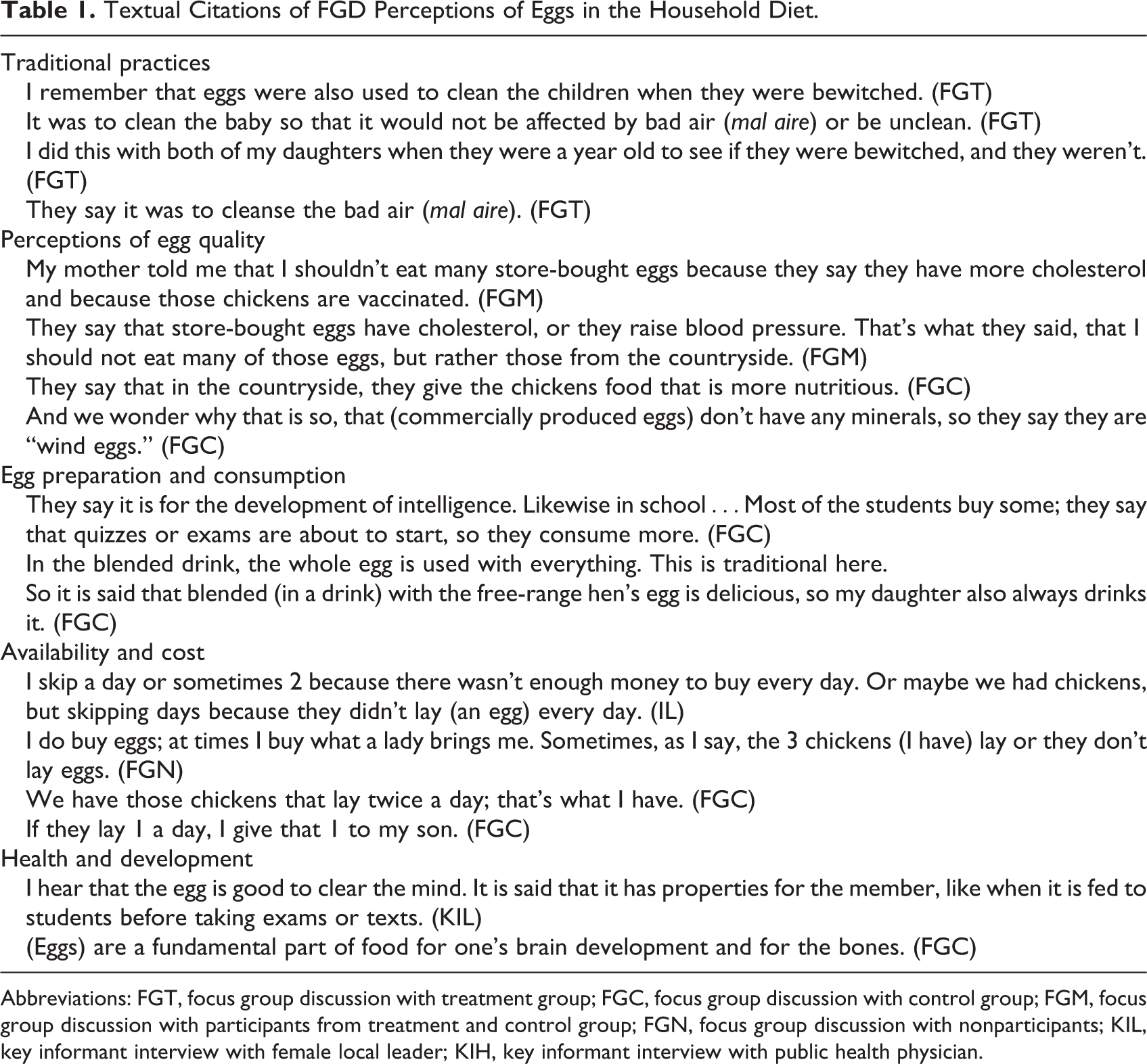
Abbreviations: FGT, focus group discussion with treatment group; FGC, focus group discussion with control group; FGM, focus group discussion with participants from treatment and control group; FGN, focus group discussion with nonparticipants; KIL, key informant interview with female local leader; KIH, key informant interview with public health physician.
Second, study participants discussed knowledge, attitudes, and practices related to introducing eggs into the diet of infants as a complementary food. Five categories emerged from this dimension: (1) perceived benefits and risks, (2) information channels, (3) timing and quantities of consumption, 4) preparation, and (5) perceived changes in nutritional and developmental status of infants (Textual citations are provided in Table 2.).
Textual Citations of FGD Perceptions of Eggs in Infant Diets.
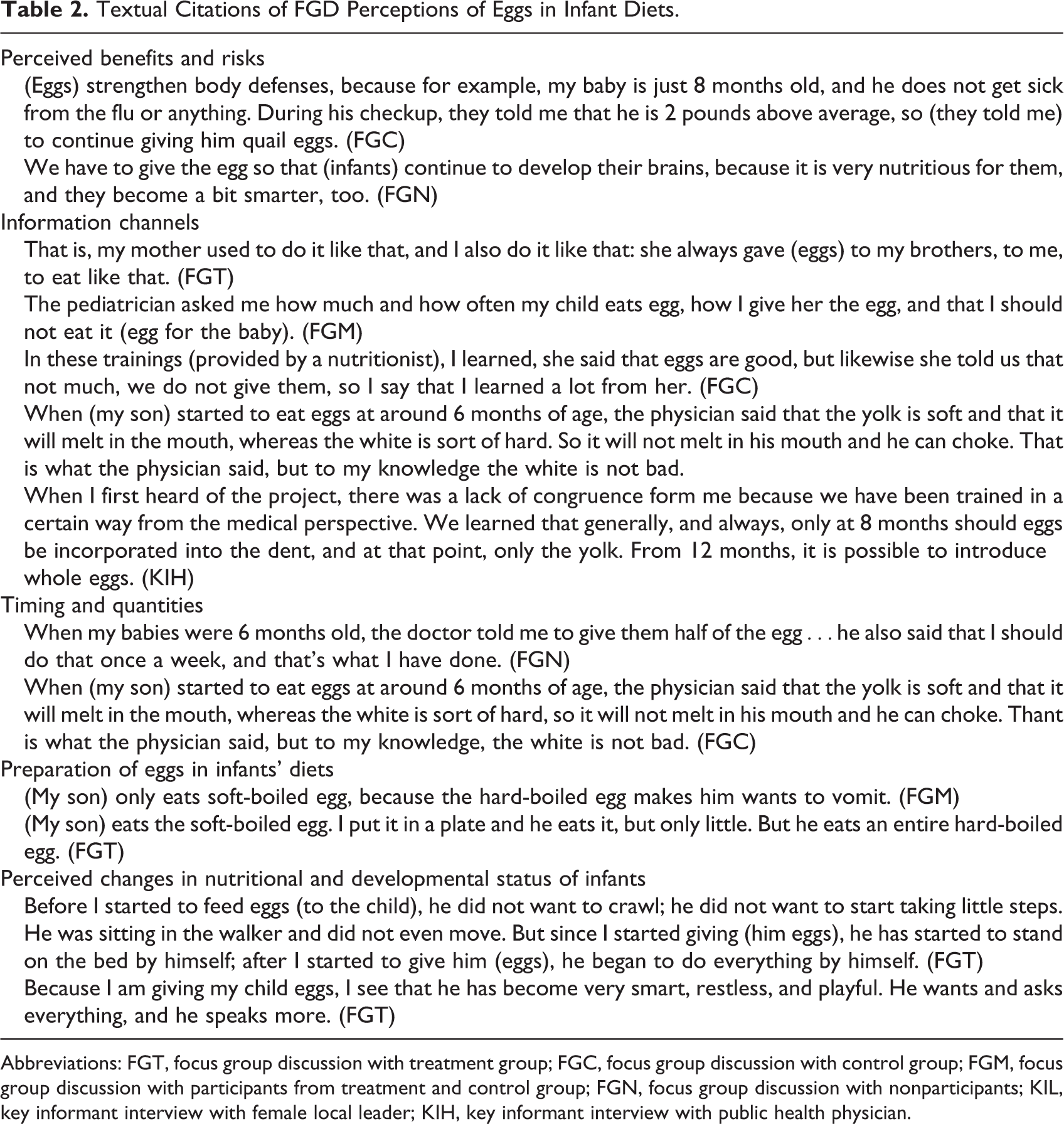
Abbreviations: FGT, focus group discussion with treatment group; FGC, focus group discussion with control group; FGM, focus group discussion with participants from treatment and control group; FGN, focus group discussion with nonparticipants; KIL, key informant interview with female local leader; KIH, key informant interview with public health physician.
Dimension 1: Eggs in the Household Diet
Traditional practices
Like other foods, eggs are incorporated into the diet for reasons related to availability and cost as well as sociocultural norms and values that shape individual- and family-level decision-making. In rural Ecuador, diet has traditionally been shaped by perceptions related to food selection, preparation, and consumption by different household members. 21
Perceptions of egg quality
In the view of FGD participants, eggs are a nutritious food, but all eggs are not equal; they distinguished between eggs produced by large-scale commercial operations and sold in supermarkets and those that come from local small-scale producers or household production. The latter are viewed as healthier, more nutritious, and more flavorful because they come from free-range chickens that eat natural food. Additionally, it was considered important that locally sourced eggs are fertile and thus more natural. In contrast, commercially produced eggs were referred to as “wind eggs” because they are thought to be full of air and to be unhealthy, infertile, and lacking in substance.
Egg preparation and consumption
Eggs may be served for breakfast, but they are also commonly used to thicken or enrich potato, barley, or quinoa soups, which are a nearly ubiquitous part of the lunch menu. Alternatively, eggs are blended into drinks made with fruits or vegetables and consumed to improve energy and memory. One traditional drink includes a mix of raw eggs, carrots, alfalfa, blackberry syrup, and a nonalcoholic malt beverage. The FGD participants indicated that the drinks are served to school children, particularly when they are taking exams, which suggests an association with mental agility and memory. They are also sold in town squares and on street corners. Hard-boiled eggs are also eaten at home and sold in weekly outdoor markets. Finally, eggs may be prepared as omelets or served over boiled potatoes.
Availability and cost
The FGD participants assessed the availability and cost of eggs by taking into account a complex set of factors. For some households, access to enough eggs to satisfy daily needs of the family is a matter of keeping enough chickens or buying the required amount in a local shop or market; eggs are inexpensive, costing between US$0.10 and US$0.20 each. For the poorest households, though,(note 1) the cost of purchasing even an egg a day for several children might be prohibitive. Moreover, hens do not always lay an egg every day, so the number of chickens a family would have to keep to provide a reliable stock of eggs for household consumption could exceed their ability to do so. Despite these obstacles, the potential for accessing an adequate supply of eggs represents an attractive and feasible alternative source of home consumption.
Dimension 2: Eggs in Infants’ Diets
Perceived benefits and risks of early introduction
The FGD participants expressed positive and negative perceptions related to egg consumption by infants. On one hand, eggs were considered to be healthy, nutritious, and energizing because they provide proteins, vitamins, and minerals. In particular, mothers and other caregivers reported that they believe that eggs contribute to intelligence and memory, strengthen infants’ immunological systems, help build strong bodies and bones, and improve eyesight. They are considered to be superior to other foods because of their nutritional quality as well as for their lower relative cost.
On the other hand, negative perceptions of eggs focus on the presumed effects of cholesterol, allergic reactions, and problems associated with digestion; for instance, egg consumption was associated with diarrhea in infants and children, being attributed to the excessive consumption of fat. Similarly, some focus group participants thought that eggs are too “heavy” for infants’ stomachs and that they produce smelly depositions that are yellow-like egg yolks.
Information channels
Mothers and other caregivers manage information about their children’s diet by receiving, acknowledging, prioritizing, and translating information into action. These cognitive processes are mediated by a variety of factors, including credibility, personal experience, and culturally based norms and values. 35 The FGD participants reported that health and nutrition information is transmitted verbally through informal interactions with family members and neighbors. Information was also reported by FGD participants to have been received directly from physicians and other health professionals and from mass media (especially television). Biomedical concepts and vocabulary have been incorporated into traditional knowledge and practices, and caregivers evaluate the relative contribution of each approach in deciding upon particular practices. Structured observations confirmed that caregivers constantly balance information received from different sources.
Consequently, FGD participants used biomedical terms in describing reasons for avoiding early introduction of eggs, often mentioning an association between cholesterol in eggs and “bad fats.” One FGD participant commented that “It has a lot of cholesterol; it is bad when an egg is fried with a lot of oil.” Another agreed: “It is said (to have to do with) the cholesterol; something about the blood.” Participants reported that they prioritize the credibility of diverse sources when they encounter discrepancies in the information, particularly when information provided by physicians conflicts with community-based sources. The KI physicians acknowledge that the information they provide may contradict traditional knowledge and attribute discrepancies to their medical training, which taught that early introduction of eggs can result in allergic reactions, diarrhea, and dyspeptic syndrome, and to existing technical guidelines. Their advice, though, is also passed on to mothers by family members and neighbors.
The age at which eggs are introduced is also related to the source of information, which is a critical factor when recommendations from different information channels come into conflict. Mothers and other caregivers who reported that they include eggs as a complementary food at between 6 and 8 months of age depended principally on information provided by family members, neighbors, and other community members, focusing on the nutritional benefits of eggs. Conversely, introduction is delayed when following physicians’ recommendations that egg whites be avoided before 12 months in order to avoid allergic reactions. Some mothers and other caregivers reported that public health professionals recommended that infants be introduced to eggs incrementally, starting with the yolk at 8 months, followed by half a whole egg, and a whole egg at 12 months.
Timing and quantities
The FGD participants in the treatment group reported that their infants consumed eggs on a daily basis, according to the project protocol. As discussed earlier, daily consumption is not a generalized practice, and some FGD participants and key informants reported that before the project intervention, infants’ egg consumption was less frequent, varying from every other day to once a week, beginning with the yolk, which is usually hardboiled and mashed. One FGD participant explained that the yolk is easy to swallow, while a child could choke on the white. While adults and older children may eat eggs as part of a lunch menu, FGD participants in the treatment group reported that infants were usually given eggs at breakfast and less commonly for lunch, while consumption at nighttime was avoided.
Preparation of eggs in infants’ diets
The FGD participants and KI interviewees reported that eggs are served to infants in different ways, either alone or mixed with other foods. Most commonly, they are served soft-boiled or hard-boiled and less frequently fried, because the oil was reported to be a concern for some mothers.
Additionally, omelets were sometimes prepared with eggs alone or by adding small quantities of cooked beets, broccoli, carrots, chard, or turnips. Finally, infants were sometimes served soups to which raw eggs were added; main ingredients included potatoes, broad beans, chard, white corn, or shredded chicken. Infants may also consume blended drinks made with raw eggs and vegetables. Interestingly, some respondents thought that when eggs are cooked, they lose some of their nutritional properties.
Perceived changes in nutritional and developmental status of infants
While this study was not designed to assess the contribution of egg consumption to child development, FGD participants reported that they had observed 2 important changes in infants during the course of the project. First, they attributed more rapid growth, greater levels of activity, and greater intellectual and physical developmental to egg consumption. Additionally, FGD participants reported that egg consumption was related to feeding strategies in general. Specifically, they stated that (1) infants enjoy eating eggs so that when they are reluctant to eat, mothers use eggs as an alternative to other foods and (2) eggs are used to introduce other foods thought to be important source of vitamins.
Discussion
The findings reported in this article suggest that the early introduction of eggs in the diet of infants from 6 to 9 months of age represents a viable approach to addressing infant malnutrition because eggs are locally available, easily produced on a small- or medium scale, inexpensive, and consistent with culturally based norms and values. In this participatory food-based approach, household production and local, medium-scale commercial production can be supported and enhanced. In addition, local authorities can play a key role in food-based interventions because of their familiarity with the communities they represent. Effective food-based interventions depend on and enhance community participation in project planning, execution, and evaluation. 3,36 Local leaders can provide essential information about the study population during initial phases of intervention, convene public meetings and informal gatherings, and provide valuable input for monitoring and evaluation. Locally hired project staffs are invaluable because they are familiar with the study area, its residents, and local dietary practices. It has long been known that local participation by family and community members is critical to successful interventions; they should be more than passive participants who simply provide or decline their support. 37,38 Sustainable behavior change in public health and nutrition is extraordinarily complex; in the long run, it can occur only when projects belong to project beneficiaries and when the intervention becomes part of daily life in the study area. This can be accomplished through a well-conceived and implemented social marketing strategy. 39,40
Food-based interventions could take advantage of Ecuador’s extraordinary agroecological diversity and the availability of locally sourced, inexpensive, and nutritious foods. As is the case elsewhere, these interventions in Ecuador represent an attractive alternative to supplementation or fortification strategies that may not draw from locally available resources, support local production, or promote local participation. 41 Effective food-based interventions can provide feasible responses to chronic malnutrition and micronutrient deficiencies without contributing to overweight and obesity, which is an emerging problem in all age-groups in Ecuador. 42 Nevertheless, few community-based studies have assessed the effectiveness of food-based interventions, particularly with respect to ensuring compliance and to the inclusion of equivalent control groups. These challenges are best met through effective strategies that target nutrition education and behavior change and build and maintain constant interrelationships between project staff and community members. 5
Malnutrition is often narrowly associated with physiological or biomedical factors. We suggest that interventions must comprehensively incorporate other aspects of food security, particularly local production or purchase. The concept of food security also draws attention to the importance of food quality and to the fact that access can be either facilitated or impeded by physical and logistical barriers (including distance to markets and transportation networks), social factors (particularly culturally based norms and information channels that shape individual perceptions of specific foods), and economic factors (including access to productive resources such as land and the costs of production or purchase). Food security is generally analyzed at the household level because it is there that food is usually produced, purchased, shared, and consumed. Household food insecurity in Ecuador is closely associated with urban poverty but is also found in small towns and rural areas and is characterized by limited access to protein- and micronutrient-rich foods and unbalanced and poorly varied diets. 43–44 Consequently, household food insecurity is associated with adverse nutritional outcomes, particularly in low-income households (note 2). 45
An important advantage of food-based interventions is that there is no need to introduce new items into local diets, and existing channels of production, storage, and distribution are uncomplicated and inexpensive. In the present case, eggs are a part of local diets; although they are not necessarily consumed on a daily basis, their nutritional value is well recognized. Nevertheless, behavior change promoted through the introduction of eggs into infants’ diets faced obstacles, especially with regard to the perception of negative consequences of egg consumption, which was largely transmitted by public health professionals. A key accomplishment of the Lulun Project was to reinforce the value of the early introduction of eggs into infants’ diets as part of a nutritious and safe (when properly cooked) complementary diet. The project demonstrated that a participatory approach to food-based interventions can result in the enhanced positive perception of egg consumption, which was expressed by FGD participants in both the treatment and the control groups.
Nutrition interventions are sometimes based on promoting behavior change while neglecting culturally based knowledge, attitudes, and practices that inform individual decision-making. These aspects of culture are not static; however, rather, they are in constant evolution. In this case, the inhabitants of the study area incorporated biomedical information into local perceptions about infant feeding, including their views about feeding eggs to infants. These perceptions, in turn, have shaped practice.
In Ecuador, school breakfast and lunch programs using fortified snacks or other processed foods are unsustainable in the long run not only because of the inherent logistical difficulties but also because of their potentially dubious nutritional value and because they may be culturally inappropriate. Ecuadorian schoolchildren presently receive granola bars, which are not well received and which contain high levels of sugar, thus potentially contributing to the alarming increase in the prevalence of overweight and obesity in children. 21 Government-sponsored child-care services in the study area and elsewhere in Ecuador provide for children from 1 to 3 years of age daily breakfast and lunch. Nevertheless, evaluations have not been conducted to show the impact of these programs on infant or child nutrition.
Micronutrient fortification has proven to be an effective response to widespread nutritional deficiencies. For example, the virtual elimination of widespread iodine deficiency was achieved in Ecuador by fortifying commercially produced salt. 16 But when specific deficiencies are limited to small subpopulations, this approach is inefficient. For instance, vitamin A deficiency is limited to specific geographic regions in Ecuador and is not prevalent in the study area. Similarly, supplementation programs should be based on the identification of specific deficiencies in large segments of the population. In many parts of the world, individual packets of micronutrients (called Sprinkles in some countries and Chis-paz in Ecuador) have been distributed to address iron deficiency anemia, but sustainability is based on maintaining production, storage, and distribution channels and require sustained community participation. Chis-paz has been distributed in the study area for nearly a decade, first through the government-sponsored child-care centers and now in health centers. Nevertheless, the impact at national level of this supplementation program is unknown.
Similar to other qualitative studies, our research faced potential limitations related to generalizability. We purposively selected households for inclusion in FGD sessions because of their characteristics, rather than randomly. Over 2 decades of research experience in rural Ecuador leads us to believe that these households are similar to others in the study area and elsewhere in the country. Similarly, the KIs were selected because they are familiar with the study area, increasing confidence in the generalizability of our results.
The Lulun Project was designed to provide mothers and other caregivers with tools for decision-making with the potential to permanently modify diets and to provide measurable effects on infant nutritional status and growth. Prior to the initiation of the project, based on advice provided by physicians, mothers and other caregivers associated egg consumption by infants with high cholesterol and with allergic reactions, which discouraged consumption. This qualitative study provided important insights into current beliefs and practices, which reflect multiple strands of the interweaving of long-standing and recent cultural beliefs and practices, thereby laying the groundwork for increased consumption of eggs and, ultimately, to enhanced infant growth and nutritional status. The results of this study, along with the nutritional achievements of this food-based intervention centered on a social marketing component, constitute key elements in the development of community-based projects to improve the nutritional status of vulnerable populations. Finally, the combination of the project’s quantitative outcomes and these qualitative data is critical to the design of updated nutritional recommendations and evidence-based public policy regarding complementary feeding and the range of other nutrition interventions available in Ecuador and potentially in the Andean Region and elsewhere in the world.
As a postscript, following the report of the results of this study to the Ministry of Public Health, the technical guidelines for the introduction of eggs into infants’ diets were changed and now call for this process to begin at 6 months.
Footnotes
Author’s Note
Carlos Andres Gallegos is also affiliated to Institute for Research in Health and Nutrition Universidad San Francisco de Quito.
Acknowledgments
The authors are grateful for the useful and constructive comments of an anonymous reviewer and for the invaluable assistance of Patricia Moreno, Amaya Carrasco, and Carla Malo for their contributions to fieldwork and data collection; to parish council members, local leaders, and local public health professionals for their support; and to focus group discussion participants and key informants.
Declaration of Conflicting Interests
The author(s) declared no potential conflict of interest with respect to the research, authorship, and/or publication of this article.
Funding
The author(s) disclosed receipt of the following financial support for the research, authorship, and/or publication of this article: Mathile Institute for the Advancement of Human Nutrition; Dayton, Ohio.