




Abstract
Important strides have been made recently in upgrading the global food aid agenda in line with evolving medical and nutrition sciences, operational experience, and innovations in food technology. A 2011 report endorsed by the United States Agency for International Development (USAID) recommended numerous improvements to products intended to support improved survival and nutrition in humanitarian programming, as well as greater rigor and transparency in the research agenda that supports innovations in this critical field. This article reviews progress since 2011 made by USAID, and other global food aid providers, in developing food aid products that are fit-for-purpose and are appropriately formulated to save lives in emergencies and to promote healthy mothers and children in nonemergency contexts. It highlights important modifications and addition made to products and identifies persisting knowledge gaps that should be prioritized in future research.
Introduction
As of the end of 2016, the United Nations estimated that 36 countries, including 28 in Africa, were in need of food aid because of major droughts or armed conflicts. 1 Almost 100 million people were at that time receiving urgent life-saving humanitarian assistance, including almost 6 million in the Democratic Republic of Congo, 14 million in the Syrian Arab Republic, and 20 million in Yemen. 2 Millions more faced longer-term health threats in the context of chronic food insecurity, hunger, and persistent undernutrition. 2,3 Although major large-scale famines have not been seen since the early 2000s, episodes of serious and widespread food shortage and malnutrition remain common in too many low-income countries, such as South Sudan, Nigeria, and Afghanistan.
Food aid is just one humanitarian resource that is used to respond to such needs. In 2014, the overall cost of global humanitarian assistance reached a record high of US$24.5 billion, 4 of which roughly US$3.3 billion was used to support food aid operations. 5 The bulk of food aid takes the form of grains, which are distributed as family rations in the so-called blanket feeding interventions designed to provide sustenance in regions with critical food shortages. Those grains are either shipped directly by donor countries or purchased elsewhere in the region using donor funds and then transported to the country of destination. Other food aid products involve processing and packaging. For example, micronutrient-fortified blends of cereal flours (fortified blended foods [FBFs]) or lipid-based products (ready-to-use food [RUF] pastes) are also used when the goal is not simply to deliver calories but specifically to treat or prevent defined forms of undernutrition that carry high risks of mortality. The latter include child or maternal wasting (defined as below negative 2 standard deviations from median weight-for-height relative to international reference populations) and health-impairing vitamin or mineral deficiencies (such as vitamin A, iron, and zinc). 6 –8
The United States (US) has long been the largest donor contributing to global food aid activities, spending roughly US$10 billion on food aid products just between 2011 and 2015. 9 In 2009, the United States Agency for International Development (USAID)’s Office of Food for Peace (FFP)—the US body responsible for most food aid programming—commissioned an independent assessment of product formulations in 2009. 10 –12 The focus was on all foods destined to support programming that has some form of nutrition goal, whether in emergency or nonemergency contexts. The resulting food aid quality review (FAQR) involved a process of consultation with experts worldwide to (1) determine the state of science regarding nutritional needs of beneficiary populations across the developing world; (2) recommend how best to reformulate existing products based on prevailing science and food technology norms; and (3) identify what new products could be used to meet defined nutritional and health needs.
The first phase of FAQR delivered recommendations to USAID that were published in 2011 in a report entitled “Improving the Nutritional Quality of US Food Aid: Recommendations for Changes to Products and Programs.” 13 The agency’s endorsement of those recommendations led to an extension of the FAQR’s activities. This article reviews what has been done since 2011 to put FAQR product-related recommendations into practice (see note 1). 1 It provides an overview of the most significant improvements made to food aid specifications and product formulations, including the new kinds of products that have been introduced or are undergoing field-testing prior to introduction. It also presents the efforts made at institutional harmonization among US agencies such as USAID and the United States Department of Agriculture (USDA), as well as between US and global food aid organizations. Finally, it discusses the evolution of research surrounding the cost-effectiveness of nutritionally enhanced food aid products.
Implementing a Fit-for-Purpose Food Aid Agenda
Given that billions of dollars continue to be invested in saving and protecting lives and in enhancing the diets of undernourished people in low-income settings, the foods delivered and the ways in which they are delivered matter immensely to ensuring cost-effective outcomes (ie, products that achieve the greatest desired effect for the resources used).
Emergency programs seek to provide food rations that are designed to meet a significant proportion of the nutritional needs of all household members for a fixed period of time, while a subset of such activities may also focus explicitly on managing malnutrition. Since mortality during crises is frequently underpinned by deteriorating nutritional status, one of the key objectives of emergency interventions is to prevent mortality by delivering nutritious foods. 14,15 This is achieved in most instances by (1) ensuring access by nutritionally vulnerable people to safe and nutritious foods that meet minimum nutrient requirements; (2) reducing levels of child wasting below a threshold that would no longer be deemed a public health emergency; and (3) reducing or preventing micronutrient deficiencies which can also increase mortality risks. The main food products used in such contexts have traditionally been FBFs—micronutrient-fortified blends of cereal and soy flours (such as corn–soy blend [CSB])—typically delivered in tandem with a family ration comprising bulk grains (maize, sorghum, rice, etc), vegetable oil, and pulses (lentils, beans, peas, etc). Additional foods have been included in rations depending on the context and purpose of the intervention. 16
By contrast, nonemergency food aid programming often aims to achieve an explicit health goal relating to specific nutritionally vulnerable individuals, such as pregnant or lactating women, infants, and children younger than 5 years. In these cases, food may be used in programs aimed at managing wasting (low weight-for-height), preventing or treating malnutrition in the context of health clinic activities, or supporting HIV/AIDS and tuberculosis treatments. Foods used in these interventions—such as CSB, wheat–soy blend, or lipid-based nutrient-dense products—should be formulated and delivered with the physiological demands of the target individuals in mind.
The principal question addressed under FAQR was: Is the macronutrient (energy, protein, and fat) and micronutrient (vitamin and mineral) composition of foods used in US-sponsored food aid programming suitable to meet the defined objectives (eg prevention of and recovery from undernutrition, promotion of linear growth, etc) of emergency and nonemergency programs—that is, is US food aid “fit for purpose“ in the sense of cost-effectively achieving specific nutrition outcomes under standard programming conditions in the field? Corollary questions related to the appropriateness of food product packaging (aimed at protecting nutrients within a food), how to bring about greater standardization of product specifications among the many stakeholders operating in the food aid domain globally, and how to generate more rigorous evidence not only of product efficacy in relation to outcomes but also cost-effectiveness in relation to potential alternative interventions.
The FAQR has responded to these tasks in three phases since 2009 (see note 2). The first phase involved wide consultation with scientists, practitioners, food technologists, and donor and United Nations agencies, as well as industry partners. This generated recommendations covering a range of technical issues from product formulation to guidance on program design to policy harmonization initiatives.
17
Key among the potentially far-reaching recommendations related to improvements in food aid products were the following: Improve the macronutrient specifications of foods used to achieve defined nutrition outcomes; Upgrade the micronutrient specifications of food products and fortified staple grains such that they deliver 115% of daily recommended nutrient intakes for most vitamins and some minerals; Adopt the use of lipid-based food products and new flour blends as potential alternatives or complements to conventional grain- or pulse-based products in the context of programming to treat or manage moderate acute malnutrition; Harmonize the activities of major food aid implementers around the setting of standards, specifications and approaches to the use of food aid, both in the US and between the US and other global players; and Strengthen the evidence base for cost-effective product use and programming impacts.
The following sections of this article illustrate changes that were proposed in the context of these recommendations, and what has happened since 2011. A final section offers conclusions on progress so far, as well as research and policy actions still needing to be taken in coming years.
Changes in the Macronutrient Specifications
Protein
As a critical component of child growth, development, and recovery from undernutrition, protein was a foremost consideration when recommending updates to product formulations. Food aid products should contain sufficient quantities of the key proteins that are needed in preventing or treating undernutrition, depending on the product’s purpose. These proteins and protein components should also be in forms that can be easily digested (ie, able to be absorbed from a food and used by the body). When given directly to children, food aid products containing such high-quality protein products support their mental development and performance and support their linear growth and reduce stunting. 18 The effects on adolescent, pregnant, and lactating women also have the potential for great benefit.
In recent years, the scientific community has explored how protein from different sources—animal or plant—responds to undernutrition. Whole animal products (such as dried skim milk) generally contain a greater inherent assortment, quantity, and digestibility of key proteins than plant products (eg, corn cereals). 19,20 However, when considered in isolation, proteins derived from animal sources (such as the milk-derived product whey protein concentrate) and those derived from plant sources (such as pea protein concentrate) can show comparable levels of digestibility in animal models. 21 Knowing how these protein components compare is important for crafting which proteins should theoretically be included in food aid products, but only to the extent that these theories bear out in the outcomes from research on the intended populations.
At the time of the initial product review, FBFs were the most procured product by volume and used for a range of emergency and nonemergency programming purposes but they no longer included animal-source proteins as they once did when originally created (see Figure 1). In trials with FBFs, foods containing animal source proteins have shown greater linear growth and recovery from undernutrition compared to foods without. 22 Thus, FAQR recommended improving the protein content of FBFs by adding some percentage of animal-source protein to the ingredients. Based on prevailing relative prices and food technology considerations at the end of the 2000s, FAQR suggested incorporating whey protein concentrate (WPC80) to a level that would provide 18% of energy from dairy protein per serving. It was further recommended that dry dairy ingredients be added to the list of approved food aid products for the purpose of fortifying other products with higher animal-source protein content when needed.
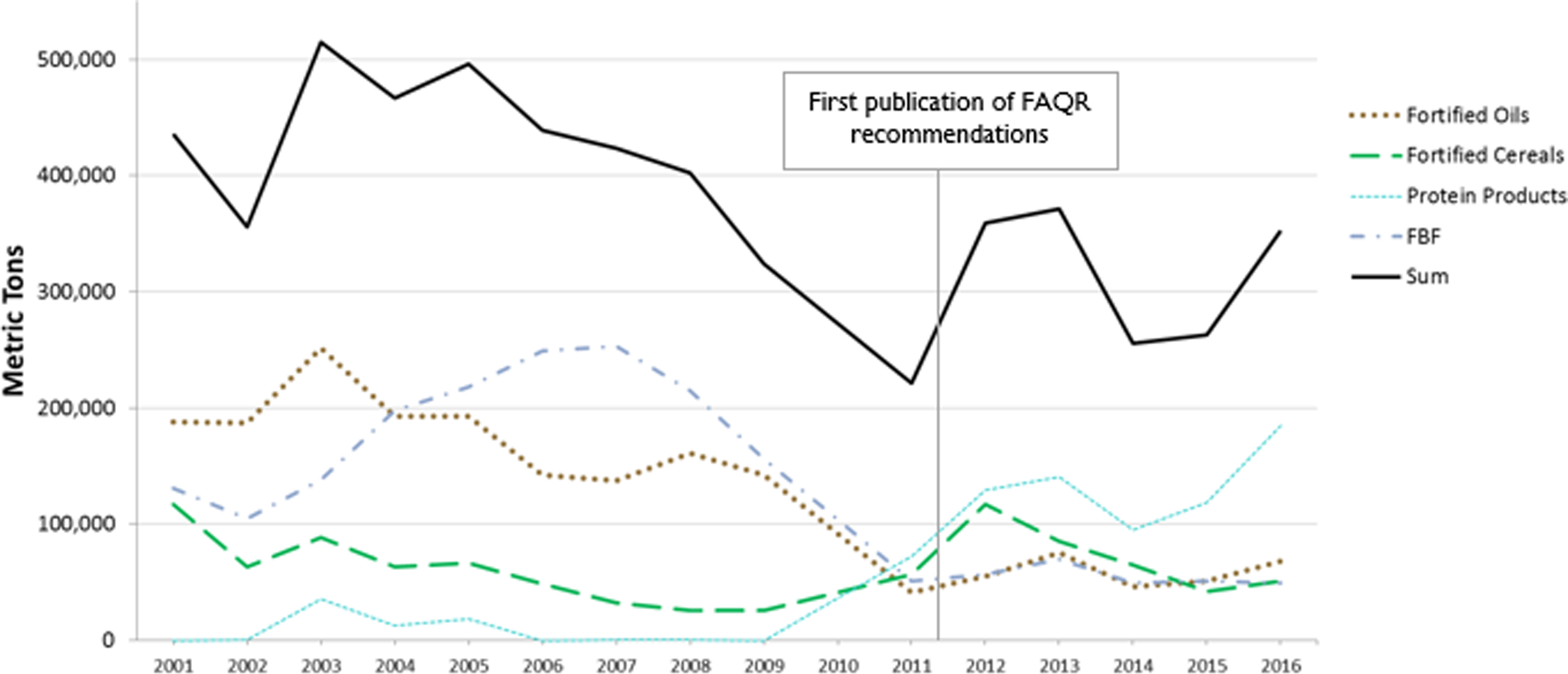
United States purchases of fortified food aid products FY 2001-2016; FY indicates fiscal year.
A number of changes to food aid products were made as a result of these recommendations. Chiefly, one of the most commonly used FBFs, CSB, was reformulated to include WPC80 at the recommended level, which improved the product’s protein profile and content (illustrated in Table 1). In addition, two forms of dehydrated dairy milk-based protein concentrates were added to the basket of food aid products. Furthermore, new versions of FBFs were initiated into the development and testing pipeline by USAID collaborators. These products include WPC80 and also employ new extrusion cooking technologies, which minimize food cooking times and make ingredients more bioavailable.
Nutrient Specifications of CSB Before and After Formula Improvements Recommended by FAQR.
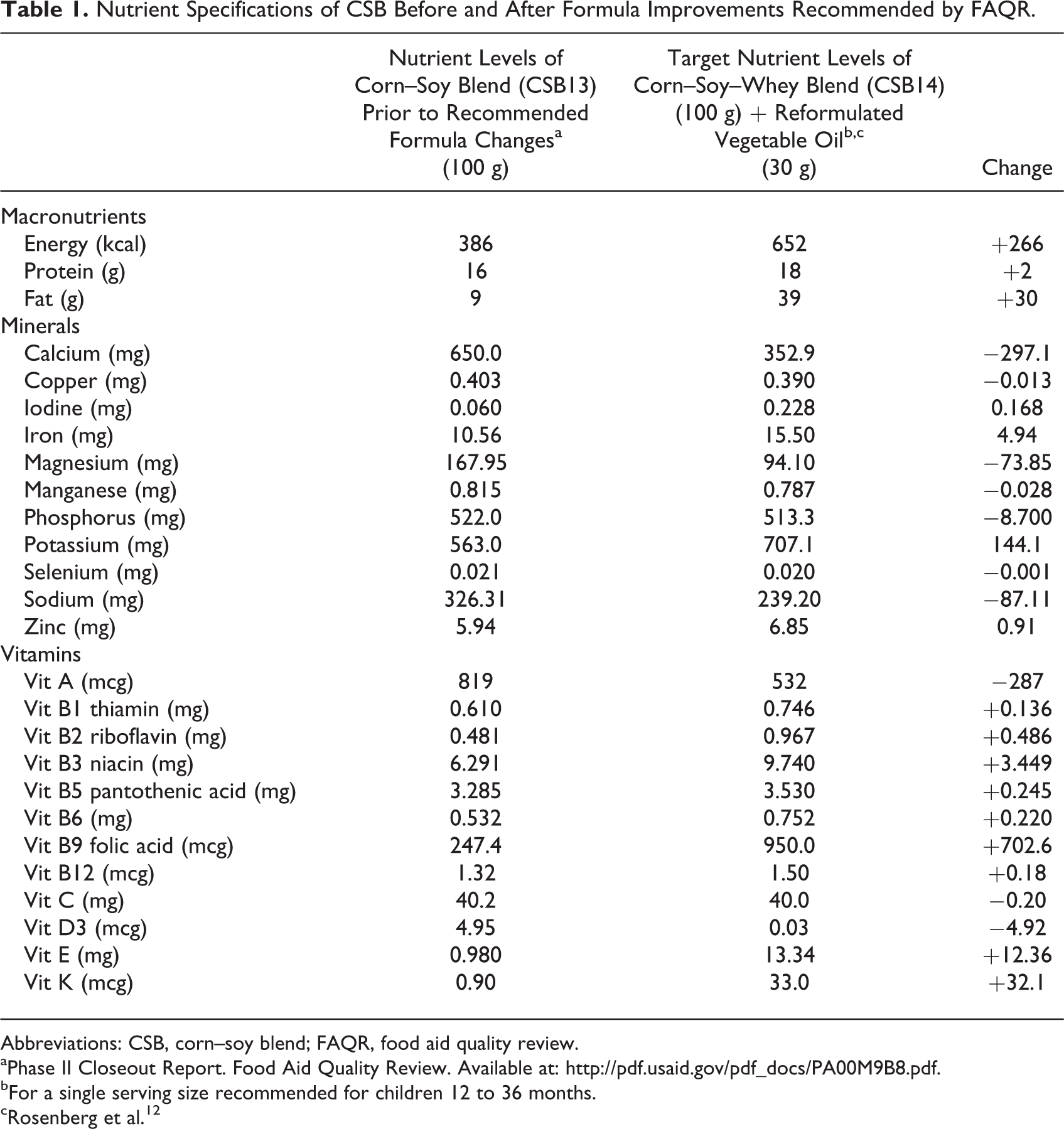
Abbreviations: CSB, corn–soy blend; FAQR, food aid quality review.
aPhase II Closeout Report. Food Aid Quality Review. Available at: http://pdf.usaid.gov/pdf_docs/PA00M9B8.pdf.
bFor a single serving size recommended for children 12 to 36 months.
cRosenberg et al. 12
The optimal amount of dairy protein in such products and the form in which it is best delivered remain unknown. WPC80 was proposed, but alternative sources should be considered where demonstrably more cost-effective. There are currently field trials underway aimed at understanding the optimum source, type, and levels of protein to be included in FBFs, 23,24 but not trials assessing the cost-effectiveness of animal- and plant-source proteins when equivalent nutritional outcomes are the goal.
Fat
To increase the energy and nutrient density of upgraded FBFs, FAQR recommended that they be prepared with a micronutrient-fortified vegetable oil (FVO) to be mixed in at the point of preparation. This recommendation was made in consideration of a renewed effort to limit free sugars because of concerns linked to child obesity and oral health. The added FVO also contributes essential fatty acids (EFAs), which are known to be essential for growth and development of nervous tissue. When consumed in recommended amounts, the oils exceed the needs of healthy children for omega 3 and omega 6 fatty acids.
The recommendation to prepare FBFs with newly formulated FVO was tested by FAQR in a treatment program for moderate acute undernutrition in Malawi, which concluded that it is possible for users to achieve the recommended high ratios of added oil to cereal in FBF preparation. 25 Research focusing on the effectiveness and cost-effectiveness of these products in preventing or treating undernutrition is being implemented by the FAQR team in Burkina Faso 26 and Sierra Leone. 27 Evidence from recent studies suggested that products with a higher proportion of calories from fat are superior to carbohydrate-based ones in terms of achieved weight gain, rates of recovery from acute malnutrition, and maintenance of health after recovery. 28,29
Energy
Including additional fat in the preparation of FBFs also raised the energy density, which is a critical feature of complementary feedings for children from 6 months, since their small stomach capacity makes it even more important that every liquid and solid consumed is highly energy dense. The higher recommended ratio of oil to grain simultaneously allows energy intake of these products to increase more rapidly in proportion with the volume consumed to meet the nutrient needs of older children and adults, and furthermore is comparable in fat density to individually packaged RUF products.
Changes in Micronutrient Specifications
Upgrades were proposed for the micronutrient premix that is incorporated into cereal and soy flour blends (ie FBFs) to account for factors such as nutrient stability, nutrient interactions and bioavailability, cooking, shelf-life, and assumptions regarding disease-prevalent environments, prior nutritional deficits, and extant dietary deficiencies. In sum, levels of vitamins B1 (thiamin), B2 (riboflavin), B3 (niacin), B5 (pantothenic acid), B12, D3, C, and E were increased, while levels of vitamin A were reduced to account for the intended addition of FVO. Vitamin K and multiple forms of iron were newly added, and changes to mineral composition were also made, including increasing the levels of zinc and potassium (based on the theoretical importance of the minerals in child growth and recovery from wasting) and decreasing the levels of magnesium, calcium, iodine, and sodium. 30
In addition to these individual nutrient changes, it was recommended generally that micronutrient-fortified products provide 115% of recommended nutrient intake for each key vitamin based on a combination of intrinsic nutrients in the food matrix and the premix added during processing of the product. The USAID fully altered the micronutrient profile of fortificant premix for cereal blends and milled cereals in accordance with this recommendation—moving from 5 different fortification standards across a number of grain-based commodities to a single premix for all, as shown in Table 2. This upgraded formulation is currently being assessed in the effectiveness and cost-effectiveness studies in Burkina Faso and Sierra Leone referred to above.
Nutrient Specifications for USAID’s Most Commonly Purchased Cereal Product, Before and After Moving to a Single Premix Intended for All Cereals.
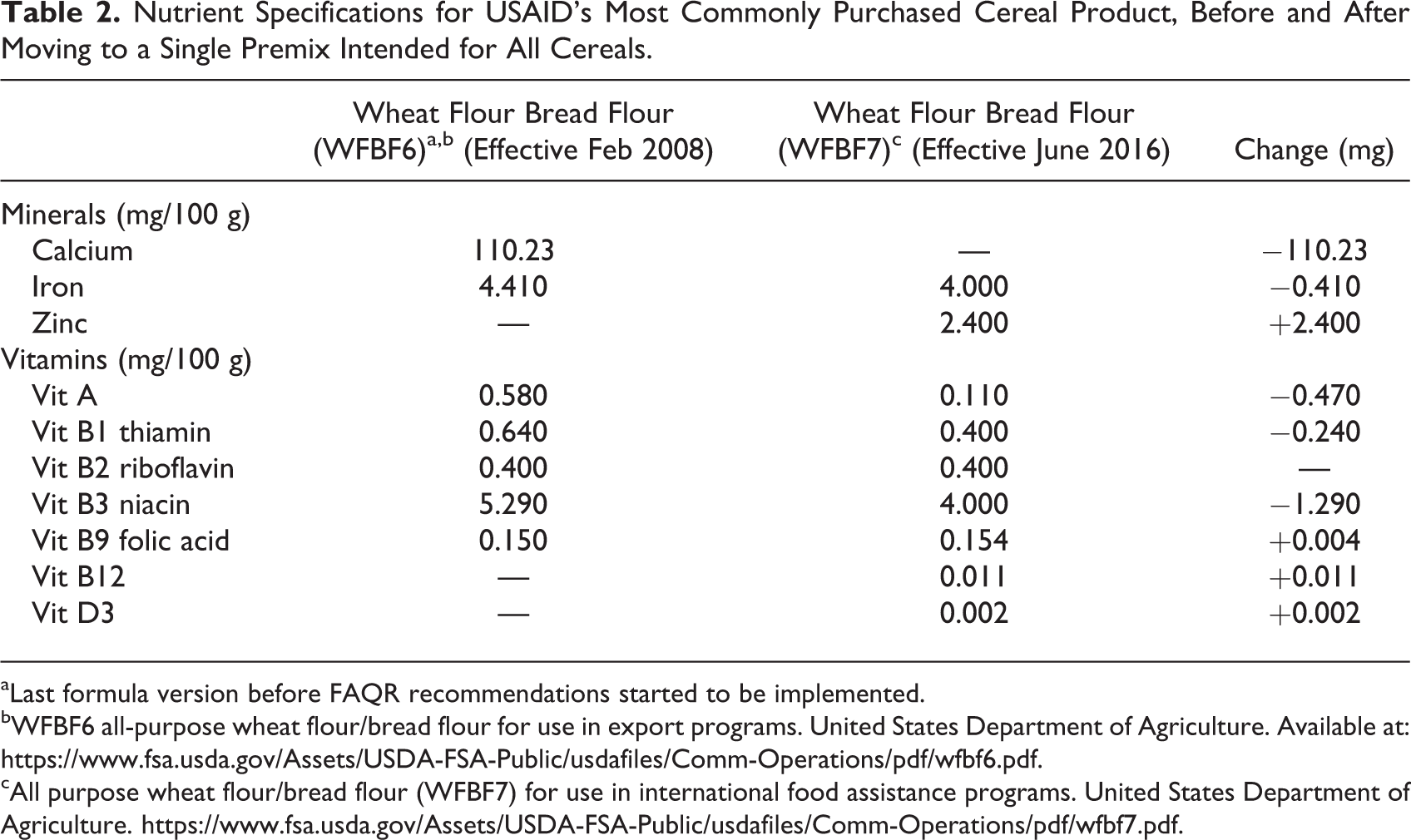
aLast formula version before FAQR recommendations started to be implemented.
bWFBF6 all-purpose wheat flour/bread flour for use in export programs. United States Department of Agriculture. Available at: https://www.fsa.usda.gov/Assets/USDA-FSA-Public/usdafiles/Comm-Operations/pdf/wfbf6.pdf.
cAll purpose wheat flour/bread flour (WFBF7) for use in international food assistance programs. United States Department of Agriculture. https://www.fsa.usda.gov/Assets/USDA-FSA-Public/usdafiles/Comm-Operations/pdf/wfbf7.pdf.
The vegetable oil intended for use in conjunction with FBFs was also updated to meet the needs not being met from breast milk, FBFs, milled cereals, and other food aid products. Most notably, the vitamin D level in vegetable oil was raised—a step that the United Nations World Food Programme (WFP) had already taken, harmonizing the products.
New Product Formulations
Lipid-based products
Since their invention in the 1990s, lipid-based products (known as lipid-based nutrient supplements or RUFs) have been shown to be very effective in the therapeutic treatment of uncomplicated severe acute malnutrition in the community setting. 31,32 Based on the FAQR recommendation that a range of lipid-based products be made available for use by US food aid programs, USAID formally incorporated lipid-based products into its list of approved products for food aid programming.
Alternative FBFs
The USAID was also encouraged to develop new cereal-based products that were rich in protein but did not include dairy proteins that often render effective products cost-prohibitive. A sorghum–soy (or sorghum-pea or other pulse) blend was envisioned, as was millet–soy, rice–soy, and even potato–soy (or other pulse) blends. As part of newly funded product development initiatives, a sorghum–cowpea blend is being developed under a grant with several national universities for other pulse–staple blends. 33 The USAID/FFP has been working closely with USDA on the sorghum–cowpea blend. These products offer new options for programming and could potentially lead to the introduction of new forms of fortified biscuits used in schools and emergency response.
Institutional Harmonization
A critical focus area for advancing food aid programming involves coordinating among the globally oriented agencies that use food aid in their mission. A working group coordinated by FAQR was established in 2016 between USAID, WFP, and United Nations Children’s Fund (UNICEF) toward the goal of harmonizing their separate policies and processes surrounding food aid products and programs. Efforts toward collaboration have prioritized agreeing on (1) product specifications and formulations, (2) product quality assurance and control requirements, (3) product packaging, (4) policy processes around the review of new or changed products, and (5) approaches to supplier review, approval, and incident resolution (eg leakage, infestation). Ongoing discussions have broadened to incorporate Codex Alimentarius(see note 3) and a range of scientific stakeholders in the search for harmonized product standards and specifications for foods intended to manage undernutrition.
One of the first outputs of this collaboration has been the adoption of a premix formulation for RUF lipid-based products. Following the success of these products as therapeutic foods meant to treat severe acute malnutrition nutrition, they have been used as a supplementary therapy to prevent and treat moderate acute malnutrition. Different agencies have used similar composition matrices to produce comparable foods in each category of intended use; however, exact specifications have varied. As a direct result of harmonization meetings, a single micronutrient premix for all RUF lipid-based foods in both the therapeutic and supplementary classes was developed with guidance from the World Health Organization (WHO). Overall, this premix standardization gives greater levels of flexibility and efficiency to the supplier base shared by multiple agencies, facilitates a high standard for lipid-based products globally, and acts as a touchstone for future collaboration.
The premix was adopted by USAID, UNICEF, and WFP in 2015/2016. Prior to adoption by USAID, the proposed specifications were taken through a phase-in period in which they were subjected to accelerated shelf-life testing and lab analysis.
Strengthening the Evidence Base
The volume of research on food aid products and programming methods has grown rapidly in the past decade, in part due to global demands for evidence-based practice. Extensive research has been done on the relative effectiveness of many food aid products, as well as the acceptability of different products. 34,35 Preliminary acceptability evaluations are now generally viewed as standard practice for the introduction of products to a new study population. The effectiveness and feasibility of many innovative products or ingredients, a significant portion of which are locally produced, is also being studied. 36 In recent years, the research agenda has shifted focus from individual product composition and efficacy to cost-effectiveness (per-recovered-child or cost-per-case-averted) of products and their programming methods. The composite effects of a product and its specific programming components, such as water, sanitation, and hygiene (WASH) interventions, nutrition-related behavior change efforts, and the duration of the intervention, are a major focus area whose findings deserve careful integration into future programming. Focusing these effects into a common outcome measure such as cost-per-recovered-child will facilitate comparison of products among studies across contexts. 37,38
Despite the growing body of research on food assistance, major knowledge gaps remain. Overall, past and ongoing research on food aid products and programming equips program implementers and the scientific community with a basic understanding of how food aid products perform but evidence on programmatic experimentation with foods is lacking. Additional evidence on what is effective in programming these foods is needed in order to improve targeting of each product to the appropriate beneficiaries. The FAQR has recommended, and is contributing original research toward, strengthening the evidence base for cost-effective product use and programming impacts.
In addition, there is limited information on the amounts of nutrients needed by infants and children who are wasted or stunted, and even less on the needs of pregnant and lactating women who are moderately undernourished. There is an urgent need to understand the role played by specific nutrients (such as certain amino acids, EFAs, or dairy-based proteins) in protecting against or treating undernutrition or its effects. There is also a great need to study the effects of food aid products with different protein ingredients but the same total quantity of protein and calories on specific health outcomes. Outcome measures that are critical to improving our understanding on this subject include relapse rates, composition of weight gain, muscle protein accretion, linear growth, and cognition.
There is also more work to be done on the body’s ability to use nutrients, specifically through exploration into the human gut and microbiome. Exposure to pathogens in the environment, which results in environmental enteric dysfunction, has been implicated in the pathogenesis of chronic undernutrition and is being investigated in clinical and community settings. 39 Together with recent trials studying the not-yet-understood effects of food aid on intergenerational undernutrition, these efforts represent a shift in research priorities toward elucidating the underlying determinants of undernutrition.
There are numerous ongoing studies addressing these knowledge gaps, assuring that there is much to be learned over the coming years. Critical review of these studies, the synthesis of their results, and communication of their lessons among stakeholders will be imperative to advancing the effectiveness of food aid operations. To this end, FAQR is working to institutionalize a process whereby new advances in nutrition, food science, and technology will be periodically reviewed and considered for incorporation into the food aid agenda.
Conclusions
The effort to review and improve the state of food aid has resulted in USAID adopting uniform micronutrient specifications for 21 products, upgrading the micronutrient content of 8 products, developing 4 new products, and establishing, with global partners, minimum nutrient levels in the micronutrient premix for RUFs. This work has accelerated the creation of new products and programming methods, harmonization of product specifications across food aid agencies, and pursuit of a research agenda that is more focused, transparent, and policy relevant.
The USAID is now prioritizing innovation, technology, data, and rigorous evidence within the US food assistance agenda, seeking to make in-kind food assistance work for all stakeholders. Continual improvements to food aid products and activities are critically important to meeting the US government’s global nutrition commitments via the Global Food Security Act of 2016, advancing the short-term objective of ensuring all people at all times have sufficient food to lead healthy and productive lives, and achieving the ultimate goal of global security and prosperity.
Footnotes
Acknowledgments
The authors would like to acknowledge the important contributions made to the Food Aid Quality Review agenda since 2009 by USAID staff—particularly Judy Canahuati, Steven Moody, Rufino Perez, Dina Esposito, Greg Olsen, and Melanie Thurber. This work is made possible by the generous support of the American people through the Office of Food for Peace (FFP) of the Bureau for Democracy, Conflict and Humanitarian Assistance, under terms of Cooperative Agreement No. AID-OAA-C-16-00020, managed by Tufts University.
Authors’ Note
This article was prepared on behalf of the Food Aid Quality Review group, which at the time of submission comprises: Patrick Webb, Bea Rogers, Quentin Johnson, Stephen Vosti, Irwin Rosenberg, Shelley Walton, Nina Schlossman, Leah Koeppel, Devika Suri, Breanne Langlois, Ilana Cliffer, Stacy Griswold, Lindsey Ellis Green, Kristine Caiafa, Ye Shen, Michael Joseph, Sajid Alavi, Ken Chui, Ozlem Ergun, Keziban Tasci, Maria Wrabel, Gloria Alvarez, and Yue Huang. The contents are the responsibility of Tufts University and its partners in the Food Aid Quality Review (FAQR) and do not necessarily reflect the views of the US Agency for International Development (USAID) or the US government.
Declaration of Conflicting Interests
The author(s) declared no potential conflicts of interest with respect to the research, authorship, and/or publication of this article.
Funding
The author(s) received no financial support for the research, authorship, and/or publication of this article.