




Abstract
The World War II mass incarceration of 120,000 Japanese Americans disrupted families, enacted intergenerational trauma, and characterized Japanese Americans as inherent racial threats. This federal exercise in biopolitical management intersected with state-sponsored eugenic sterilization in California institutions. Linking War Relocation Authority and California Department of Institutions records, we document 32 Japanese American sterilization survivors during the wartime incarceration period (1942–1946). We show how federal and state authority converged to deprive Japanese Americans of civil rights and reproductive liberty. We add original research and analysis to the intertwined histories of Japanese American incarceration, eugenics, and family in the United States.
Keywords
Introduction
A a , a young Japanese American woman, her parents, and three siblings were living in Los Angeles before the forced removal of Japanese Americans from the West Coast during WWII. 1 Along with over 120,000 other Japanese Americans living in California, Washington, Oregon, Hawai’i, Alaska, and Arizona, this family was incarcerated in a federal camp run by the War Relocation Authority (WRA) under the provisions of President Roosevelt's Executive Order (EO) 9066 and the resulting civilian exclusion orders. According to Heart Mountain Sentinel articles, A and her family were active in the camp community during their incarceration at the WRA camp at Heart Mountain, Wyoming. Like many Asian immigrants in earlier decades, her father had worked on West Coast railroads after his arrival in America, and eventually joined other Japanese Americans in work crews during the mass incarceration. 2
However, in late 1944, A was sent back to California without her family for commitment to Pacific Colony, a state home for the “feebleminded.” 3 California Department of Institutions records labeled her a “Mentally deficient girl, sex problem at Relocation Center.” Health authorities, using the eugenic terminology of the time, classified A as a “middle moron grade, probable familial type” with an I.Q. of 61 and recommended she be surgically sterilized. Still incarcerated at Heart Mountain, A's parents signed the standard consent form, and A underwent the procedure in late September 1945. 4 The date of A's release from Pacific Colony is unknown, though it appears she did not return to Heart Mountain, which closed in November 1945.
A was one of 32 Japanese Americans sterilized in California institutions during the wartime mass incarceration (1942–1946). b During these four fateful years, A was under the federal custody of the WRA, which coordinated with California agencies to arrange for her transfer to and confinement in Pacific Colony. A's story represents a forgotten yet important aspect of the Japanese American experience during the harrowing era of incarceration and encapsulates how overlapping carceral regimes, national security rhetoric, and entrenched racial prejudices intersected with eugenics and reproductive injustice to affect the bodies, lives, and futures of Nisei and Issei in the United States.
This article combines archival materials related to the history of eugenics and sterilization in California with records related to the wartime incarceration of Japanese Americans to show how eugenic sterilization was interwoven into the larger matrix of disruption, trauma, and violence of incarceration. 5 c Japanese Americans subjected to eugenic sterilization were under the thumb of both the federal government, most notably the WRA and the Western Defense Command (WDC), which stripped them of all civil rights, and authorities in California state institutions, who deprived them of their reproductive liberty and bodily autonomy. We reconstruct the experiences of 32 Japanese American incarcerees sterilized in California between 1942 and 1946, illuminating patterns of the wartime sterilization of Japanese Americans. We share illustrative individual stories that reveal the layered dynamics of state control and disempowerment that disrupted Japanese American families. This article provides new information and analysis about the role of eugenics and reproductive control during Japanese American incarceration and underscores the vacuous meaning of medical “consent” in an environment of intense power asymmetries and civil rights abuses. 6
Anti-Asian Racism, Immigration Policy, and American Eugenics: Early Twentieth-Century Roots
The incarceration of people of Japanese descent, most of whom were U.S. citizens, has rightly been understood through the lens of racism, xenophobia, and wartime doctrines of national security and animus toward “enemy aliens.” The fact this episode unfolded largely in the U.S. West reflected both the demographic concentration of Japanese and other Asian communities in the region and long-standing xenophobia and anti-Asian bigotry. From the late nineteenth to the mid-twentieth century, Western states implemented laws that targeted Japanese and Asian farmers and businesses and segregated communities of color in education and housing. 7 California was home to white supremacist groups, such as the Workingmen's Party, and legislators who passed the country's first set of anti-Asian laws, providing templates for the 1882 Chinese Exclusion Act and subsequent federal immigration bans that culminated in the 1924 Johnson Reed Immigration act. 8 The Commonwealth Club of California (CCC), an exclusive San Francisco fraternal organization, maintained active sections on immigration and eugenics. During the 1930s, the CCC immigration section extensively discussed immigration from Japan, concluding that “Asiatics and Americans are unassimilable, due to racial differences” and “American labor must be protected against the influx of … Asiatic labor, because of its cheap living standard.” 9 Emblematic of its harsh stance, the Immigration Section endorsed laws that banned Asian immigration and disqualified Japanese and other “Asiatics” from eligibility for U.S. citizenship. 10 Into the early 1940s, prominent federal and state politicians supported research and policies targeting minoritized groups for segregation and spatial containment, including institutionalization, deportation, and long-term detention at immigration ports like Angel Island. 11 The implementation of such racially and ethnically biased immigration policies capitalized on existing legal provisions that excluded disabled people, associating certain “undesirable” ethnic groups with disability and defectiveness. 12
Scientific racism was a critical foundation of the dehumanization that Japanese American communities endured during the twentieth century, and eugenics extended its influence into the realm of reproductive control. The eugenics movement in the United States emerged at the turn of the nineteenth century as a new generation of elites and professionals sought to apply science, most specifically novel theories of heredity, to perceived social problems such as poverty, immigration, and societal strife. 13 Eugenics, encoded with xenophobic biases, treated Japanese and all Asians as “others” who threatened the white middle class “stock.” In 1925, future president Franklin Roosevelt wrote “in this question of the Japanese exclusion from the United States, it is necessary to advance the true reason—the undesirability of mixing the blood of the two peoples.” 14 While many prominent eugenics organizations were founded on the East coast or in the Midwest, California established itself as an ideological center of American eugenics in the West, providing fertile ground for homegrown organizations and the promotion of a range of eugenic policies. 15 Many California white elites, like inaugural Stanford president David Starr Jordan and date palm farmer turned social reformer Paul Popenoe, propagated eugenic ideas through national and state organizations such as the Human Betterment Foundation. These elites, who had close ties to legislators and politicians, embraced a white supremacist vision of California in which “undesirable” stock would be removed or outbred, and their newly found Mediterranean paradise would be populated by a supermajority of Anglo-Saxons and Teutons.
State-Sponsored Eugenic Sterilization in California
Across the nation, scientific leaders and reformers endorsed eugenics policies and practices ranging from marriage hygiene laws to better baby contests. 16 Eugenic sterilization was a harsher policy that authorized medical professionals to subject individuals to surgical sterilization on the assumption they would produce degenerate offspring that would degrade the gene pool and financially burden society. 17 Eugenic sterilization laws enacted between 1907 and 1937 in 32 (of 48) states and the colony of Puerto Rico ultimately resulted in over 60,000 people losing their reproductive autonomy by the 1970s. 18 The United States led the world in sterilization policy, passing the first laws and informing legislation in Canada, Sweden, and Japan. 19 Strikingly, Nazi Germany relied on the sterilization laws passed in Indiana (1907) and California (1909) as templates for the development and implementation of the 1933 “Law for the Prevention of Progeny with Hereditary Diseases.” 20 In California and other states, eugenic sterilization targeted people labeled feebleminded, mentally defective, and epileptic. The first iteration of the law loosely referred to problematic mental and moral conditions to rationalize the sterilization of patients and inmates in homes, hospitals, and prison. A 1917 amendment revised the law to encompass only individuals confined to state hospitals for the “insane” and “feebleminded.” It underscored the state's responsibility to eliminate deleterious genes, explicitly targeting individuals with conditions “which may have been inherited and is [sic] likely to be transmitted to descendants, the various degrees of feeble-mindedness, those suffering from perversion or marked departure from normal mentality or from disease of syphilitic nature.” 21
Institutional authorities typically sought “permission” for sterilization from family members of the institutionalized individual they desired to sterilize, ignoring the wishes of the individual themselves. They readily admitted that this “consent” process was established to protect the institutions from liability and the sterilization statute from legal challenge 22 and not to protect the rights or autonomy of patients. However, even family signatures were not legally required under California law, and the Department of Institutions could exercise broad discretion in overriding family or patient objection to sterilization. 23 Sterilization consent forms contained little, if any, information on the surgical procedure and sometimes contained overly broad, permissive language, such as any “other surgical work as may be considered advisable.” 24 Institutional policy promoted sterilization as a prerequisite for release from the institution. 25 These conditions combined with documented instances of coercion, both explicit and subtle, characterize a “consent” process that failed to meet even the most basic standard of consent and fell far short of the bioethical mandate of freely given, informed consent. 26
Notably, the law in California and other states never explicitly identified particular racial, ethnic, or religious groups. However, categories of disability were already laden with racial biases 27 ; for example, Mexicans in California were more likely to be deemed feebleminded “morons” than whites, 28 and “mental deficiency” was perceived to be more common among Black people than white people in North Carolina. 29 While early eugenic sterilization initiatives prioritized men and “defective” whites, by the 1930s, particularly after the procedure for female sterilization (salpingectomy) became safer and more streamlined, increasing numbers of women and people of color were sterilized. 30 The Sterilization and Social Justice Lab's research has shown that Latinx 31 and Asian-born 32 individuals in California were sterilized disproportionately, which suggests that the categories of mental, physical, and intellectual disability in the state's sterilization laws were applied in an exaggerated manner to communities of color.
Pearl Harbor and the Road to Mass Incarceration
The incarceration of more than 120,000 Japanese American people from 1942–1946 has been recognized as one of the most egregious violations of human rights in United States history. Extensive scholarship has documented the process of removal and transfer, first to “assembly centers,” and then to incarceration sites (Figure 1). The majority of those incarcerated (83.4%) were Californians, 33 making the California context key to understanding the mass incarceration's xenophobic and eugenic underpinnings. By the early 1940s, California's eugenic sterilization program had been operating for over twenty years in ten institutions across the state. The program peaked in 1940 at nearly 1,000 sterilizations, and over 400 operations were performed each subsequent year until 1948. In the same year FDR issued EO 9066 and the WDC rounded up West Coast Japanese Americans, California performed 735 procedures on residents of its state institutions. Thus, the forced removal and incarceration of Japanese Americans coincided with the heightened tempo of eugenic sterilization in California. Despite Germany's position as the primary nemesis of the Allied Powers, the United States shared many attributes with the Third Reich in terms of white supremacist laws and language. 34 Eugenicists labeled Japanese Americans as undesirable “hyphenates” with a strong predilection for disloyalty, 35 but anti-German American sentiment never reached the same feverish pitch.
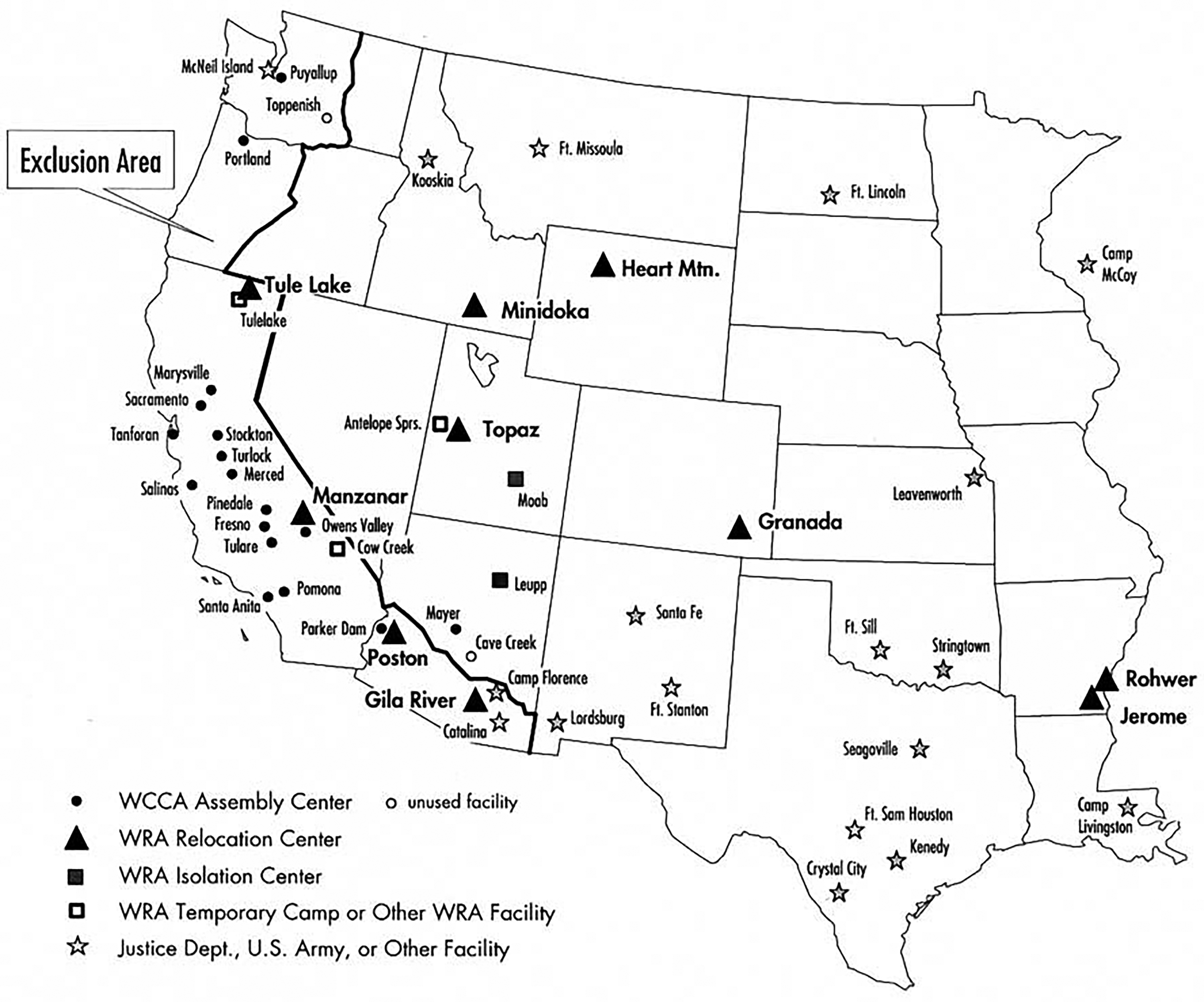
Map depicting the locations of various types of camps where Japanese Americans were incarcerated during World War II. Created by the U.S. National Park Service.
In California, there was strong eugenic animus against Japanese Americans during the lead up to removal and incarceration. Notably, the Sacramento-based Home Front Commandos dedicated to “Ousting the Japs” was funded in large part by Charles M. Goethe, Nazi sympathizer and founder of the Eugenics Society of Northern California. Interweaving Nipponophobia and eugenics, this organization published literature that demonized Japanese as treacherous, inhuman, depraved, and disloyal, among other adjectives, and endorsed the statement “No Jap is Fit to Associate with Human Beings.” Goethe propagated these ideas in his own whimsical yet cruelly racist pamphlets, which celebrated the Anglo-Saxon and Nordic “high-powers,” and demanded the elimination of Japanese and Mexican “low-powers.” Other anti-Japanese groups that circulated dehumanizing propaganda included the Pacific Coast Japanese Problem League in Los Angeles, which combined a defense of Christianity with Nipponophobia and worked to intensify anti-Japanese policies on the legislative level. 36
Furthermore, the growth of the administrative states both in California and nationally enabled the coordination of state and federal authorities in the lead up to and during the incarceration. This included Depression-era and New Deal agencies, particularly those focused on social welfare. Wartime cemented these new structures, which were emboldened by calls for patriotism and shaped by the anti-Japanese racism that permeated the U.S. after the bombing of Pearl Harbor in December 1941. 37 Federal-level plans for incarceration were underway by early 1941, before the U.S. had any inkling that Pearl Harbor would be bombed at the end of that year. 38 The confinement of Japanese Americans during wartime relied in part on overlapping systems of local, state, and federal agencies that had been established years if not decades before.
Recent scholarship shows that social workers, overwhelmingly white women trained at U.S. universities who had gained experienced in a developing criminal justice system that included the courts, police, and reformatories, 39 were instrumental in the project of removal, incarceration, and population management. This resonates with the notable role of social workers in eugenic projects, who were often dispatched by state charity organizations or the national Eugenics Records Office to survey communities and identify individuals and families that were deemed defective, unfit, and/or in need of rehabilitation or institutionalization. 40 Social workers facilitated the physical movement of Japanese Americans and made determinations about exemptions for individuals who required special medical care or were already institutionalized in prisons or mental hospitals. Even if these individuals were not remanded to the camps, they remained the “custodial responsibility” of the WRA. 41
Eugenic Dimensions of Incarceration: Family Separation and Reproductive Injustice
Despite the depth of literature on Japanese American incarceration, its intersection with the long history of eugenics and reproductive injustice in the United States has remained underexplored. Yet as an exercise in population management that sought to contain and regulate a racialized population, the incarceration had many eugenic dimensions at the structural level. 42 d It involved the separation and confinement of a group deemed biologically threatening and politically suspect, and a simultaneous fixation on and disregard for Japanese American families. Japanese American families were transported far from home and forced to raise children in hastily constructed, prison-like camps in inhospitable terrain. 43 Substandard medical facilities, 44 dismal maternal care, 45 and the lack of privacy in overcrowded barrack-style housing 46 fostered an environment conducive to ill health and replete with stressors that could precipitate mental distress. At Jerome, for instance, there were only seven doctors on site to attend to the 10,000 people incarcerated at that camp by late 1942. 47 Japanese Americans were subjected both to long-term incarceration and to mandatory relocation, including to Tule Lake if they were deemed disloyal or delinquent, and to other institutions including homes and hospitals. From a psychological perspective, removal and incarceration constituted a racialized, intergenerational mass-trauma event that continues to reverberate among Japanese Americans today. 48
During the initial phase of removal, which required Japanese Americans in the “exclusion zone” to gather at makeshift “assembly centers,” families were sometimes separated even if the purported intent of the U.S. government was to keep households intact. The primary driver of family separation was mass arrests of male Issei community leaders by the Federal Bureau of Investigation (FBI) and Immigration and Naturalization Service (INS) in the immediate aftermath of and months following Pearl Harbor. As a result of these arrests, nearly 8,000 e Japanese American men were incarcerated in separate camps under the control of the army, INS, or Department of Justice, receiving only perfunctory hearings weeks or months later. Eventually, some of these Issei men (about 1,700) were able to reunite with family after being “paroled” to WCCA or WRA camps. Yet many remained in these separate internment camps until the conclusion of or even for years after the war. 49 The segregation to Tule Lake of those labeled “disloyal” was another vehicle for family separation during the incarceration period, 50 as was the push for “loyal” Japanese Americans, especially Nisei, to depart the WRA camps and “resettle” further east outside of the military exclusion areas for education, employment, or the military. 51
Concurrent with incarceration, confinement in public institutions was often a less visible form of family separation, impacting over 1,900 Japanese Americans and their families by extension. 52 In some instances, the state forced families to institutionalize relatives in mental hospitals or medical sanitariums. In one case, during the initial phase of removal, the FBI took a father into custody, kept the mother in a tuberculosis sanitarium, and made the two teenage children travel to the assembly center on their own. In another case, a family was forced to place their “mentally retarded” son, who had always lived at home, in a mental institution. 53 Even when the state did not explicitly order institutionalization, the conditions of incarceration may have pushed some families into a decision in favor of institutional commitment. 54 f
In addition to removal, incarceration, and the eventual assimilationist dispersal of the Japanese American community via resettlement, 55 scholar James A. Tyner highlights several more extreme proposals from both lawmakers and citizens in his geopolitical examination of the eugenic facets of the mass incarceration of Japanese Americans during WWII. The Native Sons and Daughters of the Golden West called for the camps to be segregated by sex to limit the ability of Japanese Americans to have children while incarcerated. 56 Senator John Rankin of Mississippi presented to Congress a letter ostensibly written by a constituent similarly concerned that Japanese Americans would use “internment time as an incubating period.” 57 An unnamed California congressman went further, proposing giving Japanese Americans a choice between “sterilization or deportation.” 58 Historians Greg Robinson and Nancy Ordover also identify eugenically informed proposals related to incarceration. Early 1942 correspondence between President Roosevelt and Dr. Ales Hrdlicka, former chief anthropologist at the Smithsonian Institution, found the president “intrigued” by the idea of “solving the ‘Japanese problem’ through mass interbreeding,” 59 again centering reproduction as a key facet of this mass incarceration project. As late as March of 1945, Democratic Representative Jed Johnson from Oklahoma was reported to have proposed making “an appropriation to sterilize the whole outfit.” 60 These calls for sterilization and other explicit limitations to the reproductive freedoms of Japanese Americans were never implemented legislatively, and we found no evidence to suggest extralegal systematic or mass sterilization of Japanese Americans within the incarceration camps themselves. 61 g Instead, the records reveal a numerically smaller group of incarcerated Japanese Americans caught up in the pedestrian operation of the dual systems of federal wartime incarceration and eugenic sterilization via institutionalization in California.
Methods
In 2007, microfilm reels containing sterilization recommendation forms in the records of the Department of State Hospitals (formerly the California Department of Mental Health and the California Department of Institutions) were found at the California State Archives. Institutional authorities had recorded demographic, personal, and familial information on these forms. With approval from appropriate ethical review bodies in California and the universities of researchers affiliated with the Sterilization and Social Justice Lab (SSJL), these forms were digitized and abstracted into a quantitative dataset 62 using REDCap software. 63 Ultimately, more than 20,000 sterilization cases and data from more than 50,000 individual documents were entered into REDCap, creating the largest systematic dataset of eugenic sterilization in the United States.
Race, ethnicity, and nativity were not systematically collected on the California sterilization request forms. Therefore, we used the predictive unconditional Japanese surname list developed by Lauderdale and Kestenbaum 64 to search the SSJL dataset for Japanese American sterilization survivors with sterilizations authorized between 1942 and the end of the CA Department of Institutions sterilization records in 1952 (n = 42). In addition, we included individuals explicitly indicated as Japanese on their forms (n = 12) during the same period. The names of individuals and any relatives found on SSJL records were cross-referenced with publicly available WRA records and other archival sources. Of the 54 sterilization records for Japanese Americans from 1942–1952, we were able to connect 42 survivors to the incarceration camps. Of the 42 records with some link to incarceration camp records, 32 of these sterilizations were authorized between 1942 and the end of the mass incarceration in 1946. h
These 32 cases with a confirmed connection to the incarceration camps form the foundation of the following archival analysis, but additional cases not identified by our methods may still exist. Information gleaned about an individual from the sterilization recommendation forms and the other archival sources was synthesized, and themes and patterns were analyzed. To complement individual level experiences of sterilization and incarceration, archival searches were also conducted for letters, memos, reports, and other documents that illustrate relevant institutional processes. Materials about institutions primarily came from federal government 65 and California state government records, 66 accessed via both digital and physical archives.
Results
Who Were the 32 Japanese American Sterilization Survivors?
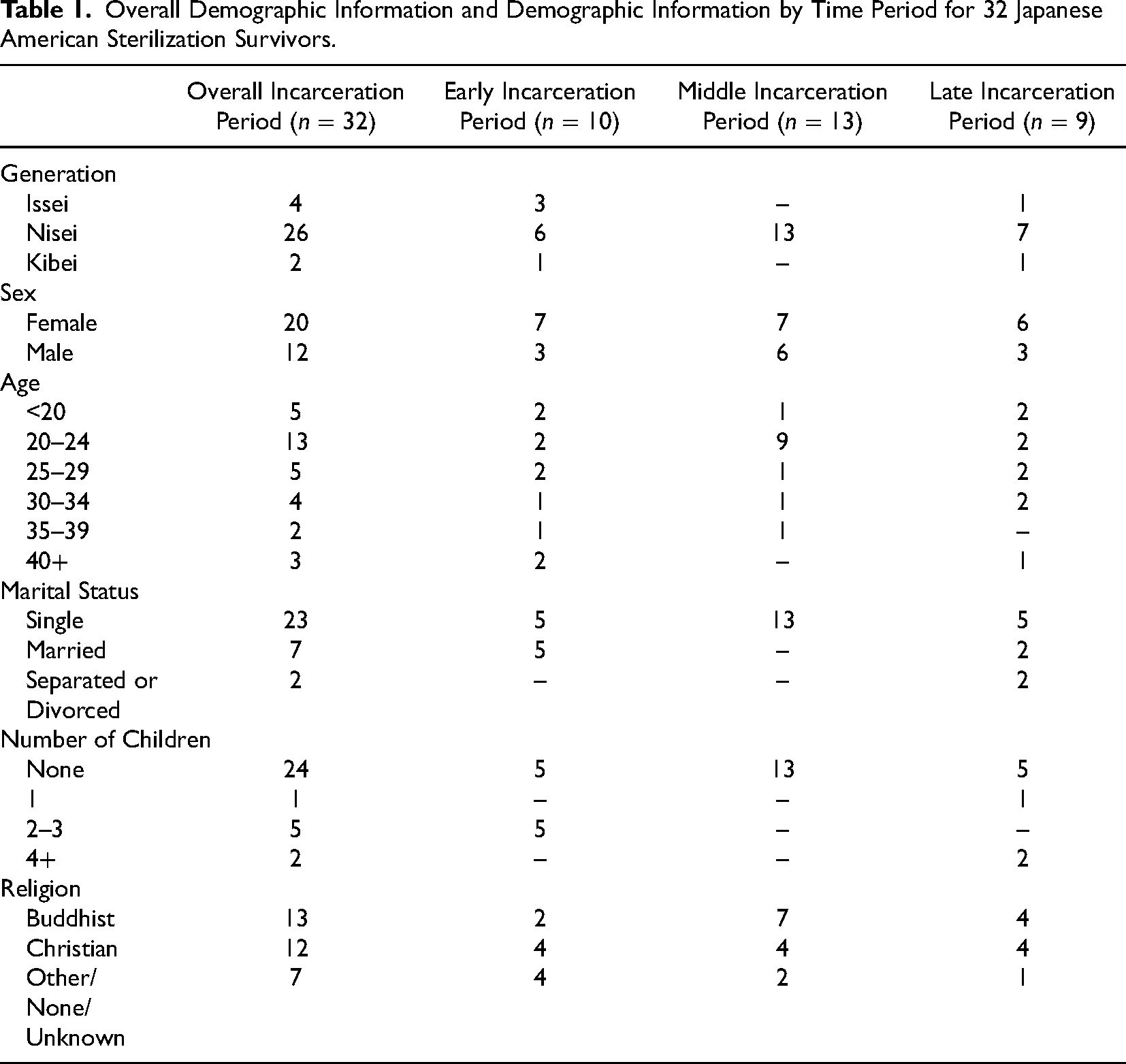
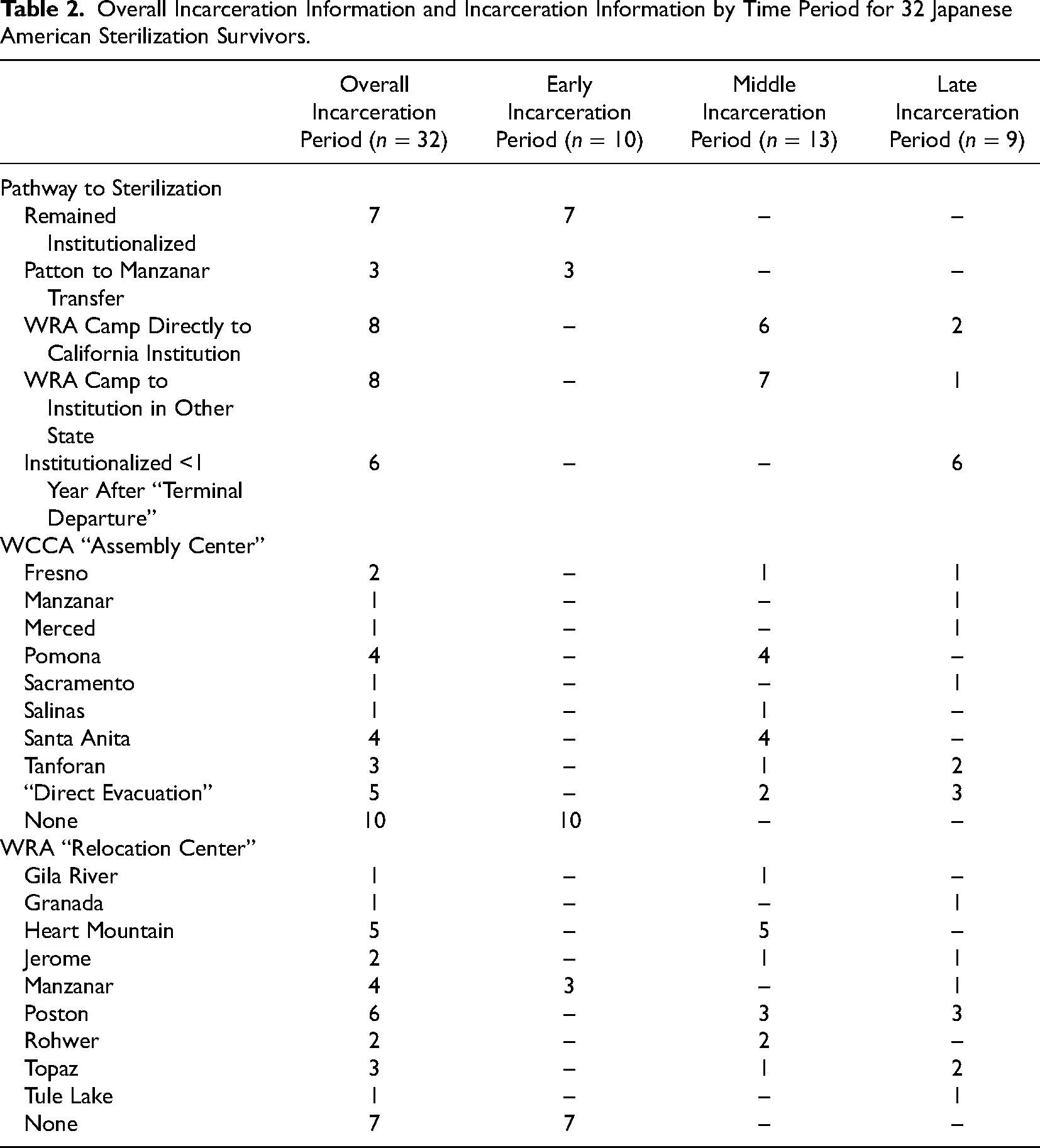
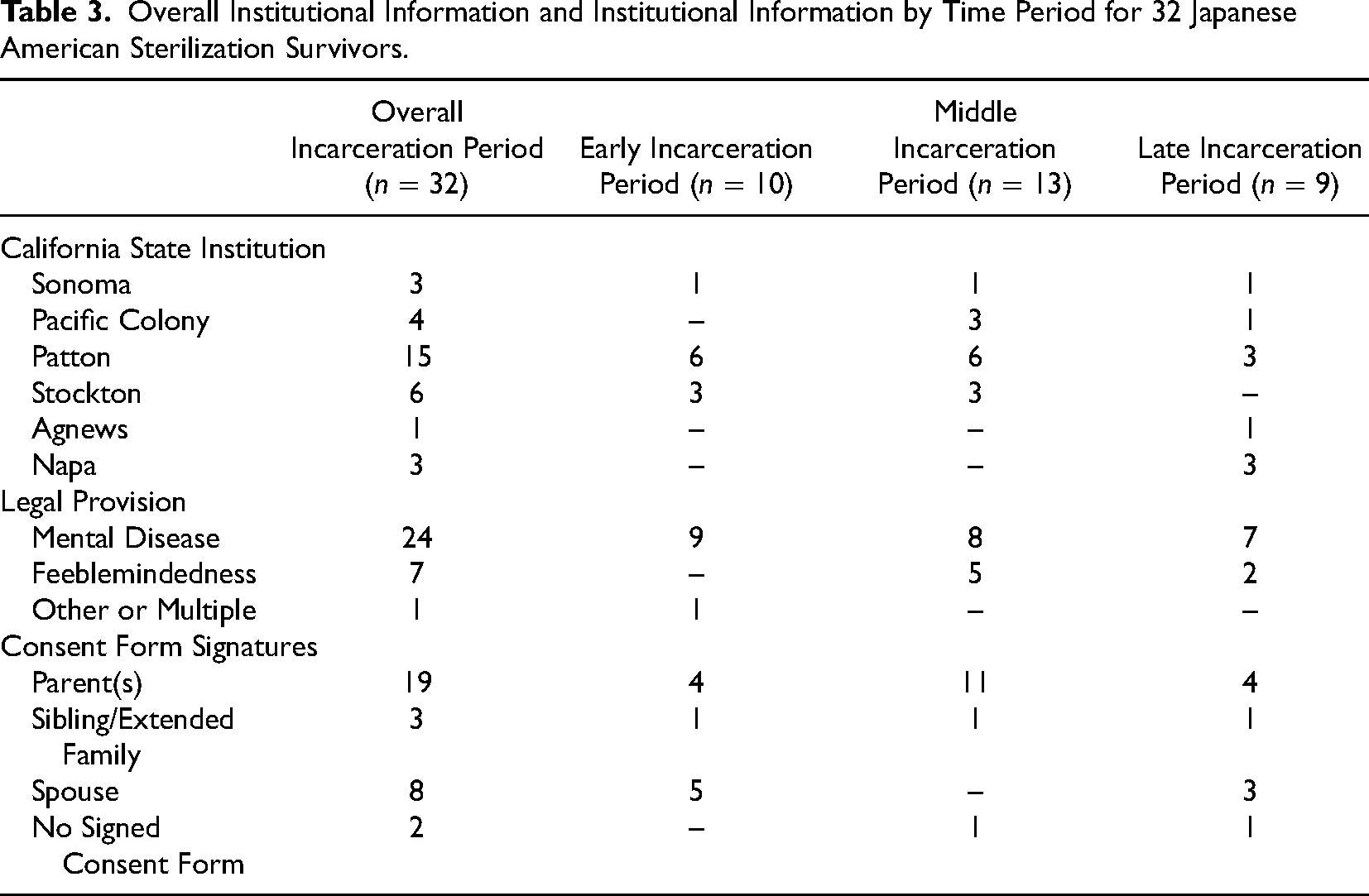
We have identified 32 Japanese Americans who, during the period of Japanese American incarceration (1942–1946), were recommended for eugenic sterilization in California State Hospitals and Homes for the Feebleminded. Demographic (Table 1), incarceration (Table 2), and institutional (Table 3) information were compiled for these 32 individuals across the entire incarceration period and by incarceration period phase. We observed six different pathways when tracing the movement of these individuals through these two carceral systems. Taken as a whole, these different pathways between carceral systems reveal the logistics behind an aspect of the biopolitical management of Japanese Americans viewed as a threat to American society and national security. Their distinct experiences reflect both idiosyncrasies during wartime and the particularities of the evolution of Japanese American incarceration, facilities and systems in place at different camps, familial situations, financial squabbles about responsibility for custodial care, and proximity between federal camps and California state institutions.
Overall Demographic Information and Demographic Information by Time Period for 32 Japanese American Sterilization Survivors.
Overall Incarceration Information and Incarceration Information by Time Period for 32 Japanese American Sterilization Survivors.
Overall Institutional Information and Institutional Information by Time Period for 32 Japanese American Sterilization Survivors.
Although there were varying pathways between incarceration camps and state institutions, in all cases, sterilizations were performed with the purported purpose of impeding the reproduction of the Japanese American women and men labeled as unfit, defective, or mentally abnormal. Reports from the WRA reveal that at least 1,942 Japanese American people, of the more than 120,000 incarcerated, were housed, for at least some period of time, in medical, penal, and mental institutions across the country. 67 As of March 20, 1946, 1,122 Japanese Americans remained institutionalized, most in western states. 68 The vast majority, 781 or 70.0%, were in California institutions, mirroring the Californian majority (83.4%) among the entire incarcerated population of Japanese Americans. 69 Close to 400 of the 781 Japanese Americans were specifically institutionalized in mental hospitals in California, 70 and our findings indicate at least 32 were sterilized during the period of incarceration.
A few distinct patterns emerged among these 32 cases: more women (20) than men (12) were sterilized, the average age was 26, and the majority (23) were single with no children. The age distribution of these sterilization survivors is consistent with these distributions among the entire population recommended for sterilization in California at this time, with those of reproductive age being the primary focus of eugenic sterilization programs. The female majority mirrors overall trends in California, whose sterilization program initially targeted men in the 1920s but by the 1940s was increasingly targeting women, and disproportionately women of color. Female Japanese American incarcerees who were sterilized in state institutions in California were a numerically small but important part of this trend.
No one incarceration camp stood out in the number of individuals institutionalized, then sterilized, in California, but Poston (n = 6) and Heart Mountain (n = 5) had the most. Most of the sterilizations occurred at Patton State Hospital (15), which may be due to the size of the institution and its proximity to Los Angeles. In the first half of the twentieth century, Patton sterilized more than 4,000 people based on a menu of psychiatric diagnoses ranging from dementia praecox, a precursor term for schizophrenia, to acute psychosis. 71 The majority of the sterilization survivors in this cohort were given a diagnosis of dementia praecox (20) and were sterilized under the legal provision for “mental disease which may have been inherited and is likely to be transmitted to descendants” (n = 24).
Seven Japanese Americans remained in California institutions post-sterilization for the duration of the incarceration period, albeit under the administrative and financial custody of the WRA, while the remaining survivors were physically incarcerated in WRA camps for some time. Three survivors were transferred from California state institutions to WRA camps post-sterilization. Eight were transferred directly from WRA camps to California state institutions, where they were then sterilized. Eight additional people were transferred from WRA camps to hospitals or mental institutions in the same state as the WRA camp, then transferred to California state institutions where they were then sterilized. A further six Japanese Americans were institutionalized and recommended for sterilization in California within just a year i of their release and departure from the incarceration camps.
Families Under State Control: Complexities of “Consent” to Sterilizations in Carceral Systems
Scholars 72 have previously documented a broad spectrum of resistance, complicity, and compliance on the part of family members during the institutional commitment process and negotiation of permission for sterilization operations. In some cases, 73 parents or other relatives used institutions or other carceral systems to punish children who were acting out or to control what they viewed as non-normative behavior, only to find that they had little power to secure the release of a child or adolescent family member if they did regret the institutionalization. Many other parents and relatives were not nearly as involved or supportive of institutionalization but their relatives still ended up in institutions due to coercive power dynamics or societal pressures. Still others saw an institution as a place for their loved one to receive needed care that they themselves felt incapable of providing or relied on the word of experts who assured them of the benefits of institutionalization. Regardless of a family's, individual's, or government official's original motivation for an institutionalization, parole from an institution was routinely made contingent upon sterilization prior to release. 74
With the evidence in the records available, the individual circumstances of each sterilization survivor's family can be difficult to ascertain. However, the increased contact with the administrative state brought about by the incarceration and the emotional, psychological, and cultural toll of the years-long experience strongly suggest added layers of coercion in the consent process for Japanese American families during this time. 75 j Signed consent forms existed in 30 cases, though in most (22 of 30), the consenter and witness “signatures” were typed, not handwritten. The two cases without consent forms were a single man with no known family and a young woman with deceased parents and several siblings who were said to have no legal status despite being listed as U.S. citizens in WRA records. On one sterilization form that was accompanied by a consent form, a handwritten notation indicated that a letter of protest had been received by the institution from a family member of a young woman, D, but the letter itself was not found among the Department of Institutions files at the California State Archives. One or both parents were the “consenters” in most of the cases with consent forms (19). The individual's spouse signed the form in eight cases and a sibling or extended family member signed in three cases.
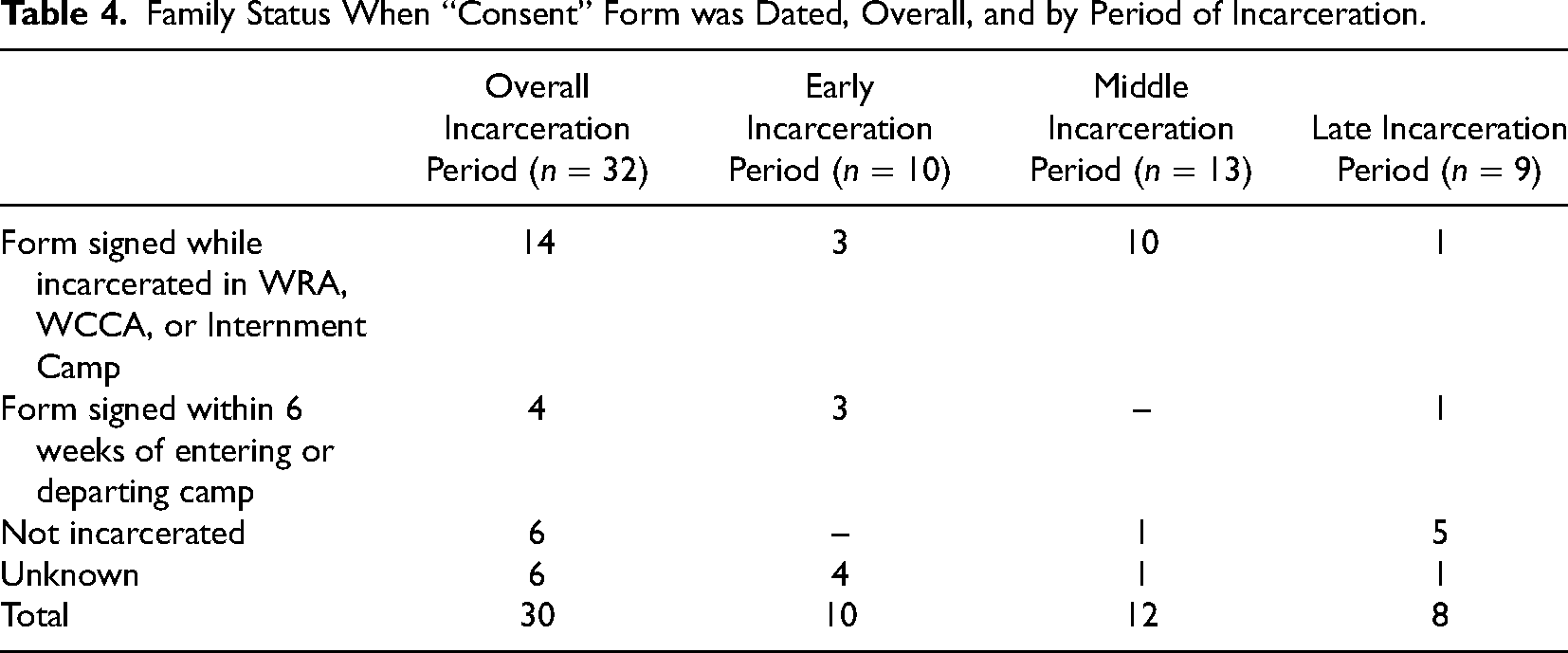
Significantly, nearly half of the familial consenters were themselves incarcerated when they signed the forms (n = 14), and a few additional familial consenters signed the sterilization consent forms within only six weeks of entering or leaving an incarceration camp (n = 4). k For an additional six familial consenters, their status at the time they signed the form is unknown due to gaps in the records (Table 4). Each Japanese American sterilization survivor in our records experienced family separation for some period due to institutionalization. Family separation and the disruption of families and communities have important implications for understanding the dynamics of familial consent for sterilization. Family members and individuals exercised their autonomy as best they could in a carceral environment that constrained their decision-making. 76 These familial consenters were faced with a “Sophie's Choice,” forced to make a serious and permanent decision about their family member's reproductive future while they navigated an entire nation questioning their rights and loyalty, protecting other family members and themselves, and worrying about when they could again live freely in American society.
Family Status When “Consent” Form was Dated, Overall, and by Period of Incarceration.
In the 30 “consent” forms for Japanese American sterilization survivors found in California Department of Institutions sterilization records, none of the “consenter” signatures came from nonfamily members. However, the presence of family member names on a “consent” form does not preclude involvement, guidance, or pressure from federal or state officials in facilitating the consent process; they just did not leave the visible evidence of their names on that particular form. 77 l Of the 21 consent forms with witness signatures in addition to consenter signatures (9 of the 30 forms did not have a place for a witness signature or had one that was left blank), nine witnesses were other relatives, six appeared to be Japanese Americans with no familial relationship, two were Japanese American physicians in the camp hospitals, and four were white physicians or other WRA health or welfare employees. One of those four white WRA employees was Dr. Alexander Leighton, a psychiatrist working as head of Poston's Bureau of Sociological Research, 78 m whose typed signature under witness appears on a sterilization consent form for a young Japanese American woman (Figure 2). 79
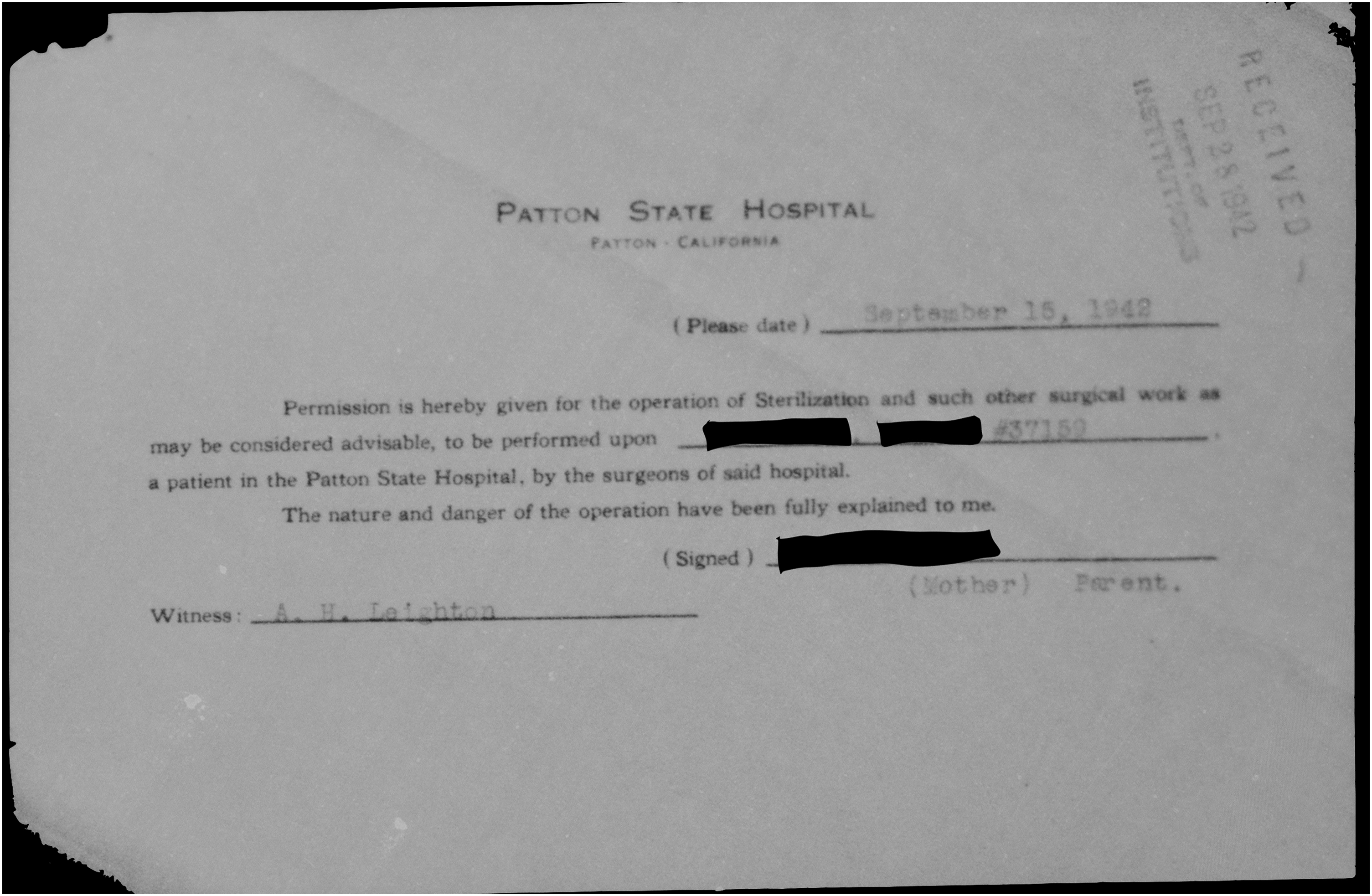
California department of institutions sterilization consent form. Used with permission from the California State Archives.
Thus, consent operated within the context of excessive management of families and reproductive futures through state coercion and control and suggests a wide spectrum between the two extremes of familial complicity or institutional pressure. In an environment of overlapping institutionalization and incarceration and involvement of respected medical experts in positions of power such as camp doctors and California institutional superintendents, consent likely became a hollow exercise. Wartime incarceration of Japanese Americans enabled the reproductive injustices of family separation, forced upbringings in inhospitable environments, and the eugenic sterilization of at least 32 Japanese Americans in California institutions.
Institutionalization and Sterilization Patterns During Distinct Phases of the Incarceration
The mass incarceration of Japanese Americans during WWII was not a single disruptive event, but a series of upheavals over several years. Each phase of the incarceration, namely removal, incarceration, and relocation shaped the institutionalization and sterilization process for Japanese Americans. Sterilizations occurred across the entire incarceration period.
Mass Removal and Deferred Evacuation: The Early Days of Incarceration
The forced mass removal of over 110,000 80 n Japanese American people from the West Coast constituted an immense challenge. Thus, at the beginning of the incarceration period and the early days of EO 9066, the exhaustive, systematic process of this “evacuation” dominated the focus of federal and state government agencies. “Deferred evacuation” of Japanese Americans in private, county, and state hospitals and institutions at the time of removal therefore gave the WCCA and WRA the opportunity to temporarily delay long-term plans for over 1,200 81 institutionalized Japanese Americans in more complex circumstances. The nine State Hospitals and Homes for the Feebleminded operated by the California State Department of Institutions, which functioned as the primary sites of sterilization under California's eugenic sterilization statutes, participated in deferring of “evacuation” for Japanese American residents of their institutions. Sources documenting initial decisions surrounding “deferred evacuation” and the later planning for Japanese Americans remaining in institutions reflected this complexity, revealing confusion, changing plans, and unclear delegation of responsibilities to participating agencies. 82 It is only after the transfers from the temporary “assembly centers” to the more permanent “relocation centers” and the transition from WCCA and WRA authority that officials again began to consider how to handle institutionalized Japanese Americans. 83 Even then, the primary focus of California and WRA officials became transferring the “deferred evacuees” who were in medical hospitals or tuberculosis sanatoria to the incarceration camps. 84 o
The California Department of Institutions appeared relatively unconcerned over the continued presence of Japanese Americans in its institutions, illustrated in part by the lack of comment on the wartime removal and incarceration of Japanese Americans in any of its annual reports from 1941–1945. The San Francisco Examiner reported on August 21, 1942, “there have been only sixty-six Japanese among the more than 4,000 persons admitted to State mental hospitals since Pearl Harbor.” Among the Japanese American sterilization survivors who remained in an institution under the custodial responsibility of the WCCA or WRA for the duration of the incarceration period (n = 7), California institutional authorities deployed sterilization quite differently than its typical use as a systematic tool for reproductive control of “parolees.” 85 Sterilization could not serve as a precondition for a return to freely living in the community since all Japanese Americans were under federal jurisdiction, whether held in a state institution or a federal incarceration camp. Confinement of Japanese Americans in an institution essentially served the same purpose as the incarceration camps by restricting freedom of movement and communication and controlling interaction with those outside the institution.
Furthermore, WRA camps’ insufficient basic medical facilities included their poor psychiatric and mental health infrastructure, presenting barriers 86 to transferring Japanese Americans from California mental institutions to incarceration camps. Some camps had medical social work divisions within the health or welfare sections, but personnel could be as scant as a single, part-time medical social worker. 87 A junior counselor at Tule Lake wrote that the camp's welfare section was primarily occupied with financial assistance, there was no psychiatrist on the hospital staff, and outside psychiatric consultation services were “unavailable.” 88 The medical social service department at Topaz reported that “the only psychiatric service available in Utah was at the State Hospital” and “the only private psychiatrist in the state was unable … to take any cases for us.” 89 The aforementioned Leighton, the head of the Bureau of Sociological Research at Poston, was occasionally asked to split his time to consult on psychiatric cases 90 at the hospital, presumably to fill a gap in the expertise of the health staff at the camp.
A smaller number of sterilization survivors (n = 3) were eventually “released” directly to WRA incarceration camps after being institutionalized before or while their families were “evacuated” from the West Coast. The earliest of these transfers, also referred to as discharges, paroles, or institutional admissions, did not occur until late February 1943. All three were women institutionalized at Patton State Hospital and reunited with family at the Manzanar incarceration camp after periods of separation ranging from about 10 months to 2.5 years. The families of the seven sterilization survivors who were not paroled (Table 5) were incarcerated at Tule Lake (n = 3), Gila River, Heart Mountain, and Jerome (1 each), indicating something about Manzanar versus other incarceration camps may have facilitated release from Patton State Hospital, such as the geographic proximity of the two sites. An August 26, 1942, interagency letter 91 from the Patton Medical Superintendent to the Manzanar Chief of Community Services Division states “We have not considered the release of any Japanese patient in the institution to go to your relocation center, or any other relocation center … as they are still in need of care.” The letter then thanks the Chief of Community Services and indicates potential future interest in “the re-uniting of families who have one or more members in this hospital,” though this interest ultimately did not result in many institutional paroles and subsequent family reunifications.
Incarceration Information for Families of 31 Japanese American Sterilization Survivors.
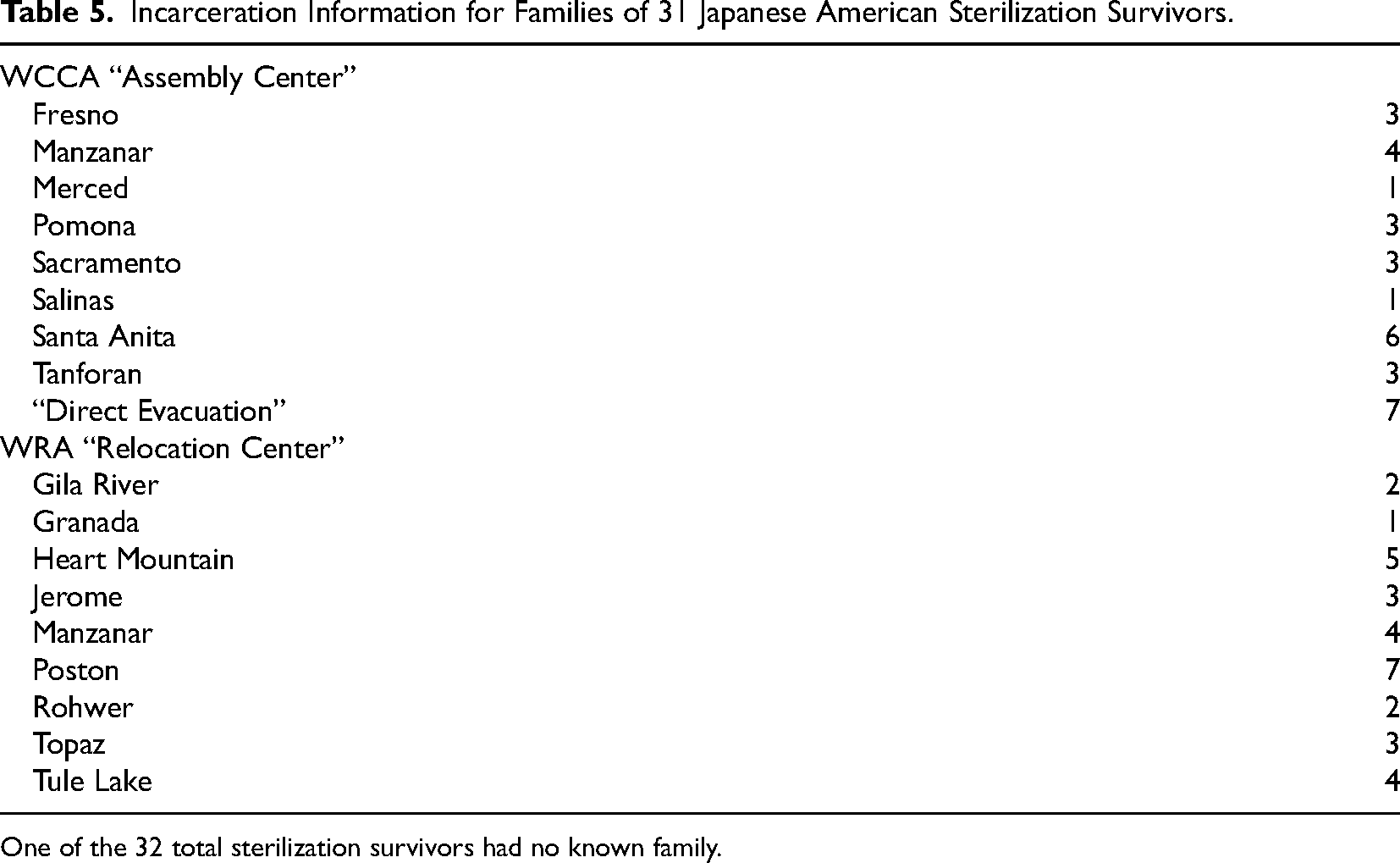
One of the 32 total sterilization survivors had no known family.
Tangled Interagency and Interstate Coordination: the Middle Incarceration Period
Among the sterilization survivors identified in CA Department of Institutions records, the first transfers from WRA camps to California state institutions did not occur until August of 1942, after the completion of “evacuation” of Military Area 1 and removal from temporary WCCA “assembly centers” to more permanent WRA “relocation centers” was well underway. While the two earliest transfers from WRA camps to institutions among sterilization survivors in our records occurred in the fall of 1942, the majority of these middle period cases (11 of 13) occurred after removal from Military Area 2 was also complete. Until the January 1945 cancellation of the civilian exclusion orders precipitated by EO 9066, Japanese Americans were fully barred from California unless confined to a federal incarceration camp (i.e., Manzanar and Tule Lake) with few exceptions. Given this wholesale exclusion from the state, commitment to institutions in California during this period required considerable interagency coordination and relied on existing, but increasingly complex interstate institutional relationships.
The group of Japanese American sterilization survivors institutionalized during this period had more uniform characteristics than their counterparts institutionalized during the early incarceration period before and during “evacuation,” and the later incarceration period after the West Coast reopened to Japanese American incarcerees. All thirteen were single Nisei without children, with a nearly equal split between women (n = 7) and men (n = 6). The majority were 20–24 years old (n = 9) with one or both parents listed as a “consenter” to the sterilization operation (n = 11). About half were committed directly to California state institutions from WRA camps (n = 6), whereas the other half were first committed to institutions in the state of their site of confinement before being transferred to California state institutions and subsequently being recommended for sterilization (n = 7).
The relative youth characterizing the Nisei Japanese American sterilization survivors in this group and the parental “consent” to sterilizations could reflect generational and familial tensions in the community exacerbated by the conditions of incarceration. Intergenerational conflict was not unique to the Japanese American community, but it was made more visible by the conditions of incarceration, such as close living quarters in the barracks. The conflict between the traditional values of Issei parents and community leaders and the Nisei youth's desire for independence was highlighted by WRA officials at different camps and discussed among the Japanese American community as well. Some WRA officials were decidedly pro-Nisei in the face of this generational divide, promoting assimilation and Americanization as proof of loyalty to the United States and worrying about the supposedly overbearing influence of the Issei generation. Some Nisei also adopted this view; they resented how the reluctance of the older generation to assimilate fueled stereotypes that their entire community was disloyal, un-American, and enemy aliens. For example, a report from Tule Lake prior to becoming a segregation center states “Life on the outside has to a large extent made the Nisei independent of Issei authority. Thrown together in the close confines of the Project with their Issei parents, the young generation admits that the opportunities of remaining independent from them will decrease” and “the Issei patiently, if openly, boast that the longer they remain on the Project and the older the Nisei become the greater are the chances of their reverting back to type.” 92
Not all WRA officials and Japanese Americans viewed the Issei-Nisei disconnect positively, instead calling it a “breakdown of discipline and parental control” 93 and contributing factor in juvenile delinquency. Occasional cases of youth misconduct, which included everything from “cutting of school classes” to “loitering, gambling, vandalism, and petty thefts,” received inordinate attention as threats to “the future welfare of the young people.” 94 Reports from several camps detail community- and WRA-led formation of commissions, committees, or councils dedicated to preventing “youth problems,” 95 yet these same reports acknowledge juvenile delinquency was not a widespread issue. Vague descriptions of two of these young people as a “sex problem at relocation center” 96 and a “problem in evacuation center because of low mentality” 97 on their Pacific Colony sterilization forms suggest such concerns motivated institutionalization and/or sterilization for at least a few young Japanese Americans.
When making decisions about commitment to outside mental institutions, the WRA assessed the liminal status of Japanese Americans as legal residents of their West Coast states of origin, physical residents in the states of their incarceration camps, and custodial residents of the federal government. The lack of health infrastructure in general and mental health infrastructure specifically meant camp hospitals could only serve as temporary sites of institutionalization or “clearing space[s] for mental cases,” as Poston General Hospital had been designated in an early Poston Health Section Report. 98 Archival sources documenting the transfers of some individuals to outside institutions reveal extensive, quotidian, and often messy bureaucratic processes involving multiple WRA sections at each camp, including Health, Welfare, and Legal, other federal agencies, and agencies from multiple states. The institutionalization process at Heart Mountain seemed particularly complicated due to a lack of cooperation from Wyoming state agencies. 99 Beginning in 1943, Heart Mountain was the only WRA camp to send individuals directly to California institutions, at least among those in CA Department of Institutions sterilization records. Four of the five sterilization survivors from Heart Mountain were transferred directly to a California institution, despite the immense logistical challenges of transporting them over 1,000 miles to destinations within a military exclusion zone. In late November 1944, Heart Mountain administrative staff struggled to book “Pullman Space” for two “mental patients,” the Medical Evacuee escort, and the Medical Social Worker in the health section serving as a female escort and in another instance, over a month passed before the staff could book Pullman accommodations for people being transferred to outside hospitals. 100
Despite these challenges and “the reluctance of institutions in some states to admit evacuee mental patients,” 101 the other incarceration camps were able to negotiate institutionalizations to mental hospitals or homes for the “feebleminded” in closer proximity, and these commitments appeared to be more than “on paper.” According to the 1942–1943 Annual Report of the Arizona State Hospital, 102 “admission of Japanese patients from the War Relocation centers of the state [Poston and Gila River] accounts for 20 new admissions during the fiscal year.” The WRA's reimbursement of “$45.00 per month a-piece” for Japanese Americans admitted from the incarceration camps did not alleviate the institutional overcrowding that the report partially attributed to this influx of Japanese American patients.
“Resettlement” and Erosion of Community and Family Structures: End of Exclusion
The West Coast “reopened” to incarcerated Japanese Americans in January 1945 and commenced a new phase of the WRA and camp administration. Relocation became a mandate with the announcement that all WRA camps would close by January 1946. Leave clearance applications and permits were no longer necessary for travel outside the camps, and the WRA now actively pressed all Japanese Americans to resettle throughout the U.S. or return to their previous residences in California and other Western states. The mission of camp personnel shifted from approving leaves based on perceived loyalty to interviewing and advising families and individuals about their long-term plans for life outside the camps. 103 This planning process could include facilitating institutional care for one family member while preparing the rest of the family for life outside a carceral setting.
Three sterilization survivors present in our records were institutionalized from a WRA camp after January of 1945, two admitted directly to California institutions and one first committed to an out-of-state institution then transferred to a California institution. Six additional sterilization survivors were not direct institutional departures according to the final accountability rosters, 104 but were admitted to institutions less than a year after leaving the incarceration camps. This group of late- and post-incarceration period sterilization survivors were fairly evenly distributed in age, similar to survivors from the early-incarceration period, but were more dispersed among institutions, with Napa and Agnews State Hospitals now represented. Signatures from spouses (n = 3) were once again found on consent forms in this period, almost as often as parental signatures (n = 4).
These later cases highlight the changing institutionalization process due to the approaching end of mass incarceration, planning for the dissolution of the WRA, and the country attempting to return to normalcy post-war. Paralleling sterilization as a mechanism for release from mental institutions, institutionalization of a relative was sometimes explicitly tied to “resettlement” planning or departure from the camps for Japanese American families. 105 Incarceration had eroded extended family relationships and community support systems that previously may have protected against institutionalization and enabled community care.
Whether families faced with such decisions were reluctant or appreciative, institutionalizing a family member likely restricted relocation opportunities since residency was a requirement for admission to some institutions 106 and receipt of government assistance to pay for care. Despite the estimated 51.4% of Japanese Americans who did not return to the West Coast upon release from the WRA camps, 107 their legal residency during the incarceration period 108 and at the time of their release 109 was determined by residency prior to incarceration. Those who “resettled” were subject to the same residency requirements as the general population and could thus only access certain services after living in a new area for a minimum period of time. Residency was cited to deny claims for government financial assistance, 110 and the head of the Rohwer Welfare Section maintained “it [was] unrealistic not to plan for those needing continuing assistance to return to their place of pre-evacuation residence.” 111
With the California institutional records currently available, the Japanese American community's relationship with state institutions prior to the incarceration period is largely unknown; however, WRA documents suggest reluctance among Japanese Americans to institutionalize family members due to cultural values and state that community care was common prior to incarceration. In one stark example, a Heart Mountain medical social service report observed “these people are concerned about caring for their own defectives and have to be convinced of the benefit of institutionalization.” 112 Japanese American families facing the decision of institutionalizing a relative were thus caught between pressure from WRA officials in positions of power and “expertise” who favored institutional care and preexisting social expectations of community care, 113 while navigating the added struggles of incarceration.
Discussion of Themes from Individual Stories
Beyond exploring the institutional and diagnostic patterns of sterilized incarcerees, the experiences of removal, family separation, medicalization, and reproductive injustice can be humanized through exploration of individual stories. Based on the depth of archival records, we are able to reconstruct the personal trajectories of three Japanese Americans—one woman and two men—who were both incarcerated and subjected to eugenic sterilization.
M's Story: Reunification at Manzanar After Sterilization and Prolonged Family Separation
Of the three Japanese American sterilization survivors moved from Patton to Manzanar during wartime, M and her family were separated for the longest period. Although her sterilization recommendation form reports a February 26, 1942, admission date, an oral history interview given 114 by her eldest son suggests she may have been institutionalized elsewhere before her time at Patton. Her son vividly remembers his mother suffering a nervous breakdown upon the arrest of his father the day after the attack on Pearl Harbor. He and his younger siblings were sent to the Salvation Army Orphanage and were “evacuated” to the Children's Village at Manzanar with other Japanese American children residing at the home.
Once she was institutionalized, the administrative authorization to sterilize M proceeded seemingly as usual, albeit quickly. A consent form for M's sterilization with her husband E's typed “signature” is dated March 10, 1942, when her husband would have still been interned at the Fort Lincoln detention facility. His imprisonment and knowledge of his children being without parents compound the already coercive nature of the eugenic sterilization “consent” process. Patton's medical superintendent then requested permission from the Department of Institutions on March 20, 1942, to sterilize M, and the director of the Department of Institutions signed his approval four days later. M underwent a sterilization procedure about three weeks after the director's authorization, less than two months after her official admission date. 115
A July 29, 1942 116 letter from E to the Manzanar Children's Village Superintendent inquired about his children's well-being and indicated his hope for transfer out of internment soon. E was eventually paroled to Manzanar in early August 1942, though his and M's children stayed in the Children's Village for some time after. In several letters, E seemed eager to have M join him and their children at Manzanar, especially for the sake of their young daughter. On August 18, 1942, WRA officials first contacted Patton about the possibility of M's transfer to Manzanar to reunite with her family. The inquiry letter candidly stated, “We have a good hospital and medical staff, but no provision for the care of the insane or for any special treatment or care of persons in any way abnormal.” 117 The institution's response discouraged the idea since she “has not improved sufficiently to leave this hospital and again assume the responsibility of her family.” 118
On June 21, 1944, the Manzanar Project director wrote with a request from M's husband E to visit her at Patton if she was not ready to be discharged. 119 The June 26, 1944 response from Patton contained a better prognosis and finally set in motion M's reunification with her family. The medical superintendent at Patton described M as “in very good condition both physically and mentally,” and “a very efficient worker” at her job in the hospital's laundry. 120 After routing this information through several WRA officials, an evacuee travel permit 121 was issued for M in late August 1944. The form included details about mode (Inland Stages) and cost ($7.50 for 5 meals and one night's stay at a hotel) of M's transportation from Patton to Manzanar. She was provided with a required white escort, 122 a male registered nurse, who also accompanied several other Japanese Americans during transfers between camps and state institutions in California.
Upon arrival, M visited the Manzanar outpatient clinic to establish care and was instructed to return for a follow-up six weeks later. 123 Multiple WRA letters indicated vaguely that M adjusted well to camp life. 124 At Manzanar, she worked as a kitchen helper in the camp mess hall, a change from her preincarceration work on her husband's ranch. Though she had been physically released from Patton, M was now subject to both WRA and California State Hospital “parolee” custodial restrictions (Figure 3). 125 The oral history interviews of M's two sons reflected the long-term hardship of family separation due to the widespread pre-“evacuation” arrests; M's children were forced to grow up too young and the separation from their parents at a crucial developmental period continued to affect the closeness of their relationship with their parents long after the incarceration period ended. 126
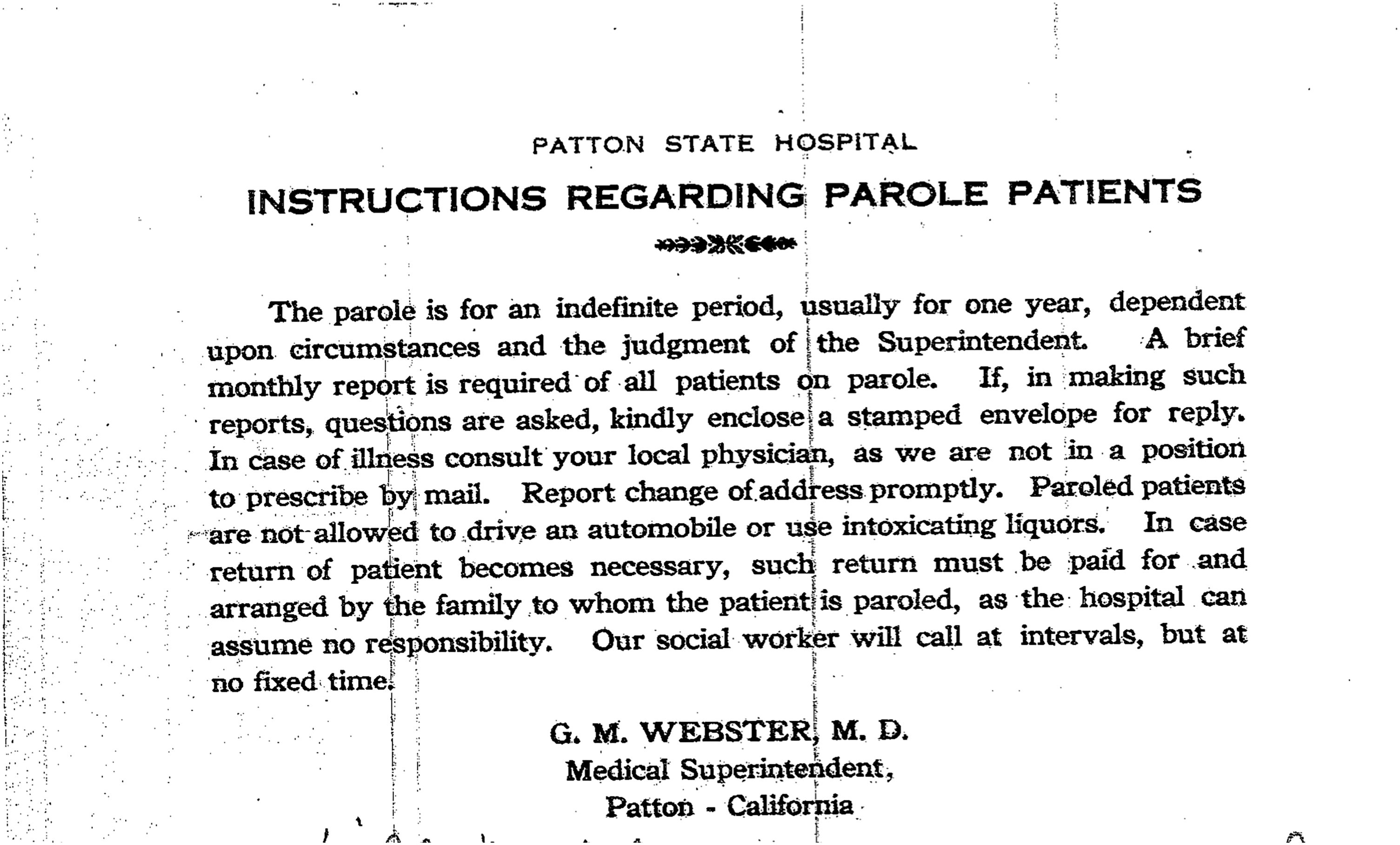
Document found in individual WRA case file containing instructions for “parole patients” from Patton State Hospital. Courtesy of the National Archives and Records Administration.
One thread common to many communications between WRA and Patton officials regarding M's institutional parole was her status as a mother to young children. One such letter dated July 31, 1944, 127 requested M's transfer from Patton to Manzanar be expedited, stating “The family situation has been reported to us several times with emphasis upon the need for the presence of the mother in the family where the children are so small.” Concern over the separation of mothers and young children may have influenced decision-making around which sterilization survivors remained institutionalized and which were allowed to reunite with family at the incarceration camps. Of the other two female sterilization survivors transferred from Patton to Manzanar after sterilization like M, one was young and single, and the other was similarly separated from her young children and interned husband. Of the seven sterilization survivors who remained in institutions, four were single and childless. The other three who remained institutionalized were married with children, but circumstances of other family members seemed to ensure some level of care for these children even without one parent.
S's Story: The Disruption and Violence of Life in an Incarceration Camp
S and his family were incarcerated at Heart Mountain, arriving from the Santa Anita Assembly Center in September 1942. His family appeared to be active in various camp community organizations. 128 Though S did not seem to belong to any similar groups, his hobbies were listed as “photography, football, basketball, [and] baseball” on a WPA form used for employment classification. 129 An undated WRA case history 130 describes S as “an epileptic who has had very little education, who comes from a family of high standards and intelligence. They managed to care for him quite well before they were evacuated by keeping him busy in a large garden at home.” S was also given seizure medication and a special diet prior to incarceration. He continued to receive at least the medication and had not had any seizures since arriving at Heart Mountain. 131 He was described as physically strong in later WRA correspondence. 132
S's family encountered new challenges caring for him at Heart Mountain, likely resulting from the radical changes in S's environment due to incarceration. His family's preremoval dwelling had space for a large garden, but the six of them were now living in a one room apartment without running water in a 20 by 120 foot barracks with about 500 other people. 133 The case history continues, “It always excited [him] to be around strangers or a crowd. Therefore, it has been difficult for him to adjust to life in the Center.” 134 His parents, older brother, and sister-in-law signed a request for S's institutionalization on March 9, 1943. 135 The statement's author, likely S's older brother, worries “mother may suffer a nervous breakdown if this continues. She cannot sleep nights thinking about him. The family cannot bear to see him ridiculed wherever he goes.” The response to the family's request appeared to be a medical exam two days later by a Japanese American doctor who recommended “constant treatment and observation,” without mentioning institutionalization. 136 Just a month later, S found an outlet to replace his preincarceration activities of gardening and helping in his father's photography studio by joining a carpentry work crew with other Heart Mountain incarcerees. 137 S seemed to enjoy the work 138 and to be well-liked by the other crew members—according to S's case history and WRA correspondence, “some of the older carpenters have been good enough to let him work with them” 139 and “they have found him to be useful and not very difficult to manage.” 140
The idea to institutionalize S next surfaced in a WRA telegram on August 20, 1943, 141 to the superintendent of the Wyoming Training School. The Heart Mountain Project Director requested to initiate commitment proceedings and inquired about a “reciprocity arrangement … under which you will accept for ultimate transfer to California institution an evacuee from this center who is a legal resident of California.” S's commitment was approved in a Wyoming county court three weeks later in mid-September. Several letters indicate that though S had been committed to a Wyoming institution “on paper,” 142 he was still not confined to or living in the institution for months after the commitment. This delay was at first driven by administrative back-and-forth through the remainder of September, the letters often referencing the cases of other Japanese Americans the WRA believed required institutionalization. The Wyoming State Board of Charities and Reform had unsuccessfully attempted on August 31, 1943, to contact the CA Department of Institutions about the transfer of “three insane persons” from their institutions back to California, their state of legal residence. 143 The secretary of the board had spoken to the governor of Wyoming about this issue who planned to personally reach out to both the Director of Institutions and the California's governor to hasten a resolution. The office of Wyoming's governor escalated the issue of institutional transfers as promised, contacting the office of California's governor via telegram on September 23, 1943 (Figure 4). 144
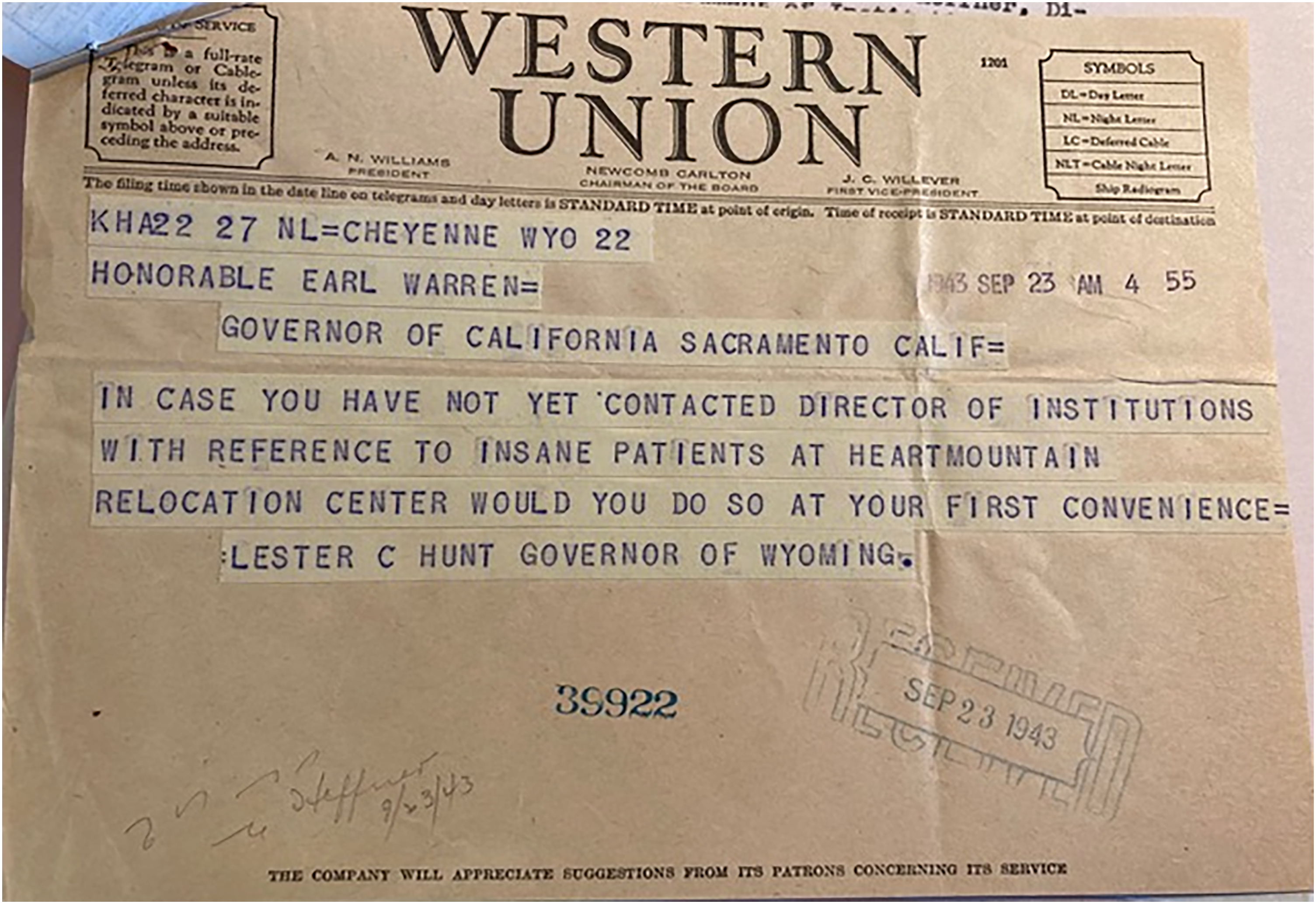
Telegram from the governor of Wyoming to the governor of California asking the latter to contact the California department of institutions on behalf of the equivalent agency in Wyoming regarding “insane patients at heart mountain.” Courtesy of the California State Archives.
Even after these initial administrative negotiations, S ultimately never spent time in the Wyoming Training School before being “deported” to California. The training school may not have had vacancies, 145 which may explain the superintendent's desire for S's direct transfer to a California institution. S's file 146 contained no further correspondence about his institutionalization until after an unfortunate tragedy on October 27, 1943. S had continued working in carpentry while the WRA and Wyoming state officials corresponded about physically institutionalizing S. Returning from a work assignment with other carpenters, the crew made a stop in Cody, Wyoming, a town about 20 miles outside of camp. A fellow worker asked S to make a purchase for him at a local bar. While S waited patiently for service, two military police officers drinking there demanded he leave. When S walked outside, one of the officers followed and attacked him. The soldier's first strike “knock[ed] him to the ground.” The soldier struck him several more times with S not physically defending himself. After the attack, S was hospitalized multiple times to treat his broken jaw. Though the military police officer blamed S for instigating by lobbing insults at the soldiers, a WRA investigation concluded that the attack on S was unprovoked and a likely case of “mistaken identity.” 147 A December 8, 1943 letter 148 from the project director to the attacker's commanding officer regarding the attack described S as “a peaceful kind of a person, not violent or aggressive in any manner whatsoever.”
Just two days later, the Wyoming State Board of Charities and Reform finally received approval from the CA Department of Institutions to transfer S back to an institution in California. 149 November correspondence indicates that the approved transfer could not proceed that month due to S receiving ongoing medical care for his jaw and difficulties coordinating travel back to California with a medical escort. 150 The same employee of the WRA, a male registered nurse, was referenced as a medical escort in several institutionalizations from different WRA camps and seemed to make multiple long interstate trips in succession to transport Japanese American patients. 151 The letters again usually referenced multiple individuals being transferred for institutionalization, demonstrating the backlog of cases at Heart Mountain and the WRA's effort to optimize transfer arrangements. S was finally taken back to California in February of 1944, 152 care of the Sheriff's office; his institutionalization took over half a year.
After S's admission to Sonoma State Home for the Feebleminded on February 19, 1944, his family had trouble communicating with him. A February 29, 1944 letter 153 from the principal medical officer and medical social worker at Heart Mountain to a San Francisco-based WRA official stated “We find that S's parents have heard nothing from him since his admission; naturally, they are anxious to have his address.” Three weeks after his admission, the Heart Mountain acting project director wrote to the superintendent of Sonoma State Home on behalf of S's parents. 154 They wanted to know how S was doing after they had not heard from him despite having given “him some postcards and self-addressed envelopes so that someone could write for him.” Dr. F. O. Butler, the medical director and superintendent of Sonoma, responded on March 13, 1944, that they had just answered a letter from S's father and that “As a rule, we do not write or wire the parents of patients unless in special instances” (Figure 5). 155
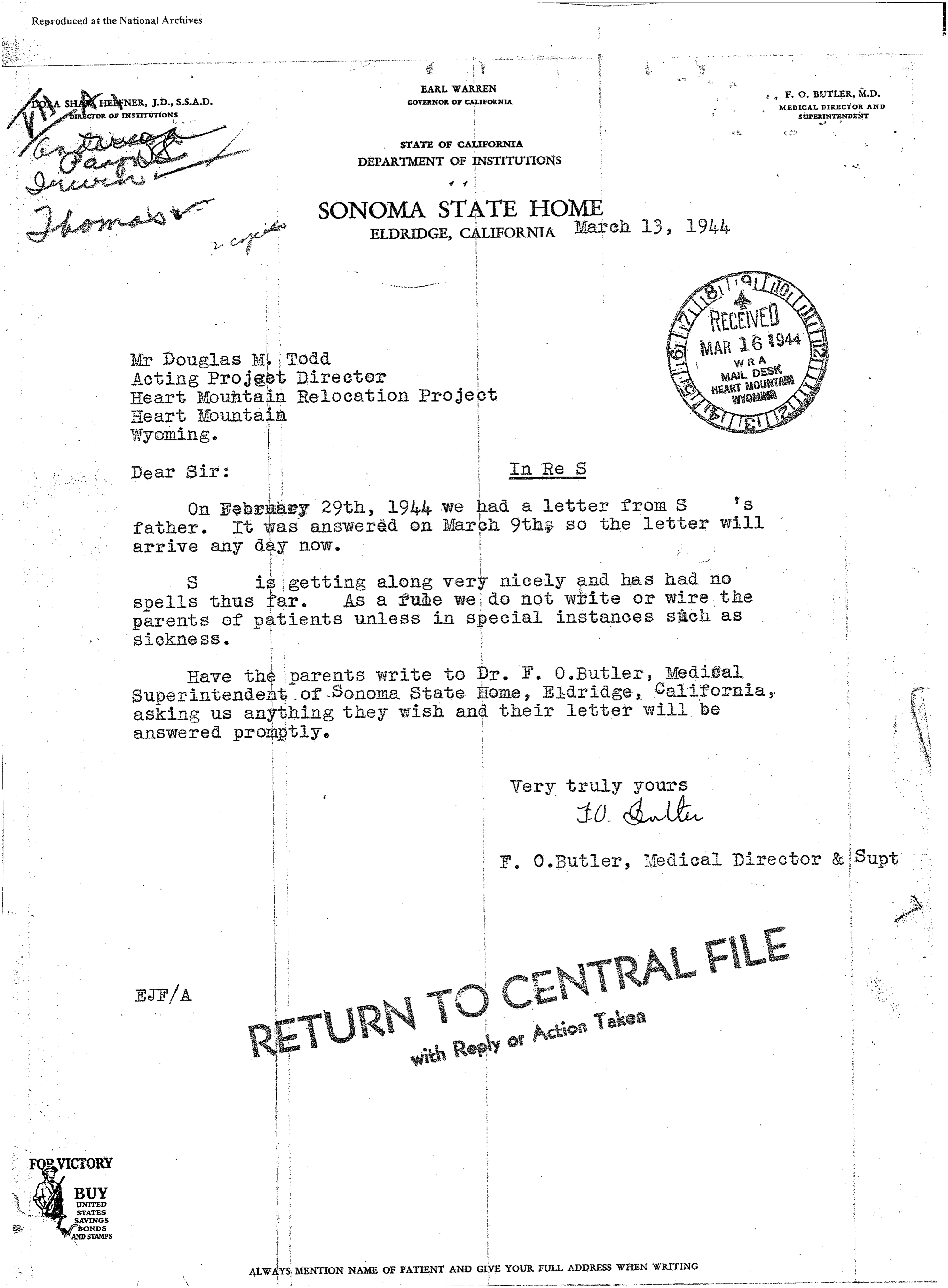
Letter from F. O. Butler, Medical Director and Superintendent of Sonoma State Home, to Douglas M. Todd, Acting Project Director of Heart Mountain Relocation Center. Courtesy of the National Archives and Records Administration.
The Department of Institutions sterilization forms reveal additional details about S's experience where the information in his WRA file ends. His father's handwritten signature appears above the family's Heart Mountain block address on a consent form dated April 7, 1944. Within eleven days, the superintendent of Sonoma had requested authorization to sterilize S, and the director of the Department of Institutions had approved. S underwent a sterilization operation about a month later, a total of about three months after his admission to Sonoma. 156 There is no evidence indicating that he was paroled or rejoined his family at Heart Mountain after sterilization, even though his brother's family remained incarcerated until late 1944 and his parents remained incarcerated until September 1945. 157
J's Story: An Adolescence Shaped by Incarceration and Loss
J was not yet a teenager when he and his family were incarcerated at Poston in May 1942. Just over 2 years later in July 1943, J's mother died from tuberculosis and cancer. 158 She left behind J, his father, and his four siblings, all of whom were still incarcerated at Poston. J's father was hospitalized with tuberculosis later the same year for about five months, 159 temporarily leaving his five children without parental care. J and his siblings were also tested for tuberculosis because the cramped incarceration camp living quarters increased the spread of an already very contagious and difficult to treat disease. J visited the Poston Clinic throughout 1943 and 1944 for treatment of minor injuries, dental issues, and tuberculosis testing. At one such visit in March 1944, the Poston Health Section referred J to the “special pediatric clinic for consideration of his retarded mentality” 160 and claimed one of his brothers was similar in mentality. 161 J underwent a litany of mental tests, which were common tools eugenicists used to classify people as “mentally deficient” or “feebleminded,” but were also used more broadly in fields such as education. Some of the tests given to J appeared to be routine testing done in school, and some were performed at the special pediatric clinic 162 to which he was referred.
J had been labeled early in his incarceration on WRA form 26 as having “mental trouble,” 163 and educational records 164 continue to note his struggles in school. Several of these same records highlight that despite his learning difficulties, he “trie[d] very hard.” In the hobbies section of Form 26, only “handwork” is listed, but his school entrance record reports that he also “like[d] to work with plants.” 165 His sixth-grade teacher's reports for J for the 1943–1944 school year 166 acknowledge not only the social, behavioral, and learning challenges J faced in school but also contain many positive comments about the time he spent in her classroom. For example, in December of 1943, only four months after the passing of his mother, she wrote J “is making very satisfactory progress because he is trying.” She expands on J's progress and the help he offered her as his teacher in another note two months later, writing J “is making very satisfactory progress in every way. He is usually obedient and cooperative. I can always count on [J] when I have a special job that needs doing, or an errand to run.” This teacher understood J's need for positive encouragement and recognized that his acting out stemmed from his need for attention and support. She ended the report stating she “shall miss him next year.”
Unfortunately, J began to receive increasingly negative attention for his behavior from the community and WRA officials after his seventh-grade school year. In the summer of 1945, while the WRA was increasingly pressuring Japanese Americans to “relocate” or “resettle” outside the camps, J was apprehended after a minor burglary 167 and confined to the Parker jail for days. The project attorney reported “arrangements were made through the relocation department whereby he was taken to a home for defective children in Los Angeles. This will undoubtedly be very much to his advantage, will save much annoyance and probably some property in this center, and will give his family an opportunity to relocate, which seemed almost impossible while they had [J] on their hands.” 168 His commitment was processed through the Los Angeles County Court system even though he and his entire family except his older brother were still at Poston. The commitment papers 169 describe J as a “general nuisance … loitering about offices and allegedly stealing.” He was admitted to Pacific Colony, the referenced home for defective children, on August 8, 1945, at only 15 years old. Formulaic correspondence 170 between WRA employees and Pacific Colony's medical superintendent mentions giving reports on J's condition to “reassure his parents” and providing the institution with “his parents’ names and addresses” despite his mother having died two years prior while incarcerated.
J's oldest sister C, who likely took on a care-taking role for her younger siblings after their mother's death, was allowed to visit J at Pacific Colony on August 17, 1945. She reported back to her family, the Poston community, and WRA officials of disturbing conditions at Pacific Colony. She wrote a letter (Figure 6) 171 detailing prolonged confinement and physical abuse from a nightwatchman and “other boys” in J's “cottage,” which was not segregated despite lingering anti-Japanese sentiment. 172 She was also told by an attendant and a doctor that J could not attend school “unless he were a good boy.” 173 The WRA initially appeared to take these allegations seriously, in part because concerns about them reached beyond J's family to “other families who have learned of [the] report,” and Poston was seeking “placement of mentally deficient children” at Pacific Colony for other families (Figure 7). 174
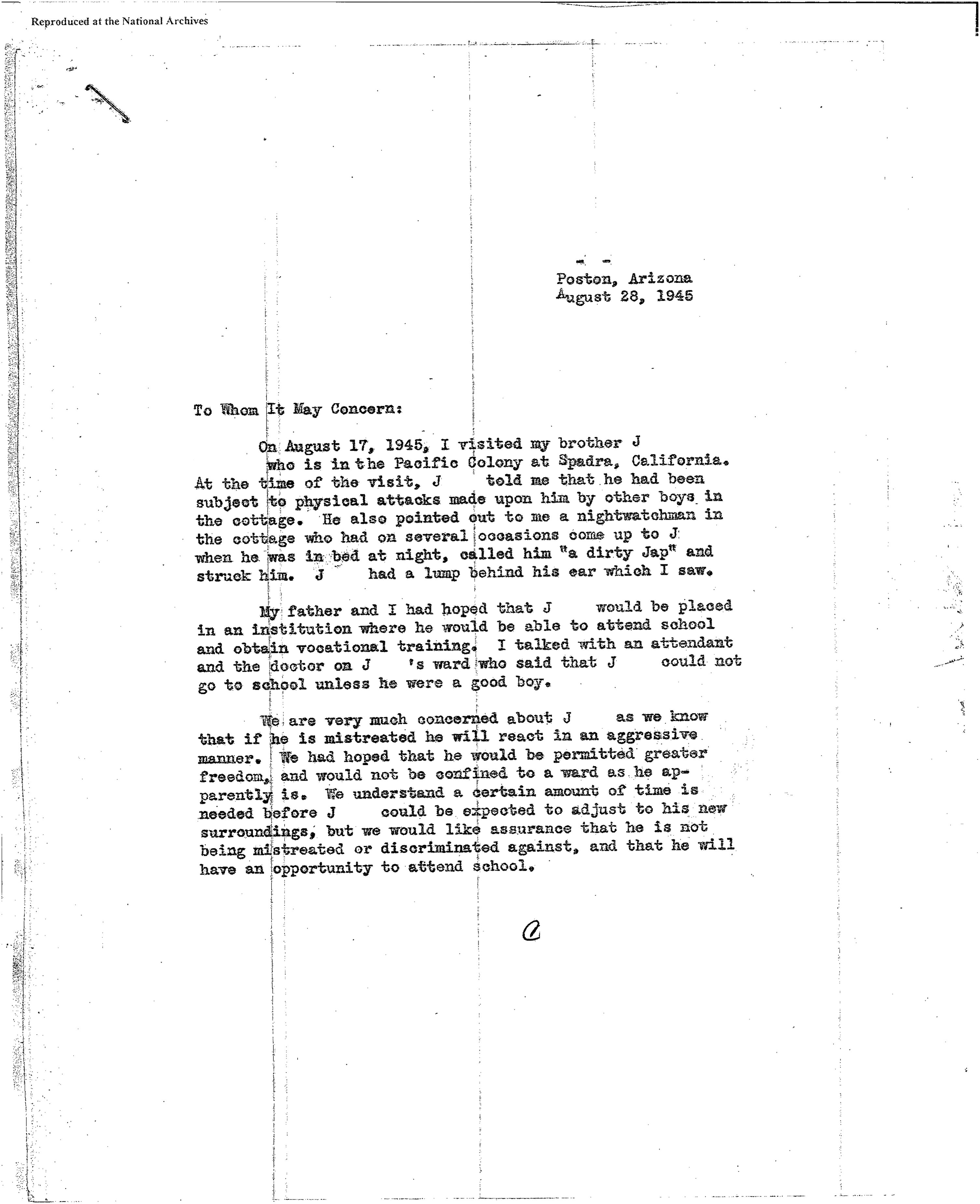
Letter of complaint written by J's oldest sister, C (full name redacted). Courtesy of the National Archives and Records Administration.
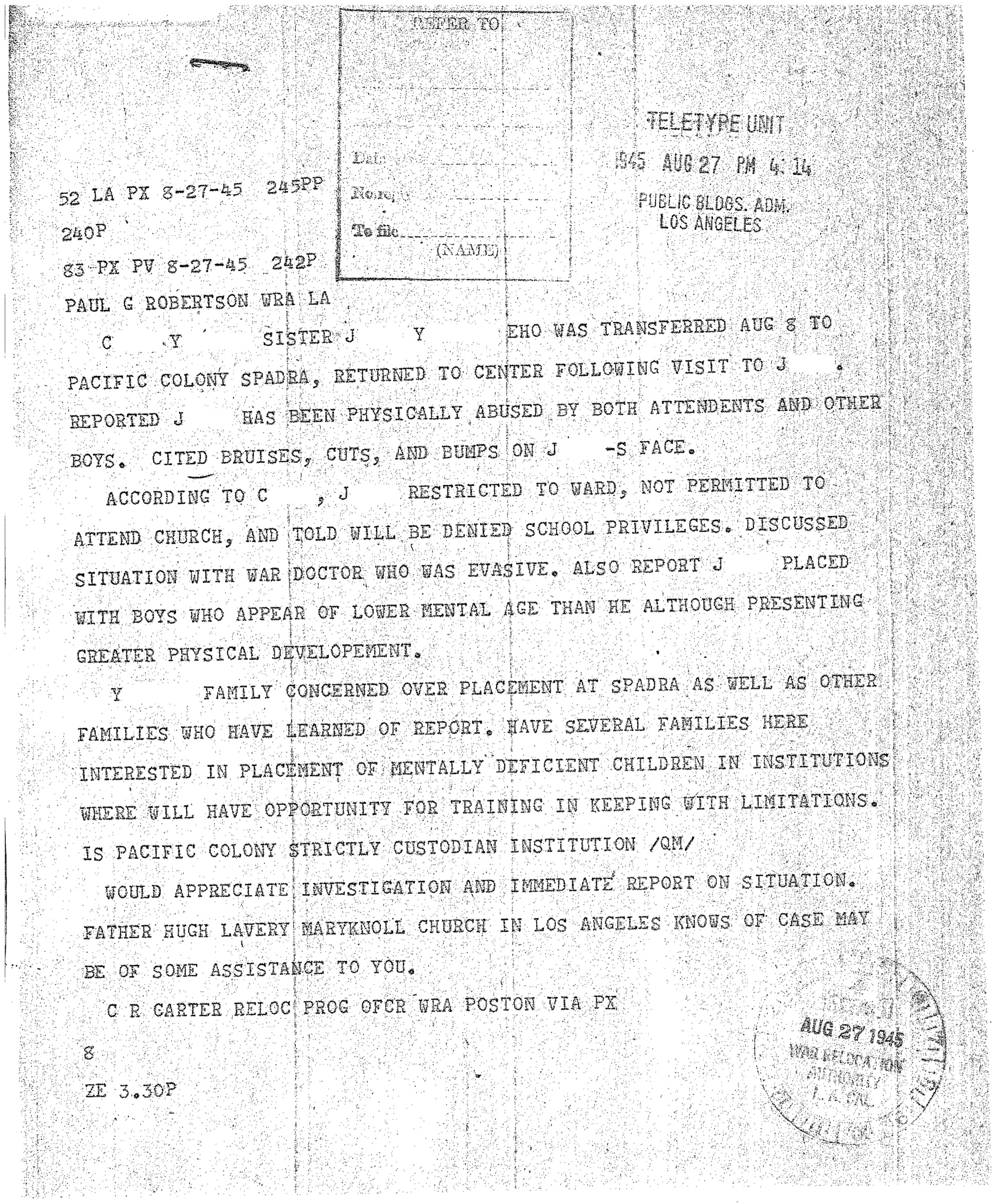
WRA initial response to reports of abuse at pacific colony by J's oldest sister, C (full name redacted). Courtesy of the National Archives and Records Administration.
The “investigation” wrapped up after a brief series of reports and a single visit to Pacific Colony on August 29, 1945, by three WRA officials. At least one of the reports incorrectly stated the date of C's visit, one of the most basic facts of the case. During the visit, J was first interviewed in the company of six WRA and Pacific Colony officials. The author of the report, a WRA special relocation officer, acknowledged their presence as “quite an imposing array of adults to be faced by the juvenile.” According to the author, J nevertheless “did not seem inhibited and talked readily.” This supposedly uninhibited interview consisted primarily of J's pleas to be reunited with his family. He promised “he would be good now,” if he could only return to his family. Someone present at the interview apparently delivered “news that [J's] family planned to relocate in the East and leave him at Spadra [Pacific Colony],” bringing J to “the verge of tears.” 175 This contradicts Poston's final accountability roster which lists a terminal departure location of Los Angeles for J's family. 176 At this point, the WRA Chief Medical Officer was left alone with J to continue the interview “under circumstances in which the boy would not feel so outnumbered by possibly unfriendly elders,” but the Chief Medical Officer's own report was not in J's WRA individual case file.
The WRA's investigation of J's experiences was hardly impartial given the involvement of Pacific Colony staff. The medical superintendent even thanked the WRA “for the dignified manner in which they presented the case” and ensuring that “everything possible has been done to safeguard the best interests of both the patient and institution.” 177 Unsurprisingly, the resulting reports and correspondence dismissed most of the complaints as unfounded. J “did not substantiate” his sister's claims that he suffered physical abuse at the hands of the other boys in his cottage and “scrutiny of his face failed to show marks of bruises, cuts or bumps, which [C] says she observed at a time 14 days prior to our visit.” J's assertion that he was hit by an attendant was described as “not too lucid.” Though eventual further investigation by Pacific Colony revealed that such an incident did occur, this WRA report speculates “that the real injury suffered may have been to the pride and dignity of a boy who suffered abrupt correction, corporal or otherwise, in public, and before a group in which he was a semi-stranger at the time.” One of the other conclusions given in the report states that the medical superintendent “may refuse to harbor [J],” suggesting that the superintendent could expel J from the institution due to J's behavior or his family's complaints and thus prevent J from receiving the “training” and care at Pacific Colony that his family hoped he could receive there.
Beyond the individual-level abuse directed at J, C had also expressed concern about possible racial discrimination toward her younger brother. Institutional authorities concluded that discrimination did not affect J and his treatment at Pacific Colony, yet the investigative report quotes the medical superintendent describing racial slurs as “the vogue among the patients.” In addition, other boys in J's ward reportedly told him that they’d seen “the Yanks kill your brother” after “returning from a movie in which apparently an American hero cinema soldier mowed down the Japanese enemy.” 178 The only concrete action taken by Pacific Colony to address the abuse J's sister complained of was the “firing” of one attendant for “sleeping on duty” 179 after he admitted to slapping J. The attendant's resignation letter expressed 180 extremely racist views that undoubtedly contributed to the man's treatment of J.
The documents 181 sadly do not give any insight as to how J's family reacted to the conclusion of the investigation. After the conditions at the institution witnessed by his oldest sister, it is unsurprising that the family acquiesced to the recommendation for sterilization made by Pacific Colony if it increased J's chances of being released, as it so often did for institutionalized people. J's father's handwritten signature appears on a sterilization consent form dated October 19, 1945 (Figure 8), 182 a mere four days after he and two of J's siblings departed from Poston. 183 From there, the superintendent of Pacific Colony requested authorization for the operation and the director of the department of institutions approved the request before the end of the month. J was sterilized in late December 1945, about two months after the approval was granted. All of the WRA incarceration camps, except Tule Lake, had now closed. No mention was made on the sterilization form as to the possible effects on J of over three years of incarceration, the loss of his mother at such a young age, or the alleged physical and mental abuse he encountered at Pacific Colony. Instead, he was succinctly described as a “Mentally deficient boy, general nuisance, petty thief” (Figure 9). 184
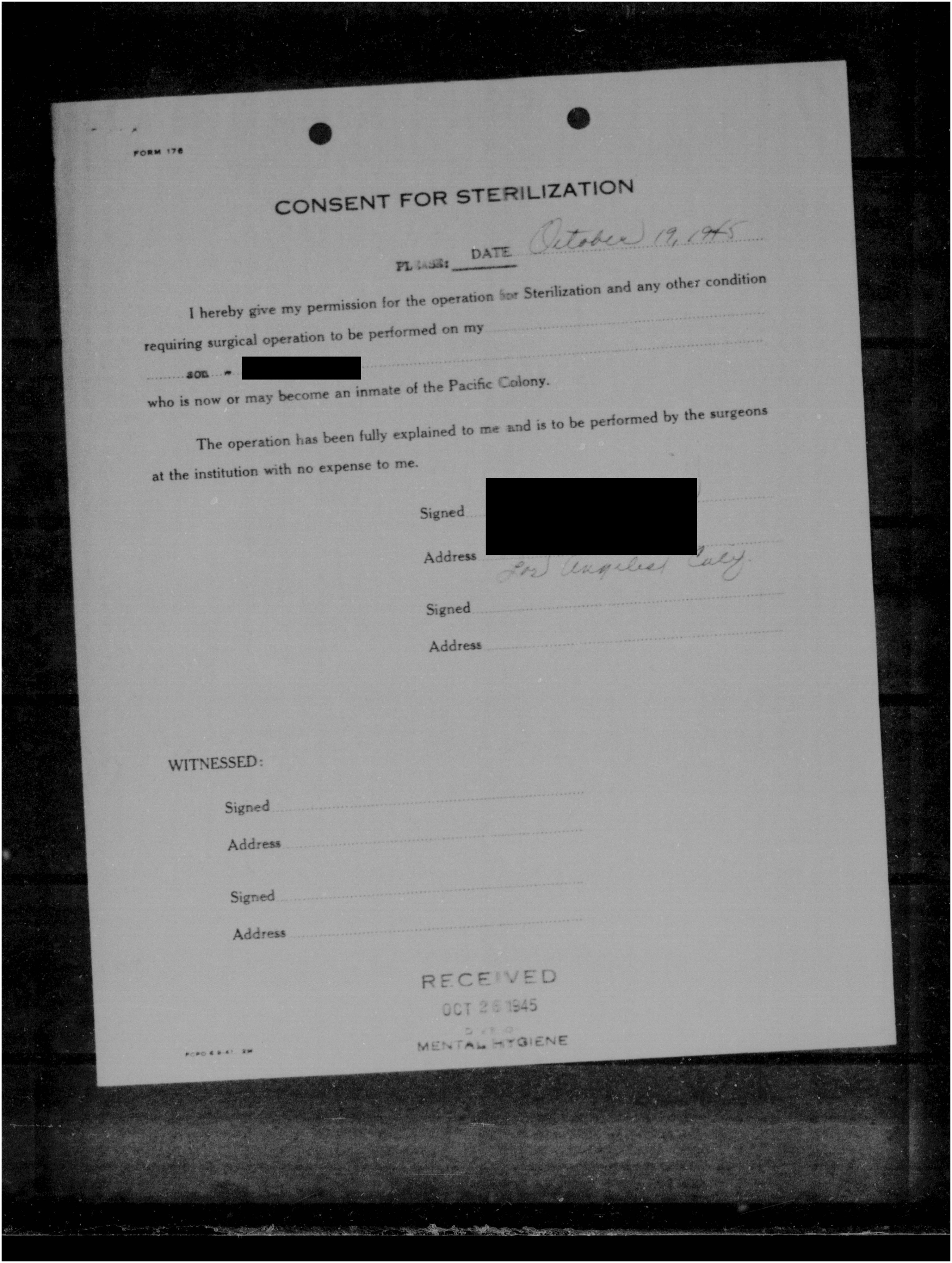
California department of institutions sterilization consent form for J (full name redacted). Used with permission from the California State Archives.
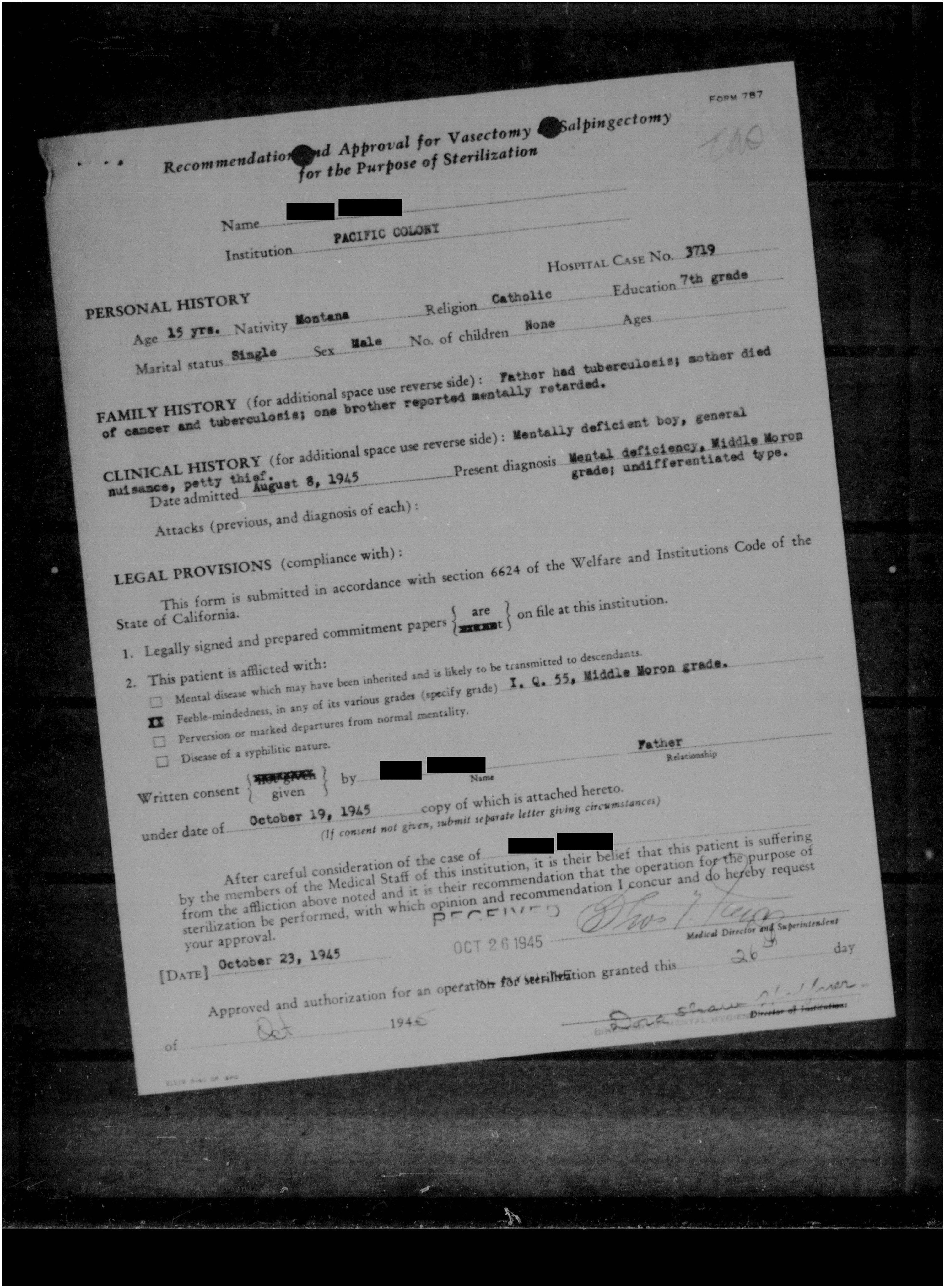
California department of institutions sterilization recommendation form for J (full name redacted). Used with permission from the California State Archives.
Conclusion
In the 1980s, the formation of the Commission on Wartime Relocation and Internment of Civilians resulted in extensive documentation of the civil and human rights abuses associated with the incarceration of Japanese American individuals and families during the 1940s and played a key role in subsequent apologies and reparations. 185 Over time, the violence and trauma of this chapter in U.S. history has been captured in books, articles, exhibits, digital projects, memoirs, oral histories, and films. 186 Organizations like Densho are important stewards of this history and the Japanese American experience more generally. 187 This novel documentation of state-sponsored eugenic sterilization during the mass wartime incarceration of Japanese Americans comprises another harrowing facet of incarceration. Stories of family separation via federal and state agency–facilitated institutionalization should be situated alongside other incarceration-mediated histories of family separation.
The stories of these 32 Japanese American sterilization survivors expand our understanding of the overlapping histories of eugenic sterilization in California and the mass incarceration of West Coast Japanese Americans during WWII. This paper builds on existing and rich bodies of literature in Asian American studies and history of medicine and links the federal project of Japanese American wartime incarceration to California's state project of eugenic sterilization. Notably, through J's story, it directly documents racism within California State Institutions, something that is not always explicit on the sterilization recommendation forms and consent forms. It also centers the stories of multimarginalized people within the Japanese American community, namely those labeled as disabled or mentally ill. The documents cited demonstrate the processes used by the WRA to manage what they identified as cases of deviance and disability, which many families were forced to navigate while incarcerated. Implementing the WRA's goal to Americanize the Japanese American community during their incarceration meant that people who could not “conform” or be rehabilitated to an acceptable standard required segregation not only from the overall American population but from their own community. The strong presence of the lives and experiences of the families of sterilization survivors, often absent in typical institutional records, enhances our understanding of the coercive elements of the “consent” process employed by California State Institutions to proceed with sterilization procedures. Pressures specific to Japanese Americans during WWII included macrolevel phenomena such as war, mass incarceration, and discrimination, and extended to family- and community-level pressures such as generational conflict, death, divorce, teenage rebelliousness, and barriers to communication. Eugenic sterilization was an intensely personal and physical episode for the 32 Japanese Americans subjected to operations in California institutions that nevertheless reverberated across families and generations, infusing a form of reproductive harm into broader patterns of community trauma.
Perhaps the most significant limitation of this article is that most sources are authored by perpetrators of institutional violence. Future research could search for additional documents authored by Japanese Americans, centering their perspectives. Unfortunately, many unanswered questions remain about the administrative decision-making around and experiences of the seven Japanese American sterilization survivors who remained institutionalized during the incarceration period. These individuals did not have much presence in the WRA records available at NARA and the California Department of Institutions records are sporadic or restricted. In addition to addressing the above limitations, future work should contextualize the experiences of these 32 Japanese American sterilization survivors with rates of institutionalization from WRA camps, cases from sterilization programs in other states, and the overall rates of the sterilization of Japanese Americans in California across the twentieth century.
Nonetheless, these 32 cases give an unprecedented look at the lives of sterilization survivors before, during, and after institutionalization. Most sterilization survivors from California institutions appear in the archival record in only two single page documents authored by staff at the institutions. The scope of archival documentation, even with the remaining gaps, more fully humanizes these individuals and echoes the important tradition of reclaiming archival documents to promote justice for the Japanese American community. 188 In several cases, the care shown to the survivors by family and community members shines through the overwhelming presence of institutional violence in their life stories. In some cases, community support systems may have provided a degree of protection against institutionalization, such as “older carpenters” at Heart Mountain taking S under their wing when he and his family struggled with the upheaval of incarceration. These relationships also led to more overt acts of resistance, such as J's sister registering formal complaints about the treatment of her brother at Pacific Colony. In this context, family and community relationships exist as one form of resistance against the bureaucratic and dehumanizing process of institutionalization and sterilization and combat the erasure of multimarginalized persons in the archival record. Japanese American family members actively attempted to maintain communication with, care for, and even visit their institutionalized relatives, often overcoming physical distance, discrimination, institutional apathy, and administrative restrictions to do so.
Footnotes
Acknowledgments
The authors would like to thank Densho for their work in preserving the history of the Japanese American Incarceration, and for their dedication to making their vast archive accessible to a broad audience. The authors especially extend our gratitude to Brian Niiya and Nina Wallace at Densho for sharing their knowledge, meeting with us to discuss the project, and reviewing drafts at various stages. The authors would also like to thank the entire Sterilization and Social Justice Lab team for their support and feedback. The authors are grateful to the archivists at the National Archives and the California State Archives for their assistance. This research was financially supported by the National Human Genome Research Institute (R01 HG010567–05).
Declaration of Conflicting Interests
The author(s) declared no potential conflicts of interest with respect to the research, authorship, and/or publication of this article.
Funding
The author(s) disclosed receipt of the following financial support for the research, authorship, and/or publication of this article: This work was supported by the National Human Genome Research Institute (grant number R01 HG010567-05).

Notes
1.
Department of Justice, Civil Rights Division, and Bancroft Library. “[Japanese-American Internee Data File], 1942–1946,” 1989. Series: Records About Japanese Americans Relocated During World War II, created 1988–1989, documenting the period 19421946, Record Group 210. National Archives at College Park—Electronic Records. https://aad.archives.gov/aad/series-description.jsp?s=623&cat=WR26&bc=,sl.
2.
Heart Mountain Sentinel. “Old-Timers Toil With Youths To Keep Railroads Running.” September 11, 1943. Folder: 202042_058_0801. ProQuest History Vault. Online; Heart Mountain Sentinel. “Parade.” April 8, 1944. Folder: 202042_059_0181. ProQuest History Vault. Online; Heart Mountain Sentinel. “80 Scouts Win ‘E’ Awards at Field Program.” July 1, 1944. Folder: 202042_059_0551. ProQuest History Vault. Online; Heart Mountain Sentinel. “Dancer Presents Farewell Program.” September 30, 1944. Folder: 202042_059_0760. ProQuest History Vault. Online.
3.
On Pacific Colony see Natalie Lira, Laboratory of Deficiency. Lira, Natalie. Laboratory of Deficiency: Sterilization and Confinement in California, 1900–1950s. University of California Press, 2021.
4.
“California Sterilization Dataset, Sterilization and Social Justice Lab.” Microform. Sterilization Records, 1925–1954, Department of Institutions, Department of Mental Hygiene, 1945. Reel 124, Documents 1383 and 1384. California State Archives. Office of the Secretary of State, Sacramento, CA. Used with permission of the California State Archives.
5.
Densho: Preserving Japanese American stories of the past for the generations of tomorrow. “Terminology,” June 18, 2015.
6.
Nakagawa, Gordon. “Deformed Subjects, Docile Bodies: Disciplinary Practices and Subject-Constitution in Stories of Japanese-American Internment.” In Narrative and Social Control: Critical Perspectives, edited by Dennis K. Mumby, 143–63. London, England: SAGE Publications, 1993.; Whatcott, Jess. “No Selves to Consent: Women's Prisons, Sterilization, and the Biopolitics of Informed Consent.” Signs: Journal of Women in Culture and Society 44, no. 1 (2018): 131–53.; Coyle, Michael J., and Stephen T. Young. “The Rhetoric of Dehumanization: Japanese American Concentration Camps and the US Criminalizing System.” In Contesting Carceral Logic: Towards Abolitionist Futures, edited by Michael J. Coyle and Mechthild Nagel. London: Routledge, 2021.
7.
Lee, Erika. The Making of Asian America: A History. Simon and Schuster, 2015.
8.
Choy, Catherine Ceniza. Asian American Histories of the United States. Beacon Press, 2022.; Pfaelzer, Jean. Driven Out: The Forgotten War Against Chinese Americans. University of California Press, 2008.
9.
“Quota or Exclusion for Japanese Immigrants.” The Commonwealth, Official Journal of the Commonwealth Club of California VIII, no. 51 (December 20, 1932): 291.
10.
Glen E. Hoover, Chairman, Section on Immigration, Commonwealth Club of California. Letter sent to senators and members of House of Representatives, July 14, 1953. Papers held by coauthor [redacted].
11.
Shah, Nayan. Contagious Divides: Epidemics and Race in San Francisco's Chinatown. University of California Press, 2001.
12.
Baynton, Douglas C. Defectives in the Land: Disability and Immigration in the Age of Eugenics. Chicago: University of Chicago Press, 2016. https://doi-org.proxy.lib.umich.edu/10.7208/9780226364339; Molina, Natalia. Fit to Be Citizens?: Public Health and Race in Los Angeles, 1879-1939. Berkeley: University of California Press, 2006. https://doi-org.proxy.lib.umich.edu/10.1525/9780520939202; Ngai, Mae M. Impossible Subjects: Illegal Aliens and the Making of Modern America. Politics and Society in Modern America 105. Princeton, NJ: Princeton University Press, 2014.
13.
Stern, Alexandra Minna. Eugenic Nation: Faults and Frontiers of Better Breeding in Modern America, 2nd Ed. University of California Press, 2015.; Largent, Mark A. Breeding Contempt: The History of Coerced Sterilization in the United States. New Brunswick, NJ: Rutgers University Press, 2011.
14.
Roosevelt, Franklin. “Column.” Macon Telegraph, April 30, 1925, quoted in Greg Robinson, After Camp: Portraits in Midcentury Japanese American Life and Politics (Berkeley: University of California Press, 2012).
15.
Stern, Eugenic Nation, 2015.
16.
Kühl, Stefan. The Nazi Connection: Eugenics, American Racism, and German National Socialism. New York, NY: Oxford University Press, 2001.; Largent, Breeding Contempt, 2011.; Stern, Eugenic Nation, 2015.
17.
Kline, Wendy. Building a Better Race: Gender, Sexuality, and Eugenics from the Turn of the Century to the Baby Boom. University of California Press, 2001.; Largent, Breeding Contempt, 2011.; Stern, Eugenic Nation, 2015.
18.
Largent, Breeding Contempt, 2011.; Stern, Eugenic Nation, 2015.
19.
Reilly, Philip R. The Surgical Solution: A History of Involuntary Sterilization in the United States. Baltimore, MD: Johns Hopkins University Press, 1991.; Stern, Eugenic Nation, 2015.
20.
Whitman, James Q. Hitler's American Model: The United States and the Making of Nazi Race Law. Princeton University Press, 2017.; Kühl, The Nazi Connection, 2001.
21.
“The Statutes of California and Amendments to the Codes Passed at the Forty-Second Session of the Legislature 1917.” California State Printing Office, 1917.
22.
Popenoe, Paul. “Attitude of Patient's Relatives toward the Operation.” Journal of Social Hygiene 14, no. 5 (1928): 271–79.
23.
Lira, Laboratory of Deficiency, 2021.; Stern, Eugenic Nation, 2015.
24.
“Sterilization Records, 1925-1954.” Microform. Department of Institutions; Department of Mental Hygiene, 1945. California State Archives. Office of the Secretary of State, Sacramento, CA.
25.
California State Printing Office. Second Biennial Report of the Department of Institutions of the State of California Two Years Ending June 30, 1924. Sacramento, CA: California State Printing Office, 1924.; California State Printing Office. Third Biennial Report of the Department of Institutions of the State of California: Two Years Ending June 30, 1926. Sacramento, CA: California State Printing Office, 1926.; Edgerton, Robert B. The Cloak of Competence, Revised and Updated Edition. Berkeley, CA: University of California Press, 1993.; Rouble, Jewel Mina. “Social and Industrial Adjustment of the Feebleminded on Parole.” Master’s thesis, University of California, 1942.
26.
Lira, Laboratory of Deficiency, 2021.; Stern, Eugenic Nation, 2015.
27.
Baynton, Douglas C. “Disability and the Justification of Inequality in American History.” In The New Disability History: American Perspectives, edited by Paul K. Longmore and Lauri Umansky. The History of Disability. New York, NY: New York University Press, 2000.; Baynton, Defectives in the Land, 2016.; Hogarth, Rana A. Medicalizing Blackness: Making Racial Difference in the Atlantic World, 1780–1840. Chapel Hill, NC: University of North Carolina Press, 2017.
28.
Lira, Laboratory of Deficiency, 2021.
29.
Woodside, Moya. Sterilization in North Carolina: A Sociological and Psychological Study. Richmond, Virginia: The William Byrd Press, Inc., 1950.
30.
Reilly, The Surgical Solution, 1991.; Stern, Eugenic Nation, 2015.; Kline, Building a Better Race, 2001.; Gartner, Danielle R., Anna L. Krome-Lukens, and Paul L. Delamater. “Implementation of Eugenic Sterilization in North Carolina: Geographic Proximity to Raleigh and Its Association with Female Sterilization during the Mid-20th Century.” Southeastern Geographer 60, no. 3 (2020): 254–74.; Price, Gregory N., and William A. Darity Jr. “The Economics of Race and Eugenic Sterilization in North Carolina: 1958-1968.” Economics and Human Biology 8, no. 2 (July 2010): 261–72.
31.
Novak, Nicole L., Natalie Lira, Kate E. O’Connor, Siobán D. Harlow, Sharon L. R. Kardia, and Alexandra Minna Stern. “Disproportionate Sterilization of Latinos Under California's Eugenic Sterilization Program, 1920-1945.” American Journal of Public Health 108, no. 5 (May 2018): 611–13.
32.
Kaniecki, Marie, Nicole L. Novak, Sarah Gao, Natalie Lira, Toni Ann Treviño, Kate O’Connor, and Alexandra Minna Stern. “Racialization and Reproduction: Asian Immigrants and California's Twentieth-Century Eugenic Sterilization Program.” Social Forces; a Scientific Medium of Social Study and Interpretation 102, no. 2 (December 2023): 706–29.
33.
Calculated from statistics reported on page 61 of “The Evacuated People: A Quantitative Description.” United States Department of the Interior: War Relocation Authority. “The Evacuated People: A Quantitative Description.” U.S. Government Printing Office, 1946.
34.
Whitman, Hitler's American Model, 2017.; Tyner, James A. “The Geopolitics of Eugenics and the Incarceration of Japanese Americans.” Antipode 30, no. 3 (July 1998): 251–69.
35.
Niiya, Brian. “California Joint Immigration Committee.” In Densho Encyclopedia, December 13, 2023. Online.
36.
McWilliams, Carey. Prejudice: Japanese Americans: Symbol of Racial Intolerance. Boston: Little, Brown, and Company, 1945. Chapter VII.
37.
Dower, John W. War without Mercy: Race and Power in the Pacific War. New York: Pantheon Books, 1986.; Gerstle, Gary. American Crucible: Race and Nation in the Twentieth Century. Princeton, NJ: Princeton University Press, 2001.; Gerstle, Gary. The Rise and Fall of the Neoliberal Order: America and the World in the Free Market Era. Oxford: Oxford University Press, 2022.; Lee, Fred I. “The Japanese Internment and the Racial State of Exception.” Theory & Event 10, no. 1 (2007). https://doi.org/10.1353/tae.2007.0043.
38.
Kashima, Tetsuden. Judgment Without Trial: Japanese American Imprisonment During World War II. University of Washington Press, 2003.
39.
Park, Yoosun. Facilitating Injustice: The Complicity of Social Workers in the Forced Removal and Incarceration of Japanese Americans, 1941-1946. Oxford University Press, 2019.
40.
Kennedy, Angie C. “Eugenics, ‘Degenerate Girls,’ and Social Workers During the Progressive Era.” Feminist Inquiry in Social Work 23, no. 1 (February 1, 2008): 22–37.
41.
Park, Facilitating Injustice, 2019. See especially pages 225–221.
42.
Muller, Eric L. “Of Coercion and Accommodation: Looking at Japanese American Imprisonment through a Law Office Window.” Law and History Review 35, no. 2 (May 2017): 277–319.
43.
Chiang, Connie Y. “Imprisoned Nature: Toward an Environmental History of the World War II Japanese American Incarceration.” Environmental History 15 (April 2010): 236–67.; Nakagawa, “Deformed Subjects, Docile Bodies,” 1993.; Matsumoto, Valerie. “Japanese American Women during World War II.” Frontiers: A Journal of Women's Studies 8, no. 1 (1984): 6–14.
44.
Fiset, L. “Public Health in World War II Assembly Centers for Japanese Americans.” Bulletin of the History of Medicine 73, no. 4 (Winter 1999): 565–84.; Jensen, Gwenn M. “System Failure: Health-Care Deficiencies in the World War II Japanese American Detention Centers.” Bulletin of the History of Medicine 73, no. 4 (Winter 1999).
45.
McKay, Susan. “Maternal Health Care at a Japanese American Relocation Camp, 1942–1945: A Historical Study.” Birth 24, no. 3 (September 1997): 188–93; Davies, Jasmine. “Reproducing Evacuees: Japanese American Women's Experiences with Reproductive Health during United States Internment, 1942–1945.” M.A. Thesis, Texas State University, 2022.
46.
Nakagawa, “Deformed Subjects, Docile Bodies,” 1993.; Matsumoto, “Japanese American Women during World War II,” 1984.
47.
Commission on Wartime Relocation and Internment of Civilians (CWRIC). “Personal Justice Denied.” U.S. Government Printing Office, 1983. See page 164.
48.
Nagata, Donna K., Jacqueline H. J. Kim, and Kaidi Wu. “The Japanese American Wartime Incarceration: Examining the Scope of Racial Trauma.” The American Psychologist 74, no. 1 (January 2019): 36–48.; Imada, Adria L. “'The Potential That Was in All of Us’: Carceral Disability and the Japanese American Redress Movement.” WSQ Women's Studies Quarterly 51, no. 1–2 (Spring/Summer 2023): 21–47.
49.
Kashima, Judgment Without Trial, 2003.; Wallace, Nina. “Of Spies and G-Men: How the U.S. Government Turned Japanese Americans into Enemies of the State.” Densho Catalyst: History, Essays, and Opinion, September 29, 2017. https://densho.org/catalyst/of-spies-and-gmen/.
50.
Girdner, Audrie, and Anne Loftis. The Great Betrayal: The Evacuation of the Japanese-Americans During World War II. Ontario: The Macmillan Company, 1969.
51.
Sakauye, Eiichi Edward. Heart Mountain: A Photo Essay. San Mateo, CA: AACP, Inc., 2000.; Asaka, Megan. “Resettlement.” In Densho Encyclopedia, October 8, 2020. https://encyclopedia.densho.org/Resettlement/.
52.
War Relocation Authority, “The Evacuated People: A Quantitative Description,” 1946, pages 181–182, 186.
53.
CWRIC, Personal Justice Denied, 1982, p. 140.
54.
Hoshida, George, and Tamae Hoshida. Taken from the Paradise Isle: The Hoshida Family Story. Edited by Heidi Kim. The George and Sakaye Aratani Nikkei in the Americas Series. Boulder: University Press of Colorado, 2015.; Masumoto, David Mas. Secret Harvests: A Hidden Story of Separation and the Resilience of a Family Farm. Artwork by Patricia Wakida. Pasadena, CA: Red Hen Press, 2023.
55.
Austin, Allan W. “Eastward Pioneers: Japanese American Resettlement during World War II and the Contested Meaning of Exile and Incarceration.” Journal of American Ethnic History 26, no. 2 (January 1, 2007): 58–84.
56.
Grodzins, Morton. Americans Betrayed: Politics and the Japanese Evacuation. The University of Chicago Press, 1949, quoted in Tyner, “The Geopolitics of Eugenics and the Incarceration of Japanese Americans,” 1998.
57.
Statement of Rep. J. E. Rankin. U.S. Congress. Congressional Record. 77th Cong., 2nd sess., 1942. Vol. 88, pt. 8, p. A931.
58.
Grodzins, Americans Betrayed, 1949, quoted in Tyner, “The Geopolitics of Eugenics and the Incarceration of Japanese Americans,” 1998.
59.
Roosevelt, Franklin Delano. Letter to Aleš Hrdlička, 1942., quoted in Robinson, Greg. After Camp: Portraits in Midcentury Japanese American Life and Politics. University of California Press, 2012.
60.
New Leader. “The Right to Reproduce,” editorial. March 3, 1945. Quoted in Ordover, Nancy. American Eugenics: Race, Queer Anatomy, and the Science of Nationalism. Minneapolis, MN: University of Minnesota Press, 2003.
61.
Leong, Russell C., ed. “The Commission on Wartime Relocation and Internment of Civilians: Selected Testimonies from the Los Angeles and San Francisco Hearings.” Amerasia Journal 8, no. 2 (October 1, 1981): 53–105.
62.
Sterilization and Social Justice Lab. “California Sterilization Dataset,” 2016.; “Sterilization Records, 1925–1954.” Microform. Department of Institutions; Department of Mental Hygiene, 1942. California State Archives. Office of the Secretary of State, Sacramento, CA.
63.
Harris, Paul A., Robert Taylor, Robert Thielke, Jonathon Payne, Nathaniel Gonzalez, and Jose G. Conde. “Research electronic data capture (REDCap)—a metadata-driven methodology and workflow process for providing translational research informatics support.” Journal of Biomedical Informatics 42, no. 2 (2009): 377–381.
64.
Lauderdale, Diane S., and Bert Kestenbaum. “Asian American ethnic identification by surname.” Population Research and Policy Review 19 (2000): 283–300.
65.
Records of the War Relocation Authority [WRA], Record Group 210, 1941–47. National Archives and Records Administration. National Archives Building, Washington, DC.
66.
Department of Social Welfare, War Services Bureau, F3729. California State Archives. Office of the Secretary of State, Sacramento, CA.; “Japanese Americans – Evacuation and Relocation, 1942–1945.” California Department of Education Records, F3752:1808–1868. California State Archives. Office of the Secretary of State, Sacramento, CA.; Earl Warren Papers, F3640. California State Archives. Office of the Secretary of State, Sacramento, CA.
67.
War Relocation Authority, “The Evacuated People: A Quantitative Description,” 1946, pages 181 and 186.
68.
War Relocation Authority, “The Evacuated People: A Quantitative Description,” 1946, page 187.
69.
War Relocation Authority, “The Evacuated People: A Quantitative Description,” 1946, page 61.
70.
War Relocation Authority, “The Evacuated People: A Quantitative Description,” 1946, page 187.
71.
California Department of Mental Hygiene. “Statistical Report of the Department of Mental Hygiene, State of California, Year Ending June 30, 1950,” June 30, 1950.
72.
Kline, Building a Better Race, 2001.; Carey, Allison C., and Lucy Gu. “Walking the Line between the Past and the Future: Parents’ Resistance and Commitment to Institutionalization.” In Disability Incarcerated: Imprisonment and Disability in the United States and Canada, edited by Liat Ben-Moshe, Chris Chapman, and Allison C. Carey, 101–19. New York: Palgrave Macmillan US, 2014.; Lira, Laboratory of, 2021.
73.
Lira, Laboratory of Deficiency, 2021, 168.
74.
Lira, Laboratory of Deficiency, 2021.; California State Printing Office, Second Biennial Report, 1924.; California State Printing Office, Third Biennial Report, 1926.; Edgerton, The Cloak of Competence, 1993.; Rouble, “Social and Industrial Adjustment of the Feebleminded on Parole,” 1942.
75.
Lopez, Iris. Matters of Choice: Puerto Rican Women's Struggle for Reproductive Freedom. Ithaca, NY: Rutgers University Press, 2008. https://doi-org.proxy.lib.umich.edu/10.36019/9780813546247.; Lira, Laboratory of Deficiency, 2021.; Ainsworth, Sara L., and Rachel Roth. “‘if They Hand You a Paper, You Sign It’: A Call to End the Sterilization of Women in Prison.” Hastings Women's Law Journal 26, no. 1 (January 1, 2015): 7–50.; Goodwin, Michele. “Vulnerable Subjects: Why Does Informed Consent Matter?” The Journal of Law, Medicine & Ethics: A Journal of the American Society of Law, Medicine & Ethics 44, no. 3 (September 2016): 371–80.; Whatcott, “No Selves to Consent,” 2018.; Nakagawa, “Deformed Subjects, Docile Bodies,” 1993; Ngai, Mae M. “Chapter 5: The World War II Internment of Japanese Americans and the Citizenship Renunciation Cases.” In Impossible Subjects: Illegal Aliens and the Making of Modern America. Politics and Society in Modern America 105. Princeton, NJ: Princeton University Press, 2014.; Muller, “Of Coercion and Accommodation,” 2017.
76.
Lopez, Matters of Choice, 2008.
77.
Lira, Laboratory of Deficiency, 168.; Stern, Eugenic Nation, 2015.; Dron, Heather. “Do Refusals to Give Consent for Eugenic Sterilization Have Relevance to Contemporary Efforts to Ensure Reproductive Justice?” Presented at the ELSI Congress, virtual, June 1, 2022.; The Los Angeles Record. “Girl Saved from State ‘Butchers.’” November 28, 1930.; “Sterilization Records, 1925-1954.” Microform. Department of Institutions; Department of Mental Hygiene, 1944. Reel 117 Documents 2038 and 2039. California State Archives. Office of the Secretary of State, Sacramento, CA.
78.
Burton, Jeffery F., Mary M. Farrell, Florence B. Lord, and Richard W. Lord. Confinement and Ethnicity: An Overview of World War II Japanese American Relocation Sites. The Scott and Laurie Oki Series in Asian American Studies. Seattle: University of Washington Press, 2002.
79.
“Sterilization Records, 1925-1954.” Microform. Department of Institutions; Department of Mental Hygiene, 1944. Reel 123 Document 1841. California State Archives. Office of the Secretary of State, Sacramento, CA.
80.
Niiya, Brian. “Ask a Historian: How Many Japanese Americans Were Incarcerated During WWII?” Densho Catalyst: History, Essays, and Opinion, June 2, 2021. https://densho.org/catalyst/how-many-japanese-americans-were-incarcerated-during-wwii/.
81.
War Relocation Authority, “The Evacuated People: A Quantitative Description,” 1946, pages 181 and 186. Figure includes Japanese Americans institutionalized in prisons, mental institutions, tuberculosis sanatoria, and medical facilities from all states in Military Exclusion Zones 1 and 2.
82.
E.T. Adler, Captain, A.G.D., Assistant Adjutant General. Letter to Lynn D. Mowat, General Manager, Community Welfare Federation, Los Angeles. Department of Social Welfare, War Services Bureau, Enemy Aliens, Japanese in Institutions - Children, F3729:88, March 7, 1942. California State Archives. Office of the Secretary of State, Sacramento, CA.; Zorin, Selma, and Alison Ketcherside. Office Memorandum to Margaret S. Watkins. Department of Social Welfare, War Services Bureau, Enemy Aliens, Japanese in Institutions - Children, F3729:88, March 26, 1942. California State Archives. Office of the Secretary of State, Sacramento, CA.; Watkins, Margaret S., and Selma Zorin. Office Memorandum to Boarding Home Division, State Department of Social Welfare. Department of Social Welfare, War Services Bureau, Enemy Aliens, Japanese in Institutions - Children, F3729:88, March 31, 1942. California State Archives. Office of the Secretary of State, Sacramento, CA.; Aaron J. Rosanoff, M.D., Director, Department of Institutions, State of California. Letter to Azile Aaron, Regional Registrar, Bureau of Public Assistance, Social Security Board. Department of Social Welfare, War Services Bureau, Enemy Aliens, Non-Evacuated Japanese in Institutions, F3729.93, April 7, 1942. California State Archives. Office of the Secretary of State, Sacramento, CA.; Azile H. Aaron, Public Assistance Representative. Letter to Carl E. Applegate, Deputy Director, Department of Institutions. Department of Social Welfare, War Services Bureau, Enemy Aliens, Japanese in Institutions - Children, F3729:88, April 13, 1942. California State Archives. Office of the Secretary of State, Sacramento, CA.; Herman P. Goebel, Jr., Captain, Cavalry, Chief of Regulatory Section. Letter to Martha Chickering, Director, State Department of Social Welfare. Department of Social Welfare, War Services Bureau, Enemy Aliens, Non-Evacuated Japanese in Institutions, F3729.93, May 17, 1942. California State Archives. Office of the Secretary of State, Sacramento, CA.
83.
Public Assistance Representative, Office of the Regional Director, Social Security Board, Federal Security Agency. Letter to Director, State Department of Social Welfare, Sacramento, CA. Department of Social Welfare, War Services Bureau, Enemy Aliens, Medical Care, F3729:89, August 18, 1942. California State Archives. Office of the Secretary of State, Sacramento, CA.
84.
Beulah L. Lewis, Director, Bureau of Medical Social Service. Letter to Mark H. Astrup, Major, A.G.D., Acting Field Assistant Director, Office of the Medical Officer, War Relocation Authority, San Francisco. Records of the War Relocation Authority [WRA], 1941–47, Record Group 210, February 17, 1943. Folder 318.1 State and County Hospitals and Institutions, Box 77 West Coast Area, Los Angeles, California, Entry 47 subject-classified general files, 1943–46, Record Subgroup 210.3.3 Records of WRA area relocation offices. National Archives and Records Administration. National Archives Building, Washington DC.; W.T. Harrison, Medical Director. Letter to Colonel Karl L. Bendetsen, GSC, AC of S, Civil Affairs Division, Presidio of San Francisco, California. Records of the War Relocation Authority [WRA], 1941–47, Record Group 210, July 8, 1943. Folder 318.1 State and County Hospitals and Institutions, Box 77 West Coast Area, Los Angeles, California, Entry 47 subject-classified general files, 1943–46, Record Subgroup 210.3.3 Records of WRA area relocation offices. National Archives and Records Administration. National Archives Building, Washington DC.
85.
California State Printing Office, Second Biennial Report, 1924.; California State Printing Office, Third Biennial Report, 1926.; Edgerton, The Cloak of Competence, 1993.; Rouble, “Social and Industrial Adjustment of the Feebleminded on Parole,” 1942.
86.
Margaret D’Ille, Assistant to Chief of Community Services Division. Letter to G. M. Webster, Medical Director and Superintendent of Patton State Hospital. 210.2.2 Evacuee Case Files, 1942–1946. Records of the War Relocation Authority [WRA], Record Group 210, 1941–47, August 18, 1942. Box 6125. National Archives and Records Administration. National Archives Building, Washington, DC.
87.
Tule Lake Health Section. “General Outline and History of the Health Program at Tule Lake Center,” May 4, 1946. Folder: 202042_114_0690. ProQuest History Vault. Online.
88.
Shallit, B. N., and C. Hale Wellman. “Personal Narrative of B. N. Shallit – Final Report, Welfare Section – War Relocation Authority, Tule Lake, California,” March 31, 1946. Folder: 202042_114_0584. ProQuest History Vault. Online.
89.
Cochran, Mary Lue, and Central Utah Project Health Section. “Review of the Work of the Medical Social Service Department – Closing Hospital Report – Central Utah Project,” May 4, 1946. Folder: 202042_015_0384. ProQuest History Vault. Online.
90.
Colson, Elizabeth. “Personal Journal, 1943.” Reports and Writings, Part 2 Section 5.3.4. Bureau of Sociological Research (BSR), Colorado River Relocation Center – Poston, Arizona (J), Japanese American Evacuation and Resettlement Records, 1930–1974, May 24, 1943. Reel 247, frame:0163, box 140, folder J 10.14. Bancroft Library, UC Berkeley. Online Archive of California. https://oac.cdlib.org/ark:/13030/k6s47011/?brand=oac4.
91.
Webster, G. M. Letter to Thomas M. Temple. 210.2.2 Evacuee Case Files, 1942–1946. Records of the War Relocation Authority [WRA], Record Group 210, 1941–47, August 26, 1942. Box 6125. National Archives and Records Administration. National Archives Building, Washington, DC.
92.
John D. Cook, Reports Officer, Tule Lake Project. “What the Colonists Prevalently Like About Project Life,” November 13, 1942. Folder: 202042_105_0252. ProQuest History Vault. Online.
93.
Todd, Douglas M. “Gila River Relocation Center, Rivers Arizona, Office of Project Director, History Covering Period From August 1, 1945 to November 15, 1945.” The Bancroft Library, University of California, Berkeley, Online Archive of California, 1945.
94.
Cook, John D. Memorandum to John Baker. Tule Lake Incarceration Camp: Project Reports, Records of the War Relocation Authority, 1942–1946, January 9, 1943. Folder: 202042-105-0540. ProQuest History Vault. Online.
95.
Cook, Memorandum to John Baker, 3.; Brown, G. Gordon, War Relocation Authority, Community Analysis Section. “Final Report on the Gila River Relocation Center as of May 20, 1945.” Project Analysis Series, No. 23, September 24, 1945. Folder: 202042-042-0360. ProQuest History Vault. Online.; Haas, T. H., Project Attorney, Colorado River Relocation Center. “Notes on Community Government.” Colorado River Incarceration Camp: Legal Division Narrative Reports, December 31, 1943. Folder: 202042-032-0612. ProQuest History Vault. Online.; Robertson, Guy. “Heart Mountain Relocation Camp: Quarterly Report February 1943.” Records of the War Relocation Authority, 1942–1946, March 4, 1943. Folder: 202042-058-0004. ProQuest History Vault. Online.; Sugihara, George. “An Analysis of Delinquent Problems, Their Possible Causes and Cures.” Records of the War Relocation Authority, 1942–1946. War Relocation Authority, Central Utah Project, April 7, 1943. Folder: 202042-006-0040. ProQuest History Vault. Online.
96.
“Sterilization Records, 1925–1954.” Microform. Department of Institutions; Department of Mental Hygiene, 1945. Reel 124 Document 1383. California State Archives. Office of the Secretary of State, Sacramento, CA.
97.
“Sterilization Records, 1925–1954.” Microform. Department of Institutions; Department of Mental Hygiene, 1944. Reel 124 Document 1445. California State Archives. Office of the Secretary of State, Sacramento, CA.
98.
Assistant in Charge of Project Reports. “Operations of Poston Division of Health and Sanitation.” Colorado River Incarceration Camp: Project Reports, Records of the War Relocation Authority, 1942–1946, September 7, 1942. Folder: 202042-021-0219. ProQuest History Vault. Online.
99.
210.2.2 Evacuee Case Files, 1942–1946. Records of the War Relocation Authority [WRA], Record Group 210, 1941–47. Box 270 and Box 926. National Archives and Records Administration. National Archives Building, Washington, DC.; “Medical Social Service Department, Monthly Reports January-November 1944.” Part 2 Section 5.6 Heart Mountain Relocation Center – Wyoming (M), Japanese American Evacuation and Resettlement Records, 1930–1974, May 30, 1945. Reel 135 frame :0263, box 190 folder M 2.04. Bancroft Library, UC Berkeley. Online Archive of California. https://oac.cdlib.org/findaid/ark:/13030/tf5j49n8kh/entire_text/.
100.
Russell T. Robinson, Chief of Evacuee Property Division, and O. B. Wilt, Head of Transportation Section. Memorandum to Dr. A Pressman, Medical Director. Records of the War Relocation Authority [WRA], 1941–47, Record Group 210, November 29, 1943. Folder 318.1 State and County Hospitals and Institutions, Box 77 West Coast Area, Los Angeles, California, Entry 47 subject-classified general files, 1943–46, Record Subgroup 210.3.3 Records of WRA area relocation offices. National Archives and Records Administration. National Archives Building, Washington DC.; “Medical Social Service Department, Monthly Reports,” January–November 1944, Online Archive of California.
101.
“ETV 7/20/43 Medical Care,” 1943. Semi-Annual Reports, Community Management Division Folder, Box 5 Washington Office Records, Documentary Files, Entry 3, Records of the War Relocation Authority [WRA], 1941–47, Record Group 210. National Archives and Records Administration. National Archives Building, Washington DC.
102.
Arizona State Hospital Board, Superintendent Seth F. H. Howes, and Business Manager Whitmer, Harry M. “Annual Report of the Arizona State Hospital, Fiscal Year July 1, 1942 to June 30, 1943.” Digitized by Google. University of California, July 1, 1943.
103.
War Relocation Authority, United States Department of the Interior. “The Liquidation Program” and “The Final Relocation Drive.” Section: The Resettlement Program. In WRA: A Story of Human Conservation. U.S. Government Printing Office, Washington DC, 1946.
104.
“Central Utah, October 1945 (Utah).” Microfilm. Final Accountability Rosters of Evacuees, 1944–1946, Records of the War Relocation Authority, 1941–1989, Record Group 210. National Archives and Records Administration. National Archives Building, Washington, DC.; “Colorado River, November 1945 (Arizona).” Microfilm. Final Accountability Rosters of Evacuees, 1944–1946, Records of the War Relocation Authority, 1941–1989, Record Group 210. National Archives and Records Administration. National Archives Building, Washington, DC.; “Granada, October 1945 (Colorado).” Microfilm. Final Accountability Rosters of Evacuees, 1944–1946, Records of the War Relocation Authority, 1941–1989, Record Group 210. National Archives and Records Administration. National Archives Building, Washington, DC.; “Manzanar, November 1945 (California).” Microfilm. Final Accountability Rosters of Evacuees, 1944–1946, Records of the War Relocation Authority, 1941–1989, Record Group 210. National Archives and Records Administration. National Archives Building, Washington, DC.
105.
“Medical Social Service Department, Monthly Reports,” January–November 1944, Online Archive of California.
106.
Deputy Director Department of Institutions Applegate, Carl E. Western Union Telegram to Superintendent Utah State Hospital Heninger, Owen P. 210.2.2 Evacuee Case Files, 1942–1946. Records of the War Relocation Authority [WRA], Record Group 210, 1941–47, August 10, 1945. Box 5121. National Archives and Records Administration. National Archives Building, Washington, DC.
107.
War Relocation Authority, “The Evacuated People: A Quantitative Description,” 1946, page 46. The WRA estimated that 48.6% of those released from incarceration returned to the West Coast as a function of the 1940 population of the “area evacuated.” Notably, these calculations did not include Arizona, Alaska, or Hawaii.
108.
“General Information Bulletin (Cody, Wyo.), Series 26.” Japanese American Archival Collection, October 15, 1942. California State University, Department of Special Collections and University Archives. Online. https://digitalcollections.archives.csudh.edu/digital/collection/p16855coll4/id/9478/rec/7.
109.
Mary E. Austin, Chief, Field Division, Bureau of Public Assistance. Memorandum to Regional Director, Federal Security Agency, Social Security Board. Department of Social Welfare, War Services Bureau, Resettlement Assistance, General, F3729.110, September 21, 1944. California State Archives. Office of the Secretary of State, Sacramento, CA.
110.
Relocation Supervisor Miller, Charles F. Letter to Relocation Supervisor Paul G. Robertson. Records of the War Relocation Authority [WRA], 1941–47, Record Group 210, September 11, 1945. Folder 314 Reports (General) Los Angeles Area Office, Box 76 West Coast Area, Los Angeles, California, Entry 47 subject-classified general files, 1943–46, Record Subgroup 210.3.3 Records of WRA area relocation offices. National Archives and Records Administration. National Archives Building, Washington DC.
111.
Project Director Ray D. Johnston. Letter to Acting Head of Welfare Section Vera H. McCord. Correspondence and Memos 1945, Welfare Section, Part 2 Section 5.10 Rohwer Relocation Center – McGehee, Arkansas (Q), Japanese American Evacuation and Resettlement Records, 1930–1974, July 14, 1945. Reel 145 frame :0115, box 235 folder Q 2.58. Bancroft Library, UC Berkeley. Online Archive of California. https://oac.cdlib.org/findaid/ark:/13030/tf5j49n8kh/entire_text/.
112.
“Medical Social Service Department, Monthly Reports,” January–November 1944, Online Archive of California.
113.
Sakauye, Heart Mountain: A Photo Essay, 2000.
114.
Suematsu, Kenji. Oral History. Interview by Sharon Yamato (interviewer) and Tani Ikeda (videographer), April 19, 2012. Friends of Manzanar Collection. Densho Digital Repository. https://ddr.densho.org/interviews/ddr-densho-1003-11-1/.
115.
“Sterilization Records, 1925–1954.” Microform. Department of Institutions; Department of Mental Hygiene, 1942. Reel 123 Documents 0062 and 0063. California State Archives. Office of the Secretary of State, Sacramento, CA.
116.
Suyematsu, Eijiro. Letter to Lillian Masumoto, Superintendent of Manzanar Children's Village. 210.2.2 Evacuee Case Files, 1942–1946. Records of the War Relocation Authority [WRA], Record Group 210, 1941–47, July 29, 1942. Box 6125. National Archives and Records Administration. National Archives Building, Washington, DC.
117.
Margaret D’Ille, Assistant to Chief of Community Services Division. Letter to G. M. Webster, Medical Director and Superintendent of Patton State Hospital. 210.2.2 Evacuee Case Files, 1942–1946. Records of the War Relocation Authority [WRA], Record Group 210, 1941–47, August 18, 1942. Box 6125. National Archives and Records Administration. National Archives Building, Washington, DC.
118.
G. M. Webster, Medical Superintendent. Letter to Ned Campbell, Assistant Project, Director Community Services Division, Manzanar Relocation Area. 210.2.2 Evacuee Case Files, 1942–1946. Records of the War Relocation Authority [WRA], Record Group 210, 1941–47, August 28, 1942. Box 6125. National Archives and Records Administration. National Archives Building, Washington, DC.
119.
Ralph P. Merritt, Project Director. Letter to G. M. Webster, Medical Superintendent. 210.2.2 Evacuee Case Files, 1942–1946. Records of the War Relocation Authority [WRA], Record Group 210, 1941–47, June 21, 1944. Box 6125. National Archives and Records Administration. National Archives Building, Washington, DC.
120.
G. M. Webster, Medical Superintendent. Letter to Ralph P. Merritt, Project Director. 210.2.2 Evacuee Case Files, 1942–1946. Records of the War Relocation Authority [WRA], Record Group 210, 1941–47, June 26, 1944. Box 6125. National Archives and Records Administration. National Archives Building, Washington, DC.
121.
“Evacuee Travel Permit.” 210.2.2 Evacuee Case Files, 1942–1946. Records of the War Relocation Authority [WRA], Record Group 210, 1941–47, August 26, 1944. Box 6125. National Archives and Records Administration. National Archives Building, Washington, DC.
122.
E.R. Fryer, Regional Director. “Circular Letter No. 38.” War Relocation Authority, July 3, 1942.
123.
“Dispensary Minor Ailment or Out-Patient Progress Record.” 210.2.2 Evacuee Case Files, 1942–1946. Records of the War Relocation Authority [WRA], Record Group 210, 1941–47, August 25, 1944. Box 6125. National Archives and Records Administration. National Archives Building, Washington, DC.
124.
210.2.2 Evacuee Case Files, 1942–1946. Records of the War Relocation Authority [WRA], Record Group 210, 1941–47. Box 6125. National Archives and Records Administration. National Archives Building, Washington, DC.
125.
G. M. Webster, M.D., Medical Superintendent, Patton California. “Patton State Hospital – Instructions Regarding Parole Patients.” 210.2.2 Evacuee Case Files, 1942–1946. Records of the War Relocation Authority [WRA], Record Group 210, 1941–47, n.d. Box 6125. National Archives and Records Administration. National Archives Building, Washington, DC.
126.
Suematsu, Kenji, Oral History Interview by Sharon Yamato, 2012.; Suyematsu, Herbert Takashi. Oral History. Interview by Reiko Katabami, California State University, Fullerton, Center for Oral and Public History, June 18, 1993. Children's Village at Manzanar Oral History Project. California State University Japanese American Digitization Project. https://digitalcollections.archives.csudh.edu/digital/collection/p16855coll4/id/10275/rec/11.
127.
Ralph P. Merritt, Project Director. Letter to R. B. Cozzens, Assistant Field Director. 210.2.2 Evacuee Case Files, 1942–1946. Records of the War Relocation Authority [WRA], Record Group 210, 1941–47, June 21, 1944. Box 6125. National Archives and Records Administration. National Archives Building, Washington, DC.
128.
Heart Mountain Sentinel. “Final Social Held by Block 2 YPC.” August 7, 1943. Folder: 202042_058_0801. ProQuest History Vault. Online.; Heart Mountain Sentinel. “Girl Scouts Hold Court of Awards.” September 18, 1943. Folder: 202042_058_0801. ProQuest History Vault. Online.; Heart Mountain Sentinel. “One Year Ago This Week.” February 5, 1944. Folder: 202042_059_0181. ProQuest History Vault. Online.; Heart Mountain Sentinel. “New Red Cross Officers Picked.” October 21, 1944. Folder: 202042_059_0760. ProQuest History Vault. Online.; Heart Mountain Sentinel. “Local Election Results Given.” February 17, 1945. Folder: 202042_060_0004. ProQuest History Vault. Online.; Heart Mountain Sentinel. “USO Family Club Program Success.” February 24, 1945. Folder: 202042_060_0004. ProQuest History Vault. Online.; M. O. Anderson, Assistant Project Director. “Heart Mountain Relocation Center, Community Government, Final Report.” Records of the War Relocation Authority, 1942–1946, December 1, 1945. Folder: 202042_063_0498. ProQuest History Vault. Online.
129.
“WPA Form 451 Federal Works Agency – Classification Card.” 210.2.2 Evacuee Case Files, 1942–1946. Records of the War Relocation Authority [WRA], Record Group 210, 1941–47, n.d. Box 270. National Archives and Records Administration. National Archives Building, Washington, DC.
130.
“Case History.” 210.2.2 Evacuee Case Files, 1942–1946. Records of the War Relocation Authority [WRA], Record Group 210, 1941–47, n.d. Box 270. National Archives and Records Administration. National Archives Building, Washington, DC.
131.
Guy Roberston, Project Director. Letter to G.M. Wilson, Superintendent Wyoming State Training School. 210.2.2 Evacuee Case Files, 1942–1946. Records of the War Relocation Authority [WRA], Record Group 210, 1941–47, September 17, 1943. Box 270. National Archives and Records Administration. National Archives Building, Washington, DC.
132.
Guy Roberston, Project Director. Letter to Captain Carl R. Green, CMP. 210.2.2 Evacuee Case Files, 1942–1946. Records of the War Relocation Authority [WRA], Record Group 210, 1941–47, December 8, 1943. Box 270. National Archives and Records Administration. National Archives Building, Washington, DC.
133.
Mackey, Mike. Heart Mountain: Life in Wyoming's Concentration Camp. Powell, Wyoming: Western History Publications, 2000, 38–40.; Burton, Jeffery F., Mary M. Farrell, Florence B. Lord, and Richard W. Lord. “Chapter 6 (Continued): Heart Mountain Relocation Center.” Online book. Confinement and ethnicity: An overview of world war II Japanese American relocation sites. Western Archeological and Conservation Center, National Park Service, 1999. https://www.nps.gov/parkhistory/online_books/anthropology74/ce6a.htm.
134.
“Case History,” 210.2.2 Evacuee Case Files, n.d.
135.
“Supplementary – [name Redacted] Case.” 210.2.2 Evacuee Case Files, 1942–1946. Records of the War Relocation Authority [WRA], Record Group 210, 1941–47, March 9, 1943. Box 270. National Archives and Records Administration. National Archives Building, Washington, DC.
136.
California S. Ushiro, M.D. Letter to Miss Virgil Payne. 210.2.2 Evacuee Case Files, 1942–1946. Records of the War Relocation Authority [WRA], Record Group 210, 1941–47, March 11, 1943. Box 270. National Archives and Records Administration. National Archives Building, Washington, DC.
137.
“Enlistee Service and Payment Record Card.” 210.2.2 Evacuee Case Files, 1942–1946. Records of the War Relocation Authority [WRA], Record Group 210, 1941–47, F.Y. 1943–44. Box 270. National Archives and Records Administration. National Archives Building, Washington, DC.
138.
Guy Roberston, Letter to G.M. Wilson, September 17, 1943.
139.
“Case History,” 210.2.2 Evacuee Case Files, n.d.
140.
Guy Roberston, Letter to G.M. Wilson, September 17, 1943.
141.
Guy Roberston, Project Director. Straight Telegram to Superintendent Wyoming Training School. 210.2.2 Evacuee Case Files, 1942–1946. Records of the War Relocation Authority [WRA], Record Group 210, 1941–47, August 20, 1943. Box 270. National Archives and Records Administration. National Archives Building, Washington, DC.
142.
“Case History,” 210.2.2 Evacuee Case Files, n.d.
143.
Jos. S. Weppner, Secretary of Wyoming State Board of Charities and Reform. Letter to Guy Roberston, Project Director. 210.2.2 Evacuee Case Files, 1942–1946. Records of the War Relocation Authority [WRA], Record Group 210, 1941–47, September 15, 1943. Box 270. National Archives and Records Administration. National Archives Building, Washington, DC.
144.
Lester C. Hunt, Governor of Wyoming. Western Union Telegram to Honorable Earl Warren, Governor of California. Earl Warren Papers, Administrative Files, Governor's Office, Institutions, F3640:2400, September 23, 1943. Folder 2400, September–December 1943. California State Archives. Office of the Secretary of State, Sacramento, CA.
145.
“Case History,” 210.2.2 Evacuee Case Files, n.d.
146.
210.2.2 Evacuee Case Files, 1942–1946. Records of the War Relocation Authority [WRA], Record Group 210, 1941–47. Box 270. National Archives and Records Administration. National Archives Building, Washington, DC.
147.
Guy Roberston, Letter to Captain Carl R. Green, December 8, 1943.; Douglas M. Todd, Assistant Project Director. Memorandum to Guy Roberston, Project Director. 210.2.2 Evacuee Case Files, 1942–1946. Records of the War Relocation Authority [WRA], Record Group 210, 1941–47, December 1, 1943. Box 270. National Archives and Records Administration. National Archives Building, Washington, DC.; C.E. Irwin, M.D., Principal Medical Officer. Letter to J. Graham. 210.2.2 Evacuee Case Files, 1942–1946. Records of the War Relocation Authority [WRA], Record Group 210, 1941–47, June 9, 1944. Box 270. National Archives and Records Administration. National Archives Building, Washington, DC.
148.
Guy Roberston, Letter to Captain Carl R. Green, December 8, 1943.
149.
Florence Thompson, Acting Deportation Officer, California Department of Institutions, and Dora Shaw Heffner, Director, California Department of Institutions. Letter to Jos. S. Weppner, Secretary of Wyoming State Board of Charities and Reform. 210.2.2 Evacuee Case Files, 1942–1946. Records of the War Relocation Authority [WRA], Record Group 210, 1941–47, October 29, 1943. Box 270. National Archives and Records Administration. National Archives Building, Washington, DC.
150.
C.E. Irwin, M.D., Principal Medical Officer. Letter to M. O. Anderson. 210.2.2 Evacuee Case Files, 1942–1946. Records of the War Relocation Authority [WRA], Record Group 210, 1941–47, November 1, 1943. Box 270. National Archives and Records Administration. National Archives Building, Washington, DC.; Guy Robertson, Project Director. Memorandum to Dr. G. D. Carlyle Thompson, Chief Medical Officer, WRA, San Francisco and Philip J. Webster, Acting Field Assistant Director, WRA, San Francisco. 210.2.2 Evacuee Case Files, 1942–1946. Records of the War Relocation Authority [WRA], Record Group 210, 1941–47, November 2, 1943. Box 270. National Archives and Records Administration. National Archives Building, Washington, DC.; Douglas M. Todd, Acting Project Director. Letter to Dr. G. D. Carlyle Thompson, WRA, San Francisco. 210.2.2 Evacuee Case Files, 1942–1946. Records of the War Relocation Authority [WRA], Record Group 210, 1941–47, November 15, 1943. Box 270. National Archives and Records Administration. National Archives Building, Washington, DC.; Dr. G. D. Carlyle Thompson, Chief Medical Officer, WRA, San Francisco, and Philip J. Webster, Acting Field Assistant Director, WRA, San Francisco. Memorandum to Douglas M. Todd, Acting Project Director. 210.2.2 Evacuee Case Files, 1942–1946. Records of the War Relocation Authority [WRA], Record Group 210, 1941–47, November 22, 1943. Box 270. National Archives and Records Administration. National Archives Building, Washington, DC.; Guy Robertson, Project Director. Letter to Dr. G. D. Carlyle Thompson, WRA, San Francisco. 210.2.2 Evacuee Case Files, 1942–1946. Records of the War Relocation Authority [WRA], Record Group 210, 1941–47, November 30, 1943. Box 270. National Archives and Records Administration. National Archives Building, Washington, DC.
151.
Olson, Reeva. Letter to Beulah L. Lewis, Director Social Services. Records of the War Relocation Authority [WRA], 1941–47, Record Group 210, October 30, 1943. Folder 318.1 State and County Hospitals and Institutions, Box 77 West Coast Area, Los Angeles, California, Entry 47 subject-classified general files, 1943–46, Record Subgroup 210.3.3 Records of WRA area relocation offices. National Archives and Records Administration. National Archives Building, Washington DC.; Guy Robertson, Memorandum to Dr. G. D. Carlyle Thompson, November 2, 1943.; Dr. G. D. Carlyle Thompson, Memorandum to Douglas M. Todd, November 22, 1943.; Russell T. Robinson, Memorandum to Dr. A Pressman, November 29, 1943.; Guy Robertson, Letter to Dr. G. D. Carlyle Thompson, November 30, 1943.; “Evacuee Travel Permit,” August 26, 1944. Box 6125.; “Health Section Report July–Nov. 1945,” n.d. Semi-Annual Reports, Community Management Division Folder, Box 5 Washington Office Records, Documentary Files, Entry 3, Records of the War Relocation Authority [WRA], 1941–47, Record Group 210. National Archives and Records Administration. National Archives Building, Washington DC.
152.
“War Relocation Authority Application for Indefinite Leave.” 210.2.2 Evacuee Case Files, 1942–1946. Records of the War Relocation Authority [WRA], Record Group 210, 1941–47, February 12, 1944. Box 270. National Archives and Records Administration. National Archives Building, Washington, DC.
153.
C. E. Irwin, M.D., Principal Medical Officer, and Emma E. Thomas, Medical Social Worker. Letter to G. D. Carlyle Thompson, WRA, San Francisco. 210.2.2 Evacuee Case Files, 1942–1946. Records of the War Relocation Authority [WRA], Record Group 210, 1941–47, February 29, 1944. Box 270. National Archives and Records Administration. National Archives Building, Washington, DC.
154.
Douglas M. Todd, Acting Project Director. Letter to Superintendent, Sonoma State Hospital. 210.2.2 Evacuee Case Files, 1942–1946. Records of the War Relocation Authority [WRA], Record Group 210, 1941–47, March 9, 1944. Box 270. National Archives and Records Administration. National Archives Building, Washington, DC.
155.
F. O. Butler, Medical Director and Superintendent, Sonoma State Home. Letter to Douglas M. Todd, Acting Project Director. 210.2.2 Evacuee Case Files, 1942–1946. Records of the War Relocation Authority [WRA], Record Group 210, 1941–47, March 13, 1944. Box 270. National Archives and Records Administration. National Archives Building, Washington, DC.
156.
“Sterilization Records, 1925–1954.” Microform. Department of Institutions; Department of Mental Hygiene, 1944. Reel 124 Documents 0866 and 0867. California State Archives. Office of the Secretary of State, Sacramento, CA.
157.
“Heart Mountain, November 1945, Volumes I and II (Wyoming).” Microfilm. Final Accountability Rosters of Evacuees, 1944–1946, Records of the War Relocation Authority, 1941–1989, Record Group 210, n.d. National Archives and Records Administration. National Archives Building, Washington, DC.
158.
“Colorado River, November 1945 (Arizona),” Microfilm. Final Accountability Rosters of Evacuees, 1944–1946; “Sterilization Records, 1925–1954.” Microform. Department of Institutions; Department of Mental Hygiene, 1945. Reel 124 Document 1710. California State Archives. Office of the Secretary of State, Sacramento, CA.
159.
J. D. Dunshee, M.D., Principal Medical Officer, and Virginia O’Connell, Medical Social Worker. “Medical Report.” 210.2.2 Evacuee Case Files, 1942–1946. Records of the War Relocation Authority [WRA], Record Group 210, 1941–47, July 31, 1945. Box 7624. National Archives and Records Administration. National Archives Building, Washington, DC.
160.
Elma Rood, Assistant Medical Social Worker. “Clinic Examination.” 210.2.2 Evacuee Case Files, 1942–1946. Records of the War Relocation Authority [WRA], Record Group 210, 1941–47, March 9, 1944. Box 7624. National Archives and Records Administration. National Archives Building, Washington, DC.
161.
Illegible. “Physicians’ Out-Patient Card.” 210.2.2 Evacuee Case Files, 1942–1946. Records of the War Relocation Authority [WRA], Record Group 210, 1941–47, March 7, 1944. Box 7624. National Archives and Records Administration. National Archives Building, Washington, DC.
162.
R. Breeze, Examiner. “Record Booklet--Form L for the Revised Stanford-Binet Scale.” 210.2.2 Evacuee Case Files, 1942–1946. Records of the War Relocation Authority [WRA], Record Group 210, 1941–47, March 13, 1944. Box 7624. National Archives and Records Administration. National Archives Building, Washington, DC.
163.
Interviewer Name Illegible. “WRA Form 26 – Individual Record.” 210.2.2 Evacuee Case Files, 1942–1946. Records of the War Relocation Authority [WRA], Record Group 210, 1941–47, July 6, 1942. Box 7624. National Archives and Records Administration. National Archives Building, Washington, DC.
164.
“Poston School Entrance Record.” 210.2.2 Evacuee Case Files, 1942–1946. Records of the War Relocation Authority [WRA], Record Group 210, 1941–47, September 29, 1942. Box 7624. National Archives and Records Administration. National Archives Building, Washington, DC.; Juth, Ema C. “Poston Schools Confidential Rating Sheet.” 210.2.2 Evacuee Case Files, 1942–1946. Records of the War Relocation Authority [WRA], Record Group 210, 1941–47, June 1943. Box 7624. National Archives and Records Administration. National Archives Building, Washington, DC.; Graham, W. M. “Poston I Elementary School Confidential Rating Sheet.” 210.2.2 Evacuee Case Files, 1942–1946. Records of the War Relocation Authority [WRA], Record Group 210, 1941–47, June 9, 1944. Box 7624. National Archives and Records Administration. National Archives Building, Washington, DC.; “Poston Elementary School Cumulative Record.” 210.2.2 Evacuee Case Files, 1942–1946. Records of the War Relocation Authority [WRA], Record Group 210, 1941–47, 1944. Box 7624. National Archives and Records Administration. National Archives Building, Washington, DC.; Jesse, Mary D. “Poston Schools Confidential Rating Sheet.” 210.2.2 Evacuee Case Files, 1942–1946. Records of the War Relocation Authority [WRA], Record Group 210, 1941–47, March 20, 1945. Box 7624. National Archives and Records Administration. National Archives Building, Washington, DC.; “Pupil's Cumulative Record Poston Junior High School.” 210.2.2 Evacuee Case Files, 1942–1946. Records of the War Relocation Authority [WRA], Record Group 210, 1941–47, 1945. Box 7624. National Archives and Records Administration. National Archives Building, Washington, DC.
165.
“Poston School Entrance Record,” 210.2.2 Evacuee Case Files, 1942.
166.
Graham, W. M. “Poston Elementary Schools Report to the Parents for the School Year, 1943–1944.” 210.2.2 Evacuee Case Files, 1942–1946. Records of the War Relocation Authority [WRA], Record Group 210, 1941–47, June 9, 1944. Box 7624. National Archives and Records Administration. National Archives Building, Washington, DC.; Graham, W. M. “Poston I Elementary School Confidential Rating Sheet,” 210.2.2 Evacuee Case Files, June 9, 1944.
167.
Scott Rowley, Project Attorney. “Report: July 22 to July 28, 1945 Inclusive.” Government Report. Weekly Reports to Washington and Replies, 1945, Part 2, Section 5.3. Colorado River Relocation Center – Poston, Arizona (J), Japanese American Evacuation and Resettlement Records, 1930–1974, July 28, 1945. Reel 195–196, frame :0085-:0226, box 104, folder J 1.71:6. Bancroft Library, UC Berkeley. Online Archive of California. https://oac.cdlib.org/ark:/13030/k65h7p76/?brand=oac4.
168.
Scott Rowley, Project Attorney. “Report: July 29 to August 4, 1945 Inclusive.” Government Report. Weekly Reports to Washington and Replies, 1945, Part 2, Section 5.3. Colorado River Relocation Center – Poston, Arizona (J), Japanese American Evacuation and Resettlement Records, 1930–1974, August 4, 1945. Reel 195–196, frame :0085-:0226, box 104, folder J 1.71:6. Bancroft Library, UC Berkeley. Online Archive of California. https://oac.cdlib.org/ark:/13030/k65h7p76/?brand=oac4.
169.
J. F. Moroney, County Clerk, and J. D. Dunshee, M.D., Petitioner. “Los Angeles County Superior Court Petition.” 210.2.2 Evacuee Case Files, 1942–1946. Records of the War Relocation Authority [WRA], Record Group 210, 1941–47, July 25, 1945. Box 7624. National Archives and Records Administration. National Archives Building, Washington, DC.
170.
Paul G. Robertson, Area Supervisor. Letter to Superintendent, Pacific Colony. 210.2.2 Evacuee Case Files, 1942–1946. Records of the War Relocation Authority [WRA], Record Group 210, 1941–47, August 13, 1945. Box 7624. National Archives and Records Administration. National Archives Building, Washington, DC.; Thomas F. Joyce, M.D., Medical Superintendent, Pacific Colony, and B. A. Young, M.D. Letter to Esther Wood, Relocation Adjustment Advisor, WRA, Los Angeles. 210.2.2 Evacuee Case Files, 1942–1946. Records of the War Relocation Authority [WRA], Record Group 210, 1941–47, August 16, 1945. Box 7624. National Archives and Records Administration. National Archives Building, Washington, DC.; Paul G. Robertson, Area Supervisor. Letter to Duncan Mills, Director, Colorado River Relocation Center. 210.2.2 Evacuee Case Files, 1942–1946. Records of the War Relocation Authority [WRA], Record Group 210, 1941–47, August 20, 1945. Box 7624. National Archives and Records Administration. National Archives Building, Washington, DC.
171.
C. Y. [name redacted]. Letter To Whom It May Concern. 210.2.2 Evacuee Case Files, 1942–1946. Records of the War Relocation Authority [WRA], Record Group 210, 1941–47, August 28, 1945. Box 7624. National Archives and Records Administration. National Archives Building, Washington, DC.
172.
Earle O’Day, Special Relocation Officer, WRA, Los Angeles. Memorandum to Paul G. Robertson, Area Supervisor. 210.2.2 Evacuee Case Files, 1942–1946. Records of the War Relocation Authority [WRA], Record Group 210, 1941–47, August 29, 1945. Box 7624. National Archives and Records Administration. National Archives Building, Washington, DC.
173.
C. Y. [name redacted], Letter To Whom It May Concern, August 28, 1945.
174.
C. R. Carter, Relocation Program Officer, WRA Poston. Teletype to Paul G. Robertson, WRA LA. 210.2.2 Evacuee Case Files, 1942–1946. Records of the War Relocation Authority [WRA], Record Group 210, 1941–47, August 27, 1945. Box 7624. National Archives and Records Administration. National Archives Building, Washington, DC.
175.
Earle O’Day, Memorandum to Paul G. Robertson, August 29, 1945.
176.
“Colorado River, November 1945 (Arizona),” Microfilm. Final Accountability Rosters of Evacuees, 1944–1946.
177.
Thomas F. Joyce, M.D., Medical Superintendent, Pacific Colony. Letter to A. Pressman, M.D., Chief Medical Officer, WRA, Los Angeles. 210.2.2 Evacuee Case Files, 1942–1946. Records of the War Relocation Authority [WRA], Record Group 210, 1941–47, September 11, 1945. Box 7624. National Archives and Records Administration. National Archives Building, Washington, DC.
178.
Earle O’Day, Memorandum to Paul G. Robertson, August 29, 1945.
179.
C. B. Kirk, Supervisor. Letter to Thomas F. Joyce, M.D., Medical Superintendent, Pacific Colony. 210.2.2 Evacuee Case Files, 1942–1946. Records of the War Relocation Authority [WRA], Record Group 210, 1941–47, September 7, 1945. Box 7624. National Archives and Records Administration. National Archives Building, Washington, DC.
180.
Johnson, Jasper Luis. Letter to E. B. Hoyt, M.D., Assistant Medical Superintendent, Pacific Colony. 210.2.2 Evacuee Case Files, 1942–1946. Records of the War Relocation Authority [WRA], Record Group 210, 1941–47, September 7, 1945. Box 7624. National Archives and Records Administration. National Archives Building, Washington, DC.
181.
210.2.2 Evacuee Case Files, 1942–1946. Records of the War Relocation Authority [WRA], Record Group 210, 1941–47, August 29, 1945. Box 7624. National Archives and Records Administration. National Archives Building, Washington, DC.
182.
“Sterilization Records, 1925–1954.” Microform. Department of Institutions; Department of Mental Hygiene, 1945. Reel 124 Document 1711. California State Archives. Office of the Secretary of State, Sacramento, CA.
183.
“Colorado River, November 1945 (Arizona),” Microfilm. Final Accountability Rosters of Evacuees, 1944–1946.
184.
“Sterilization Records, 1925–1954,” Microform, 1945, Reel 124 Document 1710.
185.
CWRIC, Personal Justice Denied, 1982; also see Burton, Confinement and Ethnicity, 2002.
186.
See, for example: Gruenewald, Mary Matsuda. Looking Like the Enemy: My Story of Imprisonment in Japanese American Internment Camps. Troutdale, Oregon: NewSage Press, 2005.; Houston, Jeanne Wakatsuki, and James D. Houston. Farewell to Manzanar: A True Story of Japanese American Experience During and After the World War II Internment. Boston: Houghton Mifflin, 1973.
187.
Densho. “Densho: Preserving Japanese American Stories of the Past for the Generations of Tomorrow,” n.d. https://densho.org/.
188.
Hastings, Emiko. “‘No Longer a Silent Victim of History:’ Repurposing the Documents of Japanese American Internment.” Archives Des Sciences / Editees Par La Societe de Physique et d’histoire Naturelle de Geneve 11, no. 1–2 (March 2011): 25–46.