




Abstract
The father–son relationship between Charles the Bald and his eldest son Louis the Stammerer is generally understood as one of hostility and distrust. This article takes several episodes from the final decades of Charles the Bald's reign to question this, re-examining how royal Carolingian fathers and royal Carolingian sons could take steps to overcome previous conflicts and arguing that political ties within the royal family were more robust, and consequently of different significance for our understanding of Carolingian politics, than is usually understood.
Keywords
Introduction
One does not have to delve very deep to find unhappy Carolingian father–son relationships, from Charles the Bald blinding one of his sons to Louis the German accusing one of his of being possessed by demons. 1 Even with this unlovely background, though, historians have frequently looked on the relationship between Charles the Bald and Louis the Stammerer as particularly rancid. 2 This is seemingly not because there were any incidents as dramatic as those referred to above, but rather the opposite. Historians have detected a contempt bleeding through the sources. Koziol sums it up pithily: “Charles the Bald did not like his son and did not respect him.” 3 Louis the Stammerer's pathetic inability to win his father's approval is the personal kernel at the heart of a wider political narrative.
It is useful to begin by orienting ourselves with a brief summary of Louis’ career under Charles the Bald. Louis’ career began in 856, when he was aged around ten years old. Charles had him crowned king of the region of Neustria, in the north-west of the kingdom. (This kind of subordinate kingship, where a son was given a royal title and a region to rule during his father's lifetime, was relatively common during the earlier Middle Ages. Such figures are known by historians as “sub-kings,” a term of art not found in the contemporary sources. 4 ) As a child, his agency was limited, and Charles intended the Breton ruler Erispoë to be his main support. This upset the balance of power in the region, and despite Charles’ efforts to stabilize the situation, spiralled into a major rebellion in 858–859. The rebels invited Charles’ brother, the East Frankish king Louis the German, to invade Charles’ kingdom, which he did. Although Louis the German was beaten off, he remained a significant threat. Louis the Stammerer, though, did not recover his position in Neustria, despite some attempts; and in 861 he was placed under the guardianship of his maternal great-uncle, the prominent magnate Adalard the Seneschal, and given the important, but thankless, task of repelling Northman attacks on the Seine. In 862, Charles’ family management underwent a crisis, as several of his children, including Louis, rebelled against him. This rebellion took some time to settle, and after reconciling with Charles in 863, Louis disappears from our sources for several years. He reappears in 866, leading an attack on a rebellious noble in Burgundy; and then in 867, when, following the death of his brother Charles the Child, Louis was made king of Aquitaine. He continued in this role for four or five years, but disappeared from the scene in Aquitaine in around 871/872. His next appearance in our sources was in 875. To forestall Charles the Bald's invasion of Italy in that year, Louis the German once more invaded his kingdom, and Louis and his stepmother, Charles’ second wife Queen Richildis, were left to manage the defence. They succeeded, and Louis the German was repelled, dying a year later in 876. Charles returned from Italy that year and attempted to conquer the East Frankish kingdom, but was in turn defeated by Louis the German's sons. He then returned to Italy, having made provisions for how the West Frankish kingdom was to be governed in his absence, provisions which culminated in the issuing of the Capitulary of Quierzy in June 877. Very few of these provisions, though, had much time to be enacted, as Charles died in October 877, and Louis succeeded him (Figure 1). 5
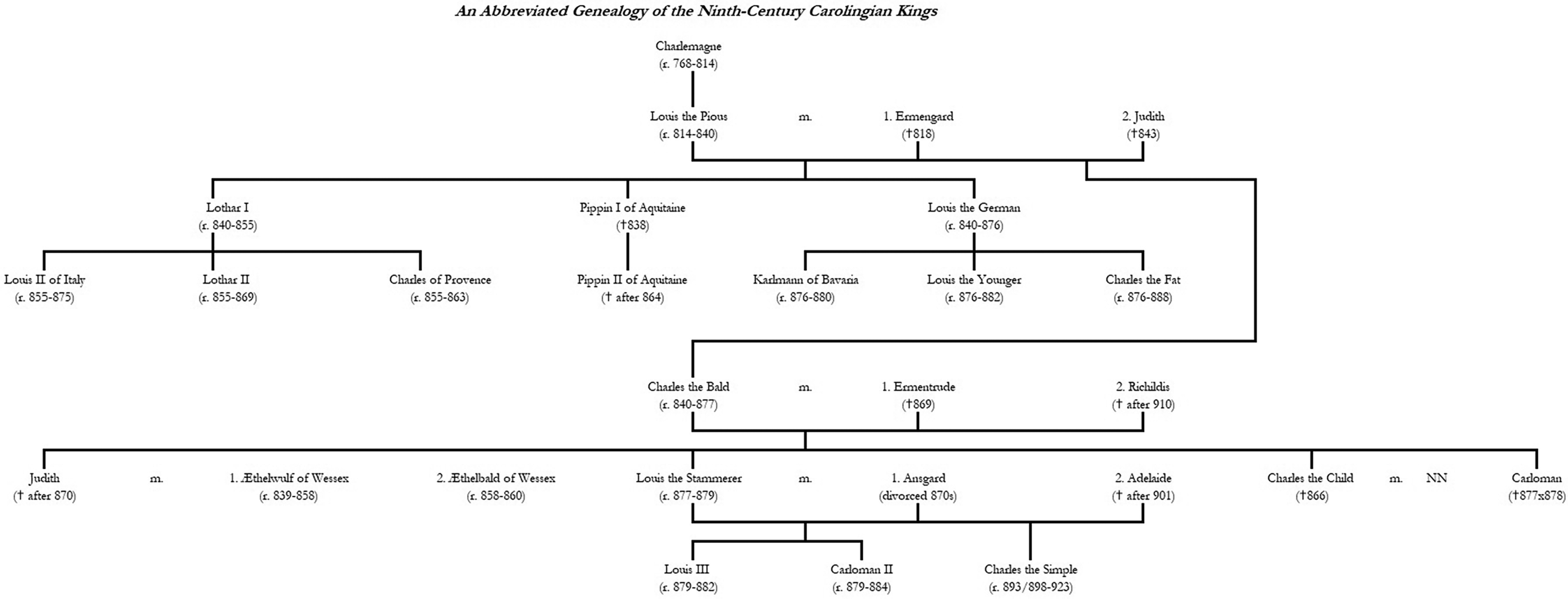
Genealogy of the ninth-century Carolingians.
Such a career has left Louis as a supporting player in a number of different historiographical traditions, from the history of marriage to the history of feudalism. In each of them, though, his image is remarkably similar: personally incompetent, denied agency by his domineering father, and enjoying a consequently bad relationship with him. 6 By the time of the capitulary of Quierzy, it is even argued, his position was so weak that his stepmother Richildis, could plot to disinherit him. 7 It is not hard to find material to substantiate views such as these, from the 866 ordo for the coronation of his mother, Charles the Bald's first wife Queen Ermentrude praying for sons to replace Charles’ existing offspring because they died or disappointed their father, to the 877 Capitulary of Quierzy seeming to cage Louis under the nannying eye of the magnates Charles the Bald preferred to his own flesh-and-blood. Our main narrative source for Louis’ life, the Annals of Saint-Bertin written by Archbishop Hincmar of Rheims, portrays a non-entity, a son whose rebellions ended in failure and whose reign as king was underpinned by desperate bribery to get his magnates to listen to him. 8 One particularly sad example highlighted by Koziol is a magnificent Legimus bull of Charles which Louis confirmed with his own signature. 9 Could anything more appropriately sum up Louis’ inadequacy than the comparison between Charles’ glorious cinnabar monogram and Louis’ dismal little black-and-white endorsement?
Such a view plays into a particular vision of the role of father-and-son relationships in Carolingian politics. Saying that these relationships were politically and ideologically important seems self-evident, even to the point of bathos; but it bears restating. On one hand, kings’ sons were potential heirs to the kingdom, who could reasonably expect to play a role in ruling during their fathers’ lives and who by virtue of their anticipated succession could build powerful networks of magnate followers; on the other, the moral charge attached to the filial relationship by contemporary thinkers gave sons and their behaviour a frisson absent from the behaviour of other aristocrats. 10 Consequently, managing these relationships was of concomitant importance. A loyal son was a useful asset; a disloyal son was a palpable threat. Whether Carolingian fathers gave more heed to the promise of the former or to the danger of the latter is thus a significant question. The answer will, of course, depend on the particulars of each individual relationship, and Schieffer has emphasised the flexibility seen in our sources concerning how Carolingian fathers dealt with their sons. 11 Not all historians view Carolingian history as a Freudian psychodrama: subtle analyses of the relationships between fathers and sons, such as those of Kasten and Schieffer have considered all aspects of their respective roles. However, the dark picture of Louis’ relationship with his father found in extant historiography has contributed to a picture of difficult, tense, and above all fragile Carolingian father–son relationships, with consequent implications for the character of Carolingian rule. 12
In the Landesmuseum in Stuttgart there a golden box known as the Ellwanger Reliquienskästchen, a highlight of the museum's small Carolingian-era display, which raises questions about some aspects of this dark picture, and gives us a point d’appui into re-examining the whole thing. 13 The name is somewhat misleading, as it does not appear to have originally had anything to do with the German abbey of Ellwangen. Instead, as Volbach convincingly argued on stylistic grounds, its point of origin was the West Frankish kingdom in the 870s. 14 The rear of the casket depicts three busts: two men in imperial costume, and in the middle a woman also dressed in imperial costume. This may allow us to date the casket even more closely: in 875, Charles the Bald invaded and conquered Italy and was crowned emperor there. Schramm developed this proposal, making two reasonable suggestions: first, that the casket was not originally designed to house relics, because nothing about it suggests any affiliation with any given saint; and second, that the place of honour of the female figure in the middle of the two men suggests that a royal woman was the casket's patron. 15 Given the date, the royal woman in question must have been Louis’ stepmother Richildis. One of the men on the casket would clearly then be her husband Charles the Bald; the other, however, could only have been Louis the Stammerer. This raises a question: if Louis’ position were indeed weak enough that within two years Richildis could plot his disinheritance, why was she patronising a depiction of her stepson as an imperial figure, one tied up in her own authority?
In what follows, my intention is to tug on this thread, with the intention of seeing how much of the traditional historiographical picture unravels. Recontextualising and closely re-reading the sources for Louis’ role in the last decade or so of Charles’ reign does, in fact, give quite a different view of Louis the Stammerer. For the period between the late 860s and the late 870s, historians have been generating false positives, and seeing animosity where the sources do not really support it. There is a risk here: revisionism for its own sake runs the risk of being propaganda, and in this case propaganda for a regime which became defunct over a thousand years ago. Consequently, I hope to serve a larger purpose through this case study, contributing to the welcome trend towards analysing examples of Carolingian father–son political relationships which were broadly functional, albeit still working with a system characterised by hierarchy and violence. 16 I do not hope to say anything about Charles and Louis’ actual, personal, feelings towards one another. 17 Nonetheless, a rebalanced interpretation of their political relationship—the roles Charles granted Louis, Louis’ actions within those roles, and the way Louis’ position was publicly presented to the audiences for royal power—one which incorporates but which does not overemphasise moments of crisis, places this father–son relationship within a framework where it and similar relationships were at root hardy plants. Given the importance of royal sons to Carolingian governance, this in turn can contribute to a better understanding of the essential robustness of late Carolingian rule.
To achieve these objectives, we will look at three case studies in chronological order: Louis’ time as king of Aquitaine between 867 and the mid-870s; his role in defending the West Frankish kingdom during Louis the German's invasion of 875; and the provisions of the 877 Capitulary of Quierzy relating to him. All three of these events have traditionally been interpreted as showing Louis as useless and/or helpless, but the historiography surrounding them is rather farraginous. By bringing them together, and examining them in chronological order to bring out the development over time of Louis’ political career, we can develop a quite different picture of Louis’ role in the West Frankish kingdom.
Rebuilding Trust: Louis’ Career up to 875
An understanding of Louis’ whole career cannot whitewash moments of tension between him and Charles the Bald. To contextualise Louis’ accession in 867, we must reckon with his tumultuous history during the previous decade. As noted in the introduction, Louis was made sub-king of Neustria as a child in 856, but was driven out by rebellion. 18 By the early 860s—thus, by Frankish standards, when Louis was on the cusp of adulthood—Charles the Bald had not succeeded in reinstating him in the west, and instead in 861 placed him under the oversight of a guardian to try and fight off the vikings attacking the Seine. 19 This was one of the triggers for what happened in 862. Three of Charles the Bald's children rebelled against him: Louis himself; Charles the Child, king of Aquitaine; and Judith, Charles’ teenaged daughter, already twice-widowed.
Since the death of her second husband King Æthelbald of Wessex, Judith had been in a nunnery-cum-prison at Senlis. Now, with Louis’ connivance, she eloped with Charles’ subordinate Baldwin Iron-Arm. 20 Next, Louis betrayed his father and went over to the Breton ruler Salomon (r. 857–874), who gave him troops with which to ravage Anjou. 21 Finally, Charles the Child married without Charles the Bald's permission, followed shortly afterwards by Louis himself, who married Ansgard, the sister of one of his close allies. 22 Charles the Bald responded with anger. He had Judith and Baldwin anathematized and tried to have them excommunicated. He then forced Charles the Child to submit to him at Meung-sur-Loire. 23
This was one of the more serious crises of Charles’ career. A good king was supposed to rule his household first and foremost, and losing control of his family so publicly was tremendously damaging to Charles. 24 Even Charles’ attempts to respond to these rebellions highlighted the limits of his authority. Pope Nicholas I (r. 858–867) refused to annul Judith and Baldwin's marriage, and instead worked to reconcile the couple with the West Frankish king. 25 This reconciliation did not take place for nearly two years. 26 The insincerity of Charles the Child's submission was palpable to contemporaries, and the elder Charles had to lead a military force south in 863 to remove his son from Aquitaine by threat of force. 27 Even Louis the Stammerer was not compelled to return to his father's authority, but did so voluntarily, keeping his marriage intact and being granted the county of Meaux and the abbey of Saint-Crépin near Soissons. 28 Even though Louis only rebelled once, therefore, the repercussions of his rebellion echoed throughout the following years, with an ongoing impact on Charles the Bald's authority.
This left Charles and Louis in an awkward position, with trust between them badly damaged. However, although the sources are laconic we can nonetheless see how their relationship began to be repaired. In 865, Charles sent Louis back into Neustria, neither restoring or denying his royal title. 29 The result was, essentially, nothing: Louis vanished into the west for a year, but crucially did not return to rebellion. The following year, in 866, he was given a more serious mission. In 864, Charles had granted the county of Autun to one of his leading magnates. 30 However, the previous count, Bernard Plantevelue, refused to depart, and Charles had been unable to kick him out. In 866, Louis was given Autun and entrusted with the task of finally getting rid of Plantevelue. 31 The sources don’t say this explicitly, but the next we hear of Bernard, he had been forced into exile in Lotharingia. 32 The obvious conclusion is that Louis succeeded in his task. With this success under Louis’ belt, when in the same year Charles the Child died of a head wound suffered a few years previously, Charles the Bald turned up the dial of responsibility again, and sent his eldest son into Aquitaine as king in 867. 33
With the background to his kingship established, let us turn our attention to the prior historiography of Louis’ reign in Aquitaine. (It is worth defining Aquitaine here. Rather than the whole vast region south of the Loire, by the mid-ninth century the sub-kingdom had de facto come to centre on central Aquitanian regions such as Auvergne. In particular, as Nelson put it, “the Spanish March and Septimania constituted a distinct zone whose nobility and ecclesiastical communities already had their own direct ties with Charles,” and so they will not be considered here. 34 ). For our purposes, this historiography is actually fairly simple. Whilst scholars such as Martindale, Nelson, Schramm, and Boyer come from different historiographical traditions and have differing opinions on how Aquitaine in the 860s and 870s fits into the wider picture of Carolingian rule, there is general consensus on three points. 35 First, that by the time Louis became king of Aquitaine, the area's sub-kings had lost any power they might have held earlier. Second, that, however successful he was in actually exercising it, Charles the Bald aimed to ensure that he was the real power to be dealt with in Aquitaine. 36 Third, and concomitantly, that Charles deliberately prevented Louis from being able to exercise any power himself. 37 Louis was given officials from Charles’ own palace, rather than his own men, and he was not allowed to issue diplomas or have a chancery. 38
Much of this image of the kingdom of Aquitaine derives from an argument from silence. The comparable case of Louis’ time in Neustria suggests that this assessment of his formal powers (i.e., his ability to issue diplomas) should be handled with care. We know that while he was king of Neustria Louis had a chancery and did issue documents. 39 However, we know the first of these facts from an offhand mention in a saint's life, and evidence for the second is preserved essentially by accident. No actual royal diplomas survive. By analogy, all the absence of royal diplomas from Aquitaine proves is that there are few sources from Aquitaine between 867 and 872. This is, in fact, particularly true of royal diplomas, even those of Charles the Bald. Between March 867 and late spring or summer 872—that is, during Louis’ tenure as king of Aquitaine—we have sixty-one surviving diplomas of Charles the Bald across all the regions of his kingdom. Of these, a single act (for Vabres, approximately 75 miles west-northwest of Toulouse) comes to us from the archives of an Aquitanian institution. 40 Given this, the silence about Louis’ activities during these years can easily cut both ways: we do not know that he was a powerful figure, certainly; but we also do not know that he was not. This suggests that the clearest way forward in assessing his position as king of Aquitaine is to look at the limited sources which do survive for contemporaries’ perceptions of him.
Above all—a fact briefly acknowledged by Martindale but dismissed in a footnote—we have a variety of charter evidence dated by his rule. 41 This was not done simply pro forma—it indicates that contemporaries, writing in a number of different locations and for a variety of audiences, took Louis seriously as a king. 42 Particularly significant here is a charter issued for the community of Saint-Philibert, which at the time was based in Noirmoutier in north-west Poitou (outside Louis’ sphere of influence) by Geilo, almost certainly one of the officials provided in 867, who later became abbot of Tournus then bishop of Langres. The preamble to this charter is a potted biography which, as Koziol has pointed out, is a work of self-mythologisation. 43 In this regard, it is significant that Geilo describes his background not as serving in Charles’ palace but Louis’. 44 The implication, surely, is that even outside Louis’ political heartland, serving in the palace of King Louis of Aquitaine was a prestigious appointment worthy of being included in the most glamorous version of one's life—to put it bluntly, a real job with real Königsnahe (closeness to the king). This is not to say that Louis was either independent or all-powerful—he was emphatically neither—simply that we know that contemporaries, at least, did take him seriously as a king.
Louis’ career as king of Aquitaine was relatively brief. However, these years were of no little significance. Louis’ rebellion at the start of the 860s had created a major breach between him and his father. Over the course of the mid-to-late 860s, though, that breach was repaired. Charles gave Louis progressively more important responsibilities, and enough ability to fulfil them that he was taken seriously by powerful contemporaries such as Geilo. Louis then, to all appearances, fulfilled these responsibilities loyally and effectively. Here, the silences in the sources are significant: at a minimum, during Louis’ tenure as king of Aquitaine, the central Aquitanian regions which formed the sub-kingdom's heartland do not seem to have been troubled by either rebellion or external disruption such as viking raids. 45 However active a role one wishes to give Louis in this situation, the opposite had been true of Neustria during his time as king there; and one can hardly imagine Charles as upset with the results of his son's time in Aquitaine. The result was that enough trust appears to have been rebuilt between the two men that, when a different family crisis caused Charles to need to rethink his management of his sons, Louis was there, able to step in and assist his father outside of the south.
Louis the Stammerer and the East Frankish Invasion of 875
In 875, Louis’ cousin Emperor Louis II of Italy died. Charles the Bald immediately led a hand-picked force over the Alps. 46 Louis the German sent his son Charles the Fat to do what he could, but little Charlie (as he was known to Italians) was defeated. 47 In response, Louis sent another of his sons, Karlmann of Bavaria, a doughty fighter and successful general, to resist him. 48 Louis himself, with some persuasion from Charles’ disgruntled ex-chamberlain Enguerrand, took his final son Louis the Younger and invaded Charles’ kingdom, hoping to force Charles out of Italy and possibly make territorial gains in the west. Charles, however, had foreseen this. Before he crossed the Alps, he had entrusted the kingdom's defence to his wife Queen Richildis—and to Louis the Stammerer. 49 Indeed, Louis had been placed on the front line. Charles had sent his son to oversee the defence of his portion of Lotharingia (in modern-day Belgium and eastern France). 50
Several things had changed since 867. For one, Louis had ceased to be acknowledged as regional sub-king by people within Aquitaine. The final charter we have dated by Louis’ reign is from May of his fifth year (i.e., 871). 51 Thereafter, all subsequent Aquitanian documents from Charles the Bald's remaining reign, are dated by Charles’ regnal years. At first glance, this seems to reflect the completion of Louis’ political marginalisation by his father. In 872, Charles appointed his new brother-in-law, Richildis’ brother Boso of Provence, as Louis’ chamberlain and de facto ruler of Aquitaine alongside a number of other magnates. 52 This has been traditionally viewed as a final humiliation of Louis qua king of Aquitaine, finally ending any hopes he had of exercising power in his own right. 53 Such an interpretation makes little sense. Nothing had happened within Aquitaine to prompt Charles to intervene; and Louis’ next appearance in our sources in 875 as his father's lieutenant also does not fit such a picture. After all, if Louis was ineffective and distrusted, why did Charles now make him a commander against the expected attack from the east? By itself, this suggests that Charles had some level of expectation both that Louis would carry out his assigned role competently, and that he would not betray his father to his uncle. This was by no means a given—when Charles got to Italy, he was able to induce his own nephew Karlmann of Bavaria to withdraw. 54 Evidently, we must look elsewhere.
First, there was the changing political context. Over the course of the 860s and 870s, the sons of Emperor Lothar I died one after the other without heirs. This exacerbated tensions between Charles the Bald and Louis the German. After the heirless death of Lothar's son Lothar II in 869, Charles had launched a bid to take over his whole kingdom. This failed, and Louis extorted the lion's share from his younger brother. Both northern rulers thus kept a careful eye on Lothar's final surviving son Louis II in Italy, and somewhat unusually Louis managed to have two politically impactful deaths. In 871, rumour had spread north of the Alps that he had been killed by Beneventans. 55 Immediately, tensions between Charles the Bald and Louis the German ratcheted up to breaking point. Charles himself went to Besançon and Louis dispatched his son Charles the Fat to the Transjurane, in modern-day south-eastern France and Switzerland, in order to rally support (both places were gateways to the Alps). At this point, the rumours proved to be false: Louis was alive and well. However, this dress rehearsal had made it clear that Louis II's actual death (which ultimately took place in 875) could be expected to provoke an immediate and high-level exchange of hostilities between the East and West Frankish kingdoms.
The second reason for Charles’ promotion of Louis was the changing familial context. Two changes were important here. One was the precipitous fall from grace of Louis’ clerical younger brother Carloman, who rebelled against his father in 870. 56 He was then imprisoned in Senlis. He was released shortly afterwards, relapsed into rebellion, and ultimately re-imprisoned late in 871. Carloman's disgrace left an empty space in Charles’ toolkit. During the late 860s, Carloman had acted as a major enforcer and military leader for his father: it was to Carloman that Charles had entrusted the enthronement of his candidate Wulfad as archbishop of Bourges in 866 and Carloman whom Charles had sent with a squad of crack troops to fight the vikings in Neustria in 868. 57 His betrayal and imprisonment left Charles without a son he could rely on as a trouble-shooter at precisely the time when the fate of Italy was in the balance—in fact, the rumours of Louis II's death had provoked a very brief reconciliation between Charles and Carloman in autumn 871 for exactly this reason. 58 The other change was Charles’ second marriage. In 869, Louis’ mother Queen Ermentrude had died. Charles had quickly remarried to a woman named Richildis, from a prominent Lotharingian kin-group. 59 Notably, Richildis was also the sister of Boso, whom we have seen Charles appoint as Louis’ chamberlain in 872. As we saw in the introduction, Richildis is often seen as antagonistic to Louis, but the evidence of the Ellwanger Reliquienskästchen suggests that the two were actually politically closer than is usually thought.
As part of this reshaping of Charles the Bald's family, Louis stepped into Carloman's vacated role as a trouble-shooter for his father. In the light of what we have seen above, it is distinctly unlikely that Charles’ 872 intervention in Aquitaine was aimed at neutering Louis. Rather, by appointing a kind of “high commissioner” to free up his son, Charles made him available for other responsibilities elsewhere. 60 We have no direct evidence for Louis’ activities between 872 and 875. Nonetheless, we have two pieces of circumstantial evidence for his new role vis-à-vis his father. The first is that, after 872, Charles apparently felt secure enough to deal with Carloman for good. In 873, he had him blinded at a synod in Senlis. 61 The most obvious reason for such an irrevocable destruction of a potentially useful resource is that Charles was confident that he had a reliable replacement. The second piece of circumstantial evidence relates to Louis’ second marriage. At some point in the mid-870s—it's not clear precisely when but certainly during this rough time—Charles ordered Louis to divorce his first wife Ansgard and marry Adelaide, daughter of Count Adalard. 62 Adalard was a powerful and well-connected magnate based perhaps in Burgundy. 63 Louis’ second marriage has generally been seen as a brutal separation pushed through by Charles in order to favour Adalard, but such a reading is to underestimate the benefits of an advantageous marriage for Louis. 64 The marriage involved some trade-offs, insofar as there may have been questions about the validity of either marriage and consequently the legitimacy of Louis’ offspring. However, these trade-offs were evidently limited. The only reference to these questions causing political problems come from a single reference in the Chronicle of Regino of Prüm, written in the early tenth century, claiming that Boso of Provence accused Louis's sons and successors Louis III and Carloman II, against whom he launched a coup in 879, of being illegitimate. 65 This strongly suggests that these concerns were not widespread (they find no echoes in the contemporary textual traces of Boso's regime such as his election document). Moreover, Boso's claims were only made after the deaths of both Louis the Stammerer and Charles the Bald; and the fact that Boso had betrothed his daughter to Carloman in 878 indicates that the prince's legitimacy did not concern him during Louis’ lifetime. 66 Against that, a new marriage into a family more powerful and politically relevant than that of Louis’ first wife would have been a remarkable powerful weapon for Charles to have handed his son if he didn’t know exactly what he was doing: giving Louis extra resources to get things done on Charles’ behalf.
Louis justified his father's confidence in winter 875. Responding to Charles’ invasion of Italy, Louis the German launched his second invasion of the western kingdom, a reprise of his attack in 858. This was no minor threat. The crisis of 858/859 had been the most serious trial of Charles’ reign. 67 Louis’ military record was long and successful, and his army was battle-hardened and very threatening. With Charles in Italy, though, defence was left to Richildis and Louis the Stammerer. This was a moment where their political interests aligned particularly closely: Charles’ conquest of Italy promised a bigger pie both for Louis, when he eventually succeeded; and for any future sons of Richildis. Assisting Charles’ success through successfully defending the north was important to both of them. Louis the German was still at Metz, on his side of the Lotharingian frontier, in late November 875. 68 A month later, he had got as far as the palace of Attigny—but no further. Very shortly after Christmas, Louis withdrew, and was in back in his own kingdom at Mainz shortly after January 6th 876. 69
Virtually everything we know about Louis’ invasion comes from the pen of Archbishop Hincmar of Rheims (r. 845–882). This is a problem. Hincmar was opposed to Richildis in particular, having quarrelled with her over her appointment of a new abbess for the convent of Origny near Soissons, which Hincmar accused of being simoniacal. 70 Indeed, in the Annals of Saint-Bertin he blames her for Louis’ invasion, attributing the East Frankish king's attack to persuasion by a court rival whom Richildis had had removed from Charles’ favour. 71 He was also distinctly sympathetic to Louis the German. After being a key figure in resisting the East Frankish king during his invasion of 858, by 875 Hincmar was angry at his declining influence in Charles the Bald's court, and resented both the newly minted emperor's absence in Italy and his patronage of Hincmar's rival Archbishop Ansegis of Sens’ claims to primacy. 72 Hincmar's resentment is most obvious in his round letter De fide Carolo regi servanda, written in the midst of Louis’ invasion, which contains brutal criticisms of the absent monarch. Even if, as recent work has shown, it is not quite advocating surrender to Louis the German, it is certainly not a stout-hearted call to resistance. Hincmar was quite happy to envisage transferring his loyalty to the incoming ruler. 73 Given Hincmar's biases, his presentation of Richildis’ and Louis the Stammerer's resistance as useless is unsurprising; but doing a certain amount of reading between the lines allows us to gain a more accurate picture.
When Louis the German invaded, Louis the Stammerer seems to have made no attempt to try and resist him militarily in Lotharingia, allowing him to get as far as the royal palace at Attigny. This has attracted historians’ opprobrium—Kasten went so far as to say that it was a sign that Louis had “failed in his task.” 74 However, it was probably a sensible choice. The younger Louis’ past military record was not good enough to warrant confidently going up against his uncle. Moreover, there was very strong ideological motivation not to commit to pitched battle. The memory of the brutal slaughter which had taken place between Charles the Bald and his brothers at Fontenoy in 841, during the civil war over the division of the Frankish empire which followed the death of Charles’ father Louis the Pious in 840, loomed large, and its spectre was brought up in the context of the 875 invasion by both Hincmar and Charles’ ally Pope John VIII (r. 872–882). 75 Even more, Louis’ military threat was not actually the most significant challenge he presented to the West Frankish kingdom. His invasion of 858 had been such a near-disaster for Charles the Bald because Louis was able, at least initially, to achieve massive political success, winning over a very large chunk of the West Frankish nobility. Equally, Charles’ ultimate victory had come about in turn because he was able to regain the nobility's support. 76 If Louis the German were to be stopped a second time, ensuring that the loyalty of the West Frankish magnates didn’t waver had to be at the very top of Richildis and Louis the Stammerer's priority list.
In comparison with 858, we know noticeably less about who Louis the German's supporters were. However, the name we do have is significant. Charles’ former chamberlain Enguerrand was a key motivating force behind Louis’ invasion. Enguerrand was part of a group of north-eastern counts used to co-operating with each other—and with Louis the German. During Carloman's rebellion in 871, Enguerrand had been one of several counts whom Hincmar had attempted to recruit as intermediaries between father and son. 77 Another was Gozlin, almost certainly the son of Count Donatus of Melun. 78 Gozlin had actually defected to Louis the German in 858, and had been punished by being stripped of some of his property. Louis the Stammerer and Richildis now took steps to cement Gozlin's loyalty. One of the properties his family had lost was the estate of Neuilly-Saint-Front (dep. Aisne, arr. Château-Thierry), which was also claimed by the church of Rheims. Now, to Hincmar's fury, Louis and Richildis returned it to the family. 79 The strategy presumably worked: we know of these events through a memorandum Hincmar wrote slightly after the fact, in summer 876, and had Louis’ and Richildis’ gambit failed the incensed archbishop would have revelled in rubbing it in. 80 For all Hincmar's complaints, then, Richildis’ and Louis’ actions in regard to Neuilly were an effective manoeuvre in a desperate situation. Moreover, we can reasonably assume that the way they dealt with Gozlin was not unique. It is likely the duo exploited their knowledge of property disputes as leverage in any number of cases of wavering loyalty.
More broadly, Hincmar describes how Richildis (and implicitly Louis as well) commanded the West Frankish magnates to take oaths to protect the realm. 81 According to Hincmar, this was a complete failure: the magnates took no heed of their oath, but instead used the conflict as an excuse to plunder their own king's realm. Despite the need to take Hincmar's account with a grain of salt, we can well imagine the cause of his complaint. Even without a major battle, both East and West Frankish forces deliberately devastated the area west of Attigny. 82 Rheims’ property would have been right in the middle of it, suffering collateral damage accordingly. 83 In the next century, a mass killing of the peasants in his benefice of Cormicy in similar skirmishing prompted the usually equanimous Rheims priest Flodoard to emotion, and it is no surprise a more effusive writer such as Hincmar condemned the fighting. 84 However, whilst Hincmar's presentation of the events of winter 875 is understandable in terms of the human cost of the war, there are reasons to doubt his portrayal of the strategic picture. A letter from Pope John VIII to the West Frankish magnates warmly praised their adamantine constancy. 85 The pope was a partisan of Charles the Bald, but if there had been mass defections then that would certainly have been reflected in letters excoriating the defectors—John did in fact write letters like this to the small number of West Frankish bishops who switched their allegiance to Louis. 86 Besides staying loyal, moreover, the magnates’ actions had a cold military logic to them. Louis the German's invasion was a hurried affair, and the East Frankish king's supply lines were attenuated. Even the Annals of Fulda, which tried their best to apply as much polish as possible to Louis’ power-grab, admit that his men were draining the area surrounding Attigny dry. 87 West Frankish ravaging had the effect of accelerating their deteriorating supply situation, denying the East Frankish army material support.
At the very start of 876, Louis the German withdrew. He had not gained significant support amongst the West Frankish magnates and was running out of supplies. Richildis and Louis the Stammerer had managed, in the space of little more than a month, to shore up support for Charles the Bald's regime and to exacerbate the supply-chain crisis facing the East Frankish army—they had, in effect, successfully gained the strategic and political upper hand. Louis the German's threat had been serious. We know that even with Richildis’ and Louis the Stammerer's prompt response, he had managed to win the active support of a small number of West Frankish counts and bishops. Others, such as Hincmar, had wavered enough that, so to speak, it would only have taken a small hole in the dam to provoke a flood. 88 However, that flood never happened. 89 Charles’ decision to repose trust in Louis the Stammerer had paid off. The newly crowned emperor's wife and her stepson had proven an effective team whilst Charles the Bald was in Italy.
The Capitulary of Quierzy (877): Deputation and Succession
In 877, Charles the Bald went back to Italy. This was only slightly less dangerous a gamble than in 875. Louis the German was dead by this point, but his son Louis the Younger was still a lurking presence on the West Frankish border. 90 A large viking fleet on the Seine was prompting concern in a number of quarters. 91 Nonetheless, Charles went. However, before he went, he set out instructions for how the realm should be governed in his absence, culminating in the capitulary issued at Quierzy in June 877. 92
The surviving text of the Capitulary of Quierzy is evidently not a straightforward record of the June assembly. 93 For one thing, no manuscript of the text has survived up to the present, and the text as it stands contains some odd lacunae. 94 It is also phrased as a kind of dialogue between Charles and his followers, until section 10, where the magnate's responses cease. This raises the question of whether these are purely textual artefacts or whether they preserve a kind of “script” for stage-managing the assembly. 95 In the absence of further evidence, this question must remain open; but what can be said of the text is that, whilst it is not a one-to-one account of what transpired in June 877, it does attempt to be an authoritative presentation of an authoritative event. That is, the composer of this particular text was attempting to use it to accomplish political ends. The composer was perhaps Abbot Gauzlin of Saint-Germain-des-Prés, a close ally of Charles the Bald during this period; the ends were certainly Charles’; and the effort saw some success, at least for a few years: the accession promises of both Louis the Stammerer and his son Carloman II make explicit reference to Quierzy's provisions. 96 Its significance, then, is not merely representational. Rather, it acts as a guide to how Charles the Bald was attempting to shape his kingship and, in this case, his political relationship with his only surviving son.
In this light the Capitulary of Quierzy has generally been interpreted as an expression of Charles’ lack of trust in, and dislike of, Louis the Stammerer. 97 Two aspects in particular have warranted special analysis. First, the nature of the power Louis was to exercise in the north whilst Charles was in Italy. This is generally interpreted as, at best, highly constrained. Charles is perceived as having neutered Louis’ capacity to rule, hedging him in with constant nannying oversight, refusing to allow him either to distribute lands and offices or to use royal resources such as animal reserves and hunting forests, and insisting on being constantly kept in the loop so as to micromanage his son's decisions. Second, the question of the succession to Charles. Here, the capitulary is interpreted as the culmination of a trend which must have seriously worried Louis: Charles’ efforts to replace him as heir. After Charles’ marriage to Richildis, historians have seen in his actions a deliberate plan to cut Louis out of the succession, and the fact that Louis was not confirmed in the capitulary as Charles’ only heir once and for all time is generally taken to be a sign of Charles’ aim of ultimate disinheritance. However, whilst both these aspects of the capitulary are important and merit study, their significance has been generally misunderstood. The provisions of the Capitulary of Quierzy are unique to their historical context, certainly, but there are Carolingian precedents and comparanda enough such that—if they are examined without the assumption that Charles and Louis were at daggers drawn—a quite different meaning can be placed upon them.
Let us first deal with Louis’ royal powers. Before examining specific points of detail here, it is important to look at the ensemble, because historians have tended to miss the wood for the trees in this regard. Certainly, Charles did not grant Louis unlimited powers. Certainly, Charles insisted he be informed of what Louis and his magnates did. Certainly, Charles admonished Louis that he not make decisions without consultation. All of these things have been interpreted as a systematic attempt to make Louis powerless. 98 However, if we put aside this framework of interpretation, the most significant takeaway from the Capitulary of Quierzy must surely be that Charles was leaving Louis in overall charge of the entire West Frankish kingdom whilst he was in Italy. The capitulary's provisions envisage Louis as disposing of the guardianship of comital honores (section 9), hearing judicial cases (section 17), suppressing internal quarrels (section 19), issuing charters and other documents (section 21, also implied in section 17), and leading armies against the realm's enemies (section 16). 99 In short, Louis was allocated wide-ranging powers as his father's deputy. 100
Probably the most significant restriction on Louis’ actions was that he was unable to bestow episcopal, abbatial, or comital offices (although in the latter case, if there was no obvious heir to act as caretaker, he could appoint a guardian until Charles was able to make a final disposition). This was a significant curb on Louis’ ability to bestow patronage, but hardly an unusual one. Evidence of royal sons making these kinds of appointments is exiguous, even in cases such as that of Louis the Pious’ reign in Aquitaine during the lifetime of his father Charlemagne or Lothar I's in Italy during Louis the Pious’ reign, where a sub-king was allowed substantial amounts of autonomy. Indeed, there are close contemporary parallels for what Charles did at Quierzy. A few years earlier, Louis the German had divided his realm between his three sons, granting them their portions to hold during their lifetimes and giving them jurisdiction over minor cases. This information comes to us from a single sentence in Notker the Stammerer's continuation of Erchambert's Breviary, rather than from a lengthy documentary source. Given how little Notker gives us, then, it is surprising that even so brief a mention makes it clear that Louis’ provisions closely paralleled Charles’. Louis specifically reserved more important rights of justice, fiscal estates, and the ability to appoint counts, bishops, and abbots for himself. Contemporaries understood these stipulations as not merely unproblematic, but provident; and, although Louis’ sons did object to the specifics of the territorial division, none of them appear to have objected to the restrictions on their rights of justice and patronage. 101 Thus, Charles’ provisions in this regard, whilst important in regulating Louis the Stammerer's actions, were not obviously a draconian imposition on him.
Similarly, Charles’ requirements that he be informed by messenger of all significant developments was well in line with existing Carolingian practice. Documentary evidence going back to Charlemagne's time shows that he expected to be briefed on events in regions of his empire ruled by royal sons in a very similar way to Charles the Bald here. 102 Moreover, Charles made reasonable exceptions for emergencies in the Capitulary, in particular when planning for potential attack from his East Frankish nephews. 103 If reports reached the West Frankish kingdom that they had attacked Charles, then the West Frankish elite were not to wait for Charles’ explicit command to come and help him, but mobilise without delay. Similarly, the restrictions on Louis’ hunting activities under section 32 explicitly leave room for visits to the forbidden palaces made out of necessity. 104 Such space for initiative seems unremarkable, but it does demonstrate that the Capitulary of Quierzy is not an expression of an unusually intense desire for control.
This brings us to the capitulary's restrictions on hunting. Historically interpreted as arising from logistical concerns, Gravel has recently re-interpreted these headings as instead representing Charles’ attempt to prevent Louis from using the chase and high-status meat such as roast pork to cement aristocratic support in the royal heartlands of the Oise valley, and especially in places symbolically important to Charles’ rule. 105 There may be something to this, but the restrictions in the capitulary seem too fragmentary to achieve the first goal if such were in fact Charles’ intention. For instance, Louis was forbidden from hunting at Compiègne, but not at nearby Verberie. It seems unlikely that anyone in the ninth century would have considered the ten-mile journey downriver to the latter palace a major obstacle to forming a conspiracy against the absent emperor if that were what was at stake. 106 Rather, another of Gravel's arguments points us in a different direction. Gravel notes that there is a geographical logic to the text: the strictest restrictions are on palaces in the West Frankish Carolingian heartland in modern day north-eastern France, and the further towards the East Frankish border one goes, the fewer restrictions are in place. 107 As Gravel points out, this seems intended to point Louis east, back to the same regions to which Charles had sent him back in 875, presumably to put pressure on their East Frankish relatives. There is a concern throughout the capitulary that Louis should stay on the move, resolving the realm's problems, something stated explicitly in section 20: “our son and our followers should dwell in that part of the realm where there is the greatest necessity.” 108 He was not supposed to linger in the placid royal heartlands. Sections 32 and 33 should be read in this light. Although Charles was visibly concerned to have his son's behaviour accounted for, the clauses surrounding Louis’ hunting emerges less as paranoid, controlling oversight of his son; and more as a series of carrots and sticks encouraging him to circulate through the realm, ensuring that a royal presence was available to deal with crises and to warn the East Frankish kings off attacking Charles.
If Charles had been genuinely distrustful of Louis, and seriously concerned with the potential that his son might conspire against him, then the final clauses which we will consider suggest that he went about this very badly. Charles made very specific provisions for who should accompany Louis, listing a selection of bishops, abbots and counts, as well as an alternating pair of magnates to be with him at all times and the personnel who should accompany him in the key strategic areas of the Lotharingian frontier and the Neustrian March. This has generally been interpreted as the emperor's attempt to keep a close watch on his son, but—as McCarthy tentatively suggested—the specific people mentioned points instead towards an attempt to provide Louis with advisers with whom he could work well. 109 A significant number of the named individuals had some kind of prior connection to Louis. 110 Some of these connections came from simple geographical proximity (like Bishop Hildebald of Soissons, diocesan bishop of Louis’ abbey of Saint-Crépin 111 ) or ties of consanguinity (like Louis’ cousins Hugh the Abbot, ruler of the Neustrian March; Abbot Welf of Sainte-Colombe de Sens; and Conrad of Paris 112 ). Others had closer ties. Abbot Gozlin of Saint-Germain-des-Prés was a brother of the Rorgonid family, the rulers of Maine, most notably one Gauzfred, to whom Gozlin was close and who was an old ally in rebellion of Louis from his days as sub-king in Neustria. 113 Baldwin Iron-Arm was Louis’ brother-in-law, and part of the great marriage conspiracy of 862. The count of the palace Adalard had recently become Louis’ father-in-law. Most notably, the two men whom Charles commanded to be at Louis’ side at all times, Boso of Provence and a Bernard who could be one of several different Aquitanian magnates with the same name (for the purposes of this argument, which one it was is irrelevant as the same analysis could apply to each) who had been key figures in Aquitaine for years, and would have worked closely with Louis as king of Aquitaine. In short, the named individuals in the capitulary were not simply minders. They were men with histories of collaborating with Louis the Stammerer.
More generally, the reason for these followers and counsellors relates to one of the text's main rhetorical through-lines, that being the need for Louis to make decisions in accordance with the consensus of his followers. This is most clearly expressed in section 22: “none of Our followers who remain with Our son should be dilatory in giving counsel. Rather, each should speak as seems best to them, and after all the talking they should choose what seems best.” 114 Such exhortations are common across the Carolingian period, and are a fundamental aspect of Carolingian political thought. 115 They can also be paralleled historically, notably in the Astronomer's description of Louis the Pious and his aristocracy running Aquitaine under Charlemagne. 116 The Capitulary of Quierzy's dispositions regarding Louis’ councillor's, then, are unusually specific in providing for certain named individuals to accompany Louis; but they evince a concern for the traditional forms of Carolingian government generally and the provision of counsellors with whom Louis had good working relationships particularly.
Having dealt with the nature of Louis’ royal powers, let us turn to the question of succession. Because modern historians have seen Charles’ and Louis’ relationship as so fraught, they have stressed that Quierzy's provisions do not seem to fix the succession once and for all. 117 Even more, there is a general consensus that by the 870s at the latest, and possibly much earlier, Charles—perhaps egged on by Richildis—had a goal to produce further male heirs in order to cut Louis out of the succession. 118 Certainly, Charles wanted more male children. His first wife, Ermentrude, produced no fewer than six sons. However, over the course of just a few years in the mid-860s, all but Louis and Carloman died; and Carloman was a cleric and therefore his throne-worthiness was distinctly dubious. We therefore have almost a decade's worth of wishes for more children contained in a variety of sources. 119
However, it is important to think about what this sort of language might mean, and how pointedly it was directed at Louis the Stammerer, if at all. To the best of my knowledge, only Kasten has adduced explicit evidence that Charles was aiming to disinherit his eldest son, pointing to a letter traditionally ascribed to Alcuin which she re-dates as actually being from the time of Charles the Bald. 120 The letter is somewhat gnomic, but seems to indicate that—amongst other criteria—both rebellion and insanity are grounds for disinheritance. 121 Kasten's overall argument for re-dating this text to the reign of Charles the Bald is not entirely convincing, but remains possible; her argument that it refers to Louis the Stammerer is extremely tenuous. Kasten argues that the passage on mental illness could only refer to Louis the Stammerer, citing Regino of Prüm's description of Louis, “who was called ‘the Stammerer’ because he found talking slow and difficult … this prince was a straightforward and mild man ….” 122 Kasten acknowledges the well-known spiritual meanings of the phrase vir simplex but argues that when this phrase is taken in tandem with Louis’ stammer Regino's description is actually an indicator of mental deficiency (Geistesschwäche) sufficient to prompt Charles to try to remove him from power. 123 Bearing in mind that, based on our evidence, we are talking about a man with a stutter, this is a remarkably extreme jump. Even considered as a stutter, Louis’ stammer does not seem to have mattered greatly to contemporaries: whilst public speaking was important to earlier medieval kingship and a speech impediment will not have benefitted him, Regino is the only source to mention it, indicating—as with his marriage—it was not a widespread concern. 124 In fact, Charles the Bald did have a son who was both a persistent rebel and mentally ill, that being his second son Charles the Child. Charles suffered a severe head wound in 864, in the aftermath of his simmering rebellion against his father, and died after two years of mental illness. 125 If these capitula do derive from Charles the Bald's reign, then Charles the Child is surely the person their author was thinking of. In any case, they are not good evidence for a masterplan to disinherit Louis the Stammerer.
In the absence of explicit evidence for any plan to disinherit Louis, we must think about language such as that found in the sources cited above in its wider context. During the latter part of the ninth century, questions of royal succession were on people's mind. Most famously, Louis’ cousin King Lothar II went through an extremely messy and protracted divorce case in which both Charles the Bald and Louis the German had an intense interest because one of the issues at stake was whether or not Lothar's sons by his mistress might be eligible to inherit his throne or whether his childless marriage to his wife would leave his kingdom up for grabs. 126 Mistry has recently argued that late ninth-century normative texts, notably but far from exclusively the 866 coronation ordo for Charles the Bald's first wife Queen Ermentrude, linked fertility not just to queenly virtue, but also to kingly virtue. 127 Being blessed with sons was a sign of good kingship; the reverse was also true. 128 Of the many formulations of this idea, the bluntest came from the Irish monk and Carolingian courtier Sedulius Scottus. In the De rectoribus Christianis “just and holy rulers” have “shining character of offspring” whilst their wicked counterparts suffer from “bereavement of sons.” 129 Charles’ enthusiasm for reproduction, then, must be situated in a context where having many sons was a sign of divinely blessed kingship.
There was more to it than that, of course. The prologue to the Ermengard ordo emphasises the need for more heirs to ensure that there was someone to take over the realm, and says that Louis’ behaviour was indeed a concern. However, these two aspects of the text do not necessarily have to be taken together. To start with the commentary on the behaviour of Charles’ existing sons, it has to be born in mind that the ordo was a document of 866. Louis’ rebellion had taken place just a few years earlier (and Charles the Child's more recently than that). Charles the Bald's need to keep order in his family was a pressing concern in 866 in a way it was not in 877, and reading worries over Louis’ behaviour which were current in the mid-860s into the late 870s is anachronistic, ignoring the way we have seen Louis’ career develop in the intervening decade. The wish to produce more heirs, by contrast, clearly continued into the 870s. This makes sense in the face of the precariousness of life: Charles the Bald himself outlived one spouse and at least seven children. Even compared to his brothers’ families (when Lothar I's wife died, he had two adult sons and one, albeit sickly, on the brink of adulthood; and when Louis the German's wife died he had three adult sons), this is a high rate of mortality. More heirs could lead to more problems, but it definitely meant dynastic security. 130 Charles’ wish to have more heirs, even if somewhat more intense than his brothers’, recognisably resembles the more general concerns of early medieval kings. However, other than the Ermentrude ordo, issued in circumstances specific to the late 860s, it was not targeted at Louis.
In the light of this argument that Charles’ wish for more heirs was not always equivalent to a conscious attack on Louis’ position, what does the Capitulary of Quierzy actually say about the succession? Three sections in particular stand out. The first is section 4, which refers back to an oath taken (presumably earlier in the year) at Rheims, which confirmed the magnates’ loyalty to Charles, Louis, and any further sons. The magnates then, in their scripted response, confirm that they wish to have Louis as their future lord (futurus senior) after Charles. 131 We begin, then, with the presentation to the audience at Quierzy of a relatively straightforward assertion of Louis’ role as Charles’ successor (indeed Hincmar, early in Louis’ reign, referred back to the events at Rheims and Quierzy precisely as having confirmed Louis as his father's heir). 132
The second is section 13, which is worth translating in full:
Which part of the empire Our son should hope to be allotted as his in the event of Our death is to be determined; and if God wishes to give Us another son in the meantime, which [part] he might have. And if any of Our grandsons 133 show themselves worthy of this, or if they don’t, let it be decided in accordance with what at that time might please Us and him (cui). 134
Historians have seized on the fact that this part of the capitulary does not establish Louis as his father's sole heir, leaving open the possibility of a division of the realm, as evidence that Charles was looking not merely to supplement Louis but to replace him. There is some basis for this: comparable texts such as the 806 Divisio regnorum, dividing up Charlemagne's realm between his sons, and 817 Ordinatio imperii, dividing up Louis the Pious’ realm between his, make no provision for hypothetical future heirs. 135 However, what seems to me a more probable reading is that Charles was learning from past mistakes. The Ordinatio imperii and its division of the realm had acted as a sore spot for years, keeping old wounds open and causing new ones when it became necessary to alter the settlement in light of new family developments. 136 These wounds, in fact, had ultimately cumulated in the massacre at Fontenoy mentioned above. Even recently, when Louis the German made the division of his realm between his sons discussed above, almost immediately a revolt had resulted when Louis the Younger felt that his father was favouring his brother Karlmann within what was supposed to be his own jurisdiction. 137 To keep the matter undecided was to keep the matter flexible, not to work towards disinheriting Charles’ eldest child. (In fact—as is rarely brought up—to starkly affirm Louis’ rights as sole heir would be actively to disinherit Richildis’ hypothetical sons.).
There are in fact some indications within the capitulary that Louis’ kingship was to be gilded with particular prestige. Section 14 orders Louis to prepare himself so that when Charles returned from Italy, he would be able to set out for Rome where he would be crowned as king and rule the kingdom on Charles’ behalf. 138 Coronation at Rome was relatively rare in Carolingian history. The imperial overtones were evident, and Charles’ order should be interpreted not as a kind of exile, but as lending a particular glamour to Louis’ role. 139 That Louis was to be entrusted with a more senior role may also be inferred from section 13. It is not entirely clear to whom relative pronoun cui in the article's final clause refers, but one obvious answer would be Louis. The meaning of this final clause would then be that, when Louis’ sons came of age, Charles and Louis together would decide which portion of their ultimate inheritance would be entrusted to them. 140 The exigencies of Latin grammar make this interpretation tentative; but at the very least this clause is not good evidence for a plan to disinherit Louis.
As with royal power, so with succession: whilst one can quibble over individual details, the whole points towards a plan whereby Louis was clearly affirmed as his father's heir, and possibly one to grant him particular symbolic and/or ideological importance. The Capitulary of Quierzy as a whole, then, is not a document aimed at restricting, neutering and ultimately removing Louis from the scene. Rather, it is one aimed—within certain boundaries—at empowering him to act effectively as his father's deputy and at securing his ultimate succession.
Conclusion
Three case studies, seemingly unalike in content yet converging into one picture. We have seen three key similarities: first, a greater degree of trust between Louis and Charles than has previously been acknowledged. Second, a wider scope for Louis to exercise personal power than has previously been acknowledged. Third, a greater degree of success than has previously been acknowledged. These three points pose serious challenges to extant interpretations of Louis’ career in Charles’ reign and consequently to his place in Carolingian history.
In place of the existing vision of Louis’ role in his father's reign, the picture painted here is something quite different. Louis the Stammerer as a prince was, after the mid-860s, generally competent and loyal, and was treated as such by Charles the Bald. Louis’ rebellion in 862 was damaging to Charles’ authority and to the political relationship between the two men; but it was also a one-off, and its effects wore off with time. By the 870s, Charles gave Louis responsibilities and concomitant powers to fulfil these responsibilities in ways comparable to other Carolingian fathers. His trust was not unqualified and the powers he delegated to Louis were not unlimited; but this was usual for the time. In turn, within the hierarchical structure of the Carolingian family, Louis fulfilled these responsibilities in ways which benefitted Charles’ best interests, maintained useful alliances within and outwith his family (notably with his stepmother Richildis), and was rewarded with prospects of power in Italy which remained a real possibility after Charles’ death. 141 In short, it is unlikely that contemporaries when Louis became sole ruler in 877 would have been worried that they were to be governed by a king who was either particularly useless or who had failed to earn his father-predecessor's public approbation.
Such a reassessment of Louis points towards reassessments of the points we touched on in the introduction. To start with, we have seen that, even when rebellion seriously upset filial relationships, Charles and Louis were able to take practical steps to rebuild trust. Consequently, Charles regained a useful subordinate and Louis was able to benefit from his parent's munificence. This is not to downplay the toxic effect intra-familial disputes could have, nor the power of paternal anger (as we’ve seen, Louis’ brother Carloman might have had some pointed words to say on these subjects), simply to place it as one element amongst many. Louis and Charles’ political relationship was not marked by perfect harmony, nor is it easily placed within an elegant conceptual model. However, once broken, it could be mended; once mended, it was fit for purpose. A formerly rebellious son could be re-integrated and used to help manage the realm's affairs. This robustness was the norm for Carolingian father–son relationships; and, I would argue, for later Carolingian political formations more widely.
This points us towards the wider significance of Louis’ career as prince for Carolingian history as a whole. Louis’ father–son relationship with Charles the Bald is emblematic of a tendency in late Carolingian politics for the mechanisms of rule to be durable and robust. Individual crises could engender important and traumatic effects. However, in the longer term ways of ruling, such as the father–son dynamic, were not particularly fragile or vulnerable, and this lent an essential stability to late Carolingian rule. It was not a cosy world, and the dead bodies around Attigny in winter 875 are testament to the frequent brutality of late Carolingian governance. However, whilst late Carolingian rule may not be glamorous, it is significant. Despite all the crises of the earlier Middle Ages, the outlines of the way of ruling developed in the Late Carolingian period—a development in which Charles the Bald's interactions with Louis the Stammerer played an important part—were able to evolve in basic continuity with their previous iterations for a century in the West Frankish kingdom and even longer in the East. Understanding late Carolingian rule requires rejecting models of “decline and fall” and developing an appreciation of its basic resilience. There is a certain appropriateness in the so-often maligned Louis the Stammerer playing an important role in helping us a millennium later gain that appreciation.
Footnotes
Acknowledgments
I would like to thank Sam Ottewill-Soulsby and Graeme Ward for their comments on earlier drafts of this text.
Declaration of Conflicting Interests
The author declared no potential conflicts of interest with respect to the research, authorship, and/or publication of this article.
Funding
The author received no financial support for the research, authorship, and/or publication of this article.
