



Abstract
We examined how female (and male) observers evaluated a woman who confronts gender-based discrimination expressing a distancing motive (distance oneself from other women) compared to different types of nondistancing motives. We were interested in the distancing motive, because it has ambivalent implications for women (opposition to discrimination and potential for prejudice reduction vs. disparaging women). In three preregistered online vignette experiments (N1 = 404 women and men; N2 = 295 women, N3 = 742 women and men; with men as control groups), participants evaluated a female professional who confronted gender-based discrimination, implying either an individual motive (improve individual situation), a group motive (improve women's group status), or a distancing motive, all compared to a condition where the woman did not confront at all. Although women perceived distancing-motivated confrontation as more effective and beneficial for women than no confrontation, they evaluated the distancing-motivated confronter equally negatively as the nonconfronter. Furthermore, effects of gender group (Studies 1 and 2) and feminist identification (Studies 2 and 3) and comparing women's to men's evaluations (Studies 1 and 3) overall indicate that the confrontation motives’ implications (e.g., devaluation of women) for people's identities (e.g., feminist women vs. feminist men) shape the evaluation of a confronter. These results encourage those who have contact with targets of gender-based discrimination to reflect on how their own identity may influence their reaction toward the target.
Keywords
“I am not like other women, I am more ambitious and assertive than them!” One would expect that most women dislike another woman who states that she is different from other—in her eyes—less capable women. But what if she makes this disparaging statement in response to gender-based discrimination to highlight that she does not deserve this treatment? This so-called “distancing confrontation” has contradictory implications for women: on the one hand, the disparaging motive of the statement is harmful to women as a group (Van Veelen et al., 2020); on the other hand, the confronter signals that women are not a homogenous group and that the discriminatory treatment was unacceptable, which might benefit the group after all (Czopp, 2019). Do women support a confronting woman for speaking up instead of remaining silent—even if her confrontation motive disparages women at the same time?
In the present research, we examined the effect of the confrontation motive on women's evaluation of a female confronter of gender bias (Becker & Barreto, 2019; Munder et al., 2020). We apply a social identity approach and argue that female observers take the implications of the confrontation motive for themselves as a woman into account when evaluating the confronter—especially when they are strongly identified with women as a group (Ellemers et al., 2013) or feminists (Mikołajczak et al., 2022). We were particularly interested in distancing-motivated confrontation (in the following, we use the term distancing confrontation) as it has paradoxical implications for other women.
The Role of Confrontation Motive in Observers’ Evaluations of Confronting Women
Women experience incidents of gender-based discrimination not only directly as targets, but also indirectly as observers of discriminatory treatment of other women. Their observation includes the reaction of the targeted woman. One possible reaction of the targeted woman is the immediate verbal opposition to the discriminatory treatment—confrontation (Barreto & Ellemers, 2015; Mallett & Monteith, 2019). Ample research has examined the direct effects of confrontation for the confronters, including interpersonal consequences for the confronter in the form of judgment and evaluation by others (Czopp, 2019; Kaiser & Major, 2006). Previous research has identified several factors that affect observers’ evaluations of a confronter such as the group membership of the confronter (those affected vs. allies; Czopp & Monteith, 2003), information about the pervasiveness of bias (high vs. low; Garcia et al., 2010), the (non)aggressive manner of confrontation (Becker & Barreto, 2014), or whether the confrontation of sexism specifically either fulfills or violates observers’ gender role expectations (Kahn et al., 2021).
Less is known about the role of the confrontation motive. Recent research suggests that people can have different motives when confronting discrimination. These motives refer to the confrontation goals that may be implied in different phrasings of the confrontation statement (Becker & Barreto, 2019; Becker et al., 2015; Munder et al., 2020). Specifically, this line of research has identified three distinct confrontation motives: First, an individual confrontation motive is directed at improving the target's personal situation and can be expressed with a statement like “It is not justified that I am being treated unfairly.” Second, a group confrontation motive is directed at improving the status of the respective group (e.g., women) as a whole, by educating the perpetrator on prejudice and sexism. A group confrontation motive may be expressed with a statement like “It is not justified that women are being treated unfairly.” Third, a distancing confrontation motive is directed at distancing oneself from the devalued group to reject the discriminatory treatment; a prototypical statement of distancing confrontation could be “This [stereotype or prejudice] might be true for most women, but I am different from most women and I don’t want to be pigeonholed as a woman.”
While confrontation per se has positive implications for women as a group, these three confrontation motives also have specific implications: The individual motive is neutral (individual coping regardless of the group), the group motive is positive (defending the group), and the distancing motive is ambivalent (disparaging women, but also emphasizing that not all women are the same). We argue that observing women are likely to consider what the confrontation—including its motive—means for themselves as a woman when evaluating the confronting woman (Gasiorek & Giles, 2012, 2015). This reasoning follows the basic premise of a social identity approach that people's social identities (e.g., being a woman) and group-level goals and values shape how people react to others’ behavior (Ellemers et al., 2013).
Furthermore, we expect interindividual differences in the relevance of the group-related implications of these motives: On the one hand, group-related implications should be particularly relevant to individuals who are strongly identified with this group, that is, women who are strongly identified with women (Ellemers et al., 1999; Kaiser et al., 2009; McCoy & Major, 2003). On the other hand, group-related implications such as promoting gender equality might have different meanings for women: Previous research has shown that identification with women does not necessarily imply striving toward gender equality and other women's issues—but identification with feminists does (Mikołajczak et al., 2022; Radke et al., 2016). Therefore, specific implications for gender equality should be particularly relevant to individuals who are strongly identified with feminists. We describe the expected pattern of confrontation motive and observers’ identification with women and feminists in the following.
Positive Implications of Nondistancing Confrontation for Women
Implications of confrontation with an individual or group motive (i.e., nondistancing confrontation) are generally positive for other women. Research indicates that observers generally evaluate a confronter positively if they believe that the confrontation was an appropriate reaction to the particular discriminatory act (Garcia et al., 2010). We therefore expected that female observers would evaluate a woman who confronts blatant gender-based discrimination with a nondistancing individual or group motive more positively than a woman who does not confront the discrimination at all.
Furthermore, we expected the effect of identification with women and feminists to differ between these two nondisparaging motives. The individual motive is neutral regarding group interests, including gender equality. Therefore, observers’ identification with women or feminists should not affect the evaluation of a woman who confronts with an individual motive. In contrast, the group motive implies promoting gender equality. In line with our argument above, observers who are highly identified with feminists should be more susceptible to these implications and approve more of the confronter with the group motive compared to weakly identified observers. In contrast, observers who are highly identified with women as a group might not necessarily approve more of the confronter with the group motive (compared to weakly identified observers), as some women hold traditional views of women and do not consider gender equality a group goal.
Ambivalent Implications of Distancing Confrontation for Women
While implications of nondistancing confrontation are unambiguously favorable for other women, implications of distancing confrontation are highly ambivalent. We were therefore particularly interested in women's evaluation of a woman who confronts discrimination with a distancing motive as this represents a “double-edged sword” for other women. On the one hand, the confronting woman wants to distance herself from women as a group: Distancing implies disparaging the group and potentially even legitimizing prejudice against other women (“This [stereotype or prejudice] might be true for most women.”)—which goes against group interests. Distancing thus constitutes a violation of group norms, which typically leads to other ingroup members’ disapproval (Marques et al., 1988). Indeed, people judge other ingroup members’ distancing behavior as a lack of loyalty to the ingroup, which elicits negative emotions, as well as derogation and reduced support for the distancer (Sterk et al., 2018; Van Veelen et al., 2020). As a consequence, female observers should evaluate a distancing-confronting woman less favorable than a woman who confronts with nondistancing motives.
On the other hand, the distancing-confronting woman is still expressing her disagreement with the prejudicial treatment of herself. She also signals that women are a heterogenous group and should not be lumped together into one homogenous category (“I don’t want to be pigeonholed as a woman.”). Her confrontation thus has the potential to reduce the perpetrator's sexist attitudes and, consequently, the likelihood of discriminatory behavior against women in the future—benefitting the group after all (Czopp et al., 2006). Indeed, one study found that women who are subject to sexist discrimination themselves prefer distancing confrontation over nonconfrontation as their own reaction, indicating that they perceive any confrontational response as more beneficial than a nonresponse (Becker et al., 2015). If women also anticipate a group benefit of distancing confrontation and take this favorable implication into account, they might evaluate a distancing-confronting woman less favorably than a nondistancing-confronting woman—but still more positively than a nonconfronting woman.
One previous study specifically examined the perspective of female observers on confrontation with a distancing statement: Garcia et al. (2010) found that women's evaluation of another woman who confronts a discriminatory hiring decision in a law firm while expressing a group motive (“This firm is not fully considering the abilities of women. If they did, they would see that women could perform just as competently as men. I expect women to be treated equally to men.”) did not differ from their evaluation of a confronting woman who implies a distancing motive in her confrontation statement (“I agree that most women are not cut out for partnership, but I am different from other women. I expect only to be judged on my individual qualifications”). At first glance, this finding could indicate that the observers were equally positive about nondistancing and distancing confrontation. However, participants were undergraduate college students and likely perceived the confronter's statement about female lawyers as individualistic but nondistancing.
The Present Research
We investigated how women evaluate another woman who confronts gender-based discrimination expressing a distancing motive. We argue that women take the implications of confrontation motives into account when evaluating a confronter and that a distancing confrontation has ambivalent implications for women (challenging the discrimination vs. devaluation of women). Previous research illustrates these ambivalent implications but has not conclusively examined women's overall evaluation of a female distancing confronter.
Hypotheses
We expected that women would be particularly sensitive to the rejection and disparaging implied by the distancing confrontation and that this reaction would be strong enough that women discount the potential benefits of distancing confrontation (Gonsalkorale & Williams, 2007; Van Laar et al., 2014). As our primary hypotheses, we therefore expected that women would evaluate a distancing confronting woman less favorably than a nondistancing confronting woman (H1a) and also less favorably than a nonconfronting woman (H1b). We further deepened the understanding of the (de)evaluation of the (distancing) confronter by testing three sets of secondary hypotheses. Given the progression of our research, we did not test all secondary hypotheses in every study (see Table 1 for an overview). In the following, we present these hypotheses in an order that adheres to the overall rationale of our research rather than the time course.
Overview Hypotheses Tested in Each Study.
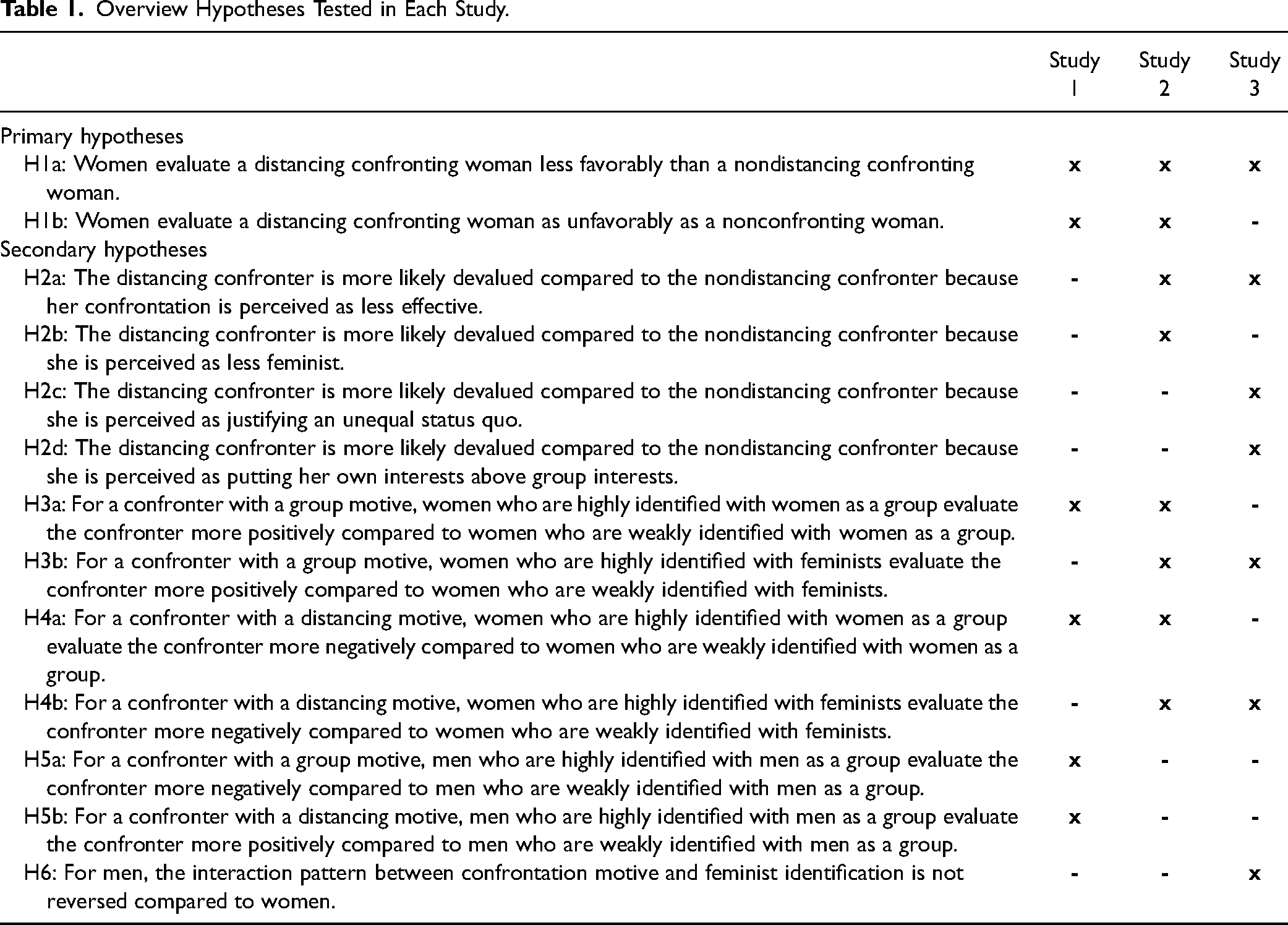
The first set of secondary hypotheses refers to indicators of the proposed underlying mechanism for the key effect of interest—the devaluation of the distancing confronter compared to the nondistancing confronter. We examined whether this devaluation effect was statistically mediated by perceived implications of distancing confrontation for other women. We hypothesized that women would not only take the perceived effectiveness of the confrontation as an intervention against prejudice into account (Czopp, 2019; H2a), but also implications that referred to the (lack of) loyalty of the confronter to the group and commitment to gender equality (Van Veelen et al., 2020). Specifically, we examined the assumed confronter's feminist identification (Sterk et al., 2018; H2b), the confronter's justification of an unequal status of women (gender-specific system justification; Jost & Kay, 2005; H2c), and the confronter putting her own interests above group interests (self-orientation; Tajmirriyahi et al., 2020; H2d) as statistical mediators.
The second set of secondary hypotheses addresses how women's social identity affects their responsiveness to the implications of group-related motives, further shaping their evaluation of the confronter. We examined identification both with women as a group and with feminists, as the former might not necessarily imply a commitment to gender equality. We expected that women highly identified as women (H3a) and as feminists (H3b) would be more responsive to the positive implications of a group confrontation motive, indicated by a more positive evaluation of the confronter. In contrast, we expected that women highly identified as women (H4a) and as feminists (H4b) would be more responsive to the overall negative implications of a distancing confrontation motive, indicated by a more negative evaluation of the confronter (DeMarco & Newheiser, 2018).
In the final set of secondary hypotheses, we examined how social identity shapes the evaluation of a confronter by comparing the effects of gender group identification and feminist identification in women to their effects in men. We expected a reversed effect of gender group identification in men: the group motive has negative implications for men as a group, as it potentially challenges the current status quo of gender hierarchies (H5a). In contrast, the distancing motive has positive implications, as the confronter demands different treatment as an individual but still legitimizes current gender hierarchies (H5b). In contrast, we did not expect a reversed effect of feminist identification in men, as feminist men also strive toward gender equality (H6).
Overall Approach
We tested our hypotheses in a series of three preregistered online scenario experiments. The basic procedure and experimental design were the same in all studies: participants read a vignette about a female professional who did not receive a promotion due to her gender, which is a realistic scenario of gender-based discrimination (Blau & Kahn, 2017; Lindsey et al., 2015). We randomly varied whether this protagonist confronted the perpetrator, implying either an individual, group, or distancing motive, or did not confront at all. This manipulation was thoroughly validated by examining different aspects of the confrontation motive: Expert feedback and attention checks validated the confrontation wording, a pilot study validated the perceived confrontation goals, and manipulation checks in Studies 1 and 2 validated the perceived confrontation motivation (see Supplemental Online Material [SOM] for details). Moderator and mediator variables were not manipulated; instead, they were measured. Consequently, we tested H1a and H1b experimentally and all other hypotheses cross-sectionally.
The study paradigm for all studies was approved by the university's local ethics committee. We report how we determined all data exclusions, sample size, manipulations, and measures in the study, consistent with reporting standards for quantitative research (Appelbaum et al., 2018). Preregistrations, study materials, codebooks, data, codes for data preparation, as well as codes and outputs for analyses reported in this manuscript and preregistered main analyses not reported in the manuscript are available as SOM in the Open Science Framework repository (https://osf.io/nzb6v). Data was analyzed using R 4.2.0 (www.r-project.org). All studies’ designs were preregistered, and analyses reported in the manuscript were mostly preregistered. Preregistered analyses are indicated as such in the respective subheading.
Study 1
In Study 1, we examined how female participants evaluated a female protagonist who confronted an incident of gender-based discrimination with either an individual, group, or distancing motive or did not confront after all. We also examined the effect of gender group identification, comparing female to male participants.
Method
Participants
As preregistered, we strived for a final sample size of 400 participants. We collected data from 490 participants using the psychology department's participant pool as well as snowball sampling via social media. Following our preregistered criteria, we excluded 80 participants who picked a wrong answer in the attention check, one who indicated a nonbinary gender, eight who indicated nonserious participation, and two who guessed the hypothesis. Other preregistered exclusion criteria did not apply. In some cases, more than one of these criteria applied, leading to a total of 86 excluded participants.
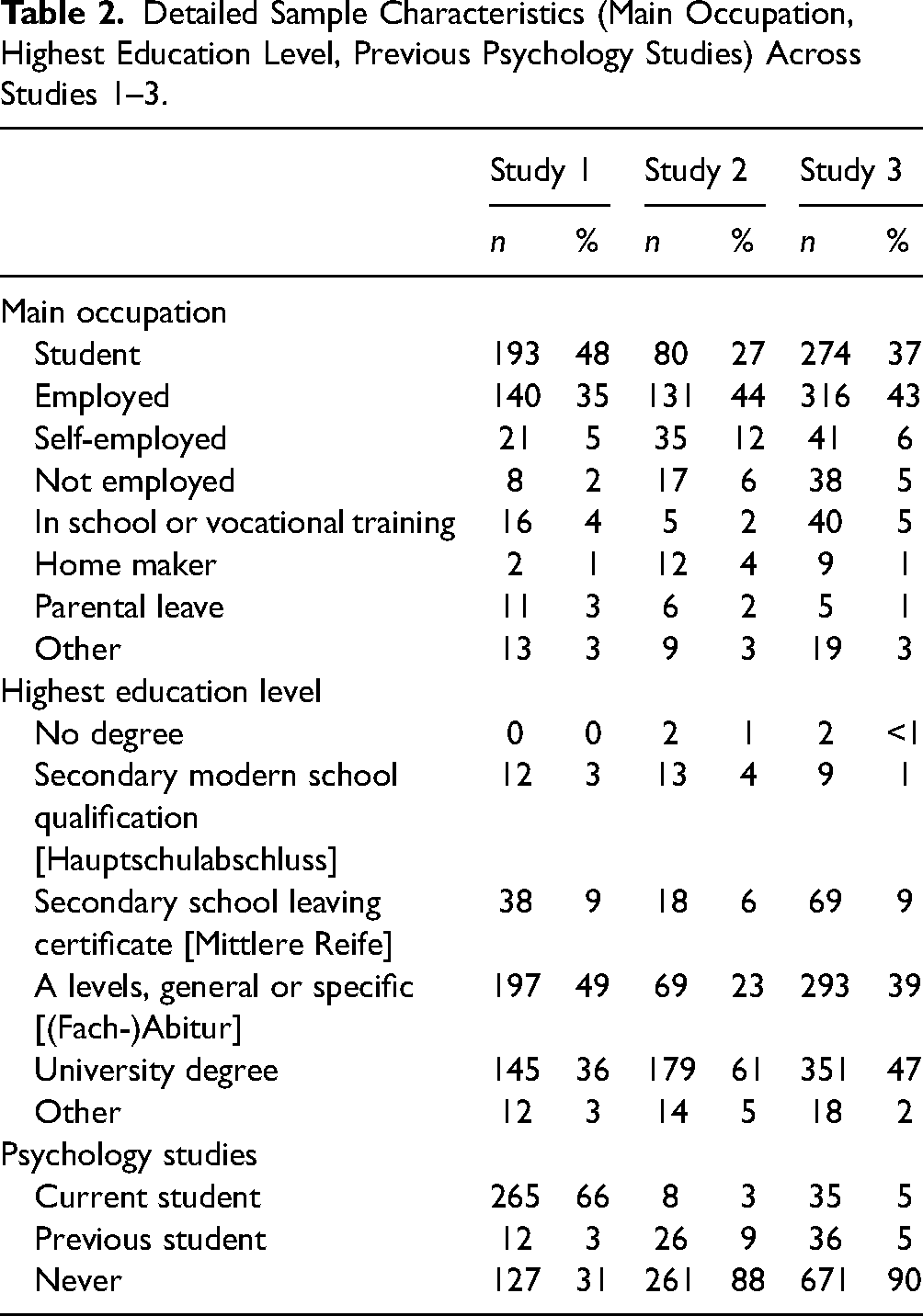
The final sample consisted of N = 404 participants (Mage = 30.8, SDage = 10.44). Most (n = 291, 72.03%) identified as female and indicated German nationality (n = 367, 90.84%); all participants were German-speaking. Their most frequent main occupation was “Student” (n = 193, 47.78%), the most frequent highest educational level was “A levels, general or specific [(Fach-)Abitur]” (n = 197, 48.76%). Most participants were current (n = 265, 65.59%) psychology students (see Table 2 for detailed sample characteristics). Participants recruited from the participant pool received partial credit for their psychology degree.
Detailed Sample Characteristics (Main Occupation, Highest Education Level, Previous Psychology Studies) Across Studies 1–3.
Procedure
Vignette. Participants first read the vignette about a discriminatory incident in the workplace complemented by pictures: the protagonist (a female professional) learns that her equally skilled and equally accomplished male coworker received a pay raise, while she did not. She decides to talk to her male supervisor to ask for a pay raise; the supervisor denies her request and states that “women do not deserve to make as much money as men.” Four conditions represented four different reactions of the protagonist: in three conditions, the female professional confronts her supervisor (“This is not okay.”), subsequently implying either an individual (“It is not justified that I am being treated unfairly. I want that my work is paid appropriately and get paid as much as [name of colleague]”), group (“It is not justified for us women being treated unfairly. We deserve to get paid as much as men”), or distancing motive (“It is not justified that I am being treated unfairly. I am different from most women and I don’t want to be pigeonholed as a woman”). In the fourth condition, the protagonist does not confront the supervisor (“Okay, I have to accept this then”). Participants were randomly assigned to one of the conditions.
Measures. If not indicated otherwise, participants rated items on a 7-point-scale (1—do not agree at all, 7—fully agree). After the manipulation, we measured the evaluation of the protagonist as our key dependent variables. Analogously to previous research on confronter evaluation, participants rated the female protagonist on a positively and a negatively valenced evaluation dimension: overall favorable impression (15 items, e.g., “… is likeable,” “… would be a good coworker,” α = .95; Kaiser & Miller, 2001) and derogation as a complainer (6 items, e.g., “… is oversensitive,” “… a troublemaker,” α = .90; Kaiser & Miller, 2001). After these key dependent variables, participants completed the manipulation check and exploratory variables (see SOM).
Participants also completed a gender group identification measure as moderator (3 items, e.g., “The fact that I am a woman/man is an important part of my identity,” α = .83; adapted from Roth & Mazziotta, 2015). Most participants (n = 303) completed this measure before reading the scenario and evaluating the protagonist and the other participants completed this measure at the end of the study. 1
Results
Table 3 displays means, standard deviations, and correlations of key variables for the female and male subsamples, respectively.
Means, Standard Deviations, and Zero-Order Pearson Correlation Coefficients Study 1.
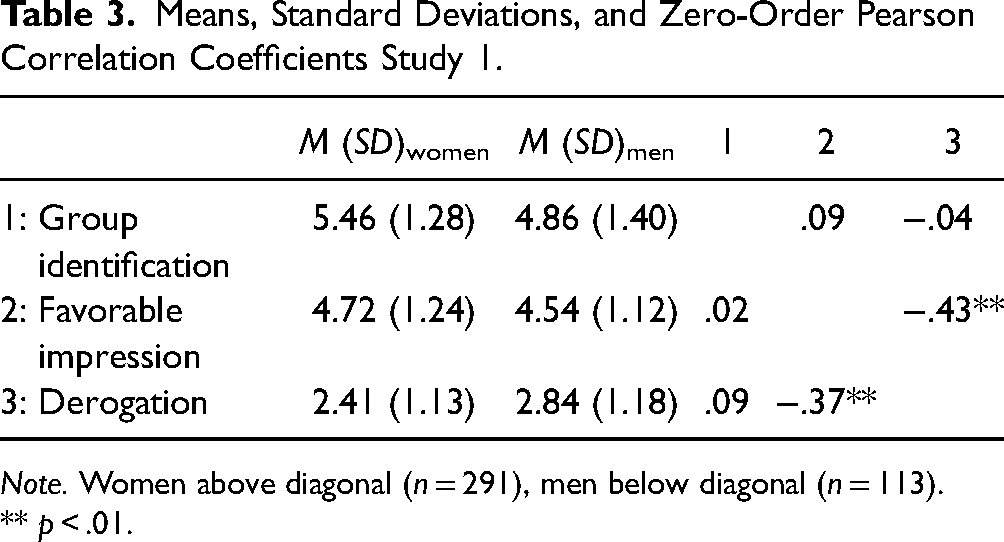
Note. Women above diagonal (n = 291), men below diagonal (n = 113).
** p < .01.
Effects of Confrontation on Women's Evaluation (H1a, H1b)
We first tested how women evaluate the woman who confronts with a distancing motive compared to a nondistancing confronter and a nonconfronter. 2 Specifically, we expected that women would evaluate a nondistancing confronter more positively than a nonconfronter and a distancing confronter, but the distancing confronter not more positively than a nonconfronter. We focused on the subset of female participants and ran two one-way between-subjects ANOVAs (confrontation: individual motive vs. group motive vs. distancing motive vs. no confrontation) with favorable impression and derogation as dependent variables, respectively. Analyses revealed a significant effect of the confrontation on favorable impression, F(3, 287) = 27.95, p < .001, η2par = .23 and derogation, F(3, 287) = 18.13, p < .001, η2par = .16. We followed up with Tukey-corrected pairwise comparisons of the estimated marginal means. A more positive evaluation was indicated by greater values on the favorable impression-measure and lower values on the derogation-measure.
As expected, women indicated a less favorable impression of the protagonist in the distancing motive-condition (M = 3.97, SE = 0.13) compared to the nondistancing confrontation-conditions (individual motive-condition: M = 5.41, SE = 0.14; group motive-condition: M = 5.28, SE = 0.13), ps < .001. Furthermore, no differences between the protagonist in the distancing motive-condition and the protagonist in the no confrontation-condition (M = 4.39, SE = 0.12) were detected, p = .082. No differences between the individual motive- and group motive-conditions were detected, p = .901, and women indicated less favorable impression of the nonconfronter compared to nondistancing confrontation-conditions, ps < .001.
Similarly, women indicated more derogation of the protagonist in the distancing motive-condition (M = 3.20, SE = 0.13) compared to the protagonist in the nondistancing confrontation-conditions (individual motive-condition: M = 2.09, SE = 0.13; group motive-condition: M = 2.29, SE = 0.12) and the no confrontation-condition (M = 2.10, SE = 0.11), ps < .001. No differences were detected between the individual motive-, group motive- and the no confrontation-conditions, ps > .662.
Taken together (see Figure 1), women evaluated the distancing confronter less positively compared to a nondistancing confronter. Furthermore, we did not find that women preferred the distancing confronter over the nonconfronter.
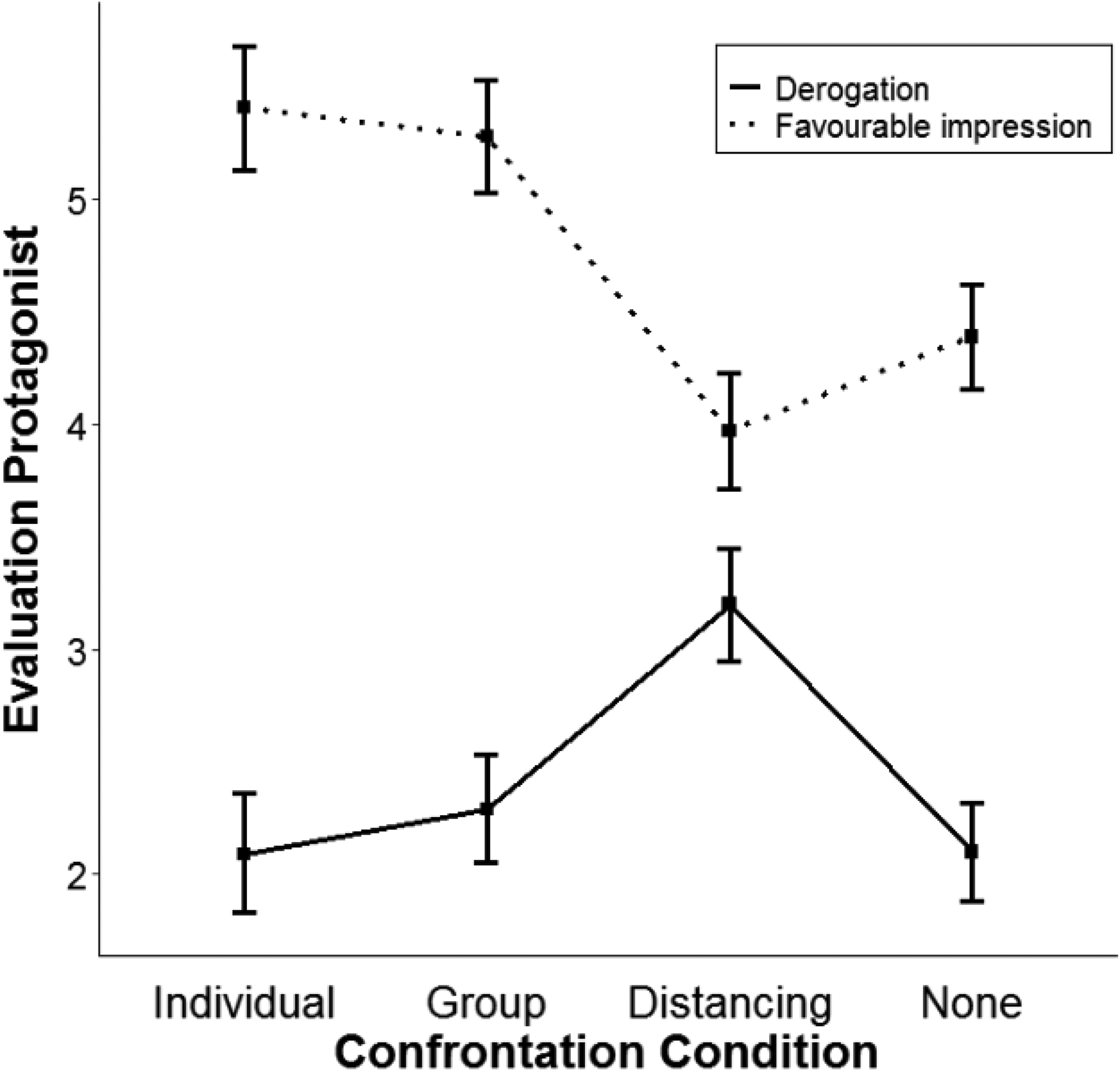
Estimated Marginal Means for the Main Effect Confrontation on Favorable Impression and Derogation Study 1.
Gender Group Identification as Moderator (preregistered; H3a, H4a, H5a, H5b)
Finally, we focused on the full sample and tested our hypotheses that highly identified women would evaluate the protagonist in the group motive-condition more positively compared to weakly identified women (H3a), highly identified men would evaluate the protagonist in the group motive-condition more negatively compared to weakly identified men (H5a), highly identified women would evaluate the protagonist in the distancing motive-condition more negatively compared to weakly identified women (H4a), highly identified men would evaluate the protagonist in the distancing motive-condition more positively compared to weakly identified men (H5b), and that there would be no differences between highly and weakly identified women and men in the individual motive- and the no confrontation condition. We tested this model with the subsample of 303 participants who completed the group identification-measure before the manipulation. To do so, we fitted a general linear model for each outcome (favorable impression and derogation) with all main effects of confrontation (dummy-coded), gender identification, gender (dummy-coded), their two-way interactions, and their three-way interaction as predictors. Due to the multiple levels of the confrontation-factor, there was not one parameter that would indicate whether the interaction was significant. We therefore tested whether including the three-way-interactions would significantly increase the explained variance in the outcome. Model comparisons of these nested models did not detect an increase of explained variance when including the three-way-interactions, ps = .132/.200. However, these tests were likely underpowered. We therefore explored the interaction pattern with estimated marginal means for high (M + 1SD) and low (M − 1SD) group identification using the Tukey HSD method for multiple comparisons. 3
As expected, no differences between highly and weakly identified women and men in the evaluation of the protagonist in the individual motive- and no confrontation-conditions were detected (ps > .427). In contrast, we found differences in the group motive- and distancing motive-conditions. We expected a reversed pattern for women and men, but results only partially supported our hypotheses (see Figure 2).
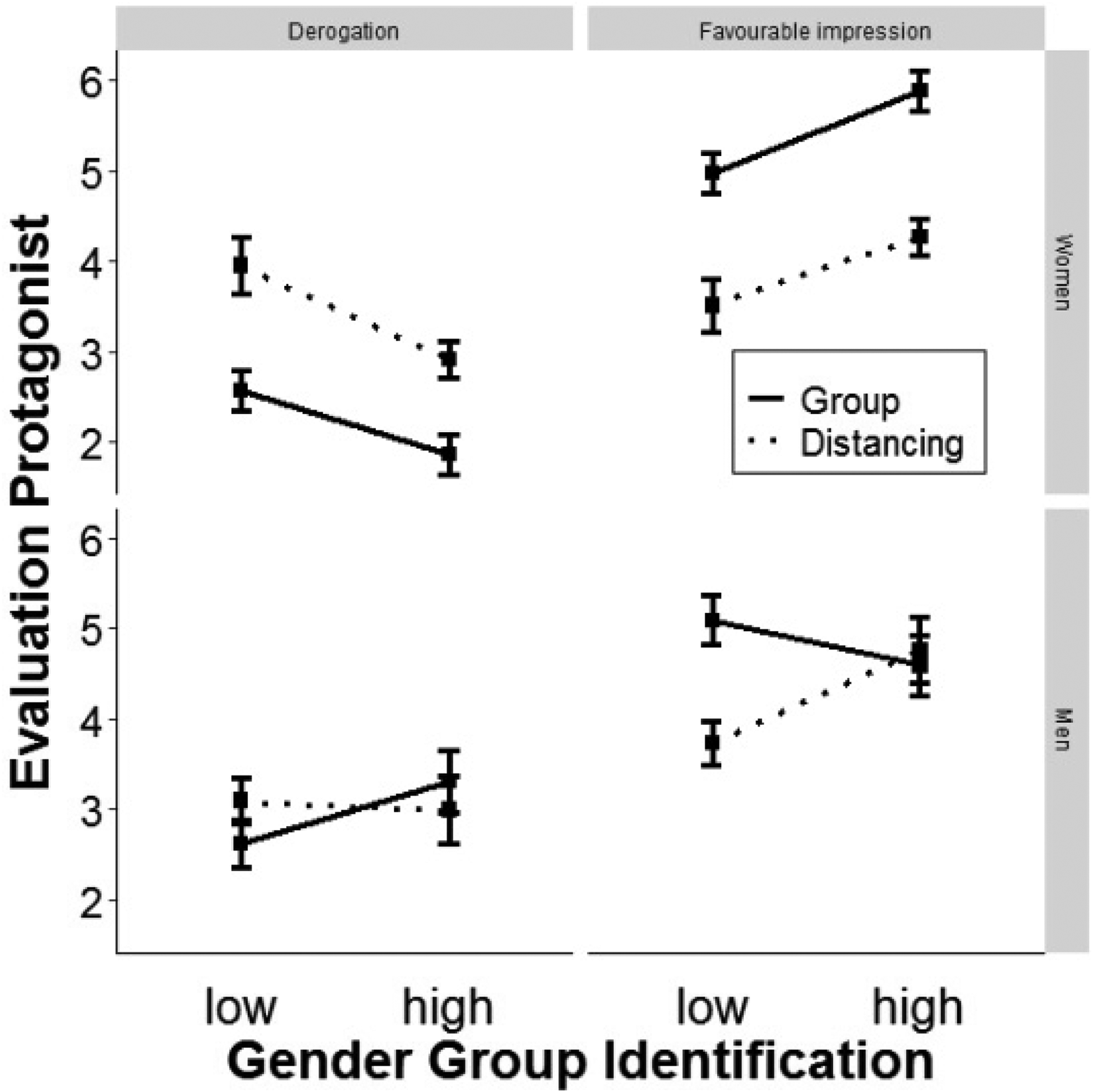
Estimated Marginal Means for the Three-Way-Interaction of Confrontation, Gender, and Gender Group Identification on Favorable Impression and Derogation Study 1.
Group Motive-Condition. As predicted, highly identified women reported a more favorable impression (M = 5.88, SE = 0.22 vs. M = 4.98, SE = 0.22) and less derogation of the protagonist (M = 1.86, SE = 0.23 vs. M = 2.57, SE = 0.22) than weakly identified women, ps = .005/.030. However, no differences between highly and weakly identified men on favorable impression and derogation were detected, ps = .221/.105.
Distancing Motive-Condition. Contrary to our hypotheses, group identification had a similar effect on the evaluation of the protagonist for both female and male participants in the group motive-condition and the effect emerged on different evaluation dimensions: against our prediction, highly identified women reported less derogation of the protagonist (M = 2.91 SE = 0.20 vs. M = 3.95, SE = 0.31) than weakly identified women, p = .010. No differences in the favorable impression between highly and weakly identified women were detected, p = .057. As predicted, highly identified men reported a more favorable impression of the distancing confronter than weakly identified men (M = 4.76, SE = 0.36 vs. M = 3.73, SE = 0.25), p = .010. No differences in derogation between highly and weakly identified men were detected, p = .800.
Discussion Study 1
Overall, results of Study 1 provide first evidence for our main hypothesis: as expected, women evaluated a distancing confronter more negatively than a nondistancing confronter. Importantly, they evaluated the distancing confronter not more positively than a woman who did not confront at all.
Results supported our secondary moderation hypothesis partially. There are two potential explanations for these findings: first, participants completed the group identification-measure right before reading the vignette. Reading and answering items about one's group entails conscious reflection about group matters, which might have made positive implications of distancing confrontation and social norms about gender equality particularly salient to highly identified women. This potential intervention effects of the measure would also be an alternative explanation of the (predicted) effect of group identification for women in the group motive condition: highly identified women might have evaluated the confronter with the group motive more positively only because gender and women's issues were more salient for highly identified women (and not because highly identified women strive toward gender equality). We address these two issues in Study 2.
Study 2
In Study 2, we aimed to replicate and extend our findings from Study 1 in an exclusively female sample while addressing methodological shortcomings and alternative explanations: first, we further refined and validated our manipulation (see SOM). Most importantly, we added a fifth condition, as participants might have perceived parts of the wording of the original distancing motive (“I don’t want to be pigeonholed as a woman.”) as the rejection of categorization and stereotyping and therefore as a pro-group motive. In the additional distancing motive-condition, the woman expressed her distancing more explicitly as so-called verbal Queen Bee-behavior (“This is not ok. It is not justified that I am being treated unfairly. This might be true for most women, but I don’t feel connected to those. I am much more ambitious and assertive than other women”). Queen Bee-behavior refers to the phenomenon that women who hold high positions in a male-dominated organizations respond to discrimination in this work context by distancing themselves from junior women via legitimization of gender hierarchy, underlining distance from other women, and stereotypically male self-presentation (Derks et al., 2016). We also measured perceived efficacy of the protagonist's reaction to rule out inefficiency as alternative explanation for the devaluation of the distancing confronter and the level of support for the protagonist to explore whether the pattern of the evaluation of the protagonist replicates in behavioral tendencies toward the protagonist. Additionally, we explored women's perceptions of implications of the distancing confrontation (effectiveness and assumed feminist identification of the protagonist) as potential statistical mediators of the evaluation of the distancing confronter. 4 Given the unexpected finding on our moderation hypothesis, we eliminated a potential intervention effect of the group identification-measurement by adding an adequate time lag between this measure and the rest of the study and additionally examining participants’ identification with feminists (Mikołajczak et al., 2022).
Method
Participants
As Study 1 used a convenience sample of mostly psychology students, we recruited the sample for Study 2 via Prolific to attain a more heterogeneous sample. Based on a power-analysis and expected attrition described in the preregistration, we strived to recruit 500 participants to fill out the first measurement time point. We recruited 498 German-speaking women at the first measurement time point and invited those who entered a valid participant ID, indicated serious participation, and consented to use their data (n = 487) to the second part of the study two weeks later. Most (n = 403) participants participated in the second part; two participants did not give the final consent to analyze their data. We further excluded 189 participants who failed an attention check at the end of the study (i.e., they did not correctly identify how the protagonist reacted in the scenario), three participants who indicated nonserious participation, and two who described our hypotheses in the suspicion check. In some cases, more than one of these criteria applied, leading to a total of 108 excluded participants. 5 Our final sample was N = 295 (Mage = 33.10, SDage = 10.52). About half indicated German nationality (n = 156, 52.88%). Their most frequent main occupation was “Employed” (n = 131, 44.41%) and the most frequent highest educational level was “University degree” (n = 179, 60.68%). Most participants had never studied psychology (n = 261, 88.47%; see again Table 2 for detailed sample characteristics). All participants received monetary compensation (see SOM).
Procedure, Materials, and Measures
Study 2 consisted of two measurement time points: participants completed demographic and group identification measures at T1 and took part in the experiment at T2 circa two weeks later. At T1, participants completed a measure for identification with women (15 items; e.g., “Being a woman is an important part of how I see myself,” α = .92; Roth & Mazziotta, 2015 adapted to the social group of women) as well as a measure of identification with feminists (1 item, “I identify with the female subtype ‘feminists’”; Postmes et al., 2013). At T2, participants read the vignette about the female professional with the described adaptions. Participants then evaluated the protagonist on two dimensions: favorable impression (7 items, α = .96; e.g., “I like …,” adapted from Kaiser & Miller, 2001; see SOM) and derogation (5 items, α = .90; e.g., “… is annoying,” adapted from Kaiser & Miller, 2001; see SOM). Finally, they indicated their level of support with the protagonist (7 items, α = .92; e.g., “… should receive the promotion”; ad hoc measure, see SOM).
Then, they rated their perception of the protagonist's behavior's efficacy: specifically, they indicated its effectiveness as an intervention (3 items, α = .93; e.g., “[name]’s behavior shows that women can be strong”), potential for prejudice reduction (5 items, α = .95; e.g., “[name]’s behavior helps reduce some of women's disadvantage in society,” adapted from Kaiser & Miller, 2004), and group-based progress regardless of prejudice reduction (3 items, α = .94; e.g., “[name]’s behavior causes that women are respected”; adapted from van Laar et al., 2014). Participants furthermore indicated how much they assumed that the protagonist was identified with feminists (3 items, α = .95; e.g., “For [name], it is an important part of her identity to be a feminist,” adapted from Roth & Mazziotta, 2015). We included manipulation checks and collected additional variables for exploratory purposes (see SOM).
Results
Table 4 displays means, standard deviations, and correlation coefficients of key variables in Study 2. In a preliminary analysis concerning perceived efficacy of the reaction, we first ruled out that women perceive distancing as inefficient. In a one-way between-subject ANOVAs (confrontation: individual motive vs. group motive vs. distancing motive “opposition to categorization” vs. distancing motive “verbal Queen Bee-behavior” vs. no confrontation), we found a significant main effect of confrontation on perceived effectiveness of intervention, F(4, 290) = 95.37, p < .001, η2par = .57, potential for prejudice reduction, F(4, 290) = 52.24, p < .001, η2par = .42, and perceived group-based progress, F(4, 290) = 39.60, p < .001, η2par = .35, respectively.
Means, Standard Deviations, and Zero-Order Pearson Correlation Coefficients Study 2.
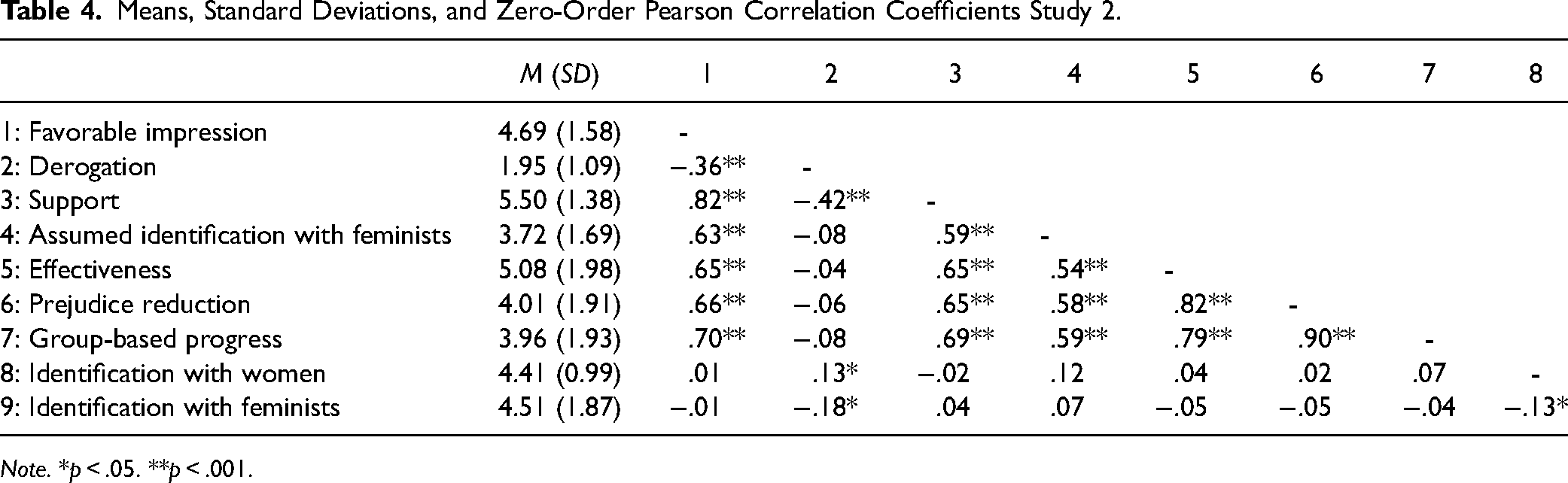
Note. *p < .05. **p < .001.
We followed up with Tukey-corrected pairwise comparisons of the estimated marginal means and found the same pattern across all three dependent variables (see Table 5 for estimated marginal means and standard errors): participants perceived both types of distancing confrontation as less efficient and thus less beneficial for the group compared to confrontation with an individual or group motive, ps < .01—but still more efficient and beneficial than no confrontation, ps < .001.
Estimated Marginal Means of Perceived Effectiveness, Prejudice Reduction, and Group-Based Progress by Confrontation-Condition Study 2.
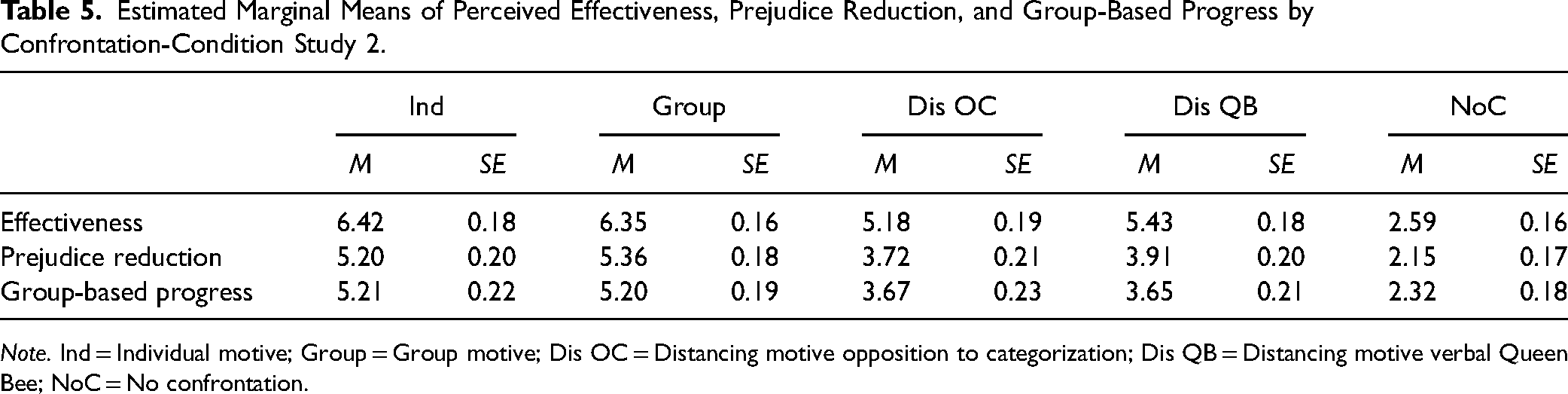
Note. Ind = Individual motive; Group = Group motive; Dis OC = Distancing motive opposition to categorization; Dis QB = Distancing motive verbal Queen Bee; NoC = No confrontation.
Main Effect Confrontation on Evaluation of and Support for the Protagonist (Preregistered; H1a, H1b)
Study 1 found that women evaluated the distancing confronter less positively than the nondistancing confronter and also did not prefer the distancing confronter over the nonconfronter. We expected the same result for Study 2.
We conducted one-way between-subjects ANOVAs (confrontation: individual motive vs. group motive vs. distancing motive “opposition to categorization” vs. distancing motive “verbal Queen Bee-behavior” vs. no confrontation) to test the effect of confrontation on the three dependent variables favorable impression, derogation, and support of the protagonist. We found a significant effect for confrontation on all dependent variables: for favorable impression, F(4, 290) = 29.38, p < .001, η2par = .29, derogation, F(4, 290) = 5.87, p < .001, η2par = .07, and support, F(4, 290) = 22.80, p < .001, η2par = .24.
Tukey-corrected pairwise comparisons of the estimated marginal means revealed the same pattern for all three dependent variables (see Table 6 and Figure 3). As predicted and replicating results from Study 1 for both distancing-conditions, participants on average rated the protagonist in the “opposition to categorization” distancing motive-condition and the “verbal Queen Bee-behavior” distancing motive-conditions equally favorably as in the no confrontation-condition, ps > .857, but less favorable than in the individual motive- and group motive-conditions, ps < .001. As predicted, we found the same pattern for the evaluation dimension derogation: participants indicated higher derogation of the protagonist in “verbal Queen Bee-behavior” distancing motive-condition than in the individual motive-, group motive-, and no confrontation-condition, ps < .01. They also indicated more derogation for the protagonist in the “opposition to categorization” distancing motive-condition than in the individual motive- and no confrontation-conditions, ps < .05. Finally, this pattern extended to the reported support for the protagonist: participants indicated less support in the “opposition to categorization” distancing motive-, “verbal Queen Bee-behavior” distancing motive-, and no confrontation-conditions compared to the individual motive- and group motive-conditions, ps < .001.
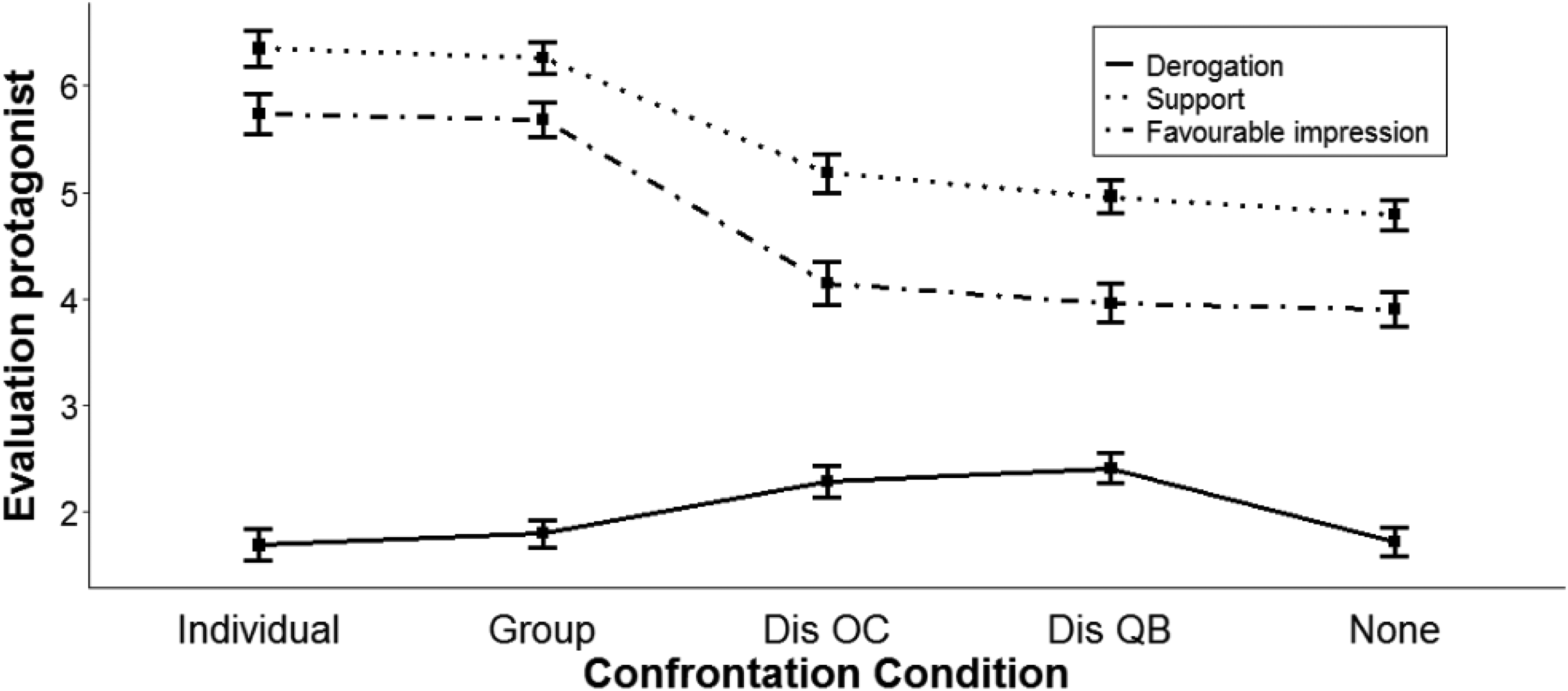
Estimated Marginal Means for the Main Effect Confrontation on Favorable Impression, Derogation, and Support Study 2.
Estimated Marginal Means for Evaluation Dimensions by Confrontation-Condition Study 2.
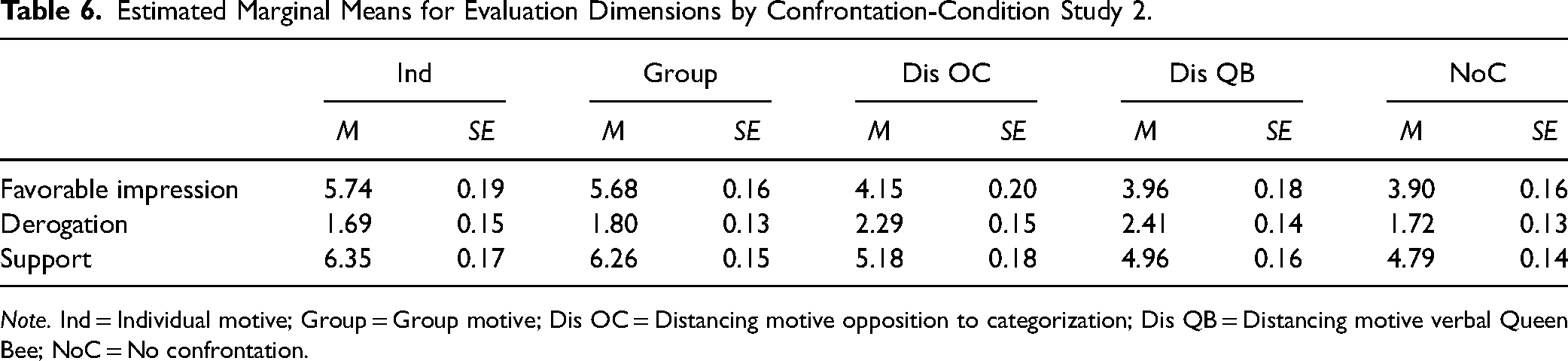
Note. Ind = Individual motive; Group = Group motive; Dis OC = Distancing motive opposition to categorization; Dis QB = Distancing motive verbal Queen Bee; NoC = No confrontation.
Perceived Effectiveness and Assumed Feminist Identification as Mediators of the Devaluation of the Distancing Confronter (H2a, H2b)
For a more nuanced understanding of the devaluation of the distancing confronter (compared to the nondistancing confronter), we fitted a mediation model with perceived effectiveness and assumed feminist identification as mediators. For this analysis, we first collapsed both nondistancing confrontation-conditions (individual and group motive) and coded them with 0 and the nonconfrontation condition with 1.
We conducted a path model with bootstrap standard errors (Figure 4; see SOM for all parameter estimations). The model was just-identified, therefore the overall fit could not be evaluated. Parameter estimates indicated that the devaluation of the distancing confronter (compared to the nondistancing confronter) was mediated by perceived effectiveness, Bindirect = −0.63, SE = 0.12, p < .001, and assumed feminist identification, Bindirect = −0.50, SE = 0.13, p < .001. Results overall indicate that the devaluation of the distancing is statistically mediated by perceived effectiveness and assumed feminist identification of the protagonist.
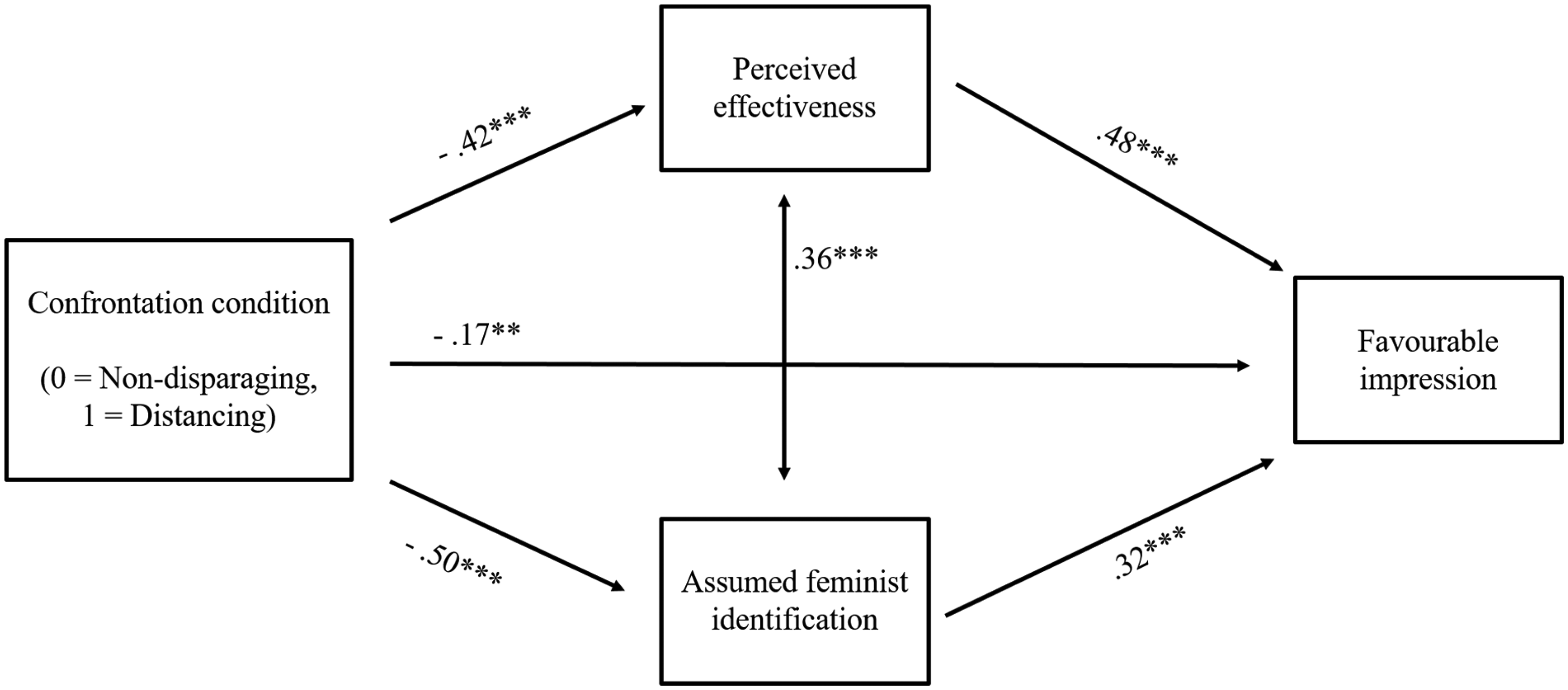
Structural Equation Model for Two Parallel Mediators of the Devaluation Effect of the Distancing Confronter Compared to the Nondisparaging Confronter Study 2.
Identification With Women (preregistered; H3a, H4a) and Identification With Feminists as Moderators (H3b, H3b)
Finally, we aimed to replicate our (tentative) findings from Study 1. As in Study 1, we tested whether including the interactions between condition and identification led to a significant increase in explained variance (respectively for favorable impression, derogation, and support as outcomes). Model comparisons did not detect an increase for including the interactions for the outcomes favorable impression and support, ps = .516/.740, but for derogation, F(4, 285) = 3.64, p = .007 (see SOM for full model results). Again, the test of the interaction might not been powered sufficiently and the nonsignificance might be inconclusive. We therefore explored the interactions with Tukey-corrected pairwise comparisons of the estimated marginal means for high (M + 1SD) and low (M − 1SD) identification. Study 1 found that highly identified women evaluated both the confronter in the distancing motive-condition and the group motive condition more favorable compared to weakly identified women. None of these findings replicated in Study 2 when identification with women was measured with a time lag before the main study: highly and weakly identified women differed in their evaluation only in the opposition to categorization-condition and on the evaluation dimension derogation: highly identified women indicated on average more derogation (i.e., less favorable evaluation) of the distancing confronter than weakly identified women (M = 2.78, SE = 0.20 vs. M = 1.62, SE = 0.24), p < .001—which contradicts the corresponding findings from Study 1 and support our initial hypothesis. All other comparisons were not significant, ps > .096 (see SOM for full results).
Using the same analysis strategy, we examined feminist identification as a moderator (see SOM for full model results). Model comparisons detected a significant increase in explained variance after including the interactions for the outcomes favorable impression, F(4, 285) = 5.63, p < .001, as well as support, F(4, 285) = 4.98, p < .001. No increase was detected for derogation, p = .222. Pairwise comparisons revealed that feminist identification affected the evaluation of the confronter only on the two positively valenced dimensions (favorable impression and support) and in the group motive- and the “opposition to categorization” distancing motive-conditions; all other comparisons were not significant, ps > .052 (see Figure 5). In the group motive-condition, women who were highly identified with feminists reported a more favorable impression (M = 5.97, SE = 0.21 vs. M = 5.39, SE = 0.22) and more support for the protagonist (M = 6.52, SE = 0.19 vs. M = 5.99, SE = 0.20) than women who were weakly identified with feminists, ps = .045/.047—replicating the corresponding effect of gender group identification in Study 1. In the “opposition to categorization” distancing motive-condition, women who were highly identified with feminists reported a less favorable impression (M = 3.49, SE = 0.25 vs. M = 4.96, SE = 0.28) and less support for the protagonist (M = 4.60, SE = 0.23 vs. M = 5.89, SE = 0.26) than women who were weakly identified with feminists, ps < .001—contradicting the corresponding finding of gender group identification in Study 1 and replicating the corresponding finding in Study 2.
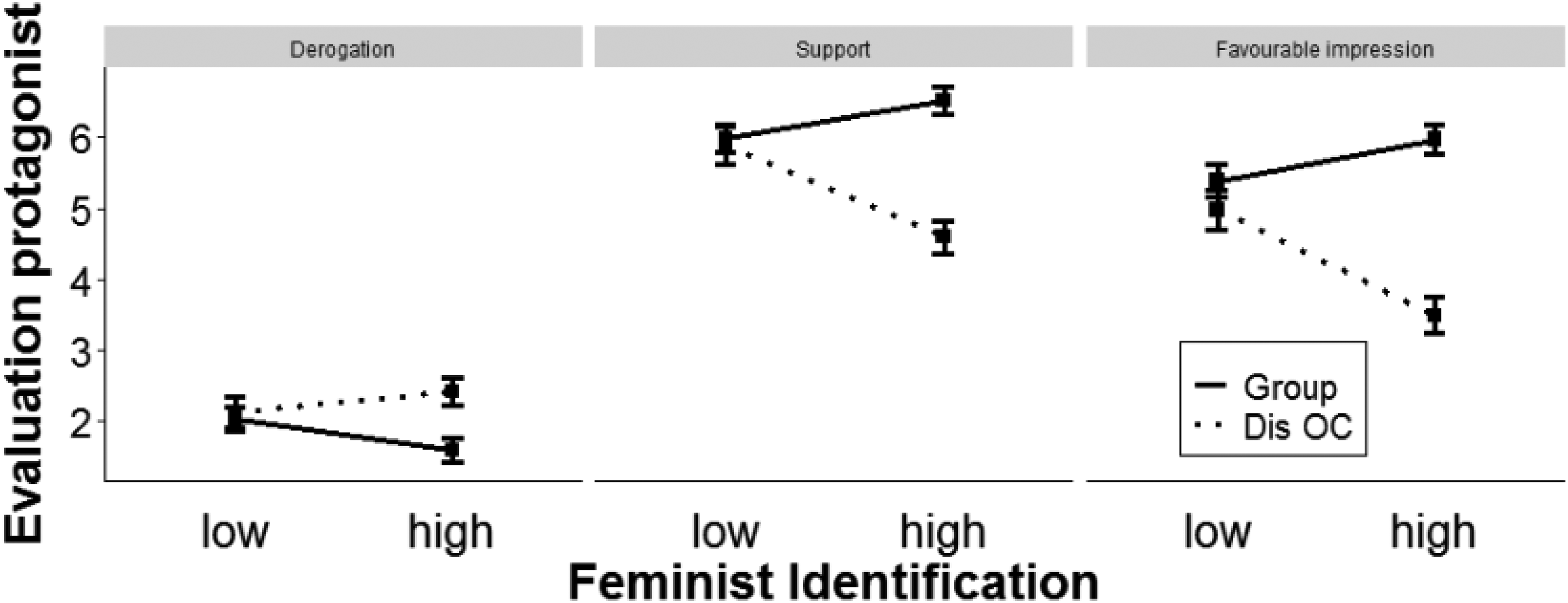
Estimated Marginal Means for the Two-Way-Interaction of Confrontation and Feminist Identification on Favorable Impression and Derogation Study 2.
Unlike gender group identification, feminist identification also affected the evaluation of the nonconfronter, but only on the dimension derogation: participants who were highly identified with feminists reported less derogation than participants who were weakly identified with feminists (M = 1.45, SE = 0.18 vs. M = 1.95, SE = 0.17), p = .044. 6
Discussion Study 2
Results from Study 2 not only confirmed but also extended our findings from Study 1. Regarding our main hypothesis on the devaluation of the distancing confronter, our results ruled out inefficiency as alternative explanation, indicated that the devaluation effect emerges regardless of the wording of the distancing motive (opposition to categorization vs. verbal Queen Bee-behavior) and extends to tangible negative consequences for the distancing confronter (loss of support for the protagonist). Results were also in line with our argument that women take the implications of distancing confrontation into account when evaluating the confronter since the devaluation of the distancing confronter was statistically mediated by the perceived effectiveness of the confrontation and assumed feminist identification of the confronter.
Study 2 provides more insight into the role of women's identities: while gender group identification had a similar effect on the evaluation of the distancing confronter and the confronter with the group motive in Study 1 (highly identified women indicated more positive evaluation than weakly identified women), highly identified women in Study 2 only differed from weakly identified women in their evaluation of the distancing confronter. Importantly, they evaluated the distancing confronter more negatively—indicating that they are more responsive to the disparaging of women. Comparing these results from Study 1 (where we measured this construct in the same session) with results from Study 2 (where we measured this construct in advance) indicates that filling out a gender group identification-measure might increase women's receptiveness to potential group benefits of any group-related confrontation motive (distancing and group). We also examined the role of feminist identification, which was a more reliable indicator of women's commitment to advancing gender equality. However, the moderation effect of feminist identification was found in an exploratory analysis and the p values of some pairwise comparisons fell just below the alpha-level of .05—which is especially concerning given the inaquate power of Study 2 for detecting interactions. Furthermore, we used a single-item measure for feminist identification. While previous research has demonstrated the validity of single-item measures of identification (Postmes et al., 2013; Reysen et al., 2013), one could argue that this measure might rather assess identification with the label “feminist”—which might differ from identification with feminism (Siegel & Calogero, 2021). We addressed these issues in Study 3.
Study 3
Study 3 focused on the secondary hypotheses: we replicated the (exploratory) finding from Study 2 that not only lower perceived effectiveness, but also perceptions of (lack of) loyalty of the confronter to the group and commitment to gender equality statistically explains women's devaluation of the distancing confronter. Finally, we replicated the effect of feminist identification with a multiple-item measure and compared the effect of feminist identification in women and men.
Method
Participants
The recruiting process was similar to Study 2: based on the expected attrition described in the preregistration, we recruited n = 1,044 (600 female and 444 male) German-speaking participants at the first measurement time point and invited them to the second part of the study two weeks later (via Prolific). Most (n = 861) participants participated in the second part; two participants did not give the final consent to analyze their data. We further excluded 118 participants who failed an attention check at the end of the study (i.e., they did not correctly identify how the protagonist reacted in the scenario) and two participants who indicated nonserious participation. Other preregistered exclusion criteria did not apply. In some cases, more than one of these criteria applied, leading to a total of 119 excluded participants. Our final sample was N = 742 (419 women, 323 men; Mage = 29.03, SDage = 8.56).
The majority indicated German nationality (n = 644, 86.79%). The most frequent main occupation status was “Employed” (n = 316, 42.59%), followed by “Student” (n = 274, 36.93%). The most frequent highest educational level was “University degree” (n = 351, 47.30%) followed by “A levels, general or specific [(Fach)Abitur]” (n = 293, 39.49%). Most participants had never studied psychology (n = 671, 90.43%; see Table 2 for detailed sample characteristics). All participants received monetary compensation (see SOM).
Procedure, Materials, and Measures
Like Study 2, Study 3 consisted of two measurement time points: participants completed demographic measures and the feminist identification measure at T1 and took part in the experiment at T2 circa two weeks later. At T1, participants completed a measure for identification with feminists (4 items, e.g., “I consider myself a feminist,” translated from Szymanski, 2004; α = .93). At T2, participants first read the vignette about the female professional who confronted either with a group or distancing motive (same wording as in Study 2). After that, participants rated the protagonist on the mediation variables (order was randomized): perceived effectiveness as an intervention (3 items as in Study 2, α = .80), perceived gender-specific system justification (3 items, 7 e.g., “According to [protagonist], relations between men and women are fair in general,” adapted and translated from Jost & Kay, 2005; α = .80), and perceived self-orientation (5 items, e.g., “[protagonist] just takes care of her needs and lets other people take care of themselves,” adapted and translated from Singelis et al., 1995 and Tajmirriyahi et al., 2020; α = .89). Finally they evaluated the protagonist on the dimension favorable impression (7 items as in Study 2, α = .97).
Results
Table 7 displays means, standard deviations, and correlation coefficients of the variables in Study 3.
Means, Standard Deviations, and Zero-Order Pearson Correlation Coefficients Study 3.
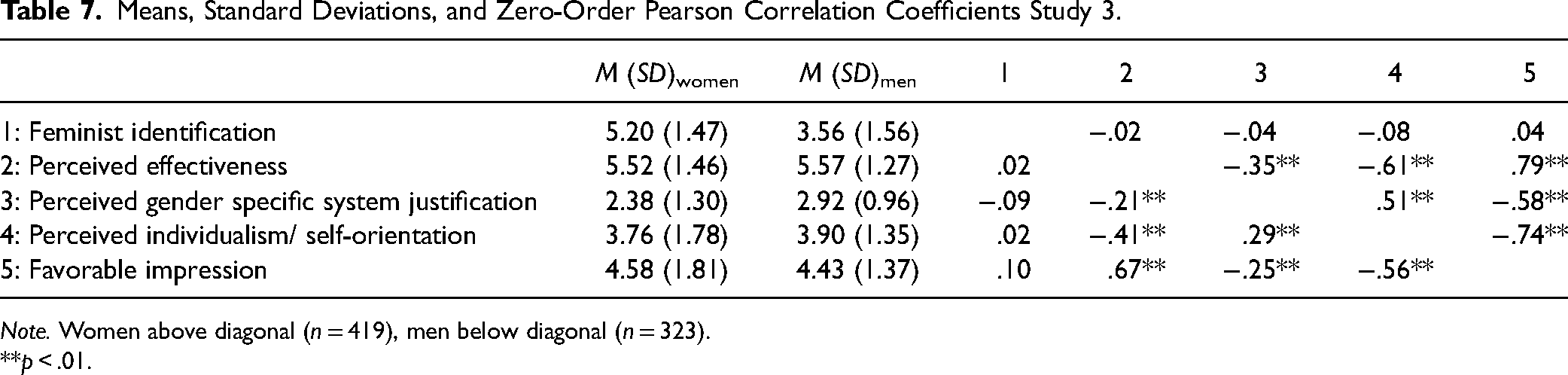
Note. Women above diagonal (n = 419), men below diagonal (n = 323).
**p < .01.
Mediation of Women's Devaluation of the Distancing Confronter Compared to the Group-Motivated Confronter (Preregistered; H1a, H2a, H2c, H2d)
Replicating results from Studies 1 and 2, women evaluated the distancing confronter less favorably (M = 3.30, SD = 1.55) compared to the group-motivated confronter (M = 5.79, SD = 1.04), t(417) = 19.28, d = 1.90, p < .001. We examined how the perceived effectiveness, gender-specific system justification, and self-orientation mediated this effect with a path model. As the mediator variables and dependent variables correlated relatively high (Table 7), we first examined whether these four scales were structurally distinct. Parallel analysis and subsequent exploratory factor analysis revealed four distinct factors but also that one perceived effectiveness-item loaded equally on all four factors, which could be explained by the rather broadly worded content of the item (see SOM for full results). We therefore excluded this item from the scale.
We conducted a path model with confrontation as the independent variable (dummy coded, group motive = 0, distancing motive = 1), favorable impression as the dependent variable, and perceived effectiveness, gender-specific system-justification, and self-orientation as parallel, correlated mediators (Figure 6; see SOM for all parameter estimates). Parameter estimates indicated that the devaluation of the distancing confronter (compared to the group-motivated confronter) was statistically mediated by perceived effectiveness (Bindirect = −0.57, SE = 0.08, p < .001), gender-specific system-justification (Bindirect = −0.27, SE = 0.07, p < .001), and self-orientation (Bindirect = −0.88, SE = 0.16, p < .001).
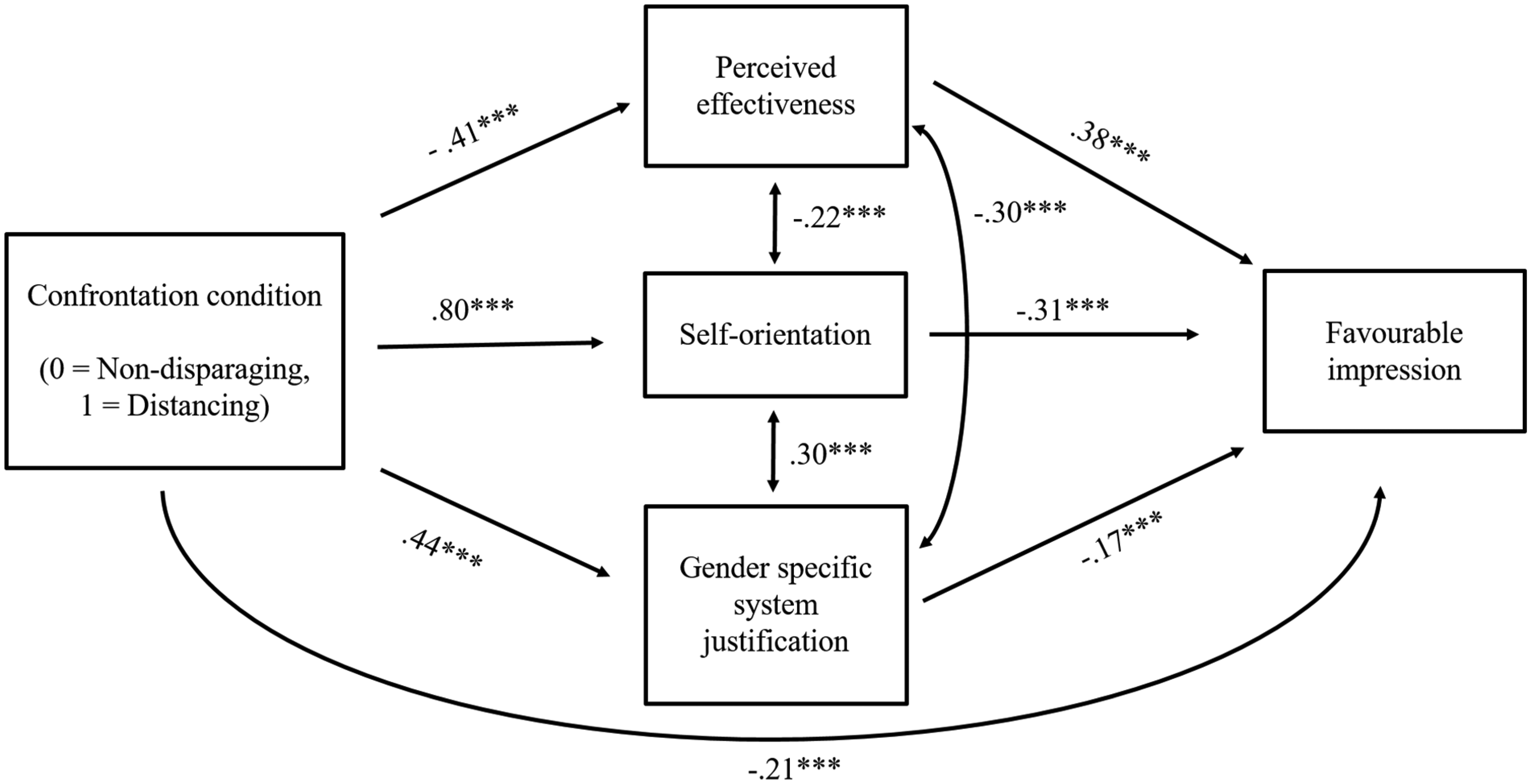
Structural Equation Model for Three Parallel Mediators of the Devaluation Effect of the Distancing Confronter Compared to the Nondisparaging Confronter Study 3.
Effect of Feminist Identification (Preregistered; H3b, H4b, H6)
We predicted that feminist identification would interact with confrontation as in Study 2 and conducted a general linear model first with female participants only with confrontation (dummy-coded) and feminist identification as well as their interaction as predictors. As the factor confrontation had only two levels, only one parameter indicated the interaction between confrontation and feminist identification.
The interaction parameter was significant, B = −0.31, SE B = 0.09, t = −3.64, p < .001 (see Table 8). Again, we followed up with Tukey-corrected pairwise comparisons of the estimated marginal means for high (M + 1 SD) and low (M − 1 SD) feminist identification (based on female participants). Results fully replicated our findings from Study 2: in the group motive-condition, women who were highly identified with feminists reported a more favorable impression (M = 6.01, SE = 0.12 vs. M = 5.55, SE = 0.13) than participants who were weakly identified with feminists, p = .010. In the distancing motive-condition, women who were highly identified with feminists reported a less favorable impression (M = 3.06, SE = 0.13 vs. M = 3.51, SE = 0.12) than participants who were weakly identified with feminists, p = .011).
General Linear Model, Women Only (n = 419), Study 3.
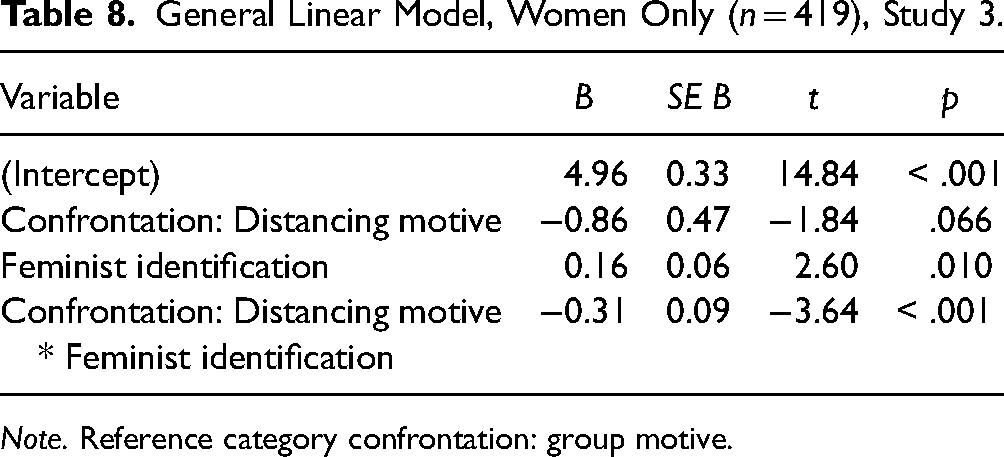
Note. Reference category confrontation: group motive.
We examined whether this effect of feminist identification would not reverse for men (in contrast to the effect of gender group identification in Study 1). We conducted a general linear model with all participants with confrontation (dummy-coded), feminist identification, and gender (dummy-coded), their two-way interactions, as well as their three-way interaction (again only one parameter).
Our study was sufficiently powered to detect a reversed interaction pattern for men, which we did not find: the three-way interaction was not significant (p = .388; see Table 9). Again, we explored Tukey-corrected pairwise comparisons of the estimated marginal means for high (M + 1 SD) and low (M − 1 SD) feminist identification (based on female and male participants). Unsurprisingly, the pattern for women was the same as above (see SOM). As expected, the pattern for men in the group motive-condition was the same as for women: men who were highly identified with feminists reported a more favorable impression (M = 5.78, SE = 0.20 vs. M = 4.74, SE = 0.11) than men who were weakly identified with feminists, p < .001. However, no differences between highly and weakly identified men in the distancing motive-condition were detected, p = .072.
General Linear Model, all Participants (N = 742), Study 3.
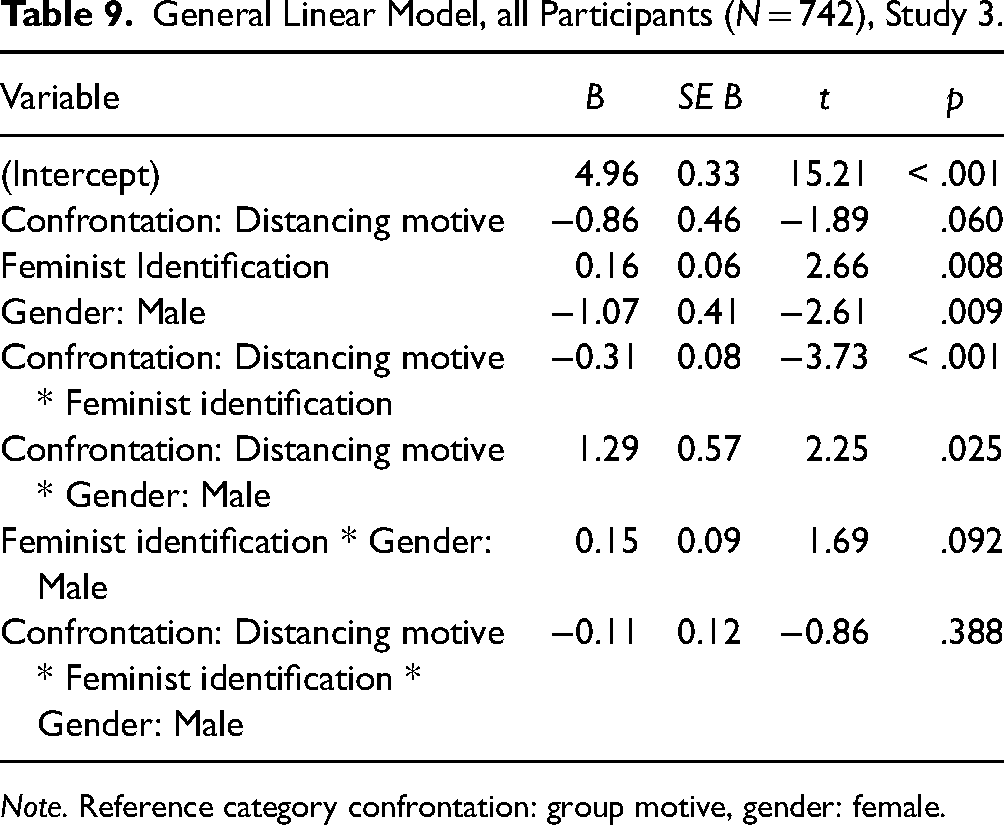
Note. Reference category confrontation: group motive, gender: female.
Discussion Study 3
As expected, women's devaluation of a distancing confronter (compared to a group-motivated confronter) was statistically mediated by lower levels of perceived effectiveness of the confrontation as well as higher levels of perceived gender-specific system justification as well as higher levels of perceived self-orientation. However, statistical mediation is only a necessary but not a sufficient condition for causal mediation and this result should be interpreted accordingly (Fiedler et al., 2011). Future research could examine the underlying mechanisms of the devaluation of distancing confrontation in depth.
We also replicated the effect of feminist identification with a multiple item-measure and adequate statistical power. Furthermore, we compared the effect of feminist identification between women and men and tested whether feminist identification would have a reverse effect for men (like gender group identification in Study 1). As expected, this was not the case: men who are strongly identified with feminists evaluate a confronter with a group motive more positively compared to men who are weakly identified with feminists. Interestingly, we did not find differences in the evaluation of the distancing confronter between men who are strongly identified with feminists and men who are weakly identified with feminists—indicating that feminist men might be less susceptible to the implications of distancing confrontation for women and gender equality. Gender might have attenuated the interaction of feminist identification and confrontation and our analysis was not powered to detect this attenuated interaction. Detecting an attenuated interaction requires a sample size that is a multiple of the sample size needed for detecting a reverse interaction pattern (Blake & Gangestad, 2020). Given the scope of our research, we were only interested in testing the latter. Future research focusing on men's feminist allyship could examine the processes of men's evaluation of a confronter in depth.
General Discussion
Women have different motives when confronting gender bias (Becker & Barreto, 2019; Munder et al., 2020). The present research provides new insights into distancing confrontation, which is confrontation directed at distancing oneself from the devalued group to reject the discriminatory treatment by emphasizing that one is different from other women. Specifically, we were interested in the social consequences of this “double-edged” resistance to discriminatory treatment. We argued that other women take the implications of the distancing confrontation for themselves into account and examined whether they are more susceptible to the potential benefit for the group (Becker et al., 2015; Garcia et al., 2010) or the disparaging of the group (Marques et al., 1988; van Veelen et al., 2020). We expected that women not only evaluate a distancing confronter less positively than a nondistancing confronter, but also would not prefer the distancing confronter over a nonconfronter (Gonsalkorale & Williams, 2007; Van Laar et al., 2014).
Devaluation of a Distancing Confronter
In three preregistered and adequately powered online vignette experiments, female participants indicated higher disapproval of a confronting woman who implied a distancing motive compared to a confronting woman who implied a nondistancing motive. Importantly, although participants perceived distancing confrontation as more beneficial for the group than no confrontation (Study 2), they did not prefer the distancing confronter over a nonconfronter (Studies 1 and 2). We ensured with several measures that women perceived the distancing confrontation as distancing from other women and ruled out alternative explanations. Additional mediation (Studies 2 and 3) and moderation analyses (Studies 1–3) examined nuances of the devaluation of a distancing confronter: the devaluation of the distancing confronter was mediated by perceived implications of the confrontations for women (effectiveness of confrontation, assumed feminist identification, assumed gender-specific system justification, putting own interests above group interests) and women who are strongly identified with women or feminists disapprove more of a distancing confronter (compared to women who are weakly identified). Taken together, our findings are in line with our argument that women take the implications of confrontation for themselves into account and are more susceptible to the disparaging of the group than to the potential group benefits of distancing confrontation. To the best of our knowledge, this research is the first to examine how women evaluate a distancing confronter when the disparaging is directed at themselves. Our research thus provides new insights into this particular manifestation of self-group distancing behavior (van Veelen et al., 2020).
Receptiveness to Disparaging Derives From a Target Perspective
Comparing our results to previous research and comparing women to men illustrates that women show this receptiveness to the disparaging of the distancing confrontation specifically because they feel that the disparaging comment affects them as a woman. First, this target perspective is illustrated by differentiating between first- and third-person perspectives on confrontation: from a first-person perspective, confronting women might be more receptive to the potential benefits of distancing confrontation and thus prefer distancing confrontation over nonconfrontation (Becker et al., 2015). In contrast, our research focuses on the third-person perspective and shows that observing women are more receptive to the disparaging of women—despite their awareness of the benefits of distancing confrontation over nonconfrontation.
Second, women only seem receptive to disparaging comments when they feel they are part of the group that is being disparaged: in previous research, female undergraduate college students did not appear receptive to the disparaging of (professionally experienced) female lawyers (Garcia et al., 2010). The college students likely perceived experienced lawyers as a distinctive subgroup of women and thus the disparaging comment not directed at themselves (as college students or women). In contrast, our research ensured that (mostly working) participants actually perceived the distancing confrontation as distancing from (working) women. Participants likely perceived that the disparaging comment was directed at women like themselves and were thus receptive to the disparaging.
Finally, examining the effect of women's gender group (Study 2) and feminist identification on the evaluation of a confronter (Studies 2 and 3) and comparing the effect to men's feminist identification (Study 3) further supports the notion that women are responsive to disparaging comments because they are the target. Women who were highly identified with women as a group and women who were highly identified with feminists were particularly receptive to the disparaging of the distancing confrontation (as they evaluated the distancing confronter more negatively compared to women who were weakly identified with women and women who were weakly identified with feminists). Feminist women were also more receptive to the benefits of confrontation with a group motive. In contrast, feminist men were only more receptive to the benefits of confrontation with a group motive, but not more receptive to the disparaging comment of distancing confrontation (both compared to men who were weakly identified with feminists). This indicates that feminist men—despite their commitment to gender equality—are not receptive to the negative implications of distancing confrontation and disparaging of women because they are not directly targeted themselves. Taken together, feminist identification increases both women's and men's receptiveness to the benefits of confrontation with a group motive—likely because they are committed to gender equality; in contrast, gender group and feminist identification only increases women's receptiveness to the disparaging content of distancing confrontation—likely because they are targets themselves.
Nuanced Processes of Receptiveness
We examined the effects of different distancing statements (opposition to categorization, verbal Queen Bee-behavior) on different evaluation dimensions (favorable impression, derogation, support). Women's devaluation of the distancing confronter (compared to the nondistancing confronter) manifested independently from the distancing statement and evaluation dimension. However, the effect of women's identification on women's evaluation of the distancing confronter depended on an interplay of several aspects: the point in time of measuring identification (in the same session as the experiment vs. two weeks in advance), the type of identification (women vs. feminists) as well as the distancing statement and the evaluation dimension. For instance, higher identification with women was associated with more negative evaluation of the distancing confronter in the form of stronger derogation; in contrast, higher identification with feminists was associated with more negative evaluation of the distancing confronter in the form of loss of liking and support (Study 2). These variations indicate that interindividual differences in women's receptiveness and reactions to the disparaging statement are the result of nuanced underlying processes of social evaluation. For instance, there processes involve the overall context, together with women's identities and corresponding goals, and manifest in distinct behavioral tendencies (Koch et al., 2021). Furthermore, results of (cross-sectional) mediational models indicate that several factors (perceptions of efficacy, system justification, and self-orientation) could explain the devaluation of the distancing confronter. Future research could examine these processes systematically, with adequately powered studies to detect attenuated interactions and designs that allow causal interpretations of mediators.
Limitations
Our experimental vignette design and materials limit the generalizability of our findings. Generally, imagined reactions to a vignette might not correspond to actual behavior following a real incident (e.g., Woodzicka & LaFrance, 2001; but see also Robinson & Clore, 2001). Future research could review the generalizability of our findings in a more naturalistic setting while using behavioral measures of the evaluation instead of self-reports. Specifically, our stimulus material was limited to one narrowly defined context (blatant workplace discrimination of a highly skilled female professional), population (German speakers, mostly of German nationality), and target group (women). Future research should examine whether the devaluation of distancing confronters replicates in different contexts (e.g., outside of the workplace, subtle forms of sexism, low status confronter), populations, and target groups.
Practice Implications
The present research also adds more broadly to the literature on the consequences of confrontation (Czopp, 2019). Previous research has found that women risk disapproval by others when they confront the discriminatory incident (so-called social costs; Kaiser & Miller, 2001). We provide a more nuanced understanding of the role of the perceived motive. Women who confront discrimination risk being perceived as a disparaging “Queen Bee” and potentially facing backlash from other women. Complicating matters even more, women might not even be aware of these specific social costs (Becker et al., 2015) and are also punished for nonconfrontation (Becker et al., 2011). Overall, navigating a discriminatory incident remains challenging for women.
Finally, our overall findings have practical implications. They show that nuances in the wording of a confrontation might make other women withdraw support for the confronter (Study 2). However, social support is a crucial resource for coping with discrimination (Foster, 2000). Results also indicate that women are aware of the potential benefits of distancing confrontation over nonconfrontation (Study 2) but overall devalue a distancing confronter. This has implications for professional contexts where women are in positions to support other women who have been a victim of discrimination and sexism (e.g., as a supervisor, HR, or equal opportunities officer): if the woman who reports the mistreatment also give the impression that she was distancing herself from other women in her reaction, she might not receive the appropriate support. Ironically, this effect might occur even more likely when the consulting woman is a feminist. Training could raise awareness of this effect. Furthermore, interventions that empower women to speak up against discrimination and sexism could raise awareness that while they might perceive a distancing confrontation as effective, it might actually backfire.
Conclusion
A woman's distancing confrontation of discrimination has both positive and negative implications for other women: on the one hand, the confrontation challenges sexism and generalized treatment of women; on the other hand, the confronter disparages women as a group. Our experimental research examined how other women overall evaluate a distancing confronter: we found that women not only devalue a disparaging confronter compared to a nondistancing confronter but also do not prefer her over a nonconfronting woman.
Supplemental Material
sj-docx-1-pwq-10.1177_03616843231207052 - Supplemental material for At Least She Is Doing Something? Women Do Not Prefer a Woman Who Confronts Gender-Based Discrimination With a Distancing Motive Over a Nonconfronter
Supplemental material, sj-docx-1-pwq-10.1177_03616843231207052 for At Least She Is Doing Something? Women Do Not Prefer a Woman Who Confronts Gender-Based Discrimination With a Distancing Motive Over a Nonconfronter by Anja K. Munder, Julia C. Becker, Nadja Salvatierra Ruiz, and Oliver Christ in Psychology of Women Quarterly
Footnotes
Declaration of Conflicting Interests
The author(s) declared no potential conflicts of interest with respect to the research, authorship, and/or publication of this article.
Funding
The author(s) received no financial support for the research, authorship, and/or publication of this article.

Supplemental Material
Supplement material for this article is available in online.
Notes
References
Supplementary Material
Please find the following supplemental material available below.
For Open Access articles published under a Creative Commons License, all supplemental material carries the same license as the article it is associated with.
For non-Open Access articles published, all supplemental material carries a non-exclusive license, and permission requests for re-use of supplemental material or any part of supplemental material shall be sent directly to the copyright owner as specified in the copyright notice associated with the article.
