



Abstract
Although many workers speak with a non-native English accent, our understanding of this phenomenon is limited because prior work predominantly focused on men. This overlooks whether the biases women experience due to their accent manifests differently. To address this omission, we use an intersectional lens to examine how non-native accents associated with more gender-traditional countries may affect women's hiring outcomes. We argue that the bias women with these accents face is subtle due to an association of non-native (vs. native) accents with perceptions of women's warmth (whereas there are no such effects for men) and consequently higher perceptions of hireability. Yet we posit that the indirect effect on hireability occurs within feminine, but not masculine, industries, which ultimately undermines equity by pushing women with these non-native accents into lower pay and prestige occupations. We found support for our hypotheses in three vignette-based experiments conducted in Canada using a Mandarin accent. Managers and decision-makers need to be aware of the insidious bias women with these non-native accents experience because it may not be immediately apparent that an association of accent with higher ratings of warmth may undermine women at work. Additional online materials for this article are available on PWQ's website at https://journals.sagepub.com/doi/suppl/10.1177/03616843231165475
Due to sustained globalization and immigration, a substantial portion of the global workforce speaks English with a non-native accent (i.e., an accent produced by speakers whose first language is not English; Moyer, 2013). Although 1.35 billion people worldwide speak English, only 375 million are native speakers (Statista, 2021), which indicates there is likely a large number of speakers with non-native English accents (Gluszek & Dovidio, 2010b). This phenomenon of having a substantial portion of the workforce speaking English with a non-native accent is particularly prevalent in traditional immigrant countries, such as Australia, Canada, and the United States (U.S.). As such, the phenomenon of speaking with a non-native accent is tightly connected with immigration. Additionally, English has also become a lingua franca, a frequent business language around the world, making non-native accents in the workplace a common global phenomenon (Neeley, 2013). Consequently, the global workforce is highly accent diverse, with this diversity being most pronounced in traditional immigrant and developed countries.
To date, research on non-native accents at work has mostly uncovered negative effects of non-native (vs. native) accents, such as lower hiring recommendations (Huang et al., 2013) or lower credibility (Lev-Ari & Keysar, 2010), indicating that non-native accented English speakers tend to be viewed negatively in a relatively straightforward manner. Yet this prior work primarily focused on men-identified speakers. This tendency to assume that the experience of men sufficiently captures the phenomenon is dominant in research on accents at work (Hideg et al., 2022). Critically, even when both men- and women-identified speakers were included in prior studies, the intersection between accent and gender was typically not explicitly examined. Thus, scholars have largely overlooked the possibility that women with non-native accents may have divergent experiences and that bias related to accents may manifest differently for women than men.
The lack of scholarship on the intersection of accent and gender is a critical omission for several reasons. First, men and women are stereotyped differently (Ellemers, 2018). However, non-native accent has generally been studied in isolation from other visible identities, including gender (Hideg et al., 2022). This is an important oversight as the literature on intersectionality indicates that an individual's membership in multiple groups (e.g., gender and accent group) often intersect to produce unique experiences and evaluations of the individual separate from what each membership would produce on its own (e.g., Crenshaw, 1989; Rosette et al., 2018). More specifically, the concept of intersectionality, which originated from Black feminist scholarship, suggests that discrimination faced by those who are multiply marginalized manifests itself differently than for individuals who have one marginalized identity (Crenshaw, 1989). Second, although it may seem puzzling that the intersection of accent and gender has received limited attention, it is in line with broader practices and norms in the conduct of scientific research in which men tend to be seen as the default and women's unique experiences are often ignored (Crasnow, 2020; Perez, 2019). This suggests that our current understanding of how accents affect work-related outcomes is limited and incomplete due to the prior research focus on men.
To address this issue, we used an intersectional lens (Crenshaw, 1989; Rosette et al., 2018) to examine how non-native accents affect women's hiring outcomes in the context of a traditional immigrant country where non-native English accents are prevalent—Canada. Specifically, we focus on accents associated with more gender-traditional countries. This is because in Canada most women immigrants, who likely speak English with a non-native accent, come from such countries. Indeed, the top three countries for immigration to Canada in 2021 were India, China, and the Philippines (El-Assal & Thevenot, 2022), which are typically classified as more gender-traditional countries and societies (World Economic Forum, 2021).
Leveraging the stereotype content model (SCM; Fiske et al., 2002) and the model of stereotyping through associated and intersectional categories (MOSAIC; Hall et al., 2019), we suggest that women with non-native (vs. native) English accents associated with such gender-traditional countries face subtle and difficult to detect bias and discrimination due to seemingly positive evaluations of their warmth. Namely, we suggest that traditional stereotypes of women as being warm are amplified (stronger) for women with non-native (vs. native) accents associated with gender-traditional countries due to beliefs that immigrant women from such countries are particularly likely to abide by traditional gender roles. In turn, the relation between warmth and hireability should mean that the higher perceived warmth for women with non-native accents associated with gender-traditional countries will translate to greater perceptions of hireability. By contrast, we do not expect that warmth perceptions will be affected for men with non-native (vs. native) accents. However, these statistical effects, which might superficially seem to be positive, for women with non-native accents subtly undermine women with these non-native accents by promoting women's hiring in feminine (typically occupied by women), but not in masculine (typically occupied by men) industries. That is, these stereotypes further perpetuate traditional gender inequities at work by channeling women from gender-traditional countries toward positions where women are traditionally overrepresented and positions that are lower paid and less prestigious.
We opted to test our hypotheses using a Mandarin accent as an exemplar of an accent associated with a more gender-traditional country, that is, China (Qing, 2020; see also World Economic Forum's Global Gender Gap Report: World Economic Forum, 2021). We conducted three studies in the context of hiring for a volunteer (Study 1) and paid position (Studies 2 and 3). Studies 1 and 2 tested the effect of Mandarin accent on hiring via increased warmth perceptions for women, whereas Study 3 tested the moderating effect of industry type (masculine vs. feminine). All our studies are situated in Canada, which is a multilingual and traditional immigrant country and has a long history of supporting and promoting cultural and linguistic diversity. It is also worth noting that although Canada has two official languages, English and French, they are isolated (i.e., the majority of the population does not speak both languages and French is dominant only in the province of Québec) and our studies were situated in the context of English-speaking Canada. Thus, we examined the effect of a non-native English accent in a setting where English is the primary language. In summary, we examined our hypotheses within this unique cultural context, and although our findings need to be interpreted accordingly, this context also provided unique contributions which we outline in the “General Discussion” section.
Theoretical Development
Before we outline our theoretical logic, we clarify what defines a speaker with a non-native English accent. Namely, this refers to someone who has learned English later in life, such that the speaker maintains the phonology of the native language when speaking English, even after perfecting other aspects of language, such as grammar and syntax (Moyer, 2013). Thus, speaking with a non-native accent is a separate phenomenon from competency or fluency in a given language (Gluszek & Dovidio, 2010b). It should be noted that speaking with a non-native accent is also different from speaking English with a British or Australian accent when English is those individuals’ native language (Cook, 1999). 1
SCM and Gender and Accent Stereotypes
The stereotype content model (SCM) specifies that the two universal dimensions of social judgment on which all groups are stereotyped are warmth and competence (Cuddy et al., 2008; Fiske et al., 2002). Groups viewed as cooperative are considered warm, whereas competitive groups are seen as lacking in warmth. Groups perceived as occupying high-status roles are seen as competent, and those who traditionally occupy low-status roles are not (Fiske et al., 2002). A parallel model to the SCM that focuses on communion and agency also attests to the fundamental nature of these perceptions, as does research indicating that these two dimensions account for 80% of the variance in individual impressions (Abele & Wojciszke, 2014).
Past research shows that women and men are stereotyped differently on these universal dimensions, such that women are traditionally stereotyped as warm, and men are viewed as competent (Eagly & Karau, 2002). That is, warmth is a core attribute for women when they are evaluated (Eagly & Karau, 2002; Haines et al., 2016). Moreover, past work shows that rating women highly on warmth is related to benevolent sexist attitudes (Becker et al., 2011; Delacollette et al., 2013), subjectively positive attitudes toward women that ultimately characterize women as wonderful, yet weak (Glick & Fiske, 1996, 1997). Thus, stereotyping women as warm, although on the surface seems positive, is rooted in sexist attitudes. As we further outline below, we focus on perceptions of warmth as opposed to competence because it is a unique trait for women to be stereotyped on, and importantly, is a trait that seemingly characterizes women in a positive light, while concealing bias and consequent inequities.
In addition to gender, research has found that accents can also lead to stereotyping. Prior work reveals that a non-native accent tends to be a salient, universal marker of immigrant status or foreignness, regardless of the national origin of the accent (Dwertmann & Kunze, 2020). Further, having a non-native accent tends to dominate over appearance or race in categorizations and evaluations (Paladino & Mazzurega, 2020; Rakić et al., 2011), suggesting that people may be more sensitive to determining whether or not an individual is part of their in-group (vs. what particular out-group this individual belongs to). Although stereotypes of immigrants as a group are often characterized as negative or ambivalent in the literature (e.g., the Chinese, the group we focus on in this paper, are characterized as high in competence, but low in warmth; Lee & Fiske, 2006), research also reveals that negative stereotypes of ethnic groups (which characterizes many immigrant groups) are mostly based on men, whereas these negative stereotypes do not necessarily apply to ethnic women (Ghavami & Peplau, 2012). As a result, stereotypes about ethnic and immigrant women may be different and superficially seem more positive.
Although past research shows that women as a group are stereotyped, and accents or immigrants as a group are also stereotyped, what has received limited attention is how gender and non-native accents may intersect to influence stereotypes. Therefore, we further draw upon and integrate the MOSAIC model, which elucidates the process via which perceivers combine an individual's multiple social categories in evaluations (Hall et al., 2019).
MOSAIC Framework
The model of stereotyping through associated and intersectional categories (MOSAIC) originates in the management literature and is grounded in and builds on traditional intersectional theories, which as discussed above, indicates that an individual's membership in multiple groups often intersect to engender unique experiences and evaluations of the individual separate from what each membership would engender on its own (e.g., Crenshaw, 1989; Rosette et al., 2018). The MOSAIC framework expands on this by introducing the concept of an associated demographic category (i.e., a category that has an implicit link with another category) to further elucidate how integration of stereotypes occurs to produce more unique and different stereotypes than either category would elicit on its own. That is, the MOSAIC framework proposes that perceivers integrate information from foundational (i.e., shared or common categories), intersectional (i.e., nonshared categories), and associated categories (i.e., a category that has an implicit link with another category) in their judgments of people.
Further, the MOSAIC framework articulates that due to this integration process, stereotypes can be amplified or diluted. Specifically, it offers that if the stereotype of an intersectional and/or associated category is consistent with the stereotype of a foundational category then the integrated or intersectional stereotype will be more extreme, that is, amplified. By contrast, if the stereotype of an intersectional and/or associated category is inconsistent with the stereotype of a foundational category then the integrated or intersectional stereotype will be less extreme, that is, diluted.
As an illustration of a diluted integrated or intersectional stereotype, when comparing Black and White women, the foundational category, which represents the demographic category that the two groups have in common, is women. By contrast, the intersectional category, which represents the salient demographic difference between the two groups, is Black and White, respectively. The associated demographic category is linked to the intersectional category. In this specific case, Hall et al. (2019) argued that Black women are associated with the category of men given that prior research finds that men and being Black are linked due to both perceived overlap in stereotype content (i.e., “aggressive”) and physical features, such that Black individuals are more likely to be viewed or classified as men (e.g., Galinsky et al., 2013; Goff et al., 2008). As a result, the stereotype of Black women is inconsistent with the foundational category, that is, women, and the typical warmth stereotype that is applied to women is diluted (i.e., weaker or less extreme) for Black women (Hall et al., 2019). That is, given that being White is perceived to be “the norm” and thus gender-neutral (Hall et al., 2019; Merritt & Harrison, 2006), in this context of intersection between race and gender, White women's stereotype is informed only by the foundational category, whereas Black women's stereotype is informed by an integrated mix of their foundational category and associated category, the latter of which is inconsistent with the foundational category.
MOSAIC Framework and Perceptions of Women with Non-native Accents Associated with Gender-Traditional Countries
In our case, we theorize that the presence of a non-native (vs. native) accent will amplify stereotypes traditionally ascribed to women (i.e., warmth). As noted above, we are focusing on nonnative accents associated with more gender-traditional countries and thus references to non-native accents in our theorizing and the development of hypotheses below refer specifically to such accents. Here, the foundational demographic category, which is shared, is women. The intersectional category, which is not shared, is non-native (vs. native) accent or presumed immigrant status. Further, we argue the intersectional category is also an associated category, as having a non-native accent or immigrant status for women may be implicitly related to women's traditionally ascribed characteristics and gender roles. For example, Remennick (2005) found that Russian immigrant women in Israel were often viewed as desirable romantic partners due to beliefs that they are likely to adhere to traditional gender roles. In a similar vein, Gereke et al. (2020) found that immigrant women from the Middle East in Germany were seen as particularly trustworthy. Further, a report on migrant women (i.e., temporary workers with no permanent residency status, which tends to differ from immigrant women who have residency status, but are just as likely to speak with a non-native accent) also suggests that women migrants are often prescribed highly gendered roles, such as being seen as caregivers (e.g., nannies and babysitters) or as part of vulnerable populations (e.g., victims of violence; Hennebry et al., 2017). Critically, in Canada, newcomer immigrant women are mostly racialized (Hudson, 2016) and racialized immigrant women in Canada are particularly associated with care work both in the labor market and domestically (Momani et al., 2021). More broadly, Canadian statistics show that immigrant women are most likely to be employed in traditionally feminine jobs (Chui, 2011), emphasizing their traditional gender roles.
It is worth noting that this past research and reports on immigrant women mostly refer to immigration from the Global South, where traditional gender roles are pronounced. This coincides with the major source of immigration in Canada (El-Assal & Thevenot, 2022), particularly, a high number of racialized immigrant women (84% of all immigrant women; Hudson, 2016). Taken together, this suggests that views of typical immigrant women in Canada would be congruent with pronounced traditional gender roles. Additionally, these views about immigrant women may stem in part from benevolent sexist attitudes, as benevolent sexists seek to protect and help women, especially those they perceive as vulnerable, which likely includes immigrant women. Indeed, as discussed above, stereotyping women more broadly as warm is rooted in sexist attitudes and ideology.
As such, women with these types of non-native accents may be seen as especially fitting traditional gender roles, and hence, being seen as high on warmth. That is, the stereotype of immigrant women is especially aligned with the stereotype of gendered roles of women generally resulting in a more extreme or amplified stereotype of warmth for women with non-native accents. In other words, the stereotype of women with non-native accents is informed by an integrated mix of their foundational category and associated category, the latter of which is consistent with the foundational category, contributing to stereotype amplification.
At the same time, we predict that the relation between non-native (vs. native) accents and warmth perceptions would be weaker for men. This is because men are not expected to be warm and warmth is not a core characteristic on which men are judged (Prentice & Carranza, 2002). Therefore, warmth may be less salient and important when evaluating men. Additionally, the group that we focus on (i.e., Chinese) is generally stereotyped as higher in competence and lower in warmth (Lee & Fiske, 2006). As a result, warmth may generally not be expected by observers for “prototypical” group members (i.e., men; Eagly & Kite, 1987). Therefore, we put forward the following hypothesis:
Next, we suggest that perceptions of warmth have downstream consequences for hiring outcomes, which has been substantiated in prior research (Cuddy et al., 2011). Perceptions of warmth are critical in selection contexts because warmth conveys cooperation and trustworthiness, traits that are associated with being a good employee, particularly for women (Cuddy et al., 2011; Rudman & Glick, 1999). Additionally, recent gains in the importance of warmth for various positions, including leadership roles and other traditionally masculine jobs (Danbold & Bendersky, 2020; Koenig et al., 2011), indicates that perceptions of warmth are critical in more jobs now than ever before.
We acknowledge that some work on communality (a trait akin to warmth) and gender suggests that communality perceptions may not be beneficial for women's hiring outcomes. For example, Madera et al. (2009) found that women were described as more communal and less agentic in the letters of recommendation for academic jobs than men, and communality then had a negative relation with hiring decisions. However, we expected that perceptions of warmth would be positively related to hiring outcomes for women with non-native accents in our studies. This is because our applicants were portrayed as competent or qualified for the position, whereas in Madera et al.'s work women were described as less agentic (competence is one dimension of agency; Fiske, 2018). Given higher competence, warmth perceptions should be related in a more positive way to hiring outcomes (Krstic & Hideg, 2019). Thus, incorporating this prediction of a positive relation between perceptions of warmth and hiring outcomes with our prior discussion of interactive effects between applicant accent and gender on perceptions of warmth, we propose the following moderated mediation model (see Figure 1A):

Moderated Mediation Model Tested in Studies 1 and 2 (Panel A) and Study 3 (Panel B).
The Moderating Role of Occupation Type (Feminine vs. Masculine)
We further argue that these seemingly positive effects for women with non-native accents associated with more gender-traditional countries are bound to feminine (i.e., typically occupied by women) industries, but not to masculine (i.e., typically occupied by men) industries. Said differently, we posit and test that the hiring advantages of speaking with a non-native (vs. native) accent for women via enhanced warmth perceptions is weakened or does not occur in more masculine (vs. feminine) industries. This prediction is also derived from the MOSAIC model, which specifies that there are several consequences of stereotype amplification (Hall et al., 2019), including the warmth stereotype amplification for women with non-native accents associated with gender-traditional countries. First, members of these groups are highly visible due to amplified stereotypes. Second, there tend to be high prescriptions for positive behaviors. Third, there are low thresholds for negative behaviors. In the case of women with non-native accents, this would suggest that they are more memorable, expectations that they are warm would be higher, and that engaging in behaviors that are prohibited or stereotype-incongruent are likely to be evaluated more harshly than for women with native accents.
As a result, we posit that the statistically positive effects of a non-native (vs. native) accent for women on warmth and hireability should be more likely in feminine industries. Feminine industries are stereotype-congruent for women (Brescoll et al., 2012), such that warmth-related characteristics are seen as necessary for success, valued, and sought out in applicants (Cejka & Eagly, 1999). Thus, the amplification of perceived warmth among women with non-native (vs. native) accents should also lead to positive hiring outcomes in this setting.
In contrast, masculine industries are stereotype-incongruent for women (Eagly & Karau, 2002). Agency and competence, rather than warmth, are typically seen as more critical in these roles (e.g., Vial & Napier, 2018). Women with non-native (vs. native) accents associated with more gender-traditional countries, who we argue are stereotyped as particularly feminine, are especially likely to stick out and garner evaluators’ scrutiny in such a setting. Additionally, showing interest in a position associated with very masculine industries may be inferred by observers as reflecting a lack of warmth, in line with prior research that finds that success in masculine tasks among women is often interpreted as an implied communality deficit (Heilman & Okimoto, 2007). Consequently, putting oneself forward for this type of role may be viewed by organizational decision-makers as failing to live up to prescriptions, leading to lower perceptions of warmth and worse evaluations as a result (Schaumberg & Flynn, 2017). We put forward the following hypotheses (see Figure 1, Panel B):
Role of Competence
Given that competence is the other fundamental dimension on which all individuals and groups are judged (Fiske et al., 2002), there may be a question of how it fits here. Past research shows that, in general, perceptions of warmth take precedence. Namely, warmth is assessed before competence, and warmth perceptions tend to be weighted more heavily (Abele & Wojciszke, 2014; Cuddy et al., 2008). However, given that our studies focus on the hiring selection context and perceptions of competence are also critical for hiring (Cuddy et al., 2011), it is reasonable to expect that perceptions of competence may also affect hiring in our studies.
Although we expected that perceptions of competence would be related to hiring, we did not expect that the intersection of accent and gender would affect perceptions of competence for several reasons. First, in our studies, job applicants were portrayed as qualified, which should lead to less stereotyping on this dimension given lower ambiguity regarding applicants’ standing (Kunda & Thagard, 1996). Second, recent work has found that gendered stereotypes of competence have changed over time (whereas the gendered stereotypes of warmth have remained the same). Indeed, women are now seen as just as competent (if not more competent) as men (Eagly et al., 2020). As such, we did not expect that there would be an interaction between accent and gender in predicting competence, but rather that intersectional effects would occur via perceptions of warmth. Nevertheless, we examined, in an exploratory fashion, perceptions of competence to isolate the effect of warmth, as the two dimensions are often positively correlated (Abele & Wojciszke, 2014; Cuddy et al., 2008). That is, we tested a multiple mediation model with both warmth and competence as parallel mediators in exploratory analyses.
Research Context
Across three studies, we examined the Mandarin accent as an exemplar of an accent associated with a more gender-traditional country (World Economic Forum, 2021) in the Canadian workplace. We focused on this accent because a significant portion of the immigrant population in Canada is Chinese (i.e., 129,020 people immigrated to Canada from China between 2011 and 2016; Statistics Canada, 2017). Studies 1 and 2 test Hypotheses 1 and 2 and Study 3 tests Hypotheses 3 and 4. All studies reported in this paper were reviewed and approved by our Institutional Review Board. Our online supplemental materials can be found on PWQ's website and audio recordings can be found on the Open Science Framework (OSF) at https://osf.io/ruyfw/?view_only=eaa0135a565747da94905558c80c1189.
Study 1
Method
Participants and Procedure
We recruited 319 undergraduate business students, who received course credit for their participation, from a Canadian university. We sought to have a final sample size of 50 to 75 participants per cell for a total of approximately 300 participants across four cells in a 2 (applicant accent: non-native vs. native) × 2 (applicant gender: woman vs. man) design, consistent with a rule of thumb recommended by Simmons et al. (2013). We excluded 15 participants who indicated that they had problems with the audio recording where our manipulation was presented and five participants who incorrectly identified the applicant’s gender. Thus, our final sample consisted of 299 students with 154 (51.5%) women, 145 (48.5%) men (age: M = 20.16, SD = 1.18); 143 (47.8%) participants identified as White, 74 (24.7%) as East Asian, 55 (18.4%) as South Asian, 5 (1.7%) as Southeast Asian, 3 (1.0%) as Middle Eastern, 3 (1.0%) as Black, 2 (<1.0%) as West Indian, 2 (<1.0%) as Hispanic, and 11 (3.7%) as mixed (1 unreported). Most participants (n = 269) reported speaking with a native accent (n = 29 speak with a non-native accent; 1 unreported).
Participants came to the laboratory in groups of 15 to 20 and were seated in front of computers with headphones. They were told that the business student society partnered with researchers to test a new hiring procedure, which involved applicants submitting audio-recorded speeches detailing why they should be hired for the position. Therefore, their task would be to provide input on this new process by listening to an audio recording and providing applicant evaluations. Participants first reviewed a job description for the volunteer position of student engagement events coordinator (see below for details). Next, we randomly assigned them to one of four conditions and asked them to listen to an audio recording of an applicant with the identical speech recited by (a) a woman with a Mandarin accent, (b) a woman with a native English accent, (c) a man with a Mandarin accent, or (d) a man with a native English accent. After listening to the audio recording, participants rated the speaker's warmth, competence, and hireability. Finally, participants reported demographics and were debriefed.
Materials
Volunteer Position and Job Description
The volunteer position of student engagement events coordinator 2 was a real position within the business student society, which is a reputable and well-known society among undergraduate business students at this university. Therefore, these volunteer positions are prestigious and highly sought after. Further, the students involved with society are the ones who make hiring decisions for this volunteer position. Thus, by situating our study within the hiring context of an important student position, which is staffed by students, we sought to make our study realistic and relevant to students’ experiences.
We created the job description by consulting the business student society website and the Occupational Information Network (O*NET) for the job of an event planner. The job description specified the hourly commitment per week (i.e., 5–10 hr), typical tasks and responsibilities (e.g., networking and interacting with corporate partners, working in a team), and the desired attributes that the successful applicant should have (e.g., problem-solving skills, taking initiative).
Audio Recordings
In the recordings, the applicants described why they were interested in the position, what they would bring to the position if they were hired, and why they thought they were the right person for the position. Recordings were created with two speakers with non-native accents who spoke Mandarin as their first language (a woman and a man) and two native English speakers (a woman and a man). All audio recordings were pilot tested to ensure that the speakers with non-native accents were perceived as such and that all speakers were understandable (please see online supplemental materials on PWQ's website for details).
Note that while participants were listening to the recording, the applicant's name was displayed on the computer screen. This was to hold group membership constant across conditions (i.e., all applicants appeared to be of Chinese descent—last name of Chen) so that we could be more certain that any effects we observe would be due to the accent. For women, the first name was Sarah, and for men it was Matthew. These names were selected as previous research has found them to be neutral in likeability (Bertrand & Mullainathan, 2004).
Measures
Warmth and Competence
To assess perceptions of the applicant's warmth and competence, we used measures commonly employed in the SCM literature. The scales were first identified, and psychometric properties were estimated in Fiske et al.'s (2002) paper using both samples of undergraduate students and nonstudents. Across three studies, Fiske et al., using different combinations of warmth and competence items and samples of both students and nonstudents, showed that reliability estimates ranged from .82 to .94. Specifically, in Fiske et al. (2002), warmth items included in Study 1 were warm, good-natured, sincere, and tolerant; in Study 2 warm, good-natured, sincere, friendly, well-intentioned, and trustworthy; in Study 3 warm and sincere. In contrast, competence items included in Study 1 were competent, confident, intelligent, independent, and competitive; in Study 2 competent, confident, intelligent, capable, efficient, and skillful; in Study 3 competent and confident.
In our research, to ensure construct coverage and to maximize reliability, we included all unique items or adjectives employed across the three studies in Fiske et al. (2002), which is a combination not used in previous studies, resulting in a 7-item warmth measure and an 8-item competence measure. Specifically, to measure warmth we used the following seven items: warm, tolerant, good-natured, sincere, friendly, well-intentioned, and trustworthy. To measure competence, we used the following eight items: competent, confident, independent, competitive, intelligent, capable, skillful, and efficient. The reliability estimates in our Study 1 sample were .92 for warmth and .93 for competence. Participants assigned a percentile score (0%–100%) for each question comparing the applicant to other business students at the university. 3 We computed an overall warmth and competence score by averaging the seven warmth items and the eight competence items, respectively. Higher numbers (higher percentage) indicated higher perceptions of warmth and competence.
Hireability
To assess perceptions of the applicant's hireability
Manipulation and Stimuli Check
To verify that participants perceived the stimuli and manipulations correctly, we asked them to indicate (a) the ethnic background of the applicant using the following options: White, East Asian, Southeast Asian, South Asian, West Indian, Middle Eastern, Black, or Hispanic, and (b) the gender of the applicant. The majority of participants (92.3%) identified the applicant as East Asian and 98.3% correctly identified the applicant's gender. As indicated above, our analyses below exclude participants who incorrectly identified the applicant’s gender.
Results
Before testing the hypotheses, we conducted missing data analyses. At the item level (i.e., the level of individual items comprising the mean score used in hypotheses tests), <1.0% of all items for all cases were missing, and 92.3% of participants had no missing data. Finally, no item had more than 3.7% of missing data. In line with recommendations from Parent (2013), we used available case analysis because we had low levels of item-level missingness. Namely, we computed mean scores using the available data without substituting or imputing values. At the scale level (i.e., the level of mean scores that we used for hypotheses tests), a mean score for hireability was missing for one participant. As such, to test Hypothesis 2 (a moderated mediation model involving hireability) our sample size was 298, but for Hypothesis 1 (moderation analysis predicting warmth) we used our full sample of 299. The analyses for Hypothesis 1 are comparable regardless of whether we use a sample of 298 or 299. In addition, we also present the distribution of all data using boxplots in online supplemental materials on PWQ's website.
Hypotheses Tests
Table 1 presents means, standard deviations, and correlations collapsed across conditions. To examine whether there was an interaction between applicant accent and gender in predicting perceptions of warmth (Hypothesis 1), we conducted 2 (applicant accent: non-native vs. native) × 2 (applicant gender: woman vs. man) analysis of variance (ANOVA). Table 2 presents full ANOVA results and means by conditions including interactions between applicant accent and gender in predicting competence and hireability (neither of these two interactions was significant), which are not directly part of our hypotheses but are presented for a full overview of data. Going back to our hypotheses tests, when predicting warmth, there was no main effect of applicant accent (p = .129), but there was a main effect of applicant gender (p = .003) with men (vs. women) rated higher on warmth. However, this main effect was qualified by the expected interaction between applicant accent and gender (p = .004; see Figure 2). In line with Hypothesis 1, a woman with a Mandarin accent was rated higher on warmth than a woman with a native accent, F(1, 295) = 9.22, p = .003,
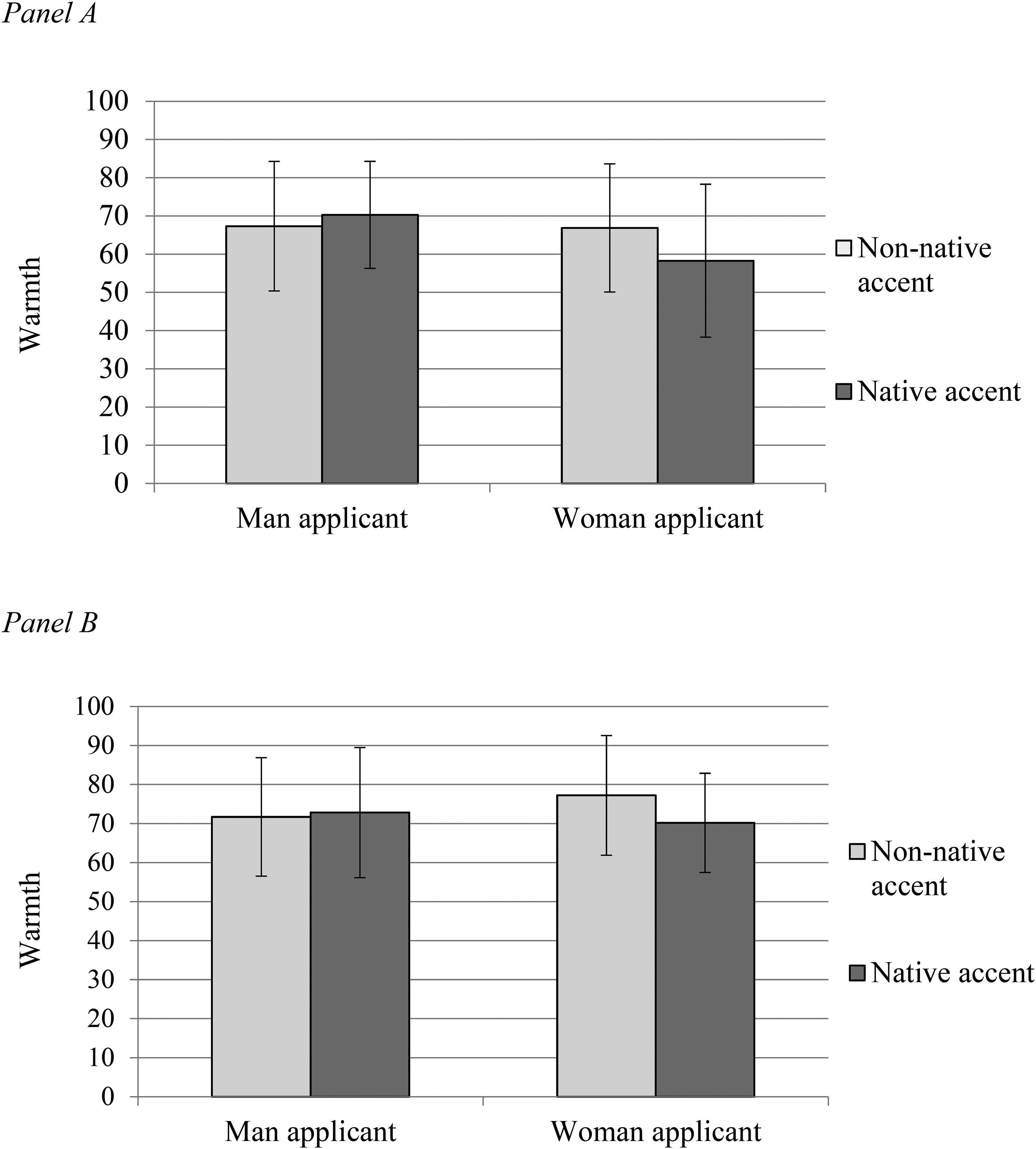
Interaction Between Applicant Accent and Gender in Predicting Perceptions of Warmth in Study 1 (Panel A) and Study 2 (Panel B).
Study 1: Means, Standard Deviations, and Zero-Order Correlations.
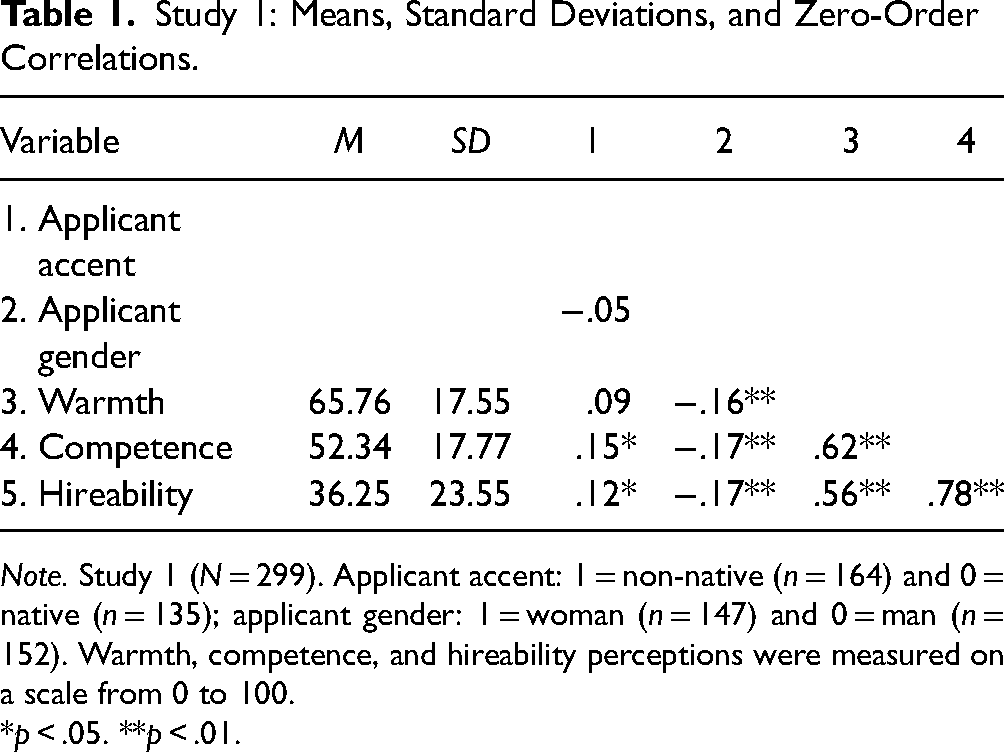
Note. Study 1 (N = 299). Applicant accent: 1 = non-native (n = 164) and 0 = native (n = 135); applicant gender: 1 = woman (n = 147) and 0 = man (n = 152). Warmth, competence, and hireability perceptions were measured on a scale from 0 to 100.
*p < .05. **p < .01.
Study 1: Means and Standard Deviations by Condition and Two-Way Analysis of Variance (ANOVA) Statistics.
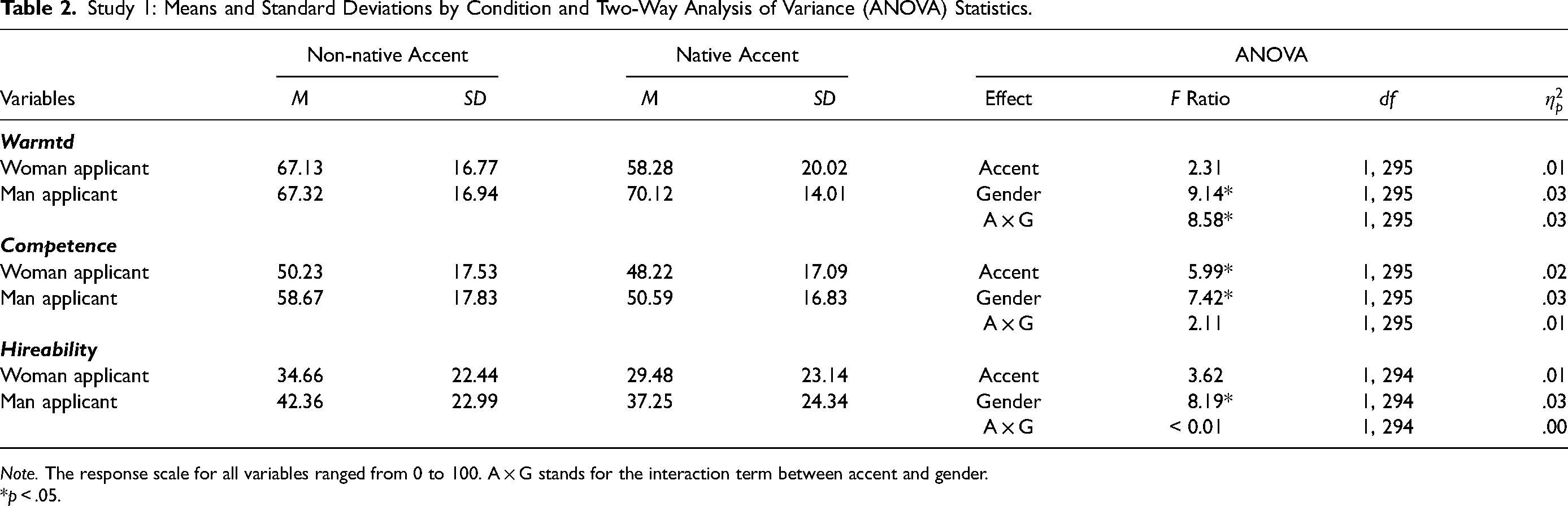
Note. The response scale for all variables ranged from 0 to 100. A × G stands for the interaction term between accent and gender.
*p < .05.
We also examined differences in warmth perceptions between the woman and man applicants within the non-native accent and native accent conditions, respectively. We found no differences in warmth perceptions between the woman and man applicants with non-native accents, F(1, 295) = 0.02, p = .891,
Next, we tested a moderated mediation model in which an indirect positive effect of non-native (vs. native) accent on hireability via enhanced warmth perceptions is stronger for woman applicants and weaker for man applicants (Hypothesis 2). We used Hayes’s (2017) PROCESS macro (version 3.4.1; Model 7), which tests for moderated mediation using two regression models and a bootstrapping percentile technique (with 10,000 samples) to compute conditional indirect effects. The first regression model tested the interaction between applicant accent and gender in predicting warmth, which as described above was significant. The second regression model tested the effect of warmth on hireability. As expected, warmth perceptions predicted hireability, b = 0.74, t(295) = 11.41, p < .001. Supporting Hypothesis 2, the conditional indirect effects of applicant accent via warmth was significant for the women applicants (indirect effect [IE] = 6.55, 95% CI [2.25, 10.99]), and not significant for the men applicants (IE = −2.30, 95% CI [−5.79, 1.36]). The index of moderated mediation was also significant (index = 8.85, 95% CI [3.32, 14.12]), indicating that the two conditional indirect effects were significantly different from each other.
Exploratory Analyses
As discussed above, to isolate the unique effects of warmth given that competence and warmth tend to be correlated, we explored a multiple mediator model with warmth and competence as parallel mediators (Hayes, 2017). Although competence predicted hireability, b = 0.94, t(294) = 15.48, p < .001, the indirect effect through competence was not significant because there was no significant interaction between applicant accent and gender in predicting competence (p = .153). Thus, the differential relation between nonnative (vs. native) accents and hireability among women versus men was not explained by competence perceptions. Finally, when including competence, the indirect effect of non-native (vs. native) accent through warmth remained significant for the women applicants (IE = 1.40, 95% CI [0.26, 3.03]) and nonsignificant for the men applicants (IE = −0.49, 95% CI [−1.48, 0.30]).
Discussion
Study 1 provides preliminary evidence that the bias women with non-native accents associated with more gender-traditional countries experience is subtle and insidious as it manifests itself through higher evaluations of warmth. Namely, in the context of applicants applying for a volunteer job at a Canadian university, we found that a woman with a non-native Mandarin accent was rated as higher on warmth compared to a woman with a native English accent, which in turn was related to greater ratings of hireability in a moderated mediation model. This statistically positive relation between non-native (vs. native) accent and warmth for women was not observed for men. We posit that although statistically, the effect of speaking with a nonnative (vs. native) accent on perceptions of warmth (and downstream on hireability) was positive, this effect is not necessarily beneficial or advantageous for women. Rather, as we demonstrate below in Study 3, it further fuels gender segregation and inequities by pushing women into traditionally feminine jobs. As such, speaking with a nonnative accent associated with a more gender-traditional country represents a difficult challenge for women as on the surface the effect appears positive, whereas in practice it subtly undermines gender equity.
Study 2
The results of Study 1 showed that a bias toward women with non-native accents associated with more gender-traditional countries manifests itself through greater perceptions of warmth (and consequent hireability), relative to the woman applicant with a native accent, in the context of a volunteer position. This raises the question of whether this effect was observed because of this specific hiring context, which could have been seen as a lower-status position and hence suitable for women. In other words, there remains a question of whether the perception of women with nonnative accents may be reversed, diluted, or amplified if the position was paid. To address this possibility, in Study 2, we examined the effect of applicant accent within the context of selection for a full-time, paid position of a marketing coordinator.
Although the context of hiring for a student volunteer position was highly salient and relevant to our sample of undergraduate business students, they have limited experience with hiring in general, which could have influenced their evaluations of job applicants. Thus, to address these potential concerns and to further enhance the generalizability and external validity of our findings, in Study 2, we recruited a sample of Canadian working adults. We also increased stimuli sampling in this study by using multiple instances of each stimulus category. As such, we included multiple individuals portraying Mandarin accents or native English accents to further increase the external and construct validity of our findings (Wells & Windschitl, 1999).
Method
Participants and Procedure
We recruited Canadian working adults using Prolific (https://prolific.co), an online platform designed to crowdsource participants for scientific research (Peer et al., 2017). We compensated participants £1.75 (∼US$2.12) for their participation. Social sciences researchers extensively use Prolific, which has a demographically more diverse pool of participants compared to undergraduate students and is, therefore, more representative of many populations. Critically, for our work, it has built-in prescreen questions that researchers can use to recruit a specific population (Palan & Schitter, 2018; Peer et al., 2017). We used two such prescreen questions: (a) current country of residence (i.e., those choosing Canada) and (b) employment status (i.e., those choosing currently employed full-time or part-time). In addition, to ensure that those demographics have not changed since the last time they were updated in Prolific, at the beginning of the study we asked the same two questions, and only participants who answered that they currently reside in Canada and are employed were allowed to proceed with the study.
Our power analysis using G*Power software (Faul et al., 2007) indicated that to detect an interaction in a two-way ANOVA using the effect size from Study 1 (
We invited participants to complete an online study posted on Prolific and told them that a company called “Quality Business and Marketing Solutions” had partnered with researchers to examine the effectiveness of a new recruitment tool (i.e., audio résumé). Participants first reviewed a job description for a marketing coordinator position and a written résumé of an applicant (see below for details). Next, we randomly assigned them to one of four conditions in which the applicant gave an identical speech: (a) a woman with a Mandarin accent, (b) a woman with a native English accent, (c) a man with a Mandarin accent, or (d) a man with a native English accent. Finally, participants completed the same measures as in Study 1 to evaluate the applicant.
Materials
Job Description
The position of a marketing coordinator that we used in Study 2 was a full-time, paid position. We pilot-tested this position in a separate sample of Canadian working adults and found that in general this position was perceived as gender-neutral with a slightly higher estimated number of women versus men holding those positions (see online supplemental materials on PWQ's website), suggesting that the position is somewhat feminine. We return to this point in the discussion about perceptions of our jobs in Studies 1 and 2 as being gender-neutral or more feminine.
We created the job description by consulting the O*NET. The job description consisted of a list of responsibilities associated with the position (e.g., developing strategies for recruiting and managing new clients; creating and presenting marketing solutions to clients) and a list of required knowledge, skills, and abilities (e.g., superb communication skills; comfortable speaking and giving presentations), which was identical across all conditions.
Applicant Résumé
We added a written résumé in Study 2 as this would be more in line with the typical hiring practices in organizations. We portrayed the applicant as qualified for the position with the required university education, past experience, and knowledge, skills, and abilities. The résumé further served to reinforce the applicant's gender and ethnicity through names, Allison Chen or Greg Chen. Apart from the applicant's name, which differed according to the gender condition, the content of the résumé was identical across conditions.
Audio Recordings
Similar to Study 1, in the recording, the applicant described why they were interested in the role, what they would bring if hired, and why they thought they were the right person for the position. We created eight different audio recordings altogether, with two recordings per condition. That is, we recruited two different women with Mandarin accents, two different men with Mandarin accents, two different women who were native English speakers, and two different men who were native English speakers. These were all different individuals from Study 1 to increase stimulus sampling. Congruent with Study 1, while participants were listening to the recording, the applicant's name was displayed on the computer screen.
Measures
We used the same measures as in Study 1 to assess warmth (α = .93), competence (α = .95), and hireability (α = .94). The only difference was that participants compared the applicant to other marketing applicants for a position at this level. We also asked participants to identify the applicant's ethnicity and gender. Ninety-six percent of participants identified the applicant as East Asian, and 100% correctly identified the applicant's gender.
In addition, we added two items to assess perceptions of the applicant's accent (which was also examined in the pilot study for Study 2, see the online supplemental materials on PWQ's website). Participants responded to the following two questions on a 7-point Likert scale (1 = strongly disagree; 4 = neither agree nor disagree; 7 = strongly agree): “The applicant speaks English as a second language” and “The applicant speaks with an accent” (α = .91). Participants perceived applicants with non-native accents (M = 6.42, SD = 0.69) to possess a stronger accent compared to applicants with native accents (M = 2.26, SD = 1.17), t(223) = −32.26, p < .001, d = −4.33.
Results
Missing data analysis showed that at the item level, <1.0% of all items for all cases were missing, and 97.3% of participants had no missing data. Finally, no item had more than 1.3% of missing data. In line with Study 1, we used available data to compute mean scores. At the scale level, we had mean scores missing for one participant for the hireability score. As such, to test Hypothesis 2 (a moderated mediation model involving hireability) we use a sample of 224, but for Hypothesis 1 (moderation analysis predicting warmth) we use the full sample of 225. The analyses for Hypothesis 1 are comparable regardless of whether we use a sample of 224 or 225 (see the online supplemental materials on PWQ's website for boxplots).
Hypotheses Tests
Table 3 presents means, standard deviations, and correlations collapsed across conditions and Table 4 presents ANOVA results with interactions and means by conditions including interactions between applicant accent and gender in predicting competence and hireability (neither of these two interactions is significant), which although not a part of our hypotheses tests are presented for a full overview of data. As in Study 1, we conducted a 2 (applicant accent: non-native vs. native) × 2 (applicant gender: woman vs. man) ANOVA predicting warmth to test Hypothesis 1. There was no main effect of either applicant accent (p = .145) or gender (p = .480), but there was an interaction between applicant accent and gender (p = .046; see Figure 2). In line with Hypothesis 1, women with Mandarin accents were rated as higher on warmth than women with a native accent, F(1, 221) = 5.45, p = .020,
Study 2: Means, Standard Deviations, and Zero-Order Correlations.
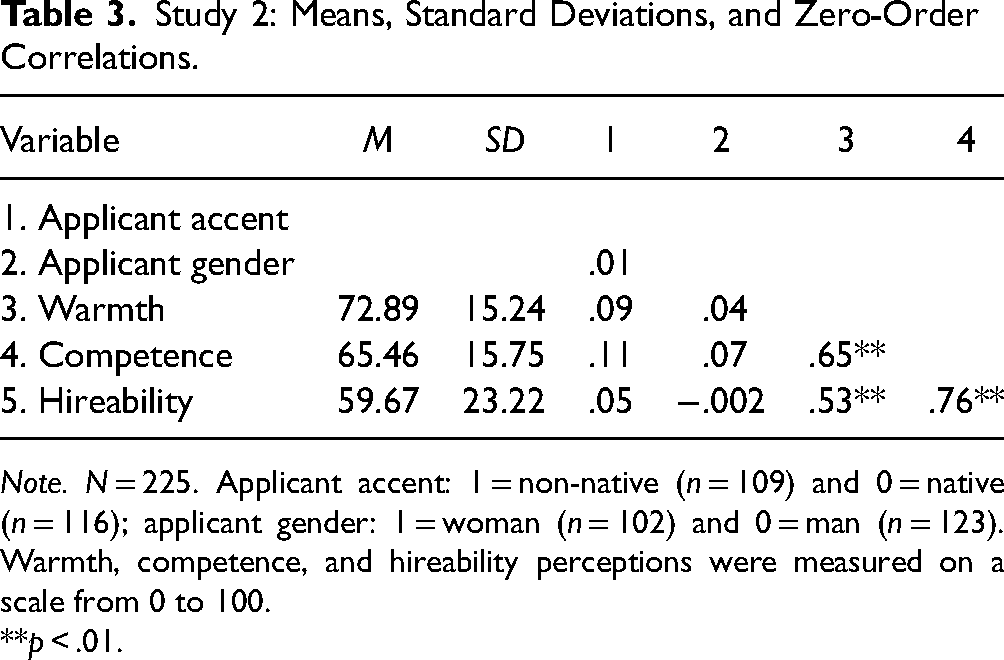
Note. N = 225. Applicant accent: 1 = non-native (n = 109) and 0 = native (n = 116); applicant gender: 1 = woman (n = 102) and 0 = man (n = 123). Warmth, competence, and hireability perceptions were measured on a scale from 0 to 100.
**p < .01.
Study 2: Means and Standard Deviations by Condition and Two-Way Analysis of Variance (ANOVA) Statistics.
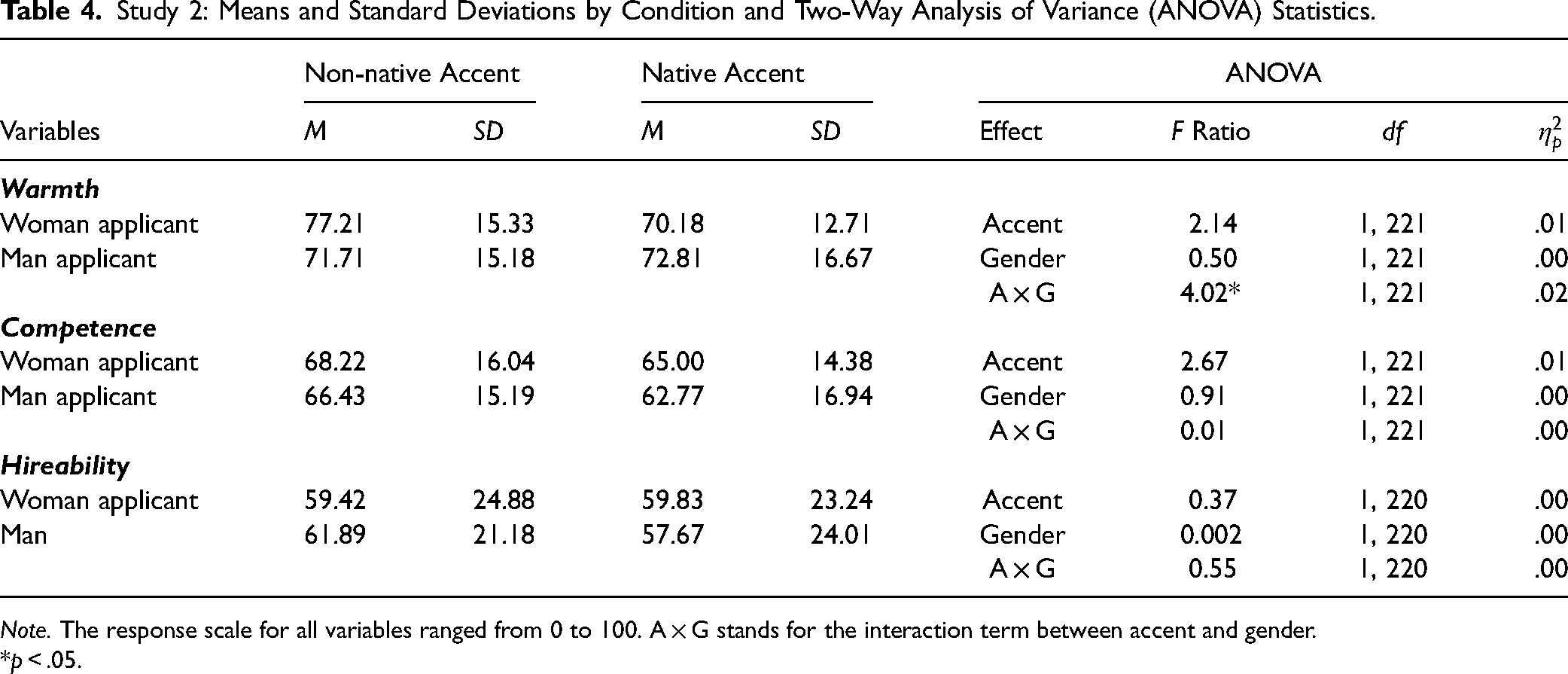
Note. The response scale for all variables ranged from 0 to 100. A × G stands for the interaction term between accent and gender.
*p < .05.
Next, we tested for moderated mediation. As expected, there was a significant effect of warmth on hireability, b = .80, t(221) = 9.13, p < .001. Supporting Hypothesis 2, the conditional indirect effect of applicant accent on hireability via warmth was significant for women (IE = 5.61, 95% CI [1.16, 10.16]), but was not significant for men (IE = −0.86, 95% CI [−5.44, 3.82]). The index of moderated mediation was also significant (index = 6.46, 95% CI [0.05, 12.88]).
Exploratory Analyses
Again, we tested a model with warmth and competence as parallel mediators. Although competence predicted perceived hireability, b = 1.08, t(220) = 12.47, p < .001, the indirect effect through competence was not significant because there was no significant interaction between applicant accent and gender in predicting competence (p = .998). In contrast to Study 1, when incorporating competence into the model, the indirect effect through warmth became nonsignificant for women (IE = 0.54, 95% CI [−0.77, 2.14]), and remained nonsignificant for men (IE = −0.08, 95% CI [−0.94, 0.63]).
Discussion
Converging with our findings in Study 1 based on a student sample, we replicated the effect that participants rated a woman applicant speaking with a Mandarin (vs. native English) accent higher on warmth (and consequently hireability) with working adults evaluating applicants for a paid position. As such, the finding that participants rated women with non-native (vs. native) accents as higher in warmth and hireability is not bound to volunteer or part-time positions, but also occurs for paid, full-time positions. This result also provides additional insights into the undermining nature of this subtle bias from non-native accents associated with more gender-traditional countries for women. Namely, although our pilot study suggests that the position of marketing coordinator was perceived as relatively gender-neutral, occupational statistics from the U.S. suggest that this position is occupied by more women than men (Zippia, 2021b) and may be characterized as more female-dominated. Similarly, statistics show that the volunteer position of student engagement events coordinator used in Study 1 is also mostly occupied by women (Zippia, 2021a). Therefore, it appears that the statistically positive effect of non-native accents on warmth perceptions we have so far observed in Studies 1 and 2 for women with non-native accents associated with more gender-traditional countries could be bound to more feminine positions, a proposition we explicitly examined in Study 3.
Study 3
In Study 3, we tested our critical argument that the effects on hireabiliy ratings for women with non-native accents associated with more gender-traditional countries are bound to feminine industries, but not to masculine industries. Said otherwise, we explored how the indirect effect on hireability via higher ratings of warmth for women applicants with non-native (vs. native) accents observed in Studies 1 and 2 may contribute to occupational segregation by gender and ultimately be detrimental to gender equality. Specifically, we do so by testing Hypotheses 3 and 4.
Method
Participants and Procedure
We recruited a separate sample of Canadian working adults using Prolific with the same prescreen questions as in Study 2. We compensated participants £1.75 (∼US$2.12). Given that we could not estimate an effect size from a previous study (as unlike our preceding two studies, here we manipulate industry type), we sought to have an approximate final sample size of 75 participants per cell in a 2 (applicant accent: non-native vs. native) × 2 (industry: masculine vs. feminine) between-subjects design, consistent with a rule of thumb recommended by Simmons et al. (2013). This would require 300 participants, but to account for inattentive responses we aimed to recruit around 500 participants and ended up recruiting 471 due to a relatively small pool of Canadian workers on Prolific (the majority of participants on this platform are from either the United Kingdom or the U.S.).
We also sought to simplify and clarify our instructions to prevent a high inattention rate and failure to focus on and listen to the audio recording that occurred in Study 2. Based on the same criteria as Study 2, we excluded 31 participants who had problems with the audio recording or failed inattention checks and eight participants who incorrectly identified the applicant’s gender. Thus, our final sample consisted of 432 Canadian working adults with 195 (45.1%) women, 231 (53.5%) men, and six (1.4%) unreported (age: M = 31.59, SD = 8.70); 229 (53.0%) reported having hiring experience and 217 (50.2%) managerial experience. There were 240 (55.6%) participants identifying as White, 82 (19.0%) as East Asian, 24 (5.6%) as Southeast Asian, 32 (7.4%) as South Asian, 10 (2.3%) as Black, eight (1.9%) as Middle Eastern, seven (1.6%) as Hispanic, two (< 1.0%) as West Indians, seven (1.6%) as mixed, and 20 (4.6%) as other; 311 (72.0%) participants reported speaking English with a native accent and 121 (28.0%) with a non-native accent. Most participants lived in predominantly English-speaking provinces (210 in Ontario, 77 in Alberta, 64 in British Columbia, 21 in Manitoba, and 12 in Saskatchewan); only 22 participants lived in the predominantly French-speaking province of Québec (25 participants lived in the East coast provinces, such Nova Scotia and New Brunswick, that have some French-speaking communities). Further, 355 (82.2%) participants were employed in full-time positions and 77 (17.8%) participants were employed in part-time positions across a range of different occupations and fields (e.g., education, engineering, retail, healthcare, and finance).
The procedure was the same as in Study 2 apart from the following two exceptions. First, after reading the job description, we randomly assigned participants to read additional information about whether the company specializes in delivering marketing solutions for masculine or feminine industries. Second, we only focused on women as applicants, randomly assigning participants to either a woman with a Mandarin accent or a woman with a native English accent and we used the same audio recordings as in Study 2.
Masculine Versus Feminine Industry Manipulation
To manipulate industry, we specified whether the marketing company specializes in working with masculine or feminine industries (i.e., “Our company specializes in delivering marketing solutions to organizations in the manufacturing and oil + gas industries/fashion and cosmetics industries”). We conducted a pilot test with 200 undergraduate business students (98 women, 101 men, and one unreported) regarding what degree nine different industries were viewed as masculine, feminine, and gender-neutral on a 7-point Likert scale ranging from 1 (strongly disagree) to 7 (strongly agree). Manufacturing (M = 5.62, SD = 1.01) and oil + gas (M = 5.92, SD = 0.99) were identified as the most masculine industries and fashion (M = 5.48, SD = 1.15) and cosmetics (M = 6.04, SD = 1.04) were identified as the most feminine industries.
Measures
We used the same measures as in Study 2 to assess warmth (α = .94), competence (α = .95), hireability (α = .94), and perceptions of applicant accent (α = .93). We also asked participants to identify the applicant's ethnicity and gender; 86% identified the applicant as East Asian and 98% correctly identified the applicant's gender. As indicated above and in line with other studies, our analyses below exclude participants who incorrectly identified applicant gender. Participants perceived applicants with non-native accents (M = 6.45, SD = 0.75) to possess a stronger accent compared to applicants with native accents (M = 2.31, SD = 1.36), t(430) = −39.04, p < .001, d = 3.77. As a check on our industry manipulation, we asked participants to indicate which industry the marketing company they read about specializes in using the following options: (a) manufacturing and oil + gas, (b) fashion and cosmetics, and (c) it was not specified; 82.4% correctly identified the industry, 16.4% reported that it was not specified, and 1.2% identified the incorrect industry. 6
Results
Less than 1.0% of all items for all cases were missing, and 99.1% of participants had no missing data. Additionally, no item had more than 0.2% of missing data. As in Studies 1 and 2, we used available data to create mean scores. We had no missing data at the scale level. The online supplemental materials on PWQ's website contain boxplots using all data.
Hypotheses Tests
Table 5 contains means, standard deviations, and correlations collapsed across conditions and Table 6 contains ANOVA results including interactions between applicant accent and industry in predicting competence and hireability (nonsignificant in predicting hireability, but significant in predicting competence and described below in exploratory analyses), which although are not a part of our hypotheses tests are presented for a full overview of data. We conducted a 2 (applicant accent: non-native vs. native) × 2 (industry: masculine vs. feminine) ANOVA predicting warmth to test Hypothesis 3. There was no main effect of applicant accent (p = .433) or industry (p = .899), but there was an interaction between applicant accent and industry (p = .049; see Figure 3). In line with Hypothesis 3, in the feminine industry, a woman with a Mandarin accent was rated higher on warmth than a woman with a native accent, F(1, 428) = 3.82, p = .051,
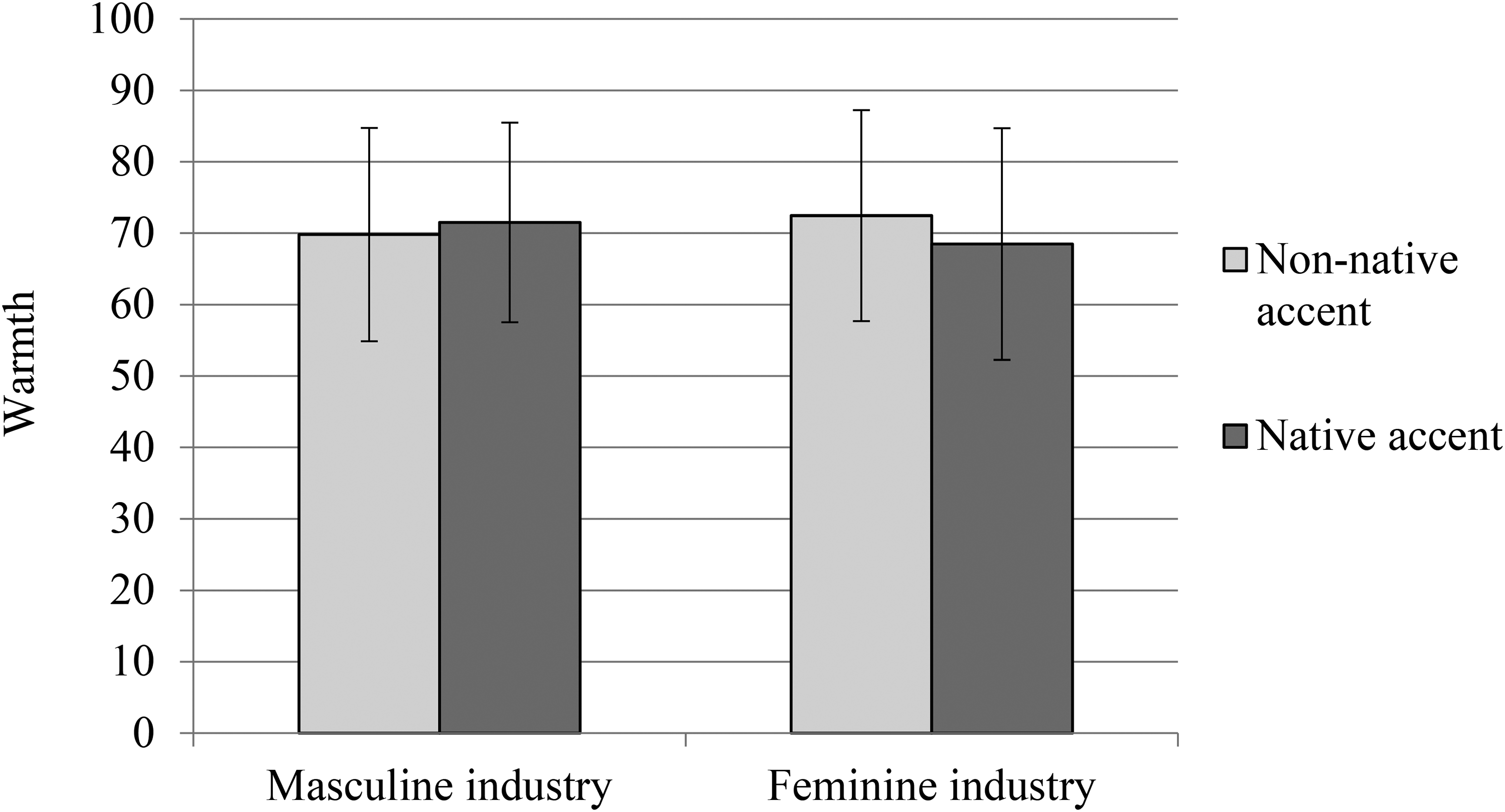
Interaction Between Applicant Accent and Industry Type in Predicting Perceptions of Warmth in Study 3.
Study 3: Means, Standard Deviations, and Zero-Order Correlations.
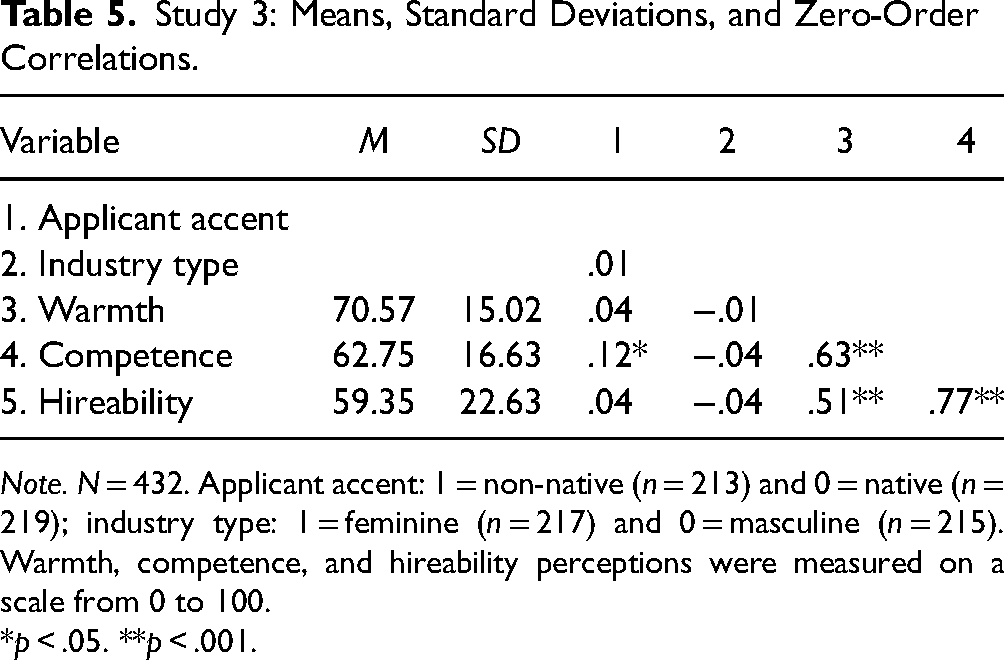
Note. N = 432. Applicant accent: 1 = non-native (n = 213) and 0 = native (n = 219); industry type: 1 = feminine (n = 217) and 0 = masculine (n = 215). Warmth, competence, and hireability perceptions were measured on a scale from 0 to 100.
*p < .05. **p < .001.
Study 3: Means and Standard Deviations by Condition and Two-Way Analysis of Variance (ANOVA) Statistics.
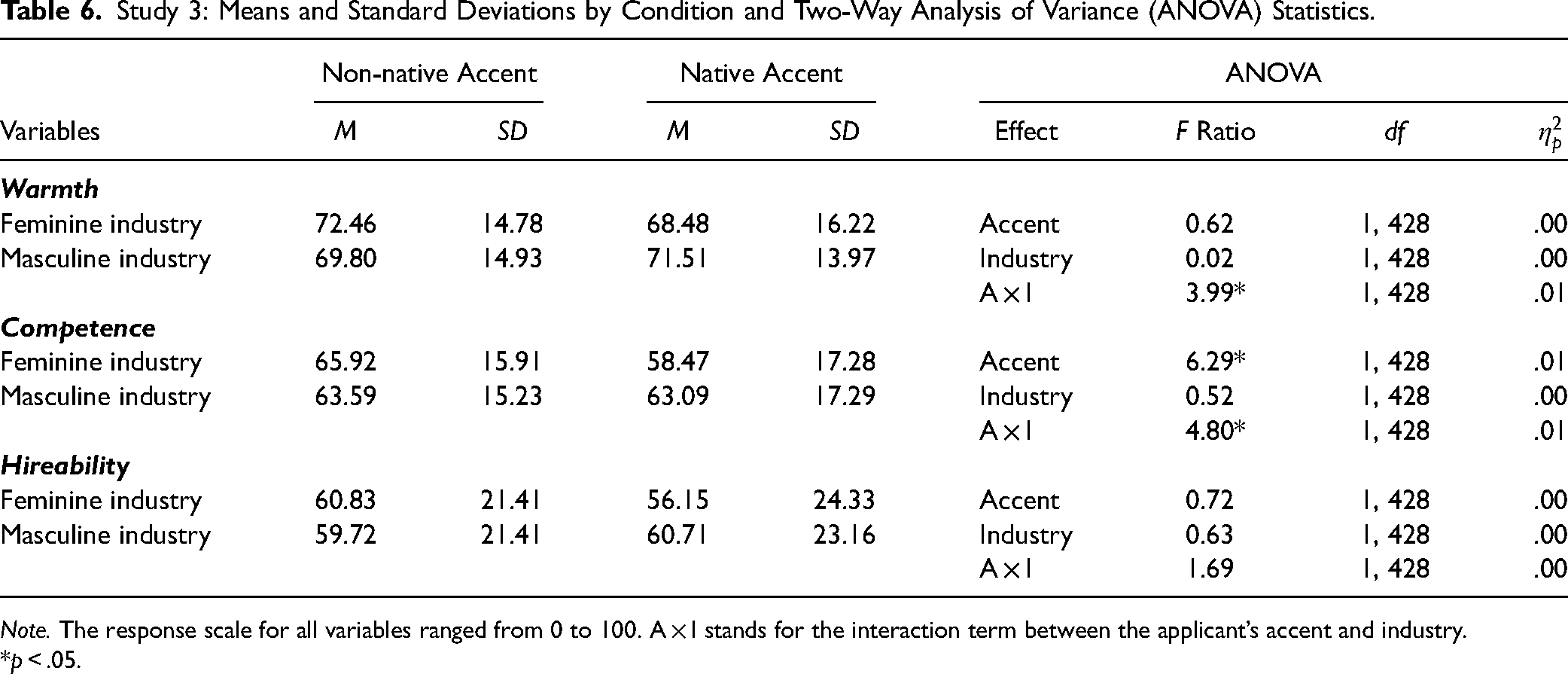
Note. The response scale for all variables ranged from 0 to 100. A × I stands for the interaction term between the applicant’s accent and industry.
*p < .05.
We next tested the proposed moderated mediation model. As expected, there was a significant effect of warmth on hireability, b = .77, t(429) = 12.38, p < .001. Supporting Hypothesis 4, the conditional indirect effect of applicant accent on hireability via warmth was significant in the feminine industry (IE = 3.44, 95% CI [0.14, 6.86]), but was not significant in the masculine industry (IE = −1.17, 95% CI [−4.18, 1.72]). The index of moderated mediation was also significant (index = 4.61, 95% CI [0.23, 9.09]).
Exploratory Analyses
We also examined the role of competence as a parallel mediator. In this model, the accent × industry type interaction remained significant in predicting warmth, in line with the findings above, b = 5.69, t(428) = 1.97, p = .049. However, there was also a significant accent × industry type interaction in predicting competence, b = 6.95, t(428) = 2.19, p = .029. Namely, in the feminine industry, a woman with a Mandarin accent was rated higher on competence than a woman with a native accent, F(1, 428) = 11.11, p = .001,
Discussion
The results of this study demonstrate that the higher ratings of hireability that women with non-native accents associated with more gender-traditional countries experience due to increased perceptions of warmth might be constrained to feminine hiring contexts, whereas such effects were not observed in the masculine context, where women are traditionally underrepresented. Although we continue to find evidence for intersectional effects, such that relative to women with native accents, women with non-native accents are perceived as higher in warmth, in this study, we also find some evidence that these women are viewed as higher in competence. Moreover, only competence served as the mechanism for why women with non-native accents appeared to possess a hiring advantage when both warmth and competence were included in a moderated mediation model as parallel mediators.
Despite these findings demonstrating some divergence from our prior studies, it is worth noting that this pattern still reflects the indirect effects on increased hireability among women with non-native (vs. native) accents in feminine industries. Further, this unexpected effect through competence rather than warmth could be a statistical artifact related to collinearity between perceptions of warmth and competence (e.g., Kiers & Smilde, 2007). Although these two dimensions are typically viewed as distinct, prior research indicates that they are generally positively correlated when evaluating a given applicant due to halo effects (Cuddy et al., 2011). Within each of our samples, the correlation ranged between .62 and .65. Alternatively, perhaps these intersectional competence effects are due to the specific “feminine” industries that we chose in the current study and may not necessarily generalize to others (e.g., healthcare). For example, in recent years, the popularity of Asian (e.g., Korean) beauty products and fashion has greatly increased worldwide (e.g., Liu, 2018), which may have contributed to evaluators’ beliefs that Asian immigrant women have advantages when working in these areas. Finally, we did not find any indirect effects of non-native (vs. native) accents on hireability ratings for women in masculine industries. However, as we explain below, this does not necessarily indicate that women with non-native accents are freed from experiencing bias.
General Discussion
Across three studies, we examined the consequences of speaking English with a nonnative accent associated with a more gender-traditional country, that is, Mandarin Chinese, for women during the hiring process in Canada. As theorized and supporting the importance of an intersectional approach, women with such nonnative accents face subtle biases and insidious challenges. Namely, participants perceived women with Mandarin (vs. native English) accents higher on warmth, which in turn was positively related to hireability. The same effects were not observed for men with Mandarin (vs. native English) accents. Critically, however, the higher ratings of warmth for women with Mandarin accent was observed mostly in feminine positions or industries, but not in masculine industries. As such, although outwardly and on the surface, it may seem that women with Mandarin accents may experience some advantages in terms of hireability, our results demonstrate how they are likely to be pigeonholed and stereotyped (i.e., not seen for the individuals they are) and are also funneled into traditionally less prestigious and lower paid positions. More broadly, stereotyping women as warm is on its own detrimental for women as it portrays all women within the bounds of traditional gender roles while failing to acknowledge within-group differences.
We also note that the nature of the interaction between applicant accent and gender in predicting warmth is slightly different in Study 1 compared to Study 2. We observed that women with Mandarin (vs. native English) accents were rated higher on warmth in all studies. However, in Study 1, it seemed that the interaction is driven by women with native accents being rated the lowest on warmth, whereas in Study 2 the interaction is driven by women with Mandarin accents being rated the highest on warmth. Although we do not have a definitive answer for this unexpected finding, it may be due to idiosyncrasies with the speakers used in the recordings. Indeed, in Study 2, we changed and had multiple speakers and we no longer observed this unexpected finding.
The findings from our studies should be interpreted within their context, with Canada being a traditional immigrant and multicultural country. Although this context may not always generalize to other countries, this context has its unique contributions. First, this context may reveal some unique outcomes of speaking with non-native accents more broadly given the country's more positive attitudes toward immigration. Indeed, below, we discuss some positive effects on competence perceptions. Importantly, despite what might seem to be positive attitudes toward women with non-native (Mandarin) accents, we still find that women with non-native (Mandarin) accents face subtle and insidious biases, which ultimately stand to undermine gender equity. That is, even in such a multicultural and progressive environment, women with non-native accents associated with more gender-traditional countries face challenges. It may be that in societies with less positive attitudes toward immigrants, biases manifest differently. Second, most of the past work on non-native English accents has been conducted in the U.S. (Hideg et al., 2022), and more broadly, most psychology studies and findings are based on samples from the U.S. (Cheon et al., 2020). By focusing our work on accents in Canada, our work is making small steps in addressing the issue of U.S.-centric sampling bias in psychology (Cheon et al., 2020).
Theoretical Contributions
Our research contributes to the intersectionality literature by demonstrating that the workplace outcomes of women with non-native accents associated with more gender-traditional countries may differ from both men with non-native accents and women with native accents. We find that women with a non-native accent associated with a more gender-traditional country do not face straightforward negative outcomes, but rather face a subtle bias in which on the surface they appear to experience positive evaluations in the hiring context (because warmth is typically associated with increased hireability; Cuddy et al., 2011). Yet, the effects of such a non-native accent on warmth and hireability may be bound to more feminine jobs and were not observed in masculine jobs in our studies, a pattern that can further reinforce gender segregation. Indeed, past research suggests that encouraging women's employment in more feminine jobs while not doing the same for masculine jobs further exacerbates gender inequality, as such jobs tend to be lower in status and pay (e.g., Hideg & Ferris, 2016).
Therefore, women with non-native (vs. native) accents associated with more gender-traditional countries may be more likely to be treated in paternalistic ways and invoke benevolent sexist attitudes (Glick & Fiske, 1996). However, these “positive” attitudes are typically only afforded to women who abide by traditional gender roles and seek positions within traditionally feminine (vs. masculine) domains (Hideg & Shen, 2019). Thus, women with non-native accents associated with more gender-traditional countries who seek positions outside of fields traditionally prescribed to them may not be seen as warmer and may even be punished. For example, in Study 3, we depicted a scenario in which a woman is seeking a generally gender-neutral role (i.e., marketing) within a masculine industry. This leaves open whether more blatantly negative effects (i.e., decreased ratings of hireability) may occur if a woman was seeking a more masculine role (e.g., finance) within a masculine industry. In addition, we did not include perceptions of men. Thus, we cannot determine whether, relative to men, there is a penalty applied to women seeking employment in masculine contexts or how the intersection of gender and accent may interact in such contexts. Overall, our work suggests that the bias and discrimination that women with non-native accents associated with more gender-traditional countries experience are not easily detected, as it is often subtly concealed through higher ratings of warmth, a seemingly positive trait.
More broadly our work contributes to research on changing gender stereotypes and women's accession to leadership roles. Eagly et al. (2020) found that gendered stereotypes of competence have changed with women being perceived as equally (if not more) competent than men. Some of these gains in competence perceptions are due to women's educational gains (i.e., women are attaining university degrees at higher rates than men). Yet such educational gains and higher perceptions of competence still have not propelled more women into leadership roles. Our work offers one answer why—even when seen as competent, warmth stereotypes and encouragement to enter more feminine and not more masculine positions, are undermining women's accession to traditional masculine roles, such as leadership.
Our work also contributes to a larger movement and need in both the natural and social sciences to expand our scientific inquiry beyond men as the primary participants in research and to carefully consider how women's experiences may be different (Crasnow, 2020; Holdcroft, 2007). This male bias in scientific research is widespread (Beery & Zucker, 2011) and attesting that the social sciences have not traditionally been gender inclusive, some major research funding agencies (e.g., Horizon Europe, Social Sciences and Humanities Research Council of Canada) now require all funded research to be gender inclusive and for researchers to conduct gender analyses regardless of whether gender is the focus of the project (Nature, 2020). As a result, this study represents one small step in making scientific knowledge more inclusive by recognizing that women's and men's experiences may diverge.
The Effects of Non-native Accent on Competence
Although not the focus of our study, we also observed some evidence that speaking with a Mandarin (vs. native English) accent led to higher perceptions of competence (and we observed a positive main effect of accent on competence perceptions across most of our studies) regardless of gender. There are several potential reasons for this effect of Mandarin accent on perceptions of competence, including the specific context of our studies (multicultural and immigrant country) and a positive shift in attitudes toward immigration within Canadian society (Trebilcock, 2019), and being an immigrant is related to a higher likelihood of speaking with a non-native accent (Gluszek & Dovidio, 2010b). In fact, a 2018 Pew Research Center survey shows that, globally, more people say that immigrants are a strength rather than a burden, and these positive attitudes are especially true in top immigrant countries (Gonzales-Barrera & Connor, 2019). In line with these changes in attitudes toward immigration, we did not find negative effects of non-native (Mandarin) accents for men, which have been observed in the past.
In addition, the group we focus on in this study—Chinese—is typically stereotyped as competent, but cold (Lee & Fiske, 2006). Therefore, it is also possible that the main effect of nonnative accents on competence we observe may hold primarily for groups that are stereotyped as such versus groups that are stereotyped as warm, but incompetent. There could also be beliefs that for an individual with any non-native accent to succeed in a foreign environment, that individual must be highly competent. For example, a student with a non-native accent, who has successfully applied to a very competitive business program abroad may be perceived as more competent than a similar student with a native accent, in line with expectancy violation theory tenets (Jussim et al., 1987). Although our work does not provide an answer for why these effects on competence were observed, the potential benefits of speaking with a non-native accent more broadly may mirror societal trends and attest to the need to understand how non-native accents affect today's contemporary and evolving workplaces beyond just accents associated with more gender-traditional countries (taking into account the general attitudes toward immigrants in different societies).
Limitations and Future Directions
There are also some limitations to the present work. First, our use of a student sample in Study 1 may raise concerns about external validity because students have limited experience with hiring and general exposure to accent-based discrimination at work. However, in line with Aguinis and Bradley's (2014) recommendations, we created an immersive experimental setting by situating the study within a hiring context to which our students can relate (i.e., a prominent student club) and in which students are responsible for making hiring decisions—enhancing external validity. In addition, our findings with a student sample were generally constructively replicated in Studies 2 and 3 using two different samples of Canadian workers. One limitation to note with Prolific samples is that participants may not necessarily have experience making hiring decisions, especially in Study 2 (in Study 3, 53% of participants reported having hiring experience and 50% reported having managerial experience; we did not assess these variables in Study 2). Individuals with hiring experience or managers may have more power, which is related to a greater focus on competence than warmth in making interpersonal impressions (Cislak, 2013). As such, future work could more explicitly examine the role of power.
Further, our accent manipulation took place in an audio recording submitted as a part of the application package. Although such submissions of audio recordings may not be frequent, some jobs may require it (e.g., acting jobs, radio, and other creative industries). Importantly, accent will be encountered at some point during the hiring process (e.g., interviews) and asynchronous interviews are becoming common in remote hiring environments (Lukacik et al., 2022). Next, although we measure hireability in line with the broader literature, our general measure does not assess specific motives or conditions of hiring. For example, it is possible that women with non-native accents associated with more gender-traditional countries are viewed as more hireable because decision-makers assume that they will not negotiate (given their warmth and cooperativeness) and therefore can be hired for lower pay than members of other groups. Future work could examine these possibilities.
Another limitation is that our effect sizes were generally small. However, we argue that our effect sizes are meaningful and consequential for several reasons. First, the applicants portrayed in our studies were qualified for the position, and information provided about the applicants was identical across all conditions except for the presence (vs. absence) of a non-native accent and gender (in Studies 1 and 2). Cortina and Landis (2009) labeled this type of design as “inauspicious” and suggested that, in such designs, small effect sizes tell a big story because, despite subtle manipulations, effects were still observed. In addition, Matz et al. (2017) have argued that researchers need to think beyond the effects on a single individual and think about how effects would cumulatively affect our society. This is particularly relevant for Study 3, where we showed that women with a non-native accent were seen as higher in warmth and subsequently more hireable for jobs in feminine, but not masculine, industries. This can cumulatively lead to significant occupational gender segregation whereby women with nonnative accents (i.e., immigrant women) are disproportionately funneled into feminine jobs, which typically offer lower pay and prestige.
Another limitation is our between-subject design given that in most hiring situations recruiters or hiring managers are presented with multiple candidates rather than a single candidate at a time. To address this, future work could employ within-subject designs where multiple candidates are presented (e.g., an applicant with non-native and native accent) or a between-subject design where multiple candidates are presented, but the best candidates’ accents and gender are varied. Another avenue for future work could be examining the potential moderating role of a third party who advocates for the applicant (e.g., headhunter) on the observed effects of accent. Finally, future work could also try to understand whether it is necessary to “hear” an accent to engender the present intersectional effects or whether being simply told (e.g., via a text-based manipulation) that a woman applicant has an accent (or is an immigrant) is sufficient to trigger amplified stereotypes of warmth.
Also, as discussed above, the interaction between applicant accent and gender in predicting warmth in Study 1 seems to be driven by women with native accents being rated the lowest on warmth, whereas in Study 2, the interaction is driven by women with non-native accents being rated the highest on warmth. We theoretically expected that the interaction would be driven by higher warmth ascribed to women with nonnative accents and we thus do not have a definitive answer for this unexpected finding. We speculate it may be due to idiosyncrasies with the speakers used in the recordings of Study 1 because in Study 2 with different and multiple speakers, we do not observe this unexpected finding.
One question that our work does not completely answer is what may cause or underlie this effect that women with nonnative English accents associated with more gender-traditional countries are rated higher on warmth than women with native English accents. In the introduction, we discussed the connection between benevolent sexism and ratings of women as warm, suggesting that these effects may be rooted in benevolent sexist attitudes. Benevolent sexism tends to be endorsed by both men and women and is often not seen as problematic due to its positive valence (Hideg & Shen, 2019; Hopkins-Doyle et al., 2019). Moreover, individuals displaying benevolent sexism are oftentimes not considered sexist at all (Barreto & Ellemers, 2005), and may be even perceived as supportive of women's empowerment (Hopkins-Doyle et al., 2019). However, past research shows that such attitudes ultimately undermine gender equality (Hideg & Ferris, 2016; King et al., 2012). We encourage future research to explicitly assess and examine the role of benevolent sexist attitudes.
Another expansion and future direction could include leveraging and integrating different theoretical accounts of intersectionality. In this paper, we draw upon the MOSAIC model, which suggests that perceivers integrate stereotypes from different categories or identities. However, recent developments in intersectional theorizing suggest that perceivers can have a repertoire of different lenses that they can use when evaluating others (i.e., a lens-based account of intersectional stereotyping; Petsko & Bodenhausen, 2020; Petsko et al., 2022). This alternative perspective suggests that perceivers generally use a particular lens to evaluate others depending on the context, but this lens can also be specifically intersectional (i.e., specific to immigrant women vs. women broadly or immigrants broadly). Future research could examine why and under what conditions women with non-native accents may be a lens that perceivers would utilize. For example, past theoretical work identifies category distinctiveness as a determinant of lens use. Thus, one possibility is that women with non-native accents are seen as distinct given their two nonprototypical statuses, whereas men with non-native accents are viewed as prototypical immigrants and therefore an intersectional lens is not used for their evaluation.
Our theorizing suggests that women with non-native English accents associated with more gender-traditional countries are especially likely to be ascribed traditional gender roles and characteristics. This premise is supported by research showing that immigrant women (who likely have a non-native English accent) from the Global South, where traditional gender roles are pronounced, are seen in traditional gender roles such as caregivers or are seen as vulnerable. Further, immigration to Canada (which is where the study is contextualized) has mostly come from the Global South with the top three countries in 2021 being India, China, and the Philippines (El-Assal & Thevenot, 2022) suggesting that a typical immigrant woman in Canada comes from a more gender-traditional society. As such, our theorizing and findings are constrained to immigrant women coming from more gender-traditional societies. This leaves an open question as to whether women immigrants from more gender-egalitarian societies (e.g., Germany) would experience the same effects related to their non-native accents. On the one hand, it may be expected that such effects would be attenuated for women immigrants from more gender-egalitarian countries as they may be perceived as less likely to act in line with traditional gender roles. On the other hand, potentially even women immigrants from more gender-egalitarian societies may be seen as vulnerable because they are in a new environment (which may pose some challenges), and given perceptions of women as being more fragile in general, they may be perceived as being in greater need of help, which is in line with traditional gender roles. 7 We call for future work to more systematically examine how gender norms associated with one's nonnative accent may affect our findings.
Generally, we encourage explorations of accent status and nationality, especially as they may differ in contexts outside of Canada (e.g., Birney et al., 2020). We also acknowledge that although our studies allow us to disambiguate the effect of race/ethnicity and accent, which is an important methodological strength (race was held constant across conditions), it is also possible that race can intersect and combine to influence judgments and evaluations in more complex ways. We recommend the pursuit of future research that explores these possibilities.
Practice Implications
Our findings suggest that biases against women with non-native accents associated with more gender-traditional countries may be masked or easily overlooked given the stereotypes about warmth and associated hiring evaluations of this group. As such, one important implication for practice is that managers and other decision-makers should be made aware of the potential differential effects of non-native accents for women and men and be on guard against steering women with nonnative accents, especially the ones associated with more gender-traditional countries, into traditionally female-occupied roles and positions. To do so, organizations can integrate information about issues surrounding non-native accents and their unique effects on women into diversity training.
Further, our finding that, in general, applicants with Mandarin (vs. native English) accents were seen as higher on competence also has implications for practice. Employees with non-native accents, in general, tend to be aware of their accent and think that their accent negatively affects their employment and work opportunities. This can cause them anxiety, stereotype threat, status loss, and produce negative emotions (e.g., Gluszek & Dovidio, 2010a; Neeley, 2013; Kim et al., 2019). Indeed, accent reduction training is a common “solution” employed by those with non-native accents. However, our research indicates that the effects of non-native accents may not be straightforwardly negative, and some positive effects are possible at the individual level (though we also caution that all stereotypes can potentially be harmful as they serve as preconceived notions and ignore individuality). Yet, accent reduction training may perpetuate accent stigmatization. To avoid that and instead of accent reduction training, organizations and managers should seek to foster positive employee attitudes toward non-native accents by having more inclusive organizational practices and emphasizing that the skills held by a multicultural workforce are valuable.
Conclusion
Non-native English accents are pervasive in the globalized and multicultural business landscape of today. However, our understanding of the consequences of such accents is incomplete as what we know is largely based on evaluations of men with non-native accents, without much consideration regarding how women's experiences may diverge from those of men. By leveraging the SCM and the MOSAIC framework, we theorized and found that women with non-native accents associated with more gender-traditional countries may face subtle and difficult to detect biases as captured by a tendency to be viewed as especially warm. However, such effects for women with nonnative accents associated with more gender-traditional countries extended only to feminine and not to masculine job contexts. In other words, such effects can conceal subtle bias and discrimination that women with non-native accents associated with more gender-traditional countries experience that may constrain their ability to pursue and succeed in their career goals if they do not conform to traditional gender roles. In summary, our work shows that experiences and biases that women with non-native accents face are intersectional and subtle, and as such, difficult to detect and address. We hope that this work will raise awareness generally and specifically among managers and other decision-makers regarding the insidious nature of how seemingly positive stereotypes can serve to undermine women at work. This awareness is critical to overcome and address any bias and consequences of speaking with a non-native accent for women.
Supplemental Material
sj-docx-1-pwq-10.1177_03616843231165475 - Supplemental material for Women With Mandarin Accent in the Canadian English-Speaking Hiring Context: Can Evaluations of Warmth Undermine Gender Equity?
Supplemental material, sj-docx-1-pwq-10.1177_03616843231165475 for Women With Mandarin Accent in the Canadian English-Speaking Hiring Context: Can Evaluations of Warmth Undermine Gender Equity? by Ivona Hideg, Samantha Hancock and Winny Shen in Psychology of Women Quarterly
Footnotes
Acknowledgments
We thank Eden King, David Kravitz, and Ashleigh Rosette, the participants of the Diversity Publishing Workshop organized by the Gender and Diversity in Organizations division at the Academy of Management in 2016, and the participants of the brown bag presentations at NerdLab at the Harvard Business School in 2019 for their developmental feedback. Special gratitude is due to Harvard Kennedy School at Harvard University and the University of Western Australia Business School, as Ivona Hideg was a Women and Public Policy Fellow and a visiting professor, respectively, while working on this paper. A version of this article was presented at the annual meeting of the Academy of Management in 2016.
Declaration of Conflicting Interests
The author(s) declared no potential conflicts of interest with respect to the research, authorship, and/or publication of this article.
Funding
The author(s) disclosed receipt of the following financial support for the research, authorship, and/or publication of this article: This research was supported in part by the following research grants awarded to the first author: the Social Sciences and Humanities Research Council of Canada Insight Grants (SSHRC #435-2014-1147 and #435-2019-0154) and Early Researcher Award from the Ontario Ministry of Research, Innovation and Science (ER15-11-169). This work was also supported by Ivona Hideg's Canada Research Chair (Tier II) in Organizational Leadership while at Wilfrid Laurier University and Winny Shen's SSHRC Insight Grant (#435-2016-0696) as well as by the Ontario Graduate Scholarship and SSHRC Doctoral Scholarship awarded to Samantha Hancock.

Supplemental material
Supplementary material for this article is available online.
Notes
References
Supplementary Material
Please find the following supplemental material available below.
For Open Access articles published under a Creative Commons License, all supplemental material carries the same license as the article it is associated with.
For non-Open Access articles published, all supplemental material carries a non-exclusive license, and permission requests for re-use of supplemental material or any part of supplemental material shall be sent directly to the copyright owner as specified in the copyright notice associated with the article.
