



Abstract
Although chemical stabilization is well practiced in dealing with expansive soils, these soils’ endurance to extreme weather events is still questionable because of potential alterations in microstructure and degradation of stabilization products. This study, therefore, investigates how moisture and temperature variations affect the structure and engineering behavior of chemically stabilized expansive clay. A series of unconfined compressive strength tests were conducted before and after freezing–thawing (FT) and wetting–drying (WD) conditioning on high-plasticity clay stabilized with cement or hydrated lime, with lime sludge as a co-additive. Cement treatment resulted in a higher initial strength (3.1 MPa) compared with hydrated lime treatment (1.3 MPa), primarily as a result of the rapid formation of binding gels through cement hydration. However, environmental conditioning and post-conditioning testing protocols significantly affected the void ratio and saturation levels of specimens, yielding different strength values for both cement and lime treatments. Cement-treated specimens experienced a strength reduction under both FT and WD conditions, with a more pronounced decrease after WD. However, lime-treated specimens exhibited an interesting trend of getting weakened after FT but becoming stronger after WD. These differences are mainly attributed to variations in the evolution of void ratio and saturation levels during the respective conditioning and post-conditioning phases. To further confirm these links, data from the experiments was fed into a random forest regression model to identify key factors influencing the engineering performance. Sensitivity analysis showed the degree of saturation (0.53) to be marginally more influential than the void ratio (0.47) in determining the strength, aligning with the experimental findings.
Keywords
Introduction
Most transportation infrastructure is constructed over natural subgrade. However, a majority of these natural soils are classified as problematic, posing substantial challenges to the integrity and longevity of the structures ( 1 ). Problematic soils include collapsible soils, expansive/shrinking soils, organic soils, dispersive soils, and liquefiable soils, among many others. Texas, one of the most economically developed states in the USA, is currently experiencing rapid population and economic growth, leading to increased demand for infrastructure development. However, Texas contains some of the most expansive soils in the country, and nearly all metropolitan areas are located in regions where these soils are widespread, posing a major geotechnical challenge and causing significant distress to pavement systems ( 2 , 3 ).
Expansive soils are highly susceptible to moisture and temperature variations because of their shrink–swell behavior ( 4 ). Increased moisture content causes the soil to swell, weakening interparticle bonds and increasing the void ratio, which reduces the soil’s structural compactness ( 4 , 5 ). In climates with alternating dry and wet seasons, shrinkage cracks often form during dry periods. These cracks enable further moisture infiltration during wet periods, intensifying changes in void ratio and saturation levels, and compromising the soil’s integrity ( 6 , 7 ). Over time, repeated cycles of swelling and shrinking lead to structural alterations that diminish the soil’s ability to resist external loads and increase its collapse potential. The shear strength of expansive soils deteriorates with such repeated wetting–drying (WD) cycles. Studies show significant reductions in both cohesion and internal friction angle as these cycles progress ( 8 , 9 ). During WD cycles, visible cyclic heave and settlement occur at the surface, accompanied by irreversible volumetric strain and internal structural alteration within the soil matrix. These transformations lead to a more open and unstable structure ( 10 ). Consequently, repeated WD cycles not only degrade the mechanical properties of the soil but also heighten the risk of subgrade failure. This degradation may ultimately contribute to the deterioration of overlying infrastructure, such as pavements and other load-bearing structures ( 11 , 12 ).
In addition to moisture fluctuation, temperature variation also significantly affects the internal structure of subgrade soils ( 13 ). When the temperature drops to the freezing point of pore water, the formation of ice lenses within the soil causes volumetric expansion, exerting pressure on the surrounding soil matrix and inducing microcracks ( 14 , 15 ). This expansion disrupts the existing soil fabric, weakens the bonding interactions among particles, and compromises the overall structural integrity ( 16 ). As temperatures rise above the melting point of ice, the ice lenses begin to thaw, releasing water and reducing the internal pressure within the soil. However, during the thawing process, the soil profile is typically only partially thawed, with certain layers still remaining frozen. These frozen layers exhibit extremely low hydraulic conductivity and could be considered nearly impervious ( 17 ). Consequently, the meltwater from thawed ice lenses becomes trapped between the still-frozen lower layers and the surface. This formation of undrained conditions and accumulation of water favors excess pore pressure generation under loads and contributes to structural instability ( 18 ). Additionally, the phase change from ice to water often leaves behind voids in the soil matrix, leading to localized weaknesses and reducing the soil’s overall load-bearing capacity to resist external loads. This increases the risk of collapse and compromises the long-term stability of the soil ( 17 , 18 ). Therefore, temperature variation cycling could substantially deteriorate the engineering properties of subgrade soils, potentially leading to premature pavement distress, foundation settlement, and other structural failures ( 19 , 20 ).
Since both moisture and temperature variation have an adverse influence on subgrade soils by increasing the void ratio, resulting in lower soil density or integrity, as well as affecting the degree of saturation, which alters soil suction and the effective stress of the soil, many researchers, practitioners, and engineers are trying to implement solutions to overcome these negative impacts ( 21 – 24 ). Chemical stabilization is a widely used ground improvement technique valued for its efficiency, effectiveness, and economic viability ( 25 , 26 ). Traditional chemical stabilizers, particularly calcium-based binders, such as cement and lime, are employed extensively to enhance soil properties by forming cementitious materials ( 1 , 27 ). This enhances the strength and durability of the soil matrix, improving resistance to moisture and temperature cycles ( 12 ). In addition to their effectiveness, chemical stabilization techniques also offer opportunities for sustainable practices, such as the reuse of industrial by-products. Lime sludge, a waste material generated from water treatment plants, primarily consists of calcite minerals and has attracted attention as a potential stabilizing agent ( 28 , 29 ). Although lime sludge may not independently enhance the engineering strength of soil as effectively as traditional stabilizers such as cement or lime, it could serve as a beneficial admixture ( 30 , 31 ). When combined with conventional binders, lime sludge could reduce the plasticity of expansive soils, indicating its potential to help minimize susceptibility to moisture ingress and temperature fluctuations. By incorporating waste-derived materials such as lime sludge into stabilization strategies, engineers could not only improve soil behavior but also promote sustainable engineering solutions ( 32 ). With these combined benefits, such approaches contribute to increased durability of transportation infrastructure while supporting more economical designs by reducing the need for frequent maintenance and rehabilitation ( 33 ).
Although chemical stabilization offers a promising solution for enhancing the engineering properties of subgrade soils in transportation infrastructure, the increase in the intensity and frequency of extreme weather events makes the effects of moisture and temperature fluctuations more concerning and makes their performance highly questionable. Also, the question of which type of stabilizer works better for what type of extreme weather event still prevails, making the choice more difficult for practitioners. There is, therefore, a strong need to thoroughly understand the links between these extreme weather events and the void ratio and saturation levels of different stabilized soils that ultimately govern their engineering performance ( 27 , 34 , 35 ). With the advances in the field of data analysis and machine learning, it is now possible to achieve a deeper understanding of the key factors that influence a phenomenon. These tools have demonstrated high capabilities to identify the most significant parameters that will be of immense value in assisting engineers, practitioners, and researchers to address the challenges more efficiently and systematically ( 23 , 36 ). Complementing the experimental observations of the performance of stabilized soils under extreme weather events with machine learning models could give valuable insights and help address the research questions discussed above, both in a physics and data-driven approach, and aid in making more informed decisions.
With this as the objective, a research study was designed and conducted to evaluate and establish the impacts of moisture intrusion and temperature variation on the structure and engineering strength of calcium-based stabilized expansive soils through laboratory testing and machine learning modeling. High-plasticity clay was treated with two calcium-based stabilizers (cement and hydrated lime), along with lime sludge as an admixture, to assess strength development and changes in soil state before and after two weather conditioning processes: FT and WD. Unconfined compressive strength (UCS) tests were performed to understand the effectiveness of the stabilization methods and to investigate changes in internal soil structure and condition. Additionally, a random forest regression model was employed to identify the key factors influencing the engineering behavior of the treated soils. Findings from this study provide a deeper understanding of the microstructural evolution (both void ratio and saturation levels) of stabilized soils with the moisture and temperature fluctuations and ultimately link them to the associated changes in the strength. The following sections outline the materials used and the research methodology adopted, and then discuss the engineering tests and machine learning model analyses conducted in this study.
Materials and Methods
Geomaterial and Stabilizers
A natural expansive soil was collected from a pavement site near the Dallas–Fort Worth metropolitan area in Texas (approximate coordinates: 32°46'45" N, 96°48'32" W). Table 1 presents the basic engineering characterization results obtained in accordance with relevant American Association of State Highway and Transportation Officials (AASHTO), American Society for Testing and Materials (ASTM), and Texas Department of Transportation (DOT) standards. Figure 1 shows the particle size distribution of the soil. Based on the Unified Soil Classification System (USCS), the soil is classified as a high-plasticity clay (CH). The soil exhibits a plasticity index (PI) of 31%, a free swell strain of 12%, and a linear shrinkage of 11%, all of which indicate pronounced volume change behavior and susceptibility to moisture intrusion ( 4 ). Additionally, it falls within the F3 frost susceptibility category according to the U.S. Army Corps of Engineers (USACE) guideline, suggesting significant vulnerability to temperature fluctuations. This soil is, therefore, well suited to investigating the effects of moisture intrusion and temperature variation on internal soil structure and associated changes in engineering properties.
Basic Engineering Characterization of Soil
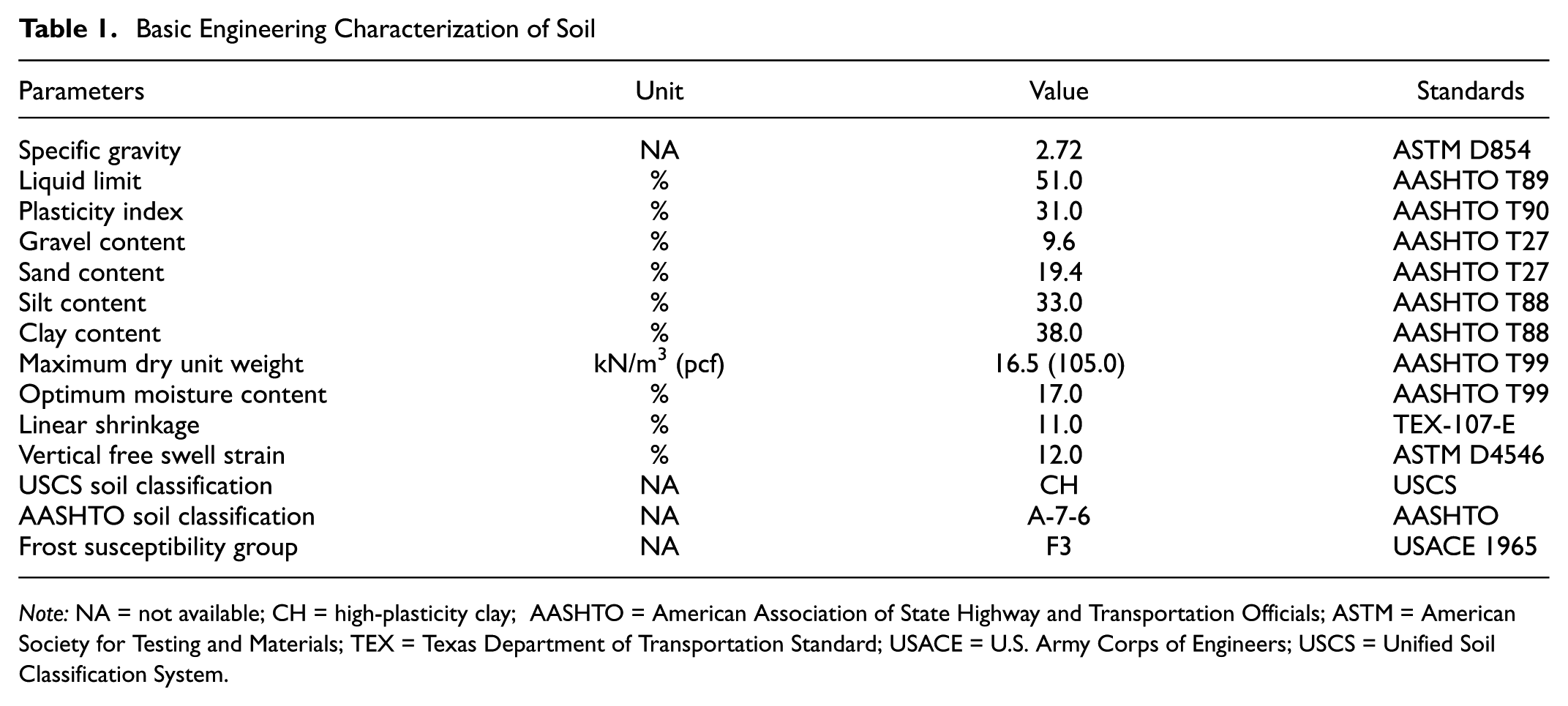
Note: NA = not available; CH = high-plasticity clay; AASHTO = American Association of State Highway and Transportation Officials; ASTM = American Society for Testing and Materials; TEX = Texas Department of Transportation Standard; USACE = U.S. Army Corps of Engineers; USCS = Unified Soil Classification System.
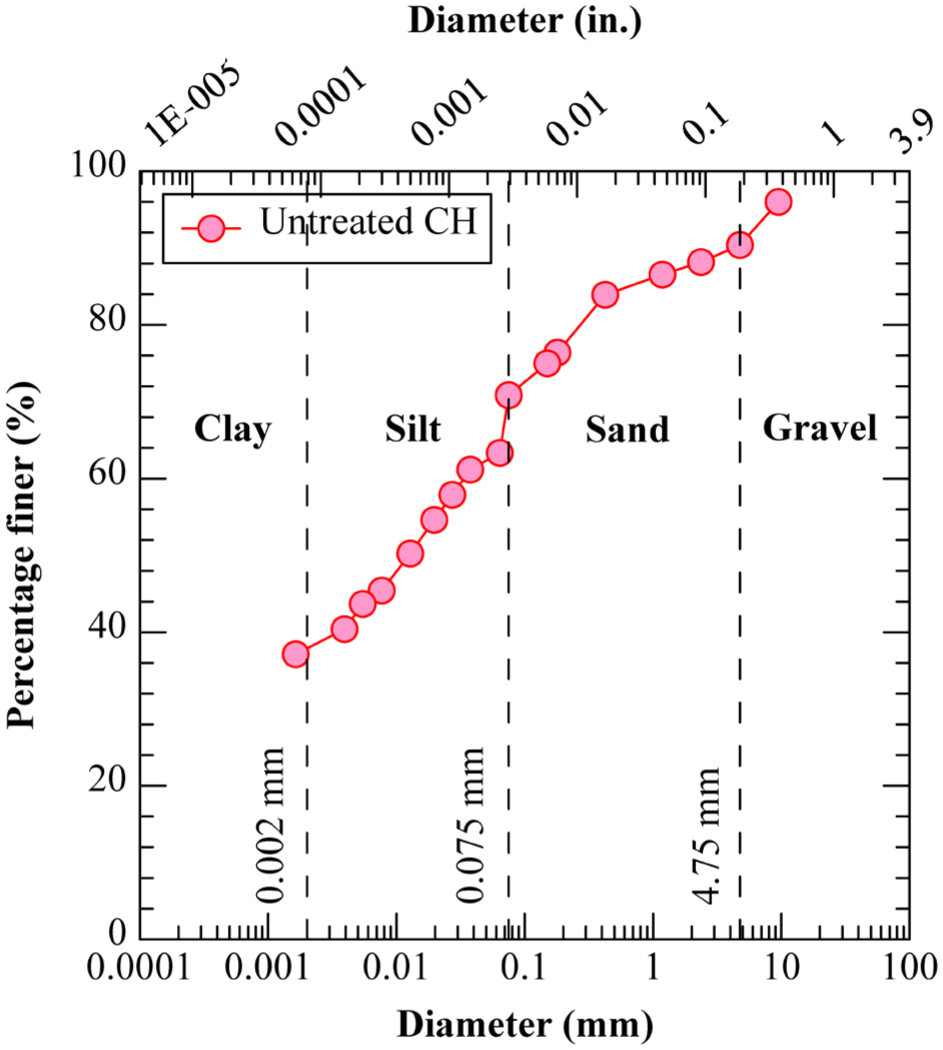
Grain size distribution of natural soil.
For stabilizers, hydrated lime complying with ASTM C977 and Type I/II ordinary portland cement (OPC) meeting the requirements of ASTM C150 were used as the primary stabilizers for the natural expansive soil. Lime sludge from a water treatment plant was dried at 50°C for 7 days. It was then pulverized to pass a 425 µm sieve and was used as a co-additive for stabilization. X-ray diffraction of lime sludge revealed calcite (CaCO3) as the dominant crystalline phase, and pH testing (ASTM D4972) showed its alkaline nature (pH of 9.96 at 25°C).
Sample Preparation
The collected soil was oven-dried at 105 ± 5°C (221 ± 9 °F) for 24 h and then crushed and passed through a No. 4 sieve (4.75 mm) to remove any foreign materials. Untreated soil specimens were prepared by uniformly mixing the dry natural soil with water at its optimum moisture content (OMC) (Figure 2). The dosages of stabilizing agents were defined as a percentage of the dry weight of the stabilizers relative to the dry weight of the soil. Based on the Eades and Grim pH test (ASTM D6276-19), the optimal dosage for the hydrated lime treatment was determined to be 6% by dry soil weight, with an additional 2% lime sludge as a co-additive. For cement treatment, the USACE (UFC 3-250-11) guideline recommends an initial cement content of 11% by dry soil weight for stabilizing CH soils to achieve a minimum UCS of 1.7 MPa (250 pounds per square inch [psi]) after 7 days of curing. In this study, specimens treated with 8% cement and 4% lime sludge exceeded the required UCS value; this dosage was, therefore, selected as the optimum cement content for soil stabilization.
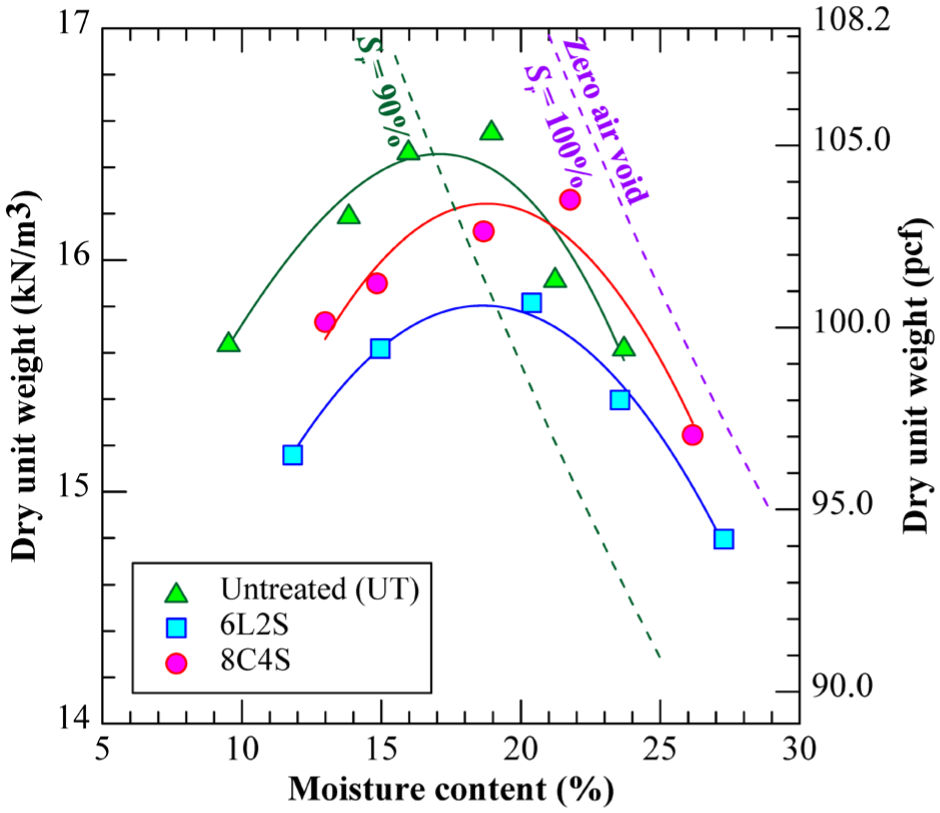
Dry unit weight versus moisture content curves for untreated and stabilized soils.
All treated soils were prepared by thoroughly mixing the target dosage of stabilizer with the dry soil, followed by the addition of the required molding water (OMC, Figure 2). The mixture was blended to ensure uniform consistency and then allowed to equilibrate at room temperature for 10 min. Specimens were then compacted in three layers within cylindrical molds with a diameter of 71 mm (2.8 in.) and an aspect ratio of 2:1 (height-to-diameter), targeting the maximum dry unit weight (Figure 2). Based on practical considerations for road construction and insights from previous studies which indicate the quick strength gain in cement-treated soils when compared with the lime-treated counterparts, the hydrated lime–treated specimens were cured for 14 days, while the cement-treated specimens were cured for 7 days in the present study ( 37 – 40 ). All specimens were placed in a hermetically sealed chamber and cured at room temperature (23.5 ± 0.5°C or 74.3 ± 0.9 °F) under approximately 95% relative humidity. For this study, specimens treated with 6% lime and 2% lime sludge are abbreviated and referred to as 6L2S, while those treated with 8% cement and 4% lime sludge are designated as 8C4S. Each group of specimens was prepared and tested in triplicate under both types of environmental conditioning.
Sample Conditioning
To evaluate the impact of moisture and temperature variation on the internal structure of the specimens, all samples were subjected to environmental conditioning before engineering strength testing. Two conditioning methods were employed: freezing–thawing (FT) and wetting–drying (WD) cycles. These processes are intended to alter the internal structure and condition of the specimens, particularly factors such as void ratio and degree of saturation, all of which are known to significantly influence the engineering performance of soils. Each specimen was subjected to four cycles of the assigned conditioning methods before the commencement of engineering tests.
For the FT conditioning, ASTM D560 was followed. Before initiating the cycles, the dimensions and mass of each specimen were recorded. The specimens were then placed on 6-mm (0.25-in.) thick saturated felt pads to promote capillary action. Each FT cycle consisted of two phases: (a) freezing and (b) thawing. During the freezing phase, specimens were stored in a freezer at −23 ± 2°C (−9.4 ± 3.5°F) for 24 h to ensure subzero temperature exposure. After freezing, specimens were weighed and measured again before transitioning to the thawing phase. Thawing was conducted at room temperature, 23 ± 2°C (73.4 ± 3.5°F), under 95% relative humidity for 23 h. During both phases, specimens remained on the saturated felt pads.
For the WD conditioning, ASTM D559 was used as a guideline. Each WD cycle consisted of: (a) wetting phase, in which specimens were submerged in potable water at 23 ± 2°C (73.4 ± 3.5°F) for 5 h, followed by (b) drying phase, during which specimens were oven-dried at 71 ± 3°C (160 ± 5°F) for 42 h. Before and after each phase, the specimen’s mass and dimensions were recorded.
Engineering Tests and Random Forest Model
UCS was measured to evaluate the strength enhancement of cement- and lime-treated soils. In addition, the influence of environmental conditioning on the strength deterioration in treated soils was evaluated through UCS on specimens after four cycles of WD and FT. The testing procedure followed relevant guidelines from NCHRP Report 144 and the USACE. All UCS tests were conducted using an Instron 5984 Universal Testing Machine. For the specimens stabilized with hydrated lime, testing was performed at a constant strain rate of 1%/min in accordance with ASTM D2166-06. For the cement-treated specimens, a 4-h soaking period in a water bath was carried out before testing, following ASTM D1633, with a strain rate of 1.3 mm/min. UCS values were determined by averaging the peak normal stresses obtained from the stress–strain curves of triplicate specimens.
A machine learning model, random forest regression (RF), was used to evaluate the factors influencing the UCS of the treated specimens. The analysis was carried out in Jupyter Notebook, an open-source platform widely used for data analysis and machine learning. The RF model consisted of an ensemble of 10 decision trees, each with a maximum depth of 3, trained on 80% of the data set, while the remaining 20% was reserved for testing. A fixed random seed of 42 was used to ensure reproducibility. To mitigate overfitting, the model was configured with a limited tree depth and a small number of trees, while leveraging the ensemble approach of RF to improve generalization. Sensitivity analysis identified the relative importance of each factor, including the void ratio and degree of saturation, both of which were significantly influenced by environmental conditioning. As each factor affects soil behavior in different ways and to varying degrees, identifying the most influential features could significantly help improve understanding and guide better design practices and testing strategies suited to site-specific conditions. The data set comprised 18 data points, including UCS, degree of saturation, and void ratio.
Results and Discussions
Engineering Properties
The strength properties of soil are significantly influenced by chemical stabilization, primarily as a result of the combined effects of soil–stabilizer interactions such as cation exchange, flocculation, and agglomeration, along with chemical processes involving the formation of binding compounds through hydration products and pozzolanic reactions. Accordingly, in this study, UCS tests were conducted on both untreated and chemically treated specimens to evaluate the improvement in strength, and the results are presented in Figure 3. Tests show that the UCS value of the untreated soil is approximately 0.3 MPa (43 psi), which is too weak to support transportation infrastructure susceptible to external loads, both from traffic and environmental factors such as moisture intrusion and temperature fluctuations. On chemical stabilization, the UCS of the 6L2S specimen increased by approximately four times, reaching 1.3 MPa (185 psi) after a 14-day curing period. Similarly, the 8C4S specimen, stabilized with cement, exhibited a notable improvement in strength, with the UCS increasing nearly tenfold to 3.1 MPa (430 psi) after 7 days of curing.
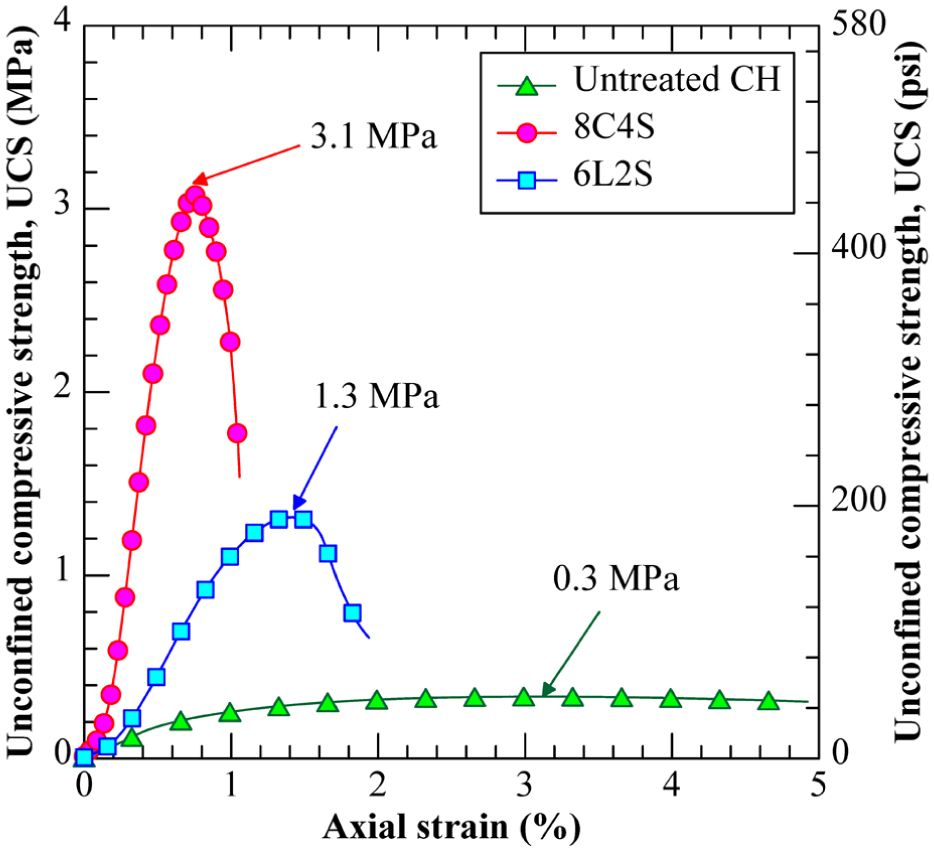
Stress–strain response of tested specimens from UCS testing after curing.
This result indicates that cement stabilization provided greater strength enhancement compared with lime treatment. This could be attributed to the dual contribution of cement hydration and pozzolanic reactions in cement-treated specimens, both of which generate binding compounds such as calcium silicate hydrate (C–S–H) and calcium aluminate silicate hydrate (C–A–S–H). In contrast, lime-treated soils rely solely on pozzolanic reactions to form these binding gels, a process that increases more slowly and generally requires a longer curing period to achieve comparable strength. Additionally, lime sludge, used as an admixture in both treatments, is expected to contribute to strength enhancement by reducing the plasticity of the CH soil. Since lime sludge contains calcite, it may improve workability and act as a filler material, thereby enhancing the overall performance of the stabilized soil ( 41 ).
Based on the stress–strain curves (Figure 3), the untreated specimen exhibited more ductile behavior, while the chemically treated specimens showed a more brittle response, evidenced by an abrupt drop in strength after reaching peak stress. This shift in behavior is primarily attributed to changes in soil structure and enhanced interparticle bonding induced by chemical stabilization, which reduces plasticity and, consequently, ductility under loading. For stiffness, the secant elastic modulus (E50) of the untreated soil was relatively low, approximately 20 MPa (2.9 ksi). In contrast, the 6L2S specimen exhibited an E50 of about 100 MPa (14.5 ksi), and the 8C4S specimen reached 300 MPa (43.5 ksi). This increase in stiffness is attributed to the formation of cementitious compounds that bind soil particles, reduce deformability, and enhance the overall rigidity and load-bearing capacity of the stabilized specimens.
The average UCS of the triplicate treated specimens after undergoing four cycles of conditioning processes, that is, FT and WD, is presented in Figure 4. Even though the engineering strength of the chemically treated specimens was significantly enhanced, the adverse effects of environmental conditions such as moisture and temperature variation were still evident in certain scenarios and remain a critical concern for transportation infrastructure constructed on expansive subgrade soils.
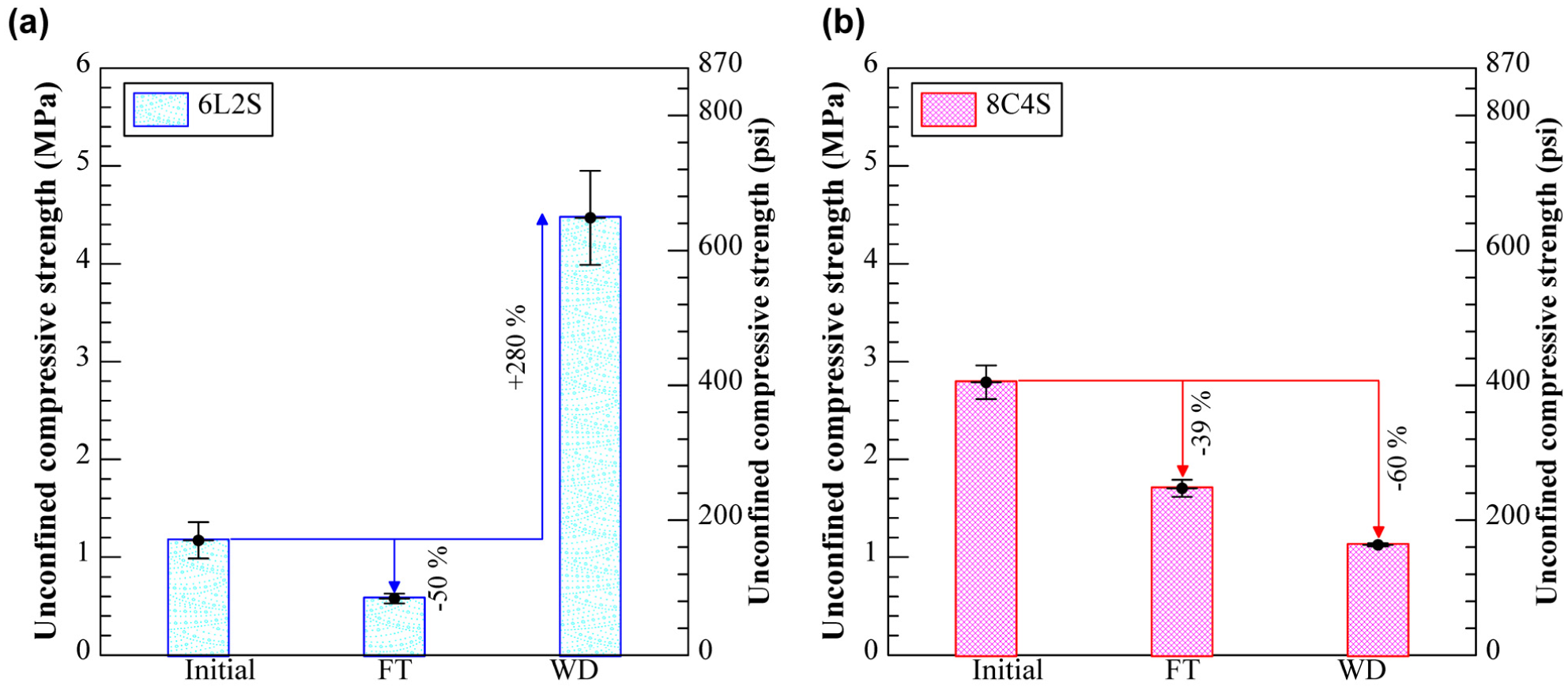
Unconfined compressive strength of tested specimens before and after environmental conditioning: (a) 6L2S specimens; and (b) 8C4S specimens.
One interesting observation from Figure 4a is that, for lime-treated soil, although FT conditioning resulted in strength deterioration as expected, WD conditioning surprisingly improved the strength of the soil severalfold. The UCS of the 6L2S specimens decreased to 0.58 MPa (84 psi) after the completion of FT conditioning, which corresponds to approximately 50% of the initial UCS measured after 14 days of curing. This reduction aligns with previous observations which showed that the strength and durability of stabilized soils are strongly influenced by changes in moisture and temperature conditions. ( 42 – 44 ). In contrast, following the WD conditioning, the UCS of the 6L2S specimens nearly tripled, reaching 4.47 MPa (648 psi). This strength increase after WD could be attributed to the enhanced formation of binding gels, driven by elevated temperatures that promoted greater pozzolanic activity and further modified the internal structure of the treated specimens. This trend indicates that the 6L2S specimens are more vulnerable to FT than to WD, which clearly suggests that different environmental conditioning methods could induce distinct changes in soil structure and moisture conditions, which will be discussed later in more detail. Understanding these differences is essential to ensure the long-term performance of transportation infrastructure constructed on stabilized subgrades.
For cement stabilization, the 8C4S specimens retained more than 60% of their original strength after FT conditioning (Figure 4b). However, their UCS decreased to about 40% following WD conditioning compared with the original UCS after 7 days of curing. This trend contrasts with that observed in lime stabilization, where FT caused more degradation than WD. In addition, although cement treatment initially resulted in higher UCS values than lime treatment, this trend did not persist after environmental conditioning. For instance, under FT conditions, cement-treated specimens showed much higher strength, about three times that of lime-treated specimens. This improvement is likely a result of the formation of stronger cementitious products in cement-stabilized specimens, which provide greater resistance to FT cycles and help preserve the internal structure even when subjected to post-conditioning soaking. However, under WD conditions, lime-treated specimens demonstrated significantly higher strength, nearly four times that of cement-treated specimens. One should keep in mind that the curing conditions (post conditioning) for lime- and cement-treated soil specimens before UCS tests are different in accordance with their respective standards. More specifically, lime-treated specimens were tested immediately after conditioning (i.e., without soaking), while cement-treated specimens underwent an additional 4-h soaking period in water before testing (USACE guideline). Therefore, even though cement treatment offers greater initial strength, the additional 4-h soaking significantly alters internal characteristics such as the void ratio and degree of saturation. These changes greatly influence the mechanical behavior of the treated soils. Therefore, in the following sections, the effects of different environmental conditionings on the internal structure (both void ratio and saturation levels) of the soil specimens are discussed.
Void Ratio Perspective
Figure 5 presents the variation in void ratio under different environmental conditioning for both lime and cement-treated soils. During these four cycles of environmental conditioning, material loss was minimal and could be considered negligible. Therefore, by knowing the initial water content after compaction as well as the mass and volume of the specimens at each conditioning phase, the void ratio was calculated based on soil phase relationship equations, assuming that the change in mass was solely a result of water content variation. The initial void ratio after compaction was relatively higher in the 6L2S specimen than in the 8C4S specimen. Under wetting and drying (Figure 5a), both treatments showed a similar trend, an increase in void ratio during wetting, followed by a reduction during drying, consistent with the observations reported in a previous work ( 45 ). The increase during wetting is attributed to moisture intrusion, where water molecules interact with clay particles, expanding the diffused double layer and increasing the void ratio. Conversely, during drying, water evaporates, the double layer contracts, and the soil structure becomes denser, leading to a reduction in void ratio. In addition to this phenomenon, elevated temperatures during the drying phase promote pozzolanic reactions, which enhance the formation of binding gels and contribute to a further reduction in the void ratio.
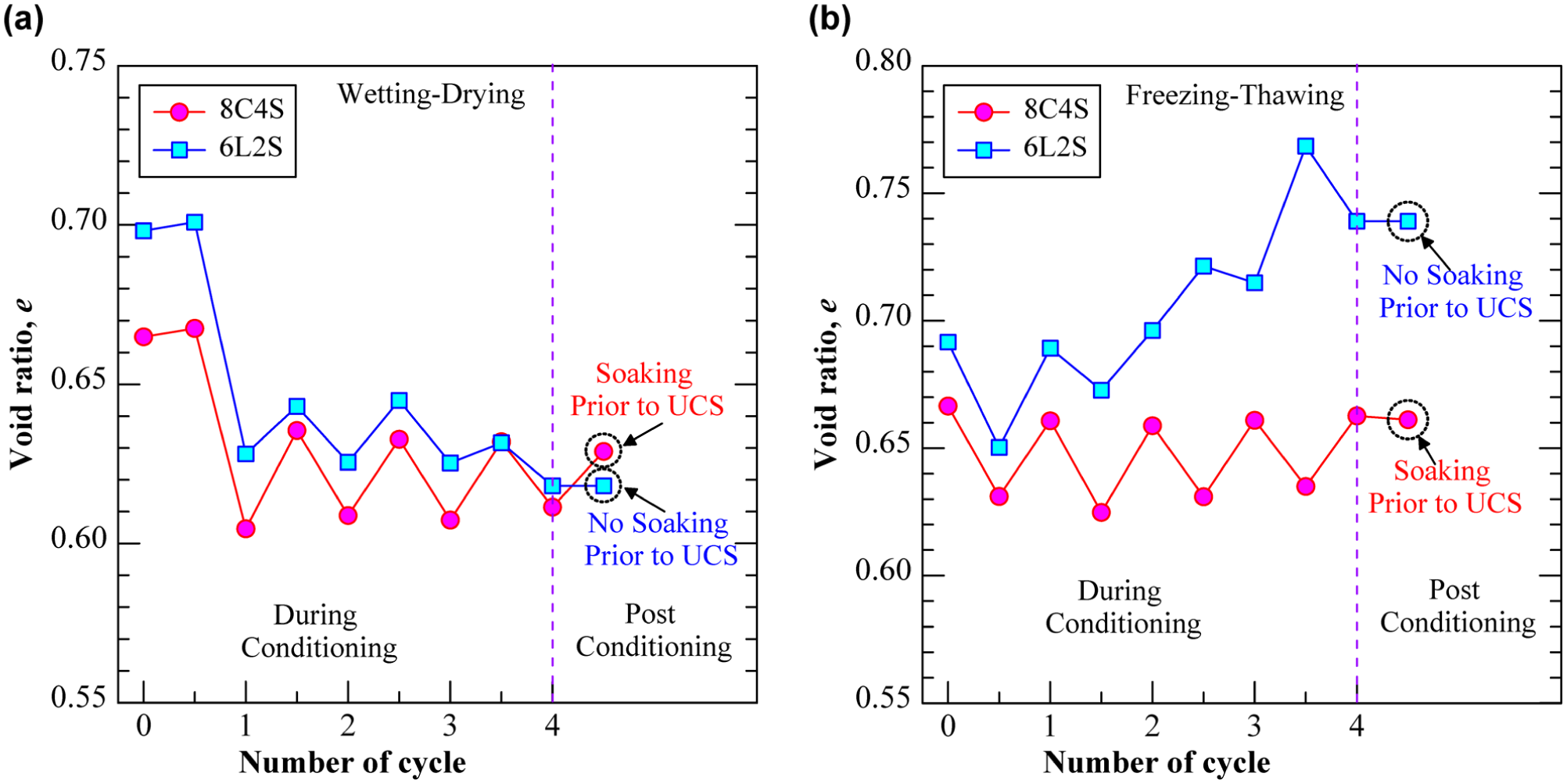
Change in the void ratio under different environmental conditioning: (a) wetting–drying; and (b) freezing–thawing.
Notably, after the first drying phase, although specimens were re-exposed to wetting, the void ratios did not return to their initial level. This suggests an overall irreversible densification of the soil matrix after the first WD cycle. Interestingly, the rate of increase in void ratio during rewetting was greater for 8C4S than for 6L2S. Additionally, the void ratio of 6L2S decreased more significantly during drying than it increased during wetting, resulting in an overall reduction of voids. By the end of the conditioning cycles, the void ratios of both specimens converged to nearly the same value. Furthermore, as a result of the testing protocol, 8C4S specimens were soaked in water for an additional 4 h before the UCS test, unlike 6L2S. This additional soaking led to a higher void ratio before testing, which likely contributed to the lower UCS observed for 8C4S compared with 6L2S, despite its stronger initial strength. This highlights the importance of understanding pre-test specimen conditions in interpreting post-conditioning mechanical performance.
For FT conditioning (Figure 5b), 8C4S exhibited greater resistance than 6L2S. During freezing, soil particles contract while water expands (turning into ice). In the first two cycles, 6L2S specimens were in relatively good condition with a lower moisture content. As a result, the expansion caused by ice formation was not sufficient to cause severe damage. The contraction of soil particles combined with the expansion of ice lenses forced water out of the specimen, leading to a reduction in volume and a lower void ratio ( 46 ). However, as the number of cycles increased, this trend shifted. By the third cycle, the void ratio during the freezing phase became higher than during the thawing phase. This change indicates accumulating internal damage and increased water retention within the specimens. The expansion of water began to outweigh the contraction of soil particles, resulting in a net increase in void ratio during freezing. Particularly in the final cycle, the pronounced increase in the void ratio during freezing likely contributed to the significant reduction in UCS, which is consistent with the findings in a previous study ( 47 ).
In contrast, 8C4S demonstrated a more consistent trend, with the void ratio decreasing during freezing and increasing during thawing across all cycles. This pattern suggests that cement-treated specimens were more resistant to the internal pressure caused by ice lens formation. During thawing, as the ice lenses melted, the released water interacted with soil particles, expanding the diffused double layer and increasing overall volume, thereby raising the void ratio. Given this enhanced resistance to freeze-induced damage, the UCS of 8C4S remained significantly higher than that of 6L2S after FT conditioning.
Saturation Levels Perspective
In addition to the void ratio, the degree of saturation also significantly influences the engineering performance of stabilized soils ( 42 – 44 ). Therefore, changes in the degree of saturation under different environmental conditions were computed using soil phase relationship equations, similar to the void ratio, and the results are presented in Figure 6. Under WD conditioning (Figure 6a), specimens experienced substantial fluctuations in the degree of saturation caused by alternating moisture intrusion and elevated temperatures during drying. These observations are consistent with the findings and interpretations of Das et al. (2023), who reported similar moisture–temperature interactions and the associated physicochemical and microstructural evolution in lime-treated soil subjected to successive WD cycles ( 48 ). After compaction, both 6L2S and 8C4S exhibited almost similar degrees of saturation. During the wetting phases, saturation increased, while in the drying phases, it dropped to below 30%. By the end of the WD cycles, both specimens reached similar final saturation levels, with 8C4S being slightly drier than 6L2S. However, before UCS testing, 8C4S specimens were soaked in water for 4 h, increasing their degree of saturation to above 85%, while the 6L2S specimens remained at approximately 22%. This substantial difference in moisture conditions significantly influenced UCS. Despite having similar void ratios, the elevated saturation level in 8C4S specimens made them more susceptible to moisture-related weakening, resulting in a UCS value of nearly one-fourth of 6L2S.
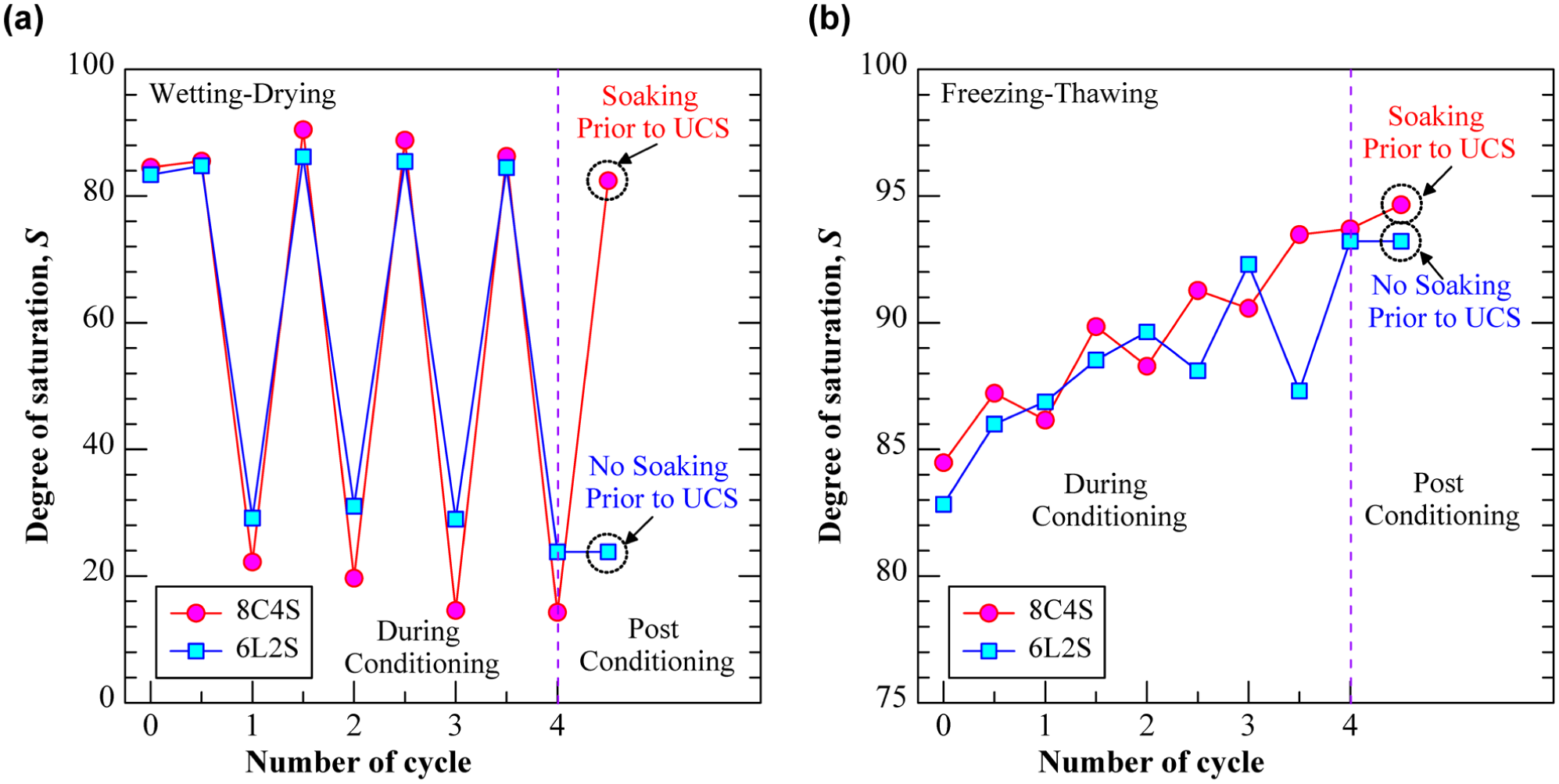
Change in degree of saturation under different environmental conditioning: (a) wetting–drying; and (b) freezing–thawing.
Under FT conditioning (Figure 6b), 8C4S specimens exhibited a consistent pattern of an increase in the degree of saturation during freezing and a decrease during thawing. Since the increase during freezing exceeded the reduction during thawing, the overall saturation level gradually increased over the conditioning period and eventually stabilized by the final cycle. In contrast, 6L2S specimens displayed a less consistent trend. During the initial two cycles, saturation increased steadily. However, by the third freezing cycle, specimen expansion was observed, and the saturation level began to decline. This was followed by a slight increase during the thawing phase. In the final cycle, a more pronounced expansion caused a sharper drop in saturation during freezing, followed again by an increase during thawing. Despite these fluctuations, both specimens reached a similar degree of saturation before UCS testing. Also, soaking of cement-treated specimens before UCS testing after FT conditioning did not have much influence on the saturation levels, unlike soaking after WD, as the saturation level was already high (about 93% to 94%). The observed differences in UCS values of the specimens were, therefore, primarily attributed to changes in the void ratio for FT conditioning. In particular, the 6L2S specimens experienced a significant increase in void ratio over the FT conditioning period, which contributed to their reduced strength performance.
Insights from Machine Learning Model
A machine learning RF model was implemented to gain further insights into the influence of internal structural and moisture-related parameters on the strength behavior of stabilized soils. The sensitivity analysis of the RF model used the Gini impurity criterion, which determines the relative importance of each input parameter by quantifying the reduction in impurity resulting from data partitioning at decision tree nodes. In this study, the model was trained and validated using an experimental data set that included key features such as void ratio, degree of saturation, and UCS, obtained from WD and FT conditioning. The sensitivity analysis (Figure 7) revealed that the degree of saturation had a relative importance of 0.53, while the void ratio accounted for 0.47. These findings suggest that both factors are critical to predicting UCS, with the degree of saturation exhibiting a marginally greater influence. This observation is consistent with the results under WD conditioning. For instance, 8C4S specimens displayed lower UCS values than 6L2S, despite having similar void ratios and being stabilized with cement, which is typically associated with higher strength than hydrated lime. In this case, the higher degree of saturation in 8C4S specimens, caused by the 4-h soaking before UCS testing, likely played a dominant role in reducing the strength. Conversely, the influence of void ratio became more prominent when the specimens exhibited similar degrees of saturation. For example, under FT conditioning, both 6L2S and 8C4S achieved nearly equal saturation levels; however, the UCS of 6L2S was considerably lower. This was primarily a result of a substantial increase in void ratio following FT cycles, which likely compromised the integrity of the soil structure. The 8C4S specimens, in contrast, demonstrated greater structural stability and higher resistance to FT effects.
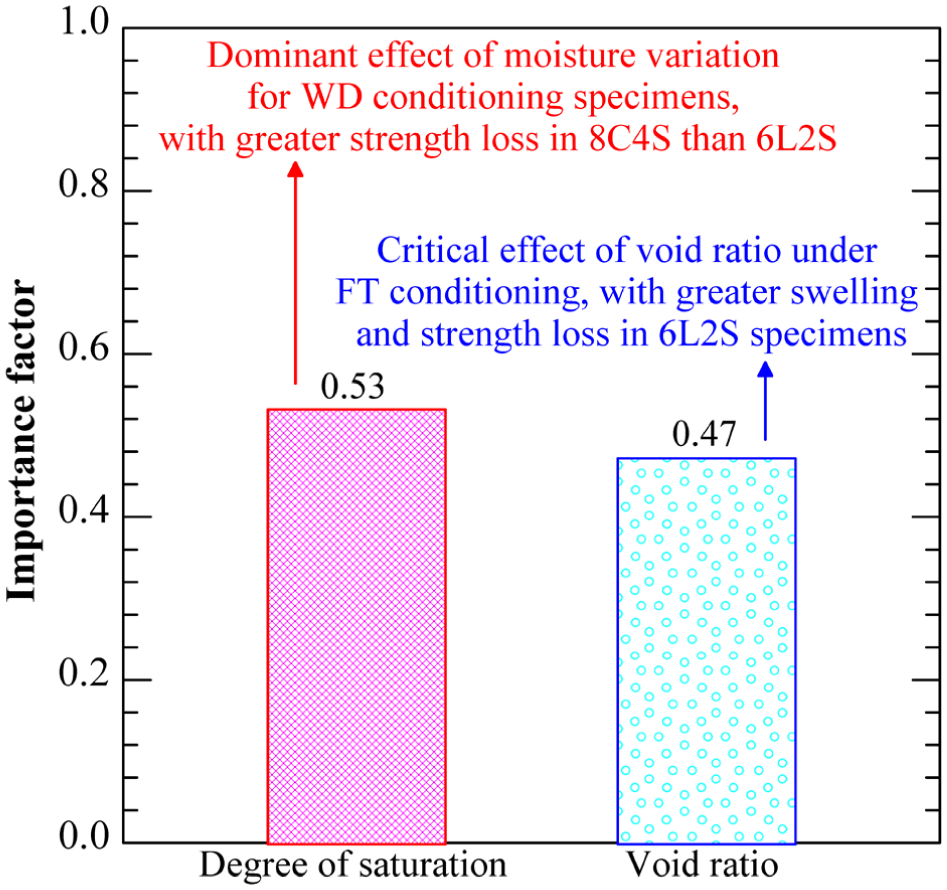
Sensitivity analysis of feature contributions to UCS using RF model.
The consistency between the RF model’s sensitivity analysis and experimental observations underscores the substantial influence of environmental conditioning on the soil’s structure and strength. In particular, the differences in post-conditioning protocols, such as the soaking requirement for cement-treated specimens, introduced significant variations in saturation levels (for the WD scenario) that greatly affected the UCS outcomes. The combined findings from experimental data and machine learning analysis reinforce the importance of looking into both void ratio and saturation levels when evaluating the durability of treated soils. Insights from these perspectives will facilitate better understanding of the performance of stabilized soils under extreme weather events and contribute to the development of testing protocols to assist in the design of resilient transportation infrastructure.
Discussion on Disparities in Durability Testing Protocols
Choosing the right type of stabilizer is the most important and challenging task in any soil stabilization program and is highly dependent on the soil type, exposed weather conditions, and desired response. However, most often this decision is either driven by experience or based on laboratory data. Laboratory testing is usually done by agencies following standard protocols, and the design engineers/practitioners eventually look at the numbers reported and make their choice. It is, therefore, critical to have a unified testing protocol to evaluate the performance of soils treated with different stabilizers for making direct and correct comparisons. If examined carefully, the USACE and NCHRP testing protocols for evaluating the strength of cement- and lime-treated soils recommend a 4-h soaking period before UCS testing for cement-treated specimens (ASTM D1633), whereas no such soaking is required for lime-treated soils (ASTM D2166-06). These types of disparities in the testing protocols may lead to wrong comparisons and false interpretations about the performance of stabilizers. For example, in the present study, if the UCS values of lime- and cement-treated soils after WD treatment are compared (Figure 4, a and b ), the 6% lime-treated soil is approximately three to four times stronger than the 8% cement-treated soil after WD conditioning. Even at high dosages and with cement generally considered a more effective stabilizer than lime, the results indicate the opposite, suggesting lime as a promising stabilizer for the present soil under WD conditions. However, this interpretation is misleading. The discrepancy primarily arises because the test results for cement-treated soils in Figure 4b were obtained after soaking, which increases saturation levels and consequently causes a significant reduction in UCS values. It would be fair to compare the performances of both stabilizers under the same conditions, that is, both with soaking. This study strongly calls for a unified durability testing protocol for different stabilizers, such as lime and cement, to make direct comparisons more meaningful and yield proper and correct decisions.
Overall, this study has not only demonstrated the clear effects of the void ratio and degree of saturation on the durability of stabilized soils but has also identified the most important disparity in the current durability testing protocols for different stabilizers that might lead to misinterpretations. It has also highlighted the strong need for a unified durability testing framework for stabilized soils.
Summary and Conclusions
A research study was conducted to investigate the impact of moisture and temperature variation on the internal structure and engineering strength of chemically stabilized expansive soils in the context of extreme environmental events. A high-plasticity clay was treated with two calcium-based stabilizers (cement and hydrated lime) along with lime sludge as a co-additive to evaluate the strength and determine the soil state before and after being subjected to two different environmental conditioning, namely, freezing–thawing (FT) and wetting–drying (WD). Key links between the environmental conditioning, internal structure, and strength of soil were discussed and established from the void ratio and saturation level perspectives. In addition, the data obtained from experiments was fed to a Random Forest regression (RF) model to identify the relative importance of governing parameters that dictate the response. Based on the experimental and machine learning analyses, important findings are summarized below.
Cement plus lime sludge–treated specimens exhibited higher strength compared with hydrated lime plus lime sludge–treated specimens after initial curing. This was a result of the rapid formation of the binding gels through cement hydration and pozzolanic reactions, compared with the slower pozzolanic reaction between lime and soil.
Environmental conditioning significantly altered stabilized soil’s strength, void ratio, and saturation. Notably, lime-treated specimens lost strength after FT but gained strength after WD, while cement-treated specimens exhibited a reduction in strength, with higher residual strength after FT compared with WD.
The RF model confirmed that both the void ratio and degree of saturation are critical factors controlling UCS, with moisture saturation having a slightly greater impact.
Differences in post-conditioning protocols, especially the soaking requirement for cement-treated specimens, caused significant variations in moisture state and void ratio that greatly influenced UCS results, making direct comparisons between lime and cement difficult. This clearly highlights the need for a unified durability testing framework for stabilized soils.
Overall, this research provides valuable insights into the impact of moisture intrusion and temperature variation on the internal soil structure and state, which are reflected in engineering performance. The findings underscore the importance of accounting for these factors in design to achieve more durable and sustainable designs, along with the need for appropriate testing protocols. The study urges engineers and researchers to develop improved guidelines and unified standards that more accurately reflect field conditions and better represent both lime and cement treatments, to avoid misunderstandings with regard the performance of these stabilizers. Future investigations are recommended to evaluate additional parameters such as resilient modulus, CBR, and cyclic strength, which directly relate to field performance. Moreover, studies including different soil types, varying treatment dosages, consistent testing protocols, and larger data sets are recommended to improve model reliability.
Footnotes
Acknowledgements
The authors would like to acknowledge the financial support of the Minnesota Department of Transportation for this research.
Author Contributions
The authors confirm contribution to the paper as follows: study conception and design: J. Huang, A.J. Puppala, S. Chou, R. Velasquez, and B. Lakkimsetti; data collection: S. Chou; analysis and interpretation of results: S. Chou, J. Huang, B. Lakkimsetti, A.J. Puppala, and R. Velasquez; draft manuscript preparation: S. Chou, J. Huang, B. Lakkimsetti, A.J. Puppala, and R. Velasquez. All authors reviewed the results and approved this version of the manuscript.
Declaration of Conflicting Interests
The authors declared the following potential conflicts of interest with respect to the research, authorship, and/or publication of this article: Anand J. Puppala is a member of Transportation Research Record’s Editorial Board. All other authors declared no potential conflicts of interest with respect to the research, authorship, and/or publication of this article
Funding
The authors disclosed receipt of the following financial support for the research, authorship, and/or publication of this article: The Minnesota Department of Transportation under award No. MnDOT1036336, “Novel Durability Screening Method for Stabilized Geomaterials”.

Any opinions, findings, conclusions, or recommendations expressed in this paper are those of the authors and do not necessarily reflect the views of Minnesota DOT.