



Abstract
Urban rail transit systems frequently encounter challenges related to service reliability and passenger crowding, particularly during peak operational hours and in networks with complex service patterns. This paper presents an innovative approach to real-time train holding that addresses the unique challenges posed by systems with scheduled short-turning, where passenger loads at short-turning points can vary significantly. We developed a dual-strategy framework that combines (1) a real-time heuristic that calculates holding times using both historical data and real-time information to minimize passenger-experienced crowding, and (2) a predictive modeling approach that anticipates headway situations when full-length service trains from the terminal arrive at short-turning stations. Unlike conventional headway-equalizing strategies that overlook load variations in high-demand scenarios operating near capacity, our approach explicitly accounts for heterogeneous passenger loads across different service types to reduce denied boarding and passenger wait times. The effectiveness of our framework was evaluated using a microscopic simulation model of a high-frequency, high-demand urban rail transit system. The results demonstrate that the proposed approach reduced denied boarding incidents by 30% through improved train load balancing. The combination of predictive control with downstream holding strategies improved service quality through the proactive regulation of train dispatching at terminals, coupled with adjustments at key stations.
Introduction
Background
Urban heavy rail transit systems facilitate efficient mobility in metropolitan areas worldwide. These systems are essential for moving large volumes of passengers quickly and reliably, particularly during peak hours when road networks are congested. As cities grow, many of which are experiencing increasing ridership after the pandemic, the importance of well-functioning urban rail systems becomes increasingly apparent for sustainable urban development and quality of life.
Maintaining service reliability and passenger satisfaction in urban rail systems is a complex challenge that requires careful planning and real-time management. One key aspect is determining optimal holding times for trains at stations. When properly implemented, holding times can help to regulate headways, reduce bunching and crowding, and improve overall service consistency. Short-turning, whether scheduled or implemented in real time, serves as a strategic tool to address varying passenger demand along rail lines and mitigates service gaps. This technique redirects select trains before reaching the terminus, increasing service frequency in high-demand segments. Although short-turning can enhance overall system efficiency by providing a higher level of service in high-demand sections, it introduces operational complexities that require careful management. These challenges include potential service disruptions at stations beyond the short-turn point, increased passenger transfer requirements, and the necessity for more sophisticated real-time control strategies to maintain service regularity.
Motivation
Typically, urban rail transit literature and practice have focused on minimizing passenger wait times. Although this approach has merit, it needs to adequately address the critical issue of passenger crowding, which significantly affects comfort and safety. Overcrowded trains lead to passenger discomfort. They can also result in extended station dwell times, further disrupting service schedules. Moreover, denied boardings can force passengers to wait for additional headway or longer in systems operating close to capacity. This scenario contradicts the underlying assumption of minimizing wait times and highlights the limitations of conventional headway management strategies.
The imperative to balance wait times with train load equalization has gained increasing prominence in urban rail transit research, as it offers a pathway to enhance the overall passenger experience. This balanced approach seeks to achieve a more uniform distribution of passengers across trains, mitigating overcrowding on certain services while simultaneously addressing the underutilization of capacity on others. However, realizing this equilibrium presents a multifaceted optimization challenge that necessitates developing and implementing sophisticated modeling techniques and real-time decision-making systems. The complexity of this task is further amplified in networks that employ short-turning strategies, for which the interplay between service frequency, passenger demand, and operational constraints must be carefully managed to maximize system efficiency and passenger satisfaction.
Objectives
This research aims to address several critical aspects of urban rail transit operations. Our primary objective is to develop a realistic holding heuristic for operational considerations, including scheduled short-turning, variable passenger demand, and system constraints. This heuristic will form the basis of a comprehensive model for calculating optimal holding times, balancing service regularity with passenger load equalization.
Building on this foundation, we intend to design a novel real-time train load equalization method that adapts to dynamic passenger flow patterns and unexpected disruptions. This method will incorporate passenger comfort metrics into the headway management process, considering factors such as perceived in-vehicle crowding, denied boarding, wait times, and journey times.
Furthermore, we aim to evaluate the impact of short-turning operations on overall system performance and develop strategies to mitigate potential service gaps. This evaluation will inform the development of a framework for integrating these service-restoration techniques into existing urban rail management systems, ensuring practical applicability and ease of implementation.
Through these objectives, we seek to enhance urban rail transit systems’ efficiency, reliability, and passenger experience using advanced, adaptive, and passenger-centric headway management strategies.
Contributions
This research advances urban rail transit control through three contributions. First, a train passenger load estimation model is proposed using passenger arrival and retention rates. Second, load equalization is introduced as an alternative in the headway management strategy, moving beyond traditional time-based metrics to explicitly consider passenger distribution across trains. Third, a dual-layer control framework is developed that integrates both reactive and predictive strategies: a real-time strategy that leverages historical and current passenger flow data for immediate holding decisions and a predictive control (PC) mechanism at the terminal that anticipates future headway configurations at critical short-turning stations. The proposed framework addresses the unique operational complexities of modern transit systems, including short-turning operations, multibranch networks, and dynamic demand patterns. By simultaneously optimizing for passenger load balance and headway regularity through a set of control strategies, the proposed approach enhances both passenger experience and system efficiency.
Literature Review
Extensive research has been conducted over the past two decades on real-time headway management strategies in high-demand urban rail transit systems. This literature review examines the development of key concepts and methodologies, focusing on train holding strategies, load equalization, and passenger experience enhancement.
Early research established the foundation for real-time control strategies in urban rail systems. Eberlein et al. addressed the holding problem with real-time information availability, signifying a shift toward data-driven decision making in transit operations ( 1 ). Xuan et al. built on this foundation, presenting a study on dynamic bus holding strategies for schedule reliability, introducing optimal linear control and performance analysis ( 2 ).
Integrating multiple operational objectives gained attention with Huang et al., who proposed a joint train scheduling optimization model that considered service quality and energy efficiency in urban rail transit networks ( 3 ). This approach aimed to balance operational efficiency with passenger satisfaction.
Real-time optimization and control methodologies have seen advancements Wang et al. developed a multiple-phase train trajectory optimization method under real-time rail traffic management, utilizing the Gauss Pseudo-spectral Method ( 4 ). Samà et al. proposed a multicriteria decision support methodology for real-time train scheduling, enhancing the field’s capability to respond to dynamic operational conditions ( 5 ). Recent advances in deep learning have enabled predictive modeling of headway propagation, where ConvLSTM (i.e., convolutional long short-term memory) networks can forecast spatiotemporal headway dynamics by incorporating terminal departure decisions as direct inputs, offering dispatchers a tool to evaluate the downstream impacts of various control strategies ( 6 ).
The importance of accurate real-time passenger flow estimation was emphasized by Tao and Tang, who developed a model based on multisource data fusion and Kalman filtering ( 7 ). Their work aimed to improve the accuracy of real-time passenger flow status estimation, providing a tool for dynamic system management. Recent advances in deep learning have enabled predictive modeling of headway propagation, with Usama and Koutsopoulos demonstrating that ConvLSTM networks can forecast spatiotemporal headway dynamics by incorporating terminal departure decisions as direct inputs ( 6 ).
In recent years, there has been a focus on more sophisticated control and optimization strategies. Ren et al. presented a two-step optimization approach that integrates train marshaling and real-time station control at comprehensive transportation hubs ( 8 ). Zhou et al. studied public norms in the operational scheme of urban rail transit express trains, aiming to contribute to a more equitable and efficient urban rail transit system ( 9 ).
Short-turning routing has emerged as a strategy for addressing overcrowded and unevenly distributed passenger demand. Yin et al. explored this concept within the context of optimization models for urban rail transit systems, incorporating subsidy considerations to provide a more comprehensive view of system economics ( 10 ).
Yuan et al. developed a real-time optimization model for train regulation and passenger flow control in urban rail transit networks ( 11 ). Their model aimed to handle frequent disturbances, representing a step toward more resilient and adaptive transit systems. Wang et al. conducted an experimental analysis of hierarchical rail traffic and train control in a stochastic environment, demonstrating the potential benefits of integrating rail traffic management systems with automatic train operation ( 12 ). Addressing passenger waiting time and energy consumption issues, Sahebi et al. proposed a robust optimization approach for metro timetabling, contributing to efforts to balance operational efficiency with passenger comfort and environmental considerations ( 13 ).
Whereas most current literature focuses on optimization-based methods for controlling urban rail transit systems, alternative approaches have also been explored. Koutsopoulos and Wang presented a framework for applying rail simulation that includes calibration, validation, evaluation methodology, and interpretation of results ( 14 ). They introduced SimMETRO, a rail simulation model designed for service performance analysis, which considers significant sources of uncertainty in operations.
Recent studies have further explored the impact of crowding on passenger behavior and system performance. Singh et al. investigated changes in departure time choices for train trips during the COVID-19 pandemic in the Netherlands, revealing that certain groups can be motivated to change their departure time if real-time crowding information is provided ( 15 ). The effects of the COVID-19 pandemic on rail passengers’ crowding perceptions were also examined by Aghabayk et al. in Tehran’s metro system, underscoring the importance of considering health concerns in crowding management strategies ( 16 ).
The integration of urban ropeways into crowded transit systems has been explored by Hofer et al. in Graz, Austria, highlighting the potential of alternative transit modes in addressing capacity issues in moderately sized European cities ( 17 ). Shin et al. conducted a comprehensive study on the valuation of metro crowding in Seoul, South Korea, emphasizing the need for context-specific crowding management strategies in different urban environments ( 18 ).
Addressing the issue of overcrowding discomfort, Agrawal et al. developed optimization models for bus frequency in Delhi, emphasizing the importance of considering overcrowding discomfort in transit planning and optimization ( 19 ). Lee and Kim estimated the willingness to pay for mitigating crowdedness in high-speed rail trains in South Korea ( 20 ), whereas Tirachini et al. used revealed preference data from Singapore’s metro to estimate the value of sitting versus standing ( 21 ).
The cost of crowding in light rail systems was modeled by Klumpenhouwer and Wirasinghe, who developed a cost-of-crowding model for determining optimal train and platform lengths ( 22 ). Legaspi et al. explored the economic benefits of transport investments, including rail projects, demonstrating that more comprehensive economic benefits can represent a significant markup over conventional economic user benefits ( 23 ). Haywood and Koning assessed the distribution of comfort costs of congestion in public transport in Paris ( 24 ), whereas Pel et al. investigated the inclusion of passengers’ response to crowding in national train passenger assignment models in the Dutch railway network ( 25 ). Earlier work by Haywood and Koning on the Paris metro estimated the total welfare cost for trips under different crowding conditions ( 26 ).
Basu and Hunt conducted a stated preference experiment in Mumbai to value attributes influencing the attractiveness of suburban train service, providing insights into willingness to pay for reducing in-vehicle crowding ( 27 ). For a comprehensive review of rail crowding valuation studies conducted before 2011, readers are directed to Wardman and Whelan, whose meta-analysis provides valuable insights into the variation of crowding costs with load factor and journey purpose ( 28 ). Whelan and Crockett conducted an in-depth study on the willingness to pay to reduce rail overcrowding in the UK, informing policy decisions on overcrowding mitigation strategies ( 29 ).
This body of research provides a foundation for developing advanced, adaptive, and passenger-centric optimization strategies for urban rail transit systems, aiming to contribute to more efficient, comfortable, and sustainable urban transportation networks. For a comprehensive overview of performance measures and their interdependencies in urban rail transit systems, readers are directed to the systematic review by Awad et al. ( 30 ).
Methodology
Simulation Model
In the subsequent sections of this paper, experiments utilize a revamped rail simulation model named “TransitLab SimMETRO” ( 31 ). TransitLab SimMETRO is a modern, object-oriented, cross-platform software, offering enhanced flexibility, scalability, and performance for rail system simulation and analysis. The model is constructed explicitly for service performance evaluation, capacity analysis, real-time subway system control testing, and operational planning. TransitLab SimMETRO represents a microscopic, dynamic, and stochastic simulation tool, building on the foundation of SimMETRO, which has been applied in various studies. Koutsopoulos and Wang developed and used SimMETRO to analyze service performance and to evaluate operations and strategies for real-time control of the Red Line in Boston, MA, demonstrating the model’s applicability and the effectiveness of the proposed calibration methodology ( 14 ). Zhou et al. employed SimMETRO to examine the effectiveness of various strategies, such as skip-stop, station consolidation, and dwell-time control, to relieve congestion and increase capacity on the Massachusetts Bay Transportation Authority’s Red Line ( 32 ). Zhou and Koutsopoulos utilized SimMETRO to conduct a schedule-based analysis of transmission risk in public transportation systems ( 33 ).
TransitLab SimMETRO incorporates several innovative design principles:
Advanced dynamic modeling of passenger demand and its intricate effects on train operations, including sophisticated dwell-time calculations at stations;
Comprehensive stochastic representation of various sources of uncertainty that encompasses fluctuations in demand patterns and a wide array of potential incidents such as train malfunctions, station emergencies, and control system anomalies;
Robust delay propagation system that accounts for complex trip chaining and intricate train schedules, providing realistic simulation of networkwide effects;
Detailed modeling of train operators and passenger behavior that allows for the evaluation of various conditions and their impact on system efficiency;
High-fidelity representation of train performance characteristics, enabling accurate simulation of various rolling stock types and their interactions with the rail infrastructure; and
Integrated PC framework for proactive holding decisions.
This model comprises a network representation of junctions, merging points, and other geometric attributes that affect train performance, including grade and curvature. It additionally captures station-specific traits, such as platform configuration and length, that allow for the use of station-specific dwell-time models.
The model’s automated train protection component is flexible and reflects the corresponding block design and related speed codes, allowing for the simulation of various control types, including fixed-block and moving-block control. The scheduling feature offers flexibility depending on the application, including departure headways, actual headways, or scheduled headways. This includes information about headways or departure times and trip chains to propagate delays as trains perform their sequence of trips accurately.
Rolling stock within the model encompasses operating characteristics that affect train performance, such as total capacity, seating capacity, door configuration, car composition, and acceleration and deceleration profiles. Passenger demand can be modeled at different levels of detail, contingent on available data. When specific passenger arrival rates or origin–destination flow data are unavailable, dwell times at stations are utilized to capture the impact of demand.
The model encompasses operating strategies representing real-time operation controls aimed at service restoration during major disruptions and schedule maintenance. Based on certain preset thresholds and configurable logic, it can simulate procedures such as holding trains at selected stations or short-turning trains.
TransitLab SimMETRO is also capable of evaluating a system’s operating performance under various scenarios, such as different schedules, control system configurations, rolling stock characteristics, and so forth. It enables the creation of scenarios representing potential operating conditions, such as varying demand levels or the inclusion of incidents. The simulation model produces a wide range of performance measures, including travel times, headway distribution, passenger waiting times, train passenger loads, and the number of passengers unable to board the first train.
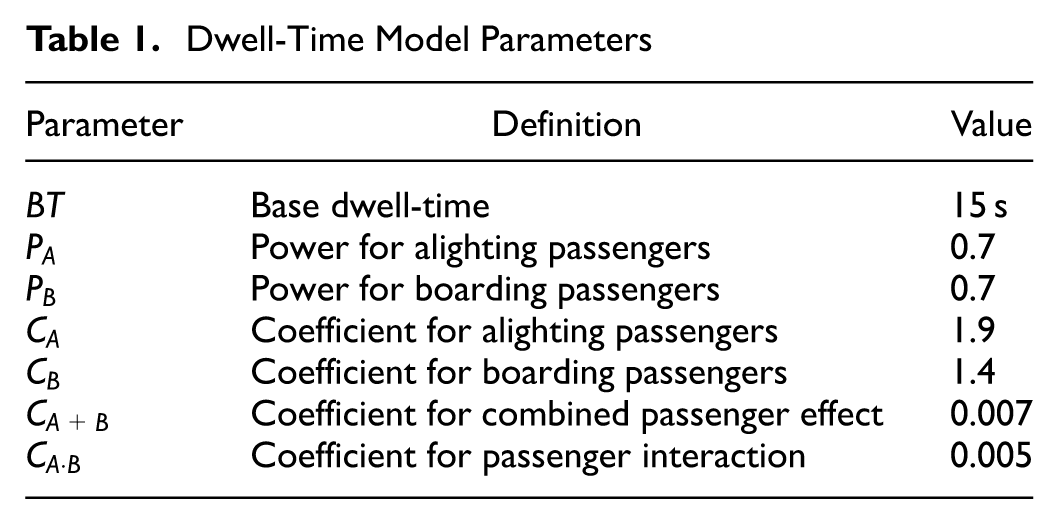
The dwell-time model used in this study is based on Douglas’s work for RailCorp in Sydney, Australia ( 34 ). The model, Equation 1, incorporates boarding, alighting, and standing passengers per door,

This model uses a power function of
The model is validated against the automated vehicle location data from Chicago Transit Authority (CTA) Blue Line. The parameter estimation results in the coefficients listed in Table 1, slightly differ from the original model by Douglas, accounting for differences in the operational environment and passenger behavior between Sydney and Chicago, IL ( 34 ).
Dwell-Time Model Parameters
Headway Management Strategies
This section presents several headway management strategies. Each strategy represents a different approach to train holding decisions, ranging from baseline operations to load-balancing techniques. We formulate these strategies for a general station,
No Holding
The baseline scenario operates without any headway management intervention. Trains depart immediately on completing passenger boarding and alighting operations, with dwell times determined solely by passenger flow dynamics. The train movements respect the infrastructure and signaling constraints. This strategy serves as the base case for evaluating the effectiveness of active management approaches.
Headway Equalizing
This strategy implements systematic holding (if needed) for all trains aimed at headway equalization. For any train,

Similarly, let

The optimal target headway,

The holding decision for train
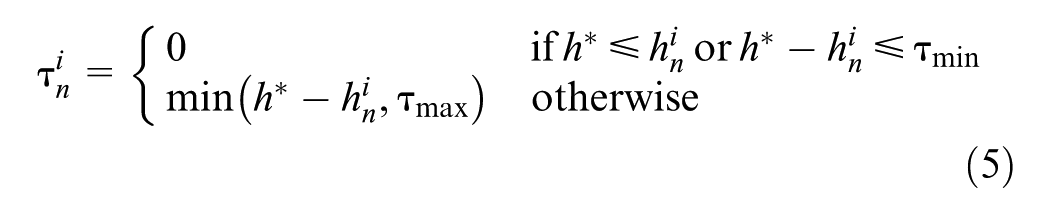
where
Load Equalizing
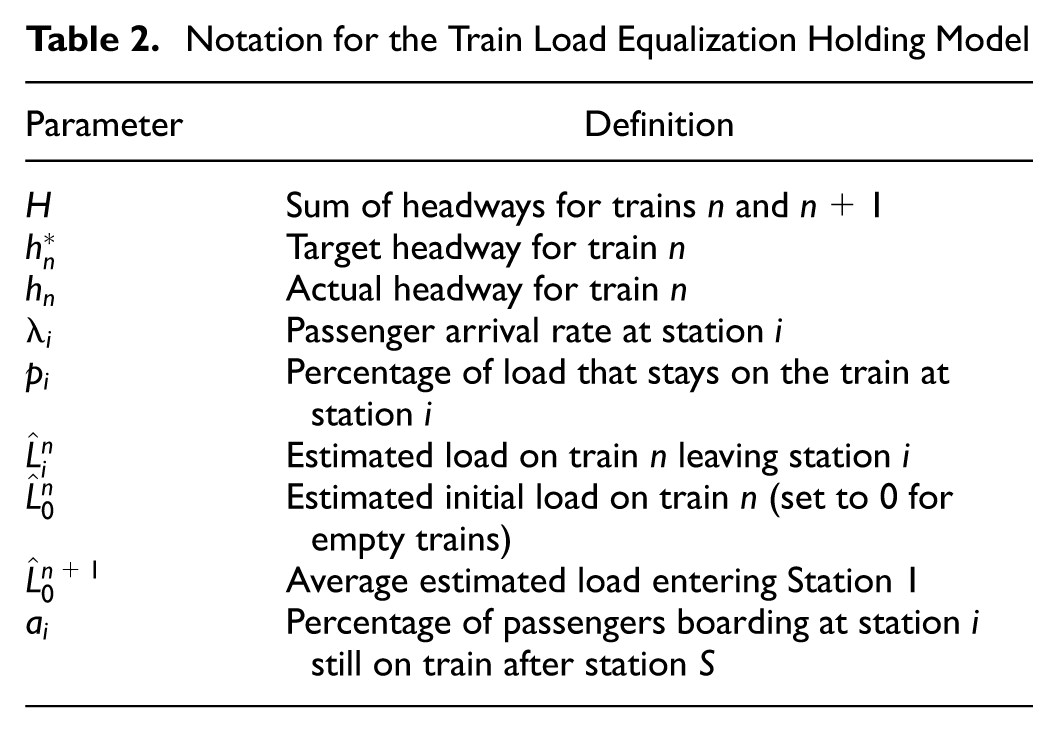
This strategy extends beyond headway management to explicitly consider passenger distribution across trains. The holding decision incorporates estimated passenger loads to achieve more balanced crowding levels across consecutive trips. We use the notations defined in Table 2 and illustrated in Figure 1 to formulate the load equalizing strategy problem. It is important to note that the time dependency of the variables has not been explicitly shown in this formulation for simplicity. However, we incorporated the dynamic nature of these parameters in the simulation model.
Notation for the Train Load Equalization Holding Model
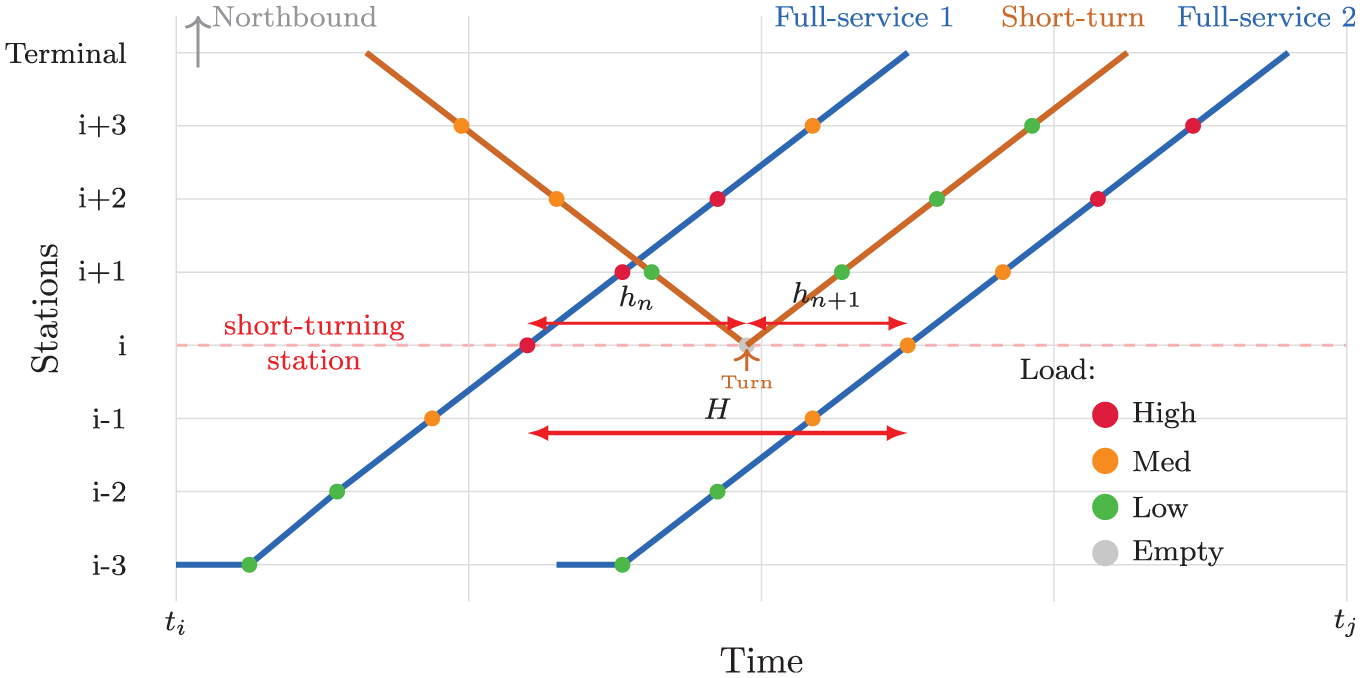
Train load equalization with short-turning operations. Full-service trains (blue) traverse the entire line whereas the short-turning train (orange) reverses direction at short-turning station,
We assume that the headways
To accurately estimate passenger loads across the network, we model the proportion of passengers that remain on board as trains traverse multiple stations. Let

where

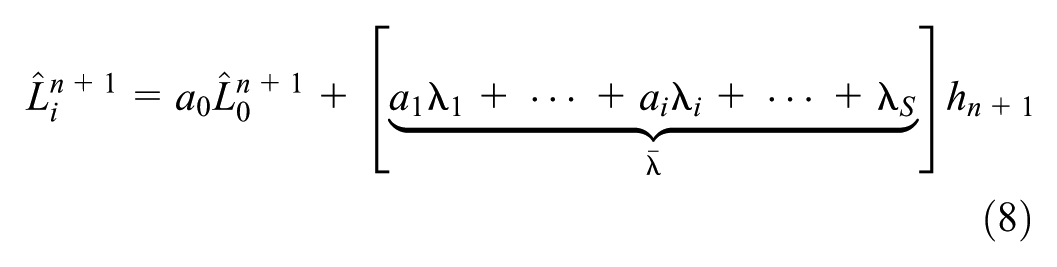
where

For load balancing between consecutive trains, we set


where


The target headway,
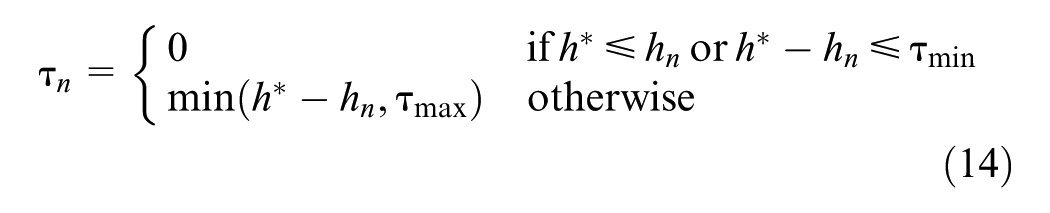
where
Predictive Control Strategy
The PC strategy transforms traditional reactive holding approaches by anticipating future system states and implementing preemptive control actions. Unlike conventional strategies that respond to current conditions, this approach simulates future train movements to optimize headway distributions at critical stations, such as the short-turning station where service patterns create natural discontinuities in flow.
Figure 2 illustrates the mechanism of the PC strategy through a time–space diagram representation. The visualization demonstrates how the system leverages parallel simulation to anticipate future train interactions at the critical station. In the main simulation timeline, trains operate normally until a decision point at time
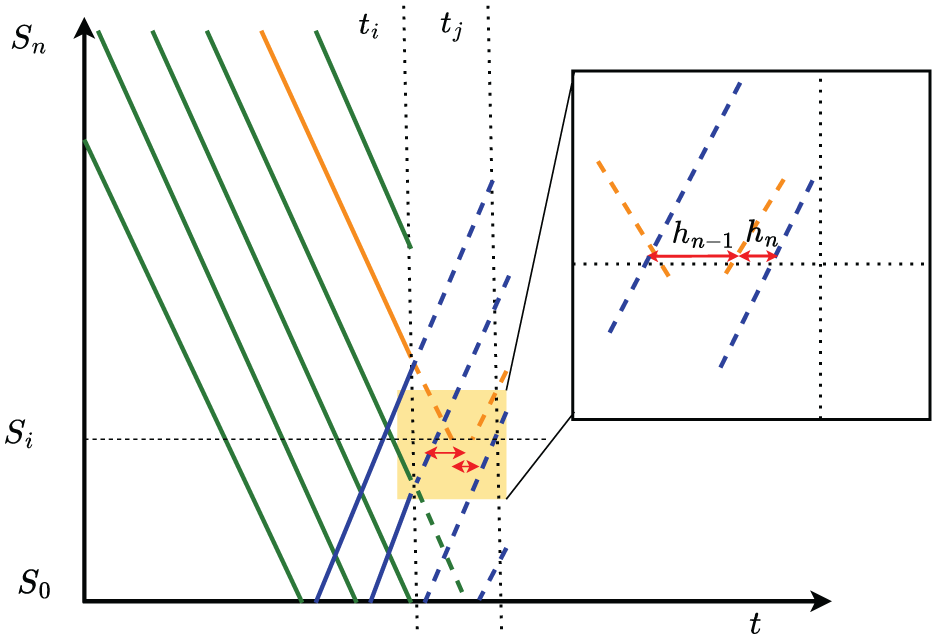
Predictive control strategy visualization showing the parallel simulation framework. The main simulation (solid lines) shows northbound full-service trains (blue), southbound full-service trains (green), and short-turning trains (orange) up to current time,
When a full-service train,

Similarly, the headway between train

The predictive target headway,

where
On completing the predictive simulation, the subsimulation instance is terminated, and the system returns to the main simulation with the predicted target headway. The holding time at terminal
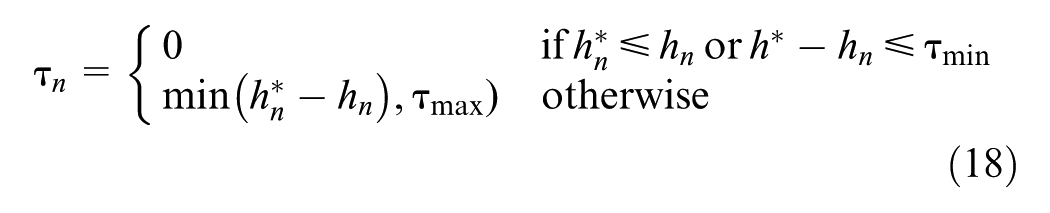
where
Performance Metrics
To evaluate the effectiveness of various holding strategies and PC systems, we employed three key performance metrics: average double headway, denied boarding percentage, and wait times. These metrics capture both service reliability and passenger experience dimensions.
Average Double Headway
The average double headway quantifies service irregularity by measuring the frequency of headways that significantly exceed scheduled intervals. We define a “double headway” event as any instance in which the actual headway equals or exceeds twice the scheduled headway at a given station and time.
Let

A double headway event occurs when

where
Nied Boarding
Denied boarding quantifies the passenger-level impact of crowding and irregular service. This metric represents the percentage of passengers unable to board relative to those who successfully boarded, averaged across all simulation replications.
Wait Times
The passenger waiting time captures the total time elapsed between a passenger’s arrival at the platform and their successful boarding onto a train. For passengers who board on their first attempt, waiting time is calculated as the difference between boarding time and arrival time at the origin station. However, for passengers experiencing denied boarding events owing to capacity constraints, the metric accumulates additional waiting time for each unsuccessful boarding attempt. For transfer passengers who must alight and reboard as part of their journey, the waiting time accounts for both the initial wait at the origin and any subsequent waiting during transfers.
Case Study
The CTA Blue Line provides the background for the case study. Spanning 26.93 mi (43.34 km) with 33 stations, the Blue Line is one of Chicago’s busiest rapid transit lines, connecting O’Hare International Airport to the downtown Loop and extending to the western suburbs. The line operates 24 h a day, 7 days a week, with trains running every 3 to 7 min during peak hours and every 10 to 15 min during off-peak times. This frequent service is crucial for managing the line’s high ridership, which averaged over 186,000 weekday passengers in 2019. The Blue Line’s diverse riders, including airport travelers, daily commuters, and off-peak users, present unique challenges for maintaining service reliability and managing passenger loads.
The Blue Line’s operational environment provides an excellent context for testing advanced train holding strategies and load equalization techniques. Its long route, including underground and elevated sections, exposes trains to factors that affect service regularity, such as weather conditions, signal delays, and fluctuating dwell times at busy stations. These characteristics make the CTA Blue Line an ideal testbed for evaluating the effectiveness of dynamic train holding approaches in improving service reliability, reducing passenger crowding, and enhancing overall system performance in a high-demand urban rail transit setting.
The load profile of the line throughout an average weekday at peak hour and on the peak direction based on passenger demand data for the time periods of Winter 2023 and Spring 2024 can be found in Figure 3. For simulation results, we use the passenger flow based on Automated Fare Collection (AFC) data from April 7, 2024, until June 7, 2024. We studied both the current demand and a scenario with a 30% uniform increase applied to the passenger flow to simulate more severe cases of crowding and evaluate the train holding strategies.
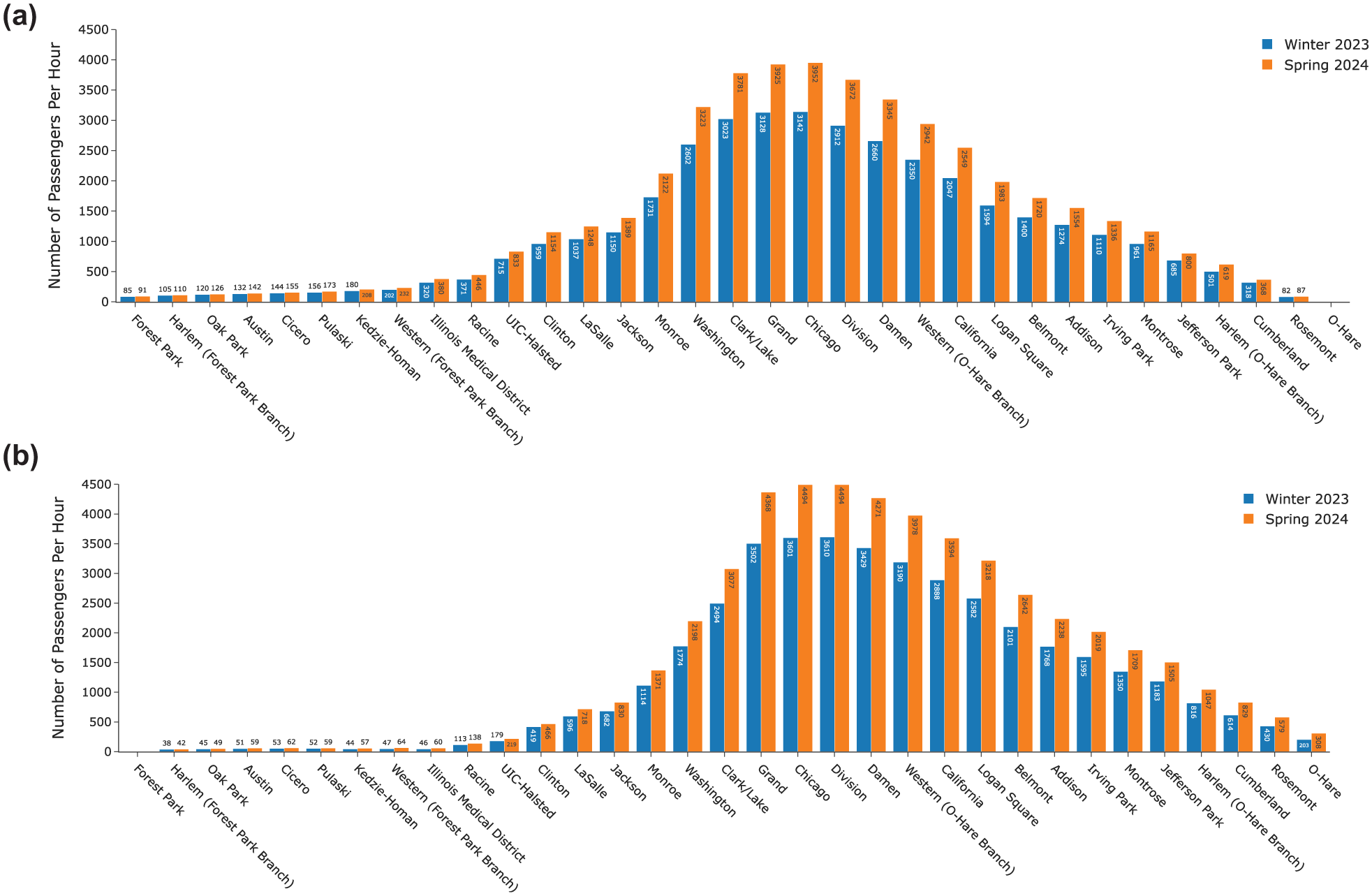
Load profile of the Chicago Transit Authority’s Blue Line: (a) average load flow for 16:00 to 17:00, northbound; and (b) average load flow for 7:00 to 8:00, southbound.
The load profile of the CTA Blue Line exhibits significant variation across different stations, with those closer to the downtown Loop (Dearborn subway) and on the O’Hare branch experiencing higher passenger volumes, as illustrated in Figure 3. This uneven distribution of passenger load, coupled with slow zones imposed on the Forest Park branch owing to track conditions, led to implementing a strategic schedule for the CTA Blue Line in Spring 2024.
During off-peak hours, the schedule follows an alternating pattern of full-service and short-turns at the UIC-Halsted station. Trains arriving from O’Hare are short-turned at the Morgan Middle pocket track to optimize capacity distribution across the network. For peak periods, the schedule is as follows:
AM Peak (6:30 to 8:30):
O’Hare branch: 5-min headways, with every fourth train short-turned
Forest Park branch: 7-min headways
PM peak (15:00 to 18:00):
O’Hare branch: 5-min headways with short-turned trains
Forest Park branch: 5-/5-/10-min headway pattern
The regular service on CTA Blue Line includes two additional gap trains from Pink Line serving the line at 7:00 and 17:00. These gap trains help alleviate passenger crowding during peak hours.
This short-turning strategy aims to redistribute capacity from the heavily loaded downtown portion to the less congested Forest Park branch. To mitigate operational challenges, the number of short-turned trains is minimized during peak periods.
Figure 4 shows the headway ratio, defined as the ratio of forward headway to the backward headway for trains short-turned at UIC-Halsted and departing the UIC-Halsted Northbound platform to serve the O’Hare branch. It can be seen that the headway ratios vary in a wide range of 0.06 to 4.0. During the PM peak period, 15:00 to 18:00, 30% of trains have a headway ratio less than 0.5, indicating a potential for bunching that has been introduced by the operational complexities of short-turning at UIC-Halsted. This irregularity in headways signals an opportunity to be addressed by real-time headway management to maintain reliable service and minimize passenger crowding.
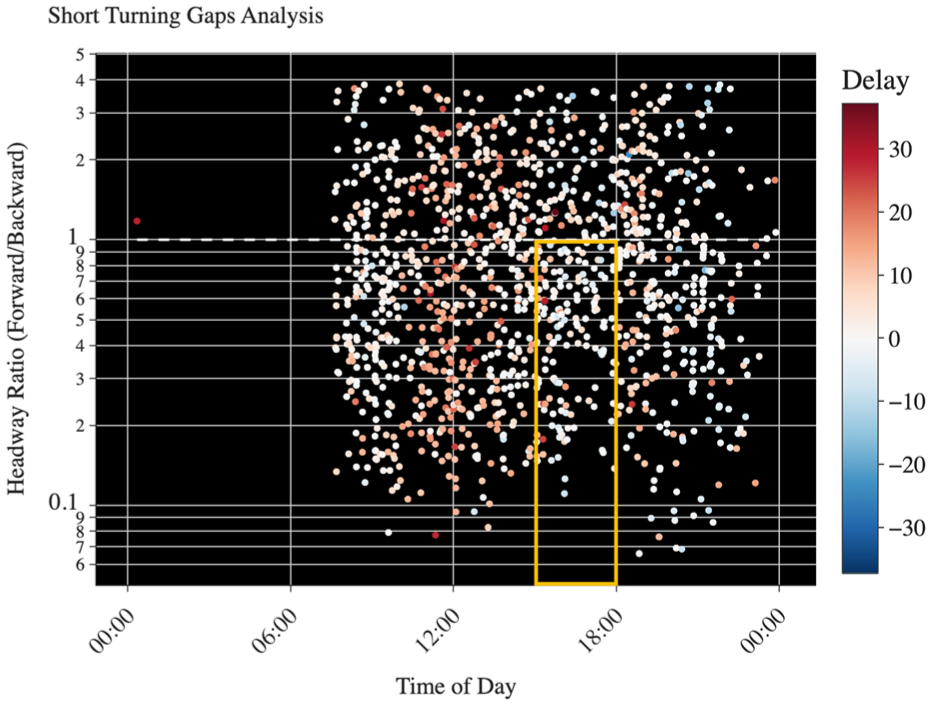
Headway ratio for trains short-turned at UIC-Halsted.
Results
This section presents the key findings from simulation experiments evaluating various train holding strategies on the CTA Blue Line. The results, unless otherwise specified, are aggregated over 100 replications. Holding times were constrained between 60 and 180 s to maintain operational efficiency and minimize passenger inconvenience. Holding times below 60 s were not applied to avoid excessive interventions, whereas a maximum of 180 s was imposed to limit passenger inconvenience. The simulation experiments encompassed the following holding strategies:
No holding: The baseline scenario in which trains operate without any headway management strategy.
Headway equalizing: A strategy for which all trains are subject to holding based on a simple heuristic to equalize headways.
Headway-equalizing short-turn only: Only short-turned trains are held to regulate headways to accommodate equalized headways.
Load equalizing: A strategy to equalize passenger loads across trains using estimated load information.
Load equalizing short-turn only: Load equalization strategy applied only to short-turning trains, using estimated loads.
PC strategy: The predictive strategy applied at the terminal based on projected headways at UIC-Halsted.
Figure 5 shows the trajectories for a sample replication of the “headway equalizing” strategy during the PM peak period (15:30 to 18:00) versus “no holding.” It can be seen that with the “headway equalizing” strategy, the headways were more evenly distributed across the trains compared with the irregular headways under “no holding.” Applying the simple heuristic of holding trains to equalize headways resulted in no cases of denied boarding in this replication of the current demand scenario. In the “no holding” case, there were instances of trains bunching together, leading to overcrowding and denied boarding.
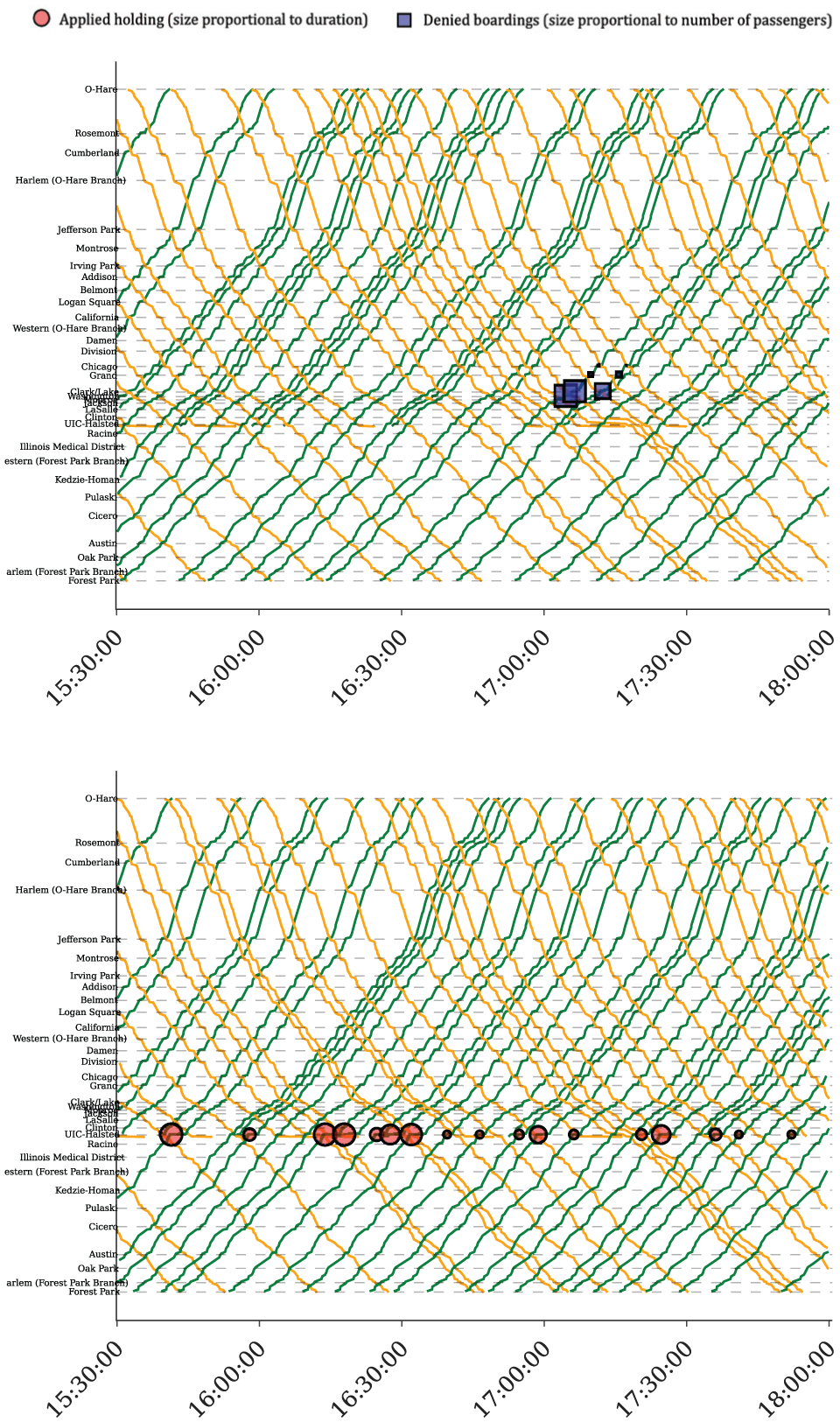
Comparison of no holding (a) and hold equalizing (b) strategies.
Figure 6 compares the average denied boarding as a percentage of passengers boarding at each station during a typical PM peak (15:30 to 18:00). Some 3.67% of passengers were denied boarding at Grand Station under the base demand level and “no holding” scenario. This should be interpreted as a passenger who wants to board the CTA Blue Line train at Grand Station to go northbound on a typical weekday not being able to board the first train that arrives, with a 3.67% chance, because of crowding.
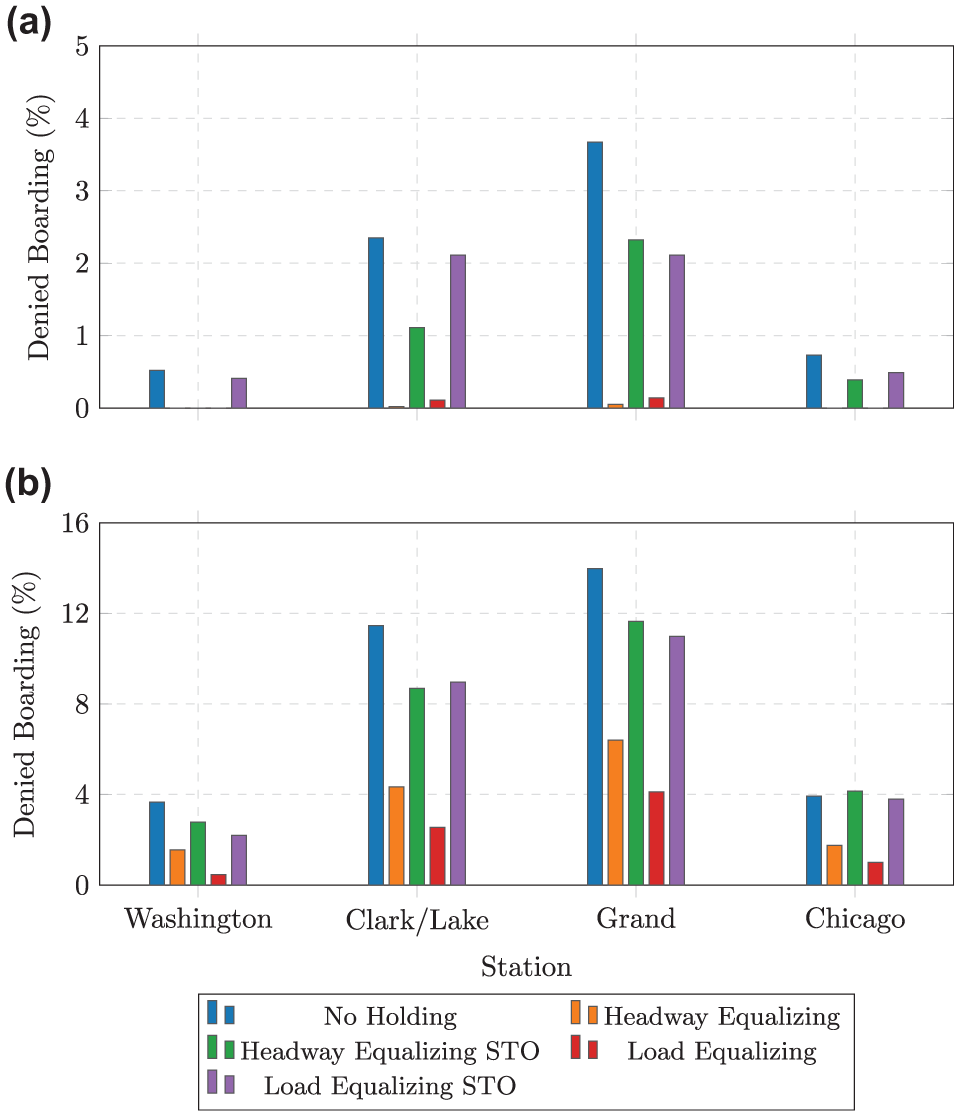
Comparison of denied boarding percentages across different holding strategies at four stations under normal and increased demand scenarios: (a) under normal demand conditions, most holding strategies effectively minimized denied boarding, with headway- and load equalizing strategies achieving near-zero denial rates at Washington and Chicago stations; and (b) finding that under increased demand, load equalizing emerged as the most effective strategy, consistently delivering the lowest denied boarding percentages across all stations.
It can be seen that under a 30% increase in demand, the load equalizing strategy applied to all trains significantly reduced denied boarding by over 30% compared with a holding strategy that attempted to equalize the headways. This is because these load equalizing strategies helped trains better balance their loads, so fewer trains arrived at crowded stations fully loaded.
Under the base demand scenario, the differences between load- and headway-equalizing strategies were smaller and, in most cases, the headway-equalizing strategy performed better. Moreover, under lower demand levels, the system was less congested and load imbalances were less severe, potentially below a level that would have contributed to denied boarding. Equalizing headways alone could still achieve good performance. However, as demand increases, load equalizing strategies become more important to actively hold trains and distribute passengers across trains to avoid overcrowding and denied boarding.
Figures 7 and 8 show the savings in total passenger minutes of waiting time achieved each day by the different holding strategies compared with the “no holding” scenario under the base (1.0) and increased (1.3) demand levels, respectively. It can be seen that the load equalizing strategies applied to all trains reduced the total systemwide waiting times experienced by passengers during the PM peak period as effectively as the strategy that held all trains to equalize headways. Under the higher demand level of 1.3, the load equalizing strategies performed significantly better than the headway-equalizing strategy in reducing waiting times. This is because the load equalizing strategies reduced overcrowding and denied boarding, which are the main contributors to increased waiting times.
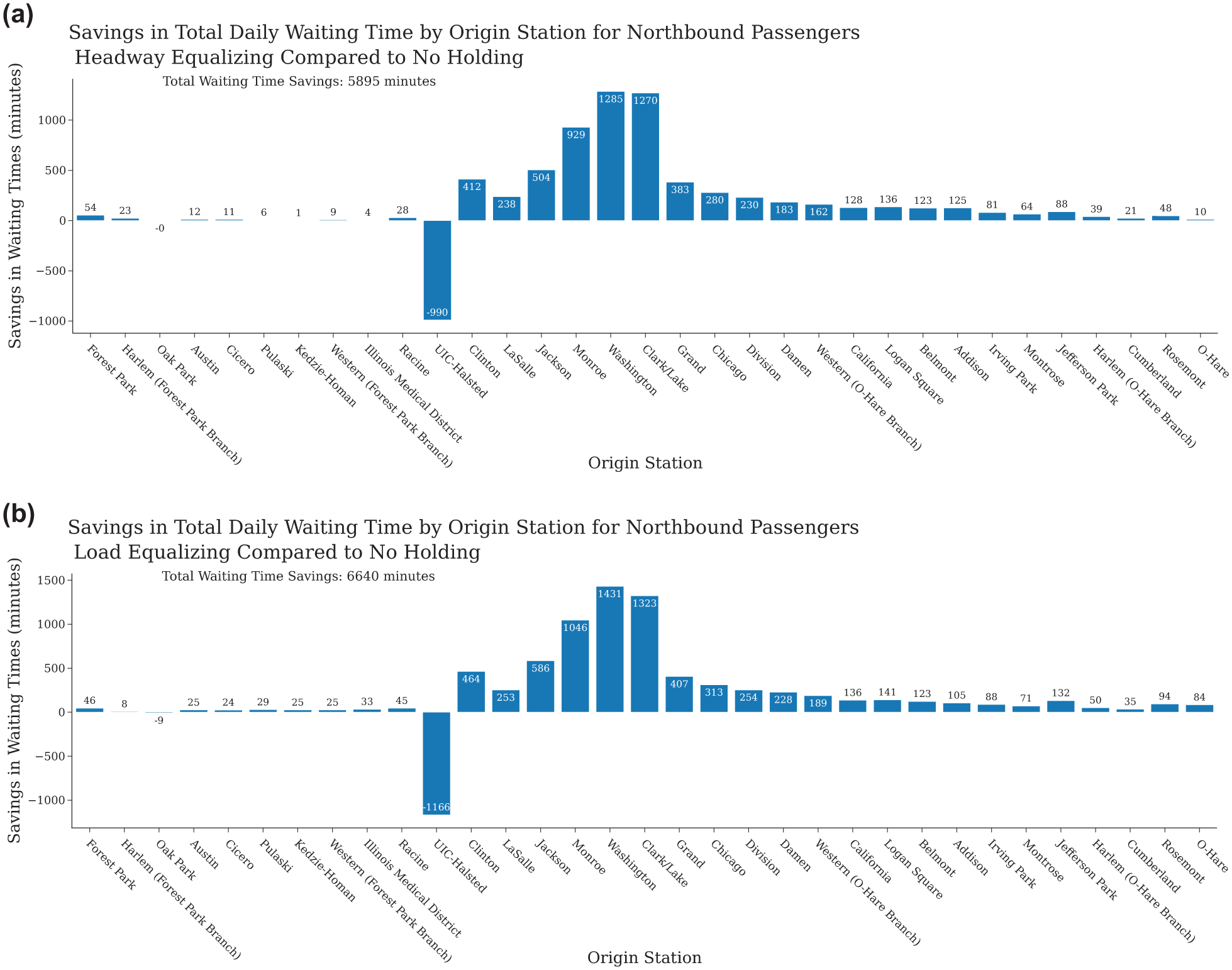
Savings in total daily waiting time for different holding strategies under 1.0 demand level: (a) headway equalizing compared with no holding, and (b) load holding compared with no holding.
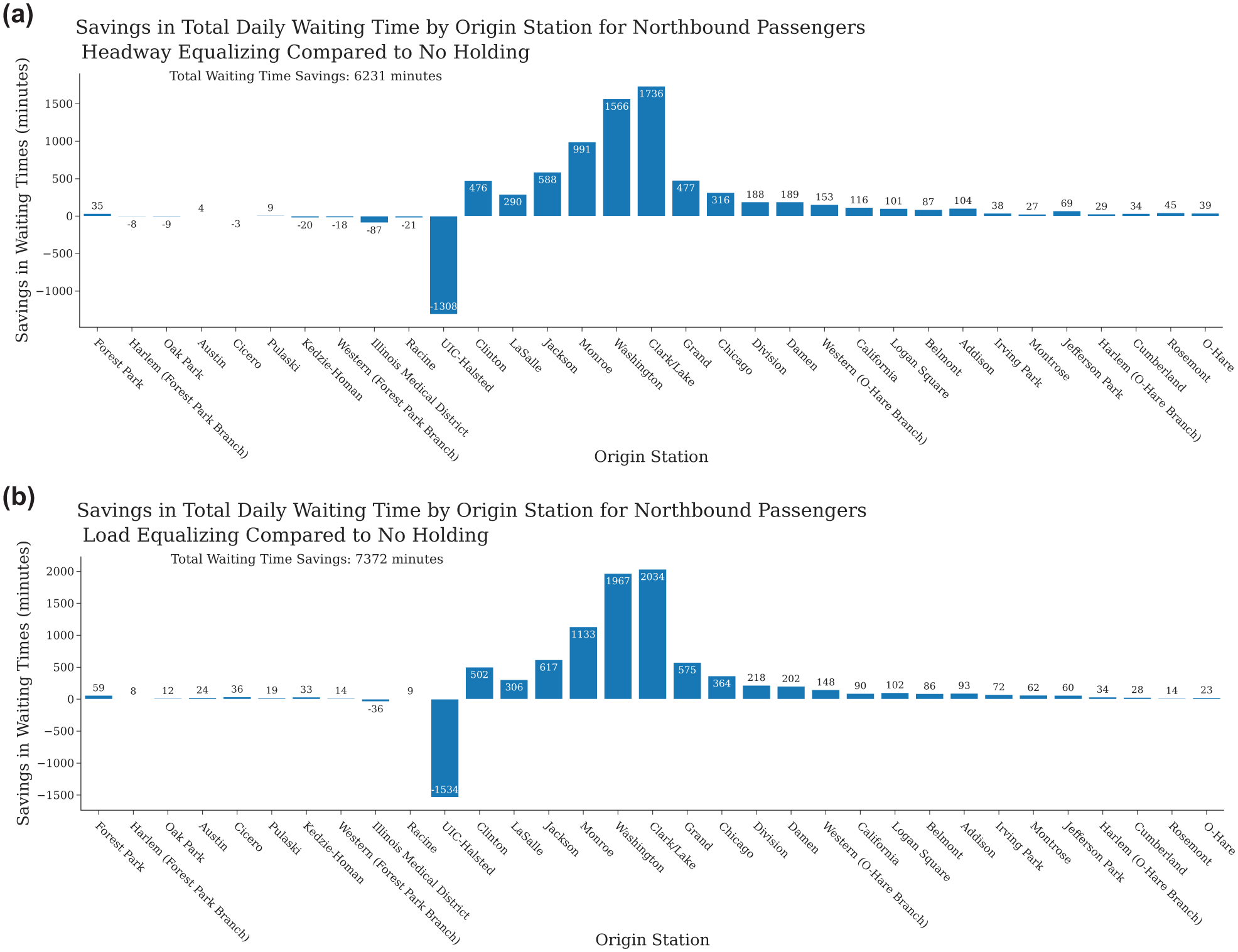
Savings in total daily waiting time for different holding strategies under 1.3 demand level: (a) headway equalizing compared with no holding, and (b) load holding compared with no holding.
To evaluate the impact of PC at the Forest Park terminal, we analyzed its effect on service regularity and passenger denied boarding at the high-demand Grand Station. Table 3 presents key performance metrics, comparing scenarios with and without PC, combined with various downstream holding strategies. The average double headway measures service irregularity by calculating how often trains experience headways that are at least double the scheduled interval at a station.
Performance Comparison of Holding Strategies With and Without Predictive Control at Grand Station during PM Peak Hours (15:30 to 18:00)
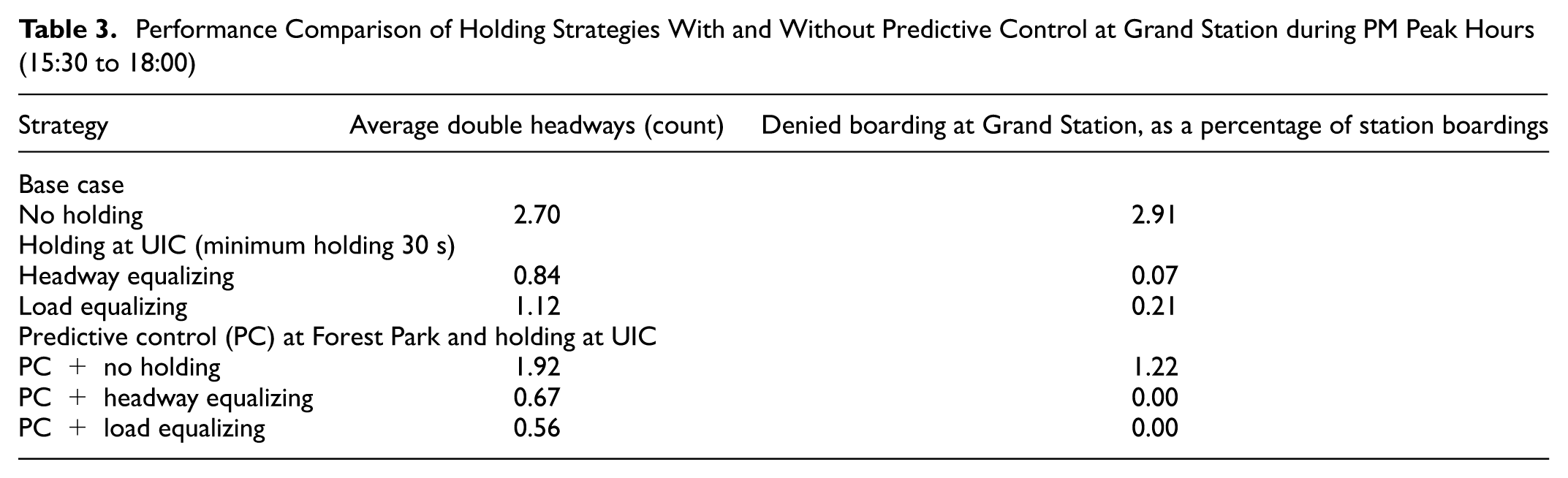
The results demonstrate the benefits of implementing PC. The baseline “no holding” strategy showed 2.7 average double headway events in the PM peak, and a substantial 2.91% of passengers denied boarding at Grand Station.
Introducing PC alone without downstream control reduced the average double headways to 1.92 and denied boarding to 1.22%. However, the best performance was achieved when PC was combined with downstream holding strategies, which eliminated denied boarding at Grand Station.
Figure 9 presents train trajectories under different control strategies during the PM peak period. The no holding strategy exhibits bunching behavior, where trains cluster together, leaving service gaps. This bunching leads to inefficient capacity utilization, where leading trains operate at near capacity whereas following trains may be underloaded. The various strategies maintained similar total train throughput, indicating that holding interventions did not reduce line capacity but rather redistributed service more effectively. The headway- and load-equalizing strategies mitigated bunching effectively in most cases.
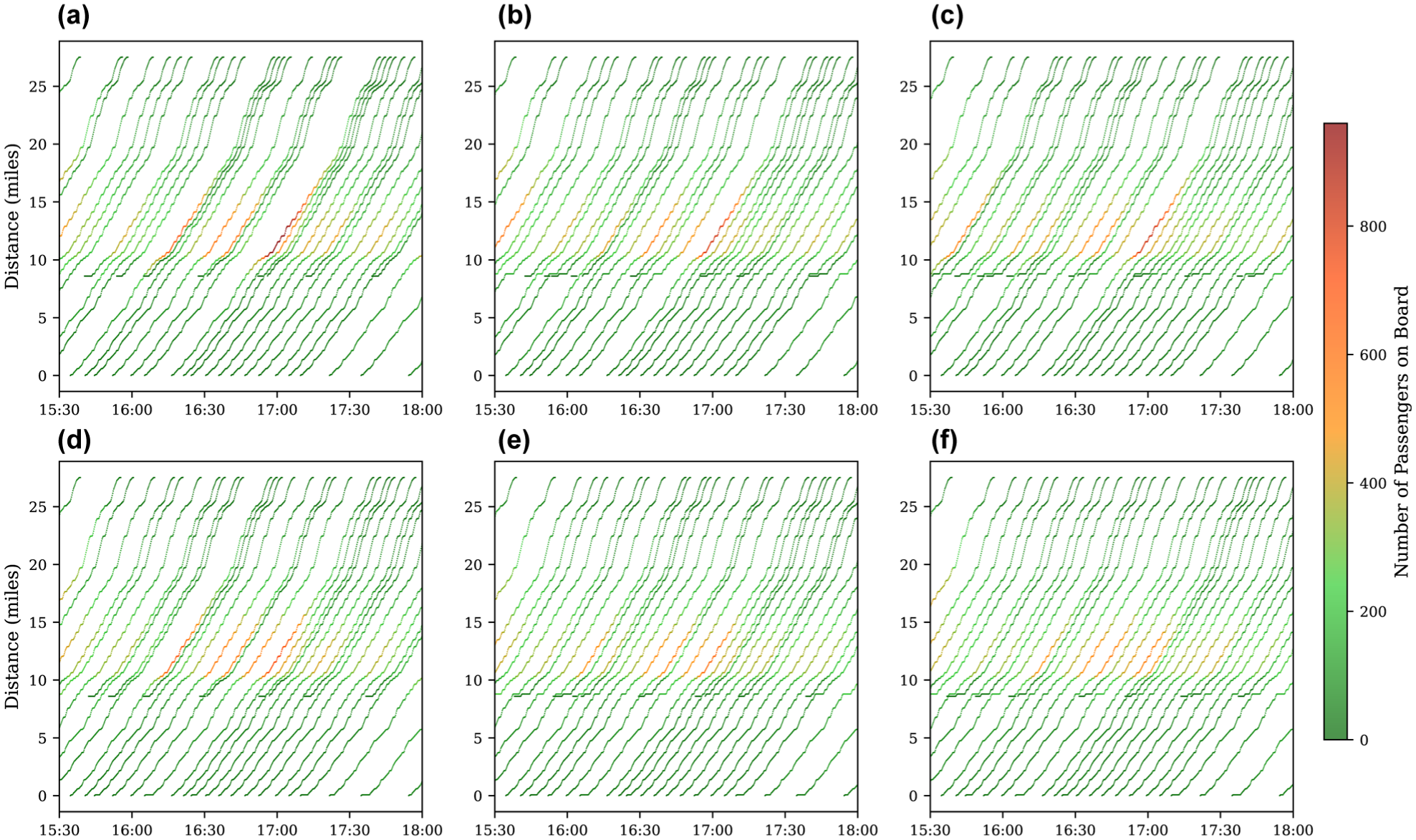
Train trajectories during PM peak hours (15:30 to 18:00) for northbound service under different control strategies: (a) no holding, (b) headway equalizing, (c) load equalizing, (d) PC + no holding, (e) PC + headway equalizing, and (f) PC + load equalizing.
Figure 9, d to f , demonstrate the impact of PC at the Forest Park terminal. In the PC + no holding case, trains were only held at the terminal based on predicted downstream conditions. This strategy held trains with lower passenger loads, minimizing the passenger minutes of delay. The trajectory patterns showed improved spacing compared with the base case; however, some bunching persisted owing to the absence of downstream interventions.
PC + headway equalizing and PC + load equalizing achieved more uniform train spacing. The PC component established favorable initial conditions at Forest Park, whereas downstream holding at UIC-Halsted addressed issues resulting from the short turning at this location.
Discussion
Interpretation of Results
The simulation experiments conducted on the CTA Blue Line demonstrated the effectiveness of the proposed load equalization strategies combined with PC in improving service reliability and passenger comfort. The results showed that by actively holding trains to balance passenger loads, the load equalizing strategies could significantly reduce denied boardings and overcrowding, especially under high-demand scenarios. The introduction of PC at the Forest Park terminal station shifted control from reactive to proactive.
Although partial holding strategies without PC resulted in denied boarding rates of 2% to 3% at key stations, the implementation of PC reduced these rates to 1.2% even without any downstream holding. These results suggest that predictive terminal control alone could address several service issues.
Although load equalizing strategies may result in a higher percentage of held trains and longer average holding times than headway-based strategies, the benefits of reduced denied boardings and improved passenger comfort were evident, particularly for passengers boarding at high-demand stations. The combination of PC with load equalization achieved zero denied boarding rates, demonstrating that upstream regulation created favorable conditions for downstream optimization.
These results underscored the importance of considering passenger load factors alongside traditional metrics such as headway regularity when designing real-time headway management strategies for urban rail transit systems. Even though regular headways ensure minimal wait times systemwide, in the case of a short-turning train, the proposed load equalization methodology, offers a promising approach for operators to strike a balance between maintaining service reliability and enhancing the overall passenger experience, especially in the face of increasing demand and capacity constraints. The simulation results indicated that it was possible to reduced denied boarding while maintaining reasonable holding times.
A critical operational concern with regard to holding strategies is their potential impact on line capacity, particularly during peak hours when maximizing passenger throughput is paramount. Our analysis demonstrated that the strategies did not reduce system capacity but rather redistributed the service more effectively. The total number of train runs, train-kilometers, and passenger-carrying capacity remained similar across all strategies tested. The strategies affected the temporal distribution of these resources: instead of allowing bunching to create alternating overcrowded and underutilized trains, holding managed headways to maintain more uniform passenger distributions. This redistribution was evidenced by the reduction in denied boardings at Grand Station and the passenger wait times.
Comparison with Existing Studies
The findings of this study align with and extend the existing body of research on real-time control strategies for urban rail transit systems. The proposed load equalization methodology builds on the foundation laid by Eberlein et al. ( 1 ) and Xuan et al. ( 2 ), who emphasized the importance of data-driven decision making and dynamic holding strategies for improving service reliability.
The integration of passenger load factors into the optimization process, as demonstrated in our study, resonates with the work of Huang et al. ( 3 ) and Tao and Tang ( 7 ), who highlighted the need for considering both operational efficiency and passenger satisfaction in urban rail transit management. Our results provide further evidence of the benefits of incorporating real-time passenger flow information into control strategies, as these studies advocate.
The simulation-based approach employed in this research complements the optimization-based methods that dominate the current literature, as discussed in Koutsopoulos and Wang ( 14 ). By testing the proposed load equalization strategies under realistic operational conditions using the TransitLab SimMETRO model, we have demonstrated the practical applicability of these techniques and their potential for improving system performance.
Furthermore, our findings on the impact of short-turning strategies on service regularity and passenger comfort align with the work of Yin et al. ( 10 ) and Yuan et al. ( 11 ), who explored the challenges and opportunities associated with short-turning in urban rail transit systems. The results of our study contribute to the growing body of evidence supporting the need for advanced, adaptive, and passenger-centric control strategies in these complex operational environments.
Overall, this research advances state-of-the-art urban rail transit headway management strategies by integrating load equalization techniques with traditional holding strategies and demonstrating their effectiveness through simulation experiments. The findings underscore the importance of considering operational efficiency and passenger experience in designing and implementing real-time control strategies, as highlighted by the systematic review of Awad et al. ( 30 ). By comparing our results with existing studies, we situate this work within the broader context of urban rail transit research and identify promising avenues for future investigation.
Practical Implications
The findings of this study have significant practical implications for transit operators and planners seeking to improve service reliability and passenger comfort in urban rail transit systems. The proposed load equalization methodology offers a promising approach for managing high-demand, high-frequency rail lines, such as the CTA Blue Line, which face challenges related to overcrowding, denied boardings, and uneven passenger distribution. This research examines the assumptions of a regular headway for transit and its implications for short-turning trains on system performance. It provides a compelling case for transit agencies to invest in the development and implementation of advanced, passenger-centric control strategies. The results suggest that operators could substantially improve system performance even with limited real-time passenger information by actively managing train holding times to balance passenger loads while considering the dynamic interplay between headways, current train loads, and passenger arrival patterns.
Limitations
A fundamental assumption in this study is the use of constant headways at the prior station, which are assumed to be equal to the value when the holding decision is made. This approach represents a practical situation in which rail supervisors only have access to displays showing current snapshots of headways. However, it is essential to acknowledge that this simplification may only capture part of the full complexity of real-world operations.
More sophisticated systems can record and utilize the observed headways in estimation, potentially leading to more accurate suggestions for holding times and load equalization. Historical headway data or real-time tracking of headway evolution could provide a more nuanced understanding of service irregularities and their impacts on passenger loads.
This limitation highlights an opportunity for future research to explore the integration of more comprehensive headway data into the load equalization methodology. By incorporating dynamic headway information, the model could improve service reliability and passenger comfort, especially in scenarios with highly variable headways or frequent disruptions.
Conclusions
This research has yielded several key findings on headway management for urban rail transit systems, with particular emphasis on the integration of PC strategies. The traditional headway-equalizing approach of holding trains at prior stations results in minimal wait times systemwide when operating at designed capacity. However, during periods of high demand or service disruptions, this approach needs to be revised for managing overcrowding and may not even ensure minimal wait times, as passengers who cannot board experience double wait times. Our experiments demonstrated that PC at terminal stations fundamentally changed this dynamic, reducing denied boarding by about 3% under no control to below 1.2% even without downstream interventions, and achieving significantly reduced denied boarding when combined with downstream holding strategies.
Short-turning routing, when implemented strategically, can effectively help distribute the existing capacity appropriate to the demand; however, to best utilize this additional capacity, real-time headway management strategies are needed to consider overcrowding and uneven passenger distribution. The implementation of load equalization strategies specifically for short-turning trains showed improvements when combined with PC.
PC created favorable initial conditions that amplified the effectiveness of downstream strategies. These results validated the premise that proactive intervention at system origins, combined with reactive adjustments throughout the network, can achieve better capacity utilization.
Balancing operational efficiency with passenger comfort is essential for sustainable urban rail systems. Our findings demonstrated that this balance is achievable through integrated control strategies that consider both headway regularity and passenger load distribution. Future research should explore multiobjective optimization approaches and integrated metrics to capture this trade-off. A particularly promising direction involves replacing simulation-based PC with well-trained machine learning models that can anticipate future system states and optimize the complex interactions between full-length services and short-turning trains. Such models could learn from historical patterns to predict potential bunching scenarios and optimal intervention points, potentially achieving better performance. Future work could apply this framework to systemwide optimization by identifying bottleneck stations that may vary between morning and afternoon peaks and adjust control strategies accordingly.
Footnotes
Acknowledgements
The authors would like to express their gratitude to various departments and personnel at the Chicago Transit Authority, including, but not limited to, scheduling, service planning, operations, engineering, and IT, for their valuable input and collaboration. Furthermore, the authors extend their appreciation to members of the MIT Transit Lab for their constructive feedback on the research direction and presentation.
Author Contributions
The authors confirm contribution to the paper as follows: study conception and design: M. Yousefi, H. N. Koutsopoulos, M. Usama; data collection: M. Yousefi; analysis and interpretation of results: M. Yousefi, M. Usama, H. N. Koutsopoulos; draft manuscript preparation: M. Yousefi, M. Usama, H. N. Koutsopoulos. All authors reviewed the results and approved the final version of the manuscript.
Declaration of Conflicting Interests
The authors declared the following potential conflicts of interest with respect to the research, authorship, and/or publication of this article: Mojtaba Yousefi, Muhammad Usama, and Haris N. Koutsopoulos received Funding from the Chicago Transit Authority, the case study in this research.
Funding
The authors disclosed receipt of the following financial support for the research, authorship, and/or publication of this article: Funding for this research was provided by the Chicago Transit Authority through their Academic Research Partnership with the MIT Transit Lab.

Although Mojtaba Yousefi, Muhammad Usama, and Haris N. Koutsopoulos received funding from the Chicago Transit Authority, the research was conducted independently, and Chicago Transit Authority had no role in the study design, data collection and analysis, decision to publish, or preparation of the manuscript.