



Abstract
With the growth of attention to equity in transportation, there is a need to understand differing definitions of transportation equity and what constitutes impactful equity work. This report examines definitions and assesses equity work within transportation in California. We do this by analyzing the expert perspectives of 28 transportation professionals who also identify as Black or people of color. Interviews were transcribed and coded for major themes. Results indicated that there is tension around what constitutes meaningful transportation equity work. Key findings centered around a distinction between “performative” equity work and “authentic” equity work. Performative equity work privileges the comfort and perspective of dominant groups, reinforces the status quo, stays in the realm of the rhetoric, and often results in superficial changes only. Authentic equity work centers the experience of Black people and people of color, embraces discomfort, transforms dominant culture, and results in measurable changes to the lives of those historically oppressed. Key recommendations include supporting action-oriented equity work, especially around resource allocation and redistribution of decision-making power to communities. The paper includes visions for more equitable transportation futures.
Keywords
This study examined the definition and status of transportation equity work in California by seeking the expert perspectives of transportation professionals who also identify as Black, Indigenous, or people of color. This study contributes to the growing awareness of the difference between performative and authentic equity work ( 1 – 8 ). Performative equity work refers to actions, words, or gestures that claim to do equity work, but in practice do not improve matters for those historically oppressed, and in turn, reinforces root systems of dominance and the status quo. Authentic equity work results in meaningful change for those most affected by historical racism and oppression. The practice of authentic equitable planning and policy development requires commitment to a long process of individual, interpersonal, cultural, and organizational reframing. Valuing transportation equity requires considering culture and history when building new infrastructure or integrating new mobility technologies. It also fosters dignity and humanizes mobility users, and asks agencies to consider how they can atone for past harms done by their institution and profession.
Several transportation agencies have stated that equity is a value of theirs. Values can act as the guiding force for agencies; it is therefore necessary to understand the precise definition of stated values and evaluate whether actions match the stated values. At the federal level, the United States Department of Transportation (U.S. DOT) released an Equity Action Plan, highlighting the work that U.S. DOT “will undertake across four focus areas—wealth creation, power of community, interventions, and expanding access—to expand access and opportunity to all communities while focusing on underserved, overburdened, and disadvantaged communities” ( 9 ). In addition to the Equity Action Plan, the federal government has identified policy initiatives such as Justice40, the Tribal Consultation Plan, the Reconnecting Communities Pilot Program, Rural Opportunities to Use Transportation for Economic Success, and Disability Policy Priorities. Furthermore, U.S. DOT is establishing an Advisory Committee on Transportation Equity under the Federal Advisory Committee Act. Within California, the California State Transportation Agency, the California Department of Transportation (Caltrans), and the California Transportation Commission are actively engaged in improving equity outcomes in transportation equity including the formation of an interagency Equity Advisory Committee. The Committee is intended to elevate diverse and historically marginalized voices to advise California state transportation agencies on how to achieve meaningful outcomes in transportation equity, environmental justice, and equitable economic opportunities, especially as related to transportation planning and programming ( 10 ). As federal and state transportation agencies continue to incorporate equity principles into emerging policies and programs, commitment to transformational practices including training, funding for programs, and recruitment and retention will ultimately guide transportation agencies into a future of true commitment to equitable outcomes.
The goal of this study was to provide the transportation field with a deeper understanding of the transportation equity work necessary for the proper creation and allocation of resources, action, and policies. There is a growing body of research on measuring efforts to bring about greater equity in transportation systems. Much of this work centers on the creation of equity metrics and what constitutes appropriate measures ( 11 – 14 ). This qualitative study offers valuable insights into how to improve these measures. Thus, one objective was to provide “thick data” on how to define transportation equity and assess its efficacy ( 15 ). Qualitative interview-based studies can provide the depth of understanding needed to refine metrics meant to measure improvements in equity. A second objective was to understand the relationship between inclusion in transportation professional spaces and transportation equity.
This study draws on research in ethnic studies, environmental justice, mobility justice, and related interdisciplinary fields as well as research on transportation equity in transportation studies. The aforementioned fields have much to offer the analysis of equity, as these fields have concerned themselves with questions of equity for decades. Although there is a growing literature on transportation equity, most of this addresses the uneven distribution of costs and benefits within transportation systems ( 16 , 17 ). This includes attempts to measure transportation equity, with a strong emphasis on accessibility in several studies ( 12 , 18–20). There is also a growing literature on community engagement as a key aspect of transportation equity ( 21 , 22 ) as well as place-based studies on the equitable impacts of new mobilities and new infrastructures ( 23 – 26 ). What is less studied is the role of equity in professional spaces within transportation. If the work environment for transportation professionals is not equitable, can we reasonably expect policies and practices coming from agencies to be fully equitable? If the workforce does not reflect the communities served, then agencies are limited in how well they can do equity work. And if professionals from historically marginalized communities do not feel that their voices are heard and valued, then the potential of equity work remains limited. If the values of the professionals implementing the work do not support equity work, then the results tend to show this ( 27 ). Thus, this project took a deep dive into equity, both within the transportation professional space and in transportation policy and practices, as the two are inextricably linked.
This study was also in dialogue with researcher and practitioner work on mobility justice. On the practitioner side, we look to the framework of mobility justice forwarded by the Untokening Collective and articulated in the Principles of Mobility Justice ( 28 ). According to their work, mobility justice envisions a world where Black communities, communities of color, people with disabilities, immigrants, trans people, queer people, women, and youth can move freely and without fear of violence. In the workplace, mobility justice strives for working environments where professionals can contribute from their full knowledge and experience without fear of retribution. In communities, mobility justice visions that longtime residents can afford to stay in place as their community receives long-overdue infrastructural improvements, and that communities are equal partners in creating infrastructural changes. Mobility justice research takes a broader systemic and international approach, linking transportation to other areas of injustice ( 29 – 39 ). Key texts in mobility justice challenge researchers to expand their definition of safety and transportation to include other systems that limit people’s mobility, including economic hardship, policing, state-sanctioned borders and violence, and harassment ( 29 , 33 , 37 , 40 , 41 ).
This study also draws insights from academic work on environmental justice, transportation equity, and transportation justice ( 42 ). Karner and Marcantonio provide a solid analysis of transportation equity and how attention to environmental justice can benefit planning. They conclude that transportation justice can push the field to think about the role of transportation in bringing about needed social change ( 21 ). This work is further demonstrated through specific studies on the disproportionate impact of inequity on communities of color ( 29 , 43 , 44 ). Environmental justice is both a field of study and an active practice of activists to address historical injustices that have subjected marginalized communities to environmental harm ( 45 ). These harms include poor air quality, an overpresence of environmental toxins, lack of access to green space, poor access to clean water, and an overall absence of access to a healthy environment ( 46 – 54 ). All these factors contribute to health inequities ( 55 – 62 ). Transportation systems play a major role in environmental injustice in the form of transportation emissions, oil and gas exposure, extraction of rare minerals such as lithium, highway placement, and placement of transit infrastructure ( 63 – 69 ). Additional related fields that this study draws on are the fields of disability justice and design justice ( 70 , 71 ), which highlight the importance of attending to how design processes and systems unequally distribute risks, harms, and benefits, and call for more participatory processes in decision-making that integrate community-based traditions, knowledges, and practices ( 71 ).
Methods
This study utilized purposive expert sampling to identify research participants. Purposive sampling relies on utilization of assumptions on the part of the researchers so that they can gain access to a specific population ( 72 – 74 ). In this case, the specific population was experts in transportation and equity. This study presumes that the life experiences of being Black, Indigenous, or a person of color (BIPOC) combined with expertise as transportation professionals gives them a unique and highly valuable lens through which to assess what aspects of equity work are most impactful and where shortcomings exist. This theory draws on a long and rich history of ethnic studies that describes a “double vision” that is necessary to survive living in oppressive social conditions resulting from racism and sexism ( 75 , 76 ). When one’s life experience challenges traditional assumptions, particularly when those experiences arise from knowing firsthand the impacts of bias and oppression, a person can become more attuned to their operation in others and oneself. Thus, the target population for sampling was transportation professionals who also identify as BIPOC and/or work primarily with BIPOC communities. A call for participation in research went out to listservs of transportation planning professional networks including through Caltrans, American Professional Planning Association (California Chapter), Young Planners in Transportation, American Society of Landscape Architects (Transportation Division), Women in Transportation, and the Urban Land Institute. We also issued invitations to transportation professionals with whom the authors had conducted past research or had met in professional settings (conferences, workshops, etc.) ( 22 , 28 , 77 , 78 ). This purposive expert sampling was complemented by snowball sampling in the form of referrals from those we interviewed. Interviews were conducted in two rounds.
After the first round, we evaluated participants for diversity in relation to gender, race/ethnicity, employer type (grassroots, business, nonprofit, local government, state agency), region of state represented, and career stage. To balance the sampling, we targeted professionals with the following characteristics in the second round: late career, working in the Central Valley or Northern California, Indigenous or from tribal nations, and male-identified. We were successful in recruiting additional participants with these characteristics, except for Indigenous people. Efforts were made to contact tribal transportation professionals, but these were unsuccessful. Because of this, in subsequent sections, we utilize the term BPOC (Black and people of color) rather than BIPOC (Black, Indigenous, and people of color) in recognition of the limitation of this study, not to exclude Indigenous people and those from tribal nations. Although the results may also apply to those affiliated with tribal nations or who identify as Indigenous, this is best determined by professionals from those communities.
In total, we interviewed 28 transportation professionals, at which point data saturation was reached ( 79 ). In the initial screening questions, all participants were asked whether they were over 18, whether they worked in the field of transportation, and whether any of the following applied to them: (1) identified as BIPOC, (2) worked primarily with BIPOC communities, or (3) worked in transportation equity. If they answered yes to at least one of these criteria, then they were eligible for the study. After this initial screening, participants took part in a 1- to 1.5-h interview. All participants were asked demographic questions, followed by questions on their professional trajectory and involvement in sustainable transportation. They were asked about how they defined equity, their involvement in diversity, equity, and inclusion (DEI) initiatives, the communities they served, and who their major stakeholders were. They were then asked a set of questions on new mobilities, the ability of new technologies to address equity issues, and current research needs related to DEI in transportation. Participants were asked for examples of successful and unsuccessful equity projects, in addition to how well they felt DEI work was integrated into sustainable transportation. Our final question was about their vision for equitable transportation. (See Appendix 1 for original interview guide.)
Recruitment and interviews occurred between April and August 2020. This was during a period of major change because of the onset of the COVID-19 pandemic and nationwide uprisings sparked by the murder of George Floyd. Both had major impacts on transportation and brought attention to the legacy of systemic inequity and injustice. Thus, we added additional questions asking how their work has shifted in response to both major events. We also asked how these events changed the status of or reception to equity work in transportation and whether these events had affected their vision for what feels possible in transportation equity (see Appendix 2 for revised interview guide). The interviews were all conducted via Zoom, recorded, and transcribed.
The lead author took part in the Untokening Collective and was a coauthor on the Principles for Mobility Justice ( 28 , 80 ). The second author has worked in transportation equity as a professional of color. The authors’ previous experience contributed to a strong response rate, rapid development of a good rapport during interviewing, and the creation of trust between interviewer and interviewee. Transcriptions were originally coded for themes aligned with the interview questions (see Appendix 3 for original codes). After coding half the interviews, codes were refined with additional codes based on emerging themes (see Appendix 4 for revised codes). The remaining interviews were coded under the new rubric and those already coded were recoded. All coding was done in Dedoose, a secure, online coding software.
Participant answers were then contextualized within existing literature on transportation equity, which is reflected in the themes and findings described in this paper.
Results
Of those interviewed, 36% identify as Latinx, 21% identify as Black, 14% identify as Asian or Pacific Islander, 25% identify as mixed race, and 3% identify as Middle Eastern. With regard to gender, 64% identify as female, 25% identify as male, and 11% identify as nonbinary. Other studies on transportation equity have experienced similar gender skews in their results ( 81 ), which contrast with the overall dominance of men in transportation ( 82 ). Those interviewed skewed young, with 85% of interviewees being under 40. We attributed this to transportation equity being a relatively newly acknowledged skill, and that transportation is a field historically dominated by white people. Although more advanced professionals may possess expertise in transportation equity, historically this was not seen as a “professional” skill. Only recently has this been seen as an area of expertise and, thus, early career professionals are more likely to identify as working in equity. Given that BPOC individuals’ representation in the field is growing, though still underrepresented, it is likely that many of those contributing to this growth are early career professionals ( 83 ). Some 42% of those surveyed work in advocacy, 25% in policy, 25% in government or planning, and 8% in research or education.
Interview-based studies are often considered as particularly vulnerable to bias. The authors adhere to a rigorous framework that considers bias in relation to culture and history. This framework is offered by feminist science studies scholars who studied the relationship between knowledge creation and historical systems of oppression ( 84 – 86 ). These scholars argue that traditional objectivity, or the idea that all bias can be removed from research, relies on “the god trick,” which presupposes that it is possible for a researcher to wholly remove themselves from their sociocultural context when conducting and analyzing research ( 84 ). History and analysis of current research practices reveal this to be more myth than reality ( 87 ). Instead, these scholars propose an accounting for bias, which leads to greater accuracy via a nuanced version of objectivity that accounts for the researcher’s subject position ( 84 , 88–90).
In the case of this study, the authors worked from the assumption that traditional transportation practices emerged from practices of discrimination and racism, even if this was not the intention of the field, and that continuing to operate from the “status quo” perpetuates these racial biases. This presumption is based on studies of the history of transportation and current day transportation practices ( 63 , 91–100). Both authors are also women of color who have been working in the transportation space for over a decade, collaborating primarily with BPOC professionals and with BPOC-dominant communities. Thus, we have both studied and seen firsthand the legacies of racism in transportation. This is our “position” in relationship to the research. It is a position that has been historically excluded from transportation research, both in relation to representation and subject matter. Following the lead of anti-colonial and ethnic studies scholars ( 101 – 103 ), we argue that this makes the knowledge produced from a historically excluded position, as is done in this study, all the more important to value.
It is probably true that those we interviewed are more likely to see discrimination and the impacts of historic racism in their everyday work lives because they have been personally affected as BPOC individuals. Were we to conduct interviews with their white colleagues, we would be likely to receive different feedback. Based on the aforementioned research, we attribute this to the assumption that all knowledge is “partial,” even though the historically dominant perspective tends to be (inaccurately) considered impartial ( 84 ). The “truth” of those who align with the status quo are more likely to be seen as impartial owing to their historic dominance and the active historical exclusion of BIPOC people from places of power. Though this is changing, part of undoing these past harms involves paying attention to the knowledge and perspectives of BPOC and centering that knowledge ( 84 , 102 , 104 ). This is what we have done in the research process.
Definition of Equity
One of the major goals of this study was to determine whether there was a shared definition of equity among those who are most expert in the field. Without a shared sense of equity, it can become a slippery word, used to mean different things to different people. Although there was no definitive shared definition of equity, there were many shared traits. All believed that equity requires giving people access to the opportunities needed to thrive. While they believed equity required access to basic needs, they also believed that all people should have the opportunity “to live your best life, being able to pursue what you love,” as one participant put it. They also agreed that this required major change. As one participant put it, “closing disparity through changing power structures, social structures, institutional structures, and then of course leadership.” Equity is strongly tied to resource allocation. Budgetary investment in equity is more important to many we interviewed than equity statements. This indicates action and allows for the creation of new positions, quality community engagement, new infrastructure, and solid policy implementation. Equity is not one-size-fits-all, but depends on local context and history. As one participant put it, “Equality is when you give everyone the exact same shoe size and say, ‘Here. You have a shoe.’ Whereas equity is where you give everyone their shoe size and what they need. That’s been a really easy way for me to describe it and also for me to ensure that we’re addressing historic injustices and divestments in communities of color in particular.” As another participant put it, “Just give people what they need.”
Participants repeatedly spoke of the following key goals when defining equity.
Redistribution of resources to the most underinvested and historically disinvested communities;
Redistribution of decision-making power to the most underinvested and historically disinvested communities;
Achieving parity in transportation access for the most underinvested and historically disinvested communities; and
Assertion of dignity for people’s humanity as a core value.
Many participants spoke of the need to distribute more resources to historically disinvested communities. They acknowledged that this has been happening, but there is more to be done. As one person put it, It becomes this question of like, “So are you saying that we’ve been able to fund enough to bring disadvantaged communities up to par with where other communities and neighborhoods have been after decades and decades of disinvestment? After less than 10 years, we feel like they’re in a good place? Is that what we’re saying?” The answer is obviously, no. More funding to these communities is needed until parity is reached.
Further, participants shared that these funds must be spent in ways that the community wishes, not how those historically occupying a leadership position deem appropriate. Many spoke of the need for more genuine community engagement. Going even further, several of those we interviewed spoke of a need for a change in leadership. One professional shared, “It’s hard for me to divorce what a system looks like on the ground from the people who are making the decisions about what that looks like … a truly equitable transportation system would not only look different in the street, it would look different in the boardroom.” Thus, equity requires transformation in ideas and representation at all levels, including leadership.
Finally, equity gives people dignity. Many expressed concerns about how communities of color are treated, even under the guise of “equity.” To treat someone with dignity is to show respect, and the BPOC professionals we spoke with saw how often respect was not shown to themselves or to communities of color. They spoke of being talked down to, seeing community’s expressed needs ignored, and having their time and effort wasted. As one transportation consultant put it, “Equity includes dignity. So me not having to explain or make anyone privy to my trauma in order to qualify for equity.” They noted how equity and dignity is not something anyone should have to “qualify” for. Instead, it should be freely and systematically given.
Participants wanted clear equity goals to inform actions that are targeted, transparent, and measurable. They pointed toward the need for change not just in rhetoric, but also policy and practice. For example, one participant spoke of how important it was when a regional transportation system created an equity platform. This allowed them to “call out every single policy and plan that are obviously not going to serve the community, that are going to serve a pro development agenda that is going to serve to displace and gentrify.” Equity as defined by the research participants requires systemic change and individual reflection at a deep level. The same person spoke of the need to “raise hell” before the chief planning officer was willing to get involved in their projects. This led the planning officer to engage in personal reflection through listening and learning, which consequently led them to enact systemwide change.
Key Findings
Particularly in the aftermath of 2020, transportation agencies are increasingly dedicating time and resources to hiring equity experts, many of whom took part in this study. Although this is a necessary first step, organizational structures or policies often become barriers to further movement. The following are key barriers cited by participants: the burden of emotional labor on BPOC transportation professionals, a lack of leadership and organizational buy-in, challenges in retention, and “equity washing,” or the performance of equity work with no actual follow-through.
Emotional Labor
Often, significant agitation is required to achieve equity goals. This has resulted in extra work and “emotional labor” on the part of BPOC professionals. Much of this extra work has involved advocacy for equity, often in tenuous circumstances or in situations where they felt their work was not valued. Many spoke of not being given the resources needed to do an assigned task well, and thus needing to advocate for greater resource investment. Others were given lofty goals to accomplish, but no decision-making power to implement the necessary actions. Sometimes equity work was siloed off from other programs or offices. Other times their colleagues in the organization were not trained in equity and histories of oppression, which led to difficult encounters. BPOC transportation professionals found that when they spoke about inequities in a way that was accurate and factual, their colleagues responded defensively, invalidated their assertions, or minimized their expertise. This led many to put immense energy into crafting messaging that would not cause emotional upset in their colleagues. When their colleagues became upset, participants spoke of spending significant time analyzing and rehashing what they had said. As one participant put it, “you’re doing emotional work at home. You’re thinking, ‘Oh, damn my coworker. He was really offended by me because I was talking about white supremacy.’ Then that person has to go deal with that conversation with their partners or roommates, and now, you’ve got 10 people doing emotional labor for that one person.” Some spoke of the toll that comes from witnessing the murder of Black people via public and social media. As one participant said, “If someone gets shot out in these streets, I’m bringing that to work.” This was particularly true for Black transportation professionals.
Lack of Leadership Buy-In
Participants saw the lack of commitment in leadership and coworkers as a key issue in workplace equity. They saw or experienced organizations hiring someone to work on equity, but not providing the resources needed to make real change—this includes looking toward what sort of systemic changes need to happen within an organization and doing the work to make those changes, both of which require leadership and institutional buy-in. Without this, tokenism and burnout result. As one participant shared, “fixing the problem and advancing equity can’t be resolved by hiring one person that’s responsible for bird-dogging people into doing equity. That’s not equity. That’s just like tokenism.” They also saw how in-depth equity work is more than just a list you can check off; it is a value. When that value is not shared by the broader organization or leadership, equity work is difficult to do. One participant shared their challenges, “It’s hard. It’s hard. I love my job, but sometimes you just want to give up because you think … . Change takes time and you have to pick your battles, but it’s hard when you feel that the management doesn’t share those values, even if they say it. It’s an ongoing challenge.” The weariness evident in this quote contributes to another challenge many participants mentioned: retention.
Retention
Many participants noted that a lack of retention of BPOC professionals is a sign of an inequitable workplace. Although they noted improvements in hiring, these did not translate to the organizational changes needed to retain BPOC employees. As one participant shared, I still think it’s like, “Let’s get these folks of color in the door so we can say we did it, but not do nearly the amount of work we need to do internally to make sure that these people feel safe, supported.” And not even safe, but an ability to feel brave, an ability to feel like they could be their authentic self and an ability to feel like when they mess up, they aren’t going to be treated differently than other folks who mess up.
This lack of support was often not just in one area, but multiple areas. Another participant described, You can get drained out so easily. Some of the women of color that I knew or just people of color that I knew on my job have left because, one, they were not offered a permanent position; they were on contracts. Two, they got tired of just listening to the equity talk and not actually seeing that in action. Three, not being able to get leadership positions. Four, having to justify everything that they do because their supervisors don’t understand the importance of community-based planning.
Equity Washing
Another challenge that emerged was what some called, “equity washing.” This threat was described by one transportation policy professional as, “people having these grand equity commitments but not having a process by which to execute their equity commitments. Not having accountability to meet those equity goals, not having equity expertise.” A few participants spoke of this lack of expertise as being endemic to the field of transportation. As one professional shared, “I also feel like there’s not a lot of room for real change, and I worry that in my efforts to get environmental justice groups more engaged in transportation … I’m pulling people into the space without an opening for us to strategically get into.” Another professional noted how when she left an active transportation organization to join a housing organization, many felt she was leaving the field. She did not see it that way, and now works on many transportation projects as a consultant. This mindset that separated transportation from other issues, including equity, was something many felt limited the potential of their work in transportation.
Creating a New Table
Many BPOC practitioners with whom we spoke are already creating their own spaces for robust dialogue about equity that is centered in different norms and assumptions than the dominant transportation profession. As one interviewee put it, Instead of being in other people’s spaces and see if we’re invited, we’re just creating our own tables and we’re telling folks to come to our tables. Instead of feeling that we must be invited, I’m like, “No. I need you to come to our table and we’ll invite you and we’ll facilitate that process, but we don’t have the time to see and help people come along to understand what diversity, inclusion and equity means.” We’re just going to do it.
Discussion
Participants spoke of the limitations of current equity work in contrast to what they desired to see. We theorized this contrast through a framework of performative versus authentic equity work. This can lead to a dynamic where equity is “performed” but meaningful action remains undone. We call this “performative equity.” Performative equity refers to actions, words, or gestures that claim to do equity work, but in practice do not improve matters for those historically oppressed. Authentic equity work demonstrably improves the living conditions of historically oppressed communities. Performative work tends to degrade the humanity of those who have borne the brunt of oppressive systems. Authentic work centers dignity for all people’s humanity. What follows is a description of performative and authentic equity work, an emergent typology, and a more detailed description of the typology, which can act as a guide to the “do’s and don’ts” of equity work.
Performative Equity Work
Performative equity work describes practices that reinforce root systems of dominance and status quo, while claiming to promote inclusion. This is a known phenomenon within scholarship on equity, diversity, and inclusion (
105
,
106
). Sara Ahmed describes this phenomenon in depth in her book, On Being Included: Racism and Diversity in Institutional Life (
107
). Performative equity work is not necessarily intentional or malicious on the part of those engaging in the performance. In fact, many times it results from good intentions that are not fully informed or reflective. Nonetheless, the impacts of performative equity work can be devastating and impede more authentic work. As one participant put it, performative equity gives people the feeling of, yeah we’re doing it. We hired so and so or we have this equity program but without doing the deeper work of looking inward. What are our practices like? Why are people leaving so often? Why can’t we retain anyone? So, I think it’s just going to take a lot more work on all of our ends to figure out how to walk the talk on equity.
Performative allyship, a related term, can be detrimental to the process of creating safe environments where individual and organizational growth may occur. Erskine and Bilimoria show how performative allyship occurs when “well-meaning people with power and privilege show interest in becoming an ally but do not engage in the ongoing emotional labor, self-reflection, continuous education, courage, commitment, and exchange of power inherent in true allyship” ( 108 ). Performative allies may leverage their privilege to engage in “empty activism” and gain social capital or validation, without fully understanding the depth and breadth of the issue ( 7 , 109 ). Furthermore, performative allyship and inclusion refuses to sacrifice “personal or professional capital to challenge or transform systems that they benefit from, even unwittingly” ( 108 ). Spanierman and Smith add that these efforts may be received as “cosmetic, superficial, and transitory, rather than as facilitating structural change” ( 110 ). Performative allyship can result in repeating or creating new systems of oppression. Power as performance can contribute to further isolation and hopelessness for individuals or teams tasked with promoting equity.
Authentic Equity Work
Authentic equity work results in meaningful change to those most affected by historical racism and oppression. The practice of authentic equitable planning and policy development requires a commitment to a long process of individual, interpersonal, cultural, and organizational reframing. Destiny Thomas, founder of Thrivance Group, a planning firm dedicated to dignity-infused planning, reminds practitioners that these processes “must be developed through a sustained examination of each of these institution’s historic and ongoing racist legacies” ( 111 ). Valuing transportation equity requires considering culture and history when building new infrastructure or integrating new mobility technologies. Transportation agencies and practitioners can consider how they can atone for past harms done by their institution and profession. This is part of fostering dignity and humanizing “users.” The following quote from an interviewee highlights the harmful effects of transportation policies when history and culture are not taken into consideration.
People’s histories are infused with how they’ve been mistreated by government and this was the time for government to actually own up to it. And so, I say that with tears because it’s the lived experience of our communities that don’t get elevated in conversations about billions and billions of dollars to do what? Right? And oftentimes transportation planning is very … It’s acultural, or whatever. I don’t even know what to call it. You are numbers, you are auto throughput, you are cars on the road, you are not a person with identity and history and culture.
Equity initiatives, when intertwined with a justice-based framework, strive to interrogate how past harms continue to affect people living within the communities they are designed to serve. By gaining this important historical context, these initiatives can then begin to repair past harms by centering the experiences of those who have been historically marginalized when seeking future solutions.
An important aspect of authentic equity work is to think of oppression as intersectional. Legal scholar Kimberlé Crenshaw coined the term intersectionality to describe the unique form of discrimination faced by Black women that is different than that experienced by women (for which the default was white women) and Black people (which defaulted as men) ( 104 ). Key to this approach is paying attention to how power operates across difference, and how discrimination is both overlapping and unique. Black feminist scholar Patricia Hill Collins describe how we live within a “matrix of domination” that requires us to think about power across different levels: the personal/interpersonal, the cultural/community, and the institutional/ideological ( 112 ). These work together to shape assumptions and norms that can encode bias and discrimination. One participant gave an example of this by discussing how they saw people using concerns around public safety to “hide their literal disgust with people who aren’t housed.” They argued that this concern acted to obfuscate racial discrimination. They went on to say, “If you were to replace the word unhoused with something else like a racial identifier, it would not be acceptable. But people see just houseless people as an acceptable way to get their opinions out.” This points out how it’s not enough to just focus on race, or gender, or class. All must be considered as important to maintaining the dignity of those who deserve to be served by transportation systems.
Table 1 describes the differences between performative equity work and authentic equity work that emerged in this study. These differentials are mapped in relation to Patricia Hill Collins’ matrix of domination, which demonstrates the necessity of equity interventions across various levels, from the individual to the interpersonal, to the cultural, to the institutional. These movements from performative to authentic equity work are described in detail in the following sections.
Performative Equity versus Authentic Equity
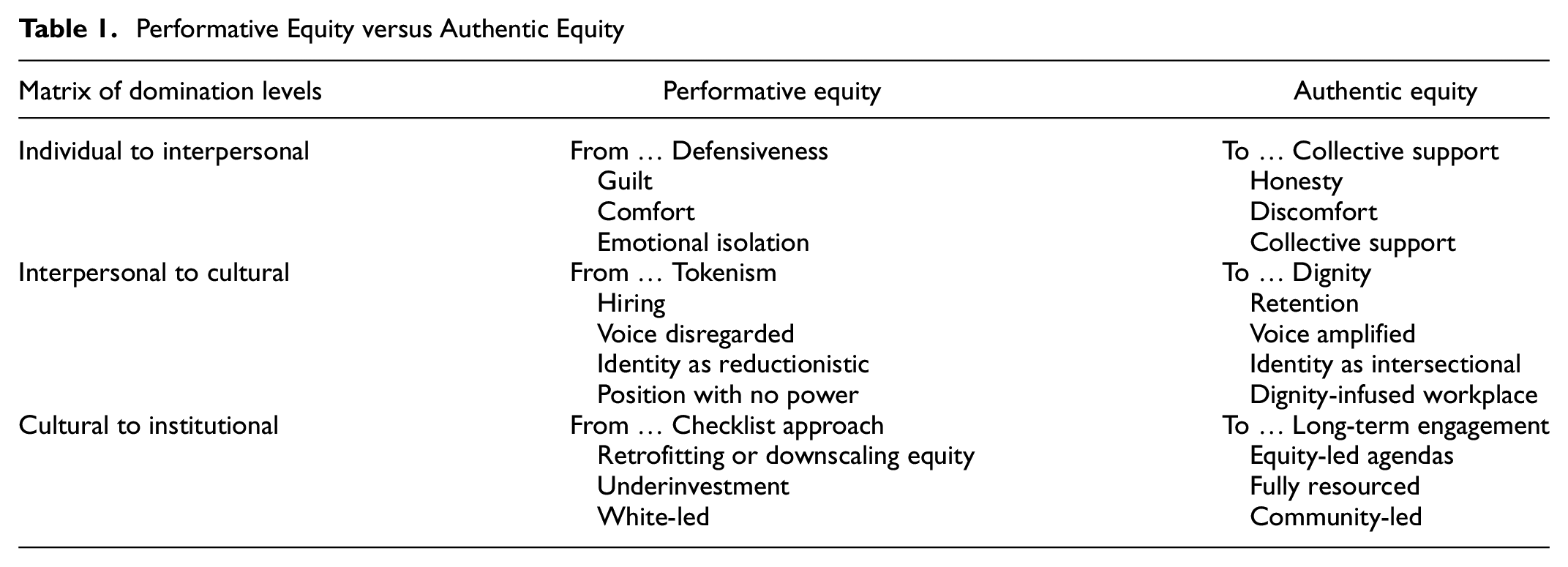
From Defensiveness to Collective Support
From Guilt to Honesty
On the individual level, research participants experienced colleagues reacting defensively in discussions of equity. This phenomenon is often referred to as white guilt or white fragility ( 113 ). Ethnic studies scholar George Lipsitz attributes this to a “possessive investment in whiteness.” This describes the attachment many have to whiteness because of the structured advantages it provides—the unearned rewards and privileges that are experienced as a loss in the call to equity ( 114 ).
One participant shared, “I don’t know that anything ever fully prepares you for the racism and fragility of white people.” They went on to say, I believe that everyone who does transportation work is a good person. You don’t get into this to make the big bucks, right? I literally think people who are in this industry do it because they want to help people and because they care and because they’re passionate because they want to do the right thing … But then I think because people are so well meaning and are such good people and are so deeply rooted to that image of themselves, there’s something particularly sensitive about them in this space that when you … It’s not even push them. When you say, “Oh, really …,” it is really tough for them.
By “Oh really …” they refer to challenges or critiques that in areas other than race are accepted or even expected as part of the professional workplace. However, when it came to issues of race, they experienced a sensitivity that shut down conversations. Those we interviewed spoke of how white professionals often experience situations where racism is pointed out as attacks, often attacks to their identity. This is substantiated by literature on white fragility ( 113 , 115 , 116 ). This reaction can force an oppositional relationship, unless the person who raised the challenge (usually a BPOC professional) finds a way to assuage the white person’s feeling of hurt. Thus, the critique gets sidelined and the person who raised it becomes responsible for maintaining the peace, which ultimately also maintains the status quo ( 117 ).
As one participant put it, “I think that equity is transparent and honest … it starts with a transparent and honest reflection of where we’ve been as a field.” This means looking at the complicity of transportation in perpetuating systemic racism at the individual, interpersonal, and institutional levels ( 112 ). Further, it requires change at all levels of the matrix of domination. Knowing the histories of discrimination in planning, both nationally and locally, is highly recommended. In an informal poll of transportation researchers and professionals, conducted by the first author at a virtual professional conference, only 27% of 72 attendees reported knowing “a lot” about their local history of transportation and planning inequity (redlining, highway construction, etc.). Learning and reflecting on the ongoing impacts of these histories can better equip transportation planners to have honest and difficult conversations. Open curiosity and reflection on one’s own behavior can also create a mindset more receptive to critique. Cultivating this learning or growth mindset sets the stage for honesty and transparency, a precondition for change.
From Comfort to Discomfort
Discussion of equity is a difficult process, which many participants acknowledged. They noted that the process will be uncomfortable and require rethinking assumptions and standard practices. As one professional consultant said, “This is going to get hard, and we’re going to want to quit. People might get offended, but we’re going to keep coming back … Sometimes being successful is not the same thing as being perfect.” When leadership takes this attitude and embrace change, even when it is uncomfortable, they can make more space for BPOC professionals and community participation.
One way to address this is through affinity groups that allow white professionals to engage in the interpersonal work needed to address institutional racism. As one participant put it, “Unless you have a really nuanced understanding of racial equity, and yourself and your identity, you’re not going to be able to implement that strategy with the fidelity to anti-racism like you should … It’s all good when you can say that oh, it’s institutional racism, it’s nothing about me. But when you get to kind of the interpersonal stuff, people are like, ‘Whoa, I don’t know. I’m a nice person.’” However, part of maintaining dignity for professionals and community members as whole people is acknowledging and working on one’s limitations, including the ways that one may be complicit in ongoing acts of racism, even if unintentional. When this is accepted, one can make the changes necessary to engage in anti-racism work.
From Emotional Isolation to Collective Support
Many spoke of the mental and emotional stressors of the work. Some of this arose from the ongoing performative commitment to equity they felt from their workplace, as described above. Interviewees called for transportation agencies and organizations to do the internal work of creating a more equitable work environment. As one participant shared, “There’s no reason in trying to go advocate to help out our communities … if we’re not looking at our own racial dynamics.” To do any authentic work with communities, this is crucial.
Many interviewees spoke of the emotional costs wrought on BPOC by legacies and systems of oppression. These are wide-ranging, from intergenerational trauma and resilience borne from systems of racism to norms that are centered on whiteness to everyday acts of discrimination and microaggressions ( 118 , 119 ). Many professionals spoke of the toll of this emotional labor—from code-switching, to educating others, to attending to other’s feelings at their own expense. Some wished that leadership would recognize this burden as part of the work they did and provide support. Adding to their emotional and mental burden is that they may be doing this at the same time as they are hearing and witnessing impacts of transportation violence and transportation-related state-sanctioned violence (such as police shootings and ICE [U.S. Immigration and Customs Enforcement] raids) within the communities they serve.
Efforts that assist with these challenges include but are not limited to the creation of affinity groups, elevating the voices of BPOC staff, and giving these staff more power and leadership. Good allyship may mean noticing the input and reactions of BPOC colleagues. One interviewee noted, “We’ll have a tough meeting and then she’ll text me afterwards and be like, ‘Hey, I noticed you didn’t say a lot during that meeting. Am I missing something? Because your voice is the one I want to hear.’” This type of act, along with calling out interruptions or negation of someone’s comments can all be helpful.
From Tokenism in Hiring to Dignity in Retention
Many participants spoke to the issue of retention within transportation planning, policy, and advocacy. They acknowledged and were pleased with the greater efforts to recruit and hire a diverse workforce and grow staffing investments in DEI initiatives. However, they felt that institutions were not grappling with the changes and considerations needed to retain these talented staff.
The necessary workplace cultural shift is best described as one moving from tokenism to dignity. Tokenism is a complex and well-researched phenomenon, which many research participants experienced in their work lives ( 28 , 120–122). It is characterized as making only symbolic change that gives the appearance of a commitment to equity. Hiring without making broader changes is a key example of tokenism. Isolation, underinvestment, and a lack of institutional buy-in are also common and can make it difficult for equity practitioners to enact meaningful strategies or policies.
A tokenistic work environment invites Black professionals and professionals of color into the conversation but rejects ideas that do not accord with the status quo ( 123 ). One person experienced the dynamic of tokenism as such: “Yes, it’s a good initiative until it hurts my reality, and then I’m not going to listen.” Other professionals felt that while their work was held up as important by the organization, they themselves were treated badly by their employer. For example, they may be asked to act as the “voice” for an entire community of which they may or may not be a member.
A tokenistic attitude can result in understaffing, as equity is siloed within the organization. This often occurs when there is not widespread buy-in for equity work. In a moment when equity work is trending, one professional worried, I am concerned that as a band-aid, many of them will simply throw up a single position or hire a single individual, give them the responsibility of being responsible for making equity happen but not giving them any of the real decision-making power or giving them access to the appropriate resources to actually manifest anything into reality and then a few years down the road, they all throw up their hands and say, “Well, shoot, we can’t figure this out, this whole equity thing, it doesn’t make sense. So we’re just not going to deal with it.”
Sometimes equity professionals felt that they were being tasked to do work that they structurally could not do because they were not granted the decision-making power or leverage to realize the institution’s stated goals. Thus, their job became mainly one of talking about equity and convincing others, rather than taking meaningful action.
A Dignity-Infused Workplace
Interviewees pointed toward the dignity-infused workplace as a solution to tokenism. They referred to a few specific examples of this model, described below. The challenge of tokenism has been so pervasive that the planners of a gathering of active transportation professionals who identify as BIPOC or who work in these communities named the event “The Untokening.” In this space, professionals experienced a level of dignity not felt in their daily work lives. The Untokening is a multiracial collective that centers the lived experiences of marginalized communities to address mobility justice and equity. The Untokening uses “mobility injustice” to name the intersectional unsafeties and attacks that people from marginalized groups experience in public spaces such as streets, transit systems, and the governance processes that lay claim to regulate those systems. An emphasis on dignity has been cultivated by other organizations leading the way in transportation equity, including the Thrivance Group, an organization working at the intersection of planning and transformative justice, and People for Mobility Justice, a Los Angeles-based nonprofit that works to end all forms of discrimination in travel so that people have the freedom to move in public spaces with dignity ( 124 , 125 ). Thrivance Group’s Dignity-Infused Community Engagement and Planning training offers biannual training to professionals interested in anti-racist praxis, robust community engagement, and justice-oriented practices. The Thrivance Group prioritizes the experiences and expertise of BIPOC planners and facilitators, and develops professional retreats for BIPOC professionals. People for Mobility Justice offers a vision for transportation futures embedded in the “Five Ds”: decolonize, decongest, decriminalize, dignify, and determination ( 125 ). People for Mobility Justice defines itself as a BIPOC collective, with a mission to seed “critical consciousness about mobility justice across all communities.”
Numerous participants pointed out how trauma, inflicted through everyday interactions and through major life events, should be a consideration in equity work. Doing so is crucial to respecting the dignity of people. It can be harmful when BIPOC individuals or communities are asked or forced to explain or perform their trauma to receive aid or attention. This reinforces a deficit model that imagines these communities as lacking, rather than attending to how they have built strength even in the face of disinvestment and oppression ( 126 – 128 ). At the same time, the impacts of trauma must be taken into account.
A participant who did extensive work with youth related how important it was that they learned how to work with young folks who had experienced high rates of trauma. They learned that many of the youth they worked with were going through, “really heavy stuff … and we found a way to have the bikes be that therapy for them.” This shows how some professionals we interviewed saw transportation and the re-creation of the built environment as part of a healing process. Authentic equity work can lead to healing, when all those involved are regarded with dignity ( 33 ).
From Checklists to Nuanced Engagement
With regard to the relationship between transportation planning and historically disinvested communities, participants experienced performative equity as a demand for a checklist. That is, some felt that they were asked for a prescription to cure inequity, as if histories of oppression were a simple problem to solve, and that all the answers were already predetermined. This was felt as a desire to quickly “solve” equity so that their colleagues could get on with the things they really cared about, rather than acknowledging the need for in-depth engagement with the long-term work needed. One participant defined performative allyship this way: “the approach to it is, ‘Tell me what we need to do, and I’ll do it tomorrow and then I can wipe my hands and say, I did it.’” Rather, those we interviewed pointed out that the work will be difficult and painful. Many spoke of how initial enthusiasm for equity work faded when it upset people’s ideas. This rejection of real change was repeatedly listed as a challenge.
Equity requires a redistribution in who gets funded, more flexibility in how funds can be spent, and expanded opportunities for programmatic and “human infrastructure,” the social networks and structures needed to bring about systemic change ( 129 ). They noted that redistribution of funds is often met with resistance, even by those who say they support equity work. As one professional put it, “The moment you actually talk to people about what this would look like, I think there’s a little bit of, ‘Oh, I didn’t think you meant that far. Maybe we don’t need to do 100% equity. Maybe we do 50% equity, because … I’m not willing to sacrifice what I want to give you what you deserve.’”
Authentic solutions arise from ongoing community engagement with those communities who have been most neglected and residents who are most vulnerable. Creating and maintaining continuous relationships with historically neglected communities is a complex and resource-intensive process ( 21 , 22 ). And yet, this is a requisite for equity work that addresses past injustices and creates more just futures.
From Retrofitting Equity to Equity-Led Agendas
Common performative gestures at the institutional level are retrofitting equity and downscaling equity efforts to just “outreach.” Half-hearted equity efforts can effectively undermine authentic equity. Downsized equity investments are often set up for failure before they even get started. As one participant put it, “There’s still a ghettoization of diversity, equity, and inclusion into outreach. And so people think if they can check an outreach box then they’ve done it. Then I think the second most common thing is that it’s trying to be retrofitted. And so it’s like, ‘We’ve already done this whole project, but we realized equity is a concern. Can we bring you in to tell us what you think after the fact that after all the decisions are made and you can’t really impact much?’”
One group in the Central Valley creates equity-led agendas at monthly meetings with community members. Their process works with residents to “envision the community that residents want to live in. And then we work to get that vision represented in plans and policies. And then we organize and advocate to get the plans and policies implemented so that residents can benefit from the time that they spend sharing their feedback.” Although interviewees had much more to say about the need for quality community engagement, another recent study by the first author provides guidelines for best practices in community engagement ( 22 ).
From Underinvested to Fully Resourced
One participant noted, “People always underestimate time and resources needed to do things in an equitable way.” This subpar investment in equity allows an institution to say they tried and to defer blame for the failure onto others.
Authentic equity work requires a significant change from the status quo and a transfer of funding, time, resources, and energy. It requires professionals and leaders to rescind power to communities very different from them, which is a complex process that necessitates recognizing differential expertise. This is the expertise of everyday lived reality that knows the challenges of a place intimately. This is the expertise that sees innovative solutions that are often not recognized as such. This is the expertise that adheres to alternative logics and value systems that, although different, are no less valid than those that traditionally dominate in transportation planning.
Flexibility in how funds can be used was reiterated by many. They noted that grants often come with restrictions that prevent them from addressing community needs and engaging in community-driven solutions. Oftentimes, funders dictate what money can be used for rather than consulting with the community about where investment is most needed. Whereas these restrictions may be based in best practices and research, they do not take into account the needs of disinvested communities. Central to the need for flexibility is the need for more community control and a redistribution of power ( 130 – 132 ). Many communities know the solutions to the challenges they face—they need access to the resources to realize the solutions. The flexibility to spend funds not just on built infrastructure, but also on expertise, programming, and human infrastructure is needed ( 123 ).
From White-Led to Community-Led
The lack of racial diversity within organizational leadership and boards is a consistent challenge within transportation planning and policy (
133
). Numerous participants noted the homogeneity of boardrooms, commissions, and other decision-making bodies. One participant said, “Many of the people are older, able-bodied, straight white men. And so maybe the bigger problem there is just that the people that we’re theoretically all serving are not the people leading those decisions.” Another participant recognized that “our board has been historically wealthier, whiter,” and that to support Black lives and racial justice initiatives, they needed to “adjust and compensate.” As one interviewee shared, Equity is being invited to the process or the process coming to you, but also there being a real sense of agency attached to your voice, not performative inclusion … I think equity, really equity in this field is going to have to mean intentionally removing power from where it is within transportation field and redistributing it or re-creating it collectively.
Future Vision
As the final part of the interview, participants were asked to envision an equitable and just transportation system. They wanted to see walkable communities where people are not forced to drive, greater use of transit and trains, and more sustainable modes of transportation. They also wanted to see greater community engagement and an investment in community that went beyond transportation. Their visions extended to more parks and green space, more affordable living, and the development of local economies. They wanted safer roads, and extended safety to include not just traffic deaths but also police and other forms of state-sanctioned violence and harassment. Participants desired transportation systems that alleviated the pressures and stress associated with everyday life. Below are a few cross-cutting themes of their visions for transportation futures that reflected the equity lens they bring to the work.
Streets with No Police
Interviewees discussed policing strategies and tactics as one of the highest priority areas in need of transformation. Communities desire solutions beyond policing and acknowledge that increased policing and surveillance create unsafe conditions for marginalized groups including BIPOC, women, trans and gender-non-conforming people, and poor and undocumented individuals. Interviews supported research revealing that policing within transportation networks disproportionately targets BIPOC individuals, resulting in higher levels of arrests and police violence ( 134 – 141 ). Planning and policy expert Charles Brown calls this phenomenon “arrested mobility,” highlighting how many people from the Black community are apprehended, accosted, injured, or killed simply for moving about public space ( 134 ). This research can unsettle the unquestioned beliefs of some (particularly white) transportation professionals, thus making strategies of implementation difficult.
Transportation professionals have the opportunity to decouple safety and policing. Doing so opens up space for affected communities to decide for themselves what safety can and should look like. Community-based solutions that value existing safety networks offer innovative solutions. Examples include revising police budgets to pay for support service providers and professionals trained in de-escalation practices. As one interviewee shared, “They weren’t trying to say, ‘let’s increase police presence.’ No, it was like, ‘let’s increase our own presence and police ourselves. Just our presence alone will deter people from acting a fool.’” Interviewees also spoke to the need to decriminalize poverty. For example, one tangible solution that addresses the criminalization of poverty is to lower or eliminate transit fares. These sorts of change-oriented proposals bear greater consideration and analysis.
Align with Other Movements
Participants linked their visions of the future of transportation to a vast array of other movements and social issues: workforce development, local economies, food systems, nonextractive practices, climate justice, housing. One participant saw a future in which the transportation sector “shifts the focus” and sees itself as a part of “women’s rights and [the] reproductive justice movement … the #MeToo movement … immigrant rights … and all of the sectors that impact people’s ability to move.” Another participant called for the widespread adoption of universal design concepts, and the need to “keep disability at the forefront” to create a truly inclusive and equitable system. They added that “there’s a lot of qualified people in the disability community that should be filling a lot of these roles, whether it’s in government or for profit or nonprofit companies that can help spearhead a lot of this work that, for one reason or another, are not in those positions right now.”
Interviewees saw the connections between poor infrastructure and violence, and sought solutions based in investment, not enforcement. One participant recalled, “Our neighborhood did not have sidewalks. We didn’t have safe parks. We had a lot of gang violence. On the other side of town where some of my family lived were really nice homes and really nice sidewalks and parks you could just walk down to and not be worried about playing in.” Once they became a transportation professional, they would visit disinvested neighborhoods and wonder, “Hey, this is how my community was growing up too. And yeah, that wasn’t right and that wasn’t safe, and we should have had more investments and why didn’t we?” Transportation professionals who had a lived experience of growing up or living in disinvested communities bring a much-needed lens to their work.
Hiring Within Communities
They also acknowledged the need to hire people from within affected communities. They saw transportation planning as a potential economic engine, which could employ people of all ages, from youth to elders in well-paying work. They advocated for hiring local teens and elders who have a unique and important perspective on the built environment. Youth have a knowledge of the hidden geographies of a city that may limit mobility, whereas elders often have in-depth historical and social knowledge of a neighborhood. One such program is the “Hood Planners” program organized by People for Mobility Justice, though they are not the only organization utilizing training and employment to create a future pipeline to interest youth in future careers as transportation planners ( 142 ).
New Research is Needed
Participants were also asked about the role of research in their work. Two general trends emerged: the need to make research more applicable to their work and the need for greater value around qualitative research. Many participants experienced alienation from transportation research: “The norms of transportation researchers and the techniques that transportation researchers get taught as part of their education are so foreign to me. I think they are very impenetrable to people who are not taught in that field.” This points toward an opportunity to consider how transportation researchers can shift their research questions to speak more directly to community need, as well as translate and demystify their research processes. Doing so can create more transparency between researchers and the people their research affects. This creates space for deeper and more meaningful dialogue between researchers, transportation practitioners, and communities.
Limitations
This study focused mainly on California transportation work. Further research assessing transportation equity nationwide or globally would allow researchers to know how broadly applicable these findings are. Within California, we did not achieve representation from far Northern California, nor did we achieve representation from Native American or Indigenous planners. The timing of this study coinciding with a global pandemic and the murder of George Floyd and other Black people by law enforcement, and the resulting uprisings meant that this research was conducted at a unique historical moment. As time passes, this context may prove more or less representative.
Recommendations
Organizations, small or large, can create equity plans that includes a shared definition of equity, defined goals, achievable objectives, and measures to assess progress. This work should be integrated into the overall vision, strategic plan, and goals for the organization. The definition, goals, objectives, and results should be reexamined regularly. If an organization does not already have this in place, we recommend hiring an outside expert to assess the current state of equity within the organization, facilitate the process of creating a plan, and lead an annual review. This plan is most likely to help guide authentic work if you center and value the voices of BIPOC professionals in your organization in the process. Retention of BIPOC employees, greater diversity in leadership roles, and budgetary commitment to equity should be some of the key goals and metrics included. Professional organizations may wish to consider how to create alternative pipelines that introduce young people to the transportation profession in a way that values their existing knowledge of the street system.
Transportation researchers and professionals can educate themselves on the histories of discrimination in planning and research, both nationally and locally. They should seek to learn more about the communities who are affected by their decisions. This includes learning neighborhood histories, visiting key community gathering places, and meeting key leaders (both formal and informal). Read past reports and learn about processes that involved the community, especially if the community was engaged. Integrate time and resources to do this work as part of the research and planning process. When meeting with the community, acknowledge any past harms that have been inflicted on them via research, transportation systems, or planning. More training opportunities are emerging, conducted by transportation professionals and researchers who are BIPOC and/or have developed in-depth expertise around equity.
Make time to form relationships with communities. Build this into the timeline of workplans and provide funding to support this aspect of the work. This is a form of professionalization and a needed expansion of existing dominant social networks in transportation. Specific activities one may take could include attending events in a local community, conducting informational interviews with community leaders, and spending time shopping or walking in the local neighborhood. This can create a stronger foundation from which to form collaborative partnerships. In these partnerships, compensate community members for their time and expertise in the process in a way that allows for flexibility and can accommodate small organizations that cannot front costs. Work with them to create research and planning agendas that prioritize their needs and solutions. Ensure that these processes are led by local BIPOC community members. Look for opportunities to hire from within the community as projects advance.
Transportation researchers could conduct more qualitative research and improve their science communication skills so that communities can better understand the relevance of the research to their everyday lives. This translation should focus on explaining the process, assumptions, limitations, and application along with the results and their implications. This gives communities the information they need to enter into a dialogue. Qualitative research offers a depth of knowledge that more closely resembles the everyday lives and needs of BIPOC communities. This research could be more approachable and more accurate to their lived experience.
Conclusion
This study contributes to the literature on transportation equity by surfacing important areas to examine. One area for examination that may predict how effective equity efforts are may be to examine how transportation equity is defined and what goals are set. Those interviewed advocated for action-oriented equity work that creates meaningful change and redistributes funding and decision-making power to communities subjected to transportation injustice. The BPOC transportation professionals interviewed in this study identified much of the existing equity work as potentially limited to the “performative realm.” To be more authentic, the transportation workplace could take further actions to diversify leadership, change workplace culture to be more inclusive, and improve retention of BIPOC staff. Community engagement could be done in a more meaningful and relationship-based way that is centered in dignity and respect. Professionals could engage in educational professional development opportunities such as undertaking training on histories of oppression in transportation, improving community engagement, valuing community voices, integrating qualitative research, and making systemic change. Greater resources could be devoted to equity work, including the relationship-building process. Further research is needed to understand how widespread these findings might be applied and to track ongoing progress toward a deeper integration of equity within transportation practices.
This paper offers insight into how equity in an organizational workplace is tied to the equity work done with the broader community. This research suggests that the integration of equity and the full inclusion of BIPOC professionals in the transportation workspace are vital measures for researchers to examine. In research on equity metrics, most attention is focused on community-based measures. These are vitally important. This study suggests that equity metrics would also benefit from looking at measures in local workplaces and organizational culture. The results suggest that retention of BIPOC professionals matters as much as or more than diversity in hiring and the workplace. Budgetary allocation of resources to equity may also be another measure worth examining. Structural changes to institutions may also merit additional analysis so that researchers and professionals can better determine what sort of systemic change in the workplace leads to a greater impact from equity efforts in the community.
Further, with the proliferation of both performative and authentic equity work identified in this study, it is worth applying the findings of this study to analyses of equity-related efforts.
The definitions and characteristics of equity, as well as the delineation of performative versus authentic equity work, offer researchers a rubric for further development that can be applied to specific contexts and organizations for expansion, modification, or challenge. This framework may also offer organizations a lens through which to improve the resources allocated to equity. Further research into what approaches and methods might best accommodate an authentic approach to equity bears consideration, with attention to the role of qualitative research and research directed by community need.
Supplemental Material
sj-docx-1-trr-10.1177_03611981231193409 – Supplemental material for Performative versus Authentic Equity Work: An Assessment of Current Practices in Transportation Planning
Supplemental material, sj-docx-1-trr-10.1177_03611981231193409 for Performative versus Authentic Equity Work: An Assessment of Current Practices in Transportation Planning by Sarah Rebolloso McCullough and C. Sequoia Erasmus in Transportation Research Record
Footnotes
Author Contributions
The authors confirm contribution to the paper as follows: study conception and design: S. McCullough; data collection: C. Erasmus; analysis and interpretation of results: S. McCullough, C. Erasmus; draft manuscript preparation: S. McCullough, C. Erasmus; All authors reviewed the results and approved the final version of the manuscript.
Declaration of Conflicting Interests
The authors declared no potential conflicts of interest with respect to the research, authorship, and/or publication of this article.
Funding
The authors disclosed receipt of the following financial support for the research, authorship, and/or publication of this article: This study was funded by a grant from California Department of Transportation (Caltrans) via the Pacific Southwest Region University Transportation Center (Caltrans 65A0674 Task Order 021USDOT Grant 69A3551747109).

Supplemental Material
Supplemental material for this article is available online.
References
Supplementary Material
Please find the following supplemental material available below.
For Open Access articles published under a Creative Commons License, all supplemental material carries the same license as the article it is associated with.
For non-Open Access articles published, all supplemental material carries a non-exclusive license, and permission requests for re-use of supplemental material or any part of supplemental material shall be sent directly to the copyright owner as specified in the copyright notice associated with the article.
