



Abstract
The demand for safe, reliable, and higher-quality infrastructure systems often increases the complexity of transportation construction projects and necessitates more comprehensive evaluation methods. This often leads to the incorporation of technologies for oversight and management. With a focus on effective technology implementation, this research stretches beyond simply evaluating technologies to consider integrating the technology with personnel and procedures at departments of transportation (DOTs). Drawing from literature and a survey of state DOT personnel, this study applies and evaluates maturity models for people, process, and technology with regard to technology implementation at DOTs. The findings support the need for understanding technology implementation in the aspects of people, process, and technology maturity to improve the probability of implementation success. The framework allows DOTs to move toward higher maturity levels and improve the likelihood of implementation success. The study’s objective is to assess the importance of people, process, and technology as implementation dimensions that state DOTs need to focus on for successfully implementing technologies. The idea and scope of the paper can be extended to any new technology implementation efforts at DOTs, including Automatic Identification and Data Capture technologies, emerging sensing and wireless technologies, safety technologies, and others. The maturity models presented enable organizations to audit and benchmark their status for technology implementation, and the relative levels allow these organizations to advance from basic to advanced stages. This paper introduces three maturity models for people, process, and technology, their adaptation to DOT operations, and their possible future use, as presented through preliminary survey results. The final result of this study provides a maturity model methodology for successful technology implementation and a self-assessment tool for state DOTs to gauge and improve their current maturity levels. Preliminary validation of these products was conducted via a workshop of subject matter experts, and the results indicate that state DOTs can use these products to self-assess their organization’s maturity and devise a plan as required for improved technology implementation.
The complexity of modern transportation construction and asset management systems is driving for more timely, accurate, reliable, and robust information. Evidence-based research has demonstrated that a range of sensing technologies, including barcodes, radio frequency identification (RFID), ultra-wideband tracking systems, global positioning, and at times a combination of these and other advanced technologies, improve the ability to more effectively manage construction and assets that are key to highway project execution. Other non-sensing technologies such as augmented reality, building information modeling, e-ticketing, e-construction, and digital twins are equally useful in highway construction and asset management.
At a time where more lane miles are being managed by fewer transportation agency staff, the opportunities for technology to be leveraged are vast ( 1 ). However, the success of technology implementation efforts is often not guaranteed. The variability in success is attributable to many factors, including regulations, funding, personnel resistance, management support, and others. Within this research, it is proposed that these factors may be categorized within areas concerning people, process, or technology itself. The focus on these three areas as considerations for technology implementation success presents an opportunity to provide guidance and support for state departments of transportation (DOTs) when implementing technologies. This study attempts to highlight the necessary maturity levels of people, process, and technology for successful technology implementation at state DOTs. The motivation for this study comes from the increasing digital transformation in the construction industry and the need for successful technology implementation to complement and supplement the workforce. It is very important to have successful technology implementations to achieve higher efficiency and digitize the industry. The main objective of the study is to use maturity models to assess technology implementation at state DOTs and provide guidelines to DOTs to improve the prospects of technology implementation success.
Through literature review, surveys, interviews, and validation of metrics, the research team was able to assemble a framework for assessing maturity levels in people, process, and technology, as well as establishing baselines for indicating probable success and failure in technology implementation efforts at state DOTs. This research identifies the required maturity levels of people, process, and technology that state DOTs need for probable success in technology implementation. This research also sets levels for the probable failure of technology implementation that state DOTs must overcome. The study’s findings allow state DOTs to self-assess their current maturity levels, identify areas needing improvement, and devise a plan to reach the levels needed for probable success in technology implementation. Although this paper presents results of ongoing research, the findings relay the importance of maturity in people, process, and technology for probable success in technology implementation.
The research methodology for this study relied on the use of well-established maturity models. These existing models, which were developed for other disciplines, were adapted under the guidance of a panel of experts experienced in technology implementation in construction and asset management at DOTs. These adaptions were further influenced and validated by a survey of state DOT professionals and an in-person workshop with a second group of experts. It can be concluded that maturity levels of at least 3 or more are required for successful technology implementation, and any maturity levels of 2 or below 2 will likely result in unsuccessful technology implementation. State DOTs need to focus on all people, process, and technology if they want to increase the likelihood of their implementation success, as the combination of people, process, and technology results in successful technology implementation efforts.
Literature Review
State DOTs continually implement technology to improve construction and asset management, among other areas. Studies have shown that the level of success of these efforts varies ( 2 ), indicating the need to understand what is needed for successful technology implementation. Any technology implementation effort that only focuses on technology has the potential for failure in the construction industry; therefore, combining people, process, and technology was a core idea for building the holistic framework ( 3 ). A review of technology implementation in other fields revealed widespread use of maturity models as assessment tools in gauging preparedness for these implementations, yet there was a void of models specific to state DOT use. However, from these studies and others, it is thus theorized that maturity in people, process, and technology are predicting factors in determining the success of technology implementation and were applicable to state DOT use ( 2 – 4 ).
The People, Process, and Technology (PPT) framework has been around since the early 1960s. The business management specialist and expert Harold Leavitt coined the original model, which consisted of four elements: people, structure, tasks, and technology ( 5 ). The PPT framework first received attention in the Information and Technology field when computer security and privacy specialist Bruce Schneier built on the Leavitt framework and introduced people, process, and technology as the three dimensions needed for successful organizational management ( 5 ). The PPT framework maps the entire value streams of people, process, and technology and highlights their interaction: the people do the work; processes make this work more efficient; and the technology enables people to do their tasks efficiently and automate the process. This framework achieves harmony within an organization and is mostly used when implementing new technologies ( 5 ). Thus, for a technology implementation to be successful, the three dimensions of people, process, and technology must be mature to achieve success. These concepts led to the development of maturity models to assess the three dimensions.
State DOTs can benefit from already established maturity models to assess each of the three dimensions of maturity needed to implement technologies successfully. Adopting existing models and modifying them to meet certain needs and requirements is a common practice in highway construction. The research uses the similar approach of using established maturity models and modifying them to meet the research objectives in DOT context. The maturity models for people, process, and technology are helpful to understand what levels are required, and their relevance in highway construction and asset management. These models provide framework to systematically study people, process, and technology. For instance, in the NCHRP: Web-Only Document 214 “Transportation Agency Self-Assessment of Data to Support Business Needs: Final Research Report,” the research team modified the original Capability Maturity Model to meet the study objectives of testing the feasibility of the data program self-assessment process and producing a guide for transportation agencies to implement data self-assessment methods ( 6 ). In NCHRP Project 08-36, Task 100, the authors used the Capability Maturity Model to create a tool to help transportation agencies assess their data programs ( 7 ). The State of Michigan created the State Unified Information Technology Environment (SUITE), built on the concepts of the Capability Maturity Model Integration (CMMI) and project management methodologies. SUITE was originally used by the DOT and later became the statewide standard. The statewide implementation was possible as SUITE has matured the process for all technology projects ( 8 ).
The study presented here adopts a similar approach where three common maturity models for people, process, and technology are reviewed and adapted for construction and asset management for state DOTs uses.
The three models considered for this study for people, process, and technology, are further detailed in their original form below:
The PCMM guides organizations in improving organizational processes for managing and developing workforces. The PCMM comprises five development levels that set up progressive establishments for consistently improving individual abilities, creating compelling groups, propelling improved execution, and forming the labor force the association needs to achieve its future field-tested strategies. The PCMM can be applied as a standard for assessing workforce practices and as a guide in planning and implementing improvement activities. The PCMM is an integrated set of best practices that improves performance and key capabilities for organizations that want to improve their critical people management process ( 10 ).
The research team used the PCMM to determine and assess people maturity for this research project. The five levels of the PCMM are:
Level 1: Initial; Inconsistent Management
Level 2: Managed; People Management
Level 3: Defined; Competency Management
Level 4: Predictable; Capability Management
Level 5: Optimizing; Change Management
The (PM)2 model integrates previous PM practices, processes, and maturity models to improve PM effectiveness in the organization. The (PM)2 model motivates the organization and related people to accomplish higher and more sophisticated PM maturity through a systematic and incremental approach. It is well suited to assess an organizational PM level.
The following five levels present the maturity model for (PM)2 as mentioned in the article Project Management Process Maturity Model written by Kwak and Ibbs ( 11 ).
Level 1: Initial; Basic PM Process
Level 2: Planned; Individual Project Planning
Level 3: Managed at Project Level; Systematic Project Planning and Control
Level 4: Managed at Corporate Level; Integrated Multi-Project Planning and Control
Level 5: Continuous Learning; Continuous PM Process Improvement
The CMMI framework for defining technology maturity within the context of DOT construction and asset management applications is adapted through this research project. The following are the five maturity levels defined by the CMMI:
Level 1: Initial; Processes unpredictable, poorly controlled, and reactive
Level 2: Managed; Processes characterized for projects and is often reactive
Level 3: Defined; Projects tailor their processes to the organization’s standards
Level 4: Quantitatively Managed; Processes measured and controlled
Level 5: Optimizing; Focus on process improvement.
These three models were adapted for this research for two reasons: (1) they have been extensively used in prior studies (NCHRP Project 08-92, NCHRP Project 8-36/Task 100, State of Michigan), and (2) they all are measured along a five-level scale, which brings uniformity across the models of people, process, and technology.
In the NCHRP Synthesis 582, the authors asked DOTs about current technology evaluation methods in different state DOTs. There are different drivers for selecting technologies: improve efficiency, promote e-construction, and enhance inspectors’ safety and staffing. DOTs use wide arrays of technologies: geospatial technologies, remote sensing and monitoring technologies, mobile devices and software applications, and nondestructive evaluation methods. Out of forty-two respondents, only 14% responded that DOTs have some system and policies for effectively reviewing technologies. Some 86% of the respondents do not have systems and policies to review the effectiveness of implementing technologies ( 13 ). Obsolete evaluation tools will not help DOTs evaluate and implement technology successfully. There is a need for a better approach and procedure to holistically review technology implementation, as there is a growing interest in technology nationally.
Methods
After reviewing the existing maturity models for people, process, and technology, the description of each maturity level for the PCMM, (PM)2, and CMMI was adjusted to fit the objective of this research by matching the requirements of technology implementation for state DOTs with regard to construction and asset management. The three maturity models are referred to hereafter as maturity dimensions. Table 1 lists the five levels used for each dimension. A description of each level is provided below.
Summary of the Assessment of the Three Dimensions of People, Process, and Technology
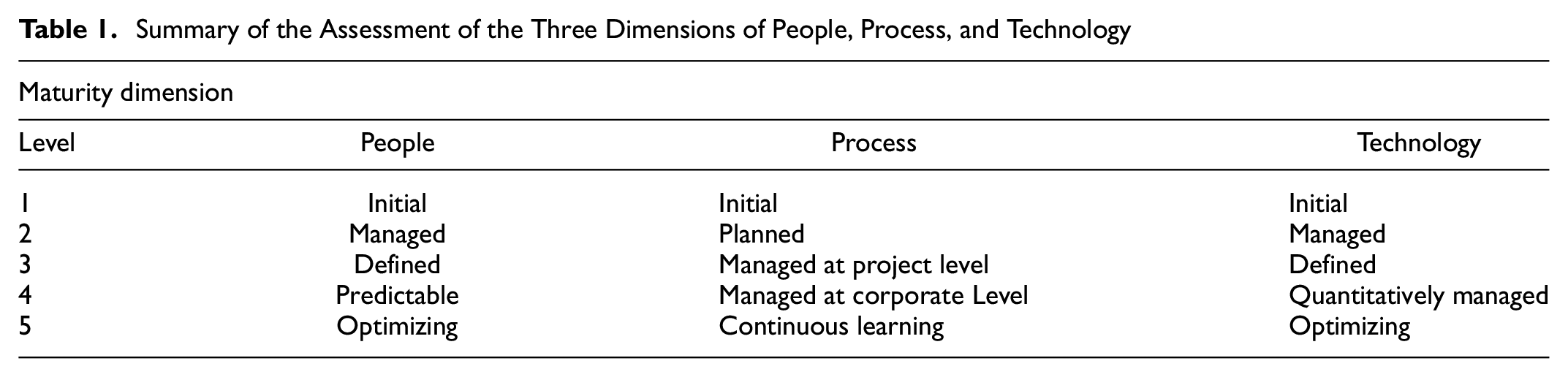
The five levels for people maturity using the PCMM were defined and modified under the supervision of research team members, subject matter experts, and with relevant DOT technology implementation experiences as follows:
Level 1: Initial—DOTs do not have enough talented human resources required to handle projects and cannot retain qualified employees.
Level 2: Managed—DOTs provide a good working environment and training to empower staff and provide a clear line of communication within units.
Level 3: Defined—DOTs onboard the proper people in the proper position based on competency, experiences, and roles and responsibilities, which are well defined and developed across an organization-wide infrastructure.
Level 4: Predictable—DOTs have confidence in their employees and delegate tasks to empowered groups. The managers operate at higher levels with the ability to focus on more strategic issues.
Level 5: Optimizing—The entire DOTs are focused on continual improvement and improvement, including the improvement of individuals and the improvement of units for the betterment of the overall organization while focusing on central organizational objectives.
Similarly, the five levels of process were defined and modified for this research project using the (PM)2 as follows:
Level 1: Initial—DOTs understand and establish a basic PM process.
Level 2: Planned—DOTs plan the projects on the individual process and are not team oriented.
Level 3: Managed at project level—DOTs provide informal PM training and manage projects based on available systems with few team members.
Level 4: Managed at corporate level—DOTs provide formal PM training, and multiple projects are integrated and planned with maximum team participation.
Level 5: Continuous learning—DOTs fully understand and implement PM procedures to create dynamic and energetic organizations able to manage complex projects into the future.
Finally, the five levels of maturity for technology were defined and modified to fit the DOT setting for this research project using the CMMI model as follows:
Level 1: Initial—DOTs have access to technologies, but the technologies are not managed properly.
Level 2: Managed—DOT staff are using technologies but only on a handful of projects.
Level 3: Defined—DOTs use and implement technologies in many projects.
Level 4: Quantitatively managed—DOTs fully use technologies in all possible projects throughout the state organization, in appropriate applications, and are managed properly.
Level 5: Optimizing—DOTs fully implement technologies and find ways to implement them in other projects and areas, technologies collaborate, and the DOT updates its implementation plan as required ( 14 ).
Each level is representative of a stage of preparedness of a state DOT for implementing a specific technology for a specific purpose. The levels are self-assigned based on these considerations and point to areas of potential improvement for technology implementation success. The levels are generalized in that specific assessment or improvement criteria would drastically limit the functionality and applicability of the model framework. This research proposes that implementation success can be more likely to succeed once the appropriate maturity levels are achieved for people, process, and technology. With the definitions of the models above, there was a need to match the requirements for DOT technology implementation to these metrics. A survey was developed under the guidance of subject matter experts with DOT experience and reviewed for institutional compliance. The intent of the survey was to have potential end-users evaluate the maturity models and their levels for assessments of technology implementation at state DOTs. This research used an electronic survey developed in Qualtrics to seek feedback on the factors and perceptions of successful and unsuccessful technology implementations along the defined model maturity levels. The survey request was sent to the American Association of State Highway and Transportation Officials (AASHTO) Committee on Construction, the AASHTO Committee on Maintenance, the AASHTO Committee on Data Management & Analytics, the AASHTO Committee on Innovation Initiative, the AASHTO Committee on Knowledge Management, and the AASHTO Subcommittee on Asset Management. AASHTO is a nonprofit, nonpartisan association representing highway and transportation departments in the fifty states, the District of Columbia, and Puerto Rico. These committee members are middle-to-late career state DOT experts who often are involved in piloted approaches and technology implementation. Its primary goal is to foster the development, operation, and maintenance of an integrated national transportation system. A definition of each maturity level was provided in the survey to ensure all participants had the same understanding of the five levels for each model.
Respondents were asked to assess the maturity levels of each dimension (i.e., people, process, and technology) for two scenarios: successful technology implementation and unsuccessful technology implementation. A definition of each level was provided in the survey to ensure all participants had the same understanding across the five levels of each model. Respondents were also asked to elaborate on their state DOT experience relating to successful and unsuccessful technology implementation efforts. The maturity assessment results were aggregated for each model, leading to the establishment of maturity boundaries for successful and unsuccessful technology implementation at state DOTs.
The survey results were also validated during an in-person workshop that hosted eighteen state DOT middle-to-late career professionals with significant technology experience. There was an opportunity for the NCHRP 03-140 research team to host the workshop for their projects. Considering the experienced and diversified participants from different DOTs, the authors decided to take opportunity of the workshop to validate the research finding in-person and compare them with the online survey responses. These workshop attendees were selected for their experience in implementing technologies at their respective DOT. The workshop feedback was collected through a questionnaire mirroring the digital survey. The research results were then incorporated into a tool that state DOTs can use to self-assess their maturity levels across people, process, and technology metrics when planning a technology implementation. Notably, this study highlights the importance of people, process, and technology for successful technology implementation for construction and asset management at state DOTs. It presents professionally determined and validated maturity limits for successful and unsuccessful technology implementation. An example of how a state DOT can use the tool to evaluate its implementation maturity is also presented here.
Results
A total of eighty-nine responses representing all fifty state DOTs (at least one response from each of the fifty state DOTs) was collected from the online survey distributed to the AASHTO members described above. The collected data were checked for reliability and validity before the analysis was done. The power analysis was done to find the smallest sample size requirements to test the hypothesis, and it was found that a minimum sample size of twelve was required. The sample is considered appropriate as each state DOT is represented, professionals were focused on construction and asset management implementation, and responses indicated repetition. The results were further corroborated by the secondary group of experts during the validation workshop. Each respondent was asked to identify (1) the people, process, and technology maturity levels that lead to successful technology implementation, and (2) the people, process, and technology maturity levels that result in unsuccessful technology implementation. The average maturity level was computed for each dimension (people, process, and technology) for each scenario (successful and unsuccessful technology implementation). Figure 1 illustrates the results for both scenarios by displaying (1) the maturity level required for each dimension to achieve a successful technology implementation (solid line) and (2) the maturity level for each dimension that, below which, results in an unsuccessful technology implementation (dashed line).
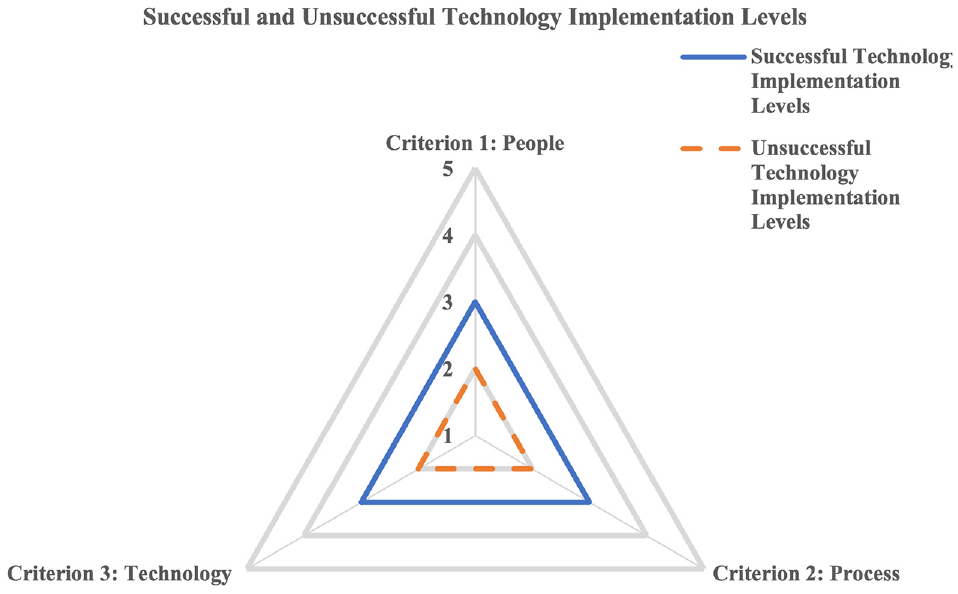
Levels of people, process, and technology for both successful and unsuccessful technology implementation.
From the results and validation, state DOTs should have at least level 3, “Defined” (average value of 3.25) maturity level for people, at least level 3, “Defined” (average value of 3.34) maturity level for process, and at least level 3, “Defined” (average value of 3.31) maturity level for technology to lead to probable success in technology implementation. The findings also present that unsuccessful technology implementation can be expected when a state DOT has a level 2 “Managed” (average value of 1.92) maturity level or less for people, a level 2, “Managed” (average value of 2.20) maturity level or less for process, and level 2 “Managed” (average value of 2.21) maturity level or less for technology. The two lines in Figure 1 define the boundaries for successful and unsuccessful technology implementation, informing state DOTs that the maturity levels of people, process, and technology below or at the dashed line is expected to yield an unsuccessful technology implementation effort, whereas maturity levels at or above the solid line support the successful implementation of technology. Furthermore, if assessed levels are between the defined bands or if one metric is below the desired level, the state DOT understands where effort needs to be expended to improve the likelihood of technology implementation success.
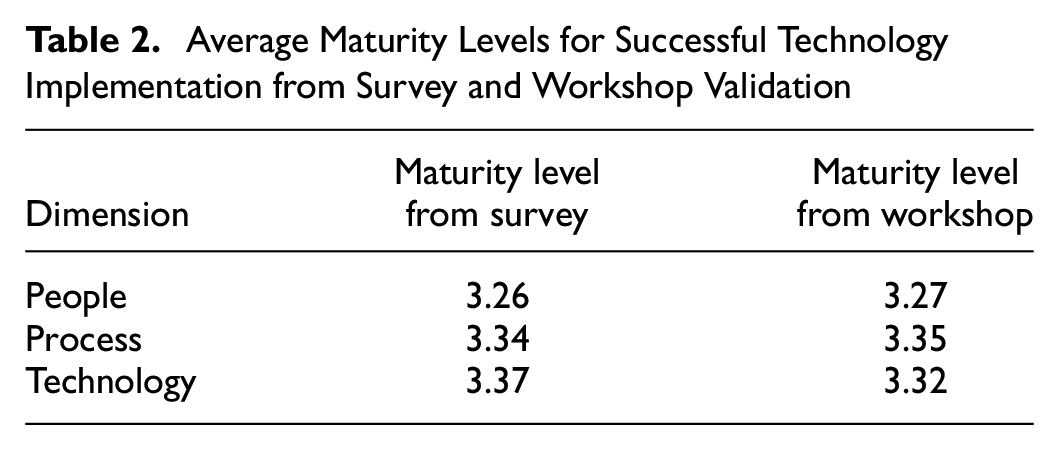
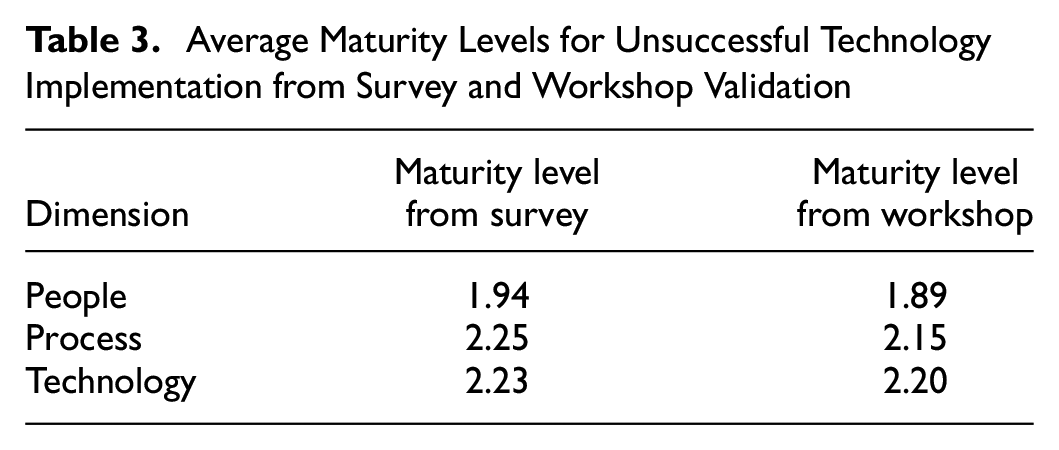
After the maturity levels of each scenario were obtained from the survey, the levels were assembled and validated during an in-person workshop that hosted eighteen transportation professionals. The workshop participants have significant technology-related experiences and expertise in state DOTs. They were asked if they agreed with the survey results or not. If they did not agree with the results, they were asked to provide new responses to questionnaires. The aggregate results from the in-person workshop were calculated similarly to the survey results. Tables 2 and 3 illustrate the average maturity levels from the survey (online survey) and workshop validation (in-person workshop) for successful and unsuccessful technology implementation, respectively. The maturity levels from the survey entail an aggregated average maturity level of eighty-nine responses, whereas the maturity level from the workshop is the aggregated average maturity level of eighteen responses. Comparing the maturity levels from the survey and the in-person workshop reveals nearly identical average maturity levels for successful and unsuccessful technology implementation. The results point to the same bands as illustrated in Figure 1.
Average Maturity Levels for Successful Technology Implementation from Survey and Workshop Validation
Average Maturity Levels for Unsuccessful Technology Implementation from Survey and Workshop Validation
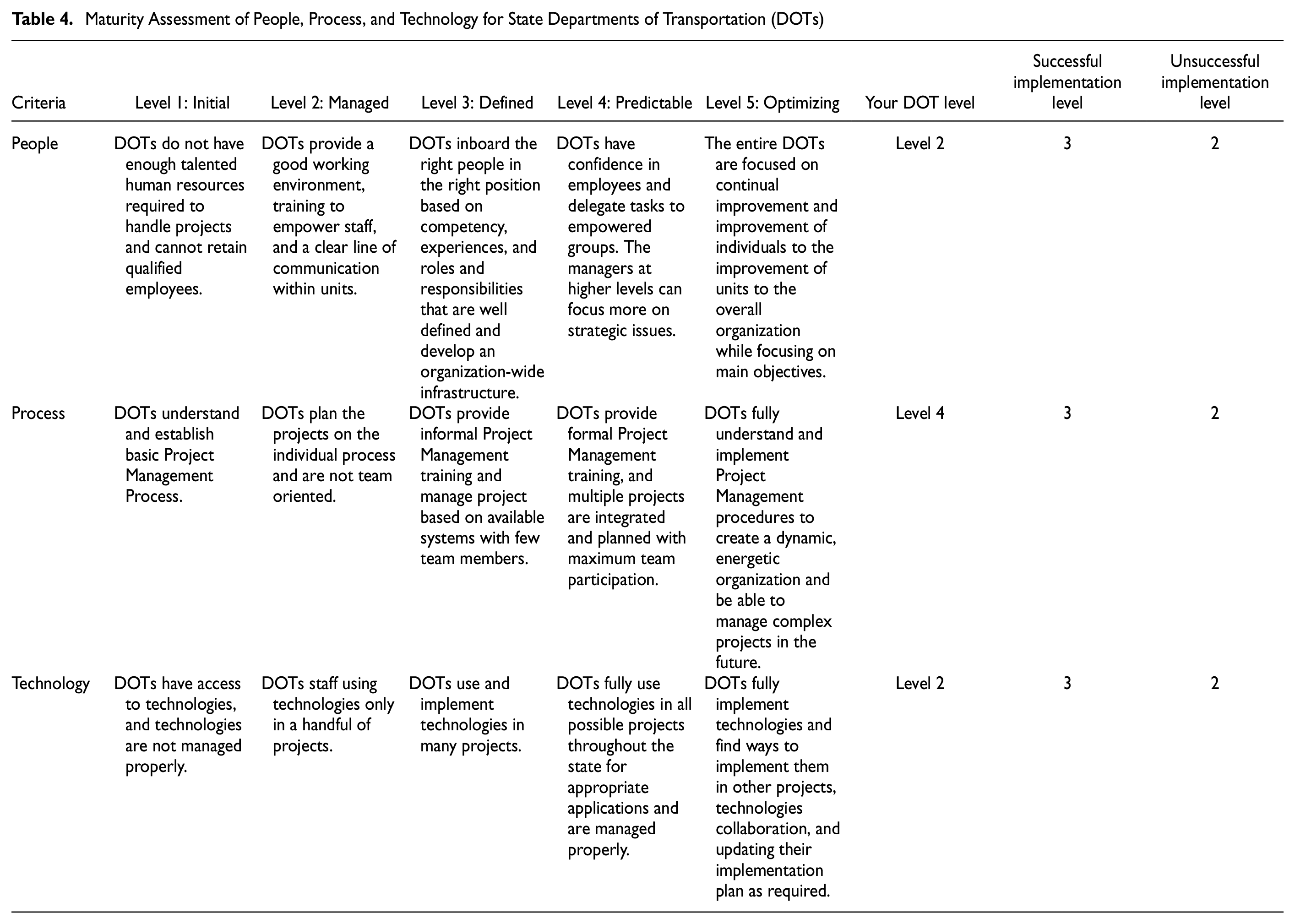
To assist state DOTs self-assess their current levels of people, process, and technology maturity and compare these with the maturity boundaries established through this research, a Microsoft Excel tool was developed to disseminate the research results to state DOTs. The concept of the tool is illustrated here in the form of a table, as shown in Table 4. Table 4 also illustrates an example of how a state DOT might assess its maturity and use this information to improve the probability of its technology implementation success. Table 4 displays the five levels for each dimension (people, process, and technology) of the model and allows the state DOT to select their current level (seventh column) using a dropdown list. The maturity boundaries established through this research for each dimension are available in columns 8 and 9. Once the user has selected their state DOT’s current level of maturity for each dimension, a chart like a Figure 2 will be displayed, showing the maturity boundaries as well as the current assessment of the state DOT’s maturity levels (represented by the dotted line).
Maturity Assessment of People, Process, and Technology for State Departments of Transportation (DOTs)
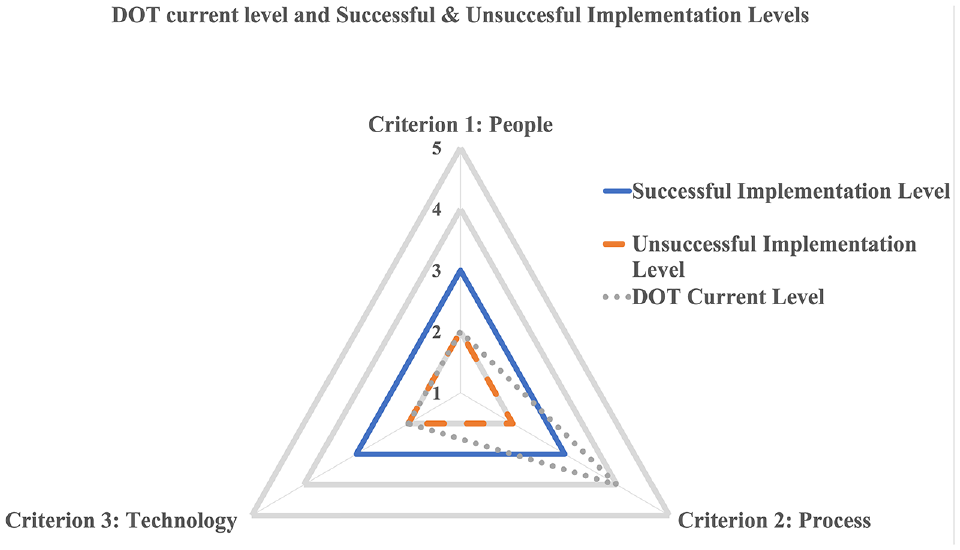
Department of Transportation (DOT) current level, successful, and unsuccessful technology implementation levels visualization.
Table 4 and Figure 2 enable state DOTs to identify where their maturity levels reside and contemplate the probability of the success of their implementation effort. The table and figure also allow the state DOT to discriminate where improvements are needed for an improved likelihood of technology implementation success. The levels selected in Table 4 are provided for illustrative purposes only, but point to the need of the example state DOT to consider improvements along People and Technology to have an improved likelihood of successful technology implementation. In this example, the state DOT may decide to make technology, in general, more visible within their DOT and include the technology as an aspect of the roles and responsibilities in alignment with job function. It should be noted that the tool involves a self-assessment, and the models are broad in nature to provide applicability across a wide range of technologies and modes of implementation. The study’s novel findings include an evaluation of technology implementation using people, process, and technology maturity to increase the successful technology implementation likelihood. The study also recommended levels of maturity along people, process, and technology for successful technology implementation
Discussion
The collective maturity of people, process, and technology is a distinguishable factor in the success or failure of technology implementation. To gain a deeper understanding of the interactions between the three dimensions of people, process, and technology, the previously mentioned survey respondents were asked to elaborate on how the three dimensions (1) collectively contributed to a successful technology implementation effort, or (2) resulted in an unsuccessful technology implementation effort.
The analysis of these collected data showed that the examples of successful technology implementation involved good coordination between people, process, and technology. One of the respondents provided the following explanation of how their state DOT leveraged the three dimensions to achieve success in an implemented technology by stating: The very first step is to understand the current business processes/standards established by agency guidelines/standards/processes. Once these are identified, the project/technology was tailored to improve or suit the identified guidelines/standards/processes. A core team of employees was selected as part of the implementation team based on experiences and capabilities. The core team manages the project at a project level, with occasional inputs from experts or management when needed. This process allowed for flexibility at the project level and adaptation of technology to the current business processes/standards to avoid any unintended interruptions.
Other survey respondents noted that their state DOT took a proactive approach and developed research capabilities where technologies are thoroughly vetted before actual implementation. The analysis of the responses shared on the unsuccessful technology implementation efforts showed that the increased emphasis on technology while neglecting the people dimension is a common theme among those experiencing technology implementation failures. Moreover, respondents also noted that although the people and process dimensions might be mature, when the technology is not compatible with existing systems, a failure is imminent. This emerged as a critical challenge, especially when the technology was driven from outside the organization and the state DOT did not have the right processes to train their employees or understand their needs. Additionally, implementation efforts were often challenged where stakeholders were not engaged in the process, resulting in little end-user input, lack of personnel training at roll-out, no direct support and commitment from leadership, and unaddressed concerns or no long-term support. Ultimately, the key difference between a successful and unsuccessful technology implementation is the presence of the right people with the right mindset working together. A successful implementation will improve by increasing levels of maturity across people, process, and technology, whereas an unsuccessful implementation will typically have maturity below the baselines previously described.
Conclusions
This research holistically analyzed the recommended levels of maturity along people, process, and technology for successful technology implementation. For any technology implementation efforts to be successful, state DOTs need to focus not only on the technology itself but also be mindful of the needs within the metrics of people and process. As noted by experts, success in technology implementation is based on the adoption and emphasis of people who drive the processes that allow for piloting and implementing the technology in all criteria per the requirements. This research relays the importance of maturity in people, process, and technology for probable success in technology implementation. It presents self-assessment metrics for state DOTs in considering technology implementations, and provides baseline limits illustrating areas of probable success and failure. These metrics and limits are provided and validated by a significant sampling of experts. With ongoing associated efforts, this work is expected to significantly assist state DOTs as they consider implementing technologies in highway construction and asset management.
The associated research based on the preliminary results here aims to find implementation factors for technology implementation capabilities. The ongoing NCHRP 03-140 research project “Guidelines for Applications of RFID and Wireless Technologies in Highway Construction and Asset Management” identified five factors as the requirements for implementing the technologies at DOTs. The panel, which includes a representative from Federal Highway Administration (FHWA), DOTs, and other industry experts, has identified Organization Structure, IT Infrastructure, Data Security, Information workflow, and Personnel Training as five important factors of technology implementation. In addition to the five factors identified in the RFP of NCHRP 03-140, the research team identified Stakeholder Engagement as the sixth factor important for technology implementation at state DOTs.
Understanding these implementation factors is a critical consideration for technology implementation. The combination of assessing maturity levels along people, process, and technology, using weighted importance of these levels of people, process, and technology, and assessing the implementation factors for technology implementation capabilities will provide state DOTs with a detailed framework with which to assess their proposed technology implementations and gauge their potential success or failure before incurring the expenses and risks of these attempts.
Noted limitations of the study include that the determination of technology implementation success is founded on a subjective measure of the subject matter experts having witnessed those implementations. Further, the study was limited to the identification of six technology implementation factors. Although these six factors were identified by experts, there are potentially other factors of importance in the success of technology implementations. Future work can explore and expand on these factors. The research is also limited by its broad nature so as not to focus on any specific technology. This limitation is also viewed a strength so that the models can be broadly applicable. This aligns with other work on maturity models, that are also broad in nature and provide opportunities for organizations to modify them per their own requirements. Although the definitions for the maturity levels may vary or be altered, the approach and main concept of maturity and maturity models remains the same.
Future research will include more detailed investigation in criteria for each technology implementation factor. The authors also plan to validate findings with detailed case investigations at selected state DOTs. Cases will be planned with state DOTs successfully implementing technologies and those that require assistance with technology implementation efforts.
Footnotes
Acknowledgements
The authors wish to thank all the DOT participants in the survey, interview, and workshops for their participation and support in this study.
Author Contributions
The authors confirm their contribution to the paper as follows: study conception and design: Amit Tripathi, Makram Bou Hatoum, Ashtarout Ammar, Roy Sturgill; data collection: Amit Tripathi, analysis and interpretation of results: Amit Tripathi, Roy Sturgill, Hala Nassereddine, Gabriel Dadi; draft manuscript preparation: Amit Tripathi, Hala Nassereddine. All authors reviewed the results and approved the final version of the manuscript.
Declaration of Conflicting Interests
The author(s) declared no potential conflicts of interest with respect to the research, authorship, and/or publication of this article.
Funding
The author(s) received no financial support for the research, authorship, and/or publication of this article.
