



Abstract
While transportation funding can be collected in a variety of direct (e.g., fares, tolls, and gas taxes) or indirect (e.g., property and sales tax) ways, dynamic demand responsive pricing not only collects revenue but also incentivizes travelers to avoid peak-demand periods, thus utilizing infrastructure capacity more efficiently. Unfortunately, the demand response to price changes, called the price elasticity of demand, is generally greater for longer-term travel planning (e.g., air and rail travel) than it is for more atomized short-term planning (e.g., highway tolls and transit fares). While this is caused by a plethora of factors (e.g., time flexibility, housing choice, automobile investment, etc.), a critical factor is that travelers simply lack sufficient information for future travel planning. For example, airline prices at different times can easily be compared, but a highway driver cannot accurately predict congestion nor congestion pricing. For this reason, such price changes have little effect on demand. This leaves any congestion abatement up to inefficient trial and error, and anecdotal speculation by travelers. Moreover, dynamic pricing is politically unsavory because of price uncertainty and collateral equity concerns. This article seeks to help remedy these concerns by proposing a simple “futures” market mechanism that can augment existing fare/toll collection technologies, providing travelers with sufficient pricing information and purchasing options to preplan their travel and avoid excessive prices. Users can optionally pre-pay their future fares/tolls to lock in a lower price for expected trips, thus encouraging good travel planning and efficient infrastructure utilization, while reducing price uncertainty.
Keywords
Despite the proven operational and revenue benefits of dynamic toll pricing, dynamic tolls are seldom implemented in the U.S.A. This is largely because of public disdain for tolls and the historic success and reliance on the gas tax funded Federal Highway Trust Fund (HTF). However, nearly three decades of unadjusted inflation coupled with ever increasing vehicle fuel efficiency has eroded the HTF’s solvency, sparking a renewed interest in alternative revenue streams.
While there are a myriad of intersecting factors affecting public acceptance, equity concerns, and the operational limitations of dynamic tolls, one factor is the price and travel time uncertainty. Given the unpredictable nature of traffic congestion, the public disdain for dynamic tolls is understandable since regular travelers are exposed to both price risk and travel time risk ( 1 ). For lower income travelers who tend to have stricter time constraints and commute longer distances, a dynamic toll presents a regressive tax ( 2 ), posing a major equity concern if no reasonable travel alternative exists. Lastly, automobile travel is notoriously inelastic, dampening the congestion mitigating benefits achievable through dynamic pricing. To summarize, there are three critical challenges with dynamic toll pricing:
low elasticity of demand, yielding a limited congestion mitigating effect;
public disdain because of the price risk; and,
equity concerns because of a lack of travel planning options.
This article seeks to explore a potential remedy to these critical challenges through a futures market-based toll pricing mechanism. The proposed concept is simple: travelers can lock in their toll price by pre-paying for future tolls, with the future price varying as more travelers book an overlapping time slot. This not only incentivizes travelers to preemptively avoid peak congested periods, but also offers an opportunity for regular commuters to compare prices and minimize the price risk of unexpected congestion by purchasing tolls in advance. Operationally, the proposed mechanism potentially yields greater congestion mitigation benefits by effectively increasing the price elasticity of demand. To evaluate the effectiveness of such a system, this article conducts a thorough sensitivity analysis of elasticity and pricing constraints to explore possible system outcomes for two objectives: delay reduction and revenue collection.
It should be strongly noted here that this article is not a blueprint for curing congestion, nor is it a critique of current road pricing policies (most of which exist for good reason). This article is purely an academic exercise using analytical exploration of road pricing and elasticity in a “futures market” context. The methodology is intentionally not a sophisticated full-scale four-step or activity-based model ( 3 – 7 ), but instead a simple analytical elasticity-based method. The elasticity-based simulation method used in this article is naive and does not consider a variety of possible exogenous factors (e.g., travel alternatives, fuel price, parking pricing, etc.): its simplicity enables the outcomes to be easily explored. The intent of this article is not to realistically model toll pricing travel demand, but rather to roughly explore the range and form of outcomes as inputs are varied. Future studies can build on these fundamentals to determine more precise outcomes.
Background
Transportation agencies must constantly balance between providing sufficient capacity for the peak period, while minimizing expenditure. Wasteful over-building is not only cost prohibitive, but also highly inefficient, leaving the majority of off-peak periods grossly underutilized. Moreover, experience over the last half century has shown that incremental highway expansion without demand controls can lead to a vicious cycle of induced demand where agencies perpetually increase capacity as users inevitably fill any available excess capacity ( 8 ). More recently, transportation agencies increasingly rely on tolls to raise revenue and to mitigate congestion. However, conventional fixed tolls fail to target the congested periods and merely apply a uniform downward disincentive on travel (see Figure 1). This is especially true when no travel alternative (e.g., transit) exists ( 9 ). Sufficiently high travel prices (e.g., tolls or gas prices) can reduce travel demand, but they do not necessarily encourage efficient use of infrastructure. Moreover, it is economically problematic to suppress overall travel demand as it can dampen economic productivity rather than increase efficiency.
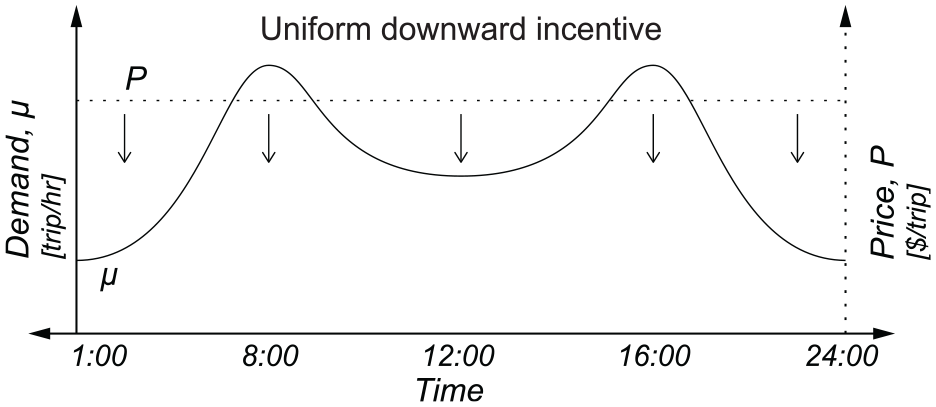
Fixed toll pricing incentive.
One solution to this problem is to dynamically adjust pricing based on demand to help discourage travel during congested periods and shift it to other modes or to off-peak periods (see Figure 2). Dynamic tolls have long been proposed as a solution to provide more targeted congestion mitigating incentives ( 10 – 13 ). Although similar schemes have been utilized in other transportation sectors (e.g., air and rail travel), the highly atomized, short-term, and high-frequency nature of highway and transit use presents a formidable technical challenge. However, with the advent of electric toll collection (e.g., FastTrak and EZ Pass), the remaining obstacles to dynamic tolls are largely political ( 14 – 16 ). Understandably, travelers do not want to pay more for travel beyond the sunk cost of fuel and automobile ownership, nor do they wish to be subjected to unpredictable congestion-related costs that they have limited control over. Moreover, dynamic pricing creates equity concerns if it simply extorts travelers if no other reasonable alternative travel options (e.g., transit) exist ( 2 , 9 , 17 ).
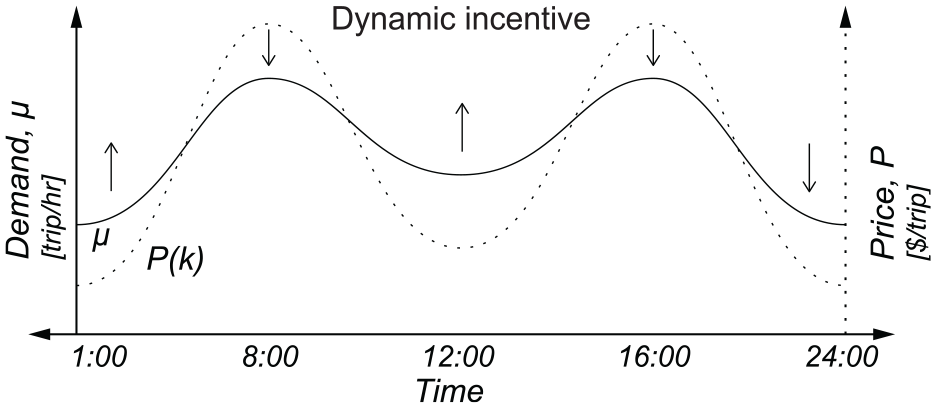
Dynamic toll pricing incentive.
A fundamental issue with dynamic pricing is uncertainty and lack of information. For example, if travelers have no information about future travel cost or time, they are unlikely to adjust their behavior. Thus, price changes will have little effect on demand in the short-term. Dynamic pricing ultimately depends on a feedback loop whereby a change in price results in some change in demand. To economists, this is called the price elasticity of demand, where elasticity reflects the sensitivity of price to demand as a proportional change in demand to a change in price ( 18 ). Automobile travel is relatively inelastic ( 19 ). This is because of a variety of exogenous factors, such as housing location choice, personal investment in an automobile, land-use context, and lack of travel alternatives ( 20 ).
In practice, travelers often base their travel decisions on a combination of current traffic conditions and anecdotal evidence of past experiences, speculating future traffic conditions. However, this is hardly efficient and only works in relatively steady-state conditions. As a result, the price elasticity of automobile travel demand remains relatively weak compared to other modes (e.g., rail or air travel). The effectiveness of dynamic pricing is dampened by travelers’ inability to avoid congestion. Moreover, price elasticity can vary by a variety of factors, such as time of day because of departure and arrival time inflexibility ( 21 – 23 ).
Looking beyond automobile transport, insight can be drawn from industries with more mature dynamic pricing systems. In the era of airline price deregulation in the 1980s, the first airlines to adopt dynamic pricing were able to out-compete their less efficient rivals. To date, most modern airlines rely on sophisticated dynamic pricing systems of some kind. More recently, it has been shown that airline ticket elasticity increased with the proliferation of telecommunications and online ticket sales ( 24 ), demonstrating the correlation of increased prior information and increased elasticity.
In an effort to increase the efficiency and social impact of dynamic pricing systems, there is a growing body of literature proposing heavy-handed, market-based approaches to congestion pricing, such as “travel permits” ( 25 ). Primitive travel permit systems have existed for decades where vehicles are only permitted to travel at certain times or locations, such as odd–even rationing or peak-hour permits ( 26 ). Odd–even rationing was first implemented in the U.S.A. during the 1979 oil crisis. Vehicles were only permitted for use on alternating odd–even days of the month corresponding to the last digit of their license plates. For example, a license plate ending with an odd number can only be driven on odd days.
Some governments have instituted a more targeted rationing scheme, such as the Singapore Area Licensing Scheme where drivers are required to purchase special permits to enter the central city during certain times ( 27 ). The licensing scheme successfully operated from 1975 to 1998, when it was replaced with an electronic road pricing (ERP) system that automatically charges drivers depending on both time and location ( 28 ). The ERP system enables the transportation agency to optimize infrastructure utilization throughout their entire road network, not just a single link or zone. Singapore also famously set a quota on the number of automobiles that can be registered. Creating scarcity, the bidding-based system has resulted in extremely high costs of up to US$7000–44,000 (S$10,000–60,0000 in Singaporean dollars) just to own and operate a vehicle. In perspective, this is approximately 12 times the median monthly household income.
Although highly effective at reducing the number of automobiles, scarcity of resources in any scheme can lead to severe equity imbalances if alternatives do not exist. Fortunately, transit options are plentiful in the dense city-state of Singapore, but such is not the case elsewhere, such as in the U.S.A. Opposition often cites inequity risk as a reason not to implement dynamic pricing systems from both ends of the political spectrum ( 29 – 31 ). One potential mitigation scheme introduced by Kockelman et al. is a “travel credit” scheme where all travelers are issued credits to use toward congestion pricing ( 15 , 32–34). This not only provides all users an equal quantity of travel, but also enables credit adjustments based on income/wealth class. Moreover, credits could be used in the higher-level “cap and trade” model, essentially crediting people for not contributing to congestion or pollution ( 17 ). Unused credits can then be redeemed in some form, such as conversion to currency or tax offset. To further combat inequity, credits can be allocated based on a variety of equity-based models ( 35 , 36 ), such as rewarding carpooling ( 37 , 38 ) or using alternative modes, such as transit or bicycling ( 39 ). A further market-based evolution of the travel credit scheme is to enable travelers to “sell” their trip rights to the highest bidder, achieving a similar goal without the need for governments to convert credits ( 40 – 43 ). In a fully realized system, a network-based travel credit scheme can optimize travel based on network capacity in the entire network ( 43 – 47 ). However, such a system would be difficult to implement because of public resistance in most western democracies ( 15 , 16 ).
Recently, more exotic concepts have been being proposed, such as mobility as a service (MaaS) and transportation as a service (TaaS). In these frameworks, automated “travel brokers” provide integrated multi-modal trip packages to travelers ( 48 – 51 ). However, the highly fragmented transportation industry makes implementing an integrated pricing and booking system extremely challenging, leaving MaaS/TaaS with little traction outside of the academic literature ( 52 ). However, some large technology companies have implemented MaaS-like multi-modal payment integration features in their platforms (e.g., integrated mobile payment with transit and ride hailing services), potentially laying the groundwork for MaaS/TaaS in the future. Relating to futures markets, work by Geddes et al. ( 53 – 55 ) further develops the concept of MaaS into a regulatory policy framework where MaaS is a wholesale purchaser of future roadway capacity in a bid-auction-based scheme. The scheme draws concepts from electricity markets, where an independent system operator (ISO) works on the public’s behalf with the goal of maximizing the value roadway capacity.
In contrast to previously discussed ideas, such as travel credits and travel permits, this article proposes an opt-in futures market to augment existing deployments of conventional revenue collection technologies (e.g., automated tolls and electronic fares). The proposed futures mechanism is not necessarily a radical new concept, nor is it a technologically driven paradigm shift, but rather is a promising concept to overcome the political barriers of road pricing while improving price elasticity and addressing equity concerns. The objective is to enhance pricing information transmission and purchasing options for travelers in a way that incentivizes positive behaviors. The purpose of this article is to explore potential outcomes of such a concept by conducting a sensitivity analysis of price limits and elasticity.
Conceptual Framework
The basic concept for the system is shown in Figure 3, where travel demand (e.g., on transit, over a bridge, along a corridor, or in a zone) can be divided into discrete travel windows (e.g., between 8:00 and 8:15 a.m.) where there is a finite quantity of capacity available (e.g., a road capacity of 2000 vehicles per hour per lane). Travelers then have the option to pre-purchase a planned trip from the available capacity, with prices increasing as the number of booked trips in that spatio-temporal window increase. This encourages travelers to avoid traveling during those peak periods as the price increases toward capacity, or to purchase trips in advance while the price remains low or discounted. Otherwise, travelers that do not pre-purchase their trip are subject to the real-time market price, or spot price, determined by dynamic congestion pricing.
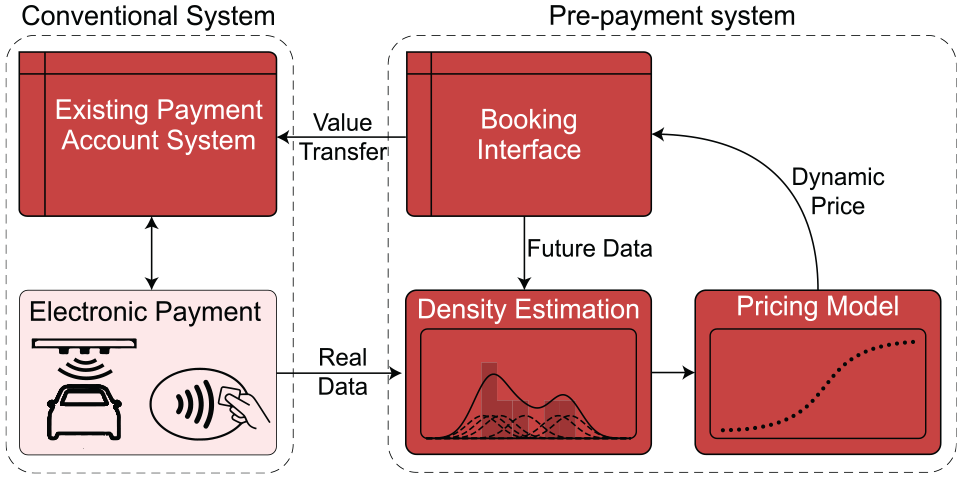
Conceptual system model.
The overall process of booking, density estimation, and then pricing is continually updated until the horizon of the future trip time or some cut-off period is reached. At this point the sale of future trips in the “futures market” is closed to booking and any additional trips must be paid at the spot price based on the actual observed traffic density. It is possible, and likely, that there will be a difference between the futures price and the spot price. This difference is the motivating force behind real futures markets: for buyers to try beat the market price, and for sellers to create stability of demand in exchange for a discount by locking buyers into a contract. In this case with transportation, as opposed to commodities such as oil and grain, there are two possible outcomes for price differences.
Futures rate < actual rate. This occurs when too few people book trips, having limited congestion mitigating effects until sufficient market penetration is reached. Pre-booked travelers would yield a large discount against the conventional toll, thus incentivizing more travelers to adopt the booking system, eventually correcting this difference and increasing congestion mitigation effects.
Futures rate > actual rate. Although highly unlikely, but still possible, this occurs when too many travelers fail to meet their target window or did not show up at all. The travelers would incur a loss on their booked trips, thus incentivizing travelers to be punctual.
A basic booking interface could be a website or app where users can pre-pay for their trip during a specified time window. The same concept exists in other ticketed transportation modes, such as airlines and rail travel. The system can then be easily integrated with existing toll collection and payment systems where the pre-purchased trips are exchanged as a toll/fare waiver.
Trip Booking
The overall objective is to increase prices when too many travelers try to occupy the same time and space in a transportation system. One approach is to discretize time into convenient time slots, such as 1, 5, or 15 min intervals. Each time slot becomes tokenized for purchase, with the price of each time slot varying as demand approaches capacity (see Figure 4). When travelers book their desired time window, they effectively purchase a sequential bundle of time slots. For example, a time window from 8:00 to 9:00 a.m. could have 60 slots at a 1 min duration or four slots at a 15 min duration, depending on the time discretization.
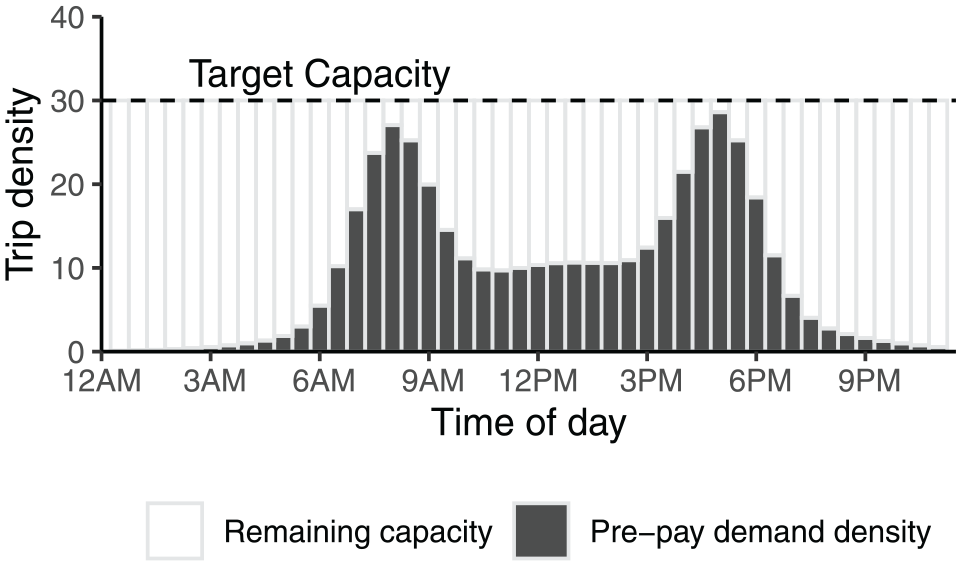
Capacity across discretized time.
The total purchase price is the sum of token prices across that time window. From this, a variety of pricing policies could be implemented. For example, travelers only pay for the actual time slot they use and are reimbursed for the remainder. Alternatively, the total cost of a typical time window (e.g., 30 min) could be calibrated to have a nominal total cost comparable to a typical toll.
A potential problem with rectangular windows is safety concerns from the psychological effects on drivers attempting to avoid missing the window. For example, a driver who is running late and risks missing the window would be financially motivated to drive aggressively to avoid losing the discount. One approach to avoid this undesirable outcome is to allow drivers to purchase non-rectangular (e.g., Hann, Gaussian) time windows with some target arrival time and some width, as illustrated in Figure 5. In this scheme a window function can be used to provide a slowly diminishing discount the further they arrive from their booked arrival time. The price could be calculated as a convex combination of the booked and spot prices:

where
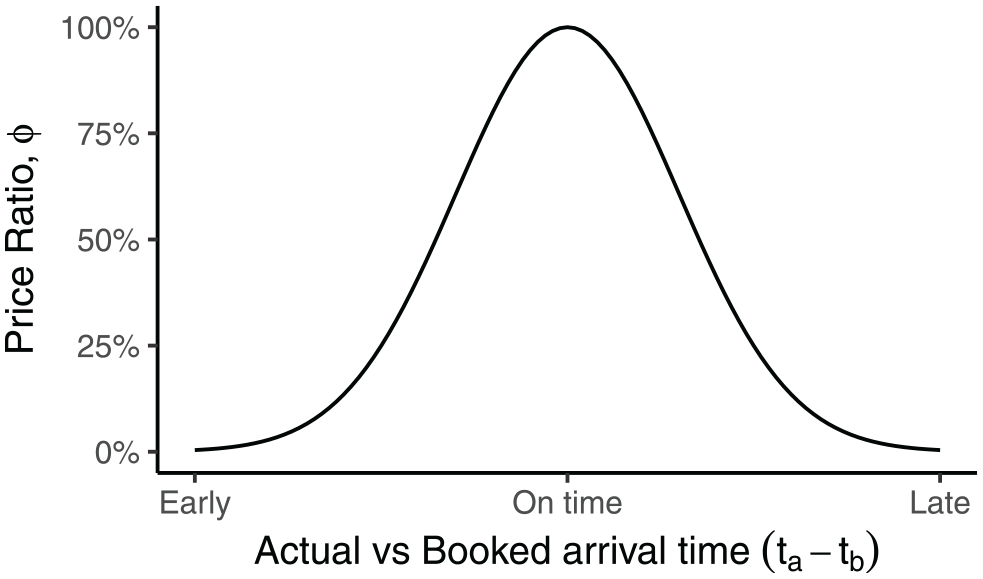
Smooth price window function.
Trip Density
A notion of trip density is introduced to convert the demand captured by the number of pre-booked trips into a smoothed representation of “presence” on the transportation facility. This notion of trip density will be used to determine prices, and it is better for it not to be wildly discontinuous. One solution is to smooth the discrete trips using kernel density estimation (KDE), converting the discrete values into a continuous function of expected trip densities. There are a variety of KDE kernel types, but a common approach is to use a Gaussian normal curve to smooth the arrivals:

where
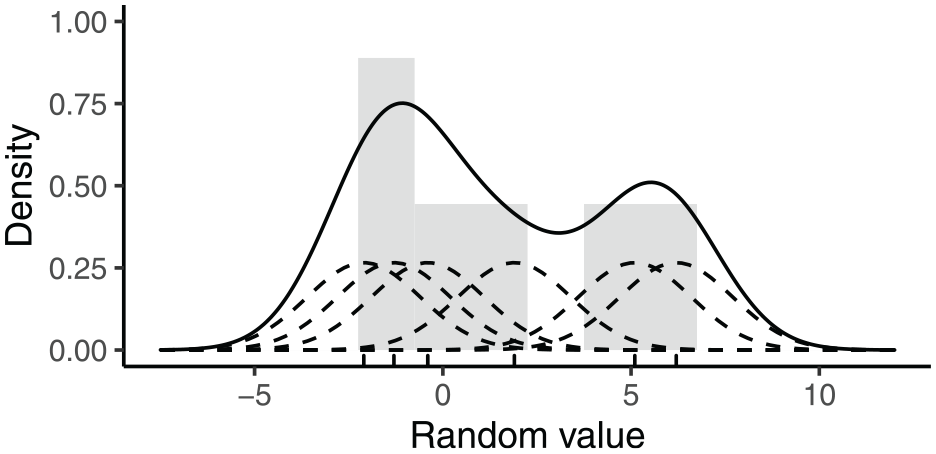
Kernel density estimation using the Gaussian function.
The modular nature of KDE is useful in this context, especially if the arrival distribution is complex, in which case a more suitable kernel can be utilized. For example, Figure 6 demonstrates KDE using a normal distribution as the kernel. If arrival times are skewed (e.g., drivers are more often early than late or vice versa), then a log-normal function could be utilized.
Pricing
Once a smooth and stable value of future traffic density
As opposed to using traffic speed or traffic flow as the target measure, traffic density provides an ideal dependent variable for pricing. While the objective in certain cases (i.e., roadways) is to maintain smooth traffic flow and speeds, a dynamic pricing function based directly on traffic speed or flow would fail to capture the underlying infrastructure utilization. Traffic speed is not a reliable measure of utilization, as speed will remain relatively constant (i.e., near the speed limit) across a range of traffic densities. Speed only begins to fall when traffic reaches a critical density and conditions deteriorate into congestion. This makes it difficult to set prices based on speed, because pricing would be flat below this critical point, then suddenly jump when congestion occurs. Moreover, traffic flow is also an unsuitable measure as it has a U-shape form where uncongested high-speed and low-density conditions can achieve the same throughput in vehicles per hour as a congested low-speed and high-density situation. This makes it difficult for a pricing function to distinguish between under- and over-saturated traffic conditions. Thus, basing the pricing on density provides a reliable measure of infrastructure utilization across a range of traffic conditions.
The pricing function itself could be a simple linear or monotonically increasing function, but it may be beneficial for political reasons to set upper and lower price constraints on a dynamic pricing system. Rather than using a piece-wise function, the smooth and bounded pricing function shown in Figure 7 uses an S-shaped sigmoid as a function of trip density
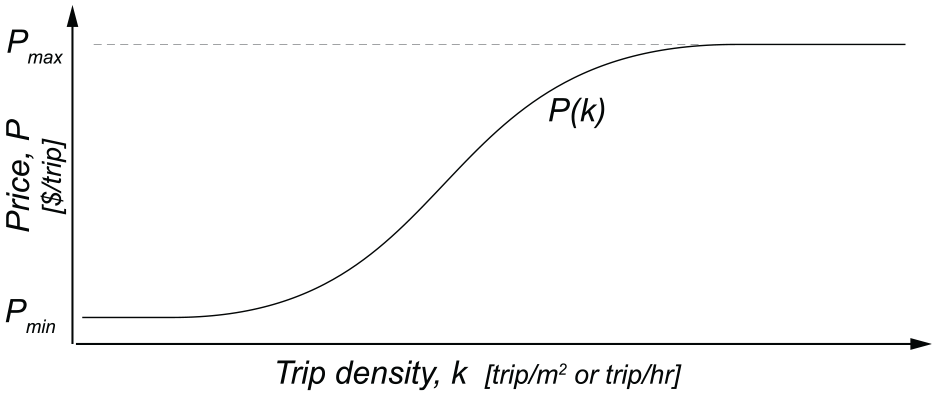
Pricing sigmoid function.
The sigmoidal price function provides natural parameters for price minimum

where
The sigmoid function provides the purchase price, but this price can also vary depending on the actual arrival time of drivers. If drivers fail to meet their booked time window, it would be unfair to other punctual drivers to still provide the full discount. This, however, can be softened using the aforementioned arrival time pricing window function, as shown in Figure 5.
Methodology
Although there are dual objectives for dynamic toll pricing—revenue generation and delay reduction—the goal of this study is not to formulate bi-criteria optimization, but rather to explore and evaluate possible outcomes through simulation. Through simulated parameter exploration, a sensitivity analysis is conducted on the proposed framework by varying the lower price limit,
a fixed-parameter example case;
exploration of how varying the upper and lower price limits affects total delay and revenue; and
exploration of how changes in elasticity affect total delay and revenue.
The purpose is to explore how different upper and lower price limits can affect revenue and delay outcomes. Moreover, the importance of exploring price elasticity is that increasing the price elasticity through a pre-pay “futures” market could enhance both the revenue generation and delay reduction benefits of dynamic tolling. The following sections describe the price elasticity of demand and the macroscopic traffic flow model used for simulation.
Price Elasticity of Demand
To simulate the resulting demand shift from pricing, the simple micro-economic principle of price elasticity of demand is utilized. Elasticity,
Although temporal variation in transportation elasticity is caused by a variety of complex socio-economic and behavioral factors, a simple explanation is that it takes time for people to adjust their behavior depending on conditions in their lives ( 23 , 56 ). For example, housing choice and automobile ownership are long-term decisions. If the fuel prices rise, people cannot easily move homes or purchase a more fuel efficient car. However, the objective of the proposed travel pricing futures market is to increase elasticity by giving travelers some of the advantages typically associated with longer-term travel behavior. That is, to be able to compare prices well in advance, rather than speculating future traffic conditions based on anecdotal evidence. For this simulation, a constant isoelastic price–demand function is used, which can be expressed as follows:

where
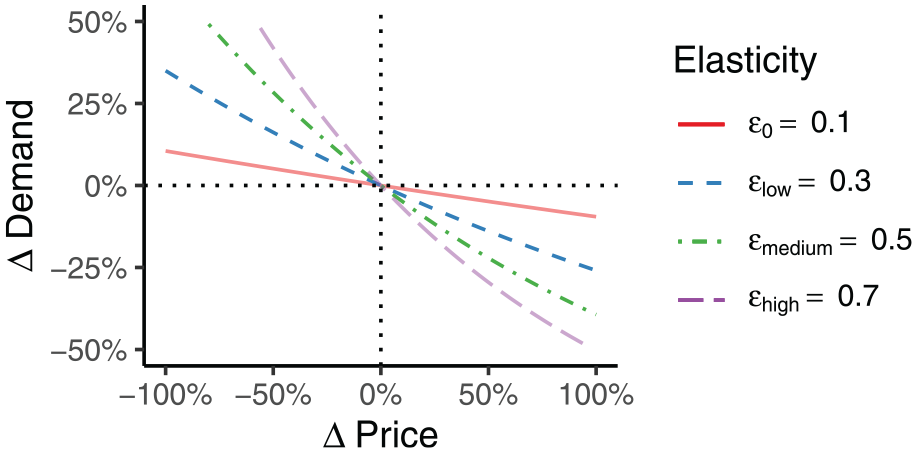
Price elasticity.
Traffic Flow
To account for congestion impacts, the traffic flow across a facility, such as a bridge, can be characterized by a fundamental diagram. Two common classical models that require no additional calibration parameters are Greenshields et al.’s ( 57 ) parabolic function and Daganzo’s ( 58 ) simple bi-linear model, as shown in Figure 9.
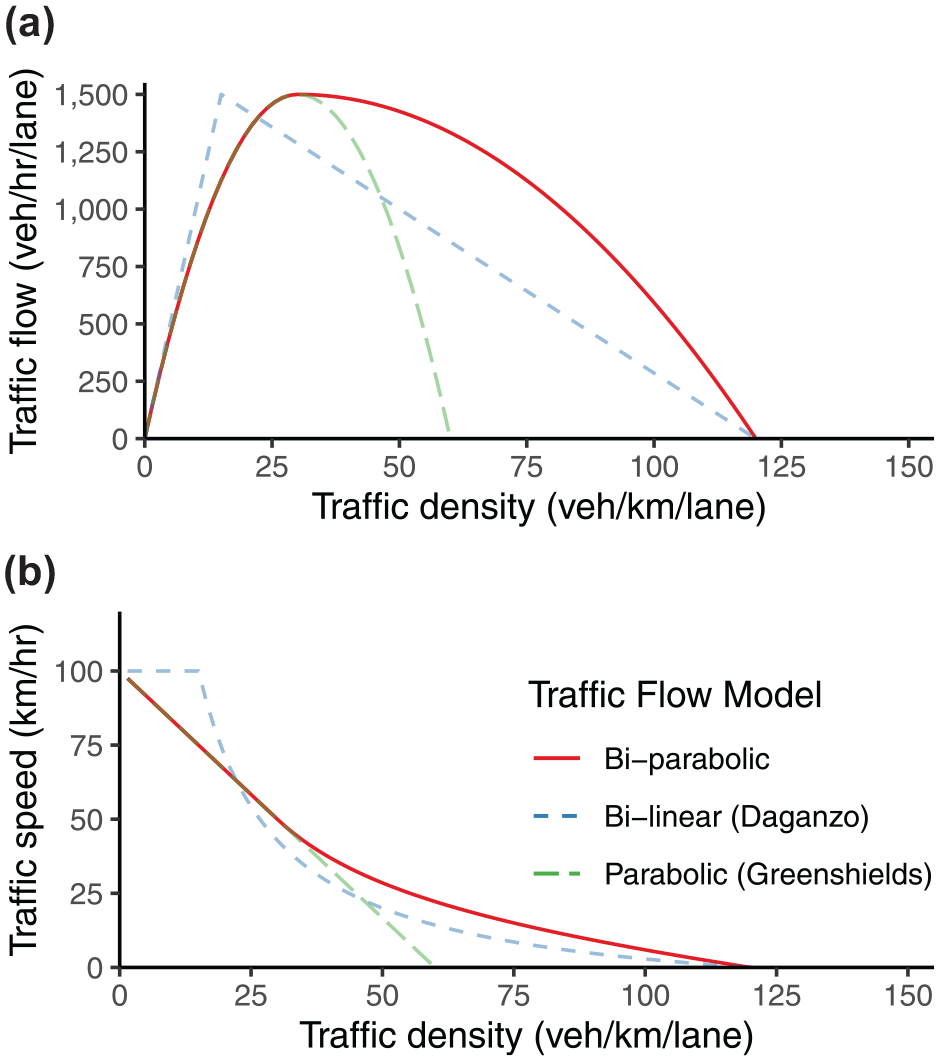
Macroscopic fundamental diagrams: (a) flow–density functions and (b) speed–density functions.
Greenshields et al.’s (
57
) seminal function is elegantly simple, but its symmetric parabolic shape has since proven a poor fit in reality, particularly when the critical density,
The bi-parabolic function, employed in this study, is a combination of both Greenshields et al.’s ( 57 ) and Daganzo’s ( 58 ) models. It is not the most elegant or precise model, but it satisfies the needs for this simple simulation as being parsimonious, requiring no additional calibration parameters, and containing no abrupt transition between free-flow and congested regimes. The modified piece-wise function is composed of two different parabolic functions to provide a more realistic asymmetric form observed empirically, as illustrated in Figure 9a, while avoiding any abrupt transitions, as shown in Figure 9b. The piece-wise bi-parabolic function can be described as follows:
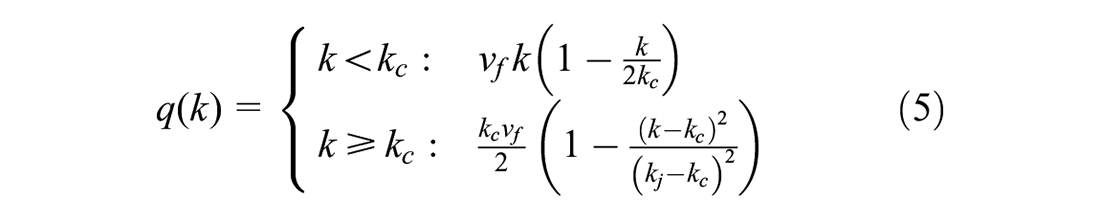
where
The free-flow regime corresponds to
Performance Measures
Although a variety of alternative performance measures exist in practice, such as vehicle miles traveled, energy consumption, greenhouse gas emissions, and so forth, this study focuses more narrowly on the primary operational outcomes of revenue and delay. Revenue is simply calculated as the sum of the products of demand,

Similar to revenue, operational performance can be evaluated with respect to delay. The total delay in each scheme can be compared as the percent change in aggregated total delay,

where delay is
Results
The results are organized as follows: firstly, a fixed-parameter example case is tested to demonstrate the model in a simple scenario. Next, a sensitivity analysis of delay and revenue is conducted by varying the upper and lower price limits. This illustrates how setting the upper and lower price limits can affect revenue and delay outcomes. Similarly, a further sensitivity analysis is conducted by varying elasticity to see how greater changes in elasticity can affect revenue and delay.
Simulation Case—Fixed Parameters
For contextual orientation, a simple case example provides context for discussion and also in selecting reasonable parameter ranges. As an example application, suppose there are two adjacent urban centers in a metropolitan region, as shown in Figure 10, which are separated by a body of water. The two cities are connected by a bridge that carries 100,000 trips per day with an existing fixed toll.
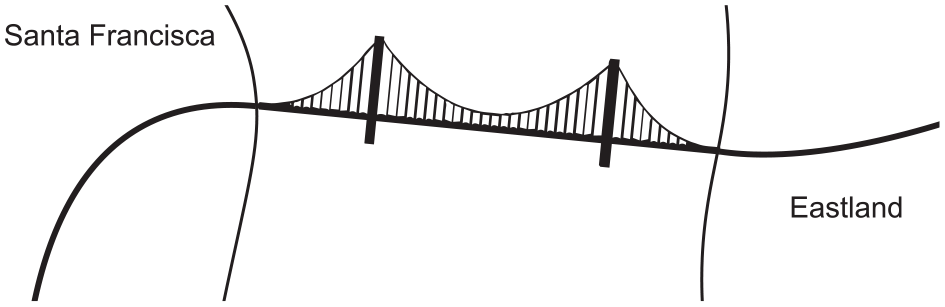
Example scenario.
The daily travel demand has a distribution with two severe peaks, as shown in Figure 11. For simplicity, assume the traffic flow is balanced in each direction and the bridge has three lanes in each direction.
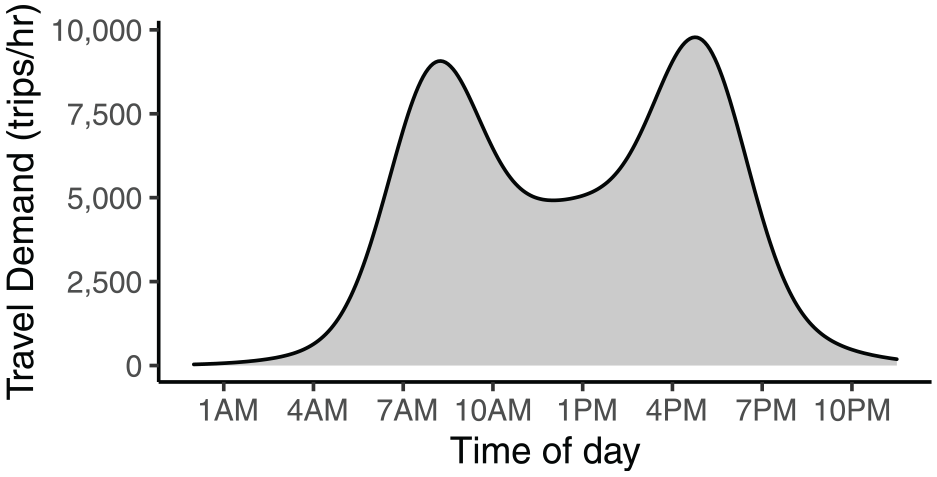
Example scenario demand distribution.
Suppose that the regional metropolitan transportation planning commission wishes to alleviate congestion during the peak periods with a dynamic tolling system. A study determines that the price elasticity of demand for a conventional dynamic tolling system without a pre-pay futures market is
Example Fixed Pricing Parameters
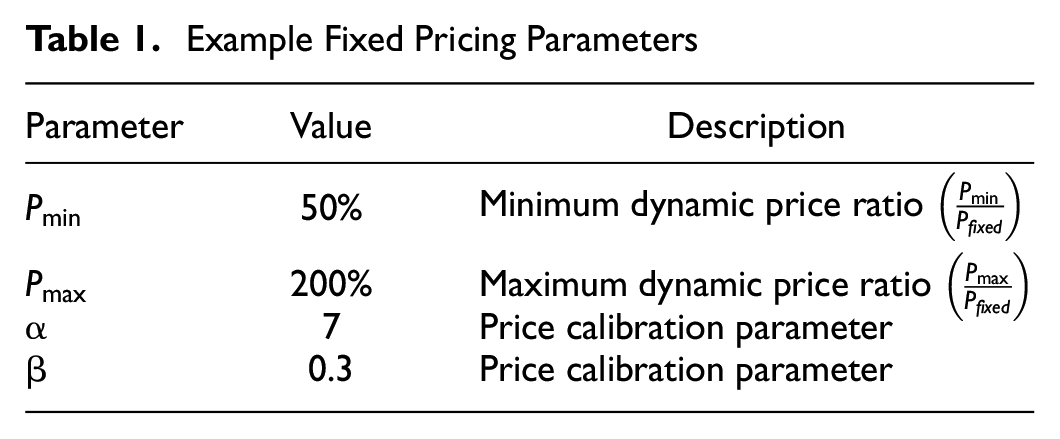
Calibration parameter values of 7 and 0.3 are set for
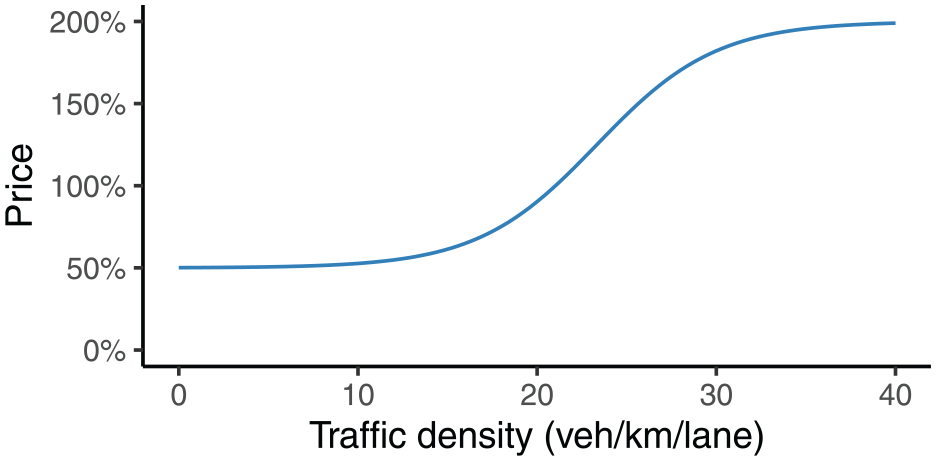
Pricing sigmoid function.
Using the parameters in Table 1, traffic conditions can be simulated to compare results between a dynamic pricing scheme against a fixed toll. The price changes cause demand to shift from the peak to the off-peak, resulting in a decrease in congestion and an improvement in average travel speed, as shown in Figure 13. Although there is a travel speed improvement in all cases, the magnitude of travel speed improvement depends on the elasticity. The greater the elasticity, the greater the improvement.
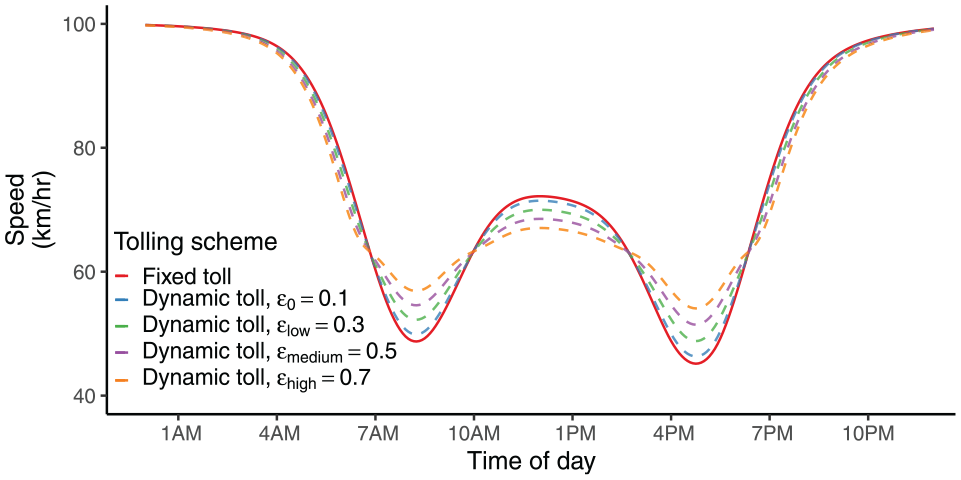
Average traffic speed by time of day.
The elasticity will not only determine how sensitive travelers are to price changes, but will also affect the aggregated total revenue collected. A revenue increase from a dynamic pricing scheme compared to a fixed price is not guaranteed and depends on the parameters selected in the pricing function. Ultimately, the revenue collected from a dynamic pricing scheme primarily depends on the elasticity,
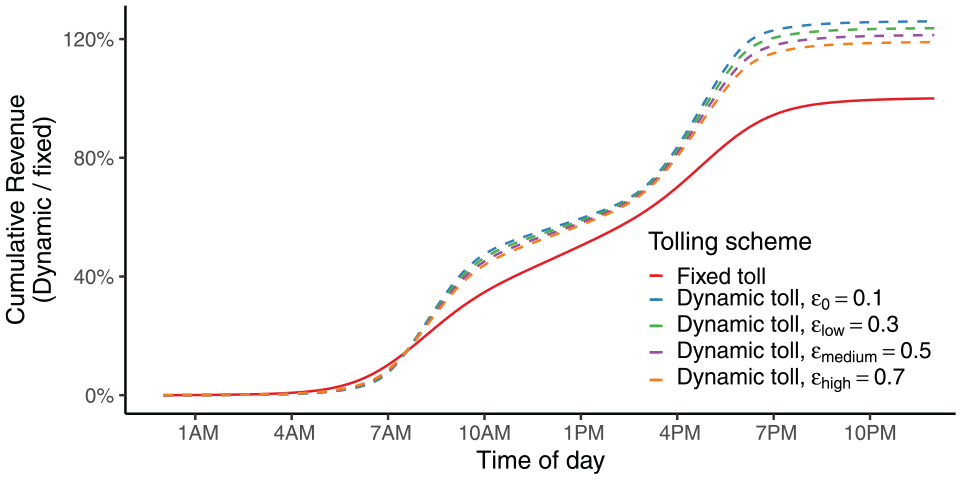
Cumulative revenue collection by time of day.
This shows that a modest adjustment in price results in a demand shift (i.e., commuters shifting behavior to avoid high tolls) without revenue loss. In this case, conventional dynamic pricing increased revenue by 26% over fixed tolls. However, as elasticity increases, this revenue gain is reduced slightly to 24%, 21%, and 19% for low, medium, and high elasticity futures market cases, respectively. The reason for this is that if travelers are more sensitive to price changes, fewer travelers are going to pay the higher prices and shift to cheaper off-peak times. There is a trade-off between improving congestion and increasing revenue, highlighting the critical nature of setting upper and lower price limits
Price Change Effects
To explore price and elasticity parameters, a simulation results matrix can be computed and plotted. The colorized results form the surfaces in Figures 15 and 16, which show the percent change in revenue or delay achievable by varying the combination of
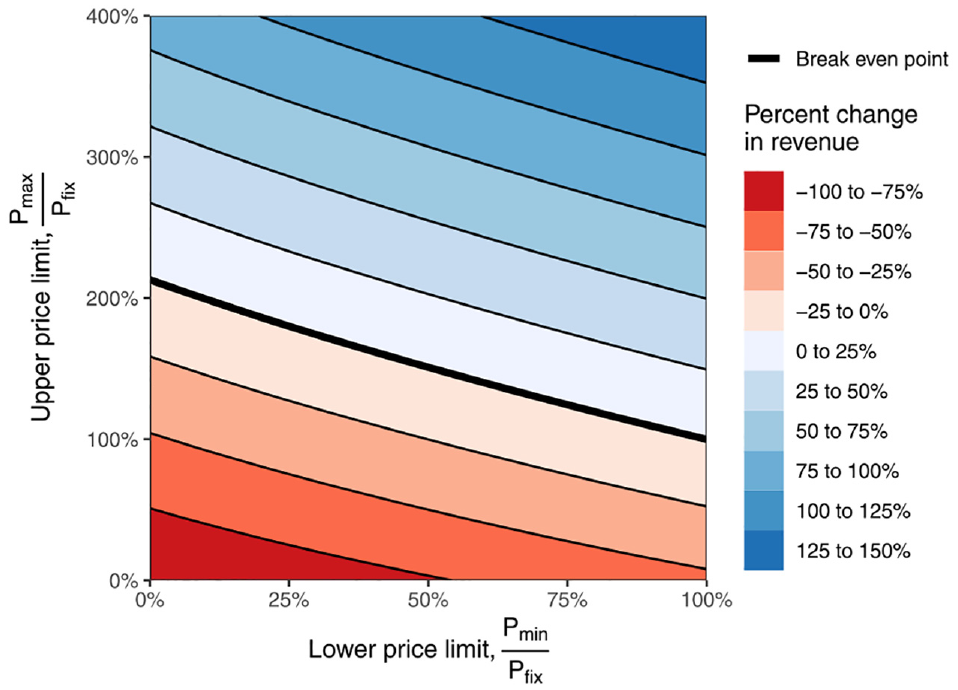
Revenue comparison between dynamic and fixed pricing varying
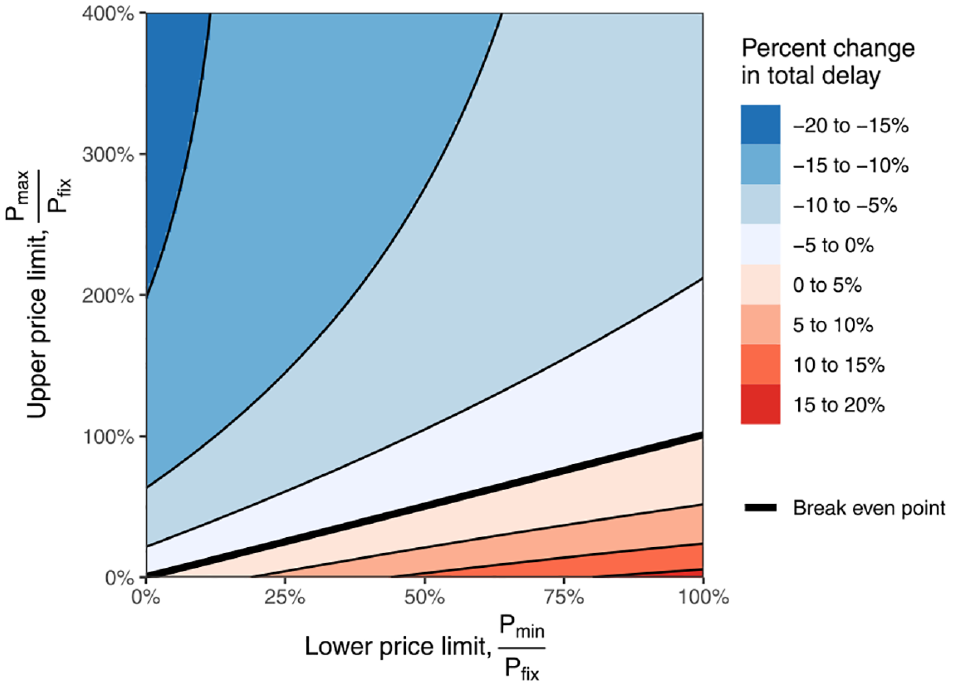
Delay comparison between dynamic and fixed pricing varying
Both Figures 15 and 16 show that an appropriately balanced combination of lower and upper price limits must be chosen. For example, if the lower price limit is decreased, then the upper price limit must be sufficiently raised to compensate for the lost discount revenue. This is a result of the relatively low elasticities (i.e.,
The dark solid lines in Figures 15 and 16 are the break even point where the upper and lower price limits balance out, resulting in 0% change in the objective of either revenue or delay. Extracting the break even lines and combining the two plots, the general regions of comparative gains are illustrated in Figure 17. The plot illustrates more clearly which regions provide improvements in both revenue and delay, only one, or neither.
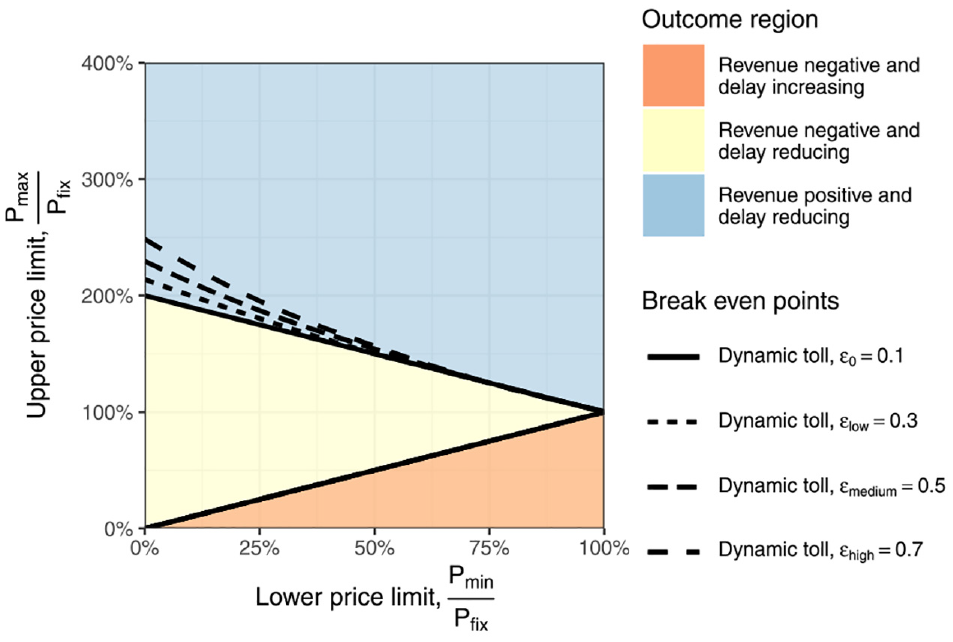
Break even points between dynamic and fixed pricing with constant elasticity of
It is apparent that congestion can be mitigated as long as
Elasticity Change Effects
Exploring how elasticity effects the revenue and delay outcomes, a set of plots can be similarly created by varying the maximum price and elasticity,
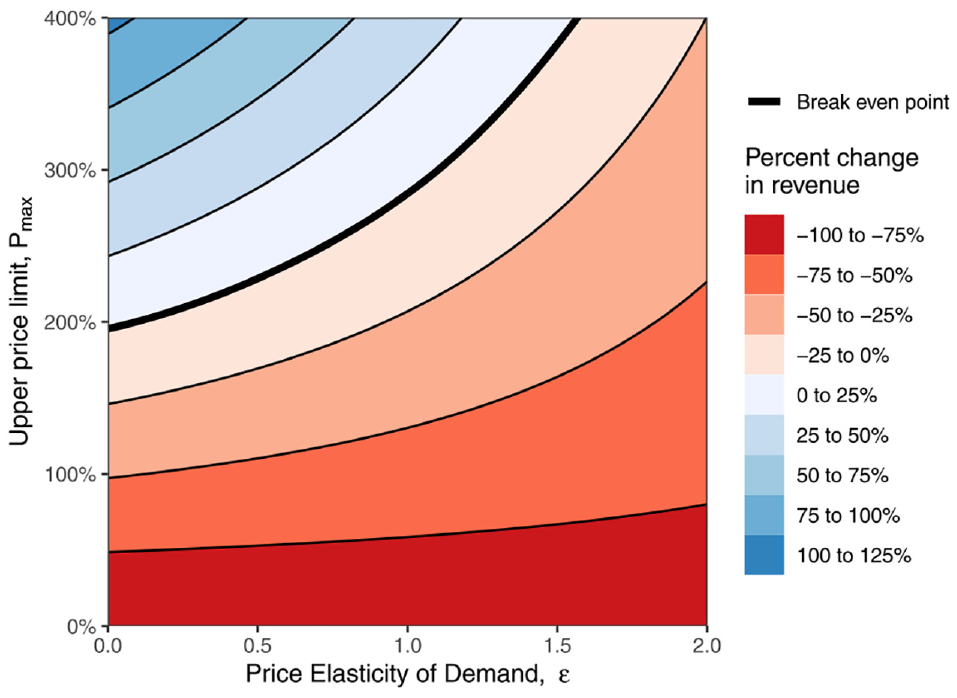
Revenue comparison between dynamic and fixed pricing varying elasticity
Figure 19 illustrates changes in delay as the upper price limit and elasticity are varied. The maximum performance benefits appear to be saddled around an elasticity of 1.0 and a maximum price above 100%. The saddle-shaped region is an interesting outcome, showing that there are diminishing returns as elasticity moves away from unit elasticity. In the most extreme case, where
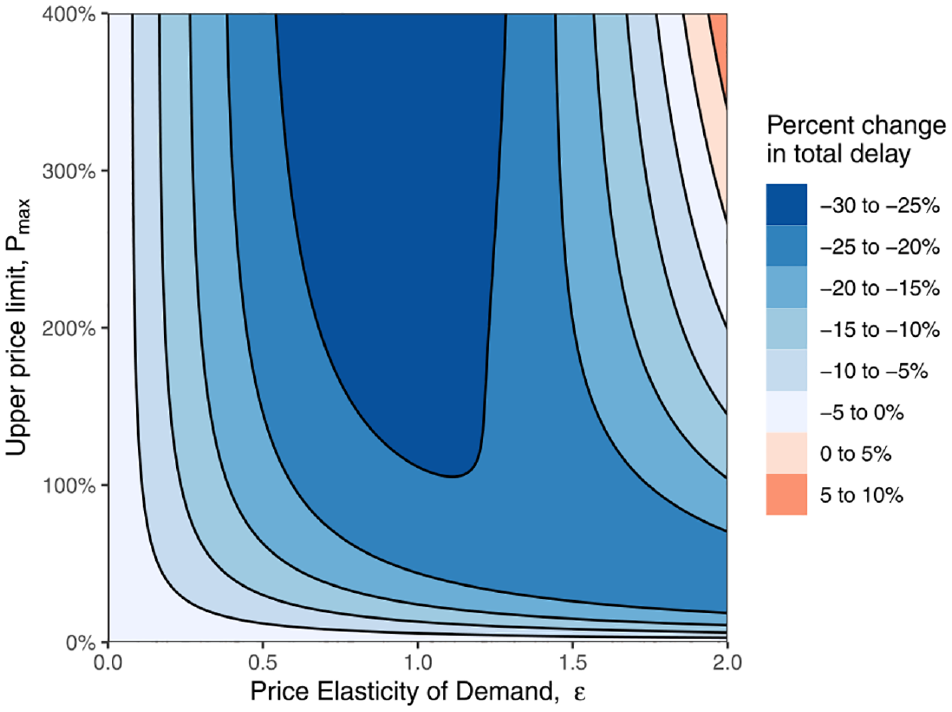
Delay comparison between dynamic and fixed pricing, varying elasticity
Discussion
An attractive feature of the futures market concept is that it can be developed independently, and implemented as an incremental improvement of an existing toll system. An existing dynamic toll system can easily be augmented with a futures market to further improve demand optimization with only software changes necessary. A fixed toll system can use a futures market to introduce dynamic pricing as an “opt-in” program, incentivizing users with discounts for booking travel during periods of low demand. Infrastructure investment would be minimal, especially if electronic tolling is already in place. A futures market in this case would be a soft way to introduce dynamic pricing in an otherwise politically hostile environment. In this case the futures market may result in revenue loss if the fixed toll, which is used as
Although this article presents the futures concept in the context of a simple bridge toll, it can easily be expanded to other applications, such as corridor tolls, congestion pricing zones, transit fares, ride hailing, or applications beyond transportation. When creating a new market, care must be taken to ensure operation is smooth, stable, and equitable. The following sections discuss several basic market safeguards and practical constraints.
Market Manipulators and Exploitation
The proposed market assumes the purchased trips are nontradable. This means that future trips cannot be sold back to the system or another party. This mitigates speculative behavior as there is little benefit to purchasing a trip at a discount and not using it. However, it is possible that users may fall into the “sunk cost fallacy” if they purchased excess trips at discount and feel pressure to take those trips beyond their normal behavior, potentially increasing congestion and vehicle miles traveled. In contrast, it could be argued that travel in this context is a dis-utility, and people are not likely to take leisure drives through congestion and that trips during non-peak periods are less of a concern. Regardless, further research in this area is necessary to understand real-world consumer behavior.
If unused trips can be “sold” back to the system, there is potential for profiteering. This would only cause undesirable price fluctuations in the system that do not correspond to physical infrastructure capacity and demand. To prevent users from inappropriately exploiting the system, restrictions should be set. For example, to prevent users from manipulating the market price, a practical restriction could be to limit users to purchase only one trip per time slot (otherwise it would be a travel impossibility), or to limit the number of sales a user can make to ensure a net profit cannot be made. Ensuring zero profit would also help avoid any user tax complexities. Although restrictions may seem market prohibitive, the intent of the system is to promote efficient travel and revenue collection, not market capitalization.
Beyond individual profiteering, large agents such as freight carriers or transportation network companies (e.g., ride hailing companies) could manipulate the market, for example by coordinating vehicle arrival to drive up the cost for their competitors. However, unlike other cases where this has occurred, such as with major airlines at airports, the far more atomized nature of roadway users makes it more difficult to manipulate ( 60 , 61 ). Still, it is worthy of regulatory consideration.
This article merely formulates and analyzes a futures market mechanism; it does not construct a policy or regulatory framework. Regulation and enforcement of such a system will need to be thoroughly drafted to prevent exploitation. Fortunately there are parallel markets from which to draw lessons learned, such as electricity markets with non-profit ISOs to oversee the market and ensure social welfare and public benefit ( 53 ).
Arrival Windows
While it is desirable to encourage punctuality, it is undesirable to cause drivers undue anxiety for missing their target arrival times. The system could be designed in such a way to allow for users to specify the desired width of their travel windows, offering greater discounts to more punctual travelers and proportionally lower discounts to those who are less punctual. Of course there are unforeseen circumstances, such as crashes or weather, that could affect a traveler’s ability to reach their target arrival window. These issues have an impact on both conventional dynamic pricing and futures markets alike. However, compared to a conventional dynamic tolling system where a user find themselves facing exorbitantly high prices because of crash-related congestion, a futures market affords some stability to the purchaser to lock in prices. Still, some additional considerations should be incorporated for catastrophic events in which travelers fail to meet their arrival window. More research is required to determine a window shape that provides an appropriate punctuality incentive.
Kernel Density Estimation
It is uncertain whether travelers are as likely to arrive early as they are to arrive late. If so, this can be modeled with a Gaussian normal curve. If travelers trend on being late but not early, then a log-normal curve might be a better choice. Research is needed to model accurately the relative reliability of travelers. This is helpful for selecting an appropriate kernel for density estimation, as this is the basis for accurate pricing.
Pricing Calibration
To avoid reaching outrageous prices and face a public outcry, the pricing function needs to be calibrated to match several criteria. Ideally the upper bound will be kept as low as possible to avoid public dissatisfaction, but high enough to achieve the desired shift in travel behavior. The lower bound must also be kept low enough to encourage a shift in travel behavior, but high enough to collect sufficient revenue. Further research is needed to measure elasticity variation in the long term as users become accustomed to the futures scheme. It is possible the pricing requires regular tuning to adjust for evolving user perceptions.
Conclusions
This article evaluated the revenue and operational benefits of a dynamic toll pricing “futures market” with a sensitivity analysis of the price elasticity of demand and pricing constraints. The sensitivity analysis was conducted using a simple elasticity-based simulation model in an effort to explore functional form and parameter effects. In addition to the sensitivity analysis, three novel concepts are introduced: a traffic density-based pricing model and continuous time horizons rather than discrete time slots, which enables soft arrival windows. These concepts, although academically trivial, are addressing some practical considerations for adoption.
Results from the sensitivity analysis show the following:
dynamic pricing is beneficial within most elasticity ranges (i.e., approximately
larger elasticity improves delay but reduces revenue; and
dynamic pricing can improve both revenue and delay within a feasible region of pricing boundaries.
This simple example showed strong potential improvements in both revenue and performance, but relies on several simplifications and assumptions, the primary being that elasticity may vary depending on a variety of factors, such as being on time, purpose, and individual preferences and flexibility. This is important to consider, particularly with regards to transportation equity when transportation costs increase over a heterogeneous population.
Another important element not considered is the possibility of overall demand suppression from pricing since travel demand is assumed to be constant. While dynamic pricing is intended to more efficiently utilize infrastructure capacity, it is possible that a pre-existing fixed toll has suppressed demand overall. Replacing a fixed toll with a dynamic toll may actually cause an increase in overall trips because of the newly available peak-hour capacity and the reduced priced off-peak trips. This could cause both positive and negative outcomes with regards to revenue and delay, as well as other endogenous outcomes, such as emissions and fuel consumption.
While simple micro-economic elasticities may often be too theoretical for practical use, they do offer general insight for policy analysis. It is clear from this simulation that the price elasticity of demand is critical to both congestion and revenue. Greater elasticity means travelers will more easily change their trip time, having a greater effect on delay, but it also means that more travelers will choose to travel at lower priced times, thus decreasing total revenue. Intuitively, this means that high inelasticity is good from a revenue perspective, but does little to mitigate congestion, and vice versa.
In practice, the simple price elasticity of demand may be too crude for day-to-day optimization. A more refined approach might be to calibrate the parameters with a bounded bi-criterion objective that seeks to optimize for revenue, congestion, or both, in a bounded region, such as that shown in Figure 17 but also accounting for variable elasticity. The pricing function itself could be modified from the symmetric sigmoid function to some custom optimized function using empirical data (e.g., use artificial intelligence to set prices to maximize the objective). The proposed booking system lends itself to such optimization, providing data of future demand to help best predict optimal prices, a feature unavailable in current dynamic pricing systems. Moreover, integration and revenue sharing policies with other modes, such as public transit, could yield wider benefits.
Footnotes
Author Contributions
The authors confirm contribution to the paper as follows: study conception and design: N. Fournier; data collection: N. Fournier; analysis and interpretation of results: N. Fournier, A. Patire, A. Skabardonis; draft manuscript preparation: N. Fournier, A. Patire. Project supervision: A. Skabardonis. All authors reviewed the results and approved the final version of the manuscript.
Declaration of Conflicting Interests
The author(s) declared no potential conflicts of interest with respect to the research, authorship, and/or publication of this article.
Funding
The author(s) disclosed receipt of the following financial support for the research, authorship, and/or publication of this article: This study was made possible through funding received by the University of California Institute of Transportation Studies from the State of California through the Public Transportation Account and the Road Repair and Accountability Act of 2017 (Senate Bill 1).

The contents of this report reflect the views of the authors, who are responsible for the facts and the accuracy of the information presented. This document is disseminated under the sponsorship of the State of California in the interest of information exchange and does not necessarily reflect the official views or policies of the State of California.