



Abstract
Despite years of legally mandated public engagement for transportation planning, there is often little evidence that this results in more equitable processes or outcomes. Recently, there has been interest in improving engagement by having community-based or advocacy groups design, lead, and implement public engagement activities. This research examines two separate engagement processes—one led by a public agency, and one designed and carried out by community advocates—to understand the opportunities and barriers for community-led engagement in transportation planning. We assess how these processes differed in: (1) representation of equity-deserving groups in respondents, (2) conceptualization of equity and community needs, and (3) transportation priorities identified in the surveys. While neither process fully reflected city demographics, the community-led process was more representative of equity-deserving groups. We found key differences in priorities between the community- and agency-led surveys, and by respondent identity. Areas that were identified as a high priority in the agency-led survey, such as traffic congestion, were lowly ranked in the community-led survey, as respondents prioritized safety and lower fares. Critically, community- and agency-led processes used substantially different framings of transportation equity, along with different understandings of community needs and experiences, which could have a significant impact on the development of future transportation plans. Community-led strategies require significant resources and capacity to undertake, but meaningful participation in the design and implementation of engagement processes has the potential to better engage a diversity of perspectives and reflect community priorities.
Despite years of legally mandated public engagement in planning, there is often little evidence that these processes result in more equitable engagement, particularly for transportation policy and investments ( 1 – 3 ). Many planning processes legally require some degree of public involvement, though, as noted early on, the “lower rungs” of participation only serve to give the perception of input in decision-making ( 4 ). There is an extensive literature on achieving meaningful engagement in planning processes (e.g., Innes and Booher, Bryson et al.), yet for transportation policy and projects there is often a “decide, announce, defend” approach, resulting in serious barriers to equitable participation ( 5 – 8 ). Although planning organizations may have goals related to equity, internal rules and norms can reproduce racial inequities ( 9 ). Community members can offer important insights, yet professionals often adopt a “deficit model” that sees the public as needing to be educated to participate in decision-making ( 10 ).
Recently, there has been interest in improving these processes and outcomes by having community groups, advocacy, and non-profit organizations design, lead, and implement public engagement activities ( 11 ). Examinations of meaningful public engagement in transportation planning show the potential for community-based organizations, with proper resourcing, to improve transportation equity outcomes ( 2 ). Scholars have pointed to the need to evaluate the performance of public engagement processes, and re-assess state-led processes which privilege specific types of data and provide only limited opportunity for meaningful change ( 12 – 14 ). Yet questions remain as to how community-led engagement processes differ from agency-led ones in their potential to improve equity outcomes, as well as the barriers and opportunities to these types of strategies.
This research examines two separate engagement processes—one led by a public agency, and one designed and carried out by community advocates—that were both aimed at informing the policy direction of a transportation master plan update. We chose a critical case study in Ottawa, Ontario, Canada, where city policy mandates an equity-lens approach, and local advocacy groups were committed to improving equity outcomes in transportation planning. Assessing these two processes in tandem allows for a better understanding of critical differences between agency- and community-led engagement, and the implications for equitable transportation outcomes. The community-led process operated from an inclusion framework that aimed to break down divisions between “process designer” and “process participant” ( 15 ). We draw on participatory action research (PAR) methods, including a co-designed public survey, and content analysis to address the following research questions:
How do community-led processes understand and assess transportation equity, and does this differ from agency-led engagement?
Do community-led engagement processes offer the potential for improved representation from equity-deserving groups?
What are the barriers and opportunities for integrating community-led engagement in formal planning processes?
We begin by describing the PAR method used for this research, which included the co-design and implementation of a community-wide survey. Using content analysis, we examine key differences in the design and implementation of both engagement processes, and analyze differences in the resulting participants and substantive responses. We find that the community-led processes led to a different framing of transportation equity, along with different understandings of community needs and experiences, that could have a significant impact on the development of future plans. We conclude by assessing the opportunities and barriers for integrating community-led engagement into agency-led processes.
Literature Review: Public Engagement for Transportation Planning
There is an extensive and long-standing literature on public engagement practices, examining the purposes of these processes and offering advice on their design, implementation, and evaluation (e.g., 4 – 6 ). While public participation may be undertaken solely because it is legally mandated, it can also be motivated by democratic ideals and a desire for inclusiveness, or to advance social justice, such as by improving equity in how services are distributed, or diversifying influence over decision-making ( 6 ). The integration of local knowledge is important not only for procedural democracy—through the inclusion of previously excluded participants—but also in providing technical insights based on different types of evidence ( 10 ). Plans that are developed using a multi-pronged approach to public participation are found to be significantly more focused on equity, though it is unclear if this is related to issues brought forth during engagement or the existing orientation of organizations ( 16 ).
Public Engagement With Diverse Communities
Given the importance and potential of public engagement processes, much research has focused on how to improve these practices. Specific tactics can be used to increase representativeness and diversity in participants, such as through multiple methods of participation, better advertising, providing childcare and transportation, choosing accessible locations, and offering translation ( 6 , 17 ). Some models of participation argue for collaborative processes that involve multiple types of actors and are aimed at building civic capacity ( 5 ). Others have emphasized the need to allow for co-production rather than specific best practices, which can address the power disparities in traditional public engagement practices ( 15 , 18 ). Despite the conflation in discussions of public engagement, there are key differences between participation, which is focused on increasing input on the content of programs or policies, and inclusion, aimed at building ongoing community capacity ( 15 ).
Despite this scholarly focus, engagement processes often display a lack of basic knowledge of diverse communities and continue to use practices that have had limited success ( 1 ). Strikingly, in Loh and Kim’s study of comprehensive plans in one state, only 1 out of 42 plans discussed efforts to engage historically marginalized populations ( 16 ). In addition to issues with processes, the outcomes of engagement are rarely evaluated for their effectiveness ( 19 ). As a social practice, public participation processes reflect their designers’ view of social realities, which can be “particularly problematic when the designer has a history and lived experience that are part of a dominant group… and sets the community norms” ( 20 ). As noted more broadly, racial inequality can be reproduced in planning departments’ internal rules and norms, such as through race-neutral analyses and providing fewer resources for projects that serve people of color, ultimately hampering organizational goals related to equity ( 9 ).
Engagement for Transportation Planning
In addition to the considerable literature on public engagement in planning, recent research has focused specifically on transportation processes, including with specific attention paid to issues of equity and justice ( 2 , 12 , 17 , 21 , 22 ). Public consultation can be evaluated in relation to its accessibility, use of engaging interactions, and link to decision-making, though this does not account for differing experiences and perceptions of accessibility, particularly for equity-deserving groups ( 12 ). While public engagement is often seen as a single step in the transportation planning process, it should be an ongoing process, and at the very least occur before plans are established ( 3 , 23 ). For populations considered hard-to-reach, tactics such as addressing concerns about privacy and reducing language barriers can increase participation ( 24 ).
Despite the interest in refining engagement strategies, issues have been linked to the types of knowledge valued in transportation planning. Local knowledge is distinguished by how it is gathered, what makes it credible, and how it is tested (such as through tacit awareness, life experiences, and cultural mediation), and this is often discounted as not “expert knowledge” ( 10 ). With much transportation planning historically centered on the “predict and provide” model—estimating future travel demand and providing infrastructure to support it—there has been little room to include different types of knowledge, including embodied or local knowledge ( 21 , 25 ). Just as designers of public engagement processes are influenced by their lived experiences, so too are transportation planners and transportation researchers, with positionalities that often do not reflect diverse communities ( 20 , 26 , 27 ). This applies to data collection as well, with traditional methods, such as household activity surveys, demonstrating an “institutional logic that prioritizes certain ways of understanding and experiencing mobility that is, by default exclusionary” ( 24 ). Limited funding and a lack of clear goals about the purpose of consultations further compromises engagement processes ( 12 ).
Given the gaps between public engagement and how local knowledge is valued in transportation planning, other strategies call for more a fundamental reconceptualization as to how engagement is conducted. Deeper strategies are required, such as involving community members in shaping the design of data collection tools, especially given the lack of trust in government agencies ( 24 ). While institutional contexts and the privileging of quantitative data reduces the input of community members, this can be challenged by explicit attention to equity-deserving groups and context-sensitive measures ( 21 ). Critically, transportation engagement often does not distinguish between different “publics,” favoring the ease of engaging with special interest groups at the expense of more disadvantaged groups ( 3 ). Meaningful engagement processes require agencies to respond to the needs of equity-deserving groups, as well as provide appropriate resources to support community participation and address identified needs ( 2 ). Community-initiated processes can be successful at improved equity outcomes, and in some cases, partly adopted by official agencies ( 22 ).
Research Methods and Context
This research was co-designed and facilitated by a group of community advocates. The Healthy Transportation Coalition, an umbrella group of 36 organizations, has been actively involved in advocating for more equitable transportation investments in Ottawa, and were interested in ensuring that equity was an integral part of the proposed Transportation Master Plan update. From 2018 to 2020, this project used PAR methods, with academic and community partners working to co-develop the research goals, tools, and implementation. PAR is premised on the involvement of “the conventionally ‘researched’ in some or all stages of research, from problem definition through to dissemination and action” ( 28 ). In addition to placing emphasis on the insights of community collaborators in shaping research design, PAR is oriented toward social change, such as through capacity-building for team members, and aiming for research outputs to have meaningful impact for community members, and this was the guiding framework for this research ( 29 ).
The research team included academic partners, non-profit organization staff, and a Community Leaders Steering Group, comprised of community advocates that identify as part of an equity-deserving group (8–12 members). For this research, members of the Healthy Transportation Coalition were involved in designing the research proposal and funding application, recruiting members for the Community Leaders Steering Group, identifying knowledge-building opportunities, and establishing dissemination goals. Members of the Community Leaders Steering Group developed key priorities for the research, developed the research tools, implemented the survey, participated in capacity-building workshops, and reviewed the findings. Community members were compensated for their roles in the project. The academic researchers supported the research design and implementation, and led capacity-building workshops.
As a key goal was to better understand the transportation needs and priorities of people from equity-deserving groups, we developed and implemented a community-wide survey. The survey was available online, as well as collected in person and through distributed paper copies, with 450 people completing the full survey. Members of the Community Leaders Steering Group were integral in promoting the survey, including distributing paper copies in libraries, collecting responses at community centers and at bus stops, assisting people interested in filling out the survey, and promoting it to their networks. As discussed below, the survey was intended to capture the views of people from equity-deserving groups, justifying this targeted recruitment method. The survey asked questions about priorities and goals for transportation investments, participation in transportation engagement events, and how equity in transportation investments should be assessed, as well as identity and mode questions.
As in other jurisdictions, there are legal requirements for public involvement. The minimum standard set out in the Ontario Planning Act requires municipalities to hold at least one public meeting, one public open house, and one special meeting of council (open to the public) for new or updated official plans. Transportation master plans are not included in this mandate, but may seek to meet the requirements of Municipal Class Environmental Assessment (MCEA), which requires two public meetings. While this is the minimum requirement, many municipalities do more extensive consultation. To assess city-led engagement, the authors undertook a content analysis of documents related to survey engagement process and outcomes. While public consultation included different aspects (such as stakeholder workshops), to allow for comparison we limited our analysis to the two public surveys conducted from 2019 to 2021. We identified and analyzed two documents which report on the engagement processes, including recruitment methods, survey questions and summarized responses, and demographic information of participants ( 30 , 31 ). We used a directive coding strategy drawing on concepts identified in the literature on transportation equity and engagement, including outreach to underrepresented and marginalized groups, data reporting, and understandings of equity ( 32 ). One limitation is that the second phase of the city-led survey occurred after the start of the Covid-19 pandemic, which limited distribution methods (online only), and may have affected responses. The first city-led survey was undertaken before the pandemic which allows for comparison of respondent representativeness but did not include any questions related to equity.
Findings
Representation in Survey Design and Reporting
As noted above, a key issue in public engagement is the participation of traditionally under-represented communities, and there is much guidance on designing engagement to be more inclusive and representative (e.g., 12 , 24 ). To explore this, we assessed: (1) how engagement processes were designed with respect to fostering participation from equity-deserving groups, (2) how representative the resulting participation was, and (3) how this was addressed in the reporting of engagement processes.
Overall, community-led and city-led processes varied in inclusiveness in implementation and outreach to equity-deserving groups (see Table 1). All three surveys were opt-in—they were not directly distributed to participants, but publicized online, through advertisements, and through in-person recruitment for the community-led and city-led (phase 1) surveys. Both city-led engagement reports discussed how they were publicized, which included notices in newspapers, posting on City websites and social media, distribution to councilors, and direct outreach to stakeholders ( 30 ). Both the community-led and first city-led surveys were conducted before the Covid-19 pandemic, while the second city-led survey was undertaken Sept–Oct, 2020. While equity-deserving groups may have been included in the direct outreach to stakeholders, this is not specified. The first phase of city-led public engagement included community pop-ups where participants could fill out the survey in person. These pop-up locations, including libraries and community centers, were described as in “pre-selected neighbourhoods or facilities frequented by equity-deserving populations” and accounted for 22% of the responses ( 31 ).
Equity in Survey Design, Implementation, and Analysis
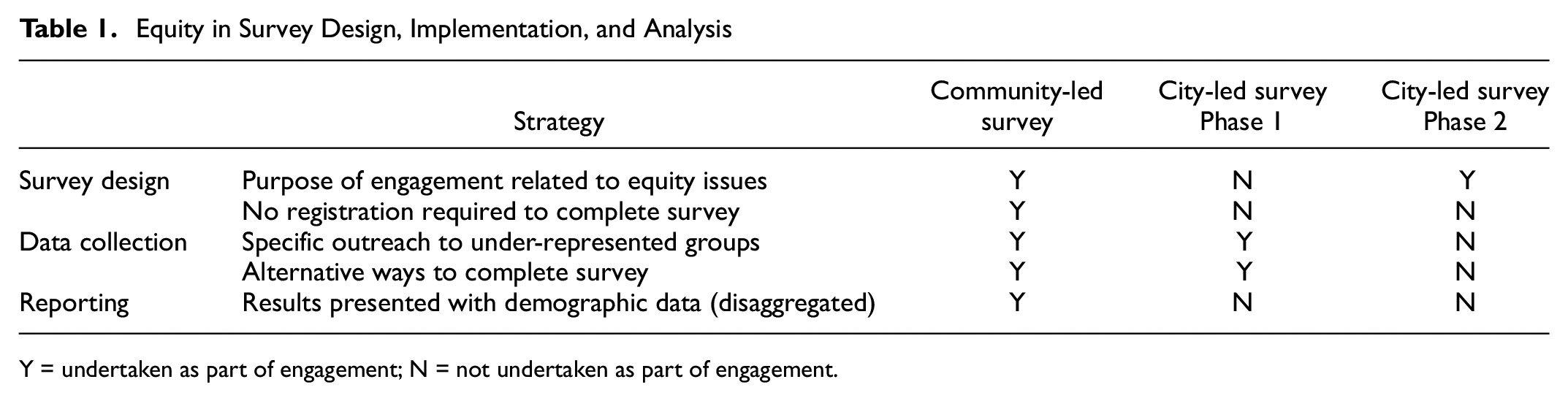
Y = undertaken as part of engagement; N = not undertaken as part of engagement.
While not addressed in the literature as a specific barrier to participation, both city-led online surveys required registration (including email address, postal code, ward, and password). Although this may be used to reduce fraud or multiple responses, it may also limit participation, especially with communities concerned about data privacy ( 24 ). Critically, none of the results in the city-led engagement are presented with information about participants from equity-deserving groups, such as differences in responses. Some demographic information is presented in the results, but this is limited to geographic areas, such as differences between central core, suburban, and rural residents.
To assess the representativeness of the engagement practices, we used self-reported demographic characteristics from participants in the city-led and community-led surveys. The community-led survey used the same categories as the city-led surveys to collect demographic data, with respondents permitted to identify as many characteristics as applicable. Since participants could select more than one category, reported findings by characteristic may sum to greater than 100%. While there are issues with the terminology used in city policies and census data, we maintained this language to allow for comparison between the processes (i.e., First Nations, Metis and Inuit groups are more accurately described as sovereignty-seeking, rather than equity-deserving, in the context of treaty rights). Overall, 450 people fully completed the community-led survey, and 361 (80%) identified as belonging to an equity-deserving group. Participation in the two city-led surveys was approximately 2 and 3.5 times greater than the community-led survey (1,605 and 860 participants) but the percentage identifying as part of any equity-deserving group was not reported.
There were key differences in the representativeness of community- and city-led engagement, in comparison to census and other city-wide data (see Figure 1). In the community-led survey, older adults and persons living in poverty were over-represented compared with census data, while women, people with a disability, immigrants, racialized persons, youth, and Indigenous residents were under-represented. City-led engagement was only over-representative for older adults and had substantially lower participation for people living with a disability, people living in poverty, racialized persons, and youth compared with both the community-led survey and general demographics. For example, while 11% of the city population have an income below the low-income cut-off (LICO) (Census Canada 2016), only 3% of those that participated in the city-led survey identified as living in poverty. The largest difference was for racialized persons, with 26% of the general population identifying as a visible minority (Census Canada 2016), but only 11% of those that completed the community-led survey and 3% for the city-led survey. In other words, for the city-led engagement to reflect the demographics of the city, it would require a nine-fold increase in participation from people identifying as racialized.
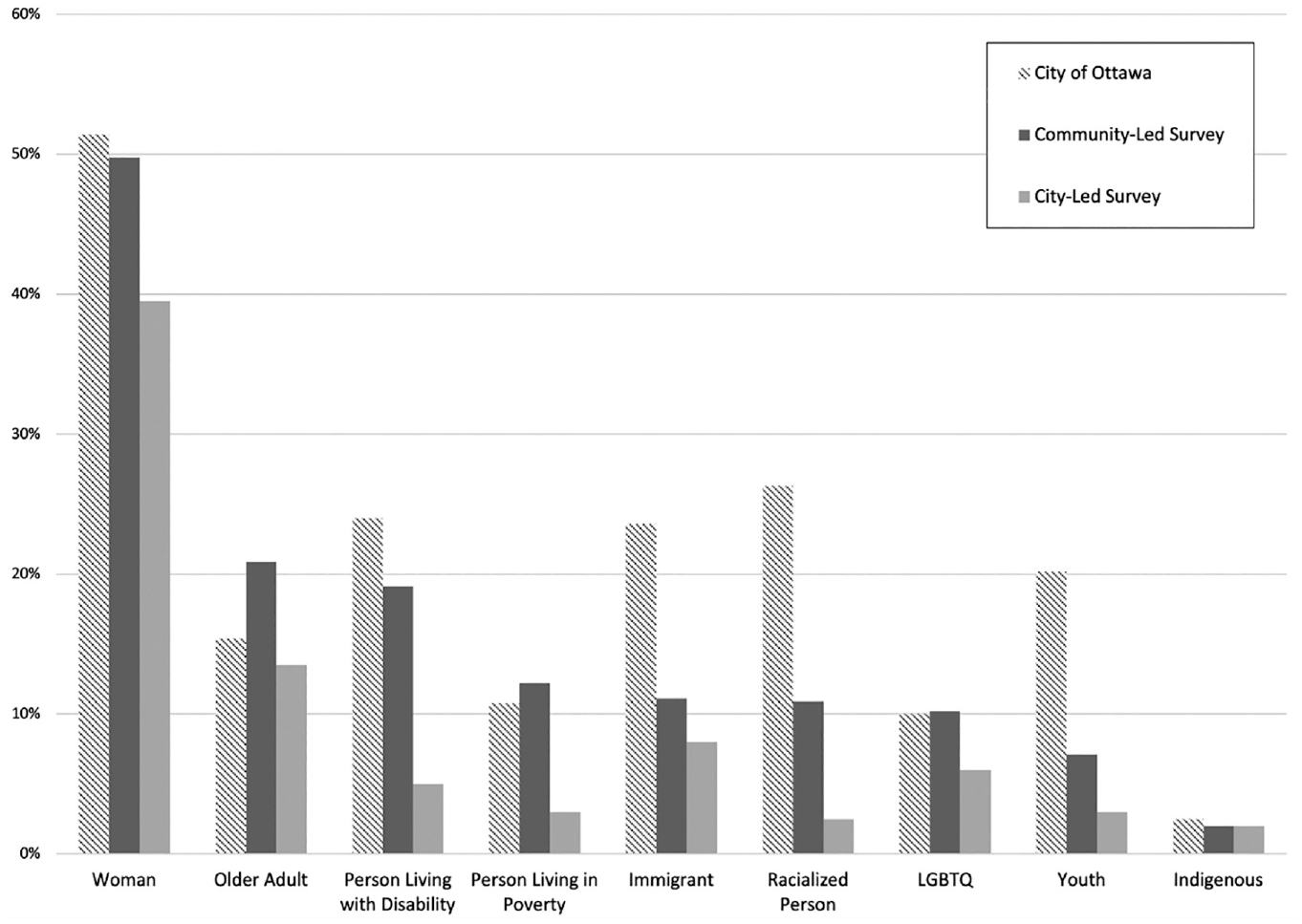
Comparison of representation in community- and city-led engagement.
Only providing responses for single categories overlooks the nuances of different intersectional identities. For the community-led survey, 57% of participants self-identified as belonging to more than one group, with 31% indicating they belong to two groups and 18% belonging to three groups. Intersectional or multiple identity categories were not reported for city-led engagement. Understanding intersectional identities is complex and may raise methodological concerns, such as representative sample sizes. Still, it is important to note that over half of equity-deserving group respondents to the community-led survey identified as belonging to multiple groups.
Conceptualizing Equity: Justice, Fairness, or Travel Time?
Given the debates on how transportation equity should be conceptualized, measured and implemented (e.g., 35, 36), we assessed the differences between how community- and city-led engagement gathered input on equity issues. The City of Ottawa’s equity and inclusion lens directive focuses not only on engagement processes, but is also applied to policy development and services, noting that policies should be assessed as to whether they “contribute to removing barriers or creating opportunities for people who risk exclusion” ( 37 ). How equity is presented in public consultation can influence its integration in policy development. Acknowledging that municipal agencies have more constraints and competing demands influencing their engagement processes, we find a narrow conceptualization of equity that may limit both the potential for meaningful public engagement and equitable outcomes in transportation planning.
The community-led survey was developed with the specific purpose of understanding how equity goals can be integrated into the transportation master plan, and this is reflected in the survey design. In addition to questions about budget priorities and experiences with public engagement, participants were asked what type of equity measures should be used in planning processes. Following a definition of equity-deserving groups, the survey asked “What information should be used to decide on transportation priorities?” and included response options with an explicit equity focus, such as “Do people from equity-deserving groups face more barriers in getting to the places they need to go?” and “Do transportation issues prevent people from participating in activities?” While not covering all options for conceptualizing transportation equity, this provided a way of understanding how equity principles could be integrated in policy development. Questions about transportation barriers that participants face in travelling were not a focus of the community-led survey, perhaps because these are already well known in the community (e.g., 38 ).
In contrast, city-led engagement included explicit questions about equity in only one of the two surveys and applied a narrow understanding of equity. Questions about barriers faced in the transportation system and transportation priorities were included, but not presented with demographic or identity-based data. In the second survey, the equity-related questions begin with a general definition of a “fair transportation system:” We’re looking at ways to make transportation more fair. A fair transportation system is one that provides options for everyone, recognizing people have different challenges and needs. (
30
)
This definition acknowledges differences in needs, although it does not address systemic barriers and identity-based discrimination, or relate specifically to people from equity-deserving groups. The conceptualization of equity is even narrower in the questions used to examine fairness in the transportation system, which focused on ease of access to destinations, and travel time (Appendix 1). For example, questions focused on ease of accessing destinations by non-driving modes did not clarify how frequently respondents used those modes, whether they were choice or dependent users, or demographic information about participants. One question asked whether the transportation system limits their choice in work or school because of travel time, and what type of mode was limiting. While this provides some insight into travel barriers, it focuses on a narrow subset of trips and only one type of barrier (travel time). Although these types of questions may address equity issues, this is only possible if paired with information about the participants and differences in responses. While a key goal for the survey was “to solicit public and stakeholder input on what a fairer transportation system looks like”, there is little focus on foundational issues of equity or justice due to the lack of disaggregated data and limited focus on the single barrier of travel time ( 30 ).
Impacts of Survey Design in Findings
A key question of this research was whether differences in survey design, collection, and representation results in substantive differences in findings. To understand potential differences, we compared two similar questions about transportation priorities in the city- and community-led surveys. These questions both addressed priorities and were framed as shaping the direction of future plans: City-led survey: Rank in order of importance the following list of transportation issues that the Transportation Master Plan should consider for the future of the city. Community-led survey: These are common goals for transportation investments. How important are they for you?
The response options do not fully overlap, as would be expected given the different designers of the surveys, and their priorities and knowledge. Despite this, we observed key differences, not only in the framing of questions and range of responses, but also in the substantive responses for similar questions. For example, while traffic congestion was identified as the second most important issue in the city-led survey, it was the second least important in the community-led survey (Table 2). Respondents from the community-led survey prioritized a broad focus on accessibility by selecting “reliable transportation for everyone” as the top priority, while the top priority for the city-led survey was broadly “expanded transit service.”
Comparison of Transportation Priorities, City- and Community-Led Surveys
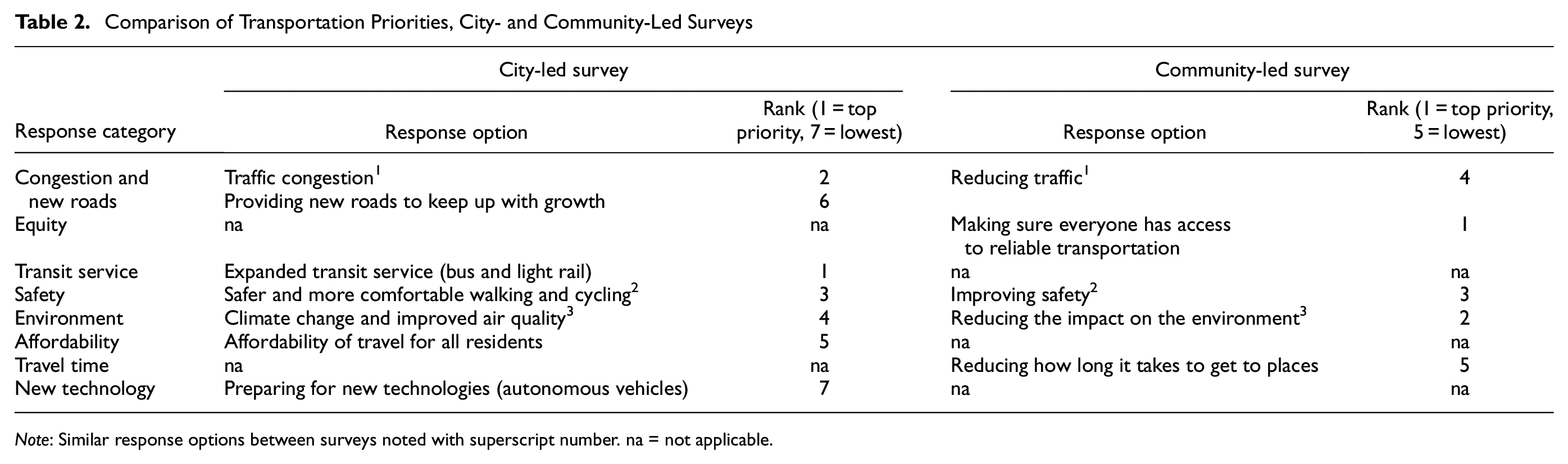
Note: Similar response options between surveys noted with superscript number. na = not applicable.
The community-led survey—which was fairly representative of city-wide demographics—allows for analysis in how priorities may vary between groups by presenting disaggregated data. By filtering responses for participants from equity- and non-equity-seeking groups, we found key differences in questions related to the broad direction and priorities for future plans. For example, when asked about spending priorities to improve transportation, there was almost no alignment in priorities for respondents based on demographic characteristics (see Figure 2). Top priorities for respondents from equity-deserving groups were: (1) safety and accessibility and (2) reducing cost of fares, while those not from equity-deserving groups prioritized: (1) walking and cycling improvements and (2) light rail. There are also dissimilarities in areas such as bus and light rail, which were grouped together in the city-led survey. Improvements to bus service was the third highest ranked priority for respondents from equity-deserving groups, while respondents not from equity-deserving groups ranked light rail much more highly. These differences reiterate the importance of presenting disaggregated data if equity is to be a priority for planning.
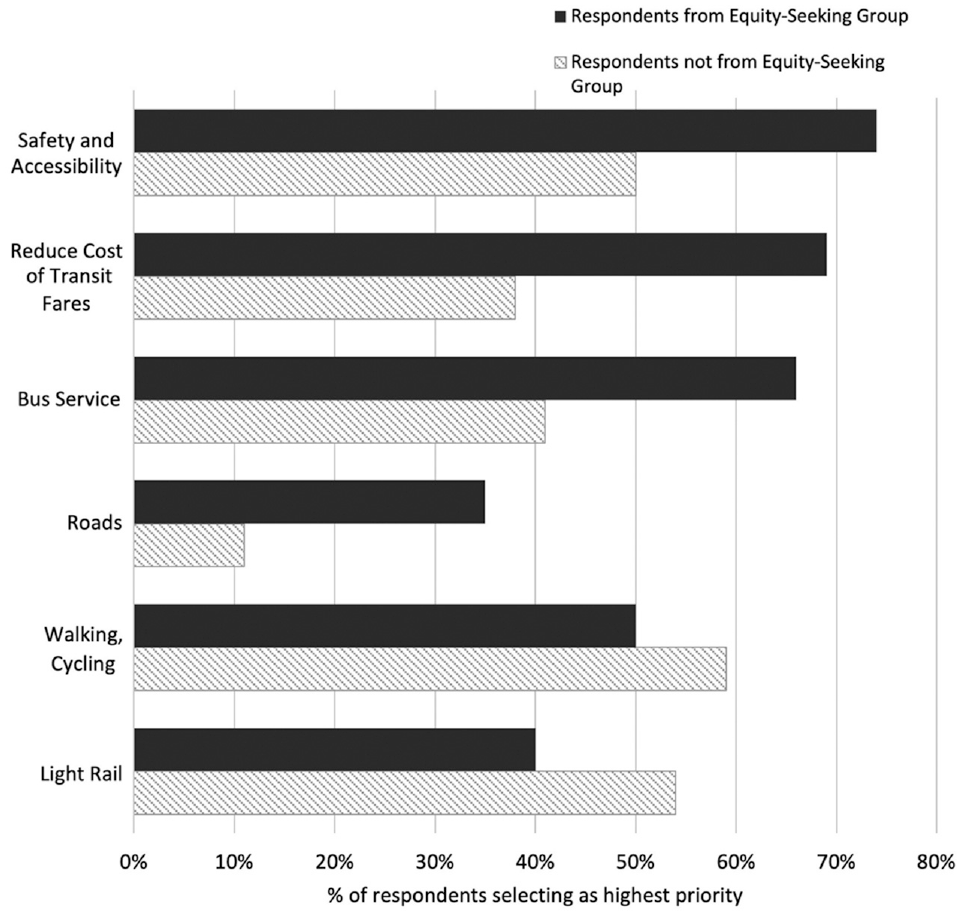
Priorities for transportation investments, disaggregated by equity and non-equity-seeking respondents. Participants could select multiple options.
Discussion
Integrating Community-Led Engagement in Planning Processes
As noted in the literature, participation processes reflect the lived experiences of their designers ( 20 ). Particularly for issues of equity, a lack of attention to the design and implementation of engagement practices from the outset can result in misalignment with community needs and goals. In examining parallel processes of engagement, we found key differences between community- and city-led surveys, pointing to fundamental inconsistencies in understandings of transportation equity and community needs. This was observed in multiple instances, from how equity was conceptualized to how barriers should be assessed. Even questions that may seem straightforward—such as transit priorities—revealed how designer biases can influence survey design. For example, while the city-led survey grouped bus and light rail modes together, the community-led survey revealed that respondents from equity-deserving groups had a much stronger preference for investment in bus rather than rail service. This points to importance of understanding community needs in a more holistic way—such as by drawing on different data sources like interviews and focus groups—when attempting to assess priorities.
In discussing demographics of transportation researchers, Lowe notes that “without a diversity of demographically linked lived experiences shaping researchers’ positionalities, the field could miss important perspectives and phenomena” ( 27 ). Just as lived experiences influence transportation researchers’ positionality, this likely extends to planners in the “problem-setting” phase of designing engagement processes, as shown in other fields ( 20 ). These findings point to the value of having community members and organizations involved in the early stages of designing public engagement tools, not just to improve participation but to better reflect diverse needs and experiences. Planners must be cautious in uncritically relying on representation of race and ethnicity as corresponding with equity, without addressing power differentials ( 39 ). While representativeness in responses is important, it is first necessary that engagement processes ask questions that demonstrate an understanding of community experiences. Agency staff must balance multiple competing interests in developing transportation plans but for engagement processes to be meaningful, they must address issues of concern to people from equity-deserving groups.
The Potential for Community-Led Engagement
Although there has been recent advocacy for involving community organizations in public participation, there has been little comparative evaluation of its potential. Our findings show that community-led engagement resulted in participation that better reflected city demographics, particularly for people living in poverty, and people with disabilities. For other equity-deserving groups—including immigrants, racialized people, and youth—the community-led survey did a better job of including participants from these communities, but it still did not fully mirror city-wide demographics. While community-based processes have a strong potential to improve engagement, attention must still be paid to how these are designed, and what communities are represented. For example, the Los Angeles Metro’s Equity Platform suggests that when involving community-based organizations in public engagement “we must be mindful that any single group does not represent all voices in every community” ( 11 ). While agency staff have many constraints in undertaking engagement processes—including legally mandated timelines—allowing for flexibility in process design and timing can allow for mid-course assessments.
As noted above, the community-led engagement process was supported by external funding, allowing for community leaders to co-design and implement the survey. It is necessary to compensate community-based organizations fairly for undertaking this type of engagement work, and this model can be more costly and resource intensive ( 2 , 11 ). Costs and timing may be a key consideration in choosing engagement strategies; however, the demonstrated benefit of community-led engagement—in more representative participation and engagement tools that better reflect community needs—should be acknowledged in decision-making. The findings here point to several low-barrier changes that can be implemented into existing engagement processes, including collecting and presenting disaggregated data, but this may require both significant organizational change and changes to professionals’ daily practices ( 9 ). As Clark suggests, the first step for designers of public participation processes should be “one that looks inward instead of outward—by critically examining themselves, the role of their own efficacy, and an understanding of the origins of their positions” ( 20 ).
Conclusion
Despite much research on barriers to participation, including exclusionary methods, concerns about data privacy, and a lack of trust of government agencies, there is little evidence that engagement practices are shifting to respond to different contexts ( 1 , 24 ). Our research demonstrates that community-led engagement which includes meaningful participation in the design and implementation of processes has the potential to better engage a diversity of perspectives. As Beebeejaun notes, representation should not be the only issue considered in assessing participation; there is a need to explicitly address power disparities and issues of equality ( 39 ). We find that community-led engagement processes differ significantly from city-led ones in how equity is framed and discussed, with focus more aligned with needs of equity-deserving groups. While transportation equity advocates have argued that there should be a focus on providing “service proportional to need—not ‘equal’ service to all,” we found city-led equity processes define equity in narrow terms—such as preferred travel time—regardless of socio-demographic experiences ( 11 ). This is underscored by the finding in the community-led survey of significant differences in transportation investment priorities between those that identify as part of an equity-deserving group, and those that do not. This research demonstrates the potential for community-led engagement—with appropriate resourcing—to both better identify and respond to community needs, though the resulting impact on policy, funding, and implementation remains to be seen.
Supplemental Material
sj-docx-1-trr-10.1177_03611981221145131 – Supplemental material for Community-Designed Participation: Lessons for Equitable Engagement in Transportation Planning
Supplemental material, sj-docx-1-trr-10.1177_03611981221145131 for Community-Designed Participation: Lessons for Equitable Engagement in Transportation Planning by Orly Linovski and Dwayne Marshall Baker in Transportation Research Record
Footnotes
Acknowledgements
Members of the Healthy Transportation Coalition and Community Leaders Steering Group were instrumental in shaping and implementing this research. Great thanks to Maria Basualdo, Trevor Haché, Justine Nkurunziza, Sally Thomas, Marcelo Saavedra-Vargas, Christine Santele, and John Woodhouse.
Author Contributions
The authors confirm contribution to the paper as follows: study conception and design: O. Linovski; data collection: O. Linovski, D.M. Baker; analysis and interpretation of results: O. Linovsk, D.M. Baker; draft manuscript preparation: O. Linovski, D.M. Baker. All authors reviewed the results and approved the final version of the manuscript.
Declaration of Conflicting Interests
The author(s) declared no potential conflicts of interest with respect to the research, authorship, and/or publication of this article.
Funding
The author(s) disclosed receipt of the following financial support for the research, authorship, and/or publication of this article: This research was supported by the Social Sciences and Humanities Research Council (Canada), Partnership Engage Grant (892-2018-3032).

Supplemental Material
Supplemental material for this article is available online.
References
Supplementary Material
Please find the following supplemental material available below.
For Open Access articles published under a Creative Commons License, all supplemental material carries the same license as the article it is associated with.
For non-Open Access articles published, all supplemental material carries a non-exclusive license, and permission requests for re-use of supplemental material or any part of supplemental material shall be sent directly to the copyright owner as specified in the copyright notice associated with the article.
