



Abstract
Because of increased urbanization and a rise in e-commerce activities, the demand for freight transport in cities is growing. E-retailers and logistics companies face the challenge of making timely, cost-effective, and reliable deliveries. To address this problem, the concept of crowdshipping has gained interest. Crowdshipping enlists members of the public to pick up and drop off parcels, ideally en route to their pre-committed destination. Individuals, such as commuters using public transport, can be engaged to fulfill deliveries as “crowdshippers.” This research explores the potential impact of crowdshipping using public transport in a congested city, focusing on Singapore as a case study. First, an online survey was conducted to investigate the willingness of transit passengers to act as crowdshippers. Then, a parcel allocation model was developed to match parcels with public bus journeys. In the case of there not being enough crowdshippers available, the remaining parcels will be delivered using the carrier’s delivery vans, which are subject to a vehicle routing problem. Using real-world data, we compared the performance of an e-commerce carrier with and without crowdshipping. The results show that crowdshipping can reduce vehicle kilometers traveled and associated air emissions by up to 17%. The carrier’s delivery cost can be reduced by up to 29% per parcel. These savings can be realized even if crowdshipping is limited to off-peak travel hours only. In a congested city with an extensive transit system, crowdshipping using public transport has the potential to be a sustainable means of moving goods in urban areas.
Keywords
Increased urbanization and e-commerce activities have resulted in a fast-rising demand for logistics services in cities. The number of digital buyers worldwide has grown from 1.66 billion in 2017 to 2.14 billion in 2021, with e-commerce revenue growing annually by more than 10% ( 1 ). With this remarkable growth, there is a need for logistics providers and carriers to prepare for increased delivery demand while maintaining good service levels. Both e-retailers and logistics companies face the challenge of making timely, cost-effective, and reliable deliveries.
In densely packed cities, the demand for both passenger and freight transport can result in negative externalities, such as traffic congestion with aggravated social, economic, and environmental consequences. Governments and industry players are open to various solutions and initiatives to ensure efficient mobility for both passengers and goods. One initiative that has been of growing interest is crowdshipping.
Crowdshipping, also known as crowdsourced delivery, is a different class of logistics originally given its name by the United States Postal Service in a report enitled Using the “Crowd” to Deliver Packages. It defines crowdshipping as a subset of the larger “crowdsourcing” movement, which marshals a large group of people to accomplish something with the use of technology ( 2 ). Some e-retailers have previously explored this option. For instance, Amazon and Walmart have recruited on-demand drivers to fulfill online delivery orders ( 3 , 4 ). In 2013, the logistics provider DHL launched a crowdsourced delivery platform called MyWays in Stockholm, Sweden, recruiting residents to fulfill deliveries ( 5 ). Recently, Le et al. ( 6 ) conducted a comprehensive review of crowdshipping. Everyday commuters can be mobilized to pick up and deliver parcels before resuming trips to their pre-committed destinations. With crowdshipping, cities can tap into excess passenger transport capacity to enable more sustainable movement of freight compared with conventional urban freight deliveries using a dedicated fleet of delivery vehicles.
For urban commuters, one possible transport mode is transit, or public transport. Cities with accessible, efficient, and affordable public transport systems can consider crowdshipping using public transport. As described by Trentini et al. ( 7 ), shared transport services for movement of both passengers and goods, in particular with an increased use of public transport, could reduce congestion in cities. If the public transport system is extensive and well utilized, it may be possible to engage public transport passengers as crowdshippers. The procedure for crowdshipping considered in this study can be described as follows.
Conventionally, a carrier will deliver parcels to receivers directly. With crowdshipping, the carrier can direct some parcels to automated parcel lockers and public transport passengers can act as crowdshippers. Enlisted crowdshippers can pick up parcels from lockers near or at their origin stops and carry them by hand, delivering the parcels to their final destinations, also located close to the passengers’ destination stops. A visualization of the parcel delivery procedure via crowdshipping is shown in Figure 1.
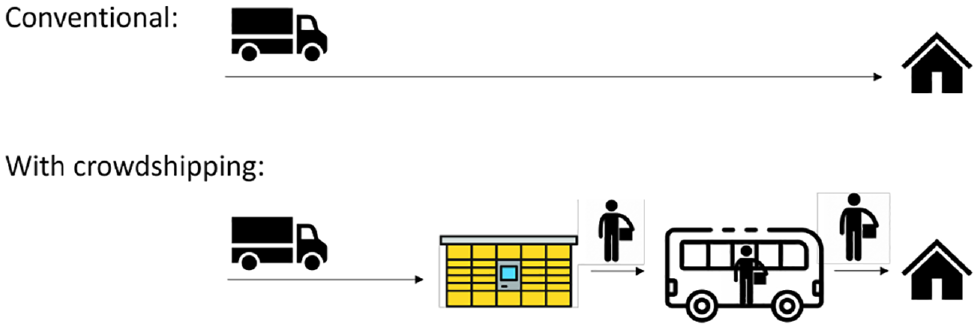
Visualization of conventional and crowdshipped parcel delivery procedures.
Therefore, the research questions of interest are as follows:
Willingness. Are public transport passengers willing to act as crowdshippers? Crowdshipping services do exist but rarely target public transport users.
Potential impact. If crowdshippers are available, what are the potential benefits of crowdshipping using public transport?
We examine these questions for the case of Singapore, a city-state located in Southeast Asia. Singapore is an ideal case study because it has an extensive and efficient public transport system ( 8 ). A single-trip public transport fare for adults ranges from S$ 0.92 to S$2.17, which is affordable. Use of public transport is high, with an average daily public transport ridership of 7.5 million in 2018 ( 9 ).
Literature Review
Previous studies on crowdshipping have generally involved three research streams: (a) empirical studies investigating public acceptance of crowdshipping; (b) operational studies on how to organize a crowdshipping service effectively; and (c) evaluation of the impact of crowdshipping.
Empirical Studies
As crowdshipping has emerged as a delivery option, several studies investigating the willingness and motivation of the public to act as crowdshippers in different countries have been undertaken. Marcucci et al. ( 10 ) conducted a survey among university students in Rome, Italy, and found a positive attitude toward the service. Nearly 90% of students surveyed were interested in working as crowdshippers. Another two surveys, also implemented in Rome, focused on metro users and estimated the likelihood they would be willing to act as crowdshippers given hypothetical scenarios ( 11 , 12 ). Similar surveys were also conducted in the U.S.A. and Vietnam. Le and Ukkusuri ( 13 ) found that about 80% of respondents from both these countries were willing to participate in crowdshipping, the main motivation being the potential for earning additional income. Le and Ukkusuri ( 14 ) also identified three main factors influencing participation in crowdshipping: sociodemographic characteristics; experience of freight transport; and social media usage. Punel et al. ( 15 ) surveyed the attitudes, preferences, and characteristics of users and nonusers of crowdshipping and concluded that users believe in its environmental benefits.
In general, the attitude toward crowdshipping was found to be positive, suggesting that the service is feasible. However, no such study has previously been conducted in Singapore.
Operational Studies
To coordinate the crowdshipping delivery service effectively, several studies related to operations planning have been conducted. At their core, these studies focus on how to assign delivery jobs to crowdshippers. The approach generally involves the integration of four main decisions: matching; routing; driver scheduling; and compensation ( 16 ).
For matching decisions, some studies focus on how occasional drivers can be enlisted to fulfill delivery requests. Different objective functions were considered. For instance, Archetti et al. ( 17 ) analyzed crowdshipping as a new variant of the vehicle routing problem (VRP) with occasional drivers. They formulated this problem with the objective of minimizing total cost, including the carrier’s delivery cost and the additional compensation cost paid to drivers. By designing a multistart heuristic, a small-scale integer programming problem was solved and the computational results showed that a crowdshipping delivery service can achieve cost reductions. The performance of such a service depends on three factors: the ratio of the available drivers to the number of the customers; flexibility of drivers; and the compensation scheme. Similar research was also conducted by Gdowska et al. ( 18 ), who introduced a VRP with occasional carriers with the objective of minimizing total delivery cost. By conducting computational experiments on randomly generated instances, the expected cost of delivery was reduced by an average of 9% as a consequence of using crowdshipping. Further, Arslan et al. ( 19 ) constructed a fleet with dedicated vehicles and dynamically arriving ad hoc drivers earning small compensation amounts to perform pickups and deliveries. The objective was to minimize the system-wide total cost. An event-based rolling horizon approach that repeatedly optimizes the system was proposed to match drivers and tasks dynamically. By testing three different origin scenarios, that is, single origin, multiple origins, and random origins, with 100 tasks and drivers, results showed that a single origin, such as in-store customers helping to deliver to online customers, may be most suitable for crowdsourced deliveries.
Other studies have attempted to take the crowdshipper’s additional burden into account. These seek to minimize distance or time deviation from the crowdshippers’ original trips. Wang et al. ( 20 ) first referred to the crowdshipping problem as a minimum cost flow problem at a larger scale. They formulated the problem with the objective of minimizing additional travel distance when assigning delivery jobs to potential workers. To demonstrate this method, they generated crowdshipper travel routes by extracting bus and taxi trip data in Singapore and GPS trajectories of individuals in Beijing. Parcel destinations were generated randomly. The results showed that the proposed method can be applied to real-time delivery requests on a large scale. Another study extended the objective further to find maximum matching with a defined minimal cost. Soto Setzke et al. ( 21 ) formulated the crowdshipping problem as a minimum-cost, maximum-flow problem in which cost is estimated from additional travel time. The feature of this problem was that crowdshippers’ distance/time deviation can be guaranteed. Le et al. ( 22 ) added pricing and compensation components into the matching model with the objective of maximizing the platform provider’s profits. By exploring pricing and compensation schemes based on different demand and supply levels, the authors argued that the integration of pricing and compensation into matching decisions is helpful for crowdshipping firms.
Considering that the crowdshipping problem is one concept of the sharing economy, Behrend and Meisel ( 23 ) extended it by including item sharing. This involved renting items among members of a sharing platform. The paper considered that a crowdshipper can transport more than one rented item and referred to the request–match problem as a set packing problem. An exact solution method, that is, a label-setting algorithm, was designed to solve the problem. Results from numerical experiments conducted suggest that the profitability of this integrated platform can improve if crowdshippers transport more than one item on their way.
Impact Studies
The increased attention given to sustainable urban freight has led some researchers to assess the environmental impact of crowdshipping. Buldeo Rai et al. (
24
) reviewed the practice of crowdshipping and found three factors that influence its environmental impact: (a) third-party involvement; (b) crowd motivation; and (c) modal choice. In particular, the use of soft transport modes, transit, and cleaner vehicles are more beneficial to the environment. Paloheimo et al. (
25
) focused on book delivery, employing a crowdshipping service for a library to deliver books to borrowers or to facilitate the return of books to the library. A trial conducted in the city of Jyväskylä in Finland achieved a reduction in transport demand for both deliveries and passengers. Devari et al. (
26
) focused on crowdsourcing last-mile delivery of online orders among available friends within the customer’s social network. The results, which were simulated in a single store in the city of Alexandria in Virginia, U.S.A., suggested that a reduction in air emissions of as much as 55% from delivery trucks according to
Some researchers have further investigated the economic impact of crowdshipping. Gdowska et al. ( 18 ) showed that the expected cost of delivery can be reduced by an average of 9%.
We conclude from the literature review that crowdshipping is a feasible and sustainable service for urban deliveries. There is also a suggestion that the public will accept this innovative service. The majority of the existing research focuses on crowdshipping that relies on private vehicles as the delivery mode. Most of the limited number of studies that examined the use of public transport did not explore operations because operational data is difficult to obtain ( 14 ). In this paper, we develop an integrated data-driven approach to study the feasibility of crowdshipping from a carrier’s perspective. The main contribution of this paper is to provide a comprehensive and systematic investigation of crowdshipping using public transport. The approach integrates compensation and willingness, a procedure for matching parcel delivery tasks with public transport passenger trips using real-world data, and delivery vehicle routing. In addition, the potential impact of crowdshipping is estimated.
Although the focus is on the case of Singapore, the study approach adopted can be applied to any city as long as the demand for parcel deliveries and volume of transit use is known in advance. Singapore represents an example of a densely populated metropolis in Asia where transit mode share is high. Today, there are many similar cities where e-commerce activities are growing rapidly, resulting in a need for urban logistics solutions such as crowdshipping.
To achieve the study goals, an online survey was first conducted to investigate the willingness of public transport passengers to act as crowdshippers, as well as relevant factors that can influence their decision. Next, a framework was designed to match parcels with public transport passengers. Finally, we compared the base case of fulfilling deliveries using conventional delivery vans with scenarios involving crowdshipping, and assessed key performance indicators for the e-commerce carrier, for example, total daily vehicle travel distance for accomplishing all the deliveries and the associated environmental impact.
Data Collection and Description
Data Sources
Our study makes use of three datasets: (a) preferences for crowdshipping obtained from an online survey conducted by the research team among public transport passengers; (b) parcel delivery demand information from an e-commerce carrier in Singapore; and (c) total bus passenger volumes by origin and destination stops from the Singapore Land Transport Authority.
Preliminary Survey
Survey Overview
An online survey was conducted in Singapore from November 2020 to January 2021 to gauge public transport passengers’ willingness to act as crowdshippers and their preferences, for example, expected compensation. The survey included questions that would help in understanding the respondents’ sociodemographic profile and their preferences when performing a hypothetical crowdshipping delivery job. The survey questionnaire is available in the appendix.
Survey Sample
Singapore public transport users aged 18 years and above were recruited for the survey. After removing incomplete responses, the final sample size is 144. The main characteristics of the sample population are summarized in Table 1.
Sociodemographic Characteristics of the Survey Sample
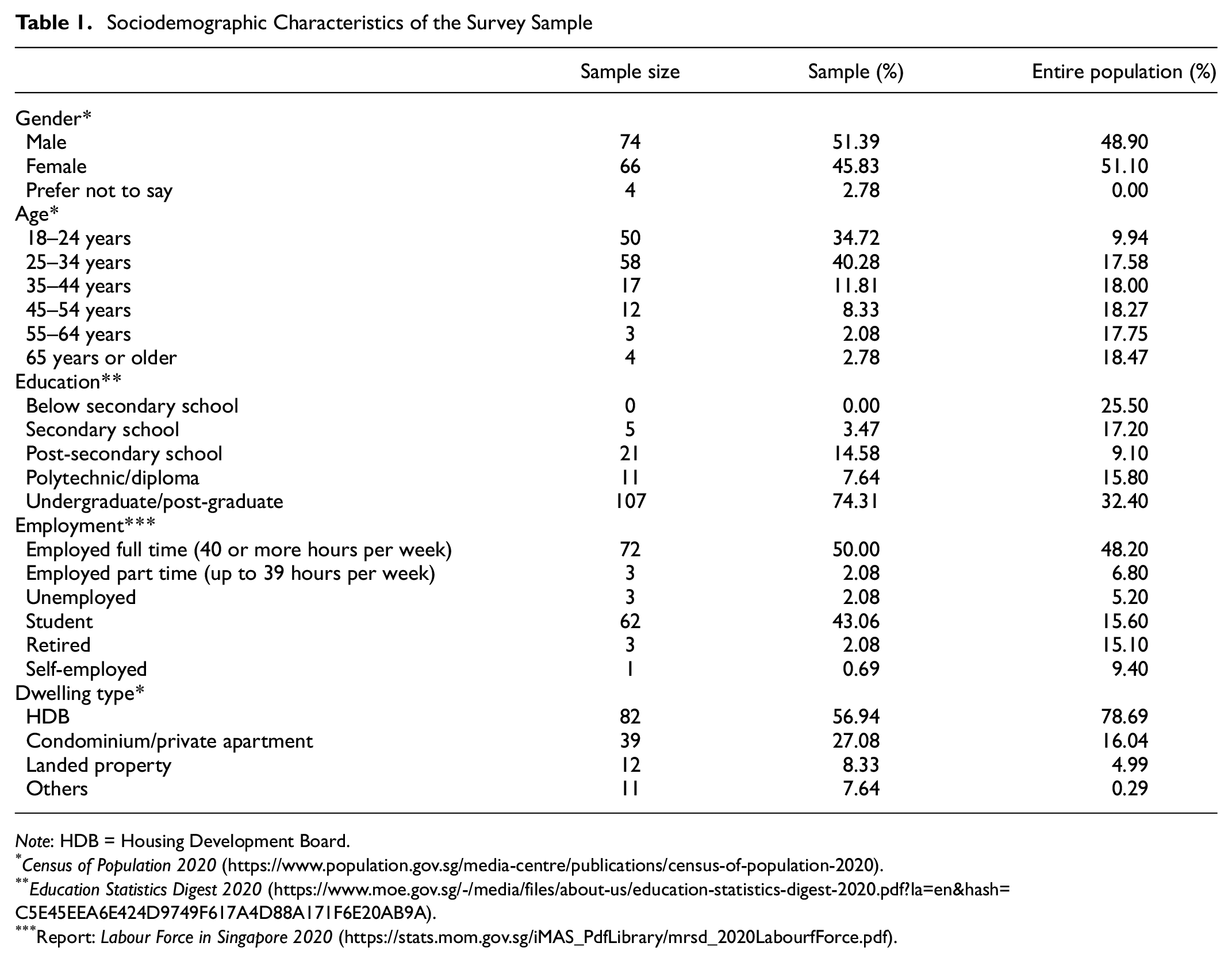
Note: HDB = Housing Development Board.
Census of Population 2020 (https://www.population.gov.sg/media-centre/publications/census-of-population-2020).
Education Statistics Digest 2020 (https://www.moe.gov.sg/-/media/files/about-us/education-statistics-digest-2020.pdf?la=en&hash=C5E45EEA6E424D9749F617A4D88A171F6E20AB9A).
Report: Labour Force in Singapore 2020 (https://stats.mom.gov.sg/iMAS_PdfLibrary/mrsd_2020LabourfForce.pdf).
Although our survey sample has a higher proportion of the younger age group, young people (under 35 years) are more likely to use public transport and online services, such as a potential crowdshipping platform ( 11 , 15 ). Other studies have also shown that delivery riders and potential crowdshippers tend to come from younger age groups ( 13 , 30 ). Because the survey sample is representative of the target population in Singapore, findings from the survey can be taken as revealing the willingness of the resident population to act as crowdshippers in this particular context.
Survey Results and Findings
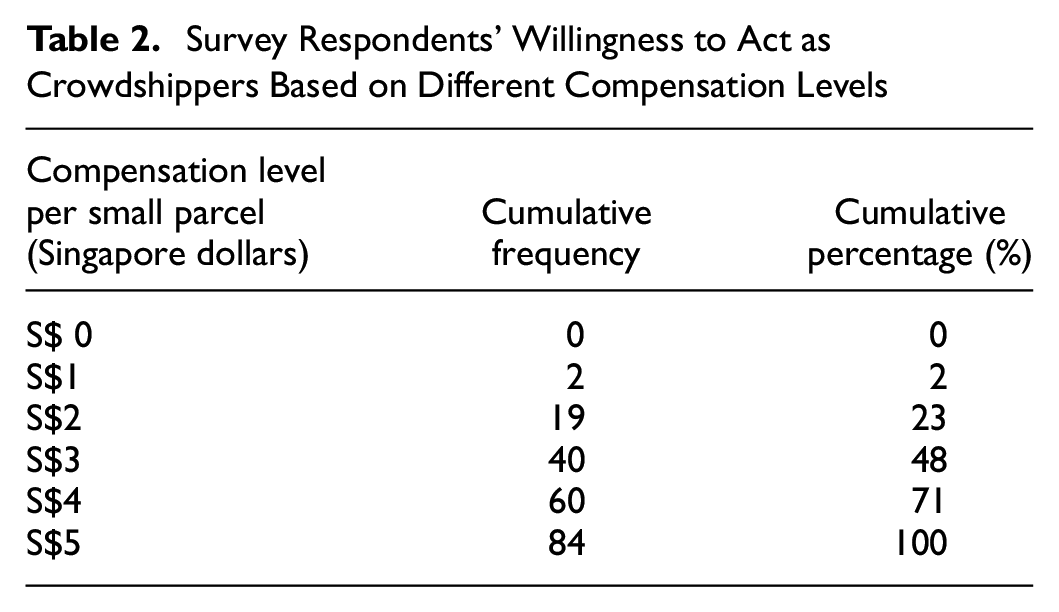
The survey results reveal that 78% of respondents are willing to act as crowdshippers. Without loss of generality, we focus on the sample who are willing. With regard to the preferred payment mode, nearly 76% of those that are willing prefer to be compensated on a per parcel basis. In our model, we therefore assume that the payment mode is per parcel. Of the survey respondents, 98% are found to be willing to deliver small parcels. Therefore, in the simulation of the service that follows, it is assumed that only small-sized parcels can be delivered via crowdshipping. In Singapore, a basic single-trip public transport fare for adults ranges from S$ 0.92 to S$2.17, based on trip distance. Accordingly, we presented six possible compensation levels ranging from S$ 0 to S$5 for each parcel delivered. By asking for the expected compensation for delivering small parcels, we were able to estimate the relationship between willingness, that is, the fraction of public transport users who are willing to act as crowdshippers, and compensation levels. The results are shown in Table 2. The third column indicates willingness as shown by the cumulative percentage of respondents.
Survey Respondents’ Willingness to Act as Crowdshippers Based on Different Compensation Levels
Parcel Delivery Data
The parcel delivery dataset contains daily delivery requests to be fulfilled by a single e-commerce carrier. Each request includes the origin and the destination for each parcel.
Parcel Origin and Destinations
A dataset of parcel delivery information for January 2019 was obtained from an anonymous e-commerce carrier in Singapore. The parcels were consolidated at several warehouses across the city before being delivered. In the dataset, the geographical coordinates (longitude and latitude) of the warehouses (origins) and final delivery location of parcels (destinations) were available. In our case study, we will only examine parcels originating from a single warehouse. In a weekday, an average of 5,844 parcels were delivered from this warehouse as shown in Figure 2.
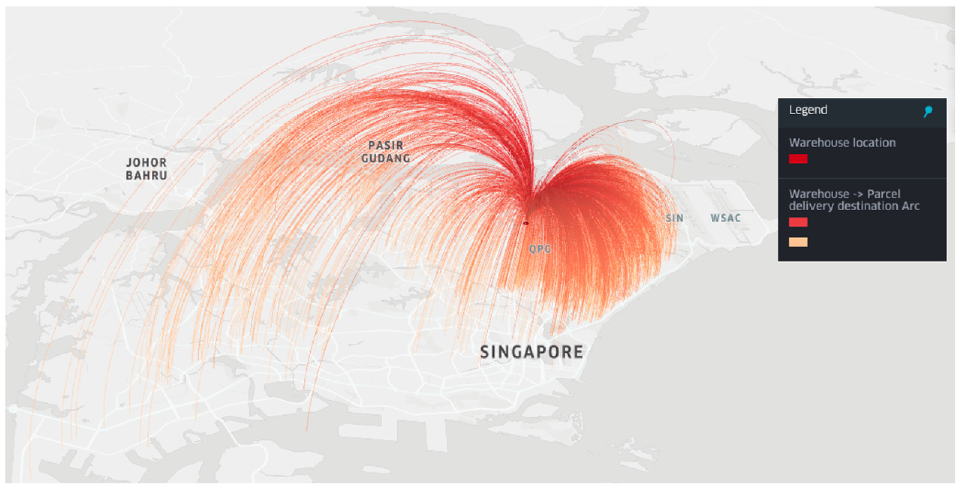
Daily parcel deliveries originating from a carrier’s warehouse in Singapore.
Parcel Sizes
The parcels to be delivered are classified by size: small; medium; large; and extra-large. Choo (
31
) presents a distribution of parcel sizes for an e-commerce carrier in Singapore. Small parcels dominated total deliveries at nearly 74.9%, followed by medium (17.6%), extra-large (4.3%), and large (3.2%). In this analysis, demand for the delivery of small parcels (defined as up to 25
Public Transport Passenger Data
A dataset on historical public transport journeys was retrieved from the Singapore Land Transport Authority. These data reveal the number of weekday trips from origin to destination bus stops in the month of October 2019. The number of workdays in that month was 22 and the average weekday volume of trips was used to represent daily passenger volumes from origin to destination stops.
In this study, we choose to focus on public bus passengers who can be engaged as crowdshippers. This is because bus ridership is high in Singapore and the public bus network is extensive and covers the entire city. The high network coverage implies easy access and a short walking distance to parcel destinations.
Methodology Overview
This study uses a quantitative approach to explore the potential impact of crowdshipping using public transport in Singapore. A parcel allocation model is developed to find matches between parcels and public bus passengers as potential crowdshippers over a single day. The task is to identify parcels that follow similar routes taken by passengers. Following this procedure, the total number of parcels to be delivered can be divided into two disjoint sets: one containing parcels that are crowdshipped; and another containing the remaining parcels that are to be transported by delivery vans. These vans are subject to a VRP. The final stage of this study is to assess the performance of a carrier fulfilling deliveries with and without crowdshipping.
We will explore scenarios of varying passenger willingness to act as a crowdshipper before using the parcel allocation model. Given different compensation levels, the number of willing crowdshippers may vary. Figure 3 presents an overall framework for this study.
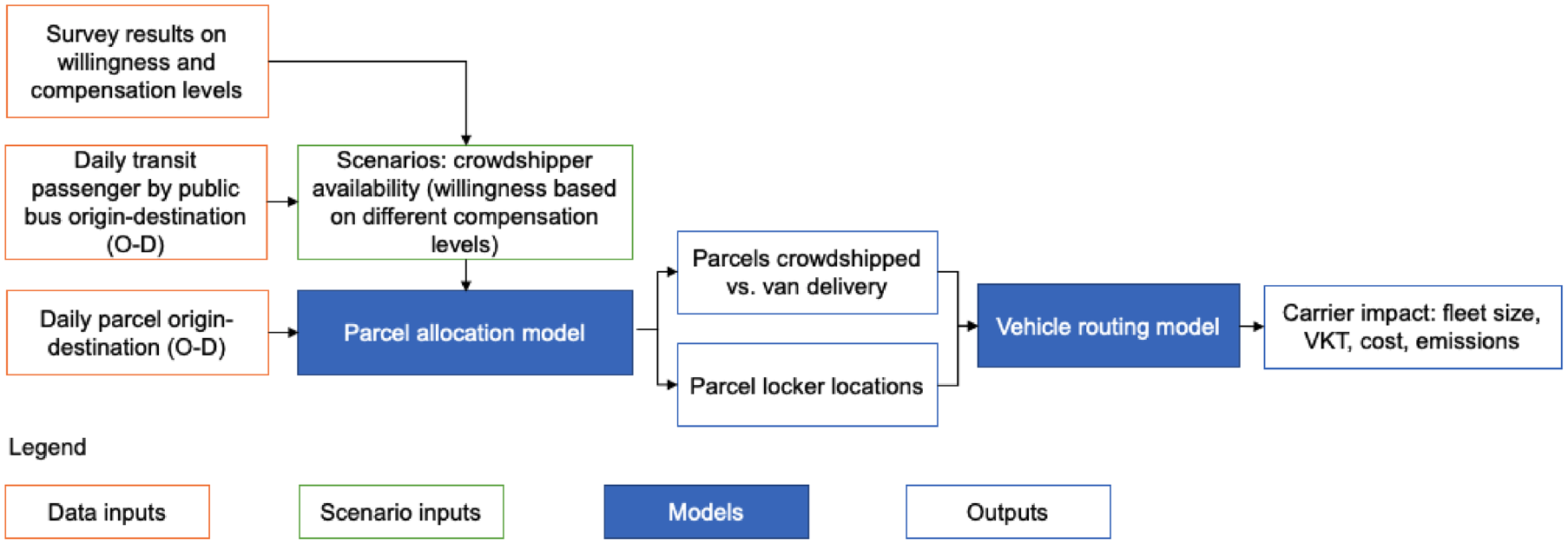
Overview of the model framework.
Parcel Allocation Model
Terminology and Key Definitions
The total parcel set is defined as the set of parcels that need to be delivered within the day from the single origin warehouse.
A serviceable parcel is defined as a parcel from the total parcel set that has the possibility of being delivered by crowdshipping. Considering that there may not be enough crowdshippers to deliver all the serviceable parcels, a crowdshipped parcel is a parcel that will eventually be delivered by crowdshipping.
A parcel locker location is that selected in the parcel allocation model. Crowdshipped parcels are to be sent from the origin warehouse to assigned parcel lockers.
Nearby bus stops are defined as the bus stops located at or near a parcel locker.
The total trip set is the set of public bus passengers’ origin–destination (O–D) pairs. The information for each O–D includes the origin bus stop, the destination bus stop, and the daily passenger volume associated with this O–D pair.
A crowdshipper is a public bus passenger who is willing to deliver the parcel. The term willingness, denoted by
Assumptions
For a practical approach, the models are formulated considering the local context. Therefore, assumptions made are as follows:
Note that in this model, the time of day at which delivery is made is not considered.
The rationale behind this assumption is that all parcels are already consolidated at the warehouse.
Considering that it may not be feasible to install lockers at every bus stop, we assume that parcel lockers are only available at railway stations. The rail or parcel locker network is shown in Figure 4. The number of trips from bus stops co-located with the single railway station nearest to the origin warehouse is 39,259, as shown in Figure 5. Given the high number of public bus trips in the city, we hypothesize that it will not be difficult to match parcels with potential crowdshippers.
We assume no limit on the number of crowdshipped parcels that parcel lockers can store at each location. Moreover, we assume that only small parcels will be eligible for crowdshipping as the survey results reveal that nearly 97% of respondents are willing to deliver small parcels.
Considering the additional travel effort required from crowdshippers, this assumption aims to limit the detour distance or deviation from the crowdshipper’s original trip.
A public bus trip is defined as a one-way movement of the passenger with two trip ends: the origin bus stop; and the destination bus stop.
We assume that all passengers have the same willingness to participate in crowdshipping at a given compensation level. That is, the willingness to act as crowdshippers is independent of passenger attributes and the motivation to act as crowdshippers is related to the expected compensation only. This assumption is based on findings from both the survey and from previous studies indicating that compensation was the most important factor influencing a crowdshipper’s preference.
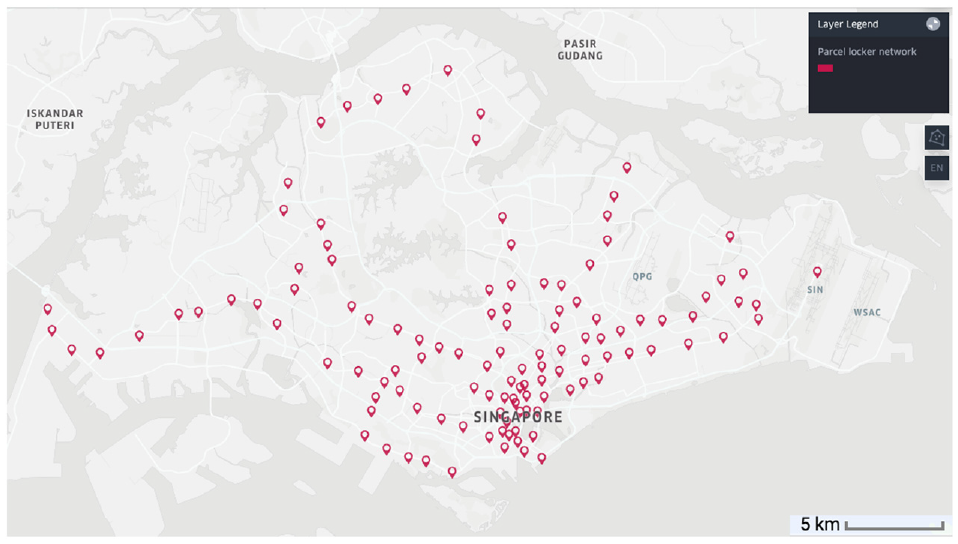
Network of parcel lockers.
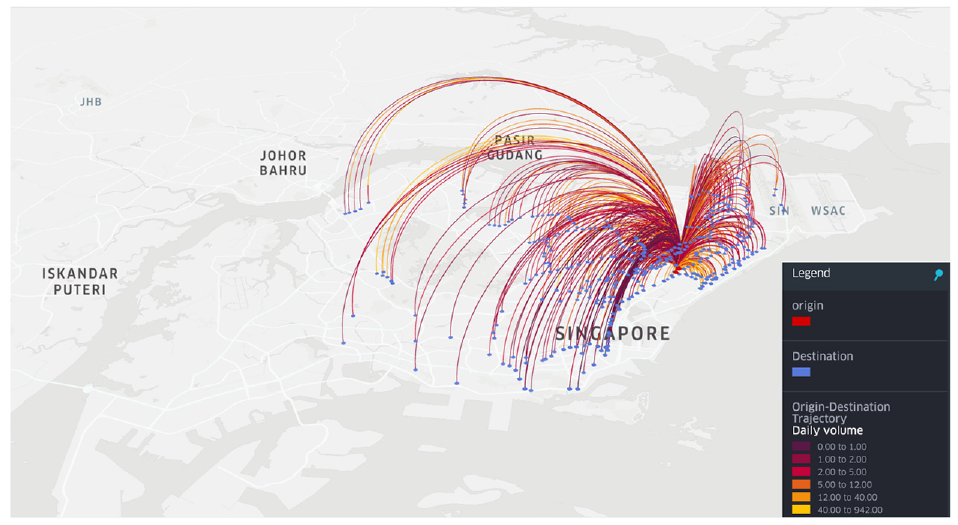
Daily public bus passenger origin–destination volume from bus stops at the nearest railway station (where a parcel locker is located).
Parcel Allocation Model Formulation
In our proposed model, the overarching problem is how to allocate parcels to parcel lockers to maximize the number of crowdshipped parcels. The prerequisites of a successful match between a crowdshipper and a parcel are as follows: (a) the crowdshipper’s origin bus stop must be at or near the parcel locker that can store the assigned crowdshipped parcel; and (b) the crowdshipper’s destination bus stop is the same as the bus stop near the end destination of the assigned parcel.
Notations
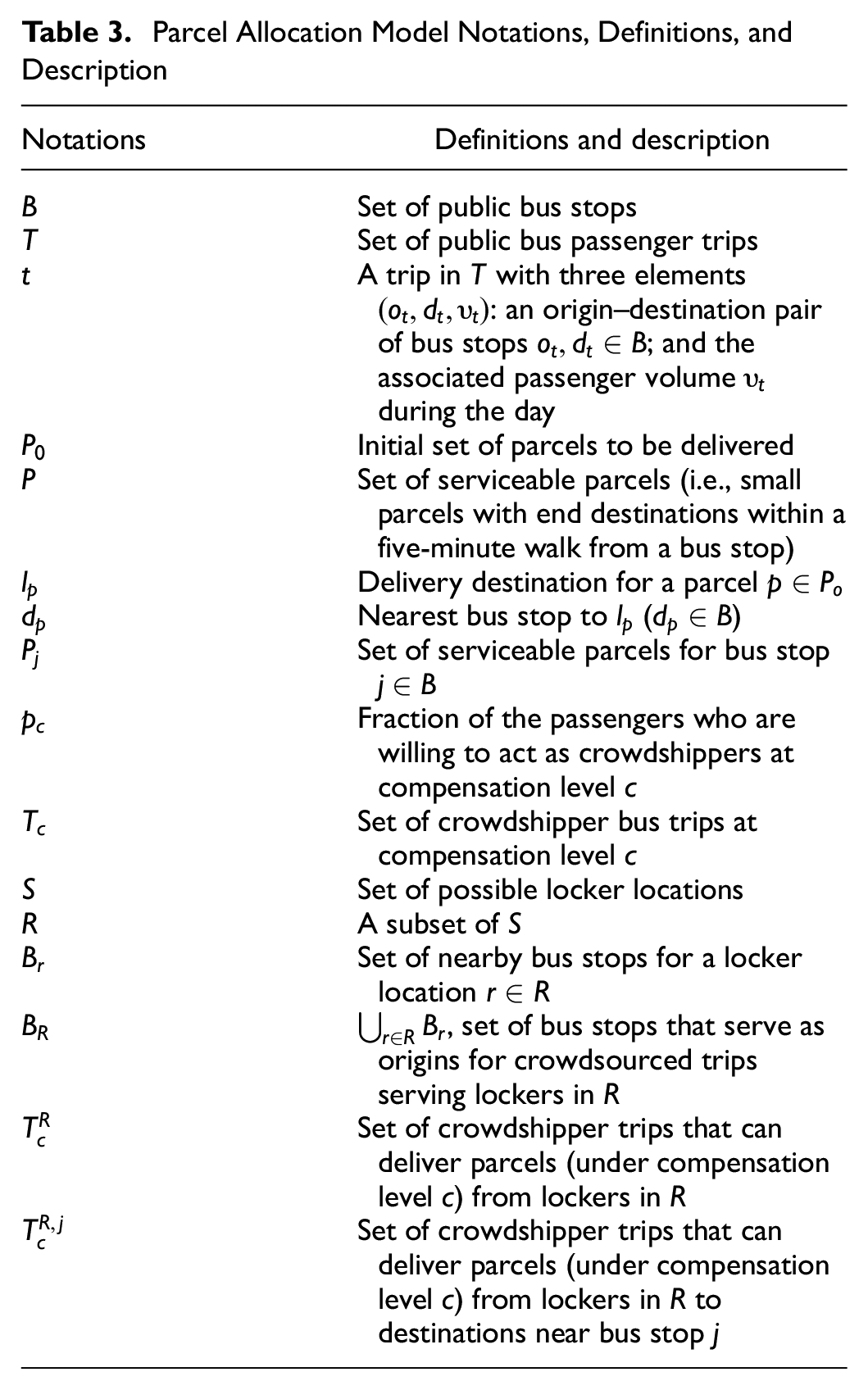
According to the order in which they appear in the parcel allocation model, we now introduce the following notations, also shown in Table 3:
Parcel Allocation Model Notations, Definitions, and Description
Let
Serviceable Parcel Set Definition
Let
Available Crowdshipper Trip Selection
As well as the set
Another factor influencing the number of available crowdshippers is the parcel locker locations. Let
Crowdshipper–Parcel Matching
A crowdshipper can only transport a single parcel as mentioned in Assumption 9. Thus, the maximum number of crowdshipped parcels is the smaller value among the number of serviceable parcels and the number of available crowdshippers. For each destination
Objective: Maximizing the Number of Crowdshipped Parcels
We expect the maximum number of crowdshipped parcels to increase with more parcel locker locations used because more locker locations increase the likelihood of finding crowdshippers. Given compensation level
Solution Approach
Here, we present a heuristic approach for finding the optimal set
Heuristic Algorithm
Our locker location determination algorithm works as follows.
If the total number of crowdshipped parcels using parcel locker locations in
Vehicle Routing Model
A main aim of this study is to assess the benefits of crowdshipping using public transport in Singapore. Vehicle kilometers traveled (VKT) and corresponding air emissions are important indicators for measuring the performance of freight transport. Therefore, this section describes how delivery vehicle routes are optimized by addressing a capacitated vehicle routing problem (CVRP).
Problem Description
Our problem can initially be described as finding the optimal routing for a fleet of vehicles charged with delivering parcels from a depot (origin warehouse) to several locations (lockers and end destinations), while minimizing some objectives such as total kilometers traveled with constraints on the vehicle capacities and total time spent per vehicle.
The vehicles start and end their routes at the warehouse. In addition, the shortest route between any two points, and the number of parcels to be delivered for each location are identified, both of which are the outputs of the described parcel allocation model. Note that the vehicles need to visit both the parcel locker locations for delivering crowdshipped parcels and the destinations of remaining parcels that are not crowdshipped.
In the CVRP, each vehicle has a capacity limit. Considering that the demand for some parcel locker locations can be high, we assume the availability of two types of vehicle in accordance with the carrier’s actual fleet: a large vehicle that can carry up to 600 parcels; and a smaller vehicle that can carry up to 120 parcels. The number of the vehicles required is an output of the program.
In practice, this routing problem involves some additional constraints. Other additional assumptions are made below:
Each location can be visited exactly once.
Up to 5 large vehicles and 100 small vehicles are available.
Each vehicle has a total working time of 10 h per day from departure to arrival back at the warehouse. The working time includes travel time and parcel delivery time to doorsteps or parcel lockers.
The parcel delivery times to doorsteps and parcel lockers are constants, given by 7 min and 30 s per parcel, respectively.
The vehicle speed for all routes remains constant at 30 km/h.
Given the assumption about constant vehicle speed, the objective of minimizing VKT can be converted to minimizing total travel time. Moreover, because the output of the parcel allocation model identifies the number of crowdshipped parcels and the remaining ones that are not crowdshipped, the total parcel delivery time for each scenario is fixed. Therefore, the objective of minimizing VKT can be converted to minimizing total time spent, defined as travel time plus parcel delivery time.
To sum up, the routing problem can be described as follows: given a fleet of vehicles with mixed capacities, the objective is to assign a sequence of visiting points to each vehicle with minimum total working time such that all the parcels are delivered and the total number of parcels and working time served by each vehicle do not exceed their respective limits.
A Computational Study
In this section, we test the proposed method and investigate the performance of a carrier fulfilling e-commerce deliveries with and without crowdshipping. The potential impact is evaluated according to daily VKT, the associated effect on the environment, and other indicators. Note that “% reduction” in these indicators refers to the crowdshipping scenarios compared with the base case without crowdshipping. The methodology was coded in Matlab, and Python linked to Google OR-Tools ( 32 ) for solving the CVRP. The computer ran on a macOS system and an Intel Core i5 CPU.
Experiment Design
The experiment involves 10 instances of generated parcel delivery location pseudo-data and repeated use of the same public bus passenger data. The pseudo-data for each instance are generated based on real-world parcel delivery data previously described. For each instance, we construct a base case and multiple crowdshipping scenarios characterized by two attributes: the number of parcel locker locations; and compensation levels. Finally, to investigate the carrier’s performance, the average of each performance indicator is reported.
Instance Generation
Initially, random noise is added to the coordinates of parcel delivery locations. Then, the serviceable parcel set is generated based on these updated parcel delivery locations. We first select the parcels satisfying the walking distance criterion and randomly choose a proportion of these parcels to produce the set of serviceable parcels. The proportion is predefined based on the known parcel size distribution. Finally, this procedure is repeated 10 times to generate 10 instances. This generation can help eliminate stochastic effects of random selection when generating the potential crowdshipping parcel set.
Average Performance Metrics
We apply an average-based method to 10 instances to assess the performance of a carrier. Each instance has a base case without crowdshipping and multiple crowdshipping scenarios. Thus, we take the average of each performance indicator from the scenarios with the same attributes over 10 instances.
Number of Matches between Crowdshippers and Parcels
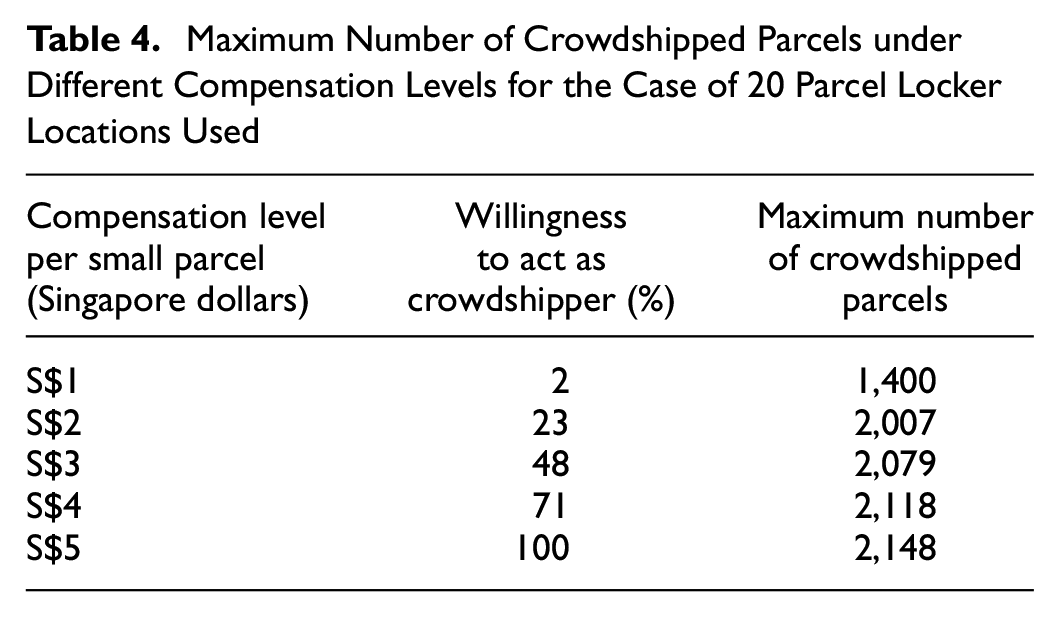
When applying the parcel allocation model to each instance, the number of matches between crowdshippers, and parcels under different numbers of parcel locker locations used and compensation levels is obtained. The results are summarized in Table 4 and visualized in Figure 6.
Maximum Number of Crowdshipped Parcels under Different Compensation Levels for the Case of 20 Parcel Locker Locations Used
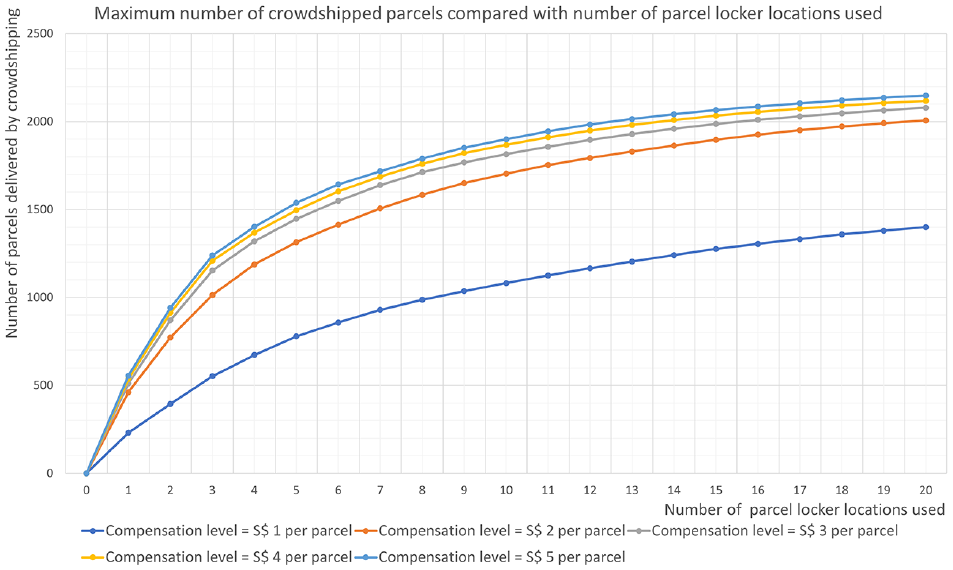
Number of crowdshipped parcels compared with the number of parcel locker locations used and compensation levels.
To examine how the number of crowdshipped parcels increases according to the number of parcel locker locations used, the number of crowdshipped parcels compared with the number of parcel locker locations under each compensation level is shown in Figure 6. Adding more parcel locker locations can increase the number of crowdshipped parcels, but the marginal benefit diminishes. This is because with more locker locations, the greater the likelihood of available crowdshippers being identified; therefore, more matches will be achieved. However, because of the limited number of serviceable parcels with size and detour constraints, the matches will stabilize. Results are shown for up to 20 parcel locker locations used.
Table 4 presents the maximum number of crowdshipped parcels at different compensation levels for the case of 20 parcel locker locations. For example, if compensation of S$1 per parcel is offered to bus passengers, 2% are willing to deliver the parcel and the maximum number of crowdshipped parcels is 1,400. As expected, the number of crowdshipped parcels increases with higher compensation offered. The increase is more significant if the compensation level is raised from S$1 to S$2 per parcel, as seen in Figure 6.
Potential Benefits
The following performance indicators for the carrier are reported:
VKT: total delivery vehicle fleet travel distance
Fleet size: total number of vehicles needed to complete all deliveries based on the CVRP
Operational cost: cost to the carrier for carrying out all delivery trips
Total cost: operational cost plus total compensation cost paid to crowdshippers
GHG: emissions produced by the vehicle fleet, considering carbon dioxide (
VKT
The results for fleet VKT are summarized in Figure 7. The horizontal dashed line shows VKT in the base case without crowdshipping at 1,678 km. The vertical bars (left axis) represent the VKT. Here, we use the depth of the gray color to reflect different compensation levels from S$1 to S$5 per parcel. The orange line (right axis) represents the percentage by which VKT is reduced compared with the base case.
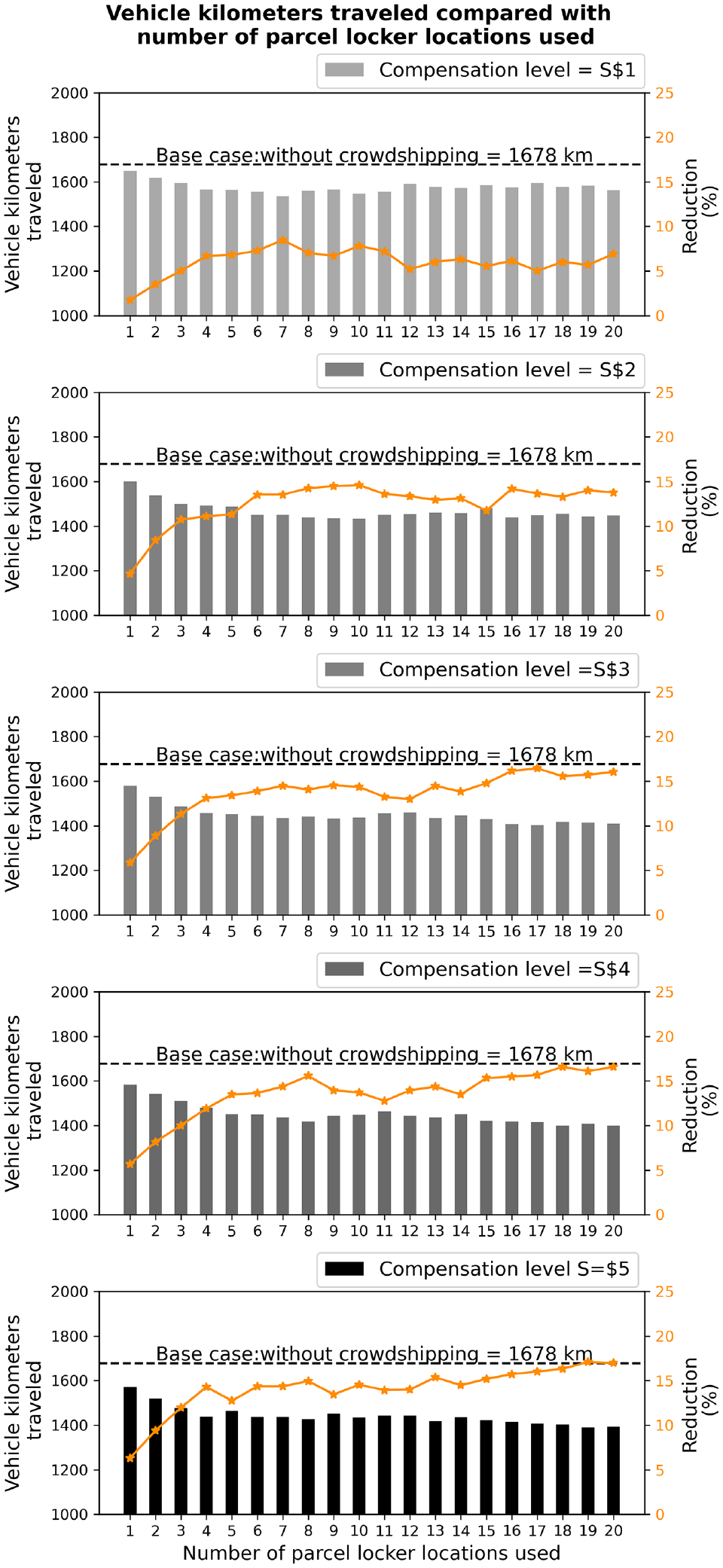
Vehicle kilometers traveled compared with the number of parcel locker locations used and compensation levels.
The results indicate that crowdshipping can help reduce the fleet VKT. More travel distance savings can be realized with a greater number of parcel locker locations used, but this eventually stabilizes. With the exception of offering compensation of S$1 per parcel, the VKT in other compensation scenarios shows a similar trend, achieving a reduction of about 15% compared with the base case. At compensation of S$1 per parcel, the reduction in VKT remains below 10%. Increasing the compensation to S$2 per parcel can achieve greater VKT savings because of a higher number of crowdshipped parcels. However, higher levels of compensation do not lead to many more savings. The results for VKT are generally consistent with the results for the number of successful matches found.
Fleet Size
Reducing the delivery vehicle fleet size has a lasting and positive impact on the carrier’s overall performance.
Figure 8 shows the effect of the number of parcel locker locations used on the required fleet size. The horizontal dashed line represents the fleet size in the base case without crowdshipping at 75 vehicles. The vertical bars (left axis) represent the fleet size. The orange line (right axis) represents the percentage by which the fleet size is reduced compared with the base case without crowdshipping.
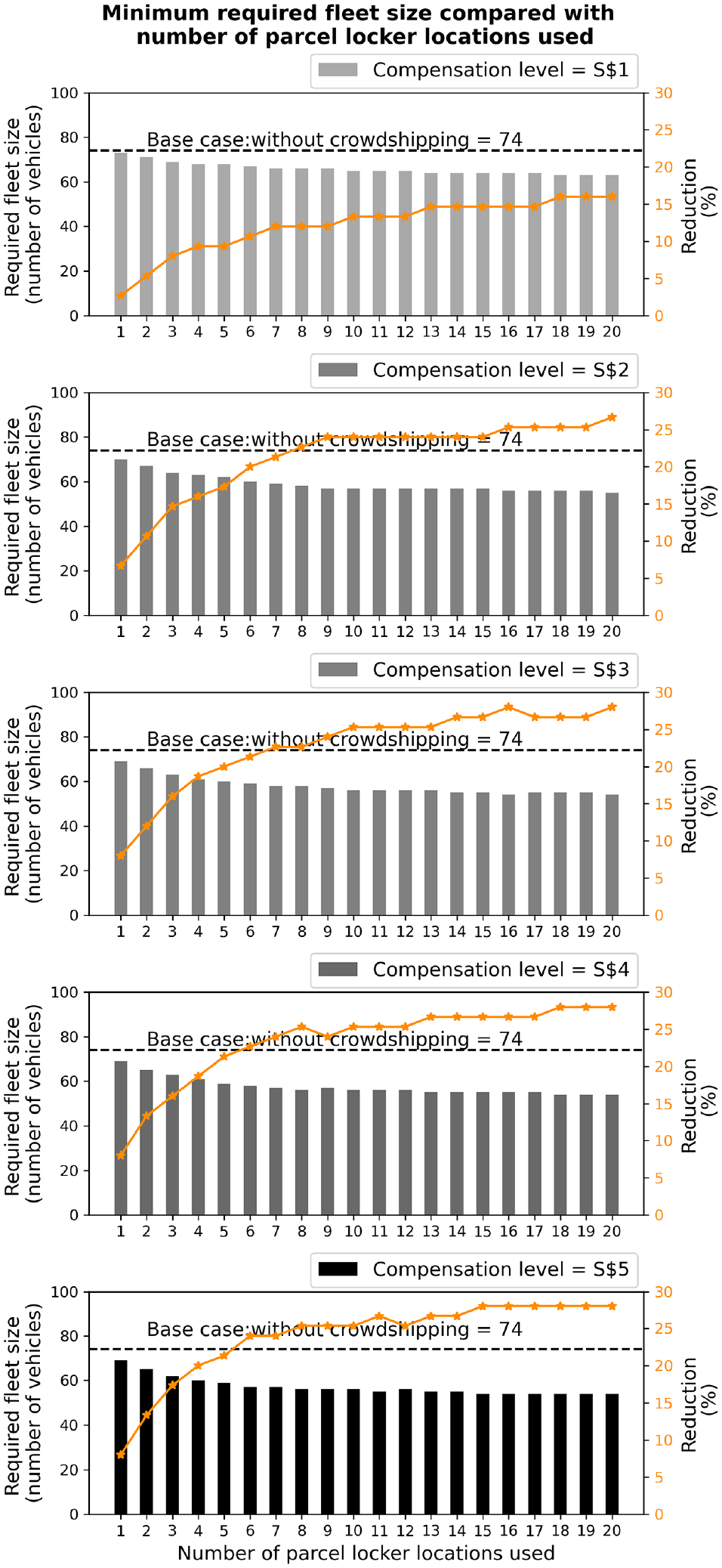
Required fleet size compared with number of parcel locker locations used and compensation levels.
The results indicate that crowdshipping can help a carrier reduce its fleet size while fulfilling all the parcel deliveries. The fleet size can be further reduced if more parcel locker locations are used and eventually stabilizes at all compensation levels.
Across different compensation levels, fleet size can be reduced by 20% to 29.3%. We can see that the required fleet size at each compensation level decreases as the number of parcel lockers increases. This is intuitive, because when more crowdshippers are available, there will be more crowdshipped parcels; therefore, fewer vehicles are required. Furthermore, we can see that the smallest fleet size appears at higher compensation levels. The fleet size decreases the most as the compensation level is increased from S$1 to S$2 per parcel. The decrease in fleet size with even higher compensation levels remains slight.
Cost Analysis
Two cost-related indicators are reported: daily delivery cost; and total cost. The latter includes the compensation paid to crowdshippers. The delivery cost borne by the carrier includes the following:
Fixed cost: cost of vehicle ownership, including purchase cost, ownership taxes, registration fee, road tax, maintenance, and insurance
Variable cost: fuel cost and manpower
It is assumed that the fleet is composed of two types of vehicle typically used in city logistics: delivery vans (such as the Nissan NV350 Urvan); and lorries (such as the Nissan Cabstar). In accordance with the specifications of these two models, the fixed costs can be estimated ( 33 , 34 ). The diesel fuel price is S$1.92/L and the average monthly salary for a delivery driver in Singapore is S$2,010 ( 35 , 36 ).
Figure 9 shows how cost is affected by the number of parcel locker locations and compensation levels. Crowdshipping can reduce the carrier’s delivery cost. This is intuitive, because reducing both fleet size and VKT can reduce the carrier’s cost. However, paying higher compensation to crowdshippers would add to the total cost burden. The total delivery cost savings are divided by the number of parcels to calculate the savings on a per parcel basis. The delivery cost savings are found to be in the range of S$1.10 to S$1.54 per crowdshipped parcel. With the exception of offering compensation at S$1 per parcel, the total cost in other crowdshipping scenarios is higher than that in the base case.
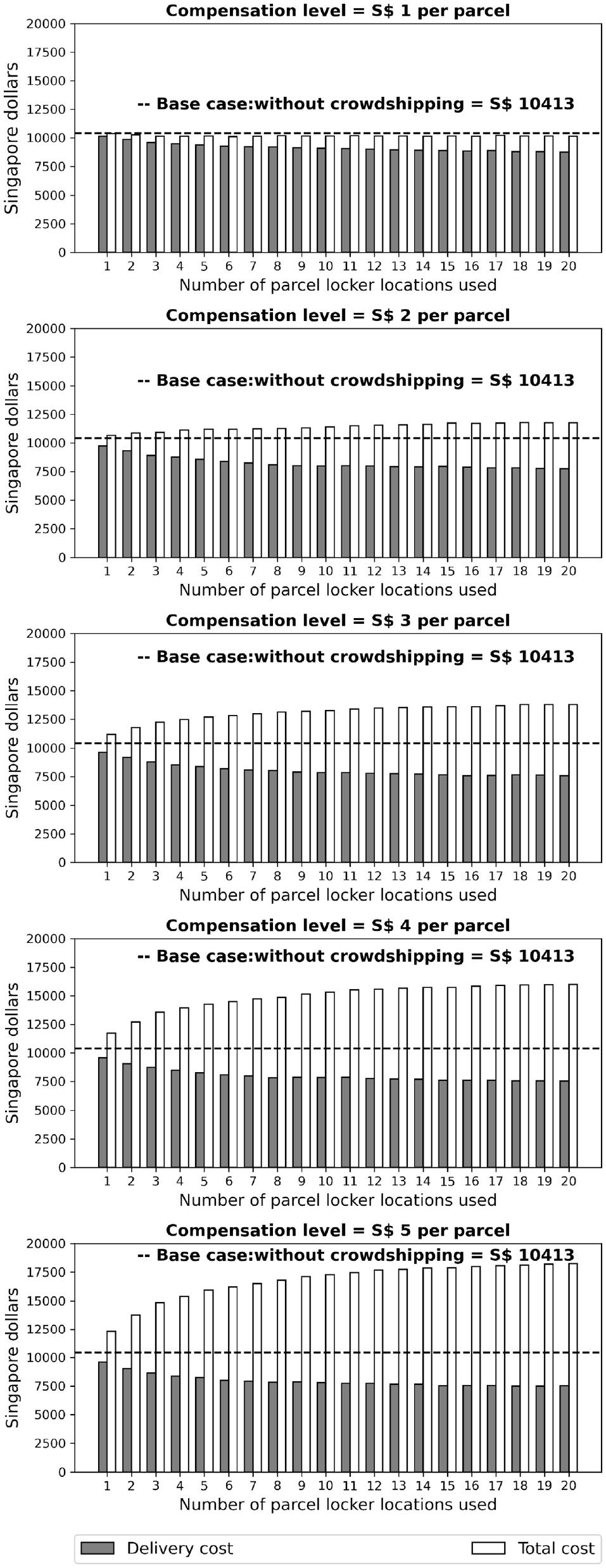
Daily delivery cost and total cost compared with the number of parcel locker locations and compensation levels.
GHG
Greenhouse gases are emitted directly through diesel fuel combustion as vehicles are driven. Carbon dioxide (
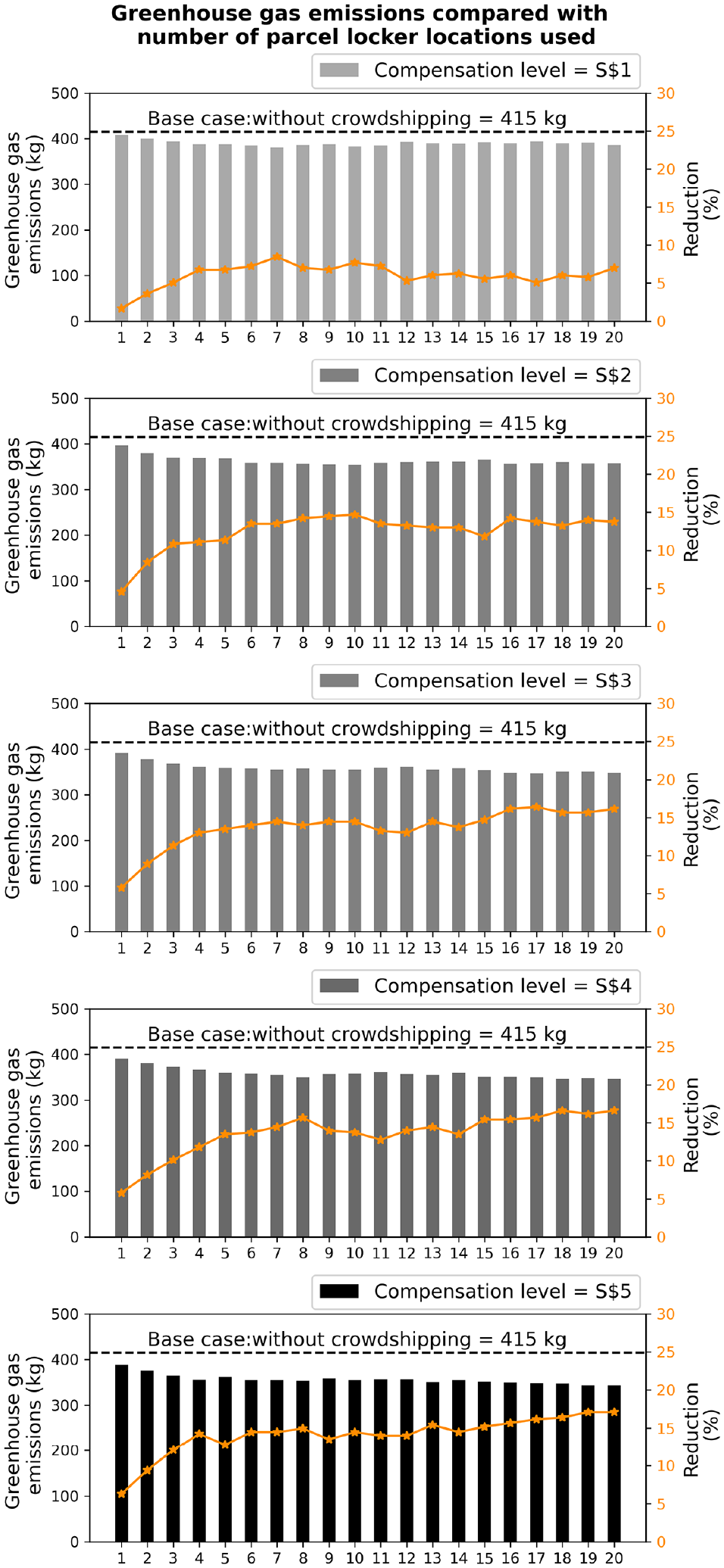
Greenhouse gas emissions in kilograms of carbon dioxide equivalents compared with the number of parcel locker locations used and compensation levels.
Off-Peak Versus All-Day Travel
We extend the crowdshipping scenarios to exclude peak hour passengers to obtain a better understanding of the feasibility of crowdshipping. Peak hours are defined as 7:00 to 9:59 a.m. and 5:00 to 7:59 p.m. on weekdays. It will be more realistic to consider crowdshipping during off-peak hours only, during which there tends to be excess public transport capacity and the buses are not crowded. Considering the large volumes of passenger movements on public transport in Singapore, there is potential for moving parcels via the public transport network even during off-peak hours only.
By matching parcels with public bus passengers traveling during off-peak hours, the number of parcels delivered by crowdshipping is shown in Figure 11. When offering compensation of S$1 per parcel, if the difference between engaging all-day versus off-peak passengers is compared, it only reveals a small variation in the number of crowdshipped parcels. For compensation levels of S$2 per parcel and above, this difference remains slight. These results suggest that crowdshipping during off-peak hours only can also achieve the desired benefits of reducing VKT as well as GHG emissions.
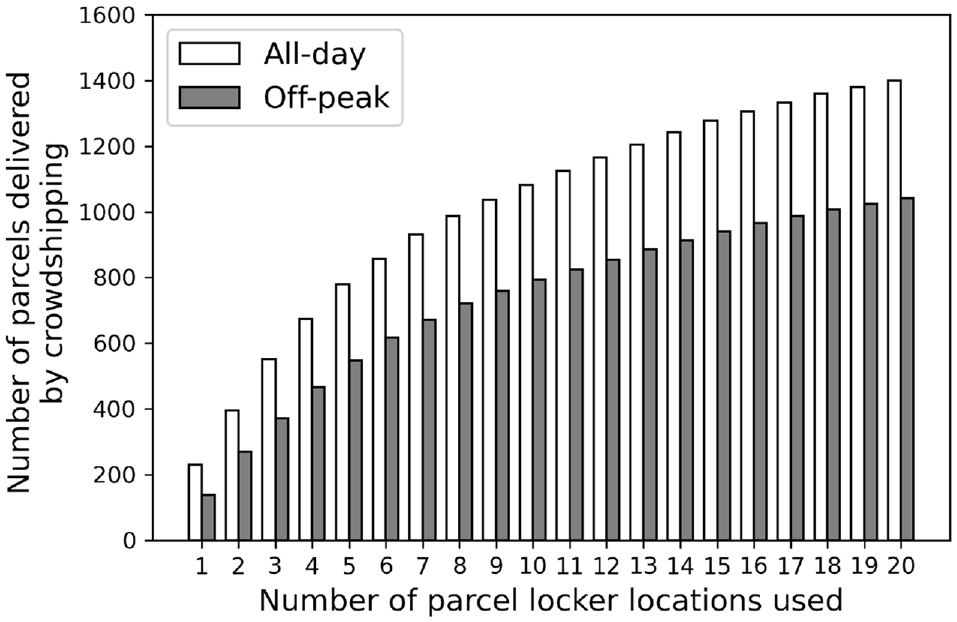
Number of crowdshipped parcels when engaging all-day passengers compared with off-peak passengers at a compensation level of S$1 per parcel.
Conclusion
Cities need new solutions to maintain efficient and effective urban mobility, catering for both passenger and freight transport needs. Crowdshipping appears to be a promising option. This research assessed the potential benefits of crowdshipping, tapping into available capacity in Singapore’s public transport system. The study combined matching and routing, exploring the effect of different compensation levels paid to crowdshippers. Real-world data were used to assess the potential benefits from a carrier’s perspective. We started with an online survey to gauge the willingness of public transport passengers to act as crowdshippers and their preferences, for example, expected compensation. Then, matches between parcel delivery requests and crowdshippers’ public transport journeys were found. In the case of there not being enough crowdshippers available to complete all deliveries, the remaining parcels will be transported by delivery vans, which are subject to a VRP. Finally, the potential impact was evaluated.
The results suggest that supplementing conventional van deliveries with crowdshipping using public transport in a congested city like Singapore can result in benefits for the carrier with regard to reduced delivery fleet size and VKT. Costs can be kept low if crowdshippers are offered S$1 compensation per parcel. Crowdshipping taps into excess public transport capacity, and will also realize benefits with regard to reduced air and GHG associated with parcel deliveries. We extended the analysis by limiting crowdshipping to off-peak hours only, during which public buses are less crowded. Interestingly, benefits can be realized with regard to reducing delivery vehicle traveling distance and associated air emissions compared with the base case of fulfilling all deliveries using delivery vehicles only.
Future Research
There are several acknowledged limitations in this study. Even though some model parameters were obtained from real-world data (i.e., willingness to act as a crowdshipper, parcel origin–destination information, and availability of public transport passengers), several assumptions had to be made, for example, parcel size, parcel locker capacity, and characteristics of public transport users and the delivery fleet. These assumptions can influence the model performance and final simulation results.
For instance, it was assumed that only small-sized parcels can be delivered by crowdshipping. However, delivering medium-sized parcels was also acceptable to some passengers.
In addition, it was assumed that each parcel locker can store an unlimited number of parcels. In our simulation, 75% of lockers are assigned 100 or fewer parcels, and 92% of lockers are assigned 300 or fewer parcels. This encourages us to pursue further research to explore a range of locker capacity limits. Limits on locker capacity might reduce the potential for crowdshipping.
All passengers were assumed to behave uniformly when offered the same compensation. Although compensation level is one of most important factors with regard to passengers’ willingness to act as crowdshippers, other factors such as parcel characteristics (e.g., parcel size/weight), trip characteristics (e.g., trip purpose, journey time, detour time), and parcel locker location may also influence their willingness. Future work should consider these additional factors and reexamine these assumptions more critically.
Further, expanding the survey sample could likely provide more robust findings.
Another direction for future research is to focus on strategies to match parcel deliveries with public transport user journeys. In our current approach, we have not yet considered the distance between parcel locker locations or distance from the warehouse during the allocation process.
Finally, integrating day scheduling into the problem can also add further realism to the case study, for example, considering the shared utilization of limited locker capacity throughout the day.
Supplemental Material
sj-pdf-1-trr-10.1177_03611981221123246 – Supplemental material for Exploring the Potential Impact of Crowdshipping Using Public Transport in Singapore
Supplemental material, sj-pdf-1-trr-10.1177_03611981221123246 for Exploring the Potential Impact of Crowdshipping Using Public Transport in Singapore by Meijing Zhang, Lynette Cheah and Costas Courcoubetis in Transportation Research Record
Footnotes
Acknowledgements
We would like to thank an anonymous e-commerce carrier in Singapore for sharing their parcel delivery data.
Author Contributions
The authors confirm contribution to the paper as follows: study conception and design: M. Chang, L. Cheah, C. Courcoubetis; data collection: M. Zhang, L. Cheah; analysis and interpretation of results: M. Chang, L. Cheah, C. Courcoubetis; draft manuscript preparation: M. Zhang. All authors reviewed the results and approved the final version of the manuscript.
Declaration of Conflicting Interests
The author(s) declared no potential conflicts of interest with respect to the research, authorship, and/or publication of this article.
Funding
The author(s) disclosed receipt of the following financial support for the research, authorship, and/or publication of this article: This research was partially funded by a grant from the Singapore Ministry of Education (T2-1712).

Supplemental Material
Supplemental material for this article is available online.
References
Supplementary Material
Please find the following supplemental material available below.
For Open Access articles published under a Creative Commons License, all supplemental material carries the same license as the article it is associated with.
For non-Open Access articles published, all supplemental material carries a non-exclusive license, and permission requests for re-use of supplemental material or any part of supplemental material shall be sent directly to the copyright owner as specified in the copyright notice associated with the article.
