



Abstract
This study presents a comprehensive review of different problem models for managing railway operations by problem-type classification. Railway terminology was used to identify the studies that encompass the existing body of knowledge. The 28 articles analyzed showed that existing studies are focused on the individual schedule components, such as rolling stock, schedules, crews, and passengers. Few studies have adopted a broader scope by covering several of those components. Two of the most popular approaches include the integer linear program and the mixed integer linear program variant. The difference between them is that integer programming uses discrete decision-making variable data, while mixed integer programming also admits continuous variable data. In contrast, few studies involve combining computational algorithms with human knowledge-based approaches. This analysis reveals that the most significant variables for managing disruptive events are related to verifying suppressed circulation and the discrete events of real-time traffic, such as departures and arrivals at stations.
Rail transport is a fundamental pillar of all national economies ( 1 ). However, it has undergone significant changes in the operating environment. In the case of the European Union, mechanisms have been introduced to promote the single market, for example, Directive 91/440/EEC, and subsequently new regulations on the railway market, Directive 2012/34/EU and Directive 2016/2370/EU. These changes have modified how the various train systems are managed in different countries. With this paradigm shift and the emergence of a liberalized market, a determining factor was introduced to manage the railways—competition ( 2 ). This new environment has forced operators to be more efficient to obtain market share and secure any concessions awarded through the liberalization of rail transport in the European Union. The increase in demand for railways as a means of transport has caused an increase in the competition arising from the above-mentioned factors, forcing railway operators to take a closer interest in the problem of schedule management, whether from a long-term or a short-term planning perspective ( 3 ).
Railway systems suffer daily interruptions and disturbances for several reasons, and their impact is experienced by passengers using this means of transport ( 4 ). This prompts the development of a proposal from the existing literature for the management by passenger rail operators of disruptive events that affect schedules.
The European Railway Agency, through document ERA-PRG-004-TD-002, establishes a taxonomy of disturbing events that have served as keywords and search terms in this study. The authors’ approach in undertaking this study comprises four phases (see illustration in Appendix A). The first phase was to identify an initial set of prospective relevant articles. The widely known Scopus and Web of Science (WoS) research databases were adopted to select articles focused on train operating companies (TOCs). Two tools were used to organize the literature: Mendeley and Nvivo. This process identified 131 candidate articles, which were reduced to 28 after a complete reading of them all. Only articles that focus on TOCs are included. The second phase consisted in defining a set of codes and meta-information, such as: main ideas, research approach, investigation methods, variables, authors, and the possibility of new investigations. In the third phase, all the relevant meta-information previously defined was collected from the articles. Finally, the last phase aimed at compiling and presenting the results obtained in the form of intuitive graphics.
This paper reviews the literature on problem models and solution approaches for real-time operation management by TOCs. The document is organized as follows. The following section presents the literature review and the contributions of this document. The third section proposes a framework for real-time operations management. The fourth section presents the results and discussion. In the final section, conclusions are drawn and the possibilities of future research are further discussed.
Literature Review
Dollevoet et al. ( 5 ) found that the current literature on railway disturbance management focuses only on rescheduling a resource, schedule, rolling stock, or crew. Few studies were found addressing the optimization of train schedules under uncertain passenger demand and disturbed operation. According to Hassannayebi et al. ( 6 ), the effectiveness of control strategies depends on a holistic system approach.
Lusby et al. ( 7 ) show that most of the literature related to passenger railway optimization from the TOC’s perspective can be categorized by scheduling, rolling stock scheduling, crew scheduling, and rail vehicle maneuvering. Corman and Meng ( 8 ) reinforce this idea, showing that few approaches have effectively brought together more than one problem, such as, for example, the management of circulations with delays, the rescheduling of rolling stock routes, the crew, and circulations. Other publications such as Fang et al. ( 9 ) and Schipper et al. ( 10 ) raise awareness of the lack of multi-objective work in real-time operations management approaches.
The study by König ( 11 ) focuses on dealing with circulation delays and highlights the question of whether a train should wait for another train with a delay. That situation can be a delayed feeder of delays that causes further delays in the network, affecting how long transit passengers wait and how many no longer have the other train waiting. The study focuses on publications that aim to reduce inconvenience to passengers. A taxonomy scheme for railway problems at the operational level is also presented and shows how the field of delay management fits into other parts of the planning process. It is found that most proposals present a macroscopic view of the infrastructure details. Thus, as most models use deterministic data, other models identified by this study are exact and heuristic methods, as well as models with incomplete information, that are usually solved with heuristics. Moreover, very few stochastic models are identified. Stochastic models are considered to lead to more complicated problems in real situations.
On the other hand, information about delays is closer to real-world problems. It is stated that deterministic scenarios are too optimistic, while scenarios with little information about the future can be too pessimistic. Finally, it is argued that the focus on passenger delays may fall short of optimal solutions for managing disturbances on the railway. König ( 11 ) considers holistic models to be capable of meeting the needs of both passengers and operators, thus resulting in a positive-sum game.
However, Corman and Meng’s approach ( 8 ) to rescheduling railway traffic in real time exhibits dynamic and stochastic, or non-deterministic, aspects. That study concluded that most approaches consider problems related to operation disturbances to have an interrelated scope. When solving a problem, Corman and Meng indicate that the basis for resolution remains the basis for resolving subsequent problems until all problems are resolved. They state that most of the models in this field of research tend to be dedicated to a question of seeking global optimization, rather than overall viability, which is a very pertinent observation, considering the numerous additional and typical restrictions on rail passenger transport. For the approaches, Corman and Meng identify a trend in developing hybrid approaches that tend to integrate the advantages of simulation, heuristics, and mathematical approaches. Thus, they conclude that there is a need for real cases and comparative approaches to assess the proposed models. Finally, they say that most decision support tools have the purpose of visualizing information or merely serving as repositories of information.
Fang et al. ( 9 ) propose a relationship approach between models and types of problems. They analyze the instances and sizes of the problems as well as the objective functions of the proposals analyzed in the literature review. According to Fang et al., the heuristic algorithms do not guarantee an ideal solution. They consider that it is very difficult or even impossible to evaluate the comparison between approaches to solving railway problems. Also mentioned by Fang et al. is the lack of studies combining research algorithms with knowledge-based approaches and the shortage of publications dealing with large-scale problems. Another issue is the lack of applicability of these same studies in the real world.
Fang et al. ( 9 ) propose reviewing the literature and presenting a classification for the publications they identify. According to these authors, the approaches can be classified into different groups, namely operational research approaches, evolutionary algorithms, fuzzy systems, specialists, and heuristic algorithms with different problem models. In basic operational research approaches, branch and bound, dynamic programming, and first come, first served have been used by researchers. Genetic algorithms, simulated annealing, differential evolution, and optimization of ant colonies have been studied for rescheduling in railway networks. Other heuristic algorithms, such as brute force, more critical completion time, taboo search, and greedy algorithms, have also been studied for rescheduling. In these studies, Fang et al. identified different models proposed for the rescheduling problem, including the task scheduling problem model, model based on graphics, Petri nets, whole programming model, and mixed whole programming model. Fang et al. ( 12 ) concluded that heuristic approaches are the most used among all approaches, as they can obtain the optimal, or almost optimal, solution in a limited time span when the scale of the railway network is not very large. With regard to problem models, the alternative graphic model and the linear programming model, including the integer linear programming model, and the mixed integer linear programming model, are used more often than the others.
Cacchiani et al. ( 13 ) present an overview of the models and algorithms for recovering from railway disturbances and interruptions in real time. That study shows that railway research is an active area of operational research, including rescheduling rolling stock and crew duties, and that most of the documents analyzed in the proposed review of the scheduling deal with relatively small delays and many circulations, instead of large interruptions. Most works also deal with a single rescheduling phase. As to the models presented, the results can be seen as promising. Nevertheless, Cacchiani et al. believe that it will be a great challenge to bring these methods to railway operations in real time. Furthermore, they add that the development of algorithmic methods of real-time railway rescheduling is still currently an academic field, where research is still far ahead of what has been implemented in practice.
Pender et al. ( 14 ) share the results of an international survey of management practices for unplanned interruptions in passenger rail transport. The article documents industry approaches to this problem and how these disruptions are managed, and describes how operators plan for disruptive events. It highlights the need for rail transport operators to resort to alternative means of transport occasionally. However, as mentioned by the operators and described in the article, some regions cannot be served in a timely fashion by alternative transport. Passenger rail operators also mentioned that any disruption could be categorized according to duration, cause, time, and place. Unplanned interruptions are, by nature, unexpected events.
Contributions
This paper contributes to the existing literature by providing an updated review of problem models for managing real-time operations of passenger TOCs. By narrowing the scope to passenger TOCs, this study focuses on the specificities associated with rail passenger transport. The TOCs sometimes does not have the same motivations and interests as the infrastructure manager. Thus, the variables that each one of them controls are not the same. For example, the management of crews and rolling stock is the responsibility of the railway operator, whereas tracking traffic control is the responsibility of the infrastructure manager ( 15 ). While both are key to operational management, the literature has mostly focused on the infrastructure manager (e.g., Corman and Meng [ 8 ]) or has not distinguished between the two roles within the operations panorama (e.g., Fang et al. [ 9 ] and Cacchiani et al. [ 13 ]). The contributions of this study are as follows:
Presenting a literature review of disruptive events from the TOC’s perspective.
Determining the variables and problem classifications considered in the studies.
Highlighting the main ideas given by the proposals presented in the literature.
Enabling the identification of a set of significant variables from the passenger transport operator’s perspective.
Management of Railway Operations From the Perspective of the TOC
Interruption management aims at returning to the planned operation, minimizing all negative impacts caused by interruptions and recovery costs ( 6 ). Unfortunately, the real-time operations of a rail system are inevitably subject to unexpected disruptions and interruptions, which result in schedule imbalances ( 3 , 13 , 16 ). When deviations from the original schedule arise, the operator within their domain is allowed some degree of freedom to resolve them to restore normal rail traffic ( 17 ). However, this freedom can be limited by issues related to the use of the infrastructure as well as the use of resources that can reduce the operating margin of the railway operator. On the other hand, operators always consider key performance indicators that allow them to mark their interventions. The main measures they take into account are the volume of the commercial offer, travel time, passenger connections, punctuality, resilience, energy consumption, and general resource use ( 18 ). It is difficult to determine the extent of an interruption, and the many possible decisions makes it difficult for dispatchers to find high-quality solutions to rescheduling problems. If there is no good interpretation and approach to the problem, the effects of interruptions can easily create a ripple effect, resulting in even more problems ( 7 ).
Nielsen et al. ( 19 ) differentiate between two types of problems that compromise compliance with the schedule. Interruptions can be caused by various internal or external factors, such as defective switching devices on a busy railway line, damaged rolling stock, or damaged catenary. In the case of an interruption, resource planning must be updated when it is no longer viable and the update must take the actual situation into account. Disturbances, on the other hand, need only simple recovery measures. An example of a disturbance is extra time taken for passenger boarding and alighting at stations. Such disturbances are absorbed by slack in the schedule or can be controlled by minor schedule changes.
An interruption has a more significant impact and generally interrupts the schedule, causing changes in the planning of the rolling stock and the crew, and thus making the schedule unviable ( 5 ). Cacchiani et al. ( 13 ) note that interruptions are relatively large incidents that require changes to the schedule and may suppress journeys, and have the effect that subsequent tasks may not be performed because the conditions for their completion are not met, because of a lack of either rolling stock or crew. Another factor associated with interruptions is their level of uncertainty. Usually, the duration of an interruption is not known at the beginning. Therefore, the schedule and resource tasks may need to be rescheduled multiple times, whenever new information emerges about the interruption duration. Disturbances, on the other hand, are relatively minor in the railway system and can be dealt with by changing the timetable, where the railway operator can accept some delayed journey movements without changing the tasks of rolling stock and crew.
During the management of real-time operations, various threats to planning may occur throughout the day. When operations are planned, the rolling stock plans, crews, or time-off times are usually not designed to absorb any disturbing events. Figure 1 illustrates the breaking point. The
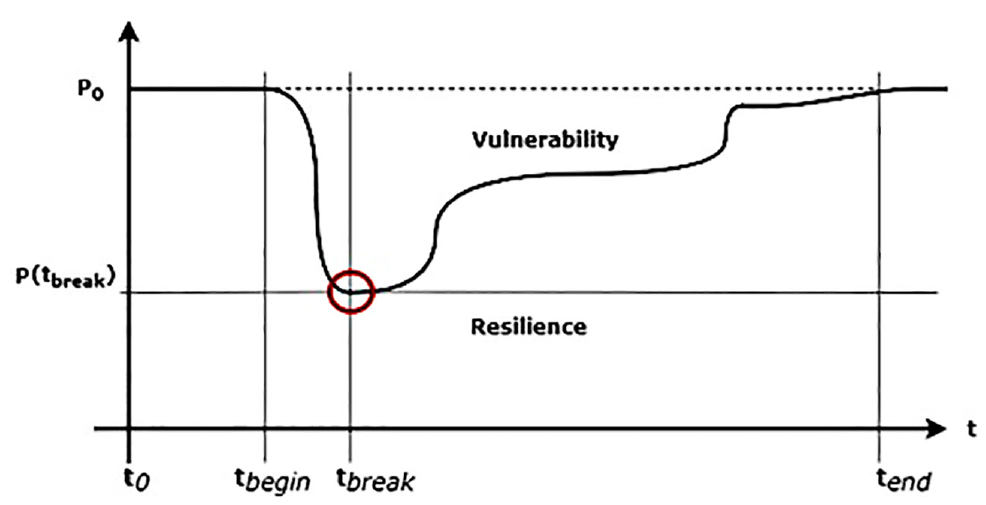
Representation of the breaking point.
Ghaemi et al. ( 21 ) propose the “bathtub” model illustrated in Figure 2. This model is composed of three phases that very effectively illustrate the moments of managing operations in real time. When there is an interruption, there is a decrease in rail traffic; this is the first phase. In the second phase, rail traffic remains low during the interruption; in this phase, contingency plans or scheduled restoration solutions are applied. Finally, when the interruption is resolved, traffic returns to normal, thus returning to the original schedule; this is the third and final phase. The first and third phases may be considered as transition phases. The first phase is a transition from the original schedule to an alternative one, and the third phase is a transition from the alternative schedule to the original one. Journeys that are to be canceled must be dealt with in the first phase of transition. In the third phase, operations need to be resumed.
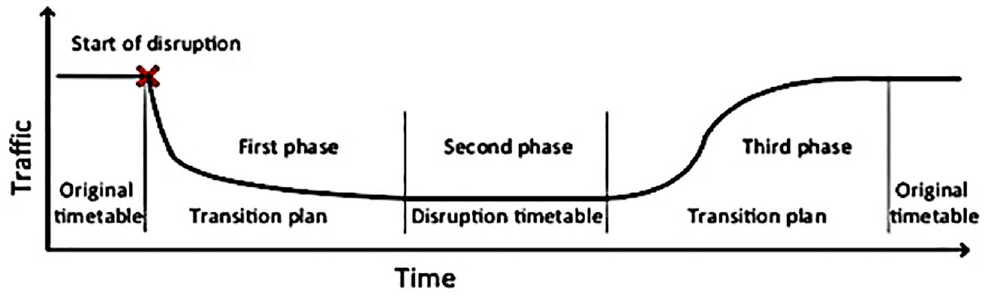
Bathtub model illustrating the traffic levels during a disruption ( 21 ).
Leng and Weidmann ( 22 ) describe three stakeholders in the process of managing railway disturbances that cannot be overlooked: passengers, train operators, and infrastructure managers. Infrastructure managers are primarily responsible for the operational feasibility of the rescheduled schedule. Train operators aim to minimize operating costs and maximize the services offered to passengers. Passenger needs are an important element to be assessed when schedules are rescheduled as a result of railway interruptions, since the three stakeholders have different and even conflicting objectives in the interruption management.
The purpose of a passenger TOC is to provide journeys that satisfy passengers. For this purpose, it endeavors to plan operations management in real time to comply with the planned schedule. However, this effort must take into account the high costs involved. The TOC’s motivation is to look for an optimal solution in an overview and not in a scenario. A management decision can become a very damaging decision with irreversible effects on meeting the schedule ( 7 , 23 ).
According to Dollevoet et al. ( 5 ), one of the essential criteria for passenger satisfaction is the reliability of train services. Another relevant factor for passengers is the transfer connections, which mainly affects those who need to take more than one train to reach their destination. In some cases, connections may not be reliable because of a disturbance or interruption. In these situations, proper operational management is critical to ensure that passengers arrive at their destinations. It is sometimes necessary to resort to alternative transport to guarantee passengers will be able to travel ( 24 ).
Moore ( 25 ) proposed three general categories of interruption, based on their impact on passengers: failure to comply with the traffic, insufficient commercial offer of available seats, and interruptions that limit the circulation of trains in the infrastructure. Moore added that, when circulation is interrupted, the main objective of restoring the schedule is to minimize the negative impact on passengers. Other publications study the impact of interruptions on railway passengers ( 14 ).
Kunimatsu et al. ( 26 ) propose a disutility function based on the utility theory to measure customers’ discomfort and dissatisfaction. They also note that an important objective of passenger operators while managing interruptions is to minimize the total number of passengers affected by the interruption as well as the inconvenience to the affected passengers. Leng and Weidmann ( 22 ) add that passenger dissatisfaction is related to travel time in general, including time inside the train, waiting time, the number of transfers, and late arrival. Ghaemi et al. ( 27 ) note that up to 1,000 passengers can wait for a train at a busy station during peak hours (that is, the time with the most significant demand), and passengers prefer a slightly delayed train to a canceled one.
With the advent of digitalization and ever-increasing open data policies, solutions based on real-time information have emerged. This paradigm fills a considerable gap in effective management of demand, knowing how many passengers are involved and using rail transport. In this sense, operating costs can be reduced through planning strategies highly targeted to passenger demand. The demand can be perceived based on data on disembarkation and embarkation at each station ( 28 ). On the other hand, Golightly and Dadashi ( 29 ) observed that technology could also be applied to passengers and the need to provide accurate information on the duration of delays and possible alternatives. This type of information is transmitted by traditional means, such as station employees, but also by more recent forms of technology, such as mobile travel applications and social networks.
Specific passenger behavior when interruptions occur is an important topic (see Candelieri et al. [ 30 ]), and significant insights are still lacking. König and Schön ( 31 ) explain that passengers are routed through the network by the existing railway offer when the railway operator cannot impose new flows. Passenger behavior can be influenced to the extent that delayed passengers comply with the TOC’s guidelines because of their desire to reach their destination. Operators seek to inform passengers using information dissemination, such as announcements at stations or inside trains. König and Schön ( 31 ) found that passenger behavior at disruptive moments is quite challenging to model for forecasting purposes. Short-term passenger behavior may be uncertain, but accounting for stochastic aspects in delay management of large space–time networks will be a challenge, if not intractable, from a computational perspective. Veelenturf et al. ( 32 ) propose an iterative approach incorporating a rescheduling model and a passenger allocation model in an iterative structure. Each iteration time is adjusted to reduce the total inconvenience caused to the passenger. Leng et al. ( 33 ) propose a simulation model to explore passenger dissatisfaction and satisfaction with different timetables as well as information strategies for passenger rail operators to offer better services to passengers in cases of disruption. In the model, passenger dissatisfaction is indicated by a scoring function resulting from the delay in the train (or trains) they are taking.
Results and Discussion
Characterization of the Literature
This section aims to provide a literature characterization of the proposed solutions. Figure 3 illustrates the relationship between the quartiles and selected article numbers. This investigation used WoS and Scopus databases. Most of the proposals in the literature were published in top-quartile journals (5 in WoS; 11 in Scopus). Nevertheless, only one journal refers to the fourth quartile, which emphasizes the quality of the proposals on view.
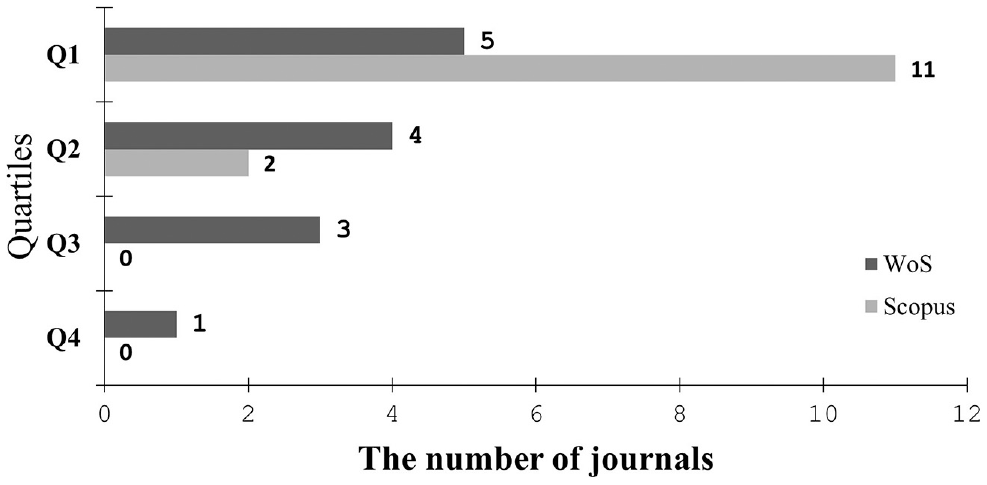
Number of journals per quartile.
Table 1 is intended to deepen the characterization of the literature by identifying the impact of the articles. Such information was extracted from the platforms WoS and Scopus. While analyzing the table, we may observe that the most cited article is the proposal by Corman et al. ( 24 ), which presents a two-part heuristic-based solution to solve the delay problem of trains. Although it dates from 2012, it stands out from the others with 135 citations in Scopus and 124 in WoS. The bulk of the proposals are in article format (24 documents), three are papers in conference proceedings, and one is in a handbook format.
Characterization of the Proposals, by Citation, Document Type, and Year
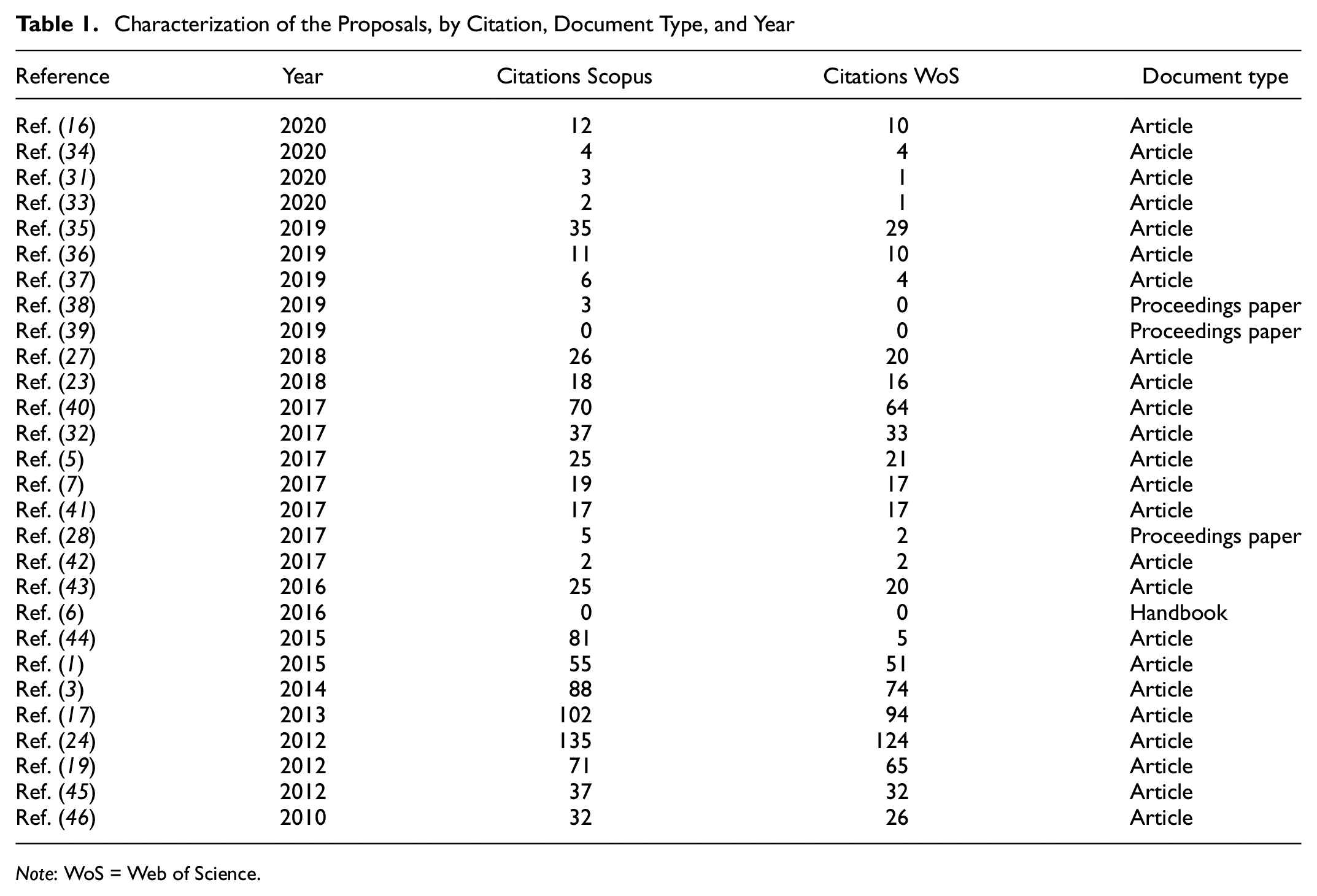
Note: WoS = Web of Science.
Table 2 provides a summary view of the number of proposals per year and their objectives. The year with the most publications was 2017, and the objective mostly studied is to minimize the number of delayed trains. On the other hand, there are still a few studies on maximizing passenger satisfaction, but this goal presented meager works considering that this review is from the perspective of TOCs. It also mentions the lack of work on broader objectives such as combining rolling stock and crew usage.
Distribution of Articles per Year
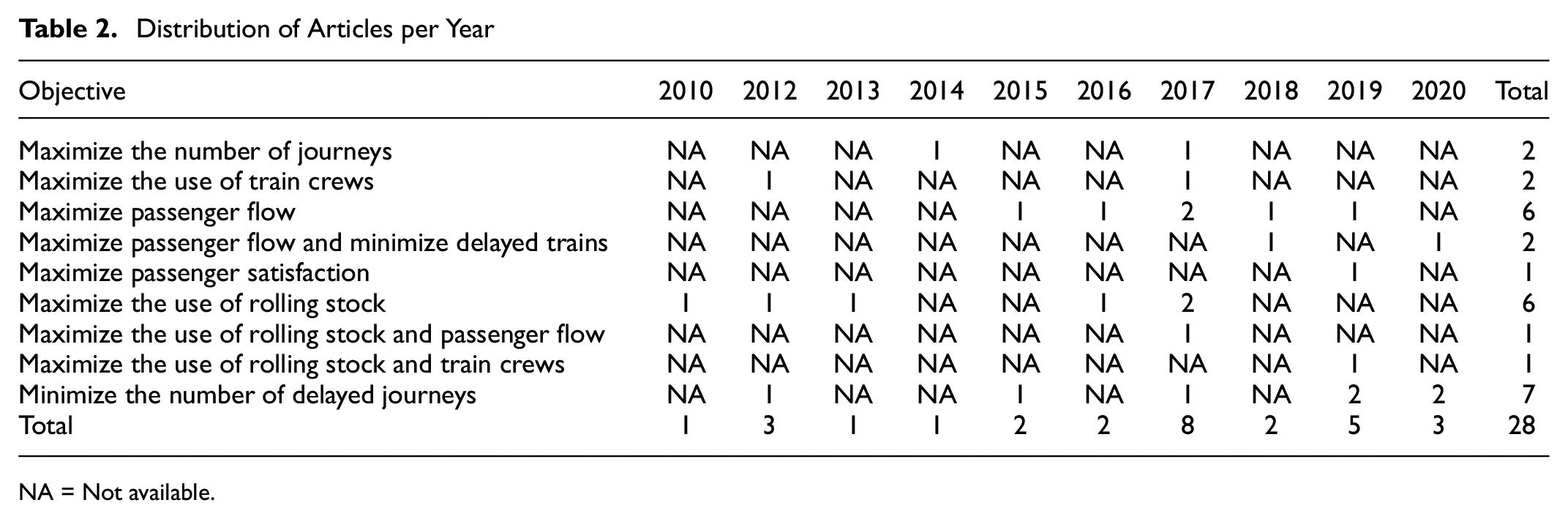
NA = Not available.
Results of the Articles per Objective
This section analyzes the proposal objectives and starts by comparing the various approaches by the goal. Although there are a few multi-objective approaches, the majority of these approaches focus only on a single goal.
Maximize the Use of Rolling Stock and Train Crews
The proposal to group these two dimensions (i.e., use of rolling stock and train crews) is studied by Zeng et al. ( 38 ). According to that paper, this model is two in one and consists of several complex constraints for both the rolling stock and the crew, such as the maintenance of rolling stock, the balance at the end of each day, and the crew working time limit. A custom ant colony algorithm is also added to facilitate the use of the integrated model within a strict deadline efficiently. This model focuses on the phase 2 of the bathtub model proposed by Ghaemi et al. ( 21 ).
Maximize the Use of Train Crews
Unlike the previous goal, this goal focuses exclusively on the crews and two articles were found. Verhaegh et al. ( 42 ) use an extended set of 5,000 real-world case situations to minimize changes to planning and reduce the number of overtime hours worked by crews. This is part of a heuristic model, and can be put to use in stage 2 of the bathtub model. The second proposal for this goal is a Lagrangian heuristics model developed by Veelenturf et al. ( 45 ), whose intention is to act on phase 2 of the bathtub model. Real-world data is used in three different scenarios with a bilateral infrastructure outage. The first proposal of this goal has its focus on avoiding overtime work. The study of these authors, envisions to benefit from the travels to achieve that they take the initiative of delaying the trips to offer a solution of service quality. On the other hand, this study only considers train drivers, ignoring other crew members.
Minimize the Number of Delayed Journeys
Delays are an issue in rail transportation systems; trains can suffer delays from another delayed train, which can happen directly or indirectly. Corman et al. ( 24 ) presented a proposal that uses two heuristic models for the first phase of the bathtub model, with legitimate data from a set of 25 cases with delayed trips. The main focus of this proposal is to calculate the Pareto frontier of uncontrolled times. The second proposal for this goal is given by Huang ( 39 ), who proposes a K-means-based model that belongs to the first phase of the bathtub model. There are three scenarios with different delay levels used. In addition, this proposal considers the characteristics and structure of the problem. Another particularity of this proposal is to use probability models resulting from historical data to improve the obtained results. The third proposal of this goal also belongs to the first phase of the bathtub model and is based on machine learning support vectors (SVRs) and Kalman filter (KF) (Huang et al. [37]). Five probability density models and two kernel functions are applied to adjust the number of assigned train distributions and the total delay time. The following proposal by Huang et al. ( 16 ) has its base on K-means, machine learning SVR, and KF. The model covers the first phase of the bathtub model and intends to fulfill the initial planning. A dataset of 57,796 rail traffic records is used, which includes information on the actual time of arrival/departure for each train and station. The number of trains, dates, duration, and a section of tracks occupied was collected to build a database with the data recorded every minute.
The proposal by Veelenturf et al. ( 44 ) focuses on the second phase of the bathtub model, suggesting a linear programming model to solve the problem of the rescheduling program. It aims to minimize journeys canceled and delayed services when there are restrictions on infrastructure and rolling stock capacity. Thus, the focus is on ensuring the existence of rolling stock. In Leng et al. ( 33 ), a solution based on mixed integer linear program is proposed and focuses on the second phase of the bathtub model. An optimization model is proposed that is capable of calculating a new schedule, based on specific waiting time and a known disorder. The article presents a scenario in the urban area of Zurich, where only urban trains are affected (long-distance traffic is deflected). This scenario has a duration of 3 h, from 16:00 to 19:00. Finally, a proposal that joins the mixed integer linear program and Lagrangian heuristics proposed by Dollevoet et al. ( 5 ) falls under the second phase of the bathtub model. It presents an iterative structure to reprogram the schedule. This all-in-one structure leads to a viable global solution for all resources. The study shows that the algorithm converges to a satisfactory solution for all instances of the real world.
Maximizing the Use of Rolling Stock
Rolling stock is one of the main assets of TOCs and represents a main operational interest in the management of rail operations. For this objective, six articles were identified. In Budai et al. ( 46 ), there is a proposal description with a heuristic model covering only the second phase of the bathtub model. A scenario is presented with disturbance events that involve 900 journeys. It describes the problem of rolling stock rebalancing as relevant both in the short-term planning stage and in real-time operations (very short-term planning). According to Budai et al., the results show that heuristics can be used effectively both to solve the most significant problems of short-term planning and as a basis for solving real-time rescheduling problems in case of an interruption in the rail system. The second proposal by Nielsen et al. ( 19 ) describes an integer linear programming solution where all three phases of the bathtub model are covered. The article contributes to the process of rolling stock rescheduling. It first defines a generic framework for the rolling stock problem rescheduling actions as a static decision problem and then sets an online variant to deal with uncertain information. It presents a scenario with a noon interruption between Utrecht and Amersfoort. The actual interruption length is unknown at the interruption time, thus only an estimated length is available. The third article, by Lusby et al. ( 7 ), only covers the second and third phases of the bathtub model in this proposal, a combined solution with integer linear programming and the restricted relaxed master problem appears as a solution to solve the rolling stock reprogramming problem. A branch and BAB price algorithm is proposed to solve the problem of rolling stock rescheduling. This well-known technique for solving integer programs in large-scale generation combines the BAB columns of Barnhart et al. ( 47 ). The generation column is generally preferred when a mathematical model contains many variables. A scenario with interruptions of 1–4 h duration with different starting points is presented. These are considered periods that may include the peak time in working days. The proposal by Veelenturf et al. ( 32 ) uses integer linear programming to solve problems in the first and second stages of the bathtub model. It proposes an interrupt management approach that integrates real-time rescheduling of the agenda, considering that passenger demand changed. Decision times are limited to additional stops for commercial traffic at the stations where traffic would not stop regularly. Several approach variants are suggested, with a difference in determining which additional steps must be performed. The authors propose a scenario with a break between 07:00 and 10:00. In Cadarso et al. ( 17 ), a proposal using the combination of the mixed integer linear program and the heuristic model shows why such proposal aims to solve the rolling stock problems in phase two of the bathtub model. The article presents a two-step approach to adjust the timing and allocation of rolling stock. The authors consider the reaction of passengers in the proposed approach. The last proposal of this objective is described in Haahr et al. ( 43 ), which combines mixed integer linear program and linear programming relaxation to solve the rolling stock problems of phase two of the bathtub model. It extends an existing column generation formulation and introduces a new line generation method. In this formulation, the order of the units in the compositions is taken into account. The authors use 12 different scenarios. A classification of the cases is created according to the complexity of the problem presented. This complexity is because of the number of journeys that need to be changed. For iteration purposes, interruptions of at least 3 h are considered.
Maximize the Number of Journeys
This goal aims to maximize the number of trips that can occur in a period where those problems take place. In this regard, two articles were found. The first article, by Zhu and Goverde ( 28 ), uses simulation model techniques and acts in the second phase of the bathtub model. It presents a model for getting passengers to their destinations during service interruptions. This model considers the maximum number of available seats offered to passengers. Two scenarios with different delay averages were considered. In one scenario, each train’s available capacity is set to infinity, allowing passengers to board any train they wish to board. In another scenario, the available capacity of each train is finite. The second article, by Louwerse and Huisman ( 3 ), uses integer linear programming and acts in phase two of the bathtub model. Two cases are studied: the first is a significant interruption on a track segment between Rotterdam and Gouda Goverwelle, and the second case is significant disruption on a track segment between the Hague and Gouda Goverwelle stations. In both cases, partial and complete blocks are considered. Whole programming models are formulated to adjust programming in case of both partial and complete blockages. By using these models, compensation can be made between the TOC’s different objectives, namely, the cancelation and the delay of journeys. Louwerse and Huisman ( 3 ) go on to solve these formulations to optimize and present numerical results in real-world cases. They then show that by postponing some journeys for a few minutes, the number of cancelations can be significantly reduced compared with current practice. Finally, they introduce inventory restrictions into the model to determine the disposal schedule.
Maximize Passenger Flow
Sometimes for passengers to reach their destinations it is necessary to use more than one train. When there are problems, some connections may be affected or even canceled. The purpose here is to find solutions to maximize the number of passengers reaching their destinations. Six articles were identified with this objective. Shakibayifar et al. ( 40 ) propose a solution that covers phases one and two of the bathtub model. To do this, they use integer linear programming. The proposed model includes the cancelation of journeys, delaying or re-routing trains with uninterrupted programming, and emergency scheduling journeys. Passenger flows dynamically adapt to the new schedule. The model can find the best solutions in reasonable computational times. A scenario is assumed in which a network is interrupted over the time horizon of the rescheduling. Kroon et al. ( 1 ) also cover the first two phases of the bathtub model, including the composition of the integer linear programming and simulation model. A scenario is presented divided into several parts, concerning the affected area, the interruption times, the rolling stock movement, and the passengers involved. Two variants are proposed to start the iterative algorithm: The Boot-Sim variant begins with a simulation of passenger flows, and the variant Boot-Opt begins with a journey optimization of rolling stock. The results show that Boot-Sim usually exceeds Boot-Opt, because Boot-Sim is able to offer a perfect solution in one of the first iterations, while Boot-Opt needs a more significant number of iterations to find a solution of comparable quality. Especially for the Boot-Yes variant, the computation times are attractive for use in real time. Ghaemi et al. ( 27 ) propose a solution based on mixed integer linear program which covers the first phase of the bathtub model. An interruption scenario that occurs in a part of the day and again hours later is considered. However, the same type of occurrence is found, but with different resolution times. Zhu and Goverde ( 34 ) propose a mixed integer linear program available in the second phase of the bathtub model to calculate the impact of getting passengers to their destinations in situations of disturbed traffic. In this proposal every decision is relevant, taking into account passenger demand. In Zhu and Goverde ( 36 ), another solution is shown to solve the passengers’ problems. The proposal is based on mixed integer linear program and falls under the second phase of the bathtub model. This model considers the timetables and passenger distribution in the trains with the purpose of minimizing the overall travel time (time inside the vehicle, waiting time at stations, and number of train changes). A network scenario is presented with a total length of about 128 km, a single track (23.5 km) and two-way (104.5 km) railway lines with 17 stations. The proposal is to calculate the impact of getting passengers to their destinations in situations of disturbed traffic. In this proposal every decision is relevant, taking into account passenger demand. In this article, 408 different scenarios are explored. Finally, Hassannayebi et al. ( 6 ) propose a simulation-based model for the second phase of the bathtub model. The objectives proposed by the authors consist of formulating a dynamic single control policy and a combined one through a model of discrete event simulation. It is also intended to optimize system performance for the benefit of passengers in situations of high uncertainty. To this end, a simulation analysis is conducted to compare the different individual and combined control strategy performance.
Maximize Passenger Satisfaction
Passengers expect that the number of trains available will always be the scheduled amount. On the other hand, passengers expect that there will be no delays. Maximizing passenger satisfaction involves addressing both of these factors. We only found the article by Zhu and Goverde ( 35 ), that uses a simulation model. This proposal positions itself in the second phase of the bathtub model. The proposal aims to avoid increasing the travel time for passengers. The authors develop a work based on a passenger allocation model that draws on the schedule during significant disruptions. A network formulation is developed to generate the schedule as an acyclic graph, aimed at the passenger trains timetables. The interruption scenario is defined as a complete block between two stations. The block begins at 7:57 and ends at 9:00. The number of nodes (events) and arcs (activities) in the formulation network is 2,085 and 3,539, respectively. The total number of passengers traveling on the network considered during the period in question is 7,515.
Maximize the Use of Rolling Stock and Passenger Flow
This is a composite objective that focuses on rolling stock management and passenger flow. The only identified work with this stated objective was Wagenaar et al. ( 41 ). The model locates itself in the second phase of the bathtub model. A mixed integer linear programming model is presented to solve the rebalancing of rolling stock. Moreover, passenger flow is added to meet passenger demand set after an interruption occurs. The proposed model is tested in six scenarios. These scenarios have variants, such as adjusting passenger demand and reducing empty journeys.
Maximize Passenger Flow and Minimize Delayed Trains
A two-factor composite goal serves to maximize passenger flow and minimize delays. In König and Schön ( 31 ), we find a proposal that uses mixed integer linear program to achieve this goal. This proposal is part of the second phase of the bathtub model and presents a model for the re-routing of passengers who have no rail connection because of delays or capacity limitations. An optimization model for rail delay management is presented that includes train speed restrictions and the number of passengers. The Deutsche Bahn schedules of 2017 are used, considering only long-distance trains in Germany. A time horizon of 6 h (11:00–17:00) applies on a typical day of the week. The model is validated with a data set of about 7,400 passengers on average. To analyze the approaches on different delay scenarios, four cases of delay are presented: small, medium, large, and mixed delays. In van der Hurk et al. ( 23 ), the proposed simulation-based model locates itself in the second phase of the bathtub model. The algorithm aims to include and evaluate solutions under realistic assumptions of passenger behavior. The proposed model aims at optimizing the use of rolling stock, which results in a better offer for passengers. The authors propose two instances with a break between 07:00 and 10:00.
Results of the Articles per Phase of the Bathtub Model
This section demonstrates the number of articles in the respective phases of the bathtub model. To this end, two figures are presented that aim to illustrate the results obtained graphically. Figure 4 demonstrates the positioning of the solution approaches presented in the literature. Phase two is highlighted with 23 records, then phase one with eight records, and finally the last phase with only three records.
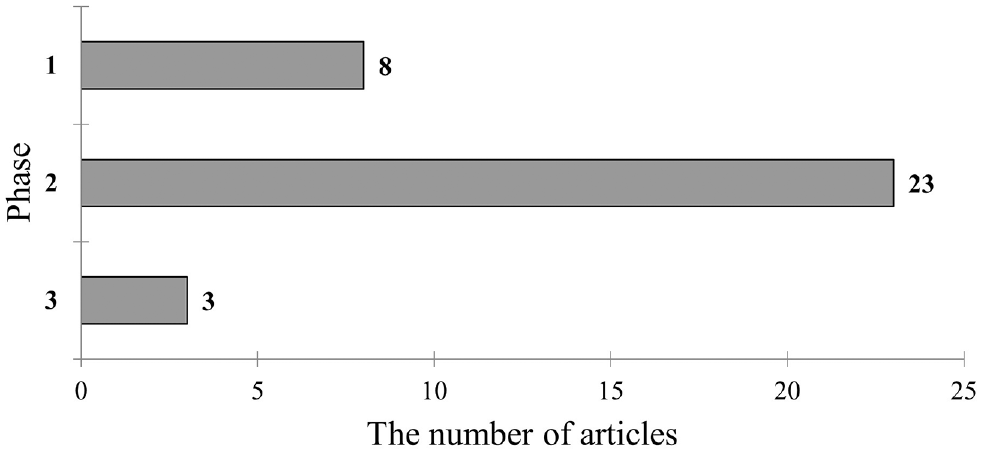
Stages of the bathtub model per article.
Figure 5 describes in more detail the distribution of the proposed resolutions over the three phases. The use of only one phase is highlighted with 23 proposals. The following information in the illustration aims to describe the number of proposals that present more than one phase. In the case of proposals covering phase one and phase two, only two proposals are submitted. In phases one and three, no proposals are submitted. Next, two proposals are presented that cover phases two and three. And finally, only one proposal covers the three phases of the bathtub model.
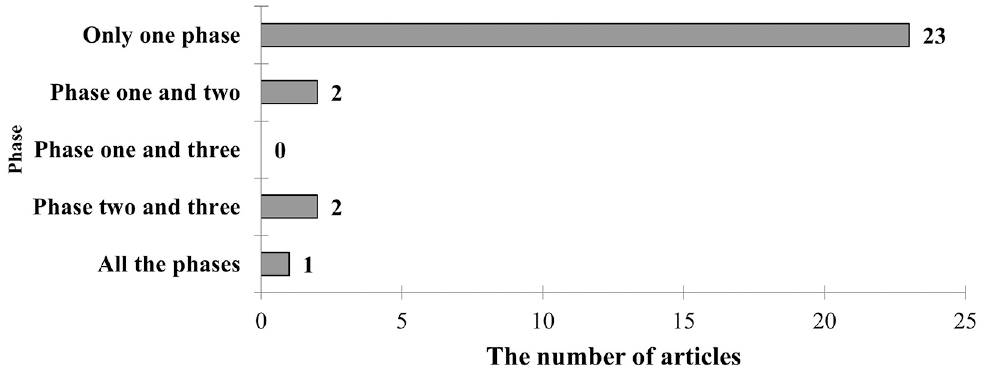
Stages of the bathtub model by article arranged by groups.
Model Problem Classifications
Figure 6 shows the relationship between the model problem classifications and the literature proposals identified in this paper. The mixed linear programming classification was identified in ten publications; this was the classification with the largest number of publications, followed by integer linear programming in seven references. It is a variant of integer programming, where the decision variables cannot be discrete. The third classification is the simulation model, which aims to create a digital prototype of a physical model as well as hypothetical scenarios in a set of probable hypotheses and test these proposals to find the right solutions. This classification of the simulation model was found five times in the articles studied. The fourth classification is the heuristic model, found in four publications. Given the uncertainty inherent to rail transport and the wide range of variables, heuristic models allow the creation of decision processes that would otherwise be impossible to implement in computer systems. Lagrangian heuristics and K-means classifications were found in two publications. Finally, four classifications (restricted relaxed master problem, linear programming relaxation, machine learning-SVR-KF, and ant colony optimization) were found in only one publication each. As artificial intelligence has recently become mainstream in a wide variety of research domains, one would expect a higher number of articles adopting machine learning-based approaches. However, proposals based on machine learning were only identified in the context of understanding or minimizing train delays. On the other hand, approaches based on mixed and integer linear programming are transversal to the different models (e.g., crews, rolling stock, delays), which to some extent clarifies the popularity of these techniques. The mixed and integer linear programming enables the model to adapt to the various decision variables identified by the authors and meet the objectives for which the models are proposed. Proposals using integer programming models usually use binary and non-binary decision variables. The integer programming proposals treat delay times with integer values. The same goes for station arrival and departure times as discrete data. On the other hand, proposals that use mixed integer programming models use decision-making variables with continuous data and such is the main difference between integer programming and mixed integer programming models. The proposed models are circumscribed and designed to solve a specific problem, and sometimes with a previously designed scenario. While such design helps in focusing on each problem, holistic approaches which would enable the encompassing of a wider range of variables that influence several types of interconnected problems (e.g., a problem involving changes to the rolling stock plan may also imply changes to the plan for crews, and vice versa) are lacking. A driver may not be able to drive a specific series of rolling stock or even legal issues such as daily work time limits may occur.
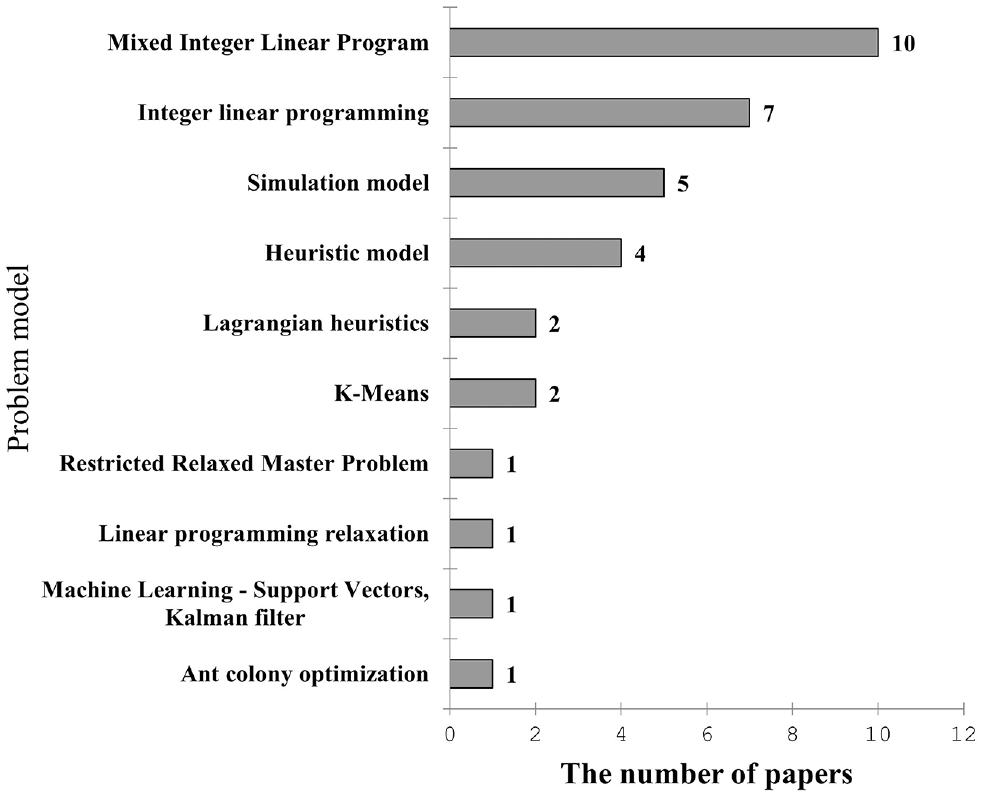
Number of papers in each problem model.
Decision Variables
Figure 7 describes the variables used in the proposals for resolution of disruptive events. These variables are classified into two decision groups: binary variables that intend to assume a Boolean state and numerical variables that intend to assign a measurable value to an event. For binary variables, the proposals focus on the variable that describes whether a train is suppressed. In the case of the numerical variables, most articles consider the delays. The figure illustrates 56 decision variables, of which 21 are binary and 35 numerical. It intends to illustrate, in a volumetric way, the most used decision variables. The visual composition is adjusted to a size ratio for the number of articles that use a specific decision variable. The larger the font size, the larger the number of articles that use a decision variable. In Appendix B, it is possible to check numerically the number of articles that use a particular variable.
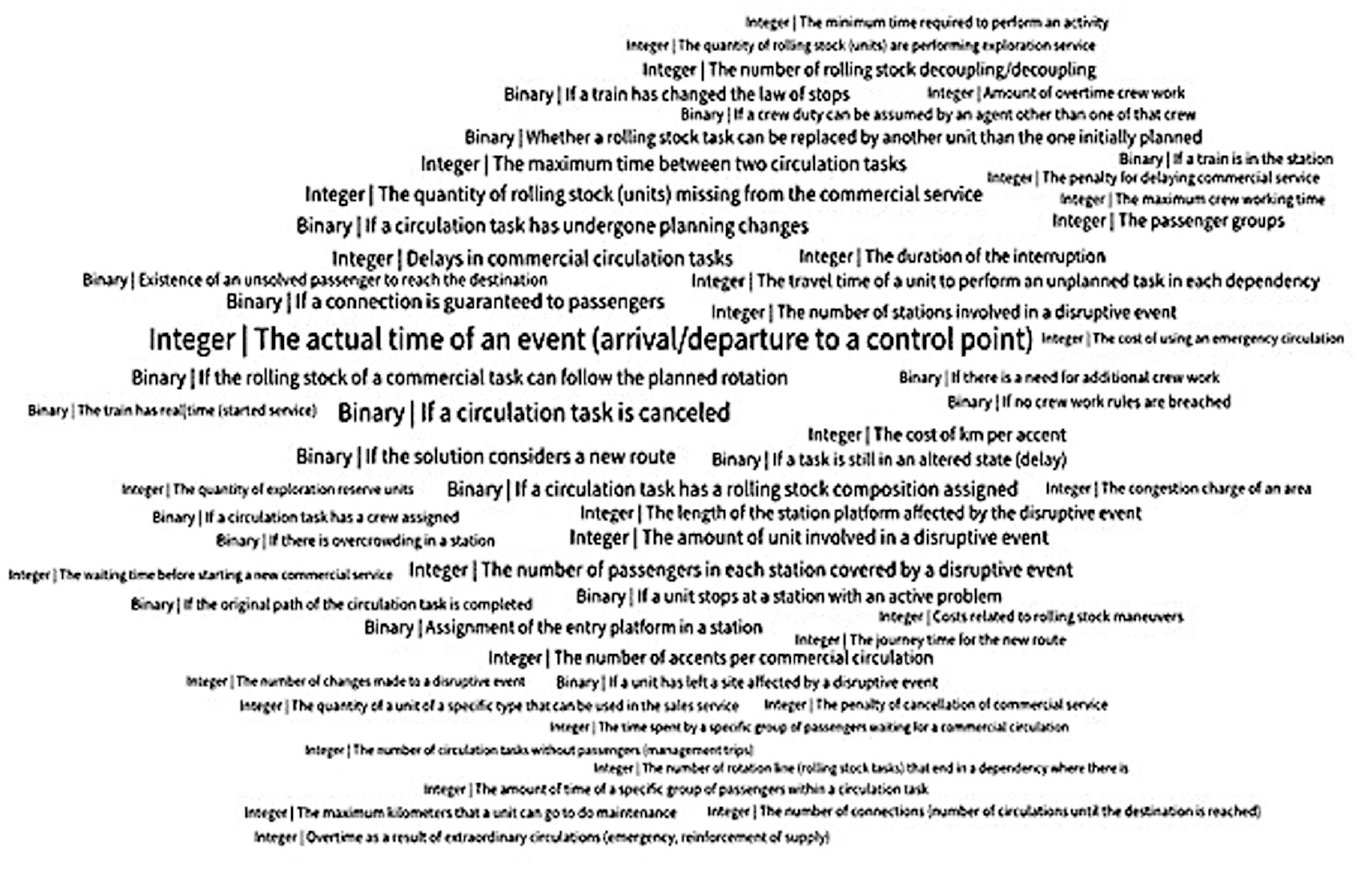
Map of decision variables.
The most used variables seem to be consensual. However, we would expect variables to convey information like times related to alternative transport routes, and more variables on reserve margins such as rolling stock units or crew reserves.
Discussion
Considering that management of disruptive events covers several themes of TOC traffic monitoring center operations, the lack of work with broader objectives may lead to solving only part of the problems that occur in operations at distressing moments. Albeit the technology of automatic train operation is quite promising, it is currently still emerging technology ( 48 ). Managing rolling stock is inseparable from managing crews at the same time. Thus, the research opportunity arises in bringing these objectives together in future investigations. Most of the proposals present deterministic, case-based solutions. On the other hand, the proposals to minimize traffic delays show stochastic solutions. There is a lack of studies that characterize the origin of problems such as the lack of train drivers or rolling stock malfunctions, the impact on train delays, which may reverse the trend of studies on delays toward deterministic proposals. Considering all the objectives, the one that shows least research is passenger satisfaction. There is also a lack of work concerning artificial intelligence and data science technologies, such as machine learning and Big Data. Doing so would create cognitive awareness of passengers and thus understand their needs. For that, support can happen through information and communication technologies such as the Internet of Things and Blockchain ( 49 ).
When reading the results obtained, the proposed approaches to solving disruptive real-time operations management problems set the focus on solving specific problems. First, two well-defined groups of decision variables are identified: binary variables and integer variables. Within the binary variables, the variables “checking whether a journey is canceled” and the variable “whether it is ensured that a passenger reaches their destination” are highlighted. In the case of integer variables, the control of delay times and the measurement of these delays are highlighted. The variables show that the proposals are clearly directed to passengers. Second, several proposals start from a known scenario, considering the level of uncertainty in disruptive events. This situation can be somewhat limiting. Only one approach is identified that encompasses the three phases. In the progress of research to create a decision support system, the three times should be considered to enhance the agent decisions in the centers of operations of the TOCs. Third, most proposals are limited to a single phase of railway operations, and few approaches present more than one perspective. The various perspectives are strongly linked. Besides, keeping to the timetable may have implications for the planning of crews and rolling stock.
The second phase is where most of the research on the bathtub model is concentrated. As most of the proposals resort to a previously established scenario, this concentration in phase two presents many limitations for implementation to real cases. All proposals identified in the literature use real scenarios. The case of the article by Haahr et al. ( 43 ) is distinguished. These authors apply their model in the Netherlands and Denmark, demonstrating that their proposal can be applied in other scenarios. However, 19 articles study scenarios in the Netherlands, representing 68% of the articles analyzed. These Netherlands studies are strongly concentrated in very well delineated geographical areas (e.g., Amsterdam, Utrecht). This limitation restricts the type of traffic included in the proposals. However, studies have been identified in other countries, such as Spain (Madrid), Switzerland (Zurich), and China (high-speed network). In the studies carried out in China, the particularity of presenting only studies on high-speed railways is highlighted. Proposals were expected to make a clear separation of traffic types taking into account their distinct characteristics.
Only four publications have been found that involve two phases and one publication that intends to cover the three phases. However, the proposal involving the three phases focuses on rolling stock only. There is a lack of studies involving all the phases to respond to issues raised in the initial moment, the intermediate phase, and the resolutive phase. There is a lack of proposals that involve all phases and allow the TOC to act from the initial moment, through the intermediate phase, and to the resolutive phase. Beyond the conjugation of the three phases, future investigations would be interesting to explore more areas such as rolling stock, crews, and delays. The conjugation of various phases implies a multi-objective model, which presents itself as an interesting challenge to solve.
Conclusion, Limitations, and Future Research
The management in real time of railway operations has received much attention in recent years, emphasizing the management of disruptive events that affect passengers and entities operating in the railway environment. This paper reviews the problem models, solution approaches, and the main ideas of the approaches. An attempt is made to analyze the relationship between problem models and operations management perspectives such as rolling stock, crews, passengers, and timetables. The decision variables used in the different solution approaches are also identified in this document. A diverse range of different problem types and models is presented, emphasizing mixed integer linear programming, and integer linear programming with other identified proposals. Each approach considers specific scenarios. It is not easy to evaluate and compare the different solution approaches. In addition to being based on a very concrete scenario and mostly focusing on phase two of the bathtub model, the proposed approaches generally present scalability problems, which to a certain extent makes it impossible to treat problems with another scale and a different number of resources, whether human or material. Remarkably, there is a lack of proposals based on multi-objective approaches aligned with real-time operations management perspectives. This results from proposals presenting highly targeted models to solve specific scenarios, and it is an important limitation insofar as it makes the proposals scarcely scalable, not extendable to other scopes beyond the one where the study was conducted. However, the results in this article show that there is opportunity for further research in this area. The complexity of involving many decision variables, including rolling stock, crews, and delays, somehow force research to focus on one of these areas. On the other hand, the uncertainty inherent to managing real-time operations makes it very difficult to develop scalable proposals taking into account the different real-world instances. However, as these areas have highly interrelated tasks and with strong precedence, this necessarily requires operations management problems to be solved in an integrated manner. On the other hand, there is a notorious scarcity of documents using information from past events. The records of past situations can be a solid base of knowledge to enhance agents’ decisions in monitoring centers.
One of the limitations of this research is to cover only passenger transport from the TOC’s perspective. This may give rise to further research involving other means of transport and adopting a multimodal vision. Thus, although much attention has been given to the management of operations in real time, there is still a lack of proposals to advance research. On the one hand, this paper presents a literature review from the perspective of the rail passenger TOC and, on the other hand, it aims to pave the way for research notes, namely a multi-purpose decision support system.
Supplemental Material
sj-docx-1-trr-10.1177_03611981221104810 – Supplemental material for Literature Review on Problem Models and Solution Approaches for Managing Real-Time Passenger Train Operations: The Perspective of Train Operating Companies
Supplemental material, sj-docx-1-trr-10.1177_03611981221104810 for Literature Review on Problem Models and Solution Approaches for Managing Real-Time Passenger Train Operations: The Perspective of Train Operating Companies by Luis Marques, Sergio Moro and Pedro Ramos in Transportation Research Record
Footnotes
Author Contributions
The authors confirm contribution to the paper as follows: study conception and design: L. Marques; data collection: S. Moro; analysis and interpretation of results; S. Moro; draft manuscript preparation: S. Moro, P. Ramos. All authors reviewed the results and approved the final version of the manuscript.
Declaration of Conflicting Interests
The author(s) declared no potential conflicts of interest with respect to the research, authorship, and/or publication of this article.
Funding
The author(s) disclosed receipt of the following financial support for the research, authorship, and/or publication of this article: This work was supported by the Fundação para a Ciência e Tecnologia (FCT).

Supplemental Material
Supplemental material for this article is available online.
References
Supplementary Material
Please find the following supplemental material available below.
For Open Access articles published under a Creative Commons License, all supplemental material carries the same license as the article it is associated with.
For non-Open Access articles published, all supplemental material carries a non-exclusive license, and permission requests for re-use of supplemental material or any part of supplemental material shall be sent directly to the copyright owner as specified in the copyright notice associated with the article.
