



Abstract
This study explores how shared micromobility services can integrate with public transit through equitable payment structures to address first and last mile issues for light rail transit riders in Seattle, WA, and increase accessibility for low-income households. Seattle has recently permitted shared micromobility services such as e-scooter companies to begin operating alongside existing bikesharing services in the city. However, equity concerns have arisen as the users of bikeshare have been disproportionately white, affluent, and well-educated. To address these concerns, efforts have been made to reduce barriers to access and make these services more equitable to encourage their use among marginalized populations. Previous research has demonstrated evidence that these services can improve accessibility for disadvantaged populations such as low-income people of color. This research consists primarily of a literature review of relevant academic and gray literature, and a jurisdictional scan of cities in the U.S., Canada, Finland, and China. The objective of this research is to identify barriers to accessing shared micromobility services and synthesize existing best practices to propose solutions to make these services more equitable. Findings from this research then inform a set of recommendations for equitable payment integration in King County, which can also be generalized to other municipalities that are striving for equitable public transit and shared micromobility integration.
Keywords
In recent years, mobility solutions such as bikeshare and e-scooter systems have changed the fabric of transportation in cities worldwide. These services are usually operated by private companies or through public-private partnerships and have at times competed with public transit by acting as a substitute for some trips ( 1 ). Nevertheless, shared micromobility services may offer the opportunity to complement fixed-route transit networks and address first and last mile issues ( 1 , 2 ). Currently, the potential for the adoption of shared micromobility as a practical transportation mode, especially when paired with public transit trips, is not fully realized.
Historically, users of bikeshare have predominantly been young, wealthy, white males ( 3 – 6 ), although recently e-scooters in particular have attracted a greater share of low-income and minority riders ( 7 ). The historical lack of diversity in ridership has propelled research initiatives to explore the potential for shared micromobility services to increase transportation equity and accessibility for marginalized populations ( 8 ). These populations are more likely to be transit-dependent, resulting in longer commute times and a lower level of accessibility to jobs and other opportunities than car owners ( 9 , 10 ). When combined with transit, shared micromobility services may offer marginalized groups an opportunity to decrease commute times and access a greater number of jobs and services ( 9 ). It is important to acknowledge that transit affordability is crucial for low-income riders ( 11 ), so any system that integrates these two modes of travel will need to ensure affordability to remain equitable and accessible for low-income communities. The focus should be primarily on equity-based approaches as they distribute a greater allocation of resources or services to a marginalized population to ensure equal access and opportunity, whereas equality-based approaches distribute benefits equally to all populations regardless of need ( 12 ).
The need for removing barriers to transportation services is nascent in communities with a rapidly increasing cost of living like Seattle. On paper, Seattle has identified the need for the integration of shared micromobility services and fixed-route transit in transportation strategies, yet the Seattle Department of Transportation and King County Metro Transit (Metro) have not started this process in practice. Currently, private bikeshare and e-scooter companies are operating in the Seattle area, but their potential to serve as a first and last mile solution for transit riders has not yet been fully harnessed. Given that, the objectives of this paper are to review the existing state of practice on the integration of public transit and shared micromobility payments, as well as to investigate the possibility of increasing equity and accessibility for marginalized populations in Seattle through this integration. Specifically, the paper aims to understand what type of fare schemes are most effective to facilitate the use of micromobility services as a first and last mile complement to transit, and how effectively each fare scheme addresses issues of exclusion from a rider’s perspective. Using the knowledge from the literature review and best practice studies, this paper provides guidance on how equity and accessibility for marginalized populations can be advanced in Seattle through the integration of public transit and micromobility.
Methods
This research is qualitative and consists of a review of relevant academic and gray literature on micromobility services and transportation equity, as well as a jurisdictional scan of cities where some integration of public transit and shared micromobility has been achieved.
Literature Review
The academic literature was primarily sourced from searches of Scopus and Science Direct. As the objective of this research is to formulate practical recommendations for Seattle’s implementation of integrated fares for public transit and shared micromobility, a review of local and regional transportation policies, organizational reports, National Association of City Transportation Officials (NACTO) guides, reports produced by TRB, and APTA sources was conducted to gain insight into current recommendations for best practice. This gray literature was sourced mainly through Google Scholar, ScienceDirect, and the Transport Research International Documentation database. Literature was also sourced through backward reference searching of articles found through database searches.
Jurisdictional Scan
A jurisdictional scan involved a review of cities in the U.S., Canada, Finland, and China where payment for transit and shared micromobility services has been integrated at various levels. These cities include Los Angeles, CA, the Bay Area, CA, Pittsburgh, PA, Montreal, Toronto, Helsinki, and Guangzhou. Transit is not currently integrated with shared micromobility in Portland, OR, and Chicago, IL, but these cities were reviewed based on their adoption of low-income programs for shared micromobility users. The cities reviewed in this study do not form an exhaustive list of communities with some level of integrated fare schemes, but they provide an overview of existing programs in cities with contexts like Seattle’s.
Literature Review
This literature review defines related concepts and serves as a broad overview of existing research on the topics of micromobility and transit integration, first and last mile travel, transportation equity, and equitable provision of shared mobility.
First and Last Mile Travel
Decades of sprawling auto-centric development have left many U.S. households without reasonable access to public transportation, with transit services being infrequent, and transit stops being spaced out. As a way to address this, shared micromobility services have been marketed not only as a stand-alone transportation mode but as a solution for first and last mile issues. The first and last mile refers to the access and egress sections of a public transit trip, where a rider needs to utilize alternative modes of transportation, such as driving, walking, or cycling, to access the transit stop or hub ( 13 ). Improving first and last mile connection times shortens the total trip time and can therefore increase transit accessibility ( 9 ). Fan et al. ( 14 ) define first and last mile issues as “the challenges caused by the built and social environment and public transport service availability in the first/last leg of the trip.” Understanding this element of travel behavior is essential to addressing issues that prevent riders from accessing public transit. Research demonstrates that first and last mile distance is the most pressing factor for commuters in deciding whether to walk or use other forms of transit to access a transit stop ( 15 ). As many transit agencies move toward redesigning bus networks to prioritize frequency over coverage to increase ridership ( 16 ), the first and last mile becomes ever more important as the distance to transit stops increases.
Micromobility
Micromobility refers to human-powered or electric-assisted vehicles such as bicycles, e-scooters, and e-bikes. In recent years, cities around the world have introduced shared micromobility services that are operated by private companies or through public-private partnerships ( 17 ). However, the observed trends in the use of shared micromobility modes raise numerous equity concerns. Bikeshare users have historically been high income, well-educated, and white ( 3 – 5 ), although this may be because of previous practices of locating these services in central business districts and other wealthy areas. Recent research has shown that e-scooters are more likely than bikeshare to be used as a mode of transport by low-income and minority riders ( 7 ). Bicycling as the sole mode of transport has also been shown to increase job accessibility as riders do not need to rely on fixed transit routes to access employment ( 18 ). As people who are public transit-dependent have the lowest level of mobility (and transport options) and are predominantly lower income ( 19 ), micromobility programs may offer a unique opportunity to improve access to jobs and other spatially dispersed opportunities.
Micromobility and Public Transit Network Integration
Analysis of the benefits of integrated shared mobility and public transit networks is a burgeoning area of research that has identified the equity benefits from such integration. APTA has identified several benefits of the integration of bikeshare and transit, which include increased transit ridership, greater transit reach, more equitable mobility for low-income riders, and a reduction in the number of car trips. APTA encourages incentivizing bikeshare use to transit hubs through the use of integrated payment methods ( 20 ). Transport Canada ( 21 ) also states that active transportation should be integrated with public transit networks through methods such as bike infrastructure at transit stations to actualize its potential to increase transit ridership. The International Transport Forum (ITF) analyzed the benefits and opportunities of an integrated approach, concluding that seamless integration of public transit stops with active travel networks can create a mode of transport that is competitive with vehicular transportation ( 22 ). This is significant because people are more willing to travel further to access high-quality transit such as light rail and subway because it is more frequent and travels at a higher speed ( 23 ).
Research also indicates that integrating bikesharing with light rail transit networks may provide an opportunity to address first and last mile issues while increasing light rail ridership ( 24 ), and King County Metro points out the opportunity for microtransit and shared mobility services to complement light rail services at a lower cost to the agency than operating bus services, especially in less dense areas during off-peak times ( 25 ).
Accessibility and Transportation Disadvantaged Populations
New micromobility services and technologies offer the potential to improve equitable transportation and accessibility for transportation disadvantaged populations. Transportation disadvantaged populations usually have low incomes and are the most disadvantaged within society ( 26 ). Transportation research defines accessibility in several different ways. Welch and Mishra ( 27 ) state that “accessibility reflects the extent to which a transportation system enables individuals to reach activities or destinations by means of transport modes or a combination thereof.” This is a traditional definition that positions transportation to facilitate accessibility, which is associated with activity participation, employment, and other well-being outcomes ( 28 ). Lucas et al. ( 10 ) expand on this definition and assert that “accessibility refers, not only to physical access to goods and services, but also the transport system itself in terms of its availability (including routing and scheduling), affordability, reliability, and safety, as well as access to timetable information, etc.” According to this definition, the accessibility of certain modes of transportation may vary between groups, which creates the potential for inequities in access. For example, low-income households are less likely to afford the high cost of a private vehicle, which in turn reduces their access to health care, employment opportunities, and schooling opportunities ( 29 ).
Figure 1 demonstrates how lack of access to services can result in transportation-related social exclusion (TRSE) ( 26 ). TRSE is a more complex concept that goes beyond the state of being transportation disadvantaged, as it is also influenced by the interaction of individual factors, such as race, gender, disability, and the availability of social services ( 26 ). The transportation poverty that can arise from this interaction limits access to not only goods and services, but also public participation in decision-making ( 26 ).
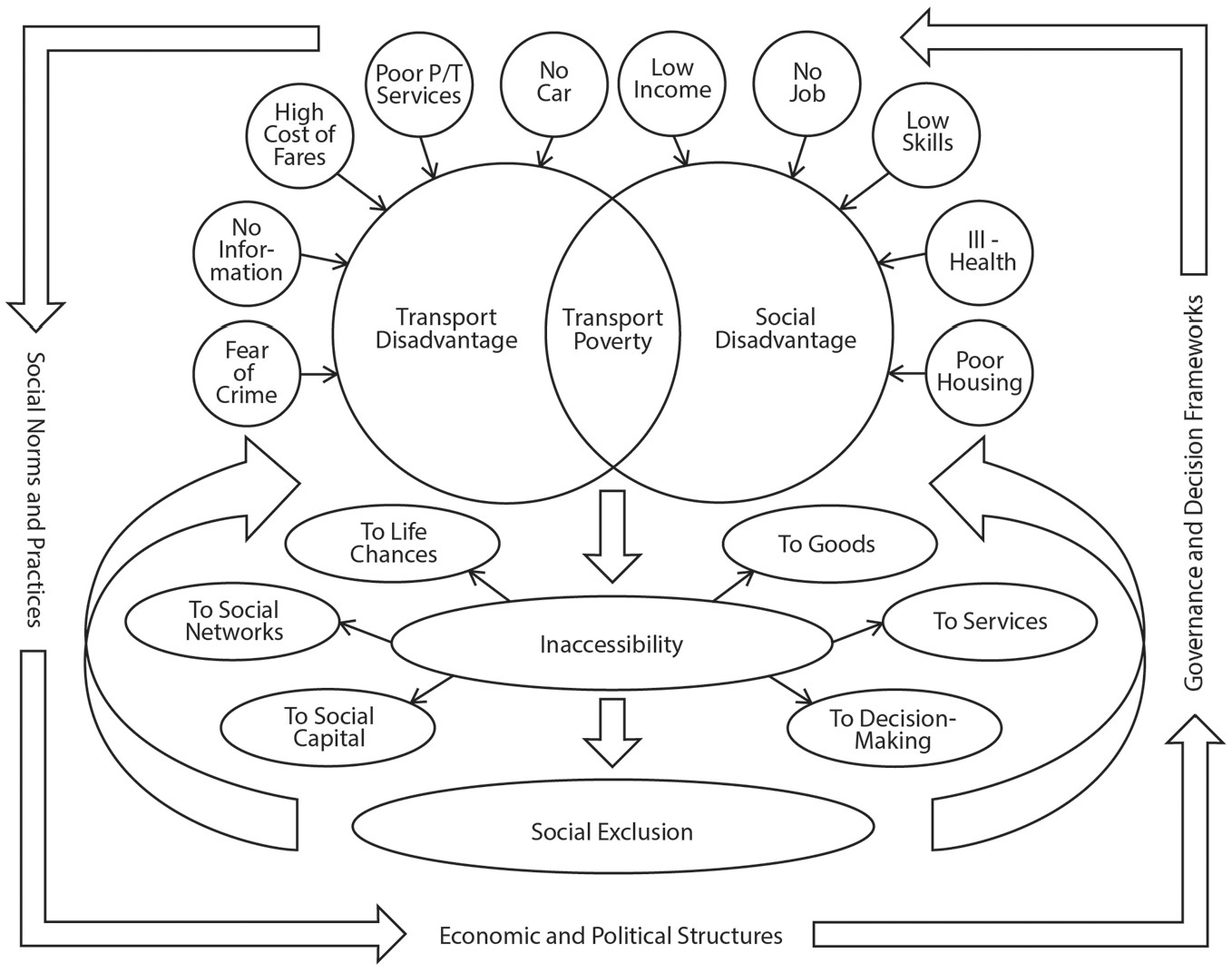
Transportation disadvantage and transportation-related social exclusion.
Previous research has also demonstrated that low-income and other marginalized populations are less likely to own a vehicle and thus have longer commute times ( 9 , 30 ). To ensure the benefits of an integrated shared micromobility and transit model, it is important to understand the consequences of transportation-related inequities.
Barriers to Accessing Micromobility
An analysis of existing literature on this topic revealed that low-income and marginalized people face several major barriers to accessing shared micromobility services, as follows.
Station Siting
People who live close to bikeshare stations are more likely to use bikeshare than others ( 31 ). However, bikeshare stations are currently placed mostly in higher-income, predominantly white, areas ( 32 ). This is because private operators locate bikes near major attractions to maximize usage and profit ( 13 ).
Misconceptions of Shared Micromobility Services
Qian and Niemeier ( 13 ) found that disadvantaged populations hold cultural beliefs that bikeshare is a recreational mode of transport for high-income individuals and tourists, rather than a viable mode of transport. Survey respondents in Portland reported similar misconceptions about bikesharing services, including a lack of knowledge about helmet requirements, assumptions that bikes would lock when the time limit was reached, and the belief that credit cards were required for payment ( 32 ).
Safety Concerns
Safety of both bike and rider were commonly reported as the most significant barrier by low-income riders. Low-income focus group participants in Philadelphia reported being concerned about liability in the event of the bike being stolen or damaged ( 33 ). Survey respondents in Portland reported concerns about their personal safety on the road, and the possibility of being a victim of crime when accessing stations ( 32 ).
Financial Barriers
Financial elements can be significant barriers, too, as low-income riders who do not have access to credit cards or smartphone technology may not be able to sign up for memberships or unlock bikes ( 13 ). Low-income people of color surveyed about bikeshare in Portland reported the cost of riding and lack of access to a credit card as the second and third highest barriers to using bikeshare after concerns about financial responsibility for a bicycle ( 32 ).
For the integrated service of micromobility and transit to be widely used, it is important that these barriers are addressed. Without intervention, the profit-maximizing approach of service confined to dense and mixed-use areas might be limiting the opportunities for the integration of transit and micromobility in low-density neighborhoods that could benefit from such first and last mile connections. Similarly, without dedicated informational and educational campaigns, the uptake of the integrated service might be low. Finally, the lack of diverse payment options might exclude a portion of potential users.
Equity of Shared Mobility Payments
The affordability of transportation is a key issue for low-income and marginalized communities. Transportation expenditures are the second highest expenditure after housing for low-income families in the U.S., and vehicle-associated costs exclude low-income populations from car ownership ( 30 ). Shared micromobility programs, when combined with public transportation, offer a higher level of accessibility without the expense of vehicle registration and maintenance. Nevertheless, many bikeshare and e-scooter programs are currently app-based, although, as of 2016, 23% of adults in the U.S. did not own a smartphone and 8% of households in the U.S. did not have a bank account, excluding these populations from accessing micromobility services that require either a smartphone or credit/debit card ( 34 , 35 ). Moreover, minority communities were overrepresented within this group ( 28 ).
Golub et al. ( 36 ) discuss the equity of “shared mobility ecosystems,” citing access to banking, credit, smartphones, internet access at home, and cell phone data as significant barriers to accessing most shared mobility services. The authors found that 40% of study participants paid for public transit fares in cash, and one-third of respondents had adopted online or smartphone applications to purchase fares. Lower-income respondents were more likely to pay for fares in cash, while higher-income respondents were more likely to pay for fares using online or smartphone payment. McNeil et al. ( 32 ) surveyed Portland residents on possible program changes that would increase their likelihood of using bikesharing systems and found that the top two suggested changes were a single pass that offered free transfers between bikeshare and public transportation, and discounted membership or use options. Other finance-related responses included a desire for cash payment options and options to sign up in-store rather than online. These findings suggest that without these specific accommodations, it is highly likely that an integrated micromobility and transit service will not provide equitable access for marginalized communities.
Jurisdictional Scan
To develop an understanding of current practices surrounding the integration of public transit and shared micromobility, as well as the potential benefits they bring in advancing equity goals, a jurisdictional scan of nine cities in the U.S., Canada, Finland, and China was conducted. Selected cities have achieved some level of integration between public transit and shared micromobility services, such as integrated payments, or discounts.
Table 1 highlights the cities included in the review, comparing their various levels of transit and shared micromobility integration and implementation of low-income programs. Seattle was included in the review as a benchmark for comparison with other cities where transit and shared micromobility services are more highly integrated.
Overview of Cities with Integrated Transit and Shared Micromobility Services
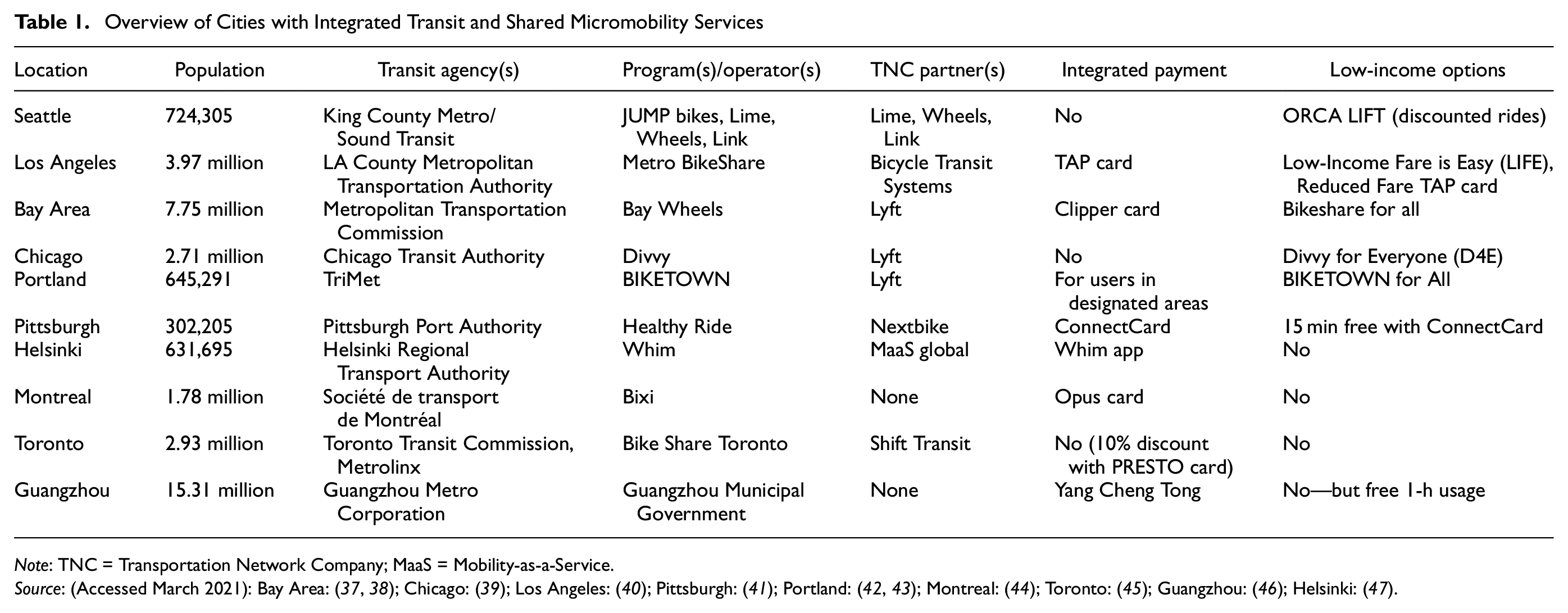
The integrated programs that were reviewed can be sorted into three different fare types, as follows.
Bundled Mobility Programs
Bundled mobility programs offer users a package of mobility services including public transit, micromobility, and ride-hailing services. An example of this type of program is Portland’s Transportation Wallet program, which was originally piloted to alleviate parking congestion, and encourages users to pursue non-vehicle modes of travel by offering a bundle of public transit and micromobility services (see Figure 2).
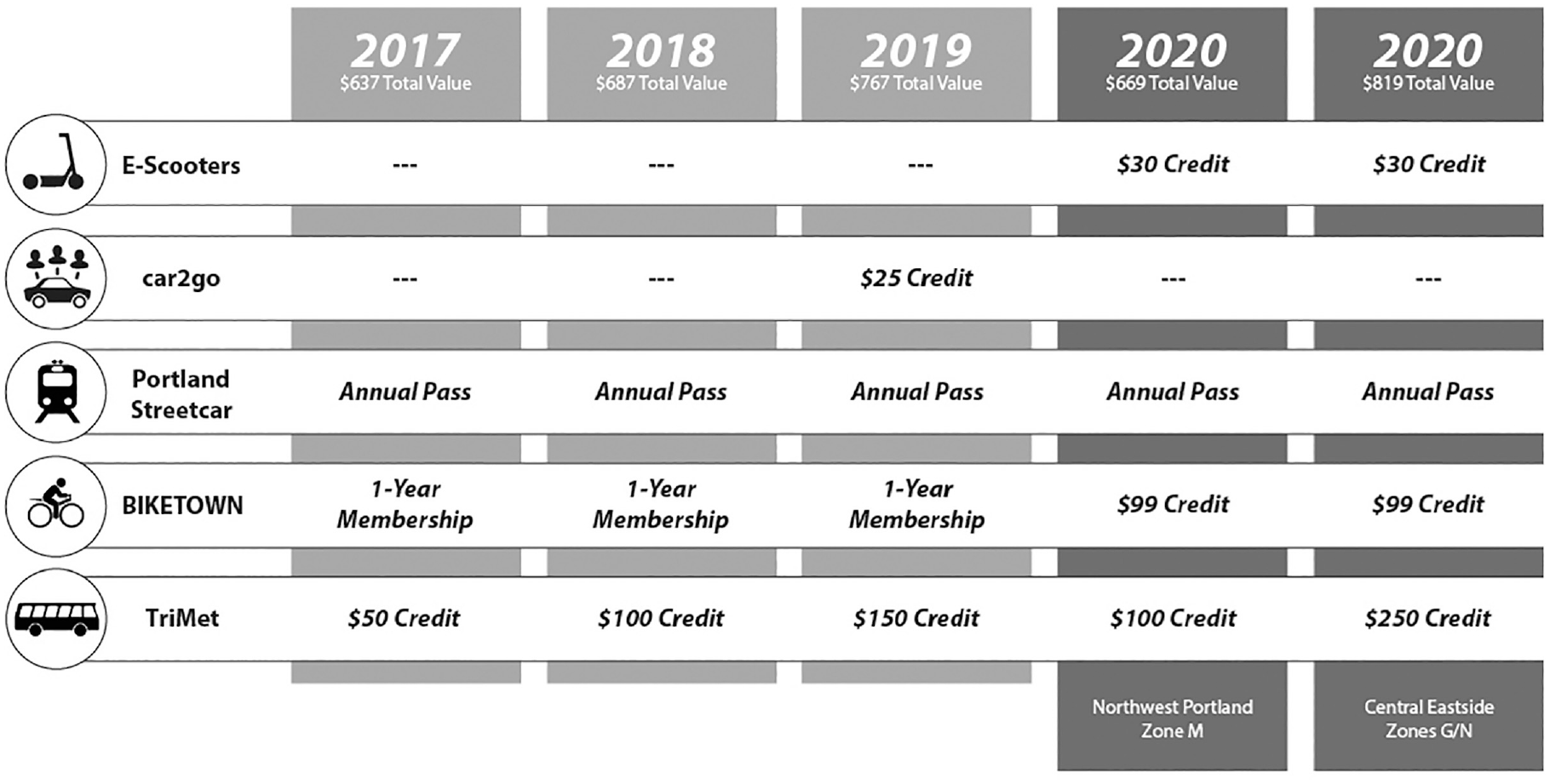
Services offered through Portland’s Transportation Wallet ( 43 ).
Helsinki’s Whim service exemplifies a program that operates on a Mobility-as-a-Service (MaaS) model, where users can select a mobility bundle of services that fits their needs. While MaaS offers a convenient option for those looking to combine transportation modes, Helsinki’s approach is not very equitable as it does not offer any low-income pricing programs on its website. Whim’s packages are marketed toward an urban elite, exceeding Finland’s average transportation expenditure (15%) at prices that are 21% of the average monthly wage ( 48 ). To disperse the benefits of MaaS to all potential users, local governments must ensure that MaaS providers affordable options for lower incomes. For example, the UK’s Government Office for Science ( 49 ) encourages governments to increase the equitability of MaaS services by requiring pricing that is flexible and available to all potential users to avoid creating the “MaaS and MaaS-nots.”
Income-Based Programs
Income-based programs allow residents who qualify for existing social benefits programs to access shared micromobility services at a discounted rate. Table 2 summarizes low-income shared mobility and transit integrated programs reviewed through the jurisdictional scan, their associated costs, and payment options.
Low-Income Shared Micromobility Programs
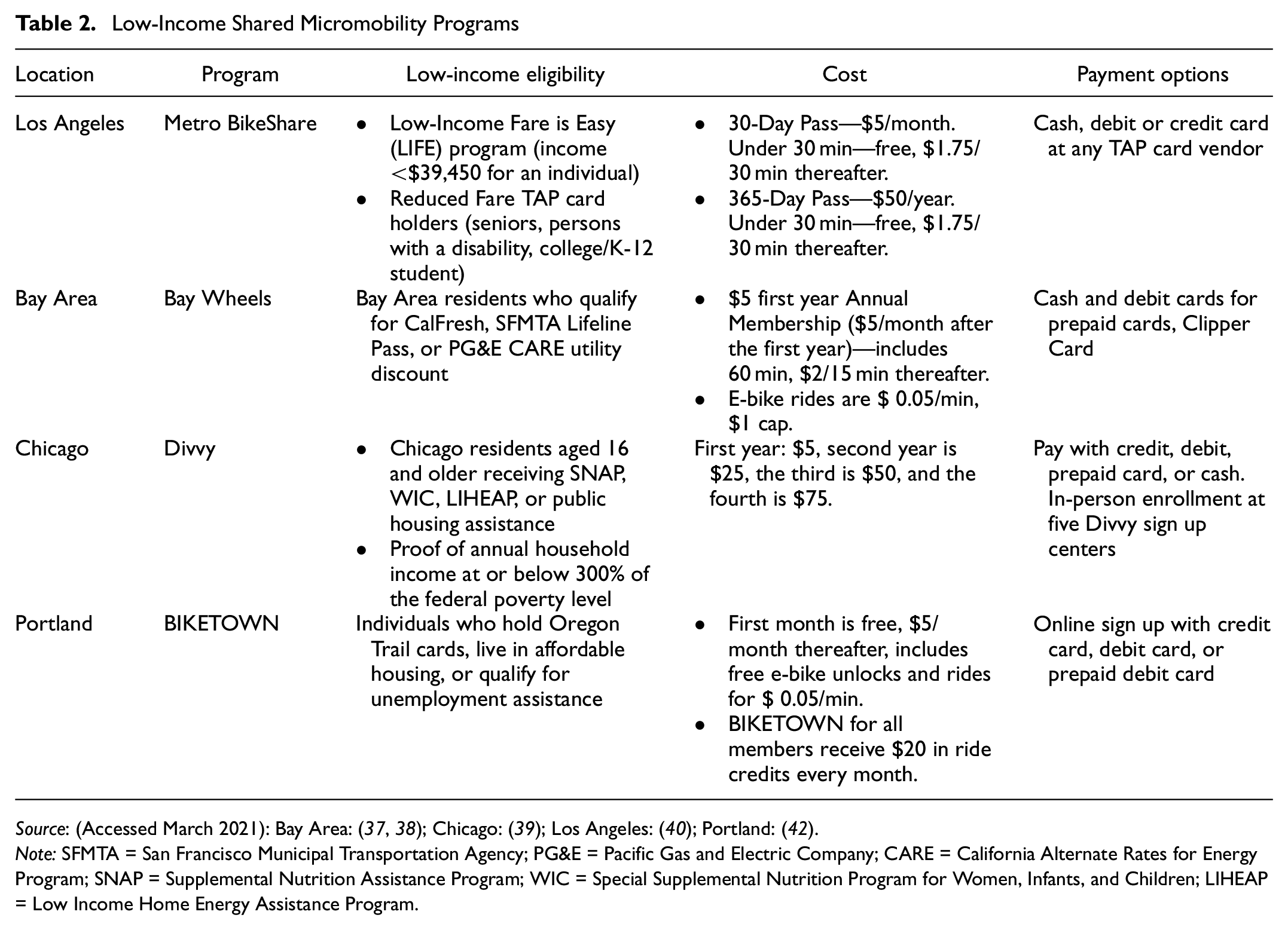
Source: (Accessed March 2021): Bay Area: ( 37 , 38 ); Chicago: ( 39 ); Los Angeles: ( 40 ); Portland: ( 42 ).Note: SFMTA = San Francisco Municipal Transportation Agency; PG&E = Pacific Gas and Electric Company; CARE = California Alternate Rates for Energy Program; SNAP = Supplemental Nutrition Assistance Program; WIC = Special Supplemental Nutrition Program for Women, Infants, and Children; LIHEAP = Low Income Home Energy Assistance Program.
Los Angeles (LA) Metro Bikeshare is an excellent example of a fully integrated, income-based mobility program. Through a public-private partnership, LA Metro offers discounted access to bikeshare for the Low-Income Fare is Easy (LIFE) program and Reduced Fare TAP card holders. Using existing administrative infrastructure, these programs attempt to address inequalities through a vertical equity approach, meaning that they distribute resources to those most in need. However, they are inconsistent in their approach given that they are based on outdated federal poverty guidelines. The federal poverty line determines eligibility for several social services, including the Supplemental Nutrition Assistance Program (SNAP), which was found to be a commonly used qualifier for low-income shared micromobility programs. Eligibility for SNAP is calculated at 130% of the federal poverty level, which is $1,830 per month for a family of three in 2022 ( 50 ). This means that a family of three who makes more than $2,379 a month, or $28,550 a year, is not eligible for SNAP and thus not eligible for low-income bike or e-scooter programs that base their eligibility on the receipt of SNAP benefits.
Incentive-Based Programs
Incentive-based programs encourage travelers to use shared micromobility as a first and last mile solution to pair with transit. For example, Toronto offers those who hold a PRESTO card (transit pass) the opportunity to receive a discounted membership for Bike Share Toronto. A more directed example of this type of incentive is Pittsburgh’s Healthy Ride program, which allows riders who pay with their ConnectCard (transit pass) to receive free rides of up to 15 min.
Incentive-based programs exemplify horizontal equity, meaning that their benefit is allocated equally to all individuals ( 51 ). The only requirement for access, as demonstrated with the Toronto and Pittsburgh programs, is the possession of a transit pass. While transit passes are commonly subsidized for social service recipients, those in need of discounted passes are not always eligible to receive one. Verbich and El-Geneidy ( 52 ) found that low-income riders are likely to spend more on transit overall as they are not able to afford a large one-time payment of a monthly pass.
Context of Seattle
King County’s first light rail transit project opened in 2009 and, since then, it has extended through downtown Seattle and several core neighborhoods to offer a fast, frequent, and reliable service ( 53 ). While Sound Transit is the Greater Puget Sound area’s regional transit service provider, it partners with King County’s local service, King County Metro, to provide fixed-route transit services in the Seattle area.
In the last three years, Metro developed its Mobility Framework, which identified the need for alternative transit services to provide first and last mile connections in several underserved areas of the region ( 54 ). The framework calls for transit investment to provide service in areas with unmet needs within King County, as follows.
Prioritize geographic areas that have high density, a high proportion of low-income people, people of color, people with disabilities, and members of limited English-speaking communities, and that have limited midday and evening transit service to schools, jobs, and childcare centers, and other ways to build wealth and opportunities.
Adapt Metro’s existing policies to provide for service improvements in these priority geographic areas and continuously evaluate their effectiveness.
Continue developing an equitable, income-based approach to fares to ensure affordability and accessibility for those who need it.
Consider additional investments in programs such as Trailhead Direct, which connects communities to other areas of open space, such as parks and farms ( 54 ).
Historically, Metro has struggled with balancing its service area and frequency, particularly in areas such as South Seattle, where a combination of low density, challenging geography, and low rates of ridership have made some fixed-route transit lines financially unsustainable. Nevertheless, these areas are also home to many of Seattle’s low-income and marginalized communities ( 55 ). To address transit equity and accessibility in these areas, Metro’s Innovative Mobility Team has begun to develop flexible transportation services to complement fixed-route networks. One example in that area is the piloting of on-demand microtransit services through its On-Demand Connections to Transit Pilot Program. The program’s goals are to grow transit ridership, improve accessibility in underserved areas, promote King County’s commitment to equity, and generate customer data to inform future network planning ( 56 ).
Metro is also exploring the opportunities of micromobility services. In its Shared Mobility Technical Report ( 25 ), Metro demonstrates the social utility of different modes of transportation and concludes that the two modes with the highest social utility in comparison to single-occupancy vehicles are bikeshare and public transit. The report identifies the major benefits of public transit as its affordability, availability, and accessibility, while the benefits of bikeshare are its low cost and ability to contribute to a healthy, active lifestyle ( 25 ).
Currently, there are no integrated payment options for public transit and micromobility services in Seattle. The cost of a single trip on Sound Transit’s Link light rail service or King County’s bus service is $2.75 ($90 for a monthly pass) for an adult, with a reduced fare of $1.50 ($45 for a monthly pass) available through the ORCA LIFT program for low-income riders (household income less than 200% of the federal poverty level) ( 57 ).
JUMP, which is Uber’s private bikeshare service operating in Seattle, charges $1 to unlock a bike, and 36 cents for each additional minute of use. In September of 2020, three e-scooter companies—Lime, Wheels, and Link—were authorized to operate in Seattle. The scooters are provided at the same cost as JUMP’s bikeshare. All these services require users to unlock bikes using a smartphone or credit card, which raises equity concerns for users that do not have access to those. The Seattle Department of Transportation requires 10% of the fleet to be available in designated equity areas in Central and South Seattle, where there is greater representation of people of color, people with low incomes, limited- or non-English-speaking communities, immigrants and refugees ( 54 ). It is possible that these residents may not be able to “access” micromobility services because of a lack of a smartphone or credit card ( 58 , 59 ).
Each of the three e-scooter companies in Seattle is mandated to provide low-income options for Seattleites who receive low-income benefits or subsidies such as SNAP or are eligible for the ORCA LIFT subsidized transit program. The operators currently permitted in Seattle offer the following programs for low-income users.
Lime Access: Five free 30-min rides per day. Additional time at 50% off.
LINK-Up: Rides of 20 min or less are free. Rides over 20 min are discounted at 95% off the regular fare.
Wheels for All: Rides are discounted at 95% off the regular fare ( 58 ).
Recommendations
Based on the insights from the literature review and jurisdictional scan conducted in this research, it is evident that there is a considerable benefit to integrating public transit and shared micromobility services as it can increase accessibility by addressing the gaps in first and last mile connections, as well as boost transit ridership by attracting more riders to the system. As a result, this improved access can lower the likelihood of a person experiencing transportation-related social exclusion, thus having even broader societal benefits. Furthermore, the integration offers an opportunity for the city of Seattle and its transit agencies to regulate shared micromobility services in a way that reflects their equity-based provision of public transit, as required by Title VI of the U.S. Department of Transportation ( 60 ). Three main recommendations are provided on how the city should improve its partnership and regulation of micromobility operators, as follows.
Integration with ORCA Card
Micromobility operators should be required to integrate their payment schemes with the existing public transit payment system, allowing riders to unlock bikes and e-scooters with their ORCA cards. This is achievable, given that the commonly used Radio Frequency Identification (RFID) card for Lime, which operates JUMP and Lime E-Scooter, is compatible with Seattle’s ORCA card, which uses the MIFARE standard, a popular contactless smart card technology ( 61 ). Aside from providing equitable access to transportation opportunities, the integration of ORCA cards and shared micromobility payments is convenient for all residents of Seattle.
Adoption of Living Income-Based Approach
The city of Seattle should adopt a living income-based discount program that considers the high cost of living in King County. This aligns with the Mobility Framework’s recommendation to “adopt an equitable, income-based approach” to the provision of transit ( 54 ). Rather than using the current eligibility criteria for the subsidized ORCA LIFT program (<200% of the federal poverty level), consider evaluating eligibility based on King County’s Self-Sufficiency Standard.
When access to low-income discounts is based on eligibility for social services that relies on the federal poverty level, exclusion of those who are struggling financially, yet not enough to qualify for these benefits, occurs. This is because the federal poverty level was originally calculated in 1974 by tripling average grocery expenditures for a family and does not account for many other expenses including housing and transportation ( 62 ). This threshold has been adjusted to inflation but not to the rising cost of living, and it does not address regional differences in living costs. Instead, eligibility for low-income programs should be based on relative measures of poverty that account for regional differences in the cost of living ( 63 ).
Provision of Accessible Payment Options
Seattle should offer cash payment options through intermediary vendors such as local markets and convenience stores and it should simplify the application process for ORCA LIFT cards, which currently requires in-person applications at a single location. The city should also consider implementing an online application in addition to expanding the number of in-person service centers where applications can be processed.
The current practice for sales of integrated public transit or shared micromobility passes poses a significant barrier for those who cannot afford time off work to travel into downtown Seattle. When compared with LA Metro’s TAP program, which allows applicants to buy transit passes at convenience stores and local markets, and its LIFE program, where applicants can apply by mail or e-mail ( 64 ), Seattle is lacking in its options for equitable access to discounted transportation. When developing low-income discounted fares for shared micromobility, public transit, or integrated programs, local governments must consider not only the affordability but also the accessibility of these options.
The latter two recommendations are crucial to ensure the equitable provision of micromobility services as they call to expand the categories of residents who qualify for subsidized passes and reduce the number of obstacles for less privileged Seattleites to access them. Moreover, by improving the access for low-income households, the city will increase opportunities for other vulnerable populations, like women, seniors, and people with disabilities.
Conclusions
As cities around the world embrace shared micromobility services as a novel form of transportation, it is important that these transportation modes complement existing services and increase accessibility for people of different income levels. The findings from this jurisdictional scan indicate that the integration of public transit and micromobility payment offers such an opportunity. However, to ensure the equitable provision of this service, income-based programs that allow for accessible payment options and mitigate financial barriers should be considered. Addressing barriers to access through low-income program development can be achieved through municipal regulation and permit requirements for private micromobility operators. Careful attention should be paid to how eligibility for these programs is determined, and how they are accessed.
This research is particularly relevant because of the impacts of the COVID-19 pandemic on public transit. Transportation agencies struggling to recover from revenue shortfalls because of lost ridership can build back ridership with improved services with pandemic-related government investment. The recent announcements on dedicated investments in public transit and active transportation by federal governments in the U.S. and Canada are important steps in the right direction. Transit agencies must prioritize the integration of public transportation and active transportation networks, including shared micromobility, as they determine how to invest these funds.
There are limitations to this research that must be acknowledged. First, this research did not attempt to provide a comprehensive or systematic review of the existing literature relating to this topic but rather searched for best practices on how the challenges of public transit and micromobility integration in Seattle could be addressed; thus, it is possible other academic and professional studies were omitted during the scan. Second, the jurisdictional scan findings were comprised of publicly available information found in policy reports, operational permits, and municipal and transit agency websites. Consequently, there may be non-publicly available information that is relevant to this research, such as details about operational structure and ownership of publicly subsidized systems such as Montreal’s Bixi. Other methods, such as data requests and interviews with involved stakeholders, would be required to provide more insight into the operations of integrated transportation systems. Ultimately, shared micromobility operators are private companies whose objective is to generate profit. With this consideration in mind, municipalities must consider how regulations related to the equitable spatial distribution of bikes and requirements for integrated fare payments may discourage Transportation Network Companies (TNC) from operating in their city. It is recommended that future research on this topic investigates the operational feasibility of integrated shared micromobility and public transit systems to ensure that equitable access does not come at the expense of shared micromobility offerings.
Footnotes
Acknowledgements
We would like to thank Ryan Martinson for his insightful comments and feedback provided throughout this research process.
Author Contributions
The authors confirm contribution to the paper as follows: study conception and design: K. Beale; data collection: K. Beale; analysis and interpretation of results: K. Beale; draft manuscript preparation: K. Beale, E. Grisé, B. Kapatsila. All authors reviewed the results and approved the final version of the manuscript.
Declaration of Conflicting Interests
The author(s) declared no potential conflicts of interest with respect to the research, authorship, and/or publication of this article.
Funding
The author(s) received no financial support for the research, authorship, and/or publication of this article.
