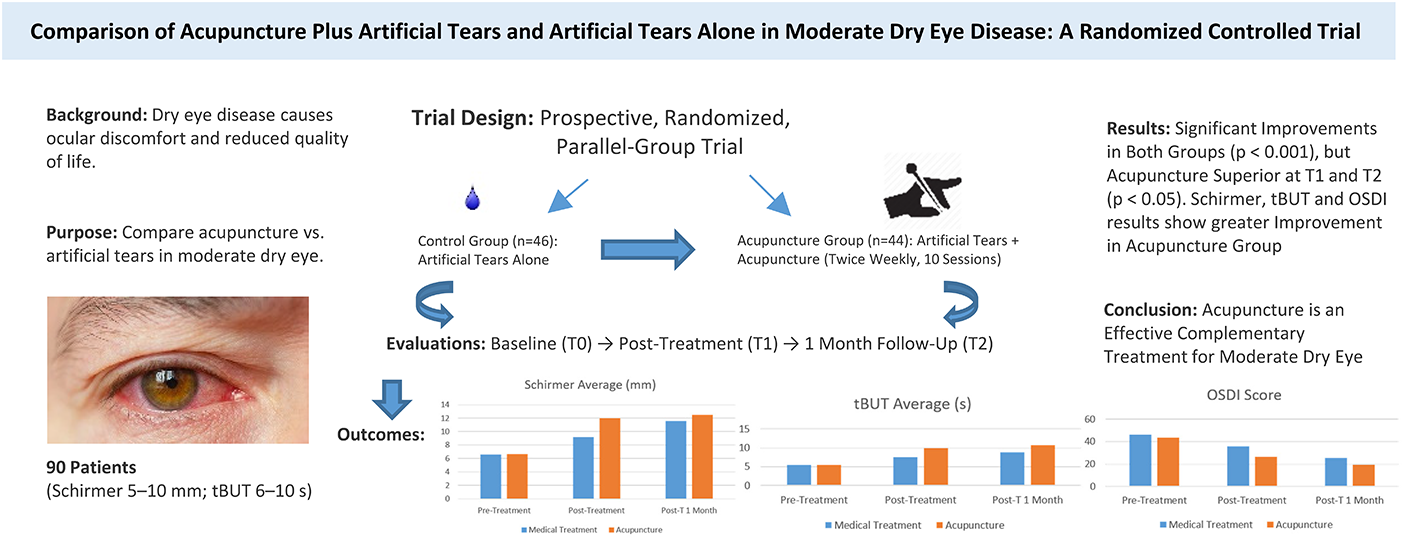
Background and Purpose: Dry eye disease (DED) is a multifactorial disorder associated with ocular discomfort and reduced quality of life. Although artificial tears are widely used, their benefit is often limited, increasing interest in acupuncture as a complementary therapy. This study evaluated the effectiveness of acupuncture combined with artificial tears in moderate dry eye disease using objective clinical measures and patient-reported outcomes.
Methods: This prospective randomized controlled trial included 90 patients with moderate dry eye disease [Schirmer 5–10 mm; tear break-up time (tBUT) 6–10 s]. The participants received either artificial tears alone (n = 46) or artificial tears plus acupuncture (n = 44). Acupuncture was applied twice weekly for 5 weeks at predefined periocular and systemic acupoints. Schirmer, tBUT, and Ocular Surface Disease Index (OSDI) scores were recorded at baseline (T0), after treatment (T1), and at 1-month follow-up (T2).
Results: Both groups improved significantly from baseline (p < 0.01). At T1, the acupuncture group showed greater gains: Schirmer +2.74 mm (95% CI: 2.08–3.39), tBUT +2.38 s (95% CI: 1.62–3.15), and OSDI −9.28 points (95% CI: −12.39 to −6.17). At T2, acupuncture maintained superiority in tBUT (+1.70 s), while differences in Schirmer and OSDI decreased. Seventeen mild, self-limited adverse events occurred in the acupuncture group.
Conclusion: Acupuncture combined with artificial tears resulted in greater short-term improvements in tear production, tear film stability, and symptoms than artificial tears alone in moderate dry eye disease. The continued advantage in tBUT suggests potential sustained benefit. Maintenance sessions may support longer-term improvement. (ClinicalTrials.gov: NCT07185854.)
AnastasiJ. K.CapiliB.NeumaierJ.HackettL. (2023). Delivery of acupuncture in clinical trials: Research acupuncturists’ perspectives. Journal of Integrative Medicine, 21, 315–319. https://doi.org/10.1016/j.joim.2023.03.007
2.
BarberL.KhodaiO.CroleyT.LievensC.MontaquilaS.ZiemanskiJ.ZiemanskiJ.McCartM.LunacsekO.BurkC.PatelV. (2018). Dry eye symptoms and impact on vision-related function across international task force guidelines severity levels in the United States. BMC Ophthalmology, 18, 260. https://doi.org/10.1186/s12886-018-0919-7
BhattK.SinghS.SinghK.KumarS.DwivediK. (2023). Prevalence of dry eye, its categorization (Dry Eye Workshop II), and pathological correlation: A tertiary care study. Indian Journal of Ophthalmology, 71, 1454–1458. https://doi.org/10.4103/IJO.IJO_2591_22
5.
BhujbalS.RupenthalI. D.StevenP.AgarwalP. (2024). Inflammation in dry eye disease: Pathogenesis, preclinical animal models, and treatments. Journal of Ocular Pharmacology and Therapeutics, 40, 638–658. https://doi.org/10.1089/jop.2024.0103
6.
Britten-JonesA. C.WangM. T. M.SamuelsI.JenningsC.StapletonF.CraigJ. P. (2024). Epidemiology and risk factors of dry eye disease: Considerations for clinical management. Medicina, 60, 1458. https://doi.org/10.3390/medicina60091458
7.
CartesC.AravenaC.MonsalveA.SegoviaC.RomeroC.QuidelD.CidF.MonsalveR.NavarroL.ArayaD.AranedaD.SepulvedaM. (2024). Prevalence of dry eye disease in laser-assisted in situ keratomileusis candidates. Eye & Contact Lens: Science & Clinical Practice, 50, 305–310. https://doi.org/10.1097/ICL.0000000000001095
8.
ChangK. J.WuH. Y.ChiangP. H.HsuY. T.WengP. Y.YuT. H.LiC.-Y.ChenY.-H.DaiH.-J.TsaiH.-Y.ChangY.-J.WuY.-R.YangY.-P.LiC.-T.HsuC.-C.ChenS.-J.ChenY.-C.ChengC.-Y.HsiehA.-R.ChiouS.-H. (2025). Decoding and reconstructing disease relations between dry eye and depression: A multimodal investigation comprising meta-analysis, genetic pathways and Mendelian randomization. Journal of Advanced Research, 69, 197–213. https://doi.org/10.1016/j.jare.2024.03.015
9.
ChenA.AugelloP.AsbellP.YingG. S., & DREAM Research Group. (2025). The repeatability of tests for dry eye signs and symptoms in the dry eye assessment and management (DREAM) study. Contact Lens and Anterior Eye, 48, 102322. https://doi.org/10.1016/j.clae.2024.102322
10.
ChenT.FengL. Q.JinY. (2025). A review of acupuncture for the treatment of dry eye syndrome: Mechanisms, efficacy, and clinical implications. International Journal of General Medicine, 18, 4647–4658. https://doi.org/10.2147/IJGM.S526265
11.
CraigJ. P.NicholsK. K.AkpekE. K.CafferyB.DuaH. S.JooC. K.JooC.-K.LiuZ.NelsonJ. D.NicholsJ. J.TsubotaK.StapletonF. (2017). TFOS DEWS II definition and classification report. The Ocular Surface, 15, 276–283. https://doi.org/10.1016/j.jtos.2017.05.008
12.
da SilvaM. D.GuginskiG.WernerM. F.BaggioC. H.MarconR.SantosA. R. (2011). Involvement of interleukin-10 in the anti-inflammatory effect of Sanyinjiao (SP6) acupuncture in a mouse model of peritonitis. Evidence-Based Complementary and Alternative Medicine, 2011, 217946. https://doi.org/10.1093/ecam/neq036
13.
DhaliwalD. K.ZhouS.SamudreS. S.LoN. J.RheeM. K. (2019). Acupuncture and dry eye: Current perspectives. A double-blinded randomized controlled trial and review of the literature. Clinical Ophthalmology, 13, 731–740. https://doi.org/10.2147/OPTH.S175321
14.
DuanH.ZhouY.MaB.LiuR.YangT.ChuH.HuoZ.QiH. (2024). Effect of acupuncture treatment on the ocular pain, mental state and ocular surface characteristics of patients with dry eye disease: A non-randomized pilot study. Clinical Ophthalmology, 18, 2751–2764. https://doi.org/10.2147/OPTH.S476573
15.
HerbautA.LiangH.DenoyerA.BaudouinC.LabbéA. (2019). Tear film analysis and evaluation of optical quality: A review of the literature. Journal Français d'Ophtalmologie, 42, e21–e35. https://doi.org/10.1016/j.jfo.2018.12.001
HuW. L.YuH. J.PanL. Y.WuP. C.PanC. C.KuoC. E.TsengY.-J.HungY.-C. (2021). Laser acupuncture improves tear film stability in patients with dry eye disease: A two-center randomized-controlled trial. The Journal of Alternative and Complementary Medicine, 27, 579–587. https://doi.org/10.1089/acm.2020.0524
18.
JonesL.CraigJ. P.MarkoulliM.KarpeckiP.AkpekE. K.BasuS.BittonE.ChenW.DhaliwalD. K.DogruM.GomesJ. A. P.KoehlerM.MehtaJ. S.PerezV. L.StapletonF.SullivanD. A.TauberJ.TongL.Travé-HuarteS.WolffsohnJ. S.AlvesM.BaudouinC.DownieL.GiannaccareG.Horwath-WinterJ.LiuZ.KohS.ElisabethM.OteroE.VillaniE.WatsonS.YoonK. C. (2025). TFOS DEWS III: Management and therapy. American Journal of Ophthalmology, 279, 289–386. https://doi.org/10.1016/j.ajo.2025.05.039
19.
KimT. H.KangJ. W.KimK. H.KangK. W.ShinM. S.JungS. Y.KimA.-R.JungH.-J.ChoiJ.-B.HongK. E.LeeS.-D.ChoiS.-M. (2012). Acupuncture for the treatment of dry eye: A multicenter randomised controlled trial with active comparison intervention (artificial teardrops). PLoS ONE, 7, e36638. https://doi.org/10.1371/journal.pone.0036638
20.
LeeC. Y.YangS. F.HsiaoC. H.SunC. C.ChangC. K.HuangJ. Y.HwangY.-S. (2024). Effectiveness of an acupuncture steam-warming eye mask on dry eye disease in visual display terminal users: A prospective randomized controlled trial. Diseases, 12, 192. https://doi.org/10.3390/diseases12080192
21.
LeeJ. H.HanK.KimT. H.KimA. R.KwonO.KimJ. H.KimJ.-E.LeeS.ShinM.-S.JungS.-Y.ParkH.-j.LeeS. (2021). Acupuncture for dry eye syndrome after refractive surgery: A randomized controlled pilot trial. Integrative Medicine Research, 10, 100456. https://doi.org/10.1016/j.imr.2020.100456
22.
LiN.GuoY.GongY.ZhangY.FanW.YaoK.ChenZ.DouB.LinX.ChenB.ChenZ.XuZ.LyuZ. (2021). The anti-inflammatory actions and mechanisms of acupuncture from acupoint to target organs via neuro-immune regulation. Journal of Inflammation Research, 14, 7191–7224. https://doi.org/10.2147/JIR.S341581
LiuC.ZhaoY.QinS.WangX.JiangY.WuW. (2021). Randomized controlled trial of acupuncture for anxiety and depression in patients with chronic insomnia. Annals of Translational Medicine, 9, 1426. https://doi.org/10.21037/atm-21-3845
25.
LiuQ.LiuJ.RenC.CaiW.WeiQ.SongY.YuJ. (2017). Proteomic analysis of tears following acupuncture treatment for menopausal dry eye disease by two-dimensional nano-liquid chromatography coupled with tandem mass spectrometry. International Journal of Nanomedicine, 12, 1663–1671. https://doi.org/10.2147/IJN.S126968
McMonniesC. W. (2021). Why the symptoms and objective signs of dry eye disease may not correlate. Journal of Optometry, 14, 3–10. https://doi.org/10.1016/j.optom.2020.10.002
29.
MoonS. Y.ChungH. S.LeeJ. H.LeeH.TchahH.KimJ. Y. (2024). Effectiveness of cyclosporine nanoemulsion eye drops in patients with mild-to-moderate dry eyes: Objective and subjective evaluation. BMC Ophthalmology, 24, 401. https://doi.org/10.1186/s12886-024-03620-5
30.
NaJ. H.JungJ. H.ParkJ. G.SongP. H.SongC. H. (2021). Therapeutic effects of acupuncture in typical dry eye: A systematic review and meta-analysis. Acta Ophthalmologica, 99, 489–498. https://doi.org/10.1111/aos.14651
31.
OhJ. E.KimS. N. (2022). Anti-Inflammatory effects of acupuncture at ST36 point: A literature review in animal studies. Frontiers in Immunology, 12, 813748. https://doi.org/10.3389/fimmu.2021.813748
32.
PesaventoF.LovatoA.CappelloS.PostiglioneM. (2022). Acupuncture in the treatment of dry eye syndrome with anxiety symptoms. A case report. European Journal of Translational Myology, 32, 10482. https://doi.org/10.4081/ejtm.2022.10482
33.
SheppardJ.Shen LeeB.PerimanL. M. (2023). Dry eye disease: Identification and therapeutic strategies for primary care clinicians and clinical specialists. Annals of Medicine, 55, 241–252. https://doi.org/10.1080/07853890.2022.2157477
34.
TangN.TangL.LyuJ.JiangX.LiY.DingC.XiangS. (2024). Effect of acupuncture on tear proteomics in patients with video display terminal-related dry eye. Journal of Proteome Research, 23, 2206–2218. https://doi.org/10.1021/acs.jproteome.4c00134
35.
Vidas PaukS.PetričekI.TomićM.BulumT.JandrokovićS.Pauk GulićM.KalauzM.Lešin GaćinaD. (2023). Diagnostic accuracy of non-invasive tear film break-up time assessed by the simple manual interferometric device. Contact Lens and Anterior Eye, 46, 101776. https://doi.org/10.1016/j.clae.2022.101776
36.
VillaniE.CampagnaG.GentiliV.PostorinoE. I.GenoveseP.PalinoP.MainiG.CarbucicchioA.FerioliE.NucciP.RizzoR.AragonaP. (2025). Hydroxypropyl-methylcellulose and GlicoPro® eyedrops in the treatment of dry eye disease: In vitro and clinical study. Ophthalmology and Therapy, 14, 787–803. https://doi.org/10.1007/s40123-025-01101-6
37.
WanK. H.ChenL. J.YoungA. L. (2016). Depression and anxiety in dry eye disease: A systematic review and meta-analysis. Eye, 30, 1558–1567. https://doi.org/10.1038/eye.2016.186
38.
WangY.PengJ.XiaoL.DengY.LuJ.ZhouY. S.YangY.-J.PengQ.-H. (2024). Effectiveness of acupuncture combined with artificial tears in managing dry eye syndrome: A systematic review and meta-analysis. Medicine, 103, e36374. https://doi.org/10.1097/MD.0000000000036374
39.
WangZ. X.QinR. J.YuL. L.NurlanA.JingX. H.LiM. (2024). Acupuncture treats sepsis through immune modulation and organ protection. Current Medical Science, 44, 1185–1192. https://doi.org/10.1007/s11596-024-2957-0
40.
WeiQ. B.DingN.WangJ. J.WangW.GaoW. P. (2020). Acupoint selection for the treatment of dry eye: A systematic review and meta-analysis of randomized controlled trials. Experimental and Therapeutic Medicine, 19, 2851–2860. https://doi.org/10.3892/etm.2020.8561
41.
WilesM. D.MamdaniJ.PullmanM.AndrzejowskiJ. C. (2017). A randomised controlled trial examining the effect of acupuncture at the EX-HN 3 (yintang) point on pre-operative anxiety levels in neurosurgical patients. Anaesthesia, 72, 335–342. https://doi.org/10.1111/anae.13785
42.
XiaY.ZhangY.DuY.WangZ.ChengL.DuZ. (2024). Comprehensive dry eye therapy: Overcoming ocular surface barrier and combating inflammation, oxidation, and mitochondrial damage. Journal of Nanobiotechnology, 22, 233. https://doi.org/10.1186/s12951-024-02503-7
43.
ZhangX.ZhangB.PengS.ZhangG.MaJ.ZhuW. (2022). Effectiveness of acupuncture at acupoint BL1 (Jingming) in comparison with artificial tears for moderate to severe dry eye disease: A randomized controlled trial. Trials, 23, 605. https://doi.org/10.1186/s13063-022-06486-4