




Abstract
Introduction
We herein report 2 interesting cases we recently encountered, whose healing processes from intractable oral diseases were facilitated by applying the Bi-Digitai O-Ring Test (OMURA,Y., 1977-2000; from here on called BDORT) for postoperative pain and glossalgia.
Case I
Patient: K. K., 54 years old, female, office worker, single. Chief complaint and clinical course: Postoperative pain. Postoperative discomfort persisted for about a half year after 5 posterior teeth in the right upper jaw were extracted at a dental clinic in her hometown. At 5 months after surgery, the patient underwent examination at a dental college hospital in Tokyo, but she was told that she had “no noticeable abnormalities.” However, a feel of heaviness and discomfort from the operated site to the left head still persisted although no marked spontaneous pain was present, and she was anxious she should have a cancer. Her doctor at the college hospital just said, “Will you have a biopsy examination?” She had a borderline depression score on SRQ-D (13). She wanted to have a BDORT, and she was referred to our institute from the university hospital.

BDORT findings: The thymus representative region showed a response of -3 (left and right), pericardium meridian/Dairyo -6, and Indo -6, indicating a psychogenic disease. Representative regions of other organs had no response (-). A narrow region in the socket at the upper 1st molar on the right side, determined on a X-ray film, resonated with TxB2 and Sub.P in the BDORT.
Intercuspal position -6 and, resonated with Influenza A in right nasal cavity part.
Treatment: She was suspected to have malocclusion because of -6 found in the intercuspal position. Because an improvement response of +6 was observed with EPA + DHA as a result of BDORT, and we suspected serious psychogenic disorder, as a result of Dairyo -6, Indo -3, and a medical examination by interview. She was given Kamishoyo-san and Hochuetsueki-to which showed positive responses (+) in the BDORT. Her symptoms were remitted within 10 days, but dental treatment and occlusion treatment were continued.
Case II
Patient: S. H., 46 years old, female, ceramist/housewife.
Chief complaints and clinical course: Contact pain and spontaneous pain in the left lateral margin of tongue and apex of tongue. Date of initial examination: She had an abnormal feeling and pain in the tongue for 10 years, but left them untreated because these symptoms fluctuated. Her glossalgia became severe, and she visited a psychosomatic internist. Although Chinese medicines were prescribed by the internist, she was referred to our institute because she wanted to receive a BDORT.
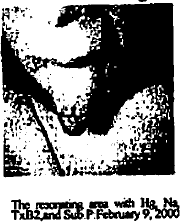
BDORT findings: The thymus representative region was -4 on the right and -2 on the left, the liver representative region was -2, the pancreas representative region was -2, pericardium meridian/Dairyo was -2 (mental stress due to hard working for ceramic exhibition and land-related troubles), and Indo was -6 (add epinephrine). The apex of tongue and lateral margin of tongue resonated with Hg, Na, TxB2, and Sub.P at -6.
In addition, according to the result of BDORT for dental metal, 20K gold alloy and Gold platinum alloy (Bio maingold®) was +6. Silver amalgam, 12% gold-silver-palladium alloy and Silver alloy was -6 ∼ -4.
Treatment: Based on these findings,
Day 9: Glossalgia became mild and occurred less frequently.
Day 32: Pain nearly completely disappeared, and a feel of discomfort was no longer remarkable. No resonance with HG. The apex of tongue and lateral margin of tongue contact with TxB2 and +6 with SubP, and -1 in Dairyo and -2 in Indo, revealing improvement. Because she should continuously work with ceramics, she was encouraged to actively have a massage and a stretch exercise for stiffness and muscular tension in the neck and shoulders, and she received only Kamishoyo-san at 7.5 g/day.
At the present time, 3 months after the 1st examination, she does not complain of any particular pain or discomfort. It’s important that psychological effect on her that she gets an excellent prize at the ceramics show.
Conclusion
Although the cause of two intractable cases was not made clear and they passed into a chronic state, we could suppose the psychogenic factor, decide the plan of treatment and lead to the early recovery with the BDORT. The BDORT was reconfirmed availability in dental practice again.
Get full access to this article
View all access options for this article.