




Abstract
Introduction:
Continuously from the previous presentation, we herein report 2 additional interesting cases to whom the BDORT was applied for chronic pain and chemical substance hypersensitivity.
Case I
Patient: M. K., 43 years old, female. Chief complaint and clinical course: Feeling pain like being compressed, from the left auricle to the submandibular region. Date of initial examination: April 14, 2000.
She noticed a pain from the left parotid gland region to the submandibular region about 1 year ago. From the summer until the end of the last year, dental treatment were done on the lower 1st and 2nd molar on the left side. However, she still had a pain between the lek auricle and submandibular region when opening mouth. Thus, the 3rd molar (wisdom tooth) was extracted, but dull pain remained. From 1 month ago, severe nasal congestion occurred on the left side, and she had Chinese medicines, health supplemental foods, etc., but her symptoms still persisted. At the present time, she receives a Chinese medicine “Shoseiryuto”.
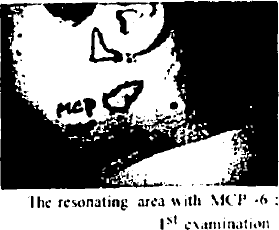
BDORT findings: There was some resonance with the right and left thymuses -3, the uterus -3, the left parotid gland -6, and Mycoplasma (MCP) -6, but no resonance with heavy metals. The uterus resonated with Neisseria gonorrhoeae -6, but such resonance was not observed in the left parotid gland or submandibular region. Although various antibiotics showed no improvement in response, an improvement response of +6 was observed with amantadine (50mg), or EPA( 180mg) + DHA (120mg) leap. Thus, EPA + DHA leap were given 4 times a day. She was instructed to do the selective drug uptake enhancement method. And we tried a method of eliminating electromagnetic energy abnormally accumulated in the affected site using a pure gold bar, called “Goshin-jo”.
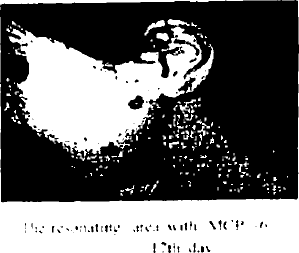
Day 17 after the initial examination: Although there was a resonance with MCP -3 by BDORT, the resonating area with MCP -6 was markedly diminished on imaging, and pain and a feel of discomfort decreased. She continuously received EPA + DHA, and ako tried a selective drug uptake enhancement method and acupressure massage of the neck and shoulders with a tolumarin sheet.
Day 26: Resonance with MCP disappeared from the affected site. Although BDORT opened -3 only at the root apex of the lower 1st and 2nd molar on the left side, pain in the parotid gland and submandibular region disappeared. Dental treatment of these teeth were continued. In addition, resonance -3 with Neisseria gonorrhoeae was observed in the uterus, right ovary, and anus, and we recommended her to visit a specialized doctor.
Case II
Patient: K. N., 45 years old, female, housewife.
Chief complaint and clinical course: Examination of her response to dental materials with BDORT.
This patient was diagnosed as having chemical substance hypersensitivity at the university hospital based on the results of hematological examination and examination of the autonomic nerve and optic nerve. She visited our institute with a reference from the university hospital to examine suspected hypersensitivity to dental materials, metals, drugs, and cements and also to receive dental treatment.
BDORT findings: As for dental metal materials, 20K over gold alloy was more than +6, and Ceramics(Crys-Cere) was +6. As for adhesives, Vitramer™ was +6, and Super-Bond was +3. As for antibiotics, a 100-mg tablet of tetracycline was +6. As for analgesics, a 250-mg capsule of mefenamic acid was +6, and a 40-mg tablet of flurbiprofen was +4. As for local anesthetics, 1.0 ml or les of 2% lidocaine was +1. Other drugs were prohibited because of (-) or less than +1.
For tooth extraction of the upper 2nd molar in the left side (with a severe periodontal disease), after premeditation (a 100-mg tablet of Minomycin®) were administered, painless extraction was successfully achieved under acupressure anesthesia with TEAS (Transcutaneous Electrical Acupuncture-point Stimulation) to left Kankotsu Gekan and bilateral Gokoku at 1.2 Hz for 15 min. Postoperative gargles was done with Concool F® (gluconic acid chlorhexidine gargles) because it was +6 by BDORT. These results were reported to the university hospital.
Conclusion:
Although various methods of Western medicine are available for the diagnosis of chemical substance hypersensitivity, an accurate diagnosis may not be made based on the data from Western medicine alone. Thus we accepted the patient’s desire and a request for BDORT from the university hospital. In addition, painless tooth extraction could be successfully achieved under acupressure anesthesia using drugs selected with the BDORT, and the patient has shown an uneventful postoperative course, again confirming the usefulness of BDORT.
Get full access to this article
View all access options for this article.