




Abstract
The IFLA–UNESCO Public Library Manifesto (2022) identifies 11 key missions that ‘should be at the core of public library services’. The mission, vision and purpose statements of a sample of 50 public library networks in Australia were analysed to gauge the extent to which they reflect these 11 key missions. It was found that the public library mission statements typically only touched on one of the Manifesto's missions, most of which were covered by few, if any, of the statements. The analysis was repeated for a smaller sample of the networks’ strategy documents. Although these touched on more of the key missions, typically it was still only about a third of them. The ways in which each of the Manifesto's missions was covered, or not covered, are detailed, and possible explanations for the lack of coverage discussed.
Keywords
Introduction
At a time when the application of democratic ideals appears to be faltering in some parts of the world, the new version of the IFLA–UNESCO Public Library Manifesto (Krass et al., 2022) serves as an important reminder of certain core values that have been embedded in the library profession for several generations. The Manifesto was first promulgated in 1949, in fact, on the back of the Universal Declaration of Human Rights (UN General Assembly, 1948), which sets out the fundamental ways in which ‘All human beings are born free and equal’. These include the freedom for people to express themselves and their equal rights to education, both of which can be supported by the institution of the public library. The original Manifesto (UNESCO, 1949) made ‘universal education’ the key mission of public libraries, by providing all of their community members access to the materials in which people express themselves. It also linked this mission to the cause of ‘modern democracy’, which depended, it asserted, on people's life-long access to education: only a fully informed public could participate effectively in community, and political life. Providing unfettered access to information was thus the public library's raison d’être, linked to sentiments that have been actively espoused by very many librarians in the intervening 75 years and resulting in strong stances against both censorship and privileged access.
However, the contents of the Manifesto have evolved to reflect a wider range of missions with which public libraries are now identified, and with which modern-day public librarians likewise identify, including those related to their increasingly important community building role (Johnston et al., 2022). In its latest version, the Manifesto enumerates 11 ‘key missions’, covering several times as many concepts. We might expect that many of these concepts would be reflected in the formal mission statements of individual library services around the world, but it is not clear if some of the Manifesto's key missions have been taken up by libraries more than others, and, if so, which ones. Any misalignment between the contents of the Manifesto and that of the mission statements of the libraries themselves is worth identifying, as it could usefully inform the future development of the Manifesto itself, as well as the local mission statements.
Building on a recent study of the content of Australian public library mission statements (Hider et al., 2022), we present here an analysis of the extent to which the 11 key missions of the IFLA–UNESCO Public Library Manifesto, are represented on the official mission statements of a sample of Australian public library networks. Given the relative lack of coverage in the high-level statements we sampled, we also explored the extent to which the Manifesto's missions were addressed at a slightly more specific level by examining a sample of the libraries’ strategic planning documents.
The IFLA–UNESCO Public Library Manifesto
The latest version of the Manifesto still links the mission of the public library to democracy, but enumerates the ways in which the library should support ‘fundamental human values’ more broadly and in a little more detail. Naturally, the revised missions (or sub-missions) reflect the contemporary information and technological environment; they also reflect a deeper consideration of how libraries might support democracy and civic participation through a recognition, for instance, of their ‘role at the core of the social fabric’. It does not differ so radically from the previous edition (UNESCO and IFLA 1994), which listed 12 specific ‘missions’, but each of the new version's 11 missions is noticeably more expansive. The 2022 version is also the first to be formally presented as a joint publication by the International Federation of Library Associations and Institutions (IFLA) as well as UNESCO.
The 11 missions from 2022 for public libraries (with our numbering) are:
providing access to a broad range of information and ideas free from censorship, supporting formal and informal education at all levels as well as lifelong learning enabling the ongoing, voluntary and self-conducted pursuit of knowledge for people at all stages of life; providing opportunities for personal creative development, and stimulating imagination, creativity, curiosity, and empathy; creating and strengthening reading habits in children from birth to adulthood; initiating, supporting and participating in literacy activities and programmes to build reading and writing skills, and facilitating the development of media and information literacy and digital literacy skills for all people at all ages, in the spirit of equipping an informed, democratic society; providing services to their communities both in-person and remotely through digital technologies allowing access to information, collections and programmes whenever possible; ensuring access for all people to all sorts of community information and opportunities for community organising, in recognition of the library's role at the core of the social fabric; providing their communities with access to scientific knowledge, such as research results and health information that can impact the lives of their users, as well as enabling participation in scientific progress; providing adequate information services to local enterprises, associations and interest groups; preservation of, and access to, local and Indigenous data, knowledge, and heritage (including oral tradition), providing an environment in which the local community can take an active role in identifying materials to be captured, preserved and shared, in accordance with the community's wishes; fostering inter-cultural dialogue and favouring cultural diversity; and promoting preservation of and meaningful access to cultural expressions and heritage, appreciation of the arts, open access to scientific knowledge, research and innovations, as expressed in traditional media, as well as digitised and born-digital material.
Many of these missions include a wide range of concepts, with some touching on multiple roles for the public library. The overarching mission of providing unfettered access to all sorts of information is enshrined in the first mission listed, which starts: ‘providing access to a broad range of information and ideas free from censorship’. This mission also connects this task to that of education and life-long learning. The second mission focuses on patrons’ creative development, without specifying how this will be nurtured – perhaps through the inspiration of creative works represented in the library's collections, but perhaps also through tools and spaces designed to support creativity (such as makerspaces). The cultivation of reading habits, particularly in children, is the next mission, one that was alluded to in the original Manifesto. A range of literacies is the subject of the fourth mission: not only basic literacy, but also media, information and digital literacies. Their mastery is connected explicitly to the functioning of modern democracy. The fifth mission recognises the importance of both in-person and remote services. The next mission focuses on community building, by providing patrons with information about their community, as well as a place for ‘community organising’: the library as ‘community hub’. The seventh mission recognises the particular importance of scientific and medical knowledge (a timely reminder in the wake of the COVID pandemic), while the ninth gives libraries a role in collecting and preserving local and Indigenous knowledge. The eighth mission supports local enterprises, associations and interest groups, while the penultimate mission supports cultural inclusion. The last mission reiterates some of the earlier concepts, reinforcing the library's role in providing open access to both cultural and scientific resources, in all formats. In summary, of the 11 missions, six deal directly with access to information and educational resources (nos 1, 5, 7, 8, 9 and 11), two support this access by developing patrons’ capacity to use them (nos 3 and 4), two support community building (nos 6, 10) and one pertains to creative development (no. 2).
Literature review
Perhaps surprisingly, there has been a dearth of scholarly discussion around the Public Library Manifesto, either since the publication of the latest version or previously. An exception was a brief discussion by the prominent Australian librarian, Alex Byrne (2004), of the way in which the connection between libraries and democracy could be operationalised by library managers, in which he noted that the 1994 version of the Manifesto introduced the notion of libraries as not only key providers of information, but also as important builders of ‘social capital’. For potential users to benefit from libraries in all the ways they might, however, Byrne (2004) points out that first of all they need to feel safe and welcome, which means thinking about users and their circumstances in the broadest possible terms when it comes to the design of services and access to collections. This includes consideration of their privacy in the wake of the USA Patriot Act, for example. Only then can libraries progress their goals of serving as a ‘democratic institution’.
About the role of public libraries in supporting democracy and human rights more broadly, and about the role of public libraries in general, there has of course been considerably more scholarly literature. Some studies of how public libraries contribute to the cultural life of, and in, communities were highlighted by Hider et al. (2022) in their earlier analysis of Australian public library mission statements. More specifically, a raft of studies examining how public libraries generated ‘social capital’ for their users were identified by Wojciechowska and Topolska (2021). The extent to which public libraries facilitate the acquisition of ‘cultural capital’ has likewise been studied by a number of scholars, such as Lee (2025). While ‘social capital’ points to the more recent ‘community building’ role that public libraries have often assigned themselves, ‘cultural capital’ points also to the way in which a library's resources may be used to help acculturate those who find themselves on the fringes of a community.
The value of libraries specifically as facilitators of democracy has also been discussed by several commentators, especially in relation to the public arenas of the Habermasian democratic model, in which community members are able to actively participate in democracy at a ‘grass roots’ level: public libraries are often seen as suitable ‘third places’ (after home and work) for this discourse (e.g. Audunson et al., 2019). A recent analysis of Swedish public librarians’ views on their libraries’ democratic role found that both the ‘social-liberal’ and ‘deliberative’ versions of democracy were well represented, relating to the concepts of equal access on the one hand and civic engagement on the other (Carlsson et al., 2023).
Other emerging roles for public libraries have also been examined. For instance, the extent to which their spaces can foster creativity, in the face of certain conflicting institutional norms, has been considered by Bromage et al. (2025). Another way of considering the roles of public libraries, as established in their communities, is by analysing the aspects of their social legitimacy. Yamagishi et al. (2024) have analysed the literature on public libraries and legitimacy, and identified five dimensions: democracy (with its subsections of intellectual freedom, neutrality, the public sphere, social justice and social capital), culture and history, communication and education, the economy, and librarianship.
Many of the roles discussed in the literature are covered, to varying degrees, in the formal mission statements of public libraries. In their inductive content analysis of the mission, vision and purpose statements of 50 public library networks across Australia, Hider et al. (2022) found that most statements covered a range of roles, with a majority covering the facilitation of learning and discovery, and social connection. Other common themes included the physical spaces provided, access to information and resources, and cultural inclusion. Another recent study analysed 80 mission statements from libraries across the United States and Canada, and identified similar concepts, although ‘culture and recreation’, and their collections, were emphasised more (Fraser-Arnott, 2022).
Methods
While there is clearly some overlap between missions of the 2022 Manifesto with the themes identified by Hider et al. (2022) in their earlier analysis of Australian public library mission statements, the formulations of these themes are different; the Manifesto's missions were, after all, published after the authors’ analysis of the Australian mission statements. Instead of analysing the mission statements inductively as in the previous paper, here we analyse them deductively, using the 11 missions from the new Manifesto, to gauge the extent and ways in which they are reflected in what Australian public libraries publicise as their missions.
To this end, the authors first of all updated the sample of Australian public library mission statements that had been used for the previous study (Hider et al., 2022). Those in documents that were still accessible on their organisation's website and that remained current were retained for this study. Where this was not the case, a replacement document was searched for, using the same criteria as previously: the document needed to be current for 2024 and include one or more statements with a heading including the term ‘mission’, ‘vision’ or ‘purpose’, and that pertained to the library network specifically (as opposed to e.g. its council as a whole). Fifteen of the previous sample of 50 documents (each representing a different library network) were no longer accessible and current, nor could they be replaced with a new document. In these cases, documents from other library networks were sought, using the qualifying criteria as above, and similar search criteria used in the compilation of the previous sample (Hider et al., 2022).
The texts of the mission/vision/purpose statements for the new sample of 50 Australian public library networks were copied into a new spreadsheet; also recorded were their organisation's name (mostly the name of a particular council), the state it was located in, the title of the document, and its date of creation and URL. Whether headed ‘mission’, ‘vision’ or ‘purpose’, the statements ranged from a few words to a few short paragraphs totalling over 100 words. An example of a short mission statement is: ‘To enhance equity of access to information, education and recreation for all members of our community’. The average would be two or three times this length, and some made use of dot points. About half of the library networks yielded two types of statement, a few all three (mission, vision and purpose).
The coding then proceeded by identifying elements of the texts that mapped to one of the particular missions of the IFLA–UNESCO Public Library Manifesto (Krass et al., 2022). Quantitatively, any mapping from any of the statements emanating from all of the library network's documents (if more than one) was counted singularly, regardless of the number of occurrences or the amount of the text; in other words, a measure was made of the number of the Manifesto's missions covered, or at least touched on, by each library network's mission statements, with vision and purpose statements treated as approximate equivalents.
An element of a mission statement was deemed to map to a Manifesto mission if the element was considered to exemplify a key component of the mission. For example, the text, ‘Reducing the digital divide by providing great internet access with support to access [information]’ was deemed to exemplify IFLA mission no. 5, of ‘providing services to their communities both in-person and remotely through digital technologies allowing access to information, collections, and programmes whenever possible’. Likewise, the text, ‘the library stimulates curiosity and lifelong learning’ was considered to map to key components of both the first (‘lifelong learning’) and second (‘curiosity’) missions. Thus, the element did not have to represent all possible ways in which a library could carry out this component of the mission, or the mission in its entirety. Conversely, where a mission in the Manifesto that was not coded for, in a given library network's mission statement(s), this meant that it was considered to not figure at all in the network's published mission.
The authors independently coded the texts from the first 10 library networks, and then discussed their discrepancies and decided on a final coding; after two more rounds of 10, they had achieved complete agreement for eight library networks and only two codes did not match in the other two cases. This represented a matching rate across the 11 Manifesto missions of 92.7% (51/55), which was deemed an acceptable level of inter-coder agreement, and one of the authors coded the remaining texts unilaterally. The coding was analysed quantitatively using basic descriptive statistics. For each of the Manifesto missions, examples of both typical and stronger representations from the mission statements were also identified.
As the results revealed a relative lack of coverage of most of the Manifesto missions, the exercise was repeated to explore the extent the missions of the Manifesto were covered at the next level ‘down’ from the library mission, i.e. the library's ‘strategy’. The authors searched for strategy documents on the websites of the 50 library networks and their parent organisations, and found a current document containing a list of strategic objectives, or similar (e.g. ‘key priorities’), for the library network specifically, in 14 cases. The relevant sections of these documents (one per library network in this round), which tended to be considerably larger than the mission statements, were coded using NVivo software. The first two documents were coded by both authors independently, with a resulting coding match of 86.4% (19/22). The other 12 lists were coded by one of the authors. The second set of coding was analysed in the same way as the first set was (with multiple codes in a document for a particular IFLA mission counting just the once).
Findings
This section will first present the findings of the analysis of the library mission statements and then the findings of the analysis of the libraries’ strategic plans. In both cases, after a summary of the quantitative results, coverage of each of the 11 Manifesto missions is illustrated and discussed one by one; where there is a relative lack of coverage, the utility of the mission itself is also considered.
Mission statements
Quantitative summary
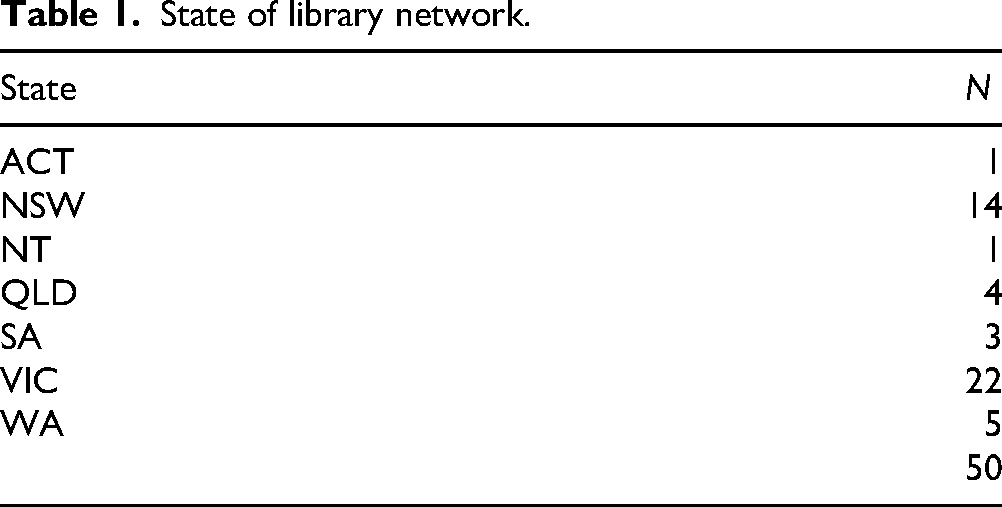
Table 1 breaks down the sample of mission statements by their library network's state. In terms of human population, Victoria is over-represented and Queensland under-represented, while Tasmania is not represented at all, although it does have only one library network. The sample includes a reasonable spread of networks across the country, however, including representation from rural as well as urban locales.
State of library network.
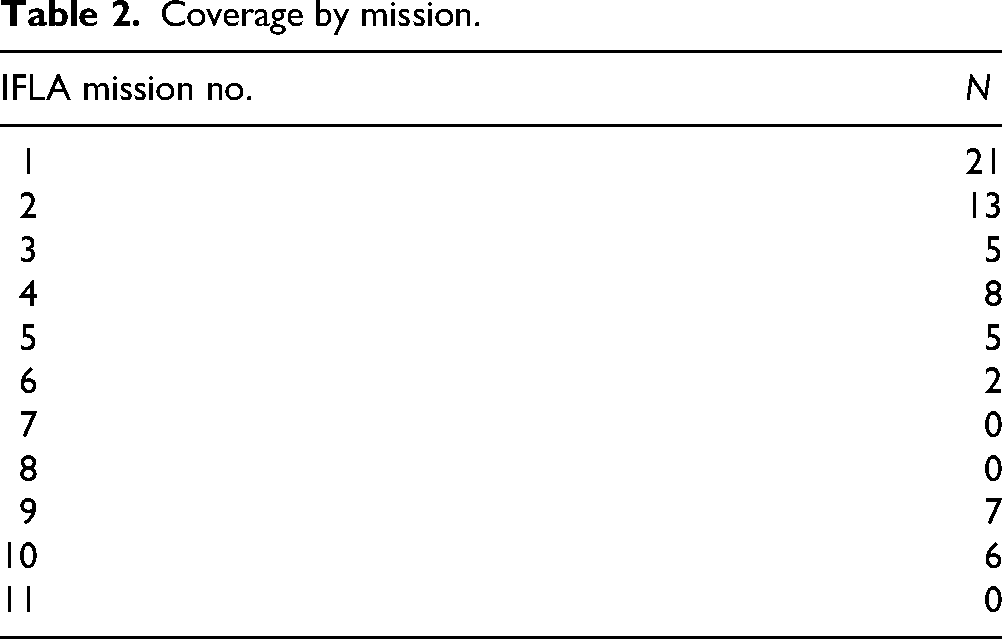
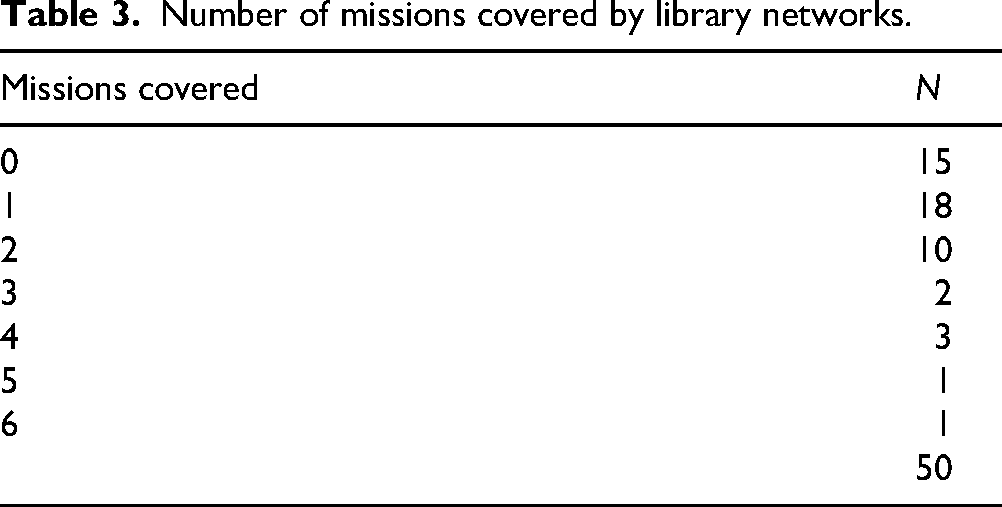
The extent to which each of the Manifesto's missions is touched on in the sample of statements as a whole is shown in Table 2. No mission is covered by a majority of the statements. The mission touched on by the most is the first, with 42% of them. Seven of the 11 missions are touched on by 10% or more, while three missions are not represented in the statements at all. Not only is the missions’ coverage uneven, it is also weak. Table 3 shows that this is not particularly due to marked differences in the statements’ coverage across the sample: only seven statements touch on more than two missions, with the median being one mission.
Coverage by mission.
Number of missions covered by library networks.
It is likely that a large number of the mission statements were drafted prior to the publication of the 2022 version of the Manifesto, although many of its key concepts were also covered in the previous version. In any case, this would not explain the concepts’ absence in the statements, but simply indicate the lack of a causal relationship between the statements and the Manifesto. Instead, a probable reason for the limited overlap is the smaller size of the typical statement, compared with length of the set of missions in the new Manifesto. In some cases, a network's statement, or statements in combination, amounts to only about the same number of words as two or three of the 11 missions, though in others their length is more than half of the full set. Thus a typical statement's coverage of the IFLA missions may have been limited owing to reasons of space, although many of the statements’ style allows for a reduction of syntactical elements through the use of dot points and the like, whereas the Manifesto is written more formally. In general, the mission statements were probably crafted with a view to brevity and succinctness more than the Manifesto and its list of missions were.
Notwithstanding their more constrained word lengths, the statements’ lack of coverage of many of the Manifesto's missions is surprising, given the missions’ intended universality. All 11 seem relevant to the Australian context. While one would not expect all of them to be covered by each statement, that the typical statement touched on only one mission is made all the more remarkable by the latitude in the coding, with a statement, or combination of statements, only needing to cover one key conceptual component of a mission, when some of the missions contained several.
A larger amount of the text in the statements was not assigned any code. As was noted in the earlier paper (Hider et al., 2022), some of the text was rather vague, or was quite generic in nature. Examples include ‘Our Vision: inspiring, enriching and engaging our community’ or ‘Our Mission: To continuously deliver excellent services’. Those that were more specifically linked to the library service, as opposed to the Council's broader vision or mission, were more likely to be coded.
The particular ways in which each of the 11 IFLA missions were covered (or not) by the library mission statements are discussed below.
IFLA 1. Providing access to a broad range of information and ideas …
Although more statements touched on this mission than on any other, none specifically mentioned ‘censorship’, and hardly any explicitly connected information access with learning. Some just covered information access, others learning, or specifically life-long learning, and some covered both, but separately. If this mission did not include both these key concepts, it would not have been coded for so much more than the other missions.
‘Free’ and/or ‘open’ access to information, resources, or services more broadly, was listed in several statements, but this may well have meant free of charge more than free from censorship. ‘Equitable’ or ‘equal’ access was listed by a similar number of the statements that were coded for this mission. Perhaps the statement that most covered the mission stated: ‘Our community are curious lifelong learners, who access trusted and relevant information, programs, technologies and opportunities.’
While the educational and learning aspect of libraries’ information provision might be assumed, it is somewhat surprising that the information access concept is only represented in a minority of the statements, and not a very large minority at that. However, this does align (not surprisingly, given the data overlap) with the findings of Hider et al. (2022), and is perhaps due to the increasing availability of alternative sources of information on the Internet, as well as the expanding remit of public libraries.
The lack of mention of censorship may be due to its avoidance being considered something of ‘a given’ in Australia, although it should be pointed out that Australian public libraries are by no means totally free from censorship, as a recent case in relation to a library network in Sydney highlights (Mokrzycki, 2024). Moreover, the political climate could change in Australia just as it can everywhere else, and a statement that unambiguously signifies a library's commitment to fighting censorial forces could support any future need for it to do so.
IFLA 2. Providing opportunities for personal creative development …
This mission was mostly represented by the inclusion of the term ‘creativity’ or ‘create’, with ‘curiosity’ occasionally appearing. Given public libraries’ increasing interest in fostering social inclusion, the absence of the ‘empathy’ concept is particularly notable. Mostly creativity was included as part of a list of traits that the library aimed to cultivate, with it not necessarily being clear how this cultivation was to occur. Perhaps the closest match to the mission was with the statement that included the aim of ‘providing opportunities for creativity and innovation’.
IFLA 3. Creating and strengthening Reading habits in children …
There were in fact no statements that included an objective specifically around children's reading, and none that talked of reading habits as such. The few statements that were coded for this mission mentioned supporting reading more generally, and more at the engagement than habitual level: one aimed to ‘to inspire our community to read’, while another listed ‘supporting literacy and a joy of reading’ as an objective. It might be that the inculcation of reading habits in children is associated in Australia more with teacher librarians and schooling than with public libraries, but even still there are many children's librarians based in Australian public libraries whose mission would probably include the promotion of reading.
IFLA 4. Initiating, supporting and participating in literacy activities and programmes …
Literacy was mentioned in 16% of the mission statements, in some cases as a focus, in others as part of a list of goals. It was sometimes linked to learning, as in, for example, ‘foster literacy and learning’. Forms other than basic reading and writing literacy were not explicitly mentioned, perhaps because they are less commonly understood. The relatively high literacy rates in Australia may well be a reason for the lack of this mission's coverage across the sample.
IFLA 5. Providing services to their communities both in-person and remotely …
This was another mission with only a small amount of coverage, with the statements more focused on bridging the ‘digital divide’ than on providing digital access per se. Perhaps the limited resourcing available for the development of online libraries beyond the standard kind of collections is a factor here.
IFLA 6. Ensuring access for all people to all sorts of community information and opportunities …
While a number of statements noted the social role of libraries, very few did so in relation specifically to community information provision, or to the hosting of community events. One that did, aimed to enable users to ‘discover opportunities and access information about our community’. If the mission had been worded to more clearly encompass library programming with a social dimension, it would have been coded for more of the statements.
IFLA 7. Providing their communities with access to scientific knowledge …
Not a single statement touched specifically on scientific and/or health information. It has been noted that Australian public libraries played an important community role during the COVID pandemic, despite their physical sites being locked down for extensive periods of time, but this role pertained more to social connection than it did to health information (Garner et al., 2021). Again, this mission's absence may be due to the assumption that community members enjoy access to reliable medical and other kinds of scientific information via other sources, including an extensive network of dedicated health services and various other kinds of government and educational agencies, beyond the public library system. However, while it is true that these other sources of scientific information are extensive, the public library could nevertheless play an important role in connecting especially vulnerable community members to them.
IFLA 8. Providing adequate information services to local enterprises …
This mission also did not feature in the sample of statements, which emphasised services for individuals and families, much more so than for groups and businesses. It should be noted, however, that not all small businesses employ people with high levels of information literacy, and that this mission also encompasses community groups, which play a key role public libraries’ broader mission of community building.
IFLA 9. Preservation of, and access to, local and Indigenous data, knowledge and heritage …
This mission contained several key concepts which explains why relatively more statements touched on it. Mostly it was covered in terms of ‘histories’ and ‘stories’, less often in terms of ‘cultural heritage’ more generally. Both the preservation and sharing of local heritage tended to be covered; the heritage was never specifically First Nations heritage, despite this being a critical part of Australian cultural heritage. A more fulsome example of the statements’ coverage of this mission was one in which the library ‘records and documents those stories and histories so they are not lost to current and future generations’ as well as ‘facilitate[s] the creation of content that will enhance community knowledge, and the ongoing discovery of our past, present and future’.
Considering Australian public libraries’ strong involvement in local history activities, however, with dedicated collections and in some cases even dedicated local history librarians, it is a little surprising that it was not touched on by more of the statements.
IFLA 10. Fostering inter-cultural dialogue and favouring cultural diversity …
This mission would have been coded for more if it were couched in terms of social inclusion rather than specifically cultural inclusion. Those statements that did touch on it, covered the ‘diversity’ concept, but not that of ‘dialogue’, which constitutes a more active kind of objective. Given the multiethnic profiles of so many Australian communities, the development of culturally safe spaces, at least, could be assigned more emphasis.
IFLA 11. Promoting preservation of and meaningful access to cultural expressions and heritage …
This mission was coded for those concepts it covered that were not covered in other missions, none of which was identified in any of the sampled statements. Cultivating users’ ‘appreciation of the arts’ appears to hark back to an earlier era, while coverage of ‘traditional’ media may still be regarded as a prerequisite for Australia's public libraries. The value that this mission adds to the Manifesto's list seems questionable.
Strategic plans
Quantitative summary
Table 4 indicates how many of the 14 strategy documents touched on each of the Manifesto's missions, compared with the mission statement documents for the same library networks. Interestingly, but perhaps coincidentally, all 14 of the networks that had a suitable public-facing strategy document for analysis were among those without any coverage of the IFLA missions in their mission/vision/purpose statements, with the exception of one network, for which the first-round coding mapped to two IFLA missions. As might be expected, the more detailed strategy documents touched on the IFLA missions much more, although their coverage and that of the larger sample's coverage in the first round were distributed across the missions differently. In this case, the most covered were the fourth and ninth missions, by just over half of the 14 networks, with the third mission covered by exactly half of them, and the first, fifth and sixth covered by just under half. As in the first round, the seventh and eight IFLA mission were not covered at all, while the second mission increased its tally by just one library network.
Coverage by mission in first- and second-round documents.
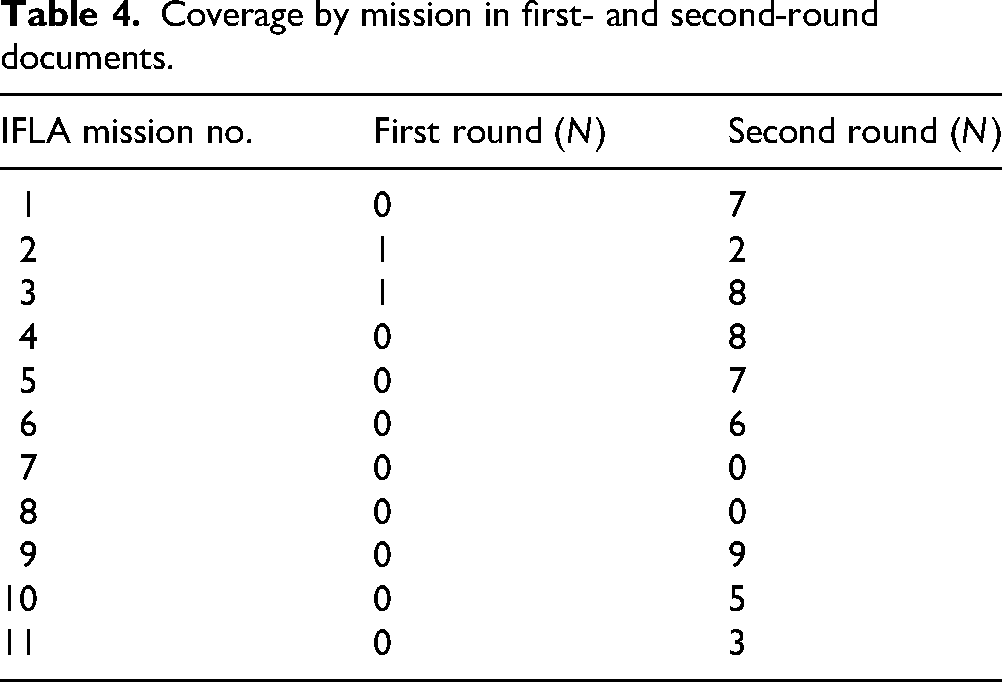
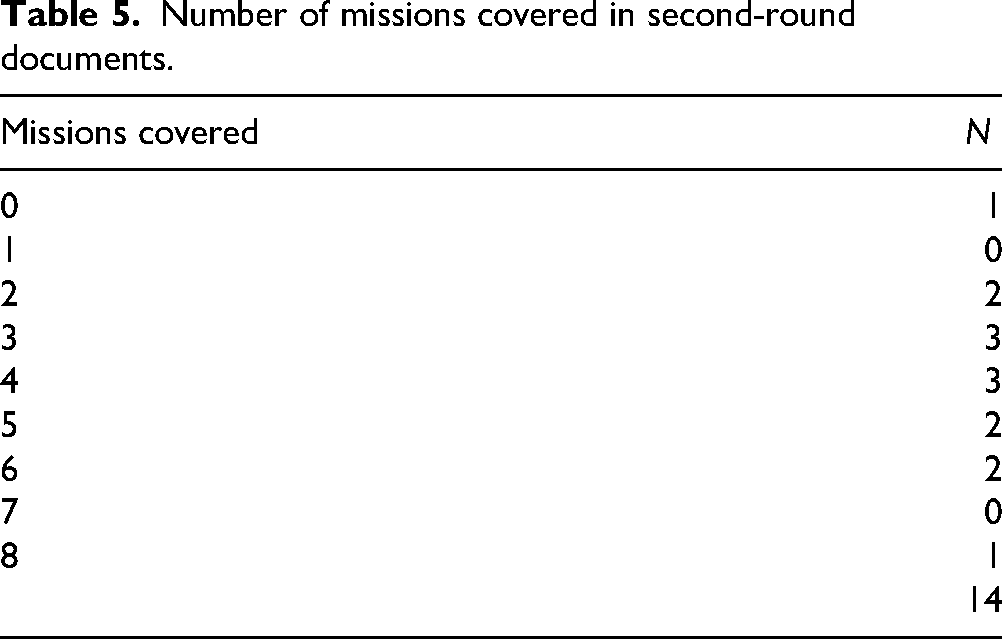
While the small sample size of library networks covered by the second round precludes any definitive claims, the numbers suggest that Australian public libraries typically touch on a few more of the IFLA missions at the strategy level than at the mission/vision/purpose level, but still fewer than half of them. Whereas the median in the first round was one mission, in the second it was four (out of 11), as can be seen in Table 5, which also shows a normal-like distribution of the second-round sample's coverage.
Number of missions covered in second-round documents.
Although only certain sections of the strategy documents were coded in the analysis, these sections were on average of a similar size to the set of IFLA missions. Therefore other reasons for the lack of overlap need to be considered. It is possible that current resourcing levels limit Australian public libraries’ capacity to deliver effectively across more of the IFLA missions. Another possibility is that while at an operational level more of the IFLA missions might be addressed, the content of this type of document is constrained by the council's broader policies and expectations, including in relation to the choice of performance measures. On the other hand, the strategies could also be in want of a more comprehensive view of what the libraries’ mission should be, and could be usefully informed by the Manifesto.
IFLA 1. Providing access to a broad range of information and ideas …
Again, the documents did not cover ‘censorship’, and in this case emphasised life-learning in particular, much more than information access provision.
IFLA 2. Providing opportunities for personal creative development …
This mission was covered by only one more of the documents, with the concept of ‘empathy’ still missing.
IFLA 3. Creating and strengthening reading habits in children …
Again, the emphasis was on fostering a ‘love of reading’ across age groups.
IFLA 4. Initiating, supporting and participating in literacy activities and programmes …
The strategy documents covering this mission all mentioned basic literacy, but half of them also mentioned digital literacy, to ‘support library users to build their confidence and skills in efficiently using digital technology and effectively using digital information and tools’, as one document put it.
IFLA 5. Providing services to their communities both in-person and remotely …
This mission was also covered much more at the strategic level, with objectives such as to ‘expand, improve and promote access to online collections and library resources’ occurring in over half the documents. Not surprisingly, these objectives tended to be framed as works in progress, as in, for example, ‘leverage the power of new and emerging technologies to deliver service improvements’.
IFLA 6. Ensuring access for all people to all sorts of community information and opportunities …
There were some details about how libraries would host community events in the strategy documents (e.g. providing suitable meeting rooms for particular groups, or allowing groups to use the library outside of opening hours), while one document included the objective of developing community information.
IFLA 7 and 8. Providing their communities with access to scientific knowledge and information services to local enterprises …
These were not touched on by the strategy documents either, as noted above.
IFLA 9. Preservation of, and access to, local and Indigenous data, knowledge, and heritage …
Specific local history projects were detailed in some of the documents, and three documents made particular reference to First Nation heritage.
IFLA 10. Fostering inter-cultural dialogue and favouring cultural diversity …
While more of the strategy documents covered developing services that catered for cultural diversity, and that aimed to foster understanding, the more proactive ‘dialogue’ concept was again missing.
IFLA 11. Promoting preservation of and meaningful access to cultural expressions and heritage …
Traditional as well as new media were covered specifically by a few of the strategies, but none aimed to develop users’ ‘appreciation of the arts’.
Discussion
Our study, which appears to be the first empirical analysis involving the contents of IFLA Public Library Manifesto, points to a notable lack of alignment between Australian public library mission statements and the 11 key missions for public libraries listed in the latest version of the Manifesto. While the brevity of the libraries’ mission statements would limit their coverage of the Manifesto's missions, many in the sample did not cover them at all, and most to only a very small degree. Although the libraries’ strategic plans appear to address the IFLA missions more, again greater coverage might have been expected, given the more expansive nature of these documents. It may be that some of the IFLA missions were less relevant in the Australian context, or were a ‘taken for granted’ part of the libraries’ mission, manifest only at the operational level. There may also have been some internal political considerations at play in the development of the documents, and/or a certain propensity for ‘motherhood’ statements. However, it is also possible that libraries lacked a comprehensive view of their mission when formulating these documents, if one accepts the universality of the Manifesto's contents.
On the other hand, one might also question the utility of some of the Manifesto's content as a guide in this context. Several of its missions overlap conceptually, and the way some of the missions’ elements are combined seems a little clumsy. This may well be the result of having a committee as its author, but including a more delineated set of goals might improve the Manifesto as a reference point for public libraries engaged in reviewing and revising their own particular mission statements.
Our findings would therefore suggest that the structure of the missions set out in the Manifesto should be reviewed, and that their content should be missions be tested for its clarity and precision, as part of the Manifesto's next revision. They would also suggest that revisions to the corporate documents of many public libraries (at least in Australia) could usefully include a mapping to the IFLA document to ensure that all key public library missions have been considered.
Footnotes

Ethical considerations and informed consent statements
Not applicable.
Funding
The authors received no financial support for the research, authorship, and/or publication of this article.
Declaration of conflicting interests
The authors declared no potential conflicts of interest with respect to the research, authorship, and/or publication of this article.
Data availability statement
Not applicable.