




Abstract
The aim of this article is to explore the current research landscape of changing information needs and the need for digital access to library materials. Print reference sources—bibliographies in particular—are discussed and possible solutions for increasing their relevance and appeal as a stable reference point are presented. Several digital curated collections created with bibliographic reference materials are highlighted as a way of reintroducing these materials as a reliable and accessible source of information. The article concludes with future directions for the study of the use of print consultative sources and the main takeaways for adjusting reference and research assistance in an academic library.
Introduction
The changes in information-seeking needs and behavior that were amplified by the COVID-19 pandemic made it clear that some of the traditional library materials need to be reevaluated and recontextualized in order to continue to be useful points of reference, especially with the younger generation of researchers. One of the questions that arises is: How do we reimagine bibliographies for the modern user? With more and more sources available digitally, are librarians and information specialists able to provide efficient user-oriented reference assistance?
Librarians are constantly looking for best practices and ways to assist and empower their patrons. This article details the design and curation of digital collections created by the Slavic Reference Service (SRS) at the University of Illinois Urbana-Champaign as a solution to bridge the gap between researchers and print library collections in an academic library. The collections are intended to facilitate the discovery of reliable research materials and contribute to the paramount goal of librarians to build their patrons’ information literacy skills, which will assist them in finding, identifying, evaluating, and critically utilizing a wide range of sources of information. By contributing to this skill set, curated collections meaningfully increase scholars’ research capacity. Moreover, these projects aim to build on the work of past generations of librarians by using print bibliographic materials to curate collections that are more readily accessible to researchers in the Internet age.
Bibliography in the digital age
The Association of College and Research Libraries (2016) has identified “the rapidly changing higher education environment, along with the dynamic and often uncertain information ecosystem in which all of us work and live” (7), as a complicated environment in which librarians assist library users to navigate a protean information landscape. The Association’s “Framework for Information Literacy for Higher Education” presents a set of guidelines that are meant to guide American research libraries in promoting metaliteracy, “which offers a renewed vision of information literacy as an overarching set of abilities in which students are consumers and creators of information who can participate successfully in collaborative spaces” (8). Although bibliographies remain an important reference source for many librarians, the topic is often not emphasized in university research instruction. Frank-Wilson (2004: 99) notes that, “with few exceptions, bibliography classes are not usually offered in the students’ main disciplines and generally students are not familiar with systematic bibliographic research.” One of the exceptions to this observation is Slavic studies, a field that enjoys a long-standing bibliographic tradition, including materials published in the countries of Russia, eastern Europe, Central Asia, and the Caucasus, among others. Furthermore, Frank-Wilson describes a semester-long bibliography course that aims to increase students’ ability to conduct systematic research in African studies—a task that has evolved from providing students with a list of materials to exploring print, digital, and oral materials in order to build students’ research competencies. Frank-Wilson’s observation that students often initially struggle to differentiate between materials from the open web, library catalogs, and subscription databases is consistent with Bawden and Robinson’s (2009: 181) conceptualization of the Web 2.0 as a place where information has become further “homogenized” due to digital formats blurring the distinctions between types of information technologies.
A search of the course catalogs of the US News and World Report’s (2021) top-ranked library schools for the 2022–2023 academic year reveals that only two institutions list courses with “bibliography” explicitly in the title or description of the course. Of these two institutions, one has a bibliography course listed in the catalog without any indication of the academic year that the course was taught this year. The remaining courses from the search relate to subject-area bibliography of African American librarianship (Illinois, 2022), the Middle East, Africa, and Russia; eastern Europe and Eurasia (Illinois, 2023); and historical research methods (Texas). In contrast, multiple courses on digital libraries, digital curation, and data processing were offered by each institution. The emphasis on digital literacy skills (Wilkes 2016) makes sense, given the changing information needs of users. However, bibliographies may remain an important source for systematic research because not all materials have been digitized, made available online, or comprehensively indexed by contemporary sources, including databases. Although the prevalence of the word “bibliography” in course names and descriptions cannot fully elucidate whether these materials are being introduced in library science coursework, the emphasis on digital aspects of librarianship does signal a shift in instructional priorities. Without instruction in both bibliography and digital librarianship, future librarians may overlook print bibliographies when creating new databases, indexing sources, and digital collections.
Students are also affected when bibliographies become invisible, as they often overestimate their ability to find relevant research resources, overlooking library collections in the process. A study of university students in Turkey conducted by Fry (2016: 128) reveals that an overwhelming majority of students relied more on the open web to conduct academic research compared to library resources. Students who had participated in library instruction were more likely to rely on academic journals in their discipline and use library resources. Students’ reliance on the open web may be especially problematic in light of the results of a study by Wilson et al. (2007), which reveals that Google Scholar had significantly different coverage for certain disciplines, with some coverage being as low as 6% of the indexed sources in major databases, and favored English-language publications. These studies also do not consider primary and secondary sources, which students may overlook when relying solely on open-web indexing sources or subscription databases. The integration of existing bibliographies with open-web platforms may increase the likelihood that researchers examine and include materials cited in bibliographies in their research.
The digital shift affecting research habits has been further accelerated by the COVID-19 pandemic. Facing physical closure, many institutions found an increased demand for digital services and materials. As libraries have reopened their spaces, librarians are entering a “new normal” (Dobreva and Anghelescu, 2022). A survey conducted by Hinchliffe and Wolff-Eisenberg (2020) revealed that by October 2020, nearly three-quarters of libraries continued to have restricted or limited access for public users. The conditions created by the pandemic have led universities to expand digital services and materials with the intention of continuing these initiatives beyond the length of emergency library closures (Murphy et al., 2022). Students are now encountering a new environment in which the physical library is not presented as a necessity for research. Materials that exist solely in physical form are inconvenient for the growing number of students who take advantage of distance learning and digital library resources.
The ongoing digital shift has changed not only the nature of library instruction but also how patrons interact with information in and outside of the library setting. This phenomenon may be described as “information-seeking behaviors,” which Case and Given (2016: 92–93) define as an underexplored concept that operates as “a catchall phrase that encompasses a variety of behaviors seemingly motivated by the recognition of ‘missing’ information.” Information seekers are influenced by social and individual factors. Each user makes decisions about when to stop seeking information based on an appraisal of these factors in relation to the utility of a continued search (Prabha et al., 2007). These decisions are complicated by the vastness of the available information. Information science professionals must now address the problem of “information overload.” This term evokes many definitions (Stanley 2021). At a basic level, information overload refers to the fundamental challenges of finding sufficient and relevant information in an environment where information is plentiful. Information overload presents a paradox in which mass information becomes more available but the process of searching and locating useful information remains problematic and even stressful for users (Bawden and Robinson, 2009). Frank-Wilson’s (2004) review of the changes to the African studies bibliography course curriculum at Indiana University provides an example of how the evolving information landscape has created an abundance of types of information and modes to seek it within a matter of decades. Given the availability of a wide range of convenient sources, one can understand why a user would prefer readily available materials online over a bibliography, even if the bibliography may provide titles that are unavailable on the Web or in published secondary material. A general lack of instruction in bibliographic research for students, and information science students in particular, may compound this issue, as researchers and librarians alike may not fully understand that they are overlooking print sources indexed by bibliographies only materials.
In this congested environment, the stress of retrieving the intended information may outweigh the benefits of continuing to search for many users. Information seekers may forgo their search by “satisficing,” or settling for unsatisfactory results in lieu of continued research (Prabha et al., 2007: 77). In other cases, users may entirely abstain from retrieving information, especially that which may be undesirable, in a behavior labeled “information avoidance” (Manheim, 2014). Manheim (2014) synthesizes the body of work on information-non-seeking behavior to categorize the three “pathologies” of overload, satisficing, and information avoidance as strategies of escape, omission, and reduction throughout the information-seeking process. For students who often rely on the open web or course assignments to obtain research information, unfamiliar resources such as reference bibliographies may provide an additional barrier, overwhelming them rather than providing the necessary information. Researchers making use of a bibliography need to take additional steps to locate the materials in the bibliography (holdings information may not be included) and then obtain that material. Depending on the research topic, this could take weeks, months, or years. Considering these information-escapist behaviors, offering patron-oriented services and collections enables students and researchers to be efficient and engaged library users.
Bridging print bibliography with modern expectations: digital curation as a potential solution
If we consider the modern user to be someone who values convenience and speed in the research process, the general reluctance to use and recommend bibliographies is a foreseeable development. Mooers’ law states that “an information retrieval system will tend not to be used whenever it is more painful and troublesome for a customer to have information than for him not to have it” (Moore, 1996: 22). This is to say that library users have always prioritized ease in information seeking. Information science professionals are incentivized to facilitate less restricted access to information in the interest of preventing information-non-seeking behavior, which is summarized by Ranganathan’s (1931) fourth rule of library science: save the user’s time. Simpson and Prusak (1995) advise librarians to provide the highest-quality information in the most convenient format to address these concerns of information overload. Librarians may reexamine collection practices in reestablishing the relevance of these entities in the digital age. Roberts (2016) notes the renewed relevance of collections in the chaotic environment of Web 2.0, where many documents exist without an organizing logic. The open availability of these digitized collections also provides a higher level of access to materials than print collections or document-sharing services alone (Gorman, 2003).
These findings illuminate the value of curation in the digital environment. According to Beagrie (2006), the term “digital curation” was first used at the Digital Curation: Digital Archives, Libraries and E-Science Seminar on 19 October 2001. The seminar was organized by the Digital Preservation Coalition and the British National Space Centre, and brought together archivists, librarians, data managers, and other information specialists. It became a platform for a cross-sectoral dialogue that considered the many aspects of digital curation, including the entire life-cycle maintenance, preservation, and added value of a curated collection. Two decades later, digital curation is considered to be a mature discipline; it is part of the higher education curriculum and “addresses the technical, administrative and financial ecology required to maintain access to digital material through organisational and technical changes over the long term” (Higgins, 2018: 1318). The significance of digital curation goes beyond collecting materials and making them accessible to include conscious design and development, and the contextualization of the collected materials, as well as ethical considerations (Mindel 2022). Disseminating cultural heritage through curated special collections allows information specialists to reflect on the integrity, equity, cultural representation, and accessibility of information and make balanced choices.
To summarize, digital curation taken in its full cycle—from identifying, locating, collecting, and digitizing to grouping, supplying description and metadata, maintaining, preserving, and promoting materials and collections—is a powerful tool for supporting the academic library’s mission in promoting information literacy and user-oriented services. Curated collections present a way to engage with patrons by introducing reliable sources that are readily available. These collections eliminate the struggle of searching and locating separate items and being overwhelmed by search results. Additionally, digital curation represents a sustainable approach to the preservation and usability of library materials as it liberate users from the challenges associated with using mass digital repositories where materials are supplied by different institutions and hence present inconsistency with regard to titles and transliteration, metadata description, and overall findability. While information has become available at a scale previously unimaginable, digital materials will benefit from logical organization that assists the user in identifying the materials most relevant to their needs. Print bibliographic materials can offer an existing guideline for this curation process by providing thematic or other focuses around which to organize collections. These bibliographies may also offer a more comprehensive approach to creating digital collections by providing a larger list of materials beyond those cited in the secondary materials used by researchers.
Digital collections of the Slavic Reference Service
The SRS, founded in 1976 at the University of Illinois Urbana-Champaign and funded by the Title VIII grant program administered by the US Department of State, provides assistance in the areas related to Slavic, eastern European, and Eurasian studies through reference work, programming, and digitization initiatives. The work of the SRS is made possible through a large collection of reference materials, including national bibliographies, subject bibliographies, and other reference materials published in and about the countries covered by the service. A long-standing print reference collection underpins much of the work of the SRS. Recent programming has sought to make these materials more accessible and attractive to researchers, and has included regular personalized bibliographic sessions for researchers, workshops for undergraduate and graduate students on using reference materials, and the three-part “Introduction to National Bibliographies” discussion series. The series was open to librarians, researchers, and the general public, and covered such topics as searching and locating bibliographies, as well as incorporating them into research. The online discussions were well attended and revealed general interest in the topic and a demand for more conversations about this type of source. Many of the participants were not entirely familiar with national bibliographies or aware of their value for research. Library instruction and consultations that include bibliographies as a recommended source might foster an appreciation of reference materials.
The limitations caused by the COVID-19 pandemic illuminated a need for the reference materials to remain accessible and user-friendly. Physical building closures, as well as the suspension of inter-institutional document delivery services, rendered many of the bibliographies in the SRS reference collection inaccessible to users for a year. One of the SRS team’s responses to the challenges of working with bibliographies—during as well as before the pandemic—was the creation of several digital collections, designed, curated, and maintained by subject specialists. These collections are based on print reference materials held at the University of Illinois and represent a variety of approaches and visions to facilitate patron interactions with bibliographic sources. The collections, which are currently hosted through the Internet Archive, are Central Asian Memoirs of the Soviet Era, The Blondheim Judaica Digital Library, and Memoirs of Russian, East European, and Eurasian Women.
The first collection—Central Asian Memoirs of the Soviet Era—is unique among these digital collections as the only example that was not originally created based on the contents of a bibliography. This collection features 154 digitized memoirs of Central Asian politicians, intellectuals, and workers from the Soviet era that were not comprehensively captured in bibliographic reference materials before. Many of the showcased materials were self-published or published in limited print runs during tumultuous times; the digital collection aims to create as comprehensive a collection as possible. Even though this collection is not based on one bibliographic source, as the collection expands, biographic reference materials are being utilized to further identify potential authors and memoirs. This collection is an example of a collaboration across institutions and disciplines. Started by a group of historians as a joint project of the Russian Perspectives on Islam initiative and George Washington University’s Central Asian Project, it was further expanded and reinforced by subject librarians and information specialists at the SRS. In its original form, the collection was accumulated by the project coordinators during their research trips in Tajikistan: some of the memoirs were found at local libraries, others at bookstores or in the homes of the coordinators’ local acquaintances. They were scanned (the quality and resolution of the scans varies), Optical character recognition was applied, and they were then uploaded as PDF files to an Omeka website. Later, the initial project coordinators realized that it was beyond their capacity to maintain and update the website. This is when the SRS team took over. The team mirrored the Omeka website to an Illinois.edu web hosting platform, simultaneously uploading the files to the Internet Archive, checking the scans’ quality, and adding necessary metadata, including the name of the memoir, a publisher summary, translations of the title and summary, and content tags reflecting the subject, chronological, and geographic content of the memoirs. The next step was to locate memoirs from other Central Asian countries to expand the collection. Future steps will include establishing institutional partnerships with the national libraries of Uzbekistan, Turkmenistan, and Kyrgyzstan to facilitate access to the bibliographic sources as well as memoirs held there, and exploring the potential of the collection for research and teaching. The overall significance of the collection is multifaceted. Aside from its content offering diverse voices and perspectives until now labeled as peripheral, the curated collection fills in the gaps of the inconsistent bibliographic description on the subject and offers access to primary sources that are unique, rare, and hard to find or locate outside the region. This anomalous project demonstrates how bibliographies, despite being incomplete regarding a particular topic, may nevertheless be used as one systematic approach to the development of research sources.
The second collection—The Blondheim Judaica Digital Library—contains 282 digitized (pre-copyright) works related to international Judaica that were published in books, reference materials, pamphlets, and other print formats, and listed in Blondheim’s (1913) “Books of Jewish interest in the library of the University of Illinois.” Blondheim’s collection was a response to deliberate efforts by the university’s administration to build its library collection at the beginning of the 20th century. One of the ambitious steps was to ask “ethnic and religious elements in America to contribute materials relating to their own history and culture” (Solberg, 2004: 56). For Jewish materials, the call was answered by Isaac Kuhn of Champaign, who sent $25, followed by $500 on behalf of District Grand Lodge No. 6 of the Independent Order of B’nai B’rith to purchase “books of Jewish interest” (57). Romance languages professor David S Blondheim was commissioned to choose and purchase books for the collection and keep track of the books that were gifted. For this project, the team created a spreadsheet with titles, location information, and journal information, when applicable, as well as sections to keep track of the locating, retrieving, scanning, and uploading of titles. Once the items were scanned (at 300–600 dots per inch preservation quality), they were reviewed and then uploaded to the Internet Archive collection page and supplied with core metadata. Built with a single bibliographic source, this collection provides instant access to otherwise scattered materials and sheds light on the history of collection development techniques and strategies, as well Jewish studies in the USA.
The third collection—Memoirs of Russian, East European, and Eurasian Women—is based on subject-specific bibliographies and will be discussed in further detail and examined as a case study in this article.
Memoirs of Russian, East European, and Eurasian Women: curating a digital collection based on Iukina’s bibliography
Currently, Memoirs of Russian, East European, and Eurasian Women is a curated digital collection featuring the stories of women in their own words. There are more than 100 women’s memoirs covering the period from the second half of the 19th century to the beginning of the 20th century, which are manifested in different forms: notes, diaries, recollections, family chronicles, and letters by a wide array of women in terms of professional affiliations and educational backgrounds. The memoirs were published before 1927 in journals and stand-alone publications that are held by the University of Illinois Library and available in print, microfilm, and microfiche. Currently, all materials in the collection are in the Russian language. The first phase of the project is primarily based on the following bibliographic resource: II Iukina’s Istoriia zhenshchin Rossii: Zhenskoe dvizhenie i feminizm (1850-e–1920-e gody): Materialy k bibliografii (History of women of Russia: Women’s movement and feminism (1850s–1920s): Materials for a bibliography). This bibliography, which was published in 2003, aimed to fill the gap in the history of women’s studies from the end of the 19th to the beginning of the 20th century by providing an overview of the development of the field of gender studies and collecting scholarly publications about political, social, historical, and cultural aspects of the so-called “woman question.” It was important for the compiler to highlight the voices of women from that period—hence the list of women’s memoirs holds a separate special place in the bibliography and is made into a separate section. This section was used as a basis for the digital collection.
When planning and designing the collection, the project team identified the following four aims: (1) to facilitate scholarly interaction with bibliographic and reference resources that may be overlooked or physically inaccessible; (2) to locate materials to create a thematic primary-source collection for Russian, east European, and Eurasian women’s studies; (3) to highlight the lived experiences and contributions of women in the region; and (4) to create a collaborative platform for digitizing, preserving, and elevating these women’s works.
This collection was compiled at the height of the COVID-19 pandemic, when the University of Illinois Library was closed to the public and many of its employees. The SRS staff continued working on-site during this time of crisis to facilitate access to library materials, especially non-circulating reference materials. The project team used the memoirs section of the bibliography to create a list of pre-copyright titles. These titles were transliterated using the American Library Association and Library of Congress transliteration scheme and searched located in the University of Illinois Library Catalog and WorldCat Union Catalog. The titles were also searched in the original in the Russian State Library Catalog and Russian National Library Catalog to verify spellings, date and place of first publication, and other bibliographic information. The workflow for this collection was used in creating and designing other SRS digital collections. A spreadsheet with the following information was created: author, title, publication information, pages, location, if the item was located, and whether it was a pre-copyright publication. The materials that were available at the University of Illinois were retrieved, scanned, reviewed, and uploaded to the collection space in the Internet Archive. The items were scanned at 300–600 dots per inch and the title pages and indexes for journals were included. The PDF names comprised the author, title of the memoir, year, and volume. Once 50 items had been scanned and reviewed, and were ready for upload, a collection space was created in the Internet Archive and the items were uploaded. The following metadata was provided: Page title: title of book or article URL: details/surname, first and middle initials, publication year, first four characters of transliterated title, multiple volume numbers at the end if applicable Description: “memoirs of [author’s first and last name]” Subject (metadata): memoirs, [geographic location], women Creator: surname, first name, date of birth and death Date: year of publication Collection: name of collection Language: language of the text License: public domain
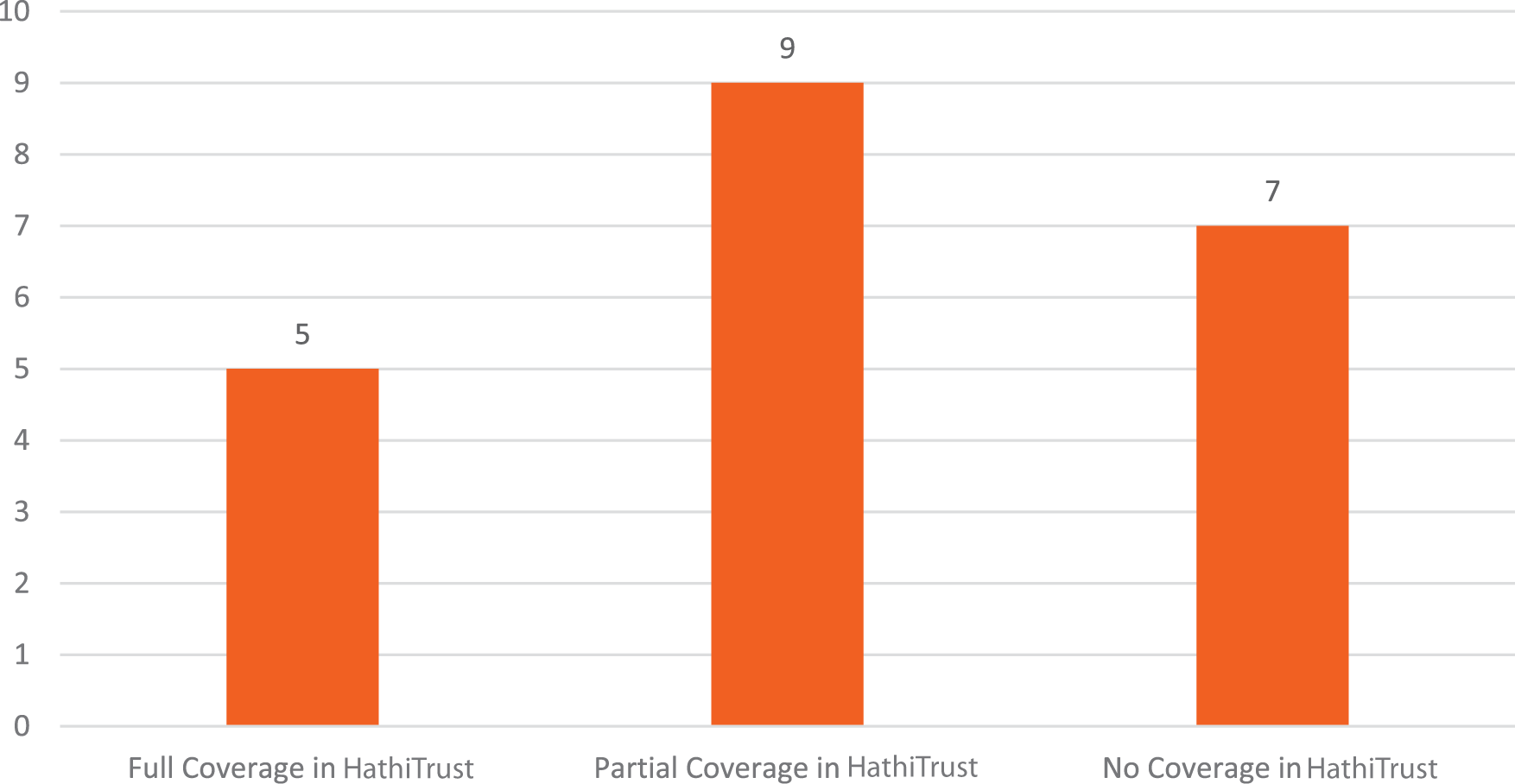
Coverage of items in the SRS curated collection versus HathiTrust (N = 21, 16 journals and 5 monographs).
This effort was not seen as duplication because by digitizing memoirs that appeared in periodical publications, the project team could be consistent with Ranganathan’s (1931) fourth law and save users time in locating the correct journal and searching the issues for the intended article. The result of this process was a curated digital collection of Russian women’s memoirs that saves users the effort involved in searching and locating a large collection of materials and navigating member-only access. The collection presents both challenges and opportunities, as discussed below. The simplified retrieval process is illustrated in Figure 2.
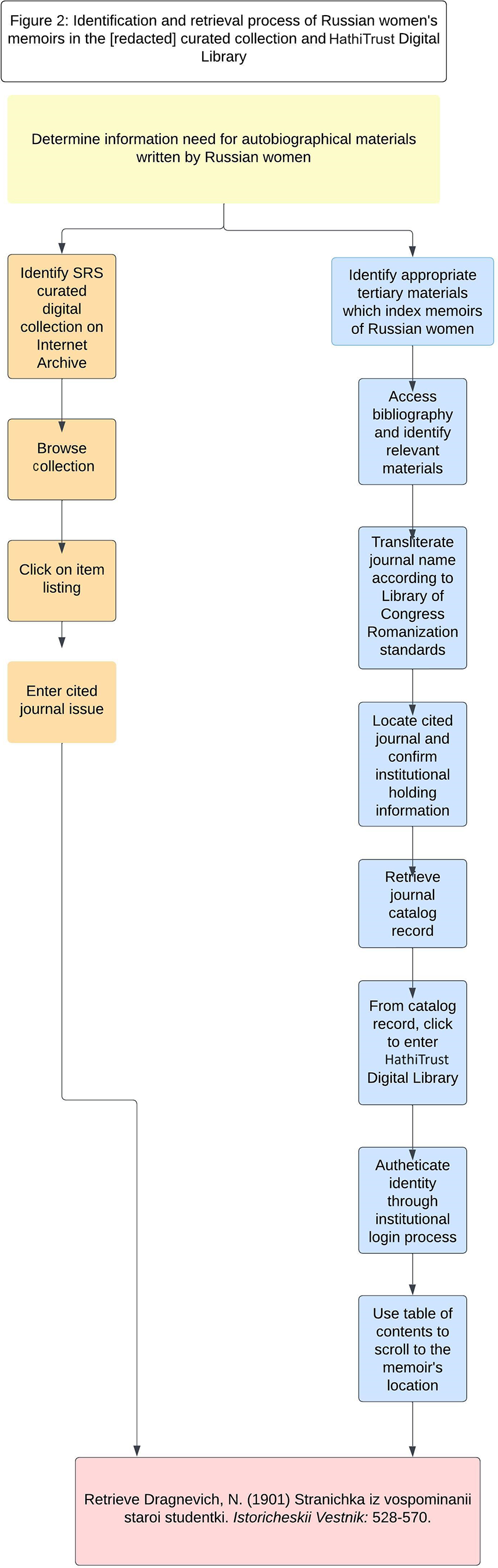
Outline of the comparative processes of identifying and retrieving Russian women’s memoirs from a curated digital collection and an institutional repository.
The circulation statistics for the items in the collection may not be accurately compared to views of the curated digital collection as users may check out periodicals without the intention of accessing the memoirs written by women. View statistics provided by the Internet Archive indicate that the majority of users accessing the collection are likely not to be affiliated with the University of Illinois and would otherwise not have access to these materials from the university’s collections. Users who have visited the collection between 2 and 30 times are located in Moscow and Nizhny Novgorod, Russia; the United Kingdom; Armenia; and Texas, USA. The viewer statistics demonstrate that the digital collection has expanded the accessibility of materials in the University of Illinois Library collection. While these statistics are encouraging, they also demonstrate a need for continued outreach related to the collection.
Expansion of the collection: future and limitations
Although the highlighted digital collection demonstrates the potential for digital curation to maintain the role of bibliographies in the research process, the approach presents challenges and limitations in its possible applications. One obvious problem is that of copyright; the scope of materials in this collection, for example, was intentionally created so as to only digitize items with expired copyright. Because the project mostly took place during the COVID-19 pandemic when resource-sharing and library-building access was limited, the collection could not reflect the full bibliography of women’s memoirs when items were held at other institutions. Finally, while this approach may make visible materials that would otherwise be overlooked by users, the digitization of materials using bibliographies may contribute to the homogenization of materials in a digital format. Although scholars may be using a bibliography in their research, they may not realize this fact and continue to regard print bibliographies as an unhelpful or obsolete artifact in the research process.
Using print bibliographies as the basis for digital curation also presents a number of possibilities that may extend the boundaries of the traditional library. Bibliographies often list resources held in a number of institutions. This strategy provides libraries with a natural opportunity for multi-institutional and even transnational collaboration, with the aim of providing as full a coverage as possible. The Memoirs of Russian, East European, and Eurasian Women digital collection will also continue to be expanded by the University of Illinois team in two ways: first, by continuing to add materials as their copyright expires and, second, by using other bibliographies of women’s studies to diversify and identify new materials for the collection. The project team has begun to form partnerships with libraries in the USA and eastern Europe to expand coverage of the materials in the bibliographies that were initially utilized.
Conclusion
Digital curation provides one avenue for keeping bibliographies relevant and attractive for library users. Libraries may make decisions about what collections to curate based on their existing reference materials, library holdings of items listed in a bibliography, and user demand for particular materials or topics. Institutional partnerships are a promising possibility for providing expanded coverage of materials listed in bibliographies. With the overwhelming amount of information available to researchers, bibliographies offer a powerful entry point to ascertain which existing primary and secondary materials may provide new insights within a field. However, while these materials provide a valuable research approach, the process of using bibliographies is often incompatible with the expectations of the modern information seeker. The process of using a bibliography in its traditional format may compound the problem of information overload for these researchers. Using existing bibliographies as a basis for digital curation is a solution that may connect users more directly to materials curated in an otherwise overlooked bibliography. Bridging print reference titles and curated digital collections serves as a way of developing information literacy and lifelong learning skills.
Footnotes
Declaration of conflicting interests
The authors declared no potential conflicts of interest with respect to the research, authorship, and/or publication of this article.
Funding
The authors received no financial support for the research, authorship, and/or publication of this article.
