




Abstract
This article investigates knowledge management for climate change in South Africa and proposes a strategy for knowledge management for climate change. The economic, political, social and ecological dimensions of climate change are predicted to pose a threat to the country’s National Development Plan and sustainable development. Given the growing emphasis on knowledge management for sustainable development and the importance of knowledge in the adaptive capacity and mitigation of climate change, knowledge management has been a central response strategy to climate change by various government and non-government agencies across the globe. The effects of climate change and the lack of focus on knowledge management for climate change in South Africa makes this an important topic for investigation. A systematic literature search and content analysis of relevant textbooks, articles, policy strategies, frameworks and legislation on knowledge management and climate change was conducted. Climate change, knowledge management and strategies were the keywords that were interrogated in the Scopus, ProQuest, EBSCO, Science Direct, Emerald, Elsevier, Taylor and Francis, Springer, Wiley and Inderscience databases to ensure comprehensive coverage. The retrieved articles were evaluated for eligibility. After removing 2900 irrelevant duplicate entries that did not entirely address the study’s scope, a descriptive synthesis of the 100 pertinent articles was completed. A strategy for knowledge management for climate change that calls for establishing a Knowledge Management Centre for Climate was proposed.
Keywords
Introduction
Climate change remains a development challenge of the 21st century across the globe, and South Africa is exploring diverse ways of adapting to and mitigating the impacts of climate change. Information, knowledge and experience are important in the process of adaptation to climate change (Brossard and Lowenstein, 2009; Jairo and Korir, 2019; Nisbet and Scheufele, 2009; World Bank, 1998). Article 7.7 of the Paris Agreement (2015) highlights the principles of knowledge management in terms of the need for sharing information, good practices, experiences and lessons learned, as well as strengthening scientific knowledge. Given the growing emphasis on knowledge management for sustainable development and the importance of knowledge in adaptive capacity and the mitigation of climate change, it stands to reason that knowledge management has been a central response strategy to climate change by various government and non-government agencies across the globe (Brossard and Lowenstein, 2009; Gulla, 2018; Jairo and Korir, 2019; Kenya National Climate Change Action plan, 2012; Nepal Academy, 2016; Niar, 2016; Nisbet and Scheufele, 2009). Although knowledge management concepts, such as the need for coordination amongst sectors and timely access to and sharing of critical information and knowledge, are reflected in different climate change adaptation strategies at the national, provincial and local levels in South Africa (National Climate Change Adaptation Strategy, 2019), knowledge management is yet to be considered an essential element in the country’s response strategy. The Intergovernmental Panel on Climate Change’s (2014) Fifth Assessment Report notes that climate change has the potential to reverse the gains made by the Millennium Development Goals and impede the country’s ability to achieve the United Nations’ 2030 Agenda for Sustainable Development.
The economic, political, social and ecological dimensions of climate change are predicted to result in a further widening of the gap between the rich and poor in South Africa, where the legacy of apartheid is still evident, thus posing a threat to the country’s National Development Plan, which charts the development and progress of the country until 2030. This is also contravening the human right to healthy environmental and sustainable development reflected in Section 24 of the Bill of Rights of the Constitution of the Republic of South Africa (1996). The president noted in the State of the Nation Address (2021) that the country’s public electricity utility, known as Eskom, has committed to achieving net-zero emissions by 2050. Against this backdrop, this article provides an overview of knowledge management and climate change from a South African perspective and proposes a strategy for knowledge management for climate change in the country.
The study is guided by the following objectives: To explore climate change and knowledge management within the South African context; To establish the need for knowledge management for climate change in South Africa; To propose a strategy for knowledge management for climate change in South Africa.
Research methodology
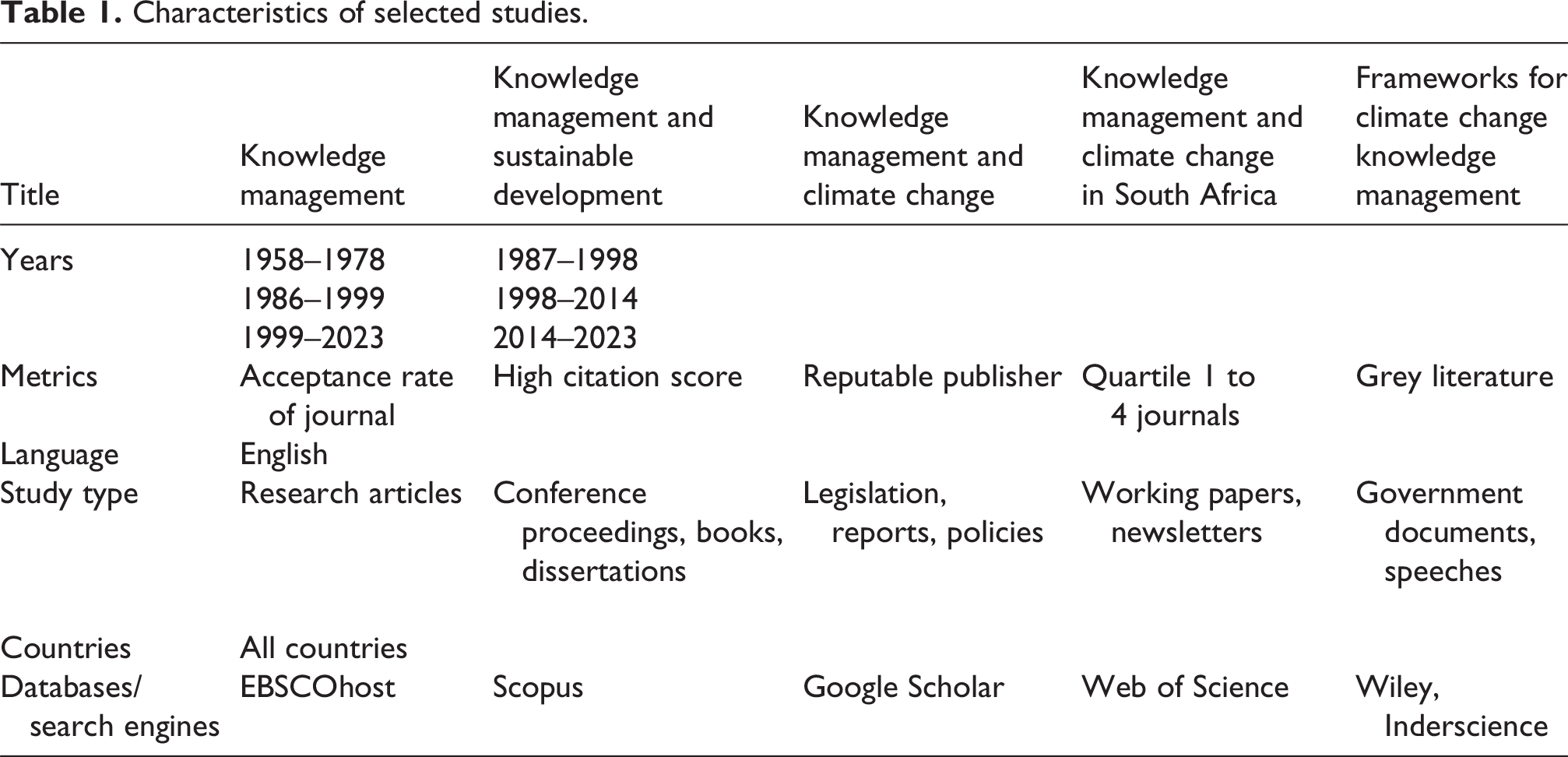
A systematic content analysis of the literature was based on studies published during 1958–2023. Searches were conducted from March 2021 to December 2022. It was necessary to situate the key themes and research questions of the study from the year the key concepts of the study emerged, and to review the progress in the field to establish the current state of research. For example, literature on knowledge management as one of the key themes of study emerged from 1958 to 1978. The most significant and relevant publications and leading authors were from 1986 to 1998. The literature on knowledge management has progressed from 1999 to date. On the other hand, literature on knowledge management for climate change and sustainable development emerged from the Brundtland Commission in 1987 to the World Bank Report of World Bank (1998), with a substantial increase in research on climate change and sustainable development from 2014. A review of relevant textbooks, articles, policy strategies, frameworks and legislation on knowledge management and climate change was conducted from Scopus, ProQuest, EBSCO, Science Direct, Emerald, Elsevier, Taylor and Francis, Springer, Wiley and Inderscience to ensure comprehensive coverage of the literature. Internet searches on various climate adaptation strategies, official statistics, reports and legislation were also conducted to facilitate understanding of this research. Moreover, a desktop review and analysis of the institutional strategies and climate change action plans of development partners, international and national non-governmental organisations, the World Bank and the International Institute for Sustainable Development was conducted. The first phase of the content analysis was to interrogate the databases and search engines with the study themes and synonyms related to the research questions, and determine the preliminary relevance of the manuscripts. The searches produced a total of 3000 records. The second phase of the analysis focused on screening the abstracts and primary bibliographic data and titles, and eliminating duplicate results, to determine their relevance to the study objectives. In total, 100 actual records were examined for significance using the eligibility requirements in Table 1. These included articles from Quartile 1 to 4 journals, books from reputable publishers and grey literature in the form of technical reports, policy frameworks and legislation. During the third phase, the researcher skimmed through the different studies to evaluate the quality and eligibility of the resources. In the fourth and final phase, the researcher reviewed the literature and thematically extracted and synthesised the applicable information on the different themes related to the research questions. The characteristics of the selected studies in terms of title, year, language, country, type of study and type of metrics are presented in Table 1.
Characteristics of selected studies.
Literature review
This section presents literature on climate change and knowledge management and an overview of different frameworks on climate change and knowledge management. It also reviews literature on climate change within the South African context and highlights the need for knowledge management for climate change in South Africa.
Climate change in South Africa
Climate change is the variation of global atmospheric weather patterns resulting from a rise in the temperature of the earth’s surface, often referred to as ‘global warming’ and attributed directly or indirectly to human activity that alters the composition of the global atmosphere and that is in addition to natural climate variability observed over comparable time periods (United Nations Framework Convention on Climate Change, 1992). Global warming is in part due to the emission of greenhouse gasses associated with the effect of the development of human activities such as burning fossil fuels, biomass burning, cement manufacturing, cattle and sheep rearing, deforestation and other changes in land use.
The United Nations Framework Convention on Climate Change, the 2015 Paris Agreement and the Kyoto Protocol recognise mitigation and adaptation as complementary policies to respond to climate change. The 2015 Paris Agreement seeks to achieve the stabilisation of greenhouse gases and keep global warming well below 2 °C by 2100 and preferably below 1.5 °C compared to pre-industrial levels.
South Africa is a high contributor to global climate change with its significant greenhouse gas emission levels because of its dependence on its energy-intensive, fossil-fuel-powered economy, agriculture and mining sector. It is ranked as the 14th largest emitter of greenhouse gases due to its high reliance on coal (Hausfather, 2018). The South African Risk and Vulnerability Atlas (2018) projected that temperatures in South Africa can be expected to rise faster than the global mean temperature, with increases of 3–4 °C along the coast and 6–7 °C in the interior by the end of the century. The country is subject to climate variability and extreme weather, characterised by searing heatwaves, warm winters, cold and rainy summers, thunderstorms, wildfires, droughts, floods and tropical cyclones, resulting in challenges for people’s livelihoods. The effects are increases in vector-borne and waterborne diseases and heat-related conditions, flooded food crops, the depletion of drinking water and the loss of habitable land by those living in informal settlements, as well as increased mortality and mental health issues (Chersic and Wright, 2019). The effects of La Niña in December 2021 resulted in a wetter than normal summer in South Africa in 2022, with several regions experiencing their heaviest rains for close to a century (Sthembile and Njini, 2022). The heavy rain and flooding across KwaZulu-Natal in the south-eastern part of the country in April 2022 resulted in the country’s deadliest natural disaster in recent times. Figure 1 provides an overview of some of the causes of climate change in South Africa and its effects.
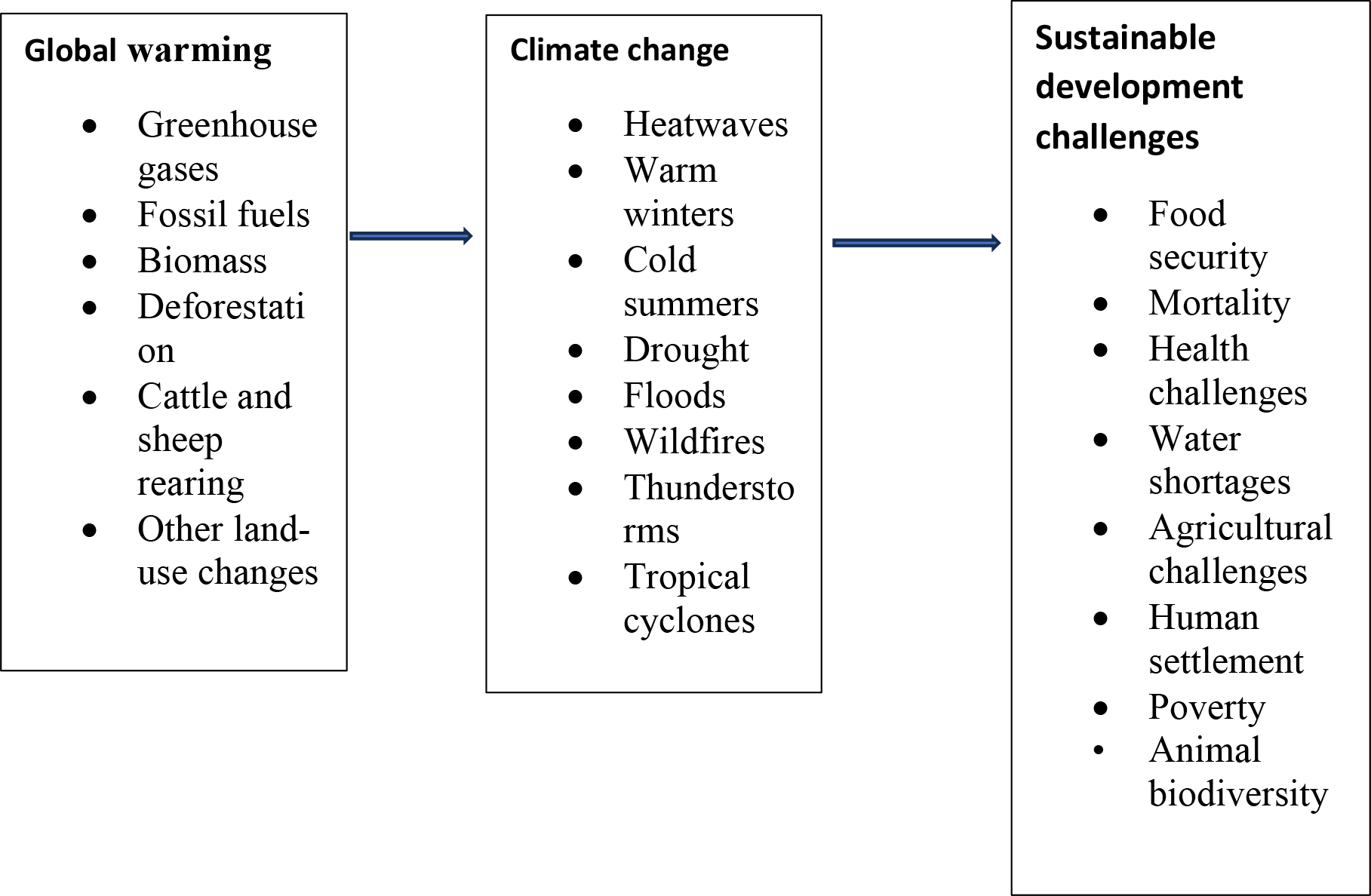
Causes of climate change and its effects in South Africa.
Climate change initiatives in South Africa
Bearing in mind the impact of climate change in South Africa as noted in the preceding section, the country is making significant efforts at the national and international levels by enhancing the transition to a lower-carbon economy, although with little priority on knowledge management initiatives, as noted in the subsequent sections.
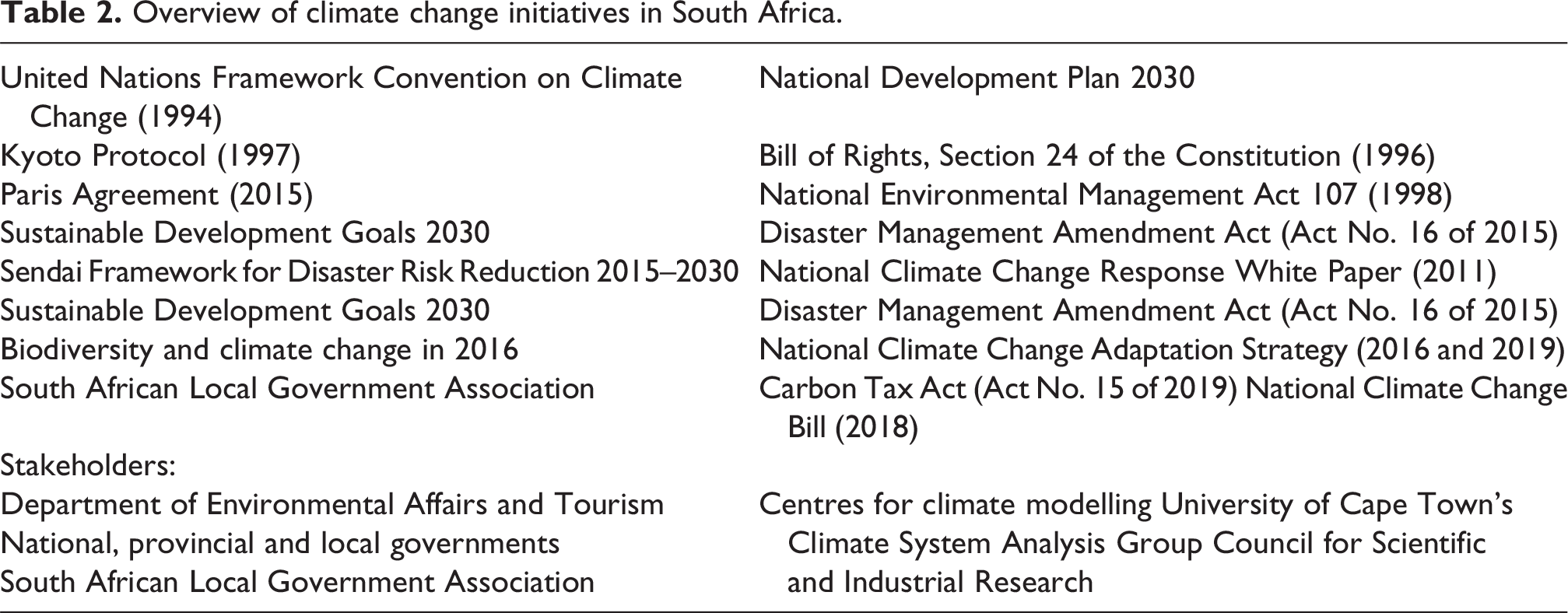
At the international level, South Africa is a signatory to all of the policies of the international initiatives and treaties. It ratified the United Nations Framework Convention on Climate Change in 1994 and the related Kyoto Protocol in 1997. It signed the Paris Agreement of 2015 and the Sustainable Development Goals 2030. It also signed the Sendai Framework for Disaster Risk Reduction 2015–2030 and adopted the decision on biodiversity and climate change in 2016 at the Conference of the Parties at the Convention on Biological Diversity in Cancún (UNEP, 2016: 34).
At the national level, the climate change response objective is informed by the National Development Plan 2030, the Bill of Rights, Section 24 of the Constitution (1996) and the National Environmental Management Act 107 of 1998. South Africa’s National Climate Change Response White Paper (Department of Environmental Affairs, 2011) is a seminal document that presents the country’s climate change response strategy. Although it adopts a sectoral approach, Section 10 of the White Paper notes the need for coordination and the alignment of policies and action as central to achieving climate resilience. It also highlights the critical need for best-practice knowledge-sharing across provinces and municipalities. The country has also made significant strides in the integration of climate change adaptation in disaster management through the Disaster Management Amendment Act (Act No. 16 of 2015). It has a disaster management centre with a disaster management framework that focuses on disasters and disaster risk reduction.
The South African National Climate Change Adaptation Strategy (2016 and 2019) recognises communication and knowledge management, and key enablers, to support and enhance climate resilience in South Africa. The South African National Climate Change Bill, published in 2018 for comments, is a landmark commitment by the country to act on climate change, and it seeks to provide for a coordinated and integrated response to climate change and its impacts by all spheres of government in accordance with the principles of cooperative governance. The Bill mandates that the minister establish a national environmentally sustainable development framework within two years of the Act coming into effect. The Carbon Tax Act (Act No. 15 of 2019) aims to provide for the imposition of a tax on the carbon dioxide equivalent of greenhouse gas emissions.
The lead agency for climate change response in the country is the Department of Environmental Affairs and Tourism. Also, different sectors of the economy, including the national, provincial and local governments, are involved in climate change. The stakeholders involved in climate-related disciplines are universities, academic and research institutions, science councils, researchers, social scientists, technologists, policymakers, non-governmental organisations, civil society and citizens. Other institutions that generate climate-related research in South Africa are governmental agencies such as the South African Weather Service and Department of Science and Technology, and non-governmental and community organisations.
South Africa has the most advanced research, observation and climate-modelling programme on the African continent. The two key centres for climate modelling in South Africa are the University of Cape Town’s Climate System Analysis Group and the Council for Scientific and Industrial Research, which focuses on global and regional modelling for seasonal forecasts and decadal to centennial projections, as well as coupling with land surface dynamics. Several researchers are leading and participating in international global-change research programmes and scientific bodies, such as the Intergovernmental Panel on Climate Change. Table 2 presents an overview of the climate change initiatives in South Africa.
Overview of climate change initiatives in South Africa.
The South African Local Government Association facilitates the Local Government Climate Change Support Programme, which has resulted in the development of climate change response plans for all the district municipalities in South Africa, with associated adaptation interventions. Due to the efforts of the South African Local Government Association, there is the ‘Let’s Respond Toolkit’ programme, municipal support programmes and other mechanisms (Intergovernmental Panel on Climate Change, 2014).
Why knowledge management for climate change in South Africa?
Notwithstanding all these initiatives, research shows that information on climate change remains scattered or isolated, and therefore the poor and vulnerable lack access to the right information and at the right time to adapt and respond to climate change. There is still much effort needed in terms of knowledge-sharing and capacity development between the levels of government (Fombad and Onyancha 2017; National Development Plan, 2030). Some farmers have accused the government of not providing them with information on how to manage their livestock amid climate change (Maponya and Mpandeli, 2012). Climate information and support services play a critical role in providing early warning systems, as well as increasing awareness for building capacity and disaster preparedness to cope with a changing climate.
Information, knowledge and experience are important in determining how and whether adaptation takes place. According to the Intergovernmental Panel on Climate Change (2014) assessment, the amount of accessible climate literature from Africa continues to be significantly low, and this has been worsened by inadequate Internet connectivity and climate information that is either not captured or packaged for online and offline access.
The country lacks a robust national system that provides spatially extensive climate data (Ziervogel et al., 2014). There is no institution to coordinate and manage the generation, codification, sharing and use of climate knowledge within the various sectors and spheres in South Africa, resulting in overlaps and disjointed efforts instead of synergy. André et al. (2017) note that responding to the impact of climate change effectively at the national policy and local planning levels requires robust and comprehensive information and a strong knowledge base. Officials in other departments within spheres of government often do not see climate change as a priority and some even see it as working against national development priorities. Coherent policy formulation and implementation remains challenging due to the fragmented nature of who is responsible for climate policy.
The upkeep of people’s livelihoods in the coastal zone largely depends on the degree to which key stakeholders at all levels of decision-making can participate in climate adaptation planning and implementation processes (Sultana and Luetz, 2022). Unfortunately, the implementation of international and national policies and adaptation strategies with the coastal population has be slow, with a top-down approach resulting from a generic understanding of climate-change-related impacts on the lives and livelihoods of the coastal people (Cabana et al., 2023; Wong and Aspinwall, 2004). Coastal regions, although vital to the local economy, are especially vulnerable to climate change due to rises in sea levels and the height of waves, coastal erosion, cyclones and flooding (Amaratunga, 2022).
Often, priority is given to scientific knowledge and expert technical and policy documents rather than the lived experiences and perceptions of the more vulnerable communities who are at risk of climate change. Climate change may be effective when it is complemented by the specific local knowledge generated by the experiences of the affected people themselves. Local knowledge is important in adaptation studies as they should not only include information about the climatic impact at the micro level, but also incorporate understanding about the local socio-economic and political structure within which adaptations must take place (Ayers et al., 2014).
In addition, although much of the information and knowledge on climate change in South Africa is generated by different stakeholders and institutions, these are mostly embedded within institutes and organisations. This has led to the creation of climate-knowledge silos in the country. A question worth asking is: How does research on climate science, impacts and vulnerability integrate with sectoral and cross-sectoral decision-making? Figure 2 provides a summary of the motivation for knowledge management and climate change in the country.
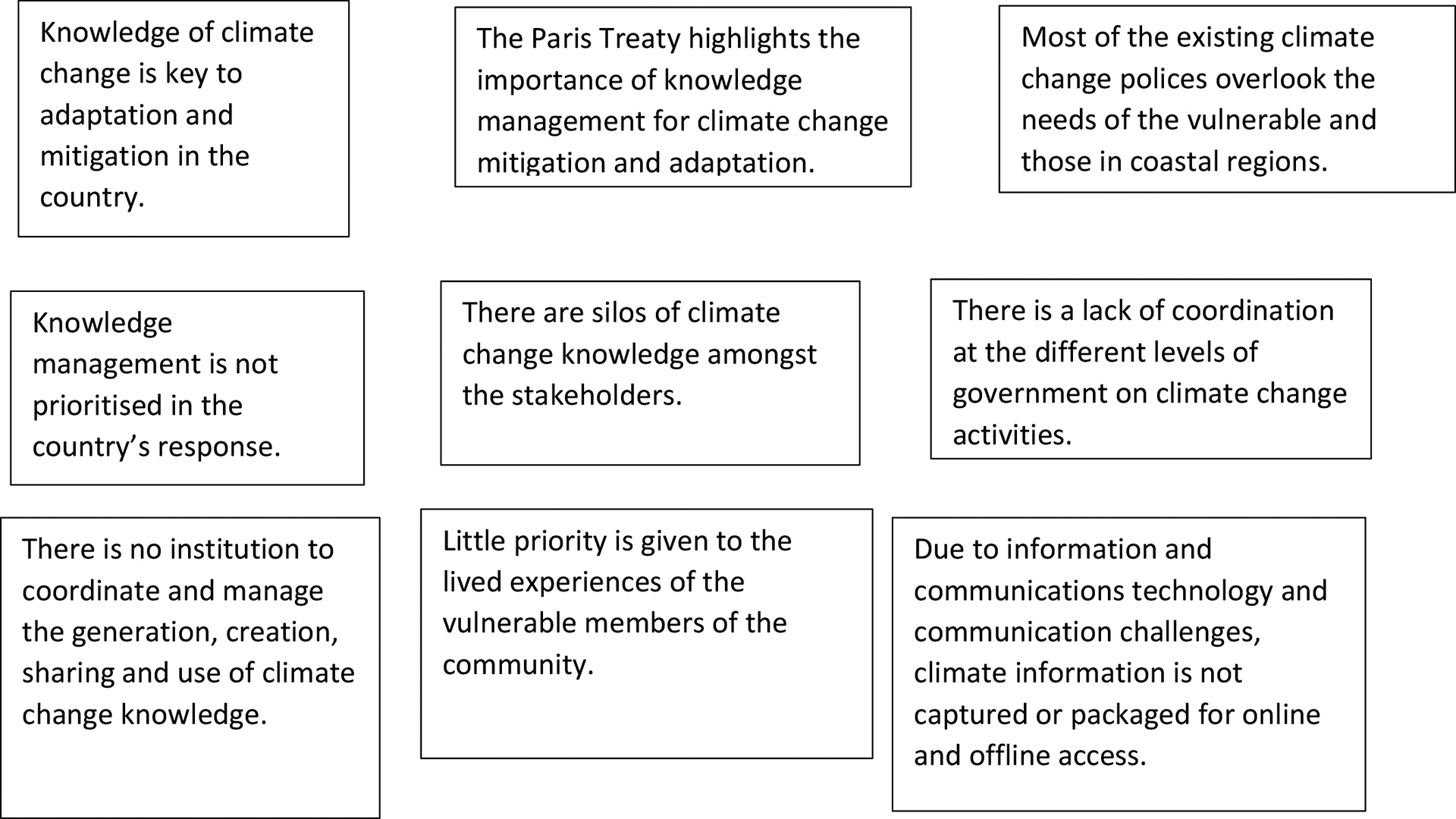
Key issues for knowledge management for climate change in South Africa.
Knowledge management
Knowledge management is defined differently in the literature by various researchers given that it is a cross-functional and multifaceted discipline. It is widely accepted that knowledge management refers to strategies and practices that are used to identify, create, represent, distribute and enable the adoption of insights and experiences for competitive advantage and effective decision-making. It is not only regarded as an important activity within organisations but also influences many activities outside organisations. For example, it is an essential element for the achievement of the Sustainable Development Goals and human development.
The concept of Knowledge managment has evolved over the years from what may be termed the ‘first generation’ of knowledge management to the ‘fourth generation’ of knowledge management. The first generation of knowledge management focuses on information and knowledge management in organisations. The second generation is linked to an individual, social, organisational and business perspective, focusing on knowledge collaboration and social networking. The third generation is the information-system perspective, which involves the arrangement and management of content through taxonomy construction. It also involves the use of artificial intelligence, machine learning, data analytics, the Internet of Things and other emerging developments.
The fourth generation of knowledge management considers knowledge management as an indispensable ingredient in human developmental strategy (Fombad and Onyancha, 2017). To this end, knowledge management captures and shares good practices, which may feed into development policies and programmes and provide a knowledge-focused perspective on finding solutions for the short- and long-term survival and well-being of mankind (Andersson et al., 2015; Bolis et al., 2014; Feil and Schreiber, 2017; Laszlo and Laszlo, 2002; Sayeed, 2021). Skrzypek (2013) notes that the concept of knowledge management fits with the principles of sustainable development, wherein the integration of political, economic and social activities takes place with respect to the natural environment to guarantee the ability to meet the basic needs of communities of the present generation and future generations.
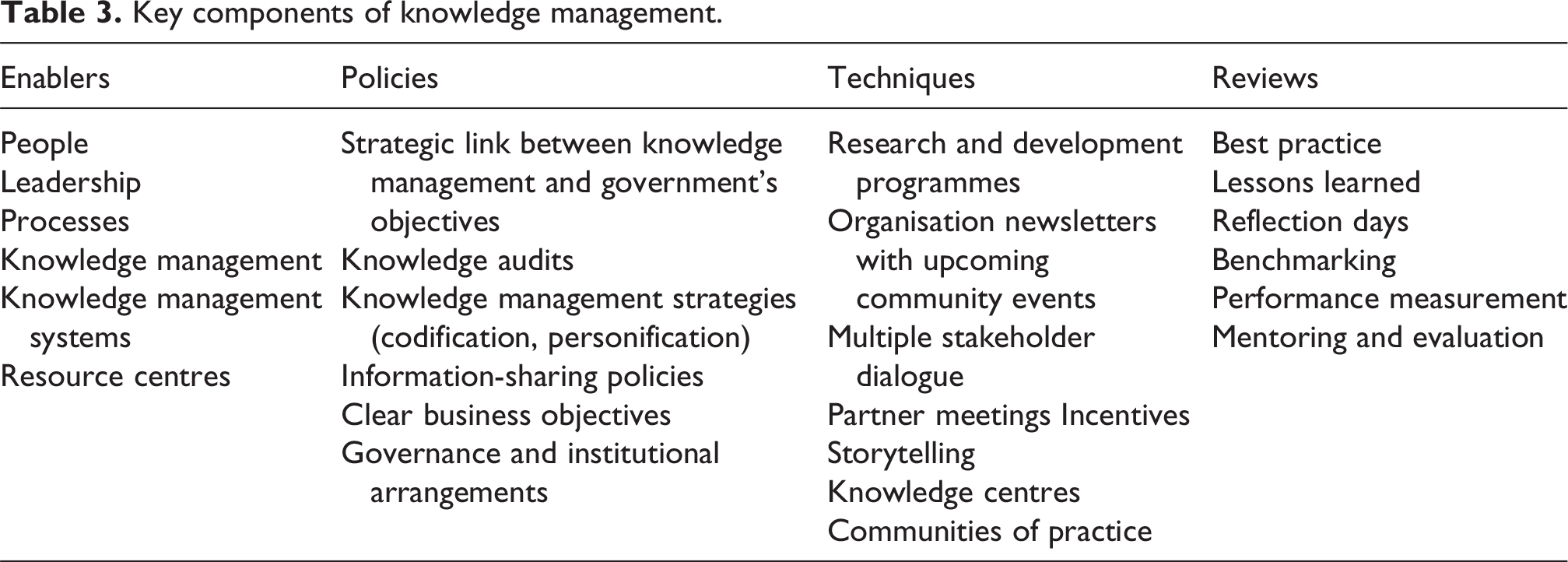
People, processes, information and communications technologies, learning organisations, knowledge markets, strategies and techniques are the key enablers of knowledge management. Knowledge management processes are social, non-linear, technologically interdependent, intertwined, continuous and dynamic, and enhance the contribution of knowledge in an organisation. Key elements are common in the definitions of knowledge management processes – for example, acquisition, creation, storage, retrieval, transfer, sharing, application and dissemination (Bouthillier and Shearer, 2002; Nonaka and Takeuchi, 1995: 77; Wong and Aspinwall, 2004).
Information and communications technologies facilitate the knowledge management process of identification capturing, creation, sharing, dissemination, acquisition and application. Information and communications technologies not only store knowledge but also connect people in organisations and people to information. Knowledge management systems have evolved as information and communications technology systems that store and retrieve knowledge, improve collaboration, locate knowledge sources, mine repositories for hidden knowledge, capture and use knowledge, and enhance the knowledge management process to an integral component of knowledge management that provides knowledge support to the right user with the right information at the right time. To this end, the definition of knowledge management systems varies from context to context. Galandere-Zile and Vinogradova (2005) define a knowledge management system as a network of contextual data and documents linked to directories of people and skills and providing intelligence to analyse these documents, links, employees’ interests and behaviour, as well as advanced functions for knowledge-sharing and collaboration.
Knowledge management systems are increasingly used to achieve the objectives of climate change mitigation and adaptation by providing the required knowledge support to different stakeholders (Dupar, 2019; Gulla, 2018; Oliveira and Jabbour, 2017). Examples of knowledge management systems are expert systems, knowledge repositories, group-decision support systems, intranets and computer-supported cooperative work, and artificial intelligence (Alavi and Leidner, 2001; Mansor, 2020; O’Leary, 2002).
Knowledge management also seeks to establish collaborative organisational learning and unlearning, whereby errors, failures and environmental uncertainty result in restructuring past successes to fit the changing environmental and situational conditions (Argyris and Schon, 1978; Senge, 1990). Learning increases knowledge and therefore the capacity for effective action. Knowledge management also operates within the market system, where knowledge is exchanged for the reward of other valuable things, such as money, respect, promotion, other knowledge or just the feeling of satisfaction from assisting others (Brown and Duguid, 1998; Davenport and Prusak, 1998; Grover and Davenport, 2001). The different barriers in the knowledge management process may be grouped as individual, organisational culture, leadership, structural, retention strategy, financial, technological and inter-project barriers.
Personification and codification are the two knowledge management strategies (Hansen et al., 1999). Personification deals with tacit-to-tacit knowledge transfer whereby people-to-people methods are used to exchange knowledge. On the other hand, the codification strategy seeks to link people to documents in organisations and enhances explicit-to-explicit knowledge transfers. It is recommended that both codification and personification must be adopted in combination in organisations to obtain the optimal maximisation of the knowledge resources, with one being predominant over the other.
Personification strategies may take the form of mentoring, debriefing and after-action reviews. Personification also involves the use of social networks, such as communities of practice, knowledge networks, knowledge communities and local networks (Berger and Luckmann, 1966; Brown and Duguid, 1998; Wenger, 2003). A community of practice is a community of individuals with a shared interest who come together to share ideas on problems related to a specific topic and, as a result, learn to do things better. Domain, community and practice are the three key elements to implementing a community of practice (Wenger, 2003). The Asia-Pacific Climate Change Adaptation Information Platform (2023) is a community of practice that has assisted countries in Asia to adapt to the challenges posed by climate change by establishing a regional knowledge-sharing system, generating new knowledge, and applying new and existing knowledge. Virtual communities of practice result from the use of information and communications technologies, such as groupware, collaborative technologies and yellow pages, to link people (Campbell, 1999; Sala-i-Martin and Subramanian, 2003: 77). Wenger (2003) establishes a relationship between a community of practice and knowledge management strategy by arguing that the three key elements of implementing a community of practice (domain, community and practice) provide the key structures to support learning, sharing, stewardship and knowledge.
Codification strategies seek to collect knowledge, store it in databases, and provide the available knowledge in an explicit and codified form to an organisation. Codification entails the use of knowledge management systems such as knowledge repositories and corporate portals to provide a single point of access to online information. An overview of the key elements of knowledge management is presented in Table 3.
Key components of knowledge management.
Knowledge management frameworks for climate change
This section explores the different knowledge management frameworks for climate change that inform the strategy for knowledge management for climate change in South Africa.
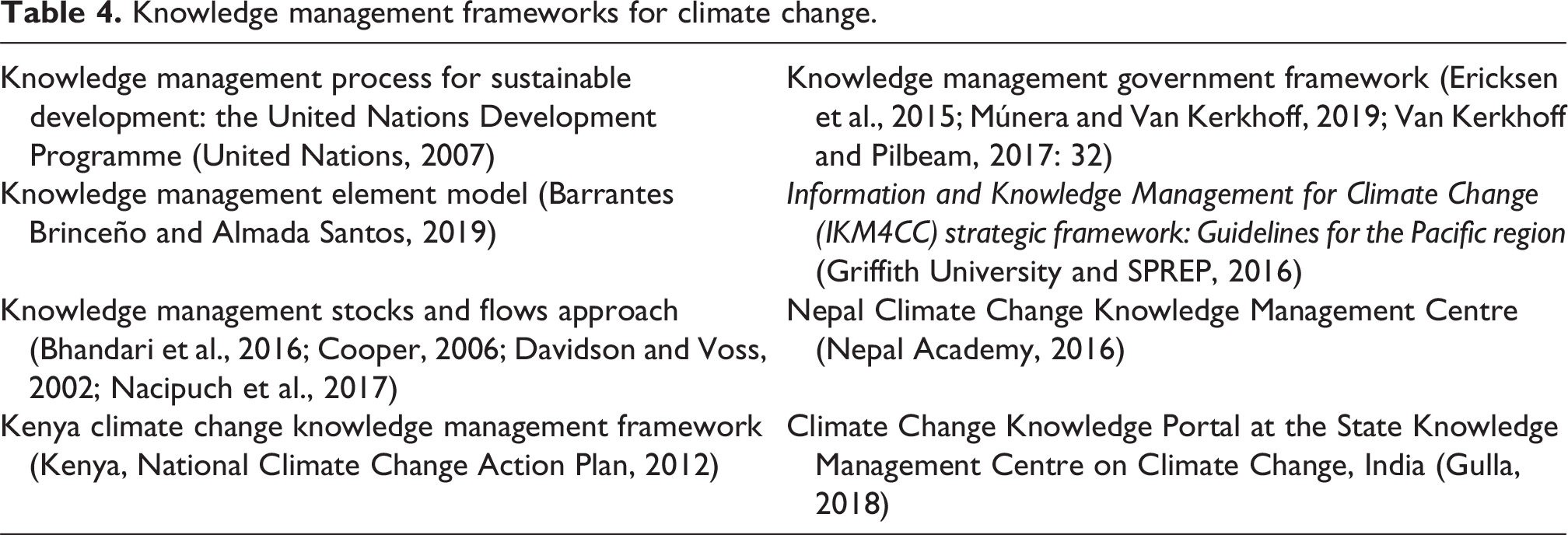
The knowledge management element model (Barrantes Briceño and Almada Santos, 2019; Oliveira et al., 2010) involves the exchange of knowledge between stakeholders from the upper level and the target populations in the development process. This model can be adapted to any context to achieve a coherent and optimal result for climate change and sustainable development. It considers eight dimensions of knowledge management – namely, leadership, people, strategy plan, processes, resources, information and knowledge, society and results.
The knowledge management stocks and flows approach is another perspective of knowledge management for climate change. It identifies climate-related knowledge stocks and flows within the destination of climate change knowledge and considers the role of governments as knowledge brokers in facilitating knowledge transfer (Bhandari et al., 2016; Cooper, 2006; Davidson and Voss, 2002; Nacipuch et al., 2017). Knowledge stocks refer to existing knowledge and knowledge sources related to climate change and the destination. Knowledge flows represent the communication or dissemination channels used to transfer information or knowledge. Knowledge management flows examines a destination’s knowledge needs regarding climate change.
The creation of groups with common interests in a knowledge area is crucial when considering knowledge management climate change initiatives. For example, Chantarasombat et al.’s (2010) five-stage knowledge process model for creating self-reliant communities in Thailand comprises preparation; creating, motivating and promoting participation; developing a knowledge management plan; implementing the plan; and evaluating the process. Moreover, Wiig’s (1993) knowledge management cycle model emphasises the importance of reconstructing, modelling and organising knowledge to facilitate the creation, accumulation, deployment and use of quality knowledge for intelligent actions by individuals as well as organisations. Venkatraman and Venkatraman (2018) draw from Wiig’s (1993) knowledge management cycle model of benefits, tools, organisation, people and processes, and Wenger’s (2003) three elements of a community of practice, to recommend a community of practice approach in addition to a knowledge management system for sustainability. Venkatraman and Venkatraman (2018) draw from Wigg's (2003) knowledge management cycle model of benefits, tools, organisation, people, and process (BTOPP) and Wenger's (2004) three elements of CoP, to recommend a CoP approach knowledge management system for sustainability as, business (products/services), customers and resources (people, capital, and facilities). The GEF (Global Environment Facility) Small Grants Programme (United Nations Development Programme (2012) pioneered innovative community-based approaches to knowledge management by capturing lessons, conducting knowledge exchanges, organising training workshops, establishing and nurturing networks, and working with the government in achieving national environmental priorities.
The knowledge management governance framework is another suitable framework for knowledge management and climate change. It recognises the role of stakeholders in knowledge-based processes, including the sociopolitical and cultural contexts where decisions are made. Domke and Pretzsch (2016) note that success in coping with and adapting to climate change depends on the local context and a complex interlinkage between institutional, socio-economic, governance, social and infrastructural conditions and capacities that facilitate the scope of action. This framework facilitates the development of effective knowledge management strategies that enable transformative adaptation (Eriksen et al., 2015; Múnera and Kerkhoff, 2019; Van Kerkhoff and Pilbeam, 2017: 32). It also enables the participants to identify interventions that align with, or challenge, societal norms; recognise political contestation over knowledge; and demonstrate different perceptions of reality and visions of the future.
Information and Knowledge Management for Climate Change (IKM4CC) strategic framework: Guidelines for the Pacific region (Griffith University and SPREP, 2016) is a set of guidelines to assist government departments and other agencies and organisations that deal with issues related to climate change in implementing good practices for managing information. It highlights the importance of choosing an information management system that is most suited to an organisation. The strategic framework seeks to identify all the people, systems and processes within a government or organisation that enable the successful creation, management and use of information. These typically include laws, policies, technology, capacity, skills and funding.
According to the United Nations Development Programme Knowledge Management Strategy (2014) knowledge management cyclical framework involves collection and mining by information systems and the generation of knowledge products and services in the form of lessons learned, publications, projects, learning networks, resource kits, the dissemination of knowledge and knowledge uptake (i.e. the steps taken to improve the use of knowledge products and services by validation, conducting workshops, holding specialised courses and training).
The Asia-Pacific Climate Change Adaptation Information Platform (2023) supports research, capacity building for climate change adaptation, policymaking and information-sharing to assist countries in Asia to adapt to climate change impacts. The goal of the platform is achieved through a regional knowledge-sharing system, the generation of new knowledge, and the application of existing and new knowledge. Its main stakeholders are government policymakers, local government development planners, community-level development workers, members of international research and development agencies, and communities that are vulnerable to the impacts of climate change.
Curl’s (2016) knowledge management framework for climate change in Cambodia consists of two support mechanisms (a knowledge management unit and a climate portal) and four application mechanisms (collating information, policies, communication and learning). The World Bank’s Climate Change Knowledge Portal (2021) is a central hub for information, data and reports about climate change around the world where a user can query, map, compare, chart and summarise key climate and climate-related information.
The Nepal Climate Change Knowledge Management Centre (NCCKMC) was established at the Nepal Academy of Science and Technology in 2010 to facilitate the incorporation and implementation of climate change knowledge into policy development at the national local level with support from knowledge partners (NAST & OPMAL 2016). The NCCKMC has since been facilitating the mechanism through which climate change knowledge is incorporated into policy development and implementation at both national and local level with support from knowledge partners. NAST and OPML (2016) proposed a knowledge management framework that will seek to develop a national research strategy on climate change and promote the use of climate change knowledge for improved policy formulation, planning and decision taking on climate change knowledge management.
The AdaptaClima (2018) online knowledge platform supports effective adaptation to climate change in Brazil by allowing users to share information and tools. The project’s objectives are to make available information on priority topics related to climate change adaptation; promote communication and coordination between ‘knowledge producers’ and ‘knowledge users’; and stimulate the production of information in response to the gaps identified.
The Kenyan national climate change response strategy of 2012 envisions the successful implementation of a knowledge management framework that will result in the effective dissemination of climate change knowledge to potential users, especially vulnerable groups. The country’s National Climate Change Action Plan 2013 proposes a climate change knowledge management framework and knowledge management system for Kenya (Kenya, National Climate Change ActionPlan, 2012). Kenya has developed a Knowledge Management for Climate Change online portal to increase the creation, validation and dissemination of climate change knowledge and tools. It has adopted a knowledge management framework in its National Climate Change Action Plan (Kenya, 2013).
The One World Foundation India set up and manages the Climate Change Knowledge Portal at the State Knowledge Management Centre on Climate Change, Environmental Planning and Coordination Organisation (EPCO), Madhya Pradesh, India (Gulla, 2018). It serves as a knowledge hub that caters for the information and knowledge needs of policymakers, scientific committees and the public on issues relating to the creation, sharing and dissemination of climate change information.
The different frameworks are summarised in Table 4.
Knowledge management frameworks for climate change.
Proposed strategy for knowledge management for climate change in South Africa
This section draws from the various frameworks for climate change in the preceding section to suggest a strategy for knowledge management for climate change in South Africa. Strategies provide a focus on the methodical and conscious areas for consideration in the knowledge management effort (Earl, 2001; Okunoye, 2004). The proposed strategy of knowledge management recommends a coordinated sectoral stakeholder project and a post-project approach by a knowledge management centre. The strategy calls for policy enhancement on climate change and a knowledge management centre for climate change, which will be responsible for implementing the various aspects of the strategy, resulting in enhanced mitigation and adaptation to climate change, and thus improved sustainable development. The strategy is presented in Figure 3.
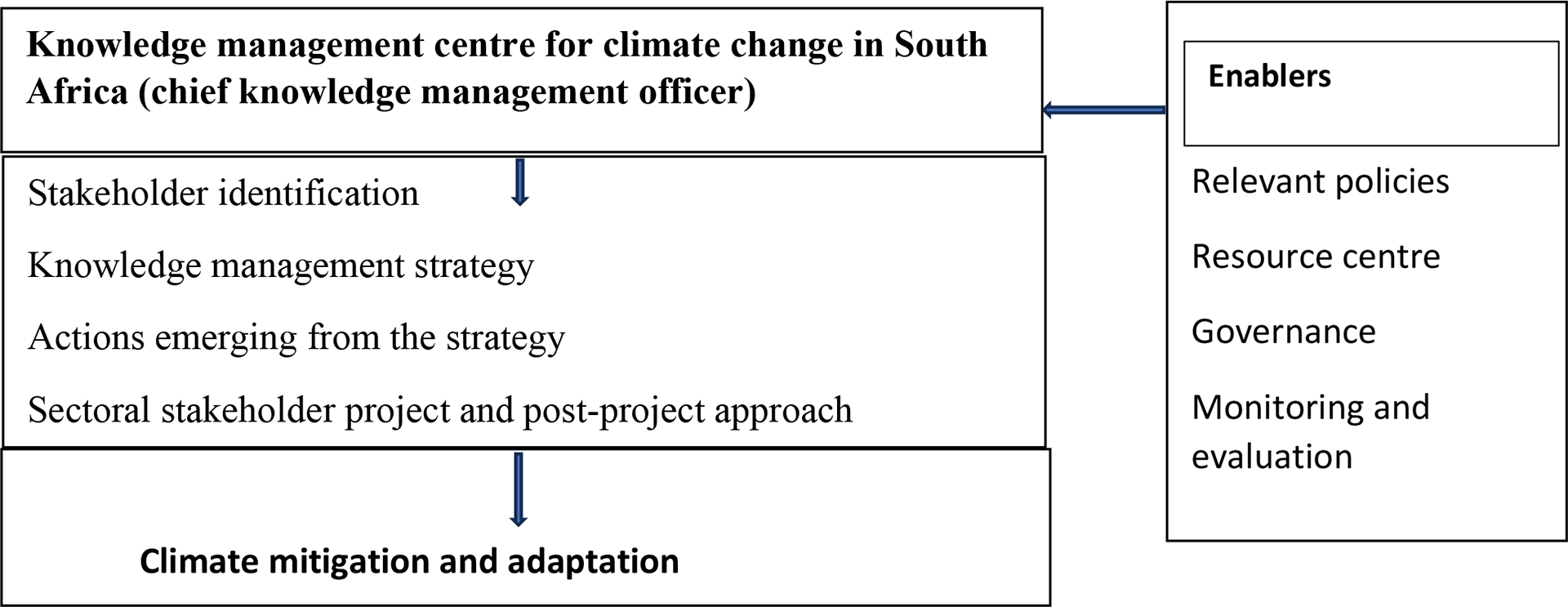
Proposed strategy for knowledge management for climate change in South Africa.
Knowledge management centre for climate change
A knowledge management centre for climate change, led by a chief knowledge management officer, should be created to serve as the hub for climate change knowledge management in South Africa. This could be created within the already existing Disaster Management Unit. Knowledge management has been noted to be one of the essential success factors for disaster management initiatives in many countries (Ahmed et al., 2015; Badpa et al., 2013). The centre could be under the Department of Cooperative Governance and Traditional Affairs, which currently manages the Disaster Management Unit. The centre should also work in liaison with the Department of Forestry, Fisheries and the Environment, which is directly responsible for coordinating climate change in the country. The knowledge management centre for climate change should coordinate and manage the generation, codification, sharing, use, dissemination and accountability of climate change information and knowledge from the national to the local level. This centre should also be responsible for identifying stakeholders and implementing the knowledge management strategy for climate change in the country, as noted in the subsequent sections.
Stakeholder identification and representation
It should be the responsibility of the knowledge management centre for climate change to identify and profile all the climate change actors and stakeholders that will be part of the centre. Drawing from the United Nations’ (2007) process for a sustainable development model, it stands to reason that a knowledge community sector by sector approach of the different stakeholders that will be represented at the knowledge management centre for climate change is beneficial. A stakeholder identification approach for knowledge management for climate change was also recommended in India (Gulla, 2018).
The identification of different stakeholders is key in the coordination of climate change activities. The Nepal Academy of Science and Technology and Oxford Policy Management Limited (2016) noted a lack in the coordination of climate change activities, despite the knowledge management centre for climate change established in India, due to the poor relationship between the centre and the different stakeholders. Therefore, drawing from Kenya, National Climate Change Action Plan ( 2012) success story, the formal mainstreaming of all stakeholders that are generating climate change information and knowledge into the national climate change institutional arrangement will bring immense benefits to the climate change agenda.
The different stakeholders that will be represented in the climate change knowledge management centre could lead the process of collating, sharing, storing and disseminating the climate change knowledge acquired from local and expert communities. The different stakeholders will be able to identify the tacit and explicit knowledge needs of their constituencies in managing the knowledge management process. The stakeholders may also facilitate knowledge creation by tapping into the local knowledge of a stakeholder community.
The notable stakeholders that should form part of the centre are policymakers, representatives from the different government departments directly involved in climate change, the South African Local Government Association, researchers, scientists, concerned citizens, non-governmental organisations, farmers, women, international organisations, members of international research and development agencies, communities that are vulnerable to climate change impacts, and the media. South Africa is one of the most culturally diverse countries in the world in terms of race, language and ethnic groups (Finestone and Snyman, 2005). The diversity of the country is an important factor to be considered in the composition of the stakeholders.
Knowledge management strategy
As well as identifying the different stakeholders, it is important for the knowledge management centre for climate change to design a knowledge management strategy for climate change that draws from the information and knowledge needs of the knowledge community and is aligned with the country’s adaptation and mitigation response strategy. A knowledge management strategy will facilitate the sharing of the internal, indigenous, local and hidden knowledge held by individuals in rural communities. A dominant personification (social networking and collaborative initiatives) strategy with element codification (information and communications technology initiatives) is recommended. This is because a personification strategy is a people-centric strategy that seeks to transfer, communicate and exchange knowledge between individuals, and vulnerable communities are looking for solutions to problems generated by scientific knowledge regarding the impact of climate change on their day-to-day activities. A personification strategy will facilitate the sharing of reliable, accurate and up-to-date data and first-hand experience on climate-related events generated by those who are the worst hit by climate change, such as smallholder farmers, fishermen, rural communities and women.
A personification strategy will necessitate actions such as communities of practice, community participation, learning processes, storytelling, mentoring, rewards, informal chats, after-action reviews, benchmarking and lessons learned, conferences, seminars and training sessions, knowledge communities and community gatherings. These are a few examples of personification strategies for climate change and a knowledge management system that will integrate the current scattered knowledge on climate change from the different sectors and stakeholders, which currently exists in silos.
Communities of Practice will enable stakeholders in the same community with common interests to come together to share and learn from each other. Through mentoring and storytelling, experienced farmers or scientists may work together with younger and inexperienced farmers or scientists to pass down their knowledge. Mchombu and Mchombu (2014) observe that mentoring sessions between commercial farmers and communal farmers in Namibia fostered knowledge-sharing and empowered poor farmers. The Women4Climate programme (City of Vancouver, 2019) is a 10-month mentoring initiative whereby business sector leaders in climate change are matched with emerging female leaders in climate change to share their knowledge and experience and advance the women’s leadership skills. The lessons learned through community projects should be used in the solving of problems.
To foster learning, errors made by stakeholders in any project should not be recognised as failures but as sources of information. Those involved in a project should be willing to discuss past experiences and promote new knowledge (Chantarasombat, 2011; Nair, 2016). An effective lessons-learned process should prevent stakeholders from repeating their mistakes and allow them to repeat their successes. This should be an instrumental part of any organisation’s overall continuous improvement process.
The different stakeholders in the knowledge management centre for climate change should be able to organise conferences, seminars, training sessions and community gatherings to transfer information and knowledge on climate change to the community. In a study on knowledge management for climate change in Ethiopia, farmers mentioned the importance of training by community experts once a year on soil and water conservation activities (Domke and Pretzsch, 2016). Moreover, individuals should be rewarded and provided with incentives for contributing, documenting and sharing information on climate change at the knowledge management centre for climate change. The United Nations Development Programme has created a ‘Knowledge Awards’ incentive to encourage staff to produce learning documents and share their climate adaptation knowledge with others (Adaptation Fund, 2020).
A knowledge management system should be designed at the knowledge management centre to capture and repackage information, bearing in mind the needs of the different sectors of the community. Such a knowledge management system would ensure that there is a linkage between the different stakeholders, from rural communities to international committees, to contribute, explore, evaluate, synthesise and learn about climate-related information and knowledge, and priority topics related to climate change adaptation and mitigation.
The availability of reliable, affordable and appropriate knowledge management systems in the form of communication channels that take into account the diversity of South African society will meet the needs of the different audiences, particularly poor and vulnerable communities. It is also worth repeating that South Africa is one of the most culturally diverse countries in the world in terms of race, language and ethnic groups. Language difficulties can easily result in misunderstandings and frustration because people may not know how to share information or communicate their opinions clearly (Finestone and Snyman, 2005).
The use of community radios, mobile phones, local television stations at the grass root level to communicate climate change information will facilitatethe access, flow and dissemination of climate information knowledge. (Prynoy 2004; Yamnill & McLean 2010). An urgent message sent via community radio to alert the community to the likelihood of an extreme whether condition, weather forecasts, food aid distributions, emergency guidelines and financial support will be very beneficial. Information and knowledge on climate change may be transmitted in the form of short dramas, stories, videos, and environmental campaigns through the different communication channels using the local language of the community. Rural infrastructural development and an enhanced internet accessibility and connectivity will enhance the use of these traditional forms of communication.
The knowledge management centre for climate change could collaborate with community outreach centres, schools and churches to serve as a gathering place for the dissemination of vital information on climate change. At the local level, traditional leaders and political councillors could be involved in imparting information on climate change to their communities. Information and knowledge on climate change can be transmitted in the form of short dramas, stories, videos and environmental campaigns through these different communication channels using the local language of the community.
On the other hand, web-based technologies, email, videoconferences, ‘smart’ applications, blogs, groupware systems, the intranet and extranet, decision support systems and document management systems, briefs and other printed sources may be used as sources of information dissemination to the literate community (Gulla, 2018). It has been noted that a knowledge management system may strengthen institutional memory, improve people’s understanding of what works well in climate change adaptation, and lead to more effective projects and programmes (Adaptation Fund, 2020). It makes it possible for the explicit knowledge that inundates local communities (such as international treaties and polices, data information statistics on climate change, research publications, and other global information and policies on climate change) to be documented.
Governance structures for the successful implementation of knowledge management for climate change
Several governance structures will be required to facilitate the successful implementation of the knowledge management strategies and initiatives at the knowledge management centre. These could take the form of a review of relevant policies, climate change governance, a resource centre for climate change, and monitoring and evaluation.
Development of relevant policies and legislation on climate change
There is a need to re-examine the relevant policies, legislation, Acts and bills to establish a clear vision for climate knowledge management adaptation and mitigation. Therefore, the country’s existing Disaster Management Amendment Act (Act No. 16 of 2015), which currently focuses on disasters and disaster risk reduction, should be amended to include aspects of climate change, such as the importance of the identification, generation, management and dissemination of climate-related knowledge management information. The amended Act should also make provision for the creation of a knowledge management centre for climate change. The Philippines Climate Change Act of 2009 (RA 9729), for example, mandates the overseeing, establishment and maintenance of a climate change information management system and network. Also, the South African Climate Change Bill of 2018, which is still open for amendments and currently places little emphasis on knowledge management, should include a clause on the importance of knowledge management in the national sustainable development framework. It is also important for each climate stakeholder sector to design its own climate change policy tailored to its needs.
Climate change governance
A country’s overall governance framework can enhance communities’ trust in the government. The government should play an active role in supporting the climate change initiative and bringing about shifts in interest and perceptions on climate change through an active mitigation and adaptation policy. It would mean a lot to the poor and vulnerable if senior representatives of the government served as brokers in delivering information directly to those at the grass-roots level in the form of workshops (Nacipuch et al., 2017). Good leadership would facilitate policy development and implementation, and provide financial support and capacity development for the knowledge management centre. Domke and Pretzsch (2016) note that farmers and their families trusted and followed governmental extension services, despite some complaints about unacknowledged requests, because governmental entities were the most dominant and visible. The government should encourage a culture of trust, understanding, support and openness amongst the diverse groups in the country (Finestone and Snyman, 2005). Good leadership could foster rural infrastructural development in the form of enhanced Internet accessibility, and connectivity would enhance the use of traditional forms of communication.
Resource centre for climate change
As well as the knowledge management centre for climate change, a national resource centre for climate change information could be created within the National Library of South Africa to serve as a physical space for climate-change-related information. The climate change resource centre could also have a live exhibition area for raising awareness of climate change. In this regard, the national resource centre could liaise with public libraries at the provincial and local levels to provide physical spaces for climate information. The knowledge resource centre could also liaise with the knowledge management centre for climate change and serve as an essential platform for communities of practice, mentoring, social networking, knowledge creation and participation by the poor (Adaptation Fund, 2020). Similarly, Kwanya (2012) recommends that a climate change knowledge resource centre should be part of the climate change response strategy in Kenya.
Monitoring and evaluation
A mechanism for monitoring and evaluating the application of climate change knowledge management by the different stakeholders and sectors involved in climate change knowledge management will ensure the long-term success of climate adaptation and mitigation initiatives, and enhance accountability and sustainability for climate change. The monitoring and evaluation of climate change was highlighted as key to the 2016 and 2019 climate change adaptation strategies of South Africa. It is important that monitoring and evaluation issues are discussed up front with the various stakeholders in terms of when and how to monitor and when and how to assess the impact of knowledge management. In suggesting monitoring performance in terms of well-defined deliverables or outcomes in India, Gulla (2018) noted a monitoring and evaluation system, and a feedback mechanism, to collect, analyse and report on the outcomes of the knowledge management strategy. Hulsebosch et al.’s (2009) ripple framework model indicates that monitoring involves tracking progress over time throughout the whole knowledge management process, while evaluation aims to assess progress at a fixed point in time.
Conclusion
This study has proposed a strategy for knowledge management for climate change in South Africa that advocates for a review of relevant policy, a knowledge management centre for climate change, a personification strategy and adequate governance structures. Climate change continues to threaten and undermine the attainment of almost all the Sustainable Development Goals in the country, and remains a noticeable threat to food security, water resources, agriculture, forestry, the health sector, maize production, plant and animal biodiversity and rangelands, human settlements, and disaster risk reduction and management, thus resulting in an impact on sustainable development. Therefore, how we respond to climate change should not be in terms of how hard a drought hits and how many policies and strategies are in place, but in terms of knowledge of the impact of the climate and a willingness to response to it. Managing knowledge for climate change is a step in the right direction for climate action and attaining the Sustainable Development Goals.
Considering that the study’s methodology is a literature review, there is a need for stakeholder-sector-specific empirical studies to assess the implementation of elements of the strategy. Given the strong connection between climate change and agriculture, and the devastating effect of climate change on the agricultural, water, forestry, biodiversity and human settlement sectors, a starting point may be to implement the strategy within the agricultural sector among smallholder farmers, fishermen and women in these communities. This article advances the field of knowledge management by looking at knowledge management dynamics at the developmental level. The research adds to the body of knowledge on knowledge management as a tool for development and lays the foundation for broader empirical research on knowledge management and climate change.
Footnotes
Declaration of conflicting interests
The author declared no potential conflicts of interest with respect to the research, authorship and/or publication of this article.
Funding
The author received no financial support for the research, authorship and/or publication of this article.
