




Abstract
This article explores how libraries and museums can become more accessible, and in turn also more inclusive, for autistic users. Through a small survey, a literature review and a short case study, it evaluates what steps to take in order to make these places more accessible for this part of the population. The survey had 126 participants, where 12 were diagnosed as autistic and 28 self-diagnosed as autistic. The survey shows that over half of the participants struggled with sensory overload, social interactions and anxiety in these places. A list of ideas on how to make these spaces more suitable for autistic people is offered in the conclusion, including different types of sensory-friendly and social provisions.
Introduction
Librarians serve the community through access, knowledge, a safe environment, and motivation. (Lankes, 2011: 154)
Access means not only physical access, but conceptual, intellectual and multi-sensory access as well. (McGinnis, 2004: 281)
The aim of this article is to explore aspects of inclusivity and accessibility for neurodivergent people in institutions promoting culture and information, with a primary focus on libraries and, to a lesser degree, museums. It takes into account some of the difficulties this group can face in institutions such as these, and how to promote inclusive and safe public spheres that can help limit potentially negative input for this group, in this case focusing on sensory sensitivities but also including other aspects that can play a role in the lives of neurodivergent people.
Especially in recent years, there has been consensus that if neurodivergent people lived in a society that fostered inclusivity and understanding, their lives would be enhanced and several stressors would be reduced (Bennie, 2022). However, the society we live in today can be loud, fast-paced, chaotic and bright. Little research has been done regarding autism and libraries to date (Berget and MacFarlane, 2020: 596), although this theme has been explored more over the past decade than before. Although it is not possible to determine exactly how many articles have been written, a quick search of autism AND librar*, refined to the field of library and information science, on the Web of Science results in 32 articles from 2013 to 2023 versus no articles originating before 2013. Nearly 44% of the articles found through the search stem from 2020–2023, showing a clear increase in interest around the topic.
This article will have libraries as its main focus, although museums will be referenced to gather information from a similar, yet different, field that may be relevant in bridging gaps of knowledge and further pushing towards better accessibility to culture and information for all. The article will also primarily focus on accessibility for people with autism, but many of the ideas discussed are also related to other types of neurodiversity, as many of the different diagnoses have similar or overlapping symptoms and these individuals may face similar difficulties in navigating the public sphere.
To explore these aspects of the libraries, archives and museums (ALM) sphere, the main question that will be asked in this article is: How can libraries and museums make their physical spaces more inclusive and accessible for the autistic population? In order to attempt to answer this research question, a small survey, a short case study and a literature review will be presented. These will attempt to shed light on not only the common barriers autistic people might face in institutions promoting information and culture, but also what solutions might be relevant to remove or reduce these barriers.
The first part of the article outlines the theoretical framework, including a few key terms relating to autism and access to information and culture, and also introduces some concepts from the previous literature. The second section focuses on the methodology and explains the processes of the data collection, survey and case study. The results from the data collection are then presented and discussed. The article ends with a conclusion, which includes ideas for how to make libraries and museums more accessible for autistic users, drawing on the previous literature and findings from the data.
Theoretical framework
As stated, there has been little research in the ALM field regarding accommodating neurodivergent people, but an increasing number of articles have been published on the topic over the past decade. Shea and Derry (2019: 326–327) also point out that most of the research previously done in the area is based on ‘the experience of parents, faculty, and administrators and not the ASD [autism spectrum disorder] students themselves’. In this section, the ideas and findings from a few articles relevant to the theme of this article, as well as an explanation of terms, theories and ideas, will be discussed.
The autism spectrum
To begin, an explanation of the autism spectrum and terms often related to autism will be presented. In this article, autism spectrum disorder (hereafter, ASD or the spectrum) includes the debated term Asperger’s syndrome, but use of this term is avoided as it is slowly being phased out of everyday use, having been removed from the autism diagnostic criteria of the fifth edition of the Diagnostic and Statistical Manual of Mental Disorders (Harvard Health Publishing, n.d.). As explained by the UK’s National Health Service, autistic people may find it hard to communicate and interact with other people find it hard to understand how other people think or feel find things like bright lights or loud noises overwhelming, stressful or uncomfortable get anxious or upset about unfamiliar situations and social events take longer to understand information do or think the same things over and over (National Health Service, 2019)
These difficulties can be a big hinderance when it comes to ALM institutions and interacting with the social sphere. Not only can it be difficult to navigate a space that can easily be overwhelming, but anxiousness about unfamiliarity and social interaction may also stop autistic people from interacting with the library or museum sphere altogether, especially if these spaces have been previously experienced negatively.
Sensory sensitivities are often accompanying factors of ASD. Sensory processing disorder, which is the official term, is ‘characterized by oversensitivity or undersensitivity to sensory stimuli, motor control problems, unusually high or low activity levels, and emotional instability’ (The American Heritage Medical Dictionary, n.d.). Many of the issues that arise when navigating the ALM sphere are connected to sensory processing sensitivities and/or difficulties in communication and interaction. As stated by Anderson (2021: 104), students in a library may, for instance, be overstimulated by ‘flickering lights, movement in a lecture hall, or the sound of typing on a keyboard’.
Because there are many highly debated terms used when talking about autistic people, some of which can be harmful to the group, I will here highlight some terms that will and will not be used in this article, and the reasons why. Using the correct words when speaking of marginalized groups can be vital for creating an inclusive, safe space, showing the group that one has actually taken into consideration their views of themselves. Person-first versus identity-first language has been highly debated, but it is clear that most autistic people prefer identity-first language since autism is understood as a fundamental part of the individual, being there from birth and being the foundation on which the person’s identity is built (Autistic Self Advocacy Network, n.d.). The idea here is that since autism is something you are born with and live with all your life, you are inherently autistic, in comparison to, for instance, most cases of anxiety and depression, where the illness may come and go, and thus may not always be a part of the individual.
The second issue regards functioning labels. It is evident that although often used, functioning labels are harmful when referring to autistic people for a multitude of reasons. One autistic advocate states: This reduction of autistics to one label or the other fails to take our differing abilities into consideration. It does not recognise that our state of being is subject to fluctuation; there will be days or week[s] where we are on top of the world – other times we hit rock bottom. (Burns, 2019) When you call an individual high-functioning, it can be used in a way to diminish their struggles, or suggest we don’t have it as hard as typically considered ‘low-functioning’ autistics. But that’s not true. Everyone’s ability changes depending on the situation, their mood, the amount of sleep they’ve had, etc.…[Furthermore] [t]he low-functioning label dismisses what those individuals are good at. It takes away some of their humanity, and it can make people less willing to help them achieve more because they automatically think they wouldn’t have the ability. (Flynn, 2018)
Accessibility and universal design
A central part of inclusive practices in the ALM sphere is universal design and universal design for learning. Although it may not be possible to use every principle, and although large changes may be impossible, universal design and the accessibility of various forms are key elements of making information and culture more accessible for autistic users.
Universal design is described as the design and composition of an environment so that it can be accessed, understood and used to the greatest extent possible by all people regardless of their age, size, ability or disability.…If an environment is accessible, usable, convenient and a pleasure to use, everyone benefits. (Centre for Excellence in Universal Design, n.d.b) [to provide] the same means of use for all users: identical whenever possible; equivalent when not…, provide choice in methods of use…, provide adaptability to the user’s pace…, accommodate a wide range of literacy and language skills…, use different modes (pictorial, verbal, tactile) for redundant presentation of essential information…, provide a clear line of sight to important elements for any seated or standing user…, etc. (Centre for Excellence in Universal Design, n.d.a)
Stereotype threat
Stereotype threat is mentioned in the mini-survey and will be briefly explained here. Stereotype threat is described as the ‘fear of being seen as reinforcing a negative stereotype’ and often affects minority groups that have been stereotyped over the years through racism, ableism and so on, particularly in the media (Katopol, 2005: 237). Katopol (2005: 237) points out that ‘[r]esearch is needed on how stereotype threat and library anxiety may affect the information behavior of other minorities’, and it may be that as people who are often perceived based on stereotypes formed by the media and medical professionals, and with underlying anxiety and knowledge about their differences, the neurodivergent group might have an enforced sense of library anxiety and stereotype threat. Although there is not the space to explore this further in this article, it could be an area for future study.
Access to information
In her article ‘From mutual awareness to collaboration: Academic libraries and autism support programs’, Anderson states: Academic libraries can be a welcoming environment for college students in general, and some studies are beginning to show that this is particularly true for autistic students, who use the library to pursue special interests, as an escape from a bustling sensory environment on campus, and, of course, for studying and pursuing academic success. (Anderson, 2021: 103)
In an article on how academic librarians can provide ‘services to students with autism spectrum disorder’, Cho states that libraries and librarians should prepare as ‘more and more students with ASD enter post-secondary educational institutions’ (Cho, 2018: 325, 326). Anderson (2018: 646) explains how, as ASD diagnoses increase, so does the number of diagnosed ASD students, and that despite their barriers, they also ‘display many strengths in the higher education environment’. Anderson and Layden (2023: 2) also point out how librarians can help those working with autistic students by ‘providing accommodations and supports’ for students on the spectrum.
Although the library can be a good source of information for autistic users, for many people living with different disabilities, this access may be lacking. Several laws and treatises relate to this problem, such as the Convention on the Rights of Persons with Disabilities (Department of Economic and Social Affairs, 2006b) and the Norwegian act relating to equality and the prohibition of discrimination (the Equality and Anti-Discrimination Act, 2018). In relation to access to information, the Convention on the Rights of Persons with Disabilities states that appropriate measures should be taken in order to ensure that persons with disabilities can exercise the right to freedom of expression and opinion, including the freedom to seek, receive and impart information and ideas on an equal basis with others and through all forms of communication of their choice. (Department of Economic and Social Affairs, 2006a: Article 21) Public undertakings and private undertakings have a duty to ensure that main solutions for information and communications technology (ICT) focused on or made available to users have a universal design, such that the general functions of the undertaking can be used by as many people as possible, regardless of disability. (Equality and Anti-Discrimination Act, 2018: Section 18)
Barriers to access
Roberson et al. (2022: 3) discuss how disabled users report a fear of being misunderstood and that their needs will be deemed dramatic and unfair, as well as how the more ‘invisible’ disabilities tend to receive less support than the ‘visible’ ones. Although the library has a duty to be accessible to all, as, for instance, seen through the Convention on the Rights of Persons with Disabilities (Department of Economic and Social Affairs, 2006a), barriers to access may be experienced by autistic users. Anderson (2021: 104) suggests that some of the barriers that autistic students might encounter include ‘those associated with executive functioning skills, navigating social situations, and self-determination or so-called “life skills”', as well as sensory sensitivities that can lead to sensory overload and, in turn, cause ‘anxiety, stress, and fatigue’. Cho (2018: 327) states that such barriers can involve ‘central coherence, rigid and literal thinking and sensory confusion’.
Although there are many obvious barriers and perhaps more hidden ones that are barely mentioned in the research, there are also solutions that can help this group have a more comfortable experience in these institutions.
Creating access and inclusivity
In her Master’s dissertation regarding museum programmes for children with autism, Freed-Brown (2010) discusses how museums can, through specified programmes, ‘alleviate concerns of the autism community by welcoming them and providing for them a safe place to learn and play’ (1). She explains that ‘[w]hile museums have made terrific strides in accommodating those with physical disabilities, developmental disabilities can be overlooked’ (2). She suggests that in order to make their spaces more inclusive for autistic people, museums should aim to set realistic goals in planning museum programmes, consulting with experts, keeping groups small, creating routines, scheduling the programmes for quiet hours and planning a variety of sensory activities, for example (41–44). She concludes that even the simplest changes, such as providing sensory activities or quiet hours, are wonderful for making the museum experience better for children on the spectrum (48). Freed-Brown also points out that ‘autism appears different in each person because it is a spectrum disorder, ranging from mild to severe’ (8). Although it is true that autism is a spectrum disorder (Harvard Health Publishing, n.d.), that it ranges ‘from mild to severe’ has been debated to the same degree as the aforementioned use of ‘high-functioning’ and ‘low-functioning’ to explain someone’s autism. As explained by Green (2020) in her article on the matter: ‘most people on the autism spectrum are often “high-functioning” in one area…but need more support in another…. In addition, functionality often changes over the course of the lifespan of an autistic person’. Furthermore, as Heyworth notes: Our function at any given day, on any given week, or month, or year, fluctuates depending on the many variables and contextual elements of our lives…. We are not one isolated element; we are the sum of our parts, the whole made up of the immeasurable number of lines that would be necessary to comprise the entirety of human experience. (Heyworth, 2021)
Relating to libraries, Anderson (2021: 104) also writes that the support needs of autistic students may differ from those of students with disabilities, and points out that ‘a growing practice on some college campuses is to institute a program for students [on the spectrum]’ that is tailored to meet these needs. In order to aid people with autism when coming into contact with libraries and museums, several suggestions have been made, including, in relation specifically to museums, ‘the use of special equipment and tools, separate tours, sensory-based art activities, and providing special hours just for families of children with ASDs’ (Freed-Brown, 2010: 26).
With regard to libraries, the suggestions include fostering collaboration with autism support programmes (Anderson, 2021: 113); having different lighting options to avoid sensory aversion to fluorescent lights; being able to guarantee the same study space each time an autistic user visits in order to help maintain predictability and routine; study space availability maps (Roberson et al., 2022: 6); quiet spaces to study or read; spaces with modifications such as ‘non-fluorescent lighting, improved signage, and incorporating principles of Universal Design wherever possible’; tutors, such as creating a space where students with ASD can ‘tutor other students in their area of expertise’; chat references ‘as an alternative to traditional reference desk-based assistance’ in order to help avoid face-to-face interactions; personal librarians; and campus outreach (Shea and Derry, 2019: 330).
Institutions that have handouts, as well as obvious signage and online information alerting their users about where there are quiet spaces, can help their users prepare for their visit in advance (Anderson, 2018: 654). Having a clear overview of the rules within the institution can help ASD users better understand how to use the space (Anderson, 2018: 654–655). In addition, it could be possible for libraries to create groups organized, for instance, by special interest in order to foster inclusivity and create a space where ASD users can socialize in a safe environment and pursue their special interests at the same time (Anderson, 2018: 655). Cho (2018: 337) mentions that, in an academic library setting, librarians ‘can learn to educate themselves about their students and learn how students with ASD best learn’. Asking questions around what ASD is and figuring out which students display symptoms and how to reach out to those students is a step in helping autistic students to succeed academically, as well as working out how to tailor instruction to individual students and the strategies and techniques to help them learn most effectively (Cho, 2018: 337). Spending more time sharing information about autism and the knowledge gained in the process can help librarians acquire a better understanding and learn how to support autistic library users (Anderson and Layden, 2023: 9), in turn creating a better library experience for the autistic user and librarians themselves (Anderson, 2018: 655).
Methodology
An anonymous questionnaire and a small case study were chosen in an attempt to better understand the barriers autistic users might face in libraries and museums, as well as look at how institutions have endeavoured to accommodate this user group in the past. The data collected here, as well as the literature review, will be used to conclude with some points that may be useful in promoting an inclusive sphere with easier access to information for autistic users.
Data collection
The data was collected through a short case study and an anonymous open questionnaire containing questions based on findings from previous research. The questionnaire was open for a month and a half during the autumn of 2021 and there were 126 respondents. Of these, 12 were diagnosed autistic, 28 were self-diagnosed/suspected autistic and 34 were unsure. In addition, 55 participants did not consider themselves to be on the autism spectrum. The participants were sourced on various social media platforms. A post was made linking to the questionnaire and asking neurodivergent people to complete it if they wanted to. The questionnaire was also open to anyone who wanted to complete it to see if people who were not on the spectrum, or even not neurodivergent, could benefit from the same accessibility practices as neurodivergent people might benefit from. The questionnaire was completely anonymous and was open to anyone who might see it, regardless of their socio-economic background, age or country of origin.
The questionnaire asked what the participants’ main struggles were with being in libraries and/or museums. A list of possible barriers was provided where the participants could choose the options that applied to them. This list was based on previous literature and observations made on museum and library visits before conducting the study, where the researcher made notes of potential barriers that could be found in the physical spaces based on knowledge gathered about both autism as a disability in itself and its potential comorbid disabilities. In addition, there was an optional question, asking if the participants had ever had their needs met in a library or museum. Of the 126 participants, only 22 answered this question. The findings presented below focus only on the results of the diagnosed and self-diagnosed autistics, although it might be relevant to create a study comparing the barriers and needs of both autistic and non-autistic people in the future in order to see if there are things that could be of benefit for all.
In addition to the questionnaire, a small case study was conducted where some libraries and museums were selected in order to determine what is already being done in terms of making collections accessible for autistic people. Only a small number of cases were chosen for the study in order to keep within the time frame for writing this article. They were selected based on a results list on Google regarding which library and museum websites had anything written about what they were doing for autistic people in particular. The case study looked at the actions taken by institutions that were meant to foster inclusivity and accessibility to culture and information. Because of the time frame for the study, only the institutions’ own written words were looked at. In a future study, it might be interesting to look at how their information pages relate to their actual actions to figure out what their actions represent in practical terms; this would also be an opportunity to ask questions and have a discussion that might open up to both inspiration and solutions.
Findings
The survey
Figure 1 shows the survey results for the diagnosed and undiagnosed autistic participants, as well as their results combined.
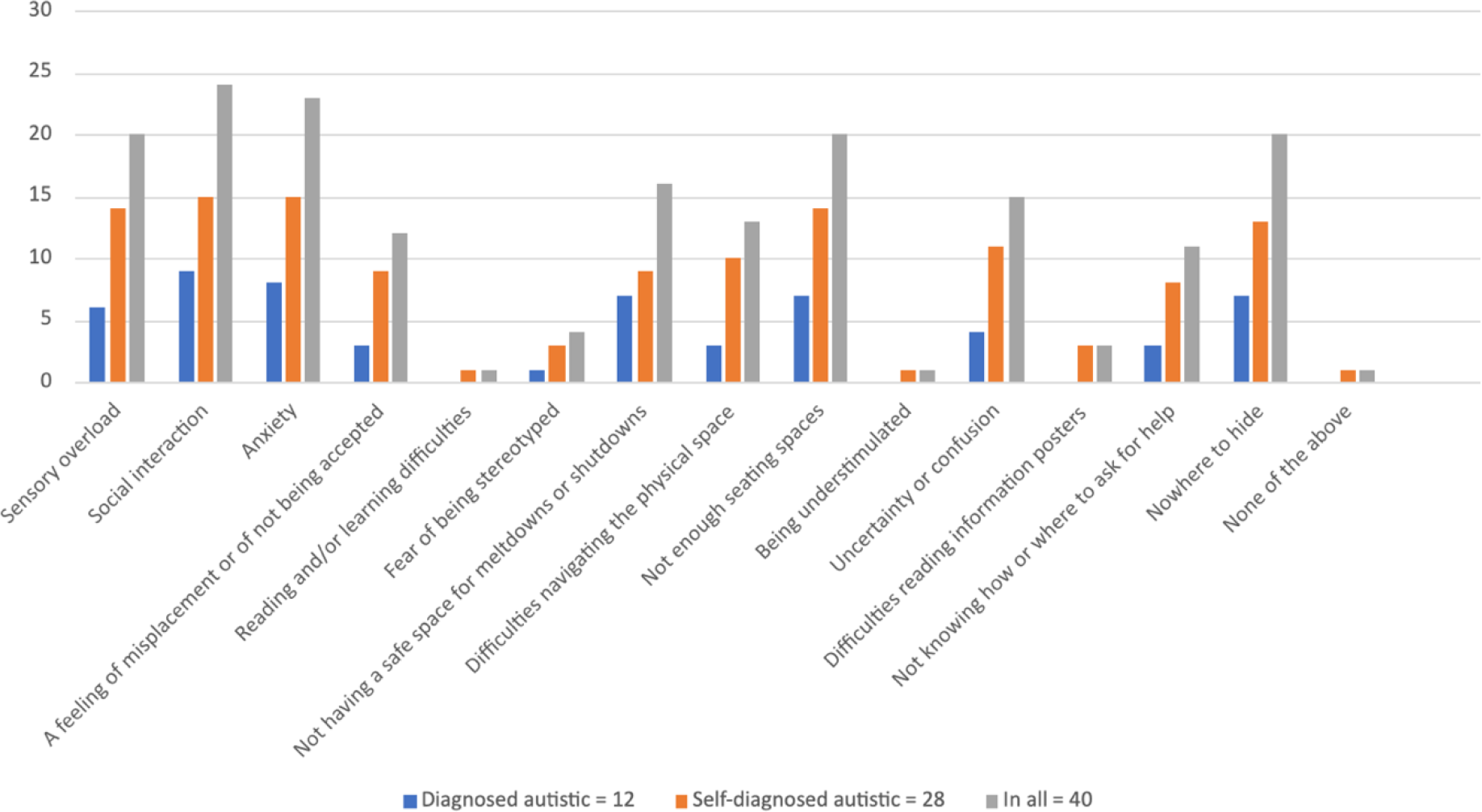
Survey results for diagnosed and undiagnosed autistics.
Of the different potential barriers, the five that stand out are social interaction; anxiety; sensory overload; not enough seating places; and not having anywhere to hide. Next to these, less than half of the participants selected barriers such as not having safe spaces for meltdowns or shutdowns; uncertainty or confusion; not knowing how or where to ask for help; difficulties navigating the physical space; and a feeling of misplacement or of not being accepted. Very few chose reading and/or learning difficulties; fear of being stereotyped; being understimulated; difficulties reading information posters; or none of the above.
In addition to the results displayed in Figure 1, the question regarding whether or not the participants had had their needs met in a library or museum showed that, out of the 22 replies, 8 stated that they had not and 6 said that they had. The other participants’ answers were more focused on which needs had or had not been met, and their overall experience. One participant mentioned that the seats in their university library were often taken and that most of the seating options were meant for groups, which triggered their social anxiety. Another mentioned how the text descriptions in museum exhibitions helped to ground them as their mind tended to wander. Two of the respondents mentioned how their experiences in libraries and museums were usually good as long as there were not too many other people around; one of these participants also stated that they appreciated it when there was a garden or pleasant spaces nearby where they could talk a walk and a break from the social and sensory input. This can be connected back to the need to have somewhere to be alone for a while, be it a separate space next to the facility or a room or similar within the facility. The other respondents mentioned that their anxiety could make it difficult for them to ask for help, but when they did, they usually had a good experience because the librarians they encountered were good at giving them both space and the right help. One stated specifically: ‘I do not feel like my needs are unmet. As long as there are other people around, I am slightly uncomfortable’. Another participant commented: As someone who has felt a lot of anxiety prior, it’s nice that librarians are good at giving space and letting me explore rather than someone working at a shop who aims for a social interaction the moment you enter the door.
The case study
Steps to make library or museum spaces more inclusive and accessible for autistic people have already been taken. This small case study briefly describes the steps taken by some museums and libraries based on articles and institution web pages regarding access for autistic users. As mentioned, it would be relevant to look into what this means in practice, as it is difficult to know whether these programmes and changes have actually been beneficial for autistic individuals. However, looking into what institutions have done previously can help other institutions find inspiration and motivation to take actions towards better inclusive and accessible practices.
The Smithsonian
In 2018, the Smithsonian Magazine published an article on its website regarding the work of The Smithsonian towards making the museum as accessible and safe as possible for autistic people. The article’s primary focus is Freed-Brown’s work on making museum spaces that are tailored so as not to overload the senses of autistic children. It states: Providing special hours is a common and effective method for cutting out lots of stimuli, as a crowd itself induces stress, along with all the unexpected noises it brings with it. Museums can also dim lights, lower volumes and be cognizant of other possible distractions. (Shrikant, 2018)
The Smithsonian’s web page ‘Accessibility for visitors: Making all visitors feel welcome’ gives an overview of some of its accessibility features, including pre-visit videos ‘designed to help prepare for situations one may encounter at the Smithsonian museums. [They] address what to expect, museum rules and routines, safety information, and more’ (The Smithsonian, n.d.). These videos are a good aid in lessening the impact of unexpected occurrences for autistic people in the museum.
The University of Warwick Library
The University of Warwick Library has various sensory study rooms with different options. Some have alternative lighting, such as bubble tubes, LED (light-emitting diode) strip lighting or galaxy star projectors. Some rooms have a yoga mat, while another room has additional seating options like rocking chairs, wobble cushions and soft seating. Many of the rooms come with computers that have accessible applications, such as Audio Notetaker, Essay Writer, Mindjet MindManager and Read&Write Gold. Its web page also has a video on how to use the library and book accessible study rooms (University of Warwick Library, n.d.). The University of Warwick itself provides an extensive overview of its support systems and resources for students (Wellbeing Support Services, 2021).
The British Museum
From a review of its detailed accessibility web page, it is clear that the British Museum has taken several groups into consideration. It contains, among other things, information about quieter times, which indicates what time of the day is usually the calmest as well as the busiest periods being at weekends; quieter areas, which indicates which rooms tend to be calmer and which tend to be more crowded and noisy; and what the lighting and temperature are like in the different rooms of the museum (The British Museum, n.d.a). It also has a link to a sensory map that can help visitors identify sensory-friendly areas in the museum. This map has a more detailed overview of what is described in the accessibility web page regarding lighting, noise, temperatures and so on (The British Museum, 2019).
The museum usually also has themed backpacks available, which are ‘designed to engage families with the galleries [and] include an activity booklet which will guide you around the museum giving you information about the collection and activities you can complete along the route’ (The British Museum, n.d.c). Each backpack has a theme, with items that help visitors engage with the exhibits in a different way. In addition, the museum has a sensory-support backpack for children aged 3–11, which contains ‘resources and ideas to support young visitors with additional sensory needs in [the] busy Museum environment’ (The British Museum, n.d.b). All of the backpacks are free but require a £10 deposit. Creating sensory backpacks and sensory-support backpacks is an excellent way to make the museum experience better for children. However, the option to borrow sunglasses or stim toys for teens and adults should also be considered, especially since many might be forgetful or not have anticipated the sensory overload in the museum during the day.
Multnomah County Library
Multnomah County Library (n.d.) has specific ‘kits to assist with sensory processing differences…to help with background noises and other distractions, and to help calm’. Even though these are focused on children, having such kits available for everyone would be a good way to make the library more accessible for autistic individuals while still maintaining the library a social public sphere for those who might not need these assisting tools. The library also has a special hour for autistic people, where ‘[n]atural and limited lighting and limited patron access will help support a sensory friendly environment’ (Multnomah County Library, n.d.).
Pickerington Public Library
In an article in the Columbus Dispatch, Ellis (2021) writes about how ‘Pickerington Public Library makes programs more accessible for sensory-sensitive patrons’. The article goes into depth about how the library has been given sensory bags containing ‘noise-canceling headphones, fidget tools, verbal cue cards and weighted lap pads’ in order to help all patrons visiting the library deal with sensory overload (Ellis, 2021). In addition to sensory-friendly initiatives, the library staff members completed a sensory-inclusion course through KultureCity. KultureCity (n.d.) is a ‘nonprofit on sensory accessibility and acceptance for those with invisible disabilities’. The organization has several programmes on sensory inclusivity and information on sensory processing difficulties that can be a source for learning for ALM institutions.
Accommodating alterations and practices
The data and information sourced from the literature review, survey and case study shed light on which barriers are most often experienced by autistic users in libraries and museums. Although many barriers have been revealed, it is worth mentioning that there may still be those that have been left unexplored, and it may be relevant for an institution to be able to change and add to its accommodations as the results of research are updated.
Autistic people usually encounter many barriers in their daily life, and some of these barriers may also be seen in their interactions with libraries and museums. The barriers mentioned were, among others, sensory sensitivities that can, for instance, be experienced through flickering or bright lights and different kinds of sounds; executive functioning skills; social navigation and interaction; anxiety; communication; and lack of awareness. The survey revealed that some of the most difficult areas in relation to libraries and museums were social interaction, anxiety, sensory overload, not having enough seating places, and not having anywhere to hide. In addition, some of the participants had experienced a lack of safe areas to be alone during shutdowns or meltdowns, as well as difficulties navigating the physical space. Although autism is a spectrum disorder, and thus each individual is different, many autistics have similar traits and experience similar barriers, and being able to remove or ease some of these barriers may be of considerable help when it comes to navigating libraries and museums.
From the case study, a number of practical solutions came to light: special hours with dimmed lighting, lower volumes and limited patron access; sensory maps and information sources that show statistically when there are fewer people in the institution, as well as give an overview of the sound, lighting and temperature; sensory support kits or bags with resources like fidget toys, noise-cancelling headphones and weighted lap pads; sensory-inclusion courses to help staff understand how to act in situations where an autistic user may need help; updated accessibility web pages; and sensory study rooms that have different options for lighting, seating and sound. From the literature review, further suggested solutions include collaboration with autism support programmes; different lighting options in general; a guarantee that an autistic person has the same study space each time they visit; study space maps; quiet spaces; chat references to avoid face-to-face interaction; personal librarians; handouts and obvious online signage to inform users about quiet areas; a clear overview of the rules; organizing special interest groups; and better education for staff.
Implications for future research
This study was limited with regard to both time and length, and only touches on some areas related to autism and accessibility in libraries and museums. It would be useful for future research to identify what more can be done to accommodate autistic users – not only in terms of sensory accommodation, but also in regard to interaction with libraries and museums, and how to make inclusive meeting spaces for autistic people that will be considered relevant enough for them to seek out. This could, for instance, be done in relation to their special interests and figuring out how to integrate teaching or social gatherings surrounding niche interests into library or museum programmes. Other research could investigate which accommodations actually help autistic people, and how best to reach out to both autistic users and employees to find a way to collaborate about which changes may realistically be made. In addition, research on information needs and search behaviour may help find ways to make the navigation of collections and information easier for this group. There are many possible areas to touch on regarding this topic and, with time, researchers may be able to figure out how to accommodate this group in a way that is realistic for each institution and perhaps also beneficial for more than just autistic users.
Conclusion
A library can be an important place for many. Students can, for instance, find an escape from sensory distractions by going to a library. It is also a place where autistic users can find room to explore their special interests or pursue academic success. This article has attempted to source information on barriers, and solutions to those barriers, when it comes to the autistic experience in libraries and museums. There has been a focus on libraries, but information sources regarding museums have also been considered, as these too are institutions that promote culture and information, and may be a good source of both inspiration and motivation for libraries seeking to make their spaces and collections more accessible for the autistic user group. The research question used to help frame the study was: How can libraries and museums make their physical spaces more inclusive and accessible for the autistic population? There has been an attempt to answer this research question through a small survey, a short case study and a literature review. The data found that many of the barriers autistic people face in libraries and museums are related to sensory differences and social difficulties or anxiety. A summary of the changes that can be made to help accommodate this group is as follows: Using inclusive language based on the preferences of the user group or individual; Including universal design and universal design for learning wherever possible; Making available quiet spaces for silent study or reading, which may include non-fluorescent lighting or several lighting choices allowing for individual preferences, good signage that shows where these spaces are located, and different types of seating to support different sensory needs; Chat references; Personal librarians; Collaboration with autism support programmes; Special hours with dimmed lights, lower volumes and limited patron access; Sensory maps and easily available information sources and websites; Sensory kits or bags including, among other things, fidget toys, noise-cancelling headphones and weighted lap pads; Sensory-inclusion courses; Giving patrons space to explore without the pressure of being sociable.
Although certain accessibility changes may be modified to fit each individual library or museum, and although these are only a few solutions, having something concrete to begin with may make it easier for institutions to make the appropriate accommodations and get the ball rolling in the right direction. Making sure to include autistic people in the decision-making process is also advisable as they know their barriers and needs best. While many museums and libraries have started to take action in making their spaces more accessible for autistic people, there is still a long way to go to make them more comfortable for this group, and more research is recommended in order to figure out what works and how best to help this user group, not only in terms of sensory inclusion, but also in terms of information needs, search behaviour, social inclusion and community-building.
Footnotes
Declaration of conflicting interests
The author declared no potential conflicts of interest with respect to the research, authorship and/or publication of this article.
Funding
The author received no financial support for the research, authorship and/or publication of this article.