




Abstract
This study aims to identify the information barriers that the LGBTQ+ (lesbian, gay, bisexual, transgender, queer, other) community encounters when seeking information about sexual orientation. For this study, a qualitative methodology was followed based on a questionnaire that was answered by various groups within the community. The findings reveal that the respondents preferred the Internet when searching for information due to the abundance of resources, easy accessibility and anonymity. However, they found it insufficient to determine their sexuality due to the presence of inaccurate information and hurtful comments from other users. Additionally, only a few of the respondents were aware of the existence of specialized LGBTQ+ libraries. They believed that the lack of financial resources results in these libraries selecting some resources over others. Therefore, libraries can play a key role in serving the LGBTQ+ community by curating collections in relation to their sexual orientation. This could overcome barriers by providing reliable information for the LGBTQ+ community.
Keywords
Introduction
This article explores the information barriers that the LGBTQ+ (lesbian, gay, bisexual, transgender, queer, other) community faces in meeting their information needs and how members of this community seek information on their sexual orientation. This article is addressed to a wide audience in the library and information science (LIS) field, but is especially relevant to LIS students commencing research. The authors consider how this community looks for health information sources, such as web pages that feature medical authorship or books and sexual health information. Sexuality education, especially among youth, is essential for their healthy development. UNESCO (2018) published an international guidelines report on how sexuality education should be addressed in primary and secondary schools. The guidelines establish eight key factors: relationships; values, rights, culture and sexuality; understanding gender; violence and staying safe; skills for health and well-being; the human body and development; sexuality and sexual behaviour; and sexual and reproductive health. In some countries, such as the USA and Spain, sexuality education is not part of the school curriculum (Delmonaco and Haimson, 2023; Sexuality Information and Education Council, 2022; Tenga, 2020; World Health Organization, 2010).
Nearly two centuries after the first wave of the LGBTQ+ movement began, the struggle for visibility and acceptance continues. The LGBTQ+ community advocates for equal rights and a more inclusive perspective that includes all people who identify as part of the community. This approach will lead to a more inclusive society (Vázquez, 2021). Our approach in this research starts in the District of Columbia in the USA where the LGBTQ+ community comprises nearly 10% of the population, more than in all other states and even countries (Movement Advancement Project, 2022). In contrast, the LGBT+ Pride 2021 Global Survey reveals that 10% of the Spanish population is primarily or exclusively attracted to an individual of the same sex (Ipsos, 2021). Discovering one’s sexual orientation is crucial as it helps people develop healthy relationships with their environment, friends and themselves. However, current technology trends have affected the way we access information. Diverse studies show that the Internet has become the primary source of information for the LGBTQ+ community to understand and explore their sexuality (Augustaitis et al., 2021; Baker et al., 2021; Burton and Avilla, 2021).
Undergraduate LIS students, as future librarians and information professionals, have a responsibility to respect different cultures and facilitate access to information for all people, as libraries become anchors that ‘actively influence their communities, and are constantly making choices that shape informed citizenship through public access to information’ (Gibson, et al., 2017). LIS students can play a vital role in promoting the provision of curated information for library users. As they study to become librarians and information professionals, they learn about the principles of information organization, access and management, as well as the ethical considerations involved in providing access to information. These future LIS professionals can contribute to the role of libraries in providing information in several ways.
First, they can work to ensure that library collections are diverse, inclusive and representative of a wide range of viewpoints and perspectives. By providing access to a variety of resources, they can help users to make informed decisions and think critically about the information they encounter (Abiolu and Okere, 2012; Connaway et al., 2017; Miller, 2017). Second, future LIS professionals can help to develop and implement policies and procedures that support the provision of information in libraries. For example, they can advocate for policies that protect the privacy of library users and ensure that library resources are free from bias or censorship (Ali and Gatiti, 2020; Ma et al., 2018; Vassilakaki and Moniarou-Papaconstantinou, 2015). Third, future LIS professionals can engage in outreach and education efforts to promote the use of libraries as a source of curated information. They can work with library users to help them navigate the information landscape and identify reliable sources of information, as well as teach them how to evaluate information critically to determine its credibility (Laybats, 2018; Tucker, 2019).
Our work tends to follow the approach of information practices rather than information behaviour. Information behaviour is an area of information science that relies on information search and information seeking to define an information system beyond an individual user (Boté-Vericad, 2022). However, our approach tends to examine information practice; it is an approach to the constructionist perspective that is a more sociologically and contextually oriented space where the processes of information seeking and use are socially and dialogically constituted, rather than being based on the ideas and motives of individual actors. All human practices are social and originate from interactions among members of a community (Savolainen, 2007).
The primary objective of this research is therefore to identify the information barriers that the LGBTQ+ community faces when seeking information about their sexual orientation in a diverse information ecosystem, including libraries. We use the acronym LGBTQ+ (to include lesbian, gay, bisexual, transgender, queer and other identities that fall outside of cisgender and heterosexual paradigms) to encompass all members of the community. We are aware that the acronym is forever changing and, even in the scientific literature, there is no consensus. For example, in different works published in 2023 there are different versions: LGBTQ (Villarroya and Boté-Vericad, 2023), LGBTQIA2S+ (Moreira et al., 2023), LGBTIQA+ (Permezel et al., 2023) and LGBTI (Mert-Karadas et al., 2023). We are also aware that the acronym changes depending on the geographic context (Wikipedia, 2023). Queer political theory and practice is based on the critique and questioning of universalized discourses on the concept of identity, and the struggle of the LGBTQ+ movement with other collectives. These ideas have finally begun to reach the Spanish queer context, where the debate on the rethinking of identity and the redefining of the subject has been encouraged, creating a certain rupture within the movements that previously existed (Vara Corrales, 2014). Moreover, our research aims to provide answers to the following guiding questions: Does the LGBTQ+ community typically find accurate information related to their information needs? What are the primary limitations the community faces when seeking information? What are the channels that the LGBTQ+ community typically uses to access information?
Literature review
For the following literature review, the keywords that form the basis of our article were identified – LGBTQ+ community, information barriers, Internet and specialized libraries. Next, a search was carried out in the specialized information science database Library and Information Science Abstracts, bibliographic reference databases such as Scopus and the Web of Science, and reports. It is worth mentioning that the articles had to be available in open access where they could be located by university students.
In recent years, various studies have attempted to analyse and identify the information barriers experienced by the LGBTQ+ community from different perspectives. Some studies have focused on information needs related to sexual relationships and health (Adler, 2017; Burton and Avilla, 2021), while others have examined the role of academic libraries (Stewart and Davis Kendrick, 2019; Villarroya and Boté-Vericad, 2023; Villarroya et al., 2022; Wexelbaum, 2017), as well as their collections (Chapman, 2013; Gómez-Hernández and Pérez-Iglesias, 2017; Hinton, 2022), in meeting the information needs of university students.
The existing literature on LGBTQ+ information-seeking behaviour highlights that there are significant information barriers faced by the community in discovering and understanding their sexual orientation. According to Burton and Avilla (2021), while there is a significant amount of information available about sexuality, it tends to be presented from a heteronormative perspective. As a result, LGBTQ+ individuals often struggle to obtain accurate information from traditional sources, such as school or family, and must resort to alternative sources, such as pornography, young adult fiction or the Internet, to seek information on their sexual orientation. For instance, Jia et al. (2022) report that in relation to health information resources for LGBTQ+ individuals, the Internet was a primary source of information. They identify 25 factors influencing health-information-seeking behaviours. Another study, conducted at the University of Northern British Columbia, Canada, using participatory maps and focus groups, found that the participants expressed concerns about the quality of the content when seeking information online (Hawkins, 2017).
Recent studies have shown that the Internet is the primary source of information about sexuality because it provides information quickly and grants anonymity, which is an important aspect for the LGBTQ+ community as it makes them feel safe (Burton and Avilla, 2021; Kitzie, 2017; Stewart and Davis Kendrick, 2019; Yeh, 2008). However, the Internet also has adverse effects due to the presence of negative comments, making it ‘an actor that affords and constrains information practices’ (Kitzie, 2017: 10). In contrast, other sources of information, such as libraries, are no longer perceived as safe spaces (Curry, 2005; Wexelbaum, 2017) and are considered inadequate for LGBTQ+ individuals, as they often find the collections to be sparse (Chapman, 2013), inappropriate, outdated or difficult to locate (Stewart and Davis Kendrick, 2019). In British Columbia, Canada, Curry (2005), using an unobtrusive observation method with the participation of a research assistant, found that 30% of a sample of libraries had a fictional book that could be used for the Gay-Straight Alliance Club meeting were adequate, but not exemplary. Curry found that improvements in the reference services of the libraries were not limited to gay and lesbian subjects. However, the primary emphasis of this study was on identifying inadequate reference service interactions that occurred with vulnerable youth.
With regard to LGBTQ+ care, health professionals prefer working with medical librarians they know to be LGBTQ+. The reason is because of concerns about discrimination or a lack of relevant knowledge (Morris and Roberto, 2016). According to one recent study, ‘online channels are a popular place to find health information’ (Hawkins et al., 2017: 320) without fear of stigmatization. Floegel and Costello (2019) carried out a study through semi-structured interviews with queer individuals and content analysis of entertainment media resources. They found that the participants viewed entertainment media as a salient part of their identity-related information practices. In another study, Hinton (2022) discusses the increasing number of proposed and passed laws that regulate what students can and cannot read. This results in children and adolescents growing up without any reference points, as they are not allowed access to materials with LGBTQ+ themes or characters (Hinton, 2022: 1).
Yeh (2008) carried out a study using qualitative interviews to explore homosexuals’ information behaviour from a constructionist viewpoint. The sample comprised 14 participants: 10 gays and 4 lesbians living in Taipei, Taiwan. Yeh found that the guidance of mentors in the participants’ initial contact with homosexual communities was useful to help them face the pressures and biases of the heterosexual society, and also follow the rules of these communities. The participants also found that the use of the Internet offered protection for their identities by affording them anonymity. Yeh concludes that homosexual communities are important for gays and lesbians because some members provide helpful information and emotional support.
In Spain, laws were passed during 2014–2016 ‘to promote and guarantee the equality of rights for all individuals, regardless of their identity, condition, or sexual practices’ (Gómez-Hernández and Pérez-Iglesias, 2017:96), in the case of autonomous communities such as Galicia, Extremadura, Madrid and Catalonia. Several studies suggest that libraries should play a more active role within the community and work towards providing a safe space (Gómez-Hernández and Pérez-Iglesias, 2017; Hinton, 2022).
Methodology
The design of this study was based on the literature review followed by a self-administered qualitative survey. First, we conducted the literature review to identify existing studies in relation to gender-identity discovery, information seeking and information behaviour, considering their results and their limitations (Garrett and Spano, 2017; Mehra et al., 2011; Villarroya and Boté-Vericad, 2023; Villarroya et al., 2022; Walker and Bates, 2016). Additionally, the study explored the role of the Internet and the use of technology in shaping information behaviour and identity discovery.
We designed a qualitative survey addressed to the LGBTQ+ community in Barcelona, Spain. We elaborated on the questions considered in previous literature and spoke with librarians specializing in LGBTQ+ collections to reach a consensus between us. Two experts in qualitative questionnaires reviewed the survey before the open-ended questionnaire was distributed. We collected the responses through Google Forms.
Using a convenience sampling method, we distributed the questionnaire by reaching out to acquaintances and through email and private communications on social networking sites – mainly Instagram, as in the work of Moraes et al. (2021). Instagram private messaging is a common way to communicate with others, especially young people (Ali et al., 2022), and it was easy for us to contact the participants for our study via this means.
The data was collected from 1–31 August 2022 and we received 20 responses. After verifying the responses, a sample of 18 participants remained. We excluded two questionnaires because they were incomplete. The participants in a qualitative survey use their own language and terminology to give their responses instead of choosing from a set of predetermined response options (see Braun et al., 2021). The questionnaire for this study was divided into two parts. The first part aimed to gather the demographic data of the participants, such as their age, highest level of education and sexual orientation. In the second part, the participants could use their own words to describe themselves while answering the survey questions. The respondents’ identities were kept anonymous and gender specification was not required.
Through the specific questions, we aimed to establish a preliminary understanding of the participants’ sexuality-discovery experiences by asking them to reflect on their first experiences when exploring their sexual orientation. The objective was to identify the resources that the participants found most helpful. We also delved deeper into the resources the participants used when discovering their sexuality, particularly online. We asked them about the benefits and drawbacks of searching for such intimate information online and how they felt about the information they found. Then, we also wanted to know if the participants were aware of specialized LGBTQ+ libraries and whether they had ever visited one. We also wanted to compare these libraries to public libraries and identify any areas where public libraries were lacking. Finally, we asked the participants to reflect on whether they would have sought information differently if they had known what they now knew.
The open-ended questions were as follows: Did you start actively seeking information at a specific age, and do you believe that the resources you found were suitable for your age? Explain which resources you used to learn about your sexual orientation, which ones you found most valuable, and which helped you accept your sexuality. You have a list of resources as a guide (information video, official-source video, pornography, specialized websites, information websites, social networks, family environment, information leaflets, media references, talks, health workers). What advantages do you think the Internet offers compared to other sources when it comes to seeking information about sexual orientation? On the other hand, what disadvantages do you find with using the Internet for this purpose? Do you think that the information available on the Internet about the experiences and perspectives of the LGBTQ+ community is limited? Do you think that it is feasible to research your sexuality and related topics using the information resources available in a library? Why or why not? Have you considered using a library as a resource for this purpose? Do you think that libraries provide their users with sufficient sources of LGBTQ+ information or, on the contrary, do you think that, due to limited resources, libraries make some groups invisible? Please explain. Have you ever visited a library specializing in sexual orientation? If not, could you explain why you have not? Do you think that your search criteria would be different from everything you know now? In what way? What recommendations would you make to people who are investigating their sexual orientation for the first time? Please explain.
To analyse the responses, we classified them according to the group of the collective to which the participants indicated they belonged: homosexual attracted to men, homosexual attracted to women, bisexual and queer. The answers were analysed using inductive coding – allowing the topic to emerge from the content (Mayring, 2000) – with version 23 of Atlas. Inductive coding allows the researcher to read and interpret raw data in order to develop concepts, themes or a process model through interpretations based on the data (Chandra and Shang, 2019). The coding was performed by two of the authors. Each author coded similar answers separately. A third author reviewed all of the coding, and disagreements about the codes were discussed by the three authors until they reached a consensus.
Results
This study examines whether LGBTQ+ individuals can find useful and accurate information through various information resources. The study’s final sample size was 18 people. Of these 18 participants, 10 identified as bisexual (55%), 4 as gay (22%), 3 as lesbian (18%) and 1 as queer (5%). The age of the respondents ranged from 16 to 40, with the majority falling between the ages of 21 and 25 (n = 12, 67%). The entire sample had completed basic education and half of the sample had also completed university studies.
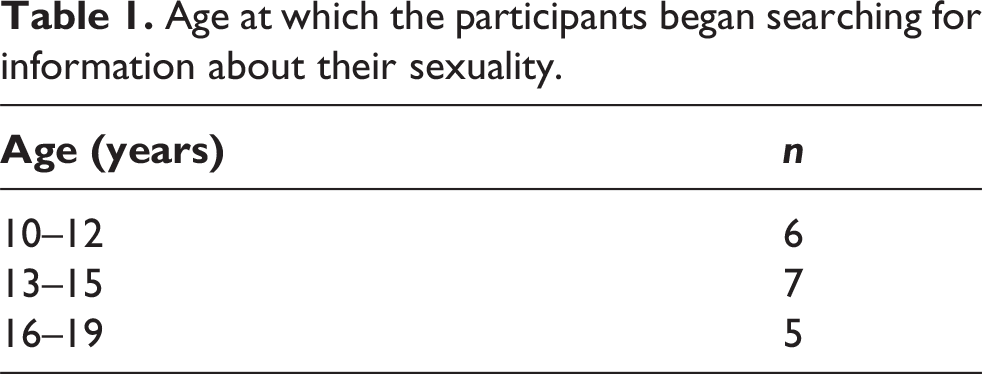
With regard to the participants’ responses to the first question about the age they first searched for information about their sexual orientation, none of the answers were over the age of 19 (Table 1). It seems that the adolescent years were crucial in terms of exposure to helpful information and when their sexual experiences began.
Age at which the participants began searching for information about their sexuality.
Half of the respondents reported that they did not find what they were looking for when searching for information about their sexuality, and only four (22%) said they did find something. The reasons for the lack of useful information varied among the participants. In relation to whether the resources they found were appropriate for their age, seven (39%) indicated that they were.
Concerning the resources they used to explore their sexuality, we provided a list of possible sources as a guide in the questionnaire (Table 2). The most commonly used channels for information seeking among the LGBTQ+ survey participants were Internet-based, with social media being the preferred choice. Other sources that were frequently utilized included media references, pornography and advice from friends. The gay individuals reported using pornography more often, while the lesbians cited media references as their primary source. The less frequently used resources included psychologists, informative talks, brochures and school. The majority of the participants mentioned ‘social networks’ (n = 15, 83%) as their primary source, followed by ‘media influencers’ (n = 8, 44%) and ‘pornography’ (n = 7, 39%), which was mostly cited by the gay individuals. It is important to note that nobody mentioned ‘official educational videos’, and only two participants (11%) mentioned ‘specialized resources’.
Information sources used to look for information to explore sexual orientation.
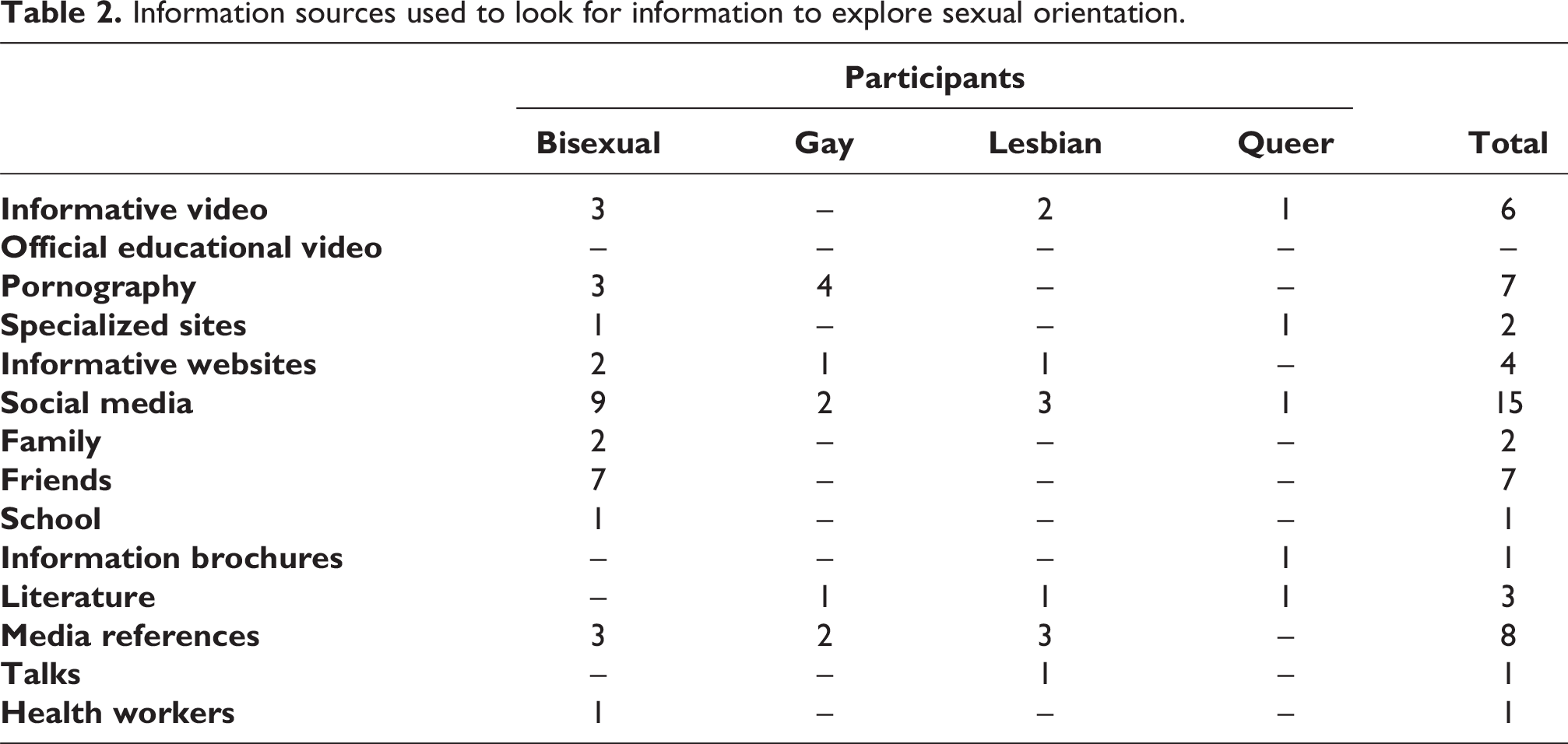
Additionally, most of the participants (n = 11, 61%) perceived ‘social networks’ as the most helpful resource in discovering their sexual orientation. When asked about the resource that aided them in accepting their sexuality, most responded with ‘friends’ (n = 11, 61%), followed by ‘social networks’ (n = 9, 50%). A 22-year-old bisexual participant provided an insight into why individuals in the community tend to rely on social networks for information: People tend to be more open to discussing the LGBTQ+ community on social networks because these platforms provide access to a wider range of information and entertainment content from the community, which is not typically found on television or in daily life.
The question regarding the limits of LGBTQ+ information available on the Internet elicited diverse opinions (Table 3). Almost half of the sample responded that there are no limitations (n = 8, 44%), while the remaining respondents (n = 10, 55%) felt that limitations exist. The most frequently cited limitations were ‘insufficient information’ (n = 3, 17%), ‘false information’ (n = 3, 17%) and ‘censorship’ (n = 2, 11%).
Limits of LGBTQ+ information available on the Internet.
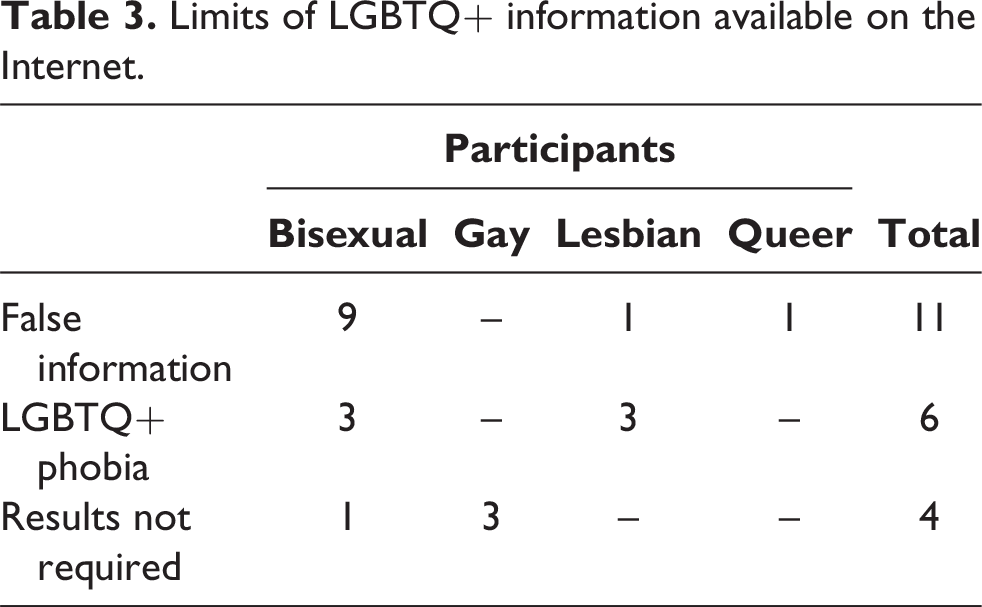
The participants reported encountering several barriers when attempting to access information, including censorship, insufficient information and false information, such as fake news. During the initial literature review, libraries were identified as a potential source of curated information, but most of the participants did not use them due to limited information resources, lack of representation of the LGBTQ+ community, discomfort with the lack of anonymity and outdated materials. From the answers obtained, we can infer that those who claimed there are no limitations were referring to the quantity of information available, rather than its quality with regard to providing information on sexuality: ‘There is no limited information, but it is not enough to find your sexuality. A lot of it is false and that has a bad influence on the discovery of your sexuality’ (Bisexual participant, aged 21).
Furthermore, we wanted to know what the respondents thought about LGBTQ+ specialized libraries. Ninety-four percent of the respondents had never visited one, mostly due to ignorance of their existence’ (n = 8, 44%), ‘lack of interest’ (n = 2, 11%), ‘not knowing where to find one’ (n = 3, 17%) and ‘fear of judgement’ (n = 2, 11%). One participant also mentioned that the place and environment in which one lives are decisive factors, since people who live in the countryside and remote areas are less likely to be exposed to these options. On the other hand, when discussing what public libraries can offer to the LGBTQ+ community, 61% of the respondents (n = 11, 61%) stated that they would not visit one, primarily due to a ‘lack of information’ (n = 4, 22%), ‘lack of anonymity’ (n = 3, 17%) and ‘outdated information’ (n = 2, 11%). Additionally, 2 (11%) of the sample found a ‘lack of LGBTQ+ representation’ in public libraries and 12 (67%) agreed that libraries could not provide enough LGBTQ+ resources due to the ‘lack of budget’. When asked why they did not visit public libraries for this purpose, a 25-year-old lesbian participant said: ‘I don’t think it’s feasible due to the small number of resources and the time it takes to search through them’. However, the idea of utilizing libraries to learn about sexuality was not entirely rejected. Some of the participants appreciated the fact that libraries provide more reliable resources, which they considered are more difficult to find on the Internet: ‘There are regulated resources, not like on the Internet’ (Bisexual participant, aged 21).
In addition, we asked the participants if they would change their search criteria if they were searching for information about their sexuality for the first time today. Of the sample, the majority (n = 12, 67%) answered ‘yes’, mainly based on the specificity of the search term (n = 7, 39%) and looking for specialized resources (n = 2, 11%). However, they also mentioned that having come out gave them more freedom to seek information on topics they previously felt self-conscious about: ‘Well, maybe now I’d search the Internet on specialized pages and even go ask a site if they have specific books because I’ve come out of the closet, but I wouldn’t have done before’ (Gay participant, aged 24). Furthermore, most of the participants (n = 12, 67%) believed that personal experience is key to discovering one’s sexuality, followed by asking people in the community (n = 3, 17%) and looking for information on verified and safe websites (n = 5, 28%). Therefore, we can conclude that although the Internet is primary when people want to learn about certain topics and feel more confident in their sexuality, it is not enough for people in the LGBTQ+ community to determine their sexual orientation.
Discussion
This study aims to investigate the information barriers faced by the LGBTQ+ community, as half of the participants questioned reported not being able to find the information they were looking for and not having access to adequate information resources to meet their needs. Various studies have shown that the Internet is the primary source of information for this community and is considered relevant and useful (Burton and Avilla, 2021; Kitzie, 2017). In our case, the participants stated a preference for social networks over other information resources to learn about their sexual identity.
The use of social networks demonstrates that ‘a simplistic interpretation of this account would be that the LGBTQ+ community prefers interpersonal resources to the static’ (Kitzie, 2017: 153), and that social networks allow individuals to ‘follow’ or ‘recommend’ similar individuals and create a community in which they can feel safe. Studies have shown that LGBTQ+ individuals use social media as a means of seeking information or accessing relevant information that they cannot find elsewhere (Randolph, 2023), and that it also plays a significant role in providing a sense of community and social support (Jia et al., 2022). In the current study, seven participants (39%) stated that the Internet and social networks offer greater accessibility, but there is a risk of misinformation or hostile behaviour due to negative comments or LGBTQ+ phobia.
Our findings align with the study conducted by Burton and Avilla (2021) and the systematic review of Jia et al. (2022), which conclude that social networking sites are the primary source of information for people on the Internet. The participants in our study also mentioned that social networks provide a platform for finding a wide range of options, and not just collecting information but also sharing it with others and expressing their doubts and questions. Additionally, they emphasized that social networks facilitate access to information and provide a means for users in similar situations or interested in similar topics to connect.
In contrast, the use of libraries, whether public or specialized in LGBTQ+ content, to find information about one’s sexual identity is almost non-existent. Recent studies have shown that libraries ‘never serve as the primary destination for LGBTQ+’ (Stewart and Davis Kendrick, 2019:611) and are considered unsafe spaces for the community (Wexelbaum, 2017) since they do not guarantee anonymity. The reason why the LGBTQ+ community does not use specialized libraries is primarily due to a lack of awareness of their existence and accessibility. Additionally, in the case of public libraries, their information resources are often considered insufficient or outdated, and individuals prefer the Internet since it is quicker to find information (Stewart and Davis Kendrick, 2019) and is accessible without feeling judged.
Public and specialized libraries were overlooked as potential sources of information by the participants. Most of them did not know about the existence of specialized libraries, and they did not go to public libraries because they believed that their content is outdated. However, these institutions can provide reliable sources of information, even though they may not be able to compete with the immediacy of Internet results. Despite this, the participants in this study did not believe that going to a library is efficient as they felt that the Internet provides more possibilities, and they did not mind finding less satisfactory content if it meant that they could limit their search time.
Analysing this situation, it seems that libraries are not connecting sufficiently with the LGBTQ+ community, and the relationship between society and these institutions is growing distant. The IFLA and UNESCO guidelines highlight that ‘librarians should keep up with changes in society’ (IFLA, 2001) otherwise they will not be able to meet people’s needs. This could also lead to people stopping visiting libraries. Romero et al. (2021) have already pointed out in their research that, following the worldwide social and health crisis resulting from COVID-19, fewer users are going to libraries.
Boté-Vericad and Sola-Martínez’s (2020) study discusses the lack of training among library professionals regarding new technologies, although they are part of their professional responsibilities. This directly affects the dissemination of their services, such as through social media and networks. Many librarians claim that it was not until the COVID-19 pandemic that they began to search for users through new digital spaces (Romero et al., 2021). This leads us to believe that libraries are not evolving at the same pace as their users’ needs, causing users to distance themselves from these institutions as they do not feel identified with. Our results also indicate that the information participants encounter is often imprecise and incomplete. Interestingly, ‘specialized pages’ were not mentioned as one of the participants’ primary sources when searching for information about their sexuality for the first time. Libraries could curate specialized pages and provide access to information that may not be readily available elsewhere. However, libraries must ensure that the information is accurate, up-to-date and unbiased, and aligns with collection policies. The participants in our study were hesitant to consider libraries, which are secure and professional spaces, as a resource for educating themselves.
Limitations
In conducting this study, we encountered several limitations that we would like to highlight. First, our sample size was limited to only 18 individuals, which may not be fully representative of the population. The sample we studied was relatively young, as most of the participants were aged between 21 and 25 (n = 12, 67%), which means that the information needs of the LGBTQ+ community over the age of 25 were not fully explored. Moreover, our sample focused on individuals living in the city of Barcelona. Notably, 10 (55%) of the participants identified as bisexual, while only one individual (5%) identified as queer.
Conclusion
We can infer different conclusions from our study. Although the participants believed that the Internet provided them with sufficient information to understand their sexuality, it was still inadequate in order to determine and accept it fully. Due to hurtful comments and perceiving it as an unsafe space, people in the LGBTQ+ community viewed the Internet as an unsecure platform to explore such a sensitive topic. The participants mentioned that the Internet was not their main source for accepting their sexuality. Instead, friends and family played a crucial role in this process. Therefore, while the Internet may be a valuable tool for searching for information about sexuality, it may not be sufficient for individuals to accept their sexual identity fully.
This study provides a foundation for future research and suggests some future directions. First, these findings provide a basis for further research into the information-seeking behaviours and barriers of the LGBTQ+ community. Second, further research could involve conducting an analysis of a larger sample of the community with a broader age range, such as 15–50, to explore similarities and differences in the information barriers between different age groups. Third, another potential direction for research could be to compare individuals from different geographic locations, such as big cities versus towns or villages. Additionally, it could also be valuable to investigate specific groups such as transgender, pansexual or queer individuals. Finally, it would be useful to investigate the information barriers experienced by the LGBTQ+ community internationally, as most research on this topic has been conducted in the USA.
Footnotes
Declaration of conflicting interests
The authors declared no potential conflicts of interest with respect to the research, authorship and/or publication of this article.
Funding
The authors disclosed receipt of the following financial support for the research, authorship, and/or publication of this article: This study was funded by the Programa de Recerca en Docència Universitària (University Teaching Research Programme) at the University of Barcelona (reference: REDICE22–3367) and the Centre de Recerca en Informació, Comunicació i Cultura (Information, Communication and Culture Research Centre), also at the University of Barcelona.