




Abstract
This article investigates patterns of knowledge exchange in hybrid communities where virtual and face-to-face links of communication are complementary. The study framework is based on social capital theory. The role of social capital dimensions and motivational factors in fostering the exchange of different forms of knowledge is investigated at an individual level. The proposed theoretical model is tested through structural equation modelling, and the analysis is carried out on a sample of over 250 individuals belonging to the community of users of the National Library of Latvia. The results confirm most of the theoretical hypotheses, but with some unexpected results– such as the relevant role of motivational factors in fostering the exchange of complex forms of knowledge– highlighting the specific nature of hybrid communities.
Keywords
Introduction
Recent years have witnessed the emergence of ‘hybrid’ communities, characterized by both digital and face-to-face network linkages. This phenomenon has relevant implications in organizational, sociological and cognitive terms, since communication channels influence not only the communication content, but also relationships between agents, the sense of belongingness to the community, and the psychological significance of communication.
In community studies, there is consensus among scholars about social assets being strong predictors of the effectiveness of knowledge and information exchange in communities. Hence, within the ongoing interdisciplinary debate on the extent to which online virtual communities can be substitutes for traditional geographical communities, a key issue is the extent to which such social assets, which are embedded within physical social networks, can be reproduced in virtual contexts. In other words, the issue amounts to investigating whether a virtual community can replicate the main features of a community of practice in terms of the social assets that are embedded in networks, and the cognitive and learning benefits related to social interaction.
While the cognitive benefits of hybrid communities are widely emphasized (Hampton and Wellman, 2003; Hine, 2020; Rainie and Wellman, 2012), the nature of the cognitive benefits and detriments in such communities when compared to different kinds of communication patterns is less clear. The efficiency in complementing physical and digital interaction does not say anything about the sense of belonging and trust, and the obstacles that characterize knowledge exchange. Furthermore, cognitive and perceptual abilities in hybrid contexts tend to mutually adjust through the use of digital tools (Risko and Gilbert, 2016), therefore presupposing a dynamic transformation of comprehension and communication structure in these communities, and generating not only benefits but also substantial costs, such as vulnerability to memory manipulation (Marsh and Rajaram, 2019; Risko et al., 2019).
In the present study, we attempt to identify the role of social capital and personal motivational factors in fostering knowledge exchange and growth within a hybrid community, in order to investigate the specificities of these dynamics in comparison to purely virtual and purely face-to-face interaction linkages. To this aim, we formulate a theoretical model on the basis of conceptual and empirical studies that apply social capital and social cognitive theory to the analysis of knowledge transfer in organizational units and virtual communities (Chiu et al., 2006; Tsai and Ghoshal, 1998), and studies of social capital (in particular, trust) accumulation in virtual communities (e.g. Usoro et al., 2007). The proposed model hypothesizes a positive effect of (relational and cognitive) social capital and motivational factors on the quality of knowledge exchange and the growth of individual knowledge.
Our model is tested on the basis of an individual-level survey carried out among members of the National Library of Latvia’s user community, a hybrid intentional community focused on the exchange of cultural and historical heritage-related knowledge. Our empirical analysis is based on structural equation modelling for latent variables (Joreskog and Sorbom, 1979).
Theoretical framework
The adopted framework is based on (1) social capital theory and its applications in organizational studies and (2) the applications of social cognitive theory, social epistemology and social categorization theory to the study of hybrid and community-level communication. The chosen approach takes into account several core issues related to knowledge transfer in communities– in particular, the role of social assets, the reproducibility of such assets in virtual contexts, and the obstacles to access to knowledge.
Community: a tentative definition
A comprehensive definition of what counts as a ‘community’ is still lacking in the literature. We argue that what is common to all kinds of communities is the following features (see Ellison, 2007; Latour, 2005; Star, 1999): Collections of causal or associative links and nodes, whereby links and nodes can refer to human (in the sense of real, physical, co-presence interaction) or artificial agents (computational knowledge representations or digital knowledge repositories, such as libraries); Principles of interaction (including norms and goals) ranging from informal or implicit (e.g. a naive world view) to explicit and well-defined social rules; Impacts of format or channel– one and the same message can be perceived differently according to a different format, and humans typically interact differently in different formats (e.g. in digital communication, the online disinhibition effect transforms the way humans interact (Suler, 2004)).
Further, we assume that communities possess an epistemologically distinct concept or sense of agency that is a group-level cognitive structure (see Theiner et al., 2010). In-group generation effects driven by a sense of belongingness, perception of joint goals and coordinated individual contributions from the members constituting the group generate a group-level sense of social identity– a ‘we-identity’ (see Gilbert, 2004; Searle, 2008; Tomasello, 2009). Individual intentions at this level are highly interdependent (List and Pettit, 2011).
We can therefore distinguish between different levels of interaction– a group level that has features exceeding the individual level, and an individual level with properties that are not necessarily shared by larger groups: (a) subjective, partially idiosyncratic knowledge (subjective beliefs, world views); (b) inclusion of the representation of significant others in the representation of the self (Brewer and Gardner, 1996; Saribay and Andersen, 2007); and (c) important parts of the external environment the agent is involved in and interacts with, such as external devices (Clark, 2011; Menary, 2010; Risko and Gilbert, 2016; Wilson, 2004). Although each level contributes to the socio-cognitive pattern of interaction, it has different dynamics, structure and overall results.
Hybrid communities
Hybrid communities have complimentary virtual (digitally mediated) and physical (in the sense of a physical co-presence) communication links (Gaved and Mulholland, 2005). Terminologically, the complementary parts of hybrid communities are also called digital (online) and analogue (offline). Although these terms are not synonymous, they refer to the same two parts of a complex communication structure. A crucial intuition is also that digital links do not entirely replace analogue links, but rather they complement one another. Furthermore, there might be parts of a system that only operate digitally (or analogously).
Hybrid communities shape the sense of self of the individual humans involved in those networks. ‘Self’ might be seen as a split structure (Turkle, 2005), complex and with different context-dependent self-aspects (McConnell, 2011), or as the single self that is shaped by the format of communication (Suler, 2004). In all cases, there seems to be a crucial role played by external factors in shaping cognitive processes. Digital devices, knowledge repositories and other individuals represent functionally important links in the hybrid conception of communication and the self (Clark, 2011; Donald, 1991; Menary, 2010).
The cognitive benefits of hybrid communities have been less explored. On the one hand, in hybrid communities, trust mechanisms operate that are typical of face-to-face social communities. On the other hand, such communities have peculiar characteristics in terms of network infrastructure and interaction tools (Gaved and Mulholland, 2005). It has been argued that the coexistence of virtual and physical channels of communication may strengthen social dynamics, fostering learning processes that are lacking in face-to-face communities (Grabher and Ibert, 2013). Moreover, hybrid communities generate complex affective impacts between and among their members, which can generate large-scale emotional contagion– for example, in digital social networks such as Facebook and Twitter (Goldenberg and Gross, 2020).
Finally, it can be assumed that hybrid communities have a group-level sense of agency. This implies that, although at the individual level discrepancies and conflicting opinions can be present, it is also possible that at the community level there are several shared group-level beliefs, aims or attitudes that are induced by the sense of joint commitment (Gilbert, 2004).
Social capital
The concept of social capital, which is widely adopted in the social sciences, indicates those kinds of social assets– from trust to obligations to norms– that are embedded within various patterns of social interaction and networking among and between individuals and groups, and can facilitate access to benefits of different kinds for those individuals and groups (Bourdieu, 1986; Burt, 2001; Coleman, 1988; Putnam, 1993). In the domain of organizational science, social capital has been adopted as a conceptual and analytical tool in order to study intra-organizational dynamics of knowledge exchange and enrichment among and between individuals and groups, at different levels of analysis. In this context, Nahapiet and Ghoshal (1998) propose an influential taxonomy of social capital, identifying three main dimensions: the structural part (network linkages), which has an enabling effect for the access of parties for knowledge exchange; the relational part (trust, shared norms), which fosters motivation to exchange knowledge; and the cognitive part (shared vision, language, codes, narratives), which enables knowledge combination capability. On the basis of this framework, Tsai and Ghoshal (1998) find empirical evidence for the central role of the relational component of social capital (fostered by the two other components) in enabling the intra-organizational exchange of cognitive resources. Further studies (e.g. Dirks and Ferrin, 2001; Levin and Cross, 2004) have confirmed the crucial role of both trust and other components of social capital in knowledge exchange in organizational communities, and the interrelation of the dimensions of social capital.
Similarly, virtual community studies have focused on the reproducibility of relational social capital, which is considered a fundamental resource for the sharing of benefits among community members. The issue of reproducibility is controversial in both social and cognitive terms, since face-to-face interaction and geographical proximity are widely considered as important conditions for social capital accumulation and, in particular, for the transfer of context-specific knowledge (Camagni and Capello, 2005).
Physical and virtual communities: social assets and cognitive dynamics
The study of virtual communities from the point of view of the reproducibility of social assets is widespread in sociology and organizational sciences (Rheingold, 1993). Scholars generally agree on the reproducibility of trust as the key factor behind knowledge and information exchange. Ridings et al. (2002) state that trust enhances information sharing in virtual communities; trust is, in turn, enhanced by perceived responsive relationships, a disposition towards trust, and a belief that others confide personal information. Usoro et al. (2007) also state that trust is an antecedent to knowledge sharing.
In social-capital-based cognitive studies, however, the structural–relational dichotomy has been deemed insufficient for analysing the impact of social capital on knowledge exchange and transfer. The above-mentioned taxonomy proposed by Nahapiet and Ghoshal (1998) adds a cognitive component, representing the mutual compatibility of agents with regard to a shared vision, culture and language.
Chiu et al. (2006) empirically study the effect of social capital and personal motivation on knowledge sharing in virtual communities, combining Nahapiet and Ghoshal’s (1998) taxonomy of social capital and Bandura’s (1989) social cognitive theory. Cognitive social capital, community expectations and trust are found to affect the quality of exchange; structural social capital, the norm of reciprocity and identification, and community expectations affect the intensity of exchange.
The issue of inner barriers: the nature of knowledge
Social capital studies investigating knowledge-transfer dynamics have rarely addressed such issues from an epistemological perspective. However, there is a strong case for considering different forms of knowledge when investigating cognitive dynamics. Nonaka’s (1991, 1994) studies on organizational learning acknowledge that information and knowledge are two distinct concepts, representing resources which may require different social learning patterns (Inkpen and Tsang, 2005). Moreover, although most debates on the dynamics of knowledge exchange in organizational studies are focused on the role of agents’ social features and attitudes (of an affective and cognitive nature), knowledge-exchange dynamics have also been found to be crucially affected by the intrinsic nature of knowledge– that is, its inner complexity (Szulanski, 1996).
Theoretical model
Main tenets
The aim of this empirical analysis is the investigation of the interplay existing in a hybrid community between social capital, motivational factors, the quality of knowledge exchange and the growth of individual knowledge among community members. The adopted framework partly relies on the model developed by Chiu et al. (2006) in investigating knowledge transfer in virtual communities, taking into account the contribution of both social capital and personal motivation to the intensity and quality of knowledge transfer. The hypotheses of Nahapiet and Ghoshal (1998) and the findings of Tsai and Ghoshal (1998) on the correlations among different social capital dimensions and their effects on inter-unit knowledge sharing in large organizations are also a basis for the model.
The adopted knowledge taxonomy is based on two widely influential dichotomies: (1) Russell’s (1998) distinction between experiential and declarative knowledge– that is, knowledge derived by experience, of a procedural nature (knowledge by acquaintance), and knowledge derived from notions and data sources, of a declarative nature (knowledge by description)– and (2) Nonaka’s (1994) distinction between information (organized data) and knowledge in a strict sense– that is, information-sustained belief (see also Devlin, 1995; Dretske, 1981). The identification of different forms of knowledge and the presence of a factor measuring the quality of knowledge exchange allows one to take into account the relevance of barriers to access that are related to the nature of knowledge itself (see Szulanski, 1996).
Variables
The choice of the dimensions of social capital is based on Nahapiet and Ghoshal’s (1998) work, which has provided a widely influential taxonomy aimed at investigating the cognitive benefits of social capital:
Structural social capital, or the social networking structure of a community.
Relational social capital, or the positive attitudes among members of a community (e.g. trust towards community members). Putnam (1993) defines it as consisting of trust and shared norms. Nahapiet and Ghoshal (1998) attribute to it a crucial motivating role for knowledge-exchange dynamics.
Cognitive social capital, or shared codes, language and narratives among members of a community (Nahapiet and Ghoshal, 1998). With regard to knowledge-exchange dynamics, it is associated with knowledge combination capability and relative absorptive capacity (Lane and Lubatkin, 1998).
Such a taxonomy is extremely influential in studies investigating knowledge sharing and enrichment in organizations and communities. However, network-based approaches to social capital accumulation, focusing on social capital as a set of individual or group-owned resources rather than collective ones (e.g. Bourdieu, 1986; Burt, 2001; Portes, 1998), define social capital as the set of assets (i.e. the relational and cognitive dimensions) that are embedded within networks, rather than the network resources themselves. Therefore, in the context of the present micro-level analysis, structural capital is not included in the theoretical model; the emphasis is on the relational and cognitive dimensions and the way in which they interact with motivational factors and knowledge sharing.
Personal motivation (following Chiu et al., 2006) is articulated in two subdimensions: (1) motivation oriented towards community benefits, implying a sense of belonging to the community and sense of collective agency, and (2) motivation oriented towards individual personal benefits.
Two dimensions of knowledge are included in the model, on the basis of Nonaka’s (1994) and Russell’s (1998) dichotomous taxonomies:
Declarative knowledge, or knowledge about facts, consisting of information and knowledge about sources of information. It is a simple form of knowledge, supposedly not characterized by relevant inner barriers such as conceptual complexity or tacitness; the main barriers to its access are related to the social context and the attitudes and features of the actors involved.
Complex knowledge, or, in the context of the present model, knowledge about procedures, and knowledge about laws and principles. It is supposed to be characterized by relevant inner barriers, since it requires intellectual elaboration and is usually expressed in coded forms and languages. It can be both tacit and explicit, and may be linked to Polanyi’s (1967) and Nonaka and Takeuchi’s (1995) tacit knowledge, and to Nonaka’s (1994) information-sustained belief.
Hypotheses
We assume that the shared perception of goals, norms, principles and sense of ‘we-identity’ that characterizes communities contributes to the generation of both relational and cognitive social capital. Further, we assume that the stronger the sense of ‘we-identity’ and shared goals, the stronger the links are within the hybrid community. We also assume that this process is co-determined by the involved channels of communication. Social capital dimensions and personal motivation are supposed to enhance the intensity and quality of knowledge exchange and, hence, facilitate the growth of individual knowledge. As mentioned above, most of the hypotheses are based on the findings of Tsai and Ghoshal (1998) in the context of inter-unit knowledge exchange in large organizations, and on Chiu et al.’s (2006) study of knowledge transfer in virtual communities. The hypothesized model is a recursive model (Bollen, 1989) in that the effects are structured according to a causal chain from left to right, without loop effects.
Relations between social capital dimensions
Hypothesis 1. Cognitive social capital positively affects relational capital
Tsai and Ghoshal (1998) find support for such a hypothesis, which implies the positive effect of a shared vision on perceived trustworthiness. In other words, shared goals and norms positively relate to trust accumulation.
Effects of social capital on personal motivation
Hypothesis 2. Relational capital positively affects community-oriented motivation
This hypothesis assumes that a trustful climate enables community-oriented behaviour. Notwithstanding the channels of communication (analogue, digital, hybrid), trust among community members shapes the sense of community belonging.
Hypothesis 3. Cognitive social capital positively affects community-oriented motivation
This hypothesis assumes that a common language and terminology, and the perception of common interests, may lead to stronger community linkages and sense of belonging.
Hypothesis 4. Cognitive social capital positively affects personal-benefits-oriented motivation
This hypothesis assumes that a common language and terminology, and the perception of common interests, shared principles and norms, may lead to behaviour with the aim of collecting useful information and knowledge for personal benefit. Group-level interaction and self-identification support personal-level interaction.
Effects of social capital and personal motivation on knowledge quality
Hypothesis 5. Relational social capital positively affects the quality of knowledge exchange
Trust is found to be an antecedent to knowledge exchange in both organizations (Tsai and Ghoshal, 1998) and virtual communities (Ridings et al., 2002), although we assume that a hybrid community contains features of both organizations and virtual communities. Chiu et al. (2006) find empirical evidence that various dimensions of relational capital affect not only the intensity, but also the quality of knowledge exchange in virtual communities.
Hypothesis 6. Cognitive social capital positively affects the quality of knowledge exchange
‘Relative absorptive capacity’ (Lane and Lubatkin, 1998) is found to be a significant factor behind knowledge exchange (Szulanski, 1996).
Hypothesis 7. Community-oriented motivation positively affects the quality of knowledge exchange
This corresponds to the idea that a sense of ‘we-identity’ positively shapes the quality and effectiveness of interactions.
Hypothesis 8. Personal-benefits-oriented motivation positively affects the quality of knowledge exchange
Various studies (e.g. Butler et al., 2002; Zhang and Hiltz, 2003) suggest that personal expectations (both egoistical and altruistic) play a relevant role in the willingness of people to share knowledge within communities and organizations. Chiu et al. (2006) find partial empirical support for such a hypothesis.
Effect of social capital on individual knowledge growth
Hypothesis 9. Cognitive social capital positively affects complex knowledge growth
This hypothesis assumes that interacting with people who have the same background, vision, goals, norms and competences may lead to an increase in procedural and conceptual skills independently from motivational dynamics.
Effects of knowledge-exchange quality on individual knowledge growth
Hypothesis 10. Knowledge-exchange quality positively affects the growth of declarative knowledge
This hypothesis assumes that information acquisition and growth is affected by the effectiveness of information exchange.
Hypothesis 11. Knowledge-exchange quality positively affects the growth of complex knowledge
Szulanski (1996) finds evidence for causal ambiguity being the main barrier to accessing knowledge in organizations. On such a basis, this hypothesis assumes that personal knowledge growth is affected by the quality (in terms of reliability, accurateness and completeness) of knowledge sharing.
Hypothesis 12. Declarative knowledge growth affects complex knowledge growth
Information growth is supposed to be a necessary factor behind the growth of more complex forms of knowledge (Nonaka, 1994).
Method
Study context and data
The theoretical model was tested on the basis of a survey among the members of the National Library of Latvia’s (the largest library institution in the Baltic states) user community in the autumn of 2012. This community has several thousand habitual members, who are based in Latvia and abroad, and interact both in real life and through virtual online platforms (portals, forums, social networks) in order to exchange information, materials and documents related, in particular, to the cultural and historical heritage of Latvia. As an intentional community characterized by a hybrid infrastructure and an intense exchange of information and knowledge among members, it is a very suitable case study for the scope of this article.
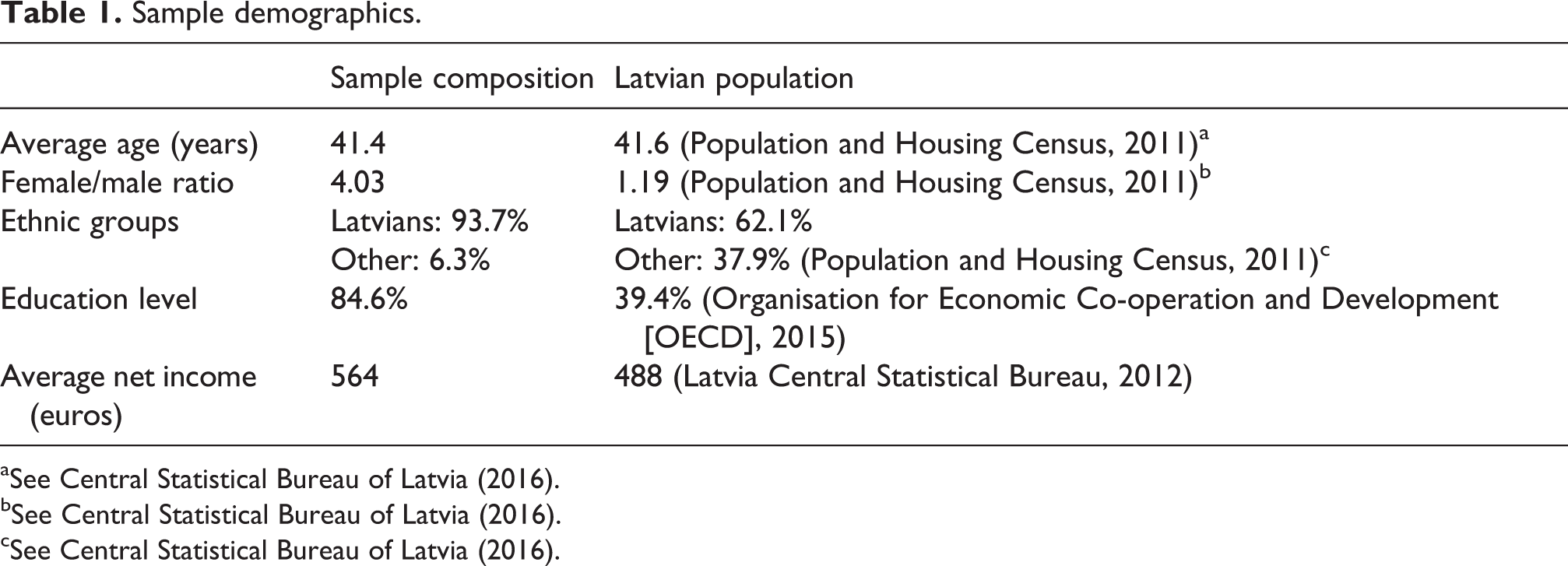
The analysis described in this article is based on a sample of 267 individuals; however, due to missing data, the structural analysis is based on 252 observations. The demographic data of the sample is compared with general Latvian population statistics in Table 1. Compared to the national average, the respondents in the sample generally have a higher level of education and income, are overwhelmingly ethnic Latvians (in the context of a highly multi-ethnic country) and are mainly female. Most of these features can be tentatively related to the nature and scope of the community– that is, knowledge and information exchange about topics of specific ethno-cultural interest.
Sample demographics.
The questionnaire was structured in sections corresponding to the latent variables as outlined in the previous paragraphs (social capital dimensions, motivational attitudes, knowledge-exchange quality and knowledge growth), with a subset of questions/statements associated with each hypothesized variable.
Measurement of variables and data analysis
The sets of statements that were used to evaluate the latent variables are listed below. The respondents’ answers were measured using a 5-point Likert scale (Likert, 1932). Given the structure of the theoretical model and the psychometric nature of the items, the chosen approach for the analysis was structural equation modelling for latent variables (Joreskog and Sorbom, 1979). The analysis was carried out using Amos 20.0, integrated in SPSS 20.0.
Cognitive social capital
This was measured through three statements: ‘Members of the community use understandable narrative forms when adding posts/messages’; ‘Members of the community have a similar educational background’; and ‘Members of the community share common memories about the past’.
Relational social capital
This was measured through six statements: ‘Members of the community behave in a reliable manner’; ‘Members of the community behave in a trustful manner’; ‘Members of the community act for the common good’; ‘Members of the community do not take advantage of others’; ‘I feel a sense of belonging towards the community’; and ‘I have a feeling of closeness with regard to the community’.
Motivation
Two scales were used to measure motivation, related to community-oriented motivation and personal-benefits-oriented motivation. Community-oriented motivation was measured by three items: ‘Sharing things that I know with community members makes me satisfied’; ‘Sharing things that I know with community members makes the community grow’; and ‘Sharing things that I know with community members makes the community successful’. Personal-benefits-oriented motivation was measured by two items: ‘I use the National Library of Latvia community to obtain useful information’ and ‘I use the National Library of Latvia community to increase my knowledge’.
Quality of knowledge sharing
This was measured through three items: ‘The knowledge shared by members is reliable’; ‘The knowledge shared by members is accurate’; ‘The knowledge shared by members is complete’.
Individual knowledge growth
Two scales were considered: declarative knowledge growth and complex knowledge growth. Declarative knowledge growth was measured through the following three items: ‘Interaction with the National Library of Latvia community helped me increase my knowledge about specific facts and topics’; ‘Interaction with the National Library of Latvia community is a relevant source of information for me’; and ‘Interaction with the National Library of Latvia community helped remind me of past events that I had forgotten/did not remember well’. Complex knowledge growth was measured through the following three items: ‘Interaction with the National Library of Latvia community helped me increase my critical thinking’; ‘Interaction with the National Library of Latvia community helped me understand connections between events’; and ‘Interaction with the National Library of Latvia community helped me increase my skills in solving practical issues’.
Results
The results support the significance of nine of the hypotheses, whereas three are rejected: cognitive social capital is not found to be a relevant factor behind personal-benefits-oriented motivation-building; cognitive social capital is not found to be a relevant factor behind the quality of knowledge sharing; and the quality of knowledge exchange is not found to be a relevant factor behind complex knowledge growth.
In addition, five unexpected significant direct effects were found on the basis of the analysis of the residuals and modification indexes: relational social capital positively affects personal-benefits-oriented motivation; cognitive social capital negatively affects declarative knowledge growth; community-oriented motivation has a positive direct effect on both declarative and complex knowledge growth; and personal-benefits-oriented motivation positively affects declarative knowledge growth.
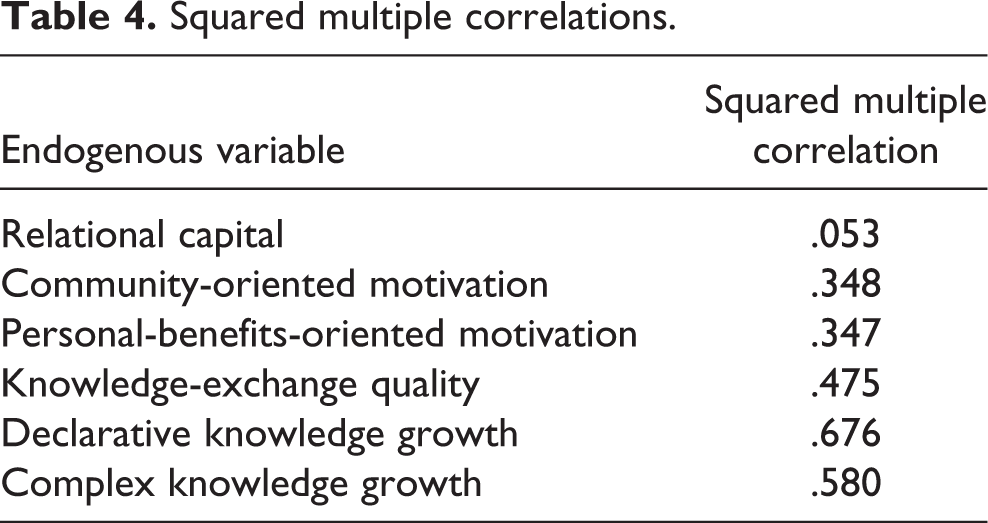
The adaptation of the modified model (including unexpected significant effects) to the data is acceptable (chi-square fit statistics/degree of freedom = 1.749; normed fit index = .879; comparative fit index = .944; root-mean-square error of approximation = .055). Moreover, the squared multiple correlations are relatively high, implying that the explicative power of the model with regard to individual knowledge growth dynamics is good. Tables 2, 3 and 4, respectively, summarize the standardized direct effects for the structural part of the model; the standardized direct effects for the measurement part of the model; and the squared multiple correlations. Figure 1 graphically represents the structural model (the causal linkages between the latent variables).
Standardized direct effects (structural part).
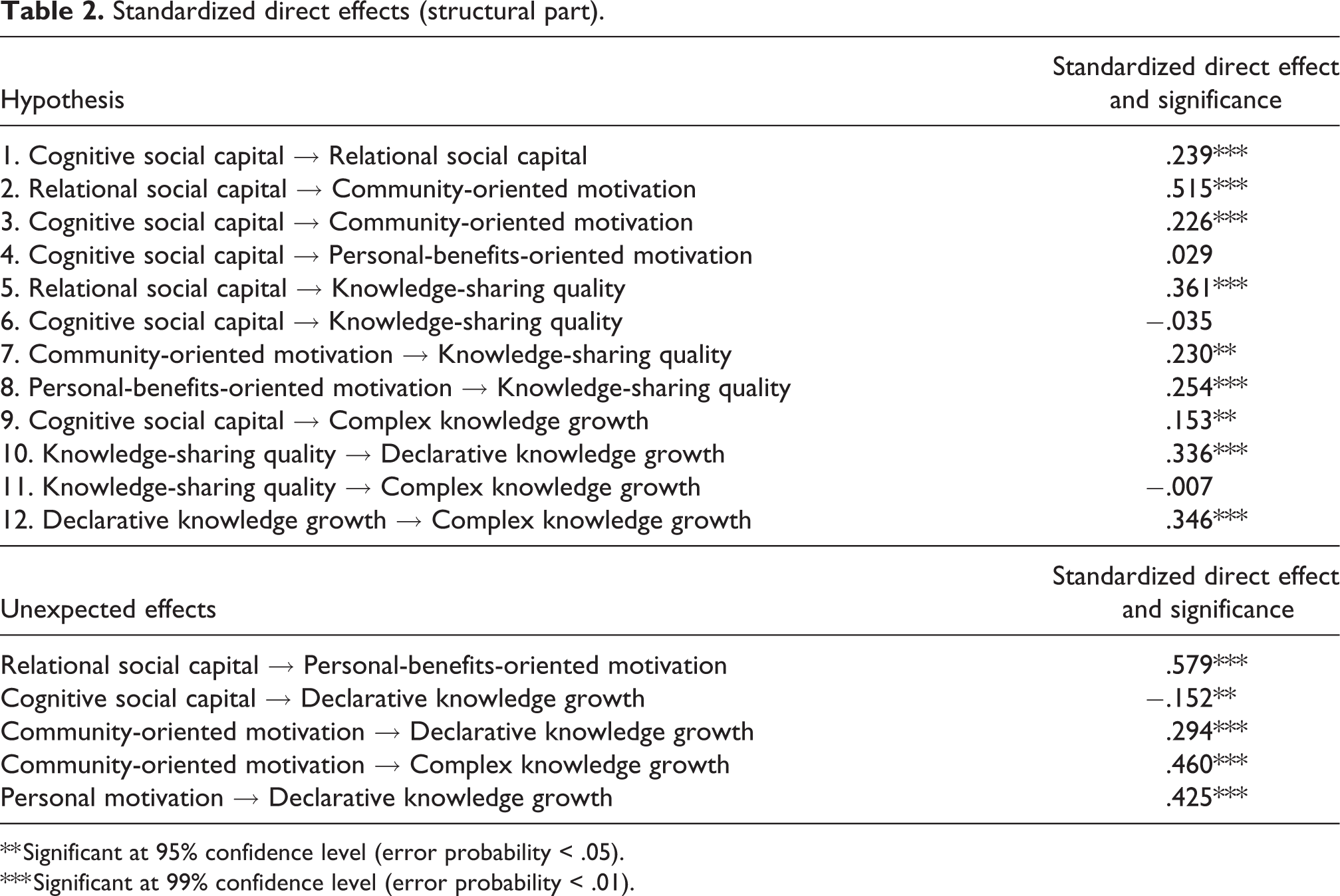
** Significant at 95% confidence level (error probability < .05).
*** Significant at 99% confidence level (error probability < .01).
Standardized direct effects (measurement part).
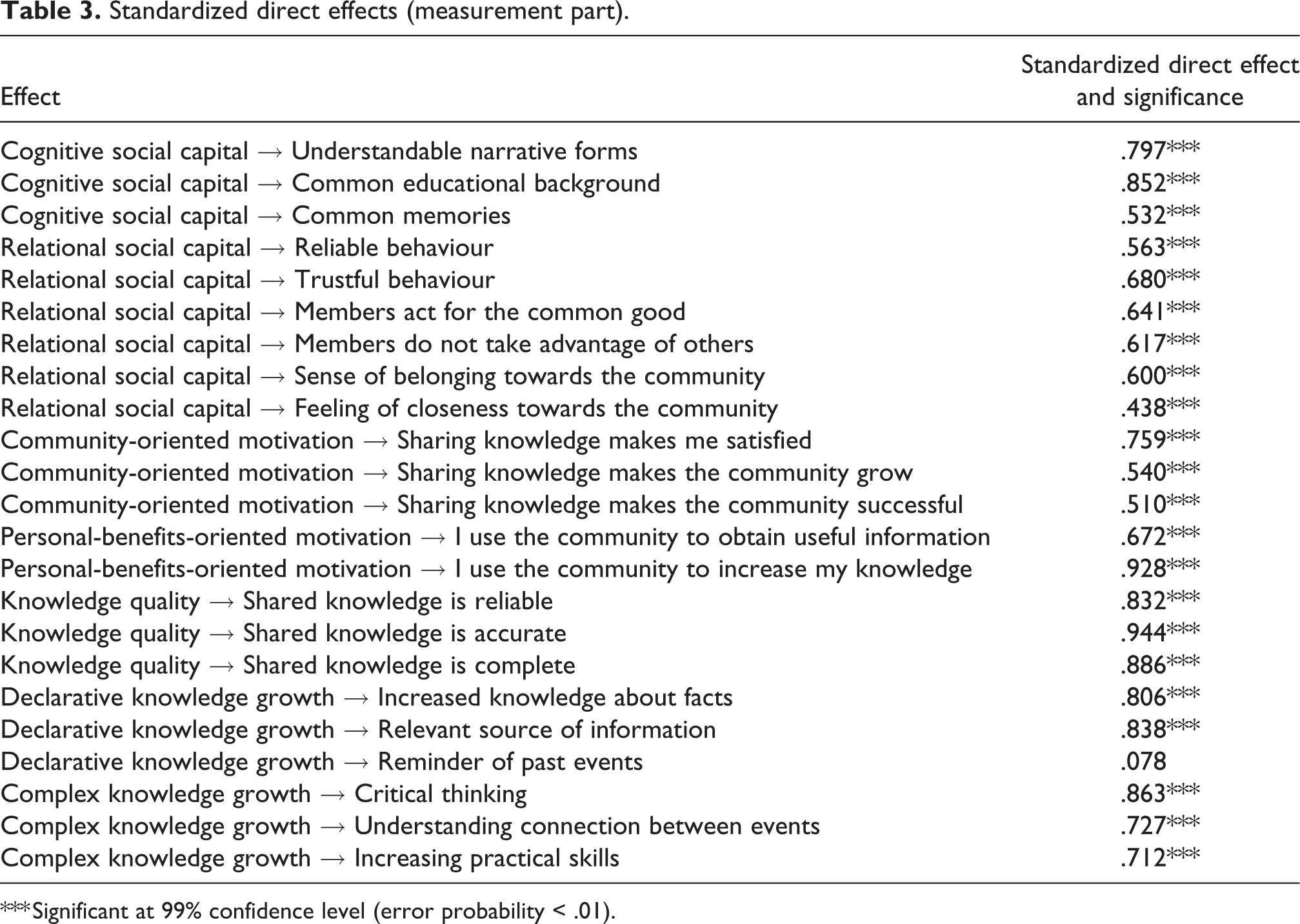
*** Significant at 99% confidence level (error probability < .01).
Squared multiple correlations.
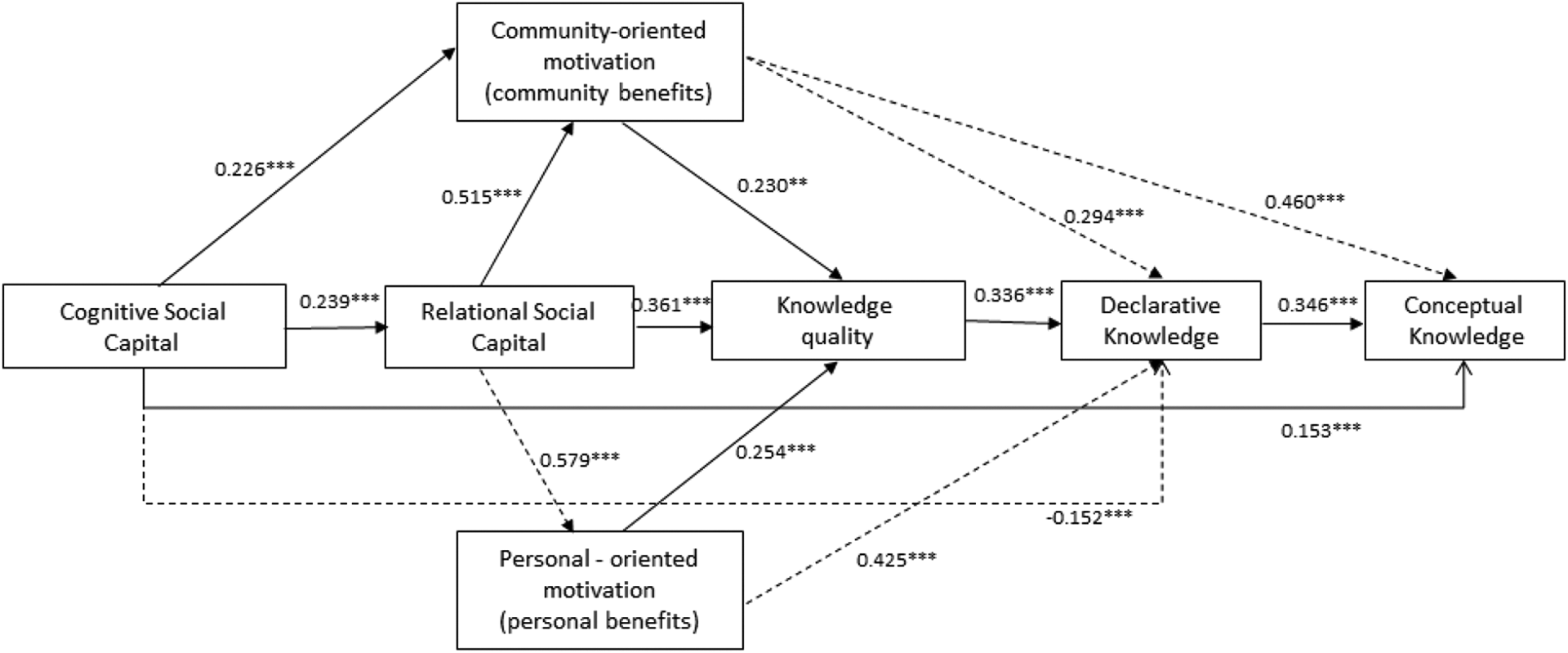
Structural model results: standardized direct effects.
Discussion
The results appear to support some common findings in organizational and community studies. However, some unexpected effects are found, which may be due to the specific nature of hybrid communities. Among the expected effects, social capital dimensions are found to positively affect (either directly or indirectly) knowledge-exchange quality and individual knowledge growth. This confirms the findings of several social-capital-based studies in organizational science (Chiu et al., 2006; Tsai and Ghoshal, 1998). The cognitive and relational social capital dimensions play different roles with regard to the investigated dynamics. In particular, relational social capital is a relevant factor behind information access and knowledge sharing mainly in an indirect way (by fostering both collective and personal motivation, and the quality of knowledge exchange). This is consistent with the vast body of literature focusing on trust and relational social capital as the main driving force behind knowledge transfer in both physical and virtual communities. The role of cognitive social capital is both direct and indirect, and ambiguous to some extent. Its indirect effect consists of fostering both relational social capital and collective motivation; this seems to mean that a common background and vision fosters a sense of community and cohesion. Moreover, a significant positive direct effect on the exchange of complex knowledge is also found, but it goes together with a negative impact on declarative knowledge. In other words, ‘relative absorptive capacity’ is an enabling asset for the transfer of conceptual and procedural knowledge, but can be an obstacle with regard to the exchange of information.
Some of the most interesting results relate to the role of motivational factors. Unexpectedly, community-oriented motivation appears to be a direct predictor of individual knowledge growth (both declarative and complex) and personal-benefits-oriented motivation has a positive impact on declarative knowledge. Therefore, motivation seems to play a more relevant role than the quality of knowledge sharing in enhancing access to knowledge. Such a finding partially contradicts Szulanski’s (1996) study, which identifies inner barriers to knowledge as more relevant than motivational barriers; on the other hand, it supports the conception of the collaborative and collective epistemic agency of social communities (Gilbert, 2004; Tomasello, 2009).
Overall, the results point to the rich variety of social patterns of knowledge access and growth. In particular, social capital is found to affect knowledge sharing and growth in both direct and indirect ways. This may support Wellman’s (2001) and Hampton and Wellman’s (2003) claims about the positive complementary role played by information and communications technologies and face-to-face contact in fostering socio-cognitive dynamics in communities– for example, information and communications technologies may foster weak ties that span structural holes (see Burt, 2000).
Finally, it is necessary to mention the implications of the results with regard to the nature of hybrid communities. The present study provides support for the hypothesis of the impact of the community format on the infrastructure, which, in turn, causes a complex pattern of knowledge transfer in the life space of an individual. Every community has factors that generate its identity (a sense of belonging and perception of in-groups and out-groups). It seems that the differences in format do not determine the strength and saliency of the social identity of a community, but they do determine the overall pattern of knowledge transfer among its members.
The results also seem to provide support for the assumption that the social structure represented in identity communities is the result of the interaction between different, simultaneously existing and interacting, domains and formats. The coexistence of digital and physical domains, in the case of hybrid communities, seems to generate specific characteristics that are not typical of digital or physical communities alone.
In terms of practical guidelines for the investigated community, the significant role of motivational factors– even ‘egoistical’ ones– in affecting knowledge-sharing quality and individual knowledge growth may imply that there is significant room for improvement in terms of the cognitive benefits for members of the community through the promotion of individual engagement, even beyond the boundaries of the common background and shared language/codes represented by cognitive social capital. Fostering trust, and relational capital in general, among community members appears to be a crucial factor in fostering both motivation and the quality of knowledge sharing.
Limitations and implications for future research
The present study has some limitations. First, it is unclear whether the results can be extended to all types of hybrid communities due to the specific ‘non-organizational’ features of the community under consideration (see Chiu et al., 2006). Second, the results could be sensitive to socio-demographic and socio-economic variables such as age (Pfeil et al., 2009), income (Grootaert and Van Bastelaer, 2002) and gender (Silvey and Elmhirst, 2003), which have been found to affect social capital dynamics in many contexts. Sensitivity analysis based on such control variables was not carried out in the present study due to the small sample size. This would definitely be a direction to take for further studies.
Finally, how differences in community format determine a sense of agency is an open issue, which could be investigated by a longitudinal study of a hybrid community, in order to discover differentiation, integration and restructuring effects in the life space and in- and out-group generation; a detailed analysis of the psychological reality of hybrid versus virtual or physical links, and the effects of their contagions on human behaviour, in order to discover what counts as a psychologically and cognitively real community (Centola, 2018; Lewin, 1936; Suler, 2016); or an investigation of the impacts of the spatial representation of communication networks on communities of different scales and formats (Peer et al., 2020).
Footnotes
Data availability statement
The data on which this study is based is available from the authors on reasonable request.
Declaration of conflicting interests
The authors declared no potential conflicts of interest with respect to the research, authorship and/or publication of this article.
Funding
The authors received no financial support for the research, authorship and/or publication of this article.
