




Abstract
In the late 1990s, the explosion of electronic resources resulted in large-scale digitisation projects amid the need for the preservation of digital information. The KB, National Library of the Netherlands, has been actively involved in these activities. Now, it is proposing better ways to both preserve physical library materials and improve their accessibility for educational purposes. This article describes two ongoing projects that involve preservation and public engagement. One, in its early stages, is to test the applicability of 360° imaging to support virtual access to the special collections’ storage. The second is the virtual reality production, for educational purposes, of children’s pop-up books. Both projects could inspire other libraries to introduce three-dimensional or virtual reality technologies and their applications to new audiences. This article describes each project, shows the methods used, and discusses the expected outcomes.
Keywords
Introduction
Collection management is an essential part of everyday library activities. This responsibility includes, among other tasks, selecting, acquiring, maintaining and storing collections. In the late 1990s, the explosion of electronic resources initiated large-scale digitisation projects and digital information preservation. These are two of the main themes of librarianship in the 21st century. One purpose of digitisation is preservation, but another is making information accessible to the wider public. The KB, National Library of the Netherlands, which was founded in 1798, has collected approximately 7 million physical items (books, newspapers, magazines, maps, etc.) that stretch in storage over 125 linear kilometres. Over the past 30 years, the KB has digitised books, periodicals and newspapers on a large scale. These resources are digitised to both preserve them and to facilitate access. Through the website Delpher.nl, every Dutch citizen can now search and browse through 120 million pages of digitised newspapers, periodicals and books. Moreover, DBNL.nl offers scans of the highest possible quality of Dutch literature. In 2020, both websites were visited in total around 10 million times. To further this massive digitisation effort, the KB is proposing enhanced ways to preserve its physical library holdings and improve, for educational purposes, patrons’ access to and engagement with them.
Digitisation has also allowed the library to develop several new interactive education programmes to engage patrons. By giving them access to a digitised copy of an item, the library supports the preservation and prolongs the life of its physical holdings. This article describes two ongoing projects at the KB that aim to aid the preservation of the library’s materials and public engagement with them. In the first project, the KB is in the early stages of testing the feasibility of 360° imaging to support virtual access to its special collections. These holdings will become less visible overall if the KB implements plans for a new automated storage and retrieval system (ASRS) to preserve its entire physical collection. In the second project, the KB is using a virtual reality interface for educational purposes; if this effort is successful, it could inspire other libraries to introduce virtual reality. This article represents the first attempt to describe the KB’s use of these technologies and to discuss the potential outcomes of these efforts.
The article is structured as follows. It discusses related works and previous research in the ‘Background’ sections, before detailing the two case studies. The first study explores 360° imaging to support virtual access to the KB’s special collections and the second study examines the KB’s creation of virtual reality representations of the library’s children’s pop-up books. The final section offers design guidelines and ideas for future work.
Background on library repositories
The KB collects everything that is published in the Netherlands or concerns the country, which ranges from medieval literature to contemporary publications. This policy means that the KB’s collection is continuously growing. The challenge for the KB is to maintain a balance between preserving and offering access to its holdings, both physical and digital. One difficulty is to provide adequate space and a safe environment for its expanding physical collections. When it is not possible to expand existing library buildings, the solution is either to redesign the current space or to move collections into a super-high-density facility.
Purpose-built high-density facilities usually follow one of two designs: the ‘Harvard model’, which was designed for manual retrieval, and the ASRS model, where retrieval is performed by a robotic mechanism. The first model was created at Harvard University in 1986 and is now used in libraries all over the world, especially in North America (Weeks and Chepesiuk, 2008). The ASRS model, by contrast, is more often used in industrial settings such as distribution centres for supermarkets. However, the ASRS model has been used in some library collections. For example, the British Library repositories in Boston Spa and the cooperative Speicherbibliothek in Büron, Switzerland, both use the ASRS model.
Background on the use of virtual reality in libraries
Like the KB, many libraries strive to make their digitised items available through their websites or other platforms, such as the Microsoft Live Search Books project, the Google Books Library Project or the Open Content Alliance (Payne, 2007). Until recently, however, libraries seldom used augmented, virtual or mixed reality to expand access to their collections. The COVID-19 pandemic, by necessity, has changed the way people access heritage collections, but, before this period, several libraries experimented with these technologies. Especially after 2014, virtual reality, augmented reality, mixed reality, three-dimensional (3-D) modelling and 3-D-capture techniques became increasingly common in higher education, research and teaching (Grayburn et al., 2019; Milgram and Kishino, 1994). It is no coincidence that, in 2014, Google released its Cardboard virtual reality viewer, which made virtual reality widely accessible. In the following years, a series of fully functional virtual reality headsets made it possible to harness virtual reality in new fields, such as architecture, design and the humanities (Figueroa, 2018).
Libraries seldom used virtual, augmented or mixed reality technologies for education projects until recently. For instance, students at the University of Iowa developed a reality sandbox to help them visualise how gravity works (Gravbox, 2018). Also, Maryland’s Prince George’s County Memorial Library System uses Google’s Tilt Brush so that users can paint in 3-D (Dar, 2018).
Also, libraries sometimes provide space and services to help develop projects or collaborate with other institutions, such as universities or private companies. For instance, in 2018, the University of California San Diego Geisel Library’s Digital Media Lab offered virtual reality headsets, 3-D printing and digital expert consultation to students and a general audience (Oyelude, 2018).
KB’s future storage solution for its physical collections (Foekje Boersma)
The KB’s physical collections are currently located in the National Library building in the centre of The Hague. The collections are stored in static stacks in 29 climate-controlled compartments over 9 floors. The current system will pose several challenges in the future. First, there is limited space for the collection to grow. Second, the building needs renovations that will be extremely expensive to make. Third, the use of space for storage in a prime location in the centre of the city is not economically sustainable. Finally, the way patrons use the library is changing; there are markedly fewer requests for physical items, aside from special collections, and there is increased access to digitised materials online.
For these reasons, the KB is exploring the possibility of moving its entire physical collection off-site to a dedicated external facility. Modelling its plans on the cooperative library storage facility in Büron, the KB is considering an automated, super-high-density storage facility with passive climate control. The planned building would passively maintain a safe climate for collections, with the temperatures adjusting with the seasons and the relative humidity stabilised by the dense storage of the hygroscopic collections themselves, which are capable of absorbing and desorbing moisture from the air. The KB’s location in a temperate climate makes this plan feasible.
To maximise the benefit of the climate’s lower temperatures (10–12°C in winter), the facility should be automated and human activity in the storage area limited. These restrictions also facilitate high-density storage. In order to mitigate fire risk, oxygen levels in the storage area will be kept artificially low. To mitigate flood risk, the plan is to construct the building on a 2-metre-high artificial hill.
ASRSs, where collections are placed in standard plastic or metal containers and organised by size, are unexceptional. However, the KB’s plan to also store its special collections in this environment is more novel. Many cultural heritage specialists resist the idea of a medieval manuscript being confined to a plastic container, placed in a high rack and retrieved only by an automated system. Nevertheless, based on the risk assessment, climate modelling and other institutions’ reports, the new set-up is sensible (American Society of Heating, 2019; Boersma et al., 2014).
It is, however, difficult to let go of the experience of being in the library stacks as they exist now. It is not that these stacks have a special design or aesthetic value – the KB’s current building dates to the early 1980s – and access to special collections is restricted to authorised staff. Of course, books can be retrieved using the catalogue, but for collection specialists, curators and conservators alike, being able to see the collection is an important part of their care for these items and can also assist their research. For this reason, the Conservation Department is conducting a survey of the condition of different special collections’ materials; this assessment ought to provide an overview that the KB can use to plan its move and for the long-term prioritisation of collection-care activities. The KB is exploring ways in which the visual and tactile aspects of these items can be captured and preserved. Virtual reality offers perhaps the best opportunity to achieve this aim.
The 360° images of the special collections’ storage: methods and approaches (Marzia Loddo)
If the KB chooses an ASRS, it would radically change the way in which it currently manages access to its collections. The care and maintenance of the collections, performed by stack-keepers and conservators, relies on their having access to the stacks. Although access to special collections is restricted to authorised staff, they benefit from access to them for research. All this might change in the future, however. A large part of the collections has already been digitised and users can access the digitised versions online. However, with these changes, the possibility to look at the books in person may largely disappear. In the special collections of the KB, the books are mainly positioned by size and date of entry, rather than by subject. However, for centuries, open shelves have helped researchers find new resources because other relevant books are positioned near those that they know are relevant to their research.
With the DIPOT project, Marzia Loddo aims to preserve high-quality access to the KB’s special collections. 1 The current arrangement of the books in storage was captured by using a 3-D camera (Insta360 EVO). The camera was installed on a tripod and placed in different areas of the current stacks. Images were captured through the technology platform ThingLink. Once collected, they were analysed and equipped with interactive elements (Figure 1). With this tool, the library could, theoretically, connect each book on the 360° image with hyperlinks to the digitised copy, a conservation report, additional images and other materials (Figure 2). Moreover, a user can roam freely in the recorded 360° space, zoom in and out for a different view, and make out the titles on the shelf. In addition, this system makes it possible to access links that provide information about the author, printer, illustrator or former owners. These links might even connect, through linked open data, the book selected with other online resources (Loddo, 2020). Currently, Marzia Loddo is in the early stages of testing the usefulness of this 360° image with several groups of higher education students at the Delft University of Technology. She is also testing 360° representations of other settings, including museums, and plans to compare the 3-D representations with others made using virtual, augmented and mixed reality.
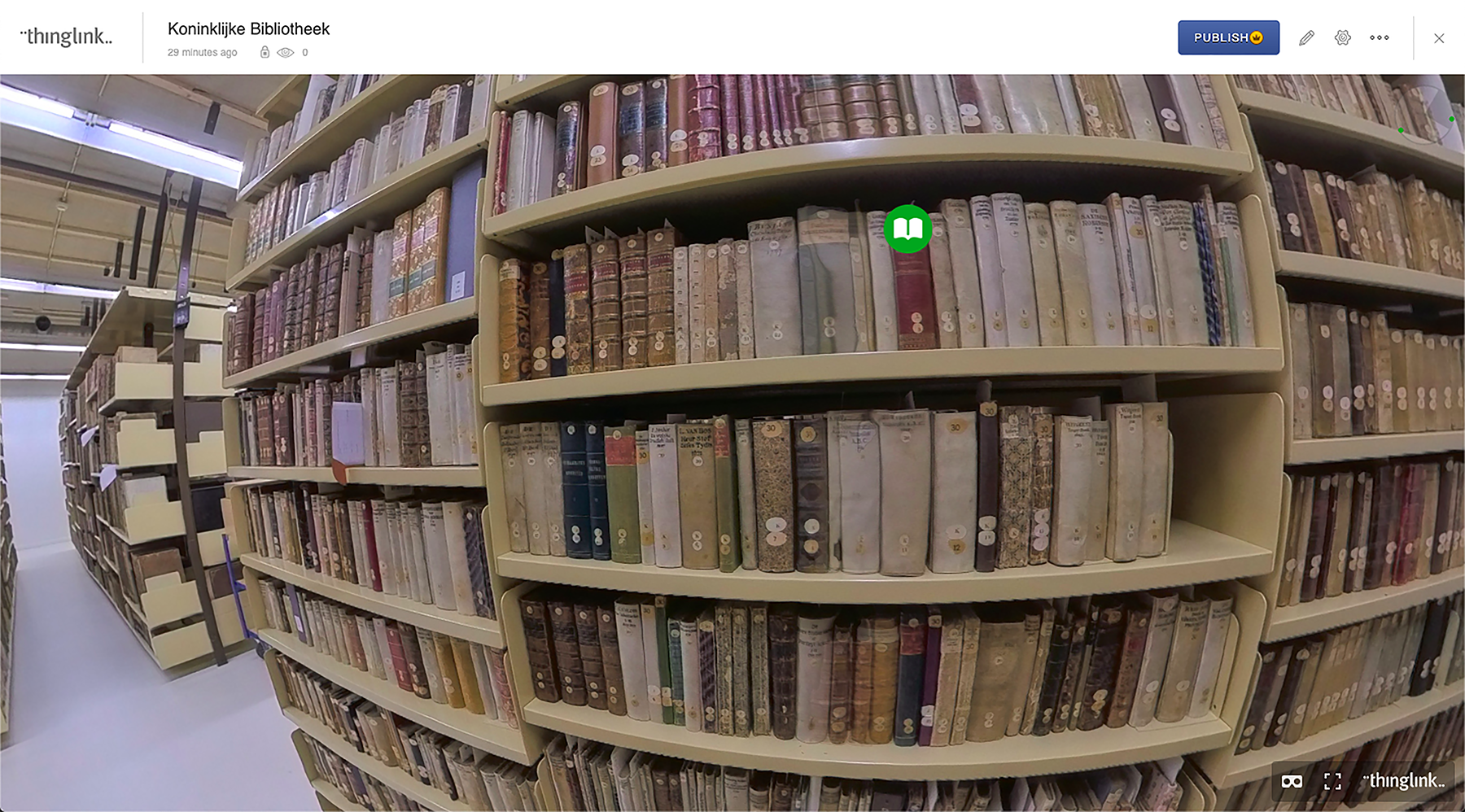
The 360° representation of the KB’s special collections’ storage (Loddo, 2020).
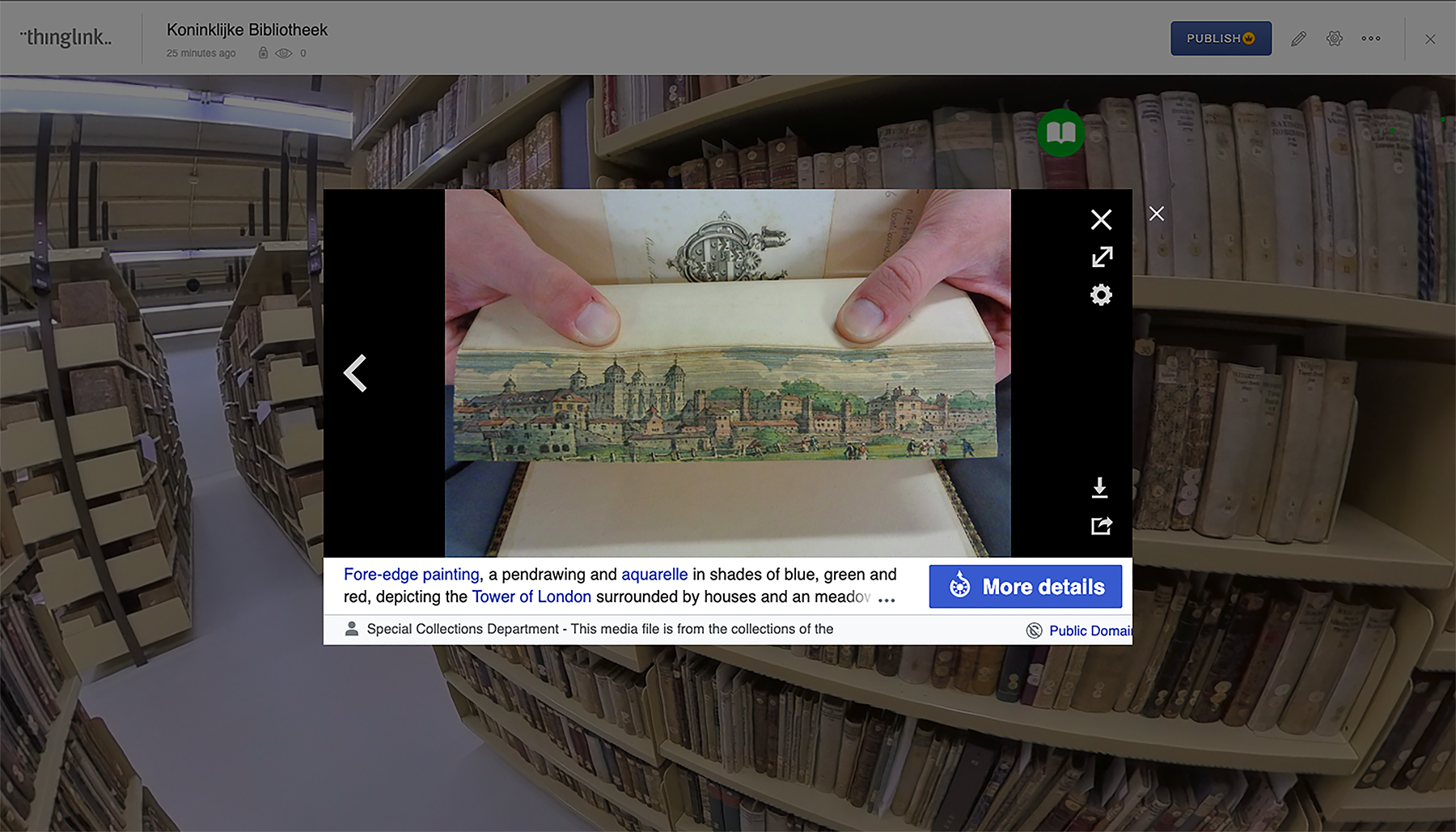
The green button – placed on the book in Figure 1 – redirects the user to the digitised copy of the manuscript (Wikimedia Commons, 2018).
Experiments with a virtual reality production of novelty children’s books: methods and approaches (Martijn Kleppe and Karin Vingerhoets)
One of the special collections of the KB is novelty children’s books, such as pop-ups. Novelty books are those whose design is more elaborate than leaves sewn between two flat covers (KB, 2019). The pages may fold out like a concertina or illustrations may pop up. Novelty books are often quite fragile and easily damaged, particularly if they are used by young readers, who are often more enthusiastic than careful while handling books. Visitors can only access novelty books on-site and by request.
To preserve the books, the KB is experimenting with virtual reality production as an alternative to physical access. The library began this project with three novelty books from the 1950s and 1970s – a pop-up book about Noah’s ark, a carousel book about a car repair shop, and a fan-folded street scene – and one book from 1863 – a picture book on farm life with movable parts. The copyright of the last book had expired, but the KB conducted research to identify the illustrators of the other books and traced their heirs to ask permission to use the books for this project. This step took several months and is still ongoing for one of the books.
For the virtual reality production, the library collaborated with Justin Zijlstra and Tijmen Lohmeijer, who specialise in making immersive, interactive experiences. With their help, the KB carefully photographed the books from all possible angles in the library’s photographic studio. Zijlstra and Lohmeijer then recreated the books in a virtual environment and mapped the photographed footage onto 3-D models. They added shadows and surrounding bookcases to give the viewer the feeling of being in a real library (Figure 3). They also added sound effects, such as a voice that reads parts of the story and the background noises of a radio and banging hammers in the car repair shop.
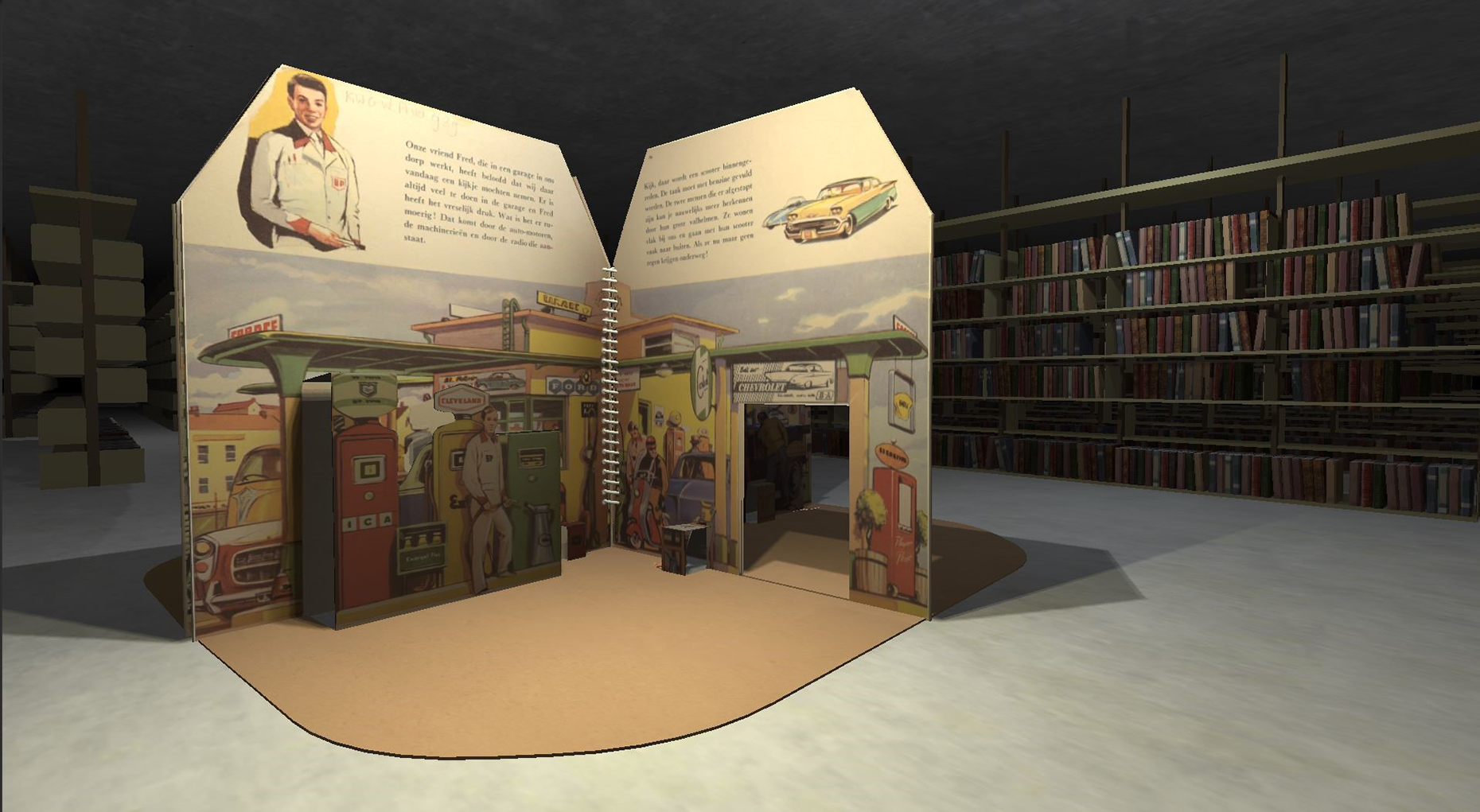
The virtual reality representation of the carousel book ‘Garage’, with illustrations by N Dear (published between 1950 and 1960), in the virtual library environment Source: KB-Koninklijke Bibliotheek (2020).
Using an Oculus Quest virtual reality headset, users can explore the books in different ways. They can see a representation of their own hands in the virtual environment and use them to open the books, move them and turn on sound effects. Also, moving one’s body allows one to move around in the virtual world; users can walk around the virtual books and view them from any angle. The virtual reality experience lets users enjoy the details of the books close up and appreciate the craftsmanship in a whole new way.
Discussion
This article has investigated two ongoing projects at the KB that involve digital-representation techniques. The first description recounts the early stages of testing 360° imaging to support virtual access to the library’s special collections. Currently, a group of students at the Delft University of Technology are testing the system. After this pilot test, the KB intends to extend the use of the 360° application to a wider audience. In this way, curators, book historians, archive professionals, conservators, scholars and the general public can virtually browse the KB’s stacks in ways that are impossible in real life, due to restricted access. In addition, this virtual representation will be an invaluable record of what has been collected and how it has changed over time.
The second project has pioneered virtual reality as a means to introduce older books to the general public in an exciting way and help these materials find a new audience. Virtual reality is more realistic and vivid than two-dimensional photography. The KB is currently setting up a user study to understand how different users experience virtual reality and their impressions of its value. The study’s outcomes will determine whether the KB uses virtual reality to open up other vulnerable collections to digital access.
Because these two projects are closely related, the authors are considering testing the usability of virtual reality pop-up books in the 3-D-storage environment. Virtual reality contents could be added to the 360° images as an interactive element. This project could also inspire other library staff to introduce virtual reality technologies to new audiences.
Footnotes
Declaration of conflicting interests
The authors declared no potential conflicts of interest with respect to the research, authorship and/or publication of this article.
Funding
The author disclosed receipt of the following financial support for the research, authorship, and/or publication of this article: The DIPOT project is part of the LEaDing Fellows Postdocs Programme and co-funded with the Delft University of Technology. The project has received funding from the European Union’s Horizon 2020 research and innovation programme under the Marie Skłodowska-Curie grant agreement no. 707404. The opinions expressed in this document reflect only the authors' view. The European Commission is not responsible for any use that may be made of the information it contains.

