




Abstract
Associations between the occurrences of headache among parents and their offspring during a 7-year follow-up were studied. Data were collected using a prestructured questionnaire from a representative population-based sample of 1443 families expecting their first child. Seven years later, another questionnaire was sent to 1132 families still included in the study. Questionnaires were returned by 968 families. One or either of the parents had experienced frequent headache in 47% of families (34% of the mothers and 19% of the fathers) before pregnancy. Of the 6-year-old children, 15% had headache disturbing daily activities. Mother's prepregnancy headache was a clear predictor of her child's preschool headache (p = 0.006, OR = 1.7, 95% CI 1.2–2.4). In the clinical interview, the children with headache more often had first-degree and second-degree relatives with headache than the control children.
Keywords
Family history of headache is considered to be a common predictor of headache occurrence (1 –5). It has previously been used as one of the criteria for migraine (6, 7), but was not included in the criteria of the International Headache Society classification (8).
Several terms have been used in epidemiological studies of familial occurrences of certain diseases: familial predisposition—a higher risk of the disease because of the presence of an affected relative; familial aggregation—the disease is caused by genetic or environmental factors which cluster in the families; positive family history—a close relative is affected.
Headache in childhood has been found to be associated with an occurrence of headache among other family members (3, 9), and parents in particular (1, 2). The best single predictor of childhood headache problems appears to be the answer to the following question: “Does one or do both of your parents have headaches?” On the other hand, the frequency of headache cannot be estimated from the general familial occurrence of headache (1).
Family history of migraine has been found to vary from 58% to 88%, and maternal history of headache is especially important in determining this disorder (6, 7, 10). A twofold to threefold family risk of migraine among first-degree relatives has been mentioned (11). A review of the literature regarding twin, spousal, and family studies strongly suggests that different types of migraine are genetically determined, and that the mode of the inheritance is most likely multifactorial.
The validity of family history data on both headache and migraine is problematic. In family history interviews, headaches have been found to be underreported even among first-degree relatives (12, 13). To avoid this bias, direct interviews should be used whenever possible.
The purpose of our study was to examine predictability of headache occurrence in young offspring with regard to parental headache in a follow-up study setting. In a case-control setting, the occurrences of headache among 6-year-old children as well as among their parents, siblings, and grandparents were studied.
Subjects and methods
The present study is part of the Finnish Family Competence Study. Using a stratified, randomized cluster sampling procedure, subject recruitment in the province of Turku and Pori in southwestern Finland began in 1986 (14). The original study population consisted of young families, mothers and fathers who were expecting their first offspring and visiting maternity healthcare clinics for the first time, which usually happens at the 10th week of pregnancy. Numbers of participants in different stages of the study can be seen in Fig. 1. Invitations to participate in the study were mailed to 1582 families; 1443 families (91%) gave their informed consent. A total of 1322 women and 1257 men responded to the questions on the prevalence of headache. There were 1294 childbirth deliveries, and the number of eligible children was 1287.

Numbers of participants in the different stages of the study.
The families were followed up during pregnancy and after the birth of the child until the child was 6 years of age. At the end of the follow-up, 87% of the children were still traceable. The parents were asked the following two questions about their child's headache: (1) “Has your child had headache disturbing his/her daily activities in the past 6 months?”, and (2) “Has your child had headache disturbing his/her daily activities at some period in his/her life (prior to the 6 months mentioned above)?” The questionnaire pertaining to the headache prevalence was responded to in an acceptable manner by 968 parents on behalf of 86% of the 1132 eligible children.
Of the respondents, 204 (22%) had had headache disturbing their daily activities during the follow-up. Of the 204 children, 144 (71% of the headache children and 15% of all children) had suffered from headache which disturbed their daily activities during the preceding 6 months (15). Of the 144 children with present headache, 106 (74%) children participated in the clinical interview and examination following the survey. The number of matched controls was 106. The control children were matched for age, gender, and degree of urbanization. The controls were also clinically examined and interviewed.
The classification of the International Headache Society (8) was used for the study. Children with secondary headaches were excluded from subsequent examinations. The total number of participants was 96 children suffering from primary headache in the previous 6 months and their 96 matched control children. In this sample, 51% were boys and 49% were girls. At the time of the examination the mean age of the children was 7.0 years. Finnish children enter the compulsory school system at the age of 7.
Statistical methods
The direct associations between the parents' frequent prepregnancy headaches and the child's headache at preschool age, the associations between the occurrences of headache among the family members as assessed in the clinical examination, as well as the influence of parents' headache as far the quality of the child's headache was concerned, were first studied by cross-tabulation with Pearson's Chi-squared test. In multivariate analyses, logistic regression models (16) and conditional logistic regression models (17) were used. Odds ratios (OR) with 95% confidence intervals (95% CI) were calculated from logistic regression models. CI limits were calculated using the formula based on normal approximation: CI = exp[(b±1.96SE(b)], where b is the estimate of the coefficient in the logistic model and SE(b) its standard error. A p-value of <0.05 was used as the cut-off point of significance. BMDP90 statistical software was used for the statistical computation (18).
Results
Expectant parents' prepregnancy headache prevalence
Thirty-four percent of the expectant mothers and 19% of the expectant fathers had suffered from headache at least once a month before pregnancy. In 47% of the families, one of the future parents had experienced frequent prepregnancy headache (19).
Prevalence of headache in 6-year-old children
Twenty-two percent of the children had had headache some time in their young lives and 15% had had headache which disturbed daily activities in the previous 6 months (15).
Associations between the occurrences of the parents' prepregnancy headache and the children's headache at preschool age
Child's preschool headache was significantly associated with mother's prepregnancy headache but not with the father's headache before pregnancy (15) (Table 1).
Parental prepregnancy headache and children's headache at school entry (follow-up study setting).

Percentage of “yes” answers.
OR =odds ratio, 95% CI= 95% confidence interval.
Associations between the parents' occurrences of headache and the child's headache at preschool age as assessed in the clinical study
Children with preschool headache more often had relatives such as mothers and fathers as well as father's parents and mother's parents with headache than the control children in the clinical interview (20) (Table 2, Fig. 2).

Familial occurrence of headache.
Associations between the parents' and grandparents' headache and children's headache at school entry (case-control study setting).

Percentage of “yes” answers.
OR=odds ratio, 95% CI= 95% confidence interval (20).
Associations between the children's headache at preschool age in the clinical study and the siblings' occurrences of headache
Headache prevalence in siblings did not differ significantly between headache children and control children (p = 0.50).
Associations between parents' and grandparents' headache occurrences
The mother's risk for headache was significantly increased if the mother's parents had suffered from headache, but the father's headache was not associated with the headache of the father's parents (Table 3).
Associations between the parents' and grandparents' headache.
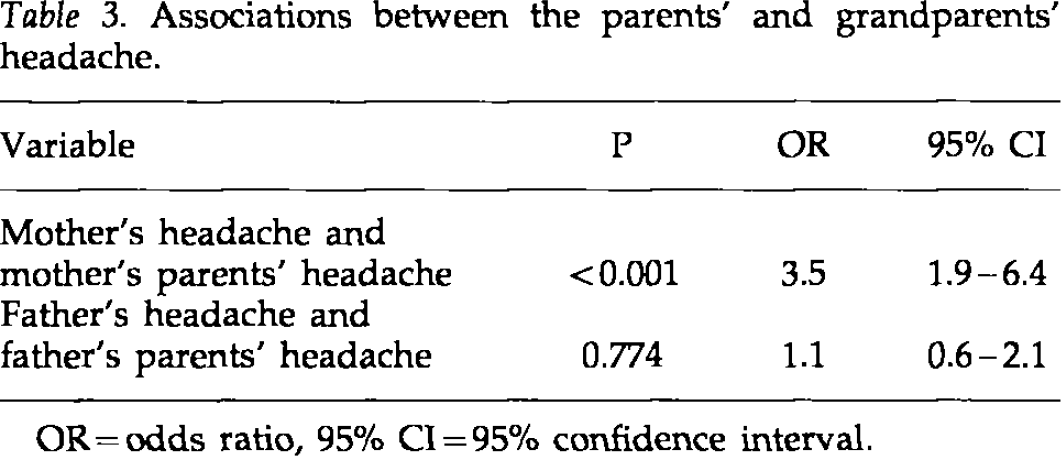
OR=odds ratio, 95% CI = 95% confidence interval.
Association between parental gender and the child's gender in connection with headache
Girls who suffered from headache seemed to have a mother suffering from headache more often than the control girls did. This difference was not statistically significant, however.
The occurrences of parental headache and characteristics of the child's headache were not associated with each other. The child's headache characteristics, such as frequency, duration, triggers as well as increasing and relieving factors did not differentiate in parental groups with or without headache. In other words, parental headache had no influence on the quality of children's headache.
Discussion
The main results of our study were as follows. Within the follow-up study setting, the child's preschool headache was clearly associated with the mother's prepregnancy headache. In the case-control study, headache children had affected mothers, fathers, and grandparents more often than the control children had. Moreover, mothers with prepregnancy headache were more likely to have had affected parents than were the mothers without headache.
The value of our study is in the prospective follow-up study setting. A prospective follow-up study setting is perhaps the best way to obtain reliable information on predictive associations between headache of the parents and their children. The original study population, consisting of the families participating in the study, was a representative sample of young Finnish families and highly representative of the target population, with a high participation rate and no significant skewness in the distribution of basic demographic characteristics (14).
An assessment of a person's familial predisposition to headache, and especially to the headache occurrence prior to the birth of the child, yields important information for health care workers to identify high-risk child groups for headache.
Recent works have suggested that psychological factors in the family play an important part in the genesis of headache (2, 15). Moreover, headache may be associated with stress within the family. Therefore, it would be useful to deal with this phenomenon in intensive preventive work and to guide and support expectant parents. In the best case, the child may later quip: “It is not my headache!”