




Abstract
Background
Migraine, particularly chronic migraine (CM), is underdiagnosed and undertreated worldwide. Our objective was to develop and validate a self-administered tool (ID-CM) to identify migraine and CM.
Methods
ID-CM was developed in four stages. (1) Expert clinicians suggested candidate items from existing instruments and experience (Delphi Panel method). (2) Candidate items were reviewed by people with CM during cognitive debriefing interviews. (3) Items were administered to a Web panel of people with severe headache to assess psychometric properties and refine ID-CM. (4) Classification accuracy was assessed using an ICHD-3β gold-standard clinician diagnosis.
Results
Stages 1 and 2 identified 20 items selected for psychometric validation in stage 3 (n = 1562). The 12 psychometrically robust items from stage 3 underwent validity testing in stage 4. A scoring algorithm applied to four symptom items (moderate/severe pain intensity, photophobia, phonophobia, nausea) accurately classified most migraine cases among 111 people (sensitivity = 83.5%, specificity = 88.5%). Augmenting this algorithm with eight items assessing headache frequency, disability, medication use, and planning disruption correctly classified most CM cases (sensitivity = 80.6%, specificity = 88.6%).
Discussion
ID-CM is a simple yet accurate tool that correctly classifies most individuals with migraine and CM. Further testing in other settings will also be valuable.
Keywords
Introduction
Migraine, especially chronic migraine (CM), remains underdiagnosed and undertreated worldwide (1–7), despite the substantial burden it imposes on individuals, their families, and society (1,8–12). Data from the American Migraine Prevalence and Prevention (AMPP) Study suggest that only 56% of respondents meeting the International Classification of Headache Disorders, 2nd edition (ICHD-2) migraine criteria had ever received a migraine diagnosis from a health care professional (13–15). Among AMPP Study respondents meeting modified Silberstein-Lipton CM criteria, only 20% reported receiving a CM diagnosis from a health care professional (1).
New epidemiologic data emerging from the longitudinal Chronic Migraine Epidemiology and Outcomes (CaMEO) Study (16) illuminate the obstacles to effective care for CM. Only a fraction of the CM sample (13.6%) in CaMEO reported consulting a specialist (i.e. neurologist, headache specialist, pain specialist) for diagnosis and treatment of migraine (2). Even among people with CM who consulted a specialist, only 36% reported receiving a diagnosis of CM (2,16). Furthermore, only 4.5% of people with CM and significant headache-related disability (Migraine Disability Assessment (MIDAS) grade ≥2) who were currently consulting a health care professional ultimately received a diagnosis of CM and were receiving minimally appropriate acute and preventive treatment (7).
One traditional approach for improving the detection of under-ascertained medical conditions involves the use of screening or case-finding tools (17). The term “screening” is traditionally applied to tools that are designed to detect conditions in the presymptomatic phase (e.g. Papanicolaou (Pap) smears are screening tools for cervical cancer). The term “case-finding” is applied to tools that identify conditions that are underdiagnosed despite symptoms (e.g. the nine-item Patient Health Questionnaire is a case-finding tool for depression). Because CM detection occurs during the symptomatic phase, the most appropriate term is “case-finding tool.” The term “screening tool” is widely used and carries the important implication that people detected using this tool require further diagnostic assessment. For these reasons, we use the terms “screening” and “case-finding” interchangeably herein.
The objective of this research was to develop a reliable and valid case-finding tool for CM, applicable to people self-identified with severe headache. This tool, Identify Chronic Migraine (ID-CM), is intended to help clinicians identify patients likely to have migraine, and in particular, likely to have CM. Herein, a four-stage process was used to develop and validate ID-CM.
Methods
Overview
The ID-CM development process comprised four distinct stages. First, an international Delphi Panel (18) of expert clinicians and researchers selected candidate items from existing instruments and generated additional items for consideration (stage 1). In stage 2, cognitive debriefing interviews among people with CM were conducted to assess relevance and understanding of the Delphi item pool. The item pool that emerged from the Delphi Panel and cognitive debriefings was then fielded in a sample of people with headache recruited from the Research Now (Plano, TX) Internet panel, to evaluate the psychometric properties of the candidate items (stage 3). The ID-CM item pool emerging from stage 3 was administered to people with headache who were independently assessed by headache-expert physicians using semi-structured diagnostic computer-assisted telephone interviews (stage 4). Classification accuracy for ID-CM was compared with diagnoses independently assigned by clinical experts using a Semistructured Diagnostic Interview for Migraine (SSDI-M; Web Appendix 1).
Institutional review board approval was obtained for all stages of this study involving humans, with different ethics boards used for various stages, depending on investigator site requirements. Written informed consent was obtained from all participants. Participant consent language and compensation are available on request.
Stage 1: Delphi Panel
A bank of candidate items for inclusion in ID-CM was developed based on a review of existing instruments: ID Migraine (19), MIDAS (20), the six-item Headache Impact Test (21), and the American Migraine Study (AMS)/AMPP Diagnostic Module (9,22–24). These items were then reviewed by three clinical experts (DWD, RBL, AMB), and evaluated by eight expert-clinician panelists (SKA, WJB, AMB, H-CD, DWD, RBL, MBV, S-JW) through a modified Delphi approach consisting of two rounds of consensus development. The item bank was reduced, and response options and recall periods were modified based on expert feedback.
Stage 2: Cognitive debriefings
Endpoint Outcomes (Boston, MA) recruited a target of approximately 10 individuals with CM for qualitative interviews to test the item bank emerging from the Delphi Panel. These individuals had headache (tension-type and/or migraine) on ≥15 days per month for ≥3 months within the last six months, had ≥5 attacks fulfilling ICHD-2 (25) criteria for migraine without aura, and fulfilled criteria for migraine pain and associated symptoms on ≥8 days per month for ≥3 months.
Cognitive debriefing interviews determined whether the participants understood the instructions, whether the items were worded appropriately, and how the participants interpreted the items and response options. Two alternative response options for symptoms were considered: a five-point response scale (never, rarely, sometimes, very often, or always) and a four-point response scale (never, rarely, less than half the time, half the time or more). Full details on the cognitive debriefing interviews are available on request.
Stage 3: Psychometric validation
The item pool emerging from stage 2, along with a set of concurrent patient-reported outcome measures, was administered to a Web-based sample of people screened for severe headache. The sampling frame was drawn from individuals previously screened for headache in a Web-panel study, including the CaMEO Study (16), which was drawn from the same panel (Research Now). This target population was selected to facilitate oversampling of individuals with CM.
The target sample included 1600 total respondents, equally divided between migraine and other severe headache (Figure 1). The migraine group included people with episodic migraine (EM) and CM, based on the AMS/AMPP Diagnostic Module. People with nonmigraine severe headache were included to facilitate assessment of discriminative validity.
Sampling flow.
Study candidates were invited by email and screened to determine eligibility. Eligible participants were ≥18 years of age, provided an email address, were literate and conversant in English, and provided informed consent. Respondents were excluded from the study if they reported that all of their headaches were associated with cold, flu, head injury, or hangover.
Potentially eligible participants received the previously validated AMS/AMPP Diagnostic Module (22,23,26). People with severe headache and ≥15 headache days in the previous three months (average ≥5 headache days per month) were potentially eligible and classified as having migraine based on ICHD 3rd edition beta (3β) criteria and subclassified as EM or CM based on the modified Silberstein-Lipton criteria for CM (27,28). People with severe headache not meeting criteria for EM or CM were said to have nonmigrainous headache.
The modified Silberstein-Lipton CM criteria aligned to ICHD-3β criteria for CM in most respects; exceptions included the requirement that ≥8 of the headache days per month be linked to migraine (criterion C from the ICHD-3β CM criteria) and the exclusion of secondary headache disorders (both are difficult to address in survey research).
Data from these participants were used to conduct item calibration (the psychometric assessment of the quality of items in the measurement of a targeted domain). During calibration assessments, items exhibiting strong psychometric properties were retained and poorly performing items were eliminated.
Stage 4: Diagnostic validity
In this stage, the goal was to compare diagnoses assigned using ID-CM with independent “gold-standard” diagnoses assigned by headache experts using an SSDI-M. Clinicians were required to ask the questions as written, but were free to probe, based on clinical judgment, to obtain the most accurate information possible. This approach is often used to obtain gold-standard diagnoses for symptom-based conditions, including headache (29).
People with headache from the stage 3 validation sample or the CaMEO (16) longitudinal sample (both drawn from same panel) were invited to participate in the clinical interview. During the initial screening and scheduling process, participants provided their phone numbers. Study headache experts contacted participants by phone and directed them to an online survey link (containing ID-CM scale items). Participants completed the survey online and, when finished, received a four-digit confirmation code; this code also alerted the clinician that the survey had been completed. After ID-CM was complete, the clinician completed the SSDI-M and assigned a gold-standard diagnosis without access to ID-CM responses.
The SSDI-M was modified from an interview developed and used in epidemiologic research and clinical trials recruiting thousands of participants (30–32). The interview was extensively branched and based on the ICHD-3β migraine criteria and Silberstein-Lipton criteria for EM and CM. Interviews were conducted by eight headache physicians who had completed or were currently enrolled in an accredited headache fellowship. Physician interviewers were trained to administer the SSDI-M by reviewing written interviews, a training video, and participating in a webinar. They then conducted mock interviews and received feedback on their interviews from neurologists with expertise in these methods. Their diagnostic interviews were also audio recorded and reviewed randomly for quality. Diagnoses were assigned both by the clinician interviewer and using a computerized algorithm. If discrepancies occurred, the recorded interview was reviewed to arrive at a final diagnosis without access to ID-CM data.
Statistical analyses
Stage 1 (Delphi Panel) and stage 2 (cognitive debriefings)
Analyses in stage 1 involved descriptive summaries of the proportion of headache experts favoring candidate items. After the initial Delphi panelist endorsement of candidate items, panelists reviewed summarized responses from all panelists, and consensus was reached on the items to include in ID-CM. In stage 2, the cognitive debriefing data were summarized descriptively to identify any issues in the item wording and response options; problems with interpretation and relevance of items were also assessed. The Delphi Panel, cognitive debriefings, and related analyses (stages 1–2) were conducted by Endpoint Outcomes.
Stage 3: Psychometric validation
Details of the psychometric and statistical methods employed in stage 3 are provided in Web Appendix 2. Briefly, analyses for item calibration consisted of four steps: (1) examining the pattern of responses to determine the best distribution for modeling count items; (2) assessing the dimensionality of the item pool through generalized linear exploratory factor analyses (EFAs) for the mixed item distributions (count and multinomial), using oblique rotations for the factor solutions; (3) fitting multidimensional item response theory (IRT) models for the mixed item distributions (count and multinomial) based on the EFA factor structures; and (4) using a two-part modeling approach to predict ICHD-3β migraine and CM status from the IRT screener models. In each of the two-part models, structural equation models were estimated in which the latent factor for migraine severity predicted modified ICHD-3β status (vs other severe headache), and the CM severity latent factor predicted Silberstein-Lipton CM status (vs EM). Both models were based on the IRT measurement models. R2 estimates were used to characterize the proportion of variance explained in the observed classification by the latent factor defined on the screening items. Although high R2 values would not guarantee strong classification accuracy in stage 4, low R2 values would nearly guarantee poor classification accuracy in clinical interviews. Items determined to have performed poorly during item calibration were eliminated. Poor performance was defined as items that displayed factor loading and IRT parameter estimates consistent with weakly or poorly reliable items were eliminated. An additional pool of theoretically important items was brought forth from stage 3 into stage 4 and held in reserve in the event that additional information was needed to improve classification accuracy. Psychometric models were estimated using Mplus version 7.1 (33), and descriptive, graphic, and classification accuracy analyses were conducted using SAS statistical software, version 9.2 (SAS Institute Inc, Cary, NC).
Stage 4: Diagnostic validity
Analyses employed for assessing classification accuracy used column and row percentages from 2-by-2 tables contrasting ID-CM classification with clinical interview diagnosis assignment to estimate sensitivity and specificity, and negative predictive value (NPV) and positive predictive value (PPV), respectively. Analyses for stages 3 and 4 were conducted by author DS.
Results
Stage 1: Delphi Panel
The preliminary item pool consisted of 27 items assessing symptoms, headache days, activities of daily living, headache-related medication use, emotional reaction (“fed up”/“irritated” with headaches), concentration, work absence, work productivity, home productivity, and social activities. Twenty items were selected based on face validity and clinical judgment of the Delphi Panel.
Stage 2: Cognitive debriefings
Draft ID-CM items used in stage 3 validation testing.
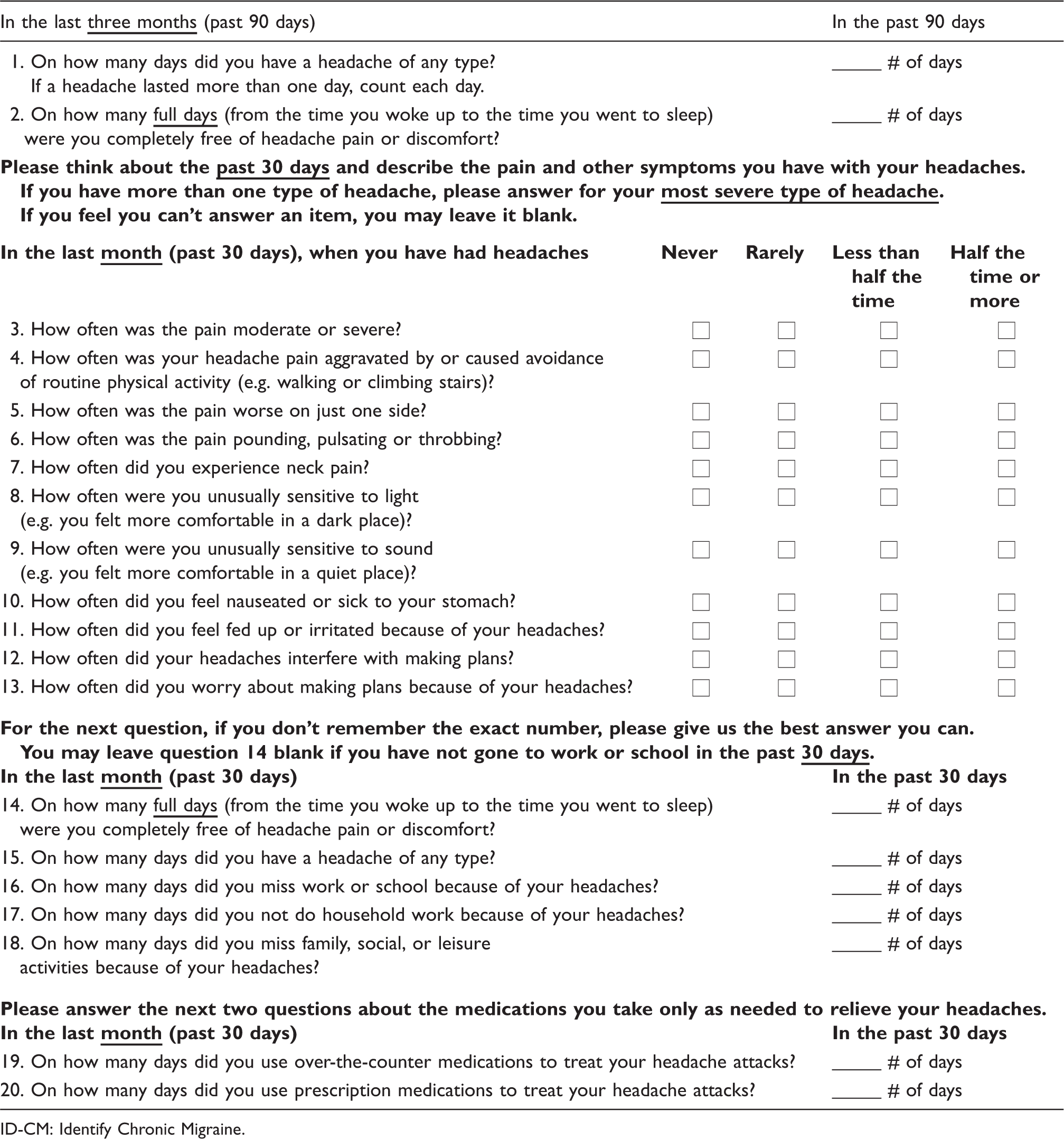
ID-CM: Identify Chronic Migraine.
Stage 3: Psychometric validation
Sampling returns
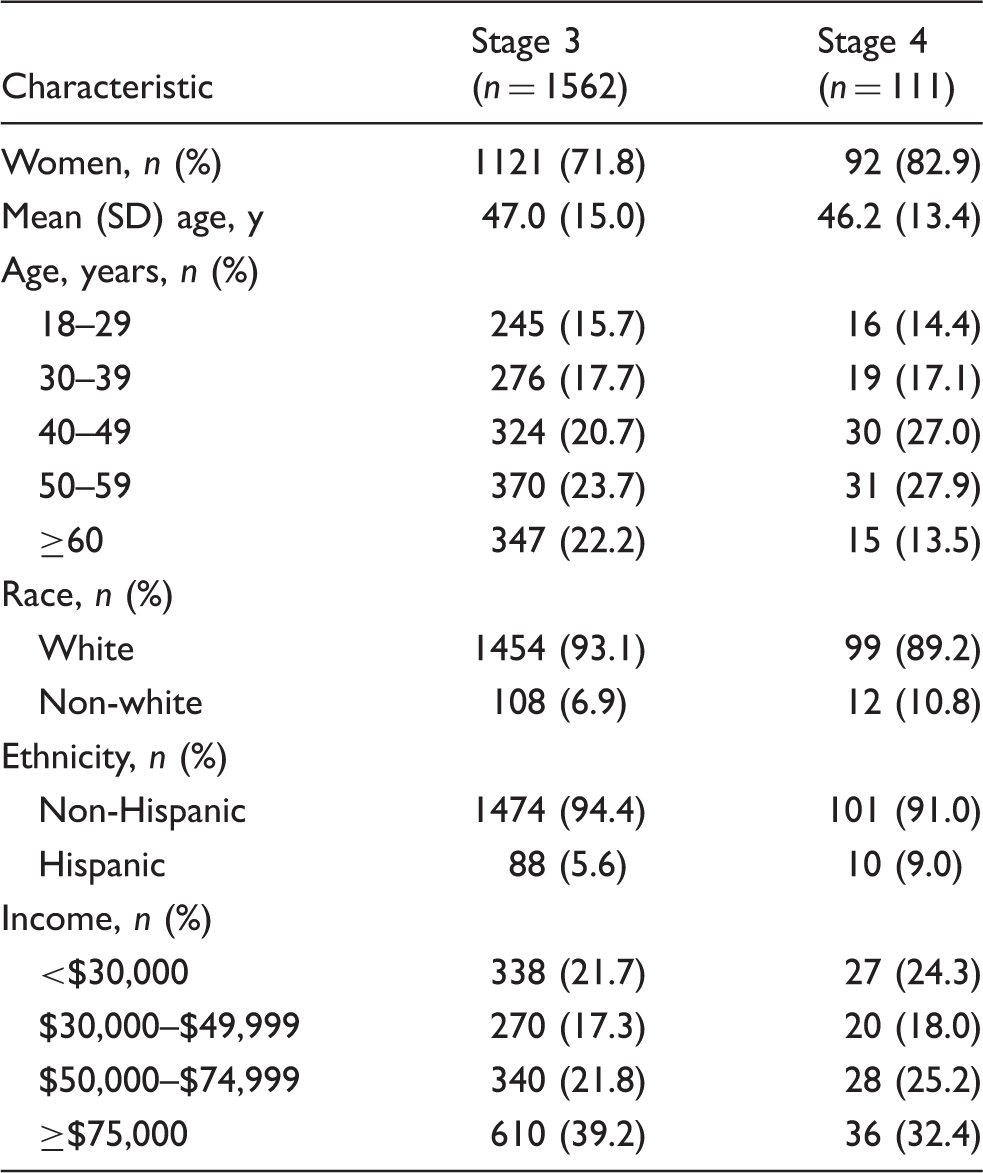
Demographic characteristics of respondents in stages 3 and 4.
Psychometric properties
Model fit for IRT models a from stage 3.

2LL: negative two times the log likelihood; AIC: Akaike information criterion; BIC: Bayesian information criterion; EFA: exploratory factor analyses; IRT: item response theory; NBIC: sample size–adjusted Bayesian information criterion.
Smaller values for each fit index indicate better fit of the model.

Final 12-item ID-CM tool.
Stage 3 case-finding tool models.

CM: chronic migraine; EST: estimate; HA: headache; ICHD-3β: International Classification of Headache Disorders, 3rd edition (beta version); OR: odds ratio; Q: question; SE: standard error; ZINB: zero-inflated negative binomial; MIDAS: Migraine Disability Assessment.
Item response theory models were estimated using reference identification. Reference item indicated with a in p value column.
Italics indicate the ID-CM items that were used for migraine (Stage 1; four symptom items) and chronic migraine (Stage 2: six items [three disruption and three disability items]) as the model was moved into stage 4.
See Table 1 for full question wording.
Eliminated in the final classification accuracy scoring algorithm, resulting in a 12-item Identify Chronic Migraine (ID-CM) form (Figure 2).
Note that the OR is so large as to be deterministic and not truly interpretable because 100% of the four-item set used for migraine screening was used in the modified ICHD-3β migraine classification. This was not the case for the model in Part 2 for chronic migraine (CM) because the item set was broader than that used in the ICHD-3β migraine classification and the ORs reflect strong but more normative ranges.
Stage 4: Diagnostic validity
Sampling returns
Of the 2923 individuals receiving invitations, 111 individuals (3.8%) met inclusion criteria and provided complete and usable clinical interview data. Figure 1 provides more details on the sampling for this stage. Mean (SD) age of participants was 46.2 (13.4) years, and most were female (82.9%) and white (89.2%) (Table 2). The distribution of the 111 completed cases across clinical interviewers stratified on headache sampling quotas is given in Web Appendix 3 (Supplemental Table 1); PPV values for each clinician ranged from 83.3% to 100%.
Classification accuracy
Stage 4 classification accuracy for ID-CM.

CM: chronic migraine; ID-CM: Identify Chronic Migraine.
The total sample analyzed was N = 111.
n = 85 were diagnosed with migraine.
n = 71 screened positive for migraine on ID-CM.
n = 67 were diagnosed with CM.
n = 59 screened positive for CM on ID-CM.
Calculated from 2 × 2 cell and marginal proportions as 71/85.
Calculated from 2 × 2 cell and marginal proportions as 23/26.
Calculated from 2 × 2 cell and marginal proportions as 23/37.
Calculated from 2 × 2 cell and marginal proportions as 71/74.
Calculated from 2 × 2 cell and marginal proportions as 54/67.
Calculated from 2 × 2 cell and marginal proportions as 39/44.
Calculated from 2 × 2 cell and marginal proportions as 39/52.
Calculated from 2 × 2 cell and marginal proportions as 54/59.
A definition of CM based on criteria for migraine above coupled with headache day criteria (≥15 headache days out of the last 30 days, and ≥45 headache days out of the last 90 days) was assessed for classification accuracy. This approach yielded high specificity but moderate sensitivity. Examination of the misclassified cases revealed, as anticipated, underreporting of headache days on ID-CM. Individuals misclassified by ID-CM as not having CM, but who received CM clinical diagnoses, had high rates of disability, medication use, or planning disruption. Expanding the scoring algorithm of ID-CM to include information on disability, medication use, and planning disruption, but eliminating the disability (i.e. chores) and planning disruption (i.e. fed up) items having the weakest IRT parameters (see model results under Part 2 in Table 4), resulted in a 12-item ID-CM having sensitivity of 80.6%, specificity of 88.6%, NPV of 75.0%, and PPV of 91.5% (Table 5) (see Web Appendix 3 Supplemental Table 1 for more details). Of the 111 stage 4 participants, 67 were diagnosed as having CM by gold-standard clinician interviews; by comparison, the final 12-item ID-CM tool identified 59 participants as CM positive.
Discussion
ID-CM is a two-part case-finding tool that aims to (1) identify individuals with severe headache who have migraine and (2) among individuals with migraine identify those with CM. ID-CM was developed using input from both clinical experts (stage 1) and individuals with CM (stage 2). Following psychometric validation in stage 3, operating characteristics of ID-CM relative to an independent diagnosis assigned by a clinical expert using the SSDI-M was also assessed (stage 4).
Classification accuracy for other screening or diagnostic tools.

AMPP: American Migraine Prevalence and Prevention Study; AMS: American Migraine Study; CM: chronic migraine; ID-Migraine: Identify Migraine Screener; PHQ-9: 9-item Patient Health Questionnaire; PSA: prostate-specific antigen; Pap: Papanicolaou.
The AMS/AMPP CM screening assessment was conducted in a clinic-based sample at the New England Headache Center, whereas ID-CM was developed using a Web-based research panel. Clinic-based samples generally involved patients with greater disease severity, which facilitates diagnostic detection, thus increasing sensitivity estimates.
Many of the classification accuracy statistics for the six-item CM tool indicated strong correspondence with clinical diagnosis of CM (Table 5). In fact, the six-item form is a good case-finding tool for CM. However, the sensitivity for the six-item version was lower than desired and lower than that observed for the 12-item CM tool (76% vs 81%). Because the 12-item version had higher sensitivity, we recommend it as a case-detection tool. The additional relevant domains of disability, medication use, and planning disruption not only improve classification, but provide additional data that permit clinicians to evaluate the roles of medication overuse and headache impact when making diagnostic and referral decisions.
This study has several inherent strengths. Item banks were generated from variants of existing validated scales reviewed and selected by an international Delphi Panel of recognized migraine experts. Furthermore, after a Web-based sample from a research panel was used for ID-CM tool validation, rigorous psychometric modeling was employed to arrive at the final item set. In addition, all ID-CM tool diagnoses were compared with gold-standard physician-administered clinical diagnostic interview validation, with review by another physician to rectify discrepancies and confirm adherence to protocol.
The study and ID-CM development also have several limitations. The sample size in the final validation study was limited. The PPV and NPV depend on the base rate of the condition in the study population. In addition, instruments should be validated in the setting of intended use. The sample used for this study was highly selected; thus, results from this Web panel may not be fully generalizable to other settings (e.g. subspecialty headache centers, general neurology, primary care practices) without supplementary analyses. Indeed, although classification accuracy may be lower in less-selected populations (e.g. primary care practices), one may expect that classification accuracy could be higher in specialty clinics because the population of patients seeking care for severe headaches would be higher than within a Web-panel population. Validation in a range of settings and languages is recommended. It should be noted that the concurrent validation data collected, and test-retest reliability assessed in the stage 3 sample with a three-week assessment lag, are not discussed here but will be presented in a forthcoming manuscript. Limitations of this analysis notwithstanding, the extensive development and evaluation process for ID-CM, along with its strong psychometric properties, support its clinical utility as a case-finding tool both for migraine and CM case detection.
Conclusion
The simplicity and accuracy of ID-CM will enable health care professionals with or without training in neurology, pain, or headache to correctly identify the majority of patients with migraine or CM. Clinicians will then be able to accurately diagnose or refer affected patients to specialists for effective treatment that will reduce the burden of illness experienced by those with migraine and CM.
Clinical implications
Of those identified as having migraine by the Identify Chronic Migraine (ID-CM) case-finding tool, using a simple scoring algorithm based on four symptom items (moderate/severe pain intensity, photophobia, phonophobia, migraine-related nausea), 96% were diagnosed with International Classification of Headache Disorders-3β (ICHD-3β) migraine (i.e. positive predictive value (PPV) = 96%). In addition, the tool correctly detected 83.5% of those diagnosed with migraine (i.e. sensitivity = 83.5%). Of those identified as having CM by ID-CM, using a scoring algorithm based on the four migraine scoring items and eight additional items assessing headache frequency, disability, medication use, and planning disruption, 91.5% were diagnosed with ICHD-3β CM (i.e. PPV = 91.5%). Of those diagnosed with CM, ID-CM correctly detected 80.6% of the cases (i.e. sensitivity = 80.6%). The simplicity and accuracy of ID-CM will enable health care professionals with or without training in neurology, pain, or headache to correctly identify the majority of patients with migraine or CM.
Supplemental Material
Supplemental material for Improving the detection of chronic migraine: Development and validation of Identify Chronic Migraine (ID-CM)
Supplemental Material for Improving the detection of chronic migraine: Development and validation of Identify Chronic Migraine (ID-CM) by Richard B Lipton, Daniel Serrano, Dawn C Buse, Jelena M Pavlovic, Andrew M Blumenfeld, David W Dodick, Sheena K Aurora, Werner J Becker, Hans-Christoph Diener, Shuu-Jiun Wang, Maurice B Vincent, Nada A Hindiyeh, Amaal J Starling, Patrick J Gillard, Sepideh F Varon and Michael L Reed in Cephalalgia
Footnotes
Funding
This work was sponsored by Allergan, Inc (Irvine, CA, USA). The Delphi Panel and cognitive debriefings were conducted by Endpoint Outcomes (Boston, MA, USA), and data collection and analyses were conducted by Vedanta Research (Chapel Hill, NC, USA). Daniel Serrano, PhD, formerly consultant for Vedanta Research and presently employed at Endpoint Outcomes, conducted all psychometric analyses.
Conflict of interest
Financial arrangements of the authors with companies whose products may be related to the present report are listed below, as declared by the authors.
Acknowledgments
The authors would like to thank Valerie Marske (Vedanta Research, Chapel Hill, NC, USA) for her assistance with participant recruitment, clinician training, and administration of the Web-based surveys; C. Mark Sollars, MS (Montefiore Headache Center, Bronx, NY, USA) for his help with study management, BRANY Institutional Review Board submission, and developing and filming the Semistructured Diagnostic Interview for Migraine (SSDI-M) training interview; Michael T. Lynch (TheInfluence.net, New York, NY, USA) for editing and producing the SSDI-M training video; James McGinley, PhD (Vedanta Research, Chapel Hill, NC, USA), who assisted with the migraine classification accuracy analyses; Kristina M. Fanning, PhD (Vedanta Research, Chapel Hill, NC, USA), who assisted with demographic data analyses; Joanna Sanderson, PharmD, MS (formerly of Allergan Inc, Irvine, CA, USA), for her help with study design and management; and Chris Evans, PhD (Endpoint Outcomes, Boston, MA, USA), for his assistance as the Delphi moderator. The authors would also like to give special thanks to Uri Napchan, MD, Tanya Bilchik, MD, Audrey Halpern, MD, and Eric Kung, MD, who conducted many of the phone-based clinical interviews. Writing and editorial assistance was provided to the authors by Kristine W. Schuler, MS, and Amanda M. Kelly, MPhil, MSHN, of Complete Healthcare Communications, Inc (Chadds Ford, PA, USA) and Dana Franznick, PharmD, and was funded by Allergan, Inc (Irvine, CA, USA). All authors met the International Committee of Medical Journal Editors (ICMJE) authorship criteria. Neither honoraria nor payments were made for authorship.
References
Supplementary Material
Please find the following supplemental material available below.
For Open Access articles published under a Creative Commons License, all supplemental material carries the same license as the article it is associated with.
For non-Open Access articles published, all supplemental material carries a non-exclusive license, and permission requests for re-use of supplemental material or any part of supplemental material shall be sent directly to the copyright owner as specified in the copyright notice associated with the article.
