




Abstract
From small beginnings running a glazing and house-painting business in Mountmellick, later members of the Star family became master-painters and wallpaper manufacturers in Dublin between 1820 and 1880. In Mountmellick, they were Anglicans with a Quaker clientele; in Dublin, a new generation became Catholics, serving a Catholic clientele and specialising in church decoration. Their story highlights both possibilities and problems in operating a business in nineteenth-century Ireland. It also gives a new angle on aspects of Ireland's ‘devotional revolution’, the nature of Irish nationalism and limits to Dublin's industrial development. Building on both historical and genealogical research, a look at one family business suggests how other families and their histories, in similar economic and social settings, could be described and analysed.
Introduction
An important theme in nineteenth-century Irish history – and most notably so in Dublin's history – is the rise of a Catholic middle class galvanised by what Emmet Larkin termed a ‘devotional revolution’. 1 The second generation of a Dublin firm of painters and decorators called Star were members of that middle class, and their approach both to business and to religion is relevant to this theme. In particular, George Baxter Star's interactions with Archbishop Cullen shed new light on how both education and art were employed to promote the Catholic cause.
A second theme is the relative failure to sustain and develop urban industry in Ireland in the nineteenth century. This theme was central to Mary Daly's account of Dublin's social and economic history of Dublin between 1861 and 1914 and later discussed by David Dickson. 2 Here again, the Stars are relevant, as a Dublin family who developed their business up to a point, but could not sustain it into a third generation. Their successes and failures, while unique, are illustrative of how a number of political, social and economic forces contributed to the overall fabric of Ireland's ‘deposed capital’.
What began modestly for the Stars as a glazing and painting concern in Mountmellick around 1800 gave rise to a significant house-painting, gilding, decorating and wallpaper-making firm in mid-nineteenth-century Dublin. Selected details of this family's story, framed here as a business history, underline the importance of generational links, and of networks based on religious affiliation, to an understanding of Ireland's development. These also were important themes in nineteenth-century Irish history. Few academic historians utilise a genealogical approach in their work, even though hereditary ownership and occupancy of land and other forms of property were key determinants in Irish lives. It can scarcely be avoided however when describing Ireland's most successful business families 3 and can be applied, just as usefully, to many lesser known families and their firms. The Stars were one such family.
Small-Town Glaziers and Painters, 1790–1870
A look, firstly, at origins. Lucas's Directory for 1788 listed 43 tradesmen and professionals based in the small Queen's County (Co. Laois) town of Mountmellick, sixty miles inland from Dublin. The best known were Quakers, though some of those named were Anglicans and Catholics. Among the Quakers was the town's painter and glazier, Samuel Neale. His immediate neighbour in Main Street was one of Mountmellick's three shoemakers: Paul Star, an Anglican.
The Provincial School had recently been founded in Mountmellick to provide boarding and a moral education for children from Quaker families ‘in low circumstances’. 4 It employed only Quaker teachers and sought out the services of Quaker tradespeople whenever possible. Glazing repairs or painting at the new school will have added both to Samuel Neale's income and to his work load: Business had expanded and he needed an apprentice. His wife's fourteen-year-old nephew was considered, but rejected when his Quaker advisers found ‘the lad did not seem qualified for the business proposal’. 5 I surmise that Samuel therefore apprenticed young Frederick Star, who lived next door to him, even though the Stars were not Quakers. Around the turn of the century, as the Neale family's interests followed a different path, it was Frederick who took over Mountmellick's painting and glazing requirements.
Frederick had the advantage and the responsibility of inheriting his father's property, and now he also held the leading role in a local business. From 1802, he was further bound to the area by his marriage. Though descended from a local Quaker family, Jane Dugdale belonged to a branch that was already Anglican. 6 In this period, when marriage to a non-Quaker invariably led to expulsion from the Society of Friends, many Quakers perforce left their faith. This happened in 1794 when Susannah White married Frederick's widowed father, Paul Star, 7 and again in 1838 when Francis Eves married Frederick's only daughter. Such unions, while they resulted in religious disassociations within Quaker families, also strengthened links between Anglicans and the network of both Quakers and ex-Quakers, which was so much a feature of Mountmellick society. It will have had particular value for the Stars as painters and glaziers in helping them maintain a Quaker clientele, comparable with the later successes of the Star family in building up a Catholic clientele in Dublin.
The monthly accounts for the Quaker school for 1822–1855 are still extant and contain information on the kind of work the Stars undertook and what they were paid. 8 They do not reveal what other jobs they did, nor their total earnings. Frederick appears in the records from 1824 to 1834, almost entirely doing glazing jobs, receiving fifteen monthly payments ranging between 9d in April 1827 and £1/14/5 in July 1834. In one specified case, he received 2/1 for glazing eight panes of glass; once he gained a shilling by selling the school some eggs. Beyond 1834, there is no record of Frederick working for the school, though they paid him 9/1 in March 1838 when he sold them a cow. This suggests both that he retired from the glazing business in 1834 (aged perhaps sixty) and that he ran a smallholding on the side.
Frederick's brother William had trained as a shoemaker like their father, but in 1804, aged twenty, he joined the British Army as a private. 9 He rose to the rank of sergeant, serving for fourteen years in India, before returning to Mountmellick in 1823. He then worked as a painter and glazier with his brother. William first appears in the Quaker school accounts in December 1824, receiving a payment of 5/7. From this time until 1835, he received a further 25 payments, ranging between 8½d in May 1826 and £2/10/- in April 1832. As in Frederick's case, this was mostly for glazing work, though he also earned 8/- painting chairs in September 1828. The tasks performed by both brothers sound minor and routine and mostly appear in the ‘repairs’ column of the school accounts.
Richard Star, born in 1809 and the oldest of Frederick's sons, would have begun his apprenticeship around 1823, taking over management of the family business in about 1835. He regularly appeared in the Quaker school accounts from 1833 to 1855 (when the extant record ends). His 48 payments ranged between 2/9 in July 1833 and £3/10/10 in May 1844. Most of his work was still glazing – school children are well known for breaking windows – but he also did a lot of painting and some ‘papering’. This no doubt refers to wallpaper hanging, for which he received payment of £1/5/- in March 1846. Richard's work at the school only slightly overlapped with that done by Frederick and William between 1833 and 1835. Thereafter, he worked on his own and could rely on regular jobs at the school. The sums he received were often larger than those earned by his predecessors, but he was certainly never rich. As a bachelor, he could probably live well enough on a small income.
In 1841, the population of Mountmellick was recorded as 4,755, more than it had been in Richard's grandfathers’ time, but the days when this small town was described optimistically as the Manchester of Ireland were over. 10 Its trade remained ‘considerable, but not so extensive as formerly’. 11 With the full onslaught of the famine in the later 1840s, both population and work declined steeply. Richard's potential clientele shrank, with many too poor to pay even for necessities. By then, he also faced competition from three other painters and glaziers, all (like him) based in Main Street. Richard continued to work until his death in Mountmellick in 1869, aged sixty. His effects were then valued at ‘under £100’, but at least he had remained solvent. 12
In places like Mountmellick during the famine years, many stayed simply because they had failed to get away. The Catholic Hannah Curtis, writing from Mountmellick to her son in Philadelphia in 1847, told him ‘the people are in a starving state, the poorhouse is crowded with people and they are dying as fast as they can’. 13 After years of struggle, the Quaker Joseph Beales finally closed his cotton mill and moved from Mountmellick to Melbourne in 1852. 14 This will have been catastrophic not only for the hundreds of workers employed in the mill, but also a major setback for anyone engaged in maintaining its buildings.
Painting and glazing were service industries, dependent on sufficient local demand. In this respect, the Stars’ situation was that of small town tradespeople throughout Ireland. Unlike (for instance) brewers and millers, they produced nothing they could export or sell elsewhere. They could, however, improve their chances through association with the more prosperous or ascendant members of the local community. For the Stars of Mountmellick, this meant building on their links with Quaker families. They did not have the capital to engage in some form of industrial production or widen the range of services. Nor could they specialise in a particular aspect of their trade, since the local population was insufficient to support specialist activity. Businesses based in Dublin had far greater opportunity to expand.
Relocation to a larger or newer centre, though a gamble, remained a possibility. And indeed, in 1843, Richard Star's younger brother John left Mountmellick for America, where he became established as a house painter at Utica in Oneida County, New York. In 1870, his personal estate was valued at US$1,500 plus he had real estate worth $10,000, so he had fared much better than Richard in Mountmellick. 15
Dublin Painters and Paper-Stainers, 1820–1850
An earlier John Star also had links with the Mountmellick business. He began his apprenticeship either in the 1790s or in the new century, but any time he spent in Mountmellick was over by 1815 when he first appears as a painter and glazier in Dublin. There is conjecture here, not only about where John was until then but also about his position within the Star family. While he could have been a cousin or other relation to Frederick and William, it seems more likely he was their younger brother.
He must have foreseen that the future of the Mountmellick business was limited and would lie with Frederick and his sons, rather than with himself. There would be insufficient work for them all in one small town, so moving to the city made sense. In Dublin, however, he was just one among a host of other painters and glaziers when advertising his services in 1816. Unlike several Quakers who had made the move from Mountmellick to Dublin (including John and Samuel Bewley and Thomas, John and Joseph Pim), 16 John Star had no large cousinhood to do business with or to give him financial assistance, so his enterprise and achievements were on a lesser scale.
John did have some family links in the city. During his first eight years in Dublin, until 1824, he appeared in Pigot's directories as a painter, glazier and signboard writer at two addresses in St Catherine's parish. 63 Meath Street, occupied by Joseph McCormick since the 1770s, had become home to pawnbroker Richard Star of Dublin following his marriage to Joseph's daughter in 1800. 50 Thomas Street was Richard's later residence, and he died there in the same year (1818) as John moved in. It is likely that this Richard was Paul Star of Mountmellick's brother, and therefore John was Richard's nephew.
John's marriage to Eliza Hely, probably in an Anglican ceremony in St Mary's parish in 1820, 17 was key to a major shift in his fortunes. Not only did she produce four children but she displayed business competence, managing the family firm after John's death. Through her family connections, John's activities extended into aspects of decoration well beyond his own background in painting and glazing, while her Catholic associations unlocked a large market for John and Eliza's services. Political and professional restrictions upon Catholics had lessened since the 1790s, and the Catholic middle class had correspondingly risen. Such people had sufficient money both to display their wealth in their own housing and to honour their faith through the building and decoration of their churches.
In 1817, Eliza Hely's sister Mary Ann had married the painter and decorator Arthur Doyle in a Catholic ceremony at St Mary's Pro-Cathedral. 18 Five years later, Arthur acquired a hundred-year lease of 39 Mary Street, where he remained at least until his bankruptcy in 1846. 19 In the 1820s, he was moving into the paper-staining business, by which was meant the creation of printed, decorative wallpaper. John and Eliza's business soon also expanded to include paper-staining and the Star family espoused Catholicism. The first of their children, George Baxter Star, was baptised a Catholic with Arthur Doyle as one of his sponsors. 20 The two couples remained close, Eliza sponsoring the baptism of three of Arthur's children between 1825 and 1831. The Stars, from 1824 onwards, lived and worked in a large building they leased at 27 Lower Ormond Quay. This was only a short distance from Arthur in Mary Street, and only a door or so away from where the Hely family conducted their business as paper merchants.
In early nineteenth-century Ireland, a change in faith might reflect conviction, marital circumstance, or business opportunity. It was a more acceptable shift, perhaps, among those Anglican and Catholic business people who shared a wish that the Act of Union of Great Britain and Ireland (1800) be repealed. Religious tolerance within the Anglican Star family is suggested by Frederick Star of Mountmellick's support for an 1812 petition to end restrictions placed upon Catholics. 21
While John's wife and their children were strongly Catholic, as were many of his business associates, there is no evidence that he openly converted, and he was buried at the Anglican cemetery at Crumlin in St Mary's parish. John Star's will listed assets of £120 of house goods, £60 in leases, £460 of stock and £330 in debts owed to him; the sum sworn in after his death was ‘under £1385’. For comparison (both financial and religious), pawnbroker Richard Star of Dublin was ‘a wealthy man’, worth about six thousand pounds when he died in 1818. He had been a church warden in St Catherine's parish in 1815 and remained a stalwart Anglican.
In 1823, the younger of Richard's two orphaned sons, William Star, found an apprenticeship as a painter and glazier. No doubt John had arranged this, but it is unclear whether he himself took on William's training. By the time of John's death in 1830, William was just short of his twenty-first birthday, while John's two older sons, who presently become apprentices in the same trade as their father, were under ten years old: George Baxter Star was born in 1821 and John Star junior in 1822.
For a while after John's death, Eliza's brother-in-law Arthur Doyle may have helped her with the paper-staining side of the business, and perhaps William oversaw some of the painting work. There was certainly a long and close association between William and Eliza and her children. William Star, like John before him, became absorbed into a Catholic family, though he had received an Anglican baptism. In the years after William's Catholic wedding in 1836, 22 his six children were baptised in the Catholic church in Westland Row, three with children of John and Eliza Star as their sponsors.
William lived at 26 Eustace Street from the mid-thirties onwards where he is referred to as a paper-stainer in 1841 and then as a house-painter in 1844. There are no references to him in Dublin after 1851, but he lived another 20 years, dying in Glasgow in 1871. 23 The census of that year described him as a house painter and widower, living as an ‘ordinary inmate’ in the poorhouse at Barony in Glasgow. In fact, his wife Jane was still very much alive in Dublin, running her own millinery establishment. 24 Her estranged husband had become an isolated outlier but he still practised the Star family trade.
A largely generational shift in branches of this family from Anglicanism to Catholicism may relate in part to who the Stars married, but it was also a reflection of wider realities. The social and economic benefits of being Anglican were declining, while the Catholic middle class was on the rise. There was a coterminous expansion of the Star family business (at least in Dublin) beyond their established work in house-painting, towards new roles in domestic and ecclesiastical decoration. Advantage was being taken of new wealth, held by a clientele who could afford not just paint to protect their homes but also wallpapers to embellish them, and who were equally able and concerned to adorn their houses of worship. At least with church decoration, the Stars’ clientele was primarily Catholic. It is less clear who bought their wallpaper, but, as David Dickson noted, the painter and decorator Patrick Boylan claimed in 1834 that ‘the only persons in Dublin now who furnish their houses in any style or magnificence are professional men, or men in business, who have amassed fortunes’. 25 An increasing number of businessmen were Catholic.
Historian Ada Longfield viewed wallpaper production in Dublin until about 1800 as ‘still something of an industrial art rather than a form of “unpremeditated commercialisation”’. She found nineteenth-century developments constraining rather than revolutionary, citing the effects of increased taxation on imported paper and a decline in Irish paper-making. Paper-staining, she considered, ‘survived in Ireland … but did not really share in the great nineteenth century expansion’. 26 Contrastingly, Dickson named wallpaper manufacture as a Dublin trade that ‘flourished in the post-Union generation’. 27 The presence of 37 paper-staining firms in Dublin by 1842, which contributed £1,951/2/4½ in duty to the government that year, substantiates this. James Boswell featured as by far the largest operator, paying £543/1/8, while the widowed Eliza Star was seventh largest, paying £69/1/4, and Arthur Doyle came in eleventh, paying £49/12/4¾. 28
In old age, Eliza Star reflected that ‘a revolution has taken place in the manufacture of wall-paper hangings since [her husband] John commenced business on the Quay. What was at first rather a primitive process of paper staining is now a scientific one; chemistry and machinery are now very fully utilised in the colouring and printing processes, and the old block-stamping process bears nearly the same relation to the modern process as the old weaver’s loom does to the present steam-driven machine’. 29 These remarks (made in the 1870s) identified practical changes in the production process, but did not address social and economic changes that occurred during the same period.
When John Star arrived in Dublin, its business activities revolved around twenty-six guilds that regulated trades and excluded intruders. Painters and paper-stainers, along with cutlers, stationers and printers, were the principal members of St Luke's Guild, incorporated in Dublin in 1670. 30 For generations, St Luke's, like the other guilds, had upheld work standards but also prevented papist participation. This had changed when St Luke's admitted Catholics in 1793. By the 1820s, religion was no longer a formal impediment to advancement within one's occupation, nor to the accumulation of wealth, but membership of a particular guild still indicated professional standing and influenced one's social network.
By the 1840s, which was after John's time, Dublin's guild system had collapsed, and trade unions were gaining importance. In the 1820s, new employment issues were already surfacing, but John's business could expand apace, while his attitude to his workers remained traditional and essentially conservative. Besides his newer responsibilities as a paper-stainer, he was still very busy as a master painter, with ‘operative house painters’ in his employ. He paid them ‘the same amount British that was formerly paid Irish’, in consideration of the loss his employees would otherwise sustain. 31 This implies mutual respect between himself and his men, but also an incipient need for delicacy in employment relations within a trade that was becoming complex and competitive.
In addition to labour issues, John Star also had to accommodate government regulation. As a paper-stainer from the 1820s, he faced financial duties and high penalties for any product he misidentified. Many in the industry were penalised for malpractice, including John in 1830 when he was fined £26 for ‘having [a ream of first class] paper in wrappers which had been used before’. 32 Mightier taxes and their rigorous application were viewed as impositions by the English, consequent upon the Act of Union. Their perceived effect upon his business, quite apart from any profounder spur to nationalist sentiment, made him a supporter of its repeal.
In a trenchant analysis of ‘nineteenth-century economic decline’ in Ireland, 33 Mary Daly noted the tendency among the Irish to blame it on the Union of Great Britain and Ireland. David Dickson has rightly questioned the validity of this ‘simplistic linkage’, placing greater emphasis on changing industrial relations in the 1820s and 1830s and ‘macro-economic factors’. 34 Nevertheless, bolstered by evidence that Ireland was ‘sufficient to sustain a strong industrial nation’, 35 at the time many (politicians and others) did argue that re-creation of a separate parliament in Dublin, together with the protection of Irish industry through tariff control, would return their country and its businesses to economic prosperity. During the nineteenth century, these opinions found expression through calls for Home Rule and other manifestations of nationalism.
Daly's comments focused on the second half of the nineteenth century, but dissatisfaction with Britain's political control of Ireland and its impositions upon the Irish economy had a longer history. John Star's remarks at a meeting of paper-stainers in November 1830, just before he died, 36 are one example of this. He claimed the Act of 1800 had robbed Ireland of ‘the glorious independence of their ancestors’ 37 and expressed strong support for Daniel O’Connell's Repeal campaign. In John's mind, as in the Great Liberator's mind, Ireland's frustrated business interests were cognate with the country's religious and political inequalities. 38 O’Connell's parallel call for emancipation became ‘a key moment in the creation of a new political nation’, 39 and it stimulated an enhanced sense of both national and religious identities in many business people. However, at least in the case of John and (later) his sons, this did not involve a radical shift in their approach to labour. While they became more consciously Catholic, they certainly did not become socialists.
For John Star's widow Eliza, the 1830s and 1840s, one imagines, were largely concerned with keeping business going until her sons reached maturity. She advertised the family as well-established paper-stainers, stressing the quality of their product and the merits of ‘Irish manufacture’. In 1841, an ‘address to the public’ from operative paper-stainers recommended thirteen Dublin firms, including those of Mrs Star and Arthur Doyle, and railed against ‘the importation of a species of stained paper, so inferior in quality and manufacture that the most experienced paper-hanger in the business can scarcely put it up’. 40 By 1851, Eliza's son John was a member of the Society for the Promotion of Irish Manufacturing and Industry, paying an annual subscription of ten shillings. 41 This fitted well with the Irish nationalist position, which both her sons displayed in their politics, for an incipient nation should be making and buying its own, superior wallpaper.
A like emphasis on quality was made for house painting, though here the subtheme was more often respectability than nationalism. St Luke's Guild had been disestablished in 1841, but an organised group of Dublin's ‘regular house painters’ sought to maintain the standards the Guild had fought for. In 1843, it publicly recommended nine firms, including the Stars’. It contrasted them with those recently ‘leagued together in a spurious Society, which is composed of men who profess themselves to be painters, without having the most distant claim to the trade either by legal servitude, conduct, or competency’. 42
Before 1830, Eliza's husband John had been careful to pay his employees enough to keep hold of them. This might indicate a genuine and well-meant paternalism on his part, or equally some awareness that the labour market had become competitive and agitation for better pay an issue. Protectionism, as expressed through the Repeal movement, was attractive both to employers (such as paper-stainers like John) who sought to profit from the expansion of Irish manufacture and to employees who sensed that higher profits would also lead to an improvement in their bargaining power and thus to higher wages.
Even when they had both supported O’Connell and Repeal and were often both Catholic, the allegiance of men to master was increasingly uncertain. In mid-century Ireland, with famine periodically present and revolution perennially possible, some workers (including house painters) turned to united action and trade unionism. Employers, hoping to maintain or increase their advantage, expanded their business concerns and sought new markets, but often struggled to accommodate a growing challenge from their labour force. The later history of the Stars’ business illustrates both these points.
Diversity in the firm's activity was approaching its peak by 1855, when Eliza's two older sons were in their thirties. They advertised themselves persuasively in Dublin's newspapers: ‘John Star, stained paper manufacturer (wholesale and for exportation), house painter and decorator’, had on hand ‘paper hangings suited for dining and breakfast parlours, sitting rooms, and studies; drawing rooms, boudoirs and salons; nurseries, bathrooms and water closets, halls, staircases, passages, and ceilings’. As well as their own wallpapers, they carried ‘the most elegant designs imported from the best manufacturers in England’ and a ‘carefully selected stock of French papers and decorations’. 43 Brief mention followed of house-painting, but not of glazing, which in Dublin was increasingly left to other tradespeople.
Lastly in this 1855 advertisement, the Stars announced that they ‘had made church decoration and staining timber a particular study, and [feel] satisfied that any commissions [they] may receive for the execution of such works shall be completed in a correct and carefully finished style’. Confirming this capability, ‘paper hangings of purely ecclesiastical design, suited for presbyteries, sacristies, convents, and monasteries’ were always in stock. Themselves active participants in Dublin's Catholic revival, the brothers had identified the perfect way to serve it through this new, and presumably profitable, extension of their trade.
Dublin Business and the Catholic Revival, 1850–1860
The Synod of Thurles, called by Archbishop Paul Cullen in 1850, sought to bring into line the teaching, practice and discipline of the Irish Catholic church. 44 Beyond this religious goal, and given the failure of the English-oriented government of Ireland to attend to the needs and wishes of the Catholic majority, Cullen and his followers developed an almost theocratic ideal for how Irish society itself should be organized. Once Cullen was appointed to the Dublin see (in 1852), George Baxter Star participated closely in this movement, sometimes in direct collaboration with the archbishop. His involvement exemplifies how religion, education, welfare, politics, industry and art could all work together towards achieving the ‘devotional revolution’ which Cullen so much desired.
Historian Sean Connolly has suggested that ‘the main use the Catholic church made of their enhanced status was to press their claims in educational matters’. 45 As an alternative to Protestant-dominated ‘godless colleges’, Cullen imagined a ‘Catholic University’ in Dublin. This began in 1851 as a room accessed via the shop front of the Stars’ paper-staining business, with George as the institution's founding secretary. 46 Two letters by Cullen have survived ‘written on headed notepaper from the Catholic University of Dublin, 27 Lower Ormond Quay, Dublin and sealed with the crest of the University’. 47 George gave John Henry Newman a conducted tour of the proposed University House, ‘marking out the alterations in order to turn it into rooms’. 48 The university was formally established in 1854, with Newman in charge of its five faculties and seventeen students. The ‘Catholic University’ never attracted many students, but it survived long enough to become the progenitor of Dublin's University College. 49
Connolly also noted that ‘The psychological impact of Catholic religious worship was increased by a transformation of its physical setting, as new or improved church buildings, more elaborate vestments and lavish altar furnishings allowed services to be conducted with a new emphasis on external magnificence and display’. The Star brothers witnessed this and contributed to it. Their attachment to the Church informed and encouraged the new direction in which they steered the firm, church decoration being their speciality. And George's support of all things Catholic, while obviously sincere, gained him acquaintance with members of the Church at every level. This will have been good for business.
In 1856, the Stars’ work featured in St Joseph's asylum for aged and virtuous females, which Eliza Star had donated towards at least since 1842. 50 In Olivia Frehill's words, this exclusively Catholic institution ‘embodied an alternative miniature welfare system for its inmates, which served the wider “divine economy”’. 51 The asylum's ‘exquisite little church of St Joseph’ was redecorated in 1856, one report noting that ‘the stucco work of the ceiling, in which the white is beautifully relieved by some gilding, is very creditable to the good taste and skill of Mr Star’. 52 In the same period, he ‘successfully completed’ the ornamentation of the Church of Mary Immaculate in Inchicore. 53 Without the same religious overtones, in 1853, ‘the Round Room and the passage leading thereto [were] newly painted and decorated in superb style by Mr Star’. 54 The Round Room, incongruously, was (and is) part of the Rotunda Maternity Hospital building and became a favourite venue for concerts and dramatic performances. George also displayed ‘very great skill’ in painting and decorating the theatre of the Mechanics Institute in 1860. 55
Redecoration of Dublin's Catholic St Mary's Pro-Cathedral in Marlborough Street was underway by 1857, with some of its features ‘painted and adorned in the very highest style of Italian creative art’. It therefore reflected the artistic preferences of Archbishop Cullen who, according to Eileen Kane, had ‘an informed interest in the visual arts’ and strongly influenced the choice of style of church construction and decoration. While the Gothic Revival style was notably championed and practised throughout Ireland by the Dublin architect J J McCarthy, Cullen's personal preference was for neoclassicism in ‘his own cathedral church’. 56
The ‘ordinary painting’ was done by George, while Frederick Settle Barff was responsible for ‘the fresco painting, and the more elaborate and artistic portion of the work’, little of which now survives. 57 Barff, an Englishman who had made his reputation decorating churches in Liverpool, had moved to Dublin in the late 1850s. 58 At least for George, work at the Pro-Cathedral continued until 1861, when ‘a very beautiful side altar’ in memory of The O’Conor Don was completed, ‘brilliantly decorated and gilded’ by him. 59
Barff and George co-operated closely, advertising together early in January 1858. George described 27 Lower Ormond Quay as their ‘depot’ for statuary and church furniture. They ‘begged to inform the Archbishop and clergy’ that they could quote for ‘painting and artistically decorating churches in the Gothic, Italian, or Byzantine styles’, 60 indicating considerable adaptability. From the same addresses, in June, they jointly advertised ‘statues of the blessed virgin, from one foot high to life size’. 61
In September 1858, Barff moved to 5 Lower Ormond Quay, 62 and by December, George had moved to number 7. 63 His working alliance with Barff was now facilitated by the even closer proximity of their businesses, both some way along the Quay from where John and Eliza remained. The Stars’ earlier business had divided and the two halves now disputed which was its principal successor. Eliza and John, at 27 Lower Ormond Quay, insisted that ‘at no period was G B Star sole proprietor of this establishment, nor did he manage the business for a term of twenty years’, and customers were urged to continue patronising their own establishment rather than George's. In a contiguous advertisement, George stated that his expanding business had required relocation and that his connection with those remaining at number 27 had ‘entirely ceased’. 64
The division was implicit in John's appearance as sole respondent in an 1861 court case regarding ‘£61 alleged to be due under builder's contract for work at Adam and Eve chapel’ on Merchant's Quay. 65 The Dublin Street Directory for 1862 listed George separately as a ‘decorator, house painter, and gilder, manufacturer and importer of paper-hangings’ based at number 7, while number 27 continued as the base for both ‘Elizabeth Star and Son (paper stainers and decorators)’ and ‘John Star (church and altar decorator)’.
Dublin Business Decline, 1860–1880
Since the late 1850s, George's life had been a roller-coaster. He married in 1858 and his wife Mary had a son, Joseph, in 1859. 66 By January 1861, both Mary and their second child had died, 67 and by February 1863, George was bankrupt. This may have been precipitated by an economic downturn, or overconfident expenditure on his new business, or by losing the battle with his own brother to retain existing clients. When Barff faced bankruptcy in the following year, 68 he returned to England. George's only option in 1863 was to go back along the Quay to live with his mother at number 27.
George was obliged not only to close up shop at number 7 but also to auction off his stock and his tools of trade. ‘Several thousand rolls of French, English and Home manufactured room papers of the newest designs, selected for noblemen's and gentlemen's mansions’ sold quickly. Slower to sell were ‘stained glass sashes, painted show panels, a splendid set of ten large-size show screens … plaster casts of the twelve Caesars [which ‘originally cost £100’], busts, figures, brackets, and pedals’. Then, there were his ‘varnishes, oils, colours, paints, brushes … two grinding mills, several superior double and single ladders, a quantity of scaffolding boards and tressels, a printing table, blocks, and appurtenances; hand cart [and] lumber’ (Figure 1). 69
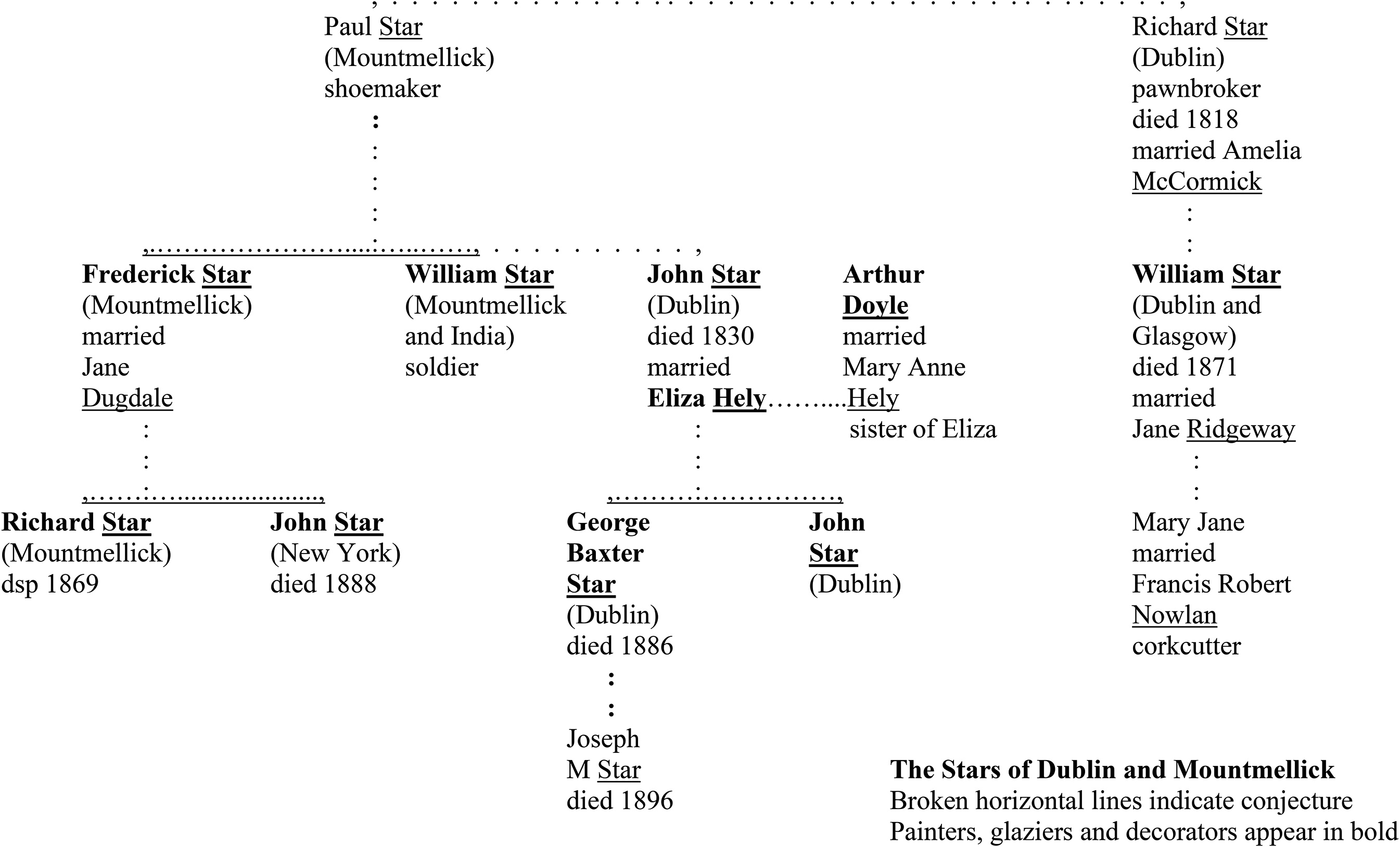
The Stars of Dublin and Mountmellick.
Soon, however, George reassembled the ‘plant of a respectable painter's establishment’ and returned to his trade, though operating on a smaller scale. Even though now back at 27 Lower Ormond Quay, he continued to run his business independently, dating its establishment to 1859. 70 His mother and brother now styled themselves as ‘Elizabeth Star and Son (John Star), painters, decorators and gilders … established 1822.’ John primarily took on domestic contracts, but not to the exclusion of the ecclesiastical work which George had specialised in, and both firms still sold wallpaper. 71
In the years before 1859, when the brothers still worked together, they had grown well beyond doing everything themselves. As employers of a work force of operative painters, they were affected by a thirteen-week painters’ strike in 1854, with workers in the trade seeking higher wages than the guinea a week that was all some received. George, as honorary secretary of the ‘Master Painters and Paper-Stainers Trade Association’ of Dublin, published a letter that firmly placed him on the side of the employer rather than the employee. ‘Dublin businesses’, he said, ‘cannot possibly accede to the proposition to give the same rate of wages to every workman. The hope of the men to establish such a system is contrary to every sound principle, subversive of all stimulus to improvement, and must inevitably tend to place the incompetent, idle, or intemperate, on a level with the skilful, industrious, and sober workman’. 72 Although the strike failed, it signalled that employment relations, and new concepts of fairness, were making business activity more complex.
Nine years later, the operative house-painters threatened a second strike but were placated when most employers (though not George) gave them an advance in wages. This may have been a more specific cause of George's bankruptcy than the ones already posited. In 1864, the operatives excluded George from their list of potential employers, hindering his ability to regain custom thereafter.
In 1867, when the operatives again sought better pay, an embittered George circulated his fellow-employers urging them to use English and Scottish labour rather than bowing to Irish workers’ demands. In a telling aside, he also objected to the operatives’ ‘attempts to have opened to them the library of the Royal Dublin Society’. George (a past auditor of the Dublin Library Society) 73 suggested that ‘hardly 25 per cent … of house-painters can either read or write and yet, forsooth, it was deemed essential for their intellectual culture and mental recreation to place at their disposal the finest semi-public library in Ireland.’ 74 In response, the president of the operatives wrote scathingly of George as now a mere ‘painter's clerk’. This probably referred to George helping in his mother's business and indicated that, at this stage, he had few customers of his own. 75
Writing from the Quay in 1868, George claimed ‘his mother was his landlady … I pay her no rent, but allow my services in conducting her business in lieu of it. I do not get any salary, or any share of the profits from her. I consider my services worth about two guineas a week, which I allow for the rent’. 76 This confirms that, financially, his mother's business was no longer his business, but it begs the question of where his brother was. Almost the only time John's name received further public mention was when Eliza died.
One day in 1870, in his fiftieth year, George ‘came down into the business part of [27 Lower Ormond Quay], and discovered that the large show-room at the rear of the shop was in flames’. £350's worth of damage was done to Eliza's stock and assets. 77 When she died in the house in 1874, her remaining effects were valued at ‘under £900’. This was less than the business had been worth in 1830, but the total would not have included what belonged to her son John as co-partner, nor the worth of George's business. John closed their firm down, selling off any remaining stock and equipment, including ‘a handsome collection of French paper fire screens’ and ‘a hand-worked paper-staining machine for colouring oak combing and ribbon stripe (original cost £47)’. 78
George's own business carried on. In 1877, he was still a ‘painting contractor, decorator and gilder, [and] importer of decorations of room papers’ at 27 Lower Ormond Quay. From this address in 1881, he joined the call in 1881 for an exhibition of goods of Irish manufacture only. 79 This received widespread support from Dublin's artisans and was nationalistic in character, but also, in Mary Daly's estimation, ‘nostalgic’ in origin and limited in impact. 80 George died in 1886, aged 66, 81 at Mater Misericordiae Hospital (a Catholic institution, founded by the Sisters of Mercy) and was buried in Glasnevin Cemetery. The Stars’ involvement in painting and allied trades ended some time before his death, and the family property had passed into other hands by 1889. 82
Eliza had two younger children, but they were never employed in the family business. There was perhaps insufficient capacity for the firm to suitably employ the third son Richard, who instead had become assistant to the master of North Dublin Workhouse in 1847. 83 Their daughter Mary became a Sister of Mercy in 1849 and headed a Catholic educational mission in Yorkshire. 84
Nationalism Before Industry, 1880–1900
The Irish journalist D P Moran, based on what he observed of Dublin in 1899, felt that the social advancement of many Irish Catholics had caused them to rate respectability above economic development and thus to reject industrial employment in favour of non-manual professional occupations. 85 They were often inspired by nationalism, no doubt, but it was a nationalism with a lesser urban industrial component. Mary Brady identified a romantic element in late nineteenth-century Irish nationalism, which reflected ‘a distaste of modern capitalism, the creator of dark satanic mills and large cities’. While the Irish language, Gaelic culture and rural Ireland were glorified, the industrial development of Dublin was little discussed and by some undesired. Nationalist ideals were increasingly conflated with promotion of the Catholic faith at a time when ‘Irish Catholic clergy feared both socialism and the destructive physical and moral consequences of city life’. 86
The termination of the Star family's business interests at this time was a result of economic circumstances, perhaps combined with the effects of an unhealthy physical environment. Not enough family members survived to ride the storms. The lives of the grandsons of the Dublin painters John Star (senior) of Lower Ormond Quay and William Star of Eustace Street may illustrate the changes that Moran and Daly identified. John Star (junior) had no children, while George Baxter Star's bachelor son Joseph sought to become a librarian and advocate for Irish nationalist poetry, not a painter and decorator. Poor health may have precluded his entry into the family business, given that he died young of tuberculosis in Dublin's Hospital for Incurables in 1896. 87
As for the Stars of Eustace Street, William had four sons, all of whom died relatively young, unmarried and in poor health. Their sister Mary Jane married Francis Robert Nowlan and had nine children, including two daughters who became nuns and four sons who were Jesuits, but no-one who was prepared to revitalise their father's cork-cutting business (which closed in the 1890s). 88 One of the sons, the Stonyhurst-educated academic Thomas P Nowlan, became a passionate promoter of Gaelic revival, the Irish language and the Irish nation, but the one industry he promoted was rural: the replantation of Ireland's ancient forests. 89
On the other hand, the Hely family of paper-makers continued in business. Edward Hely (probably close kin to Eliza Star) was already established as a paper merchant at 28 Lower Ormond Quay by 1815. Another Edward was a stationer and paper merchant at number 29 at least from 1830 and owned a paper mill at Kilternan near the Wicklow Mountains. In 1867, a third Edward, at number 17, received a patent for ‘improvements in the manufacture of envelopes’. 90 While only five paper mills remained in the Dublin area in 1895 (and Kilternan was not one of them), the Helys employed two hundred people in stationery production in 1888 and their business has continued to this day. 91
Conclusion
Examination of the Star family business has shown that, however adverse the social and economic context in nineteenth-century Ireland, it remained possible to sustain a family business and even – as George Baxter Star did – to create objects of beauty. This business succeeded through two generations, in an environment in which it was easy to fail through the effects of financial difficulty or famine, illness or disease. Irish records for the period are laden with details of bankruptcies and young people's graves. As a corrective to any overly sombre conclusion, however, the case of the Helys exemplifies that adaptability and resilience did on occasion result in the long-term survival of a Dublin family firm, well beyond the time when the Stars’ and many other businesses petered out.
There is a limit to what one can take from a single example, but investigation of one family business provides a model of how it could be applied to others and an indication of what might be found. When particular factors are discovered to act in the same way in many cases, the workings of a society as a whole begin to emerge. Even in isolation, any example can illustrate an already posited theme, or modify or expand another. In the case of the Stars, we see how association with a particular denomination (Quakers or Catholics) could promote a business, and how the application of paint, gilding and wallpaper could stimulate both a business and a devotional revolution.
The Star's business history aligns well with a historical overview that identifies increasingly ascendant Catholicism, separatist and nationalist political aspirations and unhelpful financial impediments. It confirms that these features were already interlocked in Dubliners’ minds by 1830, and the yoke of Ireland's union with Great Britain often held responsible for any difficulty. Dublin's failure to develop industrially in the way some (but not other) British cities did is factually correct. Nevertheless, it takes insufficient account of various industries (not just brewing) that held their place after 1800 and opened up new sources of income. 92 Wallpaper manufacture and church decoration are minor but interesting examples of this.
There is some suggestion that the focus on political, cultural, rural and increasingly Catholic nationalism, so potent by the 1890s, took energy and attention away from urban industrial survival and development. 93 This may help to explain the decline or demise of many industries and businesses by that decade, including the Stars’. It had, however, been George Baxter Star's espousal of Archbishop Cullen's Catholic revival, together with his family's support for specifically Irish production, that resulted in the most creative and significant expansion of their business, half a century earlier.
Footnotes
Declaration of Conflicting Interests
The author declared no potential conflicts of interest with respect to the research, authorship, and/or publication of this article.
Funding
The author received no financial support for the research, authorship, and/or publication of this article.
