




Abstract
This article reveals the multifaceted roles played by Sarah and Ann Allen in the retailing business of their father, William Allen, who was a specialist retailer in maps and printed images at Dame Street, Dublin from 1779 to 1819. Although the shop was inherited by Allen's sons, Sarah and Ann were important contributors to the family business. The procurement of goods for customers on buying trips abroad, correspondence with customers and the production of copied prints were just some of the various roles they undertook. Examining the case study of the Allen family highlights the overlap in domestic and commercial spaces of the early nineteenth-century Dublin print shop. This article also explores how their ability to cultivate relationships with wealthy female clientele meant that the Allen sisters were integral to their father's business in the early nineteenth century.
‘The silk stockings Mrs Bellew desires, my daughters will have great pleasure in procuring for her to the best of their judgements and if anything else accrues to her mind in which they can save her, it will add to that pleasure to accomplish’. 1
Procuring silk stockings for Irish customers in London was just one of the many tasks performed by Sarah and Ann Allen, on behalf of their father William Allen, the map and printseller who operated from No. 32 Dame Street, between 1779 and 1825. 2 The quotation is taken from a letter sent by Allen to his customer Christopher Dillon Bellew in August 1809. In it, Allen updated Bellew on the progress of picture frames under his repair and informed him about an upcoming buying trip abroad to England later that autumn. His two daughters, Sarah and Ann accompanied him to London on that trip where they purchased the silk stockings desired by Mrs Bellew, the wife of their father's client. This example highlights the multifaceted roles played by Sarah and Ann in their father's retail business. From buying trips abroad and liaising with their father's customers over orders, to making copied drawings of prints, the Allen women were dynamically involved in the running of the family print shop, which was the leading Dublin retailer in maps and printed images at the time. By examining the letters in the Mount Bellew Collection at the National Library of Ireland (NLI), this article attempts to expand our understanding of women's involvement in the Irish print selling trade and the diverse range of services offered to Allen's customers. Although Máire Kennedy has identified women's contributions to the printing and bookselling industry, this article focuses instead on individuals involved with the trade in printed images. 3 It also compares the experiences of Allen's daughters with other examples to further demonstrate the gendered relationship between wives, widows and daughters who worked alongside their male relatives in print shops. The print selling trade is an aspect of Irish print culture which is already difficult to trace and document. Further concealed in the historical record is the important role of the women that inhabited and worked in these businesses. This article aims to fill the gap in the historiography of Irish print culture by recovering the story of Sarah and Ann Allen.
Recently, an edited collection by Cynthia Roman and Cristina Martinez has greatly expanded our knowledge of European and American women who made and sold printed and engraved images. 4 In it, Hannah Lyons highlights the ‘gendered mechanisms’ of the English printmaking workshop and emphasises women's contributions in these ‘overlapping commercial and domestic spaces’. 5 Lia Markey argues that although the culture of engraving and printmaking was primarily limited to the male domain, family enterprises allowed women to not only participate in the industry, but thrive. 6 Referring to London print shops, Amy Torbert notes that the roles of women ‘are all too frequently hidden in plain sight beneath the names of their male relatives’. 7 Similarly, the Allen women, whose names were likewise concealed under those of their better-known father and brothers, have been forgotten. English women who belonged to large enterprise families were expected to share in the labour and responsibilities of the firm, a point which Lyons asserts extended to the printmaking trade and those who ran print shops. 8 An examination of the Allen women reveals that this expectation was also the case for Irish print shops in the Georgian period.
However, the exact nature of these contributions remains difficult to reconstruct, owing to their limited visibility in the historical record and the marginal treatment of the print selling trade in the scholarship until relatively recently. This article attempts to retrieve these details through the rich and overlooked correspondence between Allen and his client Bellew. The role of Irish women as retailers and their position within the family business more generally has been well documented. 9 Research into the production and trade of silver, ceramic and glass has demonstrated the active participation of wives in particular. For instance, William Brock, the Dublin agent of Josiah Wedgwood, made specific reference to his wife's customers. 10 Brock's wife assisted with the running of the Dublin shop and attracted her own clientele, much like the example of Sarah and Ann Allen. Similarly, Ann Cormick was a Dublin client of Matthew Boulton, the English businessman, inventor and silversmith. A widow of the silversmith Michael Cormick, Ann continued the business at 22 Parliament Street and regularly advertised her stock of imported plated épergnes during the 1780s. 11 Also located on Dame Street, Binns’ ironmongers warehouse was operated by Anne Binns who was listed as its proprietor in the commercial almanacks from the period. 12 As Catherine Cox observes, despite operating the business alongside her son after her husband Jonathan Binns’ death in 1786, Anne was relegated to the position of ‘junior partner’. 13 Though Ann Cormick and Anne Binns were both exceptions, women were generally not recorded in Irish trade directories or listed in newspaper advertisements at this time. 14 In his examination of the ceramic trade in late eighteenth-century Dublin, Toby Barnard has emphasised the complexities of analysing the pivotal role played by women in trading ventures. 15 Questions like the degree of individual agency, the roles they played in the family business and the normative expectations placed on women are often difficult to answer, owing to the absence of business records. However, the understudied letters from Allen to Bellew provide an invaluable insight into the inner-workings of the print shop and further highlight the specialised nature of Allen's retail business. Although women's roles in these spaces have remained unnoticed until recently, the NLI letters suggest that the Allen sisters were anything but hidden to their customers. Through the examples of Sarah and Ann, this article seeks to make visible what Cox has termed the lives of ‘invisible women’ in Georgian Ireland. 16
In her pioneering account of Dublin booksellers from 1550 to 1800, Mary Pollard's entry for William Allen described his succession of the print shop on Dame Street from his mentor Richard Bushell in 1778, where he went on to operate from for the next four decades. 17 Though reference was made to Allen's sons M.H. and J.W. who eventually succeeded their father as the proprietors of the business, his wife and daughters are conspicuously absent. Likewise, Allen's entry in Laurence Worms and Ashley Baynton-Williams’ British map engravers: a dictionary of engravers, lithographers and their principal employers to 1850 makes no mention of Sarah or Ann. 18 Fortunately, recent research into the Dublin print selling trade has transformed our understanding of the Irish market for printed images and opened up the field for further research. 19 Silvia Beltrametti and William Laffan's articles on William McCleary's trade in graphic satire in early nineteenth-century Dublin contextualises the competitive market in which printsellers like Allen operated. Allen himself has also been the focus of scholarly attention by James Kelly, whose research on his earlier trade in satirical prints from 1778 to 1795 has proved invaluable. 20 Building on these foundational works, this article focuses on the later period when Allen targeted the ‘more respectable end of the print market’ and dealt in maps, portraits and artist supplies. 21 It raises new questions about Allen's firm, particularly the gendered dynamics within the family workshop, the ‘overlapping commercial and domestic spaces’ and the ‘gendered mechanisms’ that were inherently characteristic of early nineteenth-century print shops in Dublin. 22 Amanda Vickery has previously challenged the idea that there were separate spheres for men and women in Georgian England, an argument which this essay explores in the context of the Allen family. 23 It must be emphasised that the experiences of the Allen sisters were but one example of women's involvement in the early nineteenth-century Irish print trade. Reconstructing the comparative experiences of other Irish female printsellers from the scant archival sources presents a significant challenge. Nevertheless, by using fragmentary newspaper records and trade directories, this essay attempts to contextualise the lives of the Allen sisters by comparing them with contemporaries like Ann Callaghan, Sarah McCleary, and Maria Le Petit. In their roles as daughters and wives, these women navigated similarly intertwined domestic and commercial spaces and their experiences help to build a broader picture of women in the Dublin print selling trade at the time.
William Allen served his apprenticeship with the printseller Richard Bushell at 88 Dame Street and eventually succeeded Bushell's business in 1778. 24 Along with the sale of engraved prints and maps, Allen also offered a repair and framing service to customers (Figure 1). Like others operating in similar retail trades, Allen diversified his range of services ‘to widen his customer base’. 25 As well as Bellew, Allen had dealings with John Foster, the Chancellor of the Exchequer and Speaker of the Irish House of Commons (1740–1828), who supplied the printseller with 24 maps of Louth in 1810. 26 Allen also supplied maps, picture frames and other ‘sundries’ to the Dublin Society throughout the 1810s and boasted that he supplied drawing materials for ‘the improvement of their drawing schools as models’. 27 The location of his shop on Dame Street, which was then a ‘great focus of fashion’ and ‘lined with noble shops and buildings’ indicated his desired clientele. 28 Situated in this prime location, where its shopkeepers and inhabitants were ‘predominantly Protestant’, an idea of Allen's respectable background can be gleaned. 29 Allen's origins have proved difficult to locate and much is still unknown about his family background. He married Lydia Allen of Bride Street in 1779 and the articles of marriage reveal that a suitable provision of ‘three hundred pounds’ was placed in estate for his wife and any subsequent children in the event of his death. 30 Throughout his correspondence with Bellew, it is revealed that with his wife Lydia, Allen had three sons and two daughters, who form the focus of this article.
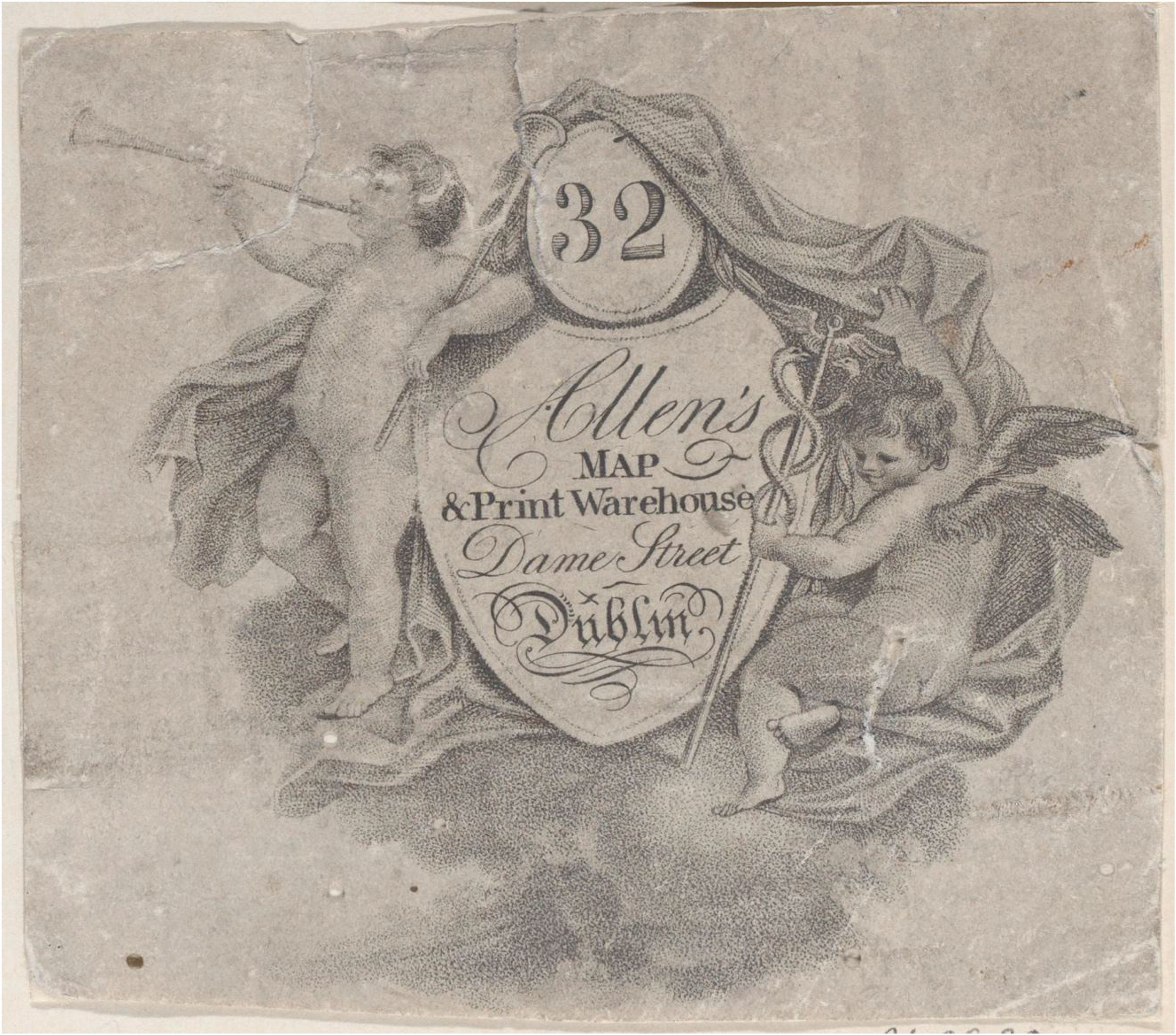
Trade card for William Allen, Map and printseller in Dublin, after 1787, etching, 9 x 10.2 cm. The Metropolitan Museum of Art, New York, 26.28.221.
The precise ages of Allen's children are difficult to confirm. However, it can be asserted that Sarah and Ann worked alongside their three brothers, Mark, John William and Charles. 31 It is likely that the family lived above the shop premises, which by 1830, consisted of five storeys. 32 This is deduced by the fact that Mark Allen included the shop's address as his place of residence in his 1831 marriage certificate. 33 Living and working alongside relatives, servants and apprentices was a common experience for trading families in eighteenth-century England. 34 The improvement of buildings on Dame Street meant that the families of Irish shopkeepers had rooms above the retailing premises as well as rooms to let for lodgers and their servants. 35 The 1798 survey carried out by Rev. James Whitelaw into Dublin parishes found that the average number of persons per household on Dame Street was 8.65. 36 A total of 302 women were recorded as residents on Dame Street from a total of 606 and 70 of the houses were inhabited. A thorough examination of the letters between Allen and Bellew provides some insight into the collaboration of relatives and how familial relationships were negotiated.
One contemporaneous account of a ‘traveller’, who resided at Merrion Square in October 1801 highlighted Allen's shop as a place where ‘scarce and good prints and paintings’ were available. 37 Allen's shop was the location of an Irish art exhibition in June 1800 and included artworks by notable artists like Hugh Douglas Hamilton, William Cuming, George Chinnery and William Ashford. 38 In the second half of the eighteenth century, ‘savvy entrepreneurs’ modified their premises to accommodate those wanting to hire venues for exhibitions. 39 The Dublin Evening Post reported that ‘crowds of visitors’ increased daily to view the artworks in the exhibition at ‘Allen's large room’. 40 This suggests that Allen's shop was a multi-functional space, where exhibitions were held to attract potential customers.
The recipient of Allen's surviving letters, Bellew (1763–1826) was a wealthy catholic landowner from Galway who regularly engaged with the printseller between 1805 and 1818. 41 An activist and proponent of Catholic Emancipation, Bellew campaigned for catholic rights throughout the 1790s and was an early signatory for the Catholic Committee in 1807. 42 Together with his wife Olivia Nugent (hereafter referred to as Mrs Bellew), Bellew had a propensity to lavishly spend money on the improvement and renovation of his mansion at Mount Bellew. 43 With an annual income of £5000 and a vast library of books, the Bellews’ interest also extended to the collection of art, and in particular engravings. 44 Allen acted as an agent for the Bellews, purchased artworks for them at auctions and made enquiries to other manufacturers on their behalf. 45 To give an indication of their close working relationship, Bellew spent a total of £322. 6d. 22s. in Allen's shop between 1810 and 1815. 46 Bellew purchased materials on credit and in 1810, instructed Allen to draw money from Lord Thomas French's bank to settle his account. 47 Although Harvey states that Allen was Bellew's primary art dealer in Dublin, he was just one retailer that Bellew consulted during this period. 48 Thomas Potter was another Dublin-based art dealer who supplied Bellew with artworks and assistance on matters relating to the provenance of paintings. 49 Allen's role as an agent was further demonstrated in 1810 when he was involved with the transportation of John Foster's portrait by William Beechey from London to the Dublin Society. 50
This was a time of greater economic involvement for women in industrial households. 51 Brophy notes that prior to pre-industrialised Dublin, businesses were smaller family-centred activities where widows continued their husband's firms, or in the case of the Allen family, required the children to assist in the running of the shop. 52 As noted by Vickery, ‘biological and familial imperatives governed the chief roles available to women in professional, commercial and gentry families’. 53 These letters offer insights into the roles performed by the Allen women and the wider networks of gilders, cabinet makers and suppliers employed by Allen.
Sarah and Ann's roles ranged from liaising with customers in their father's absence, collaborating with manufacturers and procuring materials for customers abroad. Sarah in particular, corresponded with both Bellew and his wife on several occasions, which hints that she was involved in the logistical operation of the business. In 1809, Sarah wrote to Bellew on behalf of her father who was in Cork at the time and detailed how three of his ordered picture frames were not yet finished and would be ready in ‘ten days at furthest’. 54 Sarah assured Bellew that her father would see to the packing of the entire order on his return and apologised for the delay in the order fulfilment. Along with her brother Mark, Sarah stepped in to direct and manage the material needs of the firm when her father was ill in 1814, which is examined further below. It is tempting to point to these episodes as examples of individual agency within the household, though she likely acted on her father's instructions. As noted by Lyons, women who worked alongside male relatives in English workshops did not challenge domestic codes and were primarily concerned with feminine respectability. 55 This demonstrates that Sarah conformed to the ideal of a good daughter and alleviated the pressures on the paterfamilias. The intriguing example of the English engraver sisters Anne and Jane Taylor, who alternated their labour between their father's workroom and their mother's domestic realm, offers a useful comparative English example for the Allen sisters. 56 Though Isaac Taylor (1730–1807) was an engraver as opposed to a retailer of prints like Allen, Lyons observes that he trained his daughters and provided them with an independent source of income.
As mentioned at the outset, Allen asked Bellew for requests in advance of his buying trip to London in the autumn of 1809. The letter revealed that Mrs Bellew requested Sarah and Ann to purchase silk stockings on her behalf. 57 Mairead Dunlevy observes that English manufacturers of silk were increasingly aggressive in their supply of materials to shops throughout Ireland and that the ready importation and sale of English silks drove up competition. 58 The Irish stocking industry, though lacking in capital investment, had some factories throughout the nineteenth century. 59 An excerpt from the Limerick Gazette by George Oliver and W. Woods advertised the ‘fresh supply’ of ‘plain English silk stockings’ which indicates that the materials desired by Mrs Bellew needed to be imported or purchased abroad. 60 Allen wrote that his two daughters ‘will have great pleasure in procuring for her to the best of their judgements’ and noted that if anything else accrued to Mrs Bellew in the meantime, to inform his wife Lydia in Dublin. 61 The latest accounts of fashions worn in London and Paris in newspapers and periodicals may account for this request. This also implied that Lydia Allen had written correspondence with her husband and daughters when they were abroad.
Allen and his two daughters travelled to London on 20 August 1809, where he acquired various artworks and materials for his shop and customers over the next month. It is difficult to obtain specific details around such trips but examples from other tradeswomen travelling to London provide an idea of such expeditions. Elizabeth Allin, a widowed shopkeeper from Birmingham, regularly advertised her buying trips to London in the early nineteenth century, though practical details surrounding her lodgings, meeting places and social networks while there remain elusive. 62 Additionally, the proprietor of a Chester clothes shop, Elizabeth Towsey, gave instructions to one of her female employees to meet with a number of contacts and suppliers in London. 63 Like both Allin and Towsey, the Allen women needed to keep abreast with developments in the London market and possibly travelled with their father on similar trips in the past. It is equally possible that the visit to London doubled as a holiday or a reunion with other relations.
Barnard states that those operating in other industries, like ceramics, often emphasised connections with suppliers or manufacturers abroad. 64 Travelling to London was important for retailers like Allen, as it provided an opportunity to acquire the latest materials unavailable in the Irish market and to update stock at home. 65 Bushell, who Allen apprenticed in the 1770s, boasted to customers about his annual expeditions abroad, which represented a degree of continuity in the marketing of his successor. 66 Therefore, the Allen women's familiarity with the London market and the knowledge of where to shop was likely informed by their father's prior trips abroad and his networks of suppliers built up over several decades.
As proxy shoppers, the Allen sisters had to devote a considerable amount of time when selecting the appropriate choice of articles. 67 Mrs Bellew's request indicates that the procurement of female clothing and accessories was considered to be Sarah and Ann's distinct and delineated sphere of activity, which their father evidently advertised to his client. The Allen women presumably had an intimate understanding of Mrs Bellew's preferences and an acute awareness of the modes and manners of the time. Retailers that travelled to England, whether for business or pleasure, often included some shopping for fine clothing and smaller items like watches, not just as gifts but as commissions for family or friends. 68 It is argued that Allen's daughters were a convenient source through which Mrs Bellew could acquire the latest commodities in London. It may well have been the case that Sarah and Ann travelled to London with a long shopping list of commodities to procure for their other customers. When Potter sent picture frames to Allen for repair in November 1809, he remarked in a letter to Bellew that Allen was ‘a good deal hurried since’ his return home from the buying trip, which suggests that the assistance of his children was crucial, given that business appeared to prosper in the winter of 1809–10. 69
On his return from the trip abroad, Allen notified Bellew about the artworks he had acquired and described them as ‘very fine specimens’. 70 However, the letters reveal that the Allens also sourced materials directly from the artists whose work they stocked. In 1815, Allen regretted that two pictures by the Scottish artist Alexander Naysmith (1758–1840) failed to meet Bellew's approbation but added that he expected ‘two others from him’ to arrive soon from Edinburgh. 71 Bellew was given the ‘option of taking whichever pair’ he desired. 72 Not only does this indicate the various means through which Allen sourced his stock but it implies that this direct supply was used as a marketing ploy by Allen with his customers. Allen's boasts about trade connections with the wider art world and his proximity to artists were deliberately done. Not wishing to disappoint his client and hinder the firm's professional reputation, the Allens appeared to allow Bellew to exchange the artworks free of charge. Given the competitive nature of the Dublin market, in which rival print and map sellers like James Del Vecchio operated, business acumen like this was a necessary factor in the success of shopkeepers, especially in the trade of engraved prints. 73
Just as her father displayed commercial adroitness in offering the Naysmith pictures to Bellew, the same can be said for Sarah. A reflection of the diverse range of services offered by Allen's firm, Sarah updated Mrs Bellew on the progress of a commissioned screen in December 1814. Sarah apologised for the delay in its delivery and cited disappointment in the cabinet maker hired to produce the piece. 74 A new cabinet maker was employed and required directions from another craftsman on the desired patterns for the screen, which Sarah wrote would take 10 days more to complete. In the meantime, Sarah sent a box containing three chalk drawings and two small prints after David Teniers (1610–1690), which she hoped would meet Mrs Bellew's approval. Perhaps Sarah sent these prints as compensation for the delayed delivery or as ‘furniture prints’ intended as decorations for the screen. 75 In either case, this demonstrated the trust and reliance placed on Sarah's judgement and her tactfulness when dealing with customers. A reflection of the diverse range of services offered by Allen's firm, the screen commission appears to have been the responsibility of Sarah.
Allen sustained an injury in October 1814 which left the management of the shop to his children. Sarah directly engaged with the cabinet maker commissioned to produce the screen. It is unspecified whether this cabinet maker was externally hired by the Allens for this particular project or whether this was an artisan employed on the premises. 76 In previous letters sent to Bellew about frames that he ordered, Allen made specific reference to his gilders, suggesting that he had specialist craftsmen employed to complete his customers’ framing requests. 77 Nevertheless, it is noteworthy that Sarah, and not her brother Mark, updated Mrs Bellew on the progress of the order. Mark managed the purchase of pictures for Bellew while his father was away, which suggests that the siblings had distinctive spheres of responsibility at this time. 78 Sarah's letter to Mrs Bellew reiterates that literacy and numeracy were necessary skills for this line of business, both of which the Allen women evidently possessed based off the surviving correspondence. Later in 1816, Allen informed Bellew that a 30-shilling note sent as payment for an order was a forgery. 79 This was discovered by Allen's daughter, who counted the money and noticed the counterfeit note when ‘joining the halves’. 80 Though it is not indicated by Allen which of his daughters this related to, it was likely Sarah given her previous involvement with orders. From this, it appears that Allen's daughters received and processed payments from customers.
The letters also provide an insight into the domestic aspects of Sarah and Ann's public and private responsibilities at the shop. In May 1810, Allen sent five hearth brushes bought by his daughters to Mount Bellew, and in a letter noted his regret that they could not get any with brass bottoms. 81 Referring to shopping in eighteenth-century England, Claire Walsh states that for certain commodities like clothing and furnishings, ‘women were best skilled in both selecting and buying them’. 82 It's also worth noting that in a five-storeyed building like the premises at Dame Street, both business and domestic spaces required heat, which meant that the Allen women likely had as much experience in buying or approving hearth brushes for the workroom or shop as for the home (Figure 2). Ever the commercial-minded entrepreneur, Allen trusted the respectability and tastes of his daughters to choose stock for customers. The Allen women's reputation was evidently high and their choices of articles were admired, as evidenced by the Bellews’ satisfaction with the range of goods chosen by Ann. 83
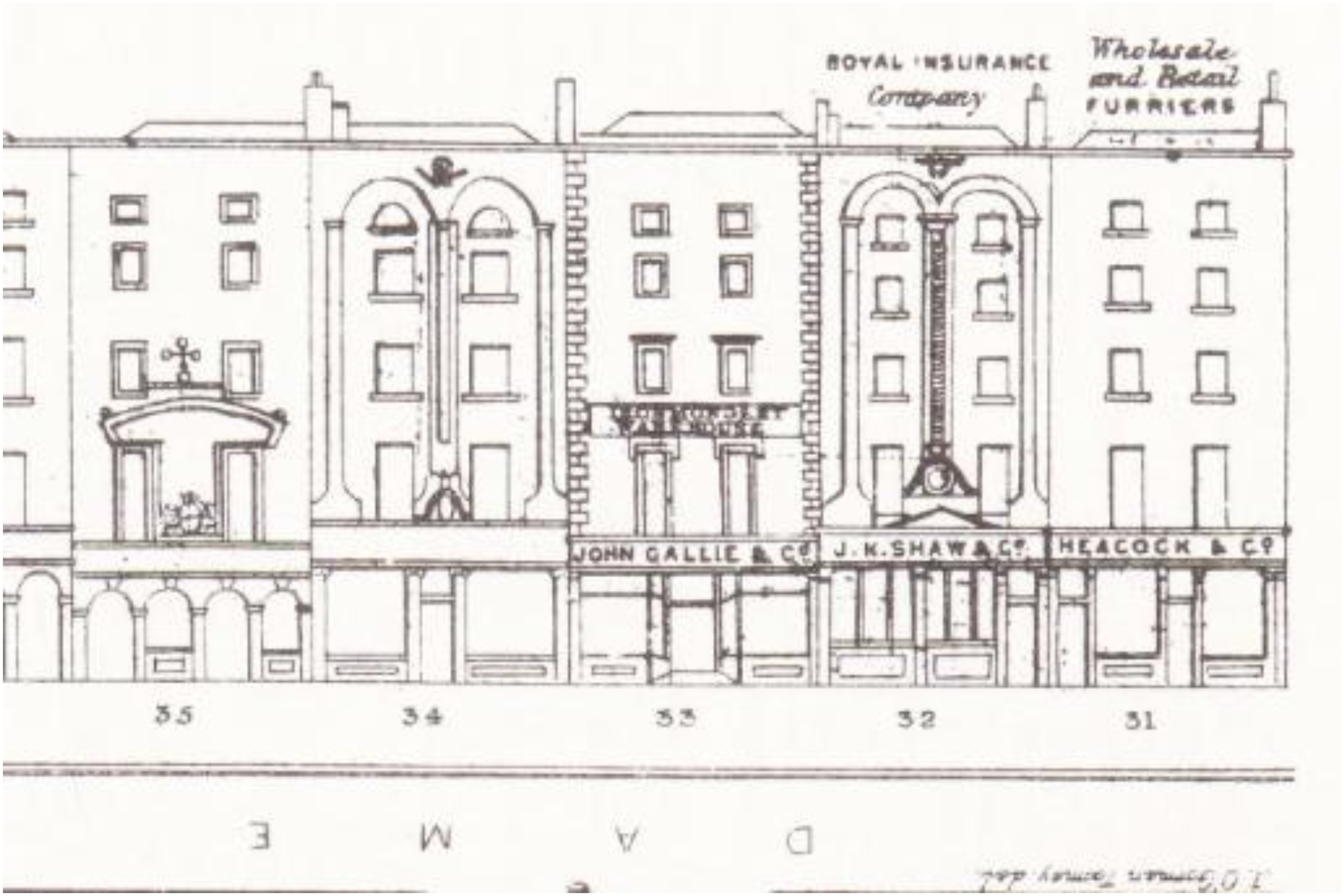
Sketch of 32 Dame Street gives an idea of what the shopfront looked like in 1850. By then, Mark Allen and the rest of the family had left the premises and moved to Westland Row and Trinity Street. 127
Earlier letters further suggest that the women's responsibilities extended beyond the assistance of customers and the mechanics of preparing bills and invoices. It is possible that they had a more involved role in the production of other materials sold in the shop. In April 1810, Ann made a copy from a picture that Bellew had previously purchased. Apologising for the delay in sending the picture, Allen informed Bellew that the print would be sent in the next delivery. 84 The copy was taken from an oval picture of The Repose in the Flight to Egypt (Figure 3), which Allen noted had ‘advanced so far’ and hoped that Bellew would ‘excuse the freedom’. 85 Given that the print is attributed to a member of the Brocas family, who were regularly employed by Allen, the illustration below gives a good indication of what it might have looked like. 86 It is equally possible that Ann copied a print designed by Francesco Bartolozzi, a renowned engraver based in London, which was possibly acquired by her father from suppliers in England. 87 However, it must be reiterated that the paucity of surviving records renders these assessments purely speculative.
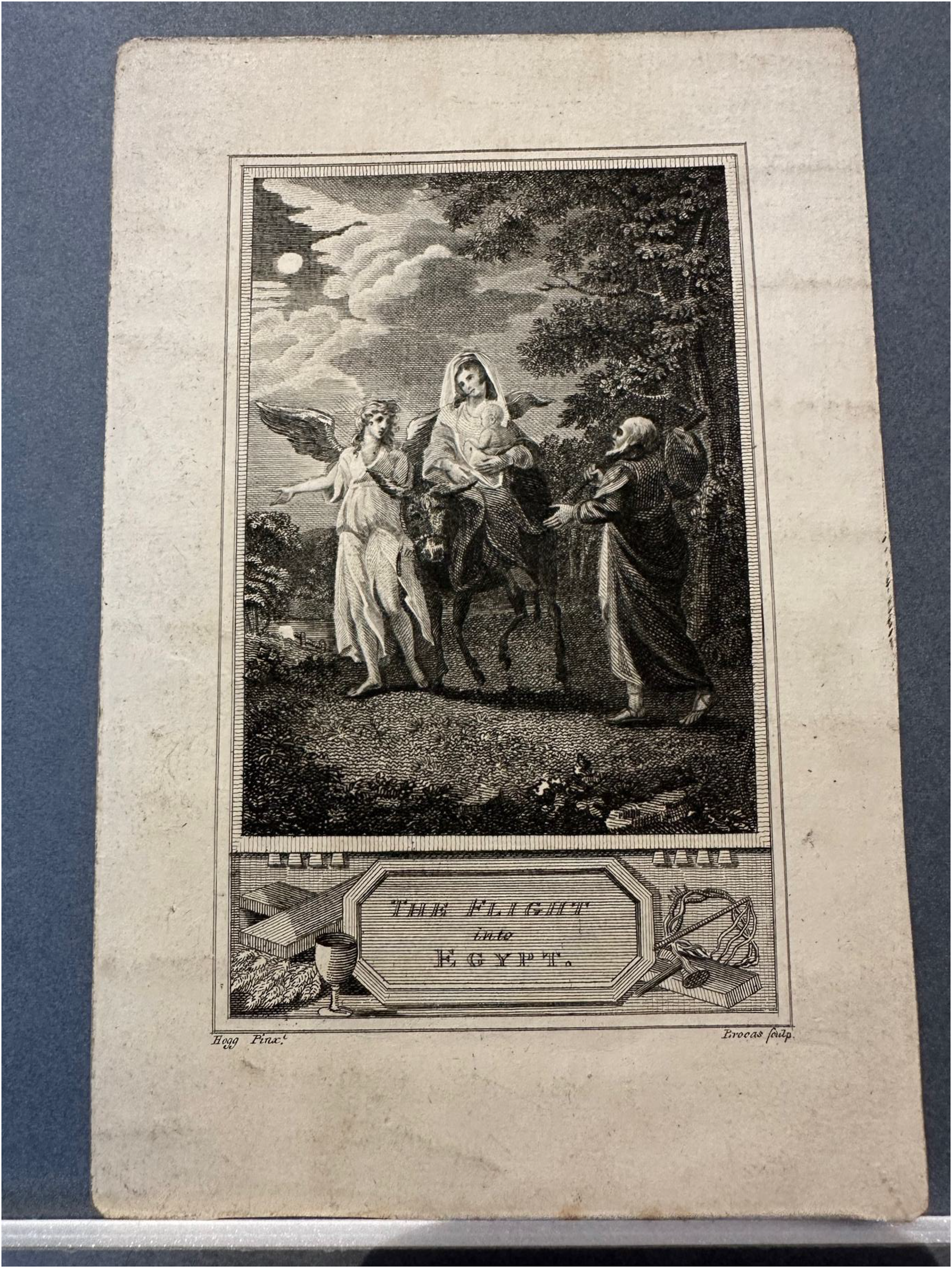
Attributed to a member of the Brocas family based on a drawing by Hogg, The flight into Egypt, date unknown, intaglio print, 17.1 x 11.7 cm. NLI PD 2175 TX 28. Courtesy of the National Library of Ireland.
Lyons mentions that children of printmakers likely received training within the family workshop, irrespective of their gender. 88 This is echoed by Barker who notes that women within a ‘familial setting’ would have undergone an ‘informal apprenticeship’. 89 It is unclear whether either Ann or Sarah received training in drawing or printmaking of any kind by their father. There is no record of Ann, or any of Allen's children attending the Dublin Society Drawing School. 90 Opportunities for formal instruction or training for female artists were minimal, if not non-existent, outside the households of the wealthier landed elite at this time. Though Allen was a printseller and not a printmaker, it is plausible that the production of Ann's copy stemmed from her particular interest in art, which was shaped by her upbringing in the workshop environment. Moreover, Allen published numerous editions of The Student's Treasure, a new drawing book consisting of a variety of Etchings and Engravings executed by Irish artists after the following great artists, an illustrated drawing book which featured a variety of designs. 91 Advertised towards beginners, amateurs and professional artists alike, it is possible that Ann learned to draw using her father's manual. Additionally, the sale of Maria Taylor's (1777–1823) engraved portrait of The Revd. B.W. Mathias, A.M by Allen in 1821 demonstrated that he was not averse to stocking artworks by female artists. 92 As mentioned already, the shop was the site of exhibitions held in 1800 and 1804 which meant that Ann likely came in contact with the leading Irish artists whose works were exhibited there. Given that printmaking and copying required great skill and high-quality workmanship, Ann's ability to copy would have been considered a highly valuable asset to a workshop.
That Ann's drawing was estimated to be ‘tolerably well executed’ and commended by her father, signifies that Allen deliberately emphasised his daughter's abilities in approving terms to a client. 93 In her examination of the Dublin glass industry in the same period, Anna Moran argues that the line between manufacturer and retailer was not clearly defined and that specialist retailers were likely heavily involved in the production of bespoke materials. 94 Though there is no concrete evidence that Allen produced his own prints at this period, it is tempting to speculate that Ann or Sarah developed artistic abilities as copyists or colourers. Moreover, Allen's reference to the copied drawing in the letter to Bellew might have been a shrewd means of advertising her artistic skills. If so, a degree of distributed authorship is attributable to some of the materials sold by Allen at this period.
From his management of the London trip to the advertisement of his daughters’ skills in letters to his client, it is evident that Allen sought to facilitate his daughters in their commercial relationships with customers. The Bellews were on such close terms with the Allen women that Ann was welcomed to visit Mount Bellew in spring 1810. 95 This might have been an invitation to access other artworks in the Bellews’ sizeable collection to draw or more simply a sociable visit. When Mrs Bellew was unwell in January 1814, Allen wrote to Bellew that her illness had filled his family with ‘grief’ and that they ‘anxiously’ awaited confirmation of her recovery. 96 Their inclusion on the buying expedition to London and Sarah's personal correspondence with Mrs Bellew over the order of a screen illustrates how their wider associations of patronage with female customers were vitally important to the family enterprise. Just as their father did, the Allen women carefully purchased materials that they thought were agreeable to their customer's taste. They served as agents on Mrs Bellew's behalf and visited her at Mount Bellew, participating in what Lyons has termed ‘gendered networking’, a form of collaboration among women of shared tastes. 97 Though the examples mentioned above were, for the most part, facilitated through the correspondence of William Allen and Christopher Dillon Bellew, the Allen women nevertheless fostered relationships with female customers in a way that their brothers or father could not.
As stated by Tim Clayton in his study of the English printseller Hannah Humphrey, English printsellers prioritised subjects like female fashion that were of interest to women and even invited their female customers to contribute ideas or designs for publication. 98 The importance of Irish landed women as customers has previously been emphasised by the example of Lady Louisa Conolly, who decorated and furnished the print room at Castletown House. 99 Kate Retford's examination of the varied usages and displays of prints in print rooms likewise places Mrs Bellew's correspondence with Sarah in its wider context. 100 Barnard adds that the success of many shops often relied on the ‘manner of female attendants and the confidence that they inspired in hesitant customers’. 101 Therefore, Sarah and Ann's commercial relationship with Mrs Bellew, built on trust and mutual taste, was of material benefit to the family firm.
Frustratingly, there is little surviving archival material that refers to the Allen women after 1816. However, a better understanding of the trajectory of Allen's sons is traceable. According to Kelly, Allen ‘passed on a thriving business to his sons in 1819’. 102 Writing to Bellew in November 1818, Allen informed his long-standing client that his three sons had become partners in the firm, which then practised as ‘Allen and sons’. 103 Though it appears that Allen had less involvement in the business, prints bearing the publication line ‘William Allen and sons’ continued to be sold until 1824. This is perhaps an indication that the sons continued to capitalise on the public familiarity of their father's identifiable brand. A record in the Land Index for Dame Street in the early 1820s indicates that Allen officially transferred the premises at Dame Street to ‘Allen sons’. 104 Lydia Allen died in November 1821 at the age of 58. 105 In October 1825, Waterford Mail reported that William Allen, ‘formerly of Dame Street, Dublin’ died at the age of 69 ‘at his house in Rathmines Road’, which suggests that he no longer lived at the print shop. 106 In the months prior to their father's death, Mark and John announced the introduction of lithographic printing at the shop. 107 Lithography was a new method of printing, which involved drawing marks on a surface using greasy printing ink on a dampened surface. 108 The sons continued to operate as Allens of Dame Street until John established his own ‘lithographic printing office’ at 16 Trinity Street in 1831. 109 The fate of Allen's children does not appear to have been a happy one. Newspaper advertisements and commercial almanacks from 1825 to 1847 highlight the turbulent nature of the early nineteenth-century Dublin print trade, which is a subject that merits further scrutiny.
The status of Sarah and Ann after their father's death and the transition of the business to their brothers are difficult to trace. Provision was made in their parents’ 1779 marriage settlement which stated that £300 be equally divided among all the children male and female. Wilson notes that provisions like this aimed to ‘increase the independence of daughters in relation to property’. 110 According to Laurence Worms and Ashley Baynton-Williams’ British map engravers, Allen's will was granted in December 1825, though locating this document has proved elusive. 111 Taking over the running of a business after a male relative's death was one way in which women entered the print selling trade. Similar examples had occurred in other industries such as goldsmithing, which demonstrates that there was a precedent of female inheritance of family businesses at an earlier period. 112 However, amendments to the laws of succession in 1833 rendered it increasingly difficult for women to inherit or bequeath property. 113 Although Sarah and Ann were probably trained by their father in the trade, it is difficult to assert whether they continued to operate in the shop or were guaranteed a living following his death. Although it may be difficult to determine the Allens’ particular experience, other examples of women that operated in the same, or similar roles as the Allen sisters can help bring broader context to this examination.
Sarah and Ann were not unique in having important roles in their male relative's print shops at the time. One of Allen's main commercial competitors in the Dublin print trade, Cornelius Callaghan also had female relatives involved in the running of his shop. Ann Callaghan, who was likely his daughter, was listed as the proprietor at 35 Mary Street for several years in the Wilson's Dublin Directories during the early 1800s. 114 Following Cornelius’ death, Ann succeeded the ‘Glazier, painter, map & printseller’ firm along with the rest of her male relatives until she married William Henry of New Dominick Street in June 1809. 115 It appears that Ann's brothers took over the reins of the family shop after her marriage when she presumably left to live with her husband.
An example of the vital role of widows in the print selling trade is evidenced by Sarah McCleary who took over the running of her husband's Nassau Street print shop in 1839. 116 Having traded from there for about three decades, her husband William enjoyed some commercial success with the sale of primarily pirated English graphic satire. 117 However, in the years leading up to his death, Sarah was more visibly involved in the upkeep of the shop and was even listed as the proprietor in newspaper advertisements. 118 Beltrametti and Laffan speculate that William died sometime in the 1830s, which ultimately left Sarah to manage the business. 119 She was listed as a ‘printseller and fancy stationer’ at 39 Nassau Street from 1840 until 1845. 120 When the print shop relocated to 24 Nassau Street, a ‘large assortment’ of materials was advertised, which indicates that akin to the Allen women, Sarah had an intimate knowledge of the business and her husband's suppliers. 121 The explicit reference to ‘her friends and the public’ in newspaper advertisements also suggests that she retained her former customers. 122 Referring to the English print trade, Barker maintains that partnerships between women and their sons were common occurrences and that mothers tended to occupy senior management roles following the death of their husbands. 123 When Sarah died at her residence at 24 Nassau Street in March 1848, the business was inherited by her nephew William McCleary Wightman. 124 Maria Le Petit offers another example of an Irish woman who ran a print shop in Georgian Dublin. Joseph Le Petit sold prints from at least 1814 and continued to retail from different locations until his presumed death in 1829. 125 From then onwards, Maria Le Petit was listed as a ‘printseller and stationer’ at 15 Henry Street. 126 Her appearance in the commercial almanacks demonstrates that a female relative of Le Petit assumed control of the business in his absence. These examples therefore showcase how familial succession offered a pathway for women into the print selling trade in Georgian Ireland.
Ultimately, the case study of Sarah and Ann Allen showcases an overlooked aspect of the Irish print selling trade. Although the contributions of the Allen women have been overlooked, this does not mean that they were unknown in their lifetime. Fortunately, recent efforts have been made to highlight individual Irish printsellers and the practices they employed to elevate their businesses in the competitive Dublin marketplace. Building on this foundational research, this article has aimed to highlight a uniquely Irish dimension to Martinez and Roman's edited collection, which has stressed the importance of recovering the stories of women in these spaces. In their familial roles as daughters, the Allen women were expected to dynamically assist with the day to day running of the shop. This ranged from copying images to dealing with payments, corresponding with customers, sourcing items for purchase and the management of the business when their father was ill. Unlike their brothers who eventually inherited the family business, Sarah and Ann were uniquely placed to cultivate their own customers, as evidenced by their relationship with Mrs Bellew, who placed great value and trust in their judgement. The comparative examples of Ann Callaghan, Sarah McCleary and Maria Le Petit likewise expand our understanding of the importance of widows and female relatives in the structure and economy of these firms. The shop on Dame Street was evidently a place where domestic and commercial spaces overlapped and where labour was shared between male and female relatives alike. The examples of Sarah and Ann provides new understanding on the realities of women as retailers and sheds new insight on this aspect of Irish visual culture.
Footnotes
Acknowledgement
The author wishes to acknowledge Alison FitzGerald and Toby Barnard for reading earlier versions of this article as well as the anonymous reviewers who offered helpful and constructive feedback.
Declaration of conflicting interests
The author declared no potential conflicts of interest with respect to the research, authorship, and/or publication of this article.
Funding
The author disclosed receipt of the following financial support for the research, authorship, and/or publication of this article: This work was supported by the Irish Research Council (Grant No. GOIPG/2024/4477).
