




Abstract
Histories of the development of professions show a profession's relationship with the state as key to its authority. Yet professions, to gain technocratic authority, also strive to depoliticise their discourses to gain technocratic authority. This dilemmatic tension is particularly true for the economics profession. The historical development of the Irish economics provides an interesting case, where a complicated relationship with the state ultimately strengthened the profession within a society. An initial formalisation trajectory of Irish economics was thrown off course by the formation of an independent Irish state in the 1920s. This marked a period of isolation for the profession and saw it ostracised from government policy. Subsequent developments also saw the Irish economists’ position as critics of government policy rather than a core part of the state.
Introduction
Despite being recognised as authoritative experts on the economy, the Great Recession raised questions about economists’ authority and orthodox economic discourse.1, 2 The economics profession's perceived inability to warn society of a major economic event led to much criticism of the profession with Colander et al. arguing that the financial crisis demonstrated ‘a systemic failure of the economics profession’, and Schneider and Kirchgassner suggesting that the crisis should lead to ‘a quite clear systematic criticism of the economics profession’. 3
Within this challenging international context, Ireland appeared to buck the trend. Rather than being side-lined or blamed for the severity of the recession, the Irish economics profession was strengthened. This is evident from the establishment of the Irish Fiscal Advisory Council in 2011 as an independent body, the foundation of the Irish Government Economics and Evaluation Service in 2012, as well as the appointment of an academic economist, Patrick Honohan, as Central Bank governor in 2009, breaking a long tradition of this position going to a senior civil servant. 4 In analysing the potential reason(s) for the Irish profession's strengthened position, this paper draws mainly on two methodological resources. First, it aligns with previous research from Fourcade, which argues that historical understanding is important to understand how the economics profession develops nationally. 5 An understanding of this initial organisation provides insights into the traits of the profession in Ireland and further understanding of the profession in contemporary society. Second, this paper draws on research from Maesse which examines the interplay of the sources (academia, the state, business and media), from which professions develop their strength. 6 This paper argues that of these four sources, the historic relationship of the Irish economics profession with the state has been pivotal in the development of its technocratic authority.
This paper begins with the origins of the academic formalisation of economics in Ireland. This was selected as the starting point because formalisation within academia has been noted as pivotal in the development of economics in a national context. 7 It then follows a broadly chronological structure, focusing on important historical moments that the profession has experienced, which shaped how the profession has developed. It draws on previous historical analysis, archival material, and interviews with professional economists. The paper then finishes with a discussion of how its historical development helps explain the manner which the profession conducts itself in contemporary Irish society.
Origins of the Irish Economics Profession and its Change of State (1832–1930)
The Irish economics profession followed the global path of formalising in academia, through the establishment of the Whately Chair in Political Economy at Trinity College Dublin in 1832. 8 The initial establishment of the Whately Chair was met with some hostility, primarily based on the belief at the time that political economy was inferior to established academic subjects, such as Philosophy, Law, and Medicine, because of its practical orientation. 9 This inferiority was reflected in its tenure, which was limited to a five-year term, something that contrasted with the permanency associated with more developed disciplines. 10
Early Whately Chair occupants would go on to form the Statistical and Social Inquiry Society of Ireland (SSISI) in 1847, a de facto professional body for political economists. 11 SSISI's connection with political economy occurred soon after its formation when it was entrusted with the Barrington lectures in 1849. 12 The awarding of the Barrington Medal, involved a grant for a political economist and required the winner to provide public lectures. 13 Though these developments further solidified the position of political economy in Irish society, a dedicated scientific journal, that could ensure requisite standards of scientific quality, was required to strengthen its position. The founding of the Economic Journal in the UK in 1891, along with the removal of the Whately Chair's five-year limit around the same time, signalled greater prestige for political economy in Irish academia. 14
Within academia, the dominance of TCD started to be challenged in the early 1900s. The Irish Universities Act (1908), allowed for a more decidedly Irish national educational institution, through the National University of Ireland, ‘which was to have three constituent colleges in Cork, Dublin and Galway’. 15 Of these, the Dublin constituent college, whose name had been changed to University College Dublin (UCD) in 1882, was perhaps the most direct challenge to TCD's dominance. 16 Along with its clearly Catholic orientation, UCD also had a professed Irish nationalist orientation, evidenced by the central position given to Irish language and literature at the University. 17
Given the separate affiliations of UCD and TCD, it is not surprising that they experienced quite differing fortunes after the establishment of the Free State. The flourishing of UCD contrasted with a swift erosion of TCD's dominance and would contribute to TCD's isolation from most parts of contemporary Irish society throughout the 1920s. 18 This isolation was also reflected in the economics profession. Charles Bastable, Whately Chair Professor in TCD from 1882 to 1932 and arguably the preeminent economist in Ireland at the founding of the Free State, was not a dominant figure in the early economic committees set up by the Free State. Bastable's relative absence from public policy contrasted with UCD economist George O’Brien's prominence in Irish public policy. 19
Despite similar roots, SSISI did not experience the same isolation as TCD. SSISI's initial silence, and implied neutrality, on constitutional issues were a reasonable attempt to remain impartial during this period of political upheaval. 20 However, once the Free State was established, SSISI was swift to accept the changed direction of Irish public policy and quickly made important contacts with the new administrative elite. 21 Also, SSISI was more willing than TCD to embrace nationalism and nationalist figures, evidenced from 1924 by its choice of presidents, who were distinctly more nationalist than their predecessors. 22 SSISI's membership started to include professors from UCD, ministers in the Free State government, and prominent nationalists in the Irish civil service. 23
By the late 1800s, the Irish economics profession had become formalised in Irish academia and the discipline had gained at least some reputation in Irish society. Had the external political situation remained unchanged, the Irish economics profession may well have developed in line with the British profession, as it broadly appeared to do until then. 24 However, the turbulent political environment of the early 1900s in Ireland would have a seismic impact on the development of the profession, knocking it off its trajectory. Prior to the establishment of the Irish Free State, many of the dominant elite institutions in Ireland were overtly loyalist to a British dominated state. 25 However, after the emergence of the Irish Free State in 1922, these loyalist leanings would become highly problematic. Although the Free State was keen to maintain some continuity with the previous British regime, especially in fiscal matters, it also was keen to ensure a nationalist orientation to the new government and civil service. 26 Irish nationalist institutes would rise to challenge the dominant institutes loyal to the United Kingdom. 27 Furthermore, the fledgling profession would have to manoeuvre within the confines of a new national state establishing its independence. This would greatly impact the profession's role within Irish society.
Irish Economists’ Hibernation (1931–1955)
The new state established a slew of committees to provide advice on the direction of economic policy and the structure of Ireland's economic apparatus. 28 The selection of members for these committees was carefully made to ensure that their recommendations would echo government policy preferences. 29 Given that the new state's policy preferences were largely in tandem with contemporary economic orthodoxy, finding amenable economists was not an onerous task. 30 As a result, the state was able to indulge its nationalist preferences in the selection of participants, evidenced by Chair of National Economics in UCD, George O’Brien, being a regular occupant and TCD economists being peripheral figures. 31
This tentative embrace of economists by the state was short lived. The arrival of Fianna Fáil (FF) to government brought a much greater commitment to protectionism and a preference for economic self-sufficiency. 32 Prior to this, the Free State governments had adopted a general policy preference for free trade that was augmented with instances of ‘selective protection’, where a need for a specific tariff was determined by a Tariff Commission. 33 In contrast, the economic policies of 1932 to 1948 can be best described as economic nationalism with a decisive break from the previous free trade preference. 34 With FF in government, Ireland's average tariff level rose from 9 per cent in 1931 to 45 per cent in 1936. 35 Though it has been argued that the Irish Free State moved from ‘one of the least to one of the most protected economies in the world’, ithin the international context of the time Ireland was not an outlier. 36 Though the average tariffs in Ireland were towards the higher end of what was typical within Europe at the time, ‘they were similar to those in Germany, Italy, Portugal, Spain and the United Kingdom’. 37 Despite protectionism being consistent with an international policy shift in that direction, FF was also keen to rationalise this policy as shift from the failure of their predecessor's economic policy. 38 Also, since much trade was done with the UK, protectionism was another front on which stronger national sovereignty could be pursued. Given that Irish economists were generally free traders and fiscal conservatives, FF isolated them, for the most part, from economic policy. 39
Protectionism persisted despite continued opposition from prominent Irish economists, including George Duncan, who held the Whately Chair, Joseph Johnson, Professor of Applied Economics in TCD, and George O’Brien, as well as opposition from senior civil servants within the Department of Finance. 40 Duncan was a keen student of the Austrian school of economics, and was ferociously hostile to FF's protectionist ideals. 41 O’Brien was also critical of rising public expenditure during the 1940s. As a member of Seanad Éireann (the Upper House in Ireland's bicameral system) in the 1940s, O’Brien spoke of the seriousness of the growing deficit in Ireland's balance of payments, and how it required immediate public attention. 42 Notwithstanding these criticisms, it was Joseph Johnston who most strongly voiced criticism of the state's economic policy in his 1934 book ‘The Nemesis of Economic Nationalism’. 43 An exception to this chorus of criticism was Timothy Smiddy, who had been professor of economics at University College Cork (UCC) as well as a diplomat for the Cumman na nGaedheal government. Smiddy had been an opponent of protectionism during the 1920s but his opinion began to change in the early 1930s as he became amenable to protectionism in some forms. 44
Despite the profession's persistent criticism of government economic policy, its concerns were largely ignored. 45 Some have laid at least part of the blame for this treatment at the profession itself, suggesting that university economists were ‘sulking in their tents’ and had failed to embrace the changing orthodoxy of economics towards mathematical formalisation, something the Irish civil service and government sought as increasingly important for economic policy. 46 It is true that the Irish economics profession was late to embracing the mathematical formalisation of economics, which had undergone a ‘quantum leap’ between 1925 and 35. 47 However, whether Irish economists were hostile to the incorporation of mathematics into their profession, as has been claimed, is debatable. 48 Thus, the reduced engagement of economists with economic policy was probably because of the disdain the profession generally held for protectionism, as well as what appears to be an antagonism from the Department of Finance to entrust policy work to non-civil servants. 49 Indeed, FF did include economists in certain policy areas where the ideological tensions were not an issue. Smiddy served as an informal economics advisor to the FF government from 1932 to 1945, a choice that was almost certainly influenced by his sympathetic views towards protectionism, and the second Banking Commission included economists amongst its 21-person membership. 50
The state's neglect, between 1931 and 1955 of the profession in policy formulation marginalised economists. Where the state gave the profession attention, such as through the second Banking Commission, economists did recommend policies that would help in the development of the profession, such as the establishment of the Central Bank of Ireland. 51 However, such instances were limited and the Irish economists’ general opposition to government policies delayed growth in the profession's authority.
Reinstating Irish Economists (1956–1969)
The 1945–1950 period saw a strong economic boom in Ireland, driven by a surge in consumption rather than in re-construction as was the case for most of Europe. 52 By the early 1950s, the Irish consumption boom of the late 1940s stalled. Ireland experienced a balance of payment crisis in 1950 and 1951, which culminated in a highly deflationary budget in 1952 and subsequent recession. 53 Green shoots of recovery in 1955 were extinguished following the decision to break the interest link with the UK, a decision taken by the Irish Minister for Finance, Gerard Sweetman, in response to the UK government's decision to increase interest rates to quell inflationary pressures in its economy. 54 What ensued was capital flight from Ireland to the UK to avail of the higher interest rate. 55 A swift policy reversal followed in 1956, resulting in a deflationary budget, import levies, and emigration. 56
Despite these economic travails, Irish economic policy was beginning to move in a new direction towards economic planning and export-oriented growth. By the 1950s much of the rest of Europe had removed its barriers to trade and had begun to adopt export-oriented growth strategies. 57 Though Ireland was a laggard in adopting such policies, the establishment of the Irish Development Authority (IDA), does suggest that export-oriented growth was a policy goal of government. 58 The appointment of T K Whitaker as Secretary of the Department of Finance in 1956 further contributed to this change in economic policy direction. Whitaker would be key in formalising this change through the Economic Development plans. 59
Economic Development is often held up as a seismic moment in the economic history of Ireland, a sort of ‘big-bang’ event that ushered in a dramatic change in Ireland's economic direction. 60 Although tariffs would reduce following its 1958 publication, this reduction was slow and took many years to implement. 61 Industrialisation was a component of Economic Development, but agriculture remained central to the Irish economy, something the economic profession recognised in its discussions. 62 Economic Development did not adopt a revolutionary approach to policy, evidenced in the fact that there was no adoption of the demand-management or social spending aspects of Keynesism. 63
The change in economic policy during this period occurred in tandem with a change in the economics profession. As figures such as George O’Brien and George Duncan retired, a new generation of economists took their place. Where previous generations of Irish economists had not taken undergraduate studies in economics, this new generation, undertook thorough economics training, and began a longstanding trend of Irish economists going abroad to attain a PhD. 64 This allowed Irish economics to be more attuned to international developments, such as the mathematical formalisation, and gain qualifications from world-leading academic institutes, strengthening its academic rigour. 65
The Economic Research Institute (ERI) was established in 1960 with the help of funding from the Ford Foundation. 66 The ERI facilitated the high quality, economic analysis that the civil service increasingly saw as an essential element of policy development. The dearth of expertise within Ireland for this high-quality analysis was evidenced in the early staffing of the ERI, which had no Irish research staff for its first five years. 67 To address this expertise deficiency, the ERI established a scholarship scheme to fund graduates to undertake postgraduate study abroad, playing a vital role in transforming the quality of economic analysis available to the state. 68
Thus, the economic crisis caused by the interest rate break with the UK, the change of direction of economic policy, and the arrival of a new generation of economists trained in the frontiers of economics, proved a perfect storm for the profession to awaken from hibernation, and once again become integral components of policy formation and advice. Economists' growing influence on public policy can be seen through prominence in the Capital Investment Advisory Committee (CIAC) and the second Economic Development plan. The CIAC was established by Whitaker to provide input and advice for industrial policy of the Department of Finance. The importance of the CIAC was evident from its membership, see Figure 1 below, and on the reception of its advice, which would become a central to the government's industrial policy. 69 Charles F. Carter's inclusion is noteworthy given that he was based in Northern Ireland, but his professional expertise and belief in the role of the state in supporting industrial development through industrial policy earned him a place on the CIAC. 70 Additionally, economists now began to take up prominent policy roles, such as Louden Ryan who was key to the second Economic Development programme, and was also effectively a ‘full-time consultant to the Department of Finance’. 71
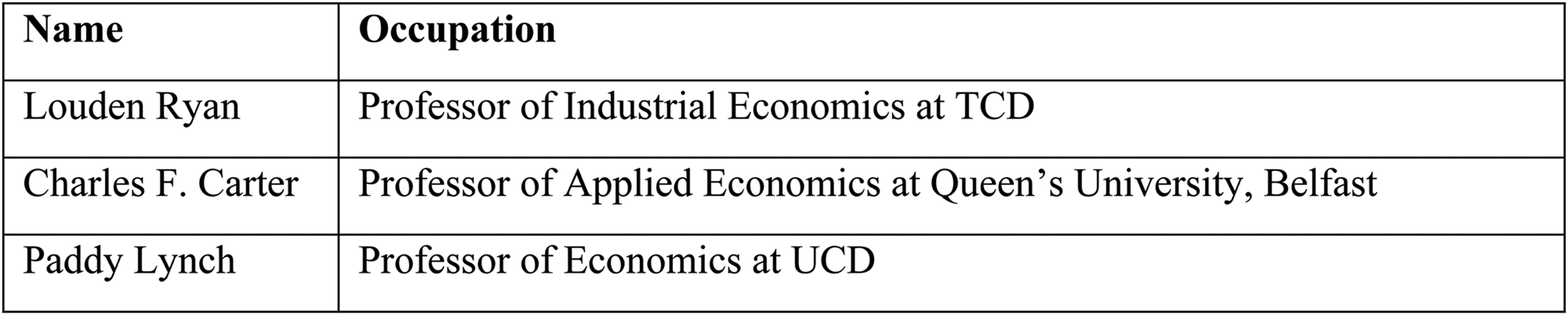
Membership of the capital investment advisory committee. Source: Compiled by the author from information in De Buitlear (2003, p.13–14) and McClintock (2002).
With the prominence of economists in policy formation and the establishment of dedicated institutions, the early 1960s was to be a high point of influence for the profession on economic policy. This level of influence would not persist. From the mid-1960s, the government began combining economic policy with social policy. Consequently, the ERI became the ESRI in 1966 and the third Economic Development Programme in 1969 saw its purview being broadened to economic and social development. 72 The social component of the ERI's remit was only added after the Irish government took over the major financing in 1966, in a move that seems emblematic of how the profession was viewed by the state. 73 That is, the state appeared to recognise a value in incorporating the economics profession into its apparatus, but only partially and with limits to its power and influence. Also, in 1969, Whitaker left the Department of Finance and moved to the Central Bank as its governor, further loosening the position of the profession within the state's economic policy. Thus, by the end of the 1960s, the profession had established itself within the state as a contributor to economic policy advice. However, the extent of its influence on actual policy formation was more limited.
Mediating Economists (1970–1989)
As economic conditions became less stable in the 1970s, Ireland responded with an expansionary fiscal policy, facilitated by running large fiscal deficits. 74 At first this fiscal expansion was reasonably in line with economic thinking internationally and represented a late arrival of Keynesian demand management to Ireland. Though by the late 1970s it would become extreme. Despite economists being embedded in the state through the employment of economic advisors to Irish Taoisigh and Ministers of Finance, the expansionary fiscal policy was not the consensus of the profession, many of whom regarded it, especially in its later extreme, as reckless. 75 Thus, the level of input into state policy-making the profession had enjoyed during the late 1950s and early 1960s was not maintained. Instead, the state reverted to its previous norm of inclusion of only a small number of economists for advice. Despite being on the policy periphery, the profession was manifestly different in the 1970s than it had been. The quality of the economic analysis provided by the profession had improved significantly and economics had a formalised and permanent role in policy advice through the ESRI, as well as a dedicated academic journal for economic analysis on the Irish Economy through the Economic and Social Review. 76 Also, during this period economists were seeking a much broader reach for their criticism of policy in national media. 77
The persistent instability of economic conditions in Ireland during the 1970s and the dire state of affairs in the early 1980s, meant there was a public appetite for economic discourse. 78 This led to a steady increase in the influence of economists in Irish public discourse as they became an ever more common presence in popular Irish media. Up until the late 1960s, there was very little media engagement from economists, with the notable exception of Garret Fitzgerald, who had a weekly column in the Irish Times from 1959 to 1973, and a series of eight ‘explainer’ articles that Patrick Lynch was asked to write for the Irish Times in 1953. 79 A more prominent engagement is evident from the 1970s. The reason for this may well be partially explained by the greater demand for economists from the media, but also a sense of public responsibility from the profession. 80 Also, in addition to contributions in national newspapers, economists were also writing in prominent, current affairs magazines during this period, where they were again often critical of government's economic policy. 81
Economists used the authority they were afforded from their media engagement to largely criticise government policy. 82 In keeping with the changing orthodoxy within the profession internationally towards fiscal retrenchment ‘to correct swollen budgets and external deficits’, the profession in Ireland were advocating similar remedies to ease the fiscal woes. 83 Given the international influences on the Irish economics profession, evidenced by the ESRI's initial Ford Foundation funding and number of economists who had gained PhD's abroad, it is unsurprising that the Irish economics profession chimed so closely with the international consensus. Though the vocal criticism of the profession served to limit influence on public policy before 1987, its engagement with the media suggests that this may have been viewed as an alternative means for the profession to continue to develop its authority, given the marginalisation by the state of members of the profession who were not in its employment. 84
Understated Watchdogs (1990–2009)
As has been well documented, the economic growth that the Irish economy experienced during the 1990s saw it become ‘one of the fastest growing economies in the European Union’. 85 The number of people in employment rose from 1.1 million to 1.9 million in the 15 years until 2005, and the population increased by 15 per cent from 1996 to 2005. 86 The term ‘Celtic Tiger’ was coined to describe the economy during this period, given its similarity to the frantic growth seen by many Asian economies in the 1980s. 87 Although there were some cautionary notes about how long the ‘Celtic Tiger’ period could last, this period of rapid economic development was broadly lauded and allowed economists to offer reasons for this success, including the wise adoption of policies advocated by the profession. 88
By 2000, Ireland's economic growth was increasingly being driven by domestic demand, particularly the property market. This led to some concerns being voiced about the government's economic policy, which was both expansionary and pro-cyclical. 89 Such reservations were echoed by members of the economics profession, particularly those in academic and research institutions, who took on a watchdog role regarding the economy. 90 These concerns became heightened after the government's decision to respond to a global economic downturn, which began in 2001, with expansionary economic policies. 91 Prominent economists voiced their concerns in the media on the decisions that the government were making. 92 Though these concerns fluctuated in terms of their severity, directness and the reach of publication, with few explicitly outlining the potential extent of the crisis, they were not isolated. 93 The profession was also not universal in warning that a severe economic contraction was possible, but when the scope of the concerns raised are viewed collectively, it is evident that the profession was regularly and systematically monitoring the Irish economy.
Though the profession was clearly aware of the developments in the property market, its response was varied. The Central Bank of Ireland's Financial Stability Reports did provide warnings of risks for the Irish economy, but its overall key message was that ‘the Irish banking system was in a good state of health’ and ‘well placed to cope with possible adverse shocks’. 94 Other economists were largely dismissive of such warnings, arguing that these warning did not appreciate the particulars of the Irish context, or used inappropriate forecasting models. 95 However, concerns were being voiced. John FitzGerald warned that property prices could fall by as much as 15 per cent following the downturn in the global economy in 2001. 96 The growing stock of vacant dwellings in Ireland, projected to be 15 per cent of the total housing stock in 2005, were pointed to as a sign that housing demand was being fuelled by speculation. 97 The significant level of the financial sector's lending to construction, and the sudden and significant increase in funds coming from abroad were both highlighted as potentially problematic. 98 Arguably economic advice within the Department of Finance did offer warnings of potential risks given the ‘pro-cyclical fiscal action’, however, the extent of such warnings have been debated. 99 Economists were also vocal in the media. Alan Ahearne, an economist at NUI Galway, wrote several newspaper articles in 2007 on the likely demise of the property sector. Titles such as ‘Will the banks go bust in a property slump’ (22 July 2007), ‘Housing market will face crack of the whip’ (12 August 2007), and ‘History suggests landing will not be soft’ (16 September 2007) illustrate the directness of his warnings. 100 In an intervention well-covered by the media, Morgan Kelly, an economist in UCD, argued that the Irish housing market was a classic example of a market boom and bust. 101 He concluded that, based on historical data of similar busts in the housing markets of OECD countries, ‘a fall in real house prices of around 40 to 60 per cent’ was probable. 102
This period shows that the academic economics profession had established itself as a distinct voice on economic policy advice, which did not shy away from criticising government policy. Economists repeatedly voiced concerns regarding the rapid appreciation of asset prices being witnessed in the Irish property market, heightening tensions with the government. Tension between government and the economics profession spilled out into public discourse. Charlie McCreevy, Minister for Finance from 1997 to 2004, mocked economists who warned against the government's fiscal policies, and even refused to appoint himself an Economic Advisor, a position that had become customary for Ministers of Finance in Ireland. 103 Bertie Ahearn, who was Taoiseach (Prime Minister) from 1997 to 2008, made perhaps the most memorable derision of the profession, when he pondered how those who criticise the economy did not ‘commit suicide’. 104 Such comments clearly suggest a tension between government and economists. Perhaps more importantly the media coverage of the tension between government and economists, meant that the profession gained strength in its relationship with the state as the public were exposed to it as an independent watchdog over the economy.
A Good Crisis and Better Recovery (2010-)
As Ireland suffered from the Great Recession, its economists benefited from their forewarnings and their tensions with government during the later Celtic Tiger. Thus, Irish economists did not suffer from the crisis of economics that was experienced elsewhere. It continued its watchdog role through regular publications that detailed both the reason for the economic collapse and providing advice for future economic policy. 105
This enabled Irish economists to enhance their societal position as voices of authority within public discourse and to grow its stature within economic policy formation. 106 Its heightened stature was evident in the elevation of Patrick Honohan, an Irish academic economist, to the position of Governor of the Central Bank of Ireland in 2009, the appointment of Alan Ahearne to the position of economic advisor to the Minister for Finance in 2009, the establishment of the Irish Fiscal Advisory Council in 2011, which was initially chaired by John McHale, another Irish academic economist, and the formation of the Irish Government Economic and Evaluation Service in 2012. This deeper embedding of Irish economists within economic policy formation has clear echoes of the 1950s, when Whitaker embedded the profession within policy advice at the Department of Finance. As this paper has outlined, although the stature that economists enjoyed under Whitaker did not endure indefinitely, it did leave lasting benefits for the profession such as the position of the ESRI and The Economic and Social Review, which has had a significant and lasting impact on Irish economic policy. 107 In contemporary Ireland, there is some evidence that the stature of economists is again waning from its heights during the Great Recession. The Governorship of the Central Bank is no longer held by an Irish academic economist and the advice of the Irish Fiscal Advisory Council has not always been welcomed by government. 108 This erosion of their authority is perhaps unsurprisingly given the historical parallels from the 1970s and 2000s, when the economy was experiencing what looked like strong economic growth and any hint of pessimism was dismissed by government. Furthermore, though economic crises can often serve as an occasion for reconsidering existing policies, this radical zeal of government seems to dissipate when the crisis has passed, causing it to return to a status quo of antagonism to outside policy input. 109
Conclusions
This paper contributes to our understanding of the development of the Irish economics profession, adding an overview account of its development that complements other work, helping to understand both policy-making and policy discourses in Ireland. 110 This overview makes clear the importance of academic and research institutions in the development of the profession both in its pre-independence establishment and from the 1950s on, but stresses the relationship with the state.
The Irish economics profession struggled to have its authority on the economy supported by the independent Irish state. The alienation, at times, from the state of the Irish profession meant that it gained a reputation of autonomy from government, perhaps unusual internationally, through its need to use media to advocate policy criticism from outside the state. In countries where economists had a more established role in the state this was probably not necessary once the discipline was sufficiently established, though the role such writings had in the development of British economics demonstrates its potency. 111
This paper focussed on the role of the academia, the media and the state in the development of the economics profession and hopefully provides a convincing account of importance of these three fields in the case of Ireland. In contrast to other work using similar theoretical approaches, our account neglects the role of commercial or business field. 112 Given the increased employment opportunities for economists in Ireland's finance sector especially since the 1980s, and the more recent demand for micro and behavioural economists since the turn of the century, this is worthy of more research. Neglected by the approach adopted here is the role of professional servants within the state, though this has shown to be a fruitful object of investigation. 113 Also, under explored in this account, and accounts using similar theoretical resources, is the relationship between religion and economic discussions, which as has been pointed out deserves further exploration in the Irish context. 114
Further understanding of the economics profession in different national contexts would benefit from international comparisons. 115 Although previous research provides some such comparative work, further research is needed. 116 An aid to such comparative work would be detailed explorations of national contexts. 117 The account presented here contributes such a historical context for Ireland which draws on theoretical concepts familiar to understanding of economists in other countries in a way that hopefully makes clear the national context as well as the incompleteness of the account.
Footnotes
Declaration of Conflicting Interests
The author(s) declared no potential conflicts of interest with respect to the research, authorship, and/or publication of this article.
Funding
The author(s) received no financial support for the research, authorship, and/or publication of this article