



Abstract
The objective of this paper is to provide a most needed comprehensive synthesis of the Indigenous procurement literature to clarify the state of the art in this area of management scholarship, as well as the associations between local conditions and policy evolution and developments across post-colonial societies. We conducted a rapid systematic literature review of the contemporary Indigenous Procurement Policy (IPP) literature. We identified and reviewed 18 qualitative and one quantitative published study from 2000 to 2023. We found weak author collaboration density across regions, with Australia producing the bulk of IPP research. We utilised the five-stage policy life cycle model to map the contemporary scholarly literature on IPP in Australia to identify critical evidence gaps in the research. In the Australian literature, there is minimal scholarship on the institutional agenda setting and formulation phase of the IPP, with research on the adoption phase making clear the case of public policy transfer from the United States, as an early exemplar, to Australia. The research on the implementation phase has focused on the evolution of the policy objectives and legality of the policy. More recent scholarship has focused on evaluating the IPP, reflecting the later stages of the policy life cycle. The findings from this review emphasise the usefulness of the policy life cycle model as an organising device in understanding the evolution of scholarship and identifying critical gaps to be addressed to deepen our understanding of policy development in the IPP domain.
Keywords
1. Introduction
Indigenous people make up 6.2% of the world’s population but are overrepresented in measures of poverty and socio-economic exclusion (United Nations, 2021). Economic empowerment is key to addressing the social determinants that characterise Indigenous peoples’ continued and embodied experience of inequality (Davis, 2015; United Nations, 2008). In an attempt to reconcile Indigenous disadvantage in post-colonial societies, governments have enacted various responses to address the relationship between Indigenous people and the state, outlining expectations for the socio-cultural and economic advancement of Indigenous people. One such policy and/or legal remedy that governments and corporations have increasingly adopted is the establishment of minority and Indigenous preferential procurement to activate the emergent Indigenous business sector.
The incorporation of social policy objectives in procurement has an extended history dating back to the 19th century (McCrudden, 2004). Procurement provides governments and corporations with a purchasing framework that can engage policy objectives, such as prioritising local sourcing, addressing environmental goals or targeting minority suppliers, while achieving value for money. The introduction of procurement preferences for Indigenous and minority businesses aims to address market barriers such as racial bias, informational and network barriers, and economies of scale (Biddle et al., 2013). Economically, addressing the market-based barriers for Indigenous businesses may have significant flow-on benefits for Indigenous families, households, health, educational outcomes and broader Indigenous economic development (Australian Institute of Health and Welfare, 2015; McDonald et al., 2019).
As of September 2023, Australia’s IPP has generated over AUD 9.5 billion in contracting opportunities for Indigenous businesses. Notwithstanding the potential for Indigenous preferential procurement policies to boost the Indigenous business sector as a powerful engine for the economic self-determination of Indigenous peoples, there is no overarching understanding of the evolution and development of the contemporary scholarship on Indigenous preferential procurement policies that enables insight into how these policies have changed, their present stage of development and the research gaps to inform a future research agenda. Understanding IPPs is vital because it significantly impacts economic self-determination, social equity, and long-term prosperity in Indigenous communities. A poorly understood and ineffective IPP helps perpetuate economic exclusion and disadvantage and hinders the sustainable growth of Indigenous businesses. Addressing IPP research gaps is essential to effectively addressing historical and ongoing socioeconomic injustices, ensuring valuable economic contributions and practical reconciliation efforts.
We document contemporary IPP scholarship and then utilise the five-stage policy life cycle model (Knill and Tosun, 2008) to conceptualise the evolution of the literature on Australia’s IPP. The five-stage public policy cycle model is used to study specific public policies through well-defined stages. As an analytical approach, the model helps identify the processes by which public policies emerge and are designed, implemented and evaluated (Knill and Tosun, 2008).
This paper makes three contributions to the domain of IPP. First, it documents the contemporary scholarship on IPP. Second, it contributes to building a systematic understanding and analysis of Australia’s IPP evolution and development using the five-stage policy life cycle model as an organising framework. Third, in proposing this policy model as an organising framework, it seeks to further a systematic approach to developing an understanding of how local political conditions, processes and actors affect the development and outcomes of IPPs in Indigenous communities across various post-colonial societies.
The paper is presented in four main parts. First, we give a background view of IPP. Next, we discuss the method applied for the systematic review of studies on IPP. Systematic reviews are helpful for comparatively analysing findings and synthesising information for new interpretations and insights (Smith et al., 2016). Third, using the five-stage policy life cycle model, we present a critical review of the research on Australia’s IPP and identify the research gaps. We discuss the limitations of the review before outlining the direction for future research and policy practice. Please note that Indigenous people have nomenclature according to place. Therefore, in this paper, we honour how they prefer to be addressed and how they are referred to in the studies that are part of the review.
1.1. Background on Indigenous procurement policy
1.1.1. Public, social and Indigenous procurement
We focus on Indigenous procurement policies. However, because of the similarities between social and public procurement, we briefly highlight the differences for clarity. Public, social, and Indigenous procurement policies are often referred to in concert with each other, with the key similarity being the leveraging of buying power, whether in the public or private sector, to achieve social policy objectives. There are, however, definitional and applicatory differences. Public procurement policies aim to stimulate social mobility, well-being, and racial equality for minority groups through economic empowerment. They are government interventions in markets, leveraging the government’s buying power to prioritise minority businesses supplying goods and services to the public sector (McCrudden, 2007). Social procurement is a strategic approach that recognises the importance of addressing social and environmental considerations in the procurement process. Social procurement aims to generate positive societal outcomes by embedding social and environmental concerns into the procurement process (Barraket and Weissman, 2009).
Indigenous procurement is specific to the economic development of Indigenous businesses. IPPs seek to help promote social and economic inclusion through targeted purchasing of goods and services from businesses owned and operated by Indigenous peoples (Denny-Smith and Loosemore, 2017). IPPs offer a direct avenue for governments to build procurement relationships with the Indigenous business sector and fulfil their objectives of promoting economic empowerment for Indigenous peoples, and their communities.
IPPs are not without concerns and hazards for both buyers and suppliers. Designing policy frameworks that ensure the primary objectives are achieved requires complex measurement and evaluation treatments integrated with a system established to ensure the smooth delivery of goods and services. Buyers are required to develop new networks with Indigenous businesses, which may be smaller and being associated with disadvantaged communities, raising perceptions of risk (Barraket and Loosemore, 2018; Loosemore et al., 2020b).
Indigenous procurement is controversial because, prima facie, it conflicts with anti-discriminatory principles and law. However, special measures in anti-discriminatory laws allow for exemptions where it is demonstrated that they can address ongoing social or economic disadvantage of a group. IPP has been legally contested with opponents arguing that race-based policies conflict with anti-discrimination legislation (Storey, 2016; Goldberg, 2002) and asserting that preferential policies cause division and violate equal opportunity laws (Goldberg, 2002). These arguments are similar to those underlying a USA federal court issuing an injunction against the Minority Business Development Agency (MBDA) for using racial presumptions in eligibility (see Nuziard, et al., v. Minority Business Development Agency, et al., 2024). Indigenous procurement fosters economic reconciliation and promotes self-sufficiency to reduce socio-economic disparities experienced by Indigenous populations (Henriques et al., 2024). Supporters contend that preferential procurement is a legitimate special measure to ensure that citizens with ongoing disadvantages enjoy equal benefits or exercise of human rights and fundamental freedoms (Storey, 2016). The IPP, therefore, requires strict alignment with conditions under the special measures in anti-discriminatory law.
1.2. The five-stage policy life cycle model
The five-stage policy life cycle model is a useful framework for viewing the policymaking process (Knill and Tosun, 2008). The five-stage policy life cycle model proposes five stages in which policy transverses from the institutional agenda-setting stage, formulation, adoption, and implementation to the evaluation stage (Knill and Tosun, 2008) (Figure 1).
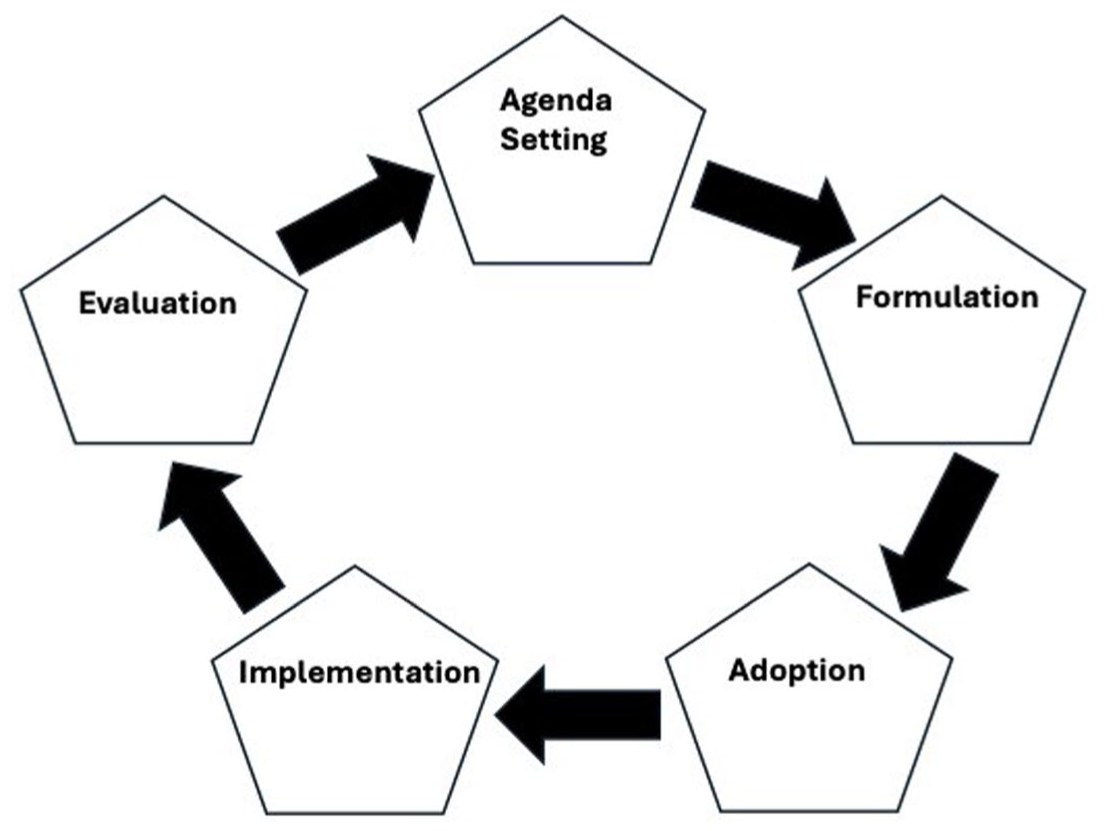
Five-stage life cycle model adapted from Knill and Tosun (2008).
Institutional agenda setting is a process by which a group of actors seeks to transform an issue such that a set of concrete items is scheduled for active and serious consideration by a particular decision-making body (Cobb and Elder, 1971). At the policy formulation stage, actors scan the environment to identify and assess possible workable solutions. The most appropriate policy instruments are considered, and the feasibility of appropriate courses of action is evaluated to select the best fit according to desired policy outcomes (Hall, 1993). With the effects of globalisation and relative ease of access to information, policymakers also draw ideas and lessons from other political systems’ institutions, programmes and policies about how they can work in their jurisdictions (Dolowitz and Marsh, 2000).
At the policy adoption stage, relevant government institutions agree to and pass a policy alternative determined as fit for purpose. The implementation stage is the administrative process, where policy is actioned through appropriate instruments (Thomas and Grindle, 1990). While the logical sequencing holds true, adoption and implementation are invariably intertwined (Sutton, 1999). Legal challenges to policy often emerge in this phase, questioning the legitimacy of the new policy in domestic or international law.
Evaluation is ‘the systematic and objective assessment of an ongoing or completed project, program, or policy, including its design, implementation, and results’ (OECD, 2022: 12). Through policy evaluation, government agencies effectively refine their plans, policies, and practices (Weiss, 1999) with the potential for revision, continuation, or even termination based on the evaluative outcomes. In this stage of the policy life cycle, feedback from actors on the policy process, local conditions and policy outcomes are fed into the assessment of the policy in relation to its stated aims and objectives asking questions such as should the policy initiative be wound down, changed and improved or continued (Knill and Tosun, 2008). The evaluation stage leads into a new round of agenda setting, decision-making and implementation.
The five-stage policy life cycle model has been criticised for minimising the complexity of policymaking by assuming a linear approach, with stages occurring in a precise, predetermined nature (Jann and Wegrich, 2017). Other models developed as alternative tools for analysis based on these criticisms, however, fall short of conceptualising and analysing the entire policy process. For example, agenda setting theory focuses on the first stage of the life cycle (Cobb and Elder, 1971) and the punctuated equilibrium model (Baumgartner and Jones, 2010) is limited to explaining opportune moments and strategies for acting upon policies. The multiple streams framework (Kingdon, 2010) focuses on agenda setting in public policy, with more recent work extending the framework to focus on adoption and implementation stages (Fowler, 2022).
Alternate life cycle models, including the six-stage and seven-stage policy life cycle models that further disaggregate the five stages into additional stages (Cairney, 2019) make analysis unnecessarily cumbersome. The discrete, disaggregated series of sequential stages of the five-stage policy life cycle places logical order on a complex web of interactions and breaks down the policy-making process to facilitate comparative research (Kulaç and Özgür, 2017). The simplicity and utility of the five-stage model for comparative policy research paper (Knill and Tosun, 2008) is the reason it has been selected as the best fit for this analysis.
2. Methods
To examine contemporary literature on Indigenous procurement, we implemented a rapid systematic review of the IPP literature to date, focusing on differences in topics and approaches across time and regions. We then utilised the five-stage policy model to evaluate the depth and trajectory of Australia’s IPP literature to identify trends and gaps for future research.
2.1. Literature search process
A rapid systematic review is a streamlined version of a systematic review. Compared to traditional systematic reviews that take months or years to complete, systematic reviews are more streamlined and maintain methodological rigour while accelerating the review process to produce snapshots of timely evidence (Khangura et al., 2012). Systematic reviews feature a limited scope, restricted database searches, shortened peer-review processes (Ganann et al., 2010), simplified inclusion criteria, and focused data extraction (Smela et al., 2023).
The methodology follows established frameworks, such as the Preferred Reporting Items for Systematic Review and Meta-Analysis (PRISMA) Statement, with modifications such as using fewer reviewers (Garritty et al., 2021). PRISMA guided the literature search and selection process in this review (PRISMA Group, 2022; Sarkis-Onofre et al., 2021). Figure 2 illustrates the PRISMA Flow Diagram summarising the literature search and inclusion process.
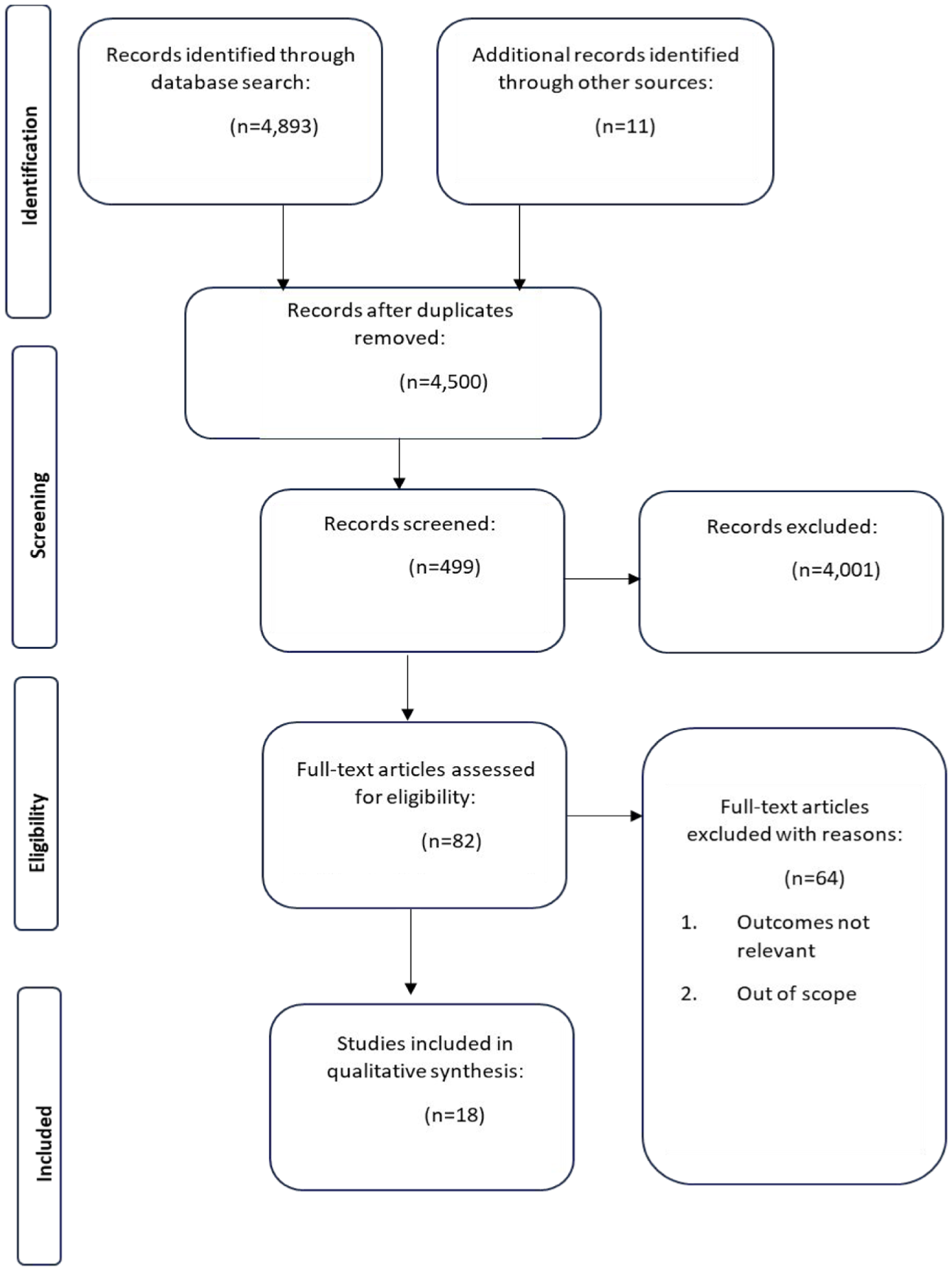
PRISMA flow diagram summarising literature search and inclusion.
We followed a systematic search and selection process for the primary studies with a streamlined coding and analysis process to report the findings in a short timeline (Thomas et al., 2013).
2.2. Eligibility
To be included in this review, references had to be full-text in English and published in peer-reviewed journals to guarantee rigour. The articles had to address Indigenous preferential procurement as a specific topic. The exclusion criteria included articles addressing the broader subject of public or social procurement, as well as affirmative action. These were considered for inclusion if they were contextualised to an Indigenous focus. We limited the systematic review to peer-reviewed published literature because the primary focus was to map the contemporary scholarly IPP literature and identify the critical research gap in the Australian literature.
We excluded grey literature in the review, instead opting to use it as a source for context related to the studies included. It is particularly useful for expanding the scope of evidence (Adams et al., 2017), providing contextual information about the specific subject matter (Mahood et al., 2014), and bridging the gap between research and practice (Kamei, 2020). Grey literature comes in various forms and is not bound by the same publishing conventions as white literature (Adams et al., 2017), with concerns about methodological obscurity, replicability, and reliability of those research outputs (Egger et al., 2003; Hopewell et al., 2005) introducing complexity to search, quality appraisal, extraction, management, and data synthesis. Supplemental grey literature was sourced from government publications, news reports and Internet searches on Google as needed.
2.3. Literature search
We systematically searched for relevant studies in electronic databases (i.e. ProQuest, EBSCOhost, Web of Science and Google Scholar). We aimed to provide a snapshot of the understanding of Indigenous preferential procurement at that time and review contemporary research addressing the current issues surrounding it. We delimited our review to the period 2000–2023 to capture the evolution of IPPs as formalised procurement frameworks and supplier diversity initiatives gained prominence in the early 21st century. Studies before 2000 were primarily focused on broader Indigenous socioeconomic policies instead of procurement-specific mechanisms. The start of the 2000s was a significant period for global Indigenous economic and social advocacy, including the establishment of the United Nations Permanent Forum on Indigenous Issues (UNPFII) as an advisory group to the United Nations Economic and Social Council (ECOSOC) and the negotiations on the United Nations Declaration on the Rights of Indigenous People (UNDRIP) (United Nations, 2000). There is, therefore, interest in understanding the evolution of research on IPP as a vehicle for economic self-determination at the start of that period. The end date of 2023 was selected to allow the most recent studies to be included, taking into consideration practical time constraints.
Our search terms in the titles and abstracts were combinations of indig*, native, traditional owner, first nation, aborigin*, first people, trib*, Indian and preferential procur*, social procur*, public procur*, procur*, and affirmative action. We applied a Boolean search to broaden our search results and capture the breadth of literature on the subject.
2.4. Data extraction
Our search returned 4904 articles consisting of results from electronic databases and direct requests to corresponding authors. The reference lists of the eligible articles included after the electronic search were also manually searched. The screening process was conducted in three phases. In the first phase, a co-author initially screened titles and abstracts from the database search process and narrowed down potential articles for inclusion. Numerous articles emerged from the Indian subcontinent due to the search term ‘Indian’, which, while intended to refer specifically to American Indians, also retrieved articles relating to India and the broader Indian subcontinent.
In addition, the term ‘Indig*’ (encompassing Indigenous, Indigeneity, etc.) yielded results pertaining to indigenous Chinese firms within the context of on-shoring and off-shoring literature. This conflation of terms resulted in an unexpectedly large number of irrelevant articles. Furthermore, we identified duplicates and articles discussing public procurement, social procurement, and affirmative action that lacked any focus on Indigenous issues. As a result, a total of 4001 articles were excluded in the initial screening phase. In the second phase, two co-authors performed independent screening of the possible selection of articles, re-examining titles and abstracts and reviewing the eligibility of the above criteria, either classifying as Yes or No/Maybe. The two co-authors then met to compare selections and discuss to reach a consensus on the final list of 18 studies.
We acknowledge potential bias in our process, given that a single researcher conducted the initial screening, filtering out irrelevant studies. To address this potential for bias, the second analysis phase involved two independent co-authors reassessing the remaining articles. This dual-review process facilitated cross-verification (Singh et al., 2021), ensuring that no relevant studies were excluded arbitrarily. Furthermore, explicit inclusion and exclusion criteria were applied systematically, and potential misclassifications – such as those arising from search term conflations – were noted.
2.5. Coding categories
In the third phase, we coded and organised our data. We utilised a hybrid analysis approach, a combination of a data-driven inductive approach (Thomas, 2006), a deductive priori template of characteristics to organise the analyses (Fereday and Muir-Cochrane, 2006), and an application of the five-stage policy life cycle model to Australian-focused publications. First, two co-authors comprehensively analysed the articles, reading the full texts of the final list and integrating the findings. This process was conducted through 2-hour reading and re-reading (Dierckx de Casterlé et al., 2012) sessions daily over 2 weeks. A codebook was developed during this process to define coding categories and ensure a shared understanding. To support inter-rater reliability (Armstrong et al., 1997), both co-authors initially coded a subset of articles independently, followed by consensus discussions to align interpretations.
In line with Armstrong et al. (1997), the iterative process of reading the complete texts and coding themes was designed to ensure transparency and encourage active discussion and agreement on theme identification, followed by meetings to discuss findings for shared meaning-making. For example, when coding themes such as ‘affirmative action’ and ‘supplier diversity’, we traced keyword usage and conceptual discussions within the articles. To illustrate, Storey (2019) direct references to risk aversion in government procurement policies informed its classification under ‘Barriers to Policy Implementation’. A third co-author served as a peer reviewer (Johnson et al., 2020), independently checking the coding decisions to validate consistency and enhance rigour.
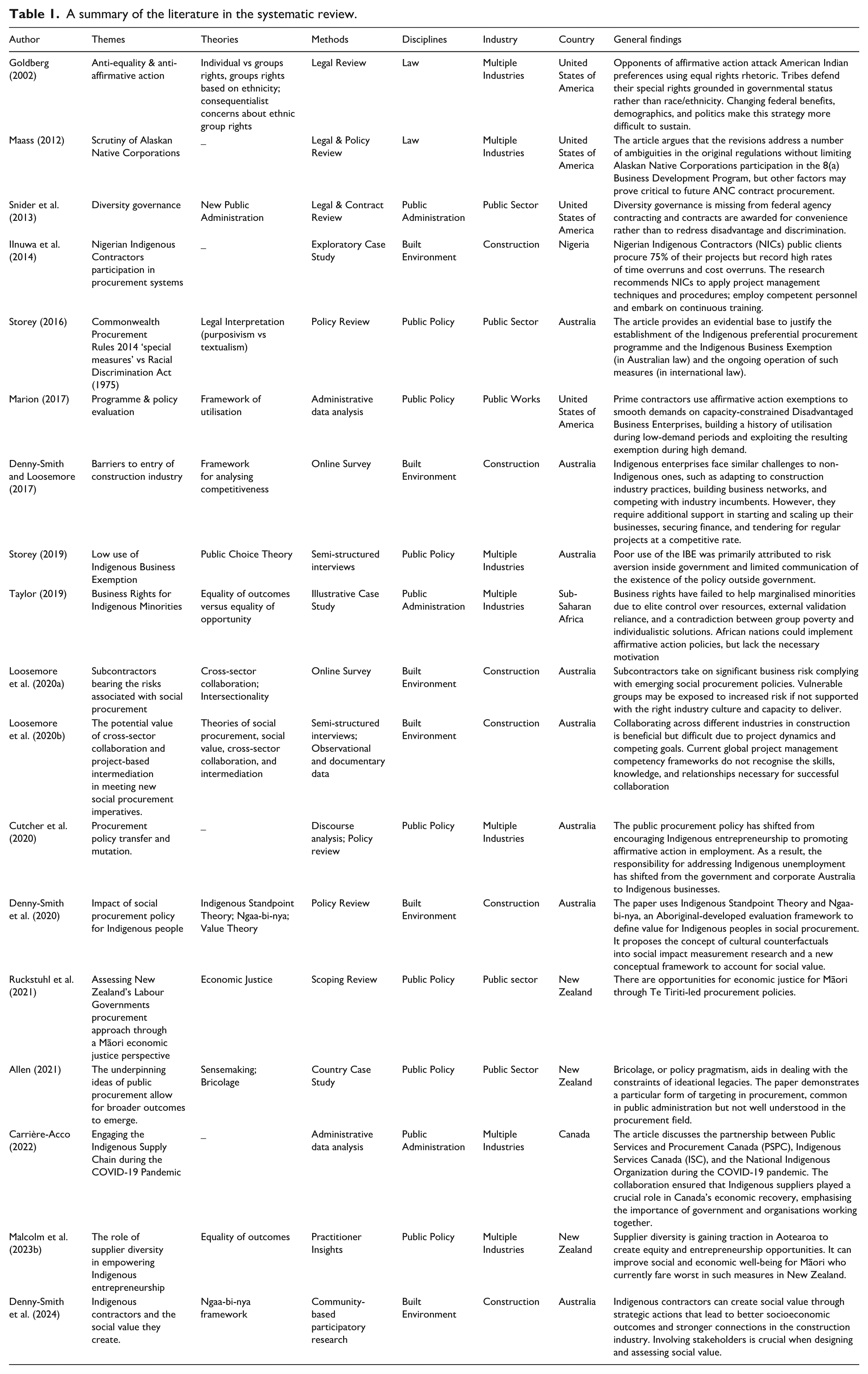
Second, we concurrently organised the themes according to a predesigned template of characteristics. The template approach is helpful for organising and subsequent interpretation of the text (Fereday and Muir-Cochrane, 2006). The attributes in the template represented the properties of the studies and the nature of their contributions (Table 1). We coded emergent themes from our analysis, the studies’ theoretical and methodological approaches, research discipline, industry focus, the contextual country, and the general findings. These steps also went through an internal peer review process and researcher consensus on how the studies were plotted in the template. For example, one of the studies on the Commonwealth IPP in Australia was initially categorised under both ‘Public Policy’ and ‘Legal Frameworks’. However, after discussing it with the co-authors, we refined our classification criteria to prioritise each study’s primary focus and applied this consistently across all sources.
A summary of the literature in the systematic review.
Third, two co-authors arranged eight identified Australian-focused publications within the five-stage policy life cycle model. The stages of the policy life cycle – institutional agenda setting, policy formulation, policy adoption, policy implementation, and policy evaluation – allowed us to visualise and map the evolution of Australia’s IPP. A third co-author independently reviewed how the literature was mapped to ensure that a robust method was followed. The hybrid-structured approach enabled us to articulate the nature of the conclusions of this review, and an internal peer review process at every step helped us validate our process through investigator triangulation (Hussein, 2009).
3. Findings
The systematic review findings are first presented, followed by an analysis of the literature on Australia’s IPP using the five-stage policy life cycle model as a framework for categorising that literature. For the systematic review’s findings, we first focus on the quantitative descriptors of the literature in the review. These descriptors allow us to characterise and quantify the properties of the studies we identified. Second, we present the qualitative findings on Australia’s IPP using the five stages of the policy life cycle model as thematic areas to explain its antecedents and trajectory.
3.1. Publication rate, regions, journals and authors
3.1.1. What, when, where and who?
We examined the publication rate for Indigenous procurement and Indigenous-specific public and social procurement papers from 2000 to 2023 (Figure 3).
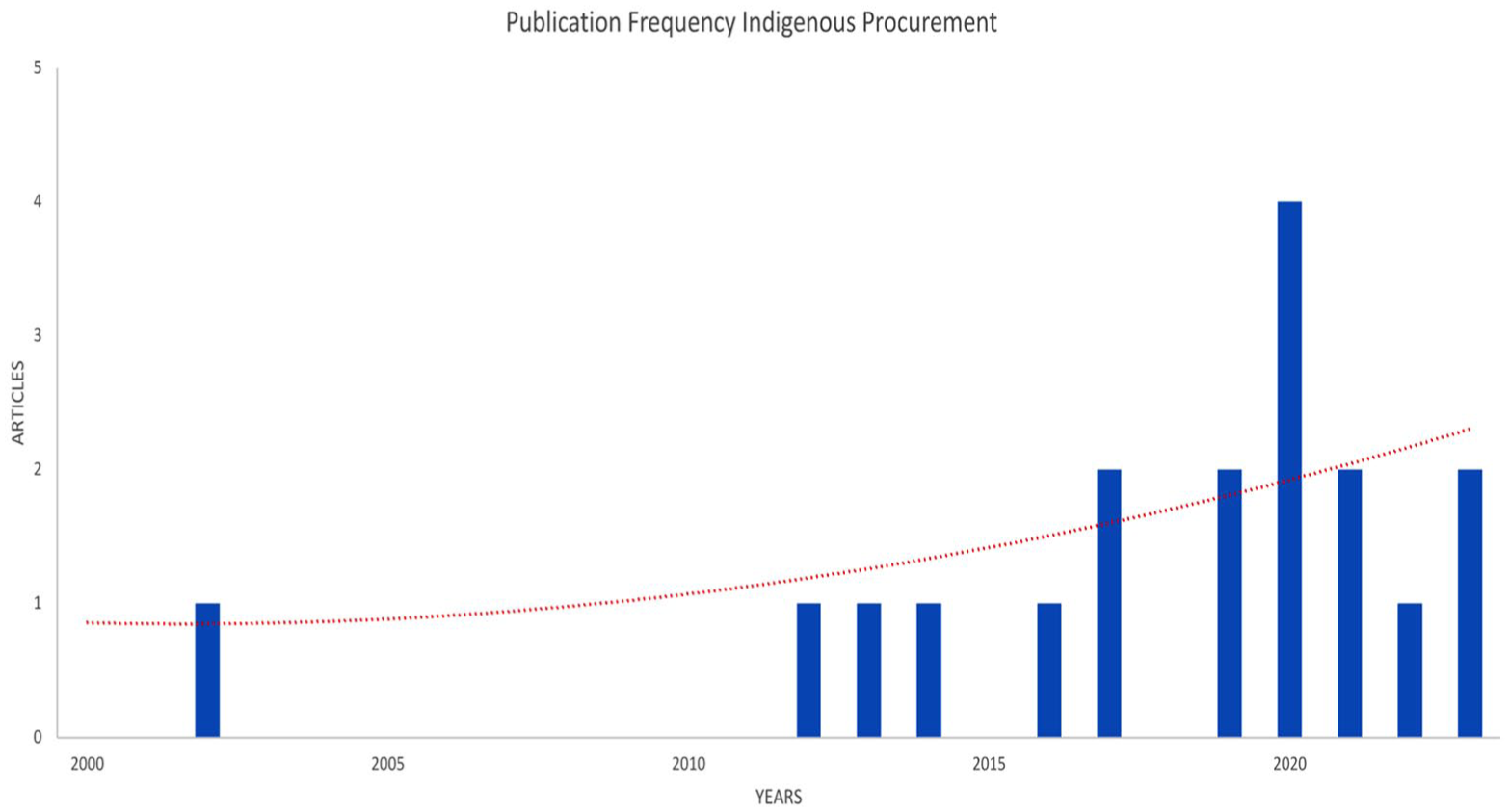
Indigenous procurement publications (2000–2023).
Despite the low overall number (18 papers), research interest has grown, with five publications before 2016 and 13 from 2017 to 2023. Nearly half (8) focus on Australia, likely due to the introduction of the Indigenous Procurement Policy (IPP) in 2015.
Geographical distribution. We examined the geographical distribution of publications to understand the topic’s global engagement and contextualise the literature by country and region (Figure 4).
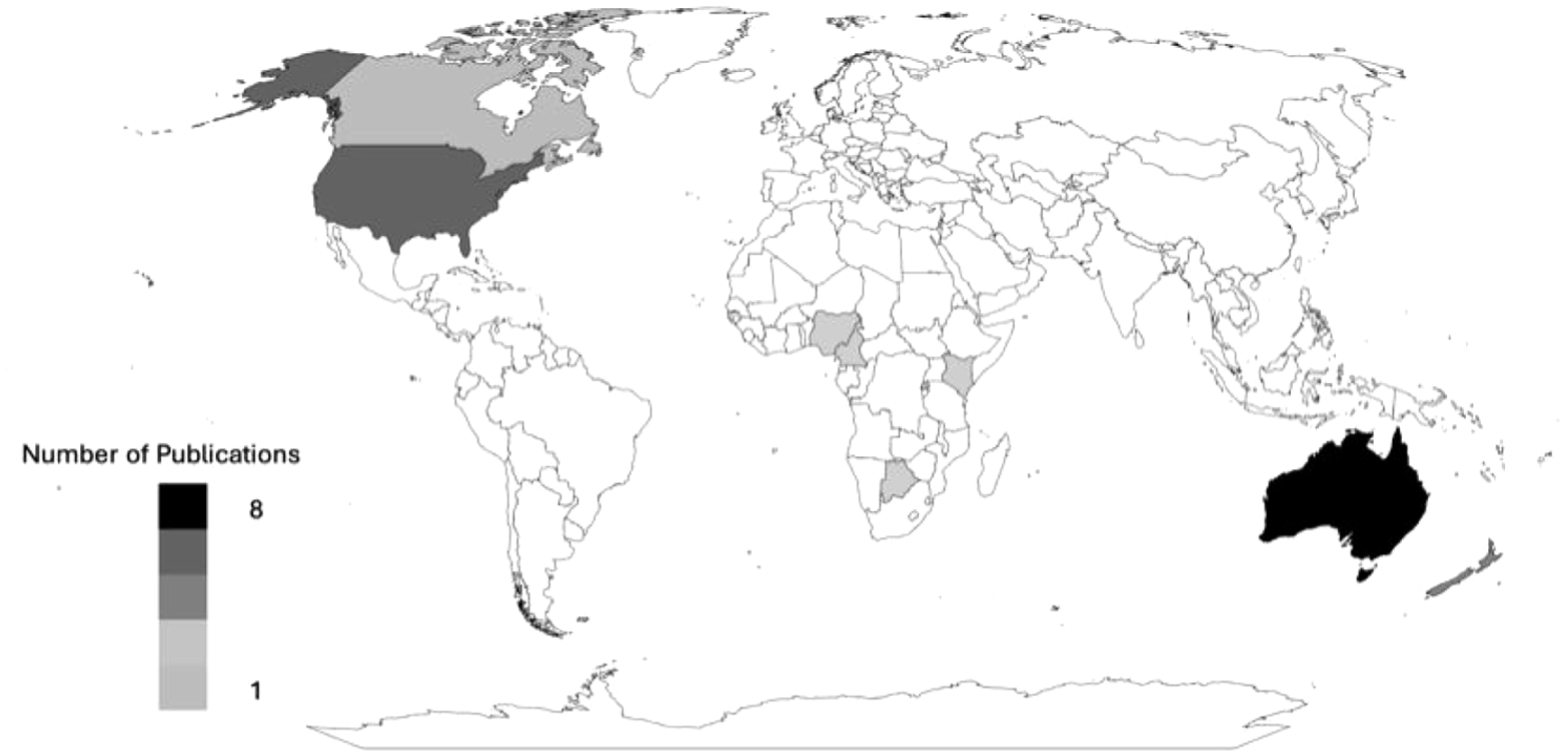
Number of publications by country of focus.
In Australia, eight studies examine Indigenous procurement from legal, policy, economic, and social perspectives (Cutcher et al., 2020; Denny-Smith and Loosemore, 2017; Denny-Smith et al., 2020, 2024; Loosemore et al., 2020a, 2020b; Storey, 2016). In the United States, four studies focus on legal, policy, and governance aspects related to Indigenous preferential procurement and affirmative action (Carrière-Acco, 2022; Goldberg, 2002; Maass, 2012; Marion, 2017; Snider et al., 2013). New Zealand is represented by three studies that primarily explore economic impacts and supplier diversity (Allen, 2021; Malcolm et al., 2023; Ruckstuhl et al., 2021). In Sub-Saharan Africa, two studies discuss policy challenges affecting Indigenous participation in economic systems (Inuwa et al., 2014; Taylor, 2019). Finally, in Canada, one study examines Indigenous supply chains and their role in economic development (Carrière-Acco, 2022).
Disciplinary focus. The research spans Engineering and Construction Management (6), Legal Review (3), Economic Development (3), Public Administration (2), Public Procurement (2), Social Work (1), and Diversity & Inclusion (1). The rising publication trend reflects the growing academic interest in Indigenous procurement, particularly following policy changes.
The papers included in this review are presented in Table 1.
Prominent authors. Authors such as Martin Loosemore and George Denny-Smith are prominent in publishing articles related to Australia’s IPP. We note that six articles relate to the construction industry, which is the focus of these two authors’ outputs. A plot of the various collaboration efforts in producing publications reveals a seemingly fractured collaboration network (Figure 5).
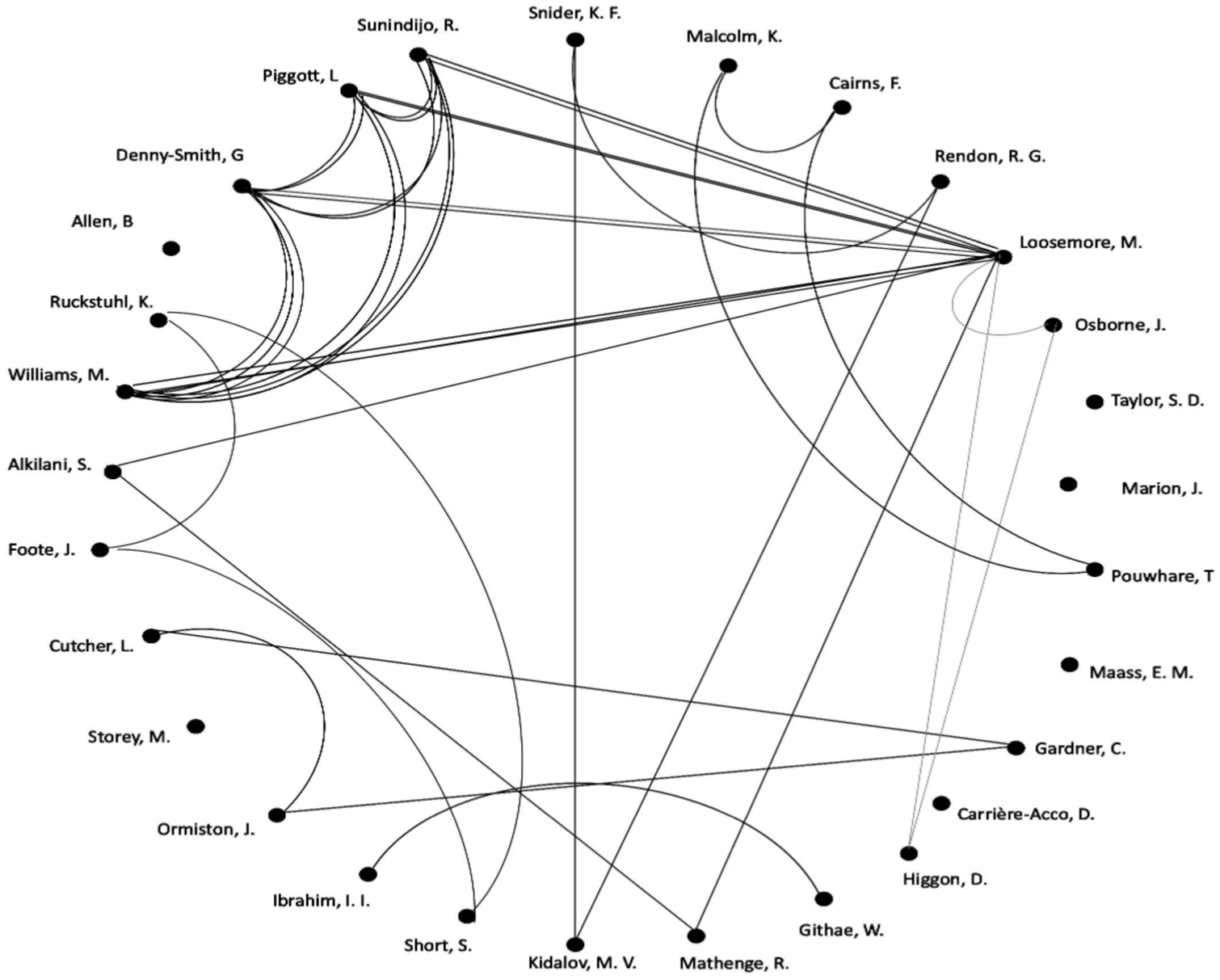
IPP research collaboration network.
Figure 5 depicts relatively weak collaboration data. A calculation of Network density returns 0.079, where Potential Connections (n*(n-1)) / 2) and Network Density (actual connections / potential connections). The closer the network density is to 1, the denser the relationships are between actors in the network (Levine and Kurzban, 2006). The weak collaboration density reflects the geographic clustering among scholars investigating their local contexts in Canada, the USA, Sub-Saharan Africa and Australia, with Australia producing the bulk of Indigenous Procurement Policy research since 2016.
Keywords analysis. Keywords indicate the core content and trends in academic research (Müngen and Kaya, 2018). Despite their high abstraction, they help give a snapshot of an article’s content. Figure 6 depicts the most utilised keywords in article abstracts by Australia’s IPP research, the most prominent being ‘social’, ‘Indigenous’, and ‘construction’.
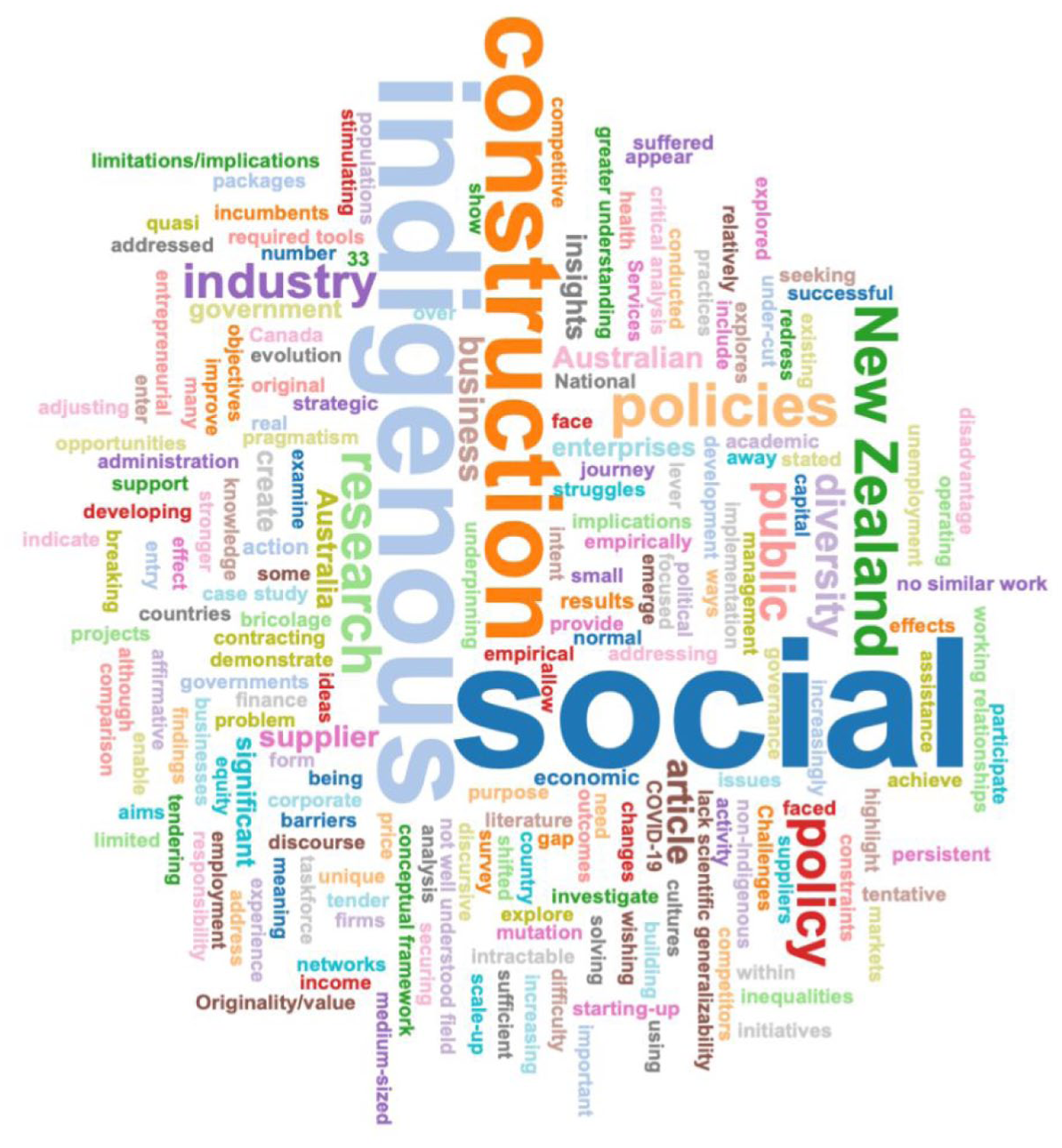
Word cloud detailing the most frequent keywords in IPP research abstracts.
The frequency-based word cloud indicates the focus of Australia’s IPP research in the social implications and/ or value arena and the construction industry. This is unsurprising as much of the construction industry literature examines Indigenous procurement’s social value and impact on Indigenous communities.
A surprisingly small number of studies (Allen, 2021; Cutcher et al., 2020) focus on policy development and evolution. Cutcher et al. (2020) focus on the evolution of the discourse on Australia’s IPP to argue that the policy’s objectives are mutating from supporting Indigenous businesses to fulfilling Indigenous employment objectives. Allen (2021) explores policy development in the New Zealand context to argue that the underpinning ideas of public procurement allow for broader outcomes to emerge through these policies using the concept of bricolage.
Two of the eighteen papers reviewed delve into the legality of Indigenous preferential policies. Writing over a decade apart, Goldberg (2002) and Storey (2016) explore the legal contours of Indigenous preferential treatment in the US and Australia, respectively, and the conditions under which they can survive legal challenges.
A third of the studies focus on various aspects and issues in the implementation of IPPs, exploring programme governance and the issue of institutional capacity and capability of public procurement officials (Snider et al., 2013), the capacity of Indigenous contractors to engage in procurement (Inuwa et al., 2014), revisions to existing policies to close loopholes (Maass, 2012) and additional barriers that Indigenous entrepreneurs face in entering the market that may affect their capacity to take advantage of Australia’s IPP (Denny-Smith and Loosemore (2017). Some scholars (Carrière-Acco, 2022; Loosemore et al., 2020b; Marion, 2017) explore successful strategies Indigenous businesses and government contractors employ to produce positive outcomes. A smaller subsection of those studies focuses on the risks that sub-contractors and vulnerable groups targeted for support face if not supported with the right industry culture and capacity to deliver on contracts (Loosemore et al., 2020a).
Recent studies have focused on programme and policy evaluation frameworks and impacts. Writing from New Zealand, Ruckstuhl et al. (2021) explore the potential impacts of IPPs through the social value generated by Indigenous contractors, opportunities for economic justice and the role of supplier diversity in empowering Indigenous entrepreneurship, respectively.
Storey (2019) explores the low use of Australia’s precursor to the IPP, the Indigenous Business Exemption (IBE), and identifies risk aversion and poor communication of the policy’s existence as key factors. Taylor (2019), in a review of the poor outcomes of business rights for minorities across Sub-Saharan Africa, identifies the impact of elite control of resources, external validation reliance, and a contradiction in policy aims, personal motivations and interests. While these studies utilise a Western lens in evaluating these policies, (Denny-Smith et al., 2024) and Denny-Smith et al. (2020) argue the need for an Indigenous evaluative lens that considers social value and empirically tests an Indigenous evaluation framework (Denny-Smith et al., 2024) using Indigenous Standpoint Theory (Foley, 2003) and the Ngaa-bin-yaa Aboriginal evaluation framework (Williams, 2018).
With a few exceptions, the literature on IPP is undertheorised. It does not present a cohesive theoretical approach, although key theoretical concepts are used across the studies to elaborate study arguments and findings. Public choice theory (Storey, 2019), Theories of social procurement (Loosemore et al., 2020b), Critical discourse theory (Cutcher et al., 2020), Indigenous standpoint theory and Value theory (Denny-Smith et al., 2020) are used in the literature to discuss different facets of IPP. The use of theoretical concepts, including individual vs group rights (Goldberg, 2002), equality of outcomes vs equality of opportunity (Taylor, 2019), economic justice (Ruckstuhl et al., 2021) and legal interpretation (Storey, 2016), are prevalent and closely aligned in the literature on the justification of discriminatory policies and preferences for Indigenous groups.
3.2. The Australian case
In this section, we present an analysis of the critical features of the included studies as they relate to the IPP literature in Australia. This analysis intends to highlight the evolution of Australia’s IPP and its research. We utilise the policy life cycle to illustrate the policy trajectory in Australia retrospectively and prospectively.
3.2.1. Indigenous procurement policy – a brief overview of the Australian case
The Liberal-National coalition government of Australia enacted the Commonwealth Indigenous Procurement Policy on the 1st of July 2015. The primary purpose of Australia’s IPP [the IPP] is to stimulate Indigenous entrepreneurship, business and economic development, providing Indigenous Australians with more opportunities to participate in the economy (Commonwealth of Australia, 2017: 4). Thus, the IPP was viewed as a policy tool to rectify the historical and post-colonial socioeconomic disadvantage of Aboriginal and Torres Strait Islander people through the support of Indigenous entrepreneurship. The IPP is described as a ‘policy overlay’ of its precursor, the Indigenous Business Exemption (IBE) (Storey, 2016: 2). The IBE was implemented in 2011 as an exemption from Commonwealth procurement tender requirements for Indigenous businesses. By June 2015, only four contracts had been awarded under the IBE (Australian National Audit Office, 2015).
The IPP is intended to significantly increase the rate of government and third-party contractors’ purchasing from Indigenous businesses. The policy builds upon the IBE and includes annual targets for the volume and value of contracts awarded to Indigenous businesses by the Commonwealth and each Portfolio. A mandatory set aside requires that Indigenous businesses be given an opportunity to demonstrate value for money before a general approach to market and applies to procurements to be delivered in remote Australia and for all other procurements wholly delivered in Australia valued between $80,000 and $200,000 (GST inclusive). Finally, the policy includes Indigenous employment and business participation targets to contracts wholly delivered in Australia valued at $7.5 million or more in 19 industries (Commonwealth of Australia, 2017: 4). The AUD 9.5 billion in contracting opportunities for Indigenous businesses generated as of September 2023 comprised over 64,000 contracts awarded to more than 3900 Indigenous businesses (National Indigenous Australians Agency, 2024). In 2023, the Government of Australia began consultations on IPP reform. Recent Australian research (Collins and Norman, 2018; Eva et al., 2023) has further highlighted both the structural and policy-level factors shaping Indigenous enterprise outcomes, including employment.
3.2.2. Applying the policy life cycle lens to the case of Australia
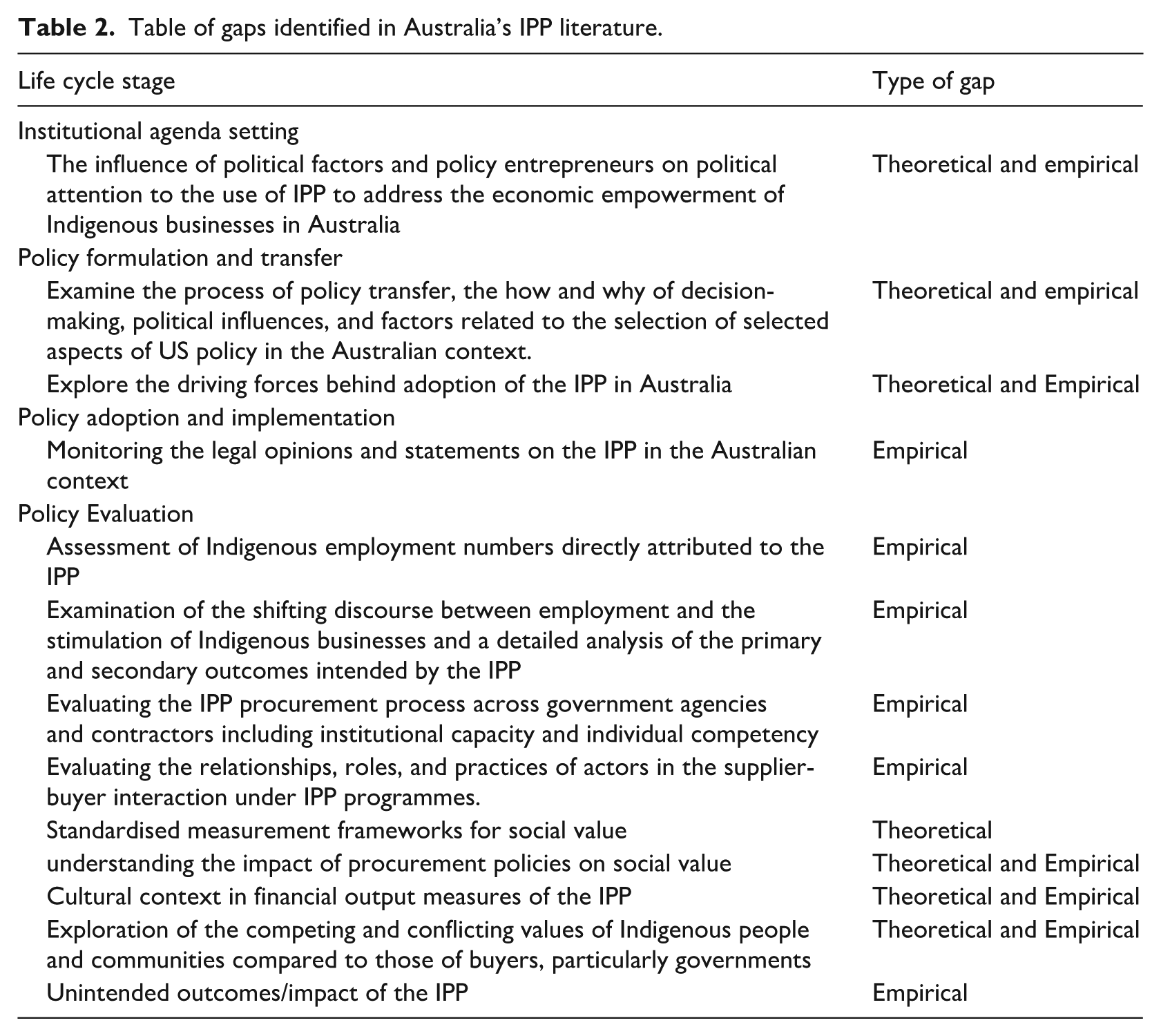
Next, we discuss the five policy life cycle stages. Across the five stages of the policy life cycle, several theoretical and empirical gaps were identified. Table 2 outlines the key gaps in the literature.
Table of gaps identified in Australia’s IPP literature.
3.2.3. Institutional agenda setting
The Commonwealth Government of Australia sought to address Indigenous Australians’ social disadvantage compared to the broader Australian community. The rationale behind the IPP was that increasing economic activity in the Indigenous business sector would correlate to increased labour force participation and, subsequently, a reduction in social disadvantage in Indigenous communities (Altman, 2001; Storey, 2019). There is scarce literature concerning the influence of political factors and policy entrepreneurs on political attention to the use of the IPP to address the economic empowerment of Indigenous businesses in Australia.
References to the emergence of the IPP in the existing scholarship implicitly identify the political elite as the agentic forces in institutional agenda setting. In their work exploring the IPP as a case of policy transfer from the US to Australia, Cutcher et al. (2020) locate the start of the discourse on the IPP at the 2008 House of Representatives Standing Committee on Aboriginal and Torres Strait Islander Affairs inquiry. The authors refer to a national conversation on the IPP, contending that the Committee ‘amplified the national dialogue’ (1406) on stimulating Indigenous entrepreneurship through supplier diversity in public procurement but go no further in identifying the actors and groups in that dialogue.
3.2.4. Policy formulation and transfer
Cutcher et al. (2020) demonstrate that the development of the IPP was a case of cross-national policy transfer based on the pioneering work of the National Minority Supplier Development Council (NMSDC) in the United States. The authors trace the discourse on the IPP through four critical junctures, pointing to the United States as Australia’s example of first-world economies with relatively successful programmes addressing disadvantages in marginalised groups. That study concludes that the IPP was a case of incomplete policy transfer because of its narrow focus on Indigenous peoples and argues that limiting the policy excluded others and sowed the seeds of the shifting focus and responsibility of the policy. They suggest that maintaining the broader policy remit would have limited the discursive framing away from supporting entrepreneurs to Indigenous employment.
No studies have conceptualised or empirically examined the process of policy transfer, the how and why of decision-making, political influences, and factors related to the selection of selected aspects of US policy in the Australian context.
3.2.5. Policy adoption and implementation
Adoption and implementation are processes that are invariably intertwined. No empirical studies have explored the driving forces behind adopting the IPP in Australia. Snider et al. (2013) argue that socio-economic policies for minority procurement can only deliver on their goals if the contracting personnel and process are effectively implemented. In their US study, the authors found that implementing these measures is often hampered by public officials’ limited contracting expertise and the lack of organisational contracting capacity. This suggests a need for scholarly engagement in mapping and understanding the IPP procurement processes across government agencies and third-party contractors as well as Indigenous businesses to understand how capacity and individual capabilities may be impacting the achievement of the IPP’s objectives.
Cutcher et al. (2020) examine the policy implementation and suggest that as state governments and social processes have altered, so too have the framing of the policy from stimulating Indigenous entrepreneurship and reducing economic disadvantage towards a greater focus on Indigenous employment outcomes. The authors argue that the shift in discourse reflects the change in the increasingly conservative government approach to framing employment as the core motive of the IPP and placing the responsibility on Indigenous businesses to increase Indigenous employment.
The concept of preferential procurement is often touted as a vehicle to promote fairness for Indigenous communities, but its legality is still debatable. A year after the Australian Federal Government introduced the IPP, the scholarship on implementation was concerned with the legality of the policy as it is implemented and the secondary objectives for which it may be utilised. Storey (2016) reflected on the legal challenges in the United States and explored the legality of establishing and maintaining the IBE and the IPP as a special measure under the Racial Discrimination Act 1975 (Cth) and the International Convention for the Elimination of All Forms of Racial Discrimination. He argued that the maintenance of the legality of the special measure would depend on the ongoing demonstration that Indigenous Australians suffer disadvantage so that it is ‘necessary to ensure [Indigenous Australians’] equal enjoyment or exercise of human rights and fundamental freedoms’ (3); that the IBE and the IPP as a special measure are ‘appropriate and adapted’ to addressing Indigenous Australian disadvantage (Storey, 2016), and the special measure was effective in achieving its stated objectives. Given the more recent legal challenges in the US (see for example Nuziard, et al., v. Minority Business Development Agency, et al., 2024), monitoring the legal opinions and statements on the IPP in the Australian context will be useful.
3.2.6. Policy evaluation
There is a small body of research on the evaluation of the IPP such that almost a decade after the IPPs’ implementation, Storey’s (2016) finding that there is little published research that considers the effectiveness of Indigenous procurement programmes through monitoring and evaluation remains relevant. Storey (2016) points out that the legality of the IPP as a special measure requires an evaluation of its effectiveness. Accordingly, the evaluation of the IPP outcome measures remains a future concern. An important area of investigation is what outcomes are to be measured. The monitoring available in the Australian system is presently focused on the number of contracts awarded to Indigenous businesses and their value.
The initial policy objectives were to stimulate the Indigenous business sector, but employment has become an increasingly dominant part of the discourse on the IPP’s objectives (Cutcher et al., 2020; Eva et al., 2023; Storey, 2019). While total employment in the Indigenous business ecosystem is estimated at over 116,000 (Evans et al., 2024), there is yet to be a study reporting on Indigenous employment numbers directly attributed to the IPP. Such an analysis will elucidate relevant factors and enhance the comprehensiveness and significance of the evaluation process. Equally important, an examination of the shifting discourse between employment and the stimulation of Indigenous businesses necessitates a detailed analysis of the primary and secondary outcomes intended by the IPP.
Policy success or failure depends on mechanisms in the policy process, from the agenda-setting, implementation and context to the evaluation stages. The policy process is not infallible and, therefore, prone to error, including a poor understanding of the problem, unclear and contradictory objectives, incorrect context assumptions, incomplete information, and poor methodology and evidence (Hudson et al., 2019). Noting the evidence of racism, conscious and unconscious bias towards Aboriginal Australians (Paradies, 2005; Paradies and Cunningham, 2009; Shirodkar, 2019), and the reported negative factors relating to working with Indigenous businesses through the IBE: procurement officer risk aversion, doubts about supply certainty, difficulty calculating value for money and procurement officer conservatism (Storey, 2019), there is no empirical work exploring the extent to which these issues and contexts were accommodated in the underlying assumptions embedded in the IPP programme logic.
Expanding Snider et al.’s (2013) findings on the role of institutional capacity and public official competency in the achievement of objectives in minority procurement initiatives, there is a valid argument for scholarship evaluating the IPP procurement process across government agencies and contractors including institutional capacity and individual competency, and the relationships, roles, and practices of these actors in the supplier-buyer interaction.
The lack of attention to the under-conceptualisation and poor definition of social value as a secondary objective of the IPP is a glaring oversight. The current literature lacks standardised measurement frameworks for social value, which may refer to socioeconomic, cultural, and other impacts on the beneficiary community of projects, programmes, and policies (Raidén et al., 2019). Administratively determined metrics often take precedence over the value as perceived by the beneficiaries (McNeill and Burkett, 2017) and fail to account for Indigenous communities’ cultural context and needs. Theoretical engagement with literature on social procurement and social value is still in its early stages (Loosemore et al., 2020a; Loosemore et al., 2020b), with a gap in understanding the impact of procurement policies on social value. A study addressing this gap (Denny-Smith et al., 2020) utilised Indigenous Standpoint Theory (Foley, 2003) and the Ngaa-bin-yaa Aboriginal evaluation framework (Williams, 2018) to contrast social outcomes across cultural dimensions. They found that it will be difficult to fully understand policy outcomes if unintended negative consequences to the policy beneficiaries are not considered.
A follow-up empirical study (Denny-Smith et al., 2024) further emphasised the alleged adverse impacts of the IPP on Indigenous communities. The study brings to light the absence of cultural context in financial output measures of the IPP, which may lead to over-reliance and limit the resilience of Indigenous firms over time. Furthermore, the psychological strain experienced by Indigenous entrepreneurs when navigating the conflict between the values of the evaluation framework and the IPP policy framework raises serious concerns. More research is urgently needed to address the competing and conflicting values of Indigenous people and communities compared to those of buyers, particularly governments. This research could pave the way for more inclusive and effective procurement policies.
Another critical area to explore in evaluation is the unintended outcomes/impact of the IPP. For example, black cladding has emerged as a concern, with observers (Denny-Smith et al., 2024) describing the phenomenon as a negative unintended consequence of the IPP because of its costs to legitimate Indigenous entrepreneurs of economic activity and the resultant flow-on effects. Black cladding is a strategy used to access Indigenous preferential procurement opportunities through business structures established with Indigenous and non-Indigenous people (partners) where Indigenous people are featured in ownership structures, but the management of the business rests with the non-Indigenous business partners. Calls for a definition of black cladding are emerging, with the effort complicated by different agencies within Australia operating under the same policy diverging between 50% and 51% ownership as the minimum percentage ownership to qualify. Currently, there are policy debates about increasing that minimum percentage (Commonwealth of Australia, 2023), which adds a layer of complexity when it comes to joint ventures and partnerships.
4. Discussion
We conducted a rapid systematic review of the contemporary literature on IPP to document the current state of research. Then, we applied the five-stage policy life cycle framework to critically explore the research gaps in the IPP literature in Australia. Like many other studies, this research has its limitations. First, the review was centred around contemporary peer-reviewed literature on Indigenous procurement published between 2000 and 2023. This delimitation of the study by time period may have excluded potentially relevant material. Despite this limitation, the focus on the current discourse surrounding the IPP and its contextual influences justified this approach.
Second, we utilised a rapid systematic review as part of our methodology. Rapid systematic reviews have been criticised for restricting results based on the topic, language, geography, and time period and excluding grey literature (Ganann et al., 2010). However, we elected to use a rapid systematic review because the research context was specific to Indigenous procurement and within a defined period. We noted the utility of grey literature and referred to it to provide context to our findings. While the exclusion of grey literature helped maintain focus on peer-reviewed sources, it may have introduced publication bias (Mahood et al., 2014) and excluded valuable insights from practitioner or policy-based perspectives. We acknowledge that more research on Indigenous procurement may have been published during this paper’s writing and peer review. Still, as mentioned earlier, this rapid systematic review gives a snapshot-in-time of the topics’ understanding. Therefore, we recommend a more comprehensive review of IPP literature as the subject garners increased scholarly engagement over time. The IPP literature was undertheorised, and we identified significant theoretical and empirical research gaps in Australia’s literature when mapped across the five stages of the policy life cycle model. Investigating these research gaps should be of interest to researchers interested in politics and business studies and the role of ideas in politics, implementation science, Indigenous business, Indigenous economic development, and public policy.
Viewing the literature on the IPP through the lens of the policy lifecycle model provides a useful organising framework for researchers. However, each stage represents a black box within which the internal processes, actors and social and political contexts that influence the outcome remain under-researched. The deployment of middle-range theories from the fields of political science, public policy and public management including punctuated equilibrium theory, agenda setting theory and multiple streams theory can be used to complement the policy life cycle model. The middle-range theories offer researchers a more focused lens and specific hypotheses that can be utilised to guide investigations to understand the outcome of specific stages of the model. They can also generate new research questions. In this way, these middle-range theories can be used to ‘create a common narrative in which to situate their individual and collective contribution’ (Cairney et al., 2019).
4.1. Institutional agenda setting
‘Policy making cannot be understood without understanding the agenda-setting process’ (Green-Pedersen and Mortensen, 2012: 167). Examining how the debates on the problem definition informed the development and implementation of the IPP in its current form and why and how issues gain and lose focus in the political agenda (Mortensen, 2010) gives context to the policy’s programme logic. For example, policy entrepreneurs who play a crucial role in the policy-making process are part of a larger interaction of actors in the policy arena. They mediate between the different stakeholder coalitions to negotiate political compromises (Anderson et al., 2020).
To fully understand policy intention and influences, examining the impact of political factors and policy actors on political attention towards using IPP for the economic advancement of Indigenous businesses in Australia is required. Given the evidence of racism, conscious and unconscious bias towards Indigenous Australians, and reported negative factors associated with working with Indigenous businesses through the IPP, there is a pressing need for empirical studies to examine the extent to which these issues and contexts were considered in and impact the underlying assumptions of the IPP programme logic. In addition, exploring what local and international conditions and historical legacy, including domestic actors, influenced the emergence of IPP on the national agenda would help to understand the complex processes around the original intention of the policy. Complementary theories, such as agenda setting theory and the punctuated equilibrium theory of policy, can help explain policy dynamics. Agenda setting theory can be deployed to examine the process and impetus of institutional agenda setting (Cobb and Elder, 1971). Punctuated equilibrium theory (Baumgartner et al., 2019) can provide a useful lens to explain long periods of inertia and periods of change in IPP development across various contexts by examining the influence of key events on policymaking. The Multiple streams theory (Kingdon, 2010) can be deployed to examine the process and impetus of institutional agenda setting, policy adoption and implementation (Fowler, 2022).
4.2. Policy formulation and transfer
Policy formulation is defined by the broader context of ‘technical and political constraints of state action’ (Howlett and Ramesh, 2016: 147). Government bureaucracies, interest group offices, legislative committee rooms, meetings of special commissions and think tanks are key actors in this process (Dye, 1995) and undertake informal negotiations to reach the most feasible outcome (Wegrich and Jann, 2006). These findings provide direction for scholarly engagement in policy formulation of the IPP and the outcomes of the IPP policy formulation process.
While the policy transfer process has been described as incomplete policy transfer, previous studies (Dolowitz and Marsh, 2000) point out that policy transfer can vary in degree, with policies borrowed in a selective rather than an indiscriminate manner. These policies are subject to localisation forces that shape interpretation and adaptation, resulting in hybrids that better fit local contexts (Stone, 2012, 2017). The role of bureaucrats, international, governmental, and non-governmental organisations have all been highlighted in policy transfer processes (Porto de Oliveira and Massaco Koga, 2023). These findings drive key questions including the mechanisms of IPP policy transfer, what localising factors informed the policy objectives and shaping of the IPP in Australia and how local conditions account for variations in IPP across post-settler societies. Policy transfer theory and Policy instrument choice theory (Howlett, 2004) are useful in exploring the factors that influence the choice of programme tools. Policy transfer theory (Dolowitz and Marsh, 2000) and norm diffusion theory (Greenhill, 2010) are useful in exploring the formulation and transfer of policy respectively.
4.3. Adoption and implementation
Politics plays a central role in policy adoption and implementation and this influence is conditional on existing policies and policy problems (Fowler, 2022) Adopter characteristics as well as political context in shaping adopter characteristics and political contexts that shaped policy trajectories (Porto de Oliveira and Massaco Koga, 2023). Understanding the socio-political and economic factors and how they shape policymakers’ ideas and beliefs associated with successful policy adoption can help understand facilitators of and barriers to progress in policy adoption.
Policy implementation has been found to be impacted by public officials’ limited contracting expertise and the lack of organisational contracting capacity (Snider et al., 2013). Limited capacity, inadequate resources, and complicated policy environments can all impact policy implementation (Althaus, 2013). This suggests a need for scholarly engagement in mapping and understanding the IPP procurement processes across government agencies and third-party contractors as well as Indigenous businesses to understand how capacity and individual capabilities may be impacting the achievement of the IPP’s objectives. Multiple streams theory can be of utility as it has more recently been used to explore policy adoption and implementation (Fowler, 2022).
4.4. Policy evaluation
Evaluation of the IPP is a topic gaining traction as the NIAA seeks to reform the policy (National Indigenous Australians Agency, 2023), and scholarship seeks to understand its impact on Indigenous communities. Indigenous communities are heterogeneous and diverse, underscoring the importance of engaging these communities in the design of evaluation frameworks. Building on the works of Denny-Smith et al. (2020); Denny-Smith et al. (2024), Indigenous evaluation methodology can be a more accurate and desirable tool for assessing the social impact of the IPP on Indigenous communities. This type of engagement ensures that Indigenous voices are heard in the evaluation process, expressing policy impact in their own terms and not as defined by technocrats. Evaluations that neglect to incorporate Indigenous voices from the onset are likely to misrepresent community values (Goforth et al., 2022). However, the heterogeneity of Indigenous communities introduces the issue of non-generalisability of evaluative outcomes (Gresku et al., 2022).
Both qualitative and quantitative methods can contribute to policy research (Hesse-Biber, 2010). The shift from ideological to evidence-based analyses by policymakers in the past decades (Head, 2010) privileges quantitative methods in the evaluation of policy design, implementation or outcomes. While quantitative methods address the question of what an outcome is, qualitative research is most useful to provide rich empirical data to explain how and why the outcomes observed occurred (Hesse-Biber, 2010).
We also urge more eclectic approaches to policy evaluation that blend Indigenous evaluation methods (Denny-Smith et al., 2024) with conventional quantitative and qualitative techniques. This methodological eclecticism (Mutch, 2009) combines the most effective strategies to address problems, offering a pragmatic and flexible solution. This approach enables more nuanced social impact assessments, enhancing research and policy influence. We emphasise methodological eclecticism as Indigenous-focused policies are enacted and social impact assessments are viewed through settler colonial frameworks (Thomas and Maddison, 2024). While Indigenous input may be marginalised (Creswell and Plano, 2011), collected data enriches technocrats’ understanding and interpretation of findings.
There is also a case for process evaluations of the IPP across states and sectors. For both government and corporate bodies, gaining greater insight into the complexity of the design features, implementation approaches, and subsequent unintended impacts from IPPs is essential to long-term investment into Indigenous economic development. The policy process does not exist in a vacuum and extends beyond the government level (Wu et al., 2018). It is imperative to engage in scholarly research to map and comprehend the IPP procurement processes across government agencies, third-party contractors, and Indigenous businesses to gain insight into how individual capabilities and institutional capacity may affect the attainment of IPP’s objectives. Research (Fukuyama, 2013; Howlett and Ramesh, 2016) has pointed to capacity deficits as a major cause of policy failure. Further research will also be required by engaging with Indigenous businesses with experience accessing contracts via IPPs to understand the design features and implementation strategies that work well and those that unforeseeably act as barriers or obstruct participation. By understanding this two-way relationship deeper, practice insights will also be generated, potentially leading to better, more equitable IPPs.
Emerging trends in Indigenous procurement beyond 2023 include stricter eligibility rules for participation and increased targets. The Australian government has instituted a move from 50% to 51% First Nations ownership of a business as the new definition of Indigenous business to come into effect by 2026 (National Indigenous Australians Agency, 2025). This shift in Australia matches Canada’s initiative to further refine definitions of Indigenous businesses to provide clarity and consistent structure to procurement processes (BDO Canada, 2023). These changes are to ensure that legitimate Indigenous businesses are able to access procurement opportunities. In 2024, the government of Canada mandated their Indigenous procurement targets to a minimum of 5% of all federal procurement spend (Henriques et al., 2024). In line with this trend, Australia is also increasing their target to 4% by 2030 (Department of the Prime Minister and Cabinet, 2025). Research will be needed to understand how these changes impact Indigenous business participation in the IPP and the outcomes for these businesses and their communities. In addition, exploring the unintended outcomes or impact of the IPPs, such as black cladding, is crucial for a comprehensive evaluation.
5. Conclusion
Indigenous procurement is a vehicle for Indigenous economic empowerment as it fosters economic reconciliation and promotes self-sufficiency to reduce socio-economic disparities experienced by Indigenous populations. The potential impacts of the IPP on Indigenous populations warrant rigorous and comprehensive analysis of existing scholarship on the policy. This paper provides a rapid systematic review of the contemporary IPP literature and utilises the five-stage policy life cycle model to conceptualise the evolution and development of the literature on Australia’s IPP. The IPP literature is limited in scope, although there has been a growth in publications in the latter half of the period under review. The IPP literature is undertheorised, with theoretical and empirical research gaps across agenda setting, policy formulation, adoption, implementation, and evaluation stages in Australia’s IPP scholarship.
Advancing theoretical models and empirical assessments will be essential to achieving meaningful economic empowerment and sustainable policy outcomes for Indigenous peoples. The five-stage policy life cycle model provides a useful organising framework for this future research agenda, allowing for comparative research across post-settler societies. Areas for future research include investigating how processes, actors, and local conditions in a web of interaction produce observed phenomena. Further research is also required to explore and evaluate social value, and the intended and unintended consequences of IPPs. Legal challenges, capacity constraints and potential racial bias in implementation require deeper exploration to ensure the sustainability and integrity of these policies.
An interdisciplinary approach using theoretical and methodological eclecticism can strengthen IPP scholarship. Indigenous perspectives and middle-range theories that make individual contributions to our understanding or connect various parts of the policy life cycle should be incorporated.
What This Paper Adds
IPP literature is under theorised with less than a quarter of studies (4 of 18) using explicit theoretical frameworks.
The geographic spread of the literature is uneven with case studies of Australia dominating the literature.
We find a weak collaboration density amongst the IPP scholars, which reflects the geographic clustering among scholars investigating their local contexts.
Scholarly interest in IPP is diverse, with publications spanning seven disciplines: engineering and construction management, law, economic development, public administration, public procurement, social work, and diversity and inclusion.
The main themes were the legality of these policies, issues arising from their implementation and governance, policy evaluation and approaches to conceptualising social value in IPP.
Contributions to Research
Provides a systematic overview of the contemporary scholarship on IPP.
Contributes to a systematic understanding and analysis of Australia’s IPP evolution.
Demonstrates the usefulness of the Five-Stage Policy Life Cycle Model as a framework for analysis of the development and outcomes of IPPs in Indigenous communities across various post-colonial settler societies.
Identifies theoretical and empirical gaps in research to inform a comprehensive IPP research agenda across settler societies.
Makes a case for the use of middle-range theories to enrich future IPP research
Contributions to Practice
Provides an assessment tool for policymakers and practitioners to appraise the current stage of their IPP and how they can advance the IPP along its life cycle.
Highlights and offers useful recommendations, including improving legal defensibility and embedding cultural legitimacy through Indigenous-led evaluation frameworks.
nforms the roadmap of future IPP work by identifying emerging risks and trends.
Footnotes
Acknowledgements
The authors acknowledge the valuable work of the editors and anonymous reviewers of the Australian Journal of Management.
Final transcript accepted on 22 June 2025 by Andrew Jackson (Editor-in-Chief ).
Funding
The author(s) received no financial support for the research, authorship and/or publication of this article.
