




Abstract
We describe the state of supplier diversity efforts by large corporations from an international perspective. We examine data for the companies in the 2020 and 2022 Fortune Global 500 and find that corporate definitions of diversity are dynamic and vary across regions. Furthermore, while supplier diversity efforts are not yet widespread, these initiatives are increasingly common, especially in the form of references to diversity in companies’ supplier codes of conduct. Companies in North America and in certain economic sectors, such as the financial and healthcare sectors, are more likely to have such efforts in place. Based on our data, companies that report on their internal diversity and companies that have other forms of supplier sustainability initiatives are also more likely to have supplier diversity initiatives. We argue further that supplier diversity efforts will follow a trajectory similar to other supplier sustainability efforts. Finally, we suggest possible avenues for future research on supplier diversity.
Introduction
In the private sector, diversity initiatives are seen as an opportunity to encourage corporate social responsibility (CSR) and strengthen relationships with stakeholders that value diversity (Hatcher, 2016). Policies to promote workplace diversity are increasingly common and have spurred academic research (Kalev and Deutsch, 2018; Kalev et al., 2006). In addition to internal initiatives, companies may make efforts to include diverse businesses in their supply chains.
There is no single definition of “supplier diversity” or even of “diversity.” Just as the definition of supplier sustainability has varied over time and across industries, geographies, and cultures (Correll and Betts, 2022), supplier diversity carries different meanings in different countries (EU MPG, 2009) and across time (Porter, 2019). There is agreement, however, that ensuring supplier diversity is one of the ways in which companies extend their social responsibility efforts along their supply chains (Carter and Jennings, 2004; Correll and Betts, 2022; Ram and Smallbone, 2003; Worthington, 2009; Worthington et al., 2008). Supplier diversity involves ethical considerations, drives equity and inclusiveness, and contributes to a broad community impact (Blount and Li, 2021). It can also be a source of innovation and competitive advantage (Adobor and McMullen, 2007; Carter et al., 1999; Min, 1999; Ram and Smallbone, 2003; Theodorakopoulos et al., 2005). In this article, we maintain that supplier diversity is a dimension of sustainability to which firms worldwide are increasingly paying attention, but it is relatively recent compared to other efforts to promote supply chain sustainability.
In this paper, we use data from companies included in the 2020 and 2022 Fortune Global 500 to provide a deeper understanding of supplier diversity initiatives for large corporations globally. The academic literature to date is focused on identifying factors influencing the development of supplier diversity efforts in the United States (U.S.) and the United Kingdom (U.K.); (Blount and Li, 2021; Giunipero, 1981; Min, 1999; Whitfield and Landeros, 2006; Worthington, 2009; Worthington et al., 2008) and on case studies specific to one or a few companies (Boyal-Seth, 2011; Hatcher, 2016; Krause et al., 1999; Min, 2009; Shah and Ram, 2006). To the best of our knowledge, there are no existing studies that map supplier diversity efforts worldwide. In fact, Worthington et al. (2008) acknowledge the lack of supplier diversity studies in the international arena.
We offer three main contributions. First, we compile definitions of supplier diversity from the academic literature and companies in our sample, with the goal of describing and standardizing a definition of the concept. Second, based on the recent evolution of other dimensions of supply chain sustainability, we conjecture that supplier diversity initiatives will follow a similar path to widespread adoption. Third, we quantify the extent to which supplier diversity practices are widespread and whether some firm characteristics make companies more likely to have supplier diversity initiatives. These characteristics are selected based on factors already identified and studied in relation to other social and environmental dimensions of sustainability that have been in place for a longer time; this strengthens the parallels drawn between supplier diversity and other efforts to achieve supply chain sustainability. In particular, we study the connection between firm efforts to achieve supplier diversity and the following firm characteristics: firm location and sector, existing internal workforce diversity, and other supplier sustainability efforts. We pose the following research questions concerning the practice of the largest revenue-generating firms:
Is there a standard definition of supplier diversity employed in the academic literature and in practice? Can we draw parallels between the evolution of other social and environmental supplier sustainability efforts and those to achieve supplier diversity? What firm characteristics (region, sector, internal diversity practices, and other supplier sustainability practices) are related to the implementation of supplier diversity efforts?
Data Collection and Instruments for Supplier Diversity
We compile data on the 2020 and the 2022 Fortune Global 500 from two sources. 1 The first of these is the Fortune 500 website, which contains basic data on the companies included in the ranking. Second, we visited each company's website during the first quarters of 2021 and 2023 to retrieve their supplier codes of conduct and their CSR and diversity reports. We use these to identify their public efforts related to supplier diversity and sustainability in general; details of our coding approach are contained in Appendix A in the E-Companion.
We focus on the largest global firms in revenue terms (the Global 500) because we hope to learn from their approaches to supplier diversity as large international companies that deal with many suppliers and also face greater pressure to make social disclosures (Baron et al., 2011). Other studies on supplier diversity examine similar sets of firms, for example, the top-ranked U.S. companies as reflected in the S&P 500 (Dang et al., 2021), the U.S. Fortune 100 (Ball et al., 2005) or U.S. Fortune 500 (Adobor and McMullen, 2007; Pearson et al., 1994; Young, 2002). Studies on supply chain sustainability tend to focus on large and multinational firms (Blome et al., 2014; Villena and Gioia, 2020).
We find that companies enact supplier diversity efforts in two main ways: by establishing supplier diversity programs and/or by establishing diversity requirements in a supplier code of conduct (SCoC). The goal of supplier diversity programs is to increase diversity and improve the supply chain by proactively seeking to attract diverse suppliers. Such programs have important intangible benefits for the buyer firm: improved reputation, recognized leadership, stronger partnerships, agility and adaptability, and compliance (Porter, 2019). Supplier diversity programs are varied in type and in the range of suppliers that they target. For example, Toyota offers scholarship and mentoring programs to their current diverse Tier 1 suppliers, which should be certified by one of the national certifying agencies set out on the Toyota website. Another automotive company, Stellantis, runs a National Black Supplier Development program jointly with the National Business League. 2
The instrument employed in the second approach to supplier diversity, the SCoC, is intended to foster ethical conduct within the supply chain (Colwell et al., 2011; Egels-Zandén, 2014; Schleper and Busse, 2013); it may be referenced by other names, such as a supplier code of ethics, or supplier principles. Other academic studies assess the content of SCoCs with regard to various aspects of social responsibility (Emmelhainz and Adams, 1999; Schleper and Busse, 2013). SCoCs are statements of expectations rather than contractual obligations, but corporations need to be proactive with their enforcement and monitoring given the increasing public scrutiny of CSR efforts (Kenny, 2006). Note that whereas SCoCs are guidelines to be followed by all suppliers, supplier diversity programs can be targeted to specific and, potentially, small subsets of suppliers, such as firms owned by individuals of a specific ethnic minority. We refine our analysis by distinguishing between mentions of supplier diversity in SCoCs and specific diversity policies in SCoCs that include concrete action items for suppliers, for example, a requirement to submit quarterly spending reports detailing how much was spent on diverse suppliers (Elevance Health, 2022).
Apart from these two prescriptive instruments—supplier diversity programs and diversity policies in SCoCs—there are CSR Reports (also called environmental, social, and governance or sustainability reports 3 ), which are used to convey a firm's progress along various sustainability dimensions and may include information on the diversity within the company (or its suppliers). CSR reports do not mandate policies or actions; they only describe the company in terms of its environmental and social impact and related issues. In fact, corporate websites and CSR reports are the most popular channels for disclosure of sustainability and CSR information among the firms surveyed in Correll and Betts (2022). We also compile the links to the CSR reports of the companies included in our sample to analyze whether these refer to supplier diversity and supplier sustainability more generally.
Toward a Standardized Definition of Supplier Diversity
Definitions in the Academic Literature
The concept of supplier diversity first emerged in the U.S. in the mid-1960s (Bateman et al., 2020), pushed by the public sector development of executive orders and federal legislation (Cole, 2008). Federal procurement was used to actively target minority corporations during the civil rights movement (Shah and Ram, 2006). Since then, public policy has been a major catalyst in the development of supplier diversity efforts in the U.S. Later, the U.K. began following the U.S. in adopting policies aimed at increasing supplier diversity (Ram et al., 2007; Shah and Ram, 2006).
As most academic studies on this topic focus on the U.S., the definitions of diversity they contain reflect the demographics of that country and the groups traditionally disadvantaged there, such as ethnic minorities, women, and small businesses, although the definition has been expanded to include other minority groups such as LGBQT individuals, veterans, and people with disabilities (Adobor and McMullen, 2007; Bateman et al., 2020; Dun & Bradstreet, 2020). Some studies go so far as to list the specific ethnicities targeted by supplier diversity efforts (Dollinger et al., 1991; Greer et al., 2006).
In the U.K., the first country to mimic U.S. efforts to achieve supplier diversity, this concept is mostly defined with ethnic-minority- and women-owned businesses in mind (Ram and Smallbone, 2003; Ram et al., 2007; Theodorakopoulos et al., 2005; Worthington, 2009; Worthington et al., 2008). In the rest of Europe, the disadvantaged groups referenced also include immigrants (EU MPG, 2009). As applied in South Africa, the concept of supplier diversity is viewed as “the active business process of sourcing products and services from previously under-used suppliers” (SASDC, 2011); in particular, it is intended to target those entrepreneurs drawn from sections of the population disadvantaged under apartheid (Rogerson, 2012). In Australia and Canada, policy efforts toward supplier diversity aim to support “ethnic” or “indigenous” businesses (Rogerson, 2012).
Ball et al. (2005) map the definition of supplier diversity employed in the top 100 U.S. companies and find that the majority of firms mention race, ethnicity, gender, and, occasionally, disabled-veteran status. The authors note, however, that a few companies include other groups (such as LGBT or disabled people) and that, overall, there is no unified definition. Next, we analyze the definition of supplier diversity drawn from our data for the top 500 companies globally (beyond U.S. firms) and offer an updated view (companies in 2020 and 2022).
Definitions in Our Company Data
We examine the definitions of diversity and supplier diversity for each company in our 2022 data. This type of description generally appears in the SCoC, the CSR or diversity report, or elsewhere on the company website. In describing diversity, some companies list specific minority groups while others avoid specificity about what it means to be “diverse” and keep the definition general. Figure 1 depicts all dimensions of diversity that companies mention. As that figure shows, the dimensions with more than 100 mentions in our data are the following: gender, disability, sexual orientation, age/generation, ethnicity, race, gender identity, nationality, religion/creed, and veterans (disabled or not). We note that 96% of the companies with a specific supplier diversity definition refer to gender, far more than any other dimension.
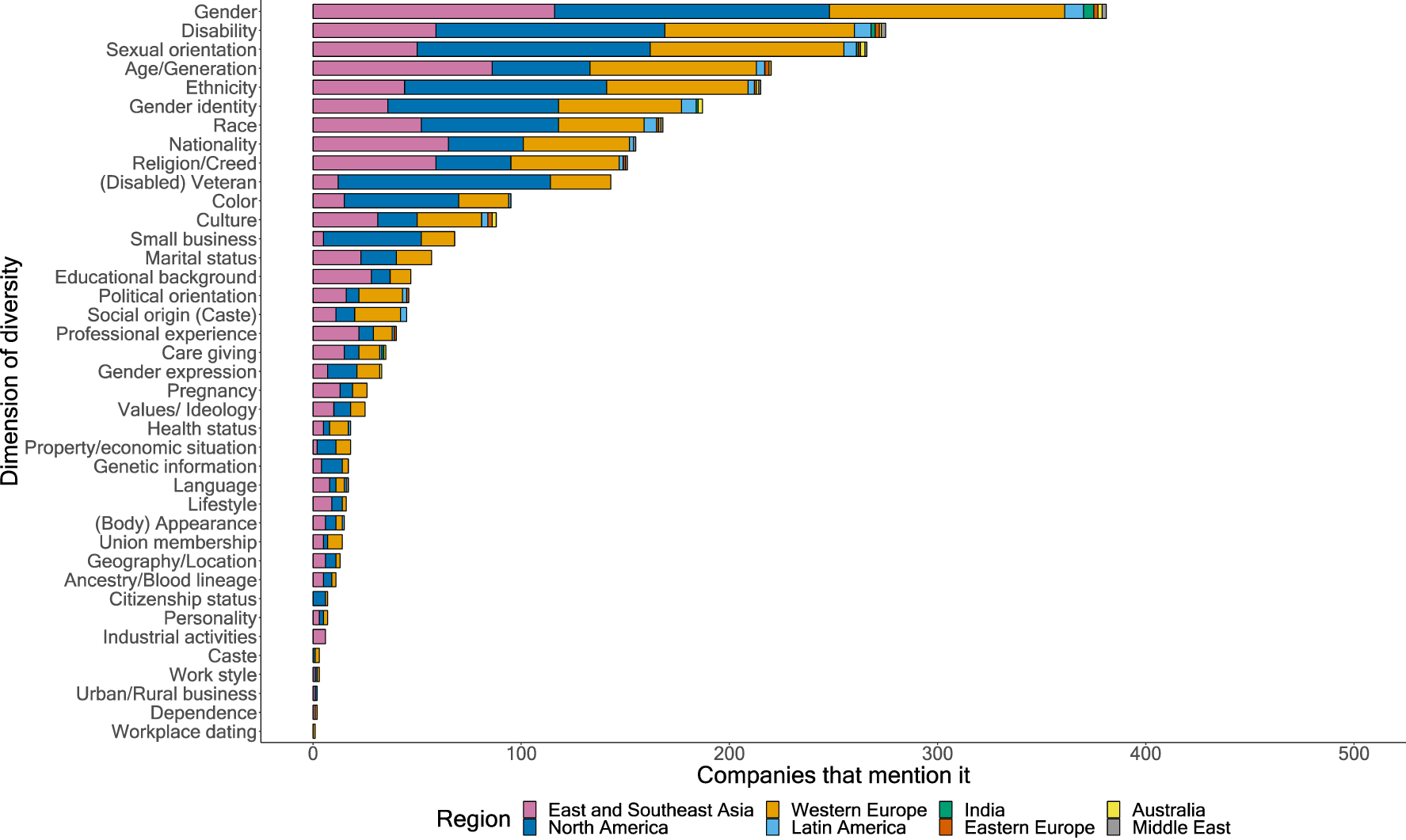
Number of companies mentioning each dimension of diversity by region.
In Appendix B in the E-Companion, we offer a breakdown of the top five diversity dimensions in our data by region (in which the companies are headquartered). In addition to gender topping the list everywhere, there are a few additional observations we can make in relation to the other four dimensions. Most companies in our data are located in East and Southeast Asia, and the diversity dimensions most often referenced are the following: age/generation, nationality, disability, and religion/creed. These dimensions do not coincide with those referenced by companies in North America, which, in addition to referencing disability and gender, refer to sexual orientation, veteran status, and ethnicity in diversity definitions. Western European companies include the same dimensions as those in North America but more commonly refer to age or generational diversity than veteran status.
Overall, mentions of gender and disability are consistent across regions. Ethnicity and nationality are broad dimensions that may refer to different population groups depending on the location. We note that veteran status is a dimension only used in North America, and sexual orientation is often referenced by firms in Western Europe and North America but not in other regions represented in the sample.
When comparing our results to those in the literature reviewed, we did not, as expected, identify firms that mention “indigenous” or “native” groups, even though the academic literature highlights those groups when defining diversity in Canada and Australia (Rogerson, 2012). However, we are of the view that companies include these dimensions under the “ethnicity” category in referring to diversity efforts on their websites and reports. Also note that the academic literature has studied supplier diversity in South Africa (SASDC, 2011), but none of the companies in our sample is headquartered in Africa.
Finally, we observe that the companies that provide a specific definition of diversity (79% of those in our data set) are more active in implementing supplier diversity efforts. Among the companies that offer specific definitions (by mentioning one or more specific groups), 45% have a supplier diversity program, 44% include diversity in their SCoCs, and 33% include supplier diversity in their CSR reports; by comparison, among companies that do not include a specific definition of diversity, only 3% have a supplier diversity program, 7% include diversity in their SCoC and none include diversity-related content in their CSR reports.
In conclusion, after reviewing the various academic and corporate definitions, we suggest the following general definition: Supplier diversity is the effort 4 made by a company to increase the relationships it has with suppliers that are owned or operated by disadvantaged groups and improve those already in place. What counts as a “disadvantaged group” depends on the region in which the company or supplier is located; each region has a distinctive demographic and groups that have suffered from a lack of opportunities, depending on its cultural and historical context.
Following this review of existing definitions, we consider the state of supplier diversity among the top global corporations and analyze whether certain firm characteristics are more correlated with its presence. In doing so, we identify evolutionary traits observed in relation to practices of supplier sustainability more generally and posit that these dynamics will also play out in relation to supplier diversity.
The boom of supplier sustainability efforts has spurred a vast body of academic studies across topics such as the drivers of sustainability diffusion along supply chains (Villena, 2019; Villena and Gioia, 2020; Wilhelm and Villena, 2021), strategies to manage sustainability in Tier 2 suppliers (Huang et al., 2022; Wilhelm et al., 2013), and parallels between the diffusion of environmental and quality standards (Corbett, 2006; Corbett and Kirsch, 2001; Delmas and Montiel, 2009). However, social sustainability efforts are less developed in practice and academia (Atasu et al., 2020; Kalkanci et al., 2019; Yawar and Seuring, 2017). By identifying potential similarities between early stage supplier diversity practices and broader supplier sustainability practices 5 that are in the growth or maturity stage, we hope to motivate future research on this topic.
Table 1 summarizes the similarities we identify between supplier diversity efforts and other supply chain sustainability efforts. We then summarize our analyses for each of the insights offered above; the complete data is in Appendix C in the E-Companion. Additionally, in Insight 5, we show that companies with reported supplier sustainability efforts are more likely to be engaged in supplier diversity efforts.
Common evolutionary traits of supplier sustainability and supplier diversity efforts.
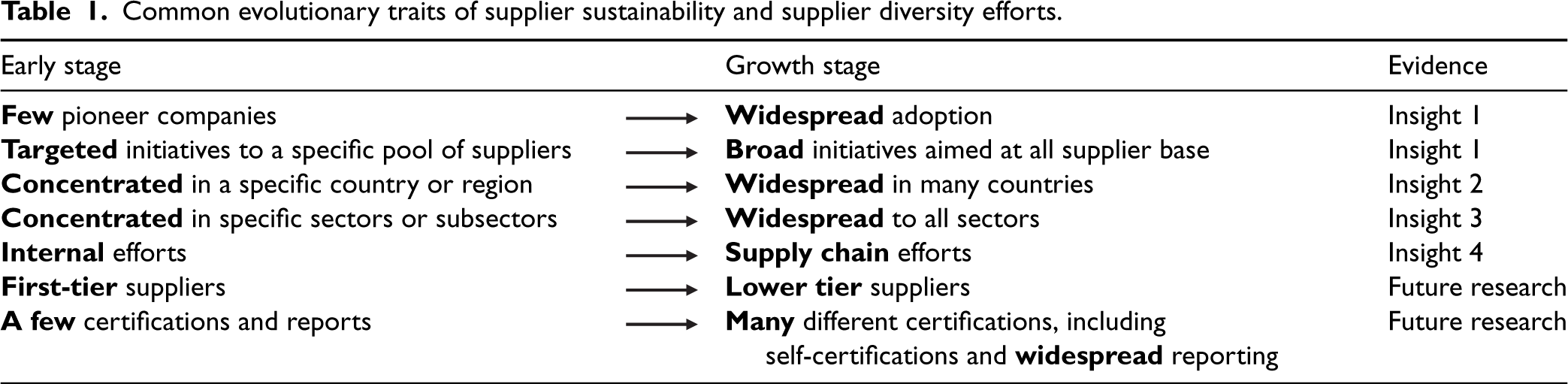
Common evolutionary traits of supplier sustainability and supplier diversity efforts.
First, we count what proportion of the companies in the 2022 Fortune Global 500 have supplier diversity efforts in place, either as part of their SCoC or in the form of a supplier diversity program, and the extent to which those are oriented to concrete action. We find that only 178 of the 500 companies analyzed, or 36%, have a supplier diversity program in 2022. We identify 348 SCoCs within the Global 500, of which 147 (42% of all 348 SCoCs) mention diversity. Of those, only 22 firms (or 15%) have SCoCs that mention concrete actions being taken to achieve diversity in the supply chain; of the firms in this group, 19 also have a supplier diversity program in place, showing a very high commitment to achieving supplier diversity.
In comparison, in the 2020 ranking, 294 companies had an SCoC, of which 67 (23%) refer to diversity. This means that the presence of SCoC content relating to supplier diversity almost doubled in two years. We identified 157 companies with supplier diversity programs in 2020. Thus, while there is a sharp growth in SCoCs with supplier diversity policies (which are directed toward all the firm's suppliers), there is no accompanying growth in supplier diversity programs (which may be targeted at a small subset of suppliers). This means that companies are increasingly directing their supplier diversity efforts more generally toward all suppliers rather than a more targeted group.
A total of 470 of the companies in our data issued a CSR report in 2022, and of those reports, 131 (28%) mentioned supplier diversity, whereas, in 2020, only 16% of 457 CSR reports mentioned it. The rapid growth in supplier diversity efforts is consistent with the survey results in Correll and Betts (2022). In that study, the authors examine many dimensions of supplier sustainability—those exhibiting the fastest growth were related to social factors, including diversity, equity, and inclusion (DEI). In conclusion, an appreciable minority of the leading corporations worldwide have supplier diversity programs or mention supplier diversity in an SCoC (few do so in a way that directs concrete action); nevertheless, these efforts are growing rapidly and broadening in scope.
We conjecture that, in only a few years, supplier diversity efforts will be widespread among the top corporations, as is now the case for other dimensions of supplier sustainability. In fact, as is reflected in Insight 1, this growth is already taking place quite quickly, and there is an expansion from supplier diversity programs (which may be targeted at a narrow subset of suppliers) to supplier diversity requirements in SCoCs (aimed at the entire supplier base).
Regional Differences
The literature portrays the U.S. as a leader in supplier diversity, with efforts beginning during the civil rights movement. Moreover, the demographic shift toward an increase in the population share of minority populations 6 implies that more diverse suppliers will operate, and it is indeed forecasted that within a few decades, minority- and women-owned companies will represent more than 50% of all small businesses in the U.S. (Porter, 2019). However, questions of supplier diversity have also arisen elsewhere (Rogerson, 2012). The U.K. interest in procuring supplies from minority-owned companies is based on the experience of the U.S. (Ram and Smallbone, 2003), and other countries and regions, such as Australia, Canada, South Africa, and the E.U., have also increased such procurement, especially in the public sector (EU MPG, 2009; Rogerson, 2012). In parallel, other initiatives for supplier sustainability are at a more mature stage and have become standard practices in many countries beyond the U.S., U.K., and the E.U. We posit that a similar expansion has begun and will continue for supplier diversity initiatives.
The region with the largest representation in the 2022 Fortune Global 500 list is East and Southeast Asia, with 214 companies. Of these, only 16 (7%) have a supplier diversity program, 86 have an SCoC, but only 24 of those (28%) mention diversity (only one includes concrete actions); 186 have a CSR report, of which eight (4%) mention supplier diversity. North America is the region with the second largest representation in our data, with 136 companies, of which 117 (86%) have a supplier diversity program, 127 have an SCoC; 69 SCoCs (54%) mention diversity, of which 13 (19%) include concrete actions to be taken. A total of 135 North American companies in our data publish a CSR report, of which 94 (70%) mention supplier diversity. The region with the third largest representation in the list is Western Europe, with 122 companies. Of these, 43 (35%) have a supplier diversity program, and 113 have an SCoC, of which 47 (42%) mention diversity and seven (15%) list concrete actions; of the 121 CSR reports published by Western Europe companies on this list, 27 (22%) mention supplier diversity. The remaining regions represented in our data have fewer than 10 companies in the list, so we cannot draw conclusions from these. The 2020 Fortune Global 500 data show the same three regions dominate among firms with supplier diversity programs, although the proportions are somewhat lower than is the case in 2022: 5.4% (Asia), 79% (North America), and 28% (Western Europe). There are comparatively fewer firms mentioning supplier diversity in their SCoCs than in 2020: 6% (Asia), 35% (North America), and 18% (Western Europe).
7
Differences Between Sectors
For the last several decades, studies on supplier sustainability have mostly examined sectors that are subject to enhanced scrutiny and regulation due to their irregular environmental practices. These sensitive industries include mining, oil exploration, paper, chemical and allied products, petroleum refining, metals, and utilities (Montes-Sancho et al., 2022). However, nowadays, supply chain sustainability is an issue impacting all sectors, spurred by market and social pressure, trans-sectoral and transnational agreements and standards (Winston, 2021), and standardization of regulations and capabilities of large global enterprises (Ghadge et al., 2019). Nevertheless, in the area of supply chain sustainability, some scholars claim that social responsibility practices are mostly observed in certain types of industries. For example, studies show that consumer-product firms have a greater need to invest in CSR activities than those involved in the production of industrial products (Baron et al., 2011). To the best of our knowledge, no recent formal study empirically analyzes supplier diversity efforts by sector.
From our 2022 data, we observe that different sectors make different levels of effort to ensure supplier diversity and are using different tools to do so. The sector with the highest proportion of supplier diversity programs is healthcare, with 72%, followed by motor vehicles and parts (51%) and technology (50%). As regards reference to diversity in their SCoCs, firms in the financial sector show the most activity, with 60% of companies, followed by the healthcare sector with 56%. In contrast, the reflection of sustainable suppliers in corporate sustainability or CSR reports is 80% or higher for all sectors in our 2022 data, confirming the very high rate of adoption of supplier sustainability practices by firms across sectors. From our 2020 data, we observe that healthcare is the sector in which the highest proportion of firms (76%) have a supplier diversity program, followed at a distance by the technology sector at 49%. Compared to the 2022 data, the mentions of diversity in SCoCs are lower in 2020 for all sectors except the transportation sector, which topped the list in 2020, with 42% of firms referencing diversity in their SCoCs, a level that dropped to 38% in 2022.
8
As Insights 2 and 3 suggest, companies that implement supplier diversity practices are more likely to be from certain regions and certain sectors. However, as observed in relation to general sustainability practices, we expect supplier diversity efforts will be extended across geographies and sectors over time.
From Internal Efforts to Supply Chain Efforts
We conjecture that companies that implement internal diversity efforts are more likely to implement supplier diversity initiatives, which is consistent with what is observed for other sustainability efforts. In the past, businesses responded to public pressure to reduce their negative environmental and social impact with initiatives that addressed those challenges in their internal operations and/or immediate communities (Thorlakson et al., 2018). However, firms are increasingly being held accountable for all operations in their supply chains (Kanter, 2010), and some have responded by announcing supplier sustainability initiatives (Winston, 2010). A 2014 survey of companies showed that the main challenge faced by firms in pursuing sustainability was extending their efforts through the supply chain (Neghaiwi, 2014; Searcy, 2016). For example, of the over 4000 companies that disclosed their emissions to the nonprofit CDP in 2015, only 28% reported the emissions of their suppliers (Scope 3) (CDP, 2015). The push for more sustainable supply chains is an ongoing effort that is being mainstreamed (Winston, 2021), led by firms with higher market performance and greater managerial commitment to sustainability (Blome et al., 2014).
Take, for instance, Apple Inc. This company is already carbon neutral in its global internal operations (Apple, 2022) and is now extending this goal to its supply chain by 2030 (Apple, n.d.). Many firms first implement sustainability initiatives internally and then expand these along their supply chains. Companies following the same pattern for diversity measures would experience the same process that has been observed for other sustainability efforts.
Of our 2022 sample of 500 companies, 379 report some form of data on employee diversity (e.g., gender or racial composition of their workforce) and are more likely to have a supplier diversity program (45%) than those who do not (7%). Companies that report internal diversity data are also more likely to mention supplier diversity in their SCoCs. Of the 379 companies that report on internal diversity have an SCoC, 44% mention diversity in it. Of the other 121 companies, 20% mention supplier diversity in their SCoC. Furthermore, among the 378 CSR reports of companies that report internal diversity data, 34% mention supplier diversity, while only 4% do of companies that do not report their internal diversity. Note that, in 2020, 253 companies reported internal workforce diversity information. Of those, 46% had a supplier diversity program, and 27% of their SCoCs and 26% of their CSR reports mentioned supplier diversity. When comparing 2022 with 2020, there is a slight decrease in the proportion of supplier diversity programs. However, there is a large increase in the mention of diversity in the SCoCs. This might indicate a change of strategy where firms are focusing on setting broad diversity requirements for their entire supplier base and not only devoting efforts to the pool of a priori established diverse suppliers. The number of companies reporting information about their diversity status (internal and supplier) is rapidly growing.
Connection With Other Supplier Sustainability Efforts
We now consider if companies that have other supplier sustainability efforts in place, for example, in relation to environmental or social issues, are also more likely to implement supplier diversity initiatives. Just as the diffusion of environmental and quality standards through supply chains can create synergies (Corbett, 2006; Corbett and Kirsch, 2001; Delmas and Montiel, 2009), we argue that there are obvious synergies between other supplier sustainability and supplier diversity efforts.
First, we examine firms’ SCoCs. Out of the 348 SCoCs we identify, 328 (94%) include content related to supplier sustainability; note that this is more than twice the number that includes diversity-related content. Of the companies that include supplier sustainability in their SCoCs, 50% have a supplier diversity program, 44% also include supplier diversity content, 15% include concrete actions, and 37% mention supplier diversity in their CSR reports. By contrast, of the firms that do not refer to sustainability in their SCoCs, only 40% reference supplier sustainability, and only 10% mention supplier diversity in their CSR reports.
Of the 470 CSR reports we identify in our data, 425 mention supplier sustainability, and of those, 41% have a supplier diversity program; of the companies with a CSR report, 74% have an SCoC, of which 43% mention supplier diversity in that SCoC, and 31% mention supplier diversity in the CSR report itself. Of the 45 firms whose CSR report does not mention supplier sustainability, only 9% have a supplier diversity program, 35% of the firms’ SCoCs mention supplier diversity, and none have CSR reports that mention supplier diversity.
We conclude that the companies in our dataset that make sustainability-related demands of their suppliers in their SCoC or that discuss supplier sustainability in their CSR reports are also more likely to have initiated supplier diversity efforts. In 2020, 90% of the 294 companies that had an SCoC already mentioned supplier sustainability in it, which proves that general supplier sustainability efforts are in a much more mature and widespread stage than supplier diversity efforts.
However, the spread of supplier sustainability efforts varies greatly by region (as is the case for supplier diversity efforts). For instance, in North America, 93.38% of companies have an SCoC, of which 92.91% mention supplier sustainability; 99.26% of companies have a CSR report, of which 97.78% mention supplier sustainability. In other words, supplier sustainability efforts are advanced and widespread in companies headquartered in North America.
By contrast, only 40.19% of companies in East and South East Asia have an SCoC (although, among those that do, 94.19% mention supplier sustainability); 86.92% of companies have a CSR report, of which 80.11% mention supplier sustainability. In other words, supplier sustainability efforts (especially prescriptive efforts like the SCoC) are less widespread in East and South East Asia. The figures for Western Europe are extremely similar to those for North America. This strengthens our argument that maturity in broader supplier sustainability efforts can help in efforts to achieve supplier diversity. It is clear that regions where supplier sustainability is more mature and widespread (North America and Western Europe) are also ahead in supplier diversity and vice versa.
Directions for Future Research on Supplier Diversity
The purpose of this study is to describe the current state of supplier diversity practices in the largest companies worldwide. This will allow researchers in the fields of operations and supply chain management to have a better perspective of current practices, to potentially offer novel insights and best practices, and to connect these aspects to what has already been studied in other supplier sustainability initiatives.
In our study of definitions of supplier diversity (Section 3), we suggest an initial standard definition of supplier diversity that can be adapted to differences in diversity measures over time and across regions. After all, supply chain sustainability is a moving target (Correll and Betts, 2022), so we expect supplier diversity—a dimension of supply chain sustainability—to be the same. This study highlights the need to develop performance or impact metrics to better evaluate supplier diversity.
In Section 4, we have shown how supplier diversity initiatives are not yet sufficiently widespread among the world's largest corporations but have substantially increased in the short span of two years. We have also examined whether the implementation of such initiatives might correspond to certain firm characteristics (region, sector, internal workforce diversity, or the existence of other supply chain sustainability efforts). A logical next step would be to establish causal links and mechanisms between these characteristics and supplier diversity initiatives to better understand why and how they spread along the supply chain.
Among the Fortune Global 500, we find two main ways to enact supplier diversity efforts: via supplier diversity programs and mentions of diversity in the SCoC. Which of these or other instruments is the most effective in achieving supplier diversity goals remains an open question. For example, given the large variation of supplier diversity programs, it would be interesting to conduct an exhaustive study about types of supplier diversity programs and their effectiveness. Beyond the instruments studied in this article, scholars have suggested other ways to foster supplier diversity, particularly in the procurement process. For example, using nudging techniques by including questions related to gender parity in competitive supplier selection events (Atal et al., 2019) or hiring new procurement personnel with views on supplier diversity that align with the company's CSR aspirations (Blount and Li, 2021). We believe that the study of other actions to spur supplier diversity, in addition to supplier diversity programs and SCoCs, is core to the fields of operations and supply chain management and should be further explored.
When analyzing regional differences, our results confirm conceptual differences underlying definitions of diversity, the intensity of supplier diversity efforts, and regional differences in terms of the form of instrument adopted. It would be interesting to explore the connection between differences in regional measures of diversity and firms’ supplier diversity efforts. For example, in our data set, we observe that firms in North America are more likely to have supplier diversity programs than firms in other regions, which use the SCoC as their main instrument—why is this the case? Our analysis shows that a firm's supplier diversity goals and efforts could depend on where it operates (i.e., globally or locally). Hence, multinational companies might need to consider changing their supplier diversity requirements depending on the region in which each supplier is located. In a world that is increasingly rich in data, a possible path for future research would be to map the global supply chains of top companies and relate their supplier diversity efforts to the specific regions in which their suppliers are located.
We propose that the spread of supplier diversity efforts will follow a path similar to that of other efforts to achieve supplier sustainability. It will be interesting to establish the extent to which that is true in the future and whether the experience and knowledge gained from establishing such initiatives will help companies successfully pursue supplier diversity or whether the concept of diversity is so different (and context-dependent) from other dimensions of supplier sustainability that the implementation of diversity initiatives will require companies to develop a new set of capabilities, such as specific supplier diversity management roles and new reporting forms. For example, there is an incipient use of a new type of report, a diversity report.
We specifically conjecture (Table 1) that soon, the public—which is increasingly demanding supply chain transparency (Kolcava et al., 2023) and DEI from companies in different industries (Cook, 2021; Harris et al., 2021)—will also demand that such DEI efforts include companies’ suppliers. A proliferation of certifications, “diversity labels,” and reporting will emerge to promote companies with good practices of supplier diversity, as is the case with companies pursuing environmental and social sustainability (Balzarova et al., 2013). Gradually, demands for diversity will cascade down to lower-tier suppliers, as is also happening with other sustainability efforts (Villena and Gioia, 2020; Wilhelm and Villena, 2021). These conjectures could motivate future research in the fields of marketing, consumer communication, and supply chain management.
As a closing consideration, we emphasize that the final goal of any supplier diversity practice should be to facilitate social and economic inclusion (Sordi et al., 2022). Moreover, as firms start to reflect on their true internal inclusion goals (Tang, 2023), they should also consider how these goals can be transferred to their suppliers to spur DEI across the supply chain. In our study, we observe a global trend among large corporations toward embracing diversity, identifying an increase (from 2020 to 2022) in mentions of diversity in firms’ SCoCs, which affect all suppliers. We encourage scholars to actively engage by studying whether supplier diversity mechanisms are actually effective at increasing social and economic inclusion, that is, actually increasing the economic prosperity of disadvantaged groups. We also encourage scholars to study in more detail what the most effective mechanisms are for achieving these bigger objectives.
Supplemental Material
sj-pdf-1-pao-10.1177_10591478241240123 - Supplemental material for The State of Supplier Diversity Initiatives by Large Corporations: The New Sustainable Supply Chain?
Supplemental material, sj-pdf-1-pao-10.1177_10591478241240123 for The State of Supplier Diversity Initiatives by Large Corporations: The New Sustainable Supply Chain? by Gemma Berenguer, Natalia Costas Lorenzo and Anna Sáez de Tejada Cuenca in Production and Operations Management
Footnotes
Acknowledgments
The authors are grateful to the editor and reviewers for their thorough feedback and guidance during the review process. The authors also thank Kathrin Boehme and Alejandro Mier, both from IESE Business School, for their excellent research assistance.
Declaration of Conflicting Interests
The authors declared no potential conflicts of interest with respect to the research, authorship, and/or publication of this article.
Funding
The authors disclosed receipt of the following financial support for the research, authorship, and/or publication of this article: This work was supported by the Comunidad de Madrid (Grant EPUC3M12), the Spanish Government's Ministerio de Ciencia e Innovación (Grant PID2021-127657NA-I00), and the Ramón y Cajal Fellowship (RYC2020-029303-I).

Notes
How to cite this article
Berenguer G, Costas Lorenzo N and Sáez de Tejada Cuenca A (2025) The State of Supplier Diversity Initiatives by Large Corporations: The New Sustainable Supply Chain? Production and Operations Management 34(3): 541–551.
References
Supplementary Material
Please find the following supplemental material available below.
For Open Access articles published under a Creative Commons License, all supplemental material carries the same license as the article it is associated with.
For non-Open Access articles published, all supplemental material carries a non-exclusive license, and permission requests for re-use of supplemental material or any part of supplemental material shall be sent directly to the copyright owner as specified in the copyright notice associated with the article.
