



Abstract
Secondary stakeholder demands represent increasingly important strategic issues for firms. However, the principal drivers of firm response remain poorly understood. We extend research on firm responsiveness to secondary stakeholders by introducing a new theoretical perspective to detail the cognitive processes through which key CEO attributes—namely, personal values and passion—shape the trajectories of firm responsiveness. We first outline key aspects of secondary stakeholder demands to explain why CEO values and passion are important determinants of a firm’s response to secondary stakeholder demands. We then explain how a CEO’s values and passion influence the process of firm responsiveness. Finally, we extend our arguments to illustrate how values and passion-infused responses may influence social (dis)approval among key organizational stakeholders. By focusing on the cognitive processes of CEOs, we offer novel theoretical contributions to stakeholder theory, strategic leadership research, and the literature on firm social evaluations.
Large corporations have become increasingly susceptible targets of secondary stakeholder demands (Briscoe & Gupta, 2016; Wu & Liu, 2024). 1 Secondary stakeholders are external constituents of the firm who are not engaged in transactions with it, and are not essential for its survival, but who may affect it in strategic and/or performance-related ways (e.g., community activists, advocacy groups, religious organizations, and other non-governmental organizations; Clarkson, 1995). Secondary stakeholders typically issue demands intending to alter firm policies and practices they view as detrimental to society, based on their value-based worldviews of how business ought to operate within it (Briscoe & Gupta, 2016; Odziemkowska & Henisz, 2021). In doing so, secondary stakeholders can play a crucial role in “setting the stage” for how firms’ primary stakeholders (e.g., customers, employees, shareholders) and other consequential audiences (e.g., competitors, infomediaries) evaluate targeted firms (Odziemkowska & Dorobantu, 2021; Vasi & King, 2012). Thus, how a firm responds to secondary stakeholder demands strongly shapes evaluators’ (enmity) affinity toward the firm—its social (dis)approval (Bundy & Pfarrer, 2015; Wang, Reger, & Pfarrer, 2021).
Responding to secondary stakeholder demands requires a firm’s top executives—namely, its CEO—to engage in decision-making that transcends rational evaluations and involves emotions and moral considerations (Pollock, Lashley, Rindova, & Han, 2019). Despite this, research has relied on mechanistic and sanitized explanations (Wu & Liu, 2024) emphasizing secondary stakeholder attributes and tactics, and strategic considerations such as the firm’s competitors, culture, reputation, and resources to explain variance in firm responsiveness to secondary stakeholder demands (e.g., Eesley & Lenox, 2006; Julian, Ofori-Dankwa, & Justis, 2008; McDonnell & King, 2013; Pacheco & Dean, 2015; Waldron, Navis, & Fisher, 2013). As such, we not only lack an integrated account of how actors at the apex of organizations—particularly CEOs—shape firms’ responsiveness to secondary stakeholder demands (e.g., Neville, 2022; Recendes, Chandler, Huang, & Hill, 2024), but also of the processes through which they respond to these demands in divergent ways (Wu & Liu, 2024).
These omissions are critical because while managing secondary stakeholders is not essential for firm survival (Clarkson, 1995), it is crucial in determining whether and how a firm may thrive (Odziemkowska & Zhu, 2025; Su & Tsang, 2015; Zhang, Briscoe, & DesJardine, 2023). This paradox, coupled with the value-laden and emotionally-charged nature of secondary stakeholder demands (Briscoe & Gupta, 2016; McDonnell & King, 2013; Odziemkowska & Henisz, 2021), makes responding to such demands not only more challenging for a CEO because firm responses similar to those of other firms may generate divergent social approval outcomes for the focal firm (i.e., multifinality), but also more intuitive and reflexive than responding to primary stakeholder demands (Wu & Liu, 2024). Consequently, current theoretical perspectives, developed with primary stakeholders in mind and rooted in rational, calculated, decision-making (Bundy, Shropshire, & Buchholtz, 2013; Durand, Hawn, & Ioannou, 2019; Waldron et al., 2013), are naturally limited in their applicability to the distinct but increasingly important domain of secondary stakeholder demands. This theoretical inadequacy leaves important questions unanswered (Locke & Golden-Biddle, 1997), such as: How do firms—and specifically CEOs—come to construct and enact divergent responses to similar—if not identical—secondary stakeholder demands? For example, in 2008, Greenpeace challenged several grocery chains’ seafood sourcing practices; some firms modified their practices immediately (e.g., Trader Joe’s), while others (e.g., Costco, Publix) lagged or did not respond at all (Trenor & Mitchell, 2013).
Answering calls to foreground managerial reflexivity and to open the black box of how decisions about secondary stakeholders actually “happen” (Wu & Liu, 2024), we develop a CEO-driven process model of firm responsiveness to secondary stakeholder demands. This perspective (1) positions the CEO as the pivotal actor shaping whether and how firms respond to secondary stakeholders demands, and (2) shifts theorizing away from the dominant focus on variable-correlations-outcome paradigms toward the activities, trajectories, dynamic entanglements, and generative mechanisms that produce those outcomes (see Cloutier & Langley, 2020). In doing so, we extend the current understanding of firm responsiveness to secondary stakeholders by tracing how CEOs initiate and adjust response pathways based on their values and passions.
We define responsiveness as the degree to which a CEO is willing to accommodate (or deny) a secondary stakeholder demand and commit themselves (and the firm) to enacting their chosen posture toward the demand (Bundy et al., 2013; David, Bloom, & Hillman, 2007). We outline how firm responsiveness to secondary stakeholder demands is shaped by a CEO’s personal values and passion toward such demands, as well as the intervening socio-cognitive and relational processes supporting these connections. “Personal values” represent stable beliefs or principles that individuals regard as desirable and use to guide their decisions and actions (Rohan, 2000; Schwartz, 1992). “Passion” refers to an intense and enduring motivational state that propels individuals toward activities experienced as deeply meaningful, identity-defining, and value-infused (Cardon, Post, & Forster, 2017; Cardon, Wincent, Singh, & Drnovsek, 2009; Perrewé, Hochwarter, Ferris, McAllister, & Harris, 2014; Vallerand et al., 2003). Drawing on work in social psychology that links personal values and passion to decision-making and action, our process model positions a CEO’s personal values and passion as central, yet minimally addressed, drivers of firm responsiveness to secondary stakeholder demands.
Our theory makes three principal contributions to management research. First, we enrich stakeholder theory by advancing its conceptualization of when and whether a secondary stakeholder demand is perceived as salient or acted upon, incorporating the role of top executives’ characteristics into the framework. Specifically, we argue that a CEO’s personal values and passion can be decisive drivers of responsiveness to secondary stakeholders. This perspective moves beyond simply applying theories developed largely for primary stakeholders to secondary stakeholders—an approach that does not fully embrace the ambiguous, value-laden, and emotionally charged nature of their demands. Further, while previous efforts suggest that managerial values shape perceptions and responses to stakeholders (Agle, Mitchell, & Sonnenfeld, 1999; Mitchell, Agle, & Wood, 1997), they stop short of specifying the socio-cognitive mechanisms and pathways that connect a CEO’s values to response. We address this gap by proposing passion as a key element in this process.
Second, we advance strategic leadership research by expanding upon the distinctive socio-cognitive process through which values and passion influence executive choice. As Neely, Lovelace, Cowen, and Hillier (2020) observe, executive cognition entails processes of field of vision, selective perception, and interpretation. However, despite the surge of work focused on top executives’ personal values (e.g., Busenbark, Bundy, & Chin, 2023; Chin, Zhang, Jahanshani, & Nadkarni, 2021; Gupta, Fung, & Murphy, 2021; Hambrick & Wowak, 2021), a theoretical distinction is needed, as Upper Echelons Theory (UET) currently treats cognitive bases and values as operating through similar processes—a conflation that is problematic from a social-psychological perspective (Neely et al., 2020). Additionally, by articulating these arguments within the scenario of a secondary stakeholder demand, we heed calls to deepen our understanding of how strategic leaders may mold their firm to reflect their identities through their firm’s interactions with its stakeholders (Gamache, Neville, Bundy, & Short, 2020; Recendes et al., 2024; Wowak, Busenbark, & Hambrick, 2022).
Finally, by recognizing that strategic leaders’ responses to secondary stakeholder demands shape their firms’ social (dis)approval, we introduce a vital micro-foundational lens to understanding how this process influences firm social (dis)approval. Social approval is not homogeneous across audiences, but is constructed through audience interpretations, particularly of the leader (George, Dahlander, Graffin, & Sim, 2016; Pollock et al., 2019; Steele & Lovelace, 2023). Our model highlights how a CEO’s values and passion influence not only whether and how a firm responds, but also how those responses are received and judged by audiences. This helps explain why similarly situated firms confronting comparable stakeholder challenges can elicit divergent social (dis)approval. By grounding firm responsiveness in a reflexive, values- and passion-driven process, we offer a more nuanced understanding of how CEO decision-making shapes stakeholder engagement and the ensuing social (dis)approval of the firm.
Theoretical Background
Firm Responsiveness to Secondary Stakeholders
Researchers concerned with understanding the interactions between secondary stakeholders and firms have traditionally leveraged theoretical perspectives emphasizing stakeholder-sided mechanisms and other factors external to the firm. Mitchell and colleagues’ (1997) seminal theory of stakeholder identification and salience is prominently featured in most inquiries. Stakeholder salience is defined as the degree to which a stakeholder and its demands resonate with—and are prioritized by—management (Bundy et al., 2013; Mitchell et al., 1997). According to the framework, stakeholder salience is driven by three interrelated stakeholder attributes: power, legitimacy, and urgency. Building on these arguments, research illustrates that secondary stakeholders with greater power relative to the target firm in terms of resources or ownership stakes, and whose requests are deemed more legitimate in the eyes of the public or are supported by key activist investment groups (e.g., the Interfaith Center of Corporate Responsibility), are considered salient to management, prompting responsiveness (David et al., 2007; Eesley & Lenox, 2006). While important, this stakeholder-sided perspective is limited by the presumption that a CEO, and their firm by extension, differs in their response only to the extent that the attributes and behaviors of secondary stakeholders they encounter differ.
More recent work adopting a strategic cognition perspective highlights the need to understand firm responsiveness based on the subjective perceptions, beliefs, and motivations of the firm’s top managers, particularly its CEO (Bundy et al., 2013; Durand et al., 2019; Waldron et al., 2013). For instance, Julian et al. (2008) analyzed how firms in the restaurant industry responded to a fat-reduction campaign spearheaded by the National Heart Savers Association (NHSA). Their findings pointed to underlying elements of managerial cognition—managers’ urgency and manageability assessments—that influenced their responses to the campaign. The strategic cognition perspective, with its emphasis on executives’ subjective perceptions and beliefs, sheds some light on why certain secondary stakeholder demands prompt different responses across firms, or why firms facing the same demand may respond in divergent ways. Yet, while progress has been made, we still lack a deep theoretical understanding of how specific CEO characteristics shape organizational engagement with secondary stakeholders.
By focusing more closely on the CEO and key individual attributes that drive their decision-making in such scenarios, we stand to gain needed insights into the role of managerial reflexivity and the realities of managing and crafting responses to secondary stakeholders (Bundy et al., 2013; Wu & Liu, 2024). Additionally, scholars can offer a compelling explanation for why some firms respond to secondary stakeholders in ways that appear, to onlookers, self-detrimental or inconsistent with their current strategy. Consider the example of Mountain Equipment Co-op’s (MEC) decision to cut ties with important and longstanding supplier CamelBak (owned by Vista Outdoors, which also owns Savage Arms) in response to what was described as a small online movement that emerged following the shootings at Marjory Stoneman Douglas High School in Parkland, Florida (Lum, 2018). Emerging evidence like this suggests that firm responses to secondary stakeholders might be significantly influenced by factors related to a CEO themselves; in particular, their values and passion (e.g., Chin, Hambrick, & Trevino, 2013; Hambrick & Wowak, 2021; Wowak et al., 2022). These elements influence not only which secondary stakeholder demands a CEO attends to, but also how intensely they engage with these concerns. This naturally raises an important theoretical question: What is the process by which a CEO’s values and passion shape firm responsiveness to secondary stakeholder demands?
Secondary Stakeholder Demands: A Deeply Personal Issue for the CEO
A CEO’s personal values and passion become particularly influential in shaping firm responsiveness to secondary stakeholder demands because these demands often arise in contexts of situational weakness (Mischel, 1968, 1977), where norms are ambiguous, dependencies are limited, and strategic implications are unclear (Clarkson, 1995; Eesley & Lenox, 2006). This stands in contrast with the more structured, goal-oriented, and obligatory nature of primary stakeholder demands. In these former settings, a CEO may not easily recognize or understand the strategic implications of secondary stakeholder demands (Hambrick & Wowak, 2021; Neville, 2022), and firm responses tend to reflect a CEO’s own cognitive filters and motivational dispositions (Hambrick & Finkelstein, 1987; Wangrow, Schepker, & Barker, 2015).
Moreover, secondary stakeholder demands are typically emotionally charged, revolve around moral issues, and are oriented toward social change (Briscoe, Chin, & Hambrick, 2014; McAdam, Tarrow, & Tilly, 2001; Odziemkowska & Henisz, 2021). Such features activate deeply held personal values that serve as evaluative frames for determining issue relevance, which can, under certain conditions, trigger passion as a driver of intense commitment or resistance to respond (Hitlin, 2003; Rokeach, 1973; Schwartz, 1999). Together, situational weakness and the value-laden, emotionally charged nature of secondary stakeholder demands create a backdrop of ambiguity and contested meaning, amplifying the importance of individual-level factors (e.g., a CEO’s personal values and passion) in shaping firm action.
The Structure and Content of Personal Value Systems
Values represent stable beliefs or principles that individuals regard as desirable and use to guide their decisions and actions (Rohan, 2000). Schwartz (1992, 1994) articulated a widely accepted and validated framework
2
that identifies two motivational dimensions as forming a basis for an individual’s value system (i.e., four “higher-order” values): self-enhancement-self-transcendence, and openness to change-conservation.
3
The self-enhancement-self-transcendence dimension relates to: the extent to which [values] motivate people to enhance their own personal interests even at the expense of others versus the extent to which they motivate people to transcend selfish concerns and promote the welfare of others, close and distant, and of nature. (Schwartz, 1992: 43)
The openness to change-conservation dimension reflects “the extent to which [values] motivate people to follow their own intellectual and emotional interests in unpredictable and uncertain directions versus to preserve the status quo and the certainty it provides in relationship with close others, institutions, and traditions” (Schwartz, 1992: 43).
Schwartz’s value theory explains that individuals vary in how their value systems are structured along the self-enhancement-self-transcendence and openness to change-conservation dimensions. Such variations also shape how individuals perceive and judge stimuli, responding favorably to stimuli that align with their personal values, and less favorably to stimuli that conflict with them (Hitlin, 2003; Kunda, 1990; Sagiv & Schwartz, 2022). For example, Matusik, George, and Heeley (2008) found that venture capitalists’ (VC) evaluations of new venture founders were more favorable when those founders had acquired experience in ways that aligned with VCs’ values along the openness to change-conservation dimension of the value system.
A central implication for our theoretical development is that a CEO’s personal values—and how these values are structured—shape both motivated cognition and behavioral channeling. The former guides how CEOs prioritize and interpret secondary stakeholder demands, and the latter activates passion, which provides the impetus to enact a response to such demands.
The Nature and Manifestation of Passion
Passion, derived from the Greek term pathos, denotes a persistent human condition marked by intense pleasure or pain that motivates sustained engagement (Leighton, 1995, 2018). While often situated under the broader rubric of desires, passion is conceptually distinct from adjacent constructs. Emotions, for instance, are typically ephemeral and physiological in nature, whereas passion endures. Similarly, if desires can be likened to sparks that ignite a flame, passion is the fireplace that sustains that flame. Further, unlike needs—which are generally objective, biological, and not necessarily affectively charged—passion entails a subjective, emotionally-laden orientation (for a detailed discussion, see Cardon et al., 2009).
In the management literature, passion has been considered a key driver of entrepreneurship and innovation (Cardon & Kirk, 2013; Cardon et al., 2017; Murnieks, Mosakowski, & Cardon, 2014; Schuh, Kim, Wang, & Liu, 2024). This research directly addresses the macro-micro bridge by investigating how firm strategy influences individual passion and outcomes, such as through the cascading effects of entrepreneurial orientation on employee creative performance (Schuh et al., 2024), and by examining how the interplay of multiple passions shapes entrepreneurial intentions within organizational contexts (Huyghe, Knockaert, & Obschonka, 2016). Also, entrepreneurial passion is recognized as influencing external decisions, such as angel investor evaluations of new ventures (Murnieks et al., 2014). Drawing on this and related work, we similarly conceptualize passion as an intense and enduring motivational state that propels individuals toward activities experienced as deeply meaningful, identity-defining, and value-infused (Cardon et al., 2009; Perrewé et al., 2014; Vallerand et al., 2003).
Social psychological research on passion (e.g., the Dualistic Model of Passion [DMP]; Vallerand et al., 2003) suggests that individuals can exhibit one of three types of passionate responses toward situational stimuli and activities they undertake. First, individuals can have little to no passion towards something. In this instance, they would spend little time or energy thinking about the situation or pursuing the activity. Second, individuals can exhibit harmonious passion. Harmonious passion refers to the autonomous internalization of the pursuit of an activity or goal into one’s identity, whereby individuals freely and voluntarily accept an activity or goal as personally meaningful. Consequently, individuals experience a sense of volitional control in pursuing the activity. Harmonious passion toward an activity “occupies a significant but not overpowering space in the person’s identity and is in harmony with other aspects of the person’s life” (Vallerand, 2010: 104). Third, individuals can exhibit obsessive passion. Obsessive passion refers to the internalization of the pursuit of an activity into one’s identity, whereby individuals experience a lack of control and an uncontrollable urge to pursue the activity. Obsessive passion “must run its course as it controls the person” (Vallerand, 2010: 103).
Core to our theorizing is the idea that whether a secondary stakeholder demand elicits no passion, harmonious passion, or obsessive passion in a CEO influences the pathways through which the CEO responds to the demand. Namely, harmonious and obsessive passion shape CEOs’ cognitive orientations and emotional states as they contemplate responses, as well as the behaviors they adopt in engaging with stakeholders whose perspectives may matter.
A CEO-Driven Process Model of Firm Responsiveness to Secondary Stakeholder Demands
The model depicted in Figure 1 highlights how a CEO’s personal values and passion influence their response to secondary stakeholder demands. We note several visual elements that will aid in the interpretation of our model. Greyed-out elements (i.e., arrows, shaded boxes) represent underlying pathways or meta-processes that are difficult to observe and fall outside of the scope of our core theorization. Black arrows depict the trajectories we theorize are occurring throughout the CEO’s sensemaking process, where arrows of a similar pattern reflect an “ideal type” of trajectory (Doty & Glick, 1994). Value-based processes are represented as clouds to connote their abstract, intangible, and interpretative nature; passion-based processes are represented as boxes to emphasize their concrete, actionable, and observable character. The concepts underlying the processes and relationships we theorize below are depicted in Figure 1, proceeding from left to right, beginning with the oval labeled “secondary stakeholder demands.”
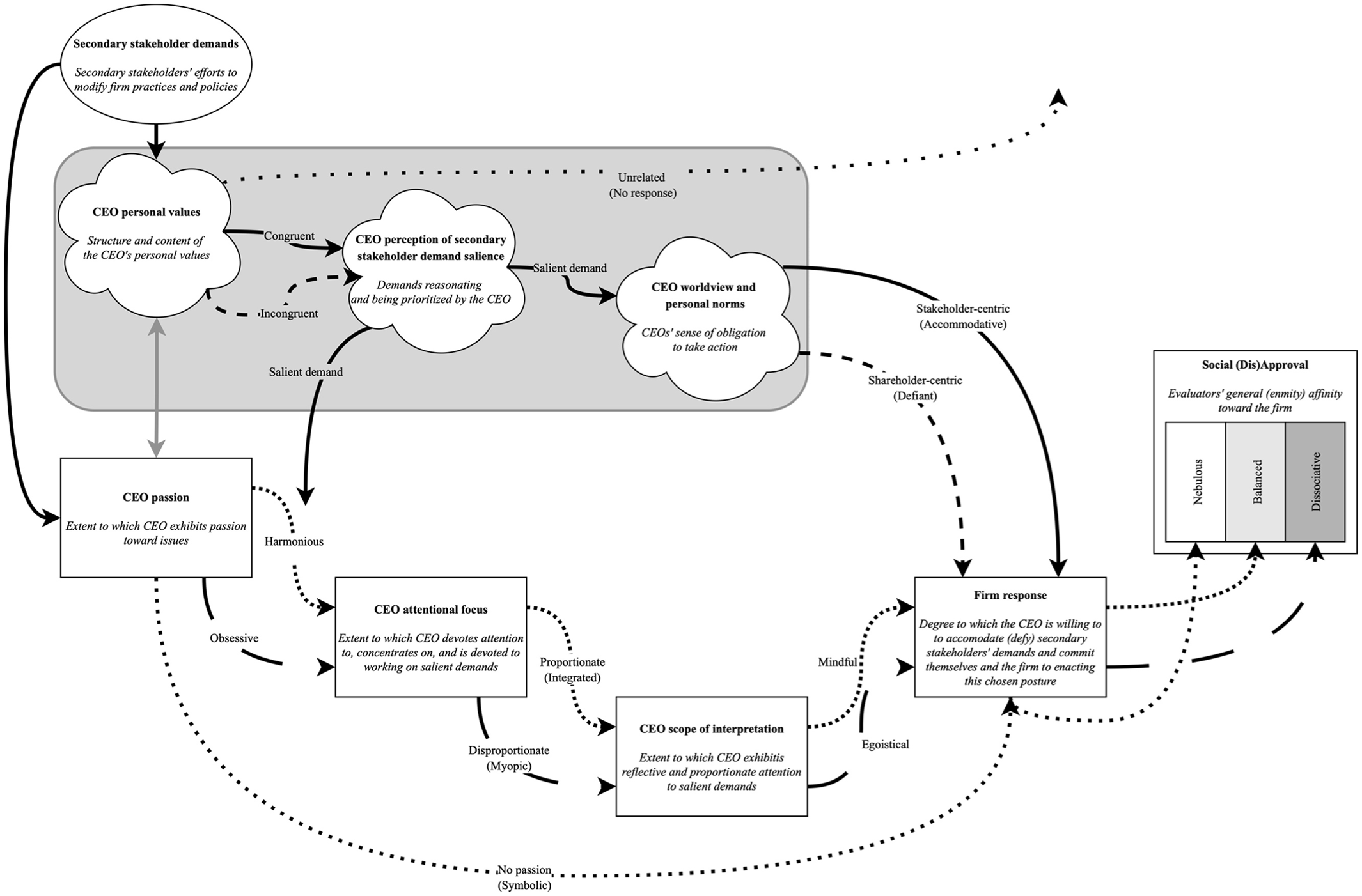
Process Model of CEO-Driven Response to Secondary Stakeholder Demands
Importantly, although we depict the model sequentially—beginning with the CEO’s perception of secondary stakeholder demand salience, followed by interpretation and response—this ordering is a narrative device. We do not mean to suggest that this process always occurs with such strict ordering, although it may. These phases may overlap, reinforce one another, or unfold in varying sequences. For instance, just as prior work shows that CEOs’ cognitive structures shift once they acquire celebrity status (Lovelace, Bundy, Hambrick, & Pollock, 2018; Neely et al., 2020), we likewise envision that passion for a stakeholder demand may evolve, reshaping how the demand is perceived, its salience assessed, and its meaning interpreted. One example of how non-linearity in our process might occur is that, in dedicating increased attention to working on a salient secondary stakeholder demand consistent with their values, a CEO initially exhibiting harmonious passion toward the demand may uncover additional implications associated with this demand that conflict with their personal values, thereby leading them to reclassify the demand and their position as defiant toward it. Alternatively, a CEO may initially assess a secondary stakeholder demand as salient but also lack passion toward it, leading the CEO to re-assess the demand as not being as strongly related to their personal values as originally believed, hence suppressing the initial inclination to respond to the demand altogether.
Finally, given that our focus is on delineating how this process unfolds, we adopt a narrative approach to theory development, ground our arguments in empirical evidence and illustrative examples to illuminate the mechanisms through which CEO values and passion shape cognition and response, and outline propositions that summarize our arguments in a descriptive rather than predictive manner (see Cloutier & Langley, 2020; Cornelissen, 2017).
Guiding Assumptions and Boundary Conditions
Before outlining our model, it is important to establish some of our core assumptions and boundary conditions. First, we assume the CEO’s limited field of vision—that is, which secondary stakeholder demands they do and do not “see”—is jointly shaped by the passion and intensity of the secondary stakeholders issuing demands as well as the firm’s competitive position. Demands voiced with high intensity, urgency, or moral conviction are more likely to resonate with other key stakeholders and infomediaries (e.g., journalists, analysts) such as they cannot go unnoticed (Eesley, Decelles, & Lenox, 2016; King, 2008; McDonnell & King, 2013). By contrast, tepid demands may fail to penetrate the CEO’s limited field of vision, leaving them with little justification to recognize the demands despite their personal inclinations. Additionally, it is possible that the firm’s competitive position and performance may constrain the CEO’s limited attention on matters that are seemingly more urgent than secondary stakeholder demands. For example, when CEOs face greater competitive intensity, their attention gets spread across more issues, focusing on a wide range of competitive threats, giving them less time to focus on any single issue, such as a secondary stakeholder demand (Andrevski, Richard, Shaw, & Ferrier, 2014). Conversely, firms with limited resources may not have the luxury of nonresponse when secondary stakeholders mobilize. Such firms, may be even more tightly coupled to secondary stakeholder pressures than large firms, lacking both the insulation and flexibility to delay or deflect engagement with secondary stakeholders. Therefore, because our focus is on how CEOs shape responses after noticing such demands, we bound the theory to contexts where secondary-stakeholder claims are already “visible” to the CEO.
Second, we bound our theory to contexts in which firm and CEO reputations are at moderate levels. Under moderate priors, shifts in social (dis)approval can be attributed primarily to how the CEO responds to secondary stakeholder claims and how proximal audiences evaluate those responses. When reputations are more extreme—whether strongly negative (e.g., stemming from poor prior performance) or strongly positive (e.g., stemming from a history of firm success)—they are likely to magnify outcomes by amplifying social (dis)approval. Also, we note that founder-CEOs, who are often seen as infusing their own worldview into the firm’s identity and strategy, are likely to have greater latitude to imprint the firm with their personal values (Lee, Yoon, & Boivie, 2020; Ling, Simsek, Lubatkin, & Veiga, 2008). Hence, their responses may appear more visceral and passionate than those of non-founder CEOs.
Finally, we are mindful that secondary stakeholders are strategic in selecting targets and seek signals that their efforts will pay off (King, 2008; McDonnell, King, & Soule, 2015; Neville, 2022). Such signals may include a CEO’s publicly espoused values and beliefs, their reputations, and their prior responses to secondary stakeholder demands. However, given the ambiguity associated with secondary stakeholder demands, we assume each new demand constitutes a distinct sensemaking episode for the CEO. Accordingly, our model applies broadly to how CEOs respond to secondary stakeholder demands—regardless of how frequently their firms are targeted—although the speed and sequence of this process are likely to vary across CEOs, influenced in part by the frequency and intensity with which their firms face such demands.
CEO Values and Perceptions of Secondary Stakeholder Salience
While all secondary stakeholder demands provide fertile ground for a CEO to act upon their values and passion, not all demands will be perceived as sufficiently salient to warrant prioritization (Bundy et al., 2013; Hambrick & Mason, 1984). We build on Schwartz’s theory to explain how the common characteristics of these demands interact with a CEO’s personal values to shape whether the demands are perceived as salient.
Consider how a CEO may filter secondary stakeholder demands based on whether their values align more closely with self-transcendence or self-enhancement. Broadly, demands can differ based on whether they are governance-oriented or socially (environmentally)-oriented (Gamache et al., 2020; Lee, Gupta, & Hambrick, 2022). 4 A self-enhancing CEO typically values maintaining control over the firm’s relationships and resources (i.e., power), economic growth, efficiency, compliance, and market power while viewing goals associated with social value creation (e.g., environment, social development) as counter-productive (i.e., achievement; Adams, Licht, & Sagiv, 2011; Gupta, Nadkarni, & Mariam, 2019). Thus, governance-oriented secondary stakeholder demands naturally align with a self-enhancing CEO’s priorities, making it more likely that governance-oriented demands will be viewed as salient.
Similarly, a CEO can differ in their orientation toward openness to change-conservation, a distinction we argue could shape whether they prioritize secondary stakeholder demands perceived as reformative or radical. Reformative demands reflect beliefs that “companies can be part of the solution,” whereas radical demands are typically supported by a belief that companies are part of the problem (den Hond & de Bakker, 2007: 903); they “offer a more comprehensive version of the problem and more drastic change as a solution” (Zald & McCarthy, 1980: 8). Thus, a CEO’s tendency toward conservation will lead them to perceive reformative demands as salient, presenting a situation that simultaneously allows them to work within the confines of maintaining order while presenting less risk of escalating out of control.
Importantly, secondary stakeholder demands that conflict with a CEO’s personal values can also be perceived as salient, as they pose challenges and threats to their personal values and identity. For instance, Chick-fil-A CEO, Dan Cathy, did not hesitate to speak out when secondary stakeholders criticized his firm’s donations to organizations perceived as hostile to LGBTQ+ rights. In his response, he made it clear that such demands conflicted with his values and beliefs on the “biblical definition of the family unit” (Blume, 2012: paragraph 28). Further, because CEOs’ personal values are structured along these continua, moderate levels of perceived salience are also possible. Similarly, other demands, may weakly resonate or be entirely unrelated—either positively or negatively—with a CEO’s personal values, in which case the demands are unlikely to be perceived as salient, and the CEO would feel little to no urgency to respond. Thus, while not intended to be exhaustive, the preceding logic suggests that a CEO’s personal values act as an initial lens through which secondary stakeholder demand salience is assessed. We depict this in Figure 1 through the three possible paths: “Congruent,” “Incongruent,” and “Unrelated.”
Proposition 1: When secondary-stakeholder demands are encountered, a CEO’s personal values function as an interpretive lens that channels firm responsiveness: value-(in)congruent demands are more likely to be perceived as salient, initiating a response trajectory; value-unrelated demands are more likely to be unfiltered, remaining as peripheral, initiating a nonresponse trajectory.
CEO Passion and Heightened Focus
While a CEO’s values orient attention to specific stakeholder demands, the type of response depends on the passion with which those values are held. In this sense, values and passion operate in tandem—values provide direction whereas passion provides intensity and enactment. While values crystallize into a worldview that informs CEOs’ cognitive schema and sets the posture of their responses, passion propels (or discourages) action. By intensifying (or nullifying) a CEO’s commitment to address issues within their field of vision (Neely et al., 2020), passion determines the breadth of possible responses to the issue. Yet, the two processes are mutually reinforcing and co-occurring rather than sequential. Thus, passion is not simply a moderator that amplifies values, nor a mediator that channels responses through values.
Consider a CEO who espouses religious values centered on community support, which makes them inclined to champion education programs in disadvantaged neighborhoods near the firm’s headquarters. Only when these values are coupled with a genuine passion for education will they move beyond symbolic gestures, incorporating the issue into identity-driven responses that tie the CEO’s sense of self to the firm’s actions. Passion thus integrates values into a coherent narrative of self that binds identity to action and becomes decisive in how CEOs enact their chosen responses (Cardon et al., 2009, 2017; Perrewé et al., 2014).
In our process, CEO passion initially manifests as heightened attentional focus on the demand, followed by a behavioral impulse (James, 1997; Vallerand, 2010). Echoing Aristotle (1941, 1984, 1995), passion at this stage is a psychologically neutral state—affectively intense but not intrinsically virtuous or vicious. Passion, in this sense, signals the intensity of engagement with an action—whether emotional, temporal, or physiological—while the experience of pleasure or pain is shaped by the values to which that engagement is tethered. For example, consider a request from a community group asking a corporation to sponsor a local cultural festival. Whether a CEO is immediately inclined to accommodate or reject this request will depend on the extent to which it aligns with their values. However, the intensity with which the CEO cares about the demand, and, thus, is motivated to enact this response, derives from the CEO’s passion. Therefore, while values filter secondary stakeholder demands by shaping their salience and directing the CEO’s posture toward the response, it is passion that determines how the response is enacted. Without passion, even deeply held values may yield only symbolic gestures. We illustrate this pattern in Figure 1 through the lightly dotted pathway: “No passion (Symbolic).” In sum, only CEO passion propels goal-directed engagement with issues central to the CEO’s identity (Vallerand et al., 2003). Therefore, we propose:
Proposition 2: A CEO’s passion catalyzes the enactment of personal values and sets a trajectory for a substantive response to a secondary stakeholder demand; the absence of a CEO’s passion sets a trajectory for a symbolic response that, regardless of value-(in)congruence, lacks behavioral commitment.
Values and the Crystallization of a Worldview
Differences in how a CEO’s personal values are structured will result in the adoption of different situation-specific worldviews. Whereas values represent a cognitive structure, a worldview is a set of conscious beliefs related to how people contemplate the way the world should be (Rohan, 2000). 5 For example, a CEO whose values are more heavily structured toward self-enhancement usually holds a shareholder-centric worldview: one built on agency theory and a strong desire to maximize shareholder wealth and maintain tight control over the firm’s stakeholder relationships. In contrast, a CEO whose values are structured toward self-transcendence typically holds a stakeholder-centric worldview: one in which the normative objective of the firm is to satisfy any and all stakeholders (Adams et al., 2011; Agle et al., 1999).
Once a CEO has adopted a situation-specific worldview, they will ascribe themselves a level of responsibility for upholding it (Schwartz & Howard, 1981). CEOs with shareholder-oriented worldviews generally tend to be defensive toward secondary stakeholder demands, whereas CEOs with stakeholder-oriented worldviews are generally more likely to accommodate them. For instance, consider former Unilever CEO, Paul Polman, who explains: Net positive leaders operate for the long-term benefit of business and society. Actually, they run their models just like we did in Unilever for the stakeholders. In fact, they believe in it so strongly that they can actually prove that by optimizing the return for all of the stakeholders, which includes the planet and future generations, they ultimately also satisfy the shareholders, but they’re not driven by the shareholders as their sole objective (Ignatius, 2021: 3).
While the shareholder-centric and stakeholder-centric worldviews are not the only ones that a CEO may adopt when faced with a secondary stakeholder demand (e.g., Crilly & Sloan, 2012), we believe they reflect the two most “dominant logics” through which CEOs and other corporate leaders tailor their stakeholder engagement approaches (Gamache et al., 2020; Ioannou & Serafeim, 2015). Accordingly, shareholder-centric worldviews incline CEOs toward responses to secondary-stakeholder demands that can generally be labeled as defensive (e.g., denial, defiance, scapegoating), whereas stakeholder-centric worldviews incline them toward more accommodative responses (e.g., apologies, expressions of sympathy, commitments to corrective action; Bundy & Pfarrer, 2015). We depict these pathways in Figure 1 as Shareholder-centric (Defensive) and Stakeholder-centric (Accommodative). Thus:
Proposition 3: A CEO’s personal values crystallize their worldview and personal norms in relation to a salient secondary stakeholder demand, setting a trajectory for (defending) accommodating the secondary stakeholder demands when the demand is (in)congruent with the CEO’s worldview and personal norms.
CEO Passion and the Scope of Interpretation
Having shown how values crystallize into a situation-specific worldview that steers CEOs toward defensive or accommodative paths, we next consider passion as the engine that propels CEOs along these paths. Like values, passion varies in both intensity and its degree of integration with the self. As described, when passion is activated, it can take one of two distinct forms—harmonious or obsessive—each impacting different scopes of interpretation that CEOs devote to secondary stakeholder demands (Vallerand, 2010).
Harmonious passion, springing from internalizing an activity into one’s identity and voluntarily engaging in it, allows for a scope of interpretation focused on the object of passion, sustaining meaningful engagement, but not at the expense of other domains (Vallerand, 2010). By contrast, obsessive passion emerges when an activity becomes so coupled with self-worth, social approval, or rigid identity scripts, leading to an internal compulsion to enact it even at the expense of other activities (Hodgins & Knee, 2002). Here, the scope of interpretation toward the object of passion becomes overwhelming, difficult to regulate or disengage from, even when the pursuit of the activity disrupts broader strategic or personal goals (Vallerand, 2010). Therefore, a CEO will evaluate secondary stakeholder demands in fundamentally different ways depending on whether their passion is harmonious or obsessive.
A CEO who is harmoniously passionate about a secondary stakeholder demand will approach the demand with a sense of poise and security in themselves, and an openness to considering multiple approaches to dealing with the demand (Deci & Ryan, 2000; Hodgins & Knee, 2002; Vallerand, 2010). Consequently, a CEO who is experiencing harmonious passion is more likely to devote effort to identifying solutions that could otherwise go unnoticed or think paradoxically about how to address the demands (Cardon et al., 2009, 2017; Fredrickson, 1998). In doing so, a CEO experiencing harmonious passion is likely to juxtapose the multiple potentially competing economic, environmental, and social attributes related to the secondary stakeholder demand, and work to balance and integrate these tensions rather than eliminate them (Hahn, Preuss, Pinske, & Figge, 2014; Smith & Tushman, 2005).
Consider former PepsiCo CEO, Indra Nooyi, whose “Performance with Purpose (PwP)” agenda exemplified harmonious passion. Her engagement with secondary stakeholders (e.g., environmental NGOs and public health advocates) was deliberate, reasoned, and framed as a means of enriching PepsiCo’s long-term vision, rather than a distraction from core operations (Nooyi & Govindarajan, 2020). CEOs with this orientation thoughtfully identify opportunities to integrate secondary stakeholder concerns into decision-making, weighing them alongside existing commitments, particularly those to primary stakeholders, without allowing them to destabilize firm strategic coherence. This pattern is depicted in in Figure 1 through the dotted pathway: “Proportionate (Integrated).” As such:
Proposition 4: A CEO experiencing harmonious passion toward a secondary stakeholder demand will seek integrative and balanced actions that accommodate the demand alongside existing organizational priorities.
In contrast, a CEO driven by obsessive passion will approach the demand with an inflexible orientation, egocentric concerns about making an error, and a closure to considering multiple perspectives on how to deal with the demand (Crocker, 2002; Hodgins & Knee, 2002). As a result, a CEO who is experiencing obsessive passion is more likely to resist exploring alternatives, as doing so may dilute and distract their intense pursuit of an “ideal” response, thereby curtailing the productive and flexible problem-solving approach usually associated with harmonious passion (Carbonneau & Vallerand, 2013; Cardon et al., 2009; Vallerand et al., 2003). Hence, a CEO experiencing obsessive passion is likely to seek to eliminate the tensions between the firm and the secondary stakeholder issuing the demand, doing so without integrating the stakeholder issue they are passionate about—whether economic, environmental, or social—with the firm’s existing priorities (Hahn et al., 2014; Smith & Tushman, 2005). This manifests through overreach or unregulated decisions that lack long-term vision.
A salient illustration of this is Howard Schultz’ second tenure as Starbucks CEO. Motivated by a personal commitment to position the company as a social justice advocate, Schultz launched the “Race Together” campaign—an initiative aimed at addressing racial equity, widely perceived by employees as top-down and disconnected from broader stakeholder input (Carr, 2015; Shah, 2015). While well-intentioned, the campaign unfolded abruptly, with little evidence of strategic integration into Starbucks’ organizational fabric, and was met with criticism for its lack of reflexivity and preparedness (Novak & Richmond, 2019). This example underscores how obsessive passion, while rooted in deep personal conviction, can drive a CEO to act in ways that are misaligned with organizational capabilities and stakeholder expectations, ultimately undermining the intended impact of their response. We depict this pattern in Figure 1 through the heavy-dashed pathway: “Disproportionate (Myopic).” We submit:
Proposition 5: A CEO experiencing obsessive passion toward a secondary stakeholder demand will seek to eliminate tensions between the demand and existing organizational commitments.
CEO Values and Passion Shaping Response
Finally, we argue that when passion fuels attention that is proportionate to broader strategic priorities, commitments, and obligations to primary stakeholders, response enactment tends to be mindful; when passion fuels attention that is disproportionate, it shifts toward egoistic enactment, crowding out other priorities and yielding over- or mis-targeted action.
A CEO driven by harmonious passion will display what Aristotelian scholars have referred to as “passions rightly channeled” (Leighton, 1995), manifesting in a response that appears timely, reasoned, and consistent with the firm’s values and purpose. These mindful responses are characterized by a CEO enacting alternative courses by soliciting input from primary stakeholders, such as senior executives, investors, and the board of directors, ensuring that their responses are perceived as beneficial to the firm. Such a CEO will generally have more productive exchanges with these key stakeholders by using more collaborative means. Furthermore, they will not exhibit antagonism toward stakeholders who might disagree with them. Because harmonious passion is rooted in the authentic self, it leads to a sense of security such that groups associated with “the other team” are not perceived as obstacles or enemies, but rather as opponents (Deci & Ryan, 2000; Hodgins & Knee, 2002; Vallerand, 2010).
Indra Nooyi’s tenure at PepsiCo exemplifies this pattern. Her proportionate attention to secondary stakeholder demands translated into organizational changes such as including nutritional reformulation, hiring scientific experts, product portfolio transformation, and initiatives to improve employee well-being—all aligned with PepsiCo’s PwP strategic plan (Freeland, 2020). This illustrates how harmonious passion can enable a CEO to pursue value-driven change in a way that fosters collaboration, inclusivity, and alignment with both stakeholder expectations and strategic goals. We illustrate this pattern in Figure 1 through the dotted pathway: “Mindful.” Thus:
Proposition 6: A CEO experiencing harmonious passion toward a secondary stakeholder demand will tend to respond mindfully and take actions likely to benefit primary stakeholder interests.
By contrast, a CEO experiencing obsessive passion will display what is referred to in Aristotelian terms as “passions improperly channeled”—excessive emotional and temporal investments that overwhelm rational judgment and trigger impulsive or self-validating behaviors (Leighton, 2018). 6 Egoistical responses are typified by an inability to engage in actions that consider multiple perspectives, a resistance to alternative approaches (Carbonneau & Vallerand, 2013; Cardon et al., 2009; Vallerand et al., 2003), and a tendency to treat the issue at hand as uniquely urgent at the expense of organizational priorities or primary stakeholders. Such egocentric responses are motivated less by strategic deliberation than by the CEO’s desire to express their identity and enact their values and worldviews. A CEO on an egotistical path will be prone to taking an antagonistic approach to dissenting voices to achieve their goal “by any means necessary” and develop a hateful perception that groups associated with “the other team” are obstacles and even threats to the self (Hodgins & Knee, 2002; Steele, 1988; Vallerand, 2010).
Consider again the example of Starbucks’ “Race Together” campaign. Schultz, driven by a seemingly obsessive passion to address systemic racism, expected baristas to engage customers in conversations about race, without adequate preparation or contextual grounding. This aspect of the campaign was widely criticized as tone-deaf and lacking any connection with Starbucks’ bottom line, highlighting how obsessive passion can overextend executive decision-making into domains the organization is ill-equipped to navigate (Carr, 2015; Shah, 2015). This example highlights how obsessive, ego-driven passion can distort stakeholder engagement, leading a CEO to pursue well-meaning but misaligned initiatives that alienate key audiences and exceed the organization’s strategic or operational capacity. We depict this pattern in Figure 1 through the heavy-dashed pathway: “Egoistical.” Hence:
Proposition 7: A CEO experiencing obsessive passion toward a secondary stakeholder demand will tend to respond egoistically to the demand and take actions likely to undermine primary stakeholder interests.
Response and Social (Dis)Approval
Responses to secondary stakeholder demands do not occur in a vacuum—they are interpreted, judged, and acted upon by a range of evaluators. These interpretations shape a firm’s social (dis)approval, which is defined as evaluators’ general (enmity) affinity toward it (Bundy & Pfarrer, 2015; Wang, Reger, & Pfarrer, 2021). In turn, social (dis)approval influences whether key stakeholders and other evaluators choose to support, challenge, or disengage from the firm, enhancing or undermining performance over time (Iqbal, Pfarrer, & Bundy, 2024; Lange, Lee, & Dai, 2011; Pollock et al., 2019). Therefore, as a natural outgrowth of our main model, we see value in theoretically exploring how, by guiding firm responses to secondary stakeholder demands, a CEO’s values and passion shape the social (dis)approval those responses elicit.
We contend that the values and passion pathways combine to influence the firm’s ensuing social (dis)approval across three consequential evaluator groups: (1) the focal secondary stakeholders issuing the demand, (2) other secondary stakeholders in the field who are not currently engaged with the firm but are monitoring the situation for signals (Briscoe & Gupta, 2016; Neville, 2022), and (3) primary stakeholders—shareholders, employees, customers, and suppliers (Clarkson, 1995; Mitchell et al., 1997). We focus on these three groups because they are most directly affected by the firm’s actions and, consequently, their judgments are most likely to set the stage for subsequent support, challenge, or disengagement.
While we theorize how these three evaluator groups’ combined reactions to a firm’s response influence its overall social (dis)approval (Barnett, 2014; Bundy, Iqbal, & Pfarrer, 2021; Neville, 2022; Zavyalova, Pfarrer, Reger, & Hubbard, 2016), we understand that responses to stakeholder demands rarely yield uniform evaluations; instead, they elicit a mix of sentiments—positive, negative, and indifferent—across these groups. For example, Lamin and Zaheer (2012) show that “Main Street” and “Wall Street” often react differently to firms’ responses following revelations of unethical outsourcing. We also recognize that reactions are unlikely to be homogeneous even within a single group (Bridoux & Stoelhorst, 2014; Hambrick & Lovelace, 2018). Accordingly, we focus on the stakeholders within the groups outlined above that are either indifferent or antagonistic toward the firm’s response posture (for brevity, we refer to these stakeholders in aggregate as “skeptical”). Our rationale is that stakeholders already supportive of the response posture are unlikely to alter overall firm social (dis)approval, since they are already “on board.” By the same token, antagonistic stakeholders—while naturally more challenging to influence (Balogun & Johnson, 2004; Hambrick & Lovelace, 2018)—can also be swayed because they still have a vested interest in how the firm responds to the demand and how it might influence their own standing with the firm (Bridoux, Coeurderoy, & Durand, 2011; Lange, Bundy, & Park, 2022). Thus, changes or shifts in social (dis)approval ensuing directly from the response come from diffusing tensions with antagonistic stakeholders or overcoming skepticism.
As an extension of our process model, we stress that our typology, presented in Figure 2, is illustrative rather than exhaustive. Given that both values and passion exist along continua, intermediate or hybrid outcomes are likely. Consequently, responses to secondary stakeholder demands can result in a spectrum of social (dis)approval outcomes, shaped by how CEOs enact their values through passion. In what follows, we detail three distinct patterns of firm-level social (dis)approval outcomes that arise from a unique combination of value orientation and passion enactment, which we term (1) Nebulous, (2) Balanced, and (3) Dissociative outcomes.
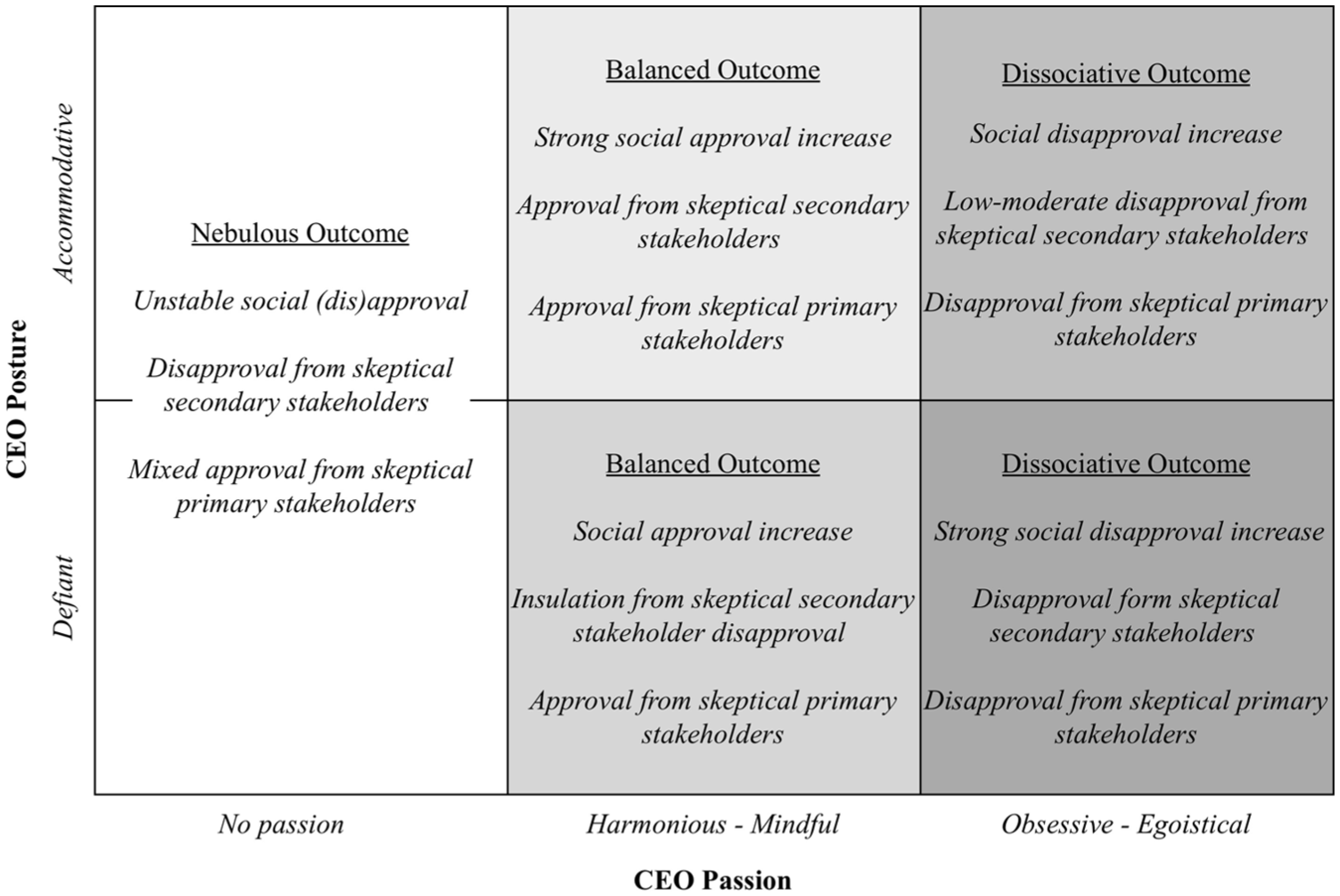
Proposed Firm Outcomes Based on the Interactive Effects of Values and Passion
Nebulous Outcomes
Nebulous firm outcomes emerge when a CEO enacts a symbolic response to a secondary stakeholder demand, contingent on the degree of alignment between them and their personal values, with little passion for the demand or the issues it contests. In such cases, symbolic responses are “cheap talk,” whereby communication is not backed by firm commitments (Hambrick & Wowak, 2021; Neville, 2022; Smulowitz, Pfarrer, Cossin, & Lu, 2025).
Among skeptical secondary stakeholders, passionless responses may be seen as dismissive or disingenuous, suggesting the CEO is deliberately “kicking the can down the road” (Smulowitz et al., 2025). This approach can result in “penalty costs” (i.e., intended audiences react negatively to false signals) and “reaction costs” (i.e., unintended audiences react negatively to a true signal that was intended for another audience; DesJardine, Marti, & Durand, 2021) among the firm’s skeptical secondary stakeholders; that is, the focal secondary stakeholders who issued the demand and those not currently engaged with the firm but paying close attention. Consider the examples of companies like ExxonMobil, Shell, and BP, who have made repeated statements about transitioning to cleaner energy and reducing emissions (i.e., BP’s “Beyond Petroleum” campaign), which have been routinely panned by pro-environmental groups like Greenpeace and the Rainforest Action Network (RAN; e.g., Greepeace, 2023). Overall, a passionless response can create confusion about the veracity of the firm’s response among skeptical secondary stakeholders, attracting social disapproval among this group of evaluators (Crilly, Zollo, & Hansen, 2012; Zuckerman, 1999).
Conversely, some skeptical primary stakeholders are likely to view such a response as protective of the status quo (DeCelles, Tesluk, & Taxman, 2013; Ford, Ford, & D’Amelio, 2008; Oreg, Vakola, & Armenakis, 2011). A passionless response may give some skeptical primary stakeholders confidence that the CEO wants to take a measured approach and does not take lightly any decision that may involve considerable changes and stakeholder re-prioritization, thus leading to some approval from skeptical primary stakeholders. Conversely, others might view such responses as lacking true engagement with secondary stakeholder demands that might reverberate with them. For example, Coinbase CEO Brian Armstrong declared that Coinbase would be an “apolitical culture,” discouraging political and social activism at work. He offered severance to employees who disagreed with that stance, which some employees took advantage of, suggesting a mixed reaction among them (Kelly, 2020).
Taken together, our arguments imply that a response enacted without passion will draw mixed reactions from skeptical stakeholders—criticism from secondary stakeholders but muted or favorable assessments from primary stakeholders. Moreover, because the response is merely symbolic, we do not expect reactions to be extreme; on balance, social approval should be mixed but not polarizing. We depict this pattern in Figure 1 through the lightly-dotted “Nebulous” pathway and summarize its implications in the left-hand third of Figure 2. We propose:
Proposition 8: When a CEO enacts a passionless response (i.e., responds symbolically), their firm is more likely to attract a) disapproval from skeptical secondary stakeholders and b) mixed approval from skeptical primary stakeholders. Overall, this will have destabilizing influence on social (dis)approval among skeptical stakeholders.
Balanced Outcomes
Balanced firm outcomes emerge when a CEO, guided by harmonious passion, responds mindfully to a secondary stakeholder demand, with the response shaped by the degree of alignment between the demand and their personal values. We contend that such outcomes reflect a CEO’s ability to integrate personal values with discernment, resulting in responses that are both principled and able to pragmatically balance stakeholder expectations.
When a CEO adopts an accommodative posture and enacts it mindfully, both skeptical secondary stakeholders and primary stakeholders will react favorability, on balance. Such a response sends a clear message to secondary stakeholders that their demands (and the types of priorities that other secondary stakeholders hold) are being taken seriously, while also signaling a thoughtful approach to integrating those demands with primary stakeholder needs. For example, Salesforce CEO, Mark Benioff, has stated: “today CEOs need to stand up not just for their shareholders, but their employees, their customers, their partners, the community, the environment, schools, everybody. Anything that’s a key part of their ecosystem”. Benioff further implies that many of his stances on social issues are not my decisions. These are the decisions of my employees. I am advocating on their behalf. . . . I just represent their interests. . . . My job is to listen and to collaborate, to share, to align, and then to push it forward. My job is not just to go up a mountain and come up with all my own ideas. (Steinmetz, 2016: paragraph 9)
Accommodative and mindful responses also reassure skeptical primary stakeholders that they remain central to the firm’s priorities—even if short-term discomfort arises. A CEO’s harmonious passion and mindful approach is likely to quell major concerns, as this type of passion is infectious by nature (Ho & Astakhova, 2020; Ho, Garg, & Rogelberg, 2021). Further, when accommodative responses are articulated in a mindful and harmonious manner, some skeptical primary stakeholders (e.g., employees) might feel inspired to work for a firm with a distinctive corporate purpose that goes beyond profit maximization (Flammer & Luo, 2017; Gartenberg, Prat, & Serafeim, 2019) while other primary stakeholders (e.g., shareholders) might appreciate how mindfully accommodating a secondary stakeholder demand reflects pursuing new strategic opportunities (Odziemkowska & Zhu, 2025; Olsen, Sofka, & Grimpe, 2016). Overall, skeptical primary stakeholders are likely to react more positively than negatively since the response will be issued with their best interests in mind. For example, following sustained activism from anti-diversity, equity, and inclusion (DEI) activists, Harley-Davidson’s CEO, Jochen Zeitz, dismantled the firm’s corporate DEI function, abandoned minority-supplier spending targets, and halted socially motivated employee training programs. By swiftly eliminating these initiatives, Zeitz not only accommodated secondary stakeholders—who valued the brand’s association with rugged individualism, Americana, traditional masculinity, and were pressuring the firm not to “be woke”—but also reassured skeptical investors who regarded DEI as a distraction from Harley-Davidson’s core identity and strategic priorities (see Green, 2024; Helmore, 2024).
When a CEO adopts a defensive posture and enacts it mindfully, the CEO approaches secondary stakeholder demands with skepticism but without hostility. A defensive yet mindful CEO acknowledges the demands as misaligned with firm priorities but avoids treating them as threats (Deci & Ryan, 2000; Hodgins & Knee, 2002; Vallerand, 2010). Instead, they disengage from those demands in ways that protect the firm’s bottom line. While skeptical secondary stakeholders are likely to express disappointment that the firm cannot address their demands, the mindful way in which the CEO expresses this is likely to curb overly negative sentiment from this group of evaluators. Of course, skeptical primary stakeholders are likely to react positively since the response is issued with their best interest in mind, and the CEO’s approach signals a commitment to shielding them from further disruption. For example, Amazon CEO, Andy Jassy, has maintained a defensive posture toward secondary stakeholder activism (e.g., NGO protests, politicians, Americans for Tax Fairness, etc.) but has responded with restraint: avoiding overt confrontation, limited media presence, and offering incentives to discourage retaliation. This strategy of measured disengagement prioritizes primary stakeholders while minimizing the risk of unnecessarily inflaming tensions with skeptical secondary stakeholders.
In sum, a mindful approach—whether accommodative or defensive—enables a CEO to enact their values with discernment. This form of response is reflective rather than reactive, allowing leaders to transform secondary stakeholder pressure into either a strategic opportunity or a calculated boundary. Mindful passion acts as a regulating force, ensuring that values-driven responses neither drift into overreach nor default to avoidance. As such, mindful CEO engagement enhances legitimacy, retains primary stakeholder trust, and lets secondary stakeholders know where they stand. We depict this pattern in Figure 1 through the dotted “Balanced” pathway, and summarize its implications in the middle third of Figure 2. Thus:
Proposition 9a: When a CEO adopts an accommodative posture and enacts it through harmonious passion (i.e., responds mindfully), their firm is more likely to attract (a) approval from skeptical secondary stakeholders and (b) approval from skeptical primary stakeholders. Overall, this will strongly positively influence social approval among skeptical stakeholders.
Proposition 9b: When a CEO adopts a defensive posture and enacts it through harmonious passion (i.e., responds mindfully), their firm is more likely to (a) insulate itself from disapproval from skeptical secondary stakeholders and (b) attract approval from skeptical primary stakeholders. Overall, this will positively influence social approval among skeptical stakeholders.
Dissociative Outcomes
Dissociative outcomes arise when a response to secondary stakeholder demands is driven by obsessive passion—manifesting as excessive or self-serving behavior, which we refer to as egoistic responses. Importantly, the orientation of these responses—whether accommodative or defensive—matters less than the egoistic way they are carried out. What drives (dis)approval is not whether the CEO sides with or resists a demand, but whether the response is perceived as an exercise in personal affirmation rather than thoughtful stakeholder engagement.
When an accommodative response is enacted egoistically, the CEO engages secondary stakeholder concerns with disproportionate intensity and poor foresight, often privileging identity-confirming self-display over coherent strategy. Such responses can appear sanctimonious or quixotic—idealistic in ways that alienate more than they persuade. While focal secondary stakeholders may welcome this support, most skeptical secondary and primary stakeholders may experience confusion or even exclusion. For example, Anheuser-Busch U.S. CEO Brendan Whitworth’s decision to approve Bud Light’s 2023 partnership with trans influencer Dylan Mulvaney was framed as an inclusive, accommodating move. The campaign triggered intense backlash among conservative consumers and retail partners, culminating in a widespread boycott because it was perceived as overreaching and insufficiently attuned to the firm’s broader stakeholder environment (Liaukonyte, Tuchman, & Zhu, 2024).
Similarly, when defensive responses are enacted egoistically, skeptical stakeholders tend to interpret them not simply as misaligned, but as threats to the firm’s long-term viability. In such cases, the CEO escalates conflict, adopts an antagonistic posture, and treats focal secondary stakeholders as adversaries (Hodgins & Knee, 2002; Steele, 1988; Vallerand, 2010). These fervent responses predictably invite animosity from those secondary stakeholders (Lamin & Zaheer, 2012; Neville, 2022) while also undermining possible support among skeptical primary stakeholders. Employees may perceive them as grandstanding, while shareholders may interpret them as reckless risk-taking with little upside (Tosi & Warmke, 2016). Tesla CEO, Elon Musk, provides a recent and vivid example of this approach. His interactions with regulators, the media, and other special interest groups often reflect an ego-driven defensiveness that prioritizes individual affirmation over strategic diplomacy (King, 2025; Klepper, 2023). These responses have strained relationships with shareholders and employees, exposing the firm to public backlash and a decline in stock value (Segal, 2022).
In sum, egoistical responses tend to conflate firm identity with personal identity, ultimately placing even primary stakeholders at risk (Galvin, Lange, & Ashforth, 2015). This pattern of ego-driven decision-making not only undermines the firm’s social approval but also risks long-term reputational damage (Lange et al., 2011), as the disconnect between executive actions and organizational identity deepens stakeholder distrust and hampers future opportunities for growth. We depict this pattern in Figure 1 through the heavy-dashed “Dissociative” pathway and summarize its implications in the right-hand third of Figure 2.
Proposition 10a: When a CEO adopts an accommodative posture but enacts it through obsessive passion (i.e., responds egoistically), their firm is more likely to attract (a) low to moderate disapproval from skeptical secondary stakeholders and (b) disapproval from skeptical primary stakeholders. This will positively influence social disapproval among skeptical stakeholders.
Proposition 10b: When a CEO adopts a defensive posture but enacts it through obsessive passion (i.e., responds egoistically), their firm is more likely to attract (a) disapproval from skeptical secondary stakeholders and (b) disapproval from skeptical primary stakeholders. This will strongly positively influence social disapproval among skeptical stakeholders.
Discussion
We introduced a CEO-driven process model of firm responsiveness to secondary stakeholder demands. To develop this model, we integrated and extend stakeholder, strategic leadership, and social psychology theories to establish CEO values and passion as critical antecedents of firm response to secondary stakeholder demands, and explicated the processes through which these influential attributes shape firm response, answering a recent call in the literature for such work (Wu & Liu, 2024).
Overall, we believe our model carries broad applicability for both micro and macro scholars. By situating value- and passion-driven responsiveness as a driver of organizational trajectories, it highlights consequences of interest not only to micro scholars of leadership and stakeholder engagement but also to macro-oriented researchers concerned with firm performance, competitive positioning, and social approval. In doing so, our model underscores how CEOs—and executives more broadly—far from being uninfluential to firm survival, shape prospects for social approval and other strategic outcomes in an era in which secondary stakeholders are becoming increasingly central.
Theoretical Contributions and Practical Implications
In developing our model, we offer three fundamental contributions to management research. First, we foreground the role and influence of a CEO’s values and passion on firm response to secondary stakeholders, providing a theoretical basis for extending this line of inquiry beyond stakeholder-sided or firm-level factors. In this regard, we offer new insights into CEO and other executives’ perceptions of secondary stakeholder salience using a cognitive and “behavioral lens to understand how firms deal with stakeholders” (Crilly, 2019: 250). Put differently, our theory expands on the notion of stakeholder salience (Bundy et al., 2013; Mitchell et al., 1997) by recognizing “that firms’ interactions with stakeholders do not take place in a frictionless world” (Dorobantu, Henisz, & Nartey, 2024: 188), but their presence or absence is usually shaped by CEO and other executives’ values (Agle et al., 1999; Mitchell et al., 1997).
Second, drawing on recent refinements in UET (Neely et al., 2020), we advance strategic leadership research by disentangling the motivational and cognitive processes through which values and passion influence executive choice. Although scholars acknowledge that “values are undoubtedly important factors in executive choice, [which] have not been the focus of much systemic study” (Finkelstein, Hambrick, & Cannella, 2009: 57), theory has often conflated values with cognitive mechanisms. This is problematic from a social-psychological perspective, as values and cognitions arise from different antecedents, operate through distinct mechanisms, and yield different outcomes (Neely et al., 2020). By contrast, our framework unpacks this “black box” by showing how strategic leaders—and especially CEOs—imprint organizational outcomes through their values and their interpretations of secondary stakeholder demands as salient, contingent on the degree of passion they direct toward those issues. By introducing CEO passion as a motivational force, we clarify how values are not only held but also enacted, offering a nuanced account of what propels executives to embed personal commitments—or their absence—into firm responses to secondary stakeholders. We contend that passion shapes how individuals engage with issues they encounter—with intensity, persistence, and emotional investment—whereas values determine what they engage with and why. In this way, our process model extends the conversation from what type of values matter for firm outcomes and when how values, in close interaction with passion, become consequential for organizational actions towards secondary stakeholders (e.g., Chin et al., 2013; Gupta, Briscoe, & Hambrick, 2018).
Finally, by recognizing that strategic leaders’ responses to secondary stakeholder demands shape their firms’ social (dis)approval, we offer a needed micro-foundational perspective of firm social evaluations. Social (dis)approval is not homogeneous across audiences, but is constructed through audience interpretations, particularly of the leader (George et al., 2016; Pollock et al., 2019; Steele & Lovelace, 2023). Our model highlights how a CEO’s values and passion influence not only whether and how a firm responds, but also how those responses are received and judged by others, including primary stakeholders such as investors or employees. This helps explain why similarly situated firms can experience divergent social evaluations from similar stakeholder challenges. By grounding responsiveness in a reflexive, value, and passion-driven process, we advance understanding of how CEO decision-making influences both stakeholder engagement and subsequent social perceptions of the firm.
In addition, the model we developed has important implications for practice. First, it suggests that strategic leaders should cultivate greater awareness of their natural tendencies to inject their personal values and passion into decision-making and into their evaluations of secondary stakeholder demands. For instance, strategic leaders may respond to secondary stakeholders in a fashion that is inconsistent with the objectives of the firm or with the priorities of its primary stakeholders. Therefore, it is important for such leaders to consider how personal values and passion impact key interpretive processes, such as perceptions of stakeholder salience, which may assist these leaders in more effectively evaluating secondary stakeholder demands. Consequently, their responses could be more amenable to the firm’s primary stakeholders than they might otherwise be.
Methodological Considerations and Future Directions
Although testing our proposed model might appear difficult—particularly measuring such constructs as CEOs’ values and passion—obtaining primary data on these attributes has been done before (e.g., Adams et al., 2011; Agle et al., 1999; Chin et al., 2021; Murnieks et al., 2014). As Borgholthaus, Bourgoin, Harms, White, and Fezzey (2025: 2) note, “mean response rates in upper echelons survey research have plateaued—not continued to decline” in the past 2 decades. Practically speaking, to measure CEOs and other executives’ personal values, our recommendation would be that researchers adopt Schwartz’s (1992) Value Survey, which still represents the most comprehensive measure of individuals’ personal values to date. When it comes to passion, we believe it would be fairly straightforward for scholars to adopt Vallerand and colleagues’ (2003) widely-adopted passion scale, or Cardon, Gregoire, Stevens, and Patel’s (2013) validated measure of entrepreneurial passion to the CEO role or the empirical context of interest. Vallerand and colleagues’ (2003) scale, in particular, would be useful in helping scholars capture the notions of harmonious and obsessive passion we outlined above. By relying on these scales, replication is also more attainable.
However, we recognize that gathering primary data from CEOs and other high-ranking corporate executives is painstaking and uncertain, and that self-reports may not always yield the most accurate measurement for these constructs. As an alternative or complement, we suggest leveraging artificial intelligence (AI) to assess the key constructs discussed above, thereby facilitating empirical tests of our model on a large scale (see Cornelissen, Höllerer, Boxenbaum, Faraj, & Gehman, 2024; Feuerriegel et al., 2025; Linegar, Kocielnik, & Alvarez, 2023). For instance, natural language processing (NLP) techniques can be used to analyze CEOs’ public speeches, interviews, earnings calls, and social media posts to infer underlying values by mapping text onto established linguistic indicators of personal values (e.g., Schwartz’s value dimensions). Similarly, CEO passion can be assessed through affective tone analysis, sentiment trajectory modeling, or detection of high-arousal language, enabling researchers to distinguish passion from adjacent constructs and identify both trait- and state-like expressions of passion. For example, empirical operationalizations should reflect that passion can best be measured as “intensity” rather than “directionality.” To that end, future work could develop more tailored linguistic tools—such as dedicated dictionaries—to capture the value-laden and identity-defining qualities of passion more directly. Overall, these AI-driven methods hold promise for generating non-intrusive measures of these latent psychological constructs (Yao, Xu, & Liu, 2024).
Additionally, there are concrete ways in which researchers looking to test portions of our model could go about it. Given the process nature of our model, one of the more fruitful ways that it could be tested would through a verbal protocol study (Ericsson & Simon, 1993) in which researchers could meet with CEOs or reasonable proxies and present them with realistic scenarios of secondary stakeholder demands, asking them to “think aloud” as they consider how to deal with these demands. Transcripts of participants’ verbalized thoughts would then be content analyzed for evidence of how their values and passion had guided their thought processes. Verbal protocol analysis “allows one to observe the thought process of executives in real time . . . as opposed to relying on retrospective recollections” (Grégoire, Barr, & Shepherd, 2010: 418, emphasis in original) and has been used to understand the thought processes that underlie managers’, entrepreneurs’, and strategic leaders’ decisions in similarly difficult scenarios as responding to secondary stakeholders (e.g., Grégoire et al., 2010; Isenberg, 1986; Williams & Grégoire, 2015).
Lastly, other research opportunities also emerge from our efforts, especially as it pertains to the consequences of response and linking these to organizational survival and performance. To accomplish this, researchers might build on an emerging trend in management research that leverages laboratory experiments to capture stakeholder and other evaluators’ sentiments toward corporate leaders and key organizational developments (e.g., Chatterji & Toffel, 2016; Flynn & Staw, 2004; Krause, Whitler, & Semadeni, 2014; Neville, 2022). For example, one might design an experiment in which participants, assuming the role of different stakeholders, evaluate the different responses we outlined above, such that it would be possible to examine how these responses contribute to firm social (dis)approval. Moreover, it would be interesting to see whether responses impact a firm’s competitors, and thus potentially influence competitive dynamics. For instance, it would be interesting to see whether competitors infer CEO submissiveness or provocativeness from their responses to secondary stakeholders (Hill, Recendes, & Ridge, 2019) such that it influences the nature of attacks on the firm. Our theoretical perspective advances the possibility of studying the extent to which executives’ personal values may form a hitherto unconsidered basis for the development of firms’ dynamic political management capabilities (Oliver & Holzinger, 2008), which allow firms to acquire and sustain competitive advantages through non-market channels (Baron, 2007).
Conclusion
We progressed toward understanding how CEOs influence a firm’s response to secondary stakeholder demands. While not intended to explain all pathways, our model does present an accurate and theoretically parsimonious portrayal of this process. By considering the role personal values and passion play in CEOs’ socio-cognitive processes when faced with secondary stakeholder demands, we strive toward theoretically depicting CEO behavior with how it unfolds in practice and contribute toward upholding the central role of strategic leaders within the fabric of management research (Hambrick, 1989; Wu & Liu, 2024). We hope that understanding the important issues related to the increasingly common interactions between secondary stakeholders and firms may be enriched through further study of this phenomenon, by promoting greater awareness of the influence of CEOs, other strategic leaders, and their individual attributes, such as their personal values and passion, in this process.
Footnotes
Acknowledgements
We are thankful for the highly constructive comments and developmental suggestions from our anonymous reviewers and associate editor Peggy Lee. We would also like to thank Pam Barr, Jon Bundy, Mark Keil, Addisu Lashitew, Elizabeth Lim, Jay O’Toole, Trish Ruebottom, and Abbie Shipp for their feedback on our research and earlier drafts of this article.
