



Abstract
With the recent experiences involving COVID-19, there is a growing need for organisations to better understand compassion in addressing employees’ suffering and boosting their well-being. Particularly, as teamwork is becoming ubiquitous, organisational scholars have identified positive benefits of compassion at the team level such as improving communication, decreasing interpersonal conflicts and boosting team effectiveness. Using a multilevel theoretical framework in reviewing compassion research, this article advances our understanding of team-level compassion by elucidating the processes through which individual-level compassion gives rise to team-level compassion. First, we delineate composition and compilation models of the emergence of team compassion and review empirical studies with respect to the two models. Second, we explain three social mechanisms in teams – social learning, emotional contagion and reciprocity – that shape the emergence of team compassion. Finally, we discuss interventions that can facilitate the emergence of team compassion and offer practical guidance for managers seeking to foster team compassion.
Keywords
1. Introduction
Suffering within organisations is pervasive and costly (Dutton et al., 2014). The World Health Organization (2022) underscored the substantial scale of this problem: Approximately 12 billion working days are forfeited annually due to depression and anxiety, for a yearly productivity loss of around US$ 1 trillion. In Australia, businesses lose almost $11 billion a year because of their inadequate responses to employees’ suffering (Australian Bureau of Statistics, 2022). Australian employees reported that having a healthy workplace was the second most important factor in their decision to accept a new job, after salary (Beyond Blue, 2019). The consequences of suffering in organisations highlight the critical importance of understanding how to address it for both researchers and practitioners (Frost, 1999).
In response to these issues, management and psychology researchers and practitioners are increasingly interested in team compassion – a team-level emergent state in which team members exhibit a desire to alleviate others’ suffering (Gilbert, 2014; Goetz and Simon-Thomas, 2017; Wee and Fehr, 2021). A team is defined as a group of two or more individuals who socially interact; exhibit interdependencies in terms of goals, workflow and outcome; perform organisational tasks and are embedded in the organisational system (Kozlowski and Ilgen, 2006; Salas et al., 2008). Many organisations use team-based structures, and teams are becoming the proximal psychological environment for many employees (Kozlowski and Ilgen, 2006). Team compassion is believed to not only help teams excel in their work (Barsade and O’Neill, 2014) but also enhance members’ well-being (Wee and Fehr, 2021), strengthen relationships within teams (Kanov et al., 2017), increase teams’ responsiveness to external stakeholders (Lilius et al., 2011) and contribute to team effectiveness (Duhigg, 2016).
Despite the benefits associated with team compassion, our understanding of how team compassion emerges has been limited. Prior literature has predominantly approached the concept of team compassion from a static perspective and has not considered the interconnectedness that renders team compassion so different from the aggregation of individual team members’ compassion (Madden et al., 2012). Relatedly, most individual-level theories of compassion do not consider the processes through which teams can learn and develop compassion, which makes it difficult to design intervention practices that can improve team compassion. Thus, a better understanding of team compassion requires investigating the emergent processes of team compassion, whereby individual members with different levels of team compassion, through their internal interactions conditioned by contextual environments, collectively create distinct team-level compassion. In this article, we conceptualise the emergent processes through which team compassion develops and integrate Kozlowski and Klein’s (2000) multilevel theory with compassion research.
By providing a multilevel, emergent perspective of team compassion, we contribute to compassion literature in three important ways. First, we provide a theoretical model that conceptualises composition and compilation emergence processes of team compassion (Kozlowski and Klein, 2000) (Figure 1), where we focus on the process of how a team gets to develop a particular level and configuration of team-level compassion. Therefore, we go beyond the existing approach, which focuses on team members’ compassion as a team-level state that has already emerged. Second, we explain three within-team mechanisms in their relation to the emergent processes of team compassion: social learning, emotional contagion and reciprocity. Therefore, we explain how a team can develop team-level compassion that is distinct from an aggregate of individual-level compassion. Finally, while interventions for improving individual-level compassion are widely discussed in the literature, there has been a lack of studies that provide practical guidance for facilitating team-level compassion. Addressing this gap, our study provides practical interventions for team compassion based on our integrative review of compassion intervention at the individual level and theoretical models of team compassion emergence. In summary, this study builds theoretical and practical pathways for compassion scholars to expand their contributions to the team level.
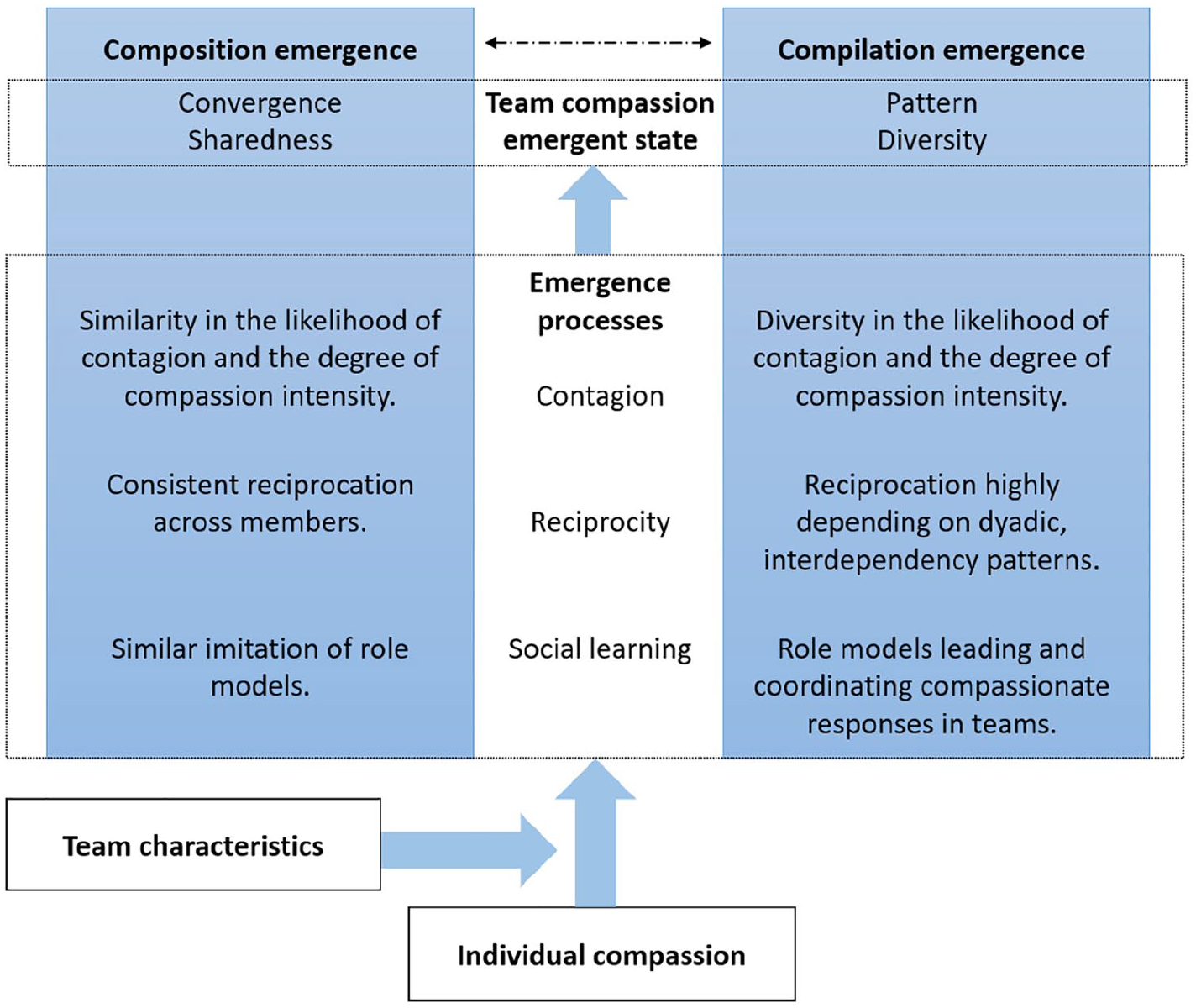
Theoretical model of the emergence of team compassion.
The article is organised as follows. First, we review prior literature on individual-level compassion and provide an integrative definition of team compassion. Second, building on this conceptualisation of team compassion and leveraging multilevel theory (Kozlowski and Chao, 2012), we develop our model of composition and compilation emergence, two ways through which team compassion emerges. Third, we highlight three psychological mechanisms – social learning, emotional contagion and reciprocity – and discuss how these mechanisms can drive both composition and compilation emergence of team compassion. Fourth, by drawing on the literature on compassion interventions at the individual level, we discuss a set of practical interventions for improving team compassion.
2. What is compassion?
The literature on compassion generally agrees that compassion is one’s desire to alleviate the suffering of others (Gilbert, 2014; Goetz et al., 2010). Researchers have examined compassion that emphasised affective (i.e. feeling), cognitive (e.g. awareness, understanding) and behavioural elements (i.e. a specific action to help; Gilbert, 2020; Appendix 1). Focusing on the affective element of compassion, scholars have studied compassion as a feeling that arises when witnessing others’ suffering and triggers a desire to help (Lazarus, 1991). Drawing on evolutionary perspectives, Goetz et al. (2010) suggest that affective compassion originates from the need to care for vulnerable offspring and the success associated with mate selection. The cognitive element of compassion is concerned with the awareness of and understanding another’s suffering (Gilbert, 2020). An experience of compassion begins with a person’s ‘noticing’ (Atkins and Parker, 2012), ‘awareness’ (Jazaieri et al., 2013) or ‘recognising’ others’ suffering (Dalai Lama, 1995). This awareness often requires one to actively listen and observe with genuine care (Strauss et al., 2016). As such, cognitive compassion allows individuals to mentally put themselves in others’ situations and comprehend their suffering (Batson et al., 1995). Finally, compassion includes a behavioural commitment to take action to relieve the pain, distress or hardship others are experiencing (Gilbert, 2016). Atkins and Parker (2012) argue that affective and cognitive elements are necessary prerequisites for an act to be considered compassionate.
Compassion is distinct from empathy, sympathy, pity and helping. Like compassion, empathy may have both affective and cognitive components (Batson et al., 1995). However, empathy means having feelings similar to others, which can be sharing happiness, sadness or anger (Lazarus, 1991). In contrast, compassion does not require that individuals share the same feelings as the sufferer but is shaped by feelings about others’ suffering that motivate helping behaviours (Cuff et al., 2016). Whereas sympathy – a feeling of sorrow or worry for another person in distress or need (Eisenberg et al., 2015) – often carries a negative valence, compassion is characterised by both positive and negative valence (Goetz et al., 2010). In a related vein, sympathy may not necessarily motivate the desire to help others as compassion does (Eisenberg et al., 2015; Spinrad and Eisenberg, 2017). Although others’ suffering can elicit pity, pity conveys a degree of judgement and condescension that typically does not motivate a desire to help (Lazarus, 1991). Like compassion, helping refers to actions to support others (Li et al., 2014). However, helping research focuses mostly on the behaviour itself without considering the unique affective or cognitive components associated with a compassionate response (Gilbert, 2019).
3. What is team compassion?
We define team compassion as an emergent state in which team members exhibit a desire to alleviate others’ suffering (Barsade and O’Neill, 2014; Wee and Fehr, 2021). Team compassion involves the shared psychological experiences of team members with respect to the same target (Weiss and Cropanzano, 1996). Team compassion can emerge from two sources: internal and external (Sternberg, 1998). The internal source encompasses the distress experienced by individuals within the team (Lilius et al., 2008; Wee and Fehr, 2021), and the external source pertains to the suffering of those beyond the team’s boundaries, such as customers (Barsade & O’Neill, 2014; Way, 2010). Using the emergent process model (Kozlowski and Klein, 2000), below, we discuss how team compassion is distinct from individual compassion.
4. Theories of emergence: a case for team compassion
Employees are embedded in teams, departments and organisations. Multilevel theories provide an enriched understanding of the dynamics associated with individual and collective levels. In particular, team researchers have long emphasised the distinctiveness of team-level constructs, despite their functional similarity to their individual-level counterparts. For example, Woolley et al. (2010) found that the cognitive abilities of individual team members had only a weak positive relationship with the team’s collective intelligence: team intelligence was largely determined by the dynamics of communication among team members and the socio-emotional responsiveness of team members. Likewise, researchers in team compassion have observed large variance in teams’ levels of compassion, even in the same organisations (e.g. Barsade and O’Neill, 2014; Madden et al., 2012; Wee and Fehr, 2021). Understanding team compassion from a multilevel perspective enables us to examine how team compassion in organisations can be facilitated.
Multilevel theory defines emergence as a bottom-up process by which interactions of elements at the individual level, under the constraints of contextual factors, give rise to collective phenomena (Kozlowski and Klein, 2000). Emergence can be described through the exemplar of the input-mechanism-output model (Lu et al., 2023; Mathieu et al., 2019). For example, individual compassion represents the input, and team compassion represents the output. Accordingly, team compassion is conceptualised as a team-level state that is the outcome of team processes (Grand et al., 2016). Following this approach, we propose that individual compassion, through dynamic interactions among team members, undergoes a process of emergence, transforming into a team-level construct of compassion (Barsade & O’Neill, 2014). We summarise existing research on team compassion from multilevel theory perspectives in Table 1.
Summary of team compassion research from multilevel theory perspectives.

4.1. Composition models of team compassion
The composition model of emergence adopts a commonality perspective. The endpoint of composition emergence is the emergent constructs at the team level, which convey the same elemental content and meaning as the individual-level construct (Fulmer and Ostroff, 2016; Kozlowski and Chao, 2012). Consider, for instance, a medical team working towards a common goal of providing care in an emergency ward. By working together, members get to share a common understanding of and level of compassion for their patients.
Composition emergent models can take several forms. The additive composition model assumes that an aggregation of individual characteristics can serve as a valid representation of team characteristics (Chan, 1998). In this model, the more team members possess desirable knowledge, skills and abilities, the more desirable attributes teams have (Mathieu et al., 2014). For example, Farr-Wharton et al. (2023) measured individual members’ compassion towards their coworkers and tallied these individual-level measures to create team-level compassion, which alleviated the negative impact of bullying on team members’ well-being.
While the additive composition model suggests team compassion is a mere summation of individual compassion, the direct consensus model uses within-group consensus as a theoretical justification for the aggregation of individual-level characteristics to represent team-level characteristics (Chan, 1998). The requisite for direct consensus models is based on agreement indices, such as interrater agreement (i.e. rwg) and interrater reliability (i.e. ICCs) (LeBreton and Senter, 2008). With high levels of agreement, the direct consensus model allows team-level constructs to be captured by aggregating similar individual team members’ characteristics; this results in equivalent structures and functions between individual- and team-level constructs (Kozlowski and Klein, 2000). For example, group affective tone relies on a direct-consensus model because it emphasises the importance of agreement among members about their affective experience in teams (Kelly and Barsade, 2001). Similarly, Ginting-Szczesny et al. (2023) conceptualised team compassion as an emerging phenomenon arising from the shared compassion of team members with high levels of interrater agreement and interrater reliability. Shared team compassion in turn was positively related to team entrepreneurial passion.
The referent-shift consensus model demonstrates the degree to which the team as a unit exhibits shared team characteristics (Chan, 1998). This model necessitates a conceptual shift from individual-level referents to team-level referents, thereby capturing the emergent properties that are distinctly collective in nature. For example, team learning goal orientation under a referent-shift consensus model suggests that team members can exhibit a shared perception of their team’s focus on learning but still maintain their individual learning goal orientation (Mehta et al., 2009). Wee and Fehr (2021) adopted a referent-shift consensus by measuring individual members’ perceptions of their team’s compassion and found that team compassion reduced the detrimental impacts of the COVID-19 pandemic on team members’ suffering.
4.2. Compilation model of team compassion
Compared with the composition emergence model, the compilation model of emergence does not necessarily involve the convergence of team members’ psychological responses because the model focuses on complementary coordination among members that manifests as a team-level phenomenon (Kozlowski and Klein, 2000). The compilation emergence model therefore explains why the whole can be more than the sum of its parts (Ablowitz, 1939). Using team compassion as an example, a team can have a much higher level of compassionate response than individual members do (Madden et al., 2012). Because they focus on complementarity, compilation emergence models assume and embrace differences and diversity inherent among team members at the individual level.
There are several forms of compilation emergence models. The minimum model of compilation emergence assumes that the team member with the lowest value of a characteristic in a team has the most influence on team performance (Kozlowski and Klein, 2000). For example, Peticca-Harris (2019) described how a senior operations manager affected the team’s compassionate response. In response to the death of a bartender in her restaurant, this manager was only concerned about the restaurant’s bottom line and kept the business running as usual, without caring about the grief employees and the bartender’s family were experiencing. The entire top management team followed her response, and as a result, the team displayed a less-compassionate reaction.
The maximum model of compilation emergence suggests that the member with the highest value of a characteristic can exert the most influence on team processes and outcomes (Kozlowski and Klein, 2000). For example, Melwani et al. (2012) found that team members who expressed the highest levels of compassion in teams had the most influence on other members and were likely to be nominated as emergent leaders.
The dispersion model of compilation emergence suggests that team members’ characteristics can differ from one another (Kozlowski and Klein, 2000). The dispersion model implies the complementary coordination of team members’ compassionate responses. Madden et al. (2012) suggest that team members may exhibit different levels of compassion and coordinate their efforts to provide assistance. Diversity increases the likelihood that at least one member of the team is aware of and responds to the suffering (Lilius et al., 2011). In addition, teams with diverse forms of compassion may possess the capacity to leverage a multifaceted array of support and resources, potentially addressing different aspects of suffering (Worline et al., 2017).
5. Social mechanisms in the emergence of team-level compassion
Both types of emergence are concerned with interactions among team members that transform individual compassion into team compassion (Kozlowski and Klein, 2000). In their influential process model of compassion, Atkins and Parker (2012) identify cognitive (noticing), affective (feeling) and behavioural (supporting) elements as crucial to the development of compassion in organisations. Drawing on this model, we delineate three team-level social mechanisms relating to a team’s cognitive (i.e. social learning), affective (emotional contagion) and behavioural (reciprocity) processes that facilitate the emergence of team compassion.
Team research has discussed social learning, emotional contagion and reciprocity as important mechanisms that underlie various types of emergent phenomena. For example, in conceptualising the emergence of team learning goal orientation, Dragoni (2005) suggests that team members learn how to deal with challenging tasks from their leaders’ achievement orientation. Research on group affect suggests that emotional contagion is responsible for how shared feelings emerge in teams (Kelly and Barsade, 2001). Finally, research on the emergence of team trust suggests that an initial instance of trust engenders reciprocal trust between dyadic members, which, through iterative interactions over time, can evolve into generalised trust permeating the broader team (Costa and Anderson, 2017).
5.1. Social learning
The emergence of team compassion can be facilitated through social learning. According to Bandura’s (1986) social cognitive theory, individuals develop cognitive, skill and behavioural competencies through the process of social learning. In addition, group norms signal which behaviours team members are encouraged to learn in teams (Bandura, 1998).
5.1.1. Composition emergence
Composition emergence suggests that social learning can produce similar social skills among team members (Fulmer and Ostroff, 2016). Team members who are perceived as role models, such as leaders, establish reference points for how team members should behave, which in turn narrows the variation in how team members actually think and feel (Ashforth, 1985). Ongoing interactions among team members thus produce convergence that formulates team-level cognition, skills and behaviours (Kozlowski and Klein, 2000). With respect to team compassion, composition emergence occurs when team members use role models’ compassion as a guide in learning and expressing similar compassion (Horsburgh and Ippolito, 2018). The literature on compassion in healthcare settings has shown that health care professionals often imitate the compassionate responses of their role models, such as doctors, peers and educators (Burack et al., 1999; Sinclair et al., 2021), which results in similar compassion among them (Zamanzadeh et al., 2018). This evidence of social learning suggests that compassion can converge in teams through composition processes.
Group norms play an important role in the compassion learning process under composition emergence. Group norms regulate group members’ behaviours and govern how groups should function (Cialdini and Goldstein, 2004). Group norms that highlight the value of expressing compassion can thus motivate individual members to learn a similar compassionate response (Nussbaum, 2003). Indeed, the compassion literature has shown that in organisations with norms and cultures that value compassion, employees are likely to express compassion and care for others (McClelland, 2012).
5.1.2. Compilation emergence
Compilation emergence implies that social learning can serve as a key process that drives the influence of an individual team member on the whole team (Kozlowski et al., 2013). Members who are role models can use their behaviours as exemplars for other members’ learning, and thereby guide and coordinate team compassion (Worline and Dutton, 2017).
Studies on leadership and compassion reveal that team leaders have a much more significant effect on the emergence of team compassion than individual team members (Worline and Dutton, 2017). For instance, witnessing a leader expressing compassion may prompt team members to discuss the experience, learn what motivates the leader’s compassion and recognise the value of compassion within the team. As a result, the entire team is more likely to engage in compassionate responses similar to those of the leader.
Group norms may facilitate social learning in compilation emergence (Kozlowski and Klein, 2000). Specifically, group norms can guide team members to coordinate their roles to help suffering members (Grandey, 2000). For example, team members may initially lack a sense of compassion when participating in charitable donations, yet they still contribute because the initiative is being orchestrated by their leadership. Cognitive dissonance theory suggests that one’s action has the capacity to shape their cognitive and affective states (Festinger, 1957). Accordingly, a team’s engagement in charity, even when initially motivated by compliance with leadership directives, may serve as a catalyst for enhancing the compassionate feelings experienced by team members. In this case, role models assume the function of establishing and reinforcing behavioural norms of compassion within teams. The adoption of norms set by role models is more likely when individuals can identify with those role models (Grant and Patil, 2012).
5.2. Contagion
Compassion can spread within teams through contagion – a conscious or unconscious process whereby the affective feelings, thoughts and behaviours of one individual are transferred to nearby individuals (Hatfield et al., 1994). In particular, research on emotional contagion in groups suggests that group members mimic nonverbal displays of emotions (e.g. vocal, facial, gestural expressions) from their leaders (e.g. Sy et al., 2005) or fellow team members (e.g. Barsade, 2002) and come to feel similar emotions (Hatfield et al., 1994).
Research on emotional contagion suggests that feelings of compassion can become contagious within teams. When team members observe compassionate emotions expressed by their colleagues, they are susceptible to a process of affective transmission, potentially experiencing commensurate levels of compassion (Saturn, 2017). Empirical evidence demonstrates that compassionate actions elicit a wide range of physiological (e.g. increased heart rate and ventral vagus activity) and psychological (e.g. moral elevation) changes in witnesses (Saturn, 2017). Such multifaceted responses engender in observers a constellation of prosocial feelings and inclinations, including the desire to be a better person, the experience of optimism about humanity and the willingness to help others in need (Freeman et al., 2009; Piper et al., 2015).
5.2.1. Composition emergence
The emotional contagion of compassion can lead to composition emergence of team compassion. Barsade and O’Neill (2014) suggest that compassion is unconsciously contagious among team members when they mimic other members’ compassion (Hatfield et al., 1994) or consciously when they regulate their own feelings to follow display rules (Hochschild, 1983). Consequently, the mechanism of emotional contagion serves as a potent catalyst, enabling an initial act of compassion to engender a ripple effect through the fabric of team interactions that can permeate the whole team (Barsade, 2002).
5.2.2. Compilation emergence
Unlike composition emergence, compilation emergence suggests that compassion can be contagious to some members but not all, and compassion can vary in intensity (Madden et al., 2012). This heterogeneity in compassion transmission and reception occurs because different members possess different personalities, perceptions and emotional sensitivities (Hinsz and Bui, 2023). Moreover, patterns of interactions within teams are characterised by differential levels of proximity and interdependence among dyads (Kozlowski et al., 1999). As a result, team members exhibit disparate levels of ‘contagiousness’ in their compassionate expressions (Elfenbein, 2014).
5.3. Reciprocity
Individual compassion can emerge at the team level through reciprocity – the interdependent exchanges between two parties (Cook et al., 2013). Drawing on social exchange theory (Cropanzano and Mitchell, 2005), research suggests that when a team member provides information, feedback or help, recipients are likely to reciprocate in the future (Seers et al., 1995). Reciprocal compassion within team dynamics manifests in both direct and indirect forms (Nowak and Sigmund, 2005). Direct reciprocity is characterised by an exchange of compassionate actions, epitomised by the following principle: ‘You extend a compassionate gesture towards me, and I reciprocate with a commensurate act of kindness’. Conversely, indirect reciprocity operates through a more complex mechanism, wherein the beneficiary does not directly reciprocate to the initial benefactor, but instead directs their benevolence towards other team members (i.e. ‘paying it forward’; Cropanzano and Mitchell, 2005).
5.3.1. Composition emergence
The composition emergence approach suggests that team members engage in reciprocal exchanges with their teammates, leading to a convergence in their perceptions of the team and thus generating a meaningful team-level phenomenon (Barsade & O’Neill, 2014; Jacobs, 1970). The coexistence of direct and indirect forms of reciprocity facilitates a non-discriminatory expression of kindness and support among members (Nowak and Sigmund, 2005). As a result, all members come to express and reciprocate the same compassion towards other members, thereby creating shared compassion at the team level. In contrast, when reciprocity rules are violated, the fabric of compassion among team members becomes disrupted, potentially impeding the convergence of team compassion (Cropanzano and Mitchell, 2005).
5.3.2. Compilation emergence
The compilation emergence approach suggests that team members exhibit a propensity for reciprocal behaviours predominantly with colleagues with whom they share heightened task interdependence or closer social bonds (Kozlowski et al., 1999). This selective reciprocity engenders heterogeneity in team members’ characteristics and relational patterns, contributing to the emergence of a diverse set of interpersonal dynamics within the team (Kozlowski et al., 2013; Stewart et al., 2005).
Compilation emergence suggests that reciprocity is established in various dyadic configurations of compassion. Members tend to show more compassion for those with whom they share closer bonds and reciprocate within their dyadic relationships (Goetz et al., 2010). As a result, the entire team develops a network of compassion that comprises various dyadic configurations (Kozlowski et al., 1999). For example, Lilius et al. (2011) describe how team compassion emerged through the lens of a structured support system, exemplified by a ‘buddy’ system. This system ensures that a team member experiencing distress invariably receives support from at least one designated colleague – their assigned ‘buddy’.
5.4. Boundary conditions of emergence processes
The emergence process of team compassion is intricately shaped and constrained by the formal task structures and social contexts within which teams operate (Fulmer & Ostroff, 2016; Kozlowski et al., 2013). In organisational settings where formal task structures facilitate more frequent and high-quality interactions among team members, there is an increased propensity for individuals to share and converge on their compassion, thereby catalysing the emergence of team-level compassion (Kozlowski and Klein, 2000). Social contexts that emphasise belongingness in interpersonal relations or allow members to freely share their feelings, thoughts and behaviours can facilitate the communication of common perspectives, thus promoting emergence processes (Kozlowski and Klein, 2000). Therefore, a comprehensive examination of emergence processes necessitates careful consideration of several key factors: the structure of tasks within teams, the perceived levels of belongingness among team members and the prevailing social climates within teams (Kozlowski and Chao, 2012; Kozlowski and Klein, 2000). Indeed, prior research has suggested that various team-level variables, such as task interdependence, team identification and team psychological safety, exert significant influence on the emergence process (e.g. Bartel and Saavedra, 2000; Caruso and Woolley, 2008; Madden et al., 2012; Naumann and Bennett, 2000; Pierce and Jussila, 2010).
Task interdependence – the extent to which team members rely on other members to complete their tasks (Hinsz, 1995) – may influence the emergence processes. When tasks are highly interdependent, team members exhibit more intensive and frequent interactions, coupled with enhanced communicative processes, in their collective pursuit of shared goals (Spitzmuller and Park, 2018; Wageman, 1995). In such conditions, members’ suffering will be easily noticeable because it may disrupt interdependent tasks (Madden et al., 2012). In addition, because team members interact more frequently in interdependent teams, the initial compassion expressed by one or several members is likely to be recognised, caught, reciprocated and learned by other members through their interactions (Bartel and Saavedra, 2000).
Team identification – the degree to which team members identify themselves as belonging to their team (Mael and Ashforth, 1992) – may moderate the strength of team compassion emergence. Members of teams with high team identification would be open to receiving other team members’ influences and engaging in reciprocity (Abrams and Hogg, 1988). Therefore, they are more likely to notice and learn from, catch and reciprocate other members’ compassion (Tanghe et al., 2010). They are also more willing to conform to group norms of compassion and engage in coordinated actions within the team to help alleviate others’ suffering.
Emergence processes may also vary depending on team psychological safety – a shared belief that teams are characterised by interpersonal trust and are a safe environment for risk-taking (Edmondson, 1999). Psychological safety signals that other team members are trusted (Edmondson and Lei, 2014). This perceived trustworthiness facilitates a milieu in which individuals feel secure in disclosing their personal suffering and are more inclined to interpret compassionate responses from fellow team members as authentic and genuine. They are also more likely to catch, reciprocate with and learn compassion from other members.
6. Interventions of team compassion and practical implications for teams
The preceding analysis suggests the necessity for managers to employ distinct and tailored interventions when aiming to enhance team-level compassion, as opposed to those strategies typically used for fostering individual compassion (Chen et al., 2005). This differentiation in approach underscores the complex and emergent nature of team-level phenomena, which transcends the mere aggregation of individual attributes (Kozlowski and Klein, 2000). As a first step towards understanding effective interventions for cultivating team compassion, we review four intervention approaches that have been extensively employed in individual compassion studies (i.e. stimuli-based interventions, meditation-based interventions, attachment security interventions and value-directed interventions). Our review aims to extrapolate from these individual-level strategies to derive implications for team-level interventions. Given the nascent state of the team compassion intervention literature, our primary objective is to furnish preliminary guidance for managers seeking to develop team-level interventions. We also discuss a nuanced perspective on team compassion interventions by considering how these practices may not always be effective and, in some cases, may have unintended consequences.
6.1. Stimuli-based interventions
Stimuli-based interventions are the most popular methods for eliciting compassion for others. Such interventions are based on findings that noticing suffering is the first step in triggering compassion (Goetz et al., 2010). For example, studies have documented elevated levels of self-reported compassion when participants were presented with photographic depictions of children enduring conditions of poverty or war, individuals experiencing homelessness and infants in distress (e.g. Pfattheicher et al., 2019; Stellar et al., 2015). To extrapolate stimuli-based interventions to the team level, we suggest that fostering a collective attunement to others’ suffering can facilitate social learning, emotional contagion and reciprocity related to the emergence of team compassion. Through the strategic and intentional direction of team members’ attentional resources towards the recognition of others’ distress, team leaders can initiate a process that fosters an environment conducive to the open disclosure of personal challenges among team members (Worline and Dutton, 2017). Notwithstanding the potential benefits of acknowledging suffering within teams, it is imperative to recognise that in the absence of adequate structural and social mechanisms to facilitate the emergence of team-level compassion, exposure to colleagues’ distress may inadvertently engender adverse consequences (Dutton et al., 2002). For example, studies on compassion fatigue have yielded compelling evidence that individuals subjected to repeated exposure to suffering, in the absence of means to take actions to support the sufferer, may subsequently manifest a response characterised by helplessness instead of compassion (Figley, 2002).
Accordingly, teams may strategically employ a team charter to discuss and codify norms pertaining to team compassion, thereby facilitating the composition emergence of team compassion. A team charter, a plan agreed by team members regarding how they should work together (Mathieu and Rapp, 2009), serves as a potent tool for establishing shared expectations and fostering a collective understanding of how to recognise and acknowledge others’ suffering. By explicitly addressing compassion-related behaviours, the charter can establish clear normative expectations around compassion engagement and supportive actions. For example, teams can pose questions in their team charter and together answer them to create group norms – for instance, ‘What do we do when team members/customers need help?’ and ‘What do we do when team members face personal issues?’. In addition, team leaders can strategically leverage the team briefing – a structured meeting in which team members share information, ask questions and give feedback while reviewing work procedures before engaging in teamwork (Pronovost et al., 2008) – as a vehicle for delivering interventions. For example, teams can add a question such as ‘Are you OK?’ in a checklist briefing to ensure that there are always opportunities for members to share their own struggles and what they notice in others. Also, some research suggests that adding a line on the checklist that prompts team members to reflect on and share their feelings and thoughts about problems in the previous days and weeks can often be enough to begin the process of team compassion (Duhigg, 2016).
A real-world example of sharing suffering within a team highlights a critical initial phase in fostering the compilation emergence of team compassion. A team leader at Google (Duhigg, 2016), Sakaguchi, held a reflection session for the whole team, in which he started by discussing his Stage 4 cancer and 5 years of treatment, which no one in the team knew about. Other members followed Sakaguchi’s lead by sharing experiences such as health and family issues that had caused their suffering. After sharing, team members discussed and agreed that from that point on, they would be willing to share their suffering and strive to notice other members’ suffering. As such, Sakaguchi became a role model who shared his suffering first, which triggered compassion in other team members through social learning. The subsequent dialogues among team members, centred on their experiences of suffering, facilitated the contagion of compassionate responses.
6.2. Meditation-based interventions
Several meditation-based interventions, such as mindfulness meditation, have been used to enhance compassion for others and self-compassion (Kirby et al., 2017). Some scholars have suggested that meditation practices can lead to changes in brain regions that activate compassion (Singer and Klimecki, 2014). Meditation involves the cultivation of attention to stimuli occurring in the moment and awareness of the moment, which increases the likelihood that participants will notice their own and others’ suffering (Atkins and Parker, 2012). Meditation also facilitates cognitive regulation, whereby people learn to suspend judgement and accept negative feelings and thoughts as natural aspects of living (Gilbert, 2019; Strauss et al., 2016). As a result, people who practice meditation are more able to shift self-focus to other focus and respond more compassionately to others (Hafenbrack et al., 2020).
Meditation-based interventions – as exemplified by leaders such as Marc Benioff, CEO of the cloud-based software company Salesforce – can facilitate a social learning process that promotes the compilation emergence of team compassion (Natale and Welch, 2023). Benioff, inspired by his meditation experiences with gurus in Hawaii and India, incorporated regular meditation into his daily activities. He actively shares the benefits of meditation on platforms such as X (formerly Twitter) and encourages others to adopt small meditation habits. Under his leadership, Salesforce now offers meditation and mindfulness programmes, workshops and resources to help employees and their teams manage stress and improve focus.
Teams may engage in meditation practice to foster the composition emergence of team compassion (Birk, 2020). For example, some practitioners claim that the incorporation of a 1-minute meditation exercise at the outset of meetings can engender a transformative effect on the overall meeting dynamics (Birk, 2020). ‘The Pause’, a form of meditation that consists of 30–45 seconds of silence following a patient’s death, has been adopted in various hospitals to foster shared compassion among healthcare teams (Hendrick and Fuller, 2022). This practice is also recommended in workplace settings when teams experience loss, such as the death of a colleague or the anniversary of a loss (Porath and Boissy, 2023). ‘The Pause’ functions by constructing meditative and reflective moments for teams, encouraging teams to focus on the present and facilitating the contagion of compassion within teams.
6.3. Attachment security interventions
Compassion has been linked to a person’s attachment security (Mikulincer et al., 2002). Attachment security is conceptualised as an individual’s belief system regarding their inherent competence and worthiness of affection, coupled with a fundamental trust in the availability and supportiveness of others during times of need (Mikulincer et al., 2002). Secure attachment security enables individuals to expand their exclusive self-focus to include other- and social-focused attention, thereby facilitating compassionate responses (Mikulincer et al., 2002). Mikulincer et al. (2005) found that inducing attachment security by showing the names of people with the highest attachment to participants or asking participants to think of the people they turned to in distress led participants to report higher levels of compassion.
Interventions at the individual level suggest that introducing attachment security in teams can facilitate composition emergence of team compassion by triggering and reinforcing reciprocity of compassion within teams. Mikulincer and Shaver (2017) suggest that teams can fulfil attachment functions by offering a secure base through team cohesion, thereby encouraging team members to shift from self-focused attention to a more other-focused perspective (Sochos, 2014) and enhancing the sense of interpersonal bonds within teams (Mikulincer and Shaver, 2017). As a result, in the context of high team cohesion, team members are likely to articulate and reinforce reciprocal compassion, ultimately culminating in the development of team compassion (Kozlowski and Chao, 2012). We suggest that leaders can take advantage of a sizable literature on team cohesion to inform and develop interventions aimed at fostering team compassion. For example, engaging teams in team-building activities through plays can enhance members’ shared feelings of interpersonal connection and support (Buljac-Samardzic et al., 2010; Petelczyc et al., 2018).
The effectiveness of these interventions is further enhanced when employees perceive organisational support – the degree to which employees perceive that their leaders and organisation appreciate their efforts and are genuinely concerned about their welfare (Eisenberger et al., 2020). Perceived organisational support enhances reciprocity, benevolence and prosocial behaviours in teams (Eisenberger et al., 2020). The absence of support from organisations could lead to compassion fatigue among teams. Therefore, the provision of adequate organisational support for teams can engender a profound sense of value among team members, potentially catalysing the expansion of their compassion. For instance, during the COVID-19 pandemic, the Victorian Healthcare and Aged Care Workers in Melbourne, Australia, responded by acknowledging and recognising the hard work of healthcare teams and providing meals during extended shifts. When team members were reminded of this support, they felt a sense of being valued, which motivated them to contribute even more to patient care (McGuinness et al., 2022).
6.4. Value-directed interventions
Value-directed interventions seek to cultivate compassion by emphasising and reinforcing compassion-related goals. For example, Schabram and Heng (2022) induced self-compassion by asking participants to notice situations in which they experienced difficulty and treated themselves with kindness. They also induced compassion for others by asking participants to notice daily situations in which they helped others in need.
In line with this work, setting compassionate goals may help increase team compassion through motivational processes. While setting compassion goals for individual team members can foster compilation emergence of team compassion, setting compassion goals for the teams can trigger composition emergence of team compassion. Team research has consistently indicated that goals focus team members’ attention on goal-relevant activities, encourage them to put more effort into achieving goals, enhance their persistence in striving for goals and motivate strategy development (DeShon et al., 2004). Compassionate goals may include actively listening when other team members seek help, providing assistance to colleagues in times of distress or proactively addressing other members’ work-related issues (Lilius et al., 2011). At the team level, establishing these compassionate goals as aspects of their team objectives can help legitimise team members’ endeavours towards cultivating heightened attentiveness to others’ suffering and orchestrating collaborative interventions to ameliorate such suffering (Li et al., 2014). The effectiveness of setting compassionate goals within teams and/or for teams can be further enhanced when team members collaboratively construct compassionate goals, commit to striving for those goals and consistently receive feedback from others regarding their compassionate responses (DeShon et al., 2004). Reviewing and evaluating compassionate goals regularly in team briefings can instil in team members a sense of interconnectedness and shared responsibility for caring for one another (Crocker and Canevello, 2008).
Organisations and leaders may boost the effectiveness of value-directed interventions by emphasising social norms for expressing compassion in organisations. For example, Salesforce has implemented the Philanthropy Cloud programme to encourage companies, employees and their teams to set compassionate goals related to community service and philanthropy (Anderson, 2019). In this programme, Salesforce provides a platform on which companies, teams and employees can set goals related to giving back to their communities. For example, such goals may include volunteering hours, participating in charitable events or supporting local initiatives. This programme fosters values of compassion by recognising and celebrating companies, teams and employees who actively contribute to their communities. Other companies and teams can participate in the Philanthropy Cloud programme or create their own platform via notice boards to encourage employees and teams to set compassionate goals. In Australia, for instance, the Australian National University and KitKat Australia have designated a day for employees to check on each other’s suffering and needs (‘R U OK’ Day; R U OK, 2023).
7. Discussion
In this article, we review research on team compassion from a multilevel perspective (Kozlowski and Klein, 2000). We conceptualise the emergence processes (i.e. social learning, emotion contagion and reciprocity) through which compassion expressed by one or more individual team members gets transformed and becomes team compassion (see Figure 1). Below, we discuss the theoretical and practical implications that emerge from this review.
7.1. Theoretical implications
While bottom-up processes have long been recognised as important for understanding the realistic dynamics of team compassion in organisations, they have been less understood (Kozlowski et al., 2013). Our emergence model of team compassion clarifies the bottom-up processes of team compassion and complements traditional top-down views, which have examined organisational culture and regulations as the main determinants of team compassion (Madden et al., 2012). In research on organisational compassion, shared compassion is often conceptualised as shaped by organisational policies, practices, shared values, culture, propagation and leadership (Kanov et al., 2004). Madden et al. (2012) suggested that the top-down view neglects the capacity of employees at lower levels to contribute to compassion at higher levels and to ultimately change the system through interactions and self-organising processes. Our work shifts the conversation from emphasising the role of organisations in mandating team compassion to highlighting the role of team members in constructing team compassion from the bottom up. Using the multilevel perspectives, however, we also acknowledge that contextual factors at the organisational level (e.g. norms, leadership, organisational support) can enable and constrain these bottom-up emergence processes.
Central to our approach is the idea that team compassion is a result of dynamic emergence processes. This conceptualisation of team compassion is consistent with recent research on team emotions, suggesting that the sharedness of team members’ affective states may depend on co-experience of events, shared appraisal and social interaction among them (e.g. Hinsz and Bui, 2023). For instance, upon experiencing an affective event, team members may differ in their appraisal of the event, creating a wide variation in the sharedness of members’ affective experience within a team. Our review, by delineating and differentiating the composition and compilation emergence processes of team compassion, provides a much-needed updated perspective of a specific type of team affective experience – team compassion. Our review not only acknowledges that team members’ emotional experiences may vary initially but also explains how the initial differences may converge through a number of social psychological processes. Extending our emergence framework, future studies could empirically examine how the affective event at the team level shapes different emergence processes of team compassion and how team compassion impacts team effectiveness.
Multilevel theorists have called for research that simultaneously examines composition and compilation models (Fulmer and Ostroff, 2016; Kozlowski and Chao, 2012). Following the recent development of multilevel theories of emergence (e.g. team knowledge emergence, Grand et al., 2016; organisational change emergence, Wee and Taylor, 2018), our review suggests that team compassion research should adopt a comprehensive approach to studying team compassion. That is, team compassion does not manifest in a single form of emergence; rather, the forms of team compassion emergence may vary between composition and compilation (Kozlowski and Chao, 2012). Indeed, similar experiences of team members can foster convergence among members (Kozlowski and Klein, 2000). However, differences among team members are also a common and necessary condition of modern organisational life (Klein et al., 2000). For example, while team goals are shared, task requirements are specialised for each member (McGrath, 1984). Roles within teams are distinct, requiring coordination among team members to leverage their distributed expertise (Kozlowski et al., 1996). Thus, considering the two different emergence models provides a more realistic and comprehensive view of team compassion in organisations.
Another important aspect of our article concerns within-team processes that are crucial for the emergence of team compassion: social learning, emotional contagion and reciprocity. We draw on theories that encompass cognitive, affective and behavioural dimensions – social learning theory (Bandura, 1986), emotional contagion (Hatfield et al., 1994) and social exchange theory (Cropanzano and Mitchell, 2005) – to analyse the emergence of compassion, which inherently has cognitive, affective and behavioural components (Atkins and Parker, 2012). Given our focus on within-team mechanisms, we did not discuss top-down organisational mechanisms that group emotion scholars suggested (e.g. Menges & Kilduff, 2015). For example, identification refers to a process where people experience similar emotions because they identify with the same group (Smith, 1993). Institutionalisation refers to a process where people come to feel alike under the constraint of emotional norms, rituals or routines (Collins, 1990; Hochschild, 1983). Within the scope of our theoretical model, we believe identification and institutionalisation would play the roles of boundary conditions that can strengthen or weaken the interactional mechanisms we reviewed in our article.
7.2. Practical implications
Virtual teams in organisations are on the rise. Boosting compassion in virtual teams may be more difficult than in face-to-face teams. Members in virtual teams are loosely coupled (Spitzmuller and Park, 2018), which reduces the richness of interpersonal contacts and thus can potentially decrease the likelihood of social learning, contagion and reciprocity processes underpinning the development of team compassion. We recommend that managers of virtual teams consider the potential benefits of arranging at least one face-to-face meeting (e.g. a team-formation session). The rationale for this recommendation stems from the recognition that physical co-presence may serve as a catalyst for the initiation of the interactive processes for team compassion emergence we have discussed. Given the evidence that virtual teams experience a greater risk of disengagement and low morale, the leaders can provide a clear task structure, role configuration and expectations of members’ behaviours (Hoch and Kozlowski, 2014). In a similar vein, virtual teams may arrange activities for team members to familiarise themselves with one another interpersonally and discuss team norms of compassion that caters to members’ roles and team tasks in the first meeting (Gilson et al., 2013).
Team scholars have suggested that effective team interventions should be implemented at the right time in a team’s life (Mathieu and Rapp, 2009; Okhuysen and Eisenhardt, 2002). We recommend team compassion interventions to be introduced during transition phases, such as initial meetings, midpoint transition meetings or transition meetings between action phases (Gersick, 1988; Marks et al., 2001). An intervention at the first team meeting, such as creating team charters or setting compassionate goals, can help establish interpersonal relationships within teams and build norms of team compassion for healthy team processes throughout a team’s life (Mathieu and Rapp, 2009). Introducing team compassion interventions, such as reflection, at the midpoint transition can focus team members’ attention on the needs of their teams and team members to redirect task strategies (Gersick, 1988). For teams that work on multiple performance episodes, such as project teams, interventions (e.g. briefings, team cohesion activities or reminders of organisational and leader support) can be effective in energising teams when introduced in transition meetings between action phases (Farh and Chen, 2018).
Maintaining team compassion in teams experiencing membership changes (i.e. adding, replacing and losing members) may be challenging. Such changes in team composition may precipitate disruptions to established patterns of norms and interaction among team members, potentially compromising the collective compassion orientation that had previously established (Arrow et al., 2000). However, these changes also provide opportunities for teams to break down routines, reflect and refocus attention on aspects that may be overlooked under stable membership conditions (Gersick and Hackman, 1990). We suggest that teams can leverage membership changes to reinforce team compassion. For example, during farewell meetings, the collective recounting of narratives that exemplify compassionate exchanges between departing and continuing members can serve to bolster the emergence of team compassion (Batista, 2014).
Footnotes
Appendix
Definitions of compassion.

| S. no. | Authors | Definitions | Components |
|---|---|---|---|
| 1 | Aristotle and Barnes (2014: 4731) | ‘. . . a feeling of pain at an apparent evil, destructive or painful, which befalls one who doesn’t deserve it, and which we might expect to befall ourselves or some friend of ours, and moreover befall us soon,’ | Affect |
| 2 | Atkins and Parker (2012: 526) | ‘. . . noticing, feeling, and acting are all aspects of compassionate responding . . .’; ‘. . . a more complete model of compassion should also include an aspect [. . .] namely, the person’s appraisals of the situation . . .’ | Cognition, affect, behaviour |
| 3 | Batson et al. (1995: 300) | ‘. . . feelings arise when a person values another’s welfare and perceives the other to be in need’. | Affect |
| 4 | Boyatzis et al. (2006: 13) | ‘. . . having three components: (1) empathy or understanding the feelings of others; (2) caring for the other person (e.g. affiliative arousal); and (3) willingness to act in response to the person’s feelings’. | Cognition, affect |
| 5 | Canevello and Crocker (2011: 423) | ‘[Compassionate goals] reflecting a genuine concern for close others’ well-being . . .’ | Cognition |
| 6 | Cassell (2017: 506) | ‘. . . is a feeling evoked by the serious troubles of another where the onlooker can identify with the sufferer and believes that it is possible that he or she might have the same difficulty’. | Affect |
| 7 | Cosley et al. (2010: 816) | ‘. . . [emotion] concern for the wellbeing of others’. | Affect |
| 8 | Dalai Lama (1995: 63) | ‘. . . based on a clear acceptance or recognition that others, like oneself, want happiness and have the right to overcome suffering’. | Cognition |
| 9 | Dalai Lama (2001: 91) | ‘. . . the wish that others be free of suffering’. | Cognition |
| 10 | Dutton et al. (2006: 60) | ‘. . . as noticing, feeling, and responding to another’s suffering’. | Cognition, affect, behaviour |
| 11 | Dutton et al. (2014: 277) | ‘. . . an interpersonal process involving the noticing, feeling, sensemaking, and acting that alleviates the suffering of another person’. | Cognition, affect, behaviour |
| 12 | Feldman and Kuyken (2011: 145) | ‘. . . an orientation of mind that recognises pain and the universality of pain in human experience and the capacity to meet that pain with kindness, empathy, equanimity and patience’. | Cognition, affect |
| 13 | Gilbert (2014: 19) | ‘. . . a sensitivity to suffering in self and others with a commitment to try to alleviate and prevent it’. | Cognition |
| 14 | Goetz et al. (2010: 351) | ‘. . . the feeling that arises in witnessing another’s suffering and that motivates a subsequent desire to help’. | Affect |
| 15 | Haidt (2003: 862) | ‘. . . [emotion] elicited by the perception of suffering or sorrow in another person’. [. . .] ‘Compassion makes people want to help, comfort, or otherwise alleviate the suffering of the other’. | Affect |
| 16 | Halifax (2012: 2) | ‘. . . an enactive, emergent process of factors in the attentional and affective domains, the intentional and insight domains, and the embodied and engaged domains of subjective experience’. | Cognition, affect |
| 17 | Jazaieri et al. (2013: 1118) | ‘. . . a multidimensional process comprised of four key components: (1) an awareness of suffering (cognitive/empathic awareness), (2) sympathetic concern related to being emotionally moved by suffering (affective component), (3) a wish to see the relief of that suffering (intention), and (4) a responsiveness or readiness to help relieve that suffering (motivational)’. | Cognition, affect |
| 18 | Kahn (1993: 546) | ‘. . . emotional presence by displaying warmth, affection, and kindness’ | Affect |
| 19 | Kanov et al. (2004: 812) | ‘. . . a process comprising three interrelated elements: “noticing” another’s suffering, “feeling” the other’s pain, and “responding” to that person’s suffering’. | Cognition, affect, behaviour |
| 20 | Kim et al. (2020: 112) | ‘. . . the motive to detect and approach suffering, with a commitment to try and alleviate or prevent it’. | Cognition |
| 21 | Koopmann-Holm et al. (2020: 1028) | ‘. . . the sensitivity to the pain or suffering of another person, coupled with a deep desire to alleviate that suffering’. | Cognition |
| 22 | Lazarus (1991: 289) | ‘In compassion, the emotion is felt and shaped in the person feeling it not by whatever the other person is believed to be feeling, but by feeling personal distress at the suffering of another and wanting to ameliorate it. The core relational theme for compassion, therefore, is being moved by another’s suffering and wanting to help’. | Affect |
| 23 | Lee and Gibbons (2017: 336) | ‘Compassion is a unique emotional response to someone’s suffering that is characterised by both the feelings of sorrow and concern for the sufferer and a strong desire to alleviate their suffering’. | Affect |
| 24 | Lilius et al. (2008: 194–195) | ‘. . . a multi-dimensional process in which three elements of compassion form a tri-partite concept: noticing another person’s suffering empathically feeling that person’s pain, and acting in a manner intended to ease the suffering’. | Cognition, affect, behaviour |
| 25 | Lupoli et al. (2017: 1027) | ‘. . . being emotionally motivated to alleviate others’ distress or suffering’. | Affect |
| 26 | Mascaro et al. (2020: 3) | ‘. . . a benevolent emotional response toward another who is suffering, coupled with the motivation to alleviate their suffering and promote their well-being’. | Affect |
| 27 | Neff (2003: 86–87) | ‘. . . being touched by the suffering of others, opening one’s awareness to others’ pain and not avoiding or disconnecting from it, so that feelings of kindness towards others and the desire to alleviate their suffering emerge. It also involves offering non-judgmental understanding to those who fail or do wrong’. | Cognition, affect |
| 28 | Nolan et al. (2022: 1) | ‘. . . an affective state that involves an individual noticing another’s suffering, feeling empathic concern, and having a strong desire to alleviate that suffering . . .’ | Affect |
| 29 | Nussbaum (2003: 301) | ‘. . . compassion is a painful emotion occasioned by the awareness of another person’s undeserved misfortune’. | Affect |
| 30 | Paul Ekman Group (2023) | ‘. . . a response to the suffering of another person [. . .] including empathic compassion, action compassion, concerned compassion, aspirational compassion’. | Cognition, affect, behaviour |
| 31 | Peng et al. (2017) | ‘. . . empathetic responses to the inevitable pain of human existence, which mainly includes noticing others’ suffering, resonating with others’ sorrow and striving to get others out of whatever trouble they are facing’. | Cognition, affect, behaviour |
| 32 | Pfattheicher et al. (2019: 1) | ‘. . . being moved by another’s suffering and possessing concerned feelings that are elicited in response to this suffering’. | Affect |
| 33 | Post (2002: 51) | ‘. . . love in response to the other in suffering . . .’ | Affect |
| 34 | Scheffer et al. (2022: 1) | ‘. . . the warm, caregiving emotion that emerges from witnessing the suffering of others . . .’ | Affect |
| 35 | Simon-Thomas et al. (2012: 635) | ‘. . . an other-oriented emotional response to perceived suffering that involves wanting to care for those in need’. | Affect |
| 36 | Sinclair et al. (2016: 139) | ‘. . . a virtuous response that seeks to address the suffering and needs of a person through relational understanding and action’. | Cognition, behaviour |
| 37 | Singer and Klimecki (2014: 875) | ‘. . . is conceived as a feeling of concern for another person’s suffering which is accompanied by the motivation to help’. | Affect |
| 38 | Smith (2004 [1759]: 11) | ‘. . . the emotion which we feel for the misery of others’. | Affect |
| 39 | Snow (1991: 196–197) | ‘. . . [compassion emotion] is a ‘suffering’ with another that includes an altruistic concern for other’s good’. | Affect |
| 40 | Sprecher and Fehr (2005: 680) | ‘[Compassionate love] is an attitude toward other(s), either close others or strangers or all of humanity; containing feelings, cognitions, and behaviors that are focused on caring, concern, tenderness, and an orientation toward supporting, helping, and understanding the other(s), particularly when the other(s) is (are) perceived to be suffering or in need’. | Cognition, affect, behaviour |
| 41 | Stellar and Keltner (2014: 330) | ‘. . . feeling sorrow or concern for the suffering of another person, coupled with the desire to alleviate that suffering’. | Affect |
| 42 | Stellar et al. (2017: 202) | ‘. . . feeling concern for another’s suffering accompanied by the motivation to help’. | Affect |
| 43 | Strauss et al. (2016: 19) | ‘. . . a cognitive, affective, and behavioral process consisting of the following five elements that refer to both self- and other-compassion: 1) Recognising suffering; 2) Understanding the universality of suffering in human experience; 3) Feeling empathy for the person suffering and connecting with the distress (emotional resonance); 4) Tolerating uncomfortable feelings aroused in response to the suffering person (e.g. distress, anger, fear) so remaining open to and accepting of the person suffering; and 5) Motivation to act/acting to alleviate suffering’. | Cognition, affect, behaviour |
| 44 | Tsui (2013: 168) | ‘. . . an affective state and a broad class of emotional and behavioral responses that motivate the desire to help when one witnesses suffering’. | Affect, behaviour |
| 45 | Valdesolo and DeSteno (2011: 262) | ‘. . . denote an emotion focused on concern for the wellbeing of another. In this capacity, we are referring to a state quite similar to what Batson (1998) terms empathic concern’. | Affect |
| 46 | Weng et al. (2013: 1171) | ‘. . . the emotional response of caring for and wanting to help those who are suffering and may have evolved in humans to foster altruistic acts that increase survival of kin as well as nonkin’. | Affect |
| 47 | Weng et al. (2015: 20) | ‘. . . the emotional response of caring for another who is suffering and that results in motivation to relieve suffering’. | Affect |
| 48 | Whitebrook (2014: 25) | ‘. . . [emotion] recognise suffering and injustice, make judgements as to its cause and decisions about appropriate action’. | Affect |
Final transcript accepted 27 August 2024 by Helena Nguyen (Deputy Editor Special Issue).
Funding
The author(s) received no financial support for the research, authorship, and/or publication of this article.
