



Abstract
How does the innovation process of small and medium-sized enterprises (SMEs) unfold, and how do SMEs manage the innovation process? These are important questions to answer because the context of SMEs presented unique benefits and challenges for innovation to occur. In this study, we interviewed owner managers and senior managers of 31 Australian SMEs about their innovation process and analyzed the data using NVivo. We delineated 10 managerial activities during SMEs’ innovation process: listening, searching, problematizing, challenging, choosing, steering, inspiring, communicating, resourcing, and tracking. Furthermore, we found that SMEs develop a dynamic capability of reflecting based on these activities and rely on employee involvement to resolve the conflicts arising from them. This article enriches our understanding on how dynamic capabilities and employee involvement contribute to the innovation process of SMEs.
Keywords
1. Introduction
Small and medium-sized enterprises (SMEs) constitute a significant economic sector globally, playing a dominant role in a country’s economy and employment (Edwards et al., 2005; Zhou et al., 2023). In Australia, the context of this study, SMEs are defined by the Australian Taxation Office as companies with an annual turnover below AUD$250 million, or by the Australian Bureau of Statistics as two separate groups—small businesses with 5–19 employees and medium businesses with less than 200 employees (Australian Government, 2020, 2024). The SME sector is a dominant sector in Australia, representing 54.7% of the national gross domestic product and over 99% of companies in 2019 (Australian Government, 2020: 7–8).
The context of SMEs presents unique benefits and challenges for innovation to occur (de Massis et al., 2018; Edwards et al., 2005). The small size of SMEs enables nimbleness, agility, and quick decisions for innovation to occur (Rosenbusch et al., 2011; Zhu et al., 2012). Its market proximity also enhances quick initial diffusion and near-market development activities (Freel, 2000). However, SMEs lack the financial resources, organizational capabilities, and economies of scale for innovation that large firms possess (Damanpour, 2010; Genc et al., 2019; Love and Roper, 2015). SMEs also lack radical business ideas and preferential government support that accompany entrepreneurial start-up firms (Blank, 2013; Cooper et al., 1988). It is therefore of economic and theoretical importance to understand the innovation process of SMEs (Crossan and Apaydin, 2010).
Research on process examines how and why an event occurs over time (Langley et al., 2013; Van de Ven, 1992). Accordingly, studies on SME innovation process have pointed to important developmental stages and processual variables that bring innovation (e.g. Berends et al., 2014; Davis and Bendickson, 2021). However, some research gaps in the literature could be noted. First, while samples of SMEs have invariably been used in these studies, it is often unclear whether the findings are specific to SMEs, or whether they could be extended to large firms. Second, best practices on how to manage the innovation process (e.g. Aarikka-Stenroos et al., 2017; de Jong et al., 2015; Sawhney et al., 2006) have been proposed independently based on different assumptions. Theoretical understanding derived from observing what have actually happened during the innovation process could be inadequate.
To address these research gaps, this study sets out to explore what happens during the innovation process of SMEs. We pose two fundamental research questions: How does the innovation process unfold in SMEs? How do SMEs manage the innovation process? These kind of “how” questions on complex process issues are best answered with grounded research (Eisenhardt, 1989; Gioia, 2021; Graebner et al., 2012). To this end, we interviewed owner managers, managing directors, and senior managers from 31 Australian SMEs about the activities they undertake to keep their companies innovative. Having a diverse sample allows more variety of activities to be examined. While SMEs in different industries may focus on different types of innovation, they may exhibit the same generic pattern in the process they innovate, regardless of their industries (de Massis et al., 2018).
As an overview of the study reported in this article, we found that the innovation process of SMEs could be best described by some specific managerial activities that are concurrent and emergent, instead of a linear transition that progresses from one distinctive stage to another. We adopted Teece’s (2007) dynamic capabilities of sensing, seizing, and transforming as a tool to conceptualize these activities. We move between data and theory in our analysis to build upon and extend what we already know about the innovation process. At the end, this study unveiled some unique features of the innovation process in SMEs, rarely reported in studies of large firms. First, a new dynamic capability of reflecting emerged, which refers to the activities where SME managers inwardly explore their firms for new ideas and opportunities. Second, high employee involvement was adopted to resolve tensions and achieve ambidexterity during the innovation process of SMEs. This study will contribute to research on the innovation process of SMEs.
2. Literature review and theoretical background
We draw on Van de Ven’s (1992) study to structure our literature review on innovation process. Van de Ven (1992) suggests three different ways when process is studied: to refer to (1) the events that unfold when something occurs, (2) the skills or capabilities of individuals or organizations underlying processual actions that enable something to happen, or (3) the logic that explains causality between variables in quantitative variance-based research. Only the first two uses of process are relevant to the study of innovation process. We will first review their uses in the general literature and then the SME literature in the following.
2.1. Innovation process in the general literature
Consistent with Van de Ven’s (1992) first two uses of process, recent reviews on innovation studies have highlighted two main approaches in innovation process research: (1) how the innovation process unfolds and (2) how processual variables are managed (Anderson et al., 2014; Crossan and Apaydin, 2010; Kahn, 2018). Related to the first approach, innovation process has often been considered as two generic progression stages in the general literature: idea generation and idea implementation (or adoption; Anderson et al., 2014; Bernstein and Singh, 2006; Gopalakrishnan and Damanpour, 1997). These two stages are also separately studied as creativity and innovation (Crossan and Apaydin, 2010; Hon and Lui, 2016). Similarly, in new product development research, the innovation process has been classified into a front-end stage and an ex-post stage, and fine-grained progression stages for the innovation process have been delineated, such as product ideation, product definition, prototype, testing and validation, product design, process design, and market launch (Aarikka-Stenroos et al., 2017; Schilling and Hill, 1988). Managerial tools to move projects through different stages of development have been formulated, such as the stage-gate process (Kahn, 2018), design for manufacturing (Schilling and Hill, 1988), and acceleration techniques (Ellwood et al., 2017).
Related to the second approach, processual variables in the general literature have been studied as organizational actions in decision-making, communication, workflow, and strategy creation (Crossan and Apaydin, 2010). Capabilities are conceptualized as deliberate routines or processes that extend and modify the resource base of a firm (Eisenhardt and Martin, 2000; Helfat and Peteraf, 2009). As such, they are able to capture the actions undertaken for the innovation process. Dynamic capabilities of a firm, which refers to its “ability to integrate, build, and reconfigure internal and external competences to address rapidly changing environments” (Teece et al., 1997: 516), have often been examined. Dynamic capabilities have found to be involved in the innovation process of service innovation (Kindström et al., 2013), open innovation (Bogers et al., 2019), process innovation (Piening and Salge, 2015), management innovation (Lin et al., 2016), and business model innovation (Schoemaker et al., 2018). Besides dynamic capability, learning capability (Lin et al., 2013) and innovation capability (Najafi-Tavani et al., 2018) have also been considered critical for the innovation process.
Research has revealed potential conflicts among the capabilities (Andriopoulos and Lewis, 2010; Gebert et al., 2010; Lewis et al., 2002). In view of the tension arising from the conflicts, the ability to achieve ambidexterity is considered necessary to resolve conflicts and balance trade-offs (Anderson et al., 2014; Lavie et al., 2010; Loon and Quan, 2021; O’Reilly and Tushman, 2013). Best practices for innovation that highlight the conflicts among various activities during the innovation process have been proposed. For instance, Sawhney et al. (2006) introduce an innovation radar for companies to manage the innovation process holistically, with 12 dimensions anchoring on the what, who, how, and where. More recently, de Jong et al. (2015) present eight essential organizational attributes (i.e. aspire, choose, discover, evolve, accelerate, scale, extend, and mobilize) needed for innovation to occur, and Aarikka-Stenroos et al. (2017) propose seven management activities (motivate, resource, refine, consolidate, coordinate, control, and leverage) that optimize the innovation process of collaborative networks. While these studies have provided useful tips for managers to consider, it is difficult to integrate their findings as they are built on diverse perspectives and assumptions.
2.2. Innovation process in SMEs
Research on the innovation process of SMEs has examined developmental stages, often highlighting the way how SMEs cope with limited resources with their flexibility and speed to react. SMEs have been found to adopt effectuation logic in the early stage and causation logic in the later stage of product innovation (Berends et al., 2014). SMEs have also been found to use a combination of leadership, people, culture, and knowledge factors to resolve resource constraint during the implementation stage of innovation (McAdam et al., 2010). At the same time, studies have highlighted the flexible and experimental nature of how innovation unfolds in SMEs. It has been found that the innovation stages of SMEs are initiated by internal and market triggers (Albats et al., 2021), sustained by unique innovation cultures (Wolf et al., 2012), and readily reconfigured to address unexpected events such as the COVID-19 (Clauss et al., 2022) or new technology (Paiola et al., 2022).
Important processual variables for the innovation process of SMEs have also been examined. These variables are similar to those examined in the general literature, which include chief executive officer (CEO) scanning behavior (Nag et al., 2020), assembling capabilities (Whittaker et al., 2016), interactive learning (Thomä and Zimmermann, 2020), process innovation competencies (Hervas-Oliver et al., 2016), and innovation orientation (Zhou et al., 2023). Dynamic capabilities for SMEs have been found to be similar to those identified in the general literature (Battaglia and Neirotti, 2022; Davis and Bendickson, 2021; Hernández-Linares et al., 2021).
Most research on SME innovation process has largely followed the approach of the general literature. However, some research has advocated for studying a unique innovation process for SMEs. Notably, Edwards et al. (2005) put forward a process manifesto for SME innovation, which emphasizes the process through which innovation emerges. With this view, the socio-political processes and actions of managers within SMEs play salient roles in innovation. The process manifesto challenges the normative-variance approach that interprets innovation as static and treats users as passive agents. Similarly, de Massis et al. (2018) explore how the German Mittelstand have innovated with limited resources to become world-class performers. They identified six unique traits of Mittelstand firms underlying their innovation process, which include niche focus and customer collaboration, globalization strategy, preference for self-financing, long-run mind-set, superior employee relations, and community embeddedness. Building upon these studies that advocate a unique innovation process of SMEs, this article intends to look for some generic pattern of SME innovation process through interviews with a diverse sample of Australian SMEs.
3. Methods
3.1. Sample and data collection
An interview study with managers was adopted in this article to examine the innovation process of SMEs. In the interviews, we ask the how and the why questions, and be open to new insights and themes (Gioia et al., 2013). Thirty-one Australian SMEs were contacted among participants at a series of industry and university workshops organized for SME managers. The focus on innovation relates specifically to the challenges of Australian SMEs, which could reveal much needed insights for their innovation process (Casidy et al., 2020; Terziovski, 2010).
We conducted semi-structured interviews with either the owner managers or senior managers over 5 months between November 2014 and March 2015. Since SMEs usually do not have an independent R&D department, their owner managers and senior managers are actively involved in the daily management of innovation, which often set the vision for their firms. They are therefore appropriate informants for this study.
A standard interview protocol was developed and used for all interviews, which consisted of questions on (1) types of innovation, (2) management and governance of innovation, () barriers and resources for innovation, and (4) performance of the company. The first question on the types of innovation helps us understand the context where innovation activities took place, and opens up the respondents for the questions that followed. The use of semi-structured interviews allows the analysis of a complex situation based on the experiences and views of the participants involved (Clauss et al., 2022; Graebner et al., 2012). Interviewees are encouraged to elaborate on the open-ended questions and provide examples. We deliberately look for companies from a wide range of industries and ask broad questions that make sense to the managers to generate insights on innovation process that are practical and generalizable.
Demographic details of the companies are presented in Table 1. The ownership structure was predominately private: 17 companies continued under the leadership of the original founder, 12 were run by professional managers, and two were non-profit. The companies were from a range of industries, including consulting and professional services, manufacturing, retail trade, engineering, and energy. Some firms with more than 200 employees were included in this study because their annual turnover was below AUD$250 million, which satisfied the definition of SME by the Australian Taxation Office. The average firm employed 169 employees (median = 85 employees), with a wide range of variance, from 9 employees in an engineering firm to 700 employees in a healthcare provider. The healthcare provider was included in this study because its annual turnover of AUD$50 million suggests that the firm shared similar organizational and cultural features with other SMEs. Its employees were mostly part-time homecare support workers, which have inflated the employee number. The average firm was 33 years old (median = 14 years), ranging from 4 years for a retailer to over 100 years for an industry association. Broadly speaking, the SMEs included in this study tended to be established companies operating in mature industries.
Sample characteristics (n = 31 companies).
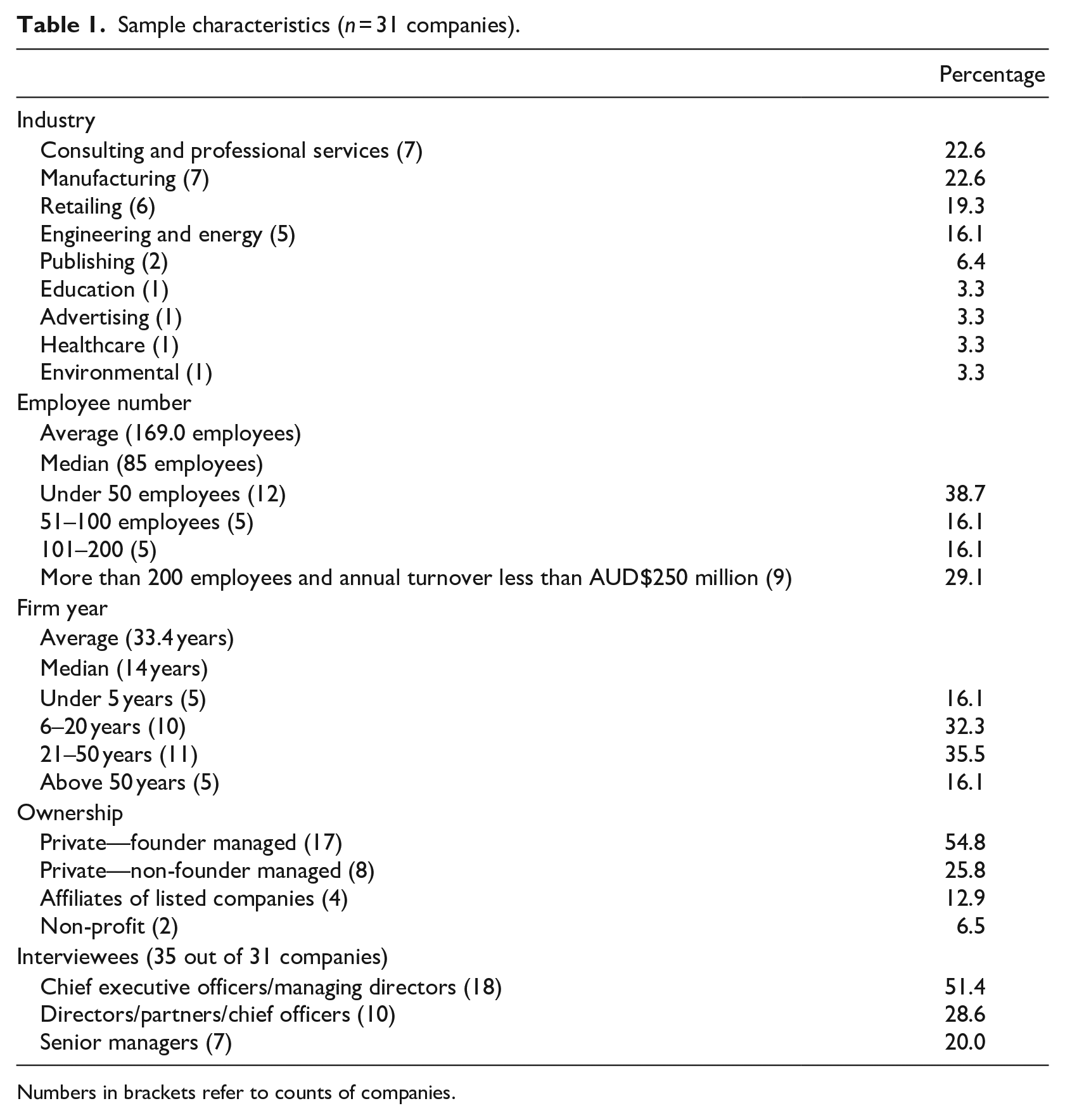
Numbers in brackets refer to counts of companies.
Since we were able to interview two managers from four companies, we interviewed 35 participants from the 31 companies. Eighteen participants were CEOs or managing directors, 10 were directors, partners, or chief officers, and 7 were senior managers. The senior job level of interviewees ensured that they had the appropriate knowledge to answer questions on innovation management in their companies. To ensure that the same set of questions was asked across all interviews, one member of the research team attended and monitored all interviews. Most interviews were attended by a second research team member who asked additional questions as they arose within the semi-structured interview. All interviews were audio-recorded, with written permission from the interviewees, and later transcribed verbatim by a professional transcription service. The average interview time was 60 minutes.
3.2. Types of innovation
As a foundation to understanding the innovation process, we began our interviews with questions on the types of innovation. We asked the informants to define innovation for the research team members and to provide examples of innovation in their companies. All interviewees defined innovation very broadly as doing something different from what they are currently doing, which at the same time adds value to the customers. We observed that managers adopted a pragmatic approach toward innovation, considering innovation as something locally new that can serve their customers better.
We used the five types of innovation outlined in the Organisation for Economic Co-Operation Development (2005) Oslo Manual to make sense of the innovations brought up in the interviews. The interviewees were also able to quickly identify their innovations in product, process, service, marketing, and management. Some mentioned innovations are presented in Table 2. For product innovation, interviewees fine-tuned their products with features that suit customers’ need, sometimes with reduced product features to maintain low cost. For process innovation, they looked for ways to use resources more efficiently for cost reduction and speedy delivery. For marketing innovation, they constantly improved on how they reached existing and new customers. For service innovation, they considered the ability to serve the changing needs of the customers who were fundamental to their business. Finally, for management innovation, they experimented with new management practices to alter the company structure and decision-making authority.
Examples of innovation in some Australian small and medium-sized enterprises.
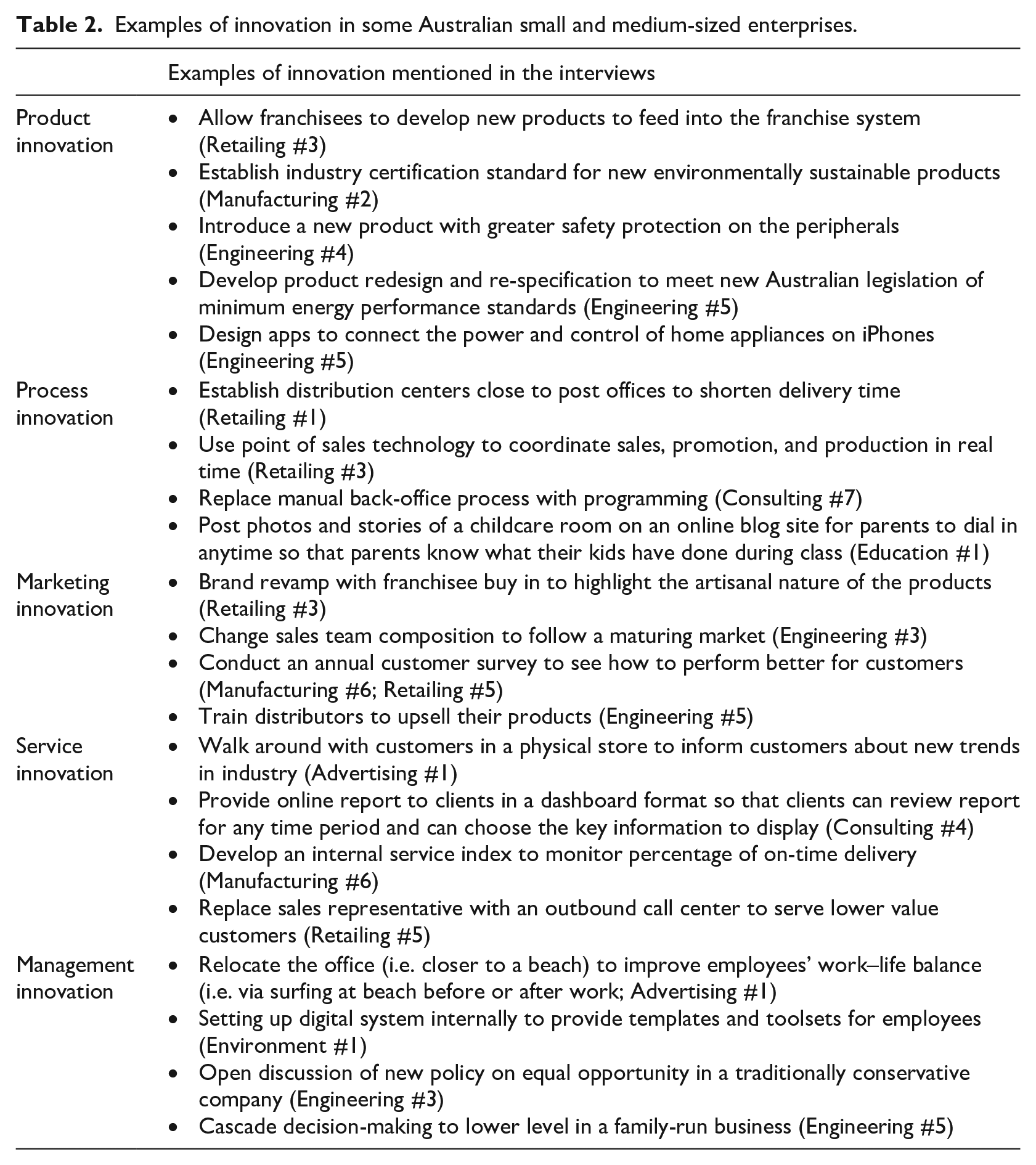
The kinds of innovation discussed in the interviews reflected the nature of SMEs. SMEs are companies that are scaling up from a successful entrepreneurial stage but have not yet achieved a large and stable turnover in their market. Most of the companies in our interviews focus their resources and attention on consolidating their company and defending against competition. As such, rather than honing in on cutting-edge technology, innovations in the SMEs in our sample are mostly incremental and exploitative. Innovations are result driven, undertaken with limited resources and minimal risk.
3.3. Data analysis and interpretation
We analyzed interview transcript text data using NVivo, focusing on the activities that managers undertake to manage innovation in their companies. Comparisons were made between cases to refine and clarify the concepts, resulting in some initial concepts being deleted or merged with other concepts. The coding process moved between and within the concepts when we clarified and made connections between the concepts (Corbin and Strauss, 2012; Silverman, 2000).
Specifically, we followed Gioia et al.’s (2013) recommendation to present the data analysis of the interviews in the article. To avoid idiosyncratic interpretation and improve methodological rigor of qualitative research, Gioia et al. (2013) recommend a systematic presentation of the first-order (informant-centered) analysis and the second-order (theory-centered) analysis (p. 18). First-order concepts adhere to informants’ original voice and perception. These concepts are based on informants’ direct quotes and terms. Second-order themes are derived from the researchers’ interpretation of the informants’ quotes and terms. While informants are “glorified reporters,” researchers are “knowledgeable people” who discover patterns, concepts, and relationships that informants are not aware of (Gioia et al., 2013: 17). Reporting both the voices of the informants and the researchers provides a strong and clear link between the data and the induction of concepts. In this way, the findings will be meaningful to the informants and to the research community. In the following sections, to maintain anonymity, to represent a specific company, we use the industry category followed by a number.
4. Findings and discussions
The main part of the interview concentrated on the innovation process of the informants’ companies. Specifically, we asked the informants what their companies did to make innovation happen. We followed Gioia et al. (2013) to analyze the interview data. We first examined the activities undertaken by managers during the innovation process, and then looked for patterns in the data to identify higher order themes underlying these activities by grouping similar activities together and separating different activities as the first-order coding. We tried to stay close to the observations for the first-order coding. We started to see stable patterns underlying the activities after a few interviews and were able to reduce the number of groups to 10 activities that were undertaken during SMEs’ innovation process as the second-order themes. These 10 managerial activities are: listening, searching, problematizing, challenging, choosing, steering, inspiring, communicating, resourcing, and tracking. These activities represent actions that unfolded during the innovation process.
Up till the second-order findings, we did not apply any prior theoretical work in our coding yet. However, it only makes sense that prior research would have already depicted some of the patterns we found (Eisenhardt, 1989: 536; Gioia, 2021: 24; Graebner et al., 2012: 281). For the third-order coding, which is theory centered, we looked for connections between the concepts in what we know and the findings that point to new ideas from this study. We noticed that the data structure of the second-order themes matched closely to the activities of sensing, seizing, and transforming described by dynamic capabilities (Teece, 2007). We therefore applied Teece’s (2007) model as a tool to organize the third-order dimensions in our analysis.
The review in the last section has shown that the framework of dynamic capabilities has been widely adopted in general innovation studies (e.g. Bogers et al., 2019; Kindström et al., 2013; Lin et al., 2016; Piening and Salge, 2015; Schoemaker et al., 2018). Using dynamic capabilities to organize the third-order dimensions of the interview data allows us to compare our findings in this study with those reported in previous studies. At the end of the analysis, we were able to fit 8 of the 10 activities identified in this study directly onto Teece’s (2007) capabilities of sensing, seizing, and transforming. We grouped the remaining two together and consider them a new form of innovation capability, reflecting, which is important for and unique to the SMEs’ innovation process. An illustration of the coding is presented in Figure 1.
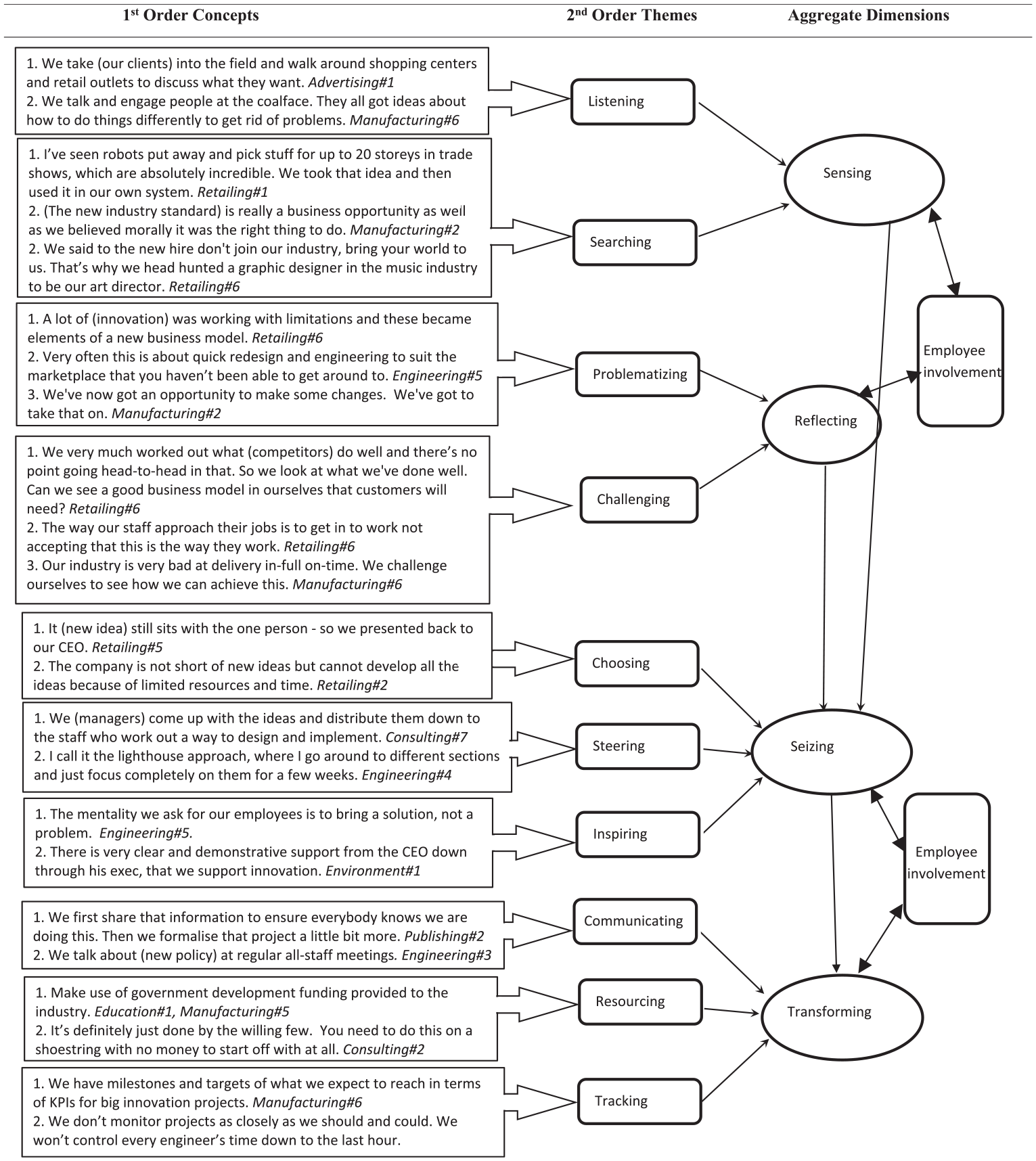
Data structure.
In the following, we organize our findings into four parts: (1) managerial activities that constitute the innovation process of SMEs; (2) a new dynamic capability of reflecting among these activities; (3) the emergent nature of these activities; and (4) employee involvement to handle conflicts and resolve tensions among activities. We distinguish between managerial and non-managerial staff who represent two major internal stakeholders of the innovation process.
4.1. Managerial activities underlying the innovation process of SMEs
In Teece’s (2007) framework, sensing refers to the capability of identifying and shaping opportunities in the business environment. Companies do this by discovering and monitoring emerging trends in the market, competition, and technology. Our interviews suggest that the two activities that build up sensing in SMEs are listening and searching.
Listening refers to collecting information on the business environment on a regular basis. Managers of SMEs constantly talk to customers to understand their needs. Sometimes this was achieved by a specially arranged walk-around-day in a retail store with customers: We take (our clients) into the field and walk around shopping centres and retail outlets to discuss what they want. We ask them what they want to do, what their goals are for the next 12 months, and how we can design something that helps their goals along. (Advertising #1)
Managers also maintained social and professional contacts and attended trade shows regularly to discover the emerging business and technology trends shared by other suppliers and competitors in the same industry. Importantly, we found that in SMEs, not only managers but also their employees listen. One company (Engineering #3), borrowing the practice from Google, allowed their engineers to work on self-initiated projects 1 day per month, which considerably extended the bandwidth of listening. In other situations, a feedback channel was established to solicit information gathered by employees and send it directly to the top management.
Searching, on the other hand, is intentionally seeking information on a specific issue. Compared with listening, searching is more focused and allows a more distant search horizon. Searching mobilizes resources and serves SMEs well, especially as these are often limited in resources they can spend on innovation. Managers often lead the search process when they investigate further an initial idea. Searching is particularly useful for new technology adaptation. SMEs often look for technology beyond their own industries to see whether companies in other industries have dealt with similar problems. The manager of Retailing #1 told us “Don’t create the wheel if others have done it already.” They attended a trade show with a focus on robots for e-commerce when they looked for further automation in their distribution center: I’ve seen robots put away and pick stuff for up to 20 storeys in trade shows, which are absolutely incredible. We take that idea and then used it in our own system. (Retailing #1)
Searching also shapes opportunities for SMEs down the road. The owner manager of Manufacturing #2 told us that they spent years to search for ways to set up a new industry certification for their environmental-sensitive products. An informant from Retailing #6 told us they purposely hired someone from another industry to provide ideas not found in their own industry. This helped to enhance the value of the company’s products.
In Teece’s (2007) framework, seizing refers to the capability to make decisive action and investment on identified opportunities. Acting on opportunities does not follow directly from recognizing them as companies can be well aware of the opportunities but still unable to act. Seizing means committing to a particular idea by overriding existing company routines and re-aligning the company structure, process, and incentives to the new purpose. To this end, SMEs invest resources and personnel in exploiting a specific idea. Seizing is guided by the manager’s intuition and interpretation of the business model (Gronum et al., 2016; Loon and Quan, 2021). We identified three activities across our SME cases undertaken for the purpose of seizing: choosing, steering, and inspiring.
Choosing is deciding which idea to invest in. This is basically a filtering process where SMEs select a few promising ideas to continue to work on. One manager (Retailing #2) told us that the company did not lack new ideas but could not foster them all: We are not short of ideas, there are heaps of ideas. We cannot develop all the ideas because of limited resources and time. I (the chairperson) need to identify, scope, and figure out how to do it and deliver it. (Retailing #2)
As distinct from large companies which have elaborate decision protocols for checks and balances, choosing in SMEs is often undertaken by managers and is based on their insight, experience, and hunches. The manager of Retailing #5 said that ultimately the CEO was the person to take the company forward. In our study, many SMEs are still managed by their founders. They understand the business model of their companies and have the vision to make these decisions.
Steering is consolidating the chosen ideas into prototype projects and assigning key employees to start work on them. Similar to the process of choosing, managers also do the heavy lifting in steering. A senior manager from Consulting #7 told us that managers usually identify new ideas, and then delegate these to employees to determine details and implementation. This reliance on managers in steering works well for SMEs because their employees are fully occupied with daily work and can benefit from clear steering. Similarly, the CEO of an engineering firm remarked: I call it the lighthouse approach, where I go around to different sections and I just focus completely on them for a few weeks. I’ll go to the sales team and I’ll sit with them for three to four weeks until everything is perfect. Then I’ll do that same for the warehouse team, and the same for the IT team. (Engineering #4)
Moreover, SMEs do not have the spare resources to compensate for failure. In their minds, their managers consciously calculate the return on innovation when steering. They understand that any resources committed in a project represent a trade off as these are taken away from other projects.
Inspiring is energizing employees to share the excitement and commitment to potential business opportunities available to a firm. Inspiring is the process that energizes employees to go along with the steering process. Managers do this in two ways. First, they create a receptive culture for change and innovation in the company. A manager from Retailing #6 reported that they demanded all 60 employees of their company to have innovation in their DNA. A manager from Engineering #5 asked their employees to be solution-focused: The mentality we ask for our employees is to bring a solution, not a problem. It’s not easy. I’ve seen organizations that have autocratic leaders and it’s a struggle to change the culture. (Engineering #5)
Second, they recruit employees who accept a high level of change as the norm. One interviewee stated that, in their SME, they hired employees who are open to innovation and can work independently (Publishing #2), while another explained they hired employees who fit the company culture and were able to grow with the company (Engineering #3).
Transforming in Teece’s (2007) framework refers to the capability to recombine and reconfigure the organization’s assets and structure to fit new ways of doing things. This requires sharing and integrating knowledge within a company. The three activities conducted for transforming in SMEs as reported in our cases are communicating, resourcing, and tracking.
Communicating is clearly and adequately explaining to employees the organizational changes associated with transforming. As new ideas and changes are often initiated from the top in SMEs, employees may not be fully informed of the changes. Managers in innovative SMEs engage in clear and early communication with employees. In Engineering #3, information was conveyed in regular staff meetings when rolling out new projects or new policies. In Publishing #2, managers shared information and communicated changes to employees before they finalized these changes: We first share that information to ensure everybody knows we are doing this. Then we formalise that project a little bit more. I think it’s a balancing act. You need to know that people are open to new ideas and positive change, but at the same time, there needs to be a structure and a clear communication strategy. (Publishing #2)
A clear and early communicating process facilitates employee participation and commitment. It helps employees to identify with the changes and to provide constructive feedback.
Resourcing is acquiring, coordinating, and mobilizing resources for innovation. For innovation to happen, new financial and technological resources are key. These kinds of resources are scant for SMEs as most resources are spent on daily operations. They need to actively secure resources for innovation. The use of governmental industry support and of proven information technology was often mentioned in our interviews as new resources for innovation (e.g. Education #1, Manufacturing #5): We have made use of government development funding provided to the industry to reduce our cost structure. Along those lines, we’ve made use of the government funding for LED lighting throughout the manufacturing plant. This provides us the opportunity to reduce our cost structure. (Manufacturing #5)
Other than this, SMEs in our study seldom worked with external parties on innovation. While Teece (2007: 1337) suggests an external focused approach with asset co-specialization with complementors, SMEs mostly rely on internal resource redeployment for innovation. Collaborating with upstream or downstream partners is rare because of the potential problem of knowledge leaking to other companies. This non-collaboration is also due to the incremental and non-technological nature of innovation in SMEs, which does not require extensive resource co-specialization with external partners.
Tracking is monitoring the progress of innovation for control and evaluation. SMEs use both formal tracking and informal tracking. To assess the return on innovation, in some companies the expenses and employee hours spent on the innovation were recorded in detail. For instance: We have milestones and targets of what we expect to reach in terms of KPIs for big innovation projects. There are defined levels of accountability that are published. They’re monitored and enforced by an independent committee that assesses the progress. (Manufacturing #6)
Other companies tracked innovation projects informally. Their managers believed that too much structure and reporting during the implementation phase stifled innovation. One remark was that they did not want to monitor their employees’ time down to the last hour (Engineering #5). Another view was that revenue was the best measure of innovation, rather than the spending put on a project (Retailing #6, Education #1). Informal tracking is possible for SMEs because of their small organizational size.
4.2. Reflecting as a dynamic capability of the SME innovation process
During the interviews, we identified some activities that do not fit neatly into the framework of Teece’s (2007) dynamic capabilities. We therefore derived two new second-order themes, problematizing and challenging, to describe these activities. We further aggregated these two into a new capability, reflecting (as shown in Figure 1). Reflecting is looking inside a firm for a business opportunity (rather than looking outside) by identifying areas for improvement in its current operations. Reflecting is similar to sensing as it helps SMEs to identify opportunities. However, unlike sensing, reflecting is inward looking. When SME managers reflect, they attempt to convert problems and challenges inside their companies into opportunities for innovation. This process is described further below in terms of its constituent components: the original second-order themes of problematizing and challenging.
Problematizing is looking for pressure points in the current business. SMEs are always reflecting on how to improve their service to customers. Indeed, managers of SMEs define innovation simply as continuous improvement in serving customers in whatever forms this takes. They consciously seek solutions to the causes of failure. A manager of Retailing #6 told us that most of their innovation came from acknowledging the limitations and constraints in the operation, and turning them into elements of new business model. As a result, they established a profitable online direct sales business model while avoiding competition from the big players in the national market. When discussing the industry standard that they set up for environmental compliance, a respondent from Manufacturing #2 said they considered it a moral obligation that they needed to take on as the industry leader: We’ve now got an opportunity to make some changes. We’ve got to take that on. It took us probably two years to develop the standard and get it to market . . . really a business opportunity as well as we believed morally it was the right thing to do. (Manufacturing #2)
Challenging is actively looking for ways for improvement and better solutions in existing organizational routines. When people in SMEs challenge themselves, they investigate how things can be done differently. Some SMEs look for ways to do things differently from their competitors: We very much worked out what (competitors) do well and there’s no point going head-to-head in that. So we look at what we’ve done well. Can we see a good business model in ourselves that customers will need? . . . We created an online community platform for our customers to talk to each other, share their reviews and recommendations on (our products). (Retailing #6)
The founder manager at an early education center (Education #1) illustrated the concept of challenging very well: on top of the children’s learning experience, the parents’ and childcare employees’ experience form part of the full learning experience for a child. The challenge for them was to improve the parents’ experience, rather than focusing solely on the children’s experience. That was how they came up with an online blog site for parents to dial in at any time (presented as process innovation in Table 2).
4.3. Temporal ordering of activities
In the above, we have identified 10 distinct activities that are involved in the process of innovation in SMEs. Another finding is related to the temporal order of the activities. Our interviews showed that there is no specific sequence for the 10 activities. This means that sensing, reflecting, seizing, and transforming do not follow a clear and linear sequence in SMEs. Managers in SMEs tend to undertake multiple activities simultaneously. For example, when looking for business opportunities, SME managers often engage in searching and challenging activities simultaneously. Indeed, these two activities could complement each other. Searching focuses on opportunities and trends presented externally in the industry, while challenging focuses on opportunities arising within a company.
To take an example, when Education #1 looked for new business opportunities, they engaged in searching and challenging at the same time. Their manager’s two quotes below illustrate searching and challenging, respectively. These two activities fed into each other for Education #1 to identify a new and successful operational innovation (i.e. an online blog site) aiming at a high-quality customer experience: We survey the families every year. We know that very often the parents are running late or they’re double parked. It’s stressful. That’s why they haven’t got time to talk to our caretakers. The primary caretakers at our centre would have gone home at five or six in the afternoon when parents come in. And children aren’t necessarily the most communicative things. So how do we communicate? (searching activities) Why don’t you tell the parent what their kid has done during the day? Why don’t you say hello to the parent when they come to pick up their child? Why don’t you remember the parent’s name? Could you make that experience a bit better? That’s my challenge. (Challenging activities)
The point was made earlier that clear and timely communication to employees is part of the transforming process. However, clear and timely communication is also needed during sensing, reflecting, and seizing processes. When business opportunities are identified through sensing and reflecting, good communication is needed to bring that information back to SMEs. Moreover, as seizing concerns decisive action and investment to act on opportunities, good communication facilitates employees’ commitment for innovation to occur. Thus, we found that the activity of communicating is a continuous process that takes place throughout the innovation process.
The process of continuous communication is illustrated by Publishing #2 with 24 employees. When its managing director was working on some new initiatives for the company, communicating was mentioned at the idea generation stage, before the roll out, and during implementation, as the three quotes below illustrate, respectively: For about six months, I (the managing director) and the CFO worked to develop some finite tools to actually roll out the new initiatives. When we did that, we ensured that everybody knew what we were doing and started to share that information. There needs to be a clear communication strategy. (At idea generation stage) To continue to build confidence and the ability to execute the agreed strategy, my role is to work with the management team to encourage them to continue doing everything needed within their teams. (Before the roll out) Everybody in our company was aware of what the objectives were for the company; we were all on board with that and I was communicating the vision to the team and then it would roll down, so that each of the leadership teams was charting their own objectives and rolling them out with their own teams. (During implementation)
The non-linear sequence of innovation activities in SMEs points to multiple progressions of the innovation process, rather than a unitary progression (Barrett and Sexton, 2006; Van de Ven, 1992). The various activities evolve along multiple paths, which could diverge, run parallel, or converge with each other over time (Van de Ven, 1992: 173). Managers in SMEs need to juggle with the 10 activities at once for multiple progressions of the innovation process.
4.4. Employee involvement to achieve contextual ambidexterity
During the interviews, managers often mentioned to us that their employees have actively engaged in the innovation process. We refer employees’ high levels of participation and engagement as employee involvement (as shown in Figure 1). Employee involvement complements managerial activities and illustrates how SMEs maximize the use of their limited human resources (HRs) to facilitate the innovation process. It is an integral part of the innovation process of SMEs. It affects and is affected by the managerial activities during the process.
When managers carry out various activities for innovation, there are continuous and frequent interactions bouncing back and forth between these managers and the employees. While the managers in SMEs are the driving force behind the innovation process, employees also play an indispensable role. They participate actively and complement the activities initiated by managers. For the SMEs that we interviewed, they focus on recruiting employees that will grow with the company and can act on their own. Some quotes below illustrate this: If someone is constantly presenting good ideas beyond the scope of their role, you should probably earmark them as a leader and show appreciation and empowerment for those people. We don’t look for people who need clear instructions in what to do. (Retailing #6) We hire the right people in the first place. When they are faced with difficult problems and need to figure out a better way to do it, they do so. That is quite often the genesis of innovation . . . We have a very low staff attrition rate, and that’s been a key to our success. (Consulting #4)
Since employees are hired for their originality and proactivity, they do not simply follow instruction from managers during the innovation process. They actively contribute their ideas and feedback to managers in the innovation process. In the previous section, many of the activities discussed rely on inputs from employees. For example, both listening and searching during the sensing process are sometimes delegated to employees. For employees to take part in the sensing process, they need to have a clear idea of what the company needs in the first place: We ask the sales people to go out to conferences and come back to give us ideas on what they believed were the opportunities for growth of the business. (Retailing #2) Employees are encouraged to go and read business articles, read design articles, have a look at the latest technology that our competitors are using, and share that as a community and say, “Hey, look at this, why don’t we do this?” So it becomes a collaborative activity. (Advertising #1)
Similarly, while seizing is mainly a top-down process initiated by managers to take on a business opportunity, it is only possible with high levels of employee involvement from bottom up. Employees need to be actively involved in the seizing process for them to commit to the new opportunity and business direction offered by the managers: Employees feel as though they’re working in a business that’s open to ideas and open to their views. We constantly seek their views and do something about them, not [being] closed off and driven by an agenda that’s unchanging and unbending and doesn’t engage people. (Manufacturing #6) We have a culture of sharing and feedback. (Consulting #7)
Importantly, we further argue that active employee involvement in the innovation process resolves the conflicting demands inherent in the process. The activities underlying the innovation process in SMEs are not always compatible with each other. Very often they pull in opposite directions and create opposing demands in the innovation process of SMEs. This tension illustrates very well the paradoxical nature of innovation capabilities suggested by Andriopoulos and Lewis (2010) and Gebert et al. (2010), discussed earlier in the literature review.
As shown above, to innovate, SMEs need to handle the tensions generated by undertaking disparate activities. O’Reilly and Tushman (2013) posit three modes of ambidexterity (i.e. structural, sequential, and contextual) to resolve tensions and paradoxes in organizations. Among these three, contextual ambidexterity refers to a supportive organizational context that allows individuals to adjust their behavior concerning conflicting activities. By empowering organizational members to work together, disparate activities can be conducted concurrently without the need to create any physical, temporal, or domain separation in an organization (Lavie et al., 2010). Empirically, in a sample of Canadian SMEs, de Clercq et al. (2014) show that contextual ambidexterity, measured as the simultaneous pursuit of alignment and adaptability, positively affects performance. Iborra et al. (2022) find that maintaining ambidexterity in exploitative and explorative orientation helps SMEs achieve resilience after disruptive external events in a sample of Spanish medium-sized firms.
Employee involvement helps SMEs achieve contextual ambidexterity by allowing managers and employees to switch between conflicting activities. For instance, listening and challenging, both important for opportunity identification, do not always align with each other. The activity of listening searches for opportunities in the external environment, whereas the activity of challenging suggests opportunities come from the internal environment. Listening is external facing while challenging is internal facing. To resolve this conflict in SMEs, we noticed that while managers actively listen to the trends presented in the external environment, they would also bring back ideas that employees can use to challenge the current operation inside the company. In this way, SMEs can focus on two different opportunities.
Similar, choosing and inspiring constitute the capability of seizing in SMEs. However, the activity of choosing requires managers to make a clear decision, whereas the activity of inspiring seeks consensus among employees. The managerial activity of choosing calls for an autocratic decision while that of inspiring seeks agreement. When SME managers choose to adopt a specific idea for innovation, they will try to inspire employees to go along with their idea. In this way, any top-down decision by the managers is supplemented by bottom-up consensus by employees.
The observation above is similar to the debate on idea generation and idea implementation, which represents opposing activities and calls for different skill sets (Lewis et al., 2002). This is resolved in SMEs as managers and employees are both actively engaged in the innovation process. Thus, the innovation process is both top down and bottom up. As a manager from Retailing #6 explained: All our employees are expected to take part in innovation. This is not done by a specific division of the company. (Retailing #6) We demand creativity from everyone. We demand it because we ask everybody to take ownership of their contribution and their value to our customers, our suppliers and the rest of the company. (Retailing #6)
To sum up, SMEs resolve conflicting demands during the innovation process by contextually integrating employees into the process (Lavie et al., 2010). Our interviews showed how contextual ambidexterity occurs in SMEs. When employees are actively involved in the innovation process, conflicting activities are taken up by managers and employees seamlessly, with a continuous bouncing back and forth between them. The size of SMEs enables contextual ambidexterity to effectively tackle the tensions.
5. Contributions
To study the innovation process of SMEs, two research questions were posed at the beginning of this article: How does the innovation process unfold in SMEs? How do SMEs manage the innovation process? We have investigated these two questions by examining the innovation process of 31 Australian SMEs through semi-structured interviews with their founders and top managers. Addressing the first question, we identified 10 managerial activities, namely listening, searching, problematizing, challenging, choosing, steering, inspiring, communicating, resourcing, and tracking, that take place during the innovation process of SMEs. These activities depict the innovation process of SMEs as a complex and non-linear phenomenon. They require continuous attention from managers and do not follow a specific time order.
In relation to the second question on how SMEs manage the innovation process, we identified reflecting as a new capability for SME innovation process. The ability to reflect on the problems and opportunities specific to the companies allows SMEs to innovate. Moreover, we observed that the SMEs in our sample rely on a high level of employee involvement to achieve contextual ambidexterity, which is useful for resolving the conflict and tension inherent in the innovation process.
5.1. Theoretical implications
This article contributes to research on the innovation process of SMEs in three ways. First, we identify 10 distinctive managerial activities to understand the innovation process of SMEs. Previous studies that focus on activities of the innovation process (such as de Jong et al., 2015; Sawhney et al., 2006) are often normative in nature, prescribing best innovation practices that companies should adopt. Moreover, these activities may not be SME specific. Focusing on how these activities unfold allowed us to examine the innovation process in SMEs as a non-linear process, instead of relying on waterfall models with linear and sequential developmental stages, which tends to over-simplify the innovation process.
Second, we add to the expanding literature on dynamic capabilities in the innovation process. Most research on SMEs has conceptualized dynamic capabilities based on findings from the general innovation literature (e.g. Battaglia and Neirotti, 2022; Davis and Bendickson, 2021). Recent studies have questioned the validity of this same set of dynamic capabilities in the context of SME. It has been found that only the dynamic capabilities in learning and integrating are related to SME performance (Hernández-Linares et al., 2021). Similarly, a dynamic capability in scanning is particularly important for SMEs in declining industry to foster innovation (Nag et al., 2020). We extend this literature by proposing a new construct of reflecting as a unique dynamic capability for SME. The capability of reflection allows SME managers to proactively consider their internal problems and look for new business opportunities, leading to innovation. Reflecting allows SMEs to innovate despite their limited resources. This is an important capability on top of the existing dynamic capabilities discussed in the general innovation literature.
Third, we contribute to the literature of employee involvement in SMEs. The role of employee involvement in the innovation process of SMEs has received limited attention in research. While previous studies have found a positive relationship between employee involvement and innovation output in SMEs (e.g. Andries and Czarnitzki, 2014; Love and Roper, 2015), the process behind the relationship is less clear. We explore the mechanism of how employee involvement contributes to innovation process. Based on the interviews in this study, we find that employee involvement allows SMEs to achieve the contextual ambidexterity needed to resolve conflicting demands arising from innovation activities. The role of superior employee relations in innovation is also noted in de Massis et al.’s (2018) study of innovative German Mittelstand firms (p. 133). Taking these findings together, high levels of employee involvement could be a common but under-researched feature for a successful innovation process among SMEs across countries. More studies on employee involvement could offer promising research opportunities. While some studies have identified employee involvement as a key HR resource unique to SMEs (McAdam et al., 2010; Salimi and Della Torre, 2022), we focus on its specific role in the innovation process.
5.2. Managerial implications
Based on the findings of this study, we offer some overarching advice to SME managers to maximize the opportunities and minimize the barriers to innovate in the SME context. To maximize opportunities to innovate, SME managers should consider undertaking a variety of innovations to take advantage of their quick response and closeness to market (Gronum et al., 2016; Love and Roper, 2015). Our interviews show that SMEs need to keep innovating to stay in business. Incremental improvement allows SMEs to continuously enhance the way they serve their customers. Innovations in service, marketing, and process tend to require less R&D and sunk cost than product innovation for SMEs. Moreover, the non-linear nature of activities revealed in this study suggests that SME managers should be confident to move back and forth during the innovation process. To maximize new opportunities in the market, SME managers need to search the environment for new trends and inputs to transform current operation as needed. In this way, they could take full advantage of their closeness to market.
To lower barriers to innovate, SME managers could audit their innovation activities based on Teece’s (2007) framework of dynamic capabilities. They could intentionally cultivate a reflecting capability in their firms to complement capabilities in sensing, seizing, and transforming. Engaging in reflection about pain points in organizational changes allows SMEs to deal with the barriers to innovate. In addition, this study revealed the critical role of non-managerial employees of SMEs to reduce conflicts and tensions arising from the innovation process. To reduce barriers to innovate, SME managers should proactively involve frontline employees in the innovation process. The involvement and commitment of employees to the company are a unique resource on which SMEs could further capitalize in their specific context (Andries and Czarnitzki, 2014; de Massis et al., 2018).
6. Limitations and future directions
The findings of this article should be interpreted with several caveats in mind. First, research based on interviews is limited by the type of company included in the sample (Goffin et al., 2019). We have tried to tackle this issue by interviewing as many companies as we could come into contact. However, in doing so, we gave up the option of an in-depth study with fewer companies and included SMEs with large employee number but small annual turnover. As Table 1 shows, our sample tends to comprise established SMEs in mature industries. We believe that our findings should be generalizable to SMEs outside Australia who face similar resource constraints and business environments as those in our sample. Future research should replicate this study in other contexts.
Second, our interviews were conducted almost 10 years ago from 2014 to 2015, which may introduce some limitations to the immediate applicability of our findings. However, it is appropriate to use older primary data if the underlying phenomenon has not changed since the data were collected (Ketchen et al., 2023). As the resource profile and institutional challenges for SMEs have not changed, the fundamental concepts and principles that SMEs face in the innovation process remain the same. The findings and suggestions of this article will still be relevant for SME managers today. Indeed, recent articles examining the responses of SMEs to the COVID pandemics in 2019 (Clauss et al., 2022) and business model innovation (Loon and Quan, 2021) have referred to the concepts of dynamic capabilities and ambidexterity studied in this article.
Third, we interviewed only owner managers and senior managers, and excluded frontline employees for this study. In doing so, we may have missed the perspective of frontline non-managerial employees. However, owner managers and senior managers are appropriate informants because managerial activities are the focus of this study. The way that they had pointed out the important role played by frontline staff in the innovation process suggests that the role of frontline staff has not been ignored in this study. Future research could include frontline staff to complement the perspective of the owners and the managers.
7. Conclusion
To summarize, this study explores how the innovation process unfolds in SMEs. Our results show that SME managers conduct various activities to manage the innovation process. Moreover, we find that reflecting, as a form of dynamic capability, and employee involvement are two important activities that SMEs undertake to resolve conflicting activities and find both/and rather than either/or solutions during the innovation process. As such, SME managers should manage innovation in its own way, rather than as a scaled-down version of what is done in large companies or a larger version of what is done in start-up companies. We encourage further inductive and deductive studies to advance the understanding of the SME innovation process.
Key theoretical and practical implications
The innovation process of SMEs should be examined differently from that of large firms. The process is not a scaled-down version of what is done in large companies.
The process consists of managerial activities unique to SMEs that unfold in no fixed sequence and can alternate between each other. The 10 innovation activities identified in this article are listening, searching, problematizing, challenging, choosing, steering, inspiring, communicating, resourcing, and tracking.
To manage the innovation process, SME managers can leverage their small size to develop a reflective capability and foster strong employee involvement.
A reflecting capability, through problematizing and challenging daily works, allows managers to proactively consider their internal problems and look for new business opportunities.
High levels of employee involvement provide contextual ambidexterity to manage conflicts and tensions arising from disparate innovation activities.
Footnotes
Acknowledgements
We gratefully acknowledge Deputy Editor Muhammad Ali, Associate Editor Miles Yang, and the two anonymous reviewers for their valuable suggestions throughout the review process.
Final transcript accepted 17 July 2024 by Miles Yang (AE Strategy).
Conflict of Interest
None.
Funding
The author(s) disclosed receipt of the following financial support for the research, authorship, and/or publication of this article: This work was supported by the Australian Research Council Linkage Project [LP140100838]. We gratefully acknowledge the support of our industry linkage partners, GE Capital Australia and Pitcher Partners.
