



Abstract
In small- and medium-sized enterprises (SMEs), adopting a strategic human resource management (SHRM), approach can improve dynamic capabilities and promote greater innovation. However, most research on this topic is theoretical and focuses on large firms with well-established formal and mature human resource management systems and access to significant resources. Using a resource-based view framework, we investigate how entrepreneurial orientation (EO) enhances the SHRM–dynamic capabilities relationship in SMEs. Using time-lagged data from 456 SMEs in Australia, our results confirm that SHRM has an indirect positive association with innovation through its impact on dynamic capabilities. Additionally, EO has an indirect positive association with innovation through its impact on dynamic capabilities. Our results also show that EO moderates the positive relationship between dynamic capabilities and innovation such that the relationship becomes stronger as EO increases. This study’s results have theoretical and practical implications for the role of SHRM and EO in developing dynamic capabilities and innovation in SMEs.
Keywords
Introduction
Small- and medium-sized enterprises (SMEs) must strategically use their human resources to develop new competencies or adapt current ones to seize opportunities in a constantly changing market (Garavan et al., 2016). Dynamic capabilities are ‘the capacity of an organisation to purposefully create, extend, or modify its resource base’ (Helfat et al., 2007: 4). The literature asserts that dynamic capabilities are imperative for innovation in firms (Bocken and Geradts, 2020) and, importantly, that strategic human resource management (SHRM) is integral in enhancing its effectiveness (Fallon-Byrne and Harney, 2017; Lewin and Teece, 2019). These SHRM–dynamic capabilities links could be significant for SMEs, as existing research on SHRM and dynamic capabilities separately hint at the significance of these factors for smaller firms (Burton et al., 2019b; Harney and Alkhalaf, 2021). Studies, for example, show that HR strategies can catalyse capability development for innovation (Branzei and Vertinsky, 2006). Others have found that SMEs must utilise their dynamic assets (such as human resources) or form network relationships with those that do to surmount their resource limitations (Vrontis et al., 2020). Still, others warn that SMEs must avoid repeating their successful routines and engage their human resources to develop new capabilities (Wang et al., 2015).
To date, however studies connecting SHRM and dynamic capabilities have been predominantly conceptual and conducted from a large organisation perspective (Fallon-Byrne and Harney, 2017; Garavan et al., 2016), emphasising greater formalisation of organisational practices and resource munificence, firm attributes that are typically less developed in SMEs (Arend, 2014; Bryson and White, 2019). Despite its potential contributions, few studies have examined the mechanisms of SHRM on dynamic capabilities and firm outcomes (Collins, 2021). Existing research notes that the theoretical development of SHRM and dynamic capabilities derived from these large firm studies are limited in providing insight into the unique context of dynamic capabilities in SMEs (Corner and Wu, 2012; Zahra et al., 2006). Large organisation perspectives overlook the predominance of entrepreneurial characteristics and people-centred management required to sustain viability in SMEs (Messersmith and Wales, 2013). Owing to an SME’s liability of resource constraints (Welsh et al., 1982), scholars have also argued that SHRM in SMEs may be contingent on its entrepreneurial nature (Khavul et al., 2010) and initiating a more proactive strategic alignment of human resources (Chadwick and Flinchbaugh, 2021; Xiu et al., 2017). In line with the RBV, we postulate that entrepreneurial orientation (EO) critically affects the SHRM–dynamic capabilities relationship in influencing firm innovation (Burton et al., 2019b; Roumpi and Delery, 2019). EO is ‘the strategy-making processes that provide organisations with a basis for entrepreneurial decisions and actions’ (Rauch et al., 2009: 762), and captures critical decision-making, agency and organisational processes that enable SME managers to create a competitive advantage. Focusing on SME EO has the potential to illuminate the boundary conditions for competitive advantage in SMEs (Covin and Wales, 2019; Park and Xiao, 2020), potentially expounding the context for the SHRM–dynamic capabilities link (Apascaritei and Elvira, 2022; Fainshmidt et al., 2019) while also elaborating on the theoretical mechanisms that enable EO to influence firm innovation (Wales et al., 2021). Integrating EO into an SHRM–dynamic capabilities framework allows insight into SME internal dynamics, allowing a more systemic analysis of strategic contingencies. This observation aligns closely with EO scholars who suggest that ‘understanding how and when it is manifest in a strategic manner would help advance the long-standing literature’ (Wales et al., 2021: 575).
Our study addresses the above challenges by testing EO as a strategic resource that enhances an SME’s ability to leverage their SHRM–dynamic capabilities. We offer three main contributions by examining the innovation implications of SHRM, dynamic capabilities and EO in SMEs. First, our study extends the SHRM–dynamic capabilities framework by articulating how SME SHRM and EO influence their dynamic capabilities and firm innovation (Covin and Slevin, 1989; Miller, 1983; Paauwe et al., 2013), providing empirical evidence for the critical role of HRM for dynamic capabilities, recently theorised but not yet tested (Apascaritei and Elvira, 2022). Second, by investigating the effects of EO on the SHRM–dynamic capabilities relationships, this study also extends EO theory by explicating its causally adjacent relationships with human resources systems and strategic capabilities, which is particularly important in SMEs due to their resource limitations and reliance on human resources (Chadwick and Li, 2018; Harney and Alkhalaf, 2021). Furthermore, this relationship is an ongoing concern for HRM research because it sets the context and boundary conditions for understanding how SMEs configure HRM for competitive advantage (Chadwick et al., 2013; Cooke, 2018). Finally, we provide insight into how SHRM extends beyond the context of large, resource-rich firms. Such concerns are more profound now that scholars consider the wholesale application of SHRM research to SMEs as ‘contentious’ (Bryson and White, 2019; Chadwick and Li, 2018). This study responds to the call for peering into the internal resources of SMEs and articulating the boundaries of SHRM and firm capabilities as applied to HRM (Chadwick and Flinchbaugh, 2021; Jebali and Meschitti, 2021).
Theoretical development and model
SHRM and dynamic capabilities for competence-enhancing innovation
Competence-enhancing innovation is one of the significant forces that propel SMEs, making it a central outcome for understanding how SHRM, EO and dynamic capabilities interact in this study (Do and Shipton, 2019; Verma et al., 2021). To grow and compete with rival businesses, SMEs must focus on their competence-enhancing innovation, which emphasises the creation and development of new procedures, technologies and strategies to enhance their existing competencies (Britton, 1989; Casper and Whitley, 2004; Tushman and Anderson, 2018). This innovation gives SMEs a sustained competitive advantage through increased productivity and cost savings. As a result, they can satisfy the demands and expectations of their target market, including facilitating knowledge sharing to respond quickly to their changing environments (Bhaskaran, 2006; Woschke et al., 2017). Despite previous research suggesting that small might be beautiful when it comes to innovation (Rothwell, 1989; Schumacher, 1985), recent studies show that some SMEs struggle to achieve this type of innovation due to their resource limitations and size-related liabilities (Beynon et al., 2021; Curado et al., 2018; Hwang et al., 2020). Therefore, there is a consensus that SMEs face difficulties pursuing this kind of innovation (Buisson et al., 2021; Torres de Oliveira et al., 2022). Competence-enhancing innovation is commonly viewed as a source of uncertainty for all firms (Tushman and Nelson, 1990); however, SMEs are more affected by their environments that call for constant change and reconfiguration of their routines and behaviours, which is risky, with little assurance that those changes will produce benefits (Ekvall, 1997; Ford, 1996). The RBV framework suggests that within this context, SMEs must develop and leverage their competence-enhancing innovation to compete effectively and sustainably (Herrmann, 2019). In this, human resources will likely be a significant strategic resource, not only because they represent a limited resource in SMEs but also because of an SME’s particular use of HR practices and the diverse roles that employees play in smaller firms (Sheehan, 2014). Thus, analysing their SHRM and its relationship to dynamic capabilities may provide insight into how SMEs overcome obstacles to expand their innovative competencies.
Taking a strategic approach to HRM (i.e. SHRM) requires understanding the firm’s HRM systems (the bundle of HR practices) and how it is designed to achieve the organisation’s strategic goals (Jackson et al., 2014; Jiang et al., 2012). However, understanding SHRM in SMEs requires an appreciation for the durability and effects of SHRM decisions on smaller firms. For example, the organisational origins literature describes the profound effects of early HRM decisions on the performance and immutability of HRM practices (Baron et al., 1996, 1999; Baron and Hannan, 2002). This suggests that an SME’s initial blueprint for SHRM significantly affects its resources and capabilities (Burton et al., 2019a; Colombo and Grilli, 2005). According to RBV, firms can have a sustainable competitive advantage by taking advantage of their heterogeneous bundle of human resources and capabilities, which by its very nature already meet the criteria of being valuable, rare, inimitable and non-substitutable (VRIN; Barney, 1991; Penrose, 1959). SMEs comprise a unique bundle of human capital, with potentially rare, inimitable and non-substitutable knowledge, skills and abilities that differ from those of comparable firms in their industry. Subsequently, scholars have expanded their perspective to be more process-oriented using dynamic capabilities theory in response to complaints of RBV’s static nature, providing firms agency for strategic management to deploy resources to achieve their goals (Amit and Schoemaker, 1993; Teece et al., 1997). Hence, having these collections of human capital alone is insufficient; understanding how firms change and reconfigure their resources can help firms nurture innovation and creativity (Eisenhardt and Martin, 2000). SHRM scholars also advocate understanding how SHRM undergirds the change processes and capabilities of the firm to respond to building innovative competencies (Chadwick and Dabu, 2009; Han et al., 2019). However, there remains limited theorisation on the nature of SHRM and dynamic capabilities, specifically from an SME perspective (Arend, 2014; Fallon-Byrne and Harney, 2017).
From its initial call to integrate SHRM with dynamic capabilities research (Wright et al., 2001), a limited but growing stream of researchers has started exploring its potential (Chadwick and Flinchbaugh, 2021). The RBV proposes that because SHRM influences the human and social capital base of firms (Becker and Gerhart, 1996) and its behavioural processes (Schuler and Jackson, 1987), there are considerable opportunities to meet the VRIN dimensions for competitive advantage due to a firm’s differential ability to harness these resources and capabilities. Chadwick and Flinchbaugh (2021), in their review of SHRM, suggest several reasons for exploring the relationships between SHRM and dynamic capabilities. First, they suggest that the SHRM–dynamic capabilities link may be a critical but overlooked piece to the HRM-performance black box because it potentially creates the ‘strategic infrastructure’ for the firm. Second, it provides insight into how value is created through the aggregation processes, such as when human resources are directed and combined with other firm resources or capabilities, creating firm-level heterogeneity. Finally, they postulate that the SHRM–dynamic capabilities link demonstrates complementarities, the idea that one organisational resource or capability increases the returns or effectiveness of another organisational resource or capability. By incorporating a ‘human side’ of dynamic capabilities, they propose a more holistic approach to understanding how firms leverage the emergent properties of capabilities through a lens of organisational change.
In this vein, Schilke et al. (2018) argue that firm resources such as employee skill sets and organisational structures are drivers of dynamic capabilities, identifying future research for examining interactions among antecedents and what enhances the value of dynamic capabilities. SHRM can facilitate the conditions required for enhancing human resources in firms (Zhu et al., 2005), including invoking the degree of social and knowledge exchange required for collective human resource action and outcomes at the organisational level (Lepak and Snell, 2002; Takeuchi et al., 2007). As such, the purposeful alignment of HRM to the organisation’s strategic goals may help direct employees with the right motivation, encourage the required knowledge and skills for employees to perform their roles and contribute to the organisation’s dynamic capabilities (Verona and Zollo, 2012). As a result, SHRM, implemented through specialised HR practices that align with the organisation’s unique strategic goals (Collins and Smith, 2006), can significantly influence the strength of dynamic capabilities in SMEs. Other scholars agree that SHRM–dynamic capabilities have the potential to explain how firms generate innovation (Garavan et al., 2016; Seeck and Diehl, 2017). Apascaritei and Elvira (2022) recently extended the work in this area by explicating a process describing human resource dynamic capabilities. Building on a review of the empirical HRM literature, they postulate that SHRM contributes to dynamic capabilities through its effects on knowledge building, social integration and reconfiguration capabilities, providing support for the importance of a ‘strong’ HRM system for developing firm capabilities (Buller and McEvoy, 2012; Ostroff and Bowen, 2016). However, while developments in the role of SHRM–dynamic capabilities have begun to emerge, they are often factored in for large, more-resourced firms.
The SHRM–dynamic capabilities relationship may be even more critical for SMEs. As identified in other reviews, assessments of SHRM in SMEs are few (Harney and Alkhalaf, 2021). Research is still at an early stage, although studies have demonstrated that SHRM in small firms can be effective (Rauch and Hatak, 2016; Wu et al., 2015). The limited evidence suggests that when SMEs do not align their HRM with their strategic goals, it can confuse employees and reduce motivation and commitment (Samnani and Singh, 2013). Additionally, Atkinson et al. (2022) point to owner–manager influences on the SHRM process, adding that they are influenced by environmental cues and bound by their information processing when it comes to gaining an advantage through their SHRM initiatives. Additionally, they emphasise that the combination of internal resources and sensemaking together form the basis of HR value creation. Others support this finding by identifying that it is not the adoption of practices or how it works as an HR system per se, but how this is integrated into the firm objectives that matter (Fabi et al., 2009; Festing et al., 2013). SMEs still need to successfully align their human resources management to strategic goals (Martínez-del-Río et al., 2021; Wang and Zang, 2005) to sense, learn, integrate and coordinate their existing resources to innovate (Rodrigues Alves et al., 2016; Vrontis et al., 2020). Consequently, the empirical evidence demonstrates how dynamic capabilities play a mediating role between SHRM with organisational outcomes leading to studies identifying how SHRM activities such as ‘acqui-hiring’ (Chatterji and Patro, 2014), ‘expert human capital leveraging’ strategy (Kor and Leblebici, 2005), and HR deployment and restructuring (Wang et al., 2012) positively affect dynamic capabilities and subsequent organisational outcomes such as firm innovation. Thus, we hypothesise the following:
Hypothesis 1. SHRM has an indirect positive relationship with innovation through its impact on dynamic capabilities.
EO and dynamic capabilities for competence-enhancing innovation
According to the RBV, not all SMEs can configure their SHRM and dynamic capabilities to benefit due to the disparate availability of human capital and idiosyncratic configurations of structure, processes and capabilities that emerge (Fainshmidt et al., 2016). Although meaningful associations exist between dynamic capabilities and SME innovation performance (Borch and Madsen, 2007; Rothaermel and Hess, 2007), studies show that SMEs deploy dynamic capabilities differently to larger firms (Arend, 2014). For example, due to their limited resources, SMEs have been shown to concentrate on specific knowledge reconfiguration and specialised technologies (Park & Kim, 2013) and on leveraging their internal networking capabilities to enhance the effects of their dynamic capabilities (Vrontis et al., 2020). Arend (2014) argues that SMEs will have ‘a different dynamic capability-use experience and that those differences are likely to be embodied in performance differences’ (p. 36), while Corner and Wu (2012) similarly question whether processes reflected in large organisations can create the product variety and altered production functions to compete. SHRM–dynamic capabilities in SMEs may require understanding the conditions that enhance their impact, given the limited resources and competitive context of SMEs (Hernández-Linares et al., 2021). Accordingly, we suggest that SME’s EO will significantly influence the SHRM–dynamic capabilities link as SMEs with high levels of EO tend to adapt quicker and reconfigure faster than those with less EO (Rauch et al., 2009; Teng, 2007).
For the purposes of this study, we conceptualise dynamic capabilities as an organisational process inherent but heterogeneous in all SMEs (Hills et al., 2008). Dynamic capabilities in SMEs are organisational processes that build on managerial cognition and agency, for example, sensing or coordinating (Helfat and Peteraf, 2015; Teece, 2007). This is important as SMEs rely on their leaders and key decision-makers (Cope et al., 2011; Lombardi et al., 2021) and their human capital base (Hayton, 2003; McKelvie and Davidsson, 2009) to configure and reconfigure their resources and capabilities in response to their environment. As such, the predominance of informality and social exchanges that characterise SME’s SHRM and employment relations (Adla et al., 2020; Lai et al., 2016; Psychogios et al., 2016) also suggest that SMEs will inevitably be heterogeneous in their ability to sense and learn the right kinds of information, integrate the required knowledge into their firm and coordinate the required activities to build on their existing competencies. Finally, consideration of dynamic capabilities in SMEs is incomplete without assessing the effects of ‘being entrepreneurial’.
Although often considered as a liability of being small (Harney and Alkhalaf, 2021), the limited resources, reduced formality and increased flexibility can also be advantageous due to the entrepreneurial nature of SMEs, or their EO, characterised by risk-taking, innovativeness, proactiveness, competitive aggression and autonomy (Lumpkin and Dess, 1996a). For example, innovativeness comprises the willingness to commit to the actions necessary even when outcomes are uncertain, and the costs of failure could be high; risk-taking energises people towards taking a calculated risk in exploration and experimentation; proactiveness encourages employees to take the initiative in the circumstances; competitive aggressiveness focuses on the ability of firms to be intensively competitive; and autonomy concerns the quality of employees to behave and act with freedom and independence (Hughes and Morgan, 2007; Lumpkin and Dess, 1996b). Since Miller’s (1983) original conception of EO, there have been five decades of theoretical development and empirical research on EO (Ferreira et al., 2019). Among these, studies have found that EO has significant effects on internationalisation (Dai et al., 2014; Felzensztein et al., 2015), firm learning (Covin et al., 2006; Krauss et al., 2005), and importantly for this study, innovation (Irwin et al., 2018; Tang et al., 2015). As with dynamic capabilities, EO complements the central ideas of RBV. EO is heterogeneous among firms and, when integrated successfully with other firm capabilities, can form a VRIN resource that enhances sustainable competitive advantage (Alegre and Chiva, 2013; Wales et al., 2013a).
Traditionally and often viewed as a strategic orientation or resource (Covin and Lumpkin, 2011; Wales et al., 2011), EO researchers have also described EO as ‘resource-based capabilities’ (Brouthers et al., 2015), an organisational configuration (Wiklund and Shepherd, 2003), an ‘organising gestalt’ (Anderson and Eshima, 2013) and even as a dynamic capability (Wales et al., 2013b). However, Covin and Wales (2019) argue that while EO has multiple distinct meanings, all approaches are equally valid as long as their conceptualisations are explicit and consistent with their measurement models. Consequently, in this study, we conceptualise EO as collectively forming a firm-wide construct involving the behaviours and processes of people in the firm as a strategic resource (Wales et al., 2011). This is distinct from SHRM which embodies HRM aligned to their strategic goals as defined above, and dynamic capabilities which embody the firm’s ability to sense, learn, integrate and coordinate.
This view of EO is more suited to understanding the SMEs in our study because it recognises the complex and nuanced context of SMEs as described above. Such an approach recognises that SMEs display a wide-ranging array of entrepreneurial activities beyond just innovation, proactiveness and risk-taking, as expounded upon in extant research (Hughes and Morgan, 2007; Wales et al., 2013a). Thus, it also acknowledges that EO enables firms to achieve broader entrepreneurial endeavours, such as incrementally enhancing firm innovation competencies (Covin and Lumpkin, 2011; Lumpkin and Pidduck, 2021). Therefore, our comprehensive perspective of EO in SMEs facilitates an assessment of firm characteristics, including the firm’s age and goals and the variation of internal conditions, such as SHRM, which underpin the success of SMEs (Lumpkin and Pidduck, 2021). Studies, for example, have confirmed that EO acts as a vital strategic resource guiding the firm’s ability to deliver innovative or entrepreneurial outcomes (Lisboa et al., 2016; Slater et al., 2006) and, in some contexts, more critical than market or learning orientations (Hernández-Linares and López-Fernández, 2020). Lastly, this conceptualisation is in line with the main argument of the study, which contends that ‘being entrepreneurial’ is a disposition that requires controlling a firm’s intrinsic motivation and ability to drive entrepreneurial action influencing the SHRM–dynamic capabilities link and subsequent innovation of the firm (Debruyne et al., 2010; Hughes et al., 2021). This view is supported by scholars who often describe EO as the tendency to be biased towards entrepreneurial opportunities for change, and therefore a strategic resource for increasing value from the process of SHRM–dynamic capabilities and innovation (Wales et al., 2015, 2020). In this vein, Hughes et al. (2020b) recently demonstrated how EO served as a unifying mechanism for innovation activities, demonstrating its ability to increase a firm’s capabilities for exploiting and exploring new opportunities and, ultimately, profitability. Thus, to address calls for exploring the internal factors such as SHRM and causally adjacent factors and mechanisms to EO such as dynamic capabilities (Covin and Wales, 2019; Hughes et al., 2020a), we next explore how EO leads to innovation via dynamic capabilities.
According to the literature that sees EO as a strategic resource, examining how SMEs reconfigure their firm resources and capabilities based on their existing EO can illustrate how they perform (Habbershon et al., 2010; Teece, 2012). In other words, strategic resources such as EO describe what a firm strategically does in its entrepreneurial mode, while capabilities such as dynamic capabilities capture how this strategy is implemented and deployed (Engelen et al., 2014). As an illustration, Lisboa et al. (2016) demonstrated this by showing that EO is a prerequisite for developing dynamic capabilities, which ultimately affects the innovation of the firms in their study. Their study also showed that EO has a variable effect on dynamic capabilities as a mediator of innovation and profitability, as EO can have either positive or negative consequences on dynamic capabilities. This is supported by prior research on the relationships between EO and dynamic capabilities on firm performance, demonstrating how EO enhances the establishment and development of dynamic capabilities since they are the coordinated actions necessary for businesses to reconfigure and evolve to achieve results (Jantunen et al., 2005; Lim and Kim, 2020; Subba Narasimha, 2001). Consequently, more recent studies also demonstrated this tendency (Abu-Rumman et al., 2021; Titi Kurnia et al., 2020). As such, we hypothesise the following:
Hypothesis 2. EO has an indirect positive relationship with innovation through its impact on dynamic capabilities.
The moderating role of EO
While EO’s main effects on innovation are well researched, its moderator role is less well understood (Wales et al., 2021). As alluded to in the previous section, the EO–innovation relationship has unearthed several discrepancies with how EO functions in firms. While most studies have generally shown positive effects on performance (Rauch et al., 2009), this is not always true. Others have found weak or no relationships (Slater and Narver, 2000; Walter et al., 2006; Zahra, 1991), leading commentators to suggest that EO is also contingent on other organisational elements such as their resources or capabilities for competitive advantage (Dimitratos and Jones, 2005; Lumpkin and Dess, 1996a; Zahra and Garvis, 2000). Recently, some have suggested that EO may work to strengthen or weaken firm capabilities and structures in line with arguments to explore the boundary conditions of EO (Wales et al., 2020). These arguments build on prior findings that moderation models increased the explanatory power of EO’s effects in firms suggesting a focus on the enabling mechanisms that explain the effects of a firm’s EO (Ferreras-Méndez et al., 2021; Lumpkin and Dess, 1996a; Wiklund and Shepherd, 2005). In line with recent guidance from Wales et al. (2021), this study examines EO as a strategic resource for SMEs that improves the effects of internal policies and practises such as SHRM in our study and the dynamic capabilities they foster for innovation.
Wiklund and Shepherd (2003) demonstrate the moderating effects of EO beyond its main effects on outcomes. In their study, they utilised a knowledge-based approach to examine how characteristics internal to the firm influence the EO–performance relationship. Their results show that EO moderates the relationship between knowledge-based resources and performance, suggesting that ‘there is a contingent relationship between EO and characteristics internal to the firm’ (p. 1313). Building on this finding, Wiklund and Shepherd (2005) found a three-way interaction between environmental dynamism, access to financial capital and EO. Their results conclude that SMEs with severe resource constraints may benefit most from EO, confirming RBV logic for differentiating from competitive rivals to create value (Covin and Slevin, 1990; Wiklund and Shepherd, 2005).
Firms with higher EO, that is, firms that are autonomous, proactive, innovative and competitive risk-takers, are motivated to use their dynamic capabilities to create and achieve innovation (Covin and Lumpkin, 2011). Thus, as a strategic resource, EO is posited to generate entrepreneurial strategy, spurring SME managers to make entrepreneurial choices by sharing their mission and concerted efforts towards action (Covin and Wales, 2019; Ferreira et al., 2011; Helfat and Peteraf, 2015). For instance, Ferreira and Coelho (2020) showed that EO moderated the link between dynamic capabilities, innovation capability and competitive advantage leading them to hypothesise that EO reflects the decision-making processes used by SME managers when weighing up opportunities for the firm. Ferreira et al. (2018) also revealed that EO moderates the links between dynamic capabilities, innovation capabilities and creativity. They cited SME information search and knowledge acquisition as reasons for EO improving firm capabilities, consistent with our argument that in constrained contexts such as ones SMEs face, EO can enhance the dynamic capabilities required to achieve innovation. Consequently, others have also found support for the role of EO as a moderator, enhancing relationships between dynamic capabilities and innovation (Khan et al., 2021; Nobakht et al., 2021). Therefore,
Hypothesis 3. EO moderates the positive relationship between dynamic capabilities and innovation such that the relationship becomes stronger as EO increases.
Besides its impact on dynamic capabilities and innovation, EO enhances internal organisational structures such as SHRM and their dynamic capabilities. Early research understood the interaction of EO and HRM, positing that EO can influence a firm’s organisational processes, culture and therefore, its employee behaviour (Lee and Peterson, 2000; Morris and Jones, 1993). The context of SMEs suggests that EO, as a strategic resource, may enhance the effects of SHRM on dynamic capabilities. SMEs with higher EO tend to focus on growth and development (Moreno and Casillas, 2008) and thus, are more liable to benefit from their HR practices aligned with the firm’s strategic goals vis a vis their SHRM (Dess et al., 2005; Hayton, 2003). When attempting to achieve innovation, SMEs face uncertainty and variability along the innovation process (Atuahene-Gima, 1996), prompting SMEs to encourage creativity and learning through their HRM and directed strategic goals (Stam, 2013; Stjernholm Madsen and Ulhøi, 2005). As a result, SMEs with higher EO tend to benefit more from any SHRM strategy, such as increasing training and development for their current employees, particularly during periods of resource scarcity, as when the labour pool is constrained (Barrett, 2015).
Empirical studies have consistently shown that an entrepreneurial firm’s existing human resource pool, which embodies a firm’s EO, is critical in adopting SHRM practices in SMEs (Balogh et al., 2021; Wu et al., 2014). Specifically, entrepreneurial firms with highly skilled employees are likelier to formalise SHRM practices, such as high-performance work systems. These SHRM practices attract, motivate and retain skilled employees who are crucial for the success and growth of the firm. Thus, a firm’s EO represents a key factor in the successful execution of SHRM and the development of dynamic capabilities. By contrast, SMEs with less EO are less able to be risk-taking, innovative, proactive, competitively aggressive and autonomous, leading to weaker effects on the SHRM–dynamic capabilities relationship (Zehir et al., 2016). SMEs with less EO cannot enhance the relationship between SHRM and dynamic capabilities because the strength of SHRM initiative on dynamic capabilities relies on how well EO as a strategic resource creates a culture that tolerates change, including motivating and developing their employees to support the SME’s strategic objectives (Bowen and Ostroff, 2004; Dello Russo et al., 2018). Messersmith and Wales’ (2013) study examining the interaction of SHRM, EO and performance shows that EO enhances performance in SMEs only in the presence of SHRM. This is also exemplified by empirical studies that show SHRM must match their existing contexts, such as their EO base and internal processes, to make a difference (Curado, 2018; Han et al., 2019). Additionally, research considering the impact of leaders and decision-makers in SMEs, which also embody the EO of the firm, demonstrates their influence on the implementation of SHRM initiatives and the development of dynamic capabilities (Edwards et al., 2006; Garavan et al., 2016; Georgiadis and Pitelis, 2012; Koryak et al., 2015). A recent study by Giannikis et al. (2021) provides evidence that employees see EO as a resource that helps reduce job stressors. They further found that a SHRM appropriately designed for the smaller firm can be an effective job resource and help support the firm’s capabilities. Accordingly, we hypothesise,
Hypothesis 4. EO moderates the positive relationship between SHRM and dynamic capabilities such that the relationship becomes stronger as EO increases.
Figure 1 presents this study’s proposed model.
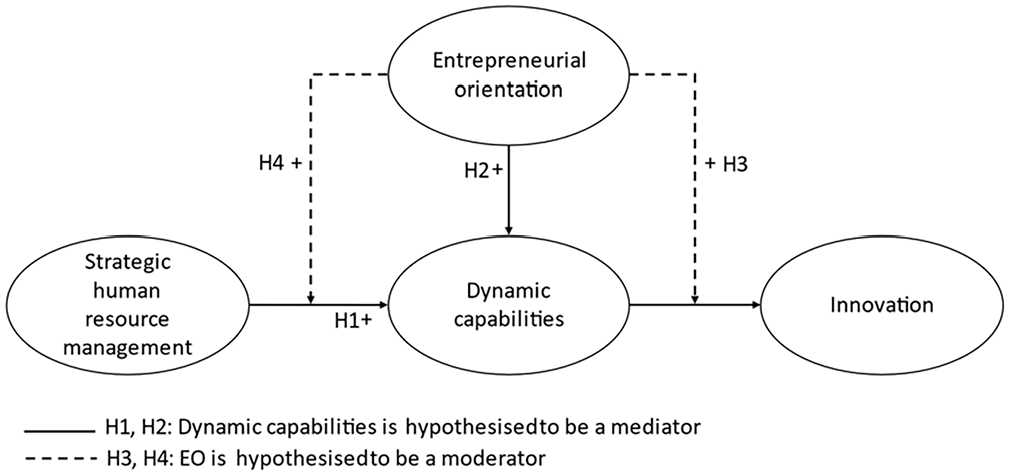
Proposed model.
Research method
Sample
Data were collected via Pureprofile, an online market research company in Australia. Pureprofile utilises a sample from an extensive database of people across gender, age, industry and locations for the study’s criteria in the Australian population. The panel approach to data collection is increasingly common, with no significant differences from traditional sources of data collection (Ghafoor and Haar, 2022). Following recommendations from previous studies (Huber and Power, 1985; Kumar et al., 1993), we elicited participants who were SME managers as potential informants for the study as they had access to the relevant information regarding strategic processes and sources of information about the whole firm.
In addition, time-lagged data were used to strengthen the relationship tested, addressing issues around common method bias (CMB; Podsakoff et al., 2003). Thus, an initial survey including our study’s IV (SHRM, dynamic capabilities and EO) was sent at wave 1, while a follow-up survey including our DVs (innovation) was sent to the same respondents to complete at wave 2 (three months apart). We also followed Podsakoff et al.’s (2003) recommendation of using procedural remedies through questionnaire design, such as guaranteeing respondent anonymity, explicitly asking respondents to answer as honestly as possible, randomly placing predictor and dependent variables in the survey, and using different formats and scale endpoint separation of the predictor and criterion variable in the survey. Lastly, we conducted Harman’s one-factor test to check for common method variance. All items were subjected to an un-rotated exploratory factor analysis. The result showed eight factors with an eigenvalue greater than 1.0. The single largest factor only accounted for 24.7% of the variance. Therefore, we conclude that common method variance was not a major issue in this current study.
A total of 1595 Australian firms were invited to participate in the study. Our final sample of 456 firms provided usable and completed data in wave 1 (response rate of 28.6%). These respondents were recontacted 3 months later to complete a wave 2 survey. Of which, 243 were matched with the wave 1 survey (i.e. 53.3% from wave 1). Most of our SMEs were from the service sector (n = 76.9%). Firm sizes included less than 50 employees (77.7%), followed by those with 50–99 employees (32%). These business sizes corresponded to the Australian definition of an SME.
Measurement of variables
For the SHRM measure, we adapted eight items from existing literature (Collins and Smith, 2006; Lepak and Snell, 2002; Takeuchi et al., 2007; Zhu et al., 2005) to capture items that focus on the alignment of specific HR practices (i.e. recruitment and selection, training and development, performance appraisal, performance management) with the organisation’s strategic goals. Example items on a five-point Likert scale (coded 1 = strongly disagree, 5 = strongly agree) include ‘performance appraisal for our employees focus on their contribution to our strategic objectives’ (Lepak and Snell, 2002); and ‘in this organisation, the training and development of the employees are in line with the overall organisation mission and objectives’ (adapted from Zhu et al., 2005). The scale’s internal reliability coefficient was 0.92.
Using the 19-item instrument developed by Pavlou and El Sawy (2011), we measured dynamic capabilities in four dimensions on a five-point scale: sensing, learning, integrating and coordinating. The sensing scale measured the firm’s ability to scan and keep up to date with changes and opportunities in the external environment. The learning items measured the firm’s routines in absorbing, assimilating and utilising new information and knowledge. Integrating items measured the ability to interconnect and utilise the various specialised knowledge in different parts of the organisation. The coordinating scale measured how the expertise and work processes of different groups were effectively synchronised and coordinated. The second-order latent variable’s internal reliability coefficient comprising sensing, learning, integrating and coordinating scales was 0.93.
We measured EO using Hughes and Morgan’s (2007) scale comprising 18 multiple-choice items on a seven-point Likert scale with measures ranging from ‘strongly disagree’ to ‘strongly agree’. The scale assessed the five dimensions of EO (Lumpkin and Dess, 1996a), including risk-taking (three items), innovativeness (three items), proactiveness (three items), competitive aggression (three items) and autonomy (six items). Risk-taking items measured the propensity of the firm to encourage risk-taking in its activities. Innovativeness items measured the extent to which firms created, improved or refined their activities for the business. Proactiveness measures the propensity to identify opportunities and take the initiative. Competitive aggressiveness measures the behavioural inclination to take a bold or aggressive approach to competition. Lastly, autonomy items measure a firm freedom and independence to engage in business activities in the firm’s interest. The scale’s internal reliability coefficient was 0.90.
Using the instrument developed by Gatignon et al. (2002), we measured competence-enhancing innovation using six items on a five-point scale (coded 1 = not at all, 5 = to a great extent). This measure is recommended for examining the competence-enhancing innovative performance in SMEs (Covin and Miller, 2014; Herrmann, 2019). The innovation scale assessed a firm’s competence-enhancing ability, that is, to reinforce and extend its current expertise. Example items include ‘Innovation was built on a great deal on the organisation’s prior skills’ and ‘Innovation built heavily on the business unit’s existing experience base’. The scale’s internal reliability coefficient was 0.85.
Control variables such as firm size, sector (manufacturing versus service) and number of years of operation were included in the analysis. These firm-level variables were found to have an association with the dependent variables (Classen et al., 2014; Klyver and Nielsen, 2021).
Measurement model estimation
Prior to hypotheses testing, we checked for the difference between manufacturing (n = 57) versus service firms (n = 190) by conducting a one-way ANOVA within SPSS v27. The analysis showed there was no statistical difference between groups. Hence, we combined the data for further statistical analyses. We also conducted a one-way ANOVA test for years of operation and firm size, both categorical variables, which showed no differences between groups.
Data analytical strategies
Using confirmatory factor analysis (CFA) with IBM AMOS version 25, we confirmed our constructs using the recommended two-step approach of Anderson and Gerbing (1988) by first undertaking a measurement model prior to testing the hypotheses with the structural model. As shown by the goodness of fit indices, the hypothesised four-factor model had a satisfactory fit (λ2/df/df = 2.049, comparative fit index (CFI) = 0.90, Tucker Lewis index (TLI) = 0.90, root mean square error of approximation (RMSEA) = 0.065, standardized root mean squared residual (SRMR) = 0.066), meeting the minimum cut-offs (Hu and Bentler, 1999). We then compared alternate models using the chi-square difference test to check for discriminant validity. Table 1 shows the CFA and comparison models indicating that the hypothesised model was the best fit. All standardised factor loadings were statistically significant and above the recommended 0.60 (Hair et al., 2010). Additionally, all average variance extracted (AVE) were above 0.50, demonstrating convergent validity. The discriminant validity of the four constructs was assured as the square root of AVE was larger than the inter-construct correlations (Fornell and Larcker, 1981).
Results of chi-square difference test.
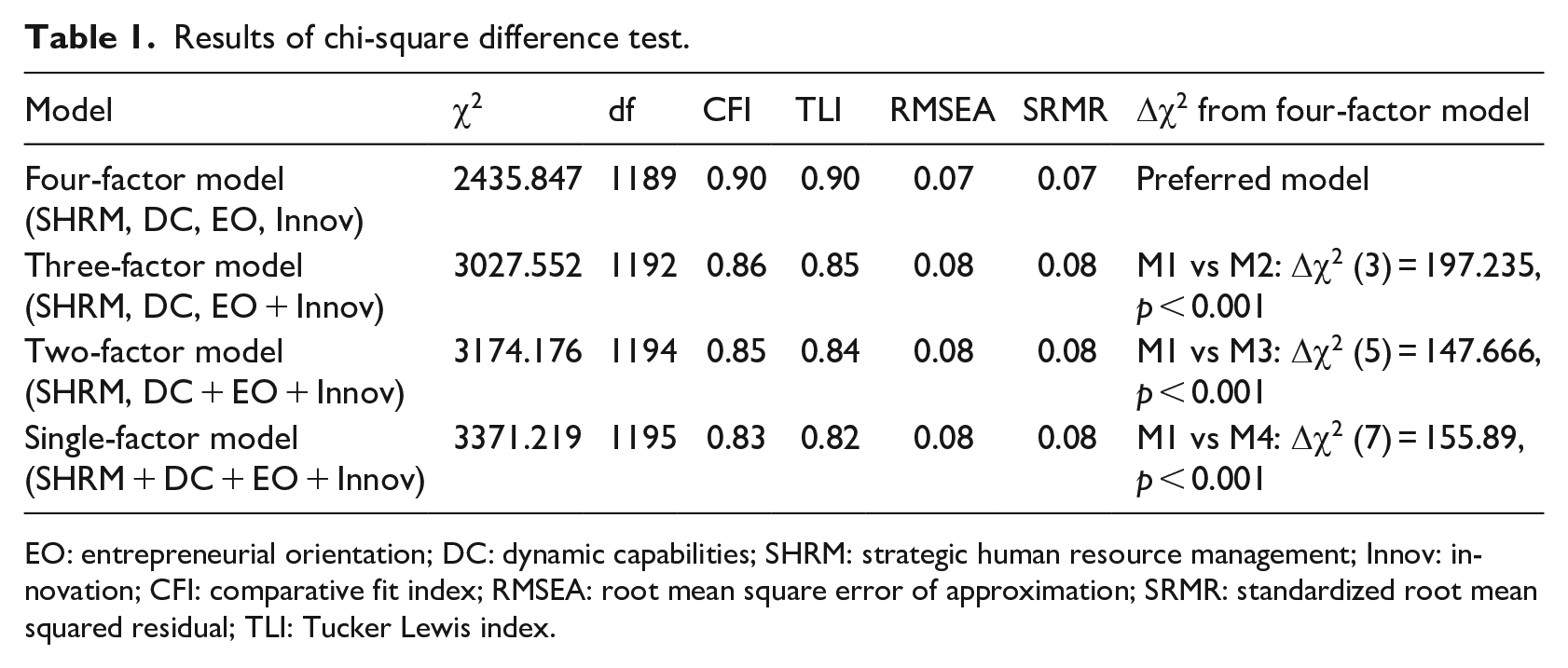
EO: entrepreneurial orientation; DC: dynamic capabilities; SHRM: strategic human resource management; Innov: innovation; CFI: comparative fit index; RMSEA: root mean square error of approximation; SRMR: standardized root mean squared residual; TLI: Tucker Lewis index.
We undertook the following procedures prior to undertaking moderation analyses (Cheung et al., 2021; Collier, 2020). Prior to computing the interaction terms to test the effects of SHRM × EO on DC and SHRM × DC on innovative performance, we computed two latent composites in IBM SPSS for path testing using IBM AMOS (Collier, 2020). (Note: In addition, we developed and estimated nine alternate models to investigate different combinations of the structural relationships among SHRM, dynamic capabilities, EO and innovation, including examining reverse causality among the variables (see Supplemental Material). The results of the analyses revealed that our hypothesised model produced the best model fit indices compared to these alternate models. Furthermore, the chi-square comparison test displayed a significantly lower Δχ² value than two of the nine alternate models. The goodness of fit indices in the remaining seven alternate models was below the minimum cut-off deemed suitable for further statistical analyses (see Supplementary Material). Our extra rigorous statistical analysis provides empirical support for the proposed theoretical model framework and hypotheses development; hence, this model was retained to examine the indirect effects hypothesised in this study.
Following Collier (2020), we adopted a mixed model method to test the moderation hypotheses within IBM AMOS. The mixed model method includes a mix of latent unobservable constructs (mediator and dependent variables) and composite interaction terms in the same model and is recommended by Collier (2020) to be appropriate for testing moderation effects in structural equations modelling. According to Collier (2020: 219), the mixed-method approach ‘accounts for the measurement error in the independent and dependent variables’. Following Collier (2020), we created two mean-centred latent composite interaction terms at high or low values of the moderators (SHRM × EO and DC × EO, respectively) to regress on the dependent variables. Model testing will then be tested for each high and low value of the latent composite of the interaction terms, control variables and the mediator and dependent variables.
Consistent with best practices in mediation analysis (Collier, 2020; Dawson, 2014; Preacher et al., 2007), indirect effect testing was conducted using IBM AMOS. Bootstrap analysis with 2000 samples and a 95% bias-corrected confidence interval was then used to determine the significance of the indirect effects (Cheung and Lau, 2008; Cheung et al., 2021). An indirect effect would be established if the 95% confidence interval (CI) lower limit and upper limit range did not pass through zero (Hayes, 2017).
Results
Mediation analyses
Table 2 reports the descriptive statistics and correlations between variables. As shown in Table 2, no statistical association existed between the control variables (years of operation, firm size and sector) and the variables of interest. Hypotheses testing was undertaken within IBM AMOS v28 using a mixed model approach to structural equation modelling (Collier, 2020). The hypothesised model was found to have a good fit with the data (λ2/df = 1.9694, CFI = 0.942, TLI = 0.933, RMSEA = 0.063, SRMR = 0.055). Results of the path analyses (see Table 3) showed no significant direct association between SHRM and innovative performance. Mediation analyses with bootstrap analysis with a 95% bias-corrected confidence interval and 2000 subsamples were then undertaken to determine the significance of the hypothesised indirect effects. There was empirical support for a mediation model (λ2 = 1137.522, df = 532, CFI = 0.926, TLI = 0.917, RMSEA = 0.068, SRMR = 0.058). The results of the path modelling provided support that the indirect effect of SHRM on innovative performance was positive and significant, as mediated by dynamic capabilities (effect = 0.281, standard error (SE) = 0.103, 95 % CI (0.105, 0.468), p = 0.008). Hence, Hypothesis 1 was supported. There was a positive direct association between EO and innovative performance as well as an indirect effect from EO to innovative performance via dynamic capabilities (effect = 0.222, SE = 0.085, 95 % CI [0.075, 0.364], p = 0.006). This finding supports Hypothesis 2.
Descriptive statistics and intercorrelations.
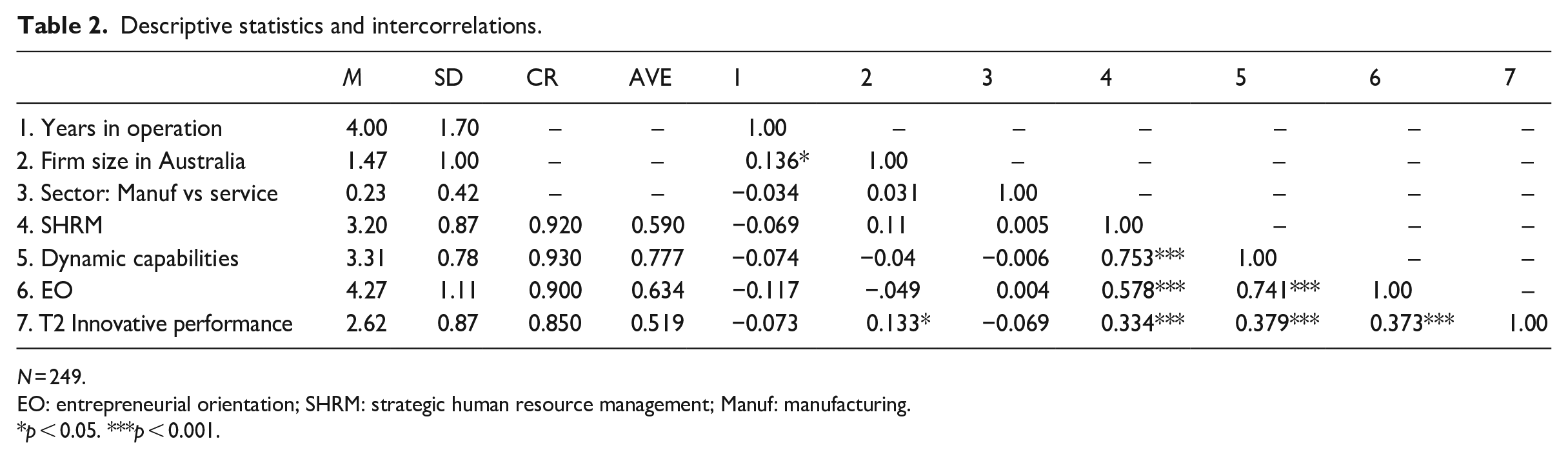
N = 249.
EO: entrepreneurial orientation; SHRM: strategic human resource management; Manuf: manufacturing.
p < 0.05. ***p < 0.001.
Results of hypotheses testing.
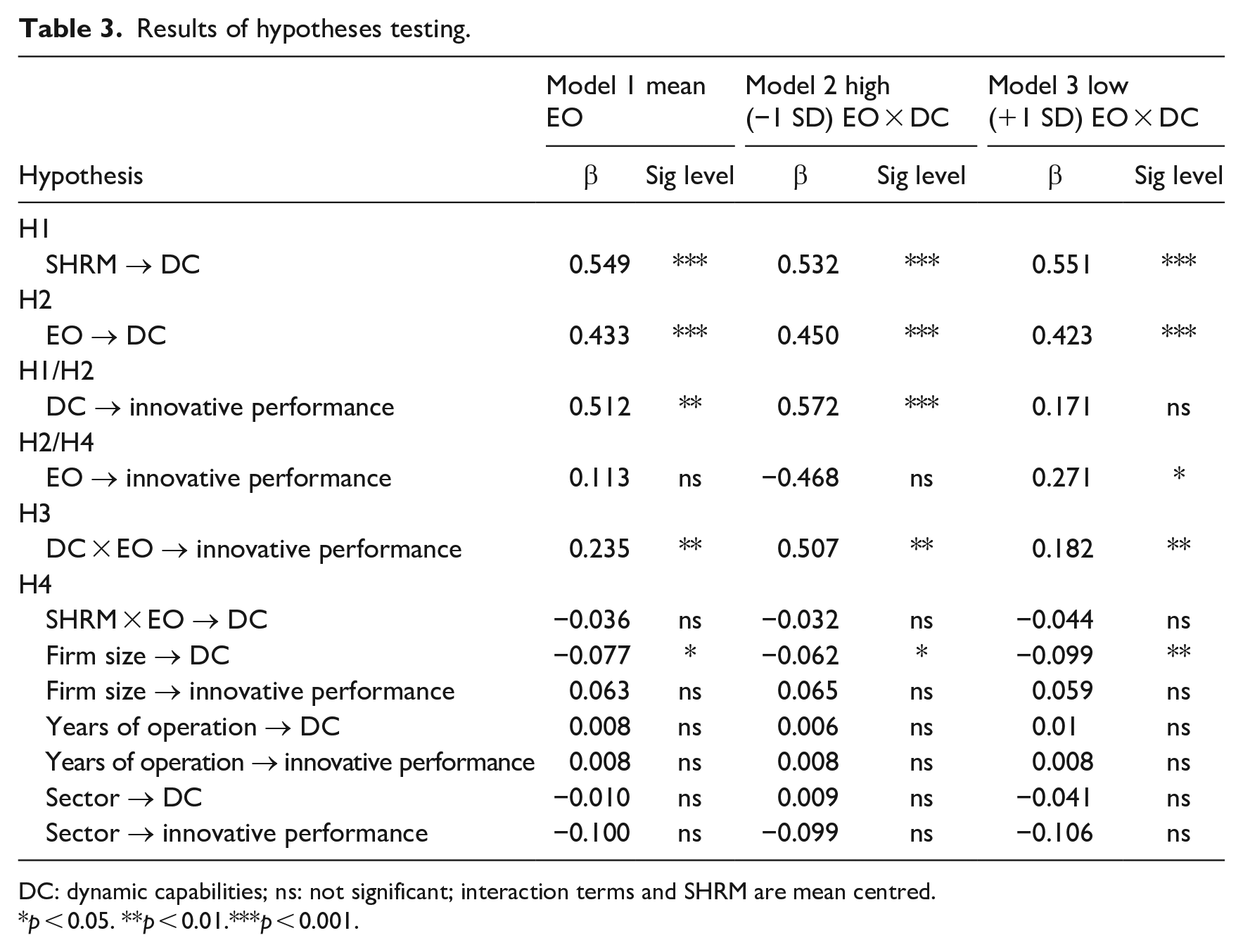
DC: dynamic capabilities; ns: not significant; interaction terms and SHRM are mean centred.
p < 0.05. **p < 0.01.***p < 0.001.
Moderation analyses
There was no support for the moderation effect of EO on the relationship between SHRM and dynamic capabilities, while EO was found to moderate the mediation of SHRM (β = 0.341, p < .001) on innovation via dynamic capabilities. The path model showed EO to positively moderate the relationship between DC and innovative performance (β = 0.330, p < 0.01). This finding supported Hypothesis 3. Surprisingly, Hypothesis 4 was not supported as EO did not moderate the association between SHRM and dynamic capabilities. As shown in Figure 2, the Johnson-Neyman plot of the moderation effect of EO × DC on innovative performance was produced using the CAHOST plot from Carden et al. (2017). The Johnson-Neyman plot shows EO to be a positive moderator of the relationship from dynamic capabilities to innovative performance.
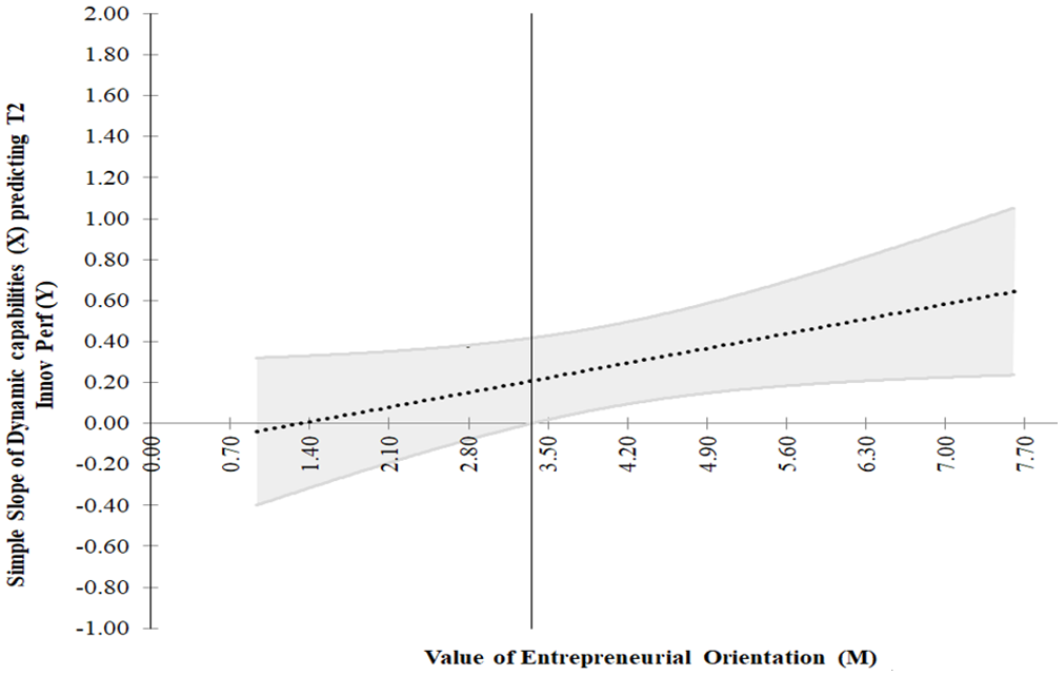
Johnson-Neyman plot showing the moderation effect of EO on dynamic capabilities and innovation.
To further examine the relationship of the moderator in greater detail (Cheung et al., 2021; Collier, 2020), we probe the moderation effect by considering different levels of the moderator, EO, at high (−1 standard deviation (SD) from the mean) and low level (+1 SD from the mean). These new moderators were separately inserted into the path model to examine how they affect the results. A simple slope analysis was then produced to show the moderation effects (see Figure 3) for high and low levels of EO as a moderator. As shown in Table 3, a high level of EO produced similar results as the path model with the mean value of EO. Surprisingly, at the low level of EO, the association between DC and innovative performance was not statistically significant (see Figure 3). Further examination of the simple plot shows that both high and low level of EO seems to influence the association between dynamic capabilities and innovative performance positively. Although, at the low level of EO, the gradient seems flatter for DC. In summary, we found support for the indirect effect of SHRM on innovative performance through dynamic capabilities is contingent on EO as the moderator of this relationship. In particular, we identify the boundary condition of the mediated moderation path model as a low level of EO did not contribute to the direct effect of DC on innovative performance.
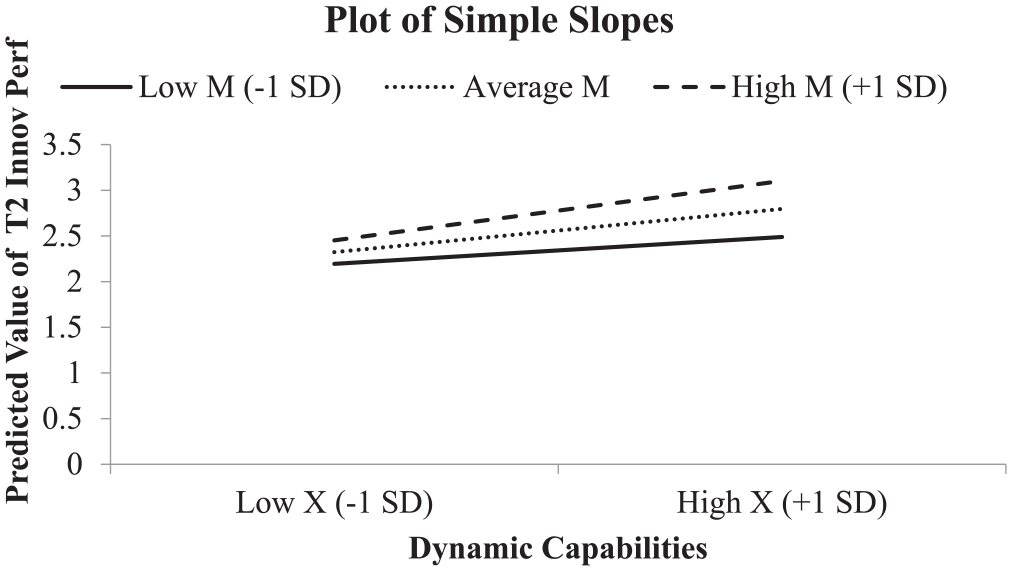
Plot of simple slopes: EO as moderator of dynamic capabilities on innovation.
Discussion
This study contributes to understanding the mechanisms of SHRM and dynamic capabilities and the influence of having an entrepreneurial SME, topic scholars have called for greater insight into its context and mechanisms (Cooke, 2018; Fallon-Byrne and Harney, 2017). Using an RBV perspective (Collins, 2021; Gerhart and Feng, 2021), our empirical study supported a moderated-mediation model of EO on the SHRM–dynamic capabilities–innovation link in SMEs. EO moderated the positive impact of dynamic capabilities on innovation. Dynamic capabilities act as a partial mediator in the relationship between EO and innovation. We discuss the implications of our results in light of the important understanding that it extends to SHRM, dynamic capabilities and EO. We follow this with a discussion of some practical implications for SMEs.
Theoretical implications
A recent but increasingly important topic to explore, the SHRM–dynamic capabilities link, has significantly influenced the SHRM and dynamic capabilities literature (Chadwick and Dabu, 2009; Harney and Alkhalaf, 2021). Consequently, emerging research has articulated a close link between SHRM and dynamic capabilities, specifying its significant effects on innovation (Seeck and Diehl, 2017), with recent work suggesting how SHRM influences dynamic capabilities in firms (Apascaritei and Elvira, 2022). We contribute to this nascent but growing research area. This article is one of the few to explore this emerging literature on the influence of SHRM and dynamic capabilities (Wang et al., 2012) and how it might influence SME innovation. In a recent review, Van Lancker et al. (2022) lamented the paucity of research that sheds light on the characteristics and processes essential for SMEs to create an effective SHRM. In line with this, our study expands on the context of SHRM–dynamic capabilities required to enable innovation by assessing the influence of ‘being entrepreneurial’ in SMEs. Thus, we address recent calls for research that identifies the factors that lead to the creation or development of dynamic capabilities, especially for SMEs (Schilke et al., 2018; Weaven et al., 2021). Additionally, this article heeds the appeal from the SHRM and EO research communities to elaborate on the supportive organisational and configurational contexts for when SHRM, dynamic capabilities and EO facilitates innovation in SMEs (Chadwick and Flinchbaugh, 2021; Wales et al., 2021).
Our study supports SHRM and EO’s positive influence on a firm’s dynamic capabilities. As expected, our findings corroborate earlier research in larger firms specifying the powerful impact of SHRM on dynamic capabilities for innovation, but in the context of SMEs. Despite their often-limited influence on market structures, access to resources and limited opportunities, SMEs must rely on the strategic alignment of their human resources to develop their dynamic capabilities. As Slater et al. (2006) earlier articulated, EO can moderate the strategy formation process in firms and result in better performance when internal organisational characteristics (such as SHRM and dynamic capabilities in our study) are interrelated and mutually reinforcing. This is in direct contrast to the broadly accepted view that SMEs have less formalised practices and their management of people less strategic (Hornsby and Kuratko, 1990); and congruent to the growing, albeit limited research demonstrating the importance of SHRM for SMEs (Barrett and Meyer, 2010; Xiu et al., 2017). Our results demonstrate that both SHRM and EO are critical in developing dynamic capabilities, even in SMEs. This necessity may be driven by the need to quickly align their human resources management and develop entrepreneurial qualities in response to environmental conditions and opportunities (Martínez-del-Río et al., 2021). Our study also adds to the growing recognition that SMEs can and should have sophisticated HRM aligned towards a firm strategy for capability development (Rauch and Hatak, 2016).
Our findings also demonstrate the importance of EO for SMEs as a boundary condition for enhancing the effects of dynamic capabilities. Our study shows that EO significantly impacts the dynamic capabilities–innovation link, especially at high levels of EO. As such, it unravels the complex nature of EO on innovation, allowing a broader perspective for EO and firm capability influences. These findings offer greater insight into how EO in SMEs helps surmount the limitations of their resource constraints and internal processes (Fallon-Byrne and Harney, 2017). We add to the literature on the influence of EO, neglected not just in understanding human resources in SMEs (Harney and Alkhalaf, 2021) but also for essential firm-level strategic capabilities (Fallon-Byrne and Harney, 2017). As several scholars have argued (Lai et al., 2017; Van Lancker et al., 2022), SHRM processes in SMEs require a theoretical recognition of the differences between SMEs from large firm paradigms and should incorporate the nuances of their internal supportive organisation and characteristics. To succeed in their competitive landscape, SMEs should not only focus on designing HRM aligned with their goals and values (Atkinson et al., 2022) but also consider their entrepreneurial qualities (Penco et al., 2022).
In our study, the presence of EO at high levels engenders an effect on dynamic capabilities, giving greater credence to scholars who theorise EO as a firm strategic resource that helps augment firm capabilities such as dynamic capabilities (Poudel et al., 2019). Another contribution is how high levels of EO moderate the effects of dynamic capabilities on innovation. This is a significant finding for SMEs, demonstrating that those with high EO leverage maximum value from their dynamic capabilities. As such, our evidence demonstrates that dynamic capabilities in SMEs may not be sufficent to provide a performance advantage, but its dependence on the contingencies of SME characteristics such as SHRM and EO is required (Arend, 2014; Zahra et al., 2006). EO is essential in creating an enabling environment for innovation, often spurring employees towards novel and creative processes, capturing new market opportunities and engaging in decisions where outcomes are uncertain (Shahzad et al., 2021). Much like their larger counterparts, SMEs enjoy the benefits of dynamic capabilities, spurring them to enjoy a limited performance advantage. However, the complexity of leveraging dynamic capabilities for sustained advantage in SMEs may lie in the heterogeneity of HRM activities and its competency-based EO, where innovation gains are achieved by managing its EO. This is consistent with several recent studies showing that careful deployment and complementary firm activities are required to strengthen EO in SMEs (Andersén, 2021; Huang et al., 2022). Thus, we contribute to the emerging literature highlighting how internal processes and characteristics may help explain the boundaries of SHRM, EO and dynamic capabilities in SMEs (Collins, 2021; Covin and Wales, 2019; Wenzel et al., 2021).
Finally, a note about EO’s surprising lack of support in moderating SHRM and dynamic capabilities: this finding concerning a non-significant moderation effect suggests several possible explanations. First, we note that despite the mitigation of threats to validity, we should note that there is a possibility that this non-significant finding may be an artefact of this particular study. However, as discussed in the EO literature, we should also note that EO may not always influence all relationships, especially when amplified by other mechanisms in the firm (Hughes and Morgan, 2007; Lumpkin and Dess, 1996a). It is possible that when EO is already strong in an SME, there is already greater organisational direction and goal clarity regarding the necessary HRM policies and practices to implement, negating any additional contribution of EO to the link between SHRM and dynamic capabilities. Alternatively, EO may affect dynamic capabilities not through HRM policies and practices but through more distal mechanisms such as knowledge management and managerial philosophies (Chen and Huang, 2009; Messersmith and Wales, 2013).
Practical implications
There are important practical implications for highlighting the relationships between SHRM, EO and dynamic capabilities in SMEs. As noted above, the important role of SHRM in developing dynamic capabilities highlights the role of HR knowledge for SMEs (Atkinson et al., 2022). This insight bodes well for SME owners and managers as evidence suggests that improving SHRM in SMEs can be achieved if owners or managers seek help or knowledge on SHRM (Martínez-del-Río et al., 2021). One recent study shows that how SHRM is aligned to their appropriate strategy and goals in the firm is just as important, suggesting that managers must also be able to match the appropriate SHRM to the correct strategies and goals required for their environment (Gahan et al., 2019). As SME circumstances change, growth and viability may necessitate changes to their internal organising and adoption of practices to overcome the challenges inherent in these changes (Desantola and Gulati, 2017; Van De Woestyne et al., 2010). Moreover, beginning with a high EO base has considerable advantages for SMEs; however, efforts to encourage EO in employees may be used for those firms lacking in EO. Studies have shown that clear HRM and organisational practices may increase EO in employees (Shahzad et al., 2021), including practices that encourage employee involvement and structures that foster the environment for EO (Hughes et al., 2020a). Consequently, scholars have recognised the potential to enervate dynamic capabilities by leveraging its EO through leadership and goal setting (Zahra et al., 2022). Finally, it is essential to note that EO in SMEs can change through temporal and strategic circumstances (Wales et al., 2011). The attention to an SME’s business model, where greater organisational support, shared vision or refocus of managerial attention will help maintain an entrepreneurial approach may be necessary.
Limitations and future research
We highlight a few potential limitations. The first relates to using a single informant for our measures; thus, CMB may have affected our results (Podsakoff et al., 2003). Although we recognise the potential effects of CMB, we have undertaken precautions to minimise CMB’s social desirability and inherent bias (Crampton and Wagner, 1994; Spector, 2006). As described above, we undertook several statistical and non-statistical remedies to check for CMB. Additionally, our time lag between independent and dependent variables would have reduced the likelihood of CMB for this study. Our recommendation following this would be for future studies to consider utilising multiple sources of ratings (e.g. from employees and other managers) and using objective sources of performance data (e.g. new products or patents created). Although this was a potential limitation in this study, objective innovation performance data are generally unavailable in a publishable form in most SME samples. Hence, we had to rely on collecting subjective performance data from the same respondents.
In addition, knowing now about the relationships between SHRM, EO and dynamic capabilities, it would be prudent to examine how environmental dynamism affects these relationships, as there is evidence to suggest that dynamic capabilities and EO are more valuable in different environmental contexts (Kim et al., 2015). This would expand the theoretical foundations of both EO and dynamic contexts, which is much needed for understanding SMEs. Additionally, we believe this also suggests a more complex analytical method that incorporates how the combination of dimensions in EO may play out as a strategic resource in different contexts and environmental conditions (Hult et al., 2003; Lisboa et al., 2016). We also encourage research examining the social (and knowledge) processes that underlie these relationships, as there is evidence to suggest that a more fine-grained analysis of the social context and processes can lead to greater insight into the antecedents and nature of our constructs (De Clercq et al., 2010, 2013). Finally, industry and sectoral contexts could also be examined as evidence suggests that different industries and sectors could have varying needs for different levels of EO and dynamic capabilities (Derbyshire, 2014). Lastly, due to the unique context of SMEs, it would be worth investigating if these issues are relevant for larger, much better-resourced firms.
Conclusion
In conclusion, our study provides empirical evidence of the relationship between SHRM, dynamic capabilities and EO in SMEs for innovation. Our model highlighted the importance of SHRM and EO for dynamic capabilities and innovation and the complex process of achieving innovation in SMEs. Thus, this study illuminated the black box mechanisms for how SHRM and EO achieve the potential of their dynamic capabilities as theorised by the RBV. This study confirms the importance of studying how SMEs deploy effective SHRM to maximise their human resources and EO for dynamic capabilities and innovation. Our findings suggest that firms consider their EO base and SHRM activities as critical antecedents to building strategic change capabilities to increase innovation. By illuminating these processes, we add to the limited body of work on SHRM, dynamic capabilities and EO for the complex process of achieving innovation in SMEs.
Supplemental Material
sj-docx-1-isb-10.1177_02662426231201761 – Supplemental material for Influence of strategic HRM and entrepreneurial orientation on dynamic capabilities and innovation in small- and medium-sized enterprises
Supplemental material, sj-docx-1-isb-10.1177_02662426231201761 for Influence of strategic HRM and entrepreneurial orientation on dynamic capabilities and innovation in small- and medium-sized enterprises by Marcus Ho, Christine Soo, Amy Tian and Stephen TT Teo in International Small Business Journal
Footnotes
Funding
The author(s) received no financial support for the research, authorship, and/or publication of this article.

Supplemental material
Supplemental material for this article is available online.
Author biographies
References
Supplementary Material
Please find the following supplemental material available below.
For Open Access articles published under a Creative Commons License, all supplemental material carries the same license as the article it is associated with.
For non-Open Access articles published, all supplemental material carries a non-exclusive license, and permission requests for re-use of supplemental material or any part of supplemental material shall be sent directly to the copyright owner as specified in the copyright notice associated with the article.
