




Abstract
This research challenges the a priori classification of time pressure and job complexity as challenge stressors and seeks to illuminate the emergence of different appraisal configurations using a latent profile approach. The sample consisted of 629 employees (66.1% male). Employees who appraised time pressure and job complexity as challenges reported higher job satisfaction and work engagement and felt less emotionally exhausted and mentally stressed compared to those with dominant hindrance/threat appraisals. Employees who report to be more resilient and have autonomy are more likely to fall into a Dominant Challenge Appraisal profile. Those who face high emotional demands are more likely to be in a Dominant Hindrance/Threat Appraisal profile. This research offers a fresh perspective on why it is essential for employers to consider their teams’ perceptions and resources when introducing new tasks or deadlines. By providing employees with adequate resources, organizations can promote a more adaptive approach to work challenges.
1. Introduction
Occupational stressors, such as time pressure and job complexity, increase strain symptoms (e.g. anxiety, exhaustion; Ford et al., 2014), but they can also promote learning and motivation (LePine et al., 2005; Prem et al., 2017). The challenge–hindrance framework of occupational stress addresses these ambiguous effects, distinguishing between challenge demands and hindrance demands (Cavanaugh et al., 2000). Challenge demands, such as time pressure and job complexity, have potential benefits for individuals, whereas hindrance demands, such as role ambiguity, role conflict, and emotional demands, constrain work performance (Cavanaugh et al., 2000; LePine et al., 2005). However, the predefined categorization is questionable given that individual differences in stressor appraisals, influenced by personal and situational demands and resources, play a critical role in determining whether a stressor is viewed as a hindrance or challenge (LePine, 2022; Mazzola and Disselhorst, 2019; Schilbach et al., 2023a). Unfortunately, the challenge–hindrance literature lacks research on appraisal antecedents and their interplay across different appraisals, which is particularly important given the simultaneous presence of challenge, hindrance, and threat appraisals (Searle and Tuckey, 2017).
We are aware of only one recent study that used a person-centered approach to explore combinations of challenge and threat appraisals in relation to action errors in a sample of entrepreneurs (Kleine et al., 2023). Previous research has shown that stressors can be simultaneously appraised as challenging, hindering, and threatening (e.g. Searle and Auton, 2015; Webster et al., 2011). In our study, we extend Kleine et al.’s (2023) approach and take a broader perspective by examining profiles based on challenge, hindrance, and threat appraisals of two common workplace stressors: time pressure and job complexity. We recognize that different individuals may appraise these stressors dominantly as challenging, hindering, or threatening, or simultaneously as challenging and hindering or threatening.
Previous research on stressor appraisals has primarily focused on outcomes of appraisals (e.g. Casper and Wehrt, 2022; Kronenwett and Rigotti, 2022), or individual traits (e.g. self-efficacy; Jerusalem and Schwarzer, 1992), or states (e.g. recovery; Casper and Wehrt, 2022) that predict appraisal. This research contributes to the scholarship by focusing on potential contextual predictors (i.e. job demands and resources) to better understand how different appraisals of the same stressors can be explained with implications for job design. Furthermore, our approach enables a systematic comparison of multiple subgroups within the population. By comparing these subgroups, we can identify differences in how they appraise events and determine if certain groups are more vulnerable to specific stressors than others. This analysis sheds light on the interplay of stressor appraisals and their implications for individual responses in various work settings.
The person-centered approach offers a nuanced understanding of the relationship between individuals and their appraisals of time pressure and job complexity, contributing to theoretical advances. It can help to refine existing theories (e.g. transactional stress theory; Lazarus and Folkman, 1984, and the challenge–hindrance framework; Cavanaugh et al., 2000) by incorporating individual differences and emphasizing the role of appraisal profiles. The identification of specific profiles has practical implications, enabling exploration of factors that contribute to adaptive or maladaptive responses. This insight can inform interventions and support systems for employees by focusing on those at risk of particular outcomes or addressing specific needs when tailoring interventions to enhance employee well-being and performance. Overall, adopting a person-centered approach enriches the literature by acknowledging individual differences, identifying adaptive strategies, uncovering outcomes and implications, guiding interventions, and advancing theory in the field.
2. The role of cognitive appraisal in evaluating workplace stressors and implications for well-being
Cognitive appraisals have been identified as playing a fundamental role in the experience of stress (Lazarus and Folkman, 1984; Roesch et al., 2002), which are defined as “an evaluative process that determines why and to what extent a particular transaction or series of transactions between the person and the environment is stressful” (Lazarus and Folkman, 1984: 19). Proponents of the transactional model of stress and coping (Lazarus and Folkman, 1984) distinguish between primary and secondary appraisal. Primary appraisal refers to the evaluation of the demand/event as challenging, harmful, or threatening. Secondary appraisal is the evaluation of the coping resources available to deal with the stressor. Three broad categories of appraisals are identified in relation to workplace stressors. Challenge appraisals refer to the potential for growth and learning (Lazarus, 1991b). Job demands appraised as a hindrance are perceived as barriers to achieving personal goals and are associated with feelings of frustration (Searle and Auton, 2015). Threat appraisals indicate perceived potential for harm or loss to the self or significant others (Lazarus and Folkman, 1984). The transactional theory of stress (Lazarus and Folkman, 1984) suggests that different appraisals of demands are not mutually exclusive, but can occur simultaneously. Previous studies incorporating primary appraisal processes into the challenge–hindrance framework have shown that, for example, learning demands are positively associated with both challenge and hindrance appraisals within the same person (Prem et al., 2017), suggesting that appraisals may not be mutually exclusive.
Appraisals play a prominent role in understanding the relationship between workplace stressors, mental health, and other outcomes (Lazarus, 1991b; Roesch et al., 2002). For example, challenge appraisals are related to positive outcomes like learning (Prem et al., 2017), motivation (Liu and Li, 2018), and work engagement (Mitchell et al., 2019). On the contrary, threat appraisals are associated with negative outcomes such as anxiety and anger (Tuckey et al., 2015), and hindrance appraisals are positively related to job dissatisfaction (Webster et al., 2011). Empirical work has emphasized the importance of appraisal processes in challenge–hindrance stress research (e.g. Tuckey et al., 2015; Webster et al., 2011). However, research on the appraisal of work-related stressors has predominantly relied on variable-centered analyses (e.g. Kim and Beehr, 2020).
Based on previous empirical and theoretical work (e.g. Lazarus and Folkman, 1984; Tuckey et al., 2015), there are likely to be systematic differences in the patterns of appraisals that characterize different subpopulations. Heterogeneity may arise from social, intraindividual, or contextual differences that influence appraisals. The transactional model of stress (Lazarus and Folkman, 1984) proposes that the background of available situational resources, demands, or perceived individual capacities may influence primary appraisal (Lazarus and Folkman, 1984; Schilbach et al., 2023a). This underscores the importance of situational resources or demands in shaping appraisal processes.
2.1. Why time pressure and job complexity may be appraised differently
We focus on appraisals of time pressure (i.e. the subjective perception of working faster than usual to complete work-related tasks; Stiglbauer, 2018) and job complexity (i.e. a condition that requires new approaches to problem solving and the use of a range of highly trained skills; Chung-Yan, 2010; Giebe and Rigotti, 2022). Time pressure and job complexity are typically categorized as challenge stressors (Cavanaugh et al., 2000), although there is evidence of between-person variability in their appraisal (e.g. Searle and Auton, 2015). Conversation of resources theory (COR; Hobfoll, 1989, 2001) proposes that individual differences in subjective appraisals are more likely and more important when the stressor itself is ambiguous. Time pressure has been found to be perceived simultaneously as a challenge and hindrance (Searle and Auton, 2015; Webster et al., 2011), and mixed findings have been reported regarding its relationship to work engagement, positive affect, or performance (e.g. Mazzola and Disselhorst, 2019). Job complexity, on the contrary, has been shown to be more consistently associated with motivational gains (e.g. Chung-Yan, 2010; Jamil et al., 2017; Van Der Vegt et al., 2000).
Considering the person or context may explain why these stressors produce ambiguity in appraisals. For example, time pressure may be viewed as a challenge when individuals have autonomy in their approach, but it may be seen as a hindrance or threat when lacking resources. Furthermore, time pressure can be characterized as a quantitative demand and job complexity as a qualitative characteristic of one’s job (Schilbach et al., 2023b; van Veldhoven, 2014). Qualitative demands have been shown to suppress the challenging effects of quantitative demands (Schilbach et al., 2023b), emphasizing the importance of studying appraisals of both quantitative and qualitative job characteristics together.
Although a person-centered approach is explorative (Howard and Hoffman, 2018), we can assume certain patterns in person-centered profiles. First, appraisal may be variable across stressor types (stressor variable) or consistent across stressors (stressor consistent). Subpopulations may exhibit a particular appraisal disposition (e.g. time pressure appraised only as a challenging demand) based on their individual resources, leading to consistent appraisal of stressors (Lazarus and Folkman, 1984; Searle and Tuckey, 2017). Therefore, it is reasonable to expect profiles that consistently appraise stressors as challenge, hindrance or threat regardless of their type.
Conversely, subpopulations may have different appraisals of different stressors depending on the resources available to meet those demands (Lazarus and Folkman, 1984). For example, job complexity may be appraised as a challenge if the employee has the training and capability to meet the demands of that complexity, but appraised as a threat if such resources are unavailable. Second, according to the transactional theory of stress (Lazarus, 1991b; Lazarus and Folkman, 1984), appraisals of stressors are not exclusive (balanced). For example, time pressure can be simultaneously appraised as both a challenge and a hindrance demand (Searle and Auton, 2015) and job complexity has been shown to be positively associated with both challenge and hindrance appraisals (e.g. Liu and Li, 2018). Furthermore, there may be subpopulations in which a particular type of appraisal is more dominant. Therefore, we propose the following:
Hypothesis 1. Challenge, hindrance, and threat appraisals of time pressure and job complexity will identify distinct profiles that may include (a) appraisal dominant profiles: high challenge/low hindrance appraisal profile, (b) appraisal balanced profiles: high challenge/high hindrance appraisal profile or a high challenge/high threat appraisal profile.
3. Differences in appraisal processes with employee health and well-being
To evaluate differences between appraisal profiles, we examined four work-related outcomes: job satisfaction, work engagement, emotional exhaustion, and cognitive irritation. Analyzing these outcomes allowed us to gain insights into how the appraisal profiles impact employee well-being. Notably, the significance of strain-related factors (e.g. emotional exhaustion) and motivational aspects (e.g. work engagement) has been emphasized in the research on challenge–hindrance stress over the past two decades (Crawford et al., 2010; Mazzola and Disselhorst, 2019; Podsakoff et al., 2007). By focusing on these specific outcomes, we can offer a deeper understanding of the framework’s implications concerning various appraisal profiles.
Job satisfaction is a positive emotional state resulting from one’s appraisal of one’s job (i.e. appraisal of one’s job; Locke, 1976), whereas work engagement is a positive state of fulfillment characterized by vigor, dedication, and absorption (Schaufeli et al., 2006). As an indicator of work-related strain, emotional exhaustion is the central quality of burnout, characterized by feelings of emotional overload (Maslach and Jackson, 1984). Cognitive irritation represents a lack of ability to mentally detach from work (Mohr et al., 2005).
Previous studies have shown that challenge, hindrance, and threat appraisals are associated with the employee health and well-being outcomes considered in this study. For example, hindrance appraisals were positively associated with job dissatisfaction (Webster et al., 2011), emotional exhaustion (Charkhabi, 2019), and work-related rumination (von Hippel et al., 2019), and negatively associated with work engagement (Li et al., 2020). In a longitudinal study, hindrance appraisal was positively associated with emotional exhaustion and negatively associated with job satisfaction with a time lag of 17 months (Paškvan et al., 2016). Similarly, threat appraisal has been positively associated with emotional exhaustion (Glaser and Hecht, 2013; Palmwood and McBride, 2019) and rumination (Kamijo and Yukawa, 2018), and negatively associated with job satisfaction (Cash and Gardner, 2011) and work engagement (Smith et al., 2022). Conversely, challenge appraisal processes have been shown to be negatively related to emotional exhaustion (Parker et al., 2019b), rumination (von Hippel et al., 2019), but positively related to job satisfaction (Malik, 2015) and work engagement (von Hippel et al., 2019). Thus, we propose that there are significant differences in employee health and well-being outcomes between the different appraisal profiles:
Hypothesis 2. Profiles that are dominantly characterized by high challenge/low hindrance appraisals will show (H2a) higher job satisfaction and work engagement (H2b), and lower emotional exhaustion (H2c) and cognitive irritation (H2d) compared to profiles with higher hindrance or threat appraisals (e.g. a high challenge/high hindrance appraisal profile or a high challenge/high threat appraisal profile).
4. Resources and job demands as correlates of appraisal profile membership
We also examined three resources (i.e. perceived capacity for resilience, work methods autonomy, and organizational social support) and job demands (i.e. role conflict, role ambiguity, and emotional demands) as correlates of appraisal profile membership. Resources are defined as “those objects, personal characteristics, conditions or energies that are valued in their own right, or that are valued because they act as conduits to the achievement or protection of valued resources” (Hobfoll, 2001: 339). Conversely, job demands are “physical, psychological, social, or organizational aspects of the job that require sustained physical and/or psychological effort and are therefore associated with certain physiological and/or psychological costs” (Bakker and Demerouti, 2017: 274). Transactional stress theory (Lazarus, 1991a) proposes that primary and secondary appraisals are interrelated and depend on the availability of resources that facilitate coping with demands. When individuals have sufficient resources to cope with a situation, stressful conditions may be appraised as less harmful or threatening. Likewise, resources may directly affect primary appraisals by helping to reduce the anticipated negative effects of demands (Lazarus, 1991a). Similarly, the cognitive–motivational–emotive system model (Smith and Lazarus, 1990) suggests that individual and situational factors (e.g. resources and demands) influence the appraisal process, which in turn determines emotional responses (e.g. subjective experiences or affective states). Relatedly, COR theory (Hobfoll, 1989) suggests that individuals must invest resources to protect themselves from resource loss, recover from resource loss, and acquire future resources. Thus, employees’ perceived capacity for resilience, work methods autonomy, and organizational social support may increase the likelihood of appraising job stressors such as time pressure and job complexity as challenging (cf. González-Morales and Neves, 2015; Lin et al., 2014).
Employee resilience, defined as “the capacity of employees to utilize resources to continually adapt and flourish at work” (Kuntz et al., 2016: 460), has gained attention in organizational stress research (Britt et al., 2016; King et al., 2016) and reflects one’s overall sense of coping self-efficacy (Crane et al., 2019). Theoretical work has suggested that appraisals of stressors may be related to an individual’s resilience capacity, because resilience acts as a catalyst for high positive emotionality, which in turn positively affects the emotion regulatory system (Fredrickson, 2004; Tugade and Fredrickson, 2004). This proposition has been supported by empirical evidence that resilience reduces the likelihood of perceiving demands as threatening (Tugade and Fredrickson, 2004). Thus, perceived capacity for resilience is likely to predict appraisal profile membership.
The Demand–Control model (Karasek and Theorell, 1992) and the Job Characteristics model (Hackman and Oldham, 1976) emphasize the roles of autonomy and social support as key job resources. Autonomy is defined as the degree of freedom and independence to perform work tasks (Morgeson and Humphrey, 2006; Nielsen et al., 2017) and is expected to influence employees’ perceived stress (Buhr et al., 2019). In this study, we focus on work methods autonomy, which represents employees’ sense of job control, including the freedom to determine the methods used to complete work tasks (De Spiegelaere et al., 2016). The ability to decide how to perform work tasks (i.e. methods autonomy) is likely to influence primary appraisal of demands because autonomy increases the available repertoire of actions (cf. Fredrickson, 2004) and the timing of those actions, thereby increasing perceived ability to cope with demands. Secondary appraisal, which refers to the evaluation of one’s coping resources and options for dealing with a stressful situation (Lazarus and Folkman, 1984) has been shown to be positively related to challenge appraisal (Szkody and McKinney, 2020). More specifically, a study by de Henestrosa et al. (2023) showed that autonomy is positively related to challenge appraisal of demands. Organizational social support is the degree and amount of opportunities to receive advice and assistance from supervisors and coworkers (Morgeson and Humphrey, 2006). The mechanisms through which social support operates include emotional support (providing empathy and understanding), instrumental support (providing tangible resources and assistance), informational support (sharing knowledge and guidance), and appraisal support (providing feedback and recognition; Langford et al., 1997). Through these means, social support can contribute to employees’ psychological well-being by reducing stress levels (Baethge et al., 2020). In addition, social support has been shown to be positively associated with challenge appraisals of demands (e.g. Ben-Zur and Michael, 2007). Thus, perceived resilience, social support, and methods autonomy are thought to potentially shape employee demand appraisal. Accordingly, we propose the following:
Hypothesis 3. Resources (i.e. employee resilience H3a, work methods autonomy H3b, and social support H3c) will be associated with profile membership. Specifically, greater resources will be associated with an increased likelihood of being in a dominant high challenge/low hindrance appraisal profile for time pressure and job complexity, compared with profiles with higher hindrance or threat appraisals (e.g. a high challenge/high hindrance appraisal profile or a high challenge/high threat appraisal profile).
The presence of (hindrance) job demands may deplete resources (Hobfoll, 1989, 2011) and influence the appraisal process, such that high demands increase the likelihood of appraising situations as more hindering or threatening (Lazarus, 1991a). For our study, we selected role conflict, role ambiguity, and emotional demands. Such demands have been shown to be robustly associated with increased psychological symptoms of strain (LePine et al., 2005), emotional exhaustion (e.g. van den Broeck et al., 2010), agitation and anxiety (Stiglbauer, 2018), decreased job satisfaction (e.g. Ritter et al., 2016), and well-being (Widmer et al., 2012).
Role conflict occurs when individuals face different tasks or conflicting demands (e.g. responding to simultaneous role pressures), whereas role ambiguity represents the amount of ambiguity a person perceives in their environment (e.g. lack of clarity about what is expected; Ritter et al., 2016; Schmidt et al., 2014). Emotional demands are interactions at work that are emotionally taxing (e.g. the misbehavior of coworkers or customers) and can be considered an antecedent of work-related strain (Xanthopoulou et al., 2013). The rationale for explicitly considering these three demands is based on claims made by COR theory (Hobfoll, 2001). According to COR theory, the consideration of subjective appraisals is more important when demands are ambiguous in nature, as opposed to demands that are considered unambiguous. Thus, these particular demands were selected because they tend to show greater between-person consistency in being appraised as hindering or threatening (e.g. Li et al., 2020; Webster et al., 2011), as opposed to time pressure and job complexity, making them more likely to influence appraisal processes, rather than being candidates for observing variable appraisal subpopulations. To substantiate this assumption, we present results of a latent profile analysis based on challenge, hindrance and threat appraisal of role ambiguity, role conflict, and emotional demands in the Online Supplement (S3). Results indicate that compared with time pressure and job complexity these demands are much less ambiguous, and are dominantly appraised as hindrance, and threats. It is proposed that these demands influence the appraisal of time pressure and job complexity. Formally, stated:
Hypothesis 4. Job demands (i.e. role conflict H4a, role ambiguity H4b, and emotional demands H4c) would be associated with profile membership. Specifically, greater job demands will be associated with a lower likelihood of being in a dominant challenge appraisal profile for time pressure and job complexity, compared to profiles with higher hindrance or threat appraisals (e.g. a high challenge/high hindrance appraisal profile or a high challenge/high threat appraisal profile).
Figure 1 depicts the conceptual model of this study.
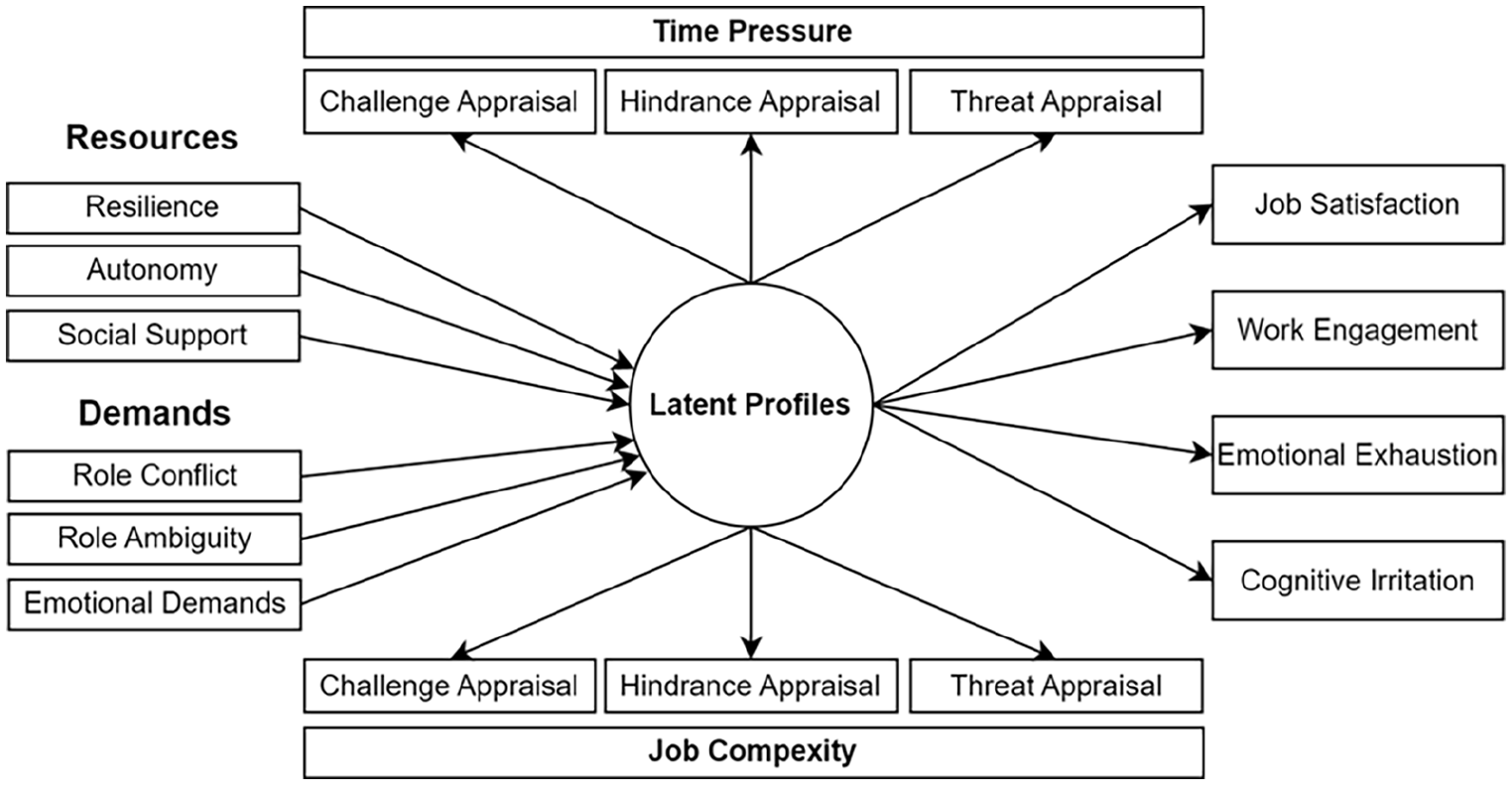
Conceptual model diagram.
5. Method
5.1. Participants and procedure
A portion of the participants were recruited from a multinational company using paper-and-pencil questionnaires (59.9%). All other participants were recruited via e-mail or an online survey link posted on social networking sites (e.g. Facebook, Xing, LinkedIn). We collected data with a 2-month time lag to minimize common method bias (Podsakoff et al., 2003).
Previous research on occupational stress and appraisals has shown that several weeks are adequate to examine the effects of appraisals on work outcomes (e.g. Kim and Beehr, 2020). The Time 1 (T1) survey included measures of sociodemographic variables, the potential predictors of latent class profile membership (resources, and job demands), and the various measures of appraisals related to time pressure and job complexity. The Time 2 (T2) survey included measures of the outcome variables (i.e. job satisfaction, work engagement, emotional exhaustion, and cognitive irritation).
At T1, 728 participants responded, 99 participants had to be excluded because they had more than 30% missing data on relevant variables (Hair et al., 1998) or did not consent to the study conditions. Thus, 629 participants were included in the latent profile analysis. We examined potential differences between the data sources on demographic variables measured at T1. Results showed that more males worked in the multinational company (94.8% male) compared with individuals from the convenience sample survey (35.1% male), (χ2 = 245.72, p < .001). In addition, participants from the company were slightly older (M = 6.50, SD = 2.45) than the convenience sample participants (M = 4.96, SD = 2.36), t = –7.84, p < .01). 1
In the T1 sample, 66.1% were male and worked an average of 35.55 (SD = 6.41) hours per week. Most of the participants (19.3%) were between 51 and 55 years of age and worked in the private sector (75.5%), followed by the public service sector (10.3%), other (12.7%), and religious institutions (1.4%). The majority of participants held a vocational degree (60.1), followed by a college degree (university degree, 19.8%), a higher vocational education (13.7%), no education (5.9%), or a PhD (0.5%). With a 51% response rate at T2, 371 responses were received. Of these, 293 participants were successfully matched using a participant-generated survey code. Latent profiles were based only on T1 data (n = 629), which had sufficient sample size to generate meaningful profiles.
5.2. Measures
Unless otherwise noted, the response format ranged from 1 (strongly disagree) to 5 (strongly agree).
5.2.1. Primary appraisal (T1)
Challenge, hindrance, and threat appraisals of time pressure and job complexity were assessed for each stressor with two items. The two items for challenge appraisal were “I appraise time pressure [job complexity] as a personal challenge to me,” and “I appraise time pressure [job complexity] as an opportunity to develop myself further” (cf. Gerich, 2017; Searle and Auton, 2015). Both scales yielded satisfactory reliability (.75 for time pressure and .81 for job complexity; split-half). The two items for hindrance appraisal were “I appraise time pressure [job complexity] as something that hinders any achievements at work” and “I appraise time pressure [job complexity] as something that restricts my capabilities” (cf. Searle and Auton, 2015). The two scales yielded satisfactory reliability (.71 for time pressure and .81 for job complexity; split-half). To measure threat appraisal, we used an adapted version of Feldman et al.’s (2004) threat appraisal scale. The two items for threat appraisal were “I appraise time pressure [job complexity] as a threat to my work” and “I appraise time pressure [job complexity] as something that is going to have a negative impact on me.” Both scales showed satisfactory reliability (.75 for time pressure and .82 for job complexity; split-half).
5.2.2. Resources (T1)
The perceived capacity for resilience was assessed using a validated German 10-item version of the Connor-Davidson Resilience Scale (CD-RISC; Connor and Davidson, 2003; Sarubin et al., 2015). Participants responded to items (e.g. “I can deal with whatever comes my way”) on a scale ranging from 1 (strongly disagree) to 7 (strongly agree). The scale had satisfactory reliability (α = .88). Social support and work methods autonomy were operationalized with a German version of the Work Design Questionnaire (WDQ; Morgeson and Humphrey, 2006; Stegmann et al., 2010). Six items assessed social support from supervisors and colleagues (e.g. “My supervisor is concerned about the welfare of the people that work for him or her”) and three items assessed work methods autonomy (e.g. “The job allows me to make decisions about the methods I use to complete my work”). Both scales showed satisfactory reliability (α = . 87 and .78, respectively).
5.2.3. Job demands (T1)
Job demands (i.e. role conflict, role ambiguity, and emotional demands) were measured using the Copenhagen Psychosocial Questionnaire (COPSOQ, Nübling et al., 2005) on a scale ranging from 1 (to a very small extent) to 5 (to a very high extent) for role conflict and role ambiguity, and from 1 (never) to 5 (always) for emotional demands. Role conflict was measured with four items (e.g. “Do you sometimes have to do things which ought to have been done in a different way?”) and role ambiguity was measured with four reversed items from the role clarity scale (e.g. “Does your work have clear objectives?”) (reversed). Previous research has shown that role ambiguity and role clarity can be used interchangeably, as role ambiguity is the opposite of role clarity (Ritter et al., 2016). Emotional demands were measured with three items (e.g. “Is your work emotionally demanding?”). All scales showed satisfactory reliability (role conflict α = .77; role ambiguity α = . 81; emotional demands α = . 84).
5.2.4. Job satisfaction (T2)
Job satisfaction was assessed using three items from the Measuring Quality of Work questionnaire (MQW; Steffgen et al., 2015) (e.g. “Are you satisfied with your work?”). The scale showed satisfactory reliability (α = .78).
5.2.5. Work engagement (T2)
Work engagement was assessed using nine items from the Utrecht Work Engagement Scale (UWES; Schaufeli et al., 2006) on a seven-point scale ranging from 1 (never) to 7 (always). A sample item is “At my work, I feel bursting with energy” (α = .96).
5.2.6. Emotional exhaustion (T2)
Emotional exhaustion was measured with three items from a German version of the Maslach Burnout Inventory (MBI; Büssing and Perrar, 1992; Maslach and Jackson, 1984) (e.g. “I feel emotionally drained from my work”). The scale showed satisfactory reliability (α = .87).
5.2.7. Cognitive irritation (T2)
Cognitive irritation was measured with three items from the Irritation Scale (Mohr et al., 2005) on a scale ranging from 1 (strongly disagree) to 7 (strongly agree). A sample item is “Even at home, I often think of my problems at work” (α = .89).
5.2.8. Control variables
Age, gender, and educational level were used as control variables to predict profile membership. Previous research has shown that these variables influence how individuals appraise situations or stressors (Aldwin et al., 1996; Gerich, 2017). In addition, we included occupation as an additional covariate because previous studies have suggested that contextual variables may also affect how individuals appraise stressors (González-Morales and Neves, 2015; Liu and Li, 2018). Accordingly, the COR theory (Hobfoll, 2011) suggests that individuals share common appraisals related to the occupation in which they work. Specifications on the coding of the control variables used are presented in Table 1.
Means, standard deviations, and correlations among the study variables.
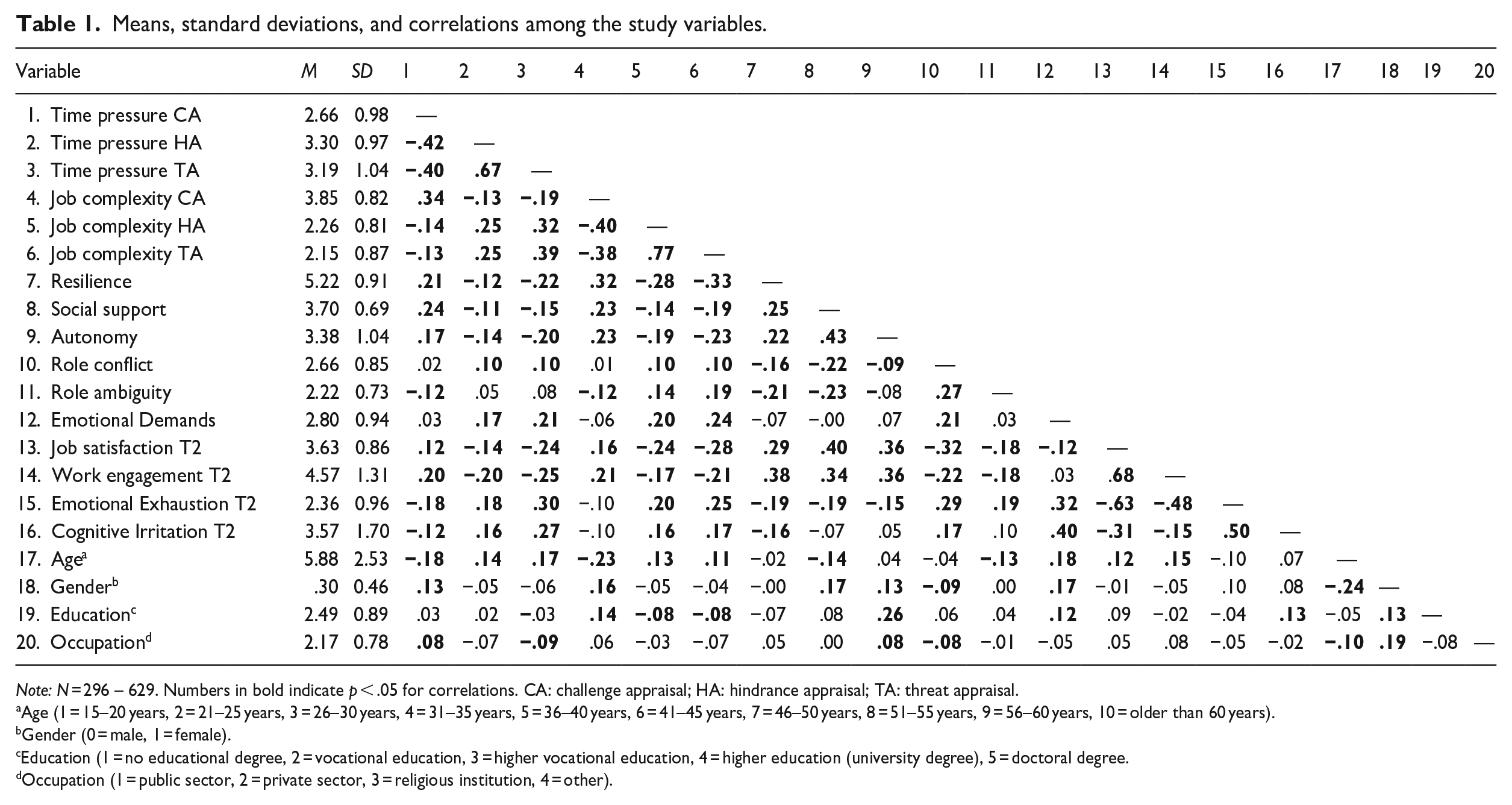
Note: N = 296 – 629. Numbers in bold indicate p < .05 for correlations. CA: challenge appraisal; HA: hindrance appraisal; TA: threat appraisal.
Age (1 = 15–20 years, 2 = 21–25 years, 3 = 26–30 years, 4 = 31–35 years, 5 = 36–40 years, 6 = 41–45 years, 7 = 46–50 years, 8 = 51–55 years, 9 = 56–60 years, 10 = older than 60 years).
Gender (0 = male, 1 = female).
Education (1 = no educational degree, 2 = vocational education, 3 = higher vocational education, 4 = higher education (university degree), 5 = doctoral degree.
Occupation (1 = public sector, 2 = private sector, 3 = religious institution, 4 = other).
5.3. Confirmatory factor analyses and average variance extracted
To determine the conceptual distinctiveness for the different appraisals related to time pressure and job complexity, we conducted three confirmatory factor analyses (CFAs). A single-factor CFA with loadings of all appraisals on one factor provided a poor fit to the data (χ2 = 1587.12, df = 54, CFI = .55, TLI = .45, RMSEA = .21). In the next model, a four-factor structure was used, with challenge appraisals related to time pressure and job complexity loading on two different factors. Hindrance and threat appraisals for each stressor were loaded on the same factor, resulting in four latent factors. This model showed a better fit than the single-factor model (χ2 = 159.52, df = 48, CFI = .97, TLI = .96, RMSEA = .06). In a third model, a six-factor model was used in which challenge, hindrance, and threat appraisal for time pressure and job complexity were loaded onto six different latent factors (three latent factors for time pressure and three for job complexity). This six-factor model showed better fit than the four-factor model (χ2 = 117.19, df = 39, CFI = .98, TLI = .96, RMSEA = .06) and consistent with previous research indicates that hindrance and threat appraisals are distinct constructs (Tuckey et al., 2015). We also tested a bi-factor model that simultaneously included two factors, with one factor including the appraisals of time pressure, and a second factor including appraisals of job complexity as well as three factors distinguishing between challenge, hindrance, and threat appraisals, regardless of which demand was rated. This model showed a slightly poorer fit than the six-factor model (χ2 = 131.83, df = 36, CFI = .97, TLI = .95, RMSEA = .07).
To further test the discriminant validity of time pressure and job complexity hindrance and threat appraisals, average variance extracted (AVE) was calculated (cf. Min et al., 2015; Tuckey et al., 2015). AVE values (time pressure hindrance appraisal AVE = .56, time pressure threat appraisal AVE = .60, job complexity hindrance appraisal AVE = .68, job complexity threat appraisal AVE = .70) exceeded the corresponding interconstruct correlations (i.e. time pressure hindrance appraisal with time pressure threat appraisal, r2 = .45; job complexity hindrance appraisal with job complexity threat appraisal r2 = .59; cf. Table 1), further demonstrating the discriminant validity of hindrance and threat appraisals between time pressure and job complexity (cf. Fornell and Larcker, 1981).
5.4. Analytical procedure
To determine whether there was any systematic response attrition attributable to participant characteristics measured at T1, backward binomial logistic regressions were used to predict responders versus non-responders (0 = non-responder, 1 = responder). All variables measured at T1 were included in the analysis as predictors to examine whether these variables significantly predicted the likelihood of remaining in the sample at T2 (Miller and Hollist, 2007). A few predictors showed significant effects (gender: Exp(B) = .36, p < .001; education: Exp(B) = .81, p = .048; job complexity appraised as challenging: Exp(B) = .72, p = .007; autonomy: Exp(B) = .75, p = .003). Retained participants were more likely to be female, to have higher educational level education, to appraise job complexity as more challenging, and to perceive more autonomy. We also examined if participant attrition was related to the emerged profiles. Participants in the Dominant Challenge Appraisal profile (profile 1) were more likely to retain in the sample (Exp(B) = 1.81, p = .04) compared with participants in the other profiles. No other predictors were significant.
We used a two-step approach to analyze the profiles in the data (cf. Bouckenooghe et al., 2019; Morin et al., 2015). First, we conducted latent profile analyses using Mplus v.8 (Muthèn and Muthèn, 1998–2017) to examine latent appraisal profiles related to time pressure and job complexity. We determined the most appropriate number of profiles through an iterative process, starting with the estimation of a two-profile model, and then adding successive profiles (Bouckenooghe et al., 2019; Djourova et al., 2019). The iterative process continues until the most parsimonious profile solution (“parsimony principle”; Morin et al., 2011) that fits data best emerges. We used Akaike’s information criterion (AIC), the Bayesian information criterion (BIC) and applied the Lo–Mendell–Rubin Adjusted LRT Test (LMR), the Vuong–Lo–Mendell–Rubin Likelihood Ratio Test (VLMR), and the Bootstrap Likelihood Ratio Difference Test (BLRT) to determine the most appropriate statistical class solution (Djourova et al., 2019; Knight et al., 2022). The lower the AIC and BIC the better the model fit (Vrieze, 2012), while significant statistical results of the LMR, VLMR, and BLR tests indicate that a k-class model should be preferred over a k-1-class model (Nylund et al., 2007). However, the LMR and VLMR values are more robust indicators of statistical model determination than the BLRT (Djourova et al., 2019), so we prefer these two tests to determine the most appropriate class solution. We successively added profiles until the LMR and VLMR stopped to obtain a significant p-value. We also considered entropy as an indicator of profile separation. The closer the entropy to 1, the better the profile separation (cf. Djourova et al., 2019). Second, we tested the determined profiles with a multivariate analysis of variance (MANOVA) followed by a discriminant analysis to investigate whether the profiles are significantly different from each other (cf. Al-Abdullatif et al., 2019).
Third, to simultaneously investigate the predictors of profile membership and the effects of profiles on outcome variables, we used the manual 3-step approach and the auxiliary BCH method (Bolck et al., 2004) in Mplus (Muthèn and Muthèn, 1998–2017). The manual 3-step approach described by Vermunt (2010) is the application of multinomial regression. This analytical procedure allows us to examine the calculated logit coefficients of potential predictors that may be related to class membership of the appraisal profiles. From the estimated logit coefficients, odds ratios (OR) can be calculated (Wickrama et al., 2016), which represent the change in odds (in percent) for a unit increase in a predictor variable. To determine the means for the T2 outcome variables (i.e. job satisfaction, work engagement, emotional exhaustion, and cognitive irritation), a concurrently applied auxiliary BCH method was used, which uses a weighted multiple group analysis and is superior to other approaches (i.e. ML, LTB) for assessing the means (Bakk and Vermunt, 2016; Vermunt, 2010). Tests of equality between the means of the outcome variables were performed automatically using the BCH procedure, which relies on the Wald chi-square test of statistical significance (Wickrama et al., 2016). 2
6. Results
6.1. Correlations and descriptive statistics
Table 1 presents the descriptive statistics and correlations between the study variables.
6.2. Hypotheses testing related to the emergence of profiles
As shown in Table 2, we analyzed two, three, four, and five profiles using an iterative procedure. The AIC and BIC decreased with each additional profile, indicating improved model fit. The p-values of LMR and VLMR supported the 3-profile solution over the 2-profile solution, and the 4-profile solution over the 3-profile solution. However, the 5-profile solution did not show better fit than the 4-profile solution. Therefore, we concluded that the 4-profile solution provided the best fit. This choice was also based on parsimony and interpretability. The final model consisted of four profiles (LMR = 152.95, VLMR = 156.35), with high class separation (entropy = .76, Wickrama et al., 2016).
Model fit statistics for the latent profiles.
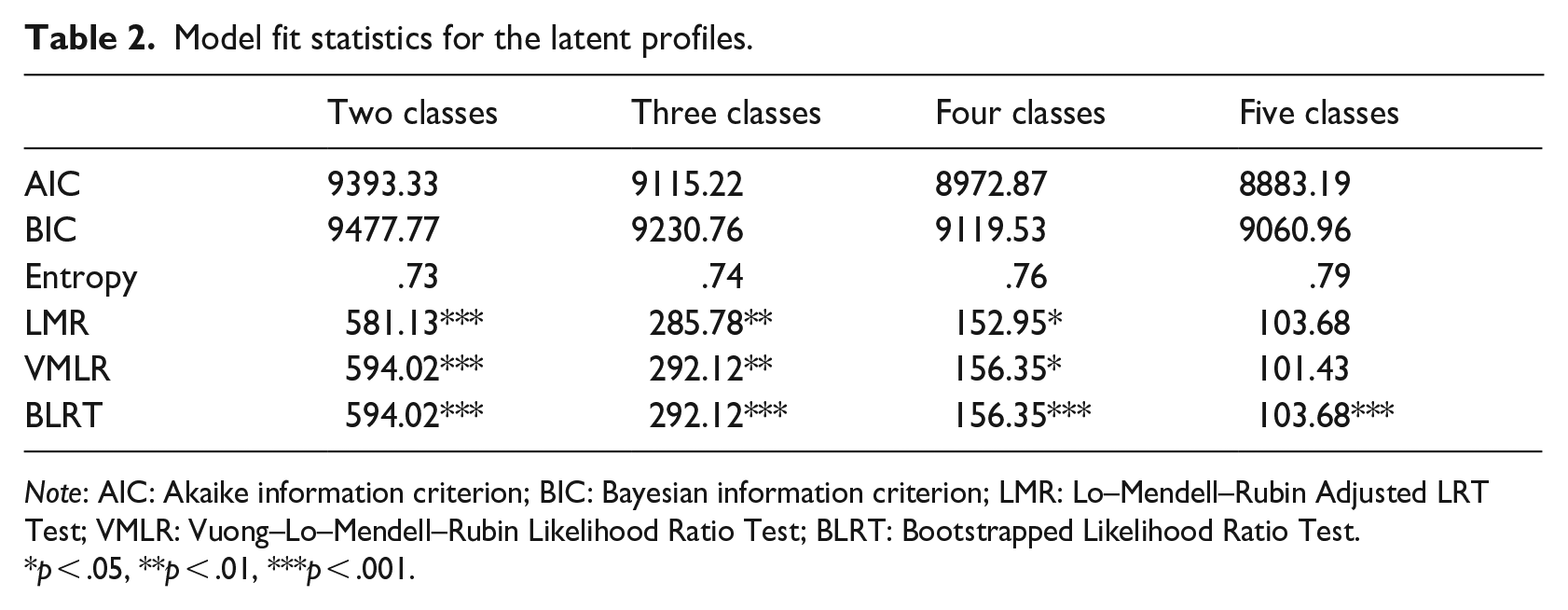
Note: AIC: Akaike information criterion; BIC: Bayesian information criterion; LMR: Lo–Mendell–Rubin Adjusted LRT Test; VMLR: Vuong–Lo–Mendell–Rubin Likelihood Ratio Test; BLRT: Bootstrapped Likelihood Ratio Test.
p < .05, **p < .01, ***p < .001.
To visualize the four profiles, we centered the scores of the different appraisals related to time pressure and job complexity (Figure 2). To determine whether the four different profiles are distinct from each other in terms of time pressure and job complexity appraisals, we performed a one-way MANOVA. Table 3 shows the significant differences between the four classes in the six indicator variables. Partial eta squared was used to determine the effect sizes, which can be categorized into small ηP2 = .01 to .058, medium ηP2 = .059 to .137, and large ηP2 ⩾ .138 effects (Cohen, 1988). Effect sizes were large in all cases.
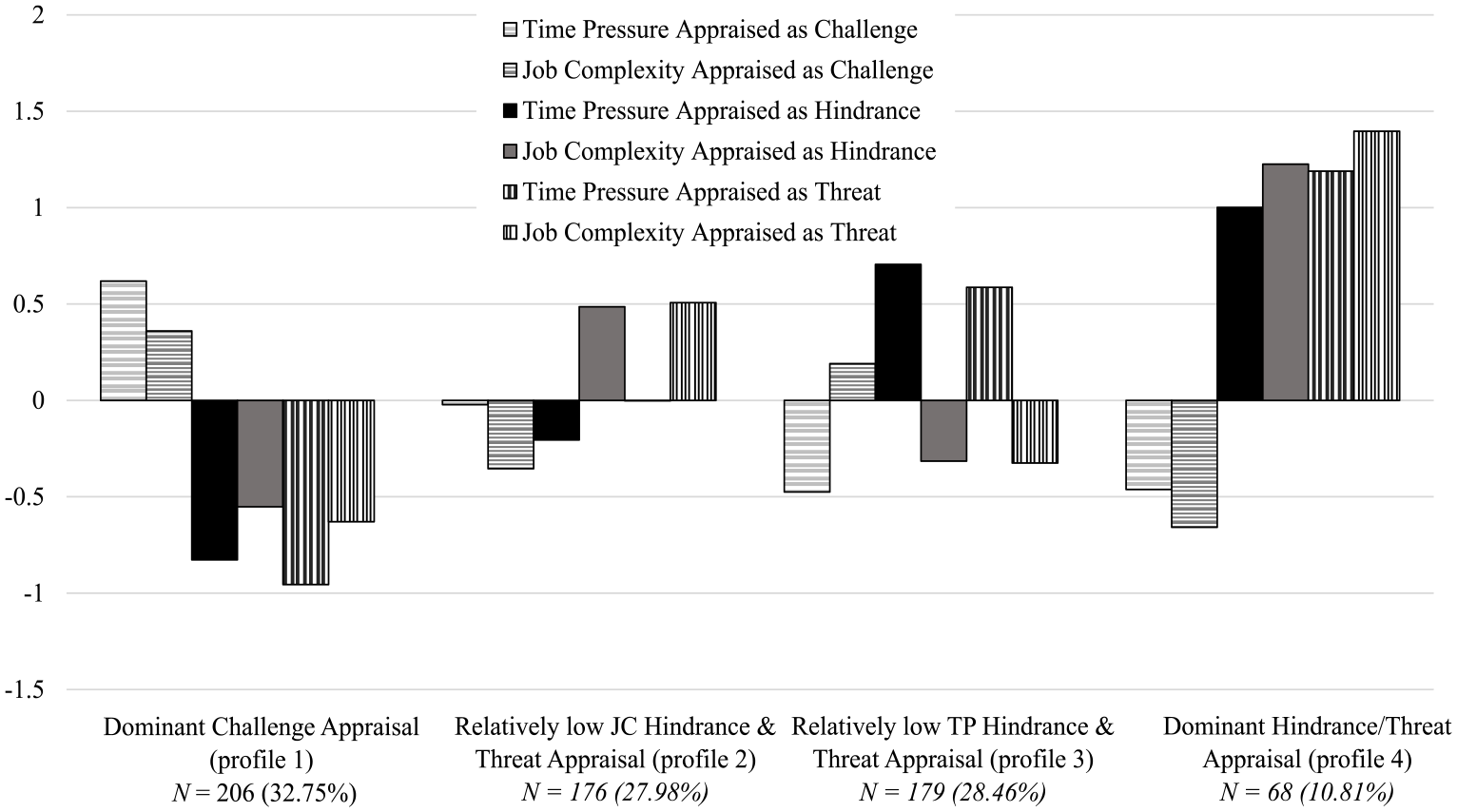
Latent profiles of appraisals (standard scores).
Mean component scores for the latent class solution.
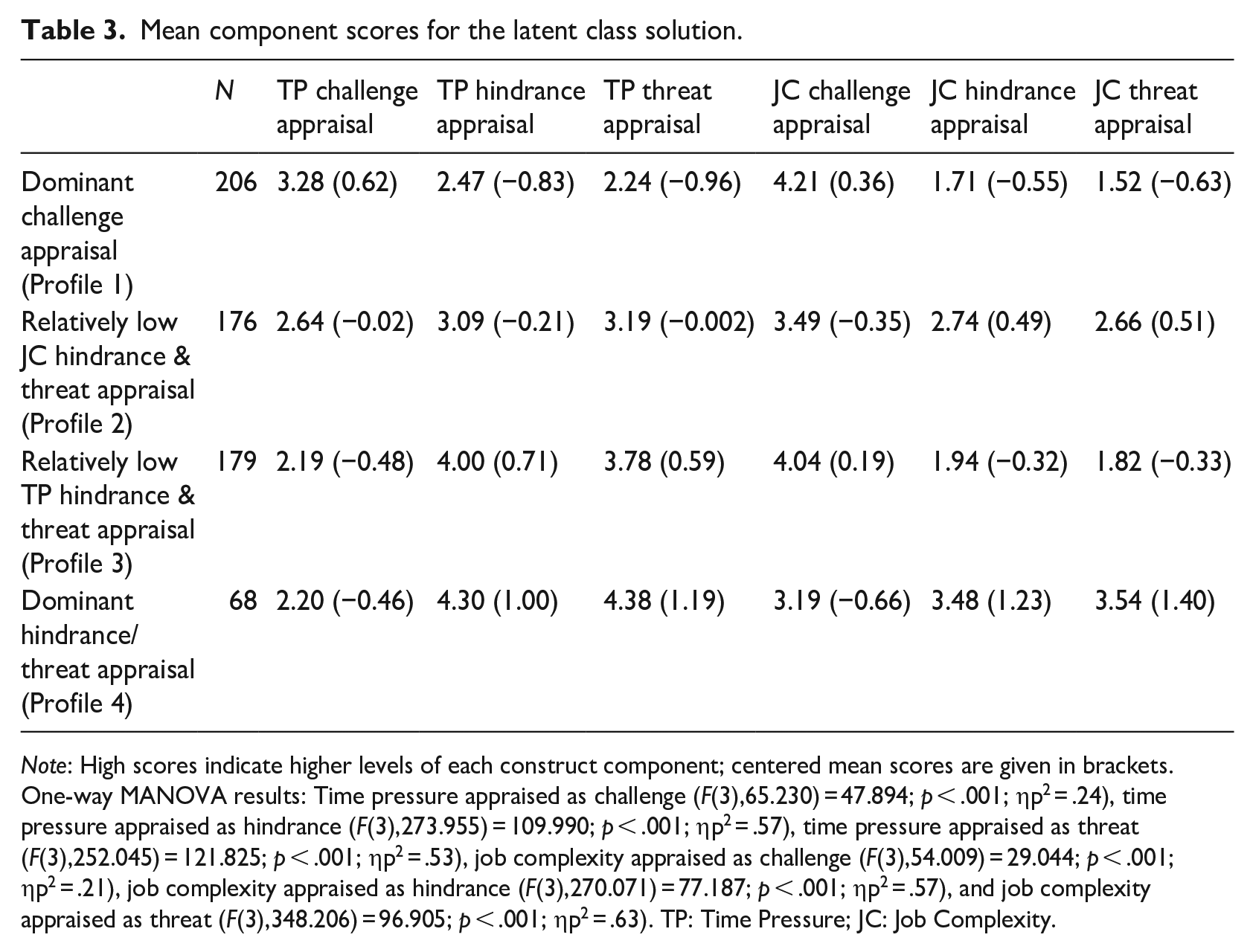
Note: High scores indicate higher levels of each construct component; centered mean scores are given in brackets. One-way MANOVA results: Time pressure appraised as challenge (F(3),65.230) = 47.894; p < .001; ηp2 = .24), time pressure appraised as hindrance (F(3),273.955) = 109.990; p < .001; ηp2 = .57), time pressure appraised as threat (F(3),252.045) = 121.825; p < .001; ηp2 = .53), job complexity appraised as challenge (F(3),54.009) = 29.044; p < .001; ηp2 = .21), job complexity appraised as hindrance (F(3),270.071) = 77.187; p < .001; ηp2 = .57), and job complexity appraised as threat (F(3),348.206) = 96.905; p < .001; ηp2 = .63). TP: Time Pressure; JC: Job Complexity.
We further explored the profile structure in Figure 2, followed by a post hoc discriminant analysis. The results of the discriminant analysis revealed three discriminant functions. In combination, these discriminant functions significantly distinguished the four classes (Λ = .11, χ2(18) = 1367, p < .001). A combination of functions two and three and consideration of only function three remained significant (Λ = .47, χ2(10) = 465, p < .001; Λ = .98, χ2(4) = 1367, p = .04, respectively). Thus, it can be concluded that the appraisals (i.e. challenge, hindrance, and threat) related to time pressure and job complexity differed significantly among the four profiles.
Centered mean component scores were used to label the identified profiles, as they provide interpretable deviations between the profile scores relative to the total sample scores (Ciarrochi et al., 2017; Ferradás et al., 2019). Profile 1 reflected the consistency of stressor appraisals and the dominance of challenge appraisals relative to threat and hindrance appraisals for both stressors: time pressure and job complexity. This profile was labeled Dominant Challenge Appraisal. Profile 2 showed a stressor variable appraisal pattern. This profile was characterized by moderate appraisals related to time pressure, but relatively low hindrance and threat appraisals related to job complexity (labeled as: Relatively low Job Complexity Hindrance and Threat Appraisal). Profile 3 again reflected variability in appraisals of different stressors with relatively low hindrance and threat appraisals for time pressure, but moderate levels across the appraisals related to job complexity (referred to as: Relatively low Time Pressure Hindrance and Threat Appraisal). Profile 4 showed consistency in stressor appraisals, with high scores for hindrance and threat appraisals, and relatively low challenge appraisals for both demands (referred to as: Dominant Hindrance/Threat Appraisal). Interestingly, Profiles 1, 2, and 3 are proportionally similar ranging from 27.98% to 32.75%, while Profile 4 represented only 10.81% of the sample. These results indicate that appraisals of challenge, hindrance, and threat related to time pressure and job complexity reflect four distinct profiles including evidence of both stressor variability and consistency in appraisal approaches. H1a was supported, as Profile 1 shows high challenge appraisals and low hindrance and threat appraisals related to time pressure and job complexity. However, H1b was not supported, because there was no profile for simultaneous high challenge/hindrance or high challenge/threat appraisal structure.
6.3. Appraisal profiles and work-related outcomes
Using the auxiliary BCH command, we examined the relationships between the four profiles and the outcome variables at T2 (i.e. job satisfaction, work engagement, emotional exhaustion, and cognitive irritation). Table 4 summarizes the means and pairwise comparisons of the T2 outcomes related to the four profiles. Pairwise comparisons revealed significant differences, in which those in the Dominant Challenge Appraisal Profile (Profile 1) had significantly higher mean T2 job satisfaction (M = 3.88, SE = .09) and T2 work engagement (M = 5.03, SE = .13) scores than those in the Dominant Hindrance/Threat Appraisal Profile (Profile 4) (T2 job satisfaction M = 2.58, SE = .17; T2 work engagement: M = 3.19, SE = .33). Conversely, the Dominant Hindrance/Threat Appraisal profile (Profile 4) was significantly associated with higher mean scores for T2 emotional exhaustion (M = 3.33, SE = .14) and T2 cognitive irritation (M = 4.30, SE = .39), compared with the Dominant Challenge Appraisal profile (Profile 1) (T2 emotional exhaustion: M = 2.02, SE = .10; T2 cognitive irritation: M = 3.17, SE = .19). However, the two variable appraisal profiles (Profiles 2 and 3) did not differ significantly from each other on the T2 outcome variables (i.e. job satisfaction, work engagement, emotional exhaustion, and cognitive irritation). Thus, the results fully supported H2. The profile with dominant challenge appraisal was associated with higher job satisfaction and work engagement, and lower emotional exhaustion and cognitive irritation, compared with the dominant hindrance/threat appraisal profile.
Means for employee health and well-being outcomes.
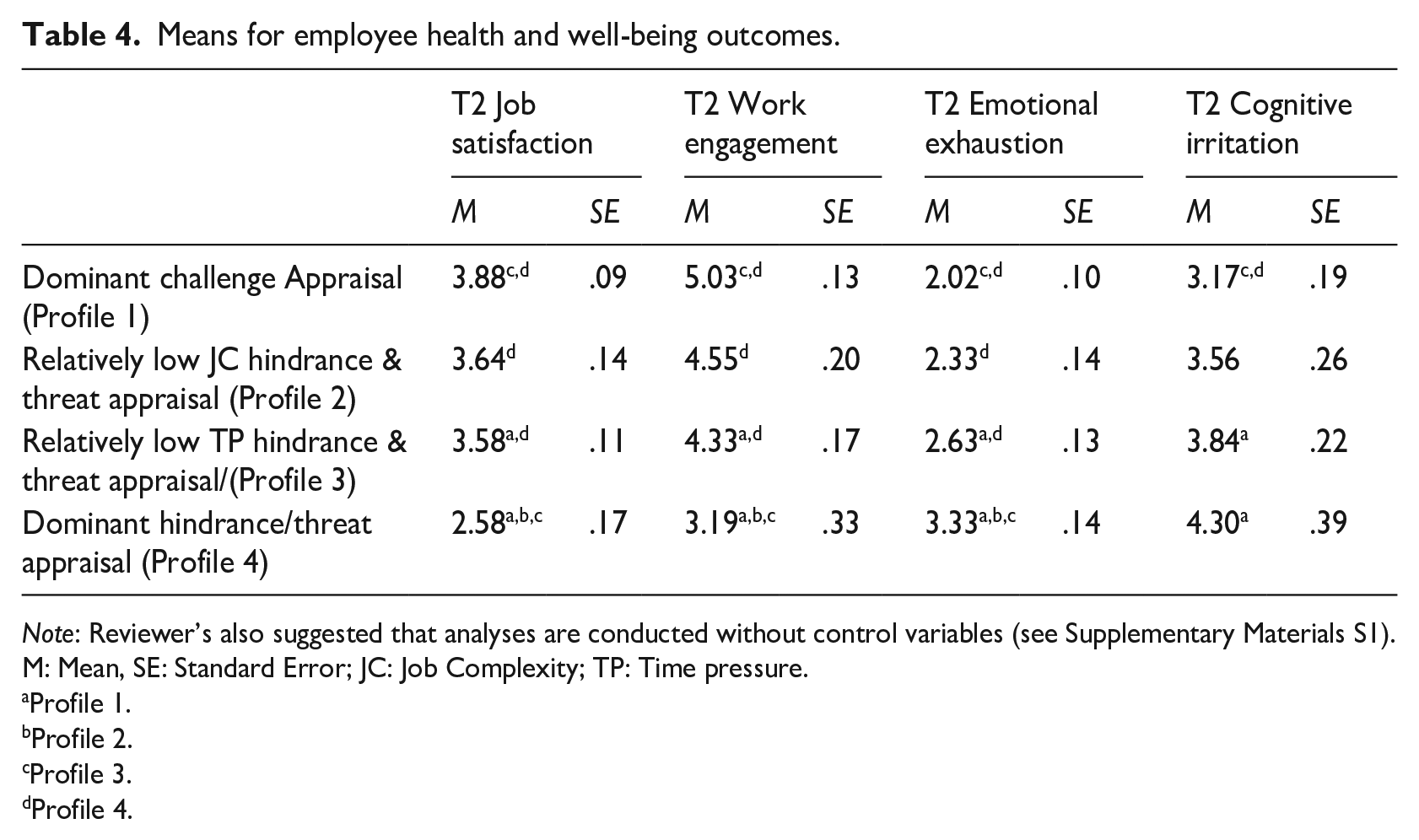
Note: Reviewer’s also suggested that analyses are conducted without control variables (see Supplementary Materials S1). M: Mean, SE: Standard Error; JC: Job Complexity; TP: Time pressure.
Profile 1.
Profile 2.
Profile 3.
Profile 4.
6.4. Resources and job-demands as predictors of profile membership
Table 5 presents the logit coefficients of the predictors from the manual auxiliary 3-step approach, in which the Dominant Hindrance/Threat Appraisal profile was the reference category for all other profiles, except for the profile itself, where the Dominant Challenge Appraisal profile was used as the reference. In support of H3a, perceived capacity for resilience was related to profile membership. Higher perceived capacity for resilience was related to a greater likelihood of membership in the Dominant Challenge Appraisal profile (b = 1.41, p < .001; OR = 4.11) and a lower likelihood of membership in a profile with higher hindrance or threat appraisals: Dominant Hindrance/Threat Appraisal profile (b = −1.41, p < .001; OR = 0.32). In support of H3b, work methods autonomy was also related to profile membership. Higher work methods autonomy was related to a greater likelihood of membership in the Dominant Challenge Appraisal profile (b = .48, p = .048; OR = 1.61) and a lower likelihood of membership in the Dominant Hindrance/Threat Appraisal profile (b = −.48, p = .048; OR = 0.62). None of the resources were significantly associated with an increased likelihood of belonging to Profile 2 (Relatively low Job Complexity Hindrance and Threat Appraisal). However, perceived capacity for resilience was associated with an increased likelihood of belonging to the Relatively low Time Pressure Hindrance and Threat Appraisal profile (b = .71, p = .004; OR = 2.04). By contrast to H3c, social support was not associated with profile membership.
Logit coefficients of predictors from the manual 3-step approach (N = 538).
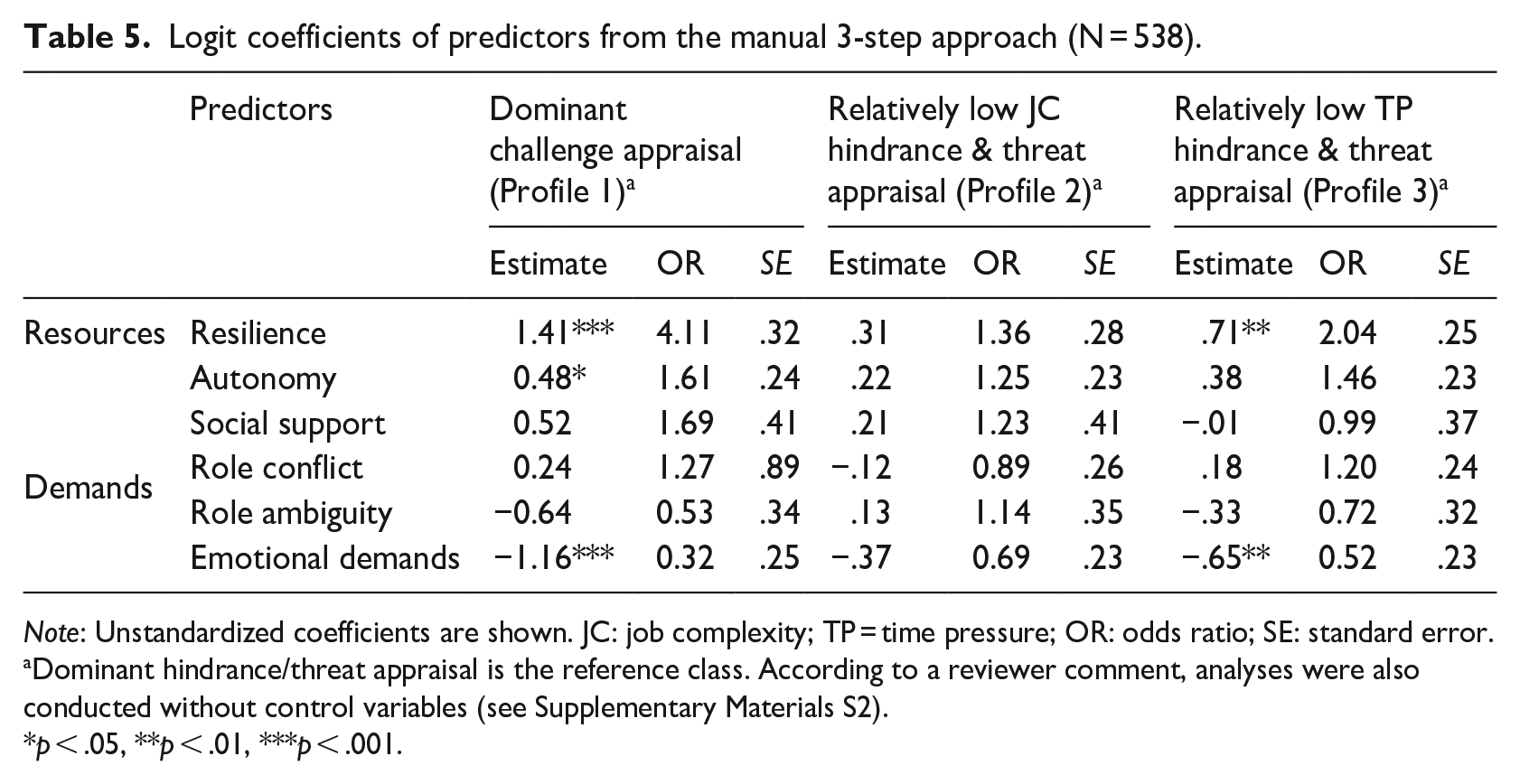
Note: Unstandardized coefficients are shown. JC: job complexity; TP = time pressure; OR: odds ratio; SE: standard error.
Dominant hindrance/threat appraisal is the reference class. According to a reviewer comment, analyses were also conducted without control variables (see Supplementary Materials S2).
p < .05, **p < .01, ***p < .001.
The same analysis was conducted for job demands: (1) role conflict, (2) role ambiguity, and (3) emotional demands. H4a and 4b were not supported because role conflict and role ambiguity did not predict profile membership. However, emotional demands were related to profile membership. In support of H4c, emotional demands were related to an increased likelihood of membership in the Dominant Hindrance/Threat Appraisal profile (b = 1.16, p < .001; OR = 3.19) and a lower likelihood of membership in the Dominant Challenge Appraisal profile (b = −1.16, p < .001; OR = 0.32). In addition, emotional demands were associated with a lower likelihood of membership in the Relatively low Time Pressure Hindrance and Threat Appraisal profile (b = −.65, p = .005; OR = 0.52), but not to membership in the Relatively low Job Complexity Hindrance and Threat Appraisal profile (b = −.37, p = .11).
7. Discussion
Our person-centered approach provides evidence for distinct configurations of appraisals related to time pressure and job complexity, contrary to the a priori classification proposed by the challenge–hindrance framework (Cavanaugh et al., 2000). To our knowledge, this research is the first to identify and explore different configurations of challenge, hindrance, and threat appraisals within challenge–hindrance research using a person-centered approach. In doing so, we contribute to the understanding and meaning of appraisal processes, providing a more comprehensive and nuanced perspective on how individuals think about and respond to workplace demands. While previous research mostly used variable-centered approaches to study appraisal processes, our approach offers a more holistic perspective, revealing unique subpopulations with specific configurations of appraisals (e.g. Li et al., 2020). Unlike variable-centered approaches that focus on analyzing the relationships between individual variables, our approach captures the interplay and combinations of these appraisals within individuals. Furthermore, variable-centered approaches in previous research often focus on examining the individual effects of specific appraisals in interaction with a set of variables. By contrast, our study takes a simultaneous perspective, considering how combinations of appraisals collectively influence employee well-being. In addition, we gained insights into the proportional distribution of individuals within different subpopulations. These findings complement variable-centered studies in this area by demonstrating how prevalent specific combinations of appraisals are.
Our study showed that the Dominant Challenge, Relatively low Time Pressure Hindrance and Threat, and Relatively low Job Complexity Hindrance and Threat Appraisal profiles were proportionally similar, suggesting no clear preference for employees to appraise time pressure and job complexity per se as challenges. Thus, our findings challenge the a priori classification of demands into challenges and hindrances (cf. Mazzola and Disselhorst, 2019) and are consistent with the transactional theory of stress (Lazarus and Folkman, 1984), suggesting that there is variability in how similar demands are appraised.
We found no evidence for profiles with simultaneously high challenge and hindrance/threat appraisals. This suggests that the presence of adaptive appraisals may reduce the presence of maladaptive appraisals and vice versa. This finding is inconsistent with theoretical (Lazarus and Folkman, 1984) and variable-centered empirical work (e.g. Webster et al., 2011), suggesting that simultaneous challenge/hindrance and challenge/threat appraisals are possible. According to Lazarus and Folkman (1984), initial appraisals are influenced by situational characteristics (e.g. novelty, duration), ambiguity, constituting in a lack of situational clarity, and uncertainty as a lack of meaning related to the environmental configuration. Previous empirical findings have shown a lower correlation of challenge appraisals with hindrance/threat appraisals at the within-person level (e.g. Mitchell et al., 2019; Tuckey et al., 2015), indicating greater distinctiveness and situational ambiguity. Thus, balanced appraisal profiles may be more likely to emerge at the within-person level.
The profiles differed in predictable ways in their association with health and well-being outcomes (cf. LePine et al., 2005). As expected, the Dominant Challenge Appraisal profile was associated with significantly higher job satisfaction and work engagement, and lower emotional exhaustion and cognitive irritation than the Dominant Hindrance/Threat Appraisal profile. This finding was consistent with assertions proposed in the transactional theory of stress (Lazarus and Folkman, 1984), such that challenge appraisals focus on the potential for personal growth and an emphasis on mastering demands, resulting in positive states of well-being. Conversely, hindrance and threat appraisals, which are associated with obstacles to goal attainment and personal harm, are associated with negative states of well-being (Searle and Tuckey, 2017; Tuckey et al., 2015). As expected, the Relatively low Time Pressure Hindrance and Threat Appraisal and the Relatively low Job Complexity Hindrance and Threat Appraisal profiles did not differ significantly in mental health and well-being outcomes. This finding suggests that the different appraisal configurations for both stressors were similar in the way they related to the outcomes. Furthermore, despite the a priori characterization of time pressure and job complexity as challenges, they were still positively related to adverse outcomes, such as emotional exhaustion and cognitive irritation.
Finally, we found preliminary evidence for the relationship between resource availability and job demands on the likelihood of appraisal profile membership. Greater perceived capacity for resilience (H3a) and work methods autonomy (H3b) were associated with an increased likelihood of belonging to the Dominant Challenge Appraisal profile with the highest odds ratio. In addition, greater perceived capacity for resilience was also associated with an increased likelihood of belonging to the Relatively low Time Pressure Hindrance and Threat Appraisal profile, compared with belonging to the Dominant Hindrance/Threat Appraisal profile. Consistent with COR theory and the proposed principle of resource investment (Hobfoll, 2011), employees with high levels of these resources may access them to reduce or manage resource loss, thereby increasing the likelihood of challenge appraisals (cf. Halbesleben et al., 2014). One possible explanation for the notable finding that employees’ resilience capacity increases the probability of belonging to the Relatively low Time Pressure Hindrance and Threat Appraisal profile is that individuals in this profile may experience a higher likelihood of potential resource loss compared with those in the Relatively low Job Complexity Hindrance and Threat Appraisal profile. As a result, employees in the former profile may face additional demands on their resources, which may include drawing on their resilience capacity. This idea is consistent with Hobfoll’s (2011) concept that resources, such as resilience capacity, may be called upon when individuals face situations that involve potential loss or strain. This contention seems plausible, given the higher mean component scores related to hindrance and threat appraisals of time pressure in this profile (see Table 3).
Contrary to prediction, perceived social support was not significantly associated with profile membership (H3c). One possible reason is related to the measurement of social support. We measured perceived social support (i.e. perceptions related to the availability of support; Sarason et al., 1987). Measuring specific instances of received support in relation to work demands may be better able to discriminate between appraisal profiles as people recall actual supportive behaviors. Previous work has shown that specific qualities of received social support (i.e. emotional and esteem support) have a stronger stress-buffering effect than perceived social support (Rees and Freeman, 2007). Therefore, by measuring received support in a more nuanced way, we may have been able to observe an association between social support and profile membership.
Of the demands examined, only emotional demands were significantly related to an increased likelihood of belonging to the Dominant Hindrance/Threat Appraisal profile (H4c), compared with the Dominant Challenge Appraisal profile, suggesting that the background of emotional demands may increase the likelihood of hindrance and/or threat appraisals (Lazarus, 1991a). Emotional demands were also associated with a decrease in the likelihood of belonging to the Relatively low Time Pressure Hindrance and Threat Appraisal profile, compared with the Dominant Hindrance/Threat Appraisal profile. The difference between the Relatively low Time Pressure Hindrance and Threat Appraisal and the Dominant Hindrance/Threat Appraisal is the degree to which job complexity was appraised as challenging (see Means in Table 3). Previously, scholars recognized that appraising job demands as challenging triggers employee motivation and increases coping efforts to manage job demands (Folkman and Lazarus, 1980). According to the transactional theory of stress (Lazarus and Folkman, 1984) and the cognitive–motivational–emotive system model (Smith and Lazarus, 1990), employees in the Relatively low Time Pressure Hindrance and Threat Appraisal profile are may be better equipped with personal (i.e. resilience) resources associated with a higher challenge appraisal of job complexity and lower exposure to experienced emotional demands compared with those in the Relatively low Job Complexity Hindrance and Threat Appraisal profile.
Role conflict (H4a) and role ambiguity (H4b) showed no relationship with profile membership. A possible explanation for this finding is that measures of role conflict and role ambiguity objectively assess the nature of the work (e.g. Do you sometimes have to do things which ought to have been done in a different way?”), rather than subjective effects on strain. As suggested in previous work, it is likely that the effects that demands have on the psychological system (e.g. strain) are likely to be more relevant to appraisal than the objective nature of stressors (Lazarus, 1991a; Lazarus and Folkman, 1984). Measures that tap into the psychological effects of job demands may be more appropriate predictors of appraisal style.
7.1. Theoretical implications and future research
A main contribution of our research is to demonstrate variability in how individuals appraise time pressure and job complexity, without a clear tendency to perceive them as universally challenging. This adds to previous scholarship highlighting the importance of appraisal processes within the challenge–hindrance framework (e.g. Tuckey et al., 2015). Our study revealed unique and distinct configurations of appraisals that differ both qualitatively and quantitatively. Furthermore, we showed that taking these different appraisal configurations into account has different implications for mental health and well-being. Our findings reinforce the idea of flexibility in appraisal processes and are consistent with the claims put forth by the transactional theory of stress (Lazarus and Folkman, 1984). According to this theory, the effect of objective demands on work-related outcomes is not directly related to positive or negative outcomes. Instead, it is the appraisal process itself that plays a critical role in determining employees’ emotional, cognitive, and motivational responses. This finding challenges research, suggesting that specific types of objective demands are associated with specific outcomes (e.g. LePine et al., 2005). Future research is needed to further elucidate the importance of appraisal processes in the context of challenge–hindrance stress research. Given the results of this study, we encourage scholars to focus on person-centered approaches when examining the interrelationships among job demands, resources, and appraisal processes of job demands.
The findings also contribute to the stress appraisal and resources literature by examining the availability of resources and job demands as antecedents of appraisal profile membership. We showed that the appraisal of stressors may be related to other stressors and resources. Finding resources to predict appraisal configurations is consistent with the resource investment principle (Hobfoll, 1989, 2011) as well as the resource acquisition principle (Hobfoll, 2011), which posits that resource-rich individuals are able to acquire future resources. We conceptualized the challenge appraisal of stressors as a potential resource, such that this type of appraisal serves as a vehicle for the accumulation of other valued resources, such as well-being (Hobfoll, 1989, 2011). Our findings support this proposal, as individuals belonging to the Dominant Challenge Appraisal profile had significantly higher levels of well-being. However, we focused only on subjective parameters of employee well-being. Future studies could examine the effects of profile membership on objective health parameters, such as blood pressure, heart rate variability, and cortisol levels. In light of the stress appraisal literature, our study findings also contribute to the transactional theory of stress (Lazarus and Folkman, 1984), as the likelihood of appraisal profile membership was related to contextual factors such as job demands. Future research could build upon this study’s findings by investigating how variations in resource availability or experienced job demands influence perceptions of job demands. For instance, conducting latent transition analyses during disruptive individual or organizational events could reveal potential shifts in individual appraisal profiles.
7.2. Practical implications
Managers and HR professionals need to recognize that employees are likely to appraise the same job-demand in different ways. Therefore, it is important to emphasize the significance of job demand appraisal and include it in organizational training programs. For example, training organizational leaders and HR professionals on the effects of demand appraisals on employee well-being and motivation, and how existing strain and resources can influence such appraisals.
In terms of practical strategies for managing appraisals, it seems important that employees and work groups exposed to high levels of time pressure and job complexity are well resourced to cope with such demands (e.g. provided with sufficient work methods autonomy by their supervisors). Leadership behaviors have been shown to increase followers’ resources directly (through role modeling) and indirectly (through empowerment of personal resources and job design). For example, by allowing followers to make decisions and take ownership of their work, empowering leaders provide a sense of control, self-determination, and opportunities for skill development (Thun and Bakker, 2018). Similarly, transformational leadership, including inspirational motivation, individualized consideration, intellectual stimulation, and idealized influence (Bass, 1999), has been positively related to follower autonomy (e.g. Stempel et al., 2023) and, in an experimental setting, negatively related to threat appraisals (Lyons and Schneider, 2009).
In addition, employee capacities for resilience can be developed through intervention approaches, such as the training of systematic self-reflective practices (e.g. trigger identification, reappraisal; Crane et al., 2019), which is a promising way to not only promote positive appraisal processes for these employees and work groups, but also to maintain their well-being during periods of psychological strain. In terms of resilience interventions, it is important to follow conceptual considerations on how to approach the delivery of such interventions (e.g. addressing mental health self-stigma and implicit theories of resilience) in workplace settings (Crane et al., 2021) to address potential individual perceptions of “being blamed” when they feel overwhelmed by their work demands (see Parker et al., 2019a). Employee appraisal can be the target of individual-level training, such as programs that help employees to reappraise workplace stressors. In particular, programs that focus on cognitive interventions (e.g. cognitive–behavioral interventions (CBI), cognitive bias modification (CBM) training) may be promising approaches because they aim to change stressor cognitions (i.e. appraisals) and have been shown to be effective in promoting reappraisal of stressful events (Deckro et al., 2002; Telman et al., 2013).
Finally, this study highlighted the importance of emotional demands as a correlate of maladaptive appraisal profiles. Although reducing emotional demands may be challenging for organizations (Van de Ven et al., 2013), a promising approach is to implement job crafting intervention programs to augment individual job redesign strategies. Job crafting strategies, such as seeking resources (e.g. support from colleagues, increased autonomy), reflect proactive individual changes in boundaries and conditions related to job-specific tasks, relationships, and the meaning of work to optimize the work environment (Bakker and Demerouti, 2017; Tims and Bakker, 2010). As outlined above, we recommend combining structural interventions provided by managers (job redesign) with training that focuses on individual resources (e.g. resilience training, job crafting interventions).
7.3. Limitations
We were unable to test the consistency and generalizability of our four-profile structure. To address generalizability, the appraisal profile structure should be examined within different occupational groups (e.g. Bouckenooghe et al., 2019). This is based on previous literature showing that appraisals of job stressors may differ across occupations (cf. Hobfoll, 2011). Furthermore, given the high correlations between hindrance and threat appraisals in this study, examining emerging profiles at the within-person level may further support their distinctiveness (cf. Tuckey et al., 2015). Thus, future studies could examine and model appraisal dynamics to capture potential intraindividual dynamics.
Although we used a lagged design in which we temporally separated latent profiles from outcome variables to reduce common method bias (Podsakoff et al., 2003), we are unable to draw any causal inferences. Because we were unable to include autoregressive effects in our model, in which we use Time 1 outcome scores as covariates, reverse causation may be prevalent in our study and relationships between our considered independent and dependent variables may be inflated (Podsakoff et al., 2003). This claim may be important to consider, as criticisms have been raised regarding the proposed causality that appraisal processes cause emotions (see Moors, 2013 for a review). Future longitudinal studies would additionally allow for testing the stability of appraisal profiles over time and also exploring trajectories with appropriate analyses such as growth mixture modeling or latent class growth modeling (Berlin et al., 2014).
Another potential limitation of this study is the attrition bias we found for some variables (i.e. age, education, job complexity appraised as challenging, autonomy, and participants belonging to the Dominant Challenge Appraisal profile) which represents one of the most common threats in multiwave studies, limiting the external and internal validity (Miller and Hollist, 2007). This non-random attrition might have biased the responses for the T2 variables, particularly toward a more positive relationship with job satisfaction and work engagement and a more negative relationship with emotional exhaustion and cognitive irritation.
8. Conclusion
The purpose of this study was to substantiate and extend the meaning of different appraisals within the challenge–hindrance stress research. Using a person-centered approach, we were able to identify not only subpopulations, but also complex profiles, taking into account combinations of challenge, hindrance, and threat appraisals. The results support our hypothesis that there are different appraisal profiles that also affect mental health and well-being outcomes. Resources such as employee resilience and work methods autonomy as well as emotional demands as a job demand predicted appraisal profile membership. This study highlights the importance of a person-centered approach to appraisal research, which is a fruitful complement to its variable-centered counterpart. Future studies should attempt to examine the consistency and generalizability of the profiles we found and could explore temporal stability through the use of longitudinal studies.
Key practical and research implications
Appraisals of job demands reflect a central component in understanding work stress and challenge appraisals may represent an important resource in fostering and maintaining mental well-being at work.
Staff training and leadership development to increase resources (i.e. resilience capacity, work-methods autonomy) may be promising avenues to positively influence employees’ appraisals of job demands.
Practitioners should be aware that a work environment high in emotional demands may increase the likelihood of hindrance/threat appraisals regarding other job demands.
Scholars should further illuminate the meaning of appraisal processes within the challenge–hindrance framework of occupational stress with a particular focus on reverse causation effects and which factors may change cognitive appraisals over time.
Measures concerning the psychological effects of job demands may be more suitable as predictors of appraisal configurations compared with job demands that objectively assess the nature of work.
Supplemental Material
sj-docx-1-aum-10.1177_03128962231222825 – Supplemental material for Latent profiles of challenge, hindrance, and threat appraisals on time pressure and job complexity: Antecedents and outcomes
Supplemental material, sj-docx-1-aum-10.1177_03128962231222825 for Latent profiles of challenge, hindrance, and threat appraisals on time pressure and job complexity: Antecedents and outcomes by Arian Kunzelmann, Thomas Rigotti and Monique F. Crane in Australian Journal of Management
Supplemental Material
sj-docx-2-aum-10.1177_03128962231222825 – Supplemental material for Latent profiles of challenge, hindrance, and threat appraisals on time pressure and job complexity: Antecedents and outcomes
Supplemental material, sj-docx-2-aum-10.1177_03128962231222825 for Latent profiles of challenge, hindrance, and threat appraisals on time pressure and job complexity: Antecedents and outcomes by Arian Kunzelmann, Thomas Rigotti and Monique F. Crane in Australian Journal of Management
Supplemental Material
sj-docx-3-aum-10.1177_03128962231222825 – Supplemental material for Latent profiles of challenge, hindrance, and threat appraisals on time pressure and job complexity: Antecedents and outcomes
Supplemental material, sj-docx-3-aum-10.1177_03128962231222825 for Latent profiles of challenge, hindrance, and threat appraisals on time pressure and job complexity: Antecedents and outcomes by Arian Kunzelmann, Thomas Rigotti and Monique F. Crane in Australian Journal of Management
Supplemental Material
sj-docx-4-aum-10.1177_03128962231222825 – Supplemental material for Latent profiles of challenge, hindrance, and threat appraisals on time pressure and job complexity: Antecedents and outcomes
Supplemental material, sj-docx-4-aum-10.1177_03128962231222825 for Latent profiles of challenge, hindrance, and threat appraisals on time pressure and job complexity: Antecedents and outcomes by Arian Kunzelmann, Thomas Rigotti and Monique F. Crane in Australian Journal of Management
Footnotes
Acknowledgements
Not applicable.
Final transcript accepted 23 November 2023 by Helena Nguyen (AE Organisational Behaviour).
Data availability statement
The data that support the findings of this study are available from the corresponding author upon reasonable request.
Funding
The author(s) received no financial support for the research, authorship, and/or publication of this article.

Supplemental material
Supplemental material for this article is available online.
Notes
References
Supplementary Material
Please find the following supplemental material available below.
For Open Access articles published under a Creative Commons License, all supplemental material carries the same license as the article it is associated with.
For non-Open Access articles published, all supplemental material carries a non-exclusive license, and permission requests for re-use of supplemental material or any part of supplemental material shall be sent directly to the copyright owner as specified in the copyright notice associated with the article.
