




Abstract
This article examines research performance of management academics in the Group of Eight (Go8) Australian universities using SCOPUS publication data. Normative research profiles for journal publications, book publications, citations, and h-index are provided for each academic level. The number of journal publications are reported for seven different journal ranking lists. The average Go8 management scholar increases the number of total journal publications per year by 56% over their entire publishing career, but does not increase the number of top international journal publications per year. Importantly, the top quartile of Go8 management scholars – who account for 70% of top journal publications and 79% of journal citations – already achieve world class productivity in the top international journals. We hope Go8 Deans and Heads of School use the research performance benchmarks to inform faculty recruitment, tenure and promotion decisions.
1. Introduction
Although evaluating scholarly research performance presents numerous challenges and surfaces divergent views in the global community of management scholars (Aguinis et al., 2020; Bartunek, 2020), measures of research performance increasingly factor into evaluations of individual scholars, departments and universities. At the individual faculty level, research performance measures often feature in hiring, tenure, promotion, salary merit evaluations and grant reviews. At the department, business school and university level, many academic institutional rankings include research performance measures aggregated across all faculty members within the relevant academic unit. The Financial Times ranking of business schools and the QS World University rankings, for example, both include some measure of faculty members’ research performance in computing rankings (Devinney et al., 2008). While the limitations of using research performance measures to evaluate individuals or academic units are well known (Adler and Harzing, 2009; Aguinis et al., 2020), and should never be used in isolation, accurate norms can provide an objective basis to assess performance and should be a critical component in these evaluation processes.
Given the growing importance of research performance evaluations for faculty career prospects, we believe empirical evidence about the distribution of research performance has become essential to help develop realistic expectations and to support evaluative judgements. Numerous studies examine research performance and scholarly productivity of international management scholars (e.g. Certo et al., 2010; Jarley et al., 1998; Podsakoff et al., 2005, 2008; Williamson and Cable, 2003). However, there has been limited investigation of Australian management scholars’ research performance. Harzing’s (2005) article examines the research output of Australian business and economics scholars compared with international scholars, but does not focus on, or report the detailed descriptive data to establish research performance norms.
This article reports research productivity and impact norms, in terms of publications, citations and h-index, for all management faculty members employed by Australian Go8 universities when we collected the data in July 2021. The means and percentile distributions provide empirically grounded norms for the number of publications at different academic levels – Lecturer, Senior Lecturer, Associate Professor, Professor – across a faculty member’s entire career and on a per year basis. These norms include total journal publications and the number of articles published in six well-known journal lists, plus a seventh list of consolidated top journals. The seven journal lists range from highly selective lists composed of the top eight international management journals (Certo et al., 2010) through to the Australian Business Deans Council (ABDC) list of 337 A-rated management journals. 1 We also report the number of book chapters and books published by Go8 Management scholars, as well as the h-index (Hirsch, 2005) of each scholar. We focused on management faculty members employed in Go8 universities because the Go8 is a well-established group of research-intensive universities within Australia. The Go8 receives 71% of Australian Competitive Grant (Category 1) funding and had the largest proportion of research fields rated at 4 or 5 (‘above’ or ‘well above’ world standard) in the latest Excellence for Research Australia exercise (https://go8.edu.au/). Certainly, some universities that do not belong to the Go8 have productive management faculty members in terms of research publications. However, the Go8 classification provides an easy to apply and well-established demarcation.
Drawing from prior studies (Certo et al., 2010; Jarley et al., 1998; Williamson and Cable, 2003), we also compare the productivity of Go8 management scholars with international management scholars outside of Australia. While almost all Australian universities have management departments, 2 these differ in the emphasis placed on research as well as in the opportunities to engage in research. Although quality management research is produced throughout Australian universities, we focus on Go8 management departments to examine the research performance of academic staff within the most research-intensive universities who have the most opportunity to pursue research.
We recognise the tensions between the increasing use of metrics in evaluating research performance, the desire to maintain academic freedom, the importance of intrinsic motivation in the research process, and taking care that the performance metrics actually encourage more high-quality management scholarship. We also acknowledge that management scholars within Australia span multiple subfields – including organisational behaviour, strategy, international business, industrial relations, human resources, and organisation theory – and may have divergent mental models about how to define high-quality research. Nevertheless, many scholars agree that aspiring to continuously improve management scholarship and to increase the societal benefits of the knowledge derived from management research are worthwhile objectives. We believe identifying, collecting, and reporting publication-based metrics to inform evaluations of research performance can play an important role in improving management scholarship and the benefits to society of that scholarship within Australia.
We have three goals for this article. These goals are to: (1) provide the descriptive statistics necessary to establish norms for Go8 management scholars’ research performance, (2) examine how research productivity of the average Go8 management scholar changes over time, and (3) assess the research performance of Go8 management scholars relative to international standards. For the first goal, we do not attempt to explain the variance in research performance across faculty members or universities. Instead, we systematically document Go8 management scholars’ research performance. While recognising that publication and citation metrics do not constitute complete measures of research performance, we believe in the importance of establishing empirical norms for these aspects of research performance.
For the second goal, we use within-subject hierarchical analysis to estimate whether and how much research productivity changes over the average Go8 management scholar’s career. This establishes a benchmark for how much productivity improves or not over time, and provides an empirical basis for setting expectations and targets for research performance.
Regarding the third goal, we compare the research performance benchmarks of Go8 management scholars with management scholars worldwide. We draw from prior studies that have examined research productivity of international management scholars in the top management journals (e.g. Certo et al., 2010; Jarley et al., 1998; Williamson and Cable, 2003) to evaluate Go8 management scholars’ performance relative to global standards. Benchmarking against international scholars provides an objective assessment of research performance and may also help identify policies for improving Australian management scholarship.
2. Method
In July 2021, we collected publication data for each full-time faculty member employed in a Go8 management department or related department (e.g. International Business, Strategy). First, we compiled a list of all full-time management faculty within each Go8 university from each university’s website. Next, we extracted data on publications, citation counts and the h-index for each faculty member from Scopus author records. We excluded research notes, letters, short surveys, and papers published in conference proceedings from each author record. The Scopus bibliometric database indexes a large number of books, book chapters, and journals including international and open-access journals (Bakkalbasi et al., 2006). Many scholars use Scopus to examine research productivity (e.g. Certo et al., 2010; Harzing, 2005; Williamson and Cable, 2003), while others use or advocate the use of Google Scholar (Adler and Harzing, 2009). We chose Scopus instead of Google Scholar because Scopus contains more reliable publication and citation count data. While Google Scholar has a very broad coverage of journals, citation counts may be inflated and authors with similar names often get pooled together, requiring considerably more data cleaning (Jacso′, 2008).
There were 314 academics in the dataset, with 16% employed by Monash University, 18% by University of Melbourne, 16% by University of Queensland, 10% by University of New South Wales, 10% by Australian National University, 17% by University of Sydney, 7% by University of Western Australia and 6% by University of Adelaide. In terms of rank, 27% of the academics in the dataset were employed as lecturer, 21% as senior lecturer, 27% as associate professor and 25% as professor.
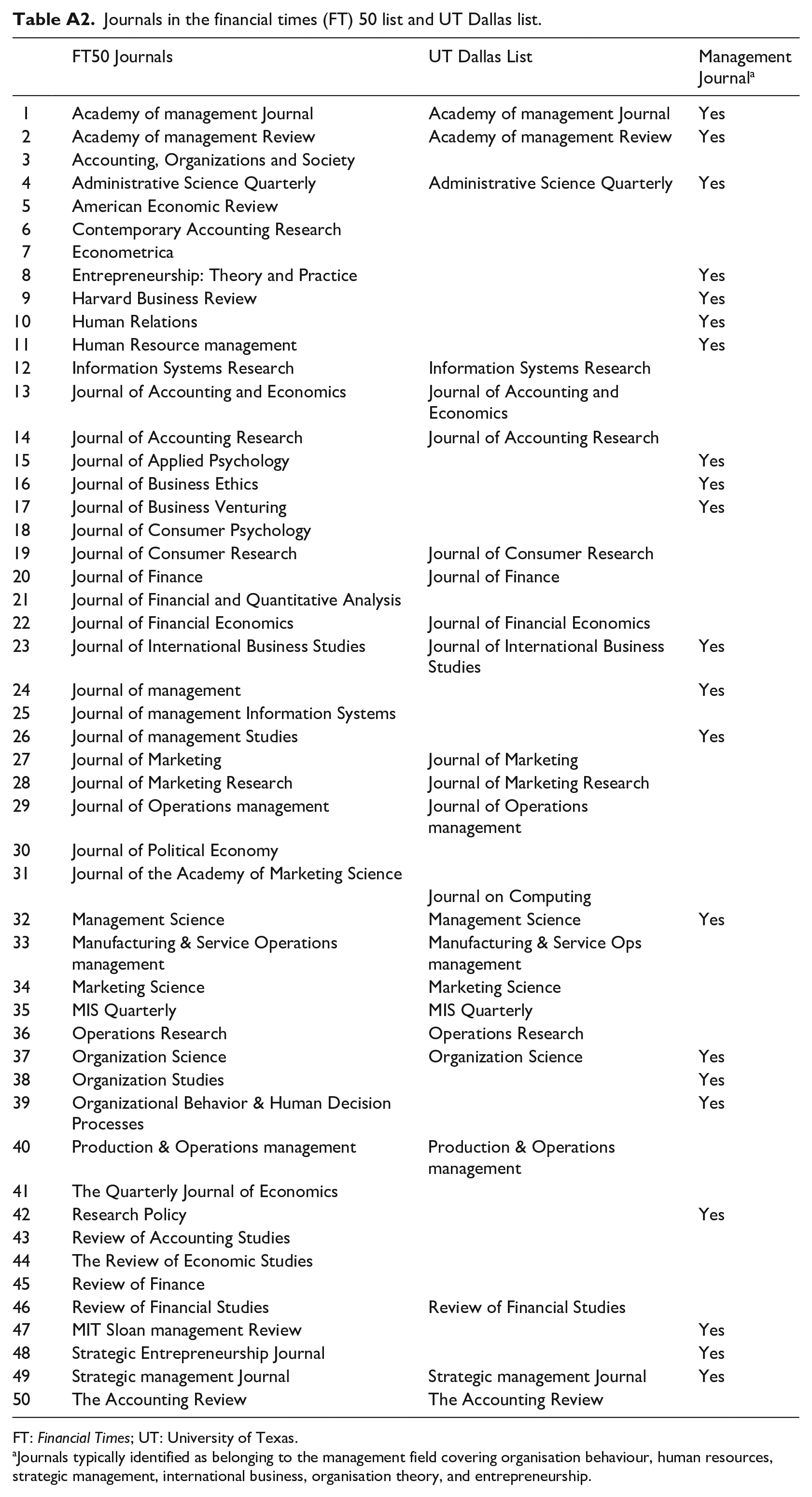
The dataset included a total of 6818 authoring events, where each authoring event corresponds to a faculty member authoring a journal publication, book chapter, or book. We also coded each journal publication according to six well-established journal quality lists. These include the ABDC journal quality list, The Financial Times (FT50) journal list, the University of Texas (UT) Dallas journal list, 3 and the journal lists included in the Certo et al. (2010), Jarley et al. (1998) and Williamson and Cable (2003) publications analysing research productivity of international management scholars. Table A1 and Table A2 in Appendix 1 show the journals included in each of these lists. We also created a consolidated list of top journals by combining the journals included in the FT50, Jarley list, W&C list, UT Dallas list, and the Certo list.
The ABDC journal quality list assesses journals in the fields of business and taxation law, economics, finance, information systems, management, marketing and tourism. The complete journal quality list across all of these fields includes over 2800 journals in the following classifications (in order of highest to lowest quality): A*, A, B, and C. The set of journals classified as A* account for the top 7% of journals, A journals account for the next 24%, B journals account for the next 32%, and C journals account for the remaining 37% of journals included in the ABDC list. Specifically for the management field, the ABDC list includes 1024 management journals just in the 1503 Field of Research code for Management, including 72 A* journals and 337 A-rated journals. This list is widely used within Australian business schools for benchmarking and promotions. Appendix 1 does not provide the ABDC list of journals due to the length of this list, but the full 2019 ABDC list can be downloaded using the link provided in footnote 1.
The Financial Times journal list consists of 50 journals (FT50) used by The Financial Times in their annual ranking of global business schools. The FT50 journal list covers all Business School fields including economics, finance, marketing, accounting, and management. Twenty-one of the FT50 journals would typically be identified as belonging to the management field covering organisational behaviour, human resources, strategic management, international business, organisation theory, and entrepreneurship.
The UT Dallas list consists of 24 leading business journals and is also used to rank the top 100 business schools. Similar to the FT50 journal list, the UT Dallas list covers all Business School fields. Seven of the 24 UT Dallas journals would typically be identified as belonging to the management field; depending on where one draws the boundaries of the domain.
The Certo et al. (2010) list includes only the top eight management journals based on a combined score of total citations and average citations per article from 1981 to 1999. Throughout the remainder of the article, we refer to this set of journals as the Certo List.
The Jarley et al. (1998) journal list comprises 33 top-tier management journals that were identified from prior research and consultation with the authors’ own management department. Throughout the remainder of the article, we refer to this set of journals as the Jarley List.
Similarly, the Williamson and Cable (2003) journal list comprise the top 21 management journals identified from prior research (Gomez-Mejia and Balkin, 1992). Throughout the remainder of the article, we refer to this set of journals as the W&C List.
We also created a consolidated list of top journals by combining the journals in the FT50, Jarley list, W&C list, UT Dallas list, and the Certo list. This Consolidated List contains 71 top journals across all Business School fields, including 41 journals typically identified as the top international journals in management (Certo et al., 2010; Jarley et al., 1998; Williamson and Cable, 2003). Importantly, this consolidated journal list covers the major management subfields of organisational behaviour, strategic management, international business, human resources & industrial relations, organisation theory, and entrepreneurship.
In terms of data analysis, we first conducted a series of descriptive analyses examining publications and citations across all Go8 management scholars included in our sample, and then repeated the analysis by academic rank and by Go8 university. We then conducted analyses restricting journal output to only those journals included in the above-mentioned lists.
We also conducted a within-person analysis to examine how the number of journal articles published per year by the average Go8 management scholar changes over time. Specifically, our data has a hierarchical structure whereby journal publications (Level 1; within-person level) are clustered within academics (Level 2; between-person level). We examined within-person changes in publications produced over time using a hierarchical generalised linear model (Raudenbush et al., 2004). The number of years publishing and the number of years publishing squared were included as independent variables in the estimation. These independent variables were not centred. We adopted a Poisson distribution for the model to capture the discrete and non-normally distributed nature of the number of journal articles published per year by each author. This analysis includes random effects for the intercepts and slopes.
3. Results
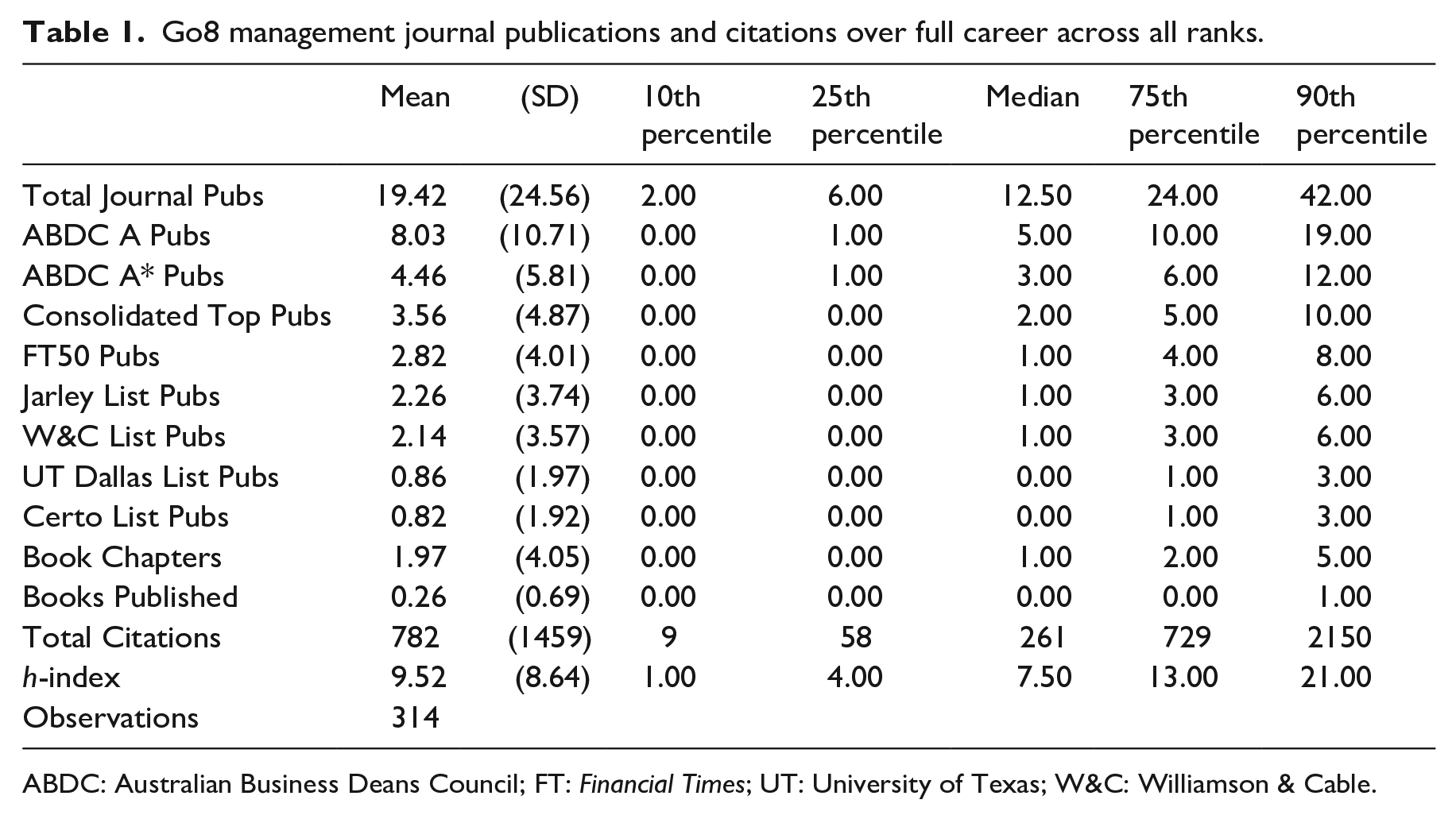
Tables 1 and 2 show the number of publications by our sample of Go8 management faculty members (n = 314) for total journal publications, number of publications in the different journal lists described in the Method section, number of books published, number of book chapters, total citation count, and h-index. Table 1 provides descriptive statistics over the full career for all Go8 management faculty members, while Table 2 reports the same information – except for h-index – on a per year basis. The journal lists are organised with Total Journal Publications at the top of Tables 1 and 2, followed by increasingly selective journal lists. Note that the ABDC A* and A journal lists are mutually exclusive, but all other lists overlap to some extent in terms of the journals included in each list. For example, seven of the eight journals included in the Certo list also appear in the FT50 list. Therefore, the journal publications reported for each journal list are not additive; instead the values represent publication productivity in different sets of journals.
Go8 management journal publications and citations over full career across all ranks.
ABDC: Australian Business Deans Council; FT: Financial Times; UT: University of Texas; W&C: Williamson & Cable.
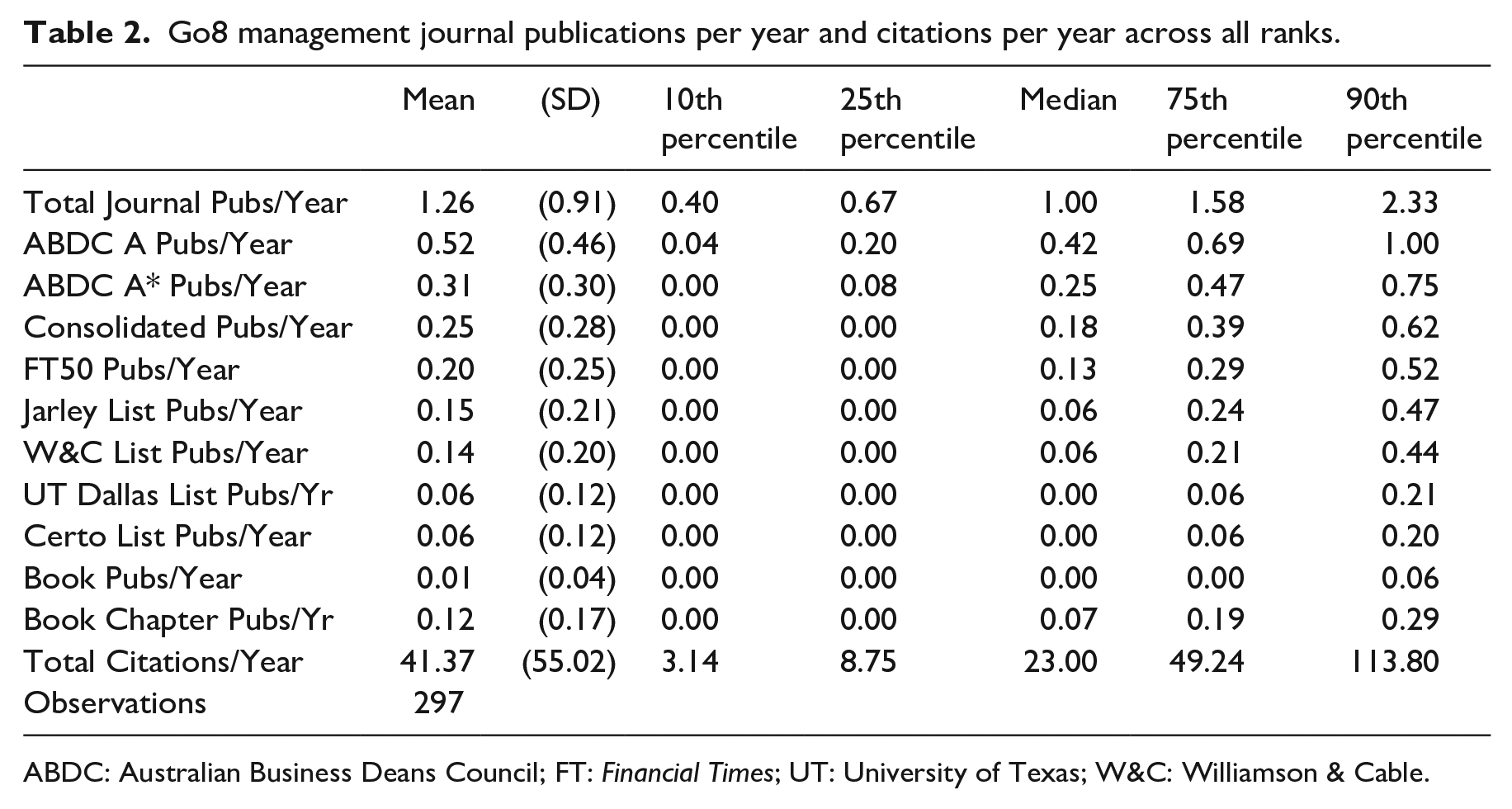
Go8 management journal publications per year and citations per year across all ranks.
ABDC: Australian Business Deans Council; FT: Financial Times; UT: University of Texas; W&C: Williamson & Cable.
To convey more information about the distribution, Tables 1 and 2 include the 10th percentile, 25th percentile, median, 75th percentile, and 90th percentile values alongside the mean and standard deviation. 4 The measures of research performance in Tables 1 and 2 exhibit high levels of skewness and show the top 25% of Go8 management faculty have much higher productivity than the rest.
Our sample of Go8 management faculty members published a mean of 19.42 total journal publications over their full career, with a mean of 4.46 of these publications in ABDC A* journals, 3.56 of these publications in the Consolidated List of top international journals, 2.82 of these publications in FT50 journals, and 0.82 publications in the Certo List of journals. To illustrate the skewness of the distribution, the 75th percentile published 24 total journal articles, with six of these published in ABDC A* journals, four of these published in FT50 journals, and one of these published in the Certo List journals. In contrast, the 25th percentile of Go8 management faculty members published six total journal articles, one article in ABDC A* journals, zero articles in the FT50 journals, and zero articles in the Certo journal list.
The final four rows of Table 1 report the number of book chapters and books published by Go8 management faculty members along with the total number of citations associated with all publications and the h-index. Our sample of Go8 management faculty members published a mean of 1.97 book chapters and 0.26 books over their full career, highlighting the emphasis on journal publications within the management field. In terms of citations, Go8 management scholars received a mean of 782 total Scopus citations to their publications over their full career. The distribution of total citations also includes high variance, with the 75th percentile receiving 729 citations to their publications, while the 25th percentile received 58 citations to their publications. A small fraction of Go8 management scholars account for the vast majority of citations. Although far from perfect, citation counts provide a signal about the quality of a publication and the impact of a scholar in their field (Harzing, 2005). Finally, Go8 management scholars have a mean h-index of 9.52, with the 75th percentile attaining an h-index of 13 compared with an h-index of 4 for the bottom 25th percentile.
The publication rates and citations reported in Table 1 include Go8 management faculty members across all academic ranks. The number of years our sample of Go8 management faculty have been publishing journal articles ranges from 1 to 47 years with a mean of 15.1 (SD = 8.5) years and a median of 14 years. To account for the variation in the number of years faculty members of different academic ranks have been publishing, Table 2 provides the publication rates and citations per year. Later in this section, we also report publication rates and citations by academic rank.
Table 2 shows Australian Go8 management faculty published a mean of 1.26 total journal articles per year, with 0.52 of these articles published in ABDC A-rated journals and 0.31 in ABDC A* journals. Of the 1.26 total journal articles per year, 0.25 were published in the Consolidated List of top international journals, 0.20 per year were published in FT50 journals, 0.06 per year were published in UT Dallas journals, and 0.06 per year were published in the eight Certo List journals. Focusing on the upper part of the distribution, the 75th percentile published 1.58 journal articles per year, with 0.47 of these articles per year published in ABDC A* journals, 0.39 of these articles published in the Consolidated List of top international journals, 0.29 of these articles in FT50 journals, and 0.06 of these articles in the Certo List journals. In contrast, the 25th percentile of Go8 scholars published 0.67 journal articles per year, with 0.08 articles published in ABDC A* journals, zero articles in the Consolidated list of top international journals, zero articles in FT50 journals and zero articles in Certo List journals. Authors without any publications were excluded from this analysis, resulting in n = 297 faculty members.
Overall, Tables 1 and 2 show that the top 25% of Go8 management scholars account for the majority of articles published each year and on aggregate in ABDC A* journals, in the Consolidated List of top journals, in FT50 journals, and also in total citations.
Figure 1 shows the percentage of journal articles and citations generated by the most productive Go8 management scholars. The top 25% of Go8 management authors account for 62% of total journal publications, 67% of ABDC A* articles, 71% of FT50 articles, and 93% of articles published in the Certo-listed journals. The same pattern also holds for total journal citations, with the top 25% of Go8 management scholars accounting for 79% of journal citations. Also, not shown in Figure 1 because the line overlaps with the A* and FT50 percentage lines, the top 25% of Go8 management authors account for 70% of articles published in the Consolidated Top Publications.
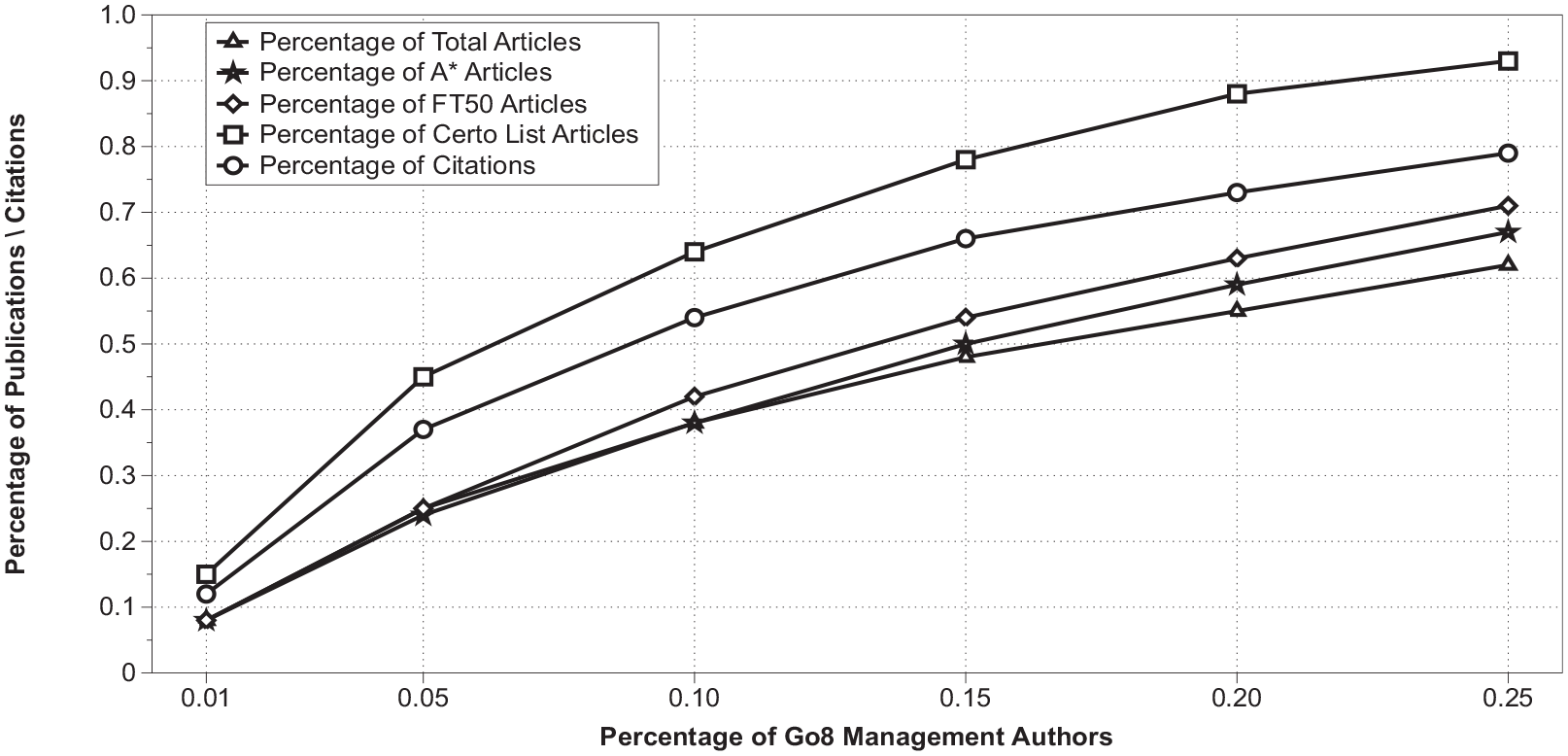
Percentage of journal articles and citations by the top 25% of Go8 management scholars.a
3.1. Research productivity over a scholar’s career
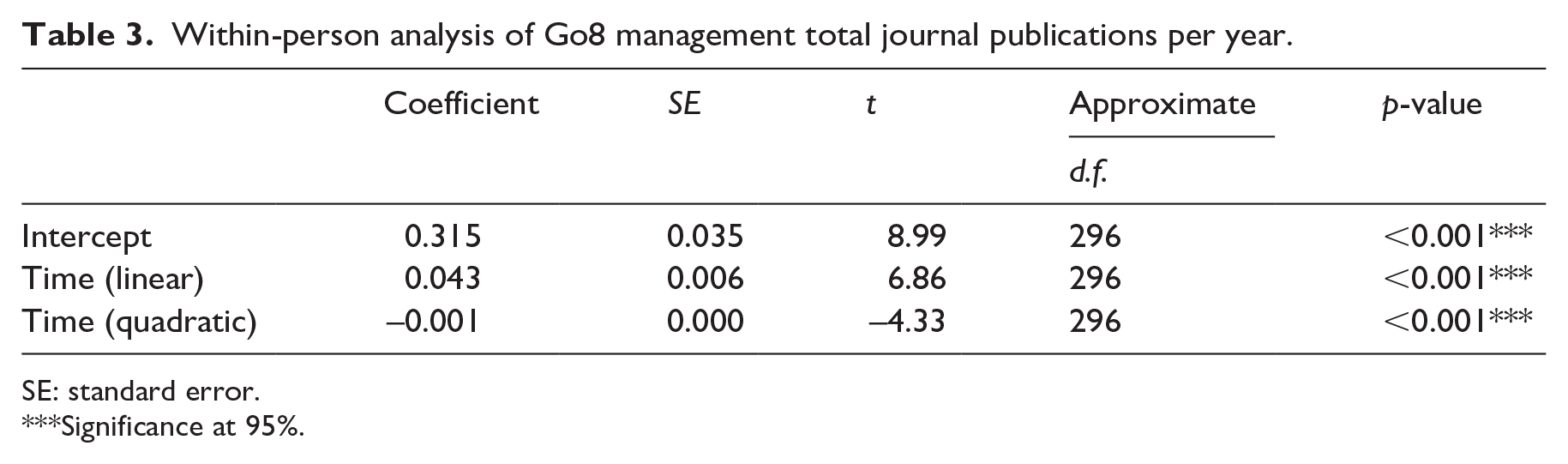
To examine how research productivity changes over time throughout a Go8 management scholar’s career, we next report the results of a within-person analysis. Figure 2 shows increasing productivity in terms of journal publications per year over the average faculty member’s career. The average Go8 management scholar publishes 1.43 journal articles per year at the beginning of their career, and by Year 20 publishes 2.23 journal articles per year. As shown in Table 3, each additional year of publishing experience (Years Publishing) increases productivity by 0.04 journal articles. The negative quadratic term of Years Publishing shows the increase in productivity slows down in the later years of an average faculty member’s career. Research finds similar negative quadratic terms for number of years in a career across a wide range of industries, showing that productivity plateaus and eventually declines after many years in a profession. This includes professions such as salespeople (Hofmann et al., 1993), film directors (Zickar and Slaughter, 1999), tennis players (Minbashian and Luppino, 2014) and fiction and non-fiction authors (Khan and Minbashian, 2021).
Within-person analysis of Go8 management total journal publications per year.
SE: standard error.
Significance at 95%.
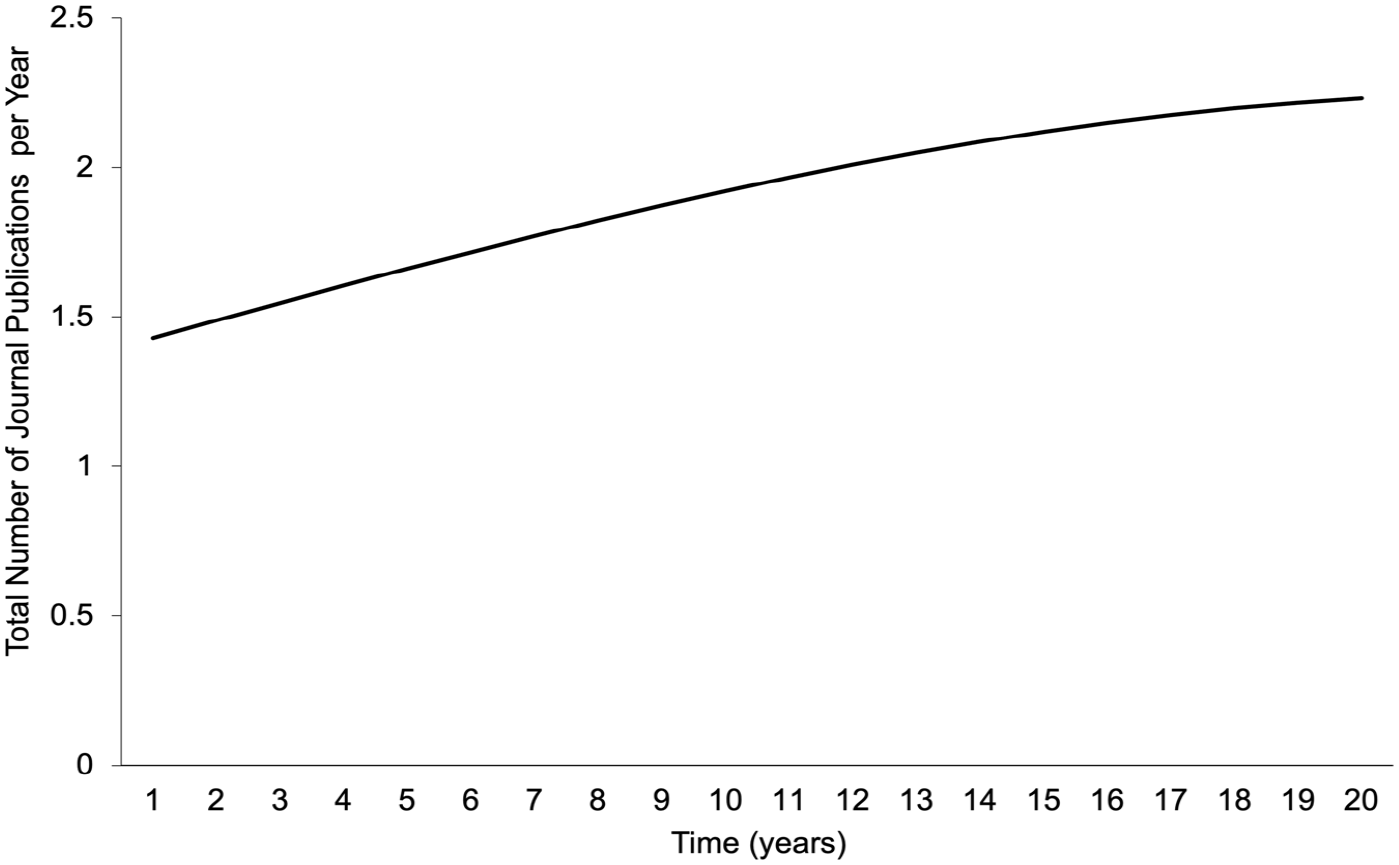
Total journal articles per year by the average Go8 management scholar over their career.
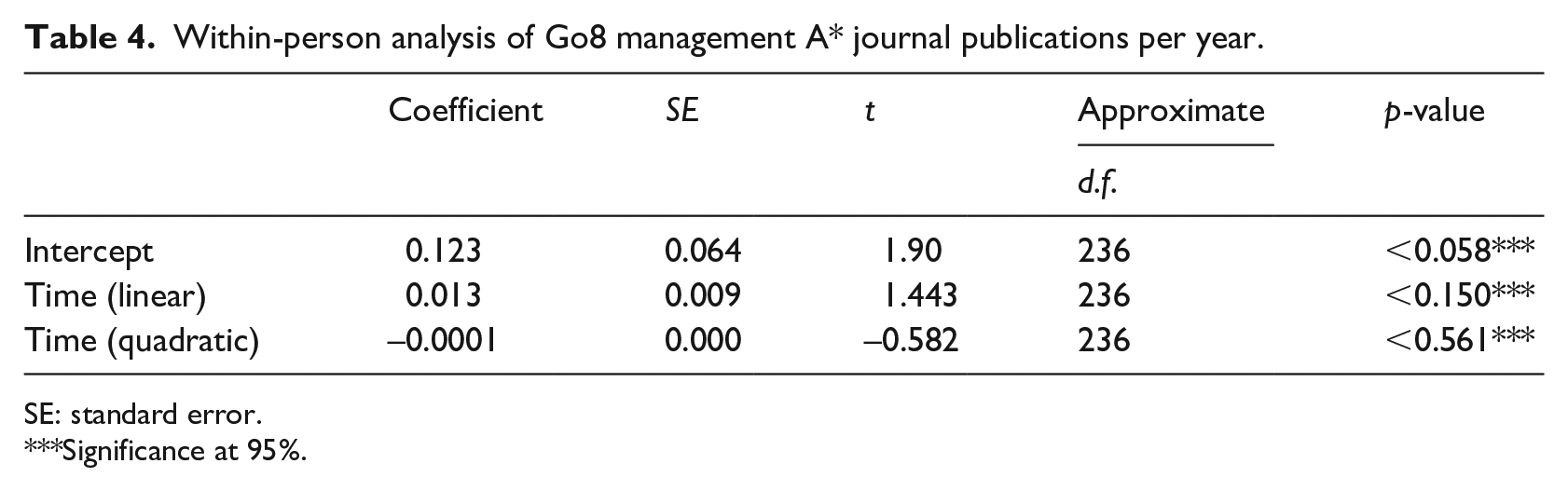
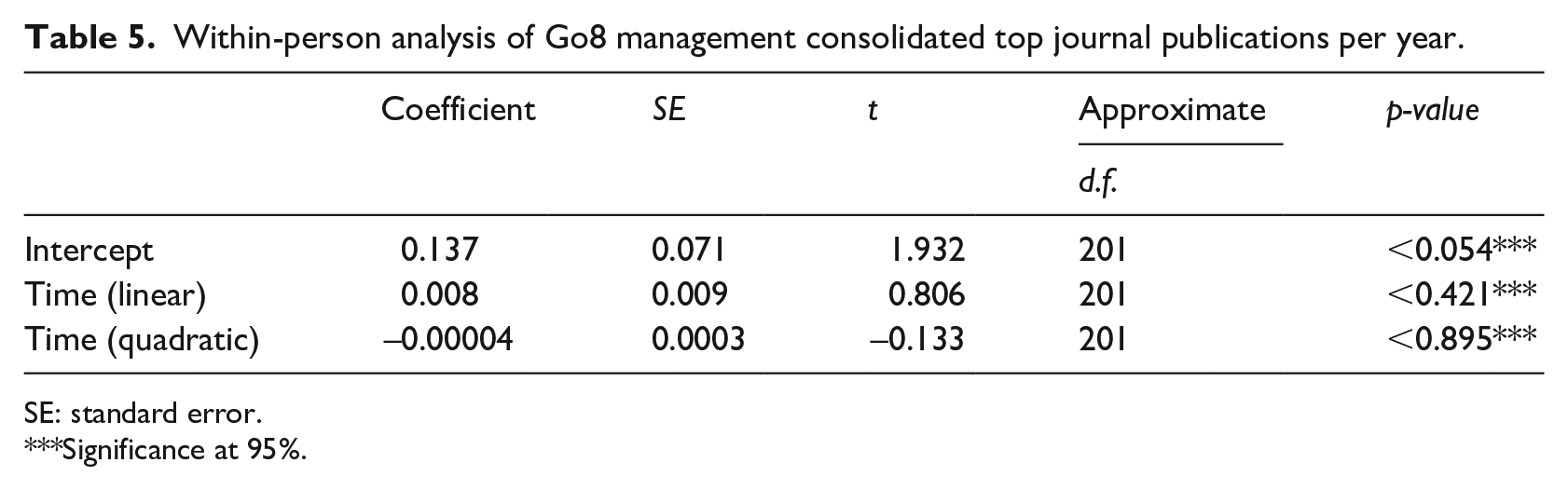
However, the increasing productivity over time observed for total journal articles published per year does not apply to publishing A* journal articles or publications in the Consolidated List of top journals. Tables 4 and 5 provide the within-person analysis results for publications in these more selective journal lists, and show the linear Time coefficient is not significant in either model. Our sample of Go8 management scholars do not become more productive over time in publishing journal articles in higher quality journals.
Within-person analysis of Go8 management A* journal publications per year.
SE: standard error.
Significance at 95%.
Within-person analysis of Go8 management consolidated top journal publications per year.
SE: standard error.
Significance at 95%.
3.2. Comparing the research performance of Go8 and other international scholars
Next, we draw on three prior studies examining research performance of international management scholars (Certo et al., 2010; Jarley et al., 1998; Williamson and Cable, 2003) to compare with Australian Go8 management faculty. In the first comparison study, Certo et al. (2010) examine management research performance and the time required to achieve a ‘substantial scholarly research record’. The authors use a benchmark of publishing five articles in the eight highest-impact management journals because many research-intensive Business Schools in North America, Europe and Asia, use five or more articles in these journals as one criterion for tenure. Their dataset included 20,184 authoring events from 1980 to 2008, representing 9110 scholars who published their first journal article within the 1980–2008 time period. Certo et al. (2010) found that 853 scholars (9.4% out of the total sample) achieved the benchmark of publishing five or more articles in the top eight management journals within the time period examined. Many of the scholars who did not achieve this benchmark would not have attained tenure at one of the top, research-intensive Business Schools.
For the 853 scholars who published five or more articles in the top eight journals, Certo et al. (2010) also calculated the average number of years it took to publish five articles in these journals. The average time to accumulate five articles in these top eight journals increased over time, and by 2008 the scholars who achieved this benchmark took 9.72 years (median = 8 years). This corresponds to publishing 0.51 articles per year in these eight journals. In contrast, our sample of Australian Go8 management scholars published a mean of 0.82 articles (median = 0, mode = 0) in the Certo List journals over their full careers, corresponding to a mean of 0.06 articles per year (median = 0, mode = 0) in these journals.
If we restrict our sample to only those Go8 authors who have published at least one article in the Certo list journals (n = 91), to more directly compare with Certo et al.’s sample, we find these scholars published a mean of 2.84 articles (median = 2, mode = 1) in the Certo list journals over their full careers. The mean publication rate of these Go8 scholars in the Certo list journals amounts to 0.18 articles per year (median = 0.15), with the 25th percentile publishing 0.07 articles per year, and the 75th percentile publishing 0.23 articles per year. Only three Go8 management faculty, 1% of the total, achieved a productivity rate of 0.50 Certo list journal articles per year; the mean productivity of the scholars in Certo et al.’s (2010) sample that achieved the five publications benchmark in 2008.
If we also exclude Go8 Lecturers from our analysis – since many of them may not have had enough time to publish in the top journals – then the remaining Go8 management scholars who have published at least one article in a Certo list journal (n = 84), published a mean of 0.17 (median = 0.13) articles per year in the Certo list journals.
Overall, in terms of publishing in the Certo list journals, management scholars who achieved the five publications benchmark in Certo et al.’s (2010) sample were 2.8 times as productive as those Go8 scholars who published at least one article in the Certo list journals and 8.5 times as productive as our full sample of Go8 management scholars. Although only 9.4% of the scholars included in Certo et al.’s (2010) sample achieved the benchmark of publishing five or more journal articles in the top eight management journals, we believe this comparison is appropriate because the Go8 aspire to make research contributions on par with the world’s top research-intensive universities.
In the second comparison study, Williamson and Cable (2003) examined the research performance of management faculty who in 1995 were working at management departments in American Assembly of Collegiate School of Business (AACSB) accredited US business schools, and who started their jobs between 1987 and 1992. Research performance was measured using the number of academic journal publications in the top 21 management journals identified by Gomez-Mejia and Balkin (1992). The Social Science Citation Index (SSCI) and ABI/Inform (ProQuest Direct) databases were used to obtain the publication counts for each faculty member by year. Only journal articles and research notes were counted as publications. The 152 faculty members comprising the sample published 285 papers in the 21W&C journals during the first six years of their academic job, corresponding to an average for each faculty member of 0.31 articles per year.
Our sample of Go8 management faculty, across all ranks, published an average of 0.14 (median = 0.06, mode = 0) articles per year in the W&C journals. In terms of productivity in the W&C journals, the faculty in Williamson and Cable’s (2003) sample were 2.2 times as productive as our sample of Go8 management scholars. If we exclude Go8 Lecturers from our analysis, then our sample of Go8 management Senior Lecturers, Associate Professors and Professors (n = 231) published an average of 0.16 (median = 0.08, mode = 0) articles per year in the W&C list journals.
In the third comparison study, Jarley et al. (1998) examined research performance of management scholars using data on 20,184 authoring events in the 33 Jarley List journals from 1986 to 1993. They found the average Academy of Management (AOM) member published 2.98 articles in these 33 journals in the 8 years from 1986 to 1993, for an average of 0.37 articles per year. We find Go8 management scholars published an average of 0.15 articles per year in these 33 journals; equivalent to 1.2 articles in 8 years. The faculty in Jarley et al.’s (1998) sample were 2.5 times as productive as our sample of Go8 management scholars. If we exclude Go8 Lecturers from our analysis, then the remaining Go8 management scholars (n = 231) published a mean of 0.17 (median = 0.09, mode = 0) articles per year in the Jarley list journals. The faculty in Jarley et al.’s (1998) sample were 2.2 times as productive as our sample of Go8 management scholars when we exclude Lecturers.
Overall, despite increasing research productivity over their individual careers, the comparisons above show that Go8 management scholars publish fewer journal articles in the very top global management journals per year and on aggregate than other international scholars.
3.3. Research performance by academic rank
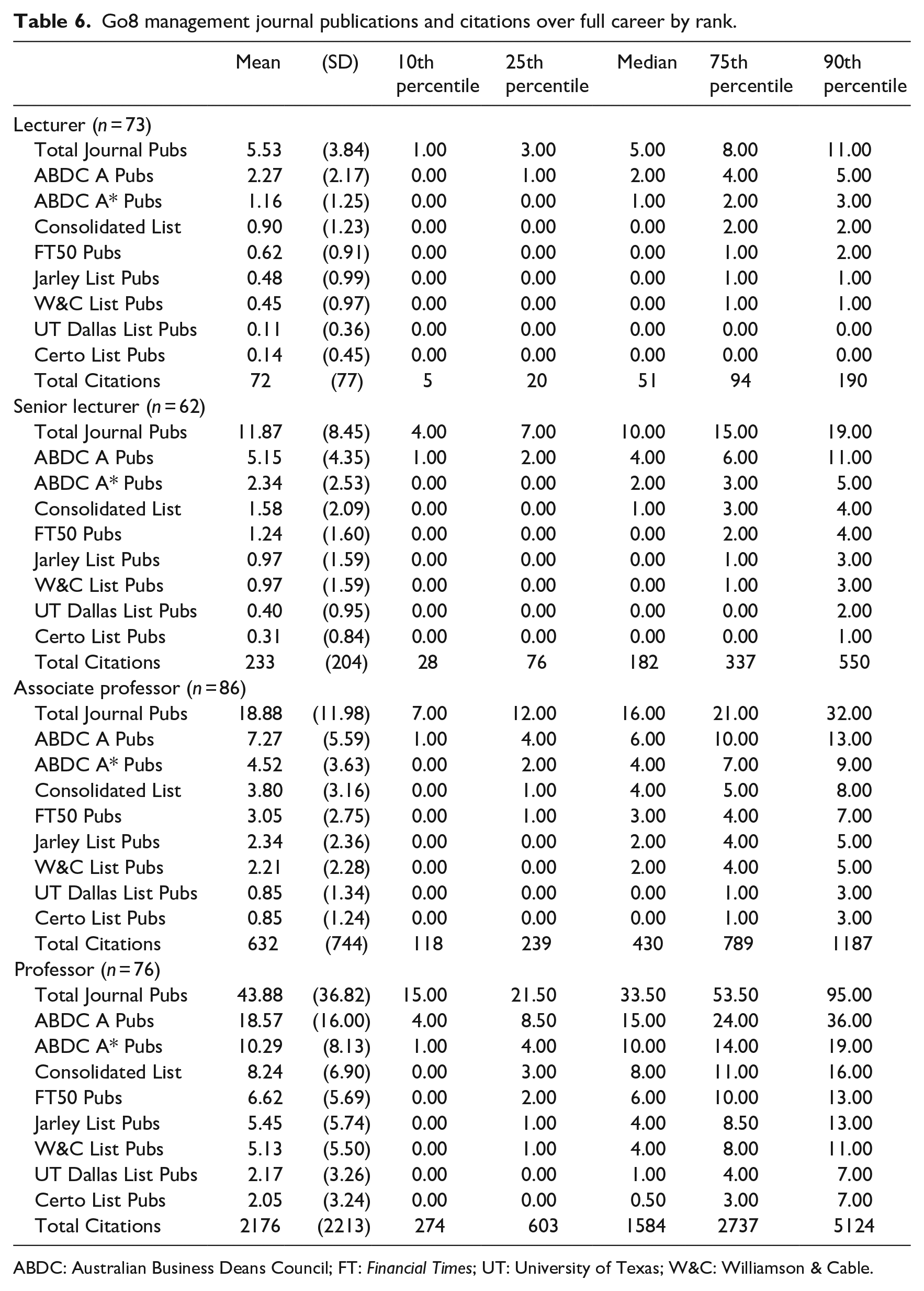
As mentioned above, our sample exhibits a great deal of variation in the number of years publishing. To more directly address these differences, Tables 6 and 7 report publication rates and citations by academic rank. Table 6 provides journal publications and total citations over the full career, while Table 7 reports the same information on a per year basis. Table 4 once again shows the skewed distribution of Go8 scholars’ journal publication rates. The top 25th percentile of scholars at each academic rank account for the majority of published articles, especially in the top international journals. Professors published a mean of 43.88 (median = 33.5) total journal articles, with 10.29 of these articles in ABDC A* journals, 8.24 of these articles in the Consolidated List of top journals, 6.62 of these articles in FT50 journals and 2.05 of these articles in the top eight journals included in the Certo List. At the upper end of the distribution, the 75th percentile of Professors published 53.5 total journal articles, with 14 of these in ABDC A* journals, 11 of these in the Consolidated List of top journals, 10 of these in FT50 journals and 3 of these in the Certo List journals. On the other hand, the 25th percentile of Professors published 21.5 total journal articles, with 4 of these in ABDC A* journals, 3 in the Consolidated List of top journals, 2 in FT50 journals and zero in the Certo List journals. This same pattern holds for each academic rank: the top performers account for a large and increasing percentage of publications as the set of journals becomes more selective. This pattern also holds for citations. The median Professors receive 1584 citations on their publications (i.e. journal articles, books and book chapters), while the 75th percentile Professors receive 2737 total citations and the 25th percentile Professors receive 603 citations.
Go8 management journal publications and citations over full career by rank.
ABDC: Australian Business Deans Council; FT: Financial Times; UT: University of Texas; W&C: Williamson & Cable.
Go8 management journal publications per year and citations per year by rank.
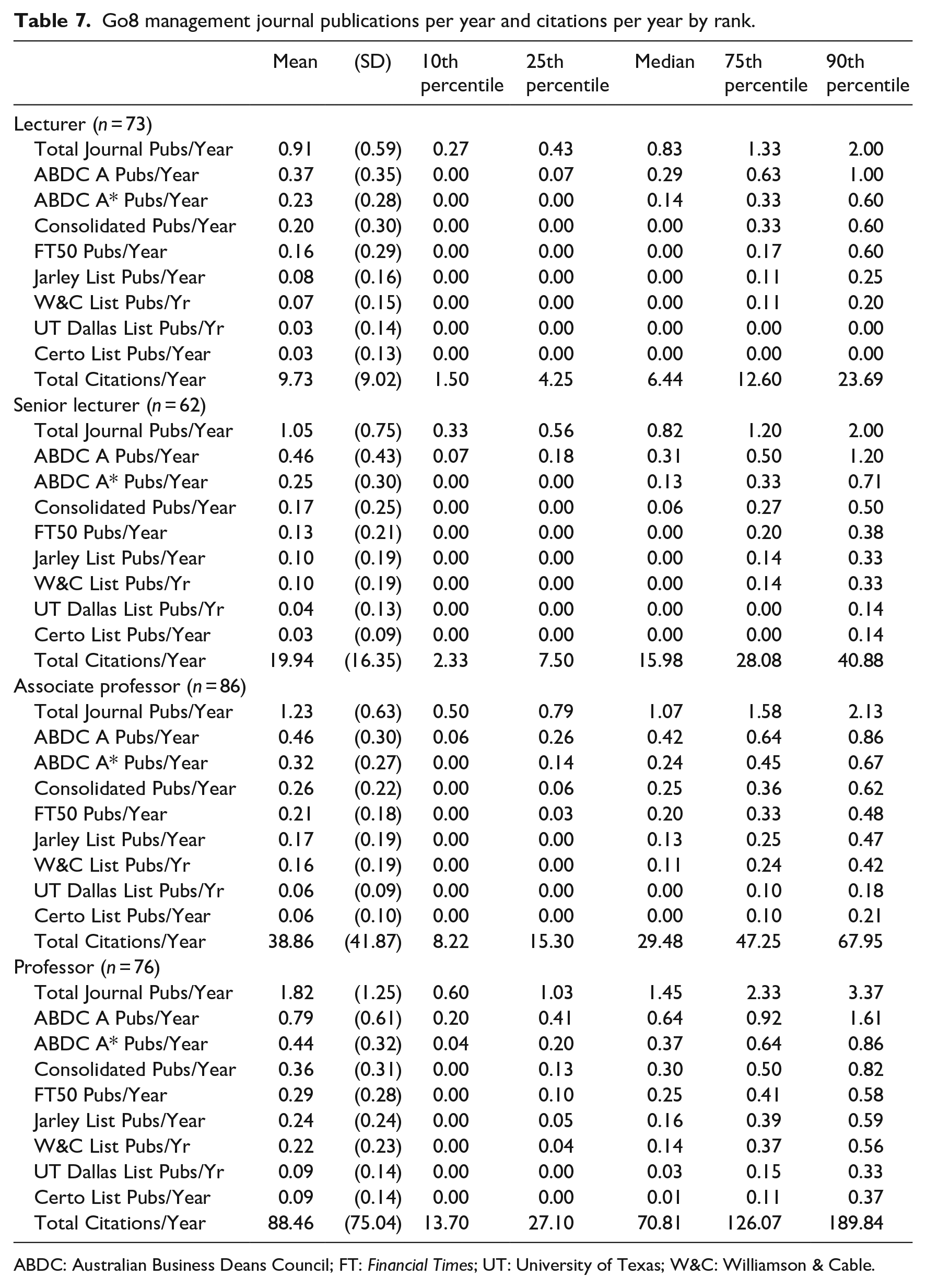
ABDC: Australian Business Deans Council; FT: Financial Times; UT: University of Texas; W&C: Williamson & Cable.
Similarly, in publishing ABDC A* journal articles, Table 7 shows the 75th percentile Go8 Senior Lecturers are 1.5 times as productive as the median Senior Lecturers; the 75th percentile Associate Professors are 1.75 times as productive as the median Associate Professors, and the 75th percentile Professors are 1.4 times as productive as the median Professors. The differences in productivity between the 75th percentile and median groups at each academic rank become more pronounced as the set of journals used to measure productivity becomes more selective. In publishing in the Williamson (W&C) list journals, the 75th percentile Associate Professors are 2.0 times as productive as the median Associate Professors, and the 75th percentile Professors are 2 times as productive as the median Professors.
Figure 3 provides boxplots for each academic rank to show the distribution of publications per year in the Consolidated List of top journals. The median number of publications per year increases by academic rank, along with the variance.
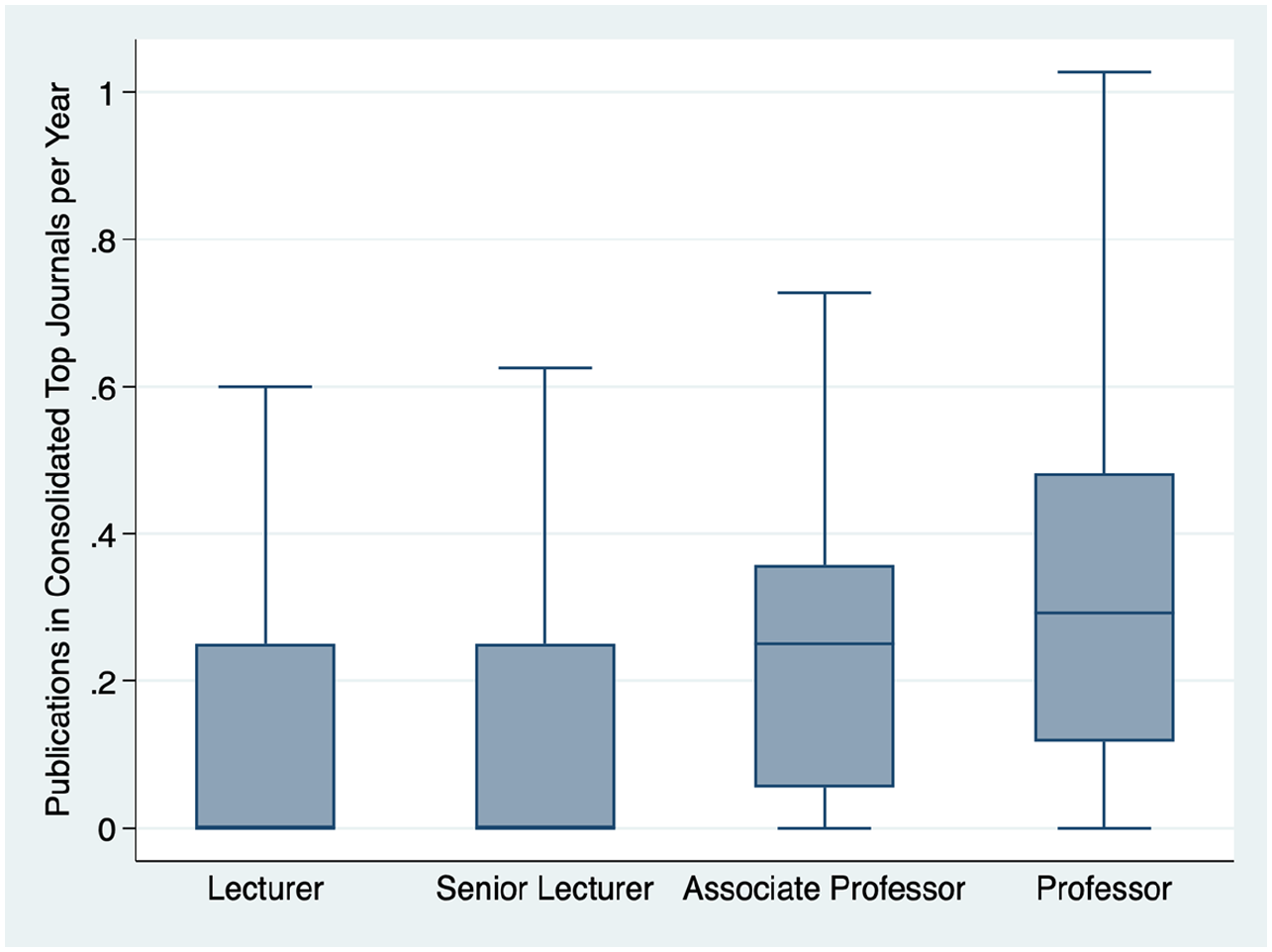
Journal articles published per year in consolidated list of top journals by academic rank.
3.4. Research performance across Go8 management departments
In Table 8 we report mean research performance over the full career of our sample of management scholars by each Go8 university (in alphabetical order). Table 9 uses these data to rank the Go8 universities based on journal publications and citations of their faculty. As shown in Table 9, the rankings change depending on the particular criterion used. Importantly, the rankings would also change if the highest performing researchers at any of the universities moved to different universities within or outside the Go8. As a practical reality, the research reputation of each institution depends on the cumulative research performance of the faculty members in that department, with the rankings especially dependent on the top performing 25% of researchers at each university.
Mean Go8 management faculty journal publications and citations over full career by university.
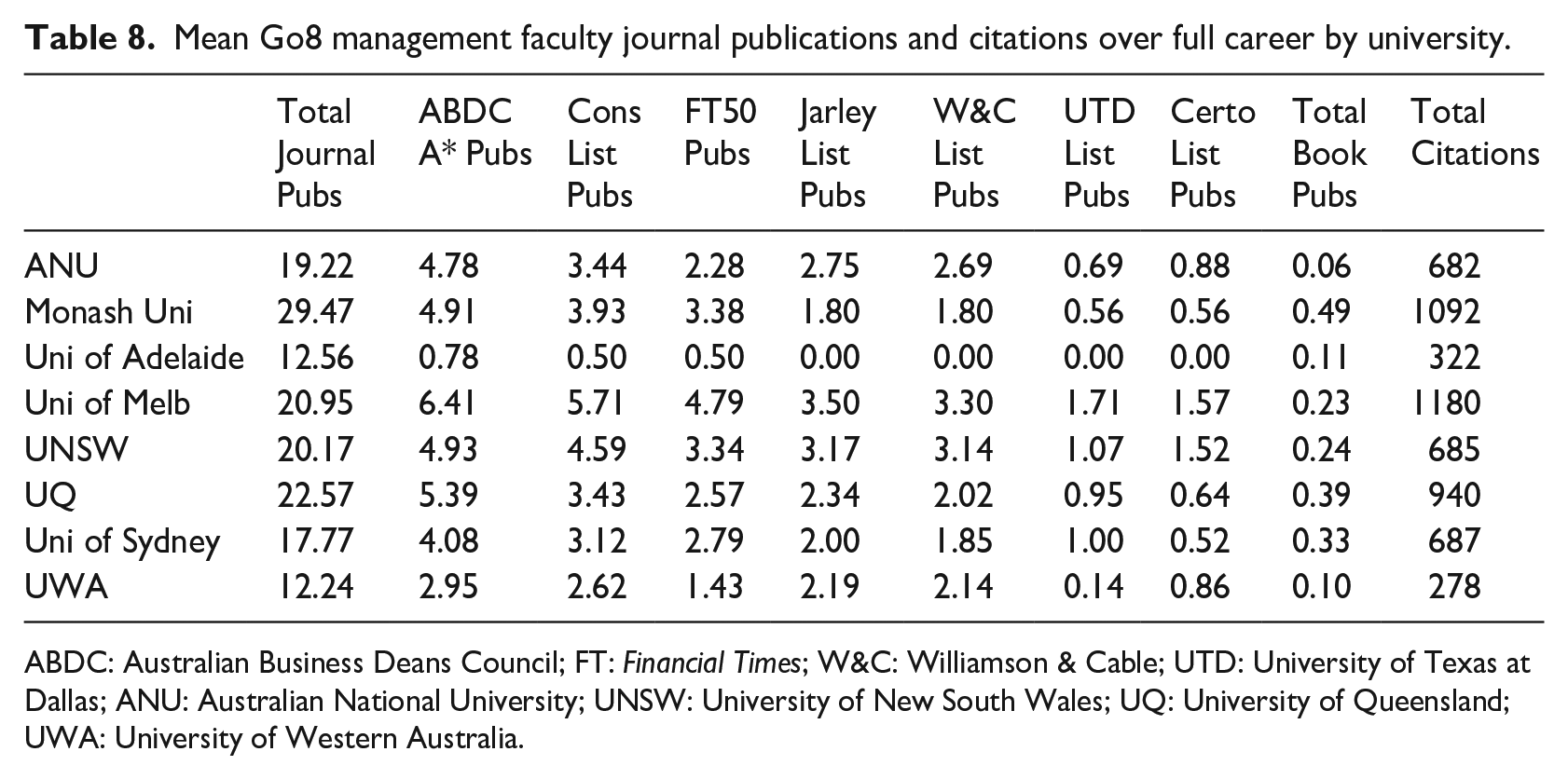
ABDC: Australian Business Deans Council; FT: Financial Times; W&C: Williamson & Cable; UTD: University of Texas at Dallas; ANU: Australian National University; UNSW: University of New South Wales; UQ: University of Queensland; UWA: University of Western Australia.
Go8 university rankings based on management faculty mean research productivity and citations.
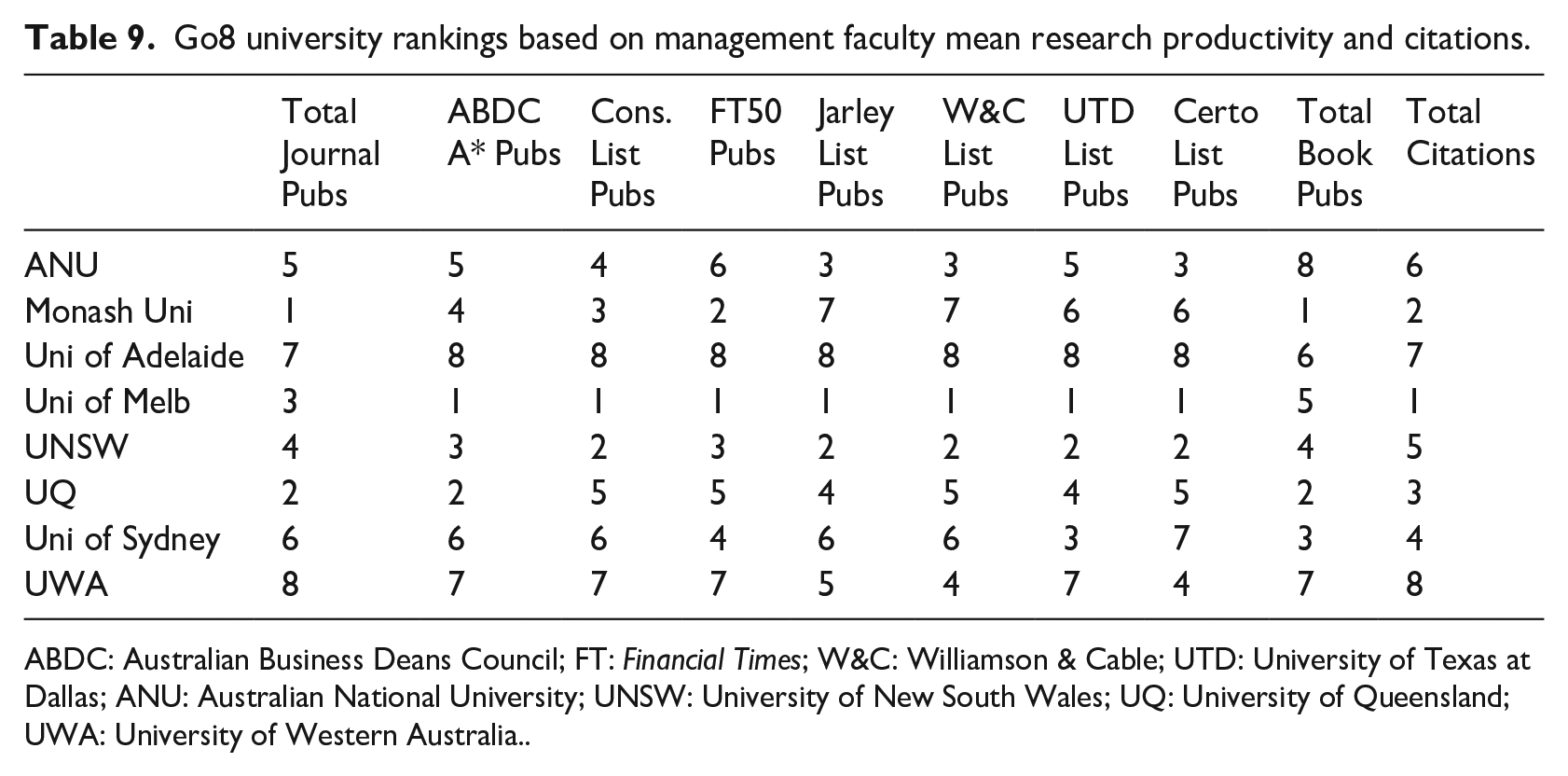
ABDC: Australian Business Deans Council; FT: Financial Times; W&C: Williamson & Cable; UTD: University of Texas at Dallas; ANU: Australian National University; UNSW: University of New South Wales; UQ: University of Queensland; UWA: University of Western Australia..
At the time these data were collected, the University of Melbourne occupied the top position in terms of citations and also in terms of publications across all of the high-quality journal lists. UNSW occupies the second position across five of the seven high-quality journal lists. The ranking based on total journal publications differs substantially, because this criterion emphasises publication quantity rather than quality. The ranking based on the number of books published also differs substantially, indicating some departments may emphasise books more than other departments.
4. Discussion
The descriptive statistics reported show that the top quartile of scholars, overall and at each academic rank, account for the majority of publications and citations. The skewed performance distribution becomes especially prominent for the number of articles published in the top international journals. This has important implications for recruiting, promotion and tenure decisions, and for the allocation of resources and rewards among faculty members.
We also find the average Go8 management scholar increases the number of total journal publications over time throughout their publishing career. The within-subject analysis shows total publications published per year increases by 56% over a 20-year period. This increase in productivity may be driven partly by: (a) learning and becoming more proficient in research skills over time, (b) building a larger professional network of researchers over time to collaborate with on projects (including PhD students), and (c) increasing incentives to publish as scholars ascend the academic ranks. The productivity improvement over time represents good news for management research within Australia. However, the results also show that productivity in terms of publishing A* journal articles or articles in the Consolidated Top Journal List does not improve over the average Go8 management scholar’s career. Again, this has important implications for recruiting and promotion if departments want faculty members to publish in the top international journals that feature in most university rankings.
Our results also highlight Go8 management scholars’ performance in terms of publishing in the top management journals compared with international scholars. We find that international scholars are between 2.2 and 8.5 times as productive as Go8 management scholars in terms of publishing in the eight Certo list journals (Certo et al., 2010), the 21W&C list journals (Williamson and Cable, 2003), and the 33 Jarley list journals (Jarley et al., 1998). This reinforces prior findings regarding ‘the Australian publication pattern of high volume, low impact and the low level of publications in top journals’ (Harzing, 2005).
Harzing (2005) found that Australian faculty members in economics, marketing, finance and accounting publish fewer articles in their respective fields’ top journals than international scholars. For Go8 management scholars, our findings show this situation still exists 17 years later. Some scholars examining this issue suggest that Australian universities do not value the same research output as universities in other countries (Pomfret and Wang, 2003). Many possible explanations could account for the comparatively low number of top management journal publications by Go8 scholars, including differences in incentives, target audience(s), research training, research funding, time available for research, professional networks, differences in PhD programmes across different countries, and opportunities to present work-in-progress to potential reviewers.
Whatever factors explain this outcome, we believe the current situation represents a problem for Australian management scholarship. Scholars benefit when they engage in debate and participate in research conversations with the best international scholars from around the world in their fields. Many of these research conversations occur in the top international journals. For Australian researchers to be at the frontier of management research, so they can make contributions to advance management theory and to disseminate their findings throughout the Australian business community, they need to participate in the ongoing research conversations with other world-class scholars in top international journals.
To motivate scholars to publish in top international journals, many of the top-ranked management departments internationally adopt a narrow list of leading journals to set performance expectations for tenure, promotion and recruitment. We do not advocate imitating this practice. We agree with scholars who argue that focusing on a narrow set of journals, such as the eight journals in the Certo list, can undermine the actual purpose of university scholarship (Adler and Harzing, 2009). Focusing on an excessively narrow set of journals may also: (a) unnecessarily restrict ‘acceptable’ research topics or methods by empowering a small number of journal editors as arbiters of research quality; (b) lead to escalating competition for publication space in leading journals; (c) increase the use of questionable research practices including p-hacking and HARKing; (c) focus scholarly research contributions primarily on advancing theory rather than meaningful practical implications; and (d) diminish some scholars’ intrinsic motivation for genuine scholarship (Aguinis et al., 2020; Rasheed and Priem, 2020).
On the contrary, setting low standards for research quality and productivity can also undermine scholarship and impede progress (Bartunek, 2020). We argue that the ABDC journal rankings for A* and A journals do not establish a high enough quality standard. The 2019 ABDC journal quality list includes 73 A* and 337 A-rated journals in the 1503 management FOR code. As a comparison, the most selective 4* category in the UK Association of Business Schools (ABS) journal quality list includes 10 management journals, and the next most selective category (4) includes 32 journals. Many North American Business Schools in research-intensive universities use the eight journals included in the Certo list or a similar list of about the same size. While we do not recommend adopting an excessively narrow set of top journals, we do recommend setting high performance standards and expecting scholars to publish some of their work in the top international journals. 5
We recommend a middle ground of adopting benchmarks for publishing in a broad set of high-impact, international management journals and providing resources and rewards to faculty who achieve or exceed those benchmarks. Specifically, we recommend adopting the benchmarks for the Consolidated List of Top Journals reported in Tables 6 and 7 at each academic rank. The Consolidated List of journals combines the Certo list, UT Dallas list, W&C list, Jarley list and FT50 list (Certo et al., 2010; Jarley et al., 1998; Williamson and Cable, 2003) to provide an aggregate collection of 71 top international journals across all Business School fields. This includes 41 journals typically identified as the top international journals in management that cover all the major management subfields of organisational behaviour, strategic management, international business, human resources & industrial relations, organisation theory, entrepreneurship.
Adopting the Consolidated List of Top Journals avoids excessive attention to a narrow set of journals, while motivating scholars to publish some of their research in the very top international management journals. Creating a new, unique journal list for a specific institution can be fraught with biases favouring journals in which faculty members within the department have published. By aggregating multiple existing top international journal lists, the Consolidated List of Top Journals avoids this conflict of interest and relies on well-established, peer-reviewed classifications of top journals. Beyond the benefits already highlighted about joining the research conversations and debates with the top scholars in the field, other positive aspects of using the Consolidated List of Top Journals include: (a) increasing transparency and reducing bias and reliance on subjective opinions about research quality; (b) providing clear expectations about what constitutes acceptable research rigour; (c) enabling straightforward comparisons of research performance; and (d) ensuring published journal articles have gone through a rigorous peer review process involving accomplished researchers in the field (Aguinis et al., 2020; Bartunek, 2020). Of course, our Consolidated List of Top Journals is not the only solution. Another viable option would be for a department/school to compile its own list of international top journals based on one or more objective criteria such as journal impact factor, journal h-index, SCImago Journal Rank (SJR), or other metrics.
Tables 6 and 7 provide important insights about evaluating research performance in terms of publications in the top international journals. One key insight is that the top 25% of Go8 management scholars – who account for 70% of articles published in the Consolidated List of top journals and 79% of total citations – already achieve world class levels of research productivity and impact. A second insight centres on the relatively small number of total top tier journal publications Go8 management scholars achieve per year and over their full career. The top quartile of Go8 Professors published 0.50 articles in the Consolidated List of top international journals each year and 0.41 FT50 articles each year. At this rate, it takes 2 years to publish one article in the Consolidated List journals and nearly 2.5 years to publish one FT50 article. This highlights the time and dedication required to successfully publish in the top international journals, even for the top quartile of Go8 Professors. An important implication is that Go8 faculty members capable of consistently publishing in the top management journals should receive strong support from department heads and deans in the form of adequate research time and resources. Management scholars who publish at high rates in the top international journals command substantial salaries and attractive working conditions in a very competitive global job market, and usually have options for employment in other universities.
To implement the research performance benchmarks for the Consolidated List of Top Journals, we recommend using the values reported in Tables 6 and 7 at each academic rank to inform recruitment, promotion and tenure/continuing contract decisions. Since the average Go8 scholar’s productivity of publishing articles in the Consolidated List of Top Journals does not improve over time, recruiting and rewarding scholars who do perform at or near the top quartile for these benchmarks provides the greatest leverage for increasing publications in the top international journals that feature in most university rankings. Deliberately setting and applying high performance standards to evaluate research performance should improve decision making for recruitment, promotion, remuneration and tenure/continuing contracts. Importantly, such publication benchmarks should be just one of multiple pieces of information considered in an informed peer review of a scholar’s research portfolio. Counting the number of publications in any set of journals does not replace a careful and rigorous review of an overall research portfolio by experts in the field. We believe widespread adoption and appropriate application of these benchmarks has the potential to enhance management scholarship across the Australian university sector over time.
4.1. Limitations
Despite the numerous strengths of the present data, such as the comprehensiveness and longitudinal nature, four limitations must be noted. First, the data comprise only Go8 academics employed in 2021; management scholars in non-Go8 universities or scholars who left academia prior to 2021 were not included in the data. If our data comprised all academics employed by all Australian universities over the past few decades, we would be able to examine how Australian management research performance has changed over this period. Obtaining more complete data on management scholars’ research productivity highlights an avenue for future research.
A second limitation relates to the journal publication comparisons with international scholars drawn from previous studies (i.e. Certo et al., 2010; Jarley et al., 1998; Williamson and Cable, 2003). While we compare the productivity of our sample with the samples in these prior studies, substantial differences exist between the samples. Accordingly, other factors – beyond those we discuss – may account for the differences. We also searched for prior studies on the research productivity of European or Asia-Pacific management scholars to expand the comparisons with other international scholars. We did not find prior studies reporting faculty member-level research productivity. The closest relevant study by Mudambi et al. (2008) ranked 130 Asia Pacific business schools using the journal authoring data underpinning the UT Dallas Business School Rankings from 1990 to 2006. The level of analysis for the Mudambi et al. (2008) study was university rather than individual faculty members, so the descriptive statistics cannot be compared to those reported in this study.
As another limitation, we did not collect or compute additional metrics of research productivity and impact such as the g-index, m-index, author-level eigenfactor, author impact factor or field-weighted citation impact. Scholars in a growing number of fields use one or more of these additional metrics in evaluating research performance (Carpenter et al., 2014). The g-index and m-index, both variants of the h-index, endeavour to account for some of the weaknesses of the h-index. Future studies can extend this research by reporting additional metrics of research productivity and impact for management scholars.
As a final limitation, we counted each author-publication observation in full. Aguinis et al. (2020) propose counting a scholar’s publications using fractional equivalents, by dividing each article by the number of listed co-authors, to assign a fractional value of each co-authored publication. Using fractional equivalents would impact the journal publication counts reported in our tables. This issue is important because the number of authors listed on each management journal article has increased over time (Certo et al., 2010). Aguinis et al. (2020) also propose evaluating research performance by assigning different weights to different categories of research outputs. The categories might include different tiers of journals, scholarly books, and other research outputs. We encourage future research to evaluate the use of fractional equivalents and also weighting schemes that include a wider range of research outputs. These complex issues entangle publication incentives, assessing individual contributions to multi-authored publications, the norms for author ordering across different fields and reaching agreement on the appropriate weights for different categories of research outputs, and require careful future investigation.
5. Conclusions and recommendations
This article provides empirical data on the research performance of Go8 management scholars in terms of publications, citations and h-index. Norms for career-wise publications and publications per year were developed for each academic level (from Lecturer to Professor) and for six well-established journal lists plus a consolidated top journal list and total citations. Evaluations of research performance increasingly play an important role in hiring, tenure, promotion, salary merit evaluations and grant reviews. Although the limitations of such metrics are well known and should never be used in isolation, accurate benchmarks provide an objective basis to assess performance. We recommend incorporating publication benchmarks in the Consolidated List of top management journals into the hiring, tenure and promotion decisions of departments that want to create high-performing research environments and to nurture excellent scholarship that influences theory and advances society. Importantly, such publication benchmarks should be just one of multiple pieces of information considered in an informed peer review of a scholar’s research portfolio.
Footnotes
Appendix 1
Journals in the financial times (FT) 50 list and UT Dallas list.
| FT50 Journals | UT Dallas List | Management Journal a | |
|---|---|---|---|
| 1 | Academy of management Journal | Academy of management Journal | Yes |
| 2 | Academy of management Review | Academy of management Review | Yes |
| 3 | Accounting, Organizations and Society | ||
| 4 | Administrative Science Quarterly | Administrative Science Quarterly | Yes |
| 5 | American Economic Review | ||
| 6 | Contemporary Accounting Research | ||
| 7 | Econometrica | ||
| 8 | Entrepreneurship: Theory and Practice | Yes | |
| 9 | Harvard Business Review | Yes | |
| 10 | Human Relations | Yes | |
| 11 | Human Resource management | Yes | |
| 12 | Information Systems Research | Information Systems Research | |
| 13 | Journal of Accounting and Economics | Journal of Accounting and Economics | |
| 14 | Journal of Accounting Research | Journal of Accounting Research | |
| 15 | Journal of Applied Psychology | Yes | |
| 16 | Journal of Business Ethics | Yes | |
| 17 | Journal of Business Venturing | Yes | |
| 18 | Journal of Consumer Psychology | ||
| 19 | Journal of Consumer Research | Journal of Consumer Research | |
| 20 | Journal of Finance | Journal of Finance | |
| 21 | Journal of Financial and Quantitative Analysis | ||
| 22 | Journal of Financial Economics | Journal of Financial Economics | |
| 23 | Journal of International Business Studies | Journal of International Business Studies | Yes |
| 24 | Journal of management | Yes | |
| 25 | Journal of management Information Systems | ||
| 26 | Journal of management Studies | Yes | |
| 27 | Journal of Marketing | Journal of Marketing | |
| 28 | Journal of Marketing Research | Journal of Marketing Research | |
| 29 | Journal of Operations management | Journal of Operations management | |
| 30 | Journal of Political Economy | ||
| 31 | Journal of the Academy of Marketing Science | ||
| Journal on Computing | |||
| 32 | Management Science | Management Science | Yes |
| 33 | Manufacturing & Service Operations management | Manufacturing & Service Ops management | |
| 34 | Marketing Science | Marketing Science | |
| 35 | MIS Quarterly | MIS Quarterly | |
| 36 | Operations Research | Operations Research | |
| 37 | Organization Science | Organization Science | Yes |
| 38 | Organization Studies | Yes | |
| 39 | Organizational Behavior & Human Decision Processes | Yes | |
| 40 | Production & Operations management | Production & Operations management | |
| 41 | The Quarterly Journal of Economics | ||
| 42 | Research Policy | Yes | |
| 43 | Review of Accounting Studies | ||
| 44 | The Review of Economic Studies | ||
| 45 | Review of Finance | ||
| 46 | Review of Financial Studies | Review of Financial Studies | |
| 47 | MIT Sloan management Review | Yes | |
| 48 | Strategic Entrepreneurship Journal | Yes | |
| 49 | Strategic management Journal | Strategic management Journal | Yes |
| 50 | The Accounting Review | The Accounting Review |
FT: Financial Times; UT: University of Texas.
Journals typically identified as belonging to the management field covering organisation behaviour, human resources, strategic management, international business, organisation theory, and entrepreneurship.
Acknowledgements
The authors would like to acknowledge the constructive comments provided in the review process by the editorial team and two anonymous reviewers.
Final transcript accepted 10 April 2023 by Andrew Jackson (Editor-in-Chief ).
Funding
The author(s) received no financial support for the research, authorship and/or publication of this article.
