




Abstract
Building on previous studies on third-party observations (TPOs) of mistreatments, in this study, we investigate the effects of TPO of workplace deviance (TPO-WD). Drawing on conservation of resource theory, we explore the intermediary process through which TPO-WD, influences employees’ workplace thriving. Using multi-wave data from 346 employees, our results suggest that those who observe, or hear about, incidents of workplace deviance experience a heightened level of emotional exhaustion, which has a detrimental impact on workplace thriving. Furthermore, we also test how these relationships are impacted by the extent of employees’ organizational identification and a cooperative psychological climate. These findings not only provide a resource-based view on how TPO-WD affects workplace thriving but also highlight the critical importance of cooperative psychological climate as a resource passageway to prevent damaging employees’ workplace thriving.
Keywords
1. Introduction
Organizations lose billions of dollars every year due to the ill-effects of workplace deviance (Bennett et al., 2018). Extant literature documents resultant losses such as productivity losses (Dunlop and Lee, 2004; Gunia and Kim, 2016) and emotional distress (Totterdell et al., 2012); however, a ‘third-party’ (used interchangeably with ‘observers’) perspective of workplace deviance is still in its infancy (Ferguson and Barry, 2011). This begs the question of whether current estimates of such losses are just the tip of the iceberg. Studies show that third-party observation (TPO) of interpersonal deviance has a negative impact on third parties, including a threat to the observer’s self-concept (Gunia and Kim, 2016), interpersonal connections (Wellen and Neale, 2006), leadership traits (Mawritz et al., 2017) and own deviance (Ferguson and Barry, 2011). However, in addition to these findings, a deeper understanding is required not only to uncover the mechanisms through which third parties are impacted by workplace deviance, but also to explore ways in which organizations can intervene to mitigate the damage.
Although literature on TPO of mistreatment explores how interpersonal deviance impacts third parties (Ferguson and Barry, 2011), this study carries out an integrative inquiry into how interpersonal or organization-directed deviance impacts third parties. Therefore, we define TPO of workplace deviance (TPO-WD) as ‘the process of an individual observing or becoming aware of interpersonal or organizational deviance’. This study aims to understand the processes and spill-over effects of workplace deviance beyond the perpetrator and target (Dhanani and LaPalme, 2019; Ferguson and Barry, 2011), to the employees (we focus on employees as third parties) who observe or hear about the deviance. This study also delineates individual and environmental factors that impact these processes. Specifically, it studies which individual characteristics could reinforce the extent of damage of TPO-WD, and the organizational factors that could mitigate this damage.
To that end, in light of the conservation of resources (COR) theory (Halbesleben et al., 2014; Hobfoll, 1989), we introduce emotional exhaustion, a state of emotional and physical depletion (Maslach and Jackson, 1981), as a mediator to explain why TPO-WD harms workplace thriving. Here, emotional exhaustion serves to explain how observation of workplace deviance could potentially consume an observer’s resources and energy (e.g. emotion regulations; Totterdell et al., 2012). Consequently, depleted energy may undermine subsequent positive consequences, including the observer’s workplace thriving, defined as ‘a positive state reflective of vitality and learning experiences’ (Spreitzer et al., 2005: 538). We focus on workplace thriving for three key reasons. First, it is a critical individual psychological state encompassing a broader umbrella of potential positive outcomes including behaviours, performance and well-being (Jiang et al., 2019; Spreitzer and Porath, 2014). Therefore, exploring the impact of TPO-WD on workplace thriving provides a critical understanding of how deviance at workplace may impact observer’s positive outcomes. Second, while research provides evidence of how TPO-WD results in positive outcomes, for example, performance (because observers may work hard to avoid being a target of deviance; Gunia and Kim, 2016), it is also important to understand whether third-party observers of deviance (who may be higher performers) are thriving at work, or are in a state of depleted resources. Third, studies in TPO of mistreatments draw on stress theories (Dhanani and LaPalme, 2019) and the COR theory (Deng et al., 2018; Miner-Rubino and Cortina, 2007); however, the COR theory has not been used to study TPO-WD. Interestingly, workplace thriving is contingent on access to positive energy and resources (Spreitzer et al., 2005), central to COR theory. Therefore, exploring impact of TPO-WD on workplace thriving, mediated by emotional exhaustion, serves as critical contribution to understanding a resource-based perspective of the impacts of TPO-WD.
However, it is important to understand not only how TPO-WD negatively impacts workplace thriving, but also for whom specifically it is more significant, and how the organization can intervene. Therefore, this article identifies organizational identification as a personal characteristic that strengthens the negative relationship between TPO-WD and emotional exhaustion, and cooperative psychological climate (CPC) as a resource passageway that weakens the mediated pathway between TPO-WD and workplace thriving. In line with the COR theory, these moderators provide critical understanding and guidance on how resource losses vary with personal characteristics (i.e. organizational identification) and how resource passageways (i.e. CPC) can replenish resources and minimize damage. Figure 1 depicts the theoretical model of this study.
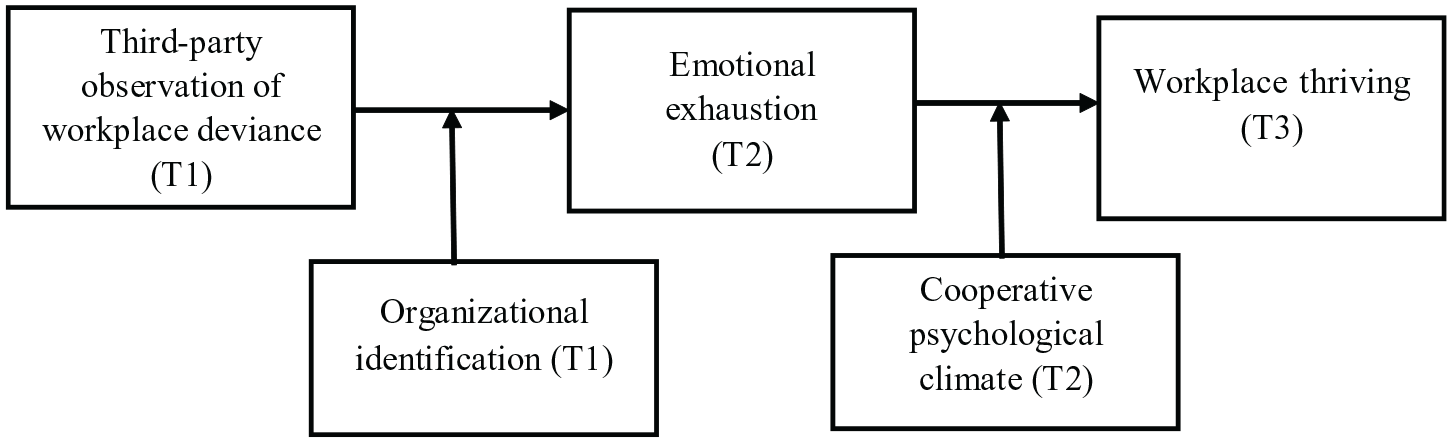
Proposed conceptual framework.
This study provides valuable contribution to theory and practice in two ways. First, it contributes to the intersection of TPO of mistreatments, workplace deviance and workplace thriving literatures. This study expands an emerging lens of TPO-WD by providing theoretical arguments and empirical evidence of how TPO-WD stifles thriving at work. Similarly, workplace deviance has a plethora of studies that focus on the dyad involved, that is, perpetrator or target; however, limited attention is on the individuals observing. Also, workplace thriving is an essential psychological state to gauge a broad array of positive outcomes of an employee. In this study, we learn how, by merely observing workplace deviance, an employee may not be able to thrive at work. Therefore, this study advances three different streams of literatures with novel insights: TPO of mistreatments, workplace deviance and workplace thriving literatures.
Second, COR theory has been used in various domains, especially in the context of emotional exhaustion, where contextual factors generating stress and resource losses have been researched extensively (Halbesleben et al., 2014; Paustian-Underdahl et al., 2013; Whitman et al., 2014). However, resource losses have ‘not been directly assessed as an explanatory mechanism’ (Dhanani and LaPalme, 2019) in the third-party mistreatment literature. In our model, COR theory provides concrete theoretical grounds to discuss the mediation of emotional exhaustion and understand how TPO-WD negatively impacts workplace thriving. More importantly, we theorize and discuss how resource passageways, discussed in the form of CPC, may provide a mechanism to replenish resources for employees who become drained from observing workplace deviance. This has strong implications for practice, since organizations need to ensure that resource passageways (e.g. CPC) are in place for those who have been emotionally damaged from observing workplace deviance. Interestingly, the need for such resource passageways is of greater criticality for individuals who identify more with their organizations, since they experience more stress when observing deviance at work (Deng et al., 2018).
This article starts by reviewing literature on third-party mistreatment and the COR theory, before providing a theoretical account of our model. Following this, it presents the methodology and results of the study. It then concludes with implications for theory and practice and recommendations on future research directions.
1.1. TPO of workplace deviance
Literature on TPO of mistreatment is at a nascent stage (Dhanani and LaPalme, 2019). Nonetheless, the limited studies in this area provide evidence of the detrimental effects of TPO on an individual’s well-being and interpersonal outcomes (Dhanani and LaPalme, 2019). Here, scholars have explored the effects of TPO of several ‘observed’ mistreatments, such as witnessing workplace incivility – less intense deviant behaviours with ambiguous intention to harm others at work (Schilpzand et al., 2016), unpleasant interpersonal interactions (Totterdell et al., 2012), rudeness (Porath and Erez, 2009) or injustice (Skarlicki and Kulik, 2004). Each study aims to understand the impact of observed behavioural mistreatment on the onlooker’s perceptions, emotions, task performance and creativity (Porath and Erez, 2009; Totterdell et al., 2012). Yet, limited scholarly attention has been given to TPO-WD. We discuss below why exploring workplace deviance with a third-party perspective is important and timely.
Workplace deviance includes ‘voluntary behavior that violates organizational norms and consequently threatens the well-being of an organization, its members, or both’ (Robinson and Bennett, 1995: 556). Here, deviance behaviours directed towards the organization include unjustified extension of overtime, shirking working hours, lying about hours worked and stealing from the organization (Bennett and Robinson, 2000). Similarly, deviance behaviours directed towards individuals include verbal abuse, gossiping and blaming (Bennett and Robinson, 2000). In the workplace deviance literature, a lot of scholarly attention has been given to the target who directly experiences workplace deviance, or the perpetrator of deviance; however, of increasing scholarly interest is the effect on individuals who observe or hear about it. Studies suggest that observation is a fast mode of learning (Bandura and Walters, 1977), as compared to direct experiences. Therefore, it is necessary to take an integrative approach of literature on TPO and workplace deviance to generate useful insights for theory and practice.
In this study, we aim to theorize and empirically test the detrimental impact of TPO-WD on the observer. One important outcome of observing workplace deviance is stress (Totterdell et al., 2012). Since resource losses occur due to stress, COR theory is well placed to provide the theoretical underpinning of our conceptual model.
1.2. COR theory
The COR theory builds on earlier theories of psychological stress and coping to suggest that all human beings strive to maintain a world that provides them with security (Hobfoll et al., 2018). As Hobfoll et al. (2018) suggest, one strategy to ensure this is to gather, foster and protect resources, for example, personal characteristics (skill and ability) as well as conditions (personal relationships) that provide security. Furthermore, the authors also argue that any loss or potential loss of these resources, or failure to gain a resource despite significant effort, may result in psychological stress for the individuals. Hobfoll (2001) specifies that stressful events, which occur over time, hinder individuals’ ability to protect their personal resources.
COR theory posits that when faced with a loss of resources, individuals and organizations aim to minimize the resource loss and resultant stress. However, at each iteration of resource loss, individuals and organizations have fewer resources to offset the losses (Hobfoll et al., 2018). Hobfoll (2001) theorized that resources travel in packs called resource caravans, accessed through resource passageways. Resource passageways are defined as the ‘ecological conditions that either nurture or block resource creation and sustenance’ (Hobfoll et al., 2018: 107). They are the organizational and cultural settings that channel resources to employees (Hobfoll et al., 2018). Recent studies discuss the positive role of resource passageways, for example, psychological safety climate (Dollard et al., 2019; Loh et al., 2018), initiative climate (Aslam et al., 2021) and human resource management practices (Mansour and Tremblay, 2018). Thus, every organization strives to maintain healthy resource passageways, that is, climate, practices and so on to facilitate access of resources for employees (Aslam et al., 2021; Dollard et al., 2019; Loh et al., 2018; Mansour and Tremblay, 2018).
1.3. TPO-WD and emotional exhaustion
Scholars have used COR theory to explain how emotional exhaustion results from resource threats and insufficient personal resources (Halbesleben and Buckley, 2004; Hobfoll, 1989). In this section, we utilize theoretical underpinnings of the COR theory to discuss how TPO-WD results in emotional exhaustion.
Observing ‘norm-deviant’ behaviour, where there is harm to an individual or the organization, threatens the resource passageways that employees bank on, thereby inducing stress. In light of COR theory, there are four main reasons for this. First, observers of interpersonal deviance may experience mental suffering (Nesse et al., 2007) feeling stressed as a result. Second, observers may experience stress in anticipation of being the next target of interpersonal deviance, especially if such events increase in frequency without corrective action by the organization. Here, personal resources could end up being consumed in coping with the threat, thinking of ways to prevent becoming a target, and pre-empting ways to respond to such a situation. Third, given a lot of valuable material resources including money and career progression flow from the organization to the employee, observing organizational deviance may instigate multiple negative emotional responses (e.g. anger, disappointment). Finally, for both interpersonal and organizational deviance, the observers may fear a permanent change in the organizational climate and practices (i.e. resource passageways that provide safety, opportunity and justice), especially if the TPO-WD events are more frequent and without corrective action by the organization.
Hypothesis 1 (H1). Third-party observation of workplace deviance will positively influence emotional exhaustion.
1.4. Organizational identification as moderator
Not everyone evaluates stressors at work in the same way; personal characteristics affect this evaluation across individuals (Hobfoll, 1989; Hobfoll and Shirom, 2001). Below we discuss how organizational identification, a unique personal characteristic, may impact the evaluation of the stressor, the extent of resources consumed by the stressor and the ability to cope with the stressors (Deng et al., 2018; Wilk and Moynihan, 2005).
Organizational identification refers to ‘perceived oneness with an organization and the experience of the organization’s successes and failures as one’s own’ (Mael and Ashforth, 1992: 103). Organizational identification is deeply rooted within individuals’ perception of how integrated their personal identity is with the organizational identity (Ashforth and Humphrey, 1993; Ashforth and Mael, 1989). COR theory suggests that, when an employee identifies with the organization, a harmful organizational stressor has personal significance for the employee (Hobfoll, 1989), where it is perceived as a personal attack (Deng et al., 2018). Therefore, the strong affiliation with the organization also shapes subsequent resource investment decisions (Hobfoll, 1989; Hobfoll et al., 2018). Based on this theoretical insight, organizational identification influences employees’ responses to a stressful situation (Wegge et al., 2012), including the experience of TPO-WD.
This study suggests that the positive relationship between TPO-WD and emotional exhaustion will be stronger for employees who identify highly with their organizations. High organizational identification makes employees feel more affiliated, bound to and concerned for the welfare of the organization (Blader et al., 2017). These employees feel a strong obligation and alignment with organizational interests and are highly protective of the organizations’ resources (Blader et al., 2017; Mael and Ashforth, 1992; Van Leeuwen et al., 2003). Stressful events that put organizational interests at risk may trigger resource losses among employees; however, such events have a greater impact on employees with high organizational identification. Thus, high organizational identification enhances anxiety, emotional and other negative outcomes due to organization-directed deviance events (Ashforth and Humphrey, 1993).
Low organizational identification makes the employees indifferent towards organizational welfare (He et al., 2018). These employees share fewer attributes in common with their organization, making their association with the organization low (Blader et al., 2017). Stressful events, such as TPO-WD, which threaten the welfare of organization do not trigger significant resource losses among these employees. They infer such events as marginal, making negative effects of TPO-WD on them relatively insignificant. Therefore,
Hypothesis 2 (H2). Organizational identification moderates the positive relationship between third-party observation of workplace deviance and emotional exhaustion, such that the relationship will be stronger for employees with higher organizational identification.
1.5. The mediating role of emotional exhaustion
Although previous studies provide evidence of the effects of TPO on employees’ task performance and work effort (Gunia and Kim, 2016; Porath and Erez, 2009), the intermediary psychological process between TPO and outcomes have not been explored. We fill this gap by hypothesizing the mechanism that explains the effects of TPO-WD on workplace thriving through emotional exhaustion.
Workplace thriving describes a psychological state where individuals feel ‘a sense of progress, or forward movement, in one’s self-development’ (Spreitzer et al., 2005: 538). Thriving comprises of two components namely, vitality (affective) and learning (cognitive). Vitality is the availability of energy and a feeling of aliveness at work (Nix et al., 1999; Spreitzer et al., 2005), while learning is employees’ ability to obtain and apply a new set of knowledge and skills at work (Dweck, 1986; Edmondson, 1999).
Research suggests that workplace thriving is more malleable and less stable than personality traits (Oldham et al., 1976; Spreitzer and Porath, 2014). Studies discuss how this malleable nature of thriving is also dependent on individual characteristics, relational characteristics, contextual features and agentic behaviours (Niessen et al., 2017; Spreitzer et al., 2005). Spreitzer et al. (2005) further argue that the key to thriving at work is providing first, enabling conditions to employees, and second, resources that are ‘produced during work’, that is, knowledge, positive affect and so on.
Since TPO-WD may have a detrimental impact on resource passageways (i.e. climate and practices), we argue that it threatens the social work environment and resources that facilitate workplace thriving (Gunia and Kim, 2016; Wellen and Neale, 2006). Studies discuss how an environment with supportive co-worker behaviour, workplace civility and supervisory behaviours (Kleine et al., 2019) positively impact workplace thriving. Given that the extent of growth and development of employees is embedded in social cues at work (Cullen et al., 2018), we argue that TPO-WD limits their ability to thrive. In the presence of TPO-WD, the environment that provides opportunities for self-development, personal growth and workplace thriving may be negatively impacted (Paterson et al., 2014).
Furthermore, in light of the COR theory, TPO-WD results in stress, which depletes personal resources (Halbesleben et al., 2014; Hobfoll, 1989) and results in emotionally drained employees. The depleted resources of these employees i.e. the lack of positive mental energy (Halbesleben, 2010) prevent them from investing in behavioural regulations (Hobfoll, 1989; Wright and Cropanzano, 1998). Consequently, continued high levels of emotional exhaustion may activate resource protection tendency (Halbesleben et al., 2009) and self-regulation behaviours (Skarlicki and Kulik, 2004), leaving individuals with fewer resources to perform at full capacity (Halbesleben et al., 2009; Hobfoll et al., 2018: 107). Once emotional exhaustion takes a toll on an individual’s personal resources, it is not easily replenished (Hobfoll, 1989), impairing performance in all domains of work (Halbesleben et al., 2009). This is because emotional energy is considered an essential ingredient for self-expression and self-investment at work (Uy et al., 2017).
In the context of workplace thriving, availability of resources makes employees feel more energetic, and increases their mental capacity to learn (Niessen et al., 2012). In the same vein, reduced resources depletes the individuals coping resources to meet the emotional demands at work (Halbesleben et al., 2014; Maslach and Jackson, 1981) hampering their vitality and learning (Jiang et al., 2019). Thus, emotional exhaustion diminishes employees’ energy levels and their potential to invest resources in work, thereby limiting their capability to self-express, learn, grow, develop and thrive at work (Baer et al., 2015; Niessen et al., 2017; Porath et al., 2012). Therefore, we expect the negative effects of TPO-WD on workplace thriving to be mediated by emotional exhaustion. Based on these arguments, the hypothesis is as follows:
Hypothesis 3 (H3). Emotional exhaustion mediates the relationship between third-party observation of deviance and workplace thriving.
1.6. CPC as moderator
We suggest that CPC holds the potential to circumvent the hostile effects of TPO-WD by allowing individuals to effectively cope with their environment (Fisher, 2014).
CPC refers to the ‘individuals’ perception of working together for common organizational goals’ (Fisher, 2014; Wagner, 1995). We argue that CPC serves as a resource passageway providing access to critical resources. Studies have discussed how resource passageways provide a cushion in stressful situations. For example, psychological safety climate serves as a resource passageway to alleviate work family conflicts (Mansour and Tremblay, 2018) and perceived inclusion climate has been found to provide a passageway to enhance resilience and facilitate work adjustment of expatriates (Davies et al., 2019). Resource passageways also provide resources to enhance positive outcomes at work. For example, an initiative climate has been found to enhance engagement and motivation (Aslam et al., 2021), and family-friendly human resources policies provide employees with the ability to cope with work demands (Mansour and Tremblay, 2018).
Therefore, CPC has a significant effect on how employees respond to resource loss situations, such as emotional exhaustion. We argue that high CPC signals cooperation among employees, which buffers the negative effects of workplace stressors (Fisher, 2014) and gives the employees the ability to maintain personal resources (Gerbasi et al., 2015). For instance, on perceiving high CPC, employees feel positive, more committed (Bogaert et al., 2012), motivated and energized to put in effort at work (Brown and Leigh, 1996; Collins and Smith, 2006). With CPC, employees who experience emotional exhaustion, as a result of TPO-WD, can ‘actively cope’ and recover from the state given the resource passageways are in place to replenish the resources lost (Hobfoll, 2001).
Moreover, we argue that under low perceptions of CPC, employees are unlikely to thrive at work when emotionally exhausted from TPO-WD. Since resource loss in the form of emotional exhaustion is considered as obstructive (He et al., 2018), employees’ growth is further truncated when coupled with low levels of CPC (Spreitzer and Porath, 2014). Therefore, the low perception of CPC correspond to limited facilitators/accelerators of resources, which negatively impact workplace thriving (Halbesleben et al., 2014). Emotional exhaustion, which has already drained the employees’ energy, provokes stronger feelings of resource loss when it is coupled with perceptions of low cooperation from their peers.
In light of the above, we posit that high CPC weakens the relationship between TPO-WD and workplace thriving, mediated by emotional exhaustion. Conversely, the harmful effects of TPO-WD on workplace thriving through emotional exhaustion will be stronger for employees with low CPC. Hence, we expect low CPC to strengthen the indirect effect of TPO-WD on workplace thriving through emotional exhaustion.
Hypothesis 4 (H4). Cooperative psychological climate moderates the strength of the relationship between third-party observation of deviance and workplace thriving mediated by emotional exhaustion, such that the mediated relationship is stronger when perception of cooperative psychological climate is low rather than high.
2. Methodology
2.1. Sample and procedure
Data were collected from full-time employees in public and private companies in Pakistan. These organizations include banks, e-commerce, engineering, fertilizers and paper and packaging. At the time of data collection, employees working in a specific position and organization for a duration of at least 3 months were contacted. We used convenience sampling to select employees from various hierarchical levels, ranging from junior executives to middle-level and senior executives.
Data collection procedures were also carefully crafted and followed to enable reliable results. Following these procedures, first an email was sent to the HR department of the target organizations to apprise the purpose of the study. On receiving the consent of the HR department, employees working in the organizations for three or more months were chosen. Once employees were selected, and after ensuring anonymity of responses to employees, questionnaires were distributed to employees physically at their organizations. To enhance response rate, at Time 1 (T1), the employees were informed about three iterations of the survey. To match respondents across three time periods, the questionnaires were also tracked by an anonymous code generated at T1. For subsequent stages, responses were matched through these codes.
A three-wave survey was administered with a time-lag of 2 weeks each. The data were collected at intervals as causal variables take time to influence individuals at work (Gollob and Reichardt, 1987). This specific time lag was chosen because individuals’ behavioural reactions to their psychological experiences are relatively instantaneous, and time intervals greater than 2 weeks may diminish the influence of data collected in previous waves, owing to possible changes in circumstances (Robins and Beer, 2001; Salancik and Conway, 1975). Furthermore, time lapses in data collection also reduce common method variance (CMV; Podsakoff et al., 2012).
During data entry in each wave, missing data points were also removed. At T1, 481 participants (response rate = 72%) completed demographic variables, control variables and measures of TPO-WD, organizational identification and emotional exhaustion. At Time 2 (T2), 373 participants (response rate = 78%) responded to the measures of emotional exhaustion, CPC, TPO-WD and workplace thriving. Finally, 346 participants (response rate = 93%) provided their responses on workplace thriving and emotional exhaustion at Time 3 (T3). The final sample comprised 346 data points, of which a majority 74.27% (n = 257) were male, which is representative of the overall male workforce of around 80.81%. 1 The sample was drawn from diverse industries such as manufacturing, services and commerce. The mean age of the sample was 30 years (SD = 5.32), and the mean organizational tenure was 4.5 years (SD = 3.62). A majority of the participants either had a Master’s (53.2%) or a bachelor’s degree (38.72%).
2.2. Measures
The following established scales were used to measure the constructs. Higher scores designate higher level of each variable.
2.2.1. TPO of workplace deviance
TPO-WD (α = 0.89) was assessed by using the Bennett and Robinson (2000) scale. Items were adapted following the method prescribed by Ferguson and Barry (2011), including interpersonal (7 items) and organizational (10 items) deviance. 2 Participants were asked the following at the start of the survey: ‘How often in the last 6 months have you observed that another person (a co-worker or subordinate) in your team/organization engaged in the following behaviors?’ Sample items include ‘said something hurtful to someone at work’ and ‘come in late to work without permission’ (1 = never to 5 = more than once a week).
2.2.2. Emotional exhaustion
Emotional exhaustion (α = 0.77) was measured using three items from Maslach burnout inventory (Maslach et al., 1986). A sample item is ‘I feel emotionally drained from my work’ (1 = never to 5 = more than once a week).
2.2.3. Organizational identification
Organizational identification (α = 0.86) was measured through a six-item scale reported by Mael and Ashforth (1992). A sample item includes ‘When someone criticizes my organization, it feels like a personal insult’ (1 = strongly disagree to 5 = strongly agree).
2.2.4. Cooperative psychological climate
CPC (α = 0.87) was measured through five-item scale developed by Chatman and O’Reilly (2004). The study adapted the scale by following Ho et al. (2018), and used the word ‘organization’ rather than ‘team’. A sample item is ‘The members in my organization openly share information with one another’ (1 = strongly disagree to 5 = strongly agree).
2.2.5. Workplace thriving
Workplace thriving (α = 0.94) was measured through the eight-item scale developed by Porath et al. (2012). We used four items each for both vitality and learning to measure employees’ workplace thriving. The sample items include vitality– ‘At work, I have energy and spirit’, learning– ‘At work, I see myself continually improving’ (1 = strongly disagree to 5 = strongly agree).
2.2.6. Control variables
Organization size and industry were included in the study as control variables. These were chosen because they have been shown to influence employees’ attitudes, specifically workplace thriving (Niessen et al., 2012).
2.3. Analytical strategy
Confirmatory factor analysis (CFA) was conducted using SPSS statistical software (Prakash Prabhakar, 2009). A reasonable fit was assessed when the values of the comparative fit index (CFI; Bentler, 1990) and Tucker–Lewis index (TLI; Tucker and Lewis, 1973) were close to or exceeded 0.90, when root mean square error of approximation (RMSEA) values were less than 0.08 and when standardized root mean square residual (SRMR) values were close to 0.06 (Hu and Bentler, 1999).
The Hierarchical ordinary least squares (OLS) regression approach was used to analyse the measurement model. The direct effects were tested by first entering only control variables in the model, followed by independent variables SPSS was used to estimate direct effects while Hayes (2013) process macro was used to estimate mediating and moderating effects. The indirect effect of TPO-WD on workplace thriving via emotional exhaustion (Edwards and Lambert, 2007; Hayes, 2013) and the conditional indirect effects at different levels of the moderators were assessed using Model 21 from the study by Hayes (2013). The 95% bias-corrected confidence interval (CI) with bootstrap sample is preferred (Preacher and Hayes, 2008) over other traditional approaches (e.g. Sobel test) for assessing indirect effects since it provides high statistical power and controls for Type-1 error. Here, bootstrap CIs, which exclude zero indicate statistically significant indirect effect.
3. Results
3.1. Data and model validation
Prior to data analysis, we confirmed quality criteria for the data used in our model. First, we conducted Harman’s single factor test and found that a single factor accounted for 19.35% of variation, which was considerably below the cut-off point of 50% (Podsakoff and Organ, 1986). To further confirm this, the common latent factor test was also conducted in structural equation modelling. To assess this, all the items were loaded onto a common latent factor, the results showing zero variance among all items. These statistics confirm that CMV was not a serious threat for the data.
All values of Cronbach’s alpha were between 0.77 and 0.94, above the threshold of 0.7 (Henseler et al., 2009). Similarly, factor loadings for all the constructs were above 0.5, confirming internal consistency of the constructs. Average variance extracted (AVE) was between 0.53 and 0.71, exceeding the cut-off point of 0.5 (Hair et al., 2010). In addition, following Fornell and Larcker (1981), square root of the AVEs exceeded their corresponding inter-construct correlations, showing satisfactory discriminant validity (Fornell and Larcker, 1981). Given all these checks, we were satisfied that convergent and discriminant validity was not an issue with our study’s constructs.
Finally, several CFA models were tested to ensure that the constructs had a good fit with the data (Field, 2009). CFA results showed that a five-factor model fit the data well (χ2 = 1312.57, df = 684, p = 0.00, SRMR = 0.05, CFI = 0.92, TLI = 0.91, RMSEA = 0.05). This best-fit measurement model was compared with a four-factor (CPC and workplace thriving loaded on one factor), three-factor (emotional exhaustion, CPC and workplace thriving loaded on one factor each), two-factor (organizational identification, emotional exhaustion, CPC, workplace thriving loaded on one factor, TPO on another factor) and one-factor model. Results showed that the four-factor model (χ2 = 3238.53, df = 696, p = 0.00, SRMR = 0.09, CFI = 0.67, TLI = 0.64, RMSEA = 0.10, Δχ2 = 1519.57, Δdf = 7), the three-factor model (χ2 = 3530.70, df = 699, p = 0.00, SRMR = 0.10, CFI = 0.63, TLI = 0.61, RMSEA = 0.11; Δχ2 = 292.17, Δdf = 3), the two-factor model (χ2 = 4370.57, df = 701, p = 0.000, SRMR = 0.12, CFI = 0.52, TLI = 0.49, RMSEA = 0.12; Δχ2 = 839.87, Δdf = 2) and the single-factor model (χ2 = 5938.46, df = 702, SRMR = 0.18, CFI = 0.31, TLI = 0.27; RMSEA = 0.15; Δχ2 = 1567.89, Δdf = 1) fit relatively poorly. This provided justification to use the five-factor model to test the hypotheses.
3.2. Descriptive statistics
Descriptive statistics, correlations and reliabilities of the constructs are provided in Table 1. TPO-WD was positively and significantly related to emotional exhaustion at T2. Emotional exhaustion was negatively associated with workplace thriving at T3.
Descriptive statistics.
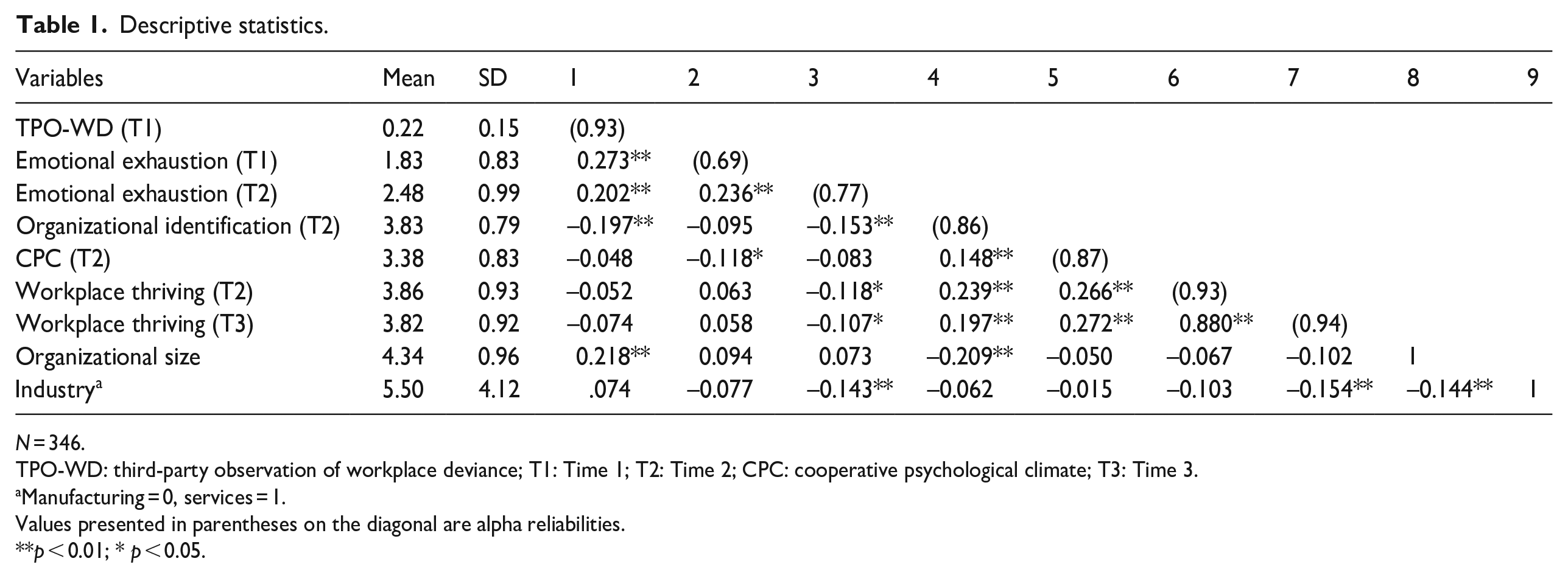
N = 346.
TPO-WD: third-party observation of workplace deviance; T1: Time 1; T2: Time 2; CPC: cooperative psychological climate; T3: Time 3.
Manufacturing = 0, services = 1.
Values presented in parentheses on the diagonal are alpha reliabilities.
p < 0.01; * p < 0.05.
3.3. Hypotheses testing
Table 2 provides the results for the proposed model while controlling for impact of previous time. Controlling for emotional exhaustion (T1), the findings showed that TPO-WD was positively related to emotional exhaustion (T2; β = 0.16, SE = 0.35, p < 0.00). Moreover, after controlling for both emotional exhaustion (T1) and workplace thriving (T2), the results remain similar (β = 0.16, SE = 0.35, p < 0.00), suggesting that employees’ TPO-WD enhances their emotional exhaustion, thereby supporting H1.
Hierarchical regression analysis.
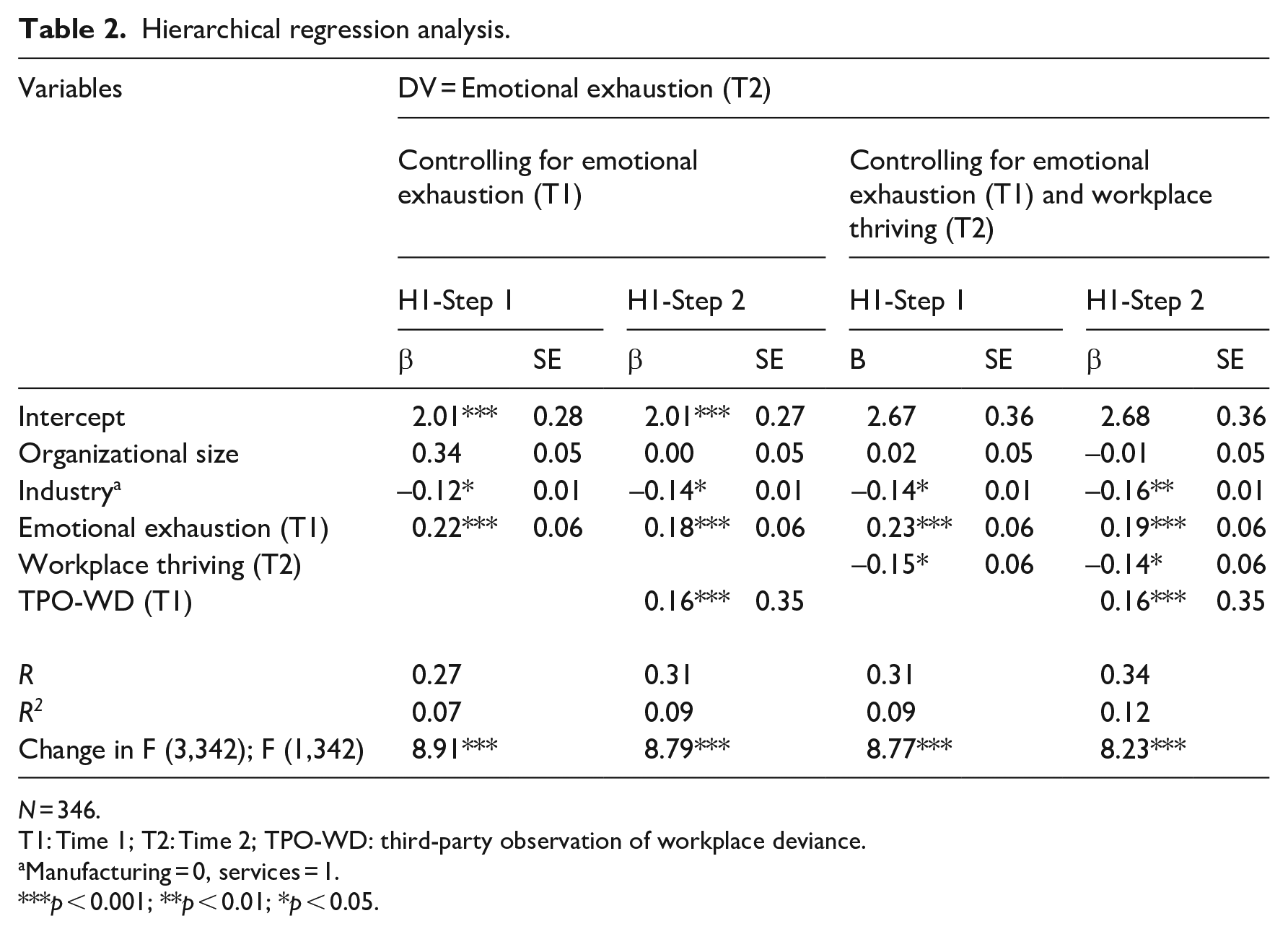
N = 346.
T1: Time 1; T2: Time 2; TPO-WD: third-party observation of workplace deviance.
Manufacturing = 0, services = 1.
p < 0.001; **p < 0.01; *p < 0.05.
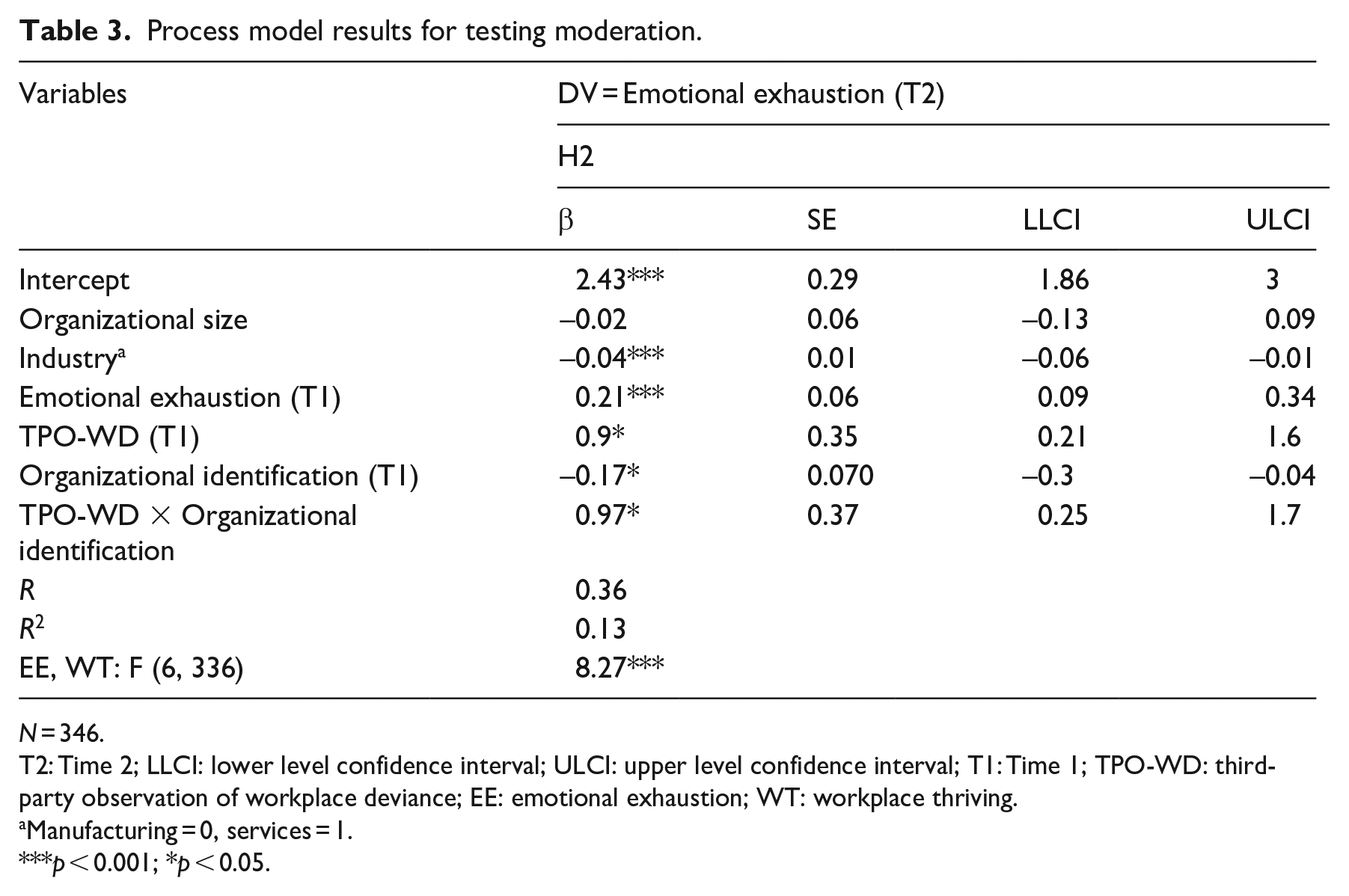
H2 predicted that the relationship between TPO-WD and emotional exhaustion would be strengthened by high organizational identification. The result indicates that the interaction between TPO-WD and organizational identification on emotional exhaustion is significant (β = 0.97; SE = 0.37, CI = [0.025, 1.7]). Moderation plots (Figure 2) allow a better understanding of these moderating effects for H2. To confirm the direction and significance of the interaction term, we conducted a simple slope analysis based on the criteria ±1 SD above and below the mean (Aiken et al., 1991; Stone and Hollenbeck, 1989). As hypothesized, the slopes (Figure 2) of the relationship between TPO-WD and emotional exhaustion is strong for employees with high organizational identification (slope = 1.68, SE = 0.45, CI = [0.8, 2.57]), whereas the slope is weak for the employees low in organizational identification (slope = 0.12, SE = 0.47, CI = [–0.8, 1.05]).
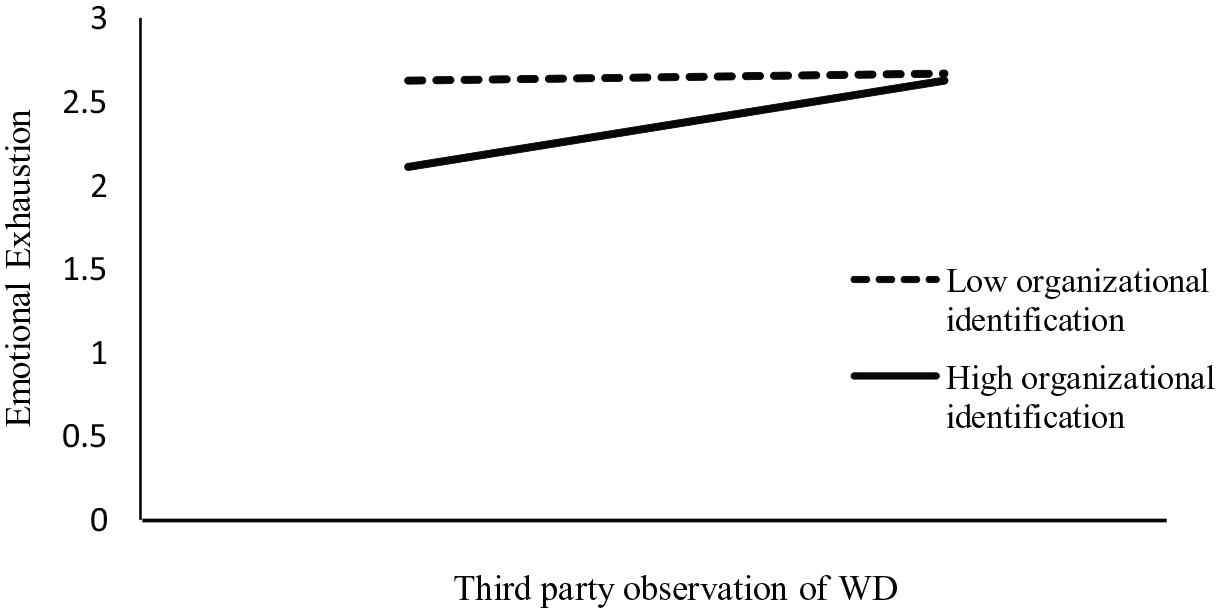
Moderation of organizational identification.
The indirect effects of TPO-WD (T1) on workplace thriving (T3) via emotional exhaustion (T2) were significant when controlled for organization size, industry and emotional exhaustion (T1; β = –0.14, SE = 0.08, 95% bias-corrected CI = [–0.35, −0.02]), supporting H3. In addition, the result showed that further controlling for workplace thriving (T2) reduces the effect size (β = –0.01, SE = 0.03, 95% bias-corrected CI = [–0.08, 0.04]; Table 3). The results suggest that TPO-WD increases emotional exhaustion among employees, which subsequently reduces their ability to thrive at work (T2). This relationship holds when emotional exhaustion persists among individuals from T1 to T2. However, the relationship between emotional exhaustion (T2) and workplace thriving (T3) was not significant after controlling for workplace thriving (T2). Therefore, the indirect effects of TPO-WD on thriving through emotional exhaustion (T2) provides support for H3.
Process model results for testing moderation.
N = 346.
T2: Time 2; LLCI: lower level confidence interval; ULCI: upper level confidence interval; T1: Time 1; TPO-WD: third-party observation of workplace deviance; EE: emotional exhaustion; WT: workplace thriving.
Manufacturing = 0, services = 1.
p < 0.001; *p < 0.05.
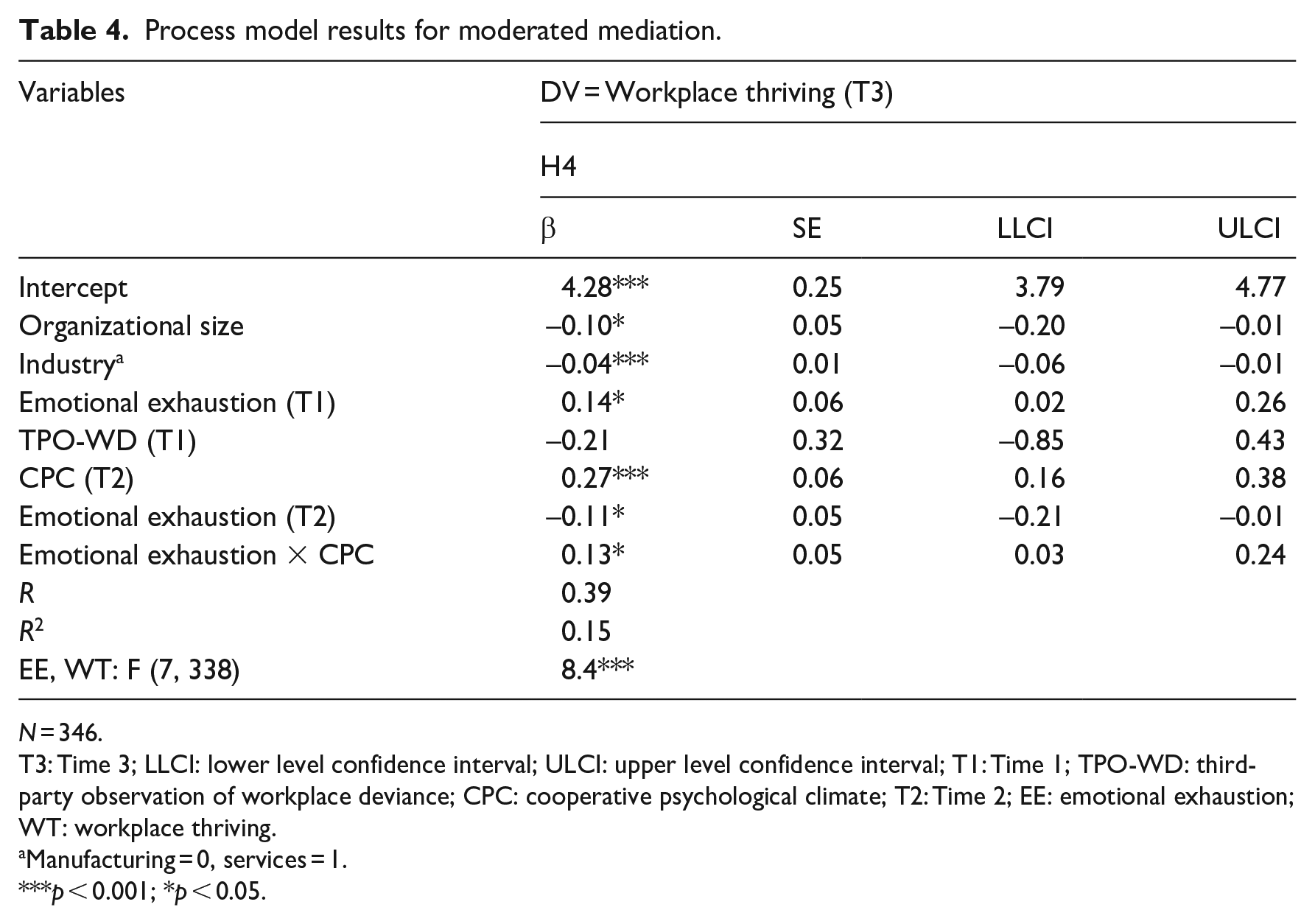
H4 examined the indirect conditional effects of TPO-WD on workplace thriving through emotional exhaustion at varying level of CPC. The interaction term between emotional exhaustion and CPC on workplace thriving was statistically significant (β = 0.13, SE = 0.05, CI = [0.03, 0.24]). The conditional indirect effect was stronger and significant for a low level of CPC (β = –0.23, SE = 0.12, CI [–0.54, –0.04]) but was weaker and not significant for high CPC (β = 0.00, SE = 0.07 CI [–0.15, 0.12]). The moderation graph for H4 was plotted in Figure 3. Table 4 depicts these results.
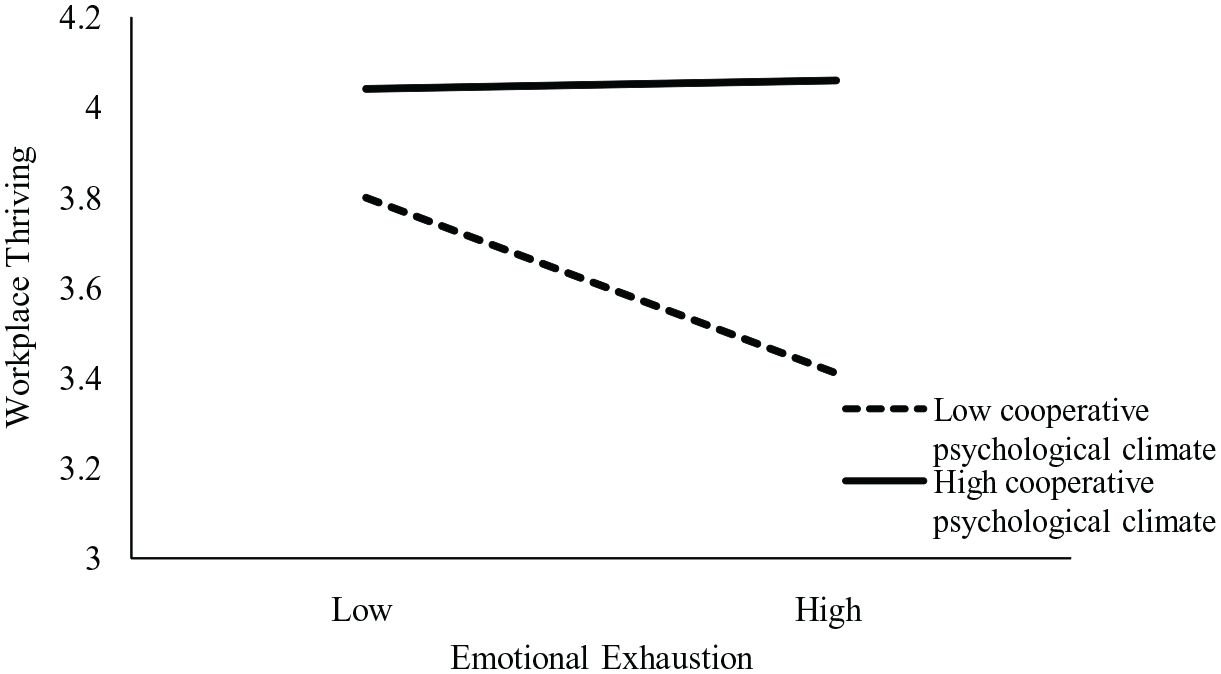
Moderation of cooperative psychological climate.
Process model results for moderated mediation.
N = 346.
T3: Time 3; LLCI: lower level confidence interval; ULCI: upper level confidence interval; T1: Time 1; TPO-WD: third-party observation of workplace deviance; CPC: cooperative psychological climate; T2: Time 2; EE: emotional exhaustion; WT: workplace thriving.
Manufacturing = 0, services = 1.
p < 0.001; *p < 0.05.
Finally, we examined the full model in the Process Macro (model 21) to see the indirect effects of TPO-WD on workplace thriving through emotional exhaustion, moderation of organizational identification and CPC. The indirect effects of TPO-WD on workplace thriving moderated by organizational identification and CPC were statistically significant (unstandardized moderated–moderated mediation index = 0.13, 95% CI = [0.01, 0.32]). Results show that the indirect effects of TPO-WD on workplace thriving through emotional exhaustion were statistically different at high and low levels of organizational identification (Index = 0.22, CI = [0.03, 0.51]). Similarly, the indirect effects of TPO-WD on workplace thriving through emotional exhaustion were statistically different at high and low levels of CPC (Index = –0.22, CI = [–0.48, –0.04]).
3.4. Supplementary analysis
To test the causal direction of the relationships, additional analysis was carried out to check the reverse-path hypotheses for H1, that is, from emotional exhaustion (T1) to TPO-WD (T2). Results showed that the reverse path for H1 (β = 0.22, SE = 0.05, p < 0.001) was also significant. Given that both the hypothesized and reverse paths were significant, data did not provide any clear grounds to support the causal direction for H1.
Furthermore, reverse causality was also tested for the relationship between emotional exhaustion and workplace thriving. Results showed that the reverse path, that is, from workplace thriving (T2) to emotional exhaustion (T3) was not significant (β = 0.07, SE = 0.05, NS); however, the path (from emotional exhaustion at T2 to workplace thriving at T3) was statistically significant (β = –0.14, SE = 0.05, p < 0.05). Therefore, our data provide support for the causal direction from emotional exhaustion (T2) to workplace thriving (T3), as per our theoretical model.
In addition, aligned with the same theorizing, we explored whether CPC would also have moderating effects on the relationship between TPO-WD and workplace thriving. The result for a moderating effect of CPC on the relationship of TPO-WD and workplace thriving was not significant (coefficient = –0.22, CI = [–0.88, 0.45]). Similarly, the result for a moderating effect of CPC on the relationship of TPO-WD and emotional exhaustion was not significant (coefficient = 0.07, CI = [–0.66, 0.81]). Hence, this indicates that CPC serves as a resource passageway that triggers a coping mechanism to deal with depleted resources, specifically when emotional exhaustion increases from TPO-WD. Results also support the importance of CPC in replenishing resources when emotional exhaustion persists for T2, which may further influence workplace thriving.
4. Discussion
This study investigates how TPO-WD influences employees’ emotional exhaustion and workplace thriving, and the conditions that strengthen or weaken these relationships. The results show that the experience of TPO-WD stifles workplace thriving through emotional exhaustion. Furthermore, we find that this mediated relationship is more salient for employees who identify more with their organizations (as it inflates their emotional exhaustion) and perceive a low CPC.
4.1. Theoretical implications
Our study provides new directions in studying TPO of mistreatment and workplace deviance. Within TPO of mistreatment, our study focused on how TPO-WD impacts work outcomes. Previous studies discuss how TPO-WD impacts observers’ self-concept (Gunia and Kim, 2016) and own deviance behaviours (Ferguson and Barry, 2011). However, by taking a resource-based view, this study examines the depletion of observers’ resources as a consequence of TPO-WD. Although studies provide evidence of a positive relationship between vicarious mistreatment and emotional outcomes (Miner-Rubino and Cortina, 2007; Totterdell et al., 2012), this study complements literature by theorizing and providing empirical support to how TPO-WD depletes the personal resources of employees. This is an extension of literature beyond previous findings of impacts on self-adaptation (Ferguson and Barry, 2011) and emotional regulation (Totterdell et al., 2012).
Although TPO-WD has found to increase observers’ work effort to self-affirm employees’ identity (Gunia and Kim, 2016), it is also important to understand the internal state of the third-party observers of workplace deviance. This study suggests that TPO-WD may provoke changes in the employees’ emotional and psychological state, for example, through emotional exhaustion, which may negatively impact employees’ workplace thriving. This is an important finding since employees who experience TPO-WD may apparently increase work effort albeit being emotionally drained. Furthermore, the detrimental effects of TPO-WD on workplace thriving may also indicate that the increase in work effort is short-lived.
We also contribute to literature by discussing critical moderating variables in the relationship between TPO-WD and workplace thriving. Prior literature in TPO provides an understanding of moderating variables such as personality traits of observers, demographic variables (Dhanani and LaPalme, 2019) and group characteristics (Gunia and Kim, 2016; Wellen and Neale, 2006) to study the varying effects of TPO-WD on employees. We extend this by highlighting that the impact of TPO-WD may also vary across different employees, depending on their organizational identification – employees who identify more with the organization are more emotionally exhausted by TPO-WD. Thus, finding a way to manage the spill-over effects of workplace deviance is imperative.
A critical finding of our study is the role of resource passageways to help circumvent the impact of TPO-WD on observers. We discuss how resource recovery after experiencing TPO-WD is through CPC, that is, organization’s resource passageway, which may counter the negative effects of emotional exhaustion resulting from TPO-WD. Within the literature on TPO of mistreatment, to the best of our knowledge, no study focuses on how resource passageways may counter the ill-effects of TPO of mistreatments and help replenish lost resources. This is an important finding which also contributes to the COR theory since, to the best of our knowledge, no earlier study has theorized and tested the role of CPC as a resource passageway to replenish depleted resources. Therefore, this study also provides scholars a new lens on resource passageways (e.g. CPC) to investigate how third parties may recover from other forms of observed mistreatments (e.g. incivility, unpleasant interpersonal interaction, injustice and so on; Schilpzand et al., 2016; Skarlicki and Kulik, 2004; Totterdell et al., 2012). Such research endeavours will further expand our understanding of the critical importance of resource passageways in organizations.
4.2. Practical implications
This research presents significant practical implications for both managers and employees. Since TPO-WD is detrimental to employees’ emotional state and workplace thriving, management will likely benefit from a close focus on environmental cues, including occurrences such as TPO-WD, their workforce experiences and the resource passageways the organization fosters to counter the ill-effects of TPO-WD.
Given deviant behaviours at the workplace are hard to eliminate (Greenbaum et al., 2013), our results show how TPO-WD has a detrimental impact on the emotional state and workplace outcomes of an employee. Several measures can mitigate these detrimental effects on observers. First, managers need to make themselves role models so that their team members and subordinates learn and understand behavioural expectations at work. Furthermore, management has the responsibility not only to identify deviance at work, but also to minimize the frequency of such occurrences. For this, anonymous reporting mechanisms may assist in bringing occurrences of workplace deviance to the management’s attention. However, to enable this, a culture of open communication should be encouraged with zero tolerance for workplace deviance. This way, third parties may enhance reporting of observing workplace deviance with the hope of positive action by management. More importantly, when workplace deviance events are highlighted, swift action to curb or eliminate such behaviour would limit resource losses of both the observers and the targets of the deviance.
Second, emotional support is essential for the psychological and emotional health of observers. Since the negative effects of TPO-WD are transmitted through emotional exhaustion, managers can reduce the observer’s negative effects if they train the employees to effectively deal with emotional exhaustion. Our study provides evidence that those who identify more strongly with the organization are more likely to be emotionally exhausted when observing workplace deviance. This gives significant support to the need for organizations to ramp up their efforts to limit occurrences of deviance as well as provide support services to affected employees. While standard training in stress management for all employees may help, supervisors should also ensure personal engagement with employees impacted by observing such events.
Third, our study highlights the critical role of CPC in curtailing the negative effects of TPO-WD and emotional exhaustion. Accordingly, managers could institute norms of support, cooperation and togetherness among employees – as perceptions of high CPC, which can reduce employees’ distress and mitigate negative attitudes (Martin et al., 2005). In the presence of these norms, if employees experience TPO-WD and are emotionally exhausted, management may be able to curtail the damage on critical workplace outcomes such as workplace thriving. This implies that managers need to invest time and energy to minimize the damage to observers, specifically by providing support, counselling and reassurance of positive organization-wide norms.
4.3. Limitations and future research directions
This research, despite its multiple contributions, has some limitations that future studies can explore. First, the results show some concerns in establishing causality. Although our study demonstrates causality between emotional exhaustion and workplace thriving, we have not been able to provide conclusive empirical evidence on the causal link between TPO-WD and emotional exhaustion. Future researchers may use experimental design to validate causality between TPO-WD and emotional exhaustion.
Second, we identified emotional exhaustion as an intermediary process and a mediating mechanism between TPO-WD and workplace thriving. Assuming that individuals’ ability to secure their personal resources serves as behavioural motivation to deal with stressors (Hobfoll, 2002), other personal resources might also intervene this relationship. Therefore, future research could empirically test how personal resources (e.g. personal traits such as self-efficacy, optimism and self-esteem; Hobfoll et al., 2018) could act as potential mediators of the relationship between the TPO-WD and workplace thriving.
Third, our focus to study moderation of organizational identification serves as a starting point to understanding the boundary conditions influencing the effect of TPO-WD. Factors such as physiological changes (Michalak et al., 2019), personal characteristics (Wellen and Neale, 2006) and environmental factors (Arshad and Malik, 2020, 2021) can also influence the effects of TPO-WD on employees’ attitudes. These factors could be studied as potential boundary conditions in future studies. In addition, since unwelcomed experiences directly generate stress among employees (Jenkins et al., 2016; Santos and Eger, 2014), it is likely that condition resources (e.g. employment, seniority, tenure) and energy resources (e.g. knowledge, reward, credit; Hobfoll et al., 2018) also influence stress. Future studies could consider the operationalization of these resources as boundary conditions to evaluate these predictions empirically.
Fourth, when exploring organizational climate as a resource passageway that moderates the relationship between emotional exhaustion and workplace thriving, we did not capture all dimensions of the psychological organizational climate. As psychological climate is a broader concept comprising of several dimensions (Carless, 2004; Jones and James, 1979), future research could explore the impact of these dimensions more comprehensively. Inclusion of a multidimensional climate would broadly represent the construct by including dimensions such as role characteristics, leadership, organizational and subsystem attributes (Jones and James, 1979) as resource passageways for employees who are emotionally exhausted.
5. Conclusion
TPO-WD has detrimental effects on psychological state, actions and behaviours of the observers (Earle et al., 2010). Using COR theory, we discuss how TPO-WD acts as a stressor causing depletion in personal resources (i.e. emotional exhaustion). Results suggest that experiencing emotional exhaustion, as emanated from TPO-WD, may undermine workplace thriving. Furthermore, this study suggests that organizational identification acts as a moderator, which intensifies emotional exhaustion, consequently reducing workplace thriving. We also discuss that the ill-effects on workplace thriving may be circumvented if observers of deviance have a high perception of CPC. Thus, this study advances theoretical and empirical understanding of TPO-WD including the intermediary processes, attitudinal implications of TPO-WD and moderating mechanisms of these relationships.
