



Abstract
When entrepreneurs suffer from work-to-family conflict, it can affect firm performance. This article considers how emotional exhaustion experienced in the course of running a business mediates this link and how beliefs about competitive hostility invigorate that effect. Using survey data collected from 200 women entrepreneurs in Ethiopia, a country marked by culturally traditional gender role expectations, the empirical findings show that a sense of being emotionally overextended, due to the demands of running a firm, creates a conduit for the negative interference of the family upon the firm. This escalates into diminished firm performance. The results also demonstrate that this conduit is particularly prominent when entrepreneurs feel more threatened by hostile market environments. For entrepreneurship scholarship and practice, this article establishes two notable factors; a feeling of being ‘worn out’ by the business and adverse competitive markets. These factors clarify the complex link between work-induced family strain and business performance for women entrepreneurs, who might be particularly challenged when balancing time demands in gender-discriminatory environments.
Keywords
Introduction
The decision to start and run one’s own business may generate both advantages and disadvantages for an entrepreneur’s ability to dedicate sufficient time to their professional and private lives. On one hand, the freedom that comes with being an entrepreneur offers increased opportunities to combine work and family obligations, which should generate flexibility that they may not be able to find in paid employment (Fritsch et al., 2019; Jennings and McDougald, 2007; Kirkwood and Tootell, 2008). On the other hand, having responsibility for the firm can exacerbate the conflict created when demands imposed by professional activities undermine the quality of family life (Bunk et al., 2012; Ezzedeen and Zikic, 2017). This work-to-family conflict is more likely to be more intense for women entrepreneurs (Agarwal and Lenka, 2015). Many women entrepreneurs are able and motivated to address such challenges (De Clercq et al., 2019; Welsh et al., 2016), and global forces towards gender emancipation increasingly call for equality between women and men in their family responsibilities (Welzel, 2013). However, expectations prevail in many countries that women are the primary family caretakers and should give priority to household duties, above those of business demands (Eddleston and Powell, 2012; Jayawarna et al., 2020; Wood and Eagly, 2010).
Accordingly, and as indicated in previous studies, the negative interference of work with family is especially salient among women entrepreneurs in cultures, such as those in many African countries, where traditional gender role expectations exert undue pressure upon women to put family ahead of work (Gudeta and van Engen, 2017; Hundera et al., 2019b). Women engage in entrepreneurship throughout Africa, which offers a pathway to make financial provision for their families (Efobi et al., 2019; Singh and Belwal, 2008). Notably, limited opportunities tend to be available to women in formal job economies, so they are driven towards entrepreneurial activities in the informal sectors (Bardasi et al., 2007; Mersha and Sriram, 2019). Overall, the patriarchal nature of many African countries places the burden for household duties primarily on women, constrains their career options in paid employment which in turn, stimulates them to start and run their own businesses (Mekonnen and Cestino, 2017). In light of these issues, gender-discriminatory forces could also increase African - based women entrepreneurs’ suffering from work demands that interfere with their expected family needs over those of the business. Yet, at the same time, successful business endeavours can be important sources of family income (Gudeta and van Engen, 2017; Hundera et al., 2019a). Accordingly, it is critical to explicate the process by which the experience of work-to-family conflict may compromise the performance of women owned firms. In this article, we analyse why and when such work-to-family conflict might lead to diminished firm performance through two hitherto unexplored, potentially influential factors. First, work-related emotional exhaustion, or the extent to which women feel ‘worn out’ by their businesses (Haar, 2013); and second, beliefs about competitive hostility, such that they perceive the market as risky, difficult to control, or lacking in opportunities (Torkkeli et al., 2012). Both factors are likely to have significant effects in African economies, but the arguments themselves may apply to a broad set of countries. Thus, the strength of the proposed relationships developed in this article might vary across cultures, but we expect their nature to remain consistent.
We aim to make several contributions in this article. First, we leverage conservation of resources (COR) theory (Hobfoll and Shirom, 2000) to theorise and empirically demonstrate how experiences of the negative interference from work to family can lead to poorer firm performance, due to the depletion of women entrepreneur’s energy resources in the form of work-related emotional exhaustion (Karatepe, 2010; Ufuk and Özgen, 2001). In so doing, we add to the current understanding of women’s entrepreneurship by identifying how a sense of exhaustion at work might cause dual harm. On one hand, they already have to cope with a compromised family life due to the pressing demands of running a business which is exacerbated in cultures marked by traditional gender role expectations. On the other hand, such resulting work-related emotional exhaustion may undermine firm performance adding even more stress to family relations. Thus, we analyse how women entrepreneurs, who operate in gender-discriminatory contexts, may become inadvertent victims of a never-ending spiral of stress.
Second, we address calls for research that applies contingency approaches to the outcomes of the work–family interface in the context of women’s entrepreneurship (De Clercq et al., 2019; Welsh et al., 2017a). In line with COR theory and its theoretical notion of resource loss spirals (Hobfoll, 2001), we argue that beliefs about resource-draining, hostile competitive environments increase the energy depletion of women entrepreneurs due to challenging work-to-family conflict (Mitchell et al., 2011). This then diminishes the probability of business success (Huettermann and Bruch, 2019). As a relevant insight for entrepreneurship scholarship, we identify a potentially self-fulfilling prophecy. Those women entrepreneurs who suffer from the negative interference of work with family, over which they may have limited control due to traditional gender-based culture (Gudeta and van Engen, 2017), and who fear for the performance of their firms, due to competitive pressures, may find firm performance compromised.
The remainder of the article is structured as follows. First, we detail the theoretical background of the study, including a discussion of the relevance of context, and develop the research hypotheses. We then go on to describe the methodological approach and report the statistical results. We conclude with a discussion of the study’s theoretical implications, limitations and further research directions, and practical implications.
Theoretical background and hypotheses
Women entrepreneurs, work-to-family conflict and the Ethiopian context
Organisational behaviour research distinguishes between work-to-family conflict, referring to the negative interference of work with family, and family-to-work conflict, which is the negative interference of family with work (Gutek et al., 1991). We focus on the former, informed by the ‘matching principle’ (Nohe and Sonntag, 2014). According to this principle, people who try to meet demands in multiple domains (e.g. work and family) but find the demands incompatible tend to assign the negative emotions they experience to the domain that they regard as the source of their suffering. The application of this principle to our study context suggests that the experiences of work-to-family conflict by women entrepreneurs will lead them to develop negative perceptions of their work in the business, as the source domain (Oren and Levin, 2017). For example, if they come home so tired that they cannot address family’s needs, they may blame the business for their exhaustion and so, feel upset or disheartened when think about working in the firm (Beutell, 2007; De Clercq et al., 2019). Yet, beyond suggestions that the ability to balance work and family demands is likely to enhance the success of women owned firms (Welsh et al., 2017b), we are not aware of explicit investigations of the harmful connection between their work-to-family conflict and their firm performance.
This study’s focus on women entrepreneurs, and particularly the extent to which their business performance may suffer due to experiences of work-to-family conflict, reflects the difficulty that these entrepreneurs may encounter when they seek to balance work and family demands (Agarwal and Lenka, 2015). Extant research indicates that many women entrepreneurs are highly skilled and driven to successfully handle negative interferences of work with family (De Clercq et al., 2019; Shelton, 2006). Yet, they likely to have little control over persistent societal expectations that they should prioritise family needs (Jayawarna et al., 2020). This is especially the case in patriarchal and developing countries, such as those in Africa (Hundera et al., 2019a). That is, most entrepreneurs may find that the stringent demands of the business compromise the quality of family life, but this challenge may be particularly salient among women who operate in normative cultures in which they ‘ought to’ take primary responsibility for household duties (Eddleston and Powell, 2012; Wood and Eagly, 2010).
In turn, gender-discriminatory environments create significant difficulties for women entrepreneurs, both at home and in a business context (Gherardi, 2015; Poggesi et al., 2019; Ufuk and Özgen, 2001). Accordingly, we propose that the negative interference of work upon family, due to such normative expectations, may escalate into poor performance at the firm level if entrepreneurs become emotionally drained by running the firm (Elmuti et al., 1993; Heilbrunn and Davidovitch, 2011). In addition, we postulate that this escalation might be reinforced by convictions that adverse competitive markets threaten to undermine the viability of their firms (Covin and Slevin, 1989). In so doing, we pinpoint a risk that the entrepreneurs might become complacent in their business endeavours and invest less energy in performance-enhancing activities. As such, the challenges at the work–family interface are exacerbated by external market threats that seem overwhelming; threats that, somewhat paradoxically, make such complacency highly problematic. Notably, our focus on this competition-based contingency factor emphasises the effect of a women business owner’s differential beliefs about the level of competitive adversity within their industry on the mediated relationship between their work–to-family conflict and firm performance. Prior research, instead, has focused on the effect of economic development in general (Welsh et al., 2018). The moderated mediation logic that underlies our theorising essentially indicates how the aforementioned risk might gain in strength to the extent that women entrepreneurs feel threatened by their competitive environment and its influence on the viability of their firm (Nicholls-Nixon et al., 2000).
We examine these issues in the context of Ethiopia. The traditional family values that mark this country make the experience of work-to-family conflict an important issue for many entrepreneurs (Hundera et al., 2019a). As noted by Gudeta and van Engen (2017), normative gendered expectations assign women the main responsibility for family tasks. In particular, these roles are ‘even more pronounced for women in developing parts of the world, such as Ethiopia, where gender role stereotypes are widely accepted and where men are generally not expected to share domestic and care responsibilities’ (p. 371). Competitive hostility also constitutes a highly relevant factor in this context. Women entrepreneurs often face unfavourable competitive forces linked to gender-based discrimination, with respect to access to finance and other business resources (Gerba, 2012; Mersha and Sriram, 2019). Finally, the Ethiopian setting is interesting in light of its cultural values that resonate with our proposed model (Hofstede et al., 2010). Ethiopia scores high on collectivism, so women entrepreneurs likely are expected to protect the interests of their in-group (e.g. family) and feel especially stressed if their work interferes with family responsibilities. 1 It also scores relatively high on uncertainty avoidance, so uncertainty-inducing work-to-family conflict and competitive hostility may be particularly troubling. Although these pressures and considerations affect entrepreneurs in various cultural settings, Ethiopian norms make such factors highly salient, so it constitutes an appropriate and insightful research context.
COR theory
Our theoretical arguments predict an indirect relationship between work-to-family conflict and firm performance, through work-related emotional exhaustion, as well as an invigorating role of competitive hostility; these are anchored in COR theory (Hobfoll and Shirom, 2000). This theory postulates that people’s work-related behaviours reflect their motivations to conserve or protect their current resource base, especially in resource-depleting conditions (Hobfoll et al., 2018). When entrepreneurs suffer from resource-draining work-to-family conflict, their firms may exhibit poorer performance because the work-induced hardships, manifested at home, deprive them of the stamina they need to run a successful business (Hoobler et al., 2010; Oren and Levin, 2017). Also in line with COR theory, negative responses to resource-depleting conditions, such as at the work–family interface, should be more evident when entrepreneurs operate in adverse competitive environments that reinforce such hardship (De Clercq et al., 2020; Hobfoll and Shirom, 2000). Formally, the escalation of work-to-family conflict into reduced firm performance, through work-related emotional exhaustion, should be more pronounced in markets characterised by competitive hostility (Grimmer et al., 2015).
The proposed theoretical framework, with its grounding in COR theory, is summarised in Figure 1. The signs of the relationships that constitute this framework should hold across countries, even if their strength may vary according to different country-level gender role expectations and competitive settings (Hundera et al., 2019b; Mersha and Sriram, 2019). Similarly, our research hypotheses are likely to apply to all entrepreneurs. However, we anticipate that the intensity with which women experience work-to-family conflict in countries with traditional gender role stereotypes, such as in Ethiopia (Gudeta and van Engen, 2017), increases the salience of enhanced emotional exhaustion and firm performance implications for women entrepreneurs. That is, our arguments and hypotheses are country- and gender-neutral, even if we expect stronger versions of the effects for certain national settings and entrepreneurs.
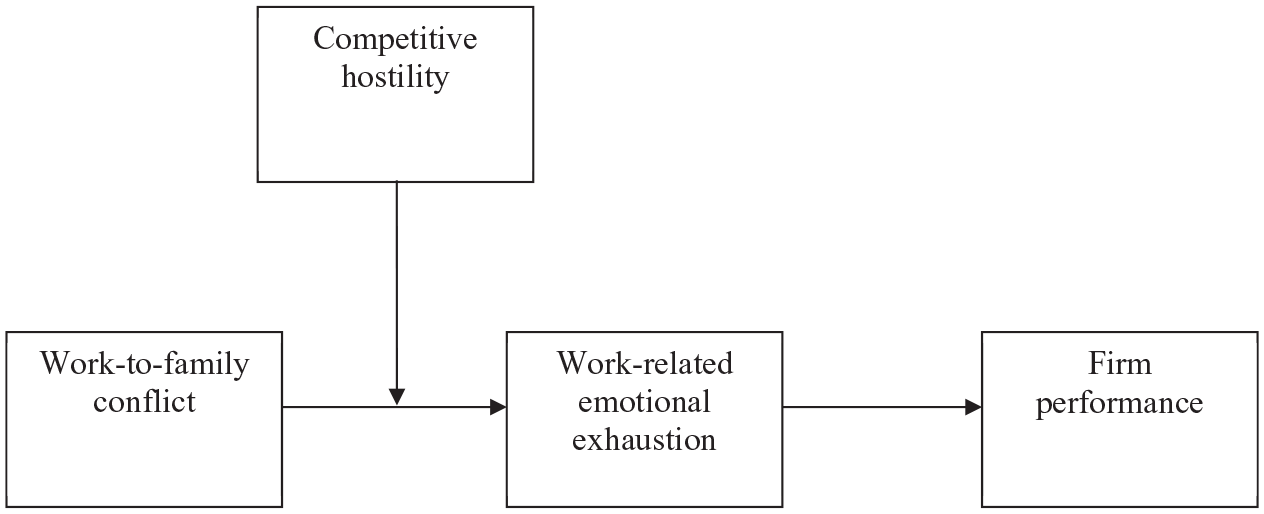
Conceptual model.
Mediating role of work-related emotional exhaustion
We hypothesise a positive relationship between women entrepreneurs’ suffering from work-to-family conflict and their work-related emotional exhaustion. According to COR theory, the frustration that entrepreneurs feel when they are not able to meet their family responsibilities, due to pressing work duties, also depletes the discretionary resources at their disposal for work (Oren and Levin, 2017; Peltokorpi, 2020; Wayne et al., 2017). The harmful outcomes of a negative interference between work and family tend to be made manifest in the work domain where, in turn, challenges arise (Nohe and Sonntag, 2014). Women entrepreneurs may blame this ‘culprit’ for the challenges they experience at home, a feeling that can convert into a sense of being worn out by business activities (Karatepe, 2010; Liu et al., 2015). Relatedly, if running their business is so demanding that they have little opportunity for quality time at home, women entrepreneurs might find it challenging to experience pleasure in their day-to-day business activities because they may mentally link those activities to difficulties in the family domain (Beutell, 2010; Jennings and McDougald, 2007). Thus, they likely feel emotionally drained due to the demands of running a firm (Boyar and Mosley, 2007).
The hardships that women entrepreneurs experience at home, because of business demands, may also deplete their work-related energy resources more indirectly. If family members complain about their limited availability, they may experience a sense of being insufficiently valued for their work efforts, which depletes the positive energy they can draw from in the course of running their business (Prottas and Thompson, 2006; Wayne et al., 2017). If the difficulty of integrating work with family duties becomes too extreme, women entrepreneurs might even question their entrepreneurial career, which exacerbates the experience of emotional exhaustion (Agarwal and Lenka, 2015). In contrast, for women entrepreneurs whose family life is not undermined by work, or whose loved ones do not complain about the limited time they spend at home, work may be vitalising and invigorating. This occurs because the perception of being appreciated for one’s efforts and receiving more respect generally generates positive work energy (De Clercq et al., 2019; Quinn et al., 2012). In short, when family experiences are not undermined by pressing work obligations, entrepreneurs should have more optimistic views about their business (Ufuk and Özgen, 2001) and be less likely to feel emotionally overextended by running it. We thus hypothesise:
However, when work-related emotional exhaustion arises, it may decrease firm performance because women entrepreneurs do not possess the discretionary energy needed to run their firms successfully (Huettermann and Bruch, 2019; Rhee et al., 2017). Consistent with COR theory, these effects might be so unsettling that women entrepreneurs simply lack the endurance to achieve high performance standards (Hobfoll et al., 2018). Organisational behaviour studies indicate that employees sense of being emotionally overextended by work tends to direct them towards negative behaviours, such as absence (Neveu, 2007) or exhibiting psychological withdrawal (Lanaj et al., 2018). Similarly, the energy-draining effect of work-related emotional exhaustion may render women entrepreneurs less dedicated to their own firm, with negative consequences for its performance (Quinn et al., 2012; Thanacoody et al., 2014). In contrast, women entrepreneurs who do not feel emotionally drained by running their firm should be better positioned to succeed in their business undertakings (Agarwal and Lenka, 2015; Huettermann and Bruch, 2019), because they continue to retain access to pertinent, residual, work-related energy.
The negative connection between work-related emotional exhaustion and firm performance may be explained not just by tarnished ability but also by lower motivation. That is, a sense of disappointment linked to work-related emotional exhaustion may diminish a women entrepreneur’s desire to run a successful business (Jennings and McDougald, 2007; Kim and Ling, 2001). They are more likely to feel spent and exhausted, so seek to preserve their individual energy and remain passive in their business endeavours (Hobfoll, 2001; Hutchins et al., 2018). This argument is consistent with organisational behaviour research, which finds a similar negative connection between an employee’s emotional exhaustion and the affective commitment they exhibit towards their organisation (Ozcelik, 2017; Soenen et al., 2019). Conversely, if women entrepreneurs do not suffer from emotional exhaustion, they can draw from discretionary work energy and should exhibit a strong desire to exploit this energy, as predicted by COR theory, in positive, performance-enhancing activities (Hobfoll et al., 2018). Specifically, relatively higher energy levels imply that entrepreneurs might derive a sense of personal accomplishment from exerting themselves and directing their individual energy to achieve better performance (Quinn et al., 2012; Ryan and Deci, 2000). We thus, hypothesise:
The combination of these relationships suggests an important mediating role of work-related emotional exhaustion. The experience of a negative interference from work with family undermines firm performance as individual energy resources are drained, leading to emotional exhaustion (Wayne et al., 2017). When family life is compromised by pressing work demands, the probability that women entrepreneurs run a successful firm diminishes because they are tired and unmotivated to engage in performance-enhancing business activities (Karatepe, 2010). Organisational behaviour studies find similar mediating roles regarding employees’ emotional exhaustion when they suffer difficult conditions, such as family ostracism (Ye et al., 2019) or inappropriate co-worker behaviour (Rhee et al., 2017), and their links to negative work outcomes. We study entrepreneurs instead of employees and thus, take a complementary view to predict that being emotionally drained from running a business underpins the translation of resource-depleting work-to-family conflict for women entrepreneurs into lower firm performance (Hobfoll and Shirom, 2000). Thus, we hypothesise:
Moderating role of competitive hostility
Operating in hostile, competitive markets might invigorate the predicted positive relationship between work-to-family conflict and work-related emotional exhaustion as such markets raise fears that it will not be possible for the firm to remain solvent (Covin and Slevin, 1989; Hsu et al., 2020). In line with the theoretical notion of resource loss spirals (Hobfoll et al., 2018), women entrepreneurs’ negative responses to resource-draining situations should be contingent on the severity of the experienced resource depletion, and this severity depends on other negative circumstances. If they feel threatened by an external source, such as hostile market environments, women entrepreneurs may feel particularly disappointed that their family life is being disrupted by their work (Mitchell et al., 2011; Yan and Yan, 2017). The experience of work-to-family conflict should be highly intrusive for their business functioning in this case, and their work-related emotional exhaustion becomes strongly activated (Liu et al., 2015). In contrast, if the competitive market environment appears benign, the experience of work-to-family conflict might be less likely to translate into emotional exhaustion. Due to their more optimistic outlooks about their competitive arena (Covin and Slevin, 1989; Hmieleski and Baron, 2009), women entrepreneurs do not suffer as much from the hardships caused by the negative interference of work with family, so the probability that this resource-depleting situation escalates into work-related emotional exhaustion is lower (Oren and Levin, 2017). We therefore, predict:
The integration of all these arguments signals a moderated mediation dynamic (Hayes and Rockwood, 2020). We argue that beliefs about competitive hostility function as critical boundary conditions of the indirect relationship between women entrepreneurs suffering from work-to-family conflict and firm performance, through their experience of work-related emotional exhaustion. For women entrepreneurs who perceive significant external threats to their firm’s well-being (Yan and Yan, 2017), emotional exhaustion more substantially explains the escalation of resource-draining work-to-family conflict into diminished firm performance (Hobfoll et al., 2018). Unfavourable competitive environments increase the likelihood that women entrepreneurs are distressed by the negative interference from their work to the family (Agarwal and Lenka, 2015), which then enhances the probability that they run an unsuccessful business, due to their emotionally draining work experiences (Huettermann and Bruch, 2019). Conversely, perceptions of a benign competitive environment reduce the likelihood that women entrepreneurs become exhausted in the course of running their business due to experienced work-to-family conflict, which further reduces the danger that their firms underperform. We thus, hypothesise:
Research method
Sample and data collection
The hypotheses are tested with data gathered from women entrepreneurs operating in Ethiopia. We conducted a survey to gather the required data, with the assistance of an expert, global survey firm (IFF International) that has partnered previously on academic research projects. Whereas we wrote and developed the survey, we relied on this professional data collector to ensure the representativeness and qualifications of a sample of Ethiopian women entrepreneurs.
A total of 300 target respondents were randomly selected by the survey firm from its sampling frame in Ethiopia, based on firm size (fewer than 250 employees), firm age (less than 10 years), and individual ownership (more than 50% of the firm’s shares) criteria. Thus, we knew that the target respondents largely determined the strategic direction of their firms, which likely were resource-constrained (i.e. because they are small and young). In these cases, entrepreneurs tend to be more sensitive to the challenge of conflicting work and family demands (Agarwal and Lenka, 2015; Rastogi et al., 2019). The 200 entrepreneurs who eventually responded, reflecting a response rate of 67%, had an average age of 42.1 years (ranging between 21 and 65 years), they had 1.2 children on average (ranging between 0% and 5), 67% employed at least one family member in their organisation, 83% had at least a college degree, they had an average of 9.7 years of experience as a businesswoman (ranging between 1 and 30 years), and their average firm age was 6.3 years (ranging between 1 and 10 years). 2
The sample size of 200 is relatively small but equivalent to or higher than the ones featured in other survey-based research on entrepreneurs in Ethiopia (see Eyana et al., 2018; Mersha and Sriram, 2019). Moreover, small sample sizes provide statistically conservative tests of hypothesised relationships. Obtaining significant findings with such samples reinforces the validity of tested theoretical frameworks (Bouckenooghe et al., 2014).
In developing the survey, we relied on a conventional translation approach (Brislin, 1986), such that the English-language survey questions were translated into Amharic and then back-translated into English, by different bilingual translators. In the Amharic final version, the survey started with several reassurances of confidentiality, participant rights, and so forth, all of which can help reduce the risk of social desirability biases (Spector, 2006). That is, the opening statement guaranteed complete confidentiality, noting that only the research team would see any individual responses and that any reports would feature only aggregate data. In addition to assuring participants that they could halt their voluntary efforts at any time, the opening statement also asked for honest answers, noting that there were no good or bad responses.
Measures
Work-to-family conflict
We measured the extent to which women entrepreneurs experience negative interferences of work with family with a four-item scale of work-to-family conflict (Gutek et al., 1991), using seven-point anchors (1 = strongly disagree, 7 = strongly agree). For example, the respondents indicated whether, ‘My business takes up time that I’d like to spend with my family’ and ‘My family dislikes how often I am preoccupied with my business while I am at home’ (Cronbach’s alpha = .66). 3
Work-related emotional exhaustion
To assess the extent to which women entrepreneurs feel emotionally drained in the course of running their business, we used four items from prior research on emotional exhaustion in paid employment (Haar, 2013; Maslach and Jackson, 1981), applied to an entrepreneurship context. Thus, respondents indicated whether ‘I feel burned out from my business’ and ‘I feel emotionally drained from my business’, using seven-point agreement anchors (Cronbach’s alpha = .87).
Firm performance
In line with previous research undertaken in African contexts (Cruz et al., 2012; Frese et al., 2007) – in which objective performance measures often are not available, because bookkeeping by smaller businesses is relatively rare, and many firms adopt secretive approaches to quantitative performance measures, out of fear of negative tax implications (Eyana et al., 2018) – we applied a subjective measure of firm performance. With a three-item scale of perceived firm performance (Hatak et al., 2016), respondents assessed the performance of their firms, relative to the performance of their competitors, on three dimensions: sales growth, market share growth, and employee growth. The seven-point anchors ranged from ‘much worse’ to ‘much better’ (Cronbach’s alpha = .82).
Competitive hostility
To assess the beliefs of women entrepreneurs regarding the hostile nature of their competitive environments, we applied a three-item scale of environmental hostility (Covin and Slevin, 1989). This measure reflects the extent to which they believe that their external markets are safe versus risky, easy versus difficult to control, and rich versus poor in opportunities. The seven-point anchors matched each measure, as in the original scale (Covin and Slevin, 1989), such as ‘very safe, little threat to the survival and well-being of my firm’ to ‘very risky, a false step can mean my firm’s undoing’ for the risk measure (Cronbach’s alpha = .73).
Control variables
The statistical analyses included six control variables: individual age (in years), number of children, whether other family members were employed by the firm (1 = yes, 0 = no), education level (1 = college or higher, 0 = no college), experience as a businesswoman (in years), and firm age (in years). That is, the extent to which women entrepreneurs suffer from emotional exhaustion, and accordingly exhibit lower firm performance, may depend on (1) their life stage, (2) the number of children for whom they are responsible, (3) their ability to share work–family hardships with family members in similar positions, (4) their general skill and education level, (5) their prior experiences with combining professional and private duties, and (6) the extent to which their firm’s internal operations are well-established.
Common method bias
We checked for common method bias by applying a confirmatory factor analysis marker procedure (Williams et al., 2010) with three different models: a baseline; a Method-C model, which constrains the loadings of the method factor to the same values; and a Method-U model, without any loading constraints (De Clercq et al., 2013). The method factor is a conceptually unrelated marker variable, namely, a five-item interdependence-power scale (Cronbach’s alpha = .74), developed by Sharma (2010). 4 Because the fit of the Method-C model (χ2(154) = 467.9) is not better than that of the baseline (χ2(155) = 467.9; Δχ2(1) = .00, ns), no method variance appears to be associated with the marker latent variable (Williams et al., 2010). However, the Method-U model (χ2(141) = 427.2) offers significantly better fit than the Method-C model (Δχ2(13) = 40.7; p < .001), so we retained it to investigate potential biasing effects of the marker variable on the factor correlation estimates. For this purpose, we estimated a Method-R model (χ2(147) = 427.6) (Williams et al., 2010), which is similar to the Method-U model but includes factor correlations fixed at the values obtained from the baseline model. The chi-square difference between the Method-R and Method-U models is not significant (χ2(6) = .40, ns), so the effects of the marker variable do not significantly bias the factor correlation estimates. Concerns about common method bias accordingly are mitigated (Williams et al., 2010).
Statistical technique
The research hypotheses were tested with the Process macro procedure (Hayes et al., 2017). The advantage of this procedure – in comparison with the piecemeal approach that marks traditional regression analyses – is that it allows not only for estimates of individual paths (i.e. to test Hypotheses 1, 2 and 4) but also offers a comprehensive evaluation of mediation and moderated mediation effects (i.e. to test Hypotheses 3 and 5). Notably, the Process macro does not assume normality for (conditional) indirect effects. It has a broader application range than a traditional Sobel test, which requires the presence of normality (MacKinnon et al., 2004). In the first step, we assessed the signs and significance of the direct paths between work-to-family conflict and work-related emotional exhaustion (Hypothesis 1) and then between work-related emotional exhaustion and firm performance (Hypothesis 2). To assess the presence of mediation, we estimated the indirect relationship between work-to-family conflict and firm performance through work-related emotional exhaustion (Hypothesis 3), using its corresponding confidence interval (CI), as specified in Model 4 of the Process macro (Hayes, 2018). Next, to check for the presence of moderation (Hypothesis 4), we calculated the CIs for the conditional direct effects of work-to-family conflict on work-related emotional exhaustion at different values of competitive hostility. As noted in the Process macro, this CI reflects effects at three different levels of the moderator: one standard deviation (SD) below its mean, at its mean, and one SD above its mean. A similar assessment applies to the conditional indirect effect of work-to-family conflict on firm performance through work-related emotional exhaustion (Hypothesis 5). In line with the proposed theoretical framework, the estimated model included the moderating effect of competitive hostility on the relationship between work-to-family conflict and work-related emotional exhaustion, but not between work-related emotional exhaustion and firm performance (i.e. Process Model 7; Hayes, 2018). A robustness check confirmed that this second relationship did not significantly vary across levels of competitive hostility.
Results
Table 1 reports the correlations and descriptive statistics of the study variables. Table 2 contains the mediation results, obtained from the Process macro. The results in Table 2 indicate that women entrepreneurs are slightly less likely to suffer from work-related emotional exhaustion when they have more children (β = –.191, p < .10) – possibly because they have, out of necessity, learned how to deal successfully with work-related hardships – and when they run a more established firm (β = –.059, p < .10). Moreover, firm performance is higher among women entrepreneurs who are older (β = .030, p < .05), can rely on other family members who are employed in the business (β = .333, p < .05), and, somewhat surprisingly, have less business experience (β = –.035, p < .10). In terms of the hypotheses, Table 2 reveals a positive relationship between work-to-family conflict and work-related emotional exhaustion (β = .317, p < .01), in support of Hypothesis 1. The negative relationship between work-related emotional exhaustion and firm performance (β = –.164, p < .01) also is consistent with Hypothesis 2. Furthermore, the indirect link between work-to-family conflict and firm performance through work-related emotional exhaustion shows an effect size of –.052, for which the CI does not include 0 (−.111, −.011), indicating the presence of mediation. Thus, we find support for Hypothesis 3.
Correlation table and descriptive statistics.
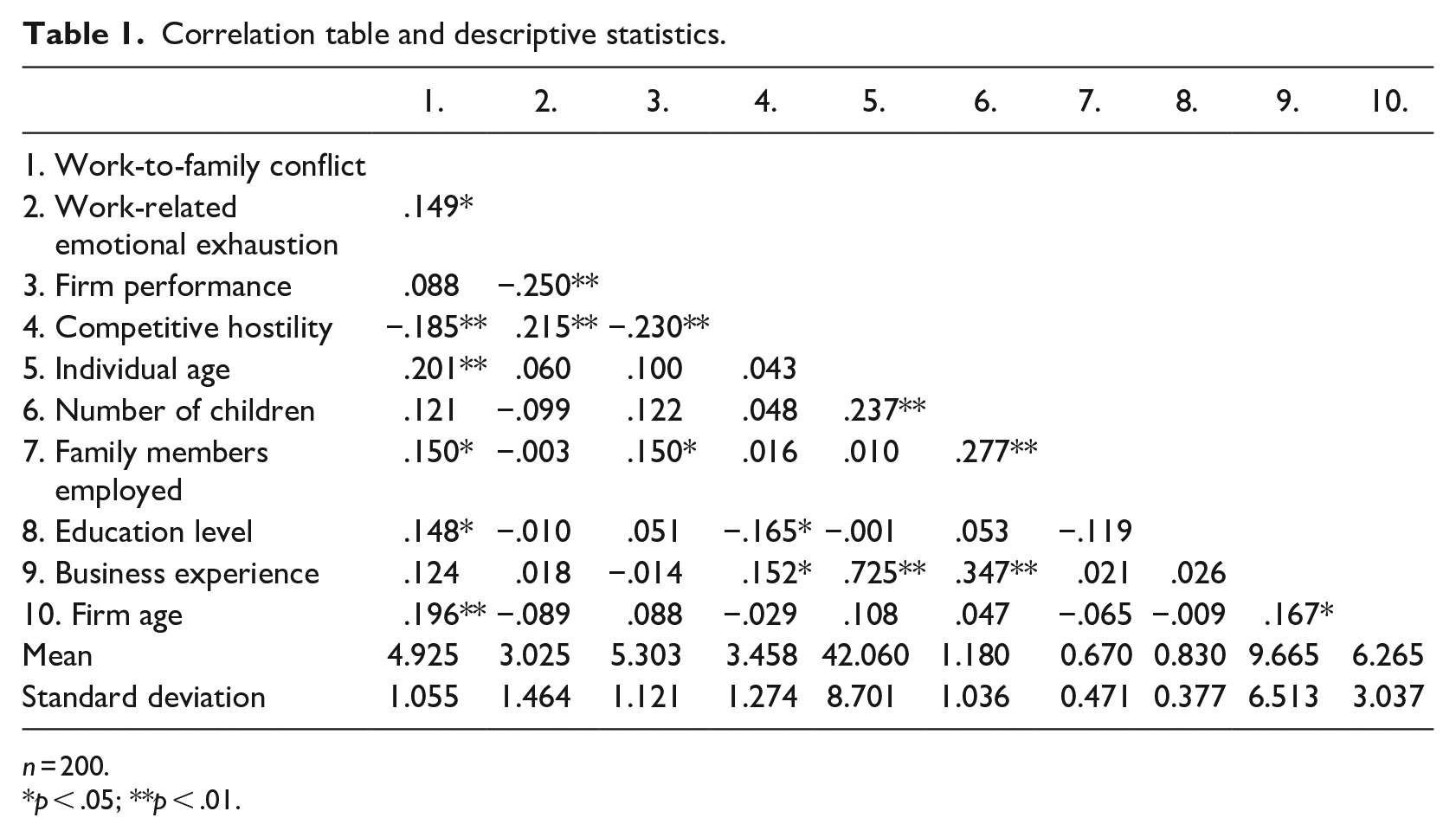
n = 200.
p < .05; **p < .01.
Mediation results (Process macro).
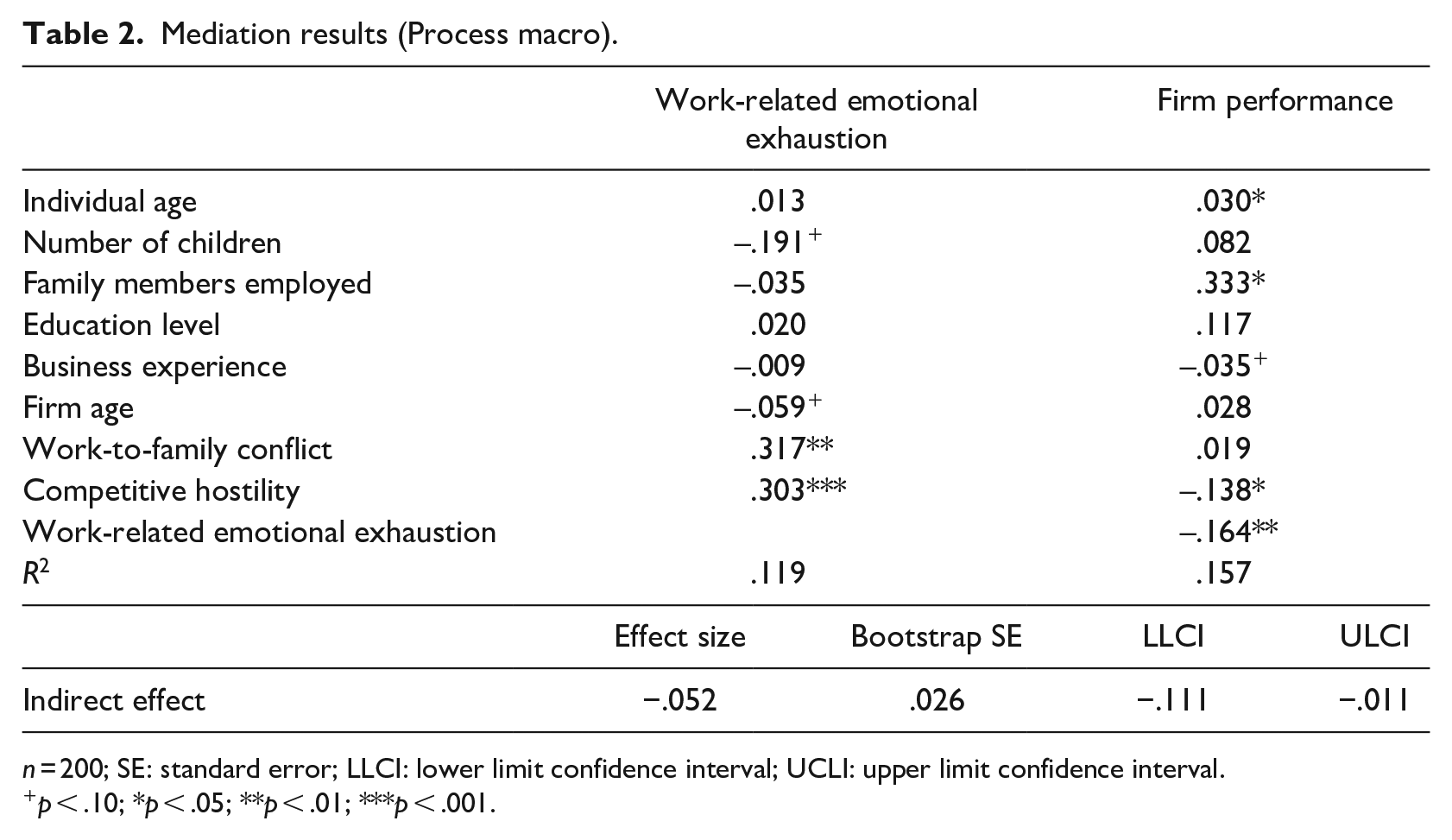
n = 200; SE: standard error; LLCI: lower limit confidence interval; UCLI: upper limit confidence interval.
p < .10; *p < .05; **p < .01; ***p < .001.
The results in Table 3 indicate a positive, significant effect of the work-to-family conflict × competitive hostility interaction term (β = .167, p < .05) for predicting work-related emotional exhaustion, which aligns with Hypothesis 4. The Process macro results similarly show that the relationship between work-to-family conflict and work-related emotional exhaustion is stronger at higher levels of competitive hostility (.076 at −1 SD, .215 at the mean, and .512 at +1 SD). Moreover, the CI spans 0 at the two lower levels of competitive intensity ((−.203, .355) and (−.001, .431)) but not at its highest level ((.258, .767), respectively), in further corroboration of Hypothesis 4. Regarding the moderated mediation, we predicted in Hypothesis 5, Table 3 reveals increasing effect sizes at higher levels of the moderator (−.013 at −1 SD, −.035 at the mean, −.084 at +1 SD). The CIs include 0 at the two lower levels ((−.080, .037) and (−.095; .001), respectively) but not at the highest level ((−.161, −.028)). The index of moderated mediation is –.027. Its CI does not include 0 ((−.060, −.002)), in support of the presence of moderated mediation and Hypothesis 5, and thus our theoretical framework.
Moderated mediation results (Process macro).
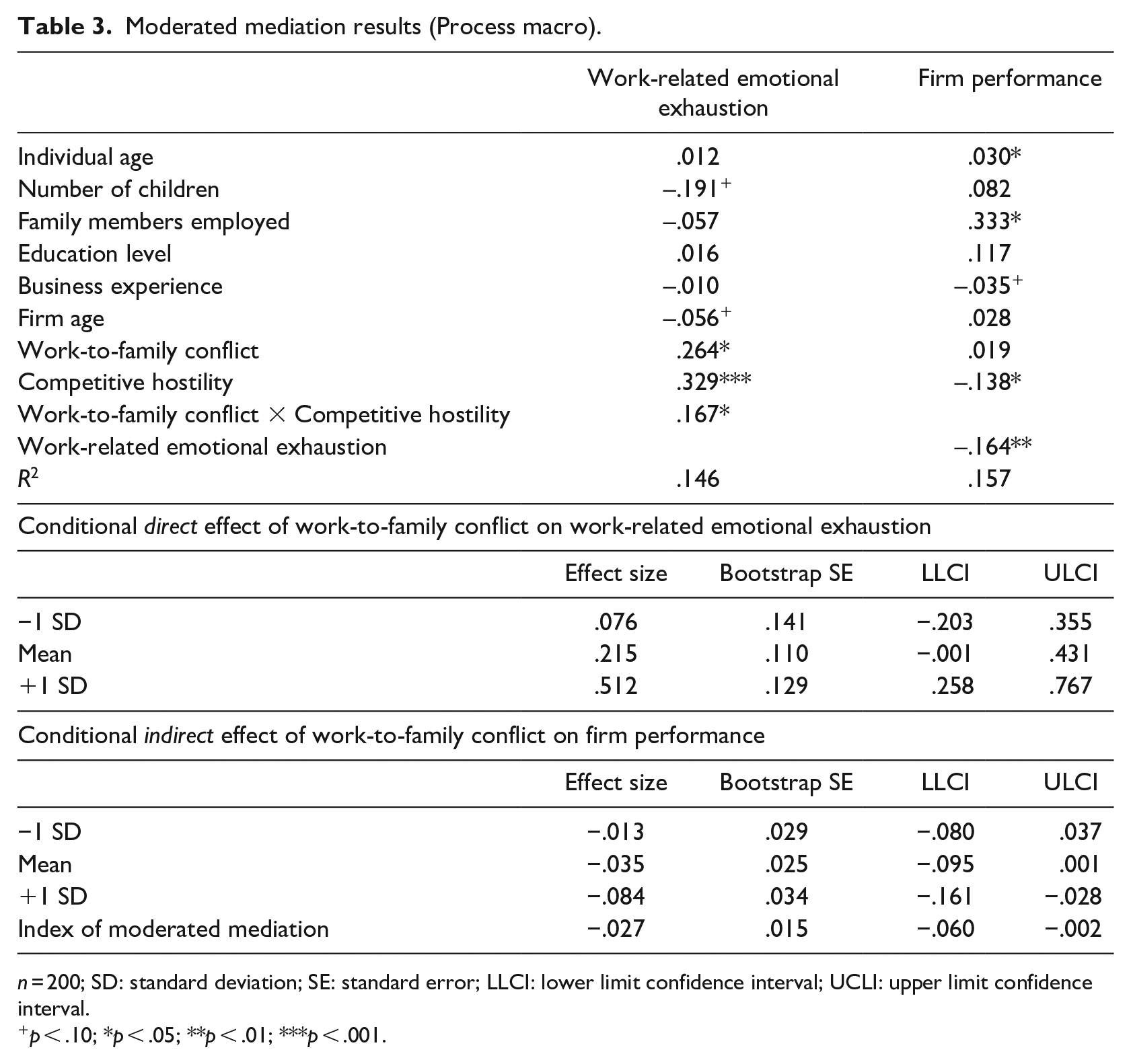
n = 200; SD: standard deviation; SE: standard error; LLCI: lower limit confidence interval; UCLI: upper limit confidence interval.
p < .10; *p < .05; **p < .01; ***p < .001.
Discussion
This study adds to extant entrepreneurship research by explicating the connection between the experience of work-to-family conflict and perceived firm performance by women entrepreneurs, with a particular focus on two pertinent factors that influence this relationship. With a conceptual anchoring in COR theory (Hobfoll et al., 2018), we have proposed that women entrepreneurs may be less successful in their business endeavours, in the presence of the resource-depleting interference of work with family, as they have less discretionary energy available to run their business. Their beliefs about hostile competitive markets may, in turn, invigorate this process. The empirical results, obtained from a sample of Ethiopian-based women entrepreneurs, affirm these conceptual predictions. In particular, work-to-family conflict spurs work-related emotional exhaustion, which diminishes firm performance. Work-related emotional exhaustion serves as a significant mediator of this process. The direct link between work-to-family conflict and work-related emotional exhaustion, as well as the indirect link between work-to-family conflict and firm performance through work-related emotional exhaustion, is invigorated by competitive hostility.
As a first theoretical implication, we provide a detailed explication of a factor that explains why a compromised family life due to work, translates into lower performance at the firm level: women entrepreneurs feel as if they are overburdened by the demands of their work (Wayne et al., 2017). What makes this finding interesting for entrepreneurship scholarship is that we might imagine an argument that women who suffer from work-to-family conflict want ‘at least’ to succeed in their business endeavours, to justify the sacrifices they make at home for their work. Yet, as we show, the difficulty of combining work with family demands can backfire in terms of the performance of their firms. The energy depletion women experience in the course of running their business can grow so intrusive that it disrupts their ability or stamina to maintain their efforts to running a successful firm (Huettermann and Bruch, 2019).
This detrimental process likely is particularly problematic in socio-economically disadvantaged countries such as Ethiopia. Women entrepreneurs in these countries are expected to put their family obligations ahead of their business but also often serve as important sources of family income (Efobi et al., 2019; Hundera et al., 2019b). This study accordingly unveils an interesting paradox: the efforts that these entrepreneurs undertake to maintain viable firms may tire them so much, due to the negative interference of these efforts with their family lives, that they ultimately are unable to run a high-performing business (Ye et al., 2019). In particular, this harmful role of work-related emotional exhaustion reveals the risk of a twofold setback from which women entrepreneurs in these countries may suffer: (1) they cannot avoid bringing their work-induced family hardships back to the business domain, with negative impacts on their work functioning, and (2) the resulting difficulties of running the business may hamper the quality of their personal lives even further.
A second salient research implication pertains to how this downwards dynamic grows stronger in intensity in adverse competitive markets (Mitchell et al., 2011). Women entrepreneurs in any country may face hostile competitive market conditions, but these conditions are particularly powerful in countries, such as Ethiopia, where gender-based discrimination tends to deprive women entrepreneurs of access to key resources that otherwise could support their competitive standing (Hundera et al., 2019b; Mekonnen and Cestino, 2017). As Mersha and Sriram, (2019, p. 161) indicate, ‘the playing field is not level for men and women entrepreneurs in Africa . . . women often encounter more constraints compared to their male counterparts, particularly during the start-up phase’. Our analysis elucidates how the experience of work-related emotional exhaustion among entrepreneurs connects their suffering from resource-draining work-to-family conflict with diminished firm performance more powerfully when they hold the belief that their external competitive markets threaten the viability of their businesses.
More generally, this invigorating role of competitive hostility is insightful in light of prior evidence of the direct negative effects of environmental hostility on firm performance (Hsu et al., 2020; Li, 2001; Torkkeli et al., 2012). Instead, we identify an indirect but no less disadvantageous role of this competitive condition among women entrepreneurs who already experience challenges because their work negatively interferes with their family. The conviction that competitive markets are more hostile catalyses women’s exhaustion when managing their business alongside work-to-family conflict. This catalytic role of competitive hostility, in tandem with the harmful effect of work-related emotional exhaustion on firm performance, reinforces the aforementioned twofold setback. From another perspective, this counterproductive dynamic offers empirical evidence of the theoretical notion of resource loss spirals which are largely explored through conceptual reflections (Hobfoll, 2001; Hobfoll et al., 2018). In this context, the detrimental effects of multiple resource-draining conditions reinforce one another in generating negative outcomes.
In short, this study contributes to women entrepreneurship research by showing how hostile competitive markets leave those who operate in countries with traditional family values particularly vulnerable to the hardships caused by work-to-family conflict. The danger that their work-related energy bases become drained is highly salient, and the resulting difficulty of running their business successfully could intensify the hardships that they experience in their private lives. In the context of poorer countries such as Ethiopia, an underperforming firm in turn could impose undue pressure on the family’s financial situation (Bardasi et al., 2007; Efobi et al., 2019). The energy depletion that women entrepreneurs in these countries may experience, in the course of running their firm, because of the combination of work-to-family conflict and external market challenges will have unwanted consequences: in this case, persistent firm underperformance. However, women entrepreneurs who suffer from work-to-family conflict in such challenging contexts might subdue the counterproductive dynamic to the extent that they recognise the inherent danger. They could benefit from leveraging the presence of hostile competitive markets as a motivation to boost their performance, rather than to resign themselves to suffering the hardships encountered at the work–family interface.
Limitations and further research
Additional research might be inspired by some of the shortcomings of this study. First, we address work-related emotional exhaustion as a critical channel through which work-to-family conflict leads to lower firm performance. In so doing, we acknowledge the resource-depleting nature of such conflict, whose negative consequences tend to manifest in the domain that produces the hardship (Nohe and Sonntag, 2014). It would be interesting to compare the relative potency of work-to-family and family-to-work conflicts with regard to hindering women’s business endeavours. Furthermore, other mechanisms might link experienced work-to-family conflict with diminished firm performance, such as dimensions of burnout other than emotional exhaustion (e.g. inadequate personal accomplishment or depersonalisation, Maslach and Leiter, 2008) or diminished psychological capital (Alessandri et al., 2018).
Second, competitive hostility catalyses the indirect relationship between work-to-family conflict and firm performance, as might other sources of environmental adversity, such as competitive rivalry or market turbulence (Leonidou et al., 2017). Researchers could consider individual factors too, such as pessimism (Liang and Dunn, 2010) or negative affect (Nikolaev et al., 2020). Furthermore, investigations might address the potential buffering roles of favourable factors that protect women entrepreneurs against the challenges of work-to-family conflict, whether external to the firm (e.g. network relationships with relevant stakeholders; Neumeyer et al., 2019) or internal (e.g. highly skilled teams; Godwin et al., 2006). It would be interesting to assess the relative power of these alternative moderators in influencing the mediated link between work-to-family conflict and firm performance, as well as how the role of competitive hostility shifts in their presence.
Third, we set this research in the understudied context of Ethiopia, though the theoretical arguments underlying our predictions are not country specific. As mentioned at the outset, the findings may apply to various countries, though the strength of the hypothesised relationships might vary. The counterproductive responses of women entrepreneurs to the negative interference of work with family, in combination with competitive hostility, might be especially salient in collectivistic, family-oriented cultures. In these cultures, concerns about respecting close family relationships prevail and uncertainty-invoking conditions are experienced as particularly intrusive and upsetting (Hofstede et al., 2010). It accordingly would be interesting to undertake cross-country comparisons that explicitly investigate the roles of these (and other) cultural factors for determining the performance consequences of women entrepreneurs’ experiences of such interference. In a similar vein, it would be interesting to investigate how the strength of the tested relationships compare between women and men entrepreneurs, according to gender-specific normative conditions that mark the broader societal environments in which they operate.
Practical implications
The results have valuable implications for entrepreneurial practice. The sense that their private life is being compromised by work-related demands likely is highly intrusive for any entrepreneur, but arguably may be even more so for women entrepreneurs in countries where prevailing cultural expectations emphasise their ‘duty’ to take on family responsibilities (Hundera et al., 2019b; Singh and Belwal, 2008). As this article shows, the associated hardships may not only undermine their family functioning but also pose the risk that this family strain leaves them too exhausted to run their firm well. These entrepreneurs must find ways to manage their time effectively across different life domains, to avoid a scenario in which the experienced conflict undermines the performance of their businesses. Accordingly, we recommend that women entrepreneurs who operate in gender-discriminatory environments adopt a proactive approach towards developing capabilities that help them cope with pertinent challenges at the interface between work and family. Such capability building could be achieved, for example, by putting together a formal board of advisors that complements their own skill sets or by maintaining an active network of informal contacts with whom they can exchange ideas about pertinent solutions (Roomi, 2013). Furthermore, this study suggests the value of customised training programmes that teach specific strategies for how entrepreneurs, both women and men, can combine a successful entrepreneurial career with a satisfactory family life.
Our findings also have timely implications for entrepreneurs facing the strain of the pandemic era and its associated economic turmoil, in which the risk that work-induced family hardships translate into poor firm performance is particularly high (Martinez Dy and Jayawarna, 2020). In such challenging environments, it is especially important for entrepreneurs to exchange valuable ideas with trusted people, inside or outside the firm, and work to guard against the heightened hardships of work-to-family conflict in the adverse competitive environment. From a positive angle, entrepreneurs should try to regard hostile markets as opportunities to develop strategies that enhance their firm’s performance, rather than becoming paralysed by the challenging conditions (Jifri et al., 2016). Insights into what these strategies might entail could be generated from multisector training initiatives, involving entrepreneurs who compete in different industries and so, are not direct competitors. The entrepreneurs could share their experiences with competitive hostility and the best practices they have discovered to mitigate its negative impact. Such training ultimately might help them leverage the challenges they encounter in the course of running their business, with positive consequences for how they respond to work-induced hardships at home and their propensity to undertake productive activities that ensure and increase the success of their businesses. Such training initiatives can benefit all entrepreneurs, but they might be particularly useful for women entrepreneurs who often confront discriminatory external forces that intensify the hardships encountered at the work–family interface or in their immediate competitive environments.
Conclusion
This article reveals two important factors that are crucial with respect to the risk that resource-draining work-to-family conflict suffered by women entrepreneurs might escalate into diminished firm performance. First, exhaustion deriving from the demands of running a business offers an explanation for why the negative interference of their work with their family lives keeps them from running a highly performing firm. Second, this negative dynamic is particularly prominent among entrepreneurs who feel threatened by how competitive markets operate. We hope the analysis serves as a springboard for cross-country investigations of how women entrepreneurs, exposed to varying levels of gender discrimination, can mitigate the risk that difficult situations at home, due to work, undermine the competitive standing of their firms, an outcome that ultimately may compromise their personal well-being even further.
Footnotes
Funding
The author(s) disclosed receipt of the following financial support for the research, authorship and/or publication of this article: This research was funded by research grant no. 2017/27/B/HS4/02075 for Eugene Kaciak, National Science Centre, Poland.
