




Abstract
This research investigates how an understudied personal resource (exhibitionism) might positively connect with peer-oriented helping behavior, as well as how this connection might be invigorated by four pertinent contextual resources: two resources that speak to beliefs about fair organizational treatment (informational justice and procedural justice) and two resources that capture how employees feel about their work functioning (job satisfaction and organizational commitment). Two-wave survey data collected among banking sector employees reveal that their desire to be the center of attention is associated with an enhanced propensity to extend help to other organizational peers, voluntarily. This process also is more likely when employees (1) believe that organizational authorities provide them with sufficient information, (2) perceive organizational procedures as fair, (3) feel happy with their current job situation, and (4) experience a strong emotional bond with their employer.
JEL Classification:
Keywords
1. Introduction
Formal job descriptions might not require it, but many employees try to help peers with their work tasks, which can be critical for organizational effectiveness (Choi and Moon, 2016; Chou and Stauffer, 2016; Zhu and Akhtar, 2014). Such helping activities are an important subset of organizational citizenship behaviors (OCBs), a broader term that captures extra-role activities for which employees do not receive direct compensation (Chung, 2017; LePine et al., 2002; Podsakoff et al., 2009). Such OCB can be directed at individual peers or the organization overall (Turnipseed, 2018; Williams and Anderson, 1991). With this study, we focus on the former and seek to explain why some employees might be more inclined to engage in peer-oriented helping behavior that entails high-quality interpersonal exchanges with potentially beneficial work outcomes (Bachrach et al., 2006; Duan et al., 2019; Zhang et al., 2020).
We know that pertinent personal factors tend to motivate employees’ extra-role work activities; prior research demonstrates the influences of a proactive personality (Yang et al., 2011) or lack of cynicism (Andersson and Bateman, 1997), for example. We propose another critical but unexplored impetus of peer-oriented helping behavior, namely, the level of exhibitionism that employees display. We define exhibitionism as a desire to receive attention from others (Xie et al., 2006), such that people who score high on it “cannot tolerate being ignored, they need to be the centre of others’ attention, and they are highly self-promotional” (Meurs et al., 2013: 372). It thus differs from previously investigated personal factors. For example, unlike proactivity, exhibitionism implies a propensity to show off, and compared with cynicism, it is a source of discretionary energy that employees might channel toward activities that they consider advantageous (Naderi and Strutton, 2015; Xie et al., 2006). As an energy-enhancing personal resource, exhibitionism thus might trigger employees’ desire to do more than is expected of them in their interactions with organizational peers (Quinn et al., 2012). Beyond this effect, we predict that four contextual factors might reinforce it: two that capture employees’ perceptions of justice (informational and procedural) and two that speak to the positive emotions that they experience toward their work or organization (job satisfaction and organizational commitment). By testing these predictions, we seek a better understanding of the circumstances in which exhibitionism tends to promote helping activities and when such beneficial activities are most likely to emerge among employees.
In turn, we derive several contributions. Drawing from conservation of resources (COR) theory, we propose that exhibitionism offers an important, hitherto overlooked personal resource that relates positively to peer-oriented helping behavior, which is not formally required. Few studies attempt to link exhibitionism with employee behavior, with the notable exception of Meurs et al. (2013), who find that employees’ “grandiose” exhibitionism, as a type of narcissism, increases the chances that they engage in counterproductive work behaviors in the presence of workplace stressors. We take a different perspective. As a personal resource, exhibitionism also may be positively associated with purposeful, voluntary attempts to help peers complete their job tasks, as a means to evoke positive reactions (Chou and Stauffer, 2016; Masterson, 1993). Marketing studies suggest a similar link, in that exhibitionist consumers tend to engage more in sustainable behaviors to secure positive reactions (Naderi and Strutton, 2015).
As a further application of COR theory, we anticipate that discretionary energy gained from a desire to show off relates more meaningfully with enhanced peer-oriented helping behaviors if the employees can draw from complementary contextual resources (Hobfoll and Shirom, 2000). In particular, employees’ exhibitionism may enhance peer-oriented helping behavior more if they also believe their organization provides information fairly (Kim, 2009) and engages in fair decision making (Lee et al., 2017), if they feel happy about their job situation (Abbas et al., 2014), and if they experience a strong emotional bond with the organization (Pooja et al., 2016). Formally, the positive connection between employees’ exhibitionism and peer-oriented helping behavior should be stronger when employees are supported by more informational justice, procedural justice, job satisfaction, and organizational commitment. Prior research reveals direct effects of these four contingency factors; voluntary work behaviors are more likely among employees who perceive that organizational communication practices and decision-making policies are fair (Colquitt et al., 2001), feel excited about their job situation (Baeza and Wang, 2016), or feel a strong emotional connection with their employer (Pooja et al., 2016). To add nuance, we address how these factors also might strengthen employees’ decisions to allocate their discretionary energy, derived from their exhibitionism, voluntarily to help their peers.
For this research effort, we choose the empirical setting of Guinea-Bissau. This country is marked by high levels of collectivism, similar to many African traditional societies (Hofstede et al., 2010), so employees in this setting might find it attractive to apply their personal energy reservoirs to extra-role activities, from which organizational colleagues can benefit (Baeza and Wang, 2016). This study’s central question—how does employees’ access to pertinent resources affect the conversion of their exhibitionism into elevated peer-oriented helping activities?—therefore may be especially relevant in this setting. From a more general perspective, this study responds to calls for more research into the determinants of productive work behaviors in understudied African contexts, to help organizations functioning in these contexts learn how to leverage pertinent features of their employee bases to achieve organization-wide benefits (Antwi et al., 2019; Obedgiu et al., 2017). Examining the interplay of exhibitionism with various triggering contingency factors and its relationship with peer-oriented helping behavior, in the rarely studied context of Guinea-Bissau, represents a step toward filling this gap.
The proposed framework and its underlying hypotheses are in Figure 1. The baseline relationship predicts a direct connection between employees’ exhibitionism and peer-oriented helping behavior. Then this connection might be invigorated by four valuable resources: informational justice, procedural justice, job satisfaction, and organizational commitment. Thus, as a distinct contribution to extant scholarship on extra-role work activities, this framework pinpoints exhibitionism as a factor with a positive association with a critical type of intra-organizational collegiality (voluntary helping of peers) and relevant circumstances in which this source of discretionary personal energy is more likely to link to this beneficial behavior.
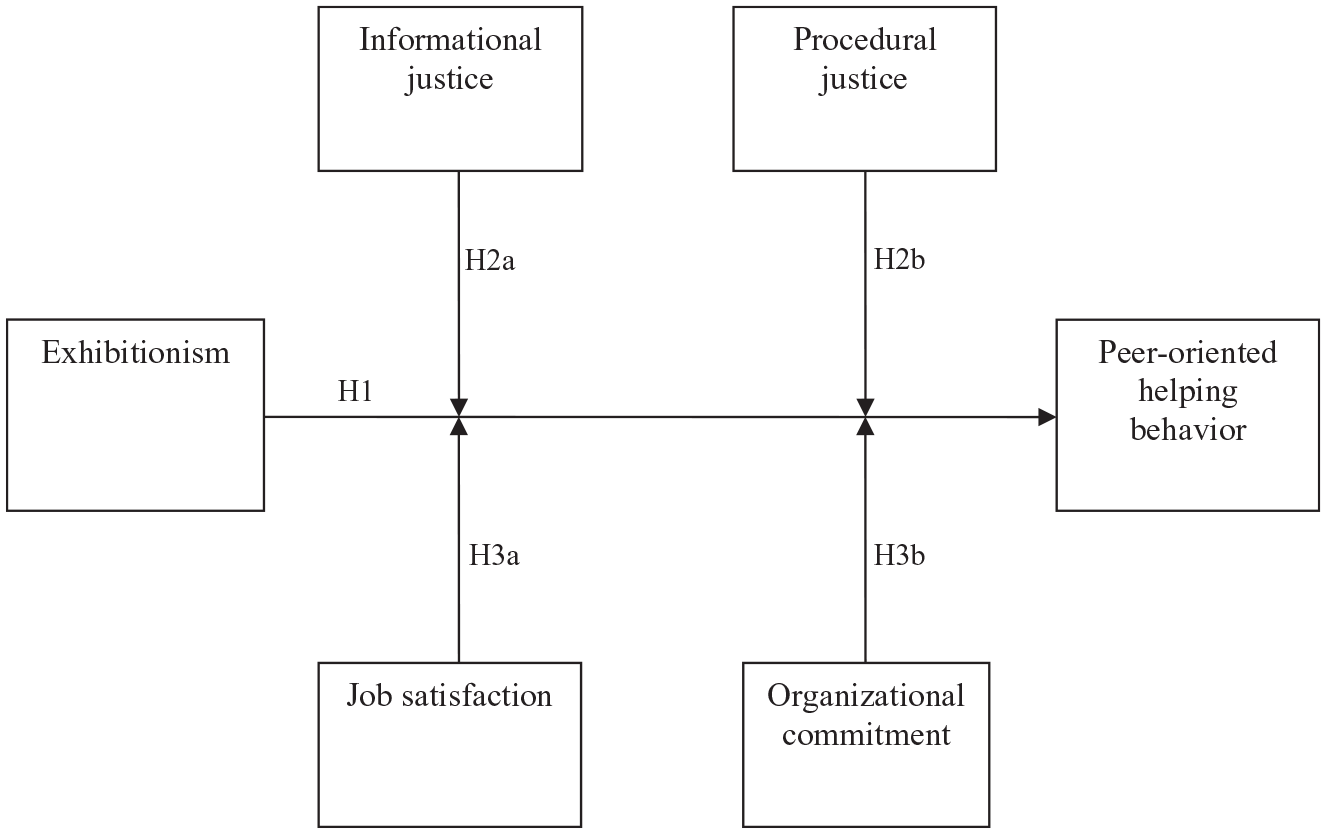
Conceptual model.
2. Theoretical background and hypotheses
Previous studies note the continued need to investigate why employees might direct discretionary energy resources toward extra-role work activities that add to organizational success but are not explicitly required (Guan and Frenkel, 2019; Velasquez Tuiao et al., 2020). Discretionary activities might contribute directly to organizational effectiveness but also can be indirect, arising through employees’ dedicated efforts to help individual peers fulfill their work tasks (Duan et al., 2019; Tang et al., 2008). As mentioned, extant research on OCB distinguishes voluntary work activities directed to their employer overall from those that focus on individual colleagues (Jiang and Law, 2013). We attend to the latter and specifically the degree to which employees extend themselves to increase their peers’ chances of succeeding in their jobs, even if those activities do not earn explicit rewards (Chou and Stauffer, 2016; De Clercq et al., 2019). We thus acknowledge a pivotal role of positive, intra-organizational relational dynamics: When employees actively support one another in their work endeavors, it can generate beneficial outcomes, such as increased innovation and performance (Bachrach et al., 2006; Tsai and Ghoshal, 1998).
Peer-oriented helping behaviors thus may enhance the success of individual colleagues directly and the organization indirectly (Ng and Van Dyne, 2005; Podsakoff et al., 2009), and they also might generate beneficial outcomes for the employees who engage in them. Employees who go out of their way to meet the work-related needs of their peers likely thrive at work (Zhang et al., 2020) or experience a sense of personal accomplishment (Lemoine et al., 2015). Furthermore, they may enjoy performance gains if their efforts are reciprocated by the beneficiaries of their help (Deckop et al., 2003; Hui et al., 2000; Korsgaard et al., 2010). Yet even if peer-oriented helping behaviors can be beneficial in all these ways, they also have a negative side. Dedicating significant time to helping others creates risks of emotional exhaustion or diminished success in regular job duties (Bergeron, 2007; Bolino et al., 2015; Lin et al., 2020). In addition, some targets of helping activities may consider these discretionary efforts meddling or disruptive, such that they resist the efforts (Podsakoff et al., 2009). We thus seek deeper insights into why some employees may be more likely than others to invest significant energy resources in helping colleagues voluntarily, despite these challenges.
Various enabling factors, related to employees’ organizational environment, might stimulate their propensities to engage in peer-oriented helping behavior, such as a procedural justice climate (Shin et al., 2015), group-focused transformational leadership (Lorinkova, Jansen, and Perry, 2019), or team cohesion and cooperation (Liang et al., 2015). Several personal factors also might increase the likelihood of such behaviors, including employees’ proactivity (Yang et al., 2011), prosocial motives (Choi and Moon, 2016), or religion-based work values (De Clercq et al., 2018). Others could limit employees’ voluntary work behaviors, targeted at peers or the organization in general, such as cynical attitudes (Andersson and Bateman, 1997), psychopathic tendencies (Smith et al., 2016), or monetary-oriented motives (Tang et al., 2008). By examining how employees’ exhibitionism—which reflects a desire for self-display and to be the center of attention (Xie et al., 2006)—may enhance their propensity to engage in voluntary behaviors targeted at peers, we expand this research stream. Even if this personal characteristic may have a negative connotation and convey a certain sense of self-importance (Meurs et al., 2013), we posit it can fuel employees with discretionary energy that enables and motivates them to help their colleagues on a voluntary basis.
2.1. COR theory
Our conceptual arguments about the positive relationship between exhibitionism and peer-oriented helping behavior are based on COR theory, which predicts that employees’ extra-role work activities can be explained by their pursuit of resource gains (Hobfoll et al., 2018). Employees may exhibit a greater tendency to perform productive work activities, such as helping peers, if they can apply their existing energy bases, informed by pertinent personal characteristics, to produce additional benefits (Hobfoll and Shirom, 2000; Ozyilmaz, 2020). Extending help to peers voluntarily can be highly beneficial for employees, because it might earn them attention or admiration for their attempts to make a positive difference in the well-being of others (Choi and Moon, 2016; Hui et al., 2000). In COR terminology, applying pertinent personal energy, derived from exhibitionism, may generate important resource gains if employees decide to go out of their way to help others (Hobfoll, 2001). Naderi and Strutton (2015: 75) similarly note that people’s exhibitionistic tendencies may provide them with the stamina to engage in positive behaviors, because these behaviors serve “as opportunities to signal self-sacrifice to others and consequently earn the societal admiration of those others.”
Moreover, COR theory postulates critical invigorating roles of employees’ access to valuable resources that relate to their work functioning; such access may catalyze the allocation of pertinent personal energy resources to extra-role work activities, to the extent that the resources enable or motivate the allocation (Hobfoll and Shirom, 2000). In particular, the notion of resource gain spirals (Hobfoll, 2001) suggests that the translation of discretionary individual energy into extraordinary work behavior is particularly likely if employees can rely on additional resources that make this translation more viable or attractive. Consistent with this logic, we propose that employees’ desire for self-display relates more powerfully to their peer-oriented helping behaviors when they experience higher levels of informational justice, procedural justice, job satisfaction, and organizational commitment.
The selection of these four contextual resources is not random but purposeful, in that they complement one another. The two justice types do not necessarily occur in conjunction, because employees who believe their organization provides them with adequate information still may regard its practices as unfair (Colquitt, 2001; Gupta and Singh, 2013). Nor are fair procedures for making organizational decisions a guarantee that employees have access to all the information they need to ensure their professional well-being (Colquitt, 2001). The other two factors similarly might not align, in that job satisfaction captures employees’ happiness with their daily work specifically, but their organizational commitment pertains to the loyalty they feel toward the organization as a whole (Estreder et al., 2019; Sim and Lee, 2018). Moreover, both informational justice and procedural justice capture cognitive beliefs about how the organization treats employees (Colquitt, 2001), whereas job satisfaction and organizational commitment speak to the positive emotions they experience in relation to their organizational membership (Estreder et al., 2019). In turn, the beneficial effects of informational justice and procedural justice should increase employees’ ability to allocate the discretionary personal energy resources they gain from their exhibitionism to voluntary helping behaviors, without compromising their in-role job performance, whereas their job satisfaction and organizational commitment heighten their desire to do so (Quinn et al., 2012). Together, the four factors offer a parsimonious, diverse account of how selected contextual contingencies likely influence the relationship between employees’ desire to be noticed and their peer-oriented helping behavior, as detailed next.
2.2. Exhibitionism and peer-oriented helping behavior
We predict a positive association between employees’ exhibitionism and peer-oriented helping behaviors, for both ability and motivation reasons. First, exhibitionism may serve as an energy-enhancing personal resource from which employees can draw, such that it enables them to go out of their way to assist other members with their job tasks (Quinn et al., 2012). Persistent, voluntary efforts to help colleagues may compromise their ability to meet their own formal job duties though, because of the significant additional energy required by such efforts (Bolino et al., 2015; Van Dyne and Ellis, 2004). Exhibitionistic tendencies may instill employees with the discretionary energy they need to engage in such additional activities, beyond the range of what might be called “normal” or expected work efforts, as well as the stamina required to demonstrate their ongoing dedication and contributions (Naderi and Strutton, 2015). Due to their desire to be the center of attention, these employees likely are confident that any resource gains generated from their peer-oriented helping activities, such as admiration or enhanced organizational standing, are feasible and accessible (Hobfoll and Shirom, 2000). Thus, their exhibitionism should be associated with an enhanced propensity to help colleagues with the challenges they encounter in the workplace, despite the risk of negative repercussions for their own regular job performance (Bergeron, 2007; Culbertson and Mills, 2011).
Second, employees marked by high levels of exhibitionism might enjoy a sense of personal fulfillment when they receive credit for helping their colleagues improve their work situation, reflecting their strong desire to be recognized for their valuable work contributions (Masterson, 1993; Naderi and Strutton, 2015). Consistent with COR theory, employees’ discretionary energy, derived from their exhibitionism, may associate positively with their peer-oriented helping behavior because they are motivated to leverage this personal energy resource to undertake voluntary activities that produce important resource gains for them, such as pubic recognition and appreciation (Hobfoll et al., 2018). Their desire to show off relates positively to extra-role work behaviors, in that they anticipate personal benefits from their voluntary effort (Quinn et al., 2012). In contrast, employees who score low on exhibitionism might be reluctant to spend significant time helping peers in ways that are not formally required, so they can stay under the radar or align with their sense of modesty (Naderi and Strutton, 2015; Wink, 1991).
2.3. Moderating role of informational justice
According to COR theory, expectations about the usefulness of applying discretionary personal energy resources to extra-role work activities are contingent on the extent to which employees believe they can rely on complementary, contextual resources that will make their effort application more feasible (Hobfoll and Shirom, 2000). When employees receive adequate information about how to fulfill their job duties, their ability to leverage their discretionary energy in voluntary peer-oriented helping efforts, without compromising their regular job tasks, should be greater (Cheung, 2013; Colquitt et al., 2001). As noted, such helping activities are energy-consuming and distracting, so employees might become so absorbed or overwhelmed by them that they stumble in their formal job duties (Bolino et al., 2015; Van Dyne and Ellis, 2004). Beliefs about informational justice can enhance their allocation of discretionary personal energy to these helping behaviors though—even if such behaviors might be counterproductive in terms of their regular job performance—because employees possess greater knowledge about how to showcase their generosity while avoiding negative performance effects (Walumbwa et al., 2009). If organizational authorities are open in their communication, employees also tend to receive organizational guidance about how to manage their time effectively (Colquitt et al., 2001; Georgalis et al., 2015), which increases their ability to leverage their energy, obtained from their exhibitionistic tendencies, as voluntary peer-oriented helping behaviors (Quinn et al., 2012). Conversely, if they lack critical organizational information, exhibitionistic employees may have a harder time avoiding a situation in which their peer-oriented helping efforts hinder the completion of their formal job obligations, so they may be less likely to extend such efforts (De Clercq and Saridakis, 2015).
2.4. Moderating role of procedural justice
We expect a similar triggering role of procedural justice. According to COR theory, discretionary energy, such as that which stems from a desire to stand out and be admired by others (Masterson, 1993), enhances employees’ resource-generating work activities more if the resource gains are likely to materialize, according to the presence of supportive organizational decision-making processes (Hobfoll, 2001; Secil, 2019). Employees who encounter fair decision-making policies have a stronger ability to leverage their discretionary energy in extra-role peer-oriented helping activities, because they can fall back on these procedures as guidelines for how to combine voluntary activities with the successful execution of their regular job tasks (Shin et al., 2015). Similarly, they likely believe they can achieve their personal objective, to show off their dedicated peer-oriented helping activities, because they expect that their energy allocations will be evaluated fairly (Mo and Shi, 2017; Yang et al., 2009). Fair organizational procedures lead employees to recognize their work environments as protective of their professional well-being (Colquitt et al., 2001; Kim and Beehr, 2020) and feel confident that they can allocate their discretionary energy reservoirs to peer-oriented helping behaviors, even if doing so might undermine their ability to meet all their formal performance targets (Culbertson and Mills, 2011). Conversely, if employees regard organizational decision making as unfair, they might doubt their abilities to channel the discretionary energy they obtain from their exhibitionistic tendencies into peer-oriented helping activities, without compromising or undermining their regular job performance (Hobfoll, 2001; Wan et al., 2012).
2.5. Moderating role of job satisfaction
Employees’ job satisfaction also might catalyze the positive relationship between their exhibitionism and peer-oriented helping behavior. In COR theory, employees endowed with discretionary personal energy resources undertake resource-generating work activities more forcefully, to the extent that they even might produce more resource gains, in the form of valued personal outcomes (Hobfoll and Shirom, 2000). Employees who have exhibitionistic tendencies and are happy with their job situation should be strongly attracted by the prospect of helping organizational peers with their dedicated work efforts, even if doing so might absorb their energy or distract them from their regular job duties (Lu et al., 2013). That is, they perceive the value of channeling positive work-related energy into extra-role peer-oriented helping behaviors that add to their organizational standing and give them more visibility (Choi and Moon, 2016; Hui et al., 2000). Job satisfaction generates work-related excitement, which they can combine with a desire to be the center of attention (Baeza and Wang, 2016). Similarly, job satisfaction produces a sense of the personal meaningfulness of work, which they can reinforce by leveraging their exhibitionistic tendencies to perform extra-role activities that assist others (Hoption, 2016; Ryan and Deci, 2000). Conversely, employees dissatisfied in their jobs tend to adopt a passive approach (Jiang et al., 2009) and likely feel indifferent about the possibility of leveraging their discretionary energy reservoirs to make a positive difference and increase the well-being of colleagues (De Clercq et al., 2019). Despite their exhibitionistic tendencies, such dissatisfied employees are less likely to display voluntary peer-oriented helping behaviors.
2.6. Moderating role of organizational commitment
Employees’ organizational commitment similarly might invigorate the positive connection between their exhibitionism and peer-oriented helping behavior. The logic of COR theory suggests that employees are more likely to allocate discretionary personal energy resources to productive work activities that reflect their emotions about their organizational membership (Hobfoll et al., 2018). If employees feel a strong emotional bond with their employer, they likely want to combine their personal goals (e.g. showing off) with activities that add value for organizational members (Pooja et al., 2016; Yang and Wei, 2018). For example, employees with a strong commitment to their organization tend to interpret the successes of organizational peers as personal successes (Meyer et al., 2004; Zuhaira et al., 2018), so they may have a particularly strong desire to direct discretionary energy, derived from their exhibitionistic tendencies, to helping efforts that increase the chances of their peers’ success, even if it reduces their ability to complete their own job duties (Bolino et al., 2015; Quinn et al., 2012). Organizational commitment also can shift employees’ attention, away from the potential negative outcomes for themselves and toward the opportunity to support the professional well-being of others (Happy et al., 2019; Shin et al., 2015). In contrast, employees who exhibit little organizational commitment care little about their potential for creating positive differences for organizational colleagues (Pooja et al., 2016), so they should be less likely to stretch themselves to channel their exhibitionistic tendencies into voluntary assistance targeted at peers (Hobfoll, 2001).
3. Research method
3.1. Sample and data collection
The research hypotheses were tested with two-wave survey data collected from a sample of employees who work for a large banking organization in Guinea-Bissau. By focusing on one specific industry and country, we sought to diminish the risk of unobserved variance in pertinent industry or country factors that could influence the perceived need to help organizational peers with their work (Chiaburu et al., 2015). The banking sector in Africa is characterized by high levels of external competition and a complex set of regulations and constraints (Barros et al., 2018), so extra-role voluntary efforts may have great value for individual and organizational effectiveness. This empirical context accordingly is relevant to address questions about how and when employees’ discretionary personal energy resources may be leveraged into dedicated efforts that help organizational peers with their work.
We applied a two-wave design that included a time lag of 6 months. The first survey assessed employees’ exhibitionistic tendencies and their beliefs about informational justice, procedural justice, job satisfaction, and organizational commitment; the second survey gauged their peer-oriented helping behavior. The time lag of 6 months diminishes concerns about expectancy bias, or the probability that employees’ responses are influenced by their guesses about the hypothesized relationships. This design cannot quite eliminate the possibility of reverse causality—that is, that a sense of personal accomplishment resulting from peer-oriented helping behaviors might influence the moderating variables, by prompting positive beliefs and emotions in employees about their organizational functioning—but it mitigates the concern. We thus acknowledge the benefits of measuring each of the focal constructs at two different points in time, which would have allowed us to estimate cross-lagged effects and formally check for causality (Antonakis et al., 2010), but we also propose that concerns about reverse causality in the link between the personal characteristic of exhibitionism and peer-oriented helping behavior generally should be low, due to the stable nature of the characteristic (Xie et al., 2006). Finally, the temporal separation between predictor and criterion variables diminishes concerns about common method bias (Jordan and Troth, 2020).
The surveys were first written in English, then translated into Portuguese by a bilingual translator. Next, the Portuguese version was back-translated into English by a different translator, to detect any discrepancies (Brislin et al., 1973). In both survey rounds, participants learned that their responses were completely confidential, that no individual data would ever be revealed, that only anonymous aggregated data would be shared outside the research team, and that they could withdraw from the research at any point in time. The surveys also underscored that there were no correct or incorrect answers, that it was normal for participants to give varying answers to questions, and that it was critical for the value of the study that they provided their honest, true opinions. These elements reduce the chances of social desirability biases (Spector, 2006). Of 257 employees contacted, we received 243 responses in the first round, then 163 in the second round. After removing surveys with incomplete data, we retained 158 completed sets for the statistical analyses, which reflects a 65% response rate. Among the respondents, 43% were women, and they had worked for their organization for an average of 6 years.
3.2. Measures
The six focal constructs were measured with items drawn from prior research, applying 7-point Likert-type scale that ranged from 1 (“strongly disagree”) to 7 (“strongly agree”).
3.2.1. Peer-oriented helping behavior
Employees’ voluntary efforts to assist their peers with their work are measured with a seven-item scale of helping behavior targeted at individual colleagues (Williams and Anderson, 1991). Two example items are “I go out of my way to help peers” and “I take time to listen to my co-workers’ problems and worries” (Cronbach’s α = .84). Because these items appeared in the second survey, employees assessed them 6 months after they had rated the other constructs. Our reliance on a self-rated measure of peer-oriented helping behavior is consistent with previous studies (Lin et al., 2020; Rubenstein et al., 2019) and with the argument that other raters may have only a partial view of the range of extra-role helping activities that employees might exhibit toward all their peers (Chan, 2009; Organ et al., 2006).
3.2.2. Exhibitionism
To assess employees’ desire for self-display, we relied on a four-item scale of exhibitionism (Xie et al., 2006). For example, employees assessed whether “I am apt to show off if I get the chance” and “I like to be the center of attention” (Cronbach’s α = .74).
3.2.3. Informational justice
We assessed employees’ beliefs that their organization is fair in its communication practices with a five-item scale of informational justice (Colquitt, 2001). The respondents indicated, for example, whether “Organizational authorities are candid/frank in their communications with me” and “Organizational authorities communicate details in a timely manner” (Cronbach’s α = .87).
3.2.4. Procedural justice
To measure the extent to which employees believe in the fairness of their organization’s decision-making processes, we applied a five-item scale of procedural justice (Masterson, 2001). For example, respondents rated their agreement with items such as, “Organizational procedures allow for requests for clarification or additional information about a decision” and “Organizational procedures provide opportunities to appeal or challenge a decision” (Cronbach’s α = .86).
3.2.5. Job satisfaction
We assessed the extent to which employees feel happy with their job situation with a five-item scale of job satisfaction (De Clercq and Belausteguigoitia, 2017). Two example statements are “I feel satisfied with my present job” and “I consider my job to be very pleasant” (Cronbach’s α = .92).
3.2.6. Organizational commitment
We measured the extent to which employees feel a strong emotional bond with their organization with three items drawn from Meyer and Allen’s (1991) affective commitment scale. For example, they evaluated whether “I feel a sense of loyalty to my company” and “I am proud to be an employee of my company” (Cronbach’s α = .74).
3.2.7. Control variables
The statistical models accounted for two demographic variables: gender (1 = female), because female employees may be more inclined to extend voluntary help to their colleagues (Belansky and Boggiano, 1994), and organizational tenure, because employees who have worked for their organization for a longer period may have greater confidence that they can find ways to engage effectively in extra-role work activities (Seppälä et al., 2012). We also controlled for two personal characteristics, a positive and negative one, that prior research has studied and that likely influence employees’ extra-role work behaviors: proactivity (Yang et al., 2011), with a four-item scale (Parker and Sprigg, 1999), and cynicism (Andersson and Bateman, 1997), with another four-item scale (Leung et al., 2010).
3.2.8. Construct validity
We estimated a six-factor measurement model with confirmatory factor analysis to evaluate the validity of the six focal constructs. The model fit was good: χ2(362) = 539.29, incremental fit index = .92, Tucker–Lewis index = .90, confirmatory fit index = .92, and root mean square error of approximation = .06. The convergent validity of the six constructs was confirmed by the significant factor loadings (p < .001) of each measurement item on its corresponding constructs and by the average variance extracted (AVE) values, which exceed the cutoff value of .50 (Bagozzi and Yi, 1988) with the exception of the AVE value for peer-oriented helping behavior, at .42. In support of discriminant validity, the AVE values are all greater than the squared correlations of the respective pairs of constructs (Fornell and Larcker, 1981), and the fit of the models with constrained construct pairs (correlation between two constructs is fixed) is significantly worse than the fit of the associated unconstrained models (correlation between constructs is free to vary), for all 15 construct pairs (Δχ2(1) > 3.84, p < .05; Anderson and Gerbing, 1988).
4. Results
4.1. Main analysis
Table 1 lists the zero-order correlations and descriptive statistics, and Table 2 contains the results of the hierarchical moderated regression analysis. Model 1 included the control variables, Model 2 added exhibitionism and the four resources, and Models 3 to 6 added the Exhibitionism × Informational Justice, Exhibitionism × Procedural Justice, Exhibitionism × Job Satisfaction, and Exhibitionism × Organizational Commitment interaction terms, respectively. We followed the recommended approach to estimate different moderating effects in separate regression equations, because their simultaneous estimation tends to hide true moderating effects (Covin et al., 2006; De Clercq and Belausteguigoitia, 2017). We also mean-centered the constructs before calculating the respective interaction terms. The variation inflation factor for each variable was below the conservative value of 5.0, so multicollinearity was not a concern (Studenmund, 1992).
Correlations and descriptive statistics (N = 158).

p < .05; **p < .01.
Regression results (dependent variable: peer-oriented helping behavior) (N = 158; unstandardized coefficients).

p < .10; *p < .05.
The control Model 1 indicated that employees with shorter organizational tenures were somewhat more likely to help their colleagues, perhaps because these efforts seemed likely to give an early boost to their careers and leave good impressions on others (β = –.032, p < .10). We also found a weak negative relationship between cynicism and peer-oriented helping behavior (β = –.105, p < .10), consistent with prior evidence that cynical beliefs steer employees away from voluntary work behaviors (Andersson and Bateman, 1997).
In line with the baseline premise in H1 that the discretionary energy that stems from a desire for self-display relates positively to employees’ voluntary efforts to help their colleagues, Model 2 indicated a positive relationship between exhibitionism and peer-oriented helping behavior (β = .171, p < .05). Models 3 and 4 provided support for the invigorating effects of the two fairness-related factors in H2: informational justice (β = .097, p < .05) and procedural justice (β = .083, p < .05). That is, the likelihood that exhibitionism would be associated positively with peer-oriented helping behavior was greater when employees believed organizational authorities provided them with sufficient information (H2a) and organizational decision-making procedures were fair (H2b). These significant invigorating roles are evident in Figure 2(a) and (b) for which the corresponding simple slope analysis (Aiken and West, 1991) reveals that the relationship between exhibitionism and peer-oriented helping behavior was positive and significant at high levels of informational justice (β = .249, p < .01) and procedural justice (β = .242, p < .01) but not significant when these contextual resources were low (β = .055, β = .076, respectively, both ns).
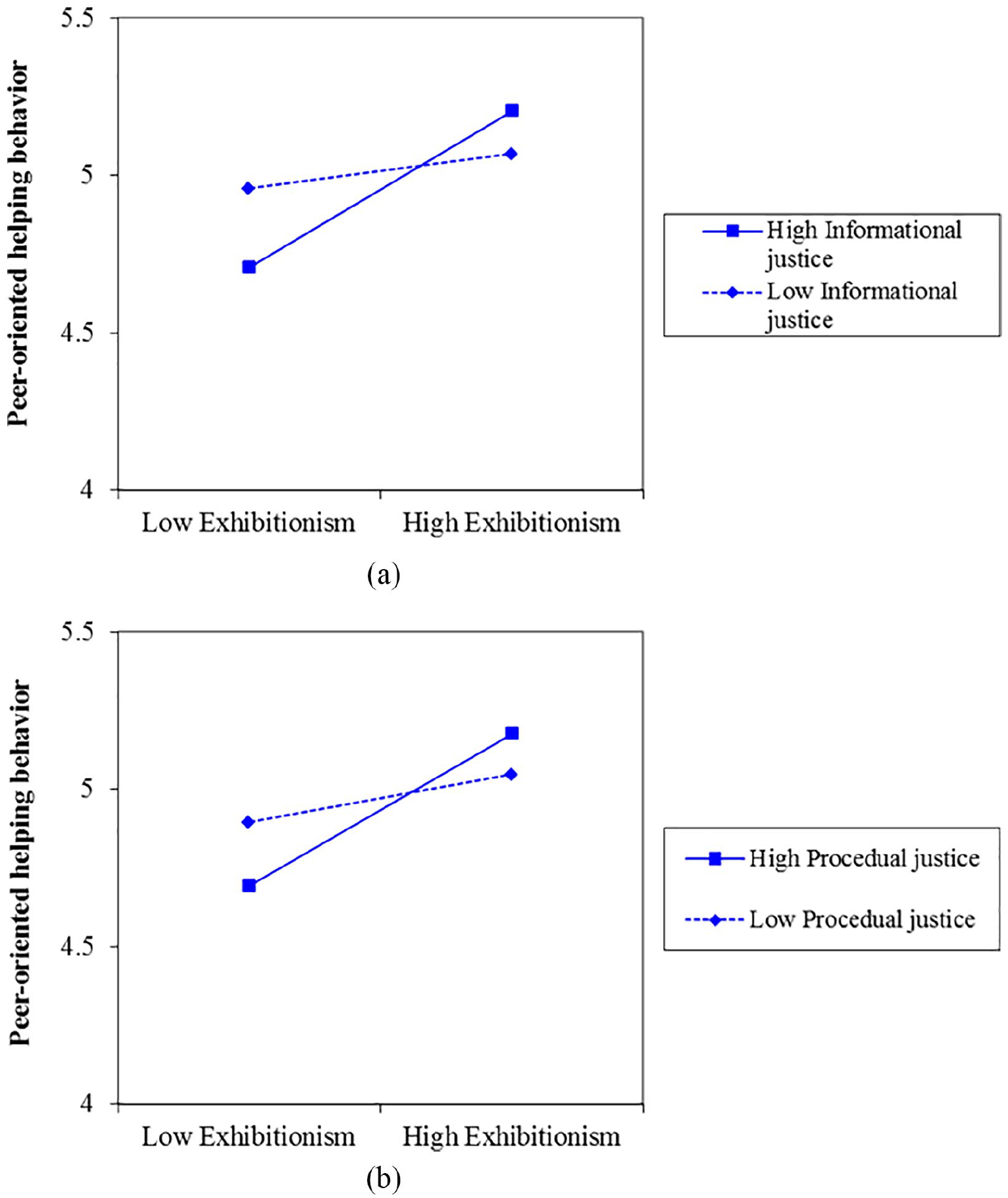
Moderating effects on the relationship between exhibitionism and peer-oriented helping behavior: (a) informational justice and (b) procedural justice.
Similarly, the findings in Models 5 and 6 were consistent with the hypothesized invigorating effects of the two factors reflecting positive work-related feelings: job satisfaction (β = .114, p < .05) and organizational commitment (β = .115, p < .05). The positive relationship between exhibitionism and peer-oriented helping efforts was stronger among employees who were excited about their jobs (H3a) and experienced an emotional bond with their organization (H3b), as the interaction graphs in Figure 3(a) and (b) indicate. Similar to the two fairness-related constructs, this simple slope analysis indicated that the relationship between exhibitionism and peer-oriented helping behavior was positive and significant at high levels of job satisfaction (β = .266, p < .001) and organizational commitment (β = .284, p < .01) but not significant at low levels (β = .038, β = .054, respectively, both ns).
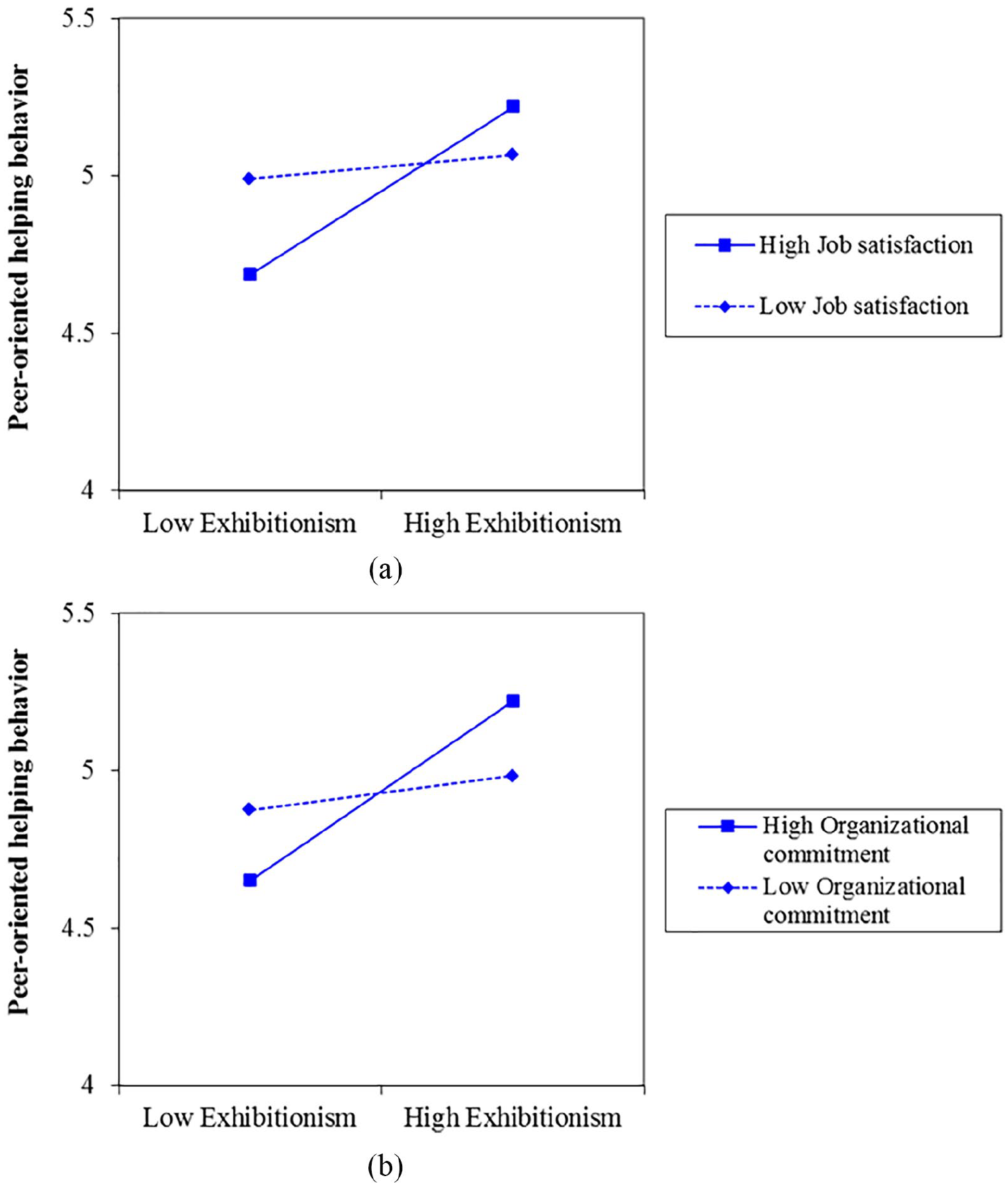
Moderating effects on the relationship between exhibitionism and peer-oriented helping behavior: (a) job satisfaction and (b) organizational commitment.
4.2. Post hoc analysis
Because the data came from a common respondent, we checked for the presence of common method bias with two statistical tests (Jordan and Troth, 2020). First, we undertook a comparison of the fit of the six-factor measurement model with that of a one-factor model in which all measurement items loaded on a single factor. The former model generated a significantly better fit (Δχ2(15) = 1.067.30, p < .001), which reduces concerns about common method bias (Lattin et al., 2003). Second, we used a marker technique, also based on confirmatory factor analysis, to estimate three models: a baseline model; a Method-C model, in which the paths between the measurement items and a marker variable were constrained to have equal values; and the Method-U model, in which these paths were unconstrained and could vary freely (Williams et al., 2010). The theoretically unrelated marker variable reflected whether the employees worked in a commercial function (e.g. marketing, sales) or technical function (e.g. operations, IT). The fit of the Method-C and Method-U models was not statistically better than that of the baseline model, that is, there were no significant fit differences when we compared the baseline (χ2(391) = 578.0) with the Method-C (χ2(388) = 577.4; Δχ2(3) = 0.6, ns) and Method-U (χ2(362) = 542.9; Δχ2(29) = 35.1, ns) models. In other words, we found no evidence of common method bias when accounting for either equal or unequal common source effects.
As we noted, self-ratings of peer-oriented helping behaviors are beneficial, because others likely do not have an accurate view of the full extent of these behaviors, directed toward various peers (Chan, 2009). However, employees also might exaggerate their own helping behaviors, particularly if they already have exhibitionistic tendencies. Then the positive relationship between exhibitionism and peer-oriented helping behavior might partially reflect employees’ desire to “show off” in their survey responses. As a robustness check, we collected employee ratings of their exhibitionism together with supervisor rates of their peer-oriented helping behavior, from informants employed in a different organization in the banking sector in Mozambique. This industry sector is the same, and the national setting has a strong Portuguese heritage, similar to Guinea-Bissau. A short survey, administered to 200 employees, gauged their exhibitionism and key demographic characteristics; another survey gathered supervisors’ assessments of the employees’ peer-oriented helping behavior. We received 147 completed response sets. Among these respondents, 46% were women, and they had worked for their organization for an average of 11 years. The correlation between exhibitionism and peer-oriented helping behavior rated by supervisors was positive and significant (r = .192, p < .05), consistent with the result obtained in the focal study (r = 206, p < 05). This robustness check offers a simple correlation analysis, without consideration of other variables, but it helps mitigate concerns about a possible bias in the focal sample with respect to inflation in the self-rated scores of peer-oriented helping behaviors.
5. Discussion
This study contributes to extant organizational research by explicating how employees’ exhibitionism relates positively to their voluntary peer-oriented helping activities, a process invigorated by their access to valuable contextual resources. The limited attention to this topic thus far is somewhat surprising, in light of the well-established argument that pertinent personal features provide employees with the stamina and motivation to undertake work efforts that go beyond the call of duty (e.g. Choi and Moon, 2016; Li et al., 2010) and that this connection can be triggered by resources that increase its feasibility or desirability (Hobfoll and Shirom, 2000). To exploit their discretionary energy resource bases to the fullest, employees need access to complementary, supportive resources. With a grounding in COR theory (Hobfoll et al., 2018), we argue that the positive association between exhibitionism and peer-oriented helping activities is especially salient when employees are convinced about the presence of informational justice and procedural justice, as well as when their organizational functioning is marked by high levels of satisfaction and commitment. The empirical findings support these theoretical predictions.
Investing considerable energy in voluntary efforts to assist colleagues can generate great benefits for both the targets of the efforts and their undertakers, though the latter also might struggle to the extent that their voluntarism threatens their formal job duties (Bergeron, 2007; Bolino et al., 2015). They appear better able to achieve such efforts when they have strong exhibitionistic tendencies, which provide employees with critical discretionary energy that they can exert to ensure they attract positive attention from others (Naderi and Strutton, 2015). Our theoretical arguments emphasize both ability and motivation mechanisms in this process. The stamina resulting from a desire to be the center of attention may enable employees to devote significant energy to providing voluntary assistance to organizational colleagues, without the risk that their regular job performance suffers (Quinn et al., 2012). The enhanced organizational standing and admiration that employees might achieve when they go out of their way to help their organizational peers (Chou and Stauffer, 2016; Hui et al., 2000) also may make such peer-oriented helping behaviors particularly attractive to employees with strong exhibitionistic tendencies. Although we do not assess the ability and motivation paths directly, they serve as the bases for our arguments about how employees’ access to valuable contextual resources may strengthen the positive link between their exhibitionism and peer-oriented helping behavior.
This link is particularly notable when employees’ access to complementary resources makes the process more viable or appealing (Hobfoll et al., 2018). As we noted in Section 1, the four resources we study represent a variety of contributions, along two dimensions. First, they capture relevant positive beliefs (informational justice and procedural justice; Colquitt, 2001) and positive emotions (job satisfaction and organizational commitment; Estreder et al., 2019) that pertain closely to employees’ work functioning. Second, the two justice types inform employees’ capability to leverage their exhibitionism in devoted peer-oriented helping behaviors, and job satisfaction and organizational commitment speak to the perceived attractiveness of leveraging the associated personal energy resources in this way. The empirical results offer the useful insight that a strong desire to show off and be admired leads to enhanced peer-oriented helping behavior more forcefully when employees (1) believe they receive adequate information from organizational leaders, (2) consider organizational decision-making procedures fair, (3) feel happy and excited with their job situation, and (4) are emotionally attached to their organization.
Notably, our focus on the invigorating roles of these four factors emphasizes that employees’ desire for self-display implies the potential for enhanced workplace voluntarism, but the degree to which they practice it depends on the presence of valuable, complementary resources (Hobfoll and Shirom, 2000). This dynamic comes to the fore in the interaction patterns in Figures 2 and 3, in combination with the results from the simple slope analyses. That is, exhibitionism does not relate positively to peer-oriented helping behavior if employees develop negative beliefs or emotions about their organizational functioning, such as when they are frustrated with how their employer communicates or makes decisions, are unhappy with their jobs, or do not feel emotionally attached to the organization. Exhibitionism instead associates more closely with enhanced peer-oriented helping behavior when the four sources are abundantly available. By detailing these contingent effects, we extend previous studies of the direct benefits of the four resources for spurring voluntary work efforts (e.g. Baeza and Wang, 2016; Colquitt et al., 2001; Pooja et al., 2016). Overall, this study provides useful insights into the contextual conditions in which a potentially controversial personal feature (desire to show off) associates with a positive outcome (peer-oriented helping behaviors). In so doing, it provides an interesting and contrasting perspective to the acclaimed dark side of employees’ exhibitionistic tendencies in generating deviant behaviors in the face of stressful work conditions (Meurs et al., 2013). A desire to show off can support work-related voluntarism, to the extent that this personal feature combines with supportive contextual resources.
5.1. Limitations and future research
This study has some limitations, which provide opportunities for continued research. In particular, we provide arguments for the positive connection between exhibitionism and peer-oriented helping behavior (Hobfoll and Shirom, 2000), by theorizing that informational justice and procedural justice inform employees’ ability to leverage their desire for self-display in devoted peer-oriented helping behaviors, and their job satisfaction and organizational commitment increase the appeal of these efforts. Further studies should explicitly measure these mechanisms to determine formally which is the most prominent. Moreover, in predicting voluntary work assistance granted to colleagues, we did not examine whether the efforts succeed (Choi and Moon, 2016). A relevant extension thus might investigate whether employees’ peer-oriented helping behaviors, informed by their exhibitionistic tendencies, actually improve peers’ work situations and whether the process might depend on various actors’ access to pertinent resources. Another extension could compare the role of exhibitionism for (successful) peer-oriented helping behavior with that of other pertinent personal factors. We found that exhibitionism played a significant role, over and beyond proactivity (Yang et al., 2011) and cynicism (Andersson and Bateman, 1997); it also may be insightful to compare its role with that of the Big Five personality traits (Organ, 1994) or the dark triad (Smith et al., 2016), for example.
Another shortcoming of this study results from our focus on four specific contingent resources. These resources span a consistent, encompassing set of factors, but it still would be interesting to investigate other features that might invigorate the connection between exhibitionism and peer-oriented helping behavior. Other contextual factors that might serve as catalysts include employees’ trust in top management (Mahajan et al., 2012), perceptions of transformational leadership (Carter et al., 2014), organizational identification (Collins et al., 2019), or an organizational climate that embraces voluntarism (Cates et al., 2010). Moreover, pertinent individual resources may trigger a positive relationship between exhibitionism and peer-oriented helping behaviors, such as employees’ innovation propensity (Tierney et al., 1999), creative self-efficacy (Tierney and Farmer, 2002), or resilience (Conley et al., 2016). It would be interesting to compare the relative value of these contextual and personal factors, as well as explicate whether the catalytic roles of our four focal resources hold after accounting for the effects of these additional factors.
As mentioned in Section 3, we purposefully focused on one industry sector (banking) and a single country (Guinea-Bissau), to control for unobserved industry and country differences that might explain why employees tend to help their colleagues. This design choice diminishes the external validity of the findings though, so a valuable extension would explicitly consider how certain industry characteristics might alter the theoretical framework. For example, a low level of external employability (Philippaers et al., 2017) could propel employees to leverage their discretionary, personal energy bases and undertake persistent peer-oriented helping efforts, so that they can make a good impression on their employer and reduce the chances of dismissal. Ongoing tests of our proposed conceptual model could include multiple industries. Moreover, the collectivism that marks Guinea-Bissau may stimulate employees in this country to go out of their way to assist others, to establish group harmony or benefit the organizational collective (Hofstede et al., 2010). From another angle though, this cultural value might render some employees more reluctant to embrace their exhibitionism or brag about their peer-oriented helping behaviors. This latter dynamic may weaken the link between exhibitionism and peer-oriented helping behavior. These considerations are speculative; further studies across countries should explicate how pertinent cultural factors may influence our proposed conceptual framework, with respect to its baseline relationship and the catalytic effects of different resources.
5.2. Practical implications
In investigating the interactive roles of employees’ exhibitionism and access to complementary resources in relation to peer-oriented helping behaviors, this study highlights a valuable path to organizational effectiveness, which can be triggered by pertinent personal and contextual resources. Investing energy in voluntary, peer-oriented helping behaviors can be time-consuming for employees and threaten their ability to meet their regular job obligations (Culbertson and Mills, 2011). If organizations hope to promote supportive, collegial relationships, they should seek out employees who can draw from energy-boosting personal characteristics. Exhibitionism normally evokes negative connotations, and it can generate negative outcomes if it leads employees to embrace self-centered inclinations and seek only to boost their own image (Meurs et al., 2013; Wink, 1991). Yet our theoretical arguments and empirical results paint a clearer picture, in which exhibitionistic tendencies enhance people’s voluntary efforts to help their colleagues.
Still, employees’ exhibitionism does not relate automatically with enhanced peer-oriented helping behaviors (Hobfoll et al., 2018). When employees score high on this personal characteristic, organizational decision makers should attempt to create contexts that encourage them to channel their discretionary energy toward extra-role helping efforts. For example, training initiatives, formal or informal (Enos et al., 2003), could emphasize that helping other members, and thus attracting attention, can be an acceptable practice, to the extent that the efforts reflect a genuine desire to ensure others’ professional well-being, not just a desire for self-promotion. Furthermore, the organization needs to exhibit fair communication and decision-making procedures, find ways to keep employees happy with their jobs, and attempt to make them proud of their employment by the organization. In particular, organizational leaders could (1) invest in clear knowledge-sharing routines so that employees can make accurate and informed decisions about how to allocate their time, (2) develop decision-making policies that offer employees some form of protection if they seek to combine their regular job duties with extensive voluntary peer-oriented helping behaviors, (3) focus on maintaining a general sense of happiness with the job experience, and (4) ensure that their relationships with employees go beyond functional elements to reflect emotional components. Ultimately, these conditions can increase the effectiveness with which organizations can channel discretionary energy among their employee ranks toward productive activities that may increase the long-term well-being of both the targets and undertakers of such activities.
6. Conclusion
With a conceptual basis in COR theory, this study reveals the interplay of exhibitionism with specific contingency factors in employees’ persistent efforts to extend voluntary help to their peers. Discretionary energy that stems from a desire to show off relates positively to employees’ dedication to extra-role, peer-oriented helping behaviors, particularly when they can rely on pertinent resources, such as those related to their convictions that their organization treats them fairly (informational justice and procedural justice) or the positive feelings that they experience with respect to their job or organization (job satisfaction and organizational commitment). These resources indirectly inform the ability and motivation of employees to leverage their exhibitionistic tendencies as dedicated efforts to assist others. We hope these insights encourage further examinations of how organizations might encourage productive but potentially energy-consuming work behaviors by their employees, by combining and leveraging pertinent personal and contextual resources.
Footnotes
Acknowledgements
The authors would like to thank Associate Editor Peter Jordan and the anonymous reviewers for their very helpful comments and suggestions.
Final transcript accepted 22 March 2021 by Peter Jordan (AE Organizational Behavior).
Funding
The author(s) received no financial support for the research, authorship, and/or publication of this article.
