



Abstract
On 14 October 1846, Charles F Heywood, house-surgeon at the Massachusetts General Hospital, Boston, MA, USA, penned an invitation to the dentist William TG Morton to demonstrate his preparation to prevent pain during a surgical operation at the Hospital on 16 October 1846. The operation would become the first public operation performed with the aid of insensibility produced by the inhalation of sulphuric ether. From Boston, news of the discovery spread around the world—the date of this momentous operation is now celebrated as Ether Day. Although Heywood’s letter is well-known from 19th century transcripts, it is apparent from examining a letter believed to be the original, now preserved in the WTG Morton papers held by the Massachusetts Historical Society, Boston, MA, USA, that these transcripts were edited before publication. A faithful transcript of Heywood’s letter is published along with two images of the historic letter.
Keywords
On 30 September 1846, Boston dentist William TG Morton (1819–1868) extracted a tooth painlessly from Ebenezer Hopkins Frost, who had been rendered insensible after inhaling from a handkerchief saturated with sulphuric ether.1–3 The next morning, Morton resolved that ‘that some further and more impressive experiments should be made at the hands of some surgeon’ who, along with well-known scientific persons, could provide endorsements of the ‘safety and efficacy’ of his preparation. 2 The obvious place for such an exhibition was the Massachusetts General Hospital, Boston, MA, USA, where the senior surgeons, according to Morton’s biographer Nathan P Rice, were ‘the most trustworthy and unbiased persons to pronounce upon it’. 2 Before approaching John Collins Warren (1778–1856), senior surgeon at the Massachusetts General Hospital, Morton ‘took the precaution of visiting his patient, Mr. Frost, and found him perfectly well and enraptured with the novelty and successful result of the experiment’. 2
A few days later, Morton met Warren to request permission to administer his undisclosed ‘preparation’ to a surgical patient. Warren appears to have readily agreed, without pressing Morton to reveal what he was intending to administer to prevent pain.4–6 On 14 October 1846, Morton received a letter inviting him to administer his preparation to prevent pain at the hospital on Friday, 16 October 1846. Although this letter from the surgical house-surgeon Charles F Heywood is known from two transcripts published in the 1850s,1,2 the existence of the presumed original letter from Heywood has for the most part been overlooked by historians. The author is aware of only one reference to the extant letter—in 1995, Leroy Vandam noted the existence of the letter, which he transcribed for his article on Heywood. 7
The author discovered Heywood’s letter in 2009 in the WTG Morton papers (call number: Ms. N-567) while conducting unrelated research at the Massachusetts Historical Society, Boston, MA, USA. A low-resolution image of Heywood’s letter was reproduced by Haridas and Coleman in an ‘Anesthesiology Reflection’ in 2022. 8 An accurate transcript of Heywood’s letter is now published along with two images of the letter, giving readers access to an historic document. As well, two 19th century transcripts of this letter are reproduced in order to highlight an issue relating to previously published transcripts: that they could have been edited prior to publication.
Charles F Heywood
Charles F Heywood (1823–1893) was appointed as surgical house-surgeon of the Massachusetts General Hospital on 12 August 1846.9,10 Two months later, he would be intimately involved in the first public operation on a patient rendered insensible to pain by the inhalation of the vapour of sulphuric ether. 11 The date of the historic operation, 16 October 1846, is now remembered as Ether Day, while the hospital’s surgical amphitheatre, now a National Historic Site, is better known as the Ether Dome. 12
Heywood was responsible for recording Edward Gilbert Abbott’s admission, operation and postoperative course in the hospital’s ‘Surgical Records for 1846, Volume 30’ (Archives, Massachusetts General Hospital, Boston, MA, USA). 13 He is also known to have penned two letters relating to the first two operations under etherisation. Both letters are known primarily from 19th century transcripts.1,2
The earlier of the two letters is the invitation dated 14 October 1846 to Morton to demonstrate his preparation to prevent pain during a surgical operation at the Hospital on 16 October 1846. Transcripts of this letter were published in a volume of testimonials submitted by Morton to the United States Congress in 1853 (hereafter referred to as Morton’s Statements volume), 1 and in Trials of a public benefactor (1859), Nathan P Rice’s authorised biography of Morton. 2
Six days after this operation, on 22 October 1846, Heywood penned a testimonial about his involvement in the first two operations under etherisation at the hospital. A transcript of this letter does not appear in Morton’s Statements volume. Rice did, however, publish a transcript in 1859. 2 Interestingly, Heywood wrote that he ‘assisted in the administration of Dr. Morton’s preparation to two patients’, a claim that cannot be corroborated because other accounts of the first two operations, including those written by Morton, have not credited Heywood for any role in the administration of ether.
Vandam cited these two letters from October 1846, as well as a letter written by Heywood in January 1853 to the US Senate Select Committee investigating Morton’s claim for the discovery of anaesthesia. 7 Perhaps unexpectedly, in 1853 Heywood gave credit to Horace Wells for the introduction of anaesthesia. Having had more time to reflect on the various claims, Heywood declared that Wells’ case had been ‘satisfactorily proved’. 7
Not cited by Vandam are two additional letters penned by Heywood in 1846–1847. On 11 December 1846, Heywood wrote to Morton inviting him to administer his preparation at the Massachusetts General Hospital on 12 December 1846 for the excision of part of the upper jaw of a patient; a transcript of this letter was published in Morton’s Statements volume in 1853. 1 The Countway Library of Medicine, Boston, MA, USA, has a letter penned by Heywood on 1 January 1847 to a George Edward Ellis inviting him to witness an operation under etherisation at the Hospital on 2 January 1847 (call number: H MS Misc).
It is worth mentioning that Heywood did not publish any reminiscences of the momentous events for which his one-year appointment at the Massachusetts General Hospital will always be remembered. Warren once remarked that Heywood ‘took an early and active interest in this matter’. 5 Even so, the young house-surgeon may have been reluctant to add his voice to the ensuing bitter controversy over credit for the discovery and Morton’s attempts to profit from it by securing an American patent and selling licences for the administration of Letheon, a trade name adopted by Morton for his commercial preparation of sulphuric ether.
Heywood’s letter dated 14 October 1846
The first of Heywood’s letters relating to etherisation is the letter dated 14 October 1846. This letter was penned on an unlined sheet of white paper (approximate size 17.5 cm × 22.5 cm) that was carefully folded (Figures 1 and 2), most likely by Heywood before it was hand-delivered to Morton, whose office was at 19 Tremont Row, about 1 km from the Massachusetts General Hospital.
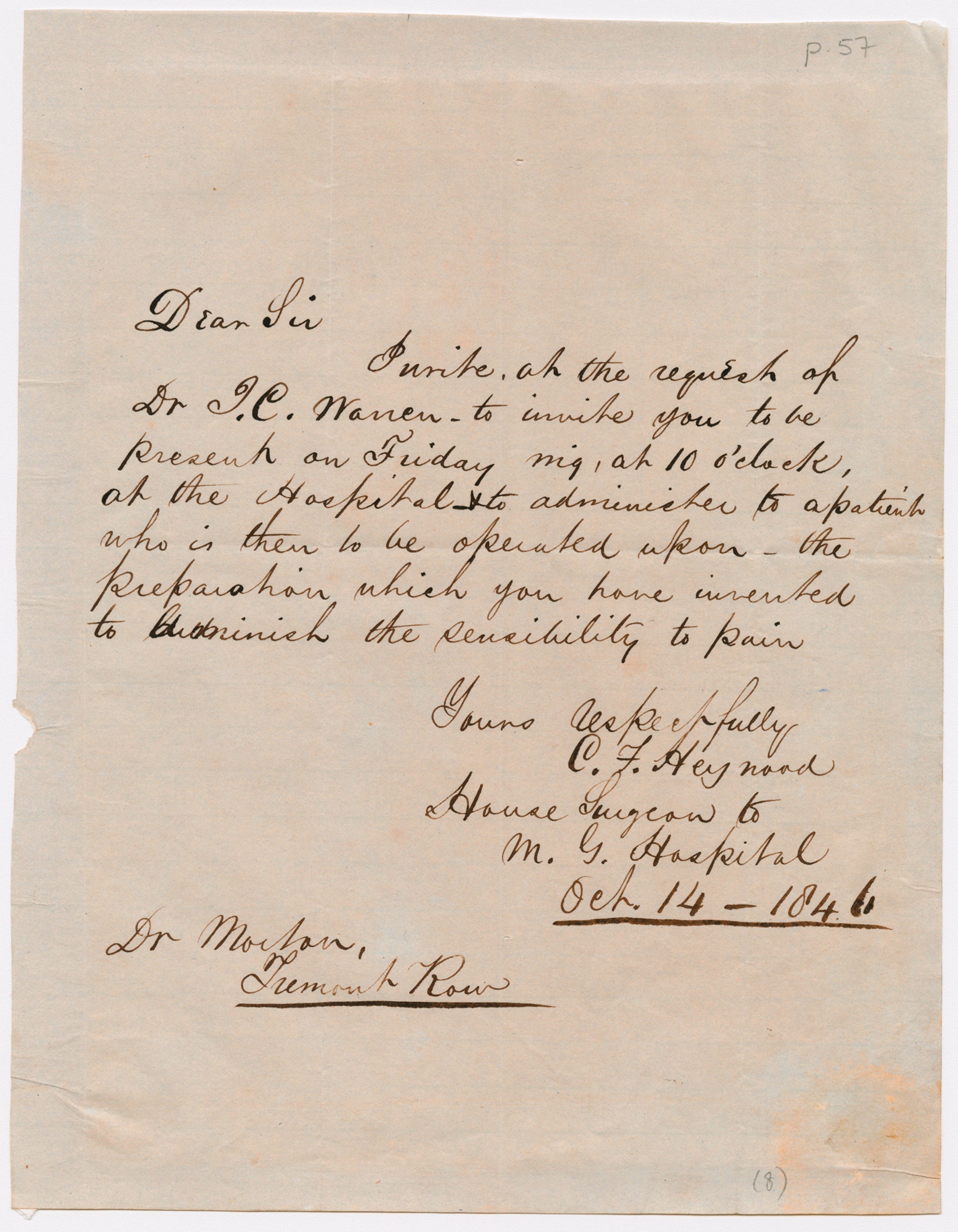
Letter dated 14 October 1846 from Charles F Heywood to WTG Morton. Part of the WTG Morton papers, Ms. N-567, Massachusetts Historical Society, Boston, MA, USA. Image source: Massachusetts Historical Society, Boston, MA, USA.
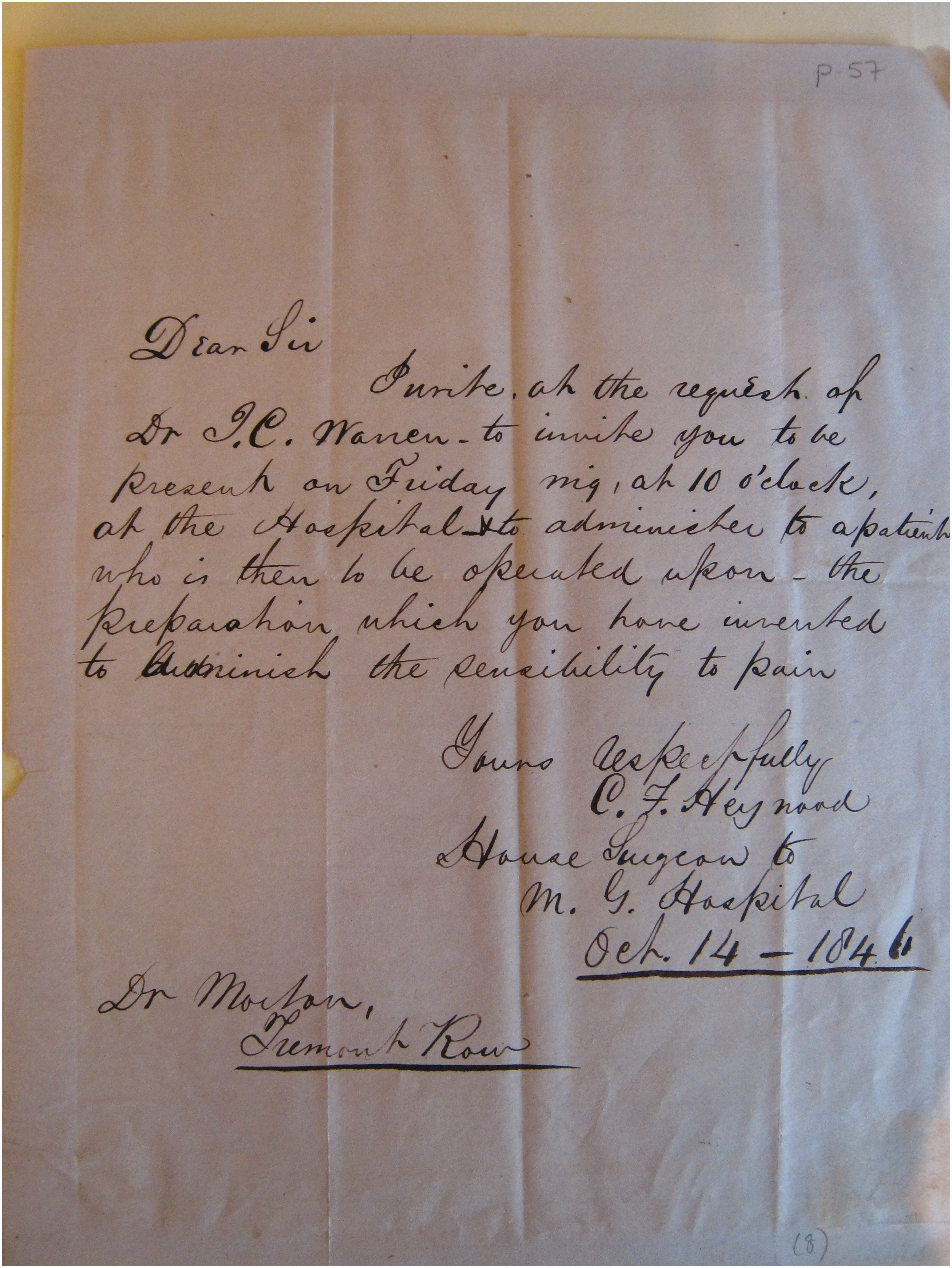
Heywood’s letter to Morton, photographed in 2009. The folds in the letter are more clearly visible than in Figure 1. Photograph by RP Haridas, 2009. WTG Morton papers, Ms. N-567, Massachusetts Historical Society, Boston, MA, USA.
At some point, the letter was pasted into a book that was part of a collection of Morton’s papers. Vandam noted in 1995 that the letter was in the ‘Morton Book’. 7 Now removed from the book, the verso of the letter can be examined. There is evidence of the glue used to paste the letter, but there is no postmark, or any text such as Morton’s name and address.
The handwriting in this letter appears to be that of Heywood, based on an examination of the case record of Edward Gilbert Abbott in volume 30 of the Surgical Records of the Massachusetts General Hospital, 13 as well as the handwriting in an extant letter held by the Countway Library of Medicine, Boston, MA, USA (call number: H MS Misc: a letter penned by Heywood on 1 January 1847 to George Edward Ellis).
Below is a transcript of the extant letter dated 14 October 1846: Dear Sir I write, at the request of Dr J. C. Warren – to invite you to be present on Friday mg [morning], at 10 o’clock, at the Hospital – & to administer to a patient who is then to be operated upon – the preparation which you have invented to diminish the sensibility to pain Yours respectfully C. F. Heywood House Surgeon to M. G. Hospital Oct. 14 – 1846 Dr Morton, Tremont Row
Although believed to be the original letter sent to Morton, and thus a prologue to the demonstration of painless surgery on 16 October 1846 that would bring lasting acclaim to the young Boston dentist, we should be mindful of other plausible explanations for the extant letter—it could be a copy retained by Heywood and later given to Morton, or a copy penned at some later date by Heywood for Morton.
Heywood’s letter—19th century transcripts
Two distinct 19th century versions of Heywood’s letter can be identified.1,2 Although numerous editorial changes have been made to the transcripts of this short letter, the key points of the letter have been retained.
The earlier of the two 19th century versions of Heywood’s letter was published in the Statements volume as part of Morton’s submission to the US Congress in January 1853 (Figure 3). 1 Note that Heywood’s name was misspelled ‘Haywood’—this error was corrected when an identically worded transcript was published six years later in Rice’s Trials of a public benefactor (Figure 4). 2 The only other differences between the two 19th century transcripts are the placements of several commas.
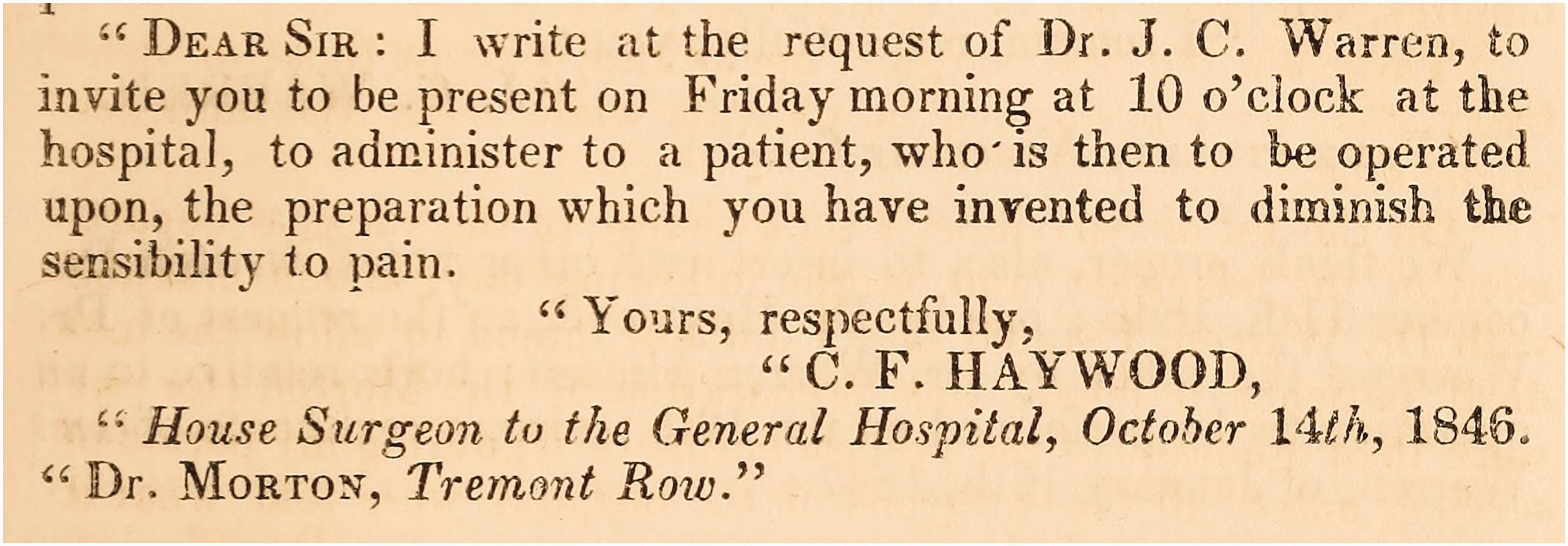
Published transcript (1853) of Heywood’s letter to WTG Morton. From Morton’s Statements volume, 1853, p.71. 1
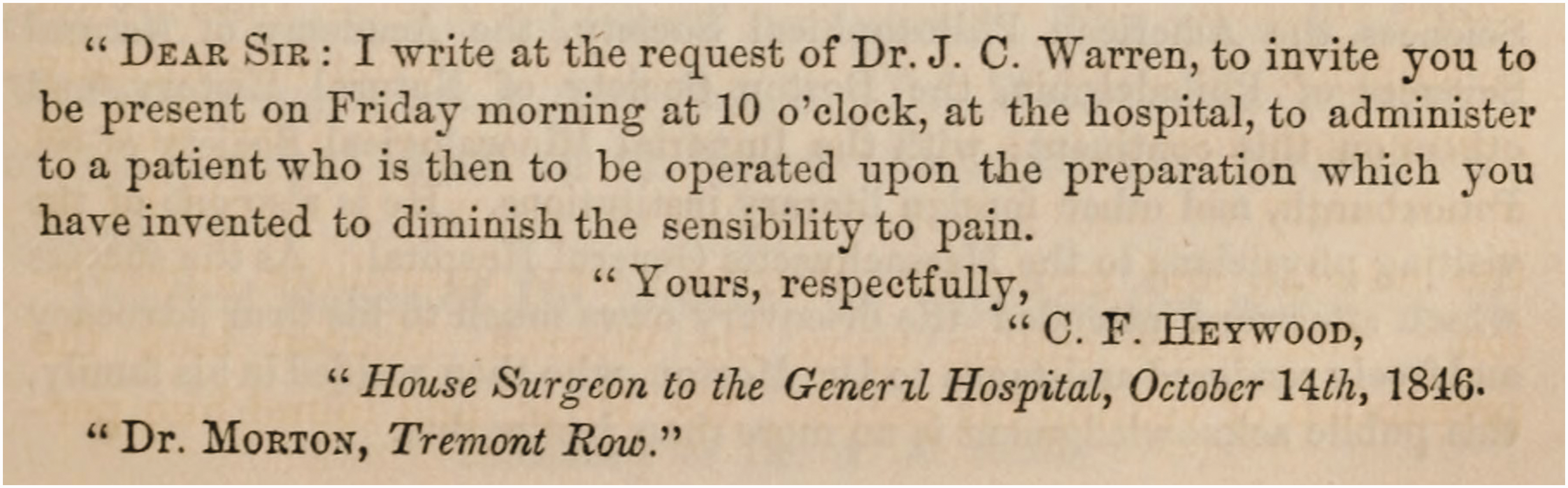
Published transcript (1859) of Heywood’s letter to WTG Morton. From Nathan P Rice’s Trials of a public benefactor, 1859, p.89. 2
Given that these earlier transcripts have been extensively reproduced and are easier to read, it seems likely that authors and historians will keep on citing them. Nonetheless, these transcripts underscore the limitations of citing secondary sources or accounts that could have been abridged or edited prior to publication. Such amendments could be limited to minor changes to the text or punctuation, or the rearrangement of paragraphs. More substantial revisions of original texts, including crucial omissions and the inclusion of new text, have occurred since antiquity. For example, the authenticity of some Hippocratic texts is debated, and Dioscorides’ De materia medica (written in the first century AD) was supplemented with material from other sources when it was copied by scribes. Examples of substantial editing of 19th century publications have also been documented. 14 In a bulletin titled Historical editing, Clarence E Carter noted that such editing ‘reflected the ideals and practices’ of that ‘generation of historical editors’. 14
Conclusion
Morton was not the first to reflect on whether insensibility could be safely produced by the inhalation of a gas or vapour. He was, nonetheless, the first to demonstrate it successfully to the medical profession on 16 October 1846, the date now commemorated as Ether Day. From Boston, news of surgical etherisation spread around the world, leading to successful replications of the procedure and the advent of the era of painless surgery and dentistry. While there are numerous published reports, claims and counterclaims regarding this celebrated surgical operation, few contemporaneous hand-written documents pertaining to the historic case are known to be extant today.
The surgical case notes penned by Heywood provide extensive details of the admission, surgery and progress of the patient (Edward Gilbert Abbott), but do not mention the administration of a preparation by Morton to produce insensibility during the surgical operation (‘Surgical Records for 1846, Volume 30’, Archives, Massachusetts General Hospital, Boston, MA, USA). An unknown writer has recorded the historic administration of sulphuric ether in a pasted addendum to the case notes. A full transcript of the case notes and addendum was published by Firth in 2022. 13
Another historically significant record is the private journal of the surgeon John Collins Warren (John Collins Warren papers, Ms. N-1731, Massachusetts Historical Society, Boston, MA, USA). The journal entry for 16 October 1846 contains only a brief statement about the remarkable operation performed that day. Notably, the use of sulphuric ether is recorded in this statement. However, there is good reason to believe that this journal entry was made sometime after 16 October 1846. Warren stated on several occasions that he did not know the composition of Morton’s preparation when it was administered for surgical operations at the hospital on 16 and 17 October 1846.4–6 It appears he was informed two or three days after these operations that Morton had administered sulphuric ether to prevent surgical pain and produce insensibility. 4
To these two valuable documents we can add the letter penned by Heywood on 14 October 1846 inviting Morton to administer his preparation to prevent pain to a surgical patient (WTG Morton papers, Ms. N-567, Massachusetts Historical Society, Boston, MA, USA). This letter, a prelude to Ether Day 1846, is primarily known through two 19th century transcripts. While it was not uncommon in the 19th century for transcripts to be edited before publication, we may not be aware that this had occurred, or know the extent of the revisions, unless we have access to the original documents.
Footnotes
Author Contribution(s)
Acknowledgements
The author thanks the staff of the Massachusetts Historical Society, Boston, MA, USA and the Countway Library of Medicine, Boston, MA, USA for their assistance. Figures 1 and  are reproduced with the permission of the Massachusetts Historical Society, Boston, MA, USA.