Abstract
The lack of radio navigational aids in early Royal Flying Doctor Service aircraft in Australia occasionally resulted in aircraft being stranded at a remote site with a critically injured patient due to weather and other conditions. For a brief period in the 1950s, at least one Royal Flying Doctor Service pilot was trained to administer anaesthesia to critically ill patients who could not be immediately evacuated. The aim of this paper is to describe the circumstances in which this arose and how it worked in practice. This is based largely on the recollections of pilot anaesthetist Captain Keith Galloway, who shared his recollections during interviews with the authors.
Keywords
The Royal Flying Doctor Service of Australia
The Royal Flying Doctor Service of Australia was established to bring medical care to remote Australian communities. 1 The initiative of the Reverend John Flynn, a Christian missionary who was motivated to alleviate their ‘social isolation, hardship and suffering’, 1 it exploited two new technologies: the aeroplane and the wireless. The first official flight was in Cloncurry, Queensland in 1928, becoming the Australian Aerial Medical Service in 1933 and subsequently the Royal Flying Doctor Service of Australia (colloquially known as the RFDS) in 1955. In the 1950s, the service operated from remotely located hubs or ‘bases’, each with a specific geographical territory. The RFDS continues to operate from bases across most of Australia, with a fleet of 77 turbine and turbo-prop aircraft.
A tragic event
In 1953 Keith Galloway (1929–) was a 23-year-old First Officer with Trans Australia Airlines (TAA), which in 1986 became Australian Airlines, and which in 1992 was subsumed into Qantas. Galloway’s career prior to that had included working as flight instructor on Tiger Moth and Gipsy Moth aircraft at the Royal Queensland Aero Club at Archerfield, Brisbane, and operating a small air charter business in remote Mundubbera, Queensland, using an Auster aircraft. After flying with TAA for two years he found that they supplied aircraft and pilots to the RFDS. He approached the TAA management indicating his willingness to apply for RFDS service but was told that they had a full complement of pilots.
A tragic event changed that. The Courier Mail (Brisbane) of 23 October 1953 2 reported on its front-page a fatal aircraft accident at Cheviot Hills Station, a pastoral property 180 miles west of Townsville. Dr Timothy J O’Leary (1925–1987), a recently immigrated 28-year-old Irishman, had taken a position as a flying doctor with the newly established Charters Towers RFDS base in northern Queensland. Charters Towers was the chosen location because of the sealed runway, its proximity to the population of the eastern Gulf of Carpentaria and Cape York Peninsula, and the better weather consequent to its position on the western slopes of the Great Dividing Range. It was though the least well equipped of the three Queensland RFDS bases which also included Charleville and Cloncurry.
O’Leary and pilot Martin Garrett were spending three days visiting three remote communities with a plan to develop clinics there. O’Leary had married six weeks earlier to sweetheart Catherine Burke, who had recently arrived from Tralee, Ireland, and she had travelled with them as far as Cheviot Hills Station where she remained with the Murphy family, to be picked up on the return flight.
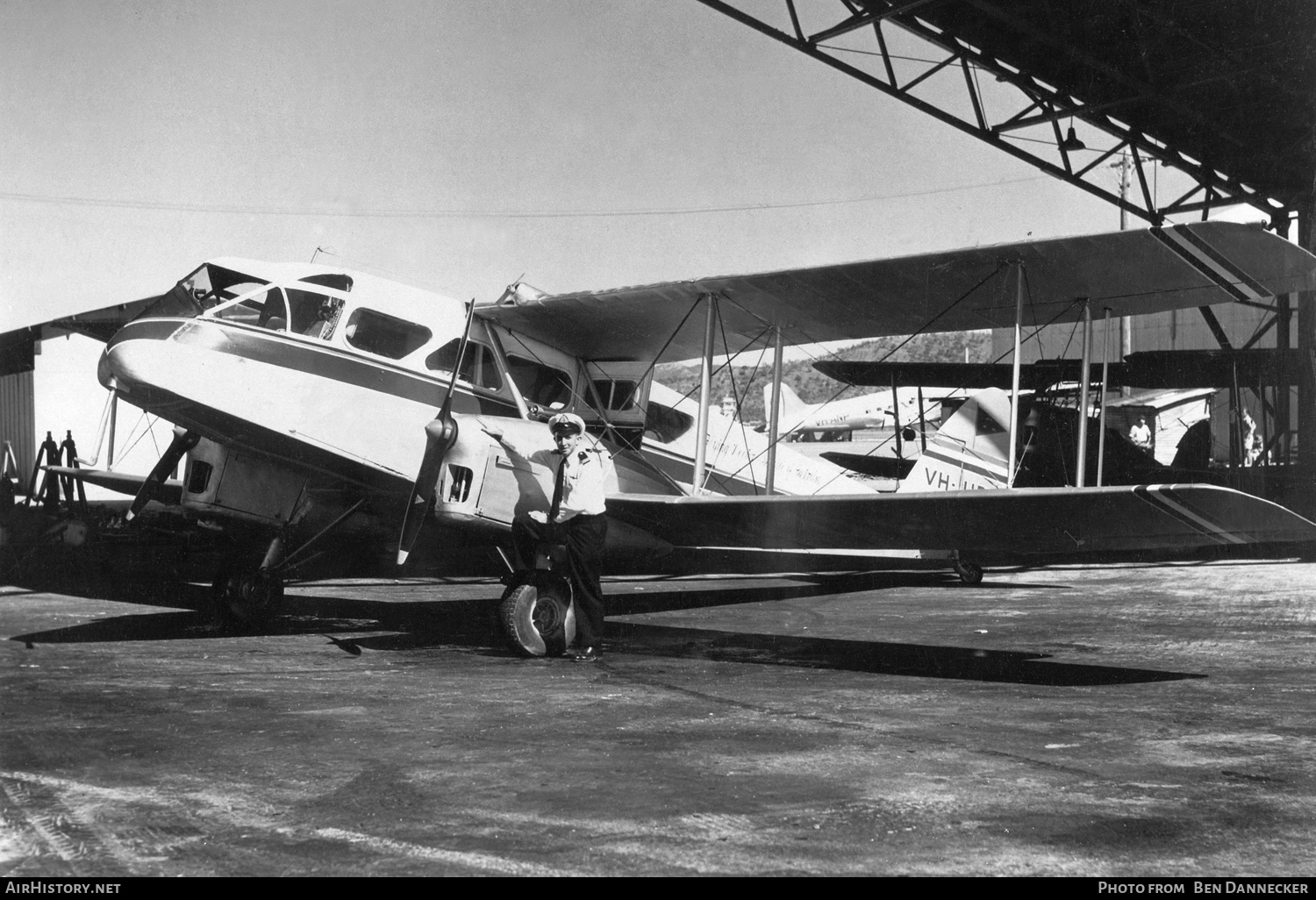
The aircraft was the De Havilland DH84 Dragon ‘John Flynn’, registration VH-URY, an obsolete wooden biplane with fabric covering and two First World War era Gipsy Major engines. Constructed in 1934, it had led a hard life and Garrett had described it as a ‘heap of junk’ (Figure 1). On the return flight to Charters Tower the occupants were Garrett, O’Leary and his wife Catherine, and a Mrs Lethbridge and her five-year-old son, who were travelling to Charters Towers for treatment of his fractured arm. On take-off, the aircraft failed to climb due to the heat and the altitude of the airfield (2820 feet) and likely also the lack of official performance charts for the aircraft. It stalled and spun into the ground, with Garrett impaled on the control column and Mrs O’Leary with an engine exhaust pipe in her back, both dying immediately. Dr O’Leary suffered a dislocated shoulder. The other passengers were uninjured.
The ‘heap of junk’ De Havilland Dragon ‘John Flynn’ DH84 VH-URY with an unknown pilot. (https://www.airhistory.net/photos/0131550.jpg with permission).
Flying for the Royal Flying Doctor Service
Despite this tragic crash, O’Leary decided to continue his work at Charters Towers and Galloway achieved his goal of joining the RFDS (Figure 2) The replacement aircraft was the improved, Australian designed and built, De Havilland Drover with three Gipsy Major engines. However, a deficiency was the lack of radio navigational aids that could enable flight in all weather conditions.
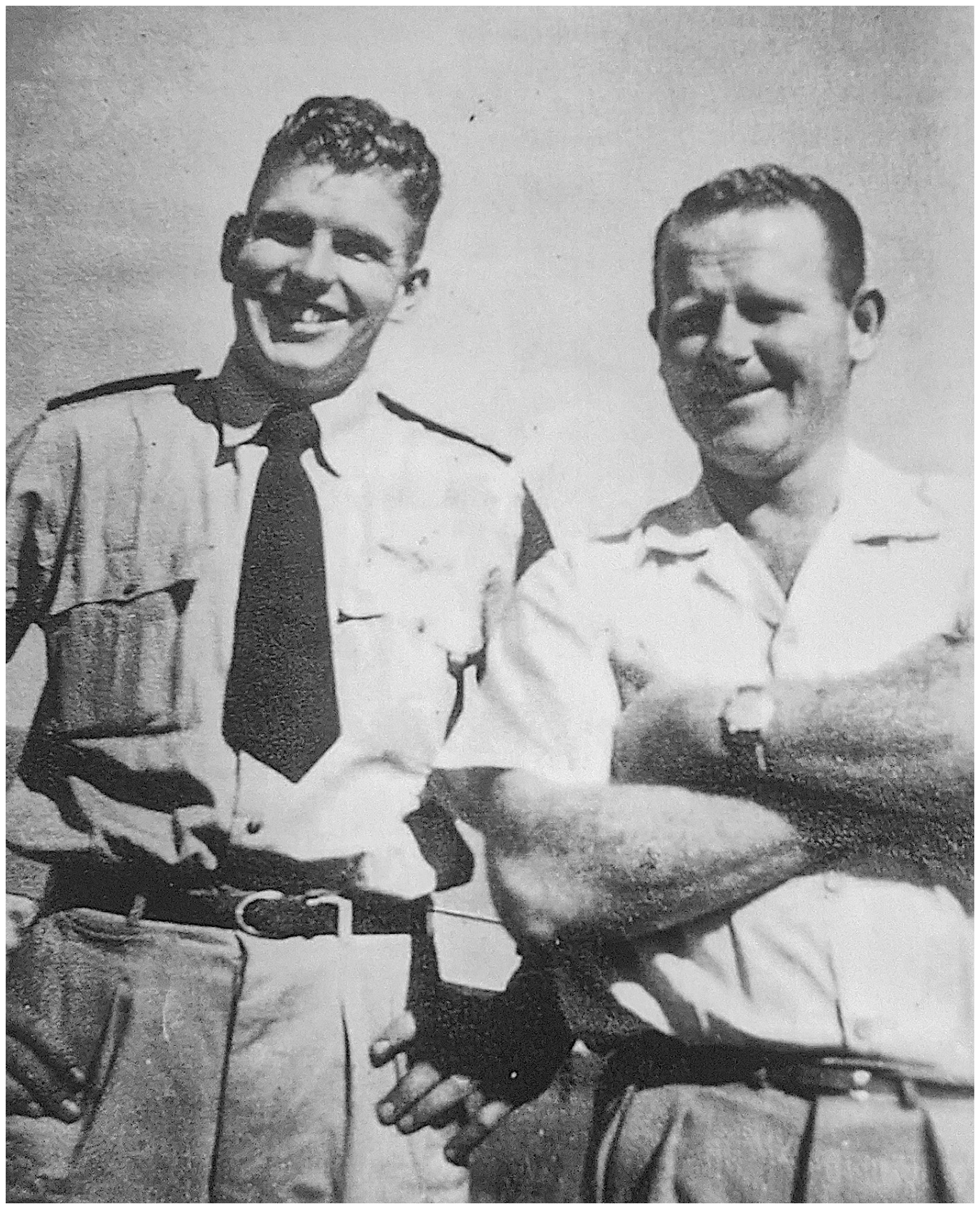
Captain Keith Galloway (left) and Dr Tim O’Leary, in the 1950s (with permission K Galloway).
Dr Allan Vickers (1901–1967), a pioneering giant of the RFDS, was at that time the RFDS medical superintendent and supervisor of bases in Queensland. It is Galloway’s recollection that he ‘badgered’ Vickers to install radio navigational aids in the aircraft, although Galloway quotes Vickers as having stated ‘If we put radio aids into aircraft you fellows would fly when you shouldn’t’. Galloway’s view is that as the TAA pilots with the RFDS were all instrument flight qualified, they were already flying when they should not, given the lack of radio aids.
Galloway illustrated this assertion with a recollection of a flight at night in poor weather to treat a horseman at Mount McConnell Station who had been rolled on by his mount. They located the landing ground which was lit by a bonfire. The patient was on a mattress on the flatbed of a truck. Dr O’Leary looked at him and said, ‘Well, this fellow has to be operated on tonight because he won’t survive till the morning. We’ll either have to do him on the kitchen table or we get him to hospital’. Despite the poor weather with low cloud and drizzle, Galloway was able to get the patient and doctor back to Charters Towers Hospital—a flight which Galloway described as the most frightening of his career.
Pilot anaesthetist
Following this dangerous flight, O’Leary decided that Galloway had to learn to give anaesthetics. The task of teaching him was accepted by Dr Jock Robinson, the superintendent of Charters Towers Hospital. Dr Robinson swore him to secrecy. Tim O’Leary’s sister Patricia, an Irish anaesthetist, had joined O’Leary after the death of his wife and had taken a position as an anaesthetist at the Townsville Hospital. She regularly visited Charters Towers and gave Galloway advice on anaesthesia. Galloway recalls that he was introduced to medical procedures by assisting at post mortems at Charters Towers Hospital ‘…until I got toughened up a bit’. Then he was promoted to the operating theatre. He recalls, ‘they started off by me watching and being instructed in giving anaesthetics. They used to use ethyl chloride spray to induce, with a wire mask and screen… induce with ethyl chloride spray and get them through the excitable stage then you swapped over to the ether. You dripped the ether; it didn’t come out as a spray, it had a special spout on it – you dribbled it over the mask’.
From then on, ‘every Tuesday and Thursday, the operating days in Charters Towers Hospital …they actually had me doing them under instruction. I finished up giving quite a few in the bush but it’s the sort of something you don’t really remember’.
O’Leary once estimated to Galloway that he had performed over 200 anaesthetics, mostly in the Charters Towers Hospital but quite often in very remote areas. He does not recall any operative deaths. When asked how he monitored the anaesthetic and his patient’s condition he replied that his favourite observations were ‘the dilation of the pupil, the pulse, and the breathing; it was very rudimentary I can tell you – but it worked!’. Respiration was key: ventilation was never assisted. When the authors asked Galloway about ‘taking over’ ventilation, he replied that this was not used: he said he tended to keep them ‘a bit lighter’ because he remembered being told once ‘they’re starting to wake up down this end how are they up your end?’ Galloway said, ‘I did learn when you needed to take them a bit deeper, like when going through the peritoneum, otherwise the flesh would twitch a bit’. When canvassed about other techniques, Galloway recalled ‘They just bought in pentothal; they got a couple of real good frights in the hospital with pentothal and they wouldn’t use it anymore, so all we ever used in the hospital and out on the Flying Doctor work was ethyl chloride and ether. The ether came in big bottles and there were six to a carton and it was a dangerous cargo, and we weren’t supposed to carry it but we carried two cartons down the back of the plane.’
Galloway clearly recalls two of the surgical cases for which he anaesthetised in the field. One was a stillbirth in Julia Creek. ‘That really tore me apart’, he said. The other he recalls is the amputation of a woman’s arm. This case is featured in O’Leary’s book North and Aloft 3 and also in the 1956 Annual Report of the Director of Native Affairs in relation to Aurukun Mission, which reads ‘Dr O’Leary has performed several small operations here and last September (1955) bought with him Dr Davis from Brisbane who amputated the hand of a woman who had been badly burned out (in the) bush and bought into the mission for treatment’. 4 Galloway believes that there is a photograph in the RFDS archive of him giving the anaesthetic. He commented, ‘Now this woman, she couldn’t speak any English, she was a bush native and she came in and we wanted to take her to Cairns, and the missionary said “no, you can’t take her to Cairns, she has no English and she’s the sort of person who, if you take her away from here, she’ll die anyhow, so you either leave her here and let her die or you get rid of the arm”.’ 3 Galloway recalls that Dr Davis was the late Brisbane surgeon Neville Davis AO.
Galloway was intrigued when told of the parallels often drawn between anaesthesia and aviation, but offered no personal view. He reflected about his time as a pilot anaesthetist with the RFDS that ‘It was something that I didn’t relish doing but when somebody’s life was dependent on it, I used to accept that I wanted to be as proficient as I could be at doing it’.
Captain Galloway went on to have a long career with TAA as an airline pilot, well into the jet era and accumulated over 22,000 flight hours.
Footnotes
Acknowledgements
The author(s) acknowledge with gratitude the assistance of Captain Keith Galloway in the preparation of this manuscript.
Author Contribution(s)
Declaration of conflicting interests
The author(s) have no conflicts of interest to declare.
Funding
The author(s) received no financial support for the research, authorship, and/or publication of this article.