




Abstract
In the mid-19th century, the French Academy of Sciences was one of the oldest and most prominent scientific institutions in the world. Individuals seeking credit for the discovery of surgical anaesthesia contacted the French academy to achieve recognition from this prestigious body of scientists and to spread news of the discovery throughout continental Europe. The French Academy of Sciences was established under the reign of King Louis XIV in 1666 with the goal of supporting and advancing scientific research. Membership was limited to the most accomplished French scientists, who presented their research at weekly meetings and advised the French government on scientific matters. The academy began their deliberations on the discovery of anaesthesia in January 1847. Since anaesthesia had already been tested in the United States and Great Britain, the main contributions of the French academy deliberations included refining administration techniques and documenting the effects of anaesthesia on animals and humans. Recognition of surgical anaesthesia by the French Academy of Sciences and the swift adoption of its use in surgical practice throughout the country lent credibility to this new discovery and enabled the discipline of surgery to progress. Nevertheless, the academy was not able to solve the initial problem for which they may have been contacted—the dispute about which individual deserved credit for the discovery of anaesthesia.
Keywords
Introduction
The introduction of anaesthesia in the mid-19th century was unusual in several respects. First, this most significant medical advance was largely developed in the USA. Second, the discovery and its clinical application occurred over a very short time frame, 1842–1847. Third, the contributions made by the individuals making claim for credit of its discovery are very well defined and documented. Finally, neither medical institutions nor society has succeeded in clearly identifying who was most deserving of recognition for discovering this wonderful gift to mankind. Those claiming credit fought in the courts and in the media, seeking support from individuals and institutions, both in the USA and in Europe. During the mid-19th century, Paris was the epicentre of the medical world, so recognition by French institutions carried significant weight. The prestigious French Academy of Sciences conducted deliberations on the information about anaesthesia that reached France, and we explore the nature of their discussions and conclusions. We also speculate how these affected the controversial topic of supporting one or another of the individuals who claimed credit for the discovery of anaesthesia.
The academy
The French Academy of Sciences was established in 1666 by Louis XIV (1638–1715, King of France 1643–1715). Jean Baptiste Colbert (1619–1683), King Louis’ Minister of Finances and one of his most trusted advisors, advocated for the king’s support of scientific research. Colbert successfully formed a French Academy of Sciences by introducing 15 ‘savants’ to Louis XIV, who bestowed on them the task of ‘driving and fostering science for the public good and glory’. 1 Since its inception, the French Academy of Sciences has supported scientific research and intellectual discourse, bringing together leading experts within major scientific fields, as well as advising the French government on scientific matters. Similar institutions were founded in Britain and Germany. The Royal Society of London for Improving Natural Knowledge was recognised by King Charles II in 1663, and the Academia Naturae Curiosorum in Germany, founded in 1652, was established by Emperor Leopold I in 1677.
In the 19th century, the French Academy of Sciences recognised 11 areas of scientific study falling into two categories: the mathematical sciences, which included geometry, mechanics, astronomy, geography and navigation, and general physics; and the physical sciences, which included chemistry, mineralogy, botany, rural economics and veterinary art, anatomy and zoology, and medicine and surgery. 2 Comptes rendues de l’Académie des Sciences was established in 1835 as the official publication of the academy, in which transcripts of the academy’s meetings, held each Monday, were published for review by international scientists. Academy membership existed at two levels: full member and corresponding member. A third category, ‘associés étrangers’ (foreign associates) existed for distinguished international scientists. Eight associés étrangers positions were available, bestowed on only the most distinguished foreign scientists, typically from Britain or Germany. 3 Election to the academy was competitive, and only the most prestigious scientists could become full members, among them Louis Pasteur (1822–1895), Pierre-Simon Laplace (1749–1827), Joseph Louis Gay-Lussac (1778–1850) and André-Marie Ampère (1775–1836). 2 Scientists who secured the position of foreign associate include Isaac Newton (1643–1727), Michael Faraday (1791–1867) and Carl Friedrich Gauss (1777–1855). Notably, Charles Darwin (1809–1882) remained a corresponding member, and was never given the honour of foreign associate. 3
A second, less prestigious organisation, the Royal Academy of Medicine—later the National Academy of Medicine—was established in 1820 by a royal ordinance from King Louis XVIII. The Royal Academy of Medicine joined the Royal Academy of Surgery, founded in 1731 by King Louis XV and the Royal Society of Medicine, founded in 1778 under King Louis XVI. This organisation focused primarily on public health, infectious disease and epidemics, and many prominent physicians were members of both organisations. The Royal Academy of Medicine met weekly on Tuesdays and published its proceedings in the Bulletin de l’Académie Royale de Médecine. 4 This study focuses on the proceedings of the medicine and surgery section of the Academy of Sciences, where the most elite French physicians shared their research about the introduction of anaesthesia into medical practice, the physiological effects of anaesthesia on animals and humans, and routes of administration.
Topics of interest
After the first discussion surrounding anaesthesia within the academy, it remained a primary focus of academy meetings for over two years. In 1847 and 1848, 77 of the medicine and surgery section’s 198 presentations discussed surgical anaesthesia. The remaining 121 presentations were split among the eight topics shown in Table 1. Presentations included original research by members of the academy, original research by non-members of the academy presented by academy members, and reading of letters received from ‘corresponding’ members.
Summary of topics discussed by the medicine and surgery section of the French Academy of Sciences, 1847 and 1848.
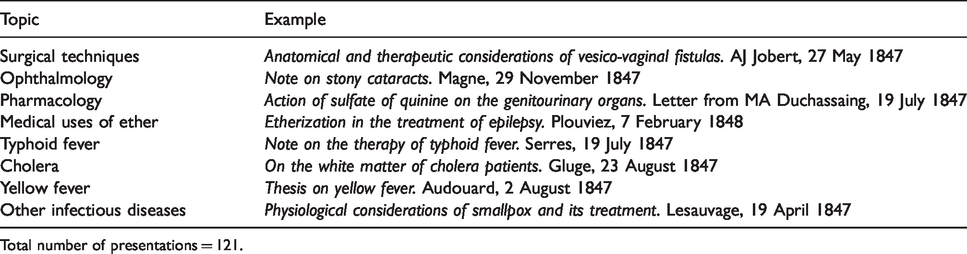
Total number of presentations = 121.
Discussions about anaesthesia and anaesthetics
The first mention of surgical anaesthesia within the French Academy of Sciences occurred on 18 January 1847 by way of a dispute regarding when the first mention truly occurred. Christophe Ducros (1808–1849) introduced the topic of surgical anaesthesia by claiming credit for the invention.
5
,
6
He recalled his presentation on 16 March 1846, in which he demonstrated that buccal and pharyngeal application of sulfuric ether caused sleepiness in humans, as he had previously shown in birds.
5
,
7
When administrated to ‘hypochondraics’, sulfuric ether could bring about sleep in those previously unresponsive to opiates.
7
This prompted geologist Jean-Baptiste Élie de Beaumont (1798–1874) to open a sealed package which he deposited at the meeting on 28 December 1846.
8
The package contained two letters from Charles Jackson (1805–1880); the Academy of Sciences published translated excerpts in Comptes Rendus.
9
In the first letter, dated 13 November 1846, Jackson wrote to Élie de Beaumont: Je vous demande la permission de communiquer, par votre intermédiaire, à l’Académie des Sciences une découverte que j’ai faite et que je crois importante pour le soulagement de l’humanité souffrante, et d’une grande valeur pour l’art chirurgical.
10
I ask your permission to communicate, through you, to the Academy of Sciences a discovery that I made and that I believe important for the alleviation of human suffering, and of great value for the surgical art.
In the second letter, dated 1 December 1846, Jackson wrote: ‘the application of vapor of ether has been completely tested in this country and been put to use with much success at Massachusetts General Hospital’. 10 Alfred-Armand-Louis-Marie Velpeau (1795–1867) responded to the letters by stating he had ‘already heard of such experiments’. 11 Indeed, at their meeting on 12 January 1847, the Royal Academy of Medicine briefly discussed surgical anaesthesia. Joseph-François Malgaigne (1806–1865) stated that American and British journals had published work on the use of ether in surgery, and that he had decided to experiment with ether the previous year. 12 It is likely that several French physicians read about the discovery in foreign scientific literature. The presentation of Jackson’s letters during the Academy of Sciences meeting on 18 January 1847 established ether inhalation as an important, new area of scientific research among France’s most prominent physicians. During this meeting, Antoine Étienne Renaud Augustin Serres (1786–1868), Philibert Joseph Roux (1780–1854) and Velpeau advocated for experimentation, which encouraged French physicians to introduce ether into their clinical practice.
Magendie’s scepticism
Discussions within the Academy of Sciences suggest that surgical anaesthesia was swiftly and widely accepted in France, and that physicians were eager to join the USA and Great Britain in their ongoing experimentation. Nevertheless, François Magendie (1783–1855), a member of the medicine and surgery section of the Academy of Sciences, strongly opposed this quick acceptance. On 1 February 1847, Velpeau opened the meeting by presenting several cases that successfully used surgical anaesthesia, referring to anaesthesia as a topic of ‘immense interest’ within the academy.
13
Following Velpeau’s case presentations, Magendie responded with an attack against surgical anaesthesia. While Magendie was primarily a physiologist, best known for his mentorship of Claude Bernard (1813–1878), he represented the fields of medicine and surgery within the academy. Magendie is described as intolerant, resentful of criticism, and as a person who made enemies easily.
14
He was well known for his vivisections on animals, which many regarded as excessively cruel.
14
Magendie’s passionate remarks during this meeting suggest that he was indeed argumentative and critical. He began his comments: C’est la première fois que j’entends retentir dans cette enceinte le récit des effets merveilleux de l’éther sulfurique (car on n’en pourrait dire autant des autres éthers), sorte de narration dont la presse s’empare et qu’elle porte au loin, satisfaisant ainsi cet insatiable et avide besoin du public pour le miraculeux et l’impossible.
15
This is the first time that I have heard in this room the story of the marvellous effects of sulfuric ether (because one could not say much about other ethers), the sort of narrative that the press seizes and carries away, thus satisfying the insatiable and greedy public need for the miraculous and the impossible.
Magendie’s first argument questioned the scientific merit and novelty of the discovery. He stated that ‘the sedative effects of sulfuric ether have been known for a long time. It is one of the most common therapeutics’.
15
He explained that ether had been used for many years as a treatment for anxious young women. In addition, he expressed disdain towards the discovery, stating: Un dentiste américain annonce, le mois dernier, que la respiration de la vapeur de l’éther amène une insensibilité telle, qu’il est possible, sous cette influence, d’extraire une dent sans douleur; ce qui est, de temps immémorial, la prétention rarement réalisée de tout dentist.
15
An American dentist announces, last month, that the respiration of vapor of ether brings an insensibility such, that it is possible, under this influence, to extract a tooth without pain; which is age-old, seldom realised ambition of any dentist.
Magendie recognised that ‘to spare patients the pains of all surgical procedures is without a doubt a philanthropic goal’.
15
Nevertheless, he believed that the use of opium addressed this need, both in humans for operations, and in animals for physiological experiments. He asked, ‘but should we, on man, bring this result by intoxication? That is the question, say the English.’
15
Above all, Magendie was concerned about the speed at which French physicians accepted the discovery. He referred to anaesthesia as being ‘in vogue’, and worried the enthusiasm was so widespread that ‘all patients who must undergo an operation, even if it is the most simple and the most insignificant, is inevitably intoxicated by ether before being subjected to it’.
15
He called for careful experimentation, warning: ‘the intoxication caused by ether is barely known – it is necessary to experiment, but like all serious experimentation, it must be quiet, calm, and satisfactory in duration to gather accurate results’.
15
His closing remarks emphasised caution and strict adherence to the scientific method: Mais, si l’on continue à expérimenter sans ménagement; si on livre à la publicité, le soir même, l’expérience qu’on a faite le matin et qui n’est pas terminée, puisqu’elle peut avoir, en définitive, de funestes conséquences, on s’exposerait à compromettre un moyen qui sera peut-être utile un jour, quand il sera bien étudié, bien connu et appliqué à propos; mais qui, au contraire, exploité comme il l’est aujourd’hui, pourrait prochainement être réduit à l’une de ces prétendues découvertes, à l’un de ces puffs scientifiques qui viennent périodiquement amuser la curiosité du public et satisfaire sa passion insensée pour tout ce qui est erreur et mensonge.
15
But, if we continue to experiment without restraint; if we advertise, the same evening, the experiment we did that morning and that is unfinished, since it can have fatal consequences, we would risk compromising a method that could maybe be useful one day, when it is well studied, well understood, and applied appropriately; but, on the contrary, if it is exploited as it has been today, it could soon be reduced to one of these alleged discoveries, one of these scientific ‘puffs’ that come periodically to amuse the public and satisfy their passion for all that is error and lie. On devait bien supposer que les résultats étranges des inhalations éthérées n’acquerraient point droit de domicile dans la science sans rencontrer d’obstacles, sans trouver d’opposants. Tous les faits merveilleux toutes les découvertes, grandes ou petites, le galvanisme lui-même, ont dû subir cette épreuve; mais, je l’avoue, ce n’est pas de la part de notre collègue que je me serais attendu à une protestationde cette espèce.
16
We must suppose that the foreign results on ether inhalation would not acquire right of abode in science without encountering obstacles, without finding opposers. All marvelous feats, all discoveries big or small, galvanism itself, had to undergo this test; but, I admit, it is not from one of our colleagues I would expect this type of protestation.
Velpeau to the rescue
According to Velpeau, Magendie had ignored the fact that ether inhalation had already been studied, and disputed, by the most prominent American scientists, with replicate experiments by surgeons and physiologists in England, both on animals and on humans. Velpeau agreed that there was a need for careful experimentation, but that observations were complete the same day they were produced. He addressed Magendie’s concern regarding the state of the patient under the influence of ether by clarifying that the effects of ether were very different from those of alcohol, and by sharing his observation that ‘the effect of ether was consistent from patient to patient, as long as the operation was well conducted’. 16 Velpeau corrected Magendie’s assertion that all surgical patients received ether, as he had used it only in certain cases. Velpeau stated, ‘I affirm that nothing, absolutely nothing, has occurred up to today that authorises the incrimination of ether’. 16
Next, Velpeau addressed Magendie’s criticism regarding the state of the patient as they woke up, arguing that the pain of surgery was just as bad. He criticised Magendie’s insistence on evidence, stating: Je n’imiterai point notre adversaire en l’accusant de barbarie, d’immoralité, de légèreté ou de témérité; mais je lui répondraique tout ce qu’il vient d’annoncer, sur ce point, ne résulte d’aucune observation, d’aucune experience rigoureuse qu’il ne nous donne ici que des suppositions, à mon sens très-peu fondées.
16
I will not imitate our adversary by accusing him of barbarism, immortality, frivolity, or recklessness, but I will respond to him, that what he has said on this topic is not the result of any observation or rigorous experience; that what he gave us here is only conjecture, and in my opinion very unfounded. Les résultats obtenus jusqu’ici sont tellement tranchés, palpables, extraordinaires, que pour en parler dorénavant, notre honorable collègue fera sagement de s’en rendre témoin, de les étudier par lui-même. J’ai la conviction qu’alors il regrettera certaines paroles acerbes qui viennent de lui échapper, et qu’il s’empressera, dans son propre intérêt, de rétracter ce qu’il vient de dire.
16
The results obtained here are so clear-cut, tangible, extraordinary, that to talk about it from now on, our honourable colleague will wisely witness them, and study them himself. I have the conviction that he will then regret certain scathing words that have escaped him, and he will hasten, in his own interest, to retract what he has just said.
Prior to Magendie’s outburst, Roux had prepared to share additional evidence in support of surgical anaesthesia. After the exchange between Velpeau and Magendie, Roux said ‘I feel the need to raise in my turn, by several observations, the criticism our honourable colleague M Magendie has made of experiments now being carried out by surgeons’.
17
Roux addressed Magendie’s concerns about experimenting on humans by saying that it was necessary in surgical practice. Roux agreed that there was a need for further experimentation, including with substances other than ether, and to establish the appropriate dosage. Nevertheless, Roux stated that ether’s ‘utility for long, difficult operations, particularly those requiring delicate movements, was clear’.
17
He discussed ongoing work to develop an administration device, and his own successes using ether for surgical procedures. Following Roux’s presentation, Claude François Lallemand (1790–1854) presented on the potential inconveniences of ether, suggesting that Magendie’s attack was premature.
18
Serres concluded the discussion of surgical anaesthesia on 1 February 1847: Si M Magendie avait assisté à la séance où il a été question pour la première fois, des effets singuliers produits par les inspirations d’éther il aurait vu que MM Roux et Velpeau avaient les mêmes apprehensions qu’il manifeste; il aurait vu qu’ils en appelaient, l’un et l’autre, à une sage expérimentation avant de se prononcer sur la valeur de ce moyen en médecine opératoire.
19
If M Magendie had attended the meeting where it was discussed for the first time, the unique effects produced by inspiration of ether, he would have seen that Messrs Roux and Velpeau had the same concerns that he expresses; he would have seen that they both called on sensible experimentation before pronouncing its value in operative medicine.
Following the debate on 1 February 1847, members of the medicine and surgery section of the Academy of Sciences continued to present work on surgical anaesthesia. For the first half of 1847, it was the main topic of discussion. Research was presented from the categories shown in Table 2. Of note, Joseph-Frédéric-Benoît Charrière (1803–1876) presented an ether administration device prior to the 1 February meeting, on 25 January. 20 Charrière was a prominent inventor of surgical devices, most well known for his invention of the ‘French gauge’ and the Charrière inhaler. 20 , 21 His work on the development of an ether administration device was instrumental in the successful experiments conducted by French physicians.
Surgical anaesthesia topics discussed within the French Academy of Sciences, 1847 and 1848.
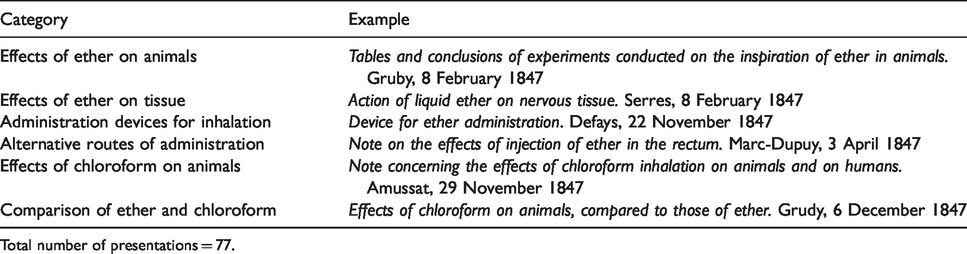
Total number of presentations = 77.
Credit for the discovery
Given that Jackson’s letters were the first official communication with the French Academy of Sciences on the topic of surgical anaesthesia, the academy initially credited him with the discovery. In subsequent meetings of the academy, presenters referred to ether as ‘Jackson’s discovery’.
22
Nevertheless, in his response to Jackson’s initial letters, Velpeau discussed contributions from a few individuals, including William Thomas Green Morton (1819–1868) and Horace Wells (1815–1848), indicating that he was aware of their contributions to the discovery. The Wonderous Story of Anesthesia summarises the evolution of credit attribution that occurred within the French Academy of Sciences, asserting that France played a key role in ‘adjudicating’ the American dispute.
6
While credit was initially given to Jackson, opinion shifted as additional correspondence reached the academy. On 8 March 1847, a letter from Horace Wells was presented, in which he claimed credit for surgical anaesthesia, citing his use of nitrous oxide as a novel discovery. The Academy of Sciences published translated excerpts:
9
La découverte que j’ai faite, ne consiste donc pas uniquement dans l’emploi de l’inhalation de l’éther, mais dans le principe même qui établit la possibilité de la production d’état d’insensibilité, par l’usage de divers agents, tels que gaz protoxyde d’azote, vapeur d’éther sulfurique, etc. Je produirai incessamment toutes les pièces qui établissent, d’une manière irrécusable, que cette découverte m’est due; mais, en attendant, j’ai voulu annoncer à l’Académie des Sciences le droit que je fais valoir, afin qu’elle ne se hâte pas de prononcer sur le véritable inventeur, avant d’avoir entendu les témoignages.
23
The discovery which I made, therefore does not consist only in the use of the inhalation of ether, but in the very principle that establishes the possibility of the production of a state of insensibility, by use of diverse agents, including nitrous oxide gas, vapor of sulfuric ether, etc. I will produce incessantly all of the documents which establish, in an irrefutable manner, that this discovery is due to me; but, meanwhile, I wanted to announce to the Academy of Sciences the right which I assert, so that it does not hasten to pronounce on the true inventor, before having heard the evidence. Le véritable bienfaiteur de l’humanité paraît être ici bien évidemment celui qui, le premier, a engagé un dentiste à essayer d’extraire une dent à une personne placée sous l’influence de l’état particulier que produit l’inhalation de la vapeur d’éther.
24
The true benefactor of humanity obviously seems to be the one who, first, hired a dentist to try to extract a tooth from a person placed under the influence of a particular state produced by the inhalation of ether. De nombreux compétiteurs réclament cette découverte tant dans ce pays qu’en Europe, et nous n’avons ici d’autres moyens d’établir la priorité légale que de nous servir de la loi des États-Unis sur les patentes. J’ai donc pris une patente dans ce pays pour fixer mes droits; et, afin que mes motifs fussent bien compris, j’ai exprimé, dans les lettres où je sollicitais cette patente, que j’étais très-opposé à l’idée de prendre des patentes pour aucune application destinée à diminuer les souffrances de l’humanité mais que je me décidais à le faire afin d’établir légalement mes droits comme auteur de la découverte et de me mettre à même de donner aux autres le droit de s’en servir.
25
Several competitors claim this discovery in this country and in Europe, and we do not have here other methods to establish legal priority than by using the United States law on patents. I therefore have taken a patent in this country to fix my rights; and, so that my motives were well understood, I expressed, in the letters in which I applied for the patent, that I was very opposed to the idea of taking patents for any application destined to diminish the suffering of humanity, but that I decided to do so in order to establish my rights legally as author of the discovery and to allow myself to give others the right to use it. Je sais qu’un dentiste de Hartford, M Wells, pretend qu’il avait fait la découverte, parce qu’il avait fait respirer à un de ses maladies du protoxyde de nitrogène (gaz exhilarant de Davy), et qu’il soutient que les effets de ce gaz sont les mêmes que ceux de la vapeur d’éther de sorte qu’il réclame le principe. J’ai seulement à dire que l’essai qu’il fait, dans cette ville, avec le protoxyde de nitrogène, n’a pas réussi, et qu’on n’a pas jugé que l’expérience méritât d’être répétée. J’apprends que M Wells pretend même m’avoir communiqué ma découverte et qu’il est parti pour l’Europe afin de spéculer sur ma découverte. Il n’a jamais rien su sur ce sujet avant l’exécution complète de mes experiences; il ne m’a jamais communiqué un mot à cet régard, et il ne peut mentionner le nom d’aucun individu dans cette ville, à qui il ait fait une pareille communication: s’il venait à élever aucunes prétentions en France, je vous prie de les réfuter par les assertions qui precedent.
25
I know that a dentist from Hartford, Mr Wells, claims he made the discovery, because he caused one of his patients to breathe nitrous oxide (exhilarating gas of Davy), and that he maintains that the effects of this gas is the same as those of the vapor of ether so that it claims the principle. I only have to say that the experiment that he did, in this city, with nitrous oxide, was not successful, and was not judged as being worth repeating. I read that M Wells claims to have communicated my discovery to me, and that he left for Europe in order to speculate on my discovery. He never knew anything on this subject before the complete execution of my experiments; he never communicated to me a word in this regard, and he would not be able to mention the name of any individual in this city, to which he made such a communication: if he came to raise any claims in France, I ask you to refute them by the assertions which precede.
Near the end of 1847, focus shifted from experimentation with ether to chloroform. Many of the experiments conducted with ether, such as the effects of ether on animals and the effects of ether on humans, were conducted with chloroform as well. Many of these works were presented at the meeting on 29 November 1847. 27 Comparisons between the two mediums followed. Interest in surgical anaesthesia began waning in the second half of 1848, as did the overall presence of the medicine and surgery section during Academy of Sciences meetings. On 27 November 1848, Roux presented his work on the use of local anaesthesia. 28 By the middle of 1849, research on surgical anaesthesia disappeared almost entirely. The academy turned its attention to the ongoing cholera epidemic, presenting clinical observations and potential therapeutics. The matter of credit for the discovery of anaesthesia was not settled in any official capacity until the beginning of 1850, three years after surgical anaesthesia was first introduced to the French Academy of Sciences. On 4 March 1850, the academy awarded the prize for medicine and surgery for 1847 and 1848 jointly to Jackson, for his observations and experiments on the effects of ether inhalation, and to Morton, for introducing the method into surgical practice. 29 Nevertheless, Jackson and Morton continued to fight for credit in the USA.
Discussion
Surgical anaesthesia was swiftly and widely accepted in France. Prominent French physicians and scientists trusted their colleagues in the USA and Great Britain and were eager to join in the ongoing experimentation. Development of the ideal administration device was one of the first priorities for scientific research, and inventor Charrière played a central role in this discovery. French physicians were interested in testing the effects of ether on both humans and animals, and in exploring alternative routes of administration, such as intravenous and rectal administration. Through the presentation of new research and discussion surrounding surgical anaesthesia, the French Academy of Sciences grappled with the question of credit, initially attributing the discovery to Jackson. While discussions surrounding ether and chloroform dominated the French Academy of Sciences during 1847 and 1848, other topics were discussed, such as infectious disease, surgical techniques and pharmacology. Undoubtedly, the introduction of anaesthesia allowed much progress to be made in the field of surgery, enabling further experimentation in practice throughout the second half of the 19th century. French Academy of Sciences members Louis Pasteur (1822–1895) and Claude Bernard were instrumental in establishing germ theory. Deliberations in the French Academy of Sciences lent credibility to the newly discovered technique of controlling pain during surgery and hastened its acceptance. Their discussions failed to address the dispute about which individual deserved to be recognised for the discovery of anaesthesia, a status quo that continues to this day.
Conclusion
The medical profession, society and government in the USA faced significant difficulty in determining who ought to receive credit for the discovery of anaesthesia; therefore, Jackson, Morton and Wells sought recognition abroad. Europe, and France in particular, had a much better reputation for the quality of scientific and medical work. The French Academy of Sciences was the most prominent scientific institution in France, and one of the oldest and most prestigious scientific institutions in the world. Recognition of anaesthesia by the French Academy of Sciences not only lent credibility to the discovery, but also served to bolster the claims of those who sought credit. We have provided here details about the origins and the deliberations of the French academy, and we conclude that the controversy surrounding credit for the discovery of anaesthesia continued in the mid to late 19th century and persists to this day. Not only was the French academy unable to determine which man deserved credit, but also may have helped fuel the rivalry between Jackson and Morton by awarding a joint prize. Despite being unable to resolve the dispute, the academy made significant contributions to the field of anaesthesia research in the two-year period following its introduction in France.
Footnotes
Declaration of conflicting interests
The author(s) declared no potential conflicts of interest with respect to the research, authorship, and/or publication of this article.
Funding
The author(s) disclosed receipt of the following financial support for the research, authorship, and/or publication of this article: This work received funding from the University of Massachusetts Medical School Office of Undergraduate Medical Education.
