




Abstract
The significance of the 1984−1985 British miners’ strike and its legacy for the left can only be properly understood through reference to the significance of informal female activism. Women’s strike activism extended outwards from community into the labour movement, and the non-aligned left, connecting local to national and international networks. In doing so, it made real the links between what appeared at first to be unconnected political struggles linking the political and material concerns of the strike with private and emotional matters. This class-based gendered informal activism has an ongoing legacy within mining communities but has frequently gone unrecognised by both the formal labour movement and academics. The efforts of women activists to sustain community in the years since the strike rests on an emotional commitment to nurture a creative socialist politics based in the realities of everyday life in ex-mining localities that are aligned with trade union and labour movement politics and values. The National Women’s Action for Positive Change was constituted in 2025 to mark the 40th anniversary of the dispute as an inclusive legacy organisation that encompasses strategic political campaigning, community activism, and creative cultural expression, harnessing traditional female skills for political communication and education. The purpose of this new configuration of National Women Against Pit Closures is to link traditional left-wing politics and the informal gendered community politics of class. Women’s organisation during and since the strike offers a practical and principled model of activism located within community action that seeks to galvanise the left and offer a counter to the populist politics of the right.
In 2025, a range of commemorative events marked the 40th anniversary of the British Miners’ strike (1984−1985), as organisers sought to affirm the socialist values of the dispute. Women Against Pit Closures (WAPC), the organisation that had been the co-ordinating body for the women’s strike support groups, was reconstituted in 2023 as a national body (NWAPC) to ensure the women’s contribution was not forgotten (facebook.com/NWAPC40). Women’s events took place across the ex-coalfield areas, and a national women’s rally that included international friends was held in Durham on 4 March 2024 (Photograph 1). The Durham event was materially supported by Trade Unions, local Labour party branches and councils, and by non-aligned organisations and individuals who value the female working-class-led activism of WAPC.
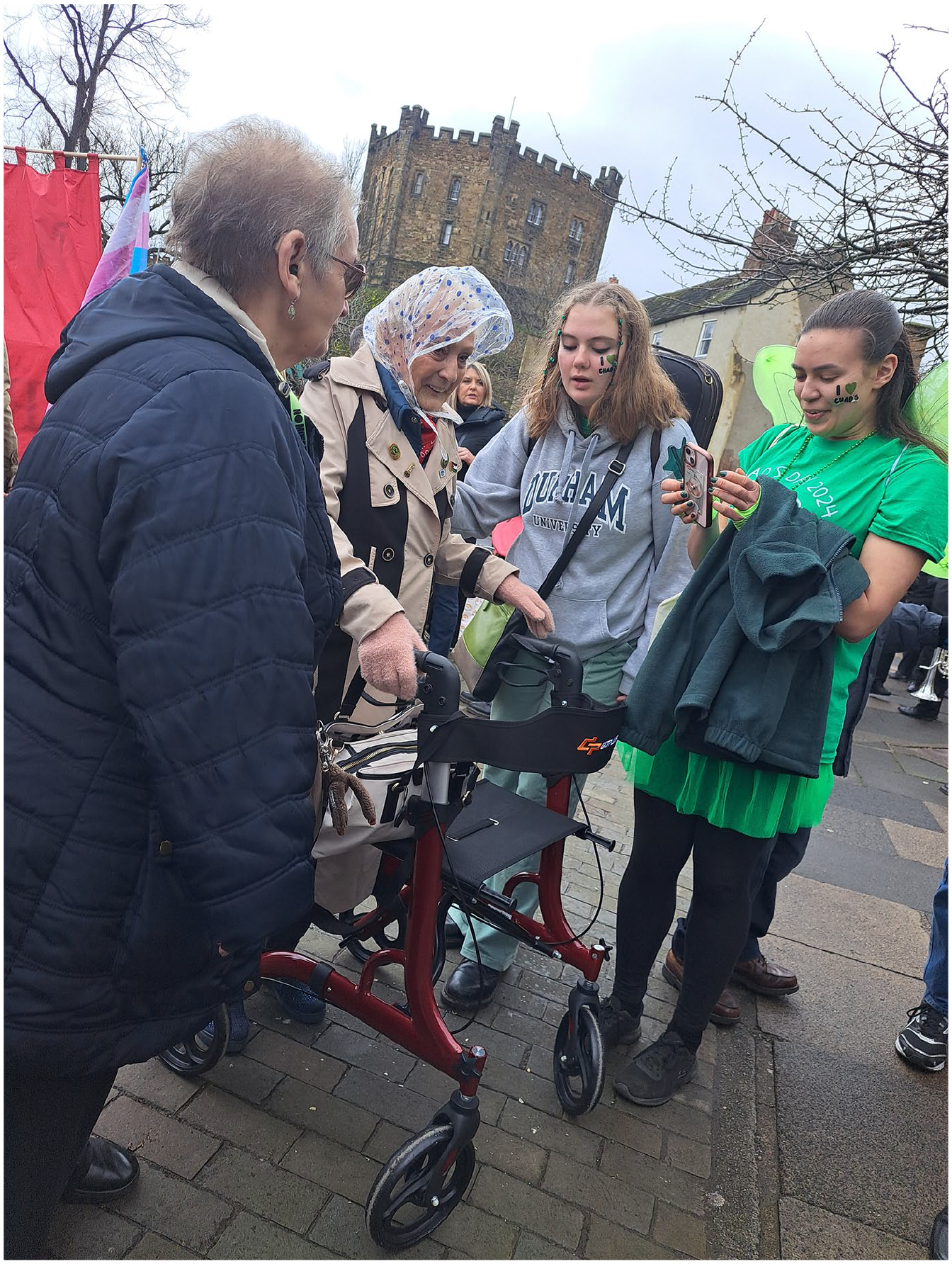
Seasoned and new activists meet at commemoration events in Durham 2025.
The anniversary has rekindled interest among researchers, creative producers, legacy journalists, and commentators on social media (e.g. Adams 2024; Lonely Tower Film and Media 2023; Wheeler 2025) and the women’s role has won particular attention (e.g. Around Town Barnsley and Rotherham 2024; Flanagan 2024; Lazenby 2024; National Mining Museum 2024; People’s History Museum 2025).
Despite the National Union of Mineworkers (NUM) conceding defeat in March 1985, the strike is perceived as a high moment of working-class struggle. The union won no concessions from the National Coal Board (NCB), and subsequently the industry was privatised and destroyed. Yet, defeat did not erase the political consciousness, learning, and bonds of comradeship that were forged in struggle.
The strike continues to inspire left-wing activists and commemorative events have been designed to reaffirm the positive gains from the struggle against the background of a relentless rise in far-right political organisation. Post-industrial, working-class locations have been targeted by right-wing populists who, in ex-mining areas, have played to the insecurities and displacement that followed the strike defeat and pit closures (Abreu & Jones 2021; Adams 2024). Populists have won support from some disconsolate voters for whom work, when it can be found, is neither a source of pride nor comradeship, and for whom ties of family and neighbourhood have been fragmented. The rightwards shift implies a rejection of the values promoted during the strike. Some ex-miners and their families have hung onto positive memories of the strike experience without retaining commitment to its politics and some strike loyalists hold racist and right-wing views (Gildea 2023). Mostly though, there has simply been a loss of trust in mainstream politics (Abreu & Jones 2021). Nevertheless, strike anniversary events signify the survival of strongly held socialist values and ideals within ex-mining areas. The women involved in NWAPC have understood the importance of celebrating those values and working to present an alternative, positive source of hope to those demoralised by post-mining conditions and political disconnection. Understanding the conditions of immiseration, the women who connect their political values with mining and the strike have continued, ‘undefeated’, to pursue an everyday politics of socialism located in local family and neighbourhood relationships which were the bedrock of their strike activism.
The pro-strike involvement of women from mining families seemed new and unexpected in 1984. However, it did not take place in a historical vacuum, nor was it contained within that discrete historical moment (Spence and Stephenson 2007a). The dispute was a catalyst, but the women’s interventions built on inherited skills and understanding and were mobilised within the terms of reference that had historically situated them in neighbourhood and family caring roles in mining societies. The absolute sexual division of labour in mining circumscribed gender roles and relationships but by 1984, women and men had benefitted from improved life conditions, educational expansion, and the relative economic stability of the post-war years. Birth control, and the policy gains of feminism further improved options for many working-class women during the 1960s and 1970s (Seccombe 1990). The historic moment of the strike offered women a route into political activism which enabled them to mobilise gender roles continuous with the past within contemporary conditions that created opportunities for female activism to extend beyond the traditional politics of mining. The strike thereby became a key moment for the expression and development of a specific form of working-class female activism, offering an approach that was deployed afterwards in response to the industry’s demise.
Women in the strike
Except as members (e.g. office workers), women strike activists were outside the decision-making and discipline of the NUM, and the relationship was not straightforward. WAPC was allied with the NUM, but not all women’s support groups were affiliated to WAPC (Sutcliffe-Braithwaite & Tomlinson 2023). While women worked alongside, and under the wing of the union (public speaking, marching, and picketing), they also acted autonomously, and often informally and spontaneously to address needs that were outside the ambit of the NUM. Thus, the organisation of women to feed striking miners and their families was a direct response to meet needs of enormous proportions that could not be met by the NUM that was entirely consonant with the traditional role of women in mining life: we provided a three-course meal at 30p per head. (Anna Lawson, interview, April, 2003) I think between 800 and 900 were on the books for food parcels. (Pat McIntyre, interview, February, 2003)
The aggressive anti-strike stance of the government, police, judiciary, and public utilities created difficulties relating to social security benefits, electricity disconnection, home repossession, and the basic dignities of birth, death, and sickness. Such matters also fell within the range of traditional female responsibility, and women activists offered mutual support and advice, discovered relevant information, and provided resources. In the informal and family-based spheres, women’s strike activism was limited only by their interpersonal relationships, personal responsibilities and resources. However, such interventions were necessarily undertaken co-operatively/collectively and in public (Shaw & Mundy 2005), creating the conditions for the development of skills such as welfare rights knowledge: The first electricity disconnections were about to take place in the homes of striking miners . . . Anne (Suddick) contacted the relevant union and asked for solidarity from the members who would be carrying out the disconnections. Some members inevitably were unwilling to co-operate. Therefore, the women formed lines around the affected house in an attempt to avert the disconnections – this was initially the only way to deal with the problems, but I thought it was not a secure option. That is when I got interested in the legal side of things. . . (Anna Lawson, interview, April, 2003)
Women were motivated by empathy and compassion in the face of impossible situations. They offered material and emotional support grounded in love for family, friends and community: if you are the sort of person who empathizes with people you go through a million deaths . . . because the cruelty that was going on during that strike. . . (Pat Macintyre, interview, February, 2003)
The strike created unprecedented levels of interpersonal, social, political, and civil conflict that sometimes erupted into violence. Incidences of family and relationship breakdown, stress associated with poverty, fear of police violence, and the ill health that follows from such events increased as the strike wore on. The fall-out absorbed the energies of women activists: It really was emotionally very tough . . . people were faced with some awfully tragic, daunting situations. And yes, they did cope, and they were good with dealing with things and having a mental resource of humour and solidarity, but it was still very, very hard, . . . if I did anything useful, . . . it was just trying to just be around for people. (Pat Fuller, interview, September, 2009)
In the face of suffering women recognised the need to maintain morale so took any opportunity for collective celebration at the bleakest of times: Christmas was just incredible, and we had nothing. . . Angela next door and me making these stupid bloody decorations, crackers and all sorts and I am not artistic or domestic at all, but it was a wonderful Christmas! (Dorothy Wray, interview, February, 2003)
Carrying the burden of care for others, affected the mental and physical health of women activists and added an emotional charge to female understanding of the meaning of class conflict. This strike might have been a rational dispute about mining jobs, but it was also a dispute about the emotional value of love, relationships and the meaning of home that created the coherence and stability of mining life, defined loosely as ‘community’. Unlike kitchens, food parcels and picketing, the emotion work that was undertaken by women during the strike is difficult to portray visually or to discuss in terms that fit within the discourses of politics (Spence & Stephenson 2012; 2023). Pat Fuller struggled to find the words to describe it: I don’t know what it is, there is something I can’t put my finger on, but just the fact of being involved in something that was as massive as that, of such significance, on a political and a public level, but also on a personal level for everybody. . ., but some of those relationships, I mean I can still get tearful talking about that time now. I think I would be very unlikely to get such an emotional involvement at any other time of my life . . . a very different kind of relationships I’ve had before or since that actual period of 84-85. (Pat Fuller, interview, September, 2009)
Female emotion work was entirely outside the ambit of the union, even though crucial for the maintenance of solidarity, and has hardly registered as a subject for analysis of strike issues. Yet, understanding the link between political awareness and emotional connectedness offers one key to interpreting the power of female intervention in the strike and its historical significance in working-class activism. The self-organised, informal, neighbourhood-based practical and emotional strike support offered by women was personal within a political context, and activism nurtured a gendered consciousness within a men’s class-defined struggle. Women’s support groups encouraged the articulation of a collective female voice in ways that resonated with feminist consciousness raising processes, but strike politics were specifically grounded in the working-class history and organisation of mining.
Some female activism was entirely personal and emotional, born of loyalties integral to traditionally ascribed feminine attributes of love and care. Political affiliation may have been intrinsic to the terms of the offering, but it was not necessarily explicit or informed. Nevertheless, sides taken became emblematic of a wider political polarisation at a moment of aggressive conservative power, and the strike laid political positions bare. Everyone was affected. The politicised use of police and judicial power against striking miners, and the collusion of mainstream media in anti-strike rhetoric revealed the realities of class conflict and gave moral weight to the critical left-wing perspectives of NUM leaders (Williams 2019 [2009]). The strike positioned the working-class struggle as fundamental to trade unionism and everyone involved in strike activism became at least aware of, and usually engaged with, political discussion relating to real-time events unfolding. The political discourse of the strike inevitably became more sophisticated and extensive for those whose field of support spilled beyond the UK coalfields into the national and international trade union movement, and as anti-conservative groups not directly impacted by the dispute became more connected, primarily through the informal networks created by the women (Spence 2010). The emotional thus linked with a political discourse especially for women activists.
Links
The local framework of female activism included representatives of civic and welfare organisations. Access to public kitchens necessitated negotiation with management committees, welfare rights information required contact with specialist agencies, support for children was sought from teachers, and priests were recruited to offer spiritual and material support. Female activism thus facilitated the participation of strike sympathisers with no direct links to the NUM. Women’s organisation similarly encouraged engagement by interest groups including anti-nuclear campaigners, anti-racists, and gay rights activists, who were threatened by the Thatcher project, wanted to resist, but had no formalised links with labour organisations (Beresford 2014; Spence 2010; see also Sian James in Allsop et al. 2017). Such strike supporters contributed their understanding of what was at stake, linking questions of injustice, inequality and oppression with personal circumstances, feelings, belief systems, with questions of class in ways that resonated with the women.
The class-based discourse of the NUM in combination with these wider networks had a significant impact on the meanings generated by the women’s strike support. An enhanced awareness of the power of the personal in the political, of the relationship between the local and global, of the relevance of the informal and emotional, and not insignificantly, of the implications of gender inequality for class unity was linked to class oppression. Female activism in the strike was thus distinctive, broader than the received traditions and discourses that had shaped trade unionism, grounded in the historic, classed roles of women in mining life, and energised by new political alliances.
One woman
The unique nature of the female role in the strike could be illustrated through the biographies of many strike activists (Scargill and Cook, with Clayton 2020; Wood 2024). The strike projected these women into a type of political and social action that outlasted 1985. Here we focus briefly on Anne Suddick, who, apart from a short piece under a pseudonym (Sutton 1986), left no biography, but who informed our thinking around the question of interpersonal, cross-campaign and international links, and the significance of love and compassion in the working-class struggle.
Anne’s strike activism grew from her determination to help her own family and the families of miners who travelled from ex-mining Durham villages to work in the remaining pits in the east of the County. Such families lived in areas no longer characterised by the solidaristic relationships that a local pit had engendered and were isolated from neighbourhood and local union welfare support. As such, Anne understood that to maintain solidarity and strike unity it was essential to establish a supportive ‘community of interest’ (Bell & Newby 1971).
Within the ex-mining village of Langley Park, Anne was known and trusted as a Girl Guide leader where she had developed insights into the nature of voluntary organisation and a network of local supporters. Her paid work within the Durham Colliery Mechanics’ Association gave her access to union resources and awareness of NUM concerns. Accordingly, she organised a meeting at Redhills, Durham Miners’ Association (DMA) headquarters, and the Durham Miners’ Support Group was formed. Anne became its effective co-ordinating chair.
Anne’s private and employment issues were inextricably combined in the strike, although her voluntary efforts were not always fully appreciated or even endorsed by her employers. Despite this, and even after redundancy in 1987, she remained loyal to the union, never speaking against it. Still, her deep feelings about the strike resided primarily in the voluntary, personal aspects of her experience. Poignant moments she recalled were invariably focused on the emotional meaning of solidarity: We had a load of Miners from South Wales, and somebody asked if I could find them somewhere to sleep. The only place we’ve got is the Church Institute and then it was on the floor . . . and they all sang ‘Myfanwy’ for me. It was absolutely beautiful. Just stood in a circle and sang. I honestly think that was probably the most moving part of the strike for me, because of the way the voices swelled up in that little hall. . . These groups of mineworkers and the communication between ordinary people defied the leadership. It wasn’t somebody coming up to make a speech, these were whole groups of people who were on strike and in the same boat. (Suddick, interview, December, 2002)
Anne contacted anybody who might offer support, and in the process extended the remit of her own politics. Her efforts won her the love and loyalty of those who encountered her during the strike, but that effort and the consequences of defeat took a toll on her mental and physical health (Stratford 2021).
After the defeat, she became involved in the Justice for Mineworkers Campaign, and retained links with a range of social causes including the women’s peace camp at Greenham Common, ‘which she visited frequently’ (Stratford 2021). She attempted to set up a web page devoted to women in the strike, but in the absence of technical support, this only lasted about 2 years. She offered day-to-day informal welfare rights guidance from her home, locally known as ‘the office’ (Spence & Stephenson 2007b). Apart from the Justice for Mineworkers campaign, the NUM played no part in Anne’s post-strike trajectory of activism.
The 2004−2005 strike anniversary, as in 2025, provoked a spike in public interest and re-energised Anne. Determined that women should be remembered, she accepted a series of speaking engagements and invited women strike activists from across the country to participate in a forum discussion which she chaired at a commemorative conference at Northumbria University. Here the women discussed the impact of the strike on their long-term activism. The forum transcript demonstrates that all 26 participants had remained locally active after 1985, though in diverse ways (Spence & Stephenson 2007a).
Defining her stance with reference to ‘Links’, Anne outlined her hope that interconnection between social groups facing oppression could lead to an effective political and social strategy to galvanise the left (Suddick 2004, 2005). Her interest in coal was generalised into one of ‘energy’, expanded through her strike connections with the anti-nuclear movement and Greenham Common activism. The Greenham women’s concern with fundamental questions of birth and death, their creative activism, and endurance of state and media hostility resonated with Anne’s strike experiences: I learned . . . how all these things are connected with one another. The women at Greenham are women of very strong beliefs, and they’re women prepared to sacrifice a lot to make a point about something they believe in. I’m beginning to see the connections between what’s happening in the nuclear power industry, and what’s happening with nuclear weapons. The main one apart from the other obvious ones is people are taking decisions that affect other people’s lives and exercise the power of life and death over them, without telling them what they’re doing or consulting with them and being totally secretive and deceitful. (Sutton 1986: 143)
Like others, Anne was displaced by the defeat of the strike when support groups lost their primary reason for existence. Her efforts to establish linked community, coal, peace, and feminist-based activism went unrecognised by the NUM, and in the absence of any significant community-based organisation to support her, she was forced to follow her own individual path, making connections as and when the opportunity arose. That reality fragmented the cohesion of her vision.
Anne Suddick died suddenly in 2021. Durham women strike activists organised her funeral to enable family and comrades to express their love and loss. In his eulogy, Alan Mardghum, Secretary of the DMA, publicly apologised for the NUM’s unwillingness to properly acknowledge or accommodate female strike activism, implicitly recognising that the involvement of women had never been a straightforward matter. Clearly, in the intervening years, a greater self-awareness had emerged among some of the men active in 1984−1985: Mardghum’s apology reflects a shift in the gender relations of trade union politics since the strike. Feminisation of the labour market and a loss of traditional male-dominated industries have translated into increased numbers of women taking union leadership positions. The terms of survival of the DMA as an advisory organisation that hosts the annual Durham Miners’ Gala, and the transition of the Redhills building into a community facility, are indicative of the terms of post-mining change. The grounds of Redhills are replete with statues of men revered in DMA history, but among them there is now a bench dedicated to the memory of Anne Suddick.
Questions for the left
Working-class female activism in community contexts has seldom been acknowledged as intrinsically relevant to trade union socialist politics. Yet such activism was the bedrock of the female response in 1984−1985. Women drew upon stories of previous mining struggles, told largely by their mothers in relation to the 1926 strike (Dorothy Wray, interview, February 2003). Not only did women bring into the strike arena family-based skills grounded in nurturing, care and love, their interpersonal connections enabled them to mobilise informal neighbourhood-based support groups. Less recognised, they deployed skills gained in female occupations such as typing, catering, and office administration, and used their experiences in community organisations, to deal with conflict and facilitate the smooth running of groups. Generations of struggle in mining had taught women coping mechanisms that encouraged them take on tasks that might have seemed impossible to outsiders, to believe they could feed thousands, to undertake large-scale fundraising, to bring community-based professionals and business people onside, and to persuade recalcitrant officials and management committees to succumb to their demands: It was just that idea about women . . . just getting straight on with what needed to be done. . . it was really critical, but it wasn’t recognised as being part of the official organisation at all. (Pat Fuller, interview, September, 2009)
Participation in the strike enhanced women’s consciousness of the collective value of their female knowledge and exposed the extent to which they were relevant to class struggle. In these circumstances, it was unlikely that the activism of women would be contained within the parameters of the strike. After defeat in March 1985, many women sought a period of respite, rehabilitation, and recovery in private, but the insights of strike activism were neither forgotten nor discarded (Shaw & Mundy 2005; see also Barbara Jackson in Allsop et al. 2017).
Afterwards, some women’s support groups closed almost immediately. Others continued to meet, many producing publications, often sponsored by trade unions and other socialist organisations, recording their strike experiences. A minority sought long-term survival and a role in shaping working-class female politics in the future. For example, the Castleford Women’s Group worked to create a women’s education centre (Sutcliffe-Braithwaite & Tomlinson 2023; Trounce 2015). The refusal of the NUM to offer associate membership to the women supporters was a blow to those who had hoped to keep campaigning in partnership with the union. Facing loss of a focal point in mining politics, most women activists sought their own paths into what they realised would be a very difficult future. Some accessed opportunities to train as professional workers in the community, social, and welfare fields. Others allied themselves with the Labour Party and a variety of campaigning organisations where they could express their values, even if only to a limited extent, others continued community activism on an ad hoc basis, some nurtured their wider trade union and socialist contacts on the national and international stage. These post-strike experiences were utilised in the organisation of the 40-year commemorations. The wisdom and skills associated with the strike, honed in post-strike experience, is now inspiring a new generation of socialist female activists through the lens of the memory of the strike.
Insight from the Durham Coalfield
Post-strike continuity in informal, everyday and campaigning activism related to mining is evident in the resurgence of the annual Durham Miners’ Gala (Beynon 2014; Mellor & Stephenson 2004; Stephenson & Wray 2005). After a period in which it seemed the Gala might die with the pits, it began to flourish as a celebration of socialist values. The visibility of women at the Gala is palpable, not only within female-interest groups (e.g. WASPI women), but also within the trade union banners, including those of the old miners’ lodges and surviving colliery bands. Significantly, women have been prominent in efforts to save and reproduce the old colliery banners and to give them a new community angle: Jane Burlinson, a community worker from a mining family, employed as a result of Coalfield Community regeneration funding, was crucial to stimulating local people to create a new and pioneering community banner after the Herrington Colliery Banner had disintegrated (Stephenson & Wray 2005). Her role was recognised at Houghton Feast in 2004 when she was invited to walk at the front of the banner at its first outing (Photograph 2). Jane’s professional role might have demanded political neutrality, but the objective of encouraging community regeneration in the context of mining was intrinsically political: Jane and others involved understood that. A different type of banner, modelled on those of the NUM, was more recently created by a Women’s Banner Group in Durham to honour the voluntary activism of women in mining life. Activism that honours mining heritage does not emerge from a vacuum: it is self-aware, understanding the importance of collective visibility to reaffirm and celebrate the political values with which it is situated.
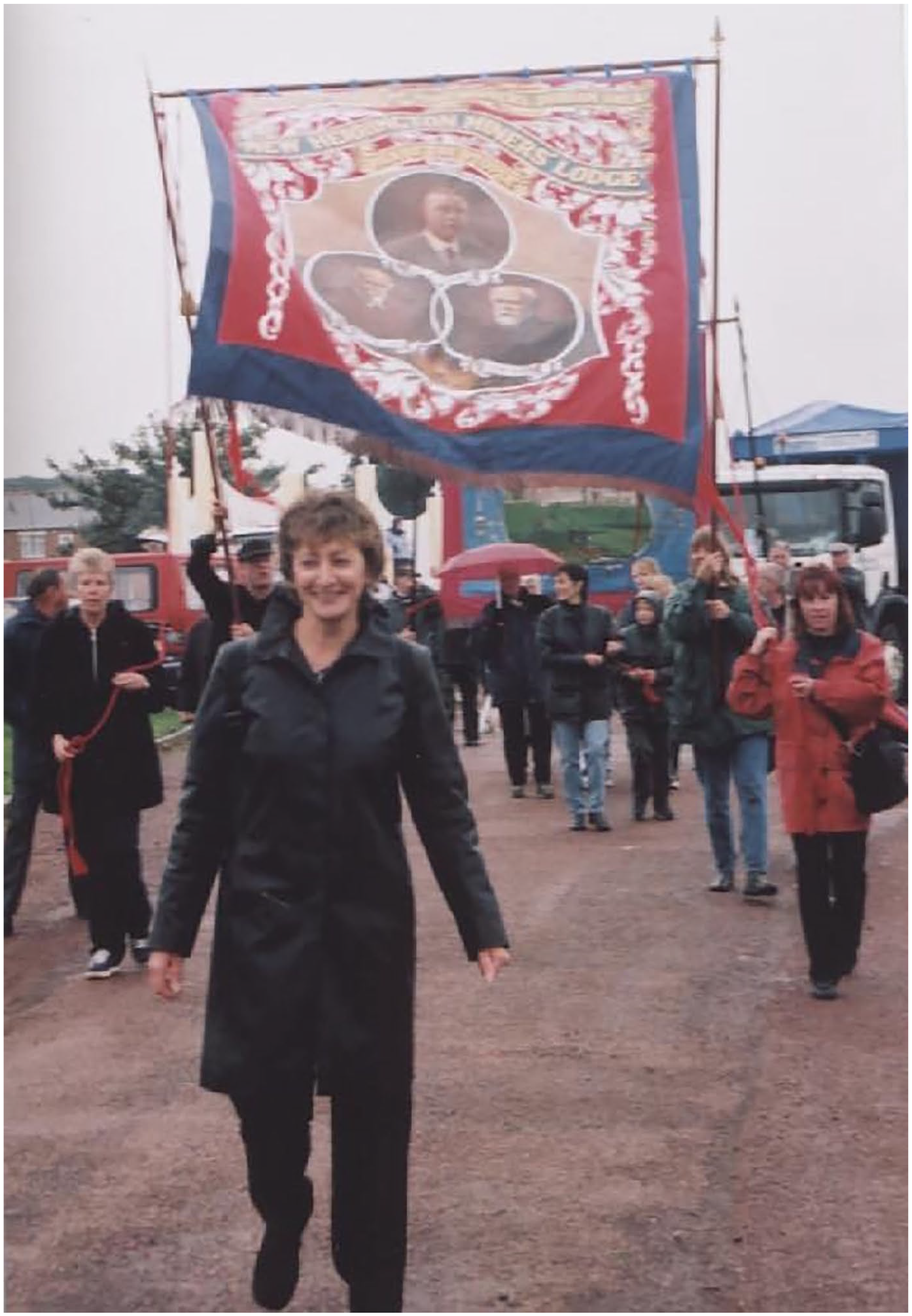
Jane Burlinson leading the Herrington Community banner at its first outing at Houghton Feast October 2004.
Despite having been largely ignored in decisions relating to economic regeneration, women have acted as creative conduits for the social regeneration of mining localities and communities (Waddington 2003, 2005). The loss of facilities and welfare support associated with the demise of the NUM corresponding with financial cuts in public services has diminished the infrastructure to support a collective and communal life, limiting opportunities for collaborative informal education, leisure, and celebration in ex-mining localities. Again, women can be found as volunteers, at the forefront of work to fill the gaps. In heritage centres and community cafes (e.g. Horden Welfare Park in what was once a mining ambulance station), older women give time to nurture local pride and to offer social facilities which operate informally, but professionally. Women are also prevalent, often behind the scenes, and usually as volunteers, in the management and day-to-day work associated with mining-related museums and heritage facilities (e.g. Beamish, Spennymoor, and the DMA building at Redhills). Meanwhile, it is apparent that in the community-based provision of non-statutory welfare support, such as arts organisations, leisure and sports groups, and food banks, women take leading roles. Such voluntarism is a signal of a commitment to collectivism associated with redistribution, equality, and the sharing of skills. As such, it is sympathetic to socialist values. Yet it is seldom perceived in political terms but rather as a separate expression of personal values.
Women activists persistently link their interventions to their feelings about the history of mining, and specifically to ‘what happened’ to their communities during the strike and after. They are unafraid to speak of the love that they carry for their mining past and its inheritors but tend to be more reticent about using the language of politics. Their activism is in many ways a response to the ‘Social Haunting’ that speaks of unspoken trauma among social groups that have suffered unresolved injustice (Bright & Ivinson 2019; Spence 2019). The voluntarism of women in ‘the shadow’ (Beynon & Hudson 2021) of coal mining might not easily be expressed within political discourse, and formal politics might not be explicit, but socialist values and political beliefs are intrinsic to the emotion and material work being undertaken in these environments.
In 2025, new and seasoned activists who organised the 40 Year strike anniversary events in Durham, evoked the women’s strike spirit through the establishment of a female led, class-focused grass roots campaign group (Photograph 3 Courtesy of Neil Terry Photography): Today we are not closing a chapter so much as turning the page. The National Women Against Pit Closures will now become the National Women’s Action for Positive Change . . . keeping our cherished NWAPC acronym while broadening our horizons. The same spirit that fuelled women’s activism during the miners’ strike will now power a new generation of women in grassroots community activism, politics and trade union organisation . . . our communities still need advocates! They still need changemakers. They still need us. We will continue to transform struggle into strength and hardship into hope. (Lynne Gibson, 2025)
The challenge will be how to make the links between community-based interventions and the traditional organisations of the labour movement, between the informal and formal, between activism based on love that seeks to grow organisational capacity rationally and strategically, and to do so locally in an increasingly unsettled global context. These questions are not easily answered, but in the light of the rise of the populist right, they are pressing.
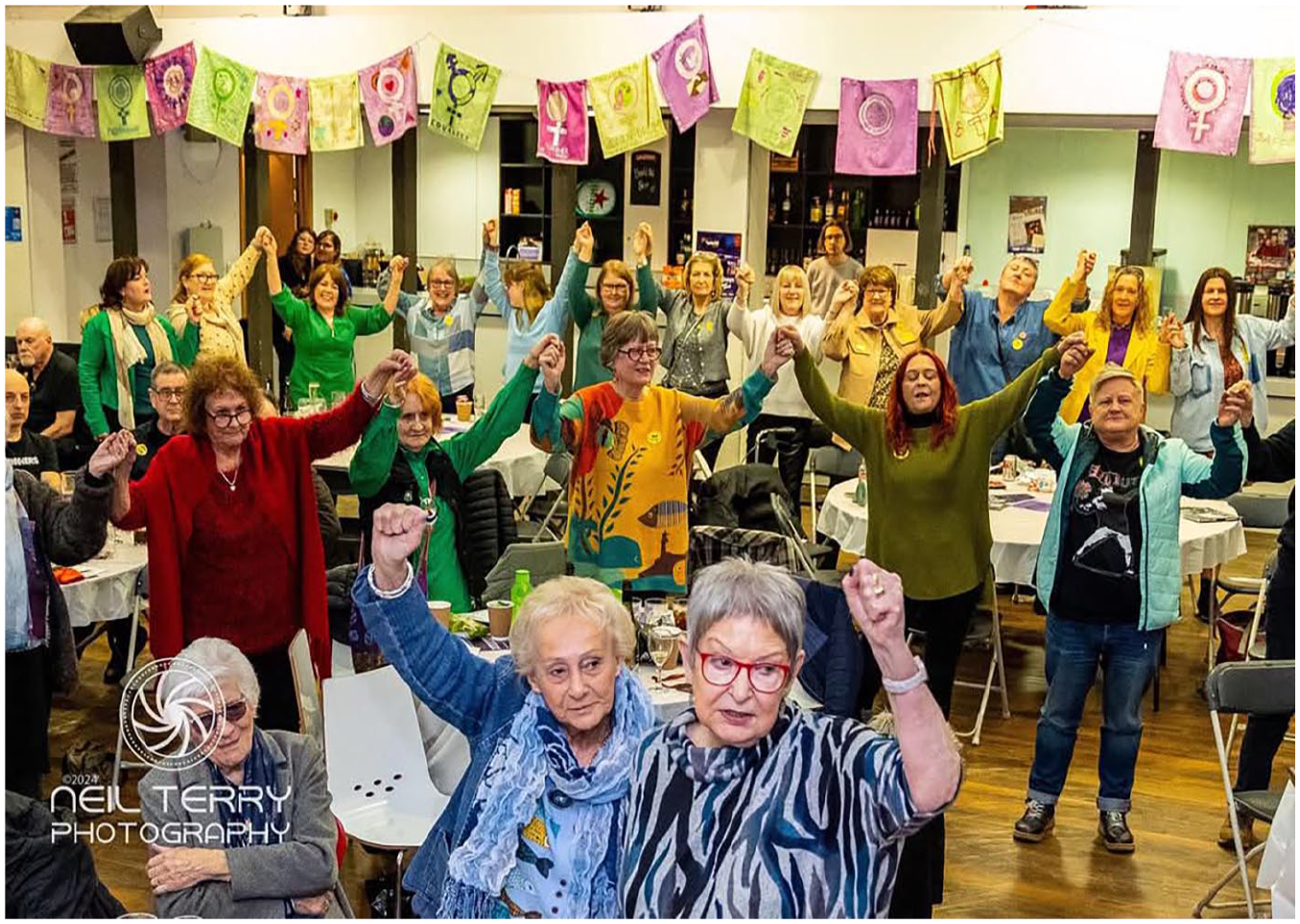
Betty Cook and Heather Wood lead the celebrations as NWAPC is renamed National Women’s Action for Positive Change in 2025. Copyright Neil Terry 2025.
Conclusion: NWAPC challenging the rise of right-wing populism
At the start of the strike, the miners were not alert to the significance of the contribution that women could make as a consequence of their informal, emotional, and interpersonal skills. The importance of female activism evolved with reference to the inclusion of community within the terms of the strike. The survival of mining life and culture depended on the continuity of mining work for men. Women’s arguments against pit closures inevitably prioritised the impact closure would have upon family life, children, and the survival of community. The family-community imperative behind the women’s support for the strike is apparent in the women’s own writings (e.g. Barnsley Miners Wives Action Group 1987). Yet, the extent to which female activism was nurtured in the context of informal, emotional and facilitative neighbourhood, community and organisational responsibility prior to the strike, and its continued development in this context in the years since, has garnered little detailed attention.
Significantly, traditional forms of family and community are consonant with conservative ideals, and there is no right-wing resistance to mobilising, organising, or playing to discontent within this arena. The connection between the rise of right-wing populism and the ability of its proponents to reach into working-class neighbourhoods, especially those denuded of their traditional institutions, is obvious. Before the strike, Seaham in County Durham boasted three coal mines, each with miners’ welfare halls. Related social institutions linked to churches and community centres were managed mainly by miners. These facilities are gone. The area has been solidly Labour-supporting for more than a century, but now ‘Community’ parties and Reform have swept the board in the local elections of May 2025 leaving no Labour Councillors at town or County levels. Right-wing agitators tap directly into the loss experienced, and the threats and anxieties besetting post-industrial working-class neighbourhoods. Feigning a love of people and country, and respect for traditional white, working-class community life, they demonise and blame those who they view as deviant outsiders. Populists understand the significance of the personal and interpersonal and the relevance of community cohesion to security in everyday life. They tune into the emotions that are generated by conditions of poverty, anxiety, and grief, using reactionary language to mobilise such feelings. They offer the illusion of the recovery of class solidarity and a rhetoric of change that recentres old relations of power, including those between men and women, and falsely promises to restore pride, security and hope. Central to their approach is a process of ‘othering’ that plays on dissatisfaction, divides people, and destroys any real potential for equality, solidarity and collectivism.
Despite the example of mining, the field of ‘community’ has often been denied as significant to class politics, representing pre-modern, pre-industrial society, a gemeinschaft that is a remnant of feudal relations. What matters to socialists taking such a stance is the class polarisation of modern Gesellschaft societies in which the working classes must eventually organise themselves to take over the means of production (Tonnies 1887). Women in their traditional, invisible, underpinning roles, are outside this frame of reference. The patronising efforts of employers and middle-class philanthropists to win the loyalty of workers through social provision, has in turn reinforced ideas that community and voluntarism belong to old-fashioned conservative politics. Yet to cede community to conservatism belies the historic significance of the role of unions such as the NUM in fostering security in community life (Beynon & Austrin 1994), confuses voluntarism and collectivism, and entirely ignores the activity of women in these settings. Moreover, it leaves the gate open to right-wing populism.
The efforts of women to sustain community in the years since the strike, to work towards building a material and political heritage that takes its cues from the values of the strike, rest on an emotional commitment to nurture a creative socialist politics based in the realities of everyday life in ex-mining localities that is aligned with the trade union and traditional labour movement. The newly constituted National Women’s Action for Positive Change is an inclusive legacy organisation that seeks to encompass strategic political campaigning, community activism, and creative, cultural expression, harnessing traditional female skills for political communication and education. The success of such an organisation depends upon the extent to which formal political organisations of the left are prepared to establish ways of working that acknowledge the significance of community activism to the possibility of growing a popularly situated left-wing resurgence. The appeal is not to adopt a populism of the left which would sink to the lowest common denominator of community sentiment, but rather to consider the virtues of informality, conversation, and the political significance of community action (Smith 1994).
Within the academy, understanding the meaning of the strike demands an effort to range beyond the obvious moment of the dispute and the standard narratives. The historical context and the wider political conditions in which it took place are important, but so too are the manifestations of strike activism within the dispute and in the years since. Recent research undertaken by Gildea (2023) and Sutcliffe-Braithwaite and Tomlinson (2023) are important additions to the literature: the words of their participants reveal the complexity of the strike. However, there is a whole field of post-strike community and political activism, which awaits attention. Only when the relevance of informal female activism within the local context is recognised as significant will there be a more comprehensive understanding of the meaning of the miners’ strike and its legacy for the left.
