




Abstract
This article advances a zemiological framework of work-based harms, as a means of interrogating the contemporary crisis in the quality of work. Such a framework provides a more nuanced conceptualisation and a stronger political framing of the various harms that are incurred in the workplace than alternative understandings. We critically appraise the development of zemiology out of critical criminology and review recent models which demonstrate the value and insights of the approach to the topic of work-based harms. Nonetheless, these accounts tend to neglect the role of worker resistance in determining the distribution of harm, and we draw on Class Composition Analysis from Autonomist Marxism as a way of better understanding the bargaining power of workers, which in our understanding is synonymous with their ability to resist the imposition of harm. We apply this combined framework to an analysis of hospitality work in Sheffield. First, we describe workers’ experiences of three significant forms of harm (employment insecurity, wage thefts and health and safety during the COVID pandemic). Second, we explore the barriers to union organisation, which very often are linked to the dynamics generating harms in the workplace. Finally, we examine how those barriers were overcome and harms effectively contested, drawing on the example of the Sheffield Needs A Pay Rise campaign.
Introduction
In this article, we advance a zemiological (or harm-based) approach to understanding and framing questions of working conditions, while demonstrating how current zemiological approaches can be improved through a framework of Class Composition Analysis (CCA). The context for this research is the increasing concern around the quality of work in the Global North over the last couple of decades, whether in relation to ‘lousy jobs’ (Goos & Manning 2007) or more recent debates on the need to rebalance the economy towards ‘good work’ (Taylor 2017). Among a plethora of terms, the notion of ‘precarity’ or precarious work (Standing 2011) has garnered the most attention from academics, activists and policymakers, as shorthand for a variety of different forms of work-related insecurity.
Yet the problem with Standing’s contribution is the range of disparate phenomena he corrals together under the rubric of ‘precarity’, from health and safety legislation to job progression (Standing 2011: 10) – an ‘extraordinary conflation’ (Choonara 2020: 432) – even while privileging contractual status over other aspects of the employment relationship. Such a perspective leads to a false equivalence between (for example) a self-employed fashion designer and the informally employed sweatshop labourers who materialise their designs (Clare 2020; Hardy 2017: 270). This privileging of contractual status is unwarranted on the basis of the empirical trends (Choonara 2020), and the more thoughtful considerations of these issues argue that precarity better describes a more diffuse set of ‘feelings of insecurity’, related to stagnant wages, rising in-work poverty, welfare conditionality, workload intensification, and the absence of representation (cf. Alberti et al. 2018: 449; Hardy 2021: 61–65).
In the following section, we introduce an alternative approach, grounded in ‘zemiology’ (the study of social harms), which we argue for in both practical and ideological terms. We argue that this offers a more nuanced appreciation of the various ‘harms’ that workers may be exposed to in employment, the way they result from different workplace controls (Scott 2018) and how they are produced at a variety of scales (Lloyd 2019). Yet equally significant for us is the way zemiology functions as a ‘counter-hegemonic’ exercise (Canning & Tombs 2021: 30) that problematises harms too often taken for granted under neoliberal capitalist political-economies and ignored by their criminal justice systems. While ‘precarity’ denotes a form of insecurity that only implies potential exposure to harm, zemiology allows us to name the ways in which workers are actively harmed for the sake of profit.
Nevertheless, current zemiological approaches tend towards ‘capital-centrism’ (Grey & Clare 2022: 1186), only weakly grasping the material factors that may shape, facilitate, or inhibit working-class resistance to the imposition of ‘work-based harms’ (hereafter WBHs). We therefore introduce the framework of CCA derived from Italian Autonomist Marxism as a way of bridging this gap. We argue that its focus on the technical, social and political determinants of working-class resistance offers novel insights into the challenges of organising highly heterogeneous workforces in the service sector, who face a number of barriers to increasing their bargaining power.
We then turn to an analysis of hospitality work in the city of Sheffield, first highlighting three harms to which our sample of workers have been subjected to (employment insecurity, wage thefts and poor health and safety during the COVID pandemic), and how they might be understood through a synthesis of zemiological and class compositional approaches. Second, we explore the barriers to unionisation for this largely unorganised sector. Finally, we explore how those barriers were partially surmounted through a political intervention in the city, the Sheffield Needs A Pay Rise (SNAP) campaign, in ways that allowed certain harms to be contested.
Harm beyond crime, a counter-hegemonic exercise
In contrast to the nebulous concept of precarity, we argue that zemiology offers both a more nuanced conceptualisation of the ways in which the conditions of labour impact upon the working class and provides us with a stronger counter-hegemonic discourse for problematising those conditions. Before turning to contemporary studies that have explicitly sought to apply a zemiological framework to issues of work, it is first necessary to explain the genesis of the approach.
Zemiology was developed out of critical criminology as a response to a critique of ‘crime’ as the organising concept of the parent discipline. These arguments were first crystalised in Beyond Criminology (Hillyard & Tombs 2004) and centred on the lack of an ontological foundation to the concept of crime – that is, what is defined as crime varies historically and geographically. It is not a natural phenomenon but rather the outcome of complex processes of law making and criminalisation (Canning & Tombs 2021: 21) shaped by elite interests and the (bourgeois) state and not (necessarily) coterminous with any criterion of harm. This is to say that much of the criminal justice system is orientated towards behaviours which are relatively harmless, and excludes many serious harms, including violence against women and girls, and state and corporate crime (Ibid: 25–27). This also relates to traditional models of a mens rea or ‘guilty mind’ to whom we can attribute criminal responsibility (Ibid: 27), which are incapable of grasping those structural harms woven into the fabric of everyday social processes. Such an orientation necessarily serves to maintain power relations through its effacement of the crimes of the powerful.
In eschewing a narrow focus on criminal law, zemiology is therefore orientated towards opening up a space to explore harms ‘far from criminological and criminal justice agendas’ (Tombs 2018: 16) and over the last couple of decades zemiological studies have explored the forms of violence implicated in phenomena as varied as excess winter deaths (Canning & Tombs 2021: 39) and the fiscal retrenchment of ‘austerity’ (Cooper & Whyte 2017). In so doing, zemiology has emphasised the role of political economy in shaping the distribution of harms (Canning & Tombs 2021: 56). It has also articulated a radical reframing of state and corporate activity as analogous to ‘crime’ (Tombs 2018: 13–15) and can therefore be understood as a counter-hegemonic exercise in unsettling the Gramscian ‘common sense’ of who and what is most harmful to society (Canning & Tombs 2021: 30). This was precisely the position adopted by Engels when he reframed the bourgeoise factory system and modes of urbanisation as engines of ‘social murder’ (Medvedyuk et al. 2021).
Zemiologists have also sought to distinguish various forms of harm, between those that impact upon us physically, economically/financially, psychologically/emotionally, and ‘culturally’ (in terms of recognition, autonomy and access to cultural/communal goods) (Canning & Tombs 2021: 64). These endeavours have not been without their critics, and perhaps the most significant of these bear upon the fact that ‘harm’ is also socially constructed and like ‘crime’ has no definitive ‘ontological reality’ (Yar 2012). On the contrary, we would argue that many of the harms we discuss below would garner broad acceptance as ‘harms’. But to the extent that we buy into Raymen’s (2019) argument that any notion of harm needs to be anchored to an Aristotelian conceptualisation of ‘the Good’ to which humanity should be orientated, we would counter that Marx already provides this through his understanding of humanity’s species-being as entailing our ability to creatively remake the world through conscious self-directed activity, free from the domination of others (Marx 1844).
While zemiology partially emerged in studies of work, such as Tombs and Whyte’s (2007) research on safety crimes, it is only more recently that the framework has been applied in a wide ranging and systematic fashion, through the work of Scott (2018), Lloyd (2019) and Davies (2019, 2020a, 2020b). These approaches both subsume and go beyond the kinds of issues often included under the rubric of precarity. Scott (2018) argues that it is necessary to explore exploitation and harm in the workplace beyond a criminological lens, because of the currently ‘fashionable’ focus on only the most ‘severely exploited’ forms of labour (p. 14), which allows politicians to be seen to ‘take action’, but that wraps up labour exploitation with increasingly restrictive (and populist) immigration policies (p. 40). Davies (2019) echoes this critique, arguing that a social harm perspective allows us to apprehend ‘routine’ forms of exploitation which would either be addressed through civil, regulatory or labour law, ‘or as unreported exploitation that occurs beyond criminal-legal frameworks’ (p. 295) not addressed at all. This is important both because such routine harms occur more frequently (Davies 2019: 297) – indeed Ioannou and Dukes (2021: 256) describe them as ‘akin to industry norms’ in the hospitality sector – and if left unchecked can lead to more severe abuses (Davies 2020a: 82).
In seeking to move beyond extreme harms, Scott (2018) presents a model whereby the patterning of WBHs is best understood through the interplay of three levels of ‘workplace controls’, which are features of the capitalist organisation of work aimed at producing ‘good or better workers’ (p. 10). These levels consist first of direct controls centred on the organisation of the workplace, such as ‘scientific management’. Second, of indirect controls linked to a regime of capitalist accumulation that has become ‘complex, multifaceted and multi-dimensional’ (Ibid: 99) and includes processes such as subcontracting. Finally, exogenous controls that are located at the societal level and encompasses ‘political-legal’ and ‘socio-cultural’ factors.
Nevertheless, while providing a variegated framework for apprehending a range of causal factors implicated in the production of WBHs, there is a conceptual imprecision that is a consequence of lumping together such disparate phenomena under the three headings above, conflating as it does processes deriving from individual businesses on the one hand and the capitalist state on the other (for example, ‘job insecurity’ is seen as a ‘direct’ workplace control but is heavily determined by legislative and regulatory frameworks). Lloyd (2019), by contrast, arguably offers greater clarity in his application of a scaler model of analysis that seeks to move from political-economic restructuring and regulation of labour markets and employment contracts at the macro level (by the capitalist state), through to meso-level organisational strategy and practice (by businesses), and from there to individual harms at the micro level – insecurity, lack of progression, fragmented transitions – linked to what Lloyd refers to as ‘positive motivations to harm’ (grounded in the dominant ideology).
Where these accounts tend to fall down, however, is in an underappreciation of the role of class struggle in determining the distribution of WBHs. Davies (2020b: 71–72) does give some consideration to the practical impediments to (for example) union organising in agri-food supply networks, in terms of restrictive legislation, flexible contracts and the transience and high turnover that characterises the workforce. Yet this is not the central focus of his studies, and questions regarding the characteristics of the workforce or the forms of political organisation appropriate to them are either relatively or entirely unexplored. For Scott (2018), the failure to emphasise class struggle is evident in a whiggish conception of history whereby more indirect forms of control (such as subcontracting) are cast as a progressive, positive process away from coercion (pp. 99, 116). Against this, we note that such indirect forms of control are not historically novel but have tended to ebb and flow in line with the collective strength of the working class (Hardy 2021: 50–56).
For Lloyd, the lacuna would seem to be a consequence of his ‘ultra-realist’ philosophy. On one hand, this position is fruitful in the way it foregrounds a positive ‘willingness to inflict harm on others’ (Lloyd 2019: 24). But on the other hand, it is conjoined to a model of subjectivity whereby ‘competition, envy, status, greed, anxiety and self-interest’ (Ibid: 30) are so hard-wired into the subjects of contemporary neoliberal capitalism that there can be ‘no recourse to class or community, politics or protest’ (Ibid: 91). This singular focus on the role of neoliberal ideology is accompanied by a failure to grasp the material factors that may shape, facilitate or inhibit working-class resistance. It is precisely this gap in his analysis which leads him elsewhere to construct the antipathy of a sample of call centre workers towards trade unions as a sort of personalised moral failing; they are not willing to expend the ‘required time, effort, money and sacrifice’ or else they do not understand that ‘collective struggle may have more success than individual complaints’ (Lloyd 2016: 275). A contrary view might explain their subjective lack of confidence in collective action through the virtual absence of trade unions from call centres and the embrace of ‘business unionism’ among those that do have a toehold in the sector.
As Cleaver (1979) once noted, ‘theories that accord all power to capital can only be in its interest’ (p. 29). The point is not simply to name harms, but to confront them, and it is precisely in seeking to go beyond the ‘capital centrism’ of existing zemiologically derived approaches that leads us to a consideration of the tradition with which Cleaver is aligned, namely Autonomist Marxism, and its signal contribution, CCA (Pitts 2024; Woodcock 2014; Wright 2002).
Class Composition Analysis
Italian Autonomist Marxism was inaugurated through the work of Raniero Panzieri in the early 1960s, who advocated for an investigation of the working class ‘from below’ and as autonomous from the political organisations that claimed to act in its name, as a means to counter ‘dogmatic conceptions’ of socialism advanced by the Italian Socialist Party (cited by Wright 2002: 18). The tradition centres the power of the working-class; Mario Tronti’s ‘Copernican inversion’ that sees capitalist restructuring as a response to working-class resistance, rather than vice versa. Accordingly, the technical organisation of work is first and foremost a strategy of social control whereby rising levels of planning are a response to prior instances of working-class struggle (Cleaver 1979: 52; Wright 2002: 41). In so doing, Tronti emphasises working-class labour power as central to the reproduction of capital (Grey & Clare 2022: 1189) and working-class recalcitrance (emblematised in the Autonomist conception of the ‘refusal of work’) as central to its disruption.
Yet the realisation of such a promise is dependent upon the ‘composition’ (organisation) of the working class and CCA posits an intimate relationship between the appropriate forms of struggle and the changing forms of production (Alberti & Joyce 2023: 222; Grey & Clare 2022: 1186), which are themselves the outcome of previous rounds of struggle. CCA thus sketches a dialectical movement from working-class composition, through decomposition (enacted by capitalist restructuring) to recomposition (of working-class strength). The practical organisation of work in capitalist society (legislatively and in terms of labour process) that aims at increasing the rate of surplus value extraction and pitting worker against worker is understood as constituting the technical composition of labour, while forms of working-class self-organisation constitute the political composition.
The latter includes a consideration of the more or less appropriate forms of political organisation in different times and places (Bologna 1972), and at different stages in the cycle of class struggles, as well as the way in which working-class activity autonomously relates to structures (unions, political parties) that claim to act in its name. While Bologna’s analyses can be read as a reduction of political forms to an epiphonema of antagonisms at the point of production (Pitts 2024: 18), we prefer to understand it in terms of an appreciation of political opportunities, which are in any case modified by a given configuration of the working-class. As Clare (2020) argues, CCA is aimed at ‘exploring the specificities of each situation’ (p. 746), not positing a predetermined class structure.
Indeed, contra Pitts (2024: 13), CCA is categorically not aimed at propagating mythologised conceptions of the working-class, but at understanding that class in all its heterogeneity. The framework is particularly well placed to do so through the development of a set of ideas formulated by the feminist wing of Italian Autonomism that have come to be seen as facets of social composition. Focusing in on questions of social reproduction, Autonomist feminists were interested in discovering the ‘organisational weakness’ that allowed the ‘more powerful sections [of the class] to be divided from those with less power [women, black migrants, Italian southerners]’ (Lotta Femminista 1972, cited by Wright 2002: 134). These questions are unexplored in the works of Scott (2018) and Lloyd (2019), other than some dismissive references to ‘identity politics’ in the latter (p. 145). But as Alberti and Joyce (2023: 222) argue, they are fundamental to ‘the problem of recomposing a heterogeneous and divided working-class’. The significance of these points has also been reiterated by more recent work using CCA, centring on localised patterns of housing, migration and labour markets (Cant 2020), and the interaction between workplace organising and dynamics beyond the workplace (Alberti & Joyce 2023).
Moreover, the way in which CCA claims that questions of composition are to be answered are via a ‘workers’ inquiry’; a partisan methodology aiming to support collective organisation by investigating the experiences of, and promoting dialogue with, discrete groups of workers (Woodcock 2014). This is counterposed to sociological investigations of work (such as those of Taylor) that aim only to further working-class exploitation. What the focus on class composition offers to us analytically then is, on one hand, a detailed picture of the ways in which capital seeks to strengthen its hand by fragmenting, deskilling, controlling, and fermenting antagonism between workers both inside and outside the workplace. And on the other, the political opportunity structure which determines workers’ ability to recompose themselves as a force for class struggle. The balance of class forces, all else equal, determines their ability of to resist the imposition of harmful working practices. From this perspective then, exposure to harm is nothing other than a reflection of the bargaining strength of the working-class.
While many other theoretical frameworks could offer us insights into one or more aspects of these problems, the great virtue of CCA is that it is able to explore all of these issues within a single framework (Grey & Clare 2022: 1187–1188). In what follows, we first describe our methodology and then apply insights from both zemiology and CCA to our sample of hospitality workers in Sheffield.
Methodology
The evidence drawn upon in this article relate to a wider study of work in Sheffield that took place between 2018 and 2021 (cf. Thomas et al. 2020). The aims of that project were to support Sheffield Trades Union Council (STUC) to better understand the distribution of low-paid and contractually insecure work in the city and the experiences of workers subject to those conditions. This was intended to inform the development of SNAP, a campaign aiming to boost union organisation in the city that we discuss further below (and in Etherington et al. 2023). While not originally being conceived in such terms, the overarching approach to the research has an affinity with the ‘workers’ inquiry’ methodology (Woodcock 2014). A number of the authors have been actively involved in STUC and SNAP and while we do not see such involvement as problematic, it is important to be upfront as to our standpoint (Holgate 2021). We also note funding by a small grant from the Department of Psychology, Sociology and Politics at Sheffield Hallam University, who also provided ethical clearance for the fieldwork.
The wider research project aimed to explore the issues of low-pay, contractual insecurity and prospects for union renewal in relation to seven employment sectors and ultimately resulted in over 70 interviews, encompassing the unemployed, workers, lay and full-time union officials and other stakeholders. However, in this article, we focus solely on hospitality, the sector that alone accounted for half the interviews (including 30 workers) and produced the richest data. The interviews were conducted between 2018 and 2021. In most instances, interviewees reported on their current job, but in some cases, they held more than one current job, or reported on previous jobs. The interview schedule focused on employment history, perceptions of specific workplaces and understandings of trade unions. The second wave of interviews also incorporated questions around the impacts of the pandemic. The data were analysed in NVivo through a process of iterative coding and regular discussions between the researchers as to the relevance of themes. All names used in this article are pseudonyms.
Some comments should be made as to the representativeness of our sample. Participants were selected theoretically because they were known to work in sectors where a high proportion of work is low paid and/or undertaken on the basis of atypical contracts, and opportunistically because they were known to a variety of gatekeepers (including local community centres), or because they had been engaged with the SNAP campaign. The latter point is clearly a source of bias, especially given that workers were drawn from a sector with very low levels of unionisation. At the same time, we would want to pre-empt critiques of the sort made by Thompson et al. (2022: 148), who claim the selective focus of workers’ inquiries on the supposed leading edge of class struggle, ‘represents and reproduces the narrow and relatively uncommon perspectives of the most militant or politically engaged workers’ (often young and more educated).
However, and unlike some of the other sectors we explored as part of the wider project, a real virtue of the hospitality sample was its demographic diversity (see Table 1) and that it included both union members who had taken actions as part of SNAP (more on which below), as well as those who had no previous contacts with trade unions and could provide insights into the challenges of ‘organising the unorganised’. Moreover, the majority of the first group, while coming from varied backgrounds in terms of prior politicisation, had not been part of a workplace union until their engagement with SNAP.
Sample demographics.
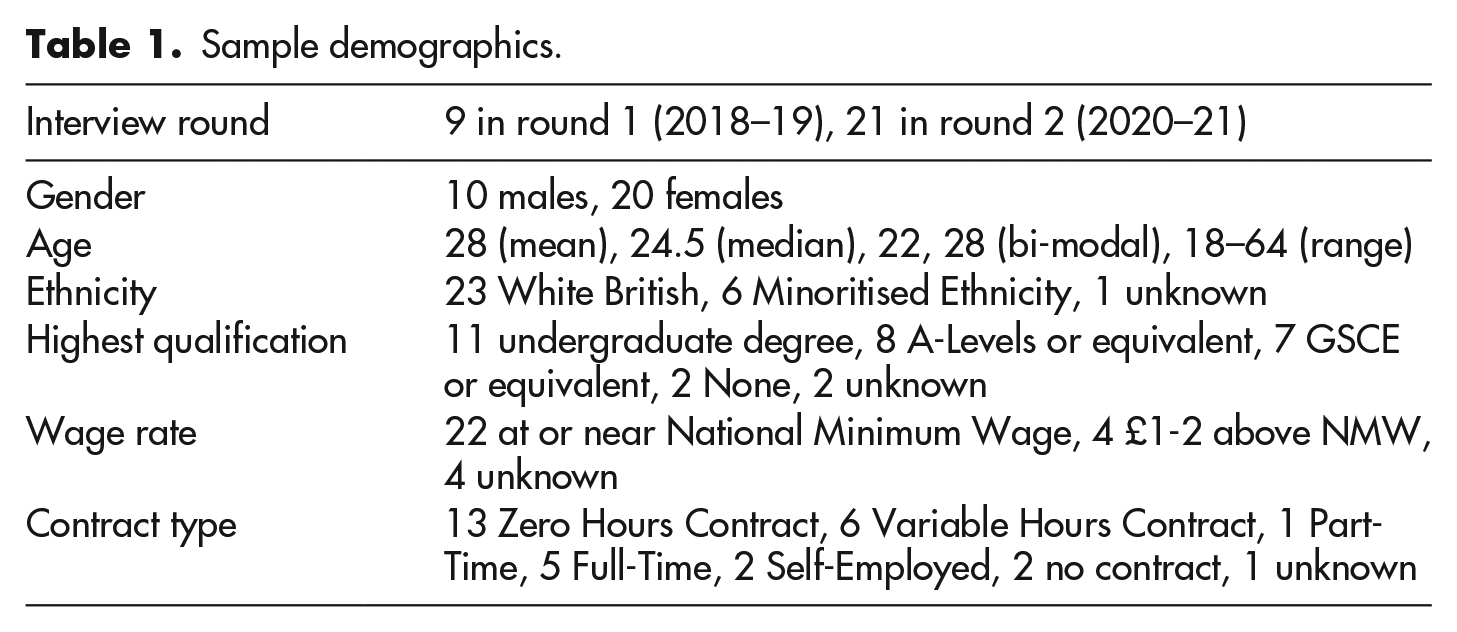
We now turn to an analysis of our empirical data. We begin by reviewing a selection of harms our sample were subject to, proceed to an exploration of the barriers to unionisation, then finally describe some of the ways those barriers could be surmounted and the harms workers faced contested.
WBHs in the hospitality sector in Sheffield
In this section, we explore three WBHs experienced by our participants, noting their impacts, and framing the harms themselves and workers’ inability to challenge them through the prisms of zemiology and CCA. Specifically, we will focus on employment insecurity (in terms of flexible contracts), wage thefts, and exposure to COVID during the pandemic. We accept that this offers only a limited sample of harms that are central to the working lives of our participants; however, they are illustrative of the different dimensions of harm described above (physical, economic, psychological and cultural – Canning & Tombs 2021: 64), and future work will explore different WBHs in greater detail (for example, routine health and safety violations and sexual harassment).
Employment insecurity
We begin our analysis by exploring employment insecurity in terms of securing enough hours to get by on. This is a critical form of harm for three reasons. First, due to the prevalence within our sample of zero-hour and variable-hour contracts (ZHCs and VHCs), and because almost all participants reported significant fluctuations in their hours of work and of not getting enough hours overall. Second, because in contrast to more nebulous conceptions of precarity it allows us to connect insecure contracts to specific forms of harm: financial, in terms of being able to make ends meet, psychological, in terms of the worries this caused, and a ‘cultural harm’ in the way they tended to pit one worker against another through competing for shifts. Third, because insecurity and competition undermine workers’ bargaining power, leading to further harms.
These experiences are fundamentally determined at the technical level of the composition of labour. At a macro-level, by the increasing corporate dominance of the hospitality sector, operating in the context of widespread financialisation and labour market deregulation courtesy of the neoliberal state. In our research, two-thirds of our participants were employed by such businesses. 1 At the meso-level, by the practices of those same businesses aimed at maximising profits in an industry where competitive pressures are high (Ioannou & Dukes 2021: 264) and the scope for increasing productivity and reducing costs is limited. Businesses therefore seek to drive down labour costs (Royle 2000: 35), whether through targets, monitoring and surveillance – one of Scott’s (2018) direct controls (pp. 77–83) – or simply through low pay, wage thefts and leaner staffing models. It is the latter that directly contributes to the employment insecurity of the majority of our sample, with Stuart (28), an assistant manager at Pub Chain A, explaining the pressures from head office: ‘They’ll never squeeze you about how much beer you’ve ordered or, you know, day to day running costs [. . .]. What the company is constantly driving down on is employment costs’.
The fundamental mechanism here is temporal flexibility, with employers increasingly unwilling to pay for labour that is excess to demand (Wood 2020: 2), which varies over the course of the day, week or year. In our sample, fast-food worker Mike (28) noted that while ‘annoying’, he has just had to accept that he will get fewer hours and be paid less over Christmas and must attempt to compensate by working more shifts at other times of the year. Kitchen worker Kirstin (23) noted a similar dynamic, evoking the psychological impacts of this insecurity for workers like herself for whom ‘it is about survival’, explaining that ‘[y]ou kind of just have to accept work when it’s available, [. . .] And you need to store up money and you can’t budget month to month, you have to budget yearly’.
But beyond these more predictable variations in hours worked, there was also short-term instability resulting from random events, peaks and troughs in demand, and the vagaries of how staffing was determined by local managers. For example, door supervisor Jim (20) explained that he has frequently ‘just [been] kick[ed] off shifts’ at short notice, when events were cancelled or even simply due to an oversupply of labour. The latter is a strategy to maximise flexibility for the business (also noted by Kirstin and fast-food worker Nicola, 54), but leads to greater competition between workers for shifts. Jim explained that as a result of losing shifts over the summer and being dependent upon the income to pay his rent, he felt unable to decline shifts now that the university term had begun: ‘I’ve pretty much got to do the thirty-odd hour week, [. . .] because the week after that, I don’t know how many shifts I will get, I don’t know if I’ll have any income that week’. Not only is this a psychological harm in terms of the worry it causes Jim, but arguably also a cultural harm in terms of the impact upon his education.
Nonetheless, the most short-term insecurity was undoubtedly experienced by those workers whose hours were cut during their shift, with bar worker Hannah (24) describing how she would be scheduled to work a late shift until 2 or 3 am but would frequently be sent home at midnight if custom dropped off (‘it didn’t really work in my favour because obviously I needed the money’). Another bar worker Alfie (22) noted the same issue, being asked to go home halfway through his shift. While he stood his ground, the consequences were cuts to his shifts going forward. This harm is fundamentally shaped by the lack of employment regulation at the level of technical composition 2 and is also implicated in a wide range of other harms through the way it limits workers’ ability to challenge managerial prerogative. This grievance did however form part of Alfie’s motivation for later joining the union.
Finally, it is worth underscoring the fact that employment insecurity was not distributed equally across the workforce, with those in managerial and (sometimes) supervisory roles granted more secure contracts or at least more hours. Sometimes cleavages around contractual insecurity also mapped on to job roles and demographic differences (overlapping technical and social compositions), creating greater challenges for collective organisation, a point we return to below.
Wage thefts
Turning to our second form of harm, we examine the prevalence of wage thefts, which refers to the myriad of ways employers are able to extract additional surplus value from workers, through unpaid overtime, not granting breaks and a plethora of other mechanisms. We foreground wage thefts because of the sheer ubiquity of this form of economic or financial harm, with Clark and Herman (2017) estimating that over two million workers miss out £3bn between them each year. The drivers of this harm are the same as those that explain leaner staffing, with financial incentives for owners and managers – the latter through bonus and incentive schemes (Lloyd 2019: 60–67) – informing a positive willingness to inflict harm at the micro level by stealing the time and money of workers.
Among our sample we had two examples of the direct use of unpaid overtime, with fast-food worker Priya (21) and former nightclub worker Awira (25) describing situations where staff would be expected to finish cleaning and/or attend a ‘team debriefing’ at the end of each shift, with the latter commenting: ‘So, it was about 16 hours a month that I wouldn’t be paid for’. More common were issues to do with sick and holiday pay (Clark & Herman 2017: 3). For the former, workers were without company sick pay and denied access to Statutory Sick Pay when their earnings were below the threshold for National Insurance contributions, again illustrating the how the regulatory frameworks of the capitalist state are implicated in the production of harms. For the latter, the practice of ‘rolling up’ holiday pay as part of the hourly wage for those on ZHCs, such as Alfie, Jim and Kirstin, led to a great deal of confusion as regards entitlement.
More ‘novel’ approaches to wage thefts included first the practice of being charged for your own uniform and safety shoes, noted by door supervisor Jim, fast-food workers Mike, Ruby (18), Aamaya (21) and Priya, with deductions taking workers under the national minimum wage. Guy (28) described it as a recurrent issue, ‘every couple of months you’d get charged again and the only way you’d get it back is you’d phone them up’.
Second, unpaid trial shifts were also an issue for hospitality workers navigating the local labour market, being noted by Jim, takeaway worker and food delivery courier Alex (31), and restaurant workers Andrew (22) and Olivia (22), with the latter explaining how her employer would collect ‘CVs’ and call in prospective workers for trial shifts at busy times of the year (such as Valentine’s Day) but without any intention of ever offering them a job. While contingent upon Olivia’s employer’s willingness to inflict harm (Lloyd 2019), exposure to this form of harm was also a product of social composition, in terms of the sheer desperation of young workers in particular, who, competing for jobs and lacking relevant experience, felt compelled to accede to employer demands. In Jim’s case he actually undertook three shifts totalling 18 hours and while he did eventually get paid, this was only due to him repeatedly contacting the owner by telephone, email and by walking into the restaurant. As Jim explains ‘[it was] a hundred and sixty quid, around Christmas time when I needed it most and I didn’t get it until January’. Most other participants never received payment for such shifts.
Third, experienced by both Jennifer (24) and Abigail (23) working for subcontracted caterers at sporting venues, was the practice of businesses failing (‘forgetting’) to uprate the pay of young workers as they reached older thresholds of the national minimum wage. This is important because again, while perpetrated by individual employers at the micro level it is facilitated by state regulation at the macro technical level of composition, and the social level; the existence of ‘youth rates’ (which a high proportion of our sample were subject to) and the lack of enforcement activity (Clark & Herman 2017: 10), coupled with the high turnover of young staff meant that such practices were unlikely to be challenged.
Moreover, while relatively serious harms could be entailed in the simple refusal of an employer to pay wages owed – the inability of workers to access sick pay or for those young people who land an unpaid trial shift at the point when their current account was empty – for most workers the often very small sums entailed in these wage thefts are more of an annoyance than anything else. However, it is precisely such ‘widespread and continuous’ wage thefts that constitute what Clark and Herman (2017) have described as a ‘sustainable strategy’ for businesses (p. 19; Ioannou & Dukes 2021: 264) and therefore such a ubiquitous form of harm.
Health and safety during the COVID pandemic
Our third harm is more ‘exceptional’ in the sense that it directly related to conditions that were precipitated by the Coronavirus pandemic, but also routine in the sense that employers’ responses to those circumstances were of a piece with their standard working practices. It therefore illustrates how routine harms, which arise from Scott’s (2018) workplace controls and are ‘akin to industry norms’ in the hospitality sector (Ioannou & Dukes 2021: 256), pave the way for more severe abuse (Davies 2020a: 82), especially in the face of contingent events. Again, for the sake of brevity, we will not be able to address employer practices in relation to furlough, redundancy and job loss during the pandemic, but instead focus on exposure to COVID-19 and the health and safety measures implemented (or not) to reduce the risk of transmission.
First, it is important to understand why our participants felt compelled to work despite widespread concerns that employers had not put in place adequate health and safety procedures to mitigate transmission. At the macro level, government shaped the technical composition of labour through the designation of some of our participants, like catering worker Sophia (51), as ‘keyworkers’. But more fundamentally through the decision to make (furlough) payments to workers through the intermediary of their employer, which effectively privatised ‘a much-needed welfare measure’ (Berry et al. 2020: 26). Given the decision of the government to not only re-open hospitality early on after the first wave (on the 4th of July – ‘independence day’) but also to incentivise custom (‘eat out to help out’), it was inevitable that many hospitality workers would be taken off of furlough, and – given their insecure contracts – asked to choose between either a physical or financial harm; expose themselves and their loved ones to the virus or be left without an income. In making a decision, fast-food workers like Nicola and Tracey (42) had to weigh up their age, pre-existing vulnerabilities and caring commitments, while Mike had to take into account his partner’s redundancy.
Mike was called back into work in late May 2020 after 2 months on furlough, and the situation was clearly a source of psychological stress. He did not feel comfortable returning to work during a ‘global pandemic’ but felt pressured to in order to increase the household income. In describing the conditions in his fast-food outlet, he noted that the size of the store made social distancing ‘impossible’ (also noted by Yezda (19) and Isabella (20)) and that it was really difficult to control the numbers of customers in the store (‘because a lot of the public just don’t care’). Another fast-food worker, Reggie (64) reported that while the company policy had dictated that there were to be two members of staff checking compliance with Coronavirus safety measures at the door, as time went on, the same financial imperatives that drive lean staffing models lead managers to ‘t[ake] them off to do table service, [. . .] to do some delivery preparation, [. . .] to do something else [. . .] and as soon as you walked away from the door, people were just walking in’. The potential for physical harm is evident, particularly given a recent deterioration in the health of Reggie’s wife.
Another example of the ways in which the organisation of work from the macro to the micro levels created the potential for COVID-related harms was that of Yezda, who felt compelled to conceal the fact that she may have been symptomatic. At the beginning of the pandemic, her partner’s brother was showing symptoms of COVID, and when she told a colleague, a manager overheard her and: [. . .] drags me into the office, and they’re, like, ‘Oh, were you joking?’ I went, ‘Yes, I’m joking, I’m joking’. [But I just said that b]ecause I need the money. I was, like, ‘I’m not going to tell them this is true because if it is, then I’m out. They’ll send me home, and you’re not going to get paid’.
Yezda’s decision-making here was clearly informed by her experience of insecure contracts (of previously losing shifts and pay) and the fact that during this period, her employer had been informing any staff who were symptomatic that their shifts would be cancelled, and they would have to self-isolate for 2 weeks, unpaid. But also, because still fresh in memory was her inability to access Statutory Sick Pay (due to being below the earnings threshold) when she injured her ankle the previous year, again illustrating the ways in which the exceptional harms of the pandemic built upon the routine harms of the sector.
In the following sections, we will explore the barriers to union organising among hospitality workers in Sheffield, and then the relatively successful efforts of workers to organise to challenge the harms they faced (including poor health and safety during COVID).
Barriers to union organising
Our argument is that the fundamental barrier to challenging WBHs in hospitality is the low levels of unionisation at the level of political composition, with only 5% of workers in the ‘accommodation and food service’ sector being in a union, compared to over 23% of all workers, and over 50% of workers in education (Office for National Statistics 2021). In part, this is a result of the technical organisation of labour, with much hospitality work relatively lacking in skills specificity and relatively easy to monitor, making workers more easily replaceable.
Moreover, the prevalence of insecure contracts – with hospitality featuring the greatest concentration of ZHCs (Koumenta & Williams 2019: 31) – is clearly enormously disempowering, as we have seen. They allow employers to exercise ‘flexible discipline’ (Wood 2020) through the granting (or not) of enough hours, at the right times. This was a point underscored by fast-food worker Guy: They were just worried about their jobs, if they’d sign up to a union or rock the boat in any sort of way they’d lose their job or lose their shifts, [. . .] you had to compete for your hours, it was having the hours taken away, that was the main [thing] it’s like, ‘fuck if I go down to four hours a week, how am I going to pay the bills, my rent is two hundred quid’.
Yet, the barriers to unionisation are not simply reducible to the technical composition of labour. Most of the workers we interviewed, in terms of political understanding and prior to their interactions with SNAP, had very little knowledge of trade unions or expectations that they could help someone in their position, as well as occasionally negative experiences of trying to access support. In terms of the latter, Olivia was told by a union that they could not help with her attempt to challenge sexual harassment because it predated her joining, while Kirstin was advised by a different union that she would need to recruit at least half of her colleagues before they would even attempt to engage with her employer. Nonetheless, representing the most common attitudes, bar worker Anthony (28) assumed – not unrealistically – that unions were more likely to represent ‘teachers or bus drivers’ than hospitality workers. Aamaya associated them with ‘doctors, nurses and teachers’, and even café worker Abigail and waitress Jennifer, both from mining families with histories of union membership, ‘didn’t know there was one that was relevant to the job I did’ (Abigail) or ‘just presumed they were a thing of the past’ (Jennifer).
These experiences are fundamentally explicable in the context of four decades of union decline and when cost–benefit analyses are more likely to direct union resources towards so-called ‘infill’ (as opposed to ‘greenfield’) organising, or towards short-term approaches that are unlikely to deliver sustainable union organisation (cf. Etherington et al. 2023: 269).
Further challenges to union organising are best understood through a CCA perspective on social composition. Broadly speaking, this relates to the employer’s ability to exploit particular demographic groups and the existence of identity-based divisions between workers. For the former, this relates to the practice of ‘recruiting acquiescence’, a term Royle (2000: 82–84) coined to describe the propensity of businesses to recruit their staff from groups in the labour market who would be more likely to acquiesce to managerial prerogative, ‘either through fear of management reprisals, through lack of interest, or through lack of experience’ (Royle 2010: 253). To a substantial extent, this explains the over-concentration of both young workers and ethnic minorities in the hospitality sector, their willingness to accept practices like unpaid trial shifts, and their fears around joining a union.
Our sample of mostly young workers, on the lower ‘youth rates’ of the national minimum wage, faced strong competition for jobs and lacked knowledge of their employment rights (Kirstin: ‘I never really considered what rights people who work hourly have, or I think I just assumed that they didn’t have many, or any’) or at least confidence in asserting those rights (Isabella: ‘It’s the worry of, am I going to get in trouble, if I start asking about it?’). This clearly fed into workers fears of joining a union, with Yezda noting that ‘people get scared. Like, I still try speaking to people at work about the union. People are like, “Oh, I’ll get fired if I get part of this”’.
On the other hand, demographic heterogeneity could be a real barrier to working-class re-composition (Alberti & Joyce 2023: 222). Two examples from our research will suffice to make the point. First, the practice of employing older workers as ‘dining area’ (‘meet and greet’ and cleaning) staff in fast-food, when the vast majority of ordinary crew members are younger. Here we found examples of older workers who were generally on more secure contracts (or at least more hours) opposing campaigns for uniform pay increases because they believed that experience should be rewarded (i.e. supported pay differentials). In the second example, pub worker Ed (22) described how gendered divisions mapped on to those of age and class background and overlapped with an occupational division, namely between older male kitchen staff from working-class backgrounds on more secure contracts and/or undertaking full-time hours, and younger female bar and waitressing staff, many of whom were students and on less secure contracts and/or undertaking part-time hours. This division was articulated onto the sexual objectification of those younger female workers by the older male kitchen staff, which reflects the societal gender order (at Lloyds macro level of analysis) and promotes bullying as a workplace control (Scott 2018: 90–92). Both are examples of where cleavages at the level of social composition (demographics) mapped onto those at the level of technical composition (job roles and contractual security) in ways that were corrosive to the forging of solidarities necessary to take collective action over the harms identified above.
Overcoming the barriers to contest harm
What is interesting to the Sheffield case is the way important campaigns to support supposedly ‘difficult-to-organise’ groups of workers have been contingent upon the activities of activist volunteers, and here we focus on the group we are associated with, Sheffield Needs A Pay Rise (SNAP). 3 This was developed by rank-and-file activists on Sheffield Trades Union Council (STUC), who wanted to tackle poor working conditions in unorganised sectors and were inspired by ideas of ‘community unionism’ (Holgate 2021; see Etherington et al. 2023 for more detail).
The campaign initially attempted to support workers into trade unions solely through volunteer organisers, but faced challenges in being able to provide consistent and timely support. As a result, STUC entered into a partnership agreement with the Bakers Food and Allied Workers Union (BFAWU) whereby STUC would crowdfund half of the costs of a full-time organiser, who would give greater coherence to the team of volunteers. BFAWU was considered a good match, given that the tactics they had drawn from the ‘Fight for $15’ campaign in the United States had produced the first strikes in UK history at McDonalds and Wetherspoons. Those tactics centred on mapping workplaces (identifying ‘worker-leaders’), ‘structure testing’ the level of workplace organisation (through petitions and pledge cards) and empowering workers by taking direct action (such as ‘marching on the boss’ to deliver a set of grievances or demands). Indeed, contrary to Cant and Woodcock’s (2020: 516) rather caricatural comparison of BFAWU to the Industrial Workers of the World, the former has proved itself to be radical, flexible and innovative.
The existence of the SNAP campaign has permitted its full-time organiser to go out ‘and meet people where they are’ (SNAP Organiser), and indeed, almost all responses to the question of how workers joined a union and became involved in the campaign began with the SNAP organiser approaching them at work or on their break. SNAP activists and BFAWU union members described the sense of ‘empowerment’ they had acquired through their involvement, helping them make new connections to their fellow workers and fostering a sense of solidarity, as described by fast-food workers Mike (‘it was just nice to feel like I was a part of something’) and Isabella (‘we all had each other’s backs’). This entailed store-level and city-wide meetings, documenting of grievances through social and traditional media (a core ethos of the campaign being that workers speak for themselves), speaking at labour movement fora across the city, and ultimately leading meaningful actions. In the process, workers were able to overcome their employment insecurity at the technical level of composition, their fragmentation at the social level and the absence of a suitable organisation at the political level.
In helping workers to create this level of organisation, the campaign was not beginning with a tabula rasa, and again a compositional perspective can help us in understanding the possibilities that existed. First, an identification of the harms of work – including those outlined above – allowed the workers to articulate them as grievances that could be organised around. These were often centred on issues of respect rather than pay (Priya: ‘The pay there doesn’t bother me but [it’s] when you’re getting treated like rubbish’). At the same time, an identification of how harms arise from the technical composition of work allowed the campaign to frame the issues as structural rather than contingent and thus requiring a collective response.
Second, in terms of social composition, this could be a barrier to collective action, but equally its bedrock; the often-dense friendship groups and camaraderie in the workplace could serve as a basis for self-organisation (Kearsey 2020). For example, Alfie explained that the initial stimulus to union organising efforts at his bar chain were post-work drinks where everyone would be ‘talking about how pissed off we are’, about issues that included last minute cuts to shifts, lost pay and disrespect from managers. Friendship networks between workers were also frequently cited as a means to overcome fragmentation across different departments, work sites, shifts and even employers. Beyond personal networks, this encompassed social media: membership of WhatsApp groups and sharing TikTok videos which highlighted poor working conditions (especially during the pandemic). These are all illustrative of practices of ‘mutualism’ (Alberti & Joyce 2023) that the successive full-time organisers – Rohan Kon and Jesse Palmer – were able to mobilise to great effect.
Third, in terms of political composition, the campaign was able to tap into pre-existing political networks in the city. These ranged from radical traditions dating back to the Miner’s Strike (Etherington et al. 2023: 266), to student activists fighting living wage campaigns at their own universities, to those engaged with the Labour Party during the Corbyn period, and – especially – those who had become involved in the housing and community union ACORN. In terms of the latter, this was partly dependent on personal connections between that organisation and one of the full-time SNAP organisers, but it also speaks to the attractiveness of their direct-action methods to a generation facing unprecedented downwards mobility, struggling with housing costs and exploitative landlords. One of the organisers was explicit in making such a connection: ‘getting [workers] to think about their landlord and their boss as part of the same class of people and one screwing you over in this way and one screwing you over in that way’.
Other workers like Kirstin did not see themselves as being ‘super political’, and those like Isabella had no prior engagement with politics at all, but through the campaign became a prominent spokesperson, making links between the exploitation of hospitality workers and Black Lives Matters. In these instances, the solidarity, training and confidence that union organisation provided was key to their political development.
In terms of the fruits of the political organisation that was built, workers were able to challenge a range of WBHs, big and small. While space prevents us from cataloguing these exhaustively, we would want to highlight three examples, which incorporate the harms analysed above. First, workers at a local ‘food hall’ establishment organised with SNAP to challenge employment insecurity and scheduling problems (related to their zero-hour contracts), as well as low-pay and poor health and safety. When they were subject to union busting through the key activists having their hours cut, STUC and SNAP coordinated a ‘community speak out’, where a wide range of trade unionists walked into the establishment every hour, on the hour, for three days, demanding the employer restore their shifts. This was successful and the workers also went on to win large pay increases, advance notification of rotas and improvements to health and safety (Smythe 2022). Second, workers at Awira’s takeaway franchise led a community demonstration outside the workplace when the previous owner left owing £10k in unpaid wages (Lazenby 2020). The workers overcame divisions related to nationality and ethnicity to create a shared collective identity, winning back the stolen wages in full. Finally, Alfie and three other workers at his bar – supported by SNAP – refused to return to work when licenced premises re-opened on the 4th of July 2020 due their concerns around inadequate health and safety. While this was a victory, Alfie worried about the employer’s ability to replace them with staff from their very many other outlets once the furlough scheme expired, and Stuart, who was part of the same action, noted the failure to involve the kitchen staff, in part because of the social and technical divides described above. For Alfie, a reflection on these issues spoke to the need to broaden organising efforts to overcome the asymmetric balance of power between the workers and a large multinational.
Conclusion
This article argues for a zemiological approach to understanding the crisis in work quality, both in terms of the rhetorical value of naming the specific ways in which workers are actively harmed for profit, but also in its ability to account for a multiplicity of harms beyond contractual insecurity. In so doing, we have reviewed the works of Scott (2018), Lloyd (2019) and Davies (2019), which have made positive contributions in terms of advancing frameworks of WBHs that go beyond ‘the legal-criminal baseline’ and help us to distinguish between different types of harms, the workplace controls that generate them and different scales at which they are produced.
Nonetheless, we have argued that while these approaches allow us to name and understand harms in the workplace, they often fail to advance our understanding of how to contest them, insufficiently accounting for working-class organisation as a factor in determining the distribution of harm, which in our view is synonymous with workers’ bargaining position. To compensate for this lacuna, we argue for a turn to the CCA framework from Autonomist Marxism. Within this framework we reformulate the questions of state regulation and business strategy (from Scott and Lloyd’s models) as pertaining to technical composition, but also bring in questions of identity and social reproduction under the rubric of social composition, and a closer examination of questions of collective organisation under political composition.
We do so not to proffer a crude reductionism whereby political organisation is read off of the technical organisation of production, nor because we want to identify a privileged class historical subject (Thompson et al. 2022: 146), homogenising blocs of workers in the process (Pitts 2024: 13). On the contrary, we would want to underscore the diversity but also the ordinariness of our sample of workers, the majority of whom had never before been a member of a workplace union and in the absence of a political intervention in all likelihood would still not have been, given what we know about the wider hospitality sector. Our application of CCA has the more modest ambition of ‘exploring the specificities of each situation’ (Clare 2020: 746) so as to understand the barriers to unionisation and the potential to overcome them.
The picture that emerges from our inquiry is one where the unionisation of hospitality workers is fraught with difficulties – in contrast to studies of platform couriers where resistance is seemingly constantly bubbling up from below (Cant 2020). These challenges are also implicated in the production of harms and they range from a lack of legislative and legal protections, to extractive business models, the dispensability of workers subject to ‘flexible discipline’ (Wood 2020), employer preferences for ‘recruiting acquiescence’ (Royle 2000) and exploiting divisions around identity, to the near total absence of initiatives from unions who are unwilling to take risks on the ‘difficult-to-organise’.
These challenges to organisation are the same factors that determine exposure to WBHs, and in the foregoing, we have made reference to the financial, psychological, physical and cultural harms entailed in routine experiences of work in the hospitality industry. Indeed, from zero-hour contracts to workplace injuries (Health and Safety Executive 2022), hospitality workers are subject to some of the highest levels of harm of any group of workers (Ioannou and Dukes’ ‘industry norms’ – 2021: 256). It is this level of exposure to harm – not because we see in them a privileged class actor – that for us underscores the necessity of organising hospitality workers, regardless of the challenges involved.
Yet the use of CCA also offers a perspective that allows us to move beyond a capital-centric (Gray & Clare 2022) model of harms as unilaterally imposed by employers and the state, to one where harm is also the result of ‘the problem of recomposing a heterogeneous and divided working class’ (Alberti & Joyce 2023: 222; Wright 2002: 134). These are not problems without solutions, and ‘community unionism’ (Holgate 2021) campaigns like SNAP – though not without their challenges and contradictions – offer new resources and the ability to experiment with novel tactics, in the relative absence of initiatives from the wider movement (Etherington et al. 2023). Examining such examples through the perspective of CCA produces powerful insights into how workers can contest the imposition of harms, even in those industries where they are endemic.
