




Abstract
Via a reflection on the evolution of a module on comparing capitalisms that I have been teaching for more than a decade, this article discusses the collective influence of new generations of students on how knowledge is (re)made. I deploy a conjunctural understanding of the term ‘generations’ in order to make sense of how students’ interpretations of the topics covered by the module have, across the 2010s, led me to increasingly question the field that was, in an earlier conjuncture, essential for my intellectual foundation and development. Their lived experiences of capitalism are more likely to be dominated by themes such as political, economic and social crises and conflicts, inequality, personal indebtedness and precarity, and in some cases activism. This has had profound and long-lasting effects on my teaching and research, discomfiting me in an ultimately beneficial way; most notably, through the recognition that future critical work on comparing capitalisms ought to move away from previous attempts to engage immanently with dominant, mainstream approaches and towards the articulation of a more confident, autonomous position. Hence, a key aspect of the development and evolution of critical research agendas occurs in and through educational exchanges in the seminar room.
Introduction
Normally, ‘state of the art’ papers focus on extant scholarship in the given discipline or field, using this as the focus for any discussion of how the discipline or field has evolved. This unintentionally neglects where the evolution might come from. Of course, some of it stems from already-established researchers absorbing newly published contributions and responding to them. However, a key element is surely the ongoing entry into Higher Education by new generations of students and into the academy by new generations of scholars. This is important, because if, for example, academics thank students in their work, it is normally in relation to a specific publication. Yet new generations possess the potential to have a more collective influence: through their enrolment on modules that they then participate in and provide feedback on, and by embarking on an academic career and making contributions in their own right. Both of these mechanisms have the potential to (re)shape research and teaching agendas, for they discomfit us by way of forcing us to confront our own comfort zones, terminologies, and assumptions. We are all former students, yet new generations are (inevitably) much less socialised into certain ways of practising their craft in their given discipline or field of study. They are less likely to take for granted established parameters, research agendas, and analyses; indeed, the definition of a doctoral research project, to make an original contribution, presupposes this.
Antonio Gramsci (1971) observed that while teachers have the function of ‘educator’, we are engaged in educational relationships in all aspects of life. In consequence, there is a constant, ongoing tension between the sedimentations of knowledge that have accumulated across our own biographies compared to those of our students – especially the more specialised forms of knowledge embodied in our (long-standing) practical activities as educators and as active participants in academic debate (see Starnes (2017) on the workings of disciplinary ‘canons’). This demands, paraphrasing Norman Denzin (2017), that tutors – the ‘experts’ – are willing to take risks when challenged by students and to move to these new generational beats (p. 14). Hopefully, this makes for healthier and more honest debates about the aims and scope of our work: how we ‘know’ our field of study is the outcome of an ongoing, mutating process of dialogical interaction between a range of voices (Freire 1996; see also Mirshak (2020) on the notion of political education).
Therefore, instead of asking what students can learn from academics and tutors, we should also consider what researchers already in the field can learn from how new generations of students respond to, modify or even reject the same area of scholarship. This is the case even when, as I have found, the new generations are still interested in similar themes. We never stop learning from our students and ought always to be ready to reflect on how we practise our craft (cf. Hamati-Ataya 2018). This article focuses on the collective influence of new generations of students, in order to make the above point most emphatically (though academic contributions by former students will be highlighted towards the end). It does so via a reflection on the evolution of a module on comparing capitalisms that I have been teaching, in one way or another, since 2009.
Research engaged in the comparison and analysis of different forms of capitalism, or the study of capitalist diversity, has been a significant growth area of social science scholarship in the 21st century. It is known by a few different terms, but for this paper will be referred to as the Comparative Capitalisms (CC) literatures. The emergence and consolidation of this field was strongly marked by a particular generational milieu – or, to put it more precisely, a particular generational experience of capitalism 1 – in the late 20th century. Clearly, this was a period of profound transformation and upheaval. However, it was also likely to be understood as such by the generation of scholars whose research agendas were most affected by the ructions which characterised this period. That leaves open the question as to whether more recent ructions could have the same effect, with later generations understanding the post-2007 world as the most salient example of transformations and upheavals in and across the global political economy. Put simply, their own generational experience of capitalism is more likely to be dominated by themes such as political, economic and social crises and conflicts, inequality, personal indebtedness and precarity, and in some cases activism. And this is not just because of observations of what has been taking place; the lived experiences would also suggest it. As Sarah Marie Hall (2019) argues, ‘[c]rises are absorbed and woven into everyday practices and relationships, often approached with an inventory of personal comparators, life experiences and memories which resonate strongly’ (p. 186).
This has had important implications, forcing me to reflect on the assumptions I hold, the scholarly and empirical reference points I rely on, and the blind spots in my worldview. The module has evolved significantly since 2009: it has become increasingly critical of capitalism and more global in scope, and consequently has produced an approach that is explicitly cross-disciplinary and which foregrounds the political nature of all forms of research (by students as well as academics). Through this process, both my teaching and my research have changed through being educated by my students on a topic which I have been researching for two decades, and I have come to question what it means to compare capitalisms in a more fundamental way.
As such, this article builds on the 2014 special issue of Capital & Class that I edited with Matthias Ebenau on critical political economy and capitalist diversity. It does so by highlighting that a key aspect of the development and evolution of critical research agendas occurs in and through educational exchanges in the seminar room. 2 More pointedly, an important conclusion is that this special issue and related publications (Bruff et al. 2013; Ebenau et al. 2013, 2015b) represent the high water mark of an ‘immanent critique’ engagement with the CC literatures. It is time to recognise that future critical work on comparing capitalisms ought to move away from previous attempts to engage immanently with dominant, mainstream approaches and towards the articulation of a more confident, autonomous position (for an outline of an alternative agenda, see Bruff 2021).
The article is structured into five main parts. First, I provide an overview of the context to my teaching experiences, in disciplinary, educational and generational terms. The subsequent three parts, covering three time periods, focus on the 2012–2020 years of teaching the module (when I was the sole tutor). The final part, and subsequent conclusion, reflect on my experiences (partly via a summary of academic contributions by former students) and on what this means for the development and evolution of critical research agendas in a more general sense.
Finally, a note about the mode of presentation below. Given the nature of the contributions that the article seeks to make, it is inevitable – and necessary – for the discussion to be significantly autoethnographic in tone and content. This is an unevenly utilised mode of writing in academic work, being widely accepted in some disciplines (e.g. anthropology) and greeted with near-ubiquitous hostility in others (e.g. political science). The approach taken below has more in common with sociological discussions: for example, Dashper’s (2015) accomplished paper on the challenges and benefits of revealing the self.
Three contexts: disciplinary, educational, generational
The CC research agenda, as it consolidated in the late 1990s and early 2000s, was dominated by the assumption that the basis for different “types”, “models” or “varieties” of capitalism are nationally specific institutions. They play a critical role in the evolution of national capitalisms, too, be it successful adjustment to new economic realities or failure to adapt through inertia. (Bruff 2011: 483)
Yet, as noted in the introduction, this was the product of a particular generational experience of capitalism: (a) the end of the Cold War leading to a shift from comparing different economic systems (i.e. socialist vs capitalist) to a focus on within-capitalist differences, (b) the growing visibility of a number of ‘developing’ countries (such as South Korea) which had been rapidly industrialising and thus posing new research questions about patterns and processes of socio-economic development, and (c) widespread debates about ‘globalisation’ and related discussions of the possibilities (or lack of) for within-capitalist differences to continue existing, especially with regard to non-neoliberal development strategies that were often considered under threat in this new global context.
A number of highly significant works were published, especially in the 2000s, that reflected this generational milieu (e.g. Peter Hall & Soskice 2001; Scharpf & Schmidt 2000; Streeck & Thelen 2005). While a number of countries were covered in these works, they focused on the parts of Europe that were capitalist before 1989 (normally under the umbrella term of ‘Western Europe’). This indicates a West-Eurocentric foundation for the CC research programme, yet it was also the case that, at the time, other world regions seemed to hold out little hope for successful, non-neoliberal strategies of development. 3 Latin America was still traumatised by nearly two decades of economic crisis and the deleterious impact of structural adjustment programmes; the notion of a socialist alternative lacked credibility after the Cold War’s conclusion; the 1997 financial crisis in East Asia, on top of Japan’s so-called ‘lost decade’, had damaged the argument that ‘Asian values’ could forge a different kind of capitalism to the West; Africa was similar to Latin America, with the added complication that it was often seen as at most a partly capitalist continent; and finally, North America plus the Antipodes were understood to be interesting cases but unlikely to move away from their neoliberal trajectories. 4 In addition, the late 1990s witnessed the launch of a multi-country European single currency and the parallel growth in popularity of the idea that there was such a thing as a European ‘social’ model of capitalism (Jepsen & Serrano Pascual 2005) – inclusive of post-socialist states preparing themselves for entry into the European Union and thus for importing ‘Western’ European policy paradigms and institutional arrangements.
Coates (2015) remarks that the focus on the possibilities for non-neoliberal development strategies meant that there was a, sometimes almost invisible but always apparent, normative commitment to the politics of (Western) European-style social democracy. Yet this commitment was also characterised by the marginalisation, and sometimes exclusion, of more critical political positions and cognate academic scholarship. For instance, the aforementioned generational experiences were coupled with the concurrent emergence, across the social sciences, of ‘new institutionalist’ research agendas. These revolved around a considerably broader understanding of the role of institutions in contemporary societies than had hitherto been the case, but they also entailed ‘the privileging of institutions over and above the wider social relations in which they sit and by which they are constituted . . . [neglecting] the contradictions, inequalities and conflicts that . . . [are] central to capitalism’ (Bruff & Ebenau 2014: 4).
Hence, the dominant, mainstream approaches to comparing capitalisms could be understood as institutionalist. Yet it also meant that, in the aftermath of the global financial and economic crises in the late 2000s, and more regionally specific manifestations such as the Eurozone crises in the early 2010s, it was striking to observe that ‘even if “capitalism” and/or “crisis” have once again become terminological reference points in parts of the literature’, these contributions move ‘swiftly from the crisis itself to varied responses to the crisis’ (Bruff & Ebenau 2014: 4; original emphases). Moreover, the genesis of the literatures in and through Western European case studies tended to mean that when the debate moved to consider other world regions, it was frequently as an ‘export’ of already-existing typologies and conceptualisations of institutions rather than as an open-ended dialogue with the complex specifics of the ‘new’ empirical possibilities (e.g., see Feldmann (2007) on Central and Eastern Europe; Schneider (2009) on Latin America; Xiaoke Zhang & Whitley (2013) on East Asia). As such, the comparison of different capitalisms usually took place against a particular epistemological and methodological backdrop.
The next context to take into account is the educational. Across the 2009–2020 period, I have taught the module mainly at postgraduate level, in Politics departments that nevertheless often attract students on either different degree programmes (e.g. in the wider School of Social Sciences) or who studied a different subject at undergraduate level. On no occasion has the module been compulsory, meaning that one could infer that students enrolling on the course have been more likely to have an interest in at least some of what the module covers. Furthermore, there were no pre-requisites: students did not need to have taken a prior course in order to enrol for mine. The module has been delivered at two Higher Education institutions in the United Kingdom: for a brief period, in 2012–2013, it was a final year undergraduate course, but due to this university’s considerably smaller provision at taught-postgraduate level (at least, in the social sciences), the aims and scope were similar to what has been the case at my other institution (where I have worked for the rest of the time). The below discussion focuses on the 2012–2020 period, because from 2009 to 2011 I was a temporary member of staff and the course was team-taught in these years. This meant that not only was I never sure if I would be teaching on the course in the following academic year, but even if I had been a permanent member of staff then I would not have been able to engage as directly with student feedback as compared to 2012 onwards. Since then, I have been in a permanent position and have always been the course convenor and sole tutor: the 2012 iteration of the module reflected what I had learned from my 2009–2011 experiences, but as detailed below, things substantially shifted thereafter. From 2012 to 2020, the modules consisted of 10 weeks of teaching, in the form of a 2-hour seminar each week (8 weeks of 2-hour seminars in 2013–2014 and 2014–2015), with the last of these sessions focusing on student views on the module and on the themes it has addressed. Assessment has primarily been a written essay, with the secondary assessment being either a review of texts (2012–2013; 2017–2020) or presentation (2013–2016). Presentations were compulsory for a time, and I was pleased to be able to remove them from the module when the opportunity arose (see below for what I replaced them with from 2017 onwards, and why).
It is not possible to discuss in detail the composition of the student cohorts. This is partly because it varied considerably over time – for example, overall, female students have usually been in the minority and markedly so in some years, but on a couple of occasions there has been parity. In addition, the presence of international, and indeed non-European Union, students has grown over time, occasionally becoming the majority on the course, but again with significant changes from year to year. Finally, a factor for a minority of students at postgraduate level has been the composition of the researchers in my department, meaning that there is an inevitable element of self-selection because of the correspondence between degree programme and student interests. At the same time, I have been teaching the module for long enough to be able to observe, across different cohorts and students from different biographical trajectories, underlying patterns of engagement with the module. One point of note, though, is that the students who have engaged most extensively with ‘politics of knowledge production’ or ‘sociologies of the discipline’ themes have almost always been women; as a result, they were more likely to question whether more institutionalist and more critical approaches could be taught together on the same course. This speaks interestingly to broader discussions about, for instance, masculinity and knowledge hierarchies (e.g. Ackerly & True 2010; Connell 2005; Harding 1991).
The final context to consider is the generational, and connects to the socio-economic locations and experiences of students across a number of backgrounds. What I discuss below highlights the malleable essence of the term ‘generations’. The notion of ‘generations’, and wider, related questions surrounding temporality, have been the subject of numerous classic commentaries (e.g. Adam 1990; Koselleck 2004; Mannheim 1952; Pilcher 1994). Yet a marginal aspect of these discussions is that the term is inevitably politically and socially charged, even if this is often acknowledged in well-known aphorisms such as Lenin’s ‘there are decades where nothing happens; and there are weeks where decades happen’, or former British Prime Minister Harold Wilson’s observation that a week is a long time in politics. In other words (and paraphrasing Marx), while the circumstances we live in are not of our choosing, the ways we live in those circumstances are of material consequence. Think about what has happened in the 2009–2020 period, giving just a few examples: the Great Recession of the late 2000s and supposed end of neoliberalism; the Eurozone crises and associated rise of anti-austerity movements; the Arab uprisings and, in many cases, their brutal repression; the Syrian war, and related rise to prominence of Islamic State; a resurgence of feminist activism and masculinist/misogynist backlashes against this; dramatic reassertions of radical Right politics, most visibly in the United States and Brazil but also elsewhere; the present and future scenario of climate catastrophe; the emergence of the COVID-19 pandemic; and the waves of anti-racism protests (most recently in the wake of the killing of George Floyd).
A more appropriate understanding of the notion of generations, then, is one that is closely tied to Stuart Hall’s discussions of ‘conjuncture’. For Hall, in conversation with Doreen Massey, a conjuncture: is a period when different social, political, economic and ideological contradictions that are at work in society and have given it a specific and distinctive shape come together, producing a crisis of some kind . . . A conjuncture can be long or short: it’s not defined by time or by simple things like a change of regime – though these have their own effects. As I see it, history moves from one conjuncture to another rather than being an evolutionary flow. And what drives it forward is usually a crisis . . . Crises are moments of potential change, but the nature of their resolution is not given. (Stuart Hall & Massey 2010: 55)
More specifically, and with considerable relevance for this article, Hall later comments that ‘[c]apitalism may, at the simplest level, be one thing, but it has its conjunctures too, and the analysis requires this kind of historical specificity’ (Stuart Hall & Massey 2010: 65). This is because: What is on the surface, what constantly appears, is what we are always seeing, what we encounter daily, what we come to take for granted as the obvious and manifest form of the process. It is not surprising, then, that we come spontaneously to think of the capitalist system in terms of the bits of it which constantly engage us, and which so manifestly announce their presence. (Stuart Hall 1996: 38; original emphasis)
This is the same for educators as it is for anyone else, especially when our biographical trajectories lead us to take for granted particular experiences of capitalism that our students do not. Therefore, a significant part of the below discussion indicates the differences between my own socialisation via one conjuncture – the period between the end of the Cold War and the onset of the Great Recession – and my students’ worldviews being primarily shaped in and through another, later period. As I outline in the next section, this difference exposed my critiques of the CC literatures as unnecessarily tentative and in some respects apolitical, and had long-lasting and profound effects.
A hybrid approach (2012–2014)
As noted above, in 2012 I had the chance to design a module on the topic from scratch. The module embodied a hybrid approach, which reflected my more critical stance vis-à-vis the field compared to the 2000s, especially given its disappointing response to the previous years of crisis (contrast Bruff 2008 with Bruff & Horn 2012). Yet, and indicative of the field’s crucial role in my intellectual foundation and development, I still held out hope for what future CC scholarship might bring. This can be most effectively observed in the module’s structure, and the readings required for each week (see Table 1). The opening 3 weeks were more introductory and conceptual-methodological; the next 4 weeks considered case studies, with two European countries in the first two seminars (the UK and Germany) followed by weeks on the ‘export’ of the debate to Central and Eastern Europe and Latin America; the final 3 weeks focused on critique, in turn covering feminism, Marxism, and in the concluding week, my first tentative questioning of the CC field in the act of teaching about the same field.
Structure of module and key readings (2012).
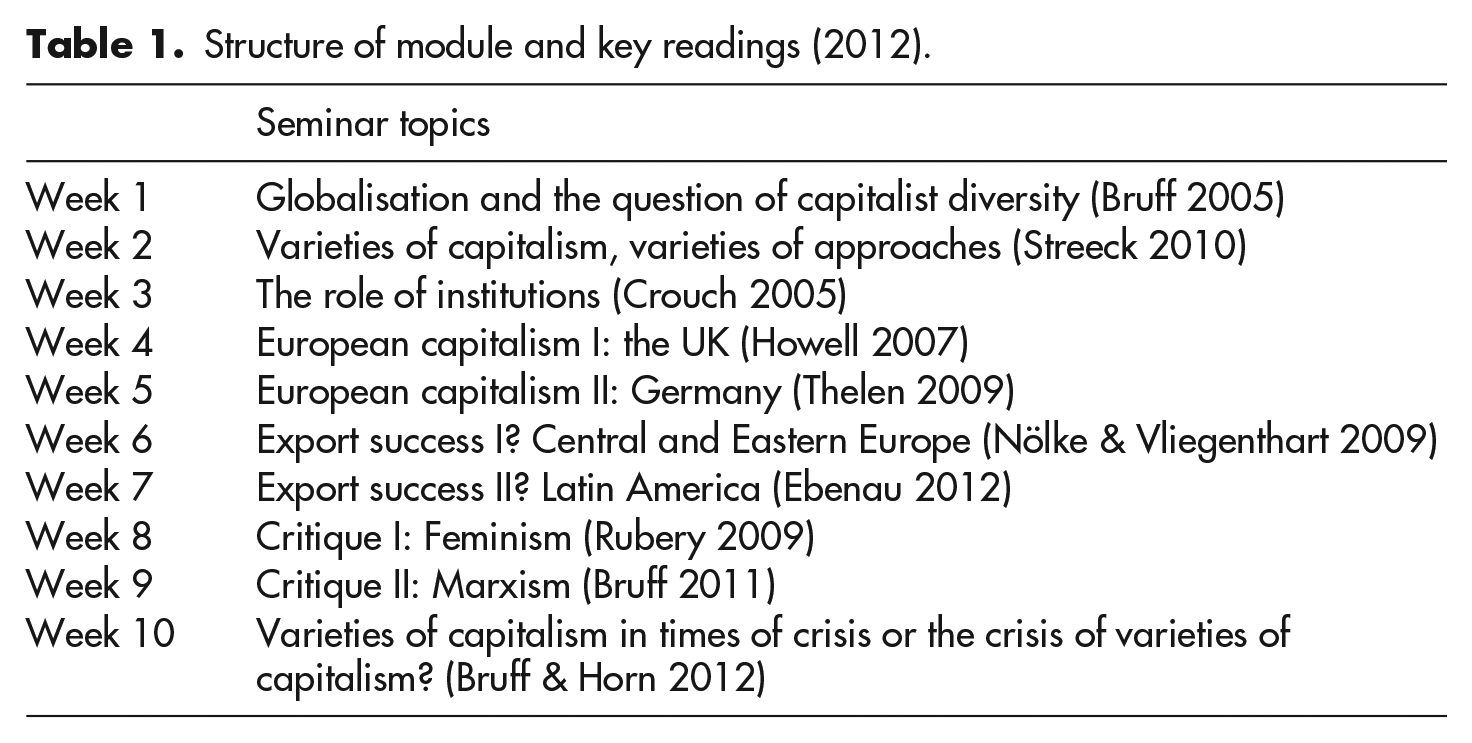
The effect was to ‘flatten’ one intellectual hierarchy in debates about comparing capitalisms while largely retaining another, mirroring my own published arguments (cf. Bruff 2011). Although the presence of the narrow form of institutionalism represented by the paradigmatic Varieties of Capitalism (VoC) framework was considerably reduced compared to the 2009–2011 period, apart from the final 3 weeks the required readings were almost all from within an institutionalist paradigm (e.g. Thelen 2009). Indeed, the first assessment – a critical literature review – contained only institutionalist texts (Crouch 2005; Peter Hall & Gingerich 2009; Schmidt 2008). I took this approach, because I felt that it was not enough to criticise institutionalist scholarship by virtue of these authors not, for example, being feminist or Marxist and thus being reductive; instead, I wanted students to engage with institutionalists on their own terrain, asking if this work realises its own goals and ambitions, before moving (if desired) to other, more open-ended and critical analyses. This also reflected the approach I took in my research and how I engaged with CC scholars I disagreed with (e.g. Bruff 2008). Nevertheless, despite these best intentions, the effect was to entrench in most students’ minds the notion that critical contributions were marginal to the debate and therefore not essential for successful completion of the module. Only a minority considered such scholarship as more important than this.
What changed things was the class of students in semester one of the 2013–2014 academic year. This time, a significant majority of the students were already critical of capitalism in one way or another. I realised that they had become interested in themes covered by the module either during or after the tumultuous years from the late 2000s onwards, and thus their ‘normal’ was my ‘crisis’. For instance, all in the class could understand the importance of the VoC intervention, but all were also convinced that this intervention had been rendered obsolete by the post-2007 period. Hence, by default, the themes of crisis, critique and the (in)appropriateness of exporting the debates on capitalist diversity beyond Western Europe were present in the seminars from the beginning. Intriguingly, too, the ‘what kind of capitalism a country could/should be’ notion, central to CC literatures, was explicitly challenged by some students who wanted to discuss possible future varieties of post-capitalist societies and not just non-neoliberal alternatives; hence, the ‘within-system’ comparison that had propelled post-1989 scholarship was now being questioned. 5
All of this had a transformative effect on my teaching and research in future years. In terms of the symbiotic relationship between teaching and research, it is important to note that while the desire to modify significantly the module was informed by the new generation of students, a single text can prove to be an effective facilitator of such change. Fortunately, by the end of 2013 a book proposal had been accepted for an edited volume on ‘new directions’ in CC research, and its final form/content (in the shape of Ebenau et al. 2015b) had this new generation in mind. This text – along with the related publications mentioned in the introduction (such as the 2014 special issue of Capital & Class) – has also shaped disciplinary discussions in ‘research’ terms, generating multiple citations for the collection as a whole and for many of the chapters, and being the basis for a debate on the notion of ‘new directions’ (Bruff & Ebenau 2017; Šitera 2015). In other words, and as I discuss later in greater depth, students contributed to the (re)makings of not just the module but also of knowledge in the field.
New paths taken (2015–2017)
One criticism from students in 2013 was the absence of a week on East Asia and especially China. Previously, I had not included such a week because scholarship on these countries tended to take the 1997 financial crisis as the analytical starting point. To students who were small children at the time, this seemed out of date but not enough of a reason not to cover the region. A week on East Asia was duly added to the course, but it was not the most noteworthy change, for the module’s content had shifted significantly. The required readings no longer had various forms of institutionalism as their centre of gravity, but instead these contributions were juxtaposed directly with the emergent literatures seeking to make sense of the previous years of multiple crises (see Table 2). This also reflected my increasingly distant positionality in relation to the field as I understood it at the time, which had been nourished by my interactions with students in 2013–2014 (e.g.,Bruff 2015; Bruff et al. 2015 6 ).
Structure of module and key readings (2016).
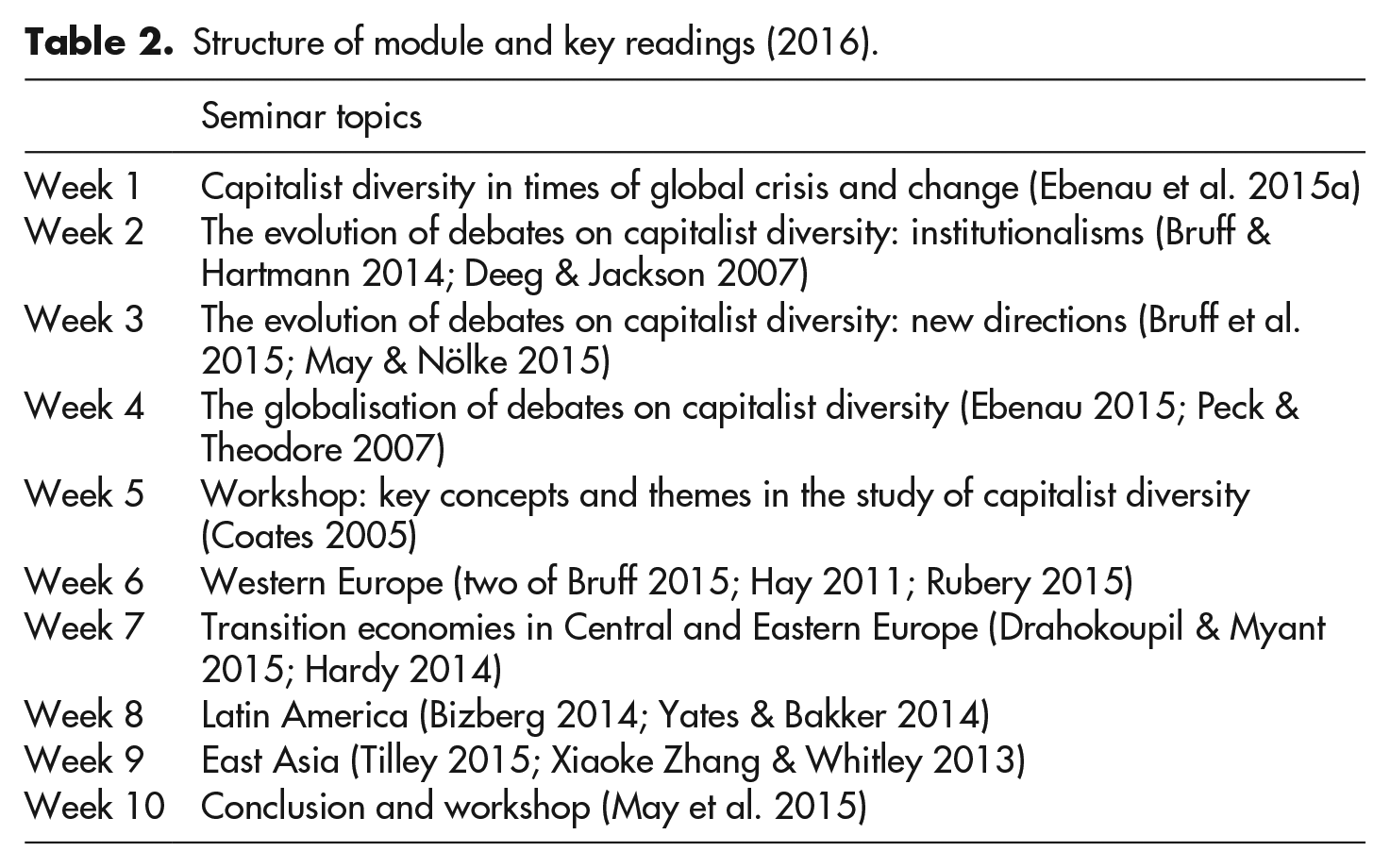
For instance, week 2, on institutionalist perspectives on capitalist diversity, contained required readings on what is at stake when studying institutions (Deeg & Jackson 2007) and a text which explicitly raised the possibility that institutionalists and more critical scholars might have little in common apart from a shared interest in the study of capitalist diversity (Bruff & Hartmann 2014). Furthermore, all seminars now had two required readings, meaning that a more institutionalist and a more critical text were placed alongside each other rather than in a hierarchy (e.g. required and further reading). In consequence, the ‘critique’ seminars were removed, because critique was now ever-present – regardless of whether the student understood themselves as institutionalist or critical – and there was an increasingly active crossing of disciplinary boundaries in the search for readings which matched this ambition. Not just economic/political geography (where there had been engagement with CC scholarship (e.g. Brenner et al. 2010)), but also critical development studies, urban studies, social policy, and social/cultural theory began to be represented in the reading lists.
The new form and content of the module was considerably more effective than hitherto in achieving the aims of engaging with not just the case studies included in the module but also with the CC research agenda itself. However, and perhaps unsurprisingly, these changes were productive of new tensions which, for the first time, related primarily to the implications of being critical rather than of being institutionalist. In a way, they can all be found in a trailblazing paper by Lisa Tilley (2015). Tilley grounds her approach in postcolonial and decolonial thought, and argues that to compare capitalisms is to potentially mask what she terms the varied geographies of coloniality. Therefore, it is not just a question of how to study a case – which, as Tilley shows, means that our understanding of, for instance, Indonesia needs to take account of the unequal relations between metropolitan accumulation and rural dispossession – but also of how to be a capitalist diversity researcher full stop. A highly salient example given is the continued centrality of the national state to how capitalisms are compared, even though many different ‘units’ of analysis avail themselves to us (see also Peck & Theodore 2007). This is of importance when considering the increasingly global nature of the CC research agenda: surely one should be able to do more than simply include a greater number of countries and implicitly assume (as Feldmann (2019) does) a general logic of equivalence, given the vastly different ‘national’ trajactories as shaped, for example, by past and ongoing processes of (neo)colonialism?
Four consequences flowed from the new-look module, student responses to it (and especially to the Tilley paper), and my own reflections on the changes. First, some students asked about the absence of Africa given the global framing of the module (which itself was taken from the assertion of Ebenau et al. (2015a: 3) that the study of capitalist diversity needs to have ‘a genuinely global horizon’). I had found it difficult to source literatures on Africa that could connect to the CC research agenda – which, to a degree, I still clung to in spite of my mounting doubts – but this had become a persistent question. Second, the ‘critical’ readings tended to privilege feminism and especially Marxism over postcolonial and decolonial approaches. Third, the ‘national state’ challenge raised by Tilley meant that greater spatial and scalar diversity in the readings was required, even if under the guise of the study of a national state (e.g. Jun Zhang & Peck (2016) on China).
Finally, there was a need to make more visible the politics of comparing across a global horizon – not just in terms of how to compare cases in different parts of the world, but also with regard to how we produce knowledge about capitalist diversity, and thus capitalism, in a more fundamental way. I had already been informally recommending the work of Heloise Weber (especially Weber 2007) to students who asked about this: the tendency of those students to then excel on the module, combined with my growing concern that other students were only addressing the ‘knowledge production’ question in a theoretical manner (i.e. institutionalist or critical), led to a reshaping of the module. Again, these engagements with students reflected, and informed, my research on these themes (see Bruff & Ebenau 2017).
The politics of comparing capitalisms in a global setting (2018–)
Most visibly, a week on Africa was created: this was achieved by merging the weeks on Western Europe and Central and Eastern Europe, and was suggested by two doctoral researchers in my department, both of whom had previously taken the module, that I had asked for advice. 7 Therefore, the ‘Europe’ focus in the CC literatures was diluted further, with the only remaining indication of this region’s dominance being that it was the first to be considered. This was intended to reflect not a Eurocentric bias but the desire to indicate to students how the debates about capitalist diversity sequentially took in different world regions from the early 2000s onwards (Europe is followed by South America, East Asia, and then Africa). In turn, literatures on African capitalisms had since the early 2010s started to discuss more extensively the renewed possibilities for non-neoliberal and/or state-directed development strategies (e.g. Harrison 2016; Ovadia & Wolf 2018), meaning that connections could be made with especially the weeks on South America and East Asia, where these themes were also highly visible (albeit in a range of ways – e.g. Grugel & Riggirozzi 2018; Kalinowski 2015).
However, a consequence was the need to ensure that students did not simply learn descriptively about each world region. Taking in one world region each week is challenging in itself, meaning that a common thread through the different weeks would be important for the module. In response, a ‘critical review’ assessment was introduced in place of group presentations on one of the world regions (which had never been popular). Three texts were to be discussed, but especially Weber (2007), on what is at stake – analytically and politically – when comparing capitalisms.
8
Weber (2007) argues that what she terms the formal comparative method – in effect, the CC method – takes as a given, rather than enquires into, the social-relational constitution of all units of analysis (national states or otherwise): it is premised upon core assumptions which – even if inadvertently – reproduce the dominant framework of inclusion and exclusion, and thus also the practices they engender. At the same time, it has the consequence of rendering invisible social struggles which have been constitutive of social and political life . . . a more appropriate approach would be one premised upon more inclusive concepts of the political and of politics. (p. 561)
Weber’s critical-theoretical sketch of the alternative, a methodological framework inspired by Philip McMichael’s (1990) notion of ‘incorporated comparison’, is too brief to provide a template for students. Yet this is not a problem (and indeed could be empowering), for students are encouraged to think creatively about this. More to the point, Weber’s text forces into the open the inevitable fact that all researchers have to make practical decisions about what to focus on – and, by definition, what not to focus on – in their work. Given no research agenda can ever cover everything, and given the manifold complexity of the world, these decisions ought to be understood as intrinsically political – Weber (2007: 568) terms this the ‘politics of the ‘visible’/‘invisible’’. This is a challenging task for students and academics alike, and also for myself as the tutor. I recognised that there was a need to be explicit about what analytical themes I took to be important in the study of the different world regions, as a means of establishing mechanisms to hopefully ensure that students understood the regions in relation to each other rather than as standalone and discrete parts of the world. In consequence, I had to make my own political choices about how to present the regions – which included the essay question for that particular region, the required/further readings for each week, the texts that would be required readings (another signal to students about the debates), and so on. Table 3 shows what I did in 2019, offering students two key analytical ‘entry points’ into the world region; regarding the essay questions, they were linked to the entry points but were framed so as to permit a wide range of possible answers.
Structure of module and key readings (2019).
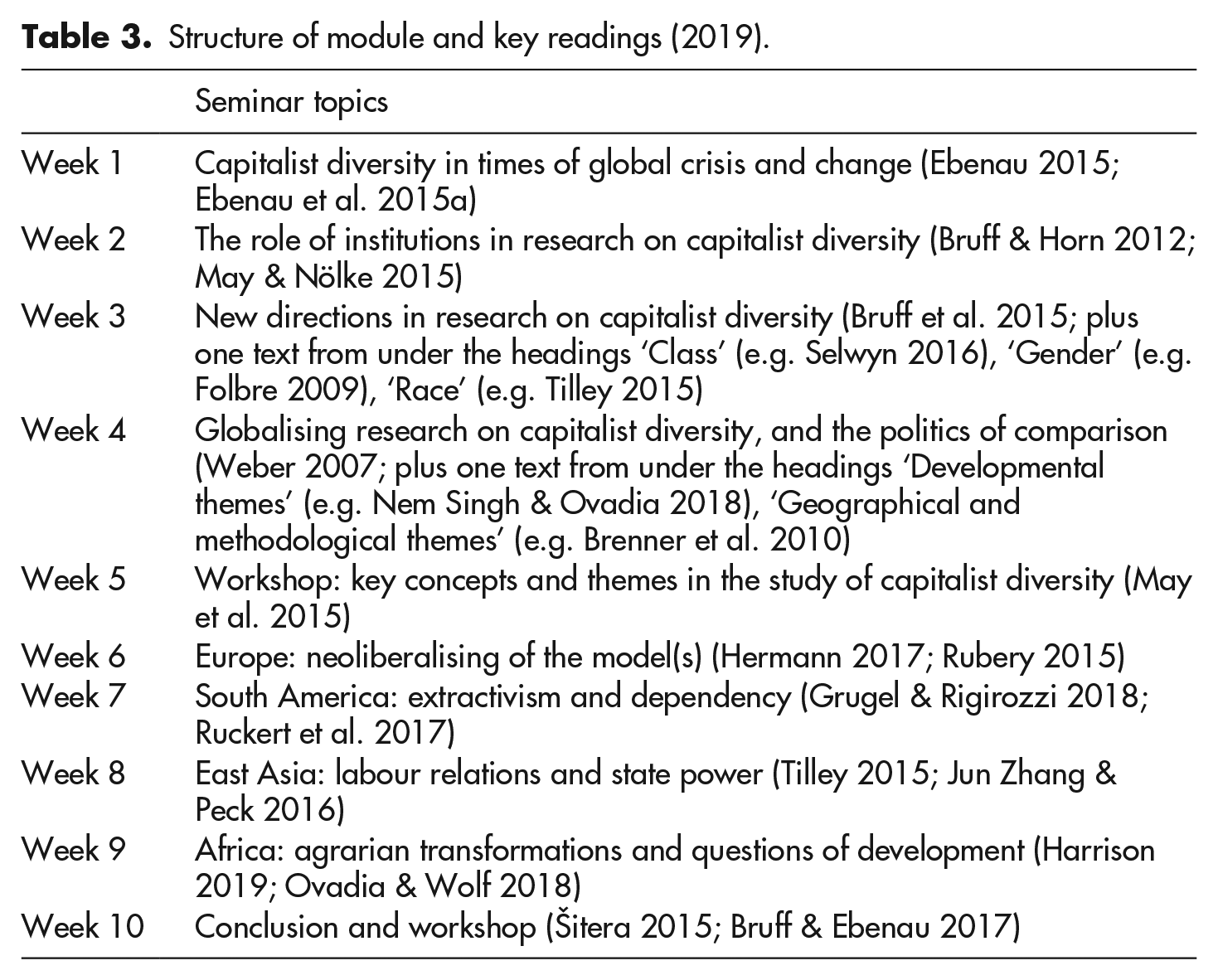
Perhaps inevitably, some students contested these entry points (e.g. why not use workfare for Europe or (neo)colonialism for Africa?). These can potentially be addressed with a few changes to the framing of the different regions and/or to which cases are cited in the readings. 9 More fundamentally, and more difficult to respond to, were the ‘state of the art’ concerns which revolved around the implications of papers such as Bruff et al. (2015), Tilley (2015), and Weber (2007) for the entire enterprise of comparing capitalisms. Put simply, some students queried whether there was a need for the institutionalist literatures and associated research agendas to be in the module at all, to the extent that the possibilities not for a range of ‘progressive’ forms of capitalism but a range of post-capitalist alternatives should be more integral to the module (building on discussions of buen vivir in the week on South America (e.g. Escobar 2010)).
Conversely, others were still interested in what institutionalist approaches could offer, but were oriented towards rather different aspects of capitalism than the classical CC contributions. For example, a number of students preferred to operate at the urban or sub-national level of analysis – that is, they concurred with the ‘container’ critique offered by Brenner et al. (2010) of the national state focus in the CC literatures; more again were interested in the operations of labour markets, but instead of, for instance, a sectoral analysis of manufacturing industries (as per much CC work), they were instead more focused on cross-cutting themes such as precarity, workfarism, household debt, and the platform/gig economy; and yet more rooted their understanding of non-neoliberal alternatives not in CC scholarship but in critical development studies research on the developmental state (e.g. Wade 2018).
Clearly, the module has undergone a significant evolution in the course of a decade, with the concerns raised by students also changing during that time; indeed, I pepper my contributions to the module with references to how the course has evolved and why I made those decisions, plus to how student engagement has shifted as well. In one sense, this is to be expected of any module but especially a political economy course, given the ructions and crises that have characterised global capitalism during this period. However, there is more to it as well, for the evolution has not just forced me to reflect on my own teaching approach; it has also raised questions about the CC field itself and, more broadly, about how we compare capitalisms full stop.
Lived experiences of capitalism and student-led (re)makings of knowledge
Is there a possibility that I would have modified the module in a more critical, global direction even without engaging with student feedback? Perhaps, but I think that my own ways of seeing and understanding are only part of the story. The changes that occurred in my worldview from the early 2010s onwards, towards a more openly critical and distanced perspective, can be traced to my own observations of the relative failure of the field to respond effectively to a period in history dominated by discussions of multiple crises, but this was also because my students, informed by their own generational experiences of capitalism, increasingly forced me to confront the possibility that the problems in the literatures were more endemic and insurmountable than I thought. It is perhaps unsurprising, then, that I explicitly and fully articulated this possibility for the first time when co-authoring a paper with a former student. 10
While it has not been the focus of this article, some former students have embarked on an academic career as well. It is thus interesting to outline briefly what they have argued in their own contributions: this is still emergent, but instructive nevertheless. Earlier students on the module have often taken an analogous approach to myself, in that they adopted an ‘immanent critique’ orientation to CC literatures and research questions as the starting point for their own work (Ebenau 2012; Lux & Wöhl 2015). However, newer publications indicate a growing willingness to depart from the CC literatures: for example, through the specification of a research agenda informed by critical development studies and geography (e.g. Ramiro Fernandez et al. 2018), via a growing focus on challenges to the ‘natural’ coupling of capitalism and democracy (Lux 2019), or regarding the notion of radical transformation itself (Silver 2018).
This increasingly holistic, cross-disciplinary and methodologically reflexive approach is reflected even more strongly in more recent students’ work. Their contributions have been more diverse, yet still connected to the module that I taught them – indeed, in a private communication one of them said that their PhD thesis had its origins in the essay written for the module. For example, the politics of labour – taken to mean labour as a social/political actor (e.g. as a trade union) and labour as the source of wealth in capitalism – has taken research to the study of grassroots resistances to economic crisis and of conflicts over public sector restructurings (Las Heras & Ribera-Almandoz 2017; Haines-Doran 2019). Moreover, work on European capitalisms has argued that the notion of ‘imbalances’ is not (as per the CC perspective) restricted to an abstracted notion of ‘the economy’ but is inscribed into governance arrangements which exacerbate crisis tendencies while portraying themselves as corrective of such imbalances (Hansen & Lovering 2019). More fundamental shifts have informed the research of Koutlou (2019), where an explicit connection is made between states and households in the context of utility indebtedness and crises in social reproduction. This work is informed by critical geography and feminist political economy, and rejects standard (academic and popular-cultural) portrayals of Southern Europe for their neocolonial framings.
What I find most interesting about these contributions is the extent to which, even though they reflect a ‘Europe’ centre of gravity that the CC literatures have often been characterised by, all reject key tenets of the CC research agenda. Most notably, they take as central to their work the need to: draw on a range of disciplinary sources; avoid taking for granted that their object of study (or unit of analysis) will remain stable over time; consider the ways in which the object of study could be transformed by crisis, social/political agency, and so on; and finally, remain aware at all times of the politics of research, be it when comparing and analysing, or when deciding on what to include in or exclude from the project. In this respect, their contributions crystallise my less publicly visible yet highly significant teaching experiences over the course of the 2010s.
Therefore, my students have clearly influenced the way I see the literature (Bruff & Ebenau 2017). They have given me more confidence, in other research, to push harder than in the past to question established assumptions, draw on other disciplinary and theoretical resources more explicitly, and feel less encumbered by extant ‘state of the art’ constraints, when working with like-minded scholars rooted in different traditions and literatures (Bruff and Starnes 2019). On the other hand, these experiences have also enabled me to appreciate that something which has animated much of my work and endeavours over the last two decades, the study of capitalist diversity and the enterprise of comparing capitalisms, is now likely to fracture into different lines of enquiry. And this should be understood in positive terms: while I am sure that some will find future institutionalist contributions most interesting, I look forward to reading, and learning from, the creative and exciting publications that emerge out of alternative and contrasting scholarly endeavours. This work is more likely to be critical of capitalism per se in the act of comparing different forms of capitalism, and also to forefront the intrinsically political nature of all research in a disciplinarily rich manner.
These developments ought to be viewed as beneficial, even if a little discomfiting on a personal level for myself, for the ‘state of the art’ is being remade in the process. While earlier attempts – including my own – to engage immanently with dominant, mainstrean approaches are important for telling the story of how we reached this point, they are now of less relevance when looking ahead to future debates and discussions. In other words, the ‘state of the art’ can now move to these new generational beats and articulate a more confident, autonomous position (cf. Bruff 2021).
Conclusion
The emotional and temporal labour I have invested into this area of research means that I still instinctively feel that I learned much from creative forms of institutionalism that offer the fine-grained analytical detail that more critical, holistic research has sometimes been less able to do effectively. Overall, though, and this is the main lesson to take away from authoring an article such as the present one, new generations of researchers will invest their emotional and temporal labour in different ways. All of this means that I am much more comfortable than even a few years ago with the notion that the CC field of study, which formed an essential basis for my intellectual foundation and development, ought to fracture into different areas of enquiry and thus become unrecognisable to my younger self. For example, in Bruff et al. (2015) a potential fracture was invoked as a warning rather than as an opportunity, whereas the latter is now my view.
What does this mean, then, for the development and evolution of critical research agendas in a more general sense? I offer possible conclusions. First, it shows how forms of knowledge production can evolve in and through their contestation in the seminar room – not just through the impact on individual academic biographies, but more collectively on the field as a whole. While I refer to my own experiences in this article, other examples can also be found – for instance, the Rethinking Economics network, which was influenced by the emergence of the Post-crash Economics [student] Society at the University of Manchester in the early 2010s. Regarding what I discuss in this article, my most recent intervention argues that CC contributions to discussions about comparing capitalisms should now be understood as of marginal significance (Bruff 2021). Undoubtedly, institutionalist analyses will continue to exist, but their role in producing relevant knowledge about capitalist diversity is increasingly limited. Second, and following on from this, we ought as educators to be more aware of the possibilities for ‘new generations’ of students to emerge quite unexpectedly, responding creatively to the socio-historical circumstances that they find themselves in. This demands that we move to these new generational beats, potentially discomfiting ourselves in the process of reflecting on the sedimentations of knowledge that have accumulated across our own biographies compared to those of our students. And finally, if we are engaged in educational relationships in all aspects of life, then the seminar room is one of the most important sites through which – and in which – we ‘move back and forth between the personal and the political, the biographical and the historical . . . [in order to] . . . teach one another’ (Denzin 2017: 14) about a world which needs transforming.
Footnotes
Acknowledgements
This article could not have been written without the constant playing of two outstanding musical trilogies: No Image-Optimist-Why Aren’t You Laughing? by Gold, and Pain Cleanses Every Doubt-Converging Sins-The Inextricable Wandering by Ultha. Moreover, it can be read in tandem with Bruff (2021). An earlier, differently framed version of the paper was presented in the Critical Political Economy Network sessions at the 2019 European Sociological Association conference in Manchester, UK. Thanks to those who asked questions at that event, and I am grateful, too, for feedback on the draft from Andreas Bieler, Nagore Calvo Mendizabal, Jana-Maria Fey, Chris Hesketh, Nadim Mirshak, Reecia Orzeck, Burak Tansel and Angela Wigger, plus from my former students Mark Coles, Andrew Eggleston, Stephanie Gillibrand, Tom Haines-Doran, Rasmus Hovedskov Hansen, Aliki Koutlou, Jon Las Heras, Julia Lux, Anna Murphy, Alexander Riley, Daniel Silver and Konrad Sobczyk. Previous conversations with former students Mila Budeva, Matthias Ebenau, Caroline Gusman Agnelli, William Harvey, Harriet Salem and Oliver Westerman were valuable, and I am indebted to Victoria Basham for encouraging me to write an article about these themes. Inanna Hamati-Ataya not only commented on the first version of the paper but a conversation with her also gave me the impetus to revise it; in a different way, Owen Worth proved to be a similar catalyst. Kathryn Starnes provided excellent feedback on both drafts. Finally, thanks to the referees for their comments.
Declaration of conflicting interests
The author(s) declares no potential conflicts of interest with respect to the research, authorship and/or publication of this article.

Notes
Author biography
References
Supplementary Material
Please find the following supplemental material available below.
For Open Access articles published under a Creative Commons License, all supplemental material carries the same license as the article it is associated with.
For non-Open Access articles published, all supplemental material carries a non-exclusive license, and permission requests for re-use of supplemental material or any part of supplemental material shall be sent directly to the copyright owner as specified in the copyright notice associated with the article.
