




Abstract
Drawing on a case study of algorithmically controlled manual labour in German manufacturing and delivery logistics, this article develops the concept of cybernetic proletarianization. It does so by joining an empirical analysis of labour processes with theoretical class analysis. Thus, it reconstructs Marx’s understanding of technical proletarianization as a dialectic between expulsion and reintegration of living labour in production processes. In the cases researched here, a qualitative and quantitative expulsion of living labour could be observed in different forms: First, deskilled flexibilization via digital instructions on working steps; second, a cybernetic mode of work intensification that is based on a permanent digital evaluation of the labour process; third, data-based automation, which builds on the data collected from the labour processes. This expulsion is counterweighted by a process of reintegration of devaluated living labour due to new highly labour-intensive forms of production and distribution, which are enabled by algorithmic work control. However, these processes are highly conflictual, resulting in different ‘technopolitics from below’, in which workers influence or even disrupt the processes of cybernetic proletarianization.
Keywords
Introduction
Digitalization is the major carrier of hope for most highly developed economies to overcome secular stagnation of growth rates in production. It is widely acknowledged that this trend transforms labour processes in nearly every sector. This article examines how digitalization and especially algorithmic work control contribute to a process of proletarianization in manual production work.
1
Thus, it joins together an empirical analysis of the corresponding labour processes with a theoretical lens of class analysis. Several Marxist scholars have bemoaned the gap between the two approaches. Carter, for example, writes, [T]he increasing separation of these perspectives has left Marxist class theory abstract and formal, a spectator rather than a crucial interpreter of the increasingly rapid changes to work processes. Labour process analysis, on the other hand, has become (over)sensitive to the myriad changes but unable to relate them to wider class theory. (Carter quoted in Neilson 2007: 90)
This article tries to overcome that separation by arguing that algorithmic work control has important effects on class composition as it creates a contradictory process of expulsion and reintegration of living labour in production. This will be shown here by drawing on a case study of algorithmically controlled manual labour in delivery logistics and manufacturing in Germany. 2
While Germany failed to put up a competitive sector of digital services, it is one of the leading economies in the digitalization of production (Fuchs 2018). The German government heavily propagates and subsidizes digitalization in production under the label ‘Industrie 4.0’ (Pfeiffer 2017). This development was focussed mainly on the implementation of algorithmic management systems rather than automation (Hirsch-Kreinsen 2016). Especially in those sectors of manufacturing that were classified as high-tech already beforehand, such as mechanical engineering and chemical production, algorithmic management rapidly gains importance. Thus, 64% of workers in the chemical industry and 69% in mechanical engineering work with software-controlled labour processes (Holler 2017: 15). 3
Already a few years prior to the establishment of the label ‘Industrie 4.0’, the delivery logistics sector had become an avant-garde in the implementation of algorithmic work control. This development coincides with a general increase in the economic importance of this sector (Moody 2017). The German Federal Statistical Office calculated a total number of more than 2.4 million employees and a total turnover of around 330.7 billion Euros in this sector for 2017 (Destatis 2019: 4). Despite the increasing degree of automation, the number of people employed in this sector in Germany rose by 18.8% between 2012 and 2016 – significantly more than the overall employment figure. A central factor in this development is the strong significance of digital platforms in the logistics sector (Srnicek 2016). On the one hand, this takes the form of online retailing platforms, whose growth is heavily increasing the number of jobs in warehouses and in the transport of goods in Germany (Jaehrling et al. 2018: 6–8). On the other hand, the significance also shows in the sector of ‘last mile delivery’ for example, of food, which relies particularly heavily on algorithmic work control (Altenried 2019; Veen et al. 2019).
For these reasons, the case study this article draws on is focussed on the sectors of digitalized manufacturing and delivery logistics. It is divided into four focus cases, which represent two companies from each of the two sectors. From 2017 through 2019, the author has conducted participant observations (Burawoy 2009) in all of those cases. He worked at an assembly line of the mechanical engineering company Smart Electrics 4 (PO#1) and as a bicycle courier at the food delivery company Smart Delivery (PO#2). In the two other cases, he participated in a series of six multi-day meetings organized by the works councils 5 of the chemical manufacturer Smart Solutions (PO#3) and of the online retailer Smart Shopping (PO#4). In these meetings, workers discussed the effects of and strategies towards digitalization in their companies. These participant observations were accompanied by 55 comprehensive interviews (Kaufmann 2011) with workers, engineers and managers (I#1-55). Half of these interviews were conducted in other digitalization companies outside of the focus cases, to ensure external validity of the results. The data were analysed according to the standards of qualitative content analysis (Schreier 2012).
The empirical results were brought into dialogue with Marxian class analysis to develop the concept of cybernetic proletarianization. This new form of proletarianization can be understood as cybernetic, because the affected workers are entangled in digital feedback loops that not only control their work, but are also the basis for their future expulsion from the production processes. Thus, part of the job of these workers consists in making themselves superfluous. At the same time, however, this cybernetic proletarianization is accompanied by a new wave of labour conflicts, which is described here as ‘technopolitics from below’ (Schaupp 2021a). They take the form of individual and collective technological disobedience, but also of collective self-organization, in many cases outside the traditional institutions of industrial relations.
The following two sections will first reconstruct the Marxian theory of proletarianization, drawing especially on the fragments on technical proletarianization in Theories of Surplus Value (Marx 1968), a text that received only limited attention in the debate so far. The remainder of the article deals with the empirical phenomenon of cybernetic proletarianization. Sections ‘Deskilled flexibilization’, ‘Cybernetic intensification of work’ and ‘Data-based automation’ identify different forms of qualitative and quantitative expulsion of living labour from production. Section ‘Reintegration of labour’ describes a counter process of reintegration of devaluated labour that also goes along with algorithmic work control. The last section demonstrates that cybernetic proletarianization gives rise to a variety of labour conflicts that bear the potential to break the spirals of devaluation.
Is there a digital proletariat?
The term proletariat has clearly come out of fashion in social sciences. This is not the place to reconstruct the lengthy debate on the supposed ‘death of class’ (for an overview, see Wright 2015a). Yet, it is important to acknowledge that this departure is also partly due to a normative rather than analytical use of the term in Marxist debates that equalled the proletariat to (male) industrial workers with a revolutionary attitude. However, in Marx’s (1977) sense, ‘Proletarian is to be understood as nothing more than the wage-labourer who produces and valorises “capital,” and is thrown out onto the street as soon as he becomes superfluous to the need for valorisation’ (p. 641 FN, own transl.). Thus, the central criterion of Marx’s concept of the proletariat is wage dependency. It therefore differs from that of ‘workers’. While the latter refers to an actual position in wage labour, the term ‘proletariat’ focuses on wage dependency and therefore includes the unemployed or the (bogus) self-employed of the so-called gig economy (Dyer-Witheford 2015: 17). Subsequently, proletarianization, in Marx, is a two-step process, consisting of ‘formal’ and ‘real’ subordination of labour to capital. Formal subordination is the eradication of other forms of subsistence beyond wage labour. Real subordination refers to the substitution of the skills and subsequently the automation of living labour in industrialization (Neilson 2007).
Modern debates on proletarianization emphasize devaluation tendencies in existing wage relations. This debate can be divided into two approaches: inequality research and the sociology of work. The former refers primarily to income distribution and lifestyle (e.g. Wright 2015b). The latter focuses on the labour process as the central site of proletarianization, emphasizing tendencies of managerial control and worker deskilling via the rationalization of production (paradigmatically Braverman 1974). Both of these approaches show that the proletariat is not a purely industrial phenomenon. Instead, in post-industrial economies since the 1980 a ‘service proletariat’ emerged in new cycles of objective and subjective devaluation (Esping-Andersen, 1993; Gorz 1982; for Germany, see Bahl & Staab 2010). This is an iteration of a process already described by Marx (1968b): ‘[D]ue to machinery and the development of the productivity of labour in general the net revenue (profit and rent) grows to such an extent that the bourgeois needs more menial servants than before’ (p. 571).
Notwithstanding hopes for ‘job upgrading’, the digitalization of work has radicalized this trend: Digitalization did not lower the overall demand for low-skilled workers (Zika et al. 2018). Studies even see an increase in routine activities in manual work since the end of the 1990s (Rohrbach-Schmidt and Tiemann 2013). Regarding the experience of the labour process, digitalization is argued to bring forward a new regime of radical surveillance and rationalization that is mostly referred to as ‘digital Taylorism’ (Brown et al. 2012). Of course, new highly qualified and highly paid jobs are also created in the course of digitalization. However, these hardly arise in the realm of manual work examined here and are dependent on constant economic growth. Overall, wages in OECD countries shrank in relation to productivity between the 1980s and 2010. In Germany and the United States, this ratio is particularly wide apart (Uguccioni & Sharpe 2016). In the context of digitalization, it can be assumed that wage inequality will increase overall: On the one hand, the demand for highly qualified workers is leading to rising wages in the high-wage sector; on the other hand, work intensification and automation are increasing the wage pressure on medium- and low-skilled workers (Bughin et al. 2018). Rising wage inequality, in turn, fuels further devaluation: it makes it increasingly profitable for companies to replace high-paid with low-skilled, low-paid labour. The same applies to private households: The growing differences between high-paid and low-paid work are also increasing the comparative cost advantage that rich households gain when they outsource work to others (Benanav 2019: 129). Thus, the most likely long-term labour market effect of digitalization is job polarization (Autor & Dorn 2013; OECD, 2017; Zika et al. 2018).
As we will see in more detail, rather than technological unemployment, new labour-intensive production processes emerge in the course of digitalization. Algorithmic work control is also an important technical basis for online mail order, which at the same time depends on a massive and constantly growing use of human labour (Jaehrling et al. 2018: 6–8). Algorithmic work control is also the basis of new forms of delivery logistics (Altenried 2019). Taxi platforms like Uber, Lyft or DiDi employ millions of people worldwide, often in addition to other jobs (Rosenblat 2018). Another labour-intensive branch of the digital economy is platform-mediated housework – especially cleaning and maintenance in private households. The platform care.com alone works with more than 14.6 million ‘caregivers’. In addition to these location- and human-related activities, algorithmic work control also produces another extremely labour-intensive form of production: so-called click work. In most cases, this involves data-related sorting work, such as identifying offensive images and text on social media platforms, maintaining databases, typing up documents or training artificial intelligence (AI). This work is usually done from home and is therefore invisible – it is also called ‘ghostwork’. Nevertheless, millions of people are engaged in these activities, which are both poorly paid and burdensome (Gray & Suri 2019).
Technical proletarianization
In the third volume of Capital, Marx (1968) described the process of the absorption of surplus workforces in new labour-intensive branches of production as a general principle of capitalist labour markets: [N]ew branches of production open up [. . .], which precisely take this relative surplus population as their basis, a population often made available owing to the preponderance of constant capital in other branches of production; these base themselves in turn on a preponderance of the element of living labour, and only gradually pass through the same trajectory as other branches. (Marx quoted in Caffentzis 2008: 64)
Marx further elaborates on this dialectics of expulsion and reintegration in Theories of Surplus Labour, a text that received relatively little attention in the debate so far. There he writes, [T]he workers who were dismissed and pauperised [. . .] are either absorbed in the expanding engineering-works themselves, or in branches of production which machinery has made necessary and brought into being, or in new fields of employment opened by the new capital and satisfying new wants. (pp. 571–572)
This dialectic is created by the contradictory forces of real subordination (labour intensification and automation) and formal subordination (the necessity to sell ones labour power): The one tendency throws the labourers on to the streets and makes a part of the population redundant, the other absorbs them again and extends wage-slavery absolutely, so that the lot of the worker is always fluctuating but he never escapes from it. (Marx 1968: 573)
In this sense, Dyer-Witheford (2015) has shown how the global digital economy is producing a new ‘cyber-proletariat’ which is subjected to cycles of displacement and reintegration of human labour, the ‘cybernetic vortex’. The cyber-proletariat includes workers in all areas of the digital economy, from resource extraction to the manufacturing of digital technologies to their use. The concept of the cyber-proletariat is excellently suited for analysing global processes that take place between different regions of the world and economic sectors. However, the subjective dimension of proletarianization, that is, the experience of the labour process, is necessarily left out of such a global perspective. This poses a conceptual problem: How much do a programmer in Silicon Valley, a Foxconn factory worker in China and a slave in a Congolese coltan mine really have in common? Is it enough to say that they are all affected by the ‘cybernetic vortex’ to speak of a cyber-proletariat as a social group or even a class? 6
A labour-process-based understanding of proletarianization can be operationalized in four elements: The first is qualitative and quantitative expulsion of living labour from production. Quantitative expulsion is realized in most cases via automation (Noble 2011) or the intensification of labour in the sense of either expanding the working day or speeding up the labour process (Moody 2017). Qualitative expulsion of labour usually takes the form of deskilling. This means that production knowledge becomes objectified in machines or centralized in management, whereby labour is devaluated (Braverman 1974). As described by Marx, however, this expulsion usually does not lead to technological unemployment but is complemented by a reintegration of devalued labour. This can take the form of a re-organization on the company level, for example, by using precarious forms of labour like bogus self-employment (Woodcock & Graham 2020). This is usually enabled by labour market policies, for example, the integration of migrant labour or cutting of welfare programmes (Standing 2011). In order to speak of proletarianization, these two processes cannot take the form of a mere shift in occupations but of a devaluation of labour, which is mainly expressed in falling wages for the affected workers (Wright & Singelmann 1982). The third element is an intensification of the relationship of domination in production. This shows in the form of technical, bureaucratic or personal managerial control (Edwards 1979), but it usually also entails elements of consent from the workers (Burawoy 1979).
The fourth element concerns the capacity of the proletarianized to act politically. This is usually understood in the Marxist debate as ‘class consciousness’ (Lukács 1972). The traditional Marxist version of the concept of consciousness asks for the insight into an objective situation of exploitation and for ideological attitudes with regard to class struggle (Fantasia 1989). Even though the concepts of class struggle were soon left out of industrial sociology, this general focus on questions of political attitudes has largely been preserved from the classical (e.g. Goldthorpe et al. 1969; Popitz et al. 1957) to current studies (e.g. Dunn et al. 2014). Other concepts of proletarianization, however, grasp this political dimension in a much more practical way. For example, Claude Lefort (1952) argued that class conflict is a central dimension of proletarianization, but that there is no direct causal link between ideology and actual conflicts. Therefore, the ‘proletarian experience’ of the labour process and the practical conflicts that accompany it, especially in the workplace, must be central. An ethnographic approach, like the one applied here, makes it possible to empirically identify the formation of proletarian organizational subcultures and resistant practices at the level of the labour process (Fantasia 1989). The following sections will draw on these four elements of proletarianization in analysing the effects of algorithmic work control in manual industrial and logistics work.
Deskilled flexibilization
In all cases researched here, algorithmic management was applied to control the labour process. In the mechanical engineering company Smart Electrics, this consisted of a screen at the workplace, which displayed assembly instructions in pictures and text. At Smart Delivery, algorithmic management was realized through an app on the couriers’ smartphones, that directed them through the city, and at Smart Shopping, workers were controlled by a handheld scanner with a display. All these systems give detailed instructions to the workers, which makes the labour process relatively easy to execute. Accordingly, the manager of Smart Electrics explains, the aim is ‘either to make things go faster or to enable people with less qualifications to do it’ (I#1). Thereby, management wants to ‘shift work to [. . .] less qualified and therefore cheaper workers’ (I#7). At Smart Delivery, algorithmic work control made it possible to replace personal training of the couriers by an online group-videoconference. A team leader explains that because of the simplicity of the labour process, ‘the [Smart Delivery] principle’ is ‘to hire anyone’ (I#36). At Smart Shopping, algorithmic work control allowed for the reduction of on-the-job-training to one and a half days, a middle manager explains (I#43). In all these cases, the goal seems to be a reduction of labour costs through deskilling. Similar strategies of deskilling have been observed in other cases of algorithmic management as well (Altenried 2017; Falkenberg 2018). Digitization also increases the complexity of some jobs and thus polarizes the workforce. In the cases of manual work researched here, however, the two processes do not balance each other out, since deskilling, in particular, promises to reduce labour costs.
The process of the incorporation of knowledge into machines was already described in Marx’s (2005) concept of machinery. Later, in Taylorism, deskilling has been an important pillar as well (Braverman 1974; Taylor 1913). Here, however, the absorption of knowledge was the task of a newly created middle management. A central element of algorithmic work control now consists precisely in the automation of this middle management. This also results in a new form of digital deskilling. On the one hand, digital machines are themselves able to absorb the knowledge of the workers via digital tracking. On the other hand – and this is the more important process – the formalization of knowledge in machines becomes the central work content of the workers themselves. A typical example of this is that the skilled workers in the assembly department at Smart Electrics were tasked with programming their knowledge into the digital work control systems. Thereby, they were told to produce digital manuals that ‘any random person from the street’ (PO#1) would be able to understand. Thus, the workers enter the production knowledge that only they have into the digital systems. This means that it is now objectified as the direct property of the company, independent of its human carriers, and can be used to integrate low-skilled workers. This is explicitly seen as a turn away from costly automation and towards cheap manual labour. A manager explains: ‘Why have we automated everything? Because our employees are too expensive’. Now that he has access to cheaper workers, he can ‘make them do it manually’ (I#7).
Algorithmic work control also enables a process of flexibilization in labour use. At Smart Shopping and Smart Delivery, it reduced the costs of high labour turnover because training was replaced by digital instructions (I#36, I#43, PO#4). Moreover, at Smart Delivery, the app tells the workers not only how to work but also when to work. This makes it possible to couple the input of labour power more directly to fluctuations in demand (PO#2). At the chemical manufacturer Smart Solutions, algorithmic work control is used to outsource certain tasks while maintaining control over the labour process and thus ensuring homogeneous standards (I#17, PO#3). At Smart Electrics, algorithmic work control was used to shift workers between different working stations within the factory. This made it possible to offer a greater variety of products while not needing to maintain specialized workers for every variant (I#1, I#7, PO#1). A scientist involved in the implementation of one of these algorithmic management systems admits that the resulting flexibility is relatively one-sided: While the company side can adapt the work input to fluctuations in orders, the workers have to adapt their lives to the variable working hours and a ‘loss of flexibility has to be expected’ (I#15).
In summary, this process can be characterized as deskilled flexibilization. Digital deskilling processes occur in the form of the absorption of human knowledge into the machines, in which the workers sometimes have to participate directly. On this basis, new possibilities for flexibilization arise, since workers can be deployed more flexibly. Overall, deskilled flexibilization amounts to a qualitative and quantitative expulsion of living labour from the production process. The production knowledge of the workers is absorbed by the steering systems. The knowledge is then objectified as the direct property of the companies, independent of its human carriers, and can be used at will to integrate low-skilled workers (see also Briken 2020). In relative terms, this also reduces the number of workers needed for flexible production. This is the case because, relatively speaking, fewer workers have to be available to maintain flexible production if existing workforces can be shifted and temporary workers can be integrated more easily. However, algorithmic work control does not only give instructions but also tracks the performance of the workers. As we will see in the next section, this gives rise to a new regime of time.
Cybernetic intensification
Evaluating the labour process is a crucial element of algorithmic work control. At Smart Electrics, the system measured the time taken for each working step in tenths of a second. At Smart Delivery, the app monitored the movements of the couriers via GPS. These data are then used to automatically create performance profiles of the workers, including speed, punctuality, time spent with customers and other factors. The couriers assume that these profiles are the basis for the decision on whether their employment contracts are prolonged (PO#2). At Smart Shopping, the workers’ movements through the warehouse are monitored by the hand scanners. One worker explains: ‘They can even see what steps you take. So they can see where you are, how much you are working, how much you are doing, how often you are doing nothing, or when you were on the toilet’ (I#45).
In all cases, the collected data were used to generate automatic feedback to the workers. At Smart Electrics, the control systems displayed the workers current speed in comparison to the average. This was supposed to make the workers ‘tune themselves’ in the sense of constantly improving their speed (I#7). At Smart Delivery, the app played a tone or made an automatic phone call to the couriers when their performance dropped (PO#2). At Smart Solutions, production machines automatically measured the utilization of the human labour capacity. If it dropped below 80%, the workers were automatically assigned additional tasks (I#20).
These automatic feedback technologies can be understood as a shift from a Taylorist to a cybernetic mode of control and intensification of labour (Schaupp 2020). The middle management created by Taylorism is automated algorithmically. General standards that ought to be kept by every worker are replaced by an open course of optimization that draws on a cybernetic idea of feedback-based self-organization. These cybernetic ideas are very old (Beer 1959; Wiener 1948). However, only the new possibilities of digital sensor technology fulfil the technical requirements for the real implementation of feedback-based self-organization. This means that the data collected is no longer given to superiors for disciplinary purposes, but is fed back to employees so that they ‘tune themselves’ (I#7).
This cybernetic control has the essential intended effect of an intensification of work. Surplus time is to be automatically detected and eliminated so that more labour power is utilized in the same time. This control model is by no means as new as it first appears. It is a new wave of digitally supported systemic rationalization (Altmann et al. 1986; Baethge & Oberbeck 1986). This means that labour processes are analysed and optimized in their entire operational and inter-company context (e.g. with regard to supply chains). In this, the principles of ‘lean production’ (Moody 1997) are essentially applied. Thus, ‘waste’ in the form of unnecessary work delays or suboptimal use of resources is to be identified and eliminated (Butollo et al. 2019). Seamless tracking of supply chains enables a further radicalization of just-in-time or just-in-sequence logistics, thus reducing operationally induced work breaks. Above all, however, the digital feedback encourages workers to identify and eliminate ‘time waste’ in their work processes themselves. This is intended to set in motion a permanent self-optimization that extends and radicalizes the collective ‘continuous improvement process’ of lean production to individuals. Thus, what is new here is the central position of the self-organization based on automatic feedback. This idea stems from classical cybernetic control theory, which is why this type of systemic rationalization can be referred to as ‘cybernetisation’ (Schaupp & Diab 2020).
Subjectively, most workers surveyed here experience this cybernetic mode of control as an additional stress factor. You are completely dependent on this shitty device’, comments a worker at Smart Shopping. ‘I no longer feel like me, but as soon as I get into Smart Shopping, I am Smart Shopping. I cannot make any decisions myself. The scanner tells me: go right or left, down, up’ (I#45) (Schaupp & Diab 2020). A works council member at Smart Solutions explains: ‘Of course, it’s a psychological burden. People’s fears are stirred up. [. . .] A pressure to perform is created. Because they say, the machine returns the data [. . .] and says you are not effective; you have to achieve more (I#11). At Smart Delivery, 63% of the surveyed couriers feel at the mercy of the digital technology very often or often (H & Author 2020). Overall, cybernetic work control seems to induce strong feelings of heteronomy on the side of the workers. It also constitutes another factor of a quantitative expulsion of living labour from the production processes, as less workers are needed if those employed work faster. Yet, this indirect expulsion also sometimes turns into a direct substitution of living labour, as we will see in the next section.
Data-based automation
Most of the discussion on the labour market effects of the current wave of digitalization focusses on the potential job destruction via automation (e.g. Acemoglu & Restrepo 2018; Brynjolfsson & McAfee 2014; Frey & Osborne 2017). For politico-economic reasons, however, this focus seems misplaced (Moody 2018). Thus, in the digitalization strategies of the companies researched here, automation played only a minor role. Nevertheless, there was the specific form of data-based automation that was advanced. This refers to automation processes, which are directly based on the prior collection of data on human labour that occurs in the cybernetic model of work control. At Smart Shopping, the data on the movements of the warehouse workers were used to automate picking via transport robots (PO#4). In another case, human intra-logistics workers were digitally tracked while driving through the factory with their transport vehicles. These data were used to control their labour process but also as a basis for the development of an AI for autonomous transport vehicles so as to fully substitute human drivers (I#34).
Thus, digital tracking serves to control the labour process, but also to automate it. Another example for this process is the statement by Uber that the purpose of the business was to collect data to program autonomous vehicles.
7
Data generation is thus tending to take on an equal role alongside the direct production of goods. These data can be sold as additional commodities – or they can become the basis of automation processes. This gives new relevance to Marx’s concept of alienation in wage labour. Marx (1959) writes, The more the worker spends himself, the more powerful becomes the alien world of objects which he creates over and against himself, the poorer he himself – his inner world – becomes, the less belongs to him as his own. [. . .] The worker puts his life into the object; but now his life no longer belongs to him but to the object. [. . .] The alienation of the worker in his product means not only that his labor becomes an object, an external existence, but that it exists outside him, independently, as something alien to him, and that it becomes a power on its own confronting him. It means that the life which he has conferred on the object confronts him as something hostile and alien. (p. 22)
Thus, in Marx, the workers in wage labour spend themselves because the capitalist appropriates the product of their labour. Production therefore contributes both to the wealth and power of the capitalist and to the poverty and powerlessness of the worker. Under conditions of algorithmic work control, this relationship is further intensified: workers spend themselves not only of the products of their labour, but also of their knowledge of production and thus of the basis for the sale of their labour power. Part of the work of the cybernetic proletariat consists in making itself superfluous by producing data that are then used to displace it from the production process altogether. These data are thus more ‘foreign and hostile’ to the cybernetic proletariat than any previous product of its wage labour (cf. Andrejevic 2011). Data collection is thus used not only for an additional layer of valorization (Doorn and Badger 2020; Wark 2019), but to displace its source – human labour.
To sum it up, the tendencies of data-driven automation, deskilled flexibilization and cybernetic intensification all amount to an expulsion of human labour from the production processes. At the basic level, this is a trend inherent to capitalist production. However, in the cases researched here it takes a specific form: rather than an indirect substitution of labour by machines as described by Marx (2005), making themselves superfluous is the direct task of the workers researched here. The workers themselves produce the data that is the basis for their expulsion from production. This can take the form of direct input as in the case of the Smart Electrics workers who were ordered to program their production knowledge into the assistance systems. Alternatively, digital tracking can be used, as in the case of the intra-logistics workers substituted by an AI-driven transportation system based on the data of their movements. This new form of expulsion can be understood as cybernetic, because workers become entangled in digital feedback loops that not only rationalize their work, but also form the basis of their future automation (see also Dyer-Witheford 2015). However, this expulsion does not lead to technological unemployment but is accompanied by a counter process of reintegration of human labour into the production process.
Reintegration of labour
Cybernetic proletarianization consists not only of the expulsion, but also of the reintegration of human labour into the production processes. In high-tech countries such as the United States, Great Britain or Germany, only a small proportion of those made redundant remain unemployed for a long time. Instead, they are forced to compete with newly employed young people for precarious jobs (Benanav 2019). With 22.7% of the workforce, Germany has one of the largest low-wage sectors in Europe (Kalina & Weinkopf 2018). This situation allows the emergence of new, extremely labour-intensive forms of digital production. The labour processes in the two logistics companies researched here are examples of such algorithmic reintegration of labour. In manual industrial work, new labour-intensive production processes are emerging as well. As we have seen above, cheap, digitally deskilled labour is explicitly seen by the managers interviewed here as an alternative to automation.
An important factor in the production of this cheap workforce is that a large proportion is made up of migrants. At Smart Shopping, workers explain that in some warehouses up to 70% of the workforce consists of migrants, many of whom are refugees with precarious residence status. 8 In some cases, the company charters busses to bring in refugees directly from asylum centres (I#41, I#52). At Smart Delivery, in the city where the participant observation was conducted, the majority of couriers were non-European migrants. In the industrial cases, this proportion is much lower, but the managers interviewed explicitly spoke of wanting to make greater use of migrant workers after implementing algorithmic work control (I#1, I#7). In most cases, these migrants are highly overqualified for the job they are doing. Most of them have been displaced from their countries of origin and their professions by various political-economic factors and now find themselves forced to perform low-skilled, algorithmically controlled activities. 9
Unsurprisingly, this goes along with a strong tendency of material devaluation for the workers. At Smart Shopping, wages are so low that many warehouse workers are dependent on additional social welfare payments. One of them explains: I am full-time and I am not on a temporary contract anymore, but the money I earn at Smart Shopping does not suffice in any way. I live in [place Z], the rents are very high, and you already have more than 200 Euros in fuel costs from [Z] to [Y]. As I said, the money is not enough. I work very hard and yet I still have to bid alms from the state. As supplement. Unfortunately, it is not enough, that’s awful. (I#45)
Even a father of three, who is also a member of the works council, declares to be dependent on additional social assistance (I#51). At Smart Delivery, workers earn the hourly minimum wage. From this, however, they still have to buy and maintain their working materials (bicycle and smartphone). In addition, there are always delays in the payment of wages. This can trigger existential hardships, especially among migrant workers who have no access to social assistance or family safety nets. Therefore, during the participant observation, food couriers themselves sometimes had too little money to buy food. One of them even became homeless (PO#2).
It must be assumed that the displacement and reintegration of human labour in the course of cybernetic proletarianization is by no means coincidental. Considering Marx’s remarks in Theories on Surplus Value, they are rather two sides of the same process. According to George Caffentzis (2008), this connection can even be formulated as a general law: Every introduction of new technology in one industrial sector leads to an increase in labour-intensive production in another sector. However, cybernetic proletarianization is not a mechanical process determined by the logics of capital accumulation. Instead, it creates various conflicts, which can influence or even break the tendencies of devaluation.
Technopolitics from below
Many critical approaches on algorithmic management assert that it leads to complete managerial control over the labour process and radical atomization of the workers, which eliminates all possibilities for resistance (Mahnkopf 2020; Rosenblat & Stark 2016; Zuboff 2019). This is a myth. Instead, in the cases researched here, workers developed various individual and collective strategies to influence digitalization, which can be termed ‘technopolitics from below’ (Schaupp 2021a). This consists of three different elements. First, technological disobedience, that is, the use of technology contrary to implementation intentions. Second, resistant proletarian technocultures, that is, the establishment of antagonistic relations of solidarity between workers, which establishes a culture of criticism of certain technologies or their use (Schaupp 2021b). This encourages technological disobedience, but also, third, organized technopolitics. This means influencing both concrete implementation projects and regulations by means of institutional representations such as works councils, trade unions or political parties. All these forms of technopolitics came into play in the cases examined here.
Many workers see algorithmic work control as a violation of their human dignity. ‘I feel like a robot, I feel constantly monitored’, reports one industrial worker (I#11). Similar words recur repeatedly when the interviewed workers report on algorithmic work control. They feel battered ‘like a dog’ (PO#3), or ‘treated like a robot’ (PO#4). In the industrial enterprises examined here, this violation of dignity was a more important motivation for resistance than the material devaluation for most of the workers. This resistance took surprisingly intense, but almost always informal forms (including collective slowdowns and even sabotage). For trade union policy, however, the dignity violations played hardly any role at all.
In the two platform cases, on the other hand, the material working conditions were at the centre of the conflicts. Food delivery services such as Smart Delivery are characterized by a highly dangerous work process that repeatedly claims lives (Ross 2019). At the same time, wages are so low that working in this industry often leads to poverty, and in some cases to homelessness (Andersson 2019). Similar conditions are reported from warehouses of online retailers worldwide. Workers react to these conditions with different forms of struggles, including manipulation of the algorithms but also strikes. Smart Delivery couriers carried out informal logout actions, and warehouse workers at Smart Shopping regularly go on strike in Germany. They are thus part of a worldwide movement of platform workers against the precarious working conditions in this industry. These protests are particularly frequent in the area of platform-mediated courier work. According to estimates by Cant (2018), the number of working days lost to strikes in this sector in Great Britain, for example, is 42% above the national average. Similar protest movements are also taking place in all other countries where such companies have established themselves. The central demand of the couriers is usually to be employed with fair wages instead of being contracted on a basis of bogus self-employment (Leonardi 2013; Tassinari & Maccarrone 2019; Vandaele 2018). This has already been enforced in various places in the wake of protests, like at the Swiss courier service NoTime (Unia 2017). Similarly, in various places all over the world, Uber and its competitors are experiencing strikes and other forms of protest (Woodcock & Graham 2020: 94–103). In the US state of California, for example, this resulted in a law being passed in September 2019 that forces Uber and other platform companies to classify their drivers as employees and not self-employed (Conger & Scheiber 2019). In June 2018, a wave of strikes broke out at the Chinese competitor DiDi, involving so many drivers that the transport industry accounted for 20% of all strike activity in China that month (China Labour Bulletin, 2018). However, the high personnel turnover and replaceability of workers make organizing this sector a challenge, as one organizer admits (I#30).
Overall, the digital economy thus seems to have a particularly high potential for conflict (see also Doorn and Badger, 2020; Woodcock & Graham 2020). The two central devaluation tendencies of precarious employment and the violation of workers’ dignity are at the centre of this. However, massive industrial conflicts do not only occur in the classic digital economy itself. On the contrary, digitalization processes seem to have a high conflict potential in all sectors. A particularly spectacular example of this is the successful wildcat strike by teaching staff in several US states. The first reason for this strike was that teachers were forced to use digital fitness trackers so that their health insurance fees would not be raised significantly (Gaffney 2018). Not only the application, but also the development of digital technologies is a field of conflict. For example, the Tech Workers Coalition (2019) lists 100 different protest actions by workers in the tech industry for the year 2019, most of them in the United States. In 35 of these, ethical concerns over the nature and use of the technologies developed was the trigger for the conflicts.
In the cases researched here, the basis for collective actions was that workers managed to build cultures of solidarity despite the technical and organizational atomization tendencies (Heiland & Schaupp 2021). Among other things, these are based on a critical appropriation of technology. Instead of taking up the self-optimization imperatives of feedback technologies, workers regularly develop critical organizational cultures. In all cases, these critical organizational cultures also resulted in technological disobedience, that is, the use of technologies contrary to their implementation purposes. In some cases, they also give rise to various forms of collective self-organization by workers, for example, in the form of setting up works councils.
The role of trade unions in these conflicts is ambivalent. In the companies researched here, the strength of the trade unions is negatively related to cybernetic proletarianization. The more pronounced the latter is, the weaker the trade union organization. However, none of the companies researched here are union strongholds. At Smart Electrics, the degree of unionization is in line with the high average typical for the metalworking industry and the company has a works council supported by the industry trade union. However, the previously applicable collective bargaining agreement was terminated right before the start of the digitalization process. Smart Solutions has a strong works council, but it is only very loosely linked to the union and relies more on informal workers self-organization. The degree of unionization in Smart Shopping is rather low. The union is relatively aggressive, but is too weak to disrupt operations through strikes, due to the low level of organization and the company’s advanced digital resource planning. The degree of organization is even lower in Smart Delivery. However, as we have seen above, there is a strong accumulation of informal resistance. Overall, the digital economy does not seem to be very fond of the institutions of social partnership that are otherwise strongly developed in Germany. Instead, a more antagonistic mode of negotiation seems to arise.
Conclusion
Job polarization is rightly assumed to be the major labour market effect of digitalization. However, in the area of manual work in manufacturing and delivery logistics examined here, successive cycles of devaluation can be observed, which were described here as cybernetic proletarianization. Its central characteristics can be identified – to varying degrees – in all cases examined here. These are (1) instructions are given via computers; (2) work activities are evaluated digitally; (3) the collected data are used to displace human labour from the production process. This is done by deskilled flexibilization, work intensification or data-based automation. In either case, part of the labour process of the cybernetic proletariat consists in making itself superfluous. Typical, therefore, are (4) precarious and poorly paid employment relationships.
Cybernetic proletarianization is not only defined by a common objective economic situation like the categories of the ‘cyber-proletariat’ (Dyer-Witheford 2015), the ‘cybertariat’ (Huws 2003) or the ‘precariat’ (Standing 2011). Instead, both objective and subjective factors play an equal role. In other words, the cybernetic proletariat actually makes common work experiences. On the one hand, these are experiences of heteronomy and violation of dignity, which the digital instructions evoke. On the other hand, the burdens that arise from continuous digital feedback and the existential insecurity of precarious employment relationships are also important. Thus, the concept of cybernetic proletarianization describes a dynamic process rather than a static social group.
This process can be seen as successive phases of a spiral of devaluation (see Image 1). In the companies studied here, the first phase begins with the implementation of algorithmic work control systems. These systems contribute to deskilled flexibilization and thus lead to an initial push in the expulsion of living labour. This is immediately followed by the second phase, which consists of cybernetic intensification of work. This is enabled by the digital evaluation of the labour process. The data collected in this way enables the third phase of the cycle: data-based automation, which heralds a further push in the expulsion of living labour. However, these three phases of displacement do not simply result in technological unemployment, but in the fourth phase of cybernetic proletarianization: the reintegration of living labour. This happens when new labour-intensive production processes emerge in the course of digitalization,, such as in the delivery logistics companies examined here. However, this reintegration is also a devaluation process, since these labour-intensive fields of the digital economy are almost always coupled with extremely poor working conditions. This is not least due to the fact that the cycle of cybernetic proletarianization is now starting all over again and that these working conditions are also being subjected to deskilled flexibilization, intensification of labour and ultimately automation.
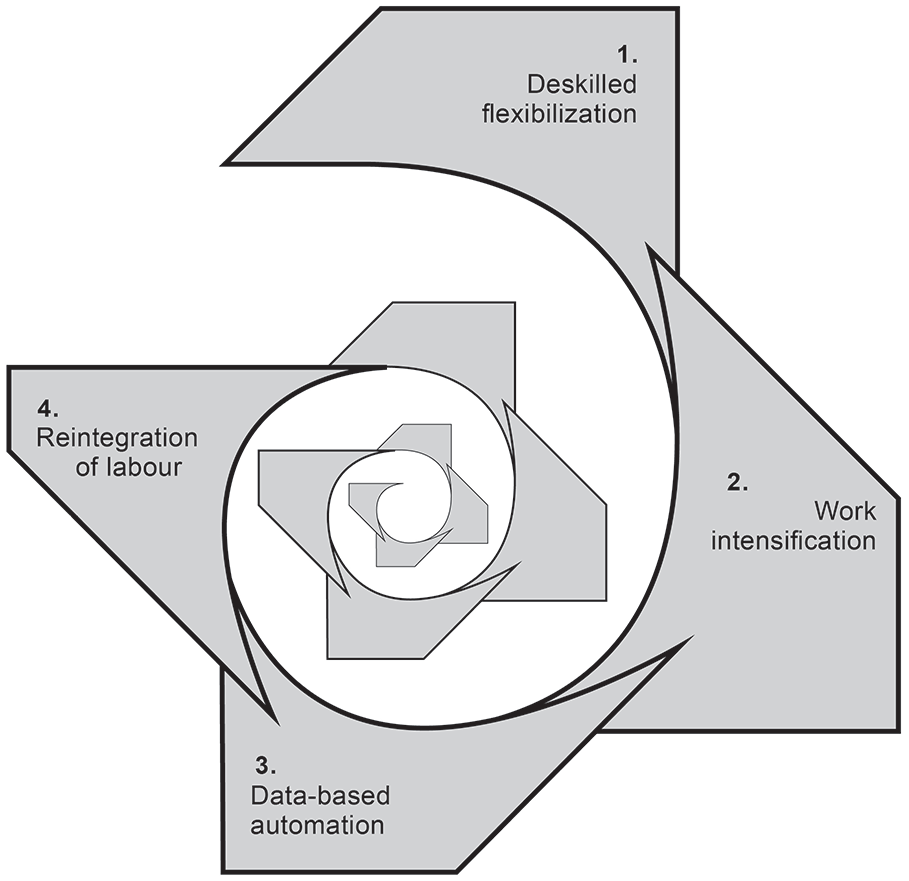
Phases of Cybernetic Proletarianization (illustration by Heidi Franke)
If we imagine cybernetic proletarianization as a spiral of repeating cycles of devaluation, the labour process in the companies researched here can be located in different cycles. Smart Electrics is in the first cycle. This means that cybernetic proletarianization has only just begun there with the implementation of work control systems. Accordingly, the labour process still largely consists of highly qualified assembly work and reasonably secure employment. However, the described devaluation tendencies of deskilled flexibilization and work intensification are already taking effect. Smart Solutions is also in the first cycle, but this has already progressed further. Thus, all phases of cybernetic proletarianization are taking place, including digital automation in intra-logistics and the systematic reintegration of devalued workers by means of ‘crowdsourcing’.
The work at Smart Delivery is already in the second cycle. Workers are thus confronted with a labour process based on a completed first cycle. This means that platform-mediated courier work, as a new digital business model, is replacing and displacing previous non-digital forms of food distribution. Here, the cycle starts again from the beginning, in the form of deskilling by means of digital control and work intensification by means of permanent evaluation. In the case of Smart Shopping, the process has progressed even further. There are warehouses with a completed second cycle or a beginning third cycle. Here, too, non-digital distribution processes (in retail or in mail order business not organized on platforms) have been replaced. Large numbers of workers are being reintegrated under very precarious conditions. However, this generation of the cybernetic proletariat is also already being displaced by the extensive automation of intra-logistics work in some of the warehouses. This is a third cycle of cybernetic devaluation.
Since cybernetic proletarianization must necessarily be thought of in dynamic categories, the concept cannot simply be limited to certain occupational groups. Thus, if the cybernetic proletariat can be described as a social group at all, then as one with continuously blurring boundaries. In general, however, the more cycles of cybernetic proletarianization a production process has gone through, the closer the workers come to the core group of the cybernetic proletariat. The full extent of cybernetic proletarianization cannot be assessed here due to the qualitative design of this study. Whether it will grow into a general trend depends, among other things, on the technopolitical actions of the workers themselves. As we have seen, there are various forms of ‘technopolitics from below’, some of which have stopped or even reversed the processes of devaluation.
