



Abstract
Vertical Axis Wind Turbine (VAWT) can be a promising solution for electricity production in remote ice prone territories of high north, where good wind resources are available, but icing is a challenge that can affect its optimum operation. A lot of research has been made to study the icing effects on the conventional horizontal axis wind turbines, but the literature about vertical axis wind turbines operating in icing conditions is still scarce, despite the importance of this topic. This paper presents a review study about existing knowledge of VAWT operation in icing condition. Focus has been made in better understanding of ice accretion physics along VAWT blades and methods to detect and mitigate icing effects.
Introduction
With the increase in environmental issues, the demand and utilization of renewable energy resources has increased significantly. Alongside solar energy, recent developments and research have made wind energy as the mainstream method of power generation through renewable resources. Production of power by harnessing the energy from wind has huge prospects. In 2020 alone, more than 93 GW of wind capacity was installed with a 59% increase as compared to 2019, and it is expected that the trend will continue rising in the upcoming years (GWE Council, 2021). Considering Europe, more investments have been made in wind energy than any other renewable energy technology. During year 2020, wind energy in Europe accounted for an annual turnover of €72 billion and 330,000 jobs; and by the year 2030 Europe aims to meet about a quarter of its energy needs through the wind energy (Wind Europe, 2020). Wind turbines are installed at carefully planned and tested sites with good wind resource to convert the kinetic energy from wind into electrical power. However, the major challenge in this regard is to find and select a site that satisfies the required working conditions of a wind turbine.
Wind turbines can be broadly classified as Horizontal Axis Wind Turbine (HAWT) and Vertical Axis Wind Turbines (VAWT), each type having its own pros and cons. Today, most of the wind turbines installed are HAWT, this is because they have higher aerodynamic efficiency and less cost per KW as compared to VAWTs. But HAWTs have the limitation that they cannot work efficiently in highly turbulent wind conditions and require a smooth wind flow, which makes it difficult to operate in urban conditions having high ground roughness and consequently irregular wind flows. On the other hand, VAWTs have a significant advantage over HAWTS in this regards, as they can operate in turbulent wind conditions irrespective of the wind direction, at low heights for small scale energy production, could be placed closer to each other and also have less no noise pollution (Damota et al., 2015). This is particularly useful as the electricity transportation from power generation plant to remote urban areas is extremely costly; and the advantages of a VAWTs make it feasible to solve this electricity transportation problem and notably reduce costs. VAWT can be classified as either lift-based or drag-based also known as the Savonius type and Darrieus type turbines respectively. Savonius type wind turbines have rotor blades that rotate utilizing the drag force acting on them. Four configurations of Savonius wind turbines have been studied in most research until now, out of which the twisted type is found to be the most efficient as shown in Figure 1. Darrieus type wind turbines have blades that rotate because of the lifting force. In terms of their aerodynamic performance, Darrieus type turbines are much efficient than Savonius type. Recently, the trend of installing offshore wind farms has also been on the rise, and is gaining more importance (IRE Agency, 2020). VAWTs are expected to take over the HAWTs in future because of their low space requirement (Ishugah et al., 2014). Damota et al. (2015) have assessed the applications of small-scale VAWTs and described that VAWTs are feasible in urban areas to be placed close to human populations where it is not feasible to install HAWTs. Recently, more and more VAWTs are being installed close to industrial buildings and along highways (Rana and Shivam, 2020). Because of their small footprint, VAWTs can integrate more easily into the environment and have nearly no environmental impact. This is also the reason that VAWTS are mostly used in small scale applications (WWE Association, 2017). VAWTs are also expected to have their advantages in offshore applications. A lot of research is going on to test the offshore capabilities of VAWT, but it is still at premature stages and no major application has emerged so far where it can rival an HAWT (Hand and Cashman, 2020). With continued study and experimentation, the researchers are confident that a VAWT can has serious advantages in offshore applications as well such as being prone to waves excitation generated by rotors, but the field is still under development (Matoug et al., 2020).
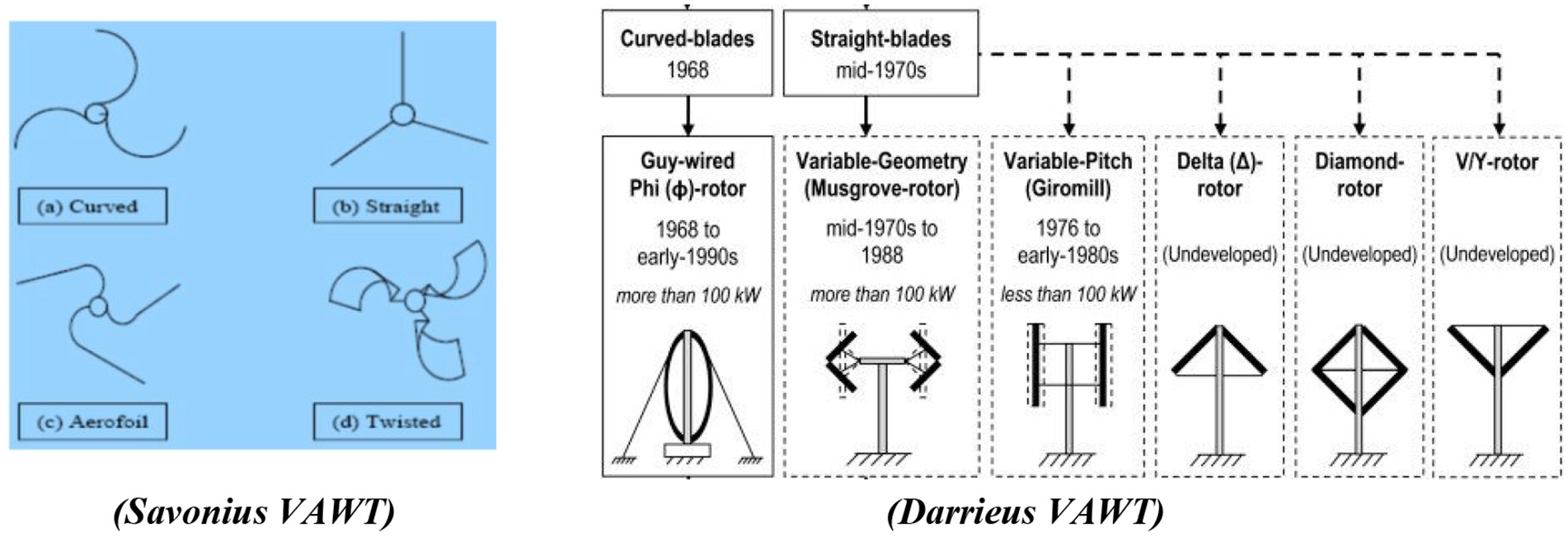
Different configurations of Savonius and Darrieus VAWTs.
Cold regions of high north have good wind resources and can be a potential option for installation of VAWT at remote territories, where distribution of power from central grid is not viable. But one parameter that can possibly has a huge influence on the VAWT operation is the atmospheric icing. The aerodynamic performance of a wind turbine depends on its blade geometry, which is affected severely when ice accretes on the blade (Wei et al., 2020). A lot of research and efforts have been made to analyze and mitigate the icing effects on the conventional HAWT, but the literature on VAWT operating in icing conditions is still scarce, despite the importance of this topic as the operation of VAWTs in icing condition is complex. VAWTs can be a promising solution for electricity production in remote ice prone territories of high north, where good wind resources are available and cost of power transportation from central grid is quite high. Figure 2 shows a straight bladed type of VAWT which is located in Tottori, Japan. Since the technology to allow VAWT to operate in icing conditions is not present, the turbine is only functional in the absence of ice. Researchers have been optimistic about potential VAWT advantages in offshore and several companies have been trying to establish offshore wind parks. SeaTwirl (Periscope-Network.eu) and Sandia Technologies (Paquette and Barone, 2012) have been developing and testing offshore VAWT wind farms with a focus on improving the cost efficiency of wind turbines. SeaTwirl particularly has set up offshore wind parks along the costs of Sweden and the company is currently working on a 1 MW offshore VAWT project. Additionally, for the Northern regions of Europe, offshore VAWTs close to the populations can also prove to be extremely beneficial given that the turbines be able to function normally under icing conditions.
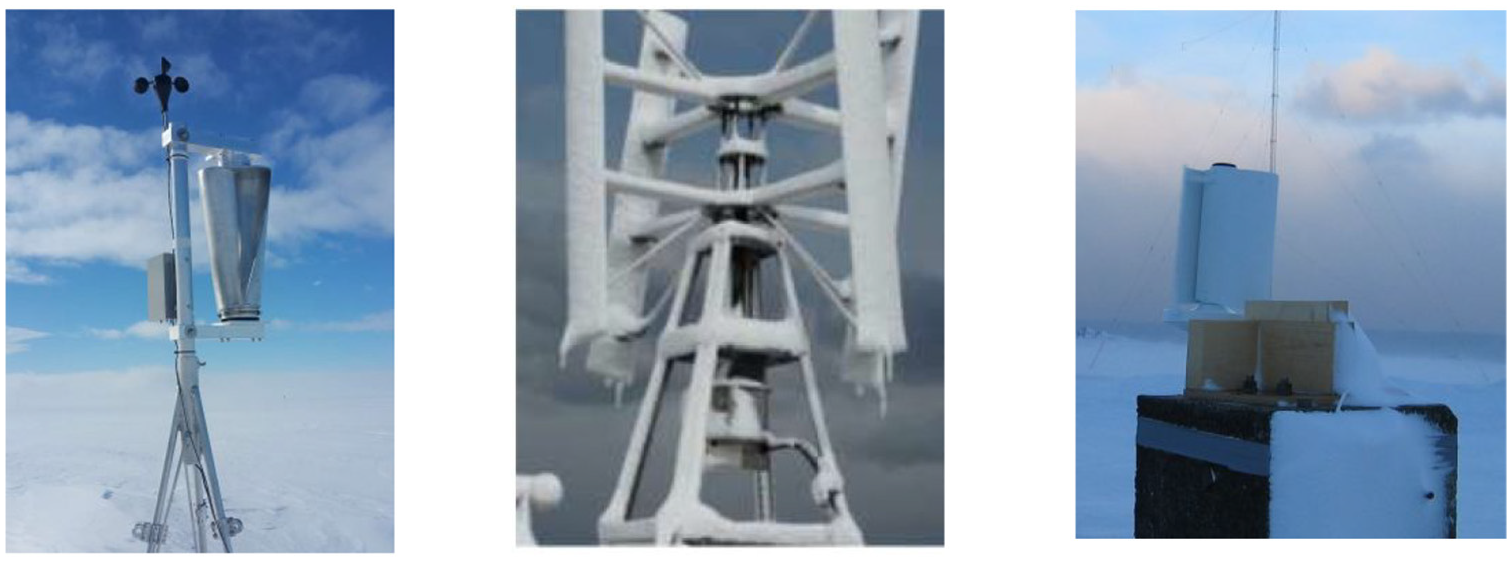
Examples of VAWT operation in icing conditions.
Ice accretion on VAWT
The major challenge in the operation of VAWT in cold regions is ice accretion. The literature available on the icing of VAWT is very limited and the available research does not completely quantify the icing effects on a VAWT. Almost all the experiments of icing on VAWT have been performed using a Straight Bladed (SB) H type VAWT. It is because the study of SB VAWT is relatively simple compared to others as aerodynamic calculations are same throughout the blade height whereas it is different in case of helical types. And also so far, SB VAWT has been found as the optimum configuration for urban applications (Li et al., 2018). Both icing tunnels based experimental and Computational Fluid Dynamics (CFD) based numerical techniques can be used to study the effects of icing on VAWT performance. Many 2D and 3D numerical simulation models have been developed to study the effects of icing on wind turbine blade characteristics. A complete overview of these methods has been described in IEA wind task 16 (Lehtomäki, 2016). However, it should be noted that the correlation of icing conditions from a simulation or a wind tunnel experiment to the actual practical performance is a big challenge especially for a VAWT because there are many uncertainties in the meteorological conditions (Etemaddar et al., 2014).
Ice accretion physics
Unlike HAWTs, VAWTs go through a range of angles of attack in each rotating cycle, so icing has more adverse effects. The ice accretion on wind turbines can either be studied through numerical simulations or by wind tunnel experiments. In the case of VAWTs, researchers have adopted both techniques to study ice accretion physics.
Wind tunnel experiments
Li et al. (2015) conducted wind tunnel experiments to study icing on VAWT and used two different blade types. They found that ice accretion is different for different blade types of VAWT. However, they only performed experiments for a specific angle of attack which is not fully relevant for practical working of VAWT. Yan et al. (2008) studied the ice accretion shapes on a conventional VAWT blade (NACA0015) at four different angles of attack under varying wind speeds and flow flux of water. They concluded that the ice accretion is quite different for the different AOAs. Li et al. (2018) took a more realistic approach and performed experiments to study the effects of icing under low tip speed ratio conditions. They found that in static condition, the ice accretion is on one side of the blade increasing from the leading edge toward the trailing edge. For rotating VAWT, ice accretion occurs throughout the blade changing completely the shape of airfoil. But the tests were made only for TSR from 0 to 1. They made a prediction that at higher TSRs, ice accretion area would increase transforming the blade into the shape of a block and completely hindering the aerodynamic capabilities. Similarly, Feng et al. (2012) studied the ice accretion physics on the blade of a VAWT in wind tunnel tests in which the ice build-up was recorded for various angles of attack. They found out that with the increasing angle, ice accretion area increases. Since for VAWT, the blade goes through a range of angle of attacks, the Figure 3 shows how ice is build up at all sides of the blade at different angles of attack.

Icing along VAWT blade profile at different angles of attack.
Numerical simulations
Yan et al. (2011) performed numerical simulation of icing effects around the blade profile for a VAWT and found that water flow flux and wind speed are the factors with which the ice accretion on airfoil increases in direct proportion. As the angle of attack changes, the ice accretion and distribution also increase because more area of blade is directly projected to wind. Manatbayev et al. (2021) took the numerical approach to perform 2D simulations on VAWT using the FENSAP-ICE. They varied the angle of attack from −25° to 25° for a static VAWT and performed the simulations for both glaze and rime ice. In both conditions, ice is accreted on both sides of the blade, however for the glaze, ice horns are formed, and the accretion is thinner as compared to rime ice. The accretion is more streamlined in case of rime. In most of the cases, numerical simulations are used to further study the effect of the ice accretion shapes on aerodynamic and performance coefficients (Yan et al., 2008) which are described in the next sections.
Effects of icing on VAWT aerodynamics
Icing on VAWT affect its aerodynamic performance. Manatbayev et al. (2021) examined the effect of rime ice and glaze ice accretion on the aerodynamic performance of a VAWT. They found that rime ice does not have significant effect on the lift coefficient, but it increases the drag coefficients thus overall hampering the performance. On the other hand, the glaze ice has more adverse effects, it increases the drag coefficient along with diminishing the lift coefficient. However, all these observations were made for a static VAWT. Feng et al. (2012) studied the static and dynamic torque coefficients of iced blades and concluded that under static conditions, the torque coefficient is greatly reduced. The dynamic torque coefficient is not much affected by an iced blade when there is small icing but decreases significantly for higher icing cases. It can also be inferred that for a VAWT operating in icing conditions, in the beginning, there would not be significant effects on its aerodynamic performance, however as the ice build-up increases with time, a condition would be reached when the drag coefficient would increase to a point making it unable for VAWT to produce any power further. Manatbayev et al. (2021) found that the cL/cD is reduced significantly under icing conditions specially in the case of glaze ice. And since VAWTs work at higher RPMs, glaze ice is more likely to be formed throughout the blade. There have been few more attempts to study the effect of iced blades on the aerodynamic performance. Li et al. (2010) took an interesting approach and simulated ice on blades and then used clay to model the accreted ice shapes. The clay shapes were attached to the blade profile to study the effect of ice shape on blade aerodynamic performance in a wind tunnel.
Effect of icing on VAWT performance
The basic objective of any wind turbine is to extract as much power from the wind as possible, indirectly to improve the power coefficient. As icing effects the aerodynamic performance of a VAWT, the concern to quantify the decrease in output power has been a hot research topic at this time. Finnish wind atlas project (Ville Turkia, 2013) lists out the statistics that shows the power reduces up to 36% due to icing. However, most of the icing research has been done on HAWT and the data available for VAWT in icing conditions is extremely limited. In the clay experiments (Li et al., 2010), the decrease in power coefficients was also shown which revealed that as the turbine was unable to operate at optimum TSR and power reduction was higher than 20%. Manatbayev et al. (2021) also performed numerical simulations about the effect of iced blades on power performance. It is observed that the glaze ice severely reduces the power performance as compared to rime ice. The overall production loss was recorded around 58% which is because the moment coefficient is extremely degraded, and it is negative for most of the cycle in glaze ice conditions.
Effect of icing on structural integrity of VAWT
Assessment of icing on VAWT is extremely important as it can increase the mass of the blades resulting in more vibrations (stall induced vibrations) and fatigue (Etemaddar et al., 2014; Lehtomäki, 2016). As mentioned earlier, VAWTs rotate at higher rpms and therefore the strength of struts is a big concern under icing conditions. There is a trade-off between the aerodynamic efficiency and the design of struts for a VAWT and the struts have to be designed accordingly to not interfere with the wind flow (Admono et al., 2020). For a VAWT operating under icing conditions, more fatigue would be induced and thus reducing the life of struts and indirectly demanding more frequent maintenances. So, there are big concerns about maintaining the structural integrity of VAWT under icing and so far, not much research has been found in this regard.
Ice detection on VAWT
Ice detection along wind turbine blade is a challenge, as most of the available icing sensors cannot be directly installed along the blade surface, rather are being installed on the nacelle section or on met mast close to the wind turbine. Ice condition along the rotating blade surface is different from ice condition along static mast or nacelle section of the wind turbine blade. Even along the blade section the ice accretion is not similar, where more ice is observed near tip section as compared to the root section mainly due to higher air velocity near tip section. In case of VAWT, this becomes more complicated to install sensor along blade and detect ice accordingly. In general, ice detection methods can be classified as direct or indirect (Carlsson, 2010; Wei et al., 2020). Direct sensing methods detect ice based on physical properties, whereas indirect methods detect ice as a result of change in environmental/meteorological parameters. Following sub-section provides a more insight overview of each method for implementation along VAWT.
Direct ice detection methods
(a) Ultrasonic ice detection method: In ultrasonic ice detection approach, a transmitter transmits an acoustic signal which is then sensed by a receiver and based on the attenuation of signal, icing is detected (Carlsson, 2010). Such a system can be installed either on nacelle (Lehtomäki, 2016) or on the rotor blades (Wang et al., 2018). However, for a VAWT, it is not feasible to fix the probes on blades because the icing occurs at all angles and on both sides. The device can be placed on some other structure near the VAWT and upon detection of ice, it can signal to apply ice mitigation strategies on the VAWT.
(b) Electric properties based ice detection method: Ice can also be detected through change of electric properties (Carlsson, 2010) such as piezoelectric (Xu et al., 2015), and proximity (Mughal and Virk, 2013) technologies. However, the patches need to be pasted on blades. It is not very optimal for the case of VAWT as it would require a lot of patches to be pasted along the blade surface at all angles and all heights.
(c) Infrared based ice detection method: Infrared sensors utilize probe that emit infrared rays and based on received signal strength, ice is detected (Wickman, 2013). If these sensors are to be placed in the same environment as the wind turbine, they are feasible to implement in VAWT wind farms to detect meteorological ice. Similarly, other optical light sensors (Kabardin et al., 2016) are also available that can detect ice based on the reflected light. The disadvantage of such sensors is that they cannot detect instrumental ice within the inner structure of VAWT and thus are not optimal. Additionally, other optical techniques such as cameras using image processing techniques can also be used but these are not viable as it would require many cameras for a single VAWT and even would not be possible to detect ice on the internal circumference of VAWT.
(d) Load based ice detection method: Various ice detectors are available that can detect ice based upon change in mass (Wickman, 2013). These sensors detect ice based on the ice weight that accretes on its rod. These sensors cannot be installed directly on the blade surface and therefore need to be installed either on the nacelle section or on a mast close to the VAWT. The major drawback of such sensors is their low accuracy and inability to detect small changes in ice.
(e) Resonance frequency based ice detection method: These sensors can be placed in the same environment as VAWT and can detect ice by change in the frequency of a vibrating probe (Carlsson, 2010).
(f) Temperature change based ice detection method: This method detects whether the ice is present or not by placing one device in the same environment as VAWT and the other at a reference temperature (Carlsson, 2010; Wei et al., 2020). The information extracted from this system is limited and for VAWT operation a lot more information that quantifies the ice accretion is required for proper ice detection.
Indirect ice detection methods
(a) Actual power versus expected power: In this method of ice detection, the power output versus wind speed data is continuously compared with the standard data and based on observations, ice is detected/predicted (Davis et al., 2016). However, for VAWT operation which have inherent torque ripples, a lot of noise would be induced in the data making it difficult to predict accurately. Furthermore, this technique is not recommended for detecting small ice loads.
(b) Heated versus un-heated anemometer: This method is considered as reliable method to detect the presence of ice. It can detect icing from the start of meteorological icing until the end of instrumental icing on the anemometer (Weather Forecasts Renewable Energies Air and Climate Environmental IT and Meteotest, 2016). However, the relation of instrumental icing of an anemometer and a VAWT cannot be easily established, and errors can occur.
(c) Meteorological data-based ice detection method: There are several methods related to the meteorological data to detect ice. The predictions are made based on the environment’s temperature, humidity, visibility, water droplet size, cloud height, liquid water content and median droplet diameter etc. (Carlsson, 2010; Makkonen and Laakso, 2005; Wei et al., 2020). However, these methods can lead to false positive signals (Weather Forecasts Renewable Energies Air and Climate Environmental IT and Meteotest, 2016) and are not very reliable for precise ice detection for VAWT operations.
(d) Turbine’s noise frequency change based ice detection method: This method uses prediction models to compare the noise from the iced blades with those operating under normal conditions and predict the presence of ice (Wei et al., 2020). However, this technique has the biggest limitation that it is extremely sensitive to noise of environment (Björkman, 2004) and additionally this technique is difficult to practically implement on VAWT as not much data is available to compare with and models have to be developed before.
(e) Turbine’s resonant frequency change-based ice detection method: As mentioned earlier, ice accretion induces extra weights and thus vibrations in the turbine structure. These vibrations can be analyzed to predict the presence of ice. This method is not suitable for VAWT, as the essence of VAWT operating in urban conditions is that it is expected to work in variable winds and gusts from any direction. In such conditions, ice detection based on resonant frequencies will lead to irrelevant results.
(f) Machine learning based ice detection method: In this method, neural networks are trained to forecast icing event based on the historical data. Kreutz et al. (2019) used SCADA historical data to predict the icing events in a wind farm and the forecast turned out to be accurate for 84% of the times. This technique for ice detection is relatively new and is equally viable for both HAWTs and VAWTs and a lot of work is being done to improve the systems.
Ice mitigation on VAWT
Upon successful detection of ice, ice mitigation strategies must be timely implemented to ensure optimum operation of VAWT and avoid power losses. Before implementing icing detection and mitigation strategies, the economic assessment needs to be performed for the produced and consumed power (Etemaddar et al., 2014). Ice mitigation strategies can be classified as active or passive, while each type is further classified as anti-icing and de-icing (Dalili et al., 2009). Passive methods take advantage of the material of blades to prevent ice build or remove ice, whereas active methods employ systems to prevent or remove ice. Anti-icing strategy prevents ice from build-up, however de-icing systems remove ice once it has been detected. The mainstream ice mitigation strategies are presented below with a discussion about their feasibility in VAWT operation.
Active methods
Active methods generally require the consumption of power or energy for the ice mitigation, so complete economic aspects need to be evaluated before employing these technologies.
(a) Maintaining the blade temperature: This is the most common and mature method for ice mitigation (Weather Forecasts Renewable Energies Air and Climate Environmental IT and Meteotest, 2016). The temperature of blade is maintained either by blowing hot air, or by electro thermal heaters. It is also the most power-hungry approach. Parent and Ilinca (2011) discussed the various researches that have been conducted in order to find the consumed power by these systems with respect to the power output of the turbine and agreed upon almost 1%–4% of the total annual production of turbine. However, all these conclusions have been made for HAWT. For blowing hot air into the turbine blades, this can prove less complex for VAWT as compared to HAWT because of multiple connections of struts across the height of blade ensuring uniform hot air throughout the blade. For placing thermal heating patches for blade heating, more of them have to be placed uniformly such that they have an effect throughout the surface of blade and not only on the leading and trailing edge, and this actually turn out to be consuming more power as compared to estimated costs for HAWT.
(b) Ultrasonic and microwave based approach: Ultrasonic technologies have proven very beneficial for ice removal (Palacios et al., 2011) in aviation and the field is being further extended for wind turbines. In this method, ultrasonic waves produce shear stress forces on the ice layer resulting in ice fall. But the method is undeveloped and practically un-tested for wind turbines so far. On the other hand, microwave technologies are also very immature for wind turbines (Weather Forecasts Renewable Energies Air and Climate Environmental IT and Meteotest, 2016). In this method, the blade is coated with a specific material and a microwave transmitter is installed within the blade. The microwaves create a heating effect on the blades. Theoretically the technique seems viable for VAWT but is dependent on field tests.
(c) Mechanical de-icing/flexible rubber boots-based approach: Because of the smaller sizes of VAWTs as compared to HAWTs, this technique could prove to be beneficial. Upon detection of ice, the flexible boots could be pneumatically expanded and contracted to crack ice (Carlsson, 2010; Wei et al., 2020). This technique has been in use in aviation, but it is still immature because it is believed that it would increase the complexity as well as maintenance of wind turbines. Also, the aerodynamic efficiency is a great concern before implementing any such systems.
Passive methods
(a) Blade surface coatings: There are two types of surface coatings to prevent ice adhesion: hydrophobic and ice phobic. Such coatings have the advantage that they are economical than other methods but they have limitations (Parent and Ilinca, 2011). Such coatings have different behaviors for different types of ice: rime or glaze and none of the coatings are ideally ice phobic, ice can still accrete. These coatings also have a limited life and can fall off along with the ice (Battisti, 2015). After removal, the surface of blade can become rough/un-symmetrical and can increase ice accretion. Currently, extensive research is being done in developing new coatings for wind turbines, but the existing surface coating materials are not suitable for VAWT for long term operation.
(b) Flexible blades: There have been instances of using flexible blades in HAWT to remove icing. For a VAWT, this technique seems to be unfeasible because it is expected to increase radius of turbine at high rpms and thus increasing fatigue. It requires proper experimentation and study to comment on how this technique can be incorporated with VAWTs.
Maintenance of VAWT for icing operations
VAWTs have significant advantages over HAWT when it comes to complexity and maintenance (Kumar et al., 2018). This is because the generator and most of the equipment are placed close to the ground with ease of access. Small scale VAWTs continue to become more popular as the cost of manufacturing decreases. In icing conditions, the maintenance of VAWT can become more complex. Simulations reveal that VAWTs are capable of ice throw with large forces at large distances (Lennie et al., 2019). And also due to the geometry of VAWTs and since they can be placed physically close to each other, it can have detrimental effects. Ice throw from one VAWT can rupture the blade of a nearby VAWT. Additionally, ice accumulated on the other side of the blades toward struts will exert continuous centrifugal forces on the structure resulting in increased fatigue. In the previous sections, several ice mitigations strategies have been discussed which add to increased maintenance costs and frequencies. All these factors lead to more frequent and costly maintenance of VAWT. Additionally, these factors also demand that VAWTs needs to be kept under constant monitoring because it is important to detect any defect at the earliest. A small crack in blade surface keeps on extending with time.
Environmental impacts
Wind energy has the least negative impacts on the environment and is more environment friendly than other green technologies like PV, solar, or biomass; (Saidur et al., 2011). But there have been concerns regarding the negative impacts like noise, killing of birds and esthetics. Additionally, under icing conditions these impacts must be studied in detail as the concerns about ice throw and increased noise are expected.
One of the major concerns about the negative impacts of wind turbines is their noise pollution (Wolsink et al., 1993). For a small scale VAWT, the noise level is much less as compared to the conventional large scale HAWTs. However, even these low levels of noise can become extremely annoying and unpleasant for some people and can have negative impacts on their health (Pedersen and Waye, 2008). Dessoky et al. (2019) lists the various sources that lead to noise in a Darrius type VAWT and conclude that the study of their acoustic behavior is much complicated than a HAWT. According to them, the noise generated by a VAWT can be broadly divided into mechanical and aerodynamic. The mechanical noise which results from moving parts can be greatly reduced through better designs. Möllerström et al. (2015) studied the aerodynamic noise characteristics of a 200 kw VAWT and the results can be plotted as function of wind speed. They inferred that the noise produced by a VAWT is less as compared to HAWT of the same size. Eriksson et al. (2008) compared the various wind turbine designs and suggested that VAWTs are superior when concerning the noise issues. Furthermore, ice accretion on blades and structure of VAWT will also change the noise frequencies. No literature or research has been conducted so far that how the noise frequencies of a VAWT will change in case of icing, however through relation with HAWT (Björkman, 2004) and since increased structural vibrations because of stalling, it can be inferred that noise is expected to become more annoying for VAWT. Hann et al. (2013) analyzed the change in noise emissions for the icing of blades of a HAWT and concluded that there is an obvious increase in noise with icing which can result in more annoyance of people. However, since there is a significant decrease in noise hear ability with increased distance, small scale VAWTs are not expected to produce the same level of annoyance and optimistic conclusions can be made.
Regarding ice throw from VAWTs, Lennie et al. (2019) conducted simulations on a darrieus VAWT of height 42 m and diameter 34 m. It can be seen from the simulation results that the ice is thrown up to 100 m by such a turbine. This can be a serious threat to people nearby and proper risk mitigation strategies need to be implemented in the areas. However, since the case under consideration is more oriented toward a small scale VAWT, the ice throw distances would be smaller, but since VAWTs operate at a large rpms, all steps must be ensured for safety. One of the major concerns of wind energy is their impact on wildlife. Collisions of birds and bats with large wind turbines is the biggest concern (Saidur et al., 2011). Several researches are available in which the mortality rates of birds have been estimated by large wind turbines (Smallwood, 2007). All these researches have been linked with HAWT and no data can be found for VAWTs. In case small scale VAWTs developed for urban environments, the impact on wildlife and bird’s mortality will be negligible because of their small height. Additionally, experiments and simulations need to be made to confirm it. Recently, a lot of VAWTs are being installed on buildings and on the side of roads (ArunPrakash et al., 2020; Muthukumar and Balasubramanian, 2012; Rana and Shivam, 2020). There were a lot of concerns regarding esthetics of large scale HAWTs installed near human civilizations. However, it is quite different for VAWTs. Small scale VAWTs have been found to improve the esthetic beauty of cities further by giving a modern touch (Damota et al., 2015). It is extremely subjective that how people want to integrate the presence of VAWTs in their natural views but the esthetic impact on environment is significantly less as compared to HAWTs.
Conclusions
In ice prone cold regions, to solve the challenge of installing wind turbines close to the populations and also at remote territories, VAWTs can be a viable solution. But there are many limitations of VAWTs as compared to the traditional HAWTs. The greatest challenge is the operation of VAWTs in icing conditions. So far, very little research has been made to assess the performance of VAWT under icing conditions. This paper provided a review of available literature about icing on VAWT and systematically presented a relation between the existing works available and to pave a pathway for future studies in this regard. Not much work has been carried out by the researchers so far to better study the VAWT operation in icing condition and keeping in view the growing energy demands and targets of reducing greenhouse gas emission, it is important to further study this topic and brings new knowledge, so that good wind resources of ice prone cold regions can be further used.
Footnotes
Declaration of conflicting interests
The author(s) declared no potential conflicts of interest with respect to the research, authorship, and/or publication of this article.
Funding
The author(s) disclosed receipt of the following financial support for the research, authorship, and/or publication of this article: The work reported in this research paper is funded by EU Kolarctic project, “Northern Axis Brents Link (KO4159)” and wind energy project (1020400) funded by the Nordic Council of Ministers.
